


ISO/TS 16697:2012
(Main)Space systems — Safety and compatibility of materials - Method to determine the flammability thresholds of materials
Space systems — Safety and compatibility of materials - Method to determine the flammability thresholds of materials
ISO/TS 16697:2012 provides a method to determine the oxygen concentration threshold when a material exposed to a standard ignition source self-extinguishes at a given constant total pressure, temperature, convective flow, and gravity-level conditions. The method can also be used to determine other flammability limits, such as the total pressure or forced convective velocity thresholds, while maintaining other test conditions constant.
Systèmes spatiaux — Sécurité et compatibilité des matériaux — Méthode de détermination des seuils d'inflammabilité des matériaux
General Information
- Status
- Withdrawn
- Publication Date
- 30-Jul-2012
- Technical Committee
- ISO/TC 20/SC 14 - Space systems and operations
- Drafting Committee
- ISO/TC 20/SC 14 - Space systems and operations
- Current Stage
- 9599 - Withdrawal of International Standard
- Start Date
- 12-Dec-2023
- Completion Date
- 12-Feb-2026
Relations
- Effective Date
- 16-Dec-2023
Get Certified
Connect with accredited certification bodies for this standard

DEKRA North America
DEKRA certification services in North America.

Eagle Registrations Inc.
American certification body for aerospace and defense.

Element Materials Technology
Materials testing and product certification.
Sponsored listings
Frequently Asked Questions
ISO/TS 16697:2012 is a technical specification published by the International Organization for Standardization (ISO). Its full title is "Space systems — Safety and compatibility of materials - Method to determine the flammability thresholds of materials". This standard covers: ISO/TS 16697:2012 provides a method to determine the oxygen concentration threshold when a material exposed to a standard ignition source self-extinguishes at a given constant total pressure, temperature, convective flow, and gravity-level conditions. The method can also be used to determine other flammability limits, such as the total pressure or forced convective velocity thresholds, while maintaining other test conditions constant.
ISO/TS 16697:2012 provides a method to determine the oxygen concentration threshold when a material exposed to a standard ignition source self-extinguishes at a given constant total pressure, temperature, convective flow, and gravity-level conditions. The method can also be used to determine other flammability limits, such as the total pressure or forced convective velocity thresholds, while maintaining other test conditions constant.
ISO/TS 16697:2012 is classified under the following ICS (International Classification for Standards) categories: 13.220.40 - Ignitability and burning behaviour of materials and products; 49.025.01 - Materials for aerospace construction in general; 49.140 - Space systems and operations. The ICS classification helps identify the subject area and facilitates finding related standards.
ISO/TS 16697:2012 has the following relationships with other standards: It is inter standard links to ISO 14624-1:2023. Understanding these relationships helps ensure you are using the most current and applicable version of the standard.
ISO/TS 16697:2012 is available in PDF format for immediate download after purchase. The document can be added to your cart and obtained through the secure checkout process. Digital delivery ensures instant access to the complete standard document.
Standards Content (Sample)
TECHNICAL ISO/TS
SPECIFICATION 16697
First edition
2012-08-01
Space systems — Safety and compatibility
of materials — Method to determine the
flammability thresholds of materials
Systèmes spatiaux — Sécurité et compatibilité des matériaux —
Méthode de détermination des seuils d’inflammabilité des matériaux
Reference number
©
ISO 2012
All rights reserved. Unless otherwise specified, no part of this publication may be reproduced or utilized in any form or by any means,
electronic or mechanical, including photocopying and microfilm, without permission in writing from either ISO at the address below or ISO’s
member body in the country of the requester.
ISO copyright office
Case postale 56 • CH-1211 Geneva 20
Tel. + 41 22 749 01 11
Fax + 41 22 749 09 47
E-mail copyright@iso.org
Web www.iso.org
Published in Switzerland
ii © ISO 2012 – All rights reserved
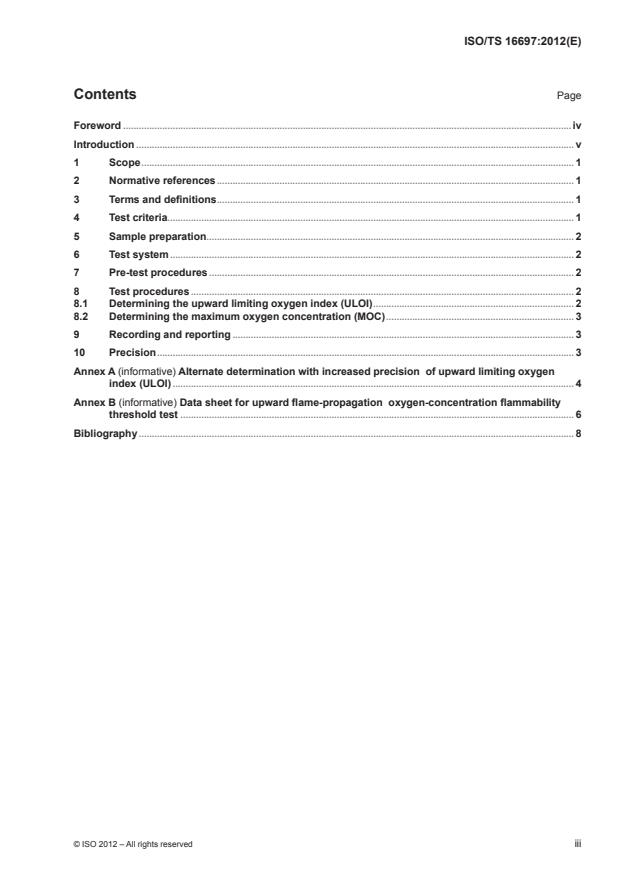
Contents Page
Foreword .iv
Introduction . v
1 Scope . 1
2 Normative references . 1
3 Terms and definitions . 1
4 Test criteria . 1
5 Sample preparation . 2
6 Test system . 2
7 Pre-test procedures . 2
8 Test procedures . 2
8.1 Determining the upward limiting oxygen index (ULOI) . 2
8.2 Determining the maximum oxygen concentration (MOC) . 3
9 Recording and reporting . 3
10 Precision . 3
Annex A (informative) Alternate determination with increased precision of upward limiting oxygen
index (ULOI) . 4
Annex B (informative) Data sheet for upward flame-propagation oxygen-concentration flammability
threshold test . 6
Bibliography . 8
Foreword
ISO (the International Organization for Standardization) is a worldwide federation of national standards bodies
(ISO member bodies). The work of preparing International Standards is normally carried out through ISO
technical committees. Each member body interested in a subject for which a technical committee has been
established has the right to be represented on that committee. International organizations, governmental and
non-governmental, in liaison with ISO, also take part in the work. ISO collaborates closely with the International
Electrotechnical Commission (IEC) on all matters of electrotechnical standardization.
International Standards are drafted in accordance with the rules given in the ISO/IEC Directives, Part 2.
The main task of technical committees is to prepare International Standards. Draft International Standards
adopted by the technical committees are circulated to the member bodies for voting. Publication as an
International Standard requires approval by at least 75 % of the member bodies casting a vote.
In other circumstances, particularly when there is an urgent market requirement for such documents, a technical
committee may decide to publish other types of document:
— an ISO Publicly Available Specification (ISO/PAS) represents an agreement between technical experts in
an ISO working group and is accepted for publication if it is approved by more than 50 % of the members
of the parent committee casting a vote;
— an ISO Technical Specification (ISO/TS) represents an agreement between the members of a technical
committee and is accepted for publication if it is approved by 2/3 of the members of the committee
casting a vote.
An ISO/PAS or ISO/TS is reviewed after three years in order to decide whether it will be confirmed for a further
three years, revised to become an International Standard, or withdrawn. If the ISO/PAS or ISO/TS is confirmed,
it is reviewed again after a further three years, at which time it must either be transformed into an International
Standard or be withdrawn.
Attention is drawn to the possibility that some of the elements of this document may be the subject of patent
rights. ISO shall not be held responsible for identifying any or all such patent rights.
ISO/TS 16697 was prepared by Technical Committee ISO/TC 20, Aircraft and space vehicles, Subcommittee
SC 14, Space systems and operations.
iv © ISO 2012 – All rights reserved
Introduction
Spacecraft fire safety emphasizes fire prevention, which is achieved primarily through the use of fire-resistant
materials. Materials selection for spacecraft is based on conventional flammability acceptance tests, along with
prescribed quantity limitations and configuration control for items that do not pass these acceptance tests or are
questionable. ISO 14624-1 and ISO 14624-2 are the main methods used to evaluate flammability of polymeric
materials intended for use in the habitable environments of spacecraft. These methods are upward flame-
propagation tests initiated in static environments and using a well-defined igniter flame at the bottom of the sample.
The pass/fail test logic of ISO 14624-1 and ISO 14624-2 does not allow for a quantitative comparison with
reduced-gravity or microgravity test results; therefore use of these methods is limited for in-depth theoretical
analyses and realistic estimates of spacecraft fire extinguishment requirements. To better understand the
applicability of laboratory test data to actual spacecraft environments, this Technical Specification has
been proposed which, as an alternative to qualifying materials as pass/fail, measures the actual upward
[1]
flammability limit for the material. A working group established by NASA to provide recommendations for
exploration spacecraft realized the importance of correlating laboratory data with real-life environments, and
[2]
recommended the development of a flammability threshold test method . The working group indicated that
“the flammability threshold information will allow identification of materials with increased flammability risk from
oxygen concentration and total pressure changes, minimize potential impacts, and allow for development of
sound requirements for new spacecraft and extravehicular landers and habitats”. Furthermore, recent research
using this method has shown that conventional normal-gravity materials flammability tests do not correlate with
[3][4]
the flammability in ventilated, micro- or reduced-gravity conditions. Currently, the materials selection for
spacecraft is based on the assumed extension of ground flammability test results to spacecraft environments,
an assumption which needs to be validated by further testing. In contrast to pass/fail data, materials flammability
threshold data acquired in normal gravity can be compared with data obtained in microgravity or reduced-
[5]
gravity experiments and, consequently, a more accurate assessment of the margin of safety of the material
in the real spacecraft environment can be made. In addition, this Technical Specification gives the option of
selecting better or best space system materials, as opposed to what would be considered just “acceptable”
from a flammability point of view, and realistic assessment of spacecraft fire extinguishment needs, which
could result in significant weight savings. The knowledge afforded by this technique allows extrapolations
of flammability behaviour to conditions not specifically tested and this could potentially result in significant
[6]
cost and time savings. This Technical Specification presents a method for evaluating oxygen-concentration
flammability extinguishment limits when a material is exposed to a standard ignition source under total pressure,
temperature, convective flow, and gravity-level conditions. However, the method can also be used to determine
[7]
other flammability extinguishment limits, such as the total pressure or forced convective velocity thresholds,
while maintaining other test conditions constant.
The intent of this Technical Specification is to highlight the importance of correlating laboratory test data with
real-life space system applications. The method presented is just one of the possibilities believed to lead to a
better understanding of the applicability of materials flammability test data. International feedback on improving
the proposed method, as well as suggestions for correlating test data with space system applications, are
being sought.
TECHNICAL SPECIFICATION ISO/TS 16697:2012(E)
Space systems — Safety and compatibility of materials —
Method to determine the flammability thresholds of materials
1 Scope
This Technical Specification provides a method to determine the oxygen concentration threshold when
a material exposed to a standard ignition source self-extinguishes at a given constant total pressure,
temperature, convective flow, and gravity-level conditions. The method can also be used to determine other
flammability limits, such as the total pressure or forced convective velocity thresholds, while maintaining other
test conditions constant. The flammability thresholds can also be determined with alternate pass/fail criteria,
sample configurations and/or size, ignition mode, etc. to allow correlations with test data obtained, for example,
under microgravity or reduced-gravity conditions which may have limited testing time in ground experiments.
NOTE The method described provides an assessment of the flammability of aerospace materials under laboratory
conditions only. Nevertheless, the results may be used as elements of a fire risk assessment which take into account all
the pertinent factors for an assessment of the fire hazard in space systems. Studies on parametric effects have been
[8]
initiated to better understand the applicability of the data.
2 Normative references
The following referenced documents are indispensable for the application of this document. For dated
references, only the edition cited applies. For undated references, the latest edition of the referenced document
(including any amendments) applies.
ISO 14624-1, Space systems — Safety and compatibility of materials — Part 1: Determination of upward
flammability of materials
ISO 14624-2, Space systems — Safety and compatibility of materials — Part 2: Determination of flammability
of electrical-wire insulation and accessory materials
3 Terms and definitions
For the purposes of this Technical Specification, the terms and definitions given in ISO 14624-1 and ISO 14624-2
and the following apply.
3.1
upward limiting oxygen index
ULOI
oxygen concentration where approximately 50 % of samples fail the test criteria described in Clause 4
3.2
maximum oxygen concentration
MOC
highest oxygen concentration where all samples tested (at least five) pass the test criteria described in Clause 4
4 Test criteria
This test method attempts to determine the self-extinguishment limits of materials. Individual samples are
considered to self-extinguish when the burn length is less than 15,2 cm when tested in accordance with
ISO 14624-1 or ISO 14624-2. The material is considered to self extinguish when all samples tested (at least
five) pass the burn length criteria for individual samples.
5 Sample preparation
A minimum of 20 samples shall be prepared. Preparation of samples for testing involves the following tasks:
a) receiving and visually inspecting the material;
b) preparing samples to the proper dimensions;
c) cleaning the samples;
d) inspecting the samples (samples should be prepared exclusively for use in this test).
The sample length should be at least 15,2 cm. A standard sample length as indicated by ISO 14624-1 and
ISO 14624-2 is recommended if a direct correlation with these standards is required. Otherwise, the samples
shall be prepared as required in ISO 14624-1 or ISO 14624-2.
6 Test s
...
Questions, Comments and Discussion
Ask us and Technical Secretary will try to provide an answer. You can facilitate discussion about the standard in here.
Loading comments...