

ISO 16671:2015/Amd 1:2017
(Amendment)Ophthalmic implants — Irrigating solutions for ophthalmic surgery — Amendment 1
General Information
- Abstract
- Status
- Withdrawn
- Publication Date
- 02-Oct-2017
- Technical Committee
- ISO/TC 172/SC 7 - Ophthalmic optics and instruments
- Drafting Committee
- ISO/TC 172/SC 7/WG 7 - Ophthalmic implants
- Current Stage
- 9599 - Withdrawal of International Standard
- Start Date
- 12-Jun-2025
- Completion Date
- 29-Aug-2026
Buy Documents


ISO 16671:2015/Amd 1:2017 - Ophthalmic implants — Irrigating solutions for ophthalmic surgery — Amendment 1/3/2017


ISO 16671:2015/Amd 1:2017 - Implants ophtalmiques — Solutions d'irrigation pour la chirurgie ophtalmique — Amendement 1/3/2017
Overview
ISO 16671:2015/Amd 1:2017 is an important amendment to the international standard specifying requirements for irrigating solutions used during ophthalmic surgery. Developed by ISO Technical Committee ISO/TC 172, Subcommittee SC 7, this standard ensures the safety and effectiveness of solutions applied in eye implant surgeries. It focuses on essential aspects such as bacterial endotoxin limits and risk management related to medical devices utilizing animal tissues.
This amendment updates key references and testing criteria to maintain compliance with the latest practices and safety requirements. It underscores the critical role of standardized irrigating solutions in ophthalmic implants, helping manufacturers, healthcare providers, and regulatory bodies maintain high standards in eye surgery procedures.
Key Topics
Updated Normative References
The amendment revises the normative references, notably updating ISO 22442-1 to the 2015 edition, which focuses on risk management for medical devices utilizing animal tissues. This ensures that risk assessment and mitigation strategies meet the latest international guidelines.Bacterial Endotoxin Limits
A crucial update in Clause 6.2.2 modifies the bacterial endotoxin threshold, stating:
“Any product that exceeds a bacterial endotoxin limit of 0.2 Endotoxin Units (EU) per millilitre fails the test.”
This stringent limit protects patients from infectious risks posed by endotoxins in irrigating solutions used during delicate ophthalmic procedures.Compliance and Testing
The amendment emphasizes adherence to updated testing protocols, ensuring that irrigating solutions meet safety standards before being used in ophthalmic implants. Consistent testing for endotoxins is critical to prevent complications during and after surgery.Scope Enhancements
While the original scope remains intact, this amendment reinforces the standard’s applicability to all ophthalmic surgeries involving irrigation fluids, enhancing patient safety and clinical outcomes.
Applications
Ophthalmic Surgery
ISO 16671:2015/Amd 1:2017 applies primarily to the formulations used as irrigating solutions during eye surgeries, including cataract removal, glaucoma treatments, and implant procedures. Safe irrigation solutions help maintain ocular tissue integrity, minimize infection risk, and improve surgical precision.Medical Device Manufacturing
Manufacturers of ophthalmic implants and associated surgical solutions rely on this standard to design and produce compliant products. It provides clear guidelines to meet regulatory requirements and quality benchmarks, facilitating market approval and global distribution.Quality Assurance in Healthcare
Hospitals and surgical centers implement this ISO amendment to verify that irrigation fluids meet international quality assurance and biosafety standards prior to use. This minimizes postoperative complications and enhances patient care.Regulatory Compliance and Audits
Regulatory bodies use this amendment as a reference standard during audits and conformity assessments of ophthalmic surgery products. It assists in harmonizing global standards and ensuring patient safety is upheld worldwide.
Related Standards
ISO 22442-1:2015
Medical devices utilizing animal tissues and their derivatives-Part 1: Application of risk management. This standard complements ISO 16671 by guiding risk assessments related to animal-derived materials in medical devices, including ophthalmic implants.ISO/IEC Directives, Part 1 and Part 2
These directives specify the procedures and editorial rules for preparing and maintaining ISO standards, supporting the systematic development of amendments like ISO 16671:2015/Amd 1:2017.Other Ophthalmic Standards by ISO/TC 172/SC 7
Additional standards cover ophthalmic instruments, optics, and implants, providing a comprehensive framework for eye care device safety and performance.
By adopting the ISO 16671:2015/Amd 1:2017 amendment, stakeholders in ophthalmic surgery can ensure irrigating solutions meet rigorous safety standards, effectively mitigating infection risks and fostering successful implant outcomes. This amendment is essential reading for manufacturers, clinicians, and regulatory professionals committed to advancing ophthalmic care quality.
Relations
- Effective Date
- 12-Feb-2026
- Effective Date
- 06-Jun-2022
- Effective Date
- 25-Dec-2021
- Effective Date
- 06-Jun-2022
Buy Documents
ISO 16671:2015/Amd 1:2017 - Ophthalmic implants — Irrigating solutions for ophthalmic surgery — Amendment 1/3/2017
ISO 16671:2015/Amd 1:2017 - Implants ophtalmiques — Solutions d'irrigation pour la chirurgie ophtalmique — Amendement 1/3/2017
Get Certified
Connect with accredited certification bodies for this standard

BSI Group
BSI (British Standards Institution) is the business standards company that helps organizations make excellence a habit.

TÜV Rheinland
TÜV Rheinland is a leading international provider of technical services.

TÜV SÜD
TÜV SÜD is a trusted partner of choice for safety, security and sustainability solutions.
Sponsored listings
Frequently Asked Questions
ISO 16671:2015/Amd 1:2017 is a standard published by the International Organization for Standardization (ISO). Its full title is "Ophthalmic implants — Irrigating solutions for ophthalmic surgery — Amendment 1". This standard covers: Ophthalmic implants — Irrigating solutions for ophthalmic surgery — Amendment 1
Ophthalmic implants — Irrigating solutions for ophthalmic surgery — Amendment 1
ISO 16671:2015/Amd 1:2017 is classified under the following ICS (International Classification for Standards) categories: 11.040.70 - Ophthalmic equipment. The ICS classification helps identify the subject area and facilitates finding related standards.
ISO 16671:2015/Amd 1:2017 has the following relationships with other standards: It is inter standard links to EN ISO 16671:2015/A1:2017, ISO 13506-2:2017, ISO 16671:2015, ISO 16671:2025. Understanding these relationships helps ensure you are using the most current and applicable version of the standard.
ISO 16671:2015/Amd 1:2017 is available in PDF format for immediate download after purchase. The document can be added to your cart and obtained through the secure checkout process. Digital delivery ensures instant access to the complete standard document.
Standards Content (Sample)
INTERNATIONAL ISO
STANDARD 16671
Second edition
2015-08-01
AMENDMENT 1
2017-10-01
Ophthalmic implants — Irrigating
solutions for ophthalmic surgery
AMENDMENT 1
Implants ophtalmiques — Solutions d'irrigation pour la chirurgie
ophtalmique
AMENDEMENT 1
Reference number
ISO 16671:2015/Amd.1:2017(E)
©
ISO 2017
ISO 16671:2015/Amd.1:2017(E)
© ISO 2017, Published in Switzerland
All rights reserved. Unless otherwise specified, no part of this publication may be reproduced or utilized otherwise in any form
or by any means, electronic or mechanical, including photocopying, or posting on the internet or an intranet, without prior
written permission. Permission can be requested from either ISO at the address below or ISO’s member body in the country of
the requester.
ISO copyright office
Ch. de Blandonnet 8 • CP 401
CH-1214 Vernier, Geneva, Switzerland
Tel. +41 22 749 01 11
Fax +41 22 749 09 47
copyright@iso.org
www.iso.org
ii © ISO 2017 – All rights reserved
ISO 16671:2015/Amd.1:2017(E)
Foreword
ISO (the International Organization for Standardization) is a worldwide federation of national standards
bodies (ISO member bodies). The work of preparing International Standards is normally carried out
through ISO technical committees. Each member body interested in a subject for which a technical
committee has been established has the right to be represented on that committee. International
organizations, governmental and non-governmental, in liaison with ISO, also take part in the work.
ISO collaborates closely with the International Electrotechnical Commission (IEC) on all matters of
electrotechnical standardization.
The procedures used to develop this document and those intended for its further maintenance are
described in the ISO/IEC Directives, Part 1. In particular the different approval criteria needed for the
different types of
...
INTERNATIONAL ISO
STANDARD 16671
Second edition
2015-08-01
AMENDMENT 1
2017-10-01
Ophthalmic implants — Irrigating
solutions for ophthalmic surgery
AMENDMENT 1
Implants ophtalmiques — Solutions d'irrigation pour la chirurgie
ophtalmique
AMENDEMENT 1
Reference number
ISO 16671:2015/Amd.1:2017(E)
©
ISO 2017
ISO 16671:2015/Amd.1:2017(E)
© ISO 2017, Published in Switzerland
All rights reserved. Unless otherwise specified, no part of this publication may be reproduced or utilized otherwise in any form
or by any means, electronic or mechanical, including photocopying, or posting on the internet or an intranet, without prior
written permission. Permission can be requested from either ISO at the address below or ISO’s member body in the country of
the requester.
ISO copyright office
Ch. de Blandonnet 8 • CP 401
CH-1214 Vernier, Geneva, Switzerland
Tel. +41 22 749 01 11
Fax +41 22 749 09 47
copyright@iso.org
www.iso.org
ii © ISO 2017 – All rights reserved
ISO 16671:2015/Amd.1:2017(E)
Foreword
ISO (the International Organization for Standardization) is a worldwide federation of national standards
bodies (ISO member bodies). The work of preparing International Standards is normally carried out
through ISO technical committees. Each member body interested in a subject for which a technical
committee has been established has the right to be represented on that committee. International
organizations, governmental and non-governmental, in liaison with ISO, also take part in the work.
ISO collaborates closely with the International Electrotechnical Commission (IEC) on all matters of
electrotechnical standardization.
The procedures used to develop this document and those intended for its further maintenance are
described in the ISO/IEC Directives, Part 1. In particular the different approval criteria needed for the
different types of
...
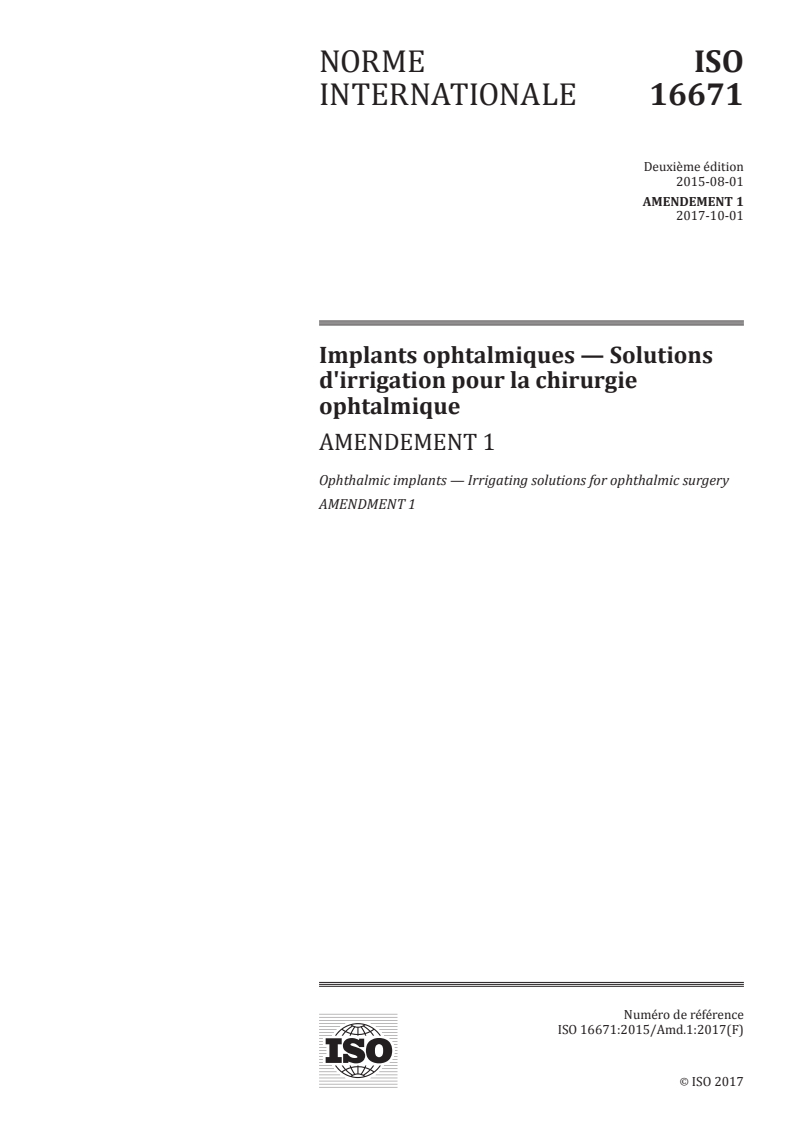
NORME ISO
INTERNATIONALE 16671
Deuxième édition
2015-08-01
AMENDEMENT 1
2017-10-01
Implants ophtalmiques — Solutions
d'irrigation pour la chirurgie
ophtalmique
AMENDEMENT 1
Ophthalmic implants — Irrigating solutions for ophthalmic surgery
AMENDMENT 1
Numéro de référence
ISO 16671:2015/Amd.1:2017(F)
©
ISO 2017
ISO 16671:2015/Amd.1:2017(F)
DOCUMENT PROTÉGÉ PAR COPYRIGHT
© ISO 2017, Publié en Suisse
Droits de reproduction réservés. Sauf indication contraire, aucune partie de cette publication ne peut être reproduite ni utilisée
sous quelque forme que ce soit et par aucun procédé, électronique ou mécanique, y compris la photocopie, l’affichage sur
l’internet ou sur un Intranet, sans autorisation écrite préalable. Les demandes d’autorisation peuvent être adressées à l’ISO à
l’adresse ci-après ou au comité membre de l’ISO dans le pays du demandeur.
ISO copyright office
Ch. de Blandonnet 8 • CP 401
CH-1214 Vernier, Geneva, Switzerland
Tel. +41 22 749 01 11
Fax +41 22 749 09 47
copyright@iso.org
www.iso.org
ii © ISO 2017 – Tous droits réservés
ISO 16671:2015/Amd.1:2017(F)
Avant-propos
L'ISO (Organisation internationale de normalisation) est une fédération mondiale d'organismes
nationaux de normalisation (comités membres de l'ISO). L'élaboration des Normes internationales est
en général confiée aux comités techniques de l'ISO. Chaque comité membre intéressé par une étude
a le droit de faire partie du comité technique créé à cet effet. Les organisations internationales,
gouvernementales et non gouvernementales, en liaison avec l'ISO participent également aux travaux.
L'ISO collabore étroitement avec la Commission électrotechnique internationale (IEC) en ce qui
concerne la normalisation électrotechnique.
Les procédures utilisées pour élaborer le présent document et celles destinées à sa mise à jour sont
décrites dans les Directives ISO/IEC, Partie 1. Il convient, en particulier de prendre note des différents
critères d'approbation requis pour les différents types de documents ISO. Le présent document a été
rédigé conformément aux règles de rédaction données dans les Directives ISO/IEC, Partie 2 (voir www.
...
NORME ISO
INTERNATIONALE 16671
Deuxième édition
2015-08-01
AMENDEMENT 1
2017-10-01
Implants ophtalmiques — Solutions
d'irrigation pour la chirurgie
ophtalmique
AMENDEMENT 1
Ophthalmic implants — Irrigating solutions for ophthalmic surgery
AMENDMENT 1
Numéro de référence
ISO 16671:2015/Amd.1:2017(F)
©
ISO 2017
ISO 16671:2015/Amd.1:2017(F)
DOCUMENT PROTÉGÉ PAR COPYRIGHT
© ISO 2017, Publié en Suisse
Droits de reproduction réservés. Sauf indication contraire, aucune partie de cette publication ne peut être reproduite ni utilisée
sous quelque forme que ce soit et par aucun procédé, électronique ou mécanique, y compris la photocopie, l’affichage sur
l’internet ou sur un Intranet, sans autorisation écrite préalable. Les demandes d’autorisation peuvent être adressées à l’ISO à
l’adresse ci-après ou au comité membre de l’ISO dans le pays du demandeur.
ISO copyright office
Ch. de Blandonnet 8 • CP 401
CH-1214 Vernier, Geneva, Switzerland
Tel. +41 22 749 01 11
Fax +41 22 749 09 47
copyright@iso.org
www.iso.org
ii © ISO 2017 – Tous droits réservés
ISO 16671:2015/Amd.1:2017(F)
Avant-propos
L'ISO (Organisation internationale de normalisation) est une fédération mondiale d'organismes
nationaux de normalisation (comités membres de l'ISO). L'élaboration des Normes internationales est
en général confiée aux comités techniques de l'ISO. Chaque comité membre intéressé par une étude
a le droit de faire partie du comité technique créé à cet effet. Les organisations internationales,
gouvernementales et non gouvernementales, en liaison avec l'ISO participent également aux travaux.
L'ISO collabore étroitement avec la Commission électrotechnique internationale (IEC) en ce qui
concerne la normalisation électrotechnique.
Les procédures utilisées pour élaborer le présent document et celles destinées à sa mise à jour sont
décrites dans les Directives ISO/IEC, Partie 1. Il convient, en particulier de prendre note des différents
critères d'approbation requis pour les différents types de documents ISO. Le présent document a été
rédigé conformément aux règles de rédaction données dans les Directives ISO/IEC, Partie 2 (voir www.
...