


ISO 567:2021
(Main)Coke — Determination of bulk density in a small container
General Information
- Abstract
This document specifies a method for the determination of the bulk density of coke in a cubical or cylindrical container of small capacity (0,2 m3). It is applicable to coke with a nominal top size not greater than 125 mm.
- Status
- Published
- Publication Date
- 26-Aug-2021
- Technical Committee
- ISO/TC 27/SC 3 - Coke
- Drafting Committee
- ISO/TC 27/SC 3 - Coke
- Current Stage
- 9020 - International Standard under periodical review
- Start Date
- 15-Jul-2026
- Completion Date
- 15-Jul-2026
Buy Documents



ISO 567:2021 - Coke -- Determination of bulk density in a small container
ISO 567:2021 - Coke — Determination of bulk density in a small container/27/2021
Overview
ISO 567:2021 is an internationally recognized standard developed by the International Organization for Standardization (ISO) that specifies a precise method for determining the bulk density of coke using a small container. This standard applies specifically to coke samples with a nominal top size not greater than 125 mm and involves measuring the mass of coke in a cubical or cylindrical container with a capacity of 0.2 cubic meters. Bulk density measurement is crucial for understanding the physical characteristics of coke, such as particle shape and size distribution, which impact its behavior in industrial applications.
Key Topics
Scope of Measurement
ISO 567:2021 targets the determination of coke bulk density in small containers, either cubical or cylindrical, with a volume of 0.2 m³.Sample Preparation and Sampling Techniques
Representative coke samples should be collected according to ISO 13909-5 or ISO 18283 standards to ensure consistent and reliable testing results. Recommended sample masses range from 600 kg to 1,000 kg depending on particle size.Apparatus Specifications
The standard requires a rigid, waterproof container with a smooth inner surface and precisely known volume. Weighing equipment with accuracy better than 0.1% error or 250 g is essential for both empty and filled container masses.Test Procedure
The process includes:- Determining the empty container mass and verifying its volume using water filling.
- Charging the container with coke in layers with a controlled fall height (not exceeding 250 mm).
- Leveling the surface and weighing the container plus coke.
- Performing duplicate tests for accuracy.
- Measuring total moisture content following ISO 579 and applying it to calculate dry bulk density.
Calculations and Results Reporting
Bulk density is calculated as the mass of coke per container volume, corrected for moisture content. Results must be reported to three significant figures and include test conditions, sample information, and moisture content for transparency.Precision and Repeatability
The standard specifies that duplicate tests by the same operator should not vary by more than 30 kg/m³, assuring test repeatability. However, reproducibility between laboratories is not defined due to potential sample alterations during transport.
Applications
The ISO 567:2021 method is widely used in industries where coke quality and characteristics substantially impact operational efficiency and product quality, including:
Metallurgical Processes
Precise bulk density data are essential in blast furnace operations and coke handling to optimize combustion, packing, and airflow.Quality Control and Product Specification
Coke producers and consumers use this standard to verify product quality, ensuring that coke meets specified physical requirements.Research and Development
Bulk density measurements contribute to developing new coke types or refining existing products by analyzing physical behavior in controlled conditions.Material Handling and Storage
Determining coke bulk density helps design appropriate storage containers, transport mechanisms, and handling protocols based on material weight and volume relationships.
Related Standards
ISO 567:2021 complements and references several related ISO standards for comprehensive coke analysis, including:
- ISO 579 - Coke: Determination of total moisture content, crucial for dry basis bulk density calculations.
- ISO 728 - Coke: Size analysis by sieving, for understanding particle size distribution.
- ISO 13909-5 and ISO 13909-6 - Hard coal and coke mechanical sampling and sample preparation protocols.
- ISO 18283 - Manual sampling methods for coke ensuring representative sample acquisition.
- ISO 1013 - Coke: Determination of bulk density in large containers, providing an alternative approach for larger volume samples.
By adhering to ISO 567:2021, industries worldwide can achieve standardized, accurate, and reliable coke bulk density measurements essential for process optimization and product consistency. For more information or to obtain the standard, visit ISO’s official website.
Relations
- Effective Date
- 23-Apr-2020
Buy Documents
ISO 567:2021 - Coke -- Determination of bulk density in a small container
ISO 567:2021 - Coke — Determination of bulk density in a small container/27/2021
Get Certified
Connect with accredited certification bodies for this standard

Element Materials Technology
Materials testing and product certification.

ABS Group Brazil
ABS Group certification services in Brazil.

ABS Quality Evaluations Inc.
American Bureau of Shipping quality certification.
Sponsored listings
Frequently Asked Questions
ISO 567:2021 is a standard published by the International Organization for Standardization (ISO). Its full title is "Coke — Determination of bulk density in a small container". This standard covers: This document specifies a method for the determination of the bulk density of coke in a cubical or cylindrical container of small capacity (0,2 m3). It is applicable to coke with a nominal top size not greater than 125 mm.
This document specifies a method for the determination of the bulk density of coke in a cubical or cylindrical container of small capacity (0,2 m3). It is applicable to coke with a nominal top size not greater than 125 mm.
ISO 567:2021 is classified under the following ICS (International Classification for Standards) categories: 75.160.10 - Solid fuels. The ICS classification helps identify the subject area and facilitates finding related standards.
ISO 567:2021 has the following relationships with other standards: It is inter standard links to ISO 567:1995. Understanding these relationships helps ensure you are using the most current and applicable version of the standard.
ISO 567:2021 is available in PDF format for immediate download after purchase. The document can be added to your cart and obtained through the secure checkout process. Digital delivery ensures instant access to the complete standard document.
Standards Content (Sample)
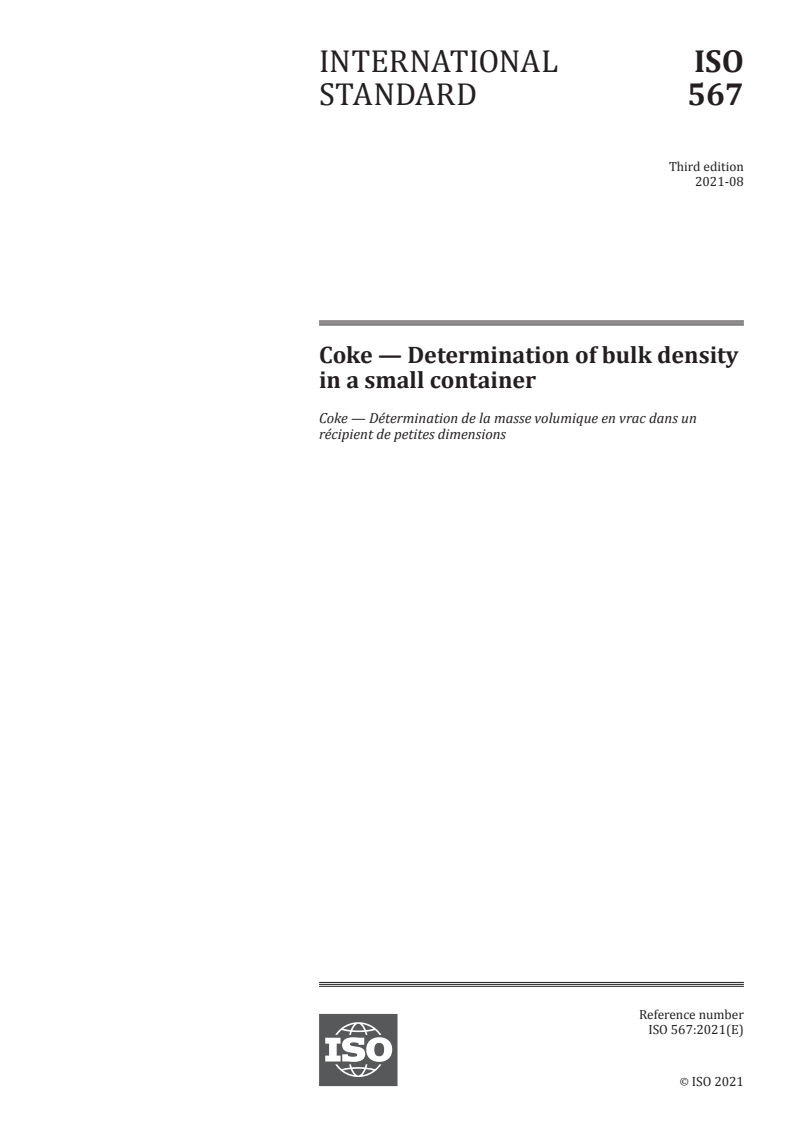
INTERNATIONAL ISO
STANDARD 567
Third edition
2021-08
Coke — Determination of bulk density
in a small container
Coke — Détermination de la masse volumique en vrac dans un
récipient de petites dimensions
Reference number
©
ISO 2021
© ISO 2021
All rights reserved. Unless otherwise specified, or required in the context of its implementation, no part of this publication may
be reproduced or utilized otherwise in any form or by any means, electronic or mechanical, including photocopying, or posting
on the internet or an intranet, without prior written permission. Permission can be requested from either ISO at the address
below or ISO’s member body in the country of the requester.
ISO copyright office
CP 401 • Ch. de Blandonnet 8
CH-1214 Vernier, Geneva
Phone: +41 22 749 01 11
Email: copyright@iso.org
Website: www.iso.org
Published in Switzerland
ii © ISO 2021 – All rights reserved
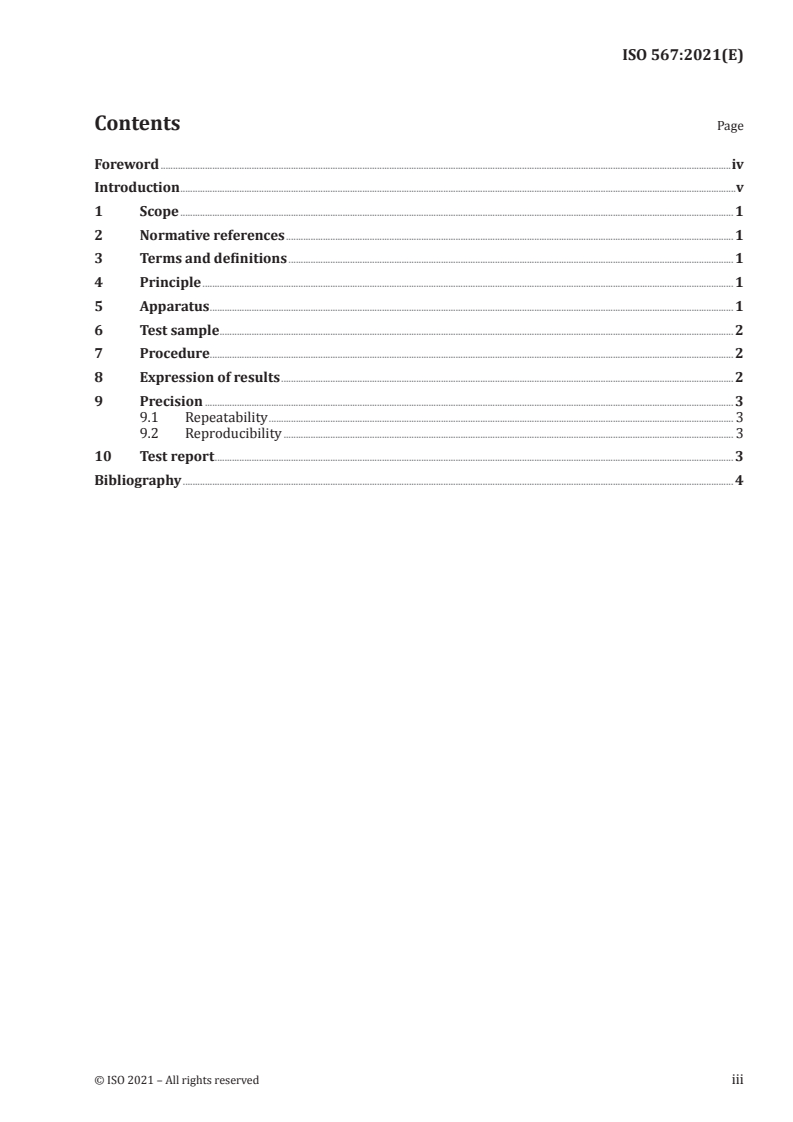
Contents Page
Foreword .iv
Introduction .v
1 Scope . 1
2 Normative references . 1
3 Terms and definitions . 1
4 Principle . 1
5 Apparatus . 1
6 Test sample . 2
7 Procedure. 2
8 Expression of results . 2
9 Precision . 3
9.1 Repeatability . 3
9.2 Reproducibility . 3
10 Test report . 3
Bibliography . 4
Foreword
ISO (the International Organization for Standardization) is a worldwide federation of national standards
bodies (ISO member bodies). The work of preparing International Standards is normally carried out
through ISO technical committees. Each member body interested in a subject for which a technical
committee has been established has the right to be represented on that committee. International
organizations, governmental and non-governmental, in liaison with ISO, also take part in the work.
ISO collaborates closely with the International Electrotechnical Commission (IEC) on all matters of
electrotechnical standardization.
The procedures used to develop this document and those intended for its further maintenance are
described in the ISO/IEC Directives, Part 1. In particular, the different approval criteria needed for the
different types of ISO documents should be noted. This document was drafted in accordance with the
editorial rules of the ISO/IEC Directives, Part 2 (see www .iso .org/ directives).
Attention is drawn to the possibility that some of the elements of this document may be the subject of
patent rights. ISO shall not be held responsible for identifying any or all such patent rights. Details of
any patent rights identified during the development of the document will be in the Introduction and/or
on the ISO list of patent declarations received (see www .iso .org/ patents).
Any trade name used in this document is information given for the convenience of users and does not
constitute an endorsement.
For an explanation of the voluntary nature of standards, the meaning of ISO specific terms and
expressions related to conformity assessment, as well as information about ISO's adherence to the
World Trade Organization (WTO) principles in the Technical Barriers to Trade (TBT), see www .iso .org/
iso/ foreword .html.
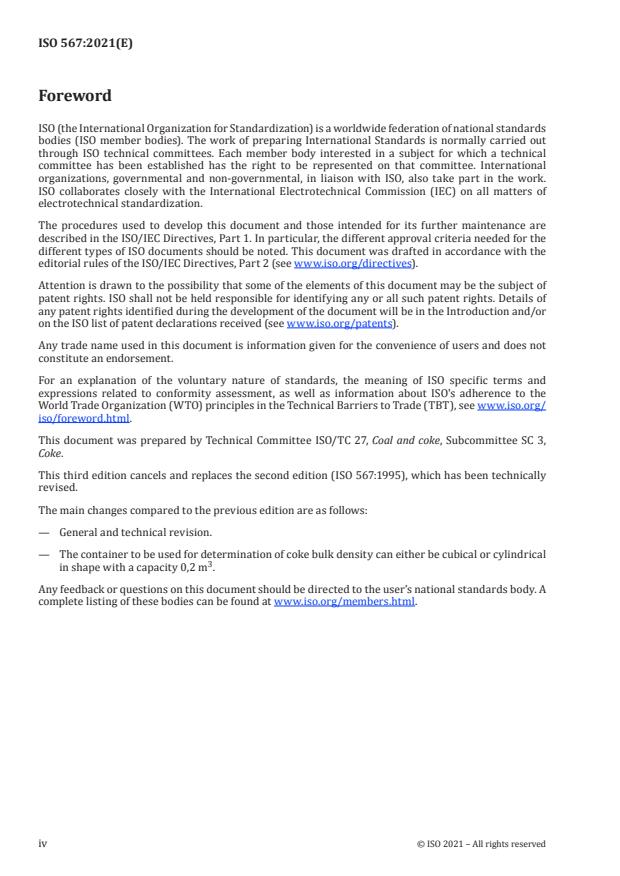
This document was prepared by Technical Committee ISO/TC 27, Coal and coke, Subcommittee SC 3,
Coke.
This third edition cancels and replaces the second edition (ISO 567:1995), which has been technically
revised.
The main changes compared to the previous edition are as follows:
— General and technical revision.
— The container to be used for determination of coke bulk density can either be cubical or cylindrical
in shape with a capacity 0,2 m .
Any feedback or questions on this document should be directed to the user’s national standards body. A
complete listing of these bodies can be found at www .iso .org/ members .html.
iv © ISO 2021 – All rights reserved
Introduction
The bulk density of coke depends on its physical characteristics, e.g. apparent relative density, shape
and size of the coke particles, and on the dimensions of the container. The container specified in this
International Standard has a capacity of 0,2 m . The
...
INTERNATIONAL ISO
STANDARD 567
Third edition
2021-08
Coke — Determination of bulk density
in a small container
Coke — Détermination de la masse volumique en vrac dans un
récipient de petites dimensions
Reference number
©
ISO 2021
© ISO 2021
All rights reserved. Unless otherwise specified, or required in the context of its implementation, no part of this publication may
be reproduced or utilized otherwise in any form or by any means, electronic or mechanical, including photocopying, or posting
on the internet or an intranet, without prior written permission. Permission can be requested from either ISO at the address
below or ISO’s member body in the country of the requester.
ISO copyright office
CP 401 • Ch. de Blandonnet 8
CH-1214 Vernier, Geneva
Phone: +41 22 749 01 11
Email: copyright@iso.org
Website: www.iso.org
Published in Switzerland
ii © ISO 2021 – All rights reserved
Contents Page
Foreword .iv
Introduction .v
1 Scope . 1
2 Normative references . 1
3 Terms and definitions . 1
4 Principle . 1
5 Apparatus . 1
6 Test sample . 2
7 Procedure. 2
8 Expression of results . 2
9 Precision . 3
9.1 Repeatability . 3
9.2 Reproducibility . 3
10 Test report . 3
Bibliography . 4
Foreword
ISO (the International Organization for Standardization) is a worldwide federation of national standards
bodies (ISO member bodies). The work of preparing International Standards is normally carried out
through ISO technical committees. Each member body interested in a subject for which a technical
committee has been established has the right to be represented on that committee. International
organizations, governmental and non-governmental, in liaison with ISO, also take part in the work.
ISO collaborates closely with the International Electrotechnical Commission (IEC) on all matters of
electrotechnical standardization.
The procedures used to develop this document and those intended for its further maintenance are
described in the ISO/IEC Directives, Part 1. In particular, the different approval criteria needed for the
different types of ISO documents should be noted. This document was drafted in accordance with the
editorial rules of the ISO/IEC Directives, Part 2 (see www .iso .org/ directives).
Attention is drawn to the possibility that some of the elements of this document may be the subject of
patent rights. ISO shall not be held responsible for identifying any or all such patent rights. Details of
any patent rights identified during the development of the document will be in the Introduction and/or
on the ISO list of patent declarations received (see www .iso .org/ patents).
Any trade name used in this document is information given for the convenience of users and does not
constitute an endorsement.
For an explanation of the voluntary nature of standards, the meaning of ISO specific terms and
expressions related to conformity assessment, as well as information about ISO's adherence to the
World Trade Organization (WTO) principles in the Technical Barriers to Trade (TBT), see www .iso .org/
iso/ foreword .html.
This document was prepared by Technical Committee ISO/TC 27, Coal and coke, Subcommittee SC 3,
Coke.
This third edition cancels and replaces the second edition (ISO 567:1995), which has been technically
revised.
The main changes compared to the previous edition are as follows:
— General and technical revision.
— The container to be used for determination of coke bulk density can either be cubical or cylindrical
in shape with a capacity 0,2 m .
Any feedback or questions on this document should be directed to the user’s national standards body. A
complete listing of these bodies can be found at www .iso .org/ members .html.
iv © ISO 2021 – All rights reserved
Introduction
The bulk density of coke depends on its physical characteristics, e.g. apparent relative density, shape
and size of the coke particles, and on the dimensions of the container. The container specified in this
International Standard has a capacity of 0,2 m . The
...