


ISO 1014-3:2025
(Main)Coke — Part 3: Determination of porosity
Coke — Part 3: Determination of porosity
This document specifies the method for the determination the porosity of the coke.
Coke — Partie 3: Détermination de la porosité
General Information
- Status
- Published
- Publication Date
- 20-Jul-2025
- Technical Committee
- ISO/TC 27/SC 3 - Coke
- Drafting Committee
- ISO/TC 27/SC 3 - Coke
- Current Stage
- 6060 - International Standard published
- Start Date
- 21-Jul-2025
- Due Date
- 18-Jan-2026
- Completion Date
- 21-Jul-2025
Relations
- Effective Date
- 29-Mar-2025
Overview
ISO 1014-3:2025 - Coke - Part 3: Determination of porosity specifies the method for calculating the porosity of coke. Rather than defining a new experimental technique, it prescribes how to derive porosity from two density measurements: the true relative density (per ISO 1014-2) and the apparent relative density (per ISO 1014-1). The porosity is reported as a percentage by volume fraction and rounded to the nearest 1%.
Key topics and requirements
- Principle: Porosity is calculated from measured true and apparent relative densities of the coke sample. ISO 1014-3 defines the mathematical expression and reporting rules rather than the sampling or density measurement procedures themselves.
- Formula: Porosity P (volume %) is calculated from the true relative density (ρo) and the apparent relative density (ρA) using the standard formula:
P = ((ρo − ρA) / ρo) × 100
- ρo = true relative density (use ISO 1014-2)
- ρA = apparent relative density (use ISO 1014-1)
- Expression of results: Results are given as a percentage by volume fraction and shall be reported to the nearest 1 %.
- Test report content: The required report items include:
- Identification of the sample tested
- A reference to ISO 1014-3:2025
- Date of determination
- Results and the method of expression used
Applications
- Quality control in coke production: Porosity is a key physical property affecting mechanical strength, reactivity and performance in metallurgical processes; manufacturers use this standard to evaluate batch consistency.
- Metallurgical industry (steelmaking): Blast-furnace coke performance is influenced by porosity (gas permeability, strength). Steel producers and coke suppliers use porosity results for material selection and process optimization.
- Laboratory testing and certification: Accredited test labs apply ISO 1014-3 when calculating porosity from density measurements performed according to the linked parts of the ISO 1014 series.
- Research and material characterization: Academics and R&D teams use the standardized porosity calculation to compare coke samples and study relationships between porosity and coke behaviour.
Related standards
- ISO 1014-1 - Coke: Determination of apparent relative density (required for ρA)
- ISO 1014-2 - Coke: Determination of true relative density (required for ρo)
- ISO 1014-3:2025 is part of the ISO 1014 series and replaces the earlier consolidated ISO 1014:2021 by splitting procedures into dedicated parts.
Keywords: ISO 1014-3:2025, coke porosity, porosity determination, apparent relative density, true relative density, coke testing, ISO 1014 series.
Get Certified
Connect with accredited certification bodies for this standard

ABS Quality Evaluations Inc.
American Bureau of Shipping quality certification.

Element Materials Technology
Materials testing and product certification.

ABS Group Brazil
ABS Group certification services in Brazil.
Sponsored listings
Frequently Asked Questions
ISO 1014-3:2025 is a standard published by the International Organization for Standardization (ISO). Its full title is "Coke — Part 3: Determination of porosity". This standard covers: This document specifies the method for the determination the porosity of the coke.
This document specifies the method for the determination the porosity of the coke.
ISO 1014-3:2025 is classified under the following ICS (International Classification for Standards) categories: 75.160.10 - Solid fuels. The ICS classification helps identify the subject area and facilitates finding related standards.
ISO 1014-3:2025 has the following relationships with other standards: It is inter standard links to ISO 1014:2021. Understanding these relationships helps ensure you are using the most current and applicable version of the standard.
ISO 1014-3:2025 is available in PDF format for immediate download after purchase. The document can be added to your cart and obtained through the secure checkout process. Digital delivery ensures instant access to the complete standard document.
Standards Content (Sample)
International
Standard
ISO 1014-3
First edition
Coke —
2025-07
Part 3:
Determination of porosity
Coke —
Partie 3: Détermination de la porosité
Reference number
© ISO 2025
All rights reserved. Unless otherwise specified, or required in the context of its implementation, no part of this publication may
be reproduced or utilized otherwise in any form or by any means, electronic or mechanical, including photocopying, or posting on
the internet or an intranet, without prior written permission. Permission can be requested from either ISO at the address below
or ISO’s member body in the country of the requester.
ISO copyright office
CP 401 • Ch. de Blandonnet 8
CH-1214 Vernier, Geneva
Phone: +41 22 749 01 11
Email: copyright@iso.org
Website: www.iso.org
Published in Switzerland
ii
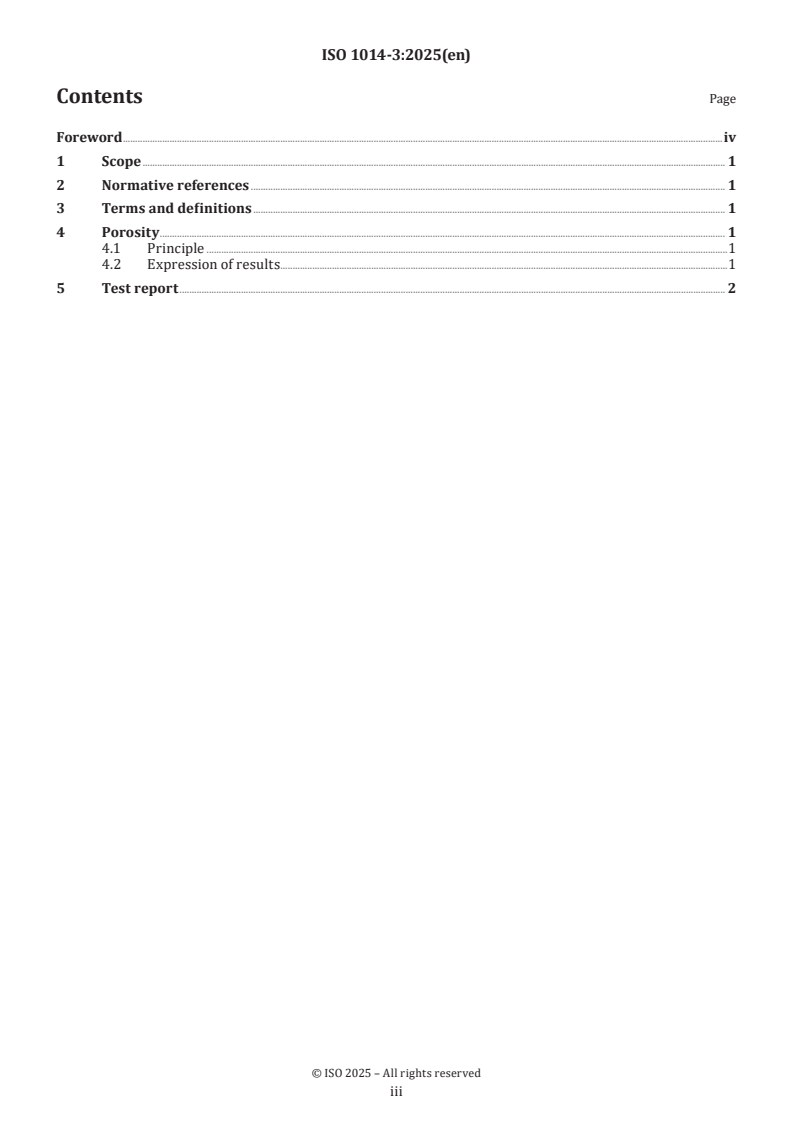
Contents Page
Foreword .iv
1 Scope . 1
2 Normative references . 1
3 Terms and definitions . 1
4 Porosity . 1
4.1 Principle .1
4.2 Expression of results .1
5 Test report . 2
iii
Foreword
ISO (the International Organization for Standardization) is a worldwide federation of national standards
bodies (ISO member bodies). The work of preparing International Standards is normally carried out through
ISO technical committees. Each member body interested in a subject for which a technical committee
has been established has the right to be represented on that committee. International organizations,
governmental and non-governmental, in liaison with ISO, also take part in the work. ISO collaborates closely
with the International Electrotechnical Commission (IEC) on all matters of electrotechnical standardization.
The procedures used to develop this document and those intended for its further maintenance are described
in the ISO/IEC Directives, Part 1. In particular, the different approval criteria needed for the different types
of ISO document should be noted. This docu
...
Questions, Comments and Discussion
Ask us and Technical Secretary will try to provide an answer. You can facilitate discussion about the standard in here.
Loading comments...