


ISO/IEC TR 24705:2005
(Main)Information technology — Office machines — Machines for colour image reproduction — Method of specifying image reproduction of colour devices by digital and analog test charts
Information technology — Office machines — Machines for colour image reproduction — Method of specifying image reproduction of colour devices by digital and analog test charts
ISO/IEC TR 24705:2005 deals with the colour reproduction properties of office devices, e. g. printers, scanners and monitors, which may depend on the device system, which includes e. g. the device properties and settings, the device driver, the file format, the computer operating system and the application software. It presents a method to allow testing of the reproduction changes if one or several of the parameters are varied, such as the device properties or settings, the device driver, the file format, the computer operating system, the colour space, and the application software. This allows manufacturers and users to get a feeling or data about the influence of the different parameters on the reproduction.
Technologies de l'information — Machines de bureau — Machines pour reproduction d'image couleur — Méthode pour spécifier la reproduction d'image des dispositifs couleur par des organigrammes numériques et analogiques
General Information
- Status
- Withdrawn
- Publication Date
- 18-Oct-2005
- Withdrawal Date
- 18-Oct-2005
- Technical Committee
- ISO/IEC JTC 1/SC 28 - Office equipment
- Drafting Committee
- ISO/IEC JTC 1/SC 28/WG 4 - Image quality assessment
- Current Stage
- 9599 - Withdrawal of International Standard
- Start Date
- 14-Mar-2019
- Completion Date
- 14-Feb-2026

Frequently Asked Questions
ISO/IEC TR 24705:2005 is a technical report published by the International Organization for Standardization (ISO). Its full title is "Information technology — Office machines — Machines for colour image reproduction — Method of specifying image reproduction of colour devices by digital and analog test charts". This standard covers: ISO/IEC TR 24705:2005 deals with the colour reproduction properties of office devices, e. g. printers, scanners and monitors, which may depend on the device system, which includes e. g. the device properties and settings, the device driver, the file format, the computer operating system and the application software. It presents a method to allow testing of the reproduction changes if one or several of the parameters are varied, such as the device properties or settings, the device driver, the file format, the computer operating system, the colour space, and the application software. This allows manufacturers and users to get a feeling or data about the influence of the different parameters on the reproduction.
ISO/IEC TR 24705:2005 deals with the colour reproduction properties of office devices, e. g. printers, scanners and monitors, which may depend on the device system, which includes e. g. the device properties and settings, the device driver, the file format, the computer operating system and the application software. It presents a method to allow testing of the reproduction changes if one or several of the parameters are varied, such as the device properties or settings, the device driver, the file format, the computer operating system, the colour space, and the application software. This allows manufacturers and users to get a feeling or data about the influence of the different parameters on the reproduction.
ISO/IEC TR 24705:2005 is classified under the following ICS (International Classification for Standards) categories: 37.100.10 - Reproduction equipment. The ICS classification helps identify the subject area and facilitates finding related standards.
ISO/IEC TR 24705:2005 is available in PDF format for immediate download after purchase. The document can be added to your cart and obtained through the secure checkout process. Digital delivery ensures instant access to the complete standard document.
Standards Content (Sample)
TECHNICAL ISO/IEC
REPORT TR
First edition
2005-10-15
Information technology — Office
machines — Machines for colour image
reproduction — Method of specifying
image reproduction of colour devices by
digital and analog test charts
Technologies de l'information — Machines de bureau — Machines pour
reproduction d'image couleur — Méthode pour spécifier la reproduction
d'image des dispositifs couleur par des organigrammes d'essai
numériques et analogiques
Reference number
©
ISO/IEC 2005
PDF disclaimer
This PDF file may contain embedded typefaces. In accordance with Adobe's licensing policy, this file may be printed or viewed but
shall not be edited unless the typefaces which are embedded are licensed to and installed on the computer performing the editing. In
downloading this file, parties accept therein the responsibility of not infringing Adobe's licensing policy. The ISO Central Secretariat
accepts no liability in this area.
Adobe is a trademark of Adobe Systems Incorporated.
Details of the software products used to create this PDF file can be found in the General Info relative to the file; the PDF-creation
parameters were optimized for printing. Every care has been taken to ensure that the file is suitable for use by ISO member bodies. In
the unlikely event that a problem relating to it is found, please inform the Central Secretariat at the address given below.
© ISO/IEC 2005
All rights reserved. Unless otherwise specified, no part of this publication may be reproduced or utilized in any form or by any means,
electronic or mechanical, including photocopying and microfilm, without permission in writing from either ISO at the address below or
ISO's member body in the country of the requester.
ISO copyright office
Case postale 56 • CH-1211 Geneva 20
Tel. + 41 22 749 01 11
Fax + 41 22 749 09 47
E-mail copyright@iso.org
Web www.iso.org
Published in Switzerland
ii © ISO/IEC 2005 – All rights reserved
Information technology – Office machines – Machines for colour image reproduction
Method of specifying image reproduction of colour devices
by digital and analog test charts
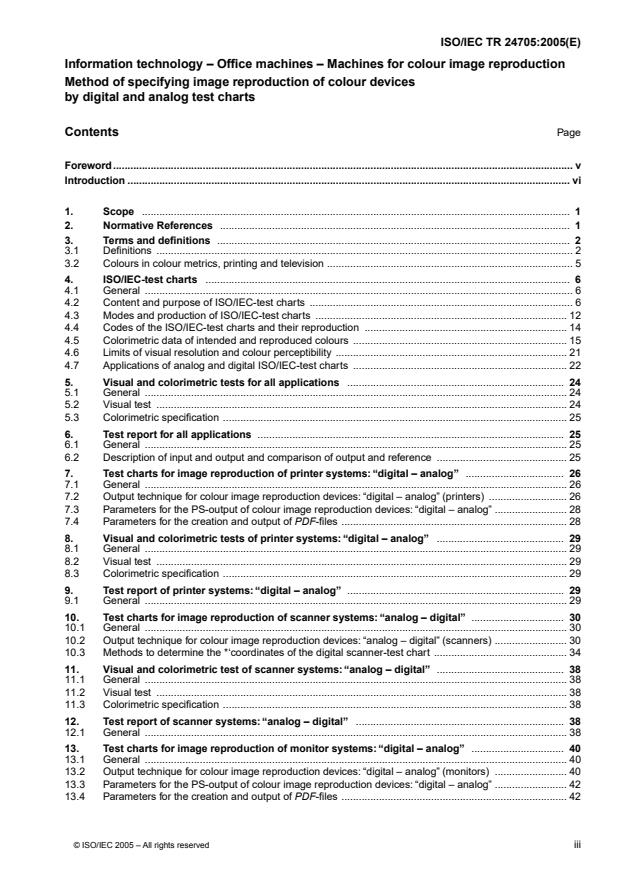
Contents Page
Foreword. v
Introduction . vi
1. Scope . 1
2. Normative References . 1
3. Terms and definitions . 2
3.1 Definitions . 2
3.2 Colours in colour metrics, printing and television . 5
4. ISO/IEC-test charts . 6
4.1 General . 6
4.2 Content and purpose of ISO/IEC-test charts . 6
4.3 Modes and production of ISO/IEC-test charts . 12
4.4 Codes of the ISO/IEC-test charts and their reproduction . 14
4.5 Colorimetric data of intended and reproduced colours . 15
4.6 Limits of visual resolution and colour perceptibility . 21
4.7 Applications of analog and digital ISO/IEC-test charts . 22
5. Visual and colorimetric tests for all applications . 24
5.1 General . 24
5.2 Visual test . 24
5.3 Colorimetric specification . 25
6. Test report for all applications . 25
6.1 General . 25
6.2 Description of input and output and comparison of output and reference . 25
7. Test charts for image reproduction of printer systems: “digital – analog” . 26
7.1 General . 26
7.2 Output technique for colour image reproduction devices: “digital – analog” (printers) . 26
7.3 Parameters for the PS-output of colour image reproduction devices: “digital – analog” . 28
7.4 Parameters for the creation and output of PDF-files . 28
8. Visual and colorimetric tests of printer systems: “digital – analog” . 29
8.1 General . 29
8.2 Visual test . 29
8.3 Colorimetric specification . 29
9. Test report of printer systems: “digital – analog” . 29
9.1 General . 29
10. Test charts for image reproduction of scanner systems: “analog – digital” . 30
10.1 General . 30
10.2 Output technique for colour image reproduction devices: “analog – digital” (scanners) . 30
10.3 Methods to determine the *‘coordinates of the digital scanner-test chart . 34
11. Visual and colorimetric test of scanner systems: “analog – digital” . 38
11.1 General . 38
11.2 Visual test . 38
11.3 Colorimetric specification . 38
12. Test report of scanner systems: “analog – digital” . 38
12.1 General . 38
13. Test charts for image reproduction of monitor systems: “digital – analog” . 40
13.1 General . 40
13.2 Output technique for colour image reproduction devices: “digital – analog” (monitors) . 40
13.3 Parameters for the PS-output of colour image reproduction devices: “digital – analog” . 42
13.4 Parameters for the creation and output of PDF-files . 42
© ISO/IEC 2005 – All rights reserved iii
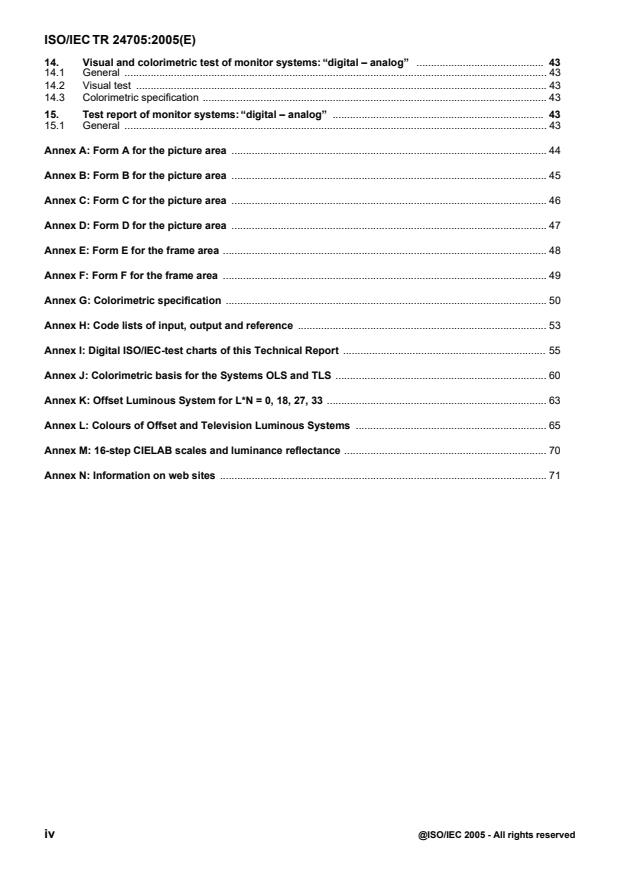
14. Visual and colorimetric test of monitor systems: “digital – analog” . 43
14.1 General . 43
14.2 Visual test . 43
14.3 Colorimetric specification . 43
15. Test report of monitor systems: “digital – analog” . 43
15.1 General . 43
Annex A: Form A for the picture area . 44
Annex B: Form B for the picture area . 45
Annex C: Form C for the picture area . 46
Annex D: Form D for the picture area . 47
Annex E: Form E for the frame area . 48
Annex F: Form F for the frame area . 49
Annex G: Colorimetric specification . 50
Annex H: Code lists of input, output and reference . 53
Annex I: Digital ISO/IEC-test charts of this Technical Report . 55
Annex J: Colorimetric basis for the Systems OLS and TLS . 60
Annex K: Offset Luminous System for L*N = 0, 18, 27, 33 . 63
Annex L: Colours of Offset and Television Luminous Systems . 65
Annex M: 16-step CIELAB scales and luminance reflectance . 70
Annex N: Information on web sites . 71
iv @ISO/IEC 2005 - All rights reserved
Foreword
ISO (the International Organization for Standardization) and IEC (the International Electrotechnical
Commission) form the specialized system for worldwide standardization. National bodies that are members of
ISO or IEC participate in the development of International Standards through technical committees
established by the respective organization to deal with particular fields of technical activity. ISO and IEC
technical committees collaborate in fields of mutual interest. Other international organizations, governmental
and non-governmental, in liaison with ISO and IEC, also take part in the work. In the field of information
technology, ISO and IEC have established a joint technical committee, ISO/IEC JTC 1.
International Standards are drafted in accordance with the rules given in the ISO/IEC Directives, Part 2.
The main task of the joint technical committee is to prepare International Standards. Draft International
Standards adopted by the joint technical committee are circulated to national bodies for voting. Publication as
an International Standard requires approval by at least 75 % of the national bodies casting a vote.
In exceptional circumstances, the joint technical committee may propose the publication of a Technical Report
of one of the following types:
— type 1, when the required support cannot be obtained for the publication of an International Standard,
despite repeated efforts;
— type 2, when the subject is still under technical development or where for any other reason there is the
future but not immediate possibility of an agreement on an International Standard;
— type 3, when the joint technical committee has collected data of a different kind from that which is normally
published as an International Standard (“state of the art”, for example).
Technical Reports of types 1 and 2 are subject to review within three years of publication, to decide whether
they can be transformed into International Standards. Technical Reports of type 3 do not necessarily have to
be reviewed until the data they provide are considered to be no longer valid or useful.
Attention is drawn to the possibility that some of the elements of this document may be the subject of patent
rights. ISO and IEC shall not be held responsible for identifying any or all such patent rights.
ISO/IEC TR 24705, which is a Technical Report of type 3, was prepared by Joint Technical Committee
ISO/IEC JTC 1, Information technology, Subcommittee SC 28, Office equipment.
This Technical Report is based on International Standard ISO/IEC 15775 and on the Draft International
Multipart ISO/IEC fast track Standard DIS 19839–1 to –4:2001 which together are identical to the multipart
standard DIN 33866-1 to -5. In 2002 it was decided at the Ballot Resolution Meeting on DIS ISO/IEC 19839-1
to -4 in Berlin to produce this Technical Report instead of a multipart International Standard.
@ISO/IEC 2005 - All rights reserved v
Introduction
Background Information
This Technical Report is based on analog ISO/IEC-test charts with 16-step colour scales equally spaced in CIELAB.
The International Standard ISO/IEC 15775 for the specification of image reproduction of colour copiers uses analog
ISO/IEC-test charts with e. g. a 16 step colour scale between White W and Cyan-blue C which is equally spaced in
CIELAB.
In image technology for the output of the colour series W – C the four device coordinates cmyk (Cyan-blue, Magenta-
red, Yellow, Black) have been used for many years. If the coordinate of Cyan-blue is changed between zero and 1
and the other three are zero then the series W – C appears on the output, e. g. on an office colour laser printer or in
offset printing.
Linear relation between device and CIELAB coordinates for office systems
There is much discussion in the field of image technology about the meaning of device coordinates, e. g. cmyk or
rgb, for printers and monitors and their relation to the L*a*b* data of the device independent colour space CIELAB.
The International Standard ISO/IEC 15775 has produced new ideas how to define more meaningful device
coordinates which are called e. g. cmy0*, w*, olv*, 000n*. This Technical Report defines the calculation methods
between the CIELAB coordinates L*a*b* of the analog ISO/IEC-test charts and device *-coordinates (star-
coordinates), e. g. cmy0*, w*, olv*, 000n*.
According to the International Technical Report ISO/IEC TR 19797 a linear relationship can be defined between
e.g. the device coordinates cmy0* and the device independent coordinates LAB* of the (absolute) CIELAB space.
According to TR ISO/IEC 19797 the coordinate c* = 1 produces the Cyan-blue colour if the others are zero, c* = 0
produces the White reference paper and c* = 0,5 produces a colour which is exactly in the middle in the CIELAB
space between Cyan-blue C and White W. The CIELAB data of the 16-step colour series between White and Cyan-
blue are calculated by the following linear equations
L* = L* + c* (L* – L* ) (0 <= c* <= 1)
W C W
and similarly for the CIELAB chroma data a* and b*. For the mean device value c*=0.5 the CIELAB data are
calculated as mean of the CIELAB data of Cyan-blue C and White W.
Multi-spectral CIELAB imaging and new device *-coordinates (star-coordinates)
If the analog ISO/IEC-test charts are scanned with the new multi-spectral technology then from the spectral
reflection or transmission data of any pixel the CIELAB data can be determined. The devices with these properties
are called CIELAB scanners or CIELAB cameras. By the calculation methods of ISO/IEC TR 19797 one can transfer
the LAB* data in the digital scan file to the device values such as cmy0*, w*, olv*, 000n* in the digital scan file.
Digital ISO/IEC-test charts with new device *-coordinates (star-coordinates)
By the calculation methods of ISO/IEC TR 19797 one can transfer the LAB* data of the analog ISO/IEC-test charts
to the device coordinates, e. g. cmy0*, w*, olv*, 000n*. The digital ISO/IEC-test charts are designed using this
device data. The CIELAB colour differences between the seven basic colours CMYOLVN and the paper White W of
the analog ISO/IEC-test charts and the standard colours of offset printing are less than the CIELAB colour
difference of ΔE* = 3. This is the ΔE* tolerance value specified in ISO/IEC 15775 as reasonable for office equipment
image technology. So instead of the production data of the present analog ISO/IEC-test charts the standard
colours of offset printing are used as default device data, e. g. cmy0*, w*, olv*, 000n*, in the digital ISO/IEC-test
charts. Examples are shown in Annex I.
This Technical Report and ISO/IEC 15775
Table 0-1: Application of this Technical Report and ISO/IEC 15775 for specifying image reproduction
Input Output Input and output media and applications Technical Report
Input media Output media Application (TR) or Standard
−−−− Basis TR ISO/IEC 24705
analog analog ISO/IEC-test chart (hardcopy) Hardcopy Copier ISO/IEC 15775
analog digital ISO/IEC-test chart (hardcopy) File Scanner TR ISO/IEC 24705
Hardcopy Printer TR ISO/IEC 24705
digital analog ISO/IEC-test chart (file)
Softcopy Monitor TR ISO/IEC 24705
TR24705/T1TA000.PS
vi @ISO/IEC 2005 - All rights reserved
Table 0-1 includes the applications of this Technical Report and ISO/IEC 15775 to specify image reproduction
properties.
This Technical Report describes the classification and a basis for the production and application of analog and
digital ISO/IEC-test charts. It describes methods for the specification of image reproduction properties of colour
devices. The International Standard ISO/IEC 15775 and this Technical Report define visual and colorimetric
methods to specify the image reproduction properties of colour systems. A colour system includes the black box
between input and reproduction of digital or analog ISO/IEC-test charts.
The area of the colour copier devices with the reproduction process “analog – analog” is excluded here as this area
is already covered by the International Standard ISO/IEC 15775. There is a close relationship to the other
reproduction process types “analog – digital” and “digital – analog” which require similar specification methods
and corresponding digital and analog ISO/IEC-test charts. The different reproduction processes are defined in
ISO/IEC 15775 and this Technical Report.
This Technical Report consists of:
Section 2. to 6.: Method of specifying image reproduction of colour systems by digital and analog test charts –
Classification and principles.
Section 7. to 9.: Method of specifying image reproduction of colour systems by digital input and analog output as
hardcopy for colour image reproduction devices: “digital – analog” (Printers) – Application and realisation.
Section 10. to 12.: Method of specifying image reproduction of colour systems by analog input and digital output
for colour image reproduction devices:“analog – digital” (Scanners) – Application and realisation
Section 13. to 15.: Method of specifying image reproduction of colour systems by digital input and analog output
as softcopy for colour image reproduction devices:“digital – analog” (Monitors) – Application and realisation.
Equal relative CIELAB spacing of analog and digital ISO/IEC-test charts
This Technical Report is based on analog and digital ISO/IEC-test charts. The analog ISO/IEC-test charts are
equally spaced in CIELAB between white W and the six colours CMYOLV and black N.
cmyolvnw* default color space cmyolv* default color space
CMYOLV CMYOLV
colour names of
L*=LAB*
hexagon Y complementary
ISO/IEC 15775
∆E*=2.51
hue planes
C
∆E*=5.18
L O
O
∆E*=3.5
W
∆E*=5.08
C* =LAB*
colour names of
ab r
C M
ISO/IEC 15775
Reference ORS18a: Offset Reflective System
L* = 18, chroma adapted (a)
V
Transfer TLS18: Television Luminous System
three basic colors three mixed colors
L* = 18
TR24705/E8370-61 TR24705/B2410-2N
Figure 0-1: Equal relative CIELAB spacing of 16 steps for different hue and lightness
Fig. 0-1 shows on the left side 16 equally spaced steps in the CIELAB colour space between White W and the six
chromatic colours CMYOLV. This spacing is realized in analog ISO/IEC-test charts by different manufacturers.
On the right two equally spaced series between White–Orange-red (W –O) and White–Cyan-blue (W–C) are shown
on both monitors and printers. It is intended here to have equal relative spacing in the CIELAB colour space on both
the printer and monitor under standard office conditions. Standard office conditions for colour control are defined by
the standard daylight CIE illuminant D65 and approximately equal luminance of the white monitor and the illuminated
white paper (e. g. in special cases in a light booth). This Technical Report and the figure on the right side assume a
monitor black with the CIELAB lightness L*=18 as standard. This lightness is produced by a standard luminance
reflectance Y =2,5 of the standard ambient light on the monitor surface.
r
For chromatic colours, equal CIELAB data on the monitor and for printer output are not intended. A relative
reproduction is intended which has the following main advantages for the 16-step colour series of the ISO/IEC-test
charts:
1. All Landolt-rings are recognized on both devices for the light (0–1), the medium (7–8) and the dark steps (E-F).
2. The recognition of the rings is optimized because the largest possible CIELAB difference is produced.
3. The whole device output colour space is filled which is desired by many applications, e. g. digital photography.
4. Linearized device systems need much less measurement data for profiling compared to unlinearized data.
@ISO/IEC 2005 - All rights reserved vii
5. The relative reproduction is approximately an absolute reproduction, e. g. if the reflective analog ISO/IEC-test
charts or other originals are reproduced on printers with 8 basic colours similar to the 8 standard offset colours.
NOTE: When the CIELAB data of ICC profiles which are used to map the CIELAB input colours on the output
device do not include the information about the 8 device colours then the above simple relative reproduction
between the input and output space is very complicated. For example one must change all hues differently.
The digital ISO/IEC-test charts are equally spaced in digital coordinates between 0 and 1. Different device
coordinates, e. g. cmy0*, 000n*, w* and olv* are used in the digital ISO/IEC-test charts. The star (*) indicates a
linear relationship between the digital device coordinates, e. g. cmy0*, and the CIELAB coordinates L*a*b*.
NOTE: The International Technical Report ISO/IEC 19797 describes the linearization methods between
device coordinates, e. g. cmy0*, and the CIELAB coordinates L*a*b*.
Production of analog ISO/IEC-test charts according to ISO/IEC 15775 from digital test charts
Anyone may produce ISO/IEC-test charts. To do this it is recommended that use the digital ISO/IEC-test chart files
be downloaded from the recommended servers. A producer may include a free digital image which must include the
standard 16 step series of the grey scale and the 14 CIE-test colours when the image is taken. According to the
International Standard ISO/IEC 15775 any ISO/IEC-test chart producer must publish digital ISO/IEC-test chart files
with the standard image in 5 resolutions which correspond to the analog ISO/IEC-test charts of the production. Test
charts which correspond to the principles of ISO/IEC 15775 have been published in Germany by DIN as DIN-test
charts according to DIN 33866-1 to 5 and in Japan by JBMIA as Asian ISO/IEC-test charts according to
ISO/IEC 15775. There are corresponding digital ISO/IEC-test charts on different servers in different resolutions
(see Annex N).
Applications and limitations of this Technical Report
This Technical Report includes the basic principles for the application of ISO/IEC-test charts for colour reproduction
devices such as for colour printers, colour scanners, colour monitors, colour displays, digital cameras, the Photo-CD
system and overhead devices, which can input (scan, read) or output (reproduce, display) analog or digital test
charts.
For this the analog and digital ISO/IEC-test charts include different image line and character elements, as well as
Siemens-stars and Landolt-rings in different colours and contrast combinations. Additionally 14 CIE-test colours as
well as 5- and 16-step colour series with equal spacing are included. The specification of image reproduction is
based on the differences between digital or analog ISO/IEC-test charts and their reproduction, especially in terms
of resolution, relative luminance and colour.
The layout, content and requirements for the production of the ISO/IEC-test charts are defined in ISO/IEC 15775.
The ISO/IEC-test charts are defined for CIE illuminant D65, the CIE 2 degree observer, the CIE 45/0 geometry and
with a three thickness backing of white paper for measurement and visual evaluation. For colour control in offices the
recommended illumination of 1000 lux of the CIE is used, which corresponds to 282 (= 1000 / 3,14 x 0,886) cd/m for
the white reference paper of the ISO/IEC-test charts. A monitor in a modern office has about the same luminance for
the white screen. Therefore the white luminance L = 300 cd/m and the same chromaticity as CIE daylight D65 is
W
recommended. Therefore no chromatic or luminance adaptation is required and only the CIELAB data are required
for the visual and colorimetric application within this Technical Report. For colorimetric evaluation of monitors the
lightness L* = 18 of Black N and L* = 95 of white W of the analog ISO/IEC-test chart no. 3 is normalized to the
N W
same data for the monitor. See Annex M.
The ISO/IEC-test charts are defined and available in different device coordinates, e. g. cmy0*, w*, olv*, 000n*, and
the absolute CIELAB coordinates L*a*b*. See Annex N. This Annex recommends three digital ISO/IEC-test charts
for the tests according to this Technical Report, but additionally other ISO/IEC-test charts of the list can be used if
appropriate. The test report requires that the forms of Annex A to Annex F be included. The ISO/IEC-test charts of
the tests appear in Annex E and Annex F.
The tests use the same test elements as for the test of colour copiers. See ISO/IEC 15775 and Annex N. The colour
series between White W and CMYOLV is tested but e.g. the series between Black and CMYOLV are not included in
ISO/IEC 15775. The last series are usually approximately equally spaced in relative CIELAB if the series Black –
White is equally spaced.
There is no preference of this Technical Report for any operating system, application software, or device driver.
These properties are within a “black box” which influence the workflow of the device systems “digital – analog”
(printer and monitor systems) or “analog – digital” (scanner systems) between input and output.
Different CIE illuminants D65 and D50 in different International Standards
In this Technical Report, in ISO/IEC 15775 and in the monitor standard IEC 61966-2 the CIE illuminant D65 is
recommended.
NOTE: The International Standard IEC 61966-7-1 measures the CIELAB output colours for RGB input data for the
CIE illuminant D50.
viii @ISO/IEC 2005 - All rights reserved
Information technology – Office machines – Machines for colour image
reproduction
Method of specifying image reproduction of colour devices
by digital and analog test charts
1. Scope
The colour reproduction properties of office devices, e.g. printers, scanners and monitors, may depend on the device
system, which includes e.g. the device properties and settings, the device driver, the file format, the computer
operating system and the application software.
The method of this Technical Report is to test how the reproduction changes if one or several of the parameters
are varied, such as the device properties or settings, the device driver, the file format, the computer operating
system, the colour space, and the application software. This allows manufacturers and users to get a feeling or data
about the influence of the different parameters on the reproduction.
2. Normative References
The following referenced documents are indispensable for the application of this document, For dated references,
only the edition cited applies. For undated references, the latest edition of the referenced document (including any
amendments) applies.
ISO 216:1975, Writing paper and certain classes of printed matter – Trimmed sizes – A and B series
ISO 536:1995, Paper and board – Determination of grammage
ISO 554:1976, Standard atmospheres for conditioning and/or testing – Specifications
ISO 2469:1994, Paper, board and pulps – Measurement of diffuse reflectance factor
ISO 2471:1998, Paper and board – Determination of opacity (paper backing) – Diffuse reflectance method
ISO 2846–1:1997, Graphic technology – Colour and transparency of ink sets for four-colour-printing – Part 1:
Sheet-fed and heat-set web offset lithographic printing
ISO 3664:2000, Viewing conditions – Graphic technology and photography
ISO 5627:1995, Paper and board – Determination of smoothness (Bekk method)
ISO 5651:1989, Paper board and pulps – Units for expressing properties
ISO 5737:1983, Prints – Preparation of standard prints for optical tests
ISO 7724–1:1984, Paints and varnishes – Colorimetry – Part 1: Principles
ISO 7724–3:1984, Paints and varnishes – Colorimetry – Part 3: Calculation of colour differences
ISO 8596:1994, Ophthalmic optics – Visual acuity testing – Standard optotype and its presentation
ISO 8597:1994, Optics and optical instruments – Visual acuity testing – Method of correlating optotypes
ISO 13655:1996, Graphic technology – Spectral measurement and colorimetric computation for graphic arts images
ISO 12641:1997, Graphic technology – Prepress digital data exchange – Colour targets for input scanner calibration
ISO/IEC 15775: 1999, Information technology – Office machines – Method of specifying image reproduction of
colour copying machines by digital and analog test charts – Realisation and application
ISO/CIE 10526:1991, CIE standard colorimetric illuminants
ISO/CIE 10527:1991, CIE standard colorimetric observers
CIE-pub. 13.3:1995, Colour rendering – Method of Measuring and Specifying Colour Rendering Properties of Light
Sources
CIE-pub. 15.2:1986, Colorimetry
DIN 6160:1996, Anomaloscopes for the diagnosis of red-green colour vision deficiencies (or equivalent)
DIN 33866–1: 2000, Information technology – Office machines – Colour image reproduction devices, Part 1: Method
of specifying image reproduction of colour devices by digital and analog test charts – Classification and principles
DIN 33866–2: 2000, Information technology – Office machines – Colour image reproduction devices – Method of
specifying image reproduction of colour copiers by analog test charts – Application and realisation
@ISO/IEC 2005 - All rights reserved 1
DIN 33866–3: 2000, Information technology – Office machines – Colour image reproduction devices, Part 3: Method
of specifying image reproduction of colour devices by digital input and analog output as hardcopy for colour image
reproduction devices: “digital – analog” (Printers) – Application and realisation
DIN 33866–4: 2000, Information technology – Office machines – Colour image reproduction devices, Part 4: Method
of specifying image reproduction of colour devices by analog input and digital output for colour image reproduction
devices: “analog – digital” (Scanners) – Application and realisation
DIN 33866–5: 2000, Information technology – Office machines – Colour image reproduction devices, Part 5: Method
of specifying image reproduction of colour devices by digital input and analog output as softcopy for colour image
reproduction devices: “digital – analog” (Monitors) – Application and realisation
DIN 58220–5:1996, Test of visual acuity – Part 5: General test of vision
ITU-R Recommendation BT.709–3:1998, Parameter Values for the HDTV Standards for Production and International
Programme Exchange
IEC 61966-2-1: 1999, Multimedia systems and equipment - Colour measurement and management - Part 2-1:
Colour management - Default RGB colour space - sRGB
IEC 61966-7-1: 2001, Multimedia systems and equipment - Colour measurement and management - Part 7-1:
colour printers - reflective prints - RGB inputs
IEC/CIE publ. 17.4: 1987, International lighting vocabulary, 4th edition, Joint publication IEC/CIE
ISO/IEC TR 19797: 2003, Device output of 16-step colour scales, output linearization method (LM) and
specification of the reproduction properties
3. Terms and definitions
3.1 Definitions
For the purpose of this Technical Report, the following definitions apply.
3.1.1
colour rendering
relation between the original colour of an object and its reproduction colour, either exclusively under another
illuminant or additionally after passing through a transfer process
NOTE For calculation with the colours of this Technical Report, see Annex G.
3.1.2
original colour
the perceived colour of an object for the reference condition which is being referred to at the assessment of the
colour rendering
3.1.3
non-luminous (perceived) colour
colour of a non-luminous colour, i. e. an area that requires a reflecting light for its appearance
3.1.4
standard tristimulus values X, Y, Z
colorimetric parameters L*a*b*
describe the psycho-physical colour
NOTE 1 Standard tristimulus values X, Y, Z are mostly obtained as an immediate result of a colour
measurement
NOTE 2 As standard tristimulus values X, Y, Z only allow statements referring to equality of two colours, for
statements made beyond that, e. g. concerning the kind and size of colour differences, non-linear
transformations of X, Y, Z into other colorimetric parameters systems, preferably into the colorimetric
parameters L*, a*, b*, are necessary.
3.1.5
colour difference ΔE*
ab
see CIE publ. 15.2, page 95
3.1.6
lightness L*
see CIE publ. 15.2, page 95
3.1.7
chroma C*
see CIE publ. 15.2, page 95
2 @ISO/IEC 2005 - All rights reserved
3.1.8
Landolt-ring
standard optotype defined by a ring with an open segment which can be in eight different positions
3.1.9
halftone technique
production of intermediate tones such as grey using only black and white pixels
NOTE In offset printing a halftone cell of a square width 0,16 mm may be filled by 16 x 16 single points with
the square width 0,01 mm. This technique allows 256 grey steps which are not visually equally spaced.
3.1.10
continuous tone technique
production of mean tones, e. g. grey, by density variation of the (black) colorant
NOTE: In continuous tone (photographic) technique for the test chart material in A4 size the cells (or pixels) of
the square width 0,16 mm may be filled by 16 x 16 single points with the square width 0,01 mm.
3.1.11
*-image (“star-image”)
includes colours defined by the colorimetric parameters L*a*b* of the CIELAB colour system.
NOTE: The *-image (“star-image”) includes colours (of the colour pixels or areas) which are defined either in
absolute (LAB*) or relative (lab*) coordinates
3.1.12
*’-image (“star-prime-image”)
includes colours produced by a standard reproduction process of a colour device and is different than the *-image
NOTE: The *’-image (“star-prime-image”) has different colorimetric parameters (*’-coordinates) compared to
the *-image (“star-image”) with L*a*b* parameters defined either in absolute (LAB*) or relative (lab*)
coordinates
3.1.13
’*-image (“prime-star-image”)
is produced by the standard reproduction process of a colour device and is different than the *-image (“star-image”).
NOTE: The ’*-image (“prime-star-image”) is called the inverse image and includes L*a*b* parameters defined
either in absolute (LAB*) or relative (lab*) coordinates
3.1.14
standard image transformation
changes a *-image (“star-image”) into a *’-image (“star-prime-image”) (Fig. 1) or changes a ’*-image (“prime-star-
image”) into a *-image (“star-image”) (Fig. 2)
PostScript-
(PS-)image file:
LAB*- or lab*-file
CMY*- or cmy*-file
OLV*- or olv*-file
standard image inverse image
transformation transformation
*-image *’-image *-image
changes e. g. from changes e. g. from
LAB* to LAB*’ LAB* to LAB’*
or lab* to lab*’ or lab* to lab’*
PortableDocument-
(PDF-)image file:
LAB*- or lab*-file
CMY*- or cmy*-file
OLV*- or olv*-file
TR24705/T1BI011.PS
Figure 1: Standard and inverse image transformation
NOTE Fig. 1 shows that the standard image transformation changes a *-image (“star-image”) into a *’-image
@ISO/IEC 2005 - All rights reserved 3
(“star-prime-image”) and that the inverse image transformation changes a *’-image (“star-prime-image”) into a *-image
(“star-image”). There may be small differences between the input (in) and output (ou) in real applications.
3.1.15
inverse image transformation
changes a *-image (“star-image”) into a ’*-image (“prime-star-image”) (Fig. 2) or changes a *’-image (“star-prime-
image”) into a *-image (“star-image”) (Fig. 1)
PostScript-
(PS-)image file:
LAB*- or lab*-file
CMY*- or cmy*-file
OLV*- or olv*-file
inverse image standard image
transformation transformation
*-image ’*-image *-image
changes e. g. from changes e. g. from
LAB* to LAB’* LAB* to LAB*’
or lab* to lab’* or lab* to lab*’
PortableDocument-
(PDF-)image file:
LAB*- or lab*-file
CMY*- or cmy*-file
OLV*- or olv*-file
TR24705/T1BI021.PS
Figure 2: Inverse and standard image transformation
NOTE Fig. 2 shows that the inverse image transformation changes a *-image (“star-image”) into a ‘*-image (“prime-
star-image”) and that the standard image transformation changes a ‘*-image (“prime-star-image”) into a *-image (“star-
image”). There may be small differences between the input (in) and output (ou) in real applications.
3.1.16
additive mixed colours
mixture of three colour lights
3.1.17
subtractive mixed colours
mixture of three colorants (pigments)
3.1.18
hardcopy
output (copy) of an image, typically on paper or film material
3.1.19
softcopy
output (copy) of an image, typically on a monitor or display
3.1.20
scanner
electronic device which illuminates an object, e. g. a sheet of paper or a photography, and digitizes the image of the
object
NOTE It is possible to illuminate a transparent material (e. g. negative or positive film) to digitize the image on the
transparency.
3.1.21
scanner system
based on hardware and software which produces a changed *‘-image (“star-prime-image”) from a scanned *-image
(“star-image”) with the achromatic colour data (w* or n*) or the chromatic colour data (cmy* or olv*).
NOTE The changed “star-prime-image” has the achromatic colour data (w*‘ or n*‘) or the chromatic colour data
(cmy*‘ or olv‘).
4 @ISO/IEC 2005 - All rights reserved
3.1.22
digital output data of a scanner system
include digital *‘-coordinates (“star-prime-coordinates”) with one (e. g. w*‘ or n*‘), three (e. g. olv*‘ or cmy*‘), four (e.
g. olvw*‘ or cmyn*‘), eight (olvwcmyn*‘) or more digital output levels per pixel within a digital area of 4 bit (16 steps),
8 bit (256 steps) up to 16 bit (256 x 256 = 65 000 steps).
NOTE 1 The relative *-coordinates (“star-coordinates”) describe the equally spaced colour series in the CIELAB
colour space for offset printing. The CIELAB coordinates for offset printing are defined in Table 6.
NOTE 2: The 16-step colour series ( e. g. white–black or white–Cyan-blue) for ISO/IEC-test chart 1 and 2 are
visually equally spaced in the CIELAB colour space. An ideal scanner system produces for these steps digital
*‘-image data which are for n*‘ or c*‘ equally spaced in 16 steps in the decimal range 0 to 1, or the hexadecimal
range 0 to F, 00 to FF, or 0000 to FFFF.
NOTE 3 In general a scanner system will try to produce relative digital output values *‘-coordinates (“star-prime-
coordinates”) nearly the same as the relative *-coordinates (“star-coordinates”) for the digital input data.
3.2 Colours in colour metrics, printing and television
b*
four elementary hues in CIELAB
CIELAB
J Y
colors
J
L O
R
G
a*
CIELAB
G R
T D65 P
C M
B
B V
4 unique hues 6 basic colours
TR24705/E8151−3X TR24705/E8370-22
Figure 3: Four elementary and six reproduction colours relative to the CIELAB chroma axes a*,b*
The colour metrics is based on visual elementary colours with the terms R, G, B, and J for red, green, blue, and
yellow („RGBJ“) with e. g. yellow J as neither greenish nor reddish or red R as neither yellowish nor blueish. The
defined colours for (colour) printing and (colour) television differ significantly from the elementary colours and it is
required therefore to have other names. The terms „CMYOLV“ (C = Cyan-blue, M = Magenta-red, Y = Yellow, O =
Orange-red, L = Leaf-green, V = Violet-blue) are most appropriate for the vi
...
Questions, Comments and Discussion
Ask us and Technical Secretary will try to provide an answer. You can facilitate discussion about the standard in here.
Loading comments...