


ISO/IEC 29142-1:2013
(Main)Information technology — Print cartridge characterization — Part 1: General: terms, symbols, notations and cartridge characterization framework
Information technology — Print cartridge characterization — Part 1: General: terms, symbols, notations and cartridge characterization framework
ISO/IEC 29142-1:2013 establishes terms, symbols, notations and a framework for characterizing toner and ink cartridges used in printing devices that have a digital input printing path, including multi-function devices. It is intended for equipment used in office environments. It primarily provides a foundation for measuring, evaluating, or specifying characteristics of such toner and ink cartridges. The terms, symbols, notations and framework established in ISO/IEC 29142-1:2013 can be applied to such cartridges. The characterizations associated with the terms, symbols, notations, and framework established in ISO/IEC 29142-1:2013 are specified throughout the ISO/IEC 29142 series.
Technologies de l'information — Caractérisation de cartouche d'impression — Partie 1: Généralités: termes, symboles, notations et cadre de travail de caractérisation de cartouche
General Information
- Status
- Withdrawn
- Publication Date
- 24-Mar-2013
- Withdrawal Date
- 24-Mar-2013
- Technical Committee
- ISO/IEC JTC 1/SC 28 - Office equipment
- Drafting Committee
- ISO/IEC JTC 1/SC 28/WG 2 - Consumables
- Current Stage
- 9599 - Withdrawal of International Standard
- Start Date
- 31-Aug-2021
- Completion Date
- 14-Feb-2026
Relations
- Effective Date
- 23-Apr-2020


Frequently Asked Questions
ISO/IEC 29142-1:2013 is a standard published by the International Organization for Standardization (ISO). Its full title is "Information technology — Print cartridge characterization — Part 1: General: terms, symbols, notations and cartridge characterization framework". This standard covers: ISO/IEC 29142-1:2013 establishes terms, symbols, notations and a framework for characterizing toner and ink cartridges used in printing devices that have a digital input printing path, including multi-function devices. It is intended for equipment used in office environments. It primarily provides a foundation for measuring, evaluating, or specifying characteristics of such toner and ink cartridges. The terms, symbols, notations and framework established in ISO/IEC 29142-1:2013 can be applied to such cartridges. The characterizations associated with the terms, symbols, notations, and framework established in ISO/IEC 29142-1:2013 are specified throughout the ISO/IEC 29142 series.
ISO/IEC 29142-1:2013 establishes terms, symbols, notations and a framework for characterizing toner and ink cartridges used in printing devices that have a digital input printing path, including multi-function devices. It is intended for equipment used in office environments. It primarily provides a foundation for measuring, evaluating, or specifying characteristics of such toner and ink cartridges. The terms, symbols, notations and framework established in ISO/IEC 29142-1:2013 can be applied to such cartridges. The characterizations associated with the terms, symbols, notations, and framework established in ISO/IEC 29142-1:2013 are specified throughout the ISO/IEC 29142 series.
ISO/IEC 29142-1:2013 is classified under the following ICS (International Classification for Standards) categories: 37.100.10 - Reproduction equipment. The ICS classification helps identify the subject area and facilitates finding related standards.
ISO/IEC 29142-1:2013 has the following relationships with other standards: It is inter standard links to ISO/IEC 29142-1:2021. Understanding these relationships helps ensure you are using the most current and applicable version of the standard.
ISO/IEC 29142-1:2013 is available in PDF format for immediate download after purchase. The document can be added to your cart and obtained through the secure checkout process. Digital delivery ensures instant access to the complete standard document.
Standards Content (Sample)
INTERNATIONAL ISO/IEC
STANDARD 29142-1
First edition
2013-04-01
Information technology — Print
cartridge characterization —
Part 1:
General: terms, symbols, notations and
cartridge characterization framework
Technologies de l’information — Caractérisation de cartouche
d’impression —
Partie 1: Généralités: termes, symboles, notations et cadre de travail
de caractérisation de cartouche
Reference number
©
ISO/IEC 2013
© ISO/IEC 2013
All rights reserved. Unless otherwise specified, no part of this publication may be reproduced or utilized otherwise in any form
or by any means, electronic or mechanical, including photocopying, or posting on the internet or an intranet, without prior
written permission. Permission can be requested from either ISO at the address below or ISO’s member body in the country of
the requester.
ISO copyright office
Case postale 56 • CH-1211 Geneva 20
Tel. + 41 22 749 01 11
Fax + 41 22 749 09 47
E-mail copyright@iso.org
Web www.iso.org
Published in Switzerland
ii © ISO/IEC 2013 – All rights reserved
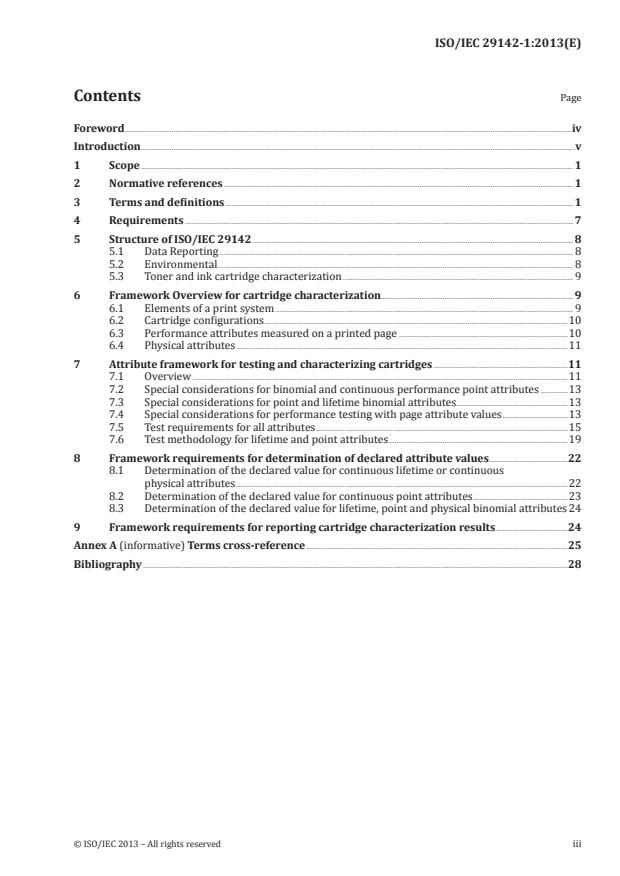
Contents Page
Foreword .iv
Introduction .v
1 Scope . 1
2 Normative references . 1
3 Terms and definitions . 1
4 Requirements . 7
5 Structure of ISO/IEC 29142 . 8
5.1 Data Reporting . 8
5.2 Environmental . 8
5.3 Toner and ink cartridge characterization . 9
6 Framework Overview for cartridge characterization . 9
6.1 Elements of a print system . 9
6.2 Cartridge configurations.10
6.3 Performance attributes measured on a printed page .10
6.4 Physical attributes .11
7 Attribute framework for testing and characterizing cartridges .11
7.1 Overview .11
7.2 Special considerations for binomial and continuous performance point attributes .13
7.3 Special considerations for point and lifetime binomial attributes.13
7.4 Special considerations for performance testing with page attribute values .13
7.5 Test requirements for all attributes .15
7.6 Test methodology for lifetime and point attributes .19
8 Framework requirements for determination of declared attribute values .22
8.1 Determination of the declared value for continuous lifetime or continuous
physical attributes.22
8.2 Determination of the declared value for continuous point attributes .23
8.3 Determination of the declared value for lifetime, point and physical binomial attributes 24
9 Framework requirements for reporting cartridge characterization results .24
Annex A (informative) Terms cross-reference .25
Bibliography .28
© ISO/IEC 2013 – All rights reserved iii
Foreword
ISO (the International Organization for Standardization) and IEC (the International Electrotechnical
Commission) form the specialized system for worldwide standardization. National bodies that are
members of ISO or IEC participate in the development of International Standards through technical
committees established by the respective organization to deal with particular fields of technical
activity. ISO and IEC technical committees collaborate in fields of mutual interest. Other international
organizations, governmental and non-governmental, in liaison with ISO and IEC, also take part in the
work. In the field of information technology, ISO and IEC have established a joint technical committee,
ISO/IEC JTC 1.
International Standards are drafted in accordance with the rules given in the ISO/IEC Directives, Part 2.
The main task of the joint technical committee is to prepare International Standards. Draft International
Standards adopted by the joint technical committee are circulated to national bodies for voting.
Publication as an International Standard requires approval by at least 75 % of the national bodies
casting a vote.
Attention is drawn to the possibility that some of the elements of this document may be the subject of
patent rights. ISO and IEC shall not be held responsible for identifying any or all such patent rights.
ISO/IEC 29142-1 was prepared by Joint Technical Committee ISO/IEC JTC 1, Information technology,
Subcommittee SC 28, Office equipment.
iv © ISO/IEC 2013 – All rights reserved
Introduction
The purpose of this part of ISO/IEC 29142 is to define the framework for characterizing ink and toner
cartridges used in printing devices that have a digital input printing path, including multi-function
devices. This part of ISO/IEC 29142 defines terms, symbols, and notations used throughout the
ISO/IEC 29142 series to characterize such ink and toner cartridges.
Customer information related to ink and toner cartridges is not consistent in the global marketplace.
Cartridge manufacturers, including original, non-original manufacturers, refillers, and remanufacturers,
have each communicated expressions of cartridge characteristics.
The ISO/IEC 29142 series is provided to aid transparency between manufacturers, suppliers and their
customers regarding selected cartridge characteristics. The selected cartridge characteristics do not
provide for an exhaustive cartridge characterization. Where applicable, cartridge attributes and the
associated characterization tests are used consistently with both ink and toner cartridge technologies.
The selected cartridge attributes are defined for all cartridges, regardless of manufacturing methodology.
© ISO/IEC 2013 – All rights reserved v
INTERNATIONAL STANDARD ISO/IEC 29142-1:2013(E)
Information technology — Print cartridge
characterization —
Part 1:
General: terms, symbols, notations and cartridge
characterization framework
1 Scope
This part of ISO/IEC 29142 establishes terms, symbols, notations and a framework for characterizing
toner and ink cartridges used in printing devices that have a digital input printing path, including multi-
function devices. This part of ISO/IEC 29142 is intended for equipment used in office environments.
It primarily provides a foundation for measuring, evaluating, or specifying characteristics of such toner
and ink cartridges.
The terms, symbols, notations and framework established herein can be applied to such cartridges.
The characterizations associated with the terms, symbols, notations, and framework established herein
are specified throughout the ISO/IEC 29142 series.
2 Normative references
The following documents, in whole or in part, are normatively referenced in this document and are
indispensable for its application. For dated references, only the edition cited applies. For undated
references, the latest edition of the referenced document (including any amendments) applies.
ISO 13655, Graphic technology — Spectral measurement and colorimetric computation for graphic arts images
ISO 5-3, Photography and graphic technology — Density measurements — Part 3: Spectral conditions
ISO/IEC 29142-2, Information technology — Print cartridge characterization — Part 2: Cartridge
characterization data reporting
ISO/IEC 29142-3, Information technology — Print cartridge characterization — Part 3: Environment
3 Terms and definitions
For the purposes of this document, the following terms and definitions apply.
3.1
all-in-one toner cartridge
cartridge that includes at least: a toner containment part, a photoreceptor part, and a developer part
3.2
black-only printer
printer with an operating part to apply ink or toner on a substrate with functionality limited to print
output using only a single black colourant
Note 1 to entry: In the case of a printer capable to operate with only a black colourant cartridge and alternatively
to operate with other cartridge configurations that include other colourants, the black-only printer condition is
limited to when only the single black colourant cartridge is installed.
© ISO/IEC 2013 – All rights reserved 1
3.3
binomial attribute
attribute which either occurs or does not occur and which is characterized by a count of the number of
times it occurs in a particular number of observations
Note 1 to entry: A random process is said to be binomial if it satisfies four basic properties:
a) It consists of a sequence of n trials for some n > 1.
b) Each trial has exactly two possible outcomes, A and B, which are mutually exclusive.
c) P(A), the probability of A, takes the same value p on all n trials. P(B) is likewise fixed at 1-p.
d) The n trials are independent of one another.
3.4
cartridge
user replaceable unit operating with a printing system that includes at least a containing mechanism
designed for materials intended for deposition on a substrate
3.5
cartridge attribute test report
report including the information of a cartridge customer report and the detailed cartridge
characterization results of an ISO/IEC 29142 cartridge characterization test reported for customer
presentation according to a required format
Note 1 to entry: The format is prescribed according to each ISO/IEC 29142 standardized or specified cartridge
characterization test and is in compliance with ISO/IEC 29142-2.
3.6
cartridge characterization test
test method provided in or in compliance with ISO/IEC 29142-1 for the purpose of evaluating an attribute
of a cartridge or cartridge set of interest to cartridge and cartridge set users
3.7
cartridge collector
any party providing a cartridge take-back or collection program
EXAMPLE A business entity designated to collect cartridges.
3.8
cartridge element
sub piece of a cartridge other than the containment part of the cartridge
3.9
cartridge end-of-life
point in a cartridge life-cycle from which the cartridge is no longer used for its intended purpose without
additional non-customer interaction
3.10
cartridge identifier
formatted human readable arrangement of information uniquely specifying a distinct cartridge
3.11
cartridge life percent completion point
point in the life of a cartridge computed as a percent of expected cartridge life
3.12
cartridge set
group of colourants and their assignment to one or more cartridges as defined by a printer manufacturer
to be necessary and sufficient to produce the fully functional default colour renditions
EXAMPLE Default colour renditions: printed black, red, green, blue, cyan, magenta, and yellow.
2 © ISO/IEC 2013 – All rights reserved
Note 1 to entry: A printer may have more than one fully functional cartridge set.
3.13
cartridge supplier
cartridge marketer, manufacturer, remanufacturer, refiller, or distributor, being the party or parties
responsible for marketing the cartridge and providing customer support for the cartridge
3.14
colour printer
printer with an operating part to apply ink or toner on a substrate, with functionality to produce print
output containing colours
3.15
containment part
containing mechanism designed for materials intended for deposition on a substrate
3.16
continuous attribute
attribute which can take on any of a range of values
3.17
cross-systems attribute tolerance range
CSATR
range of actual attribute values for a cartridge characterization attribute of a particular cartridge
characterization test method, determined from evaluation of exemplary systems to which the test
method applies
3.18
customer report
report, including a cartridge notification, and a cartridge attribute checklist, with summary results of
selected ISO/IEC 29142 cartridge attribute characterization tests, presented according to a required format
Note 1 to entry: The format is prescribed according to each ISO/IEC 29142 standardized or specified cartridge
characterization test and is in compliance with ISO/IEC 29142-2.
3.19
deposition material
material, ink or toner, liquid or solid, colourant or non-colourant, that can be contained in a cartridge,
and that is designed for deposition on a surface by means of a printing system
3.20
developer part
physical mechanism, which may or may not be a cartridge element, which functions to apply toner
particles to the latent image on the photoreceptor part of an electrophotographic printing system
3.21
discrete attribute
attribute which can take only a finite number of values within a range, such as an integer count
3.22
dye ink
material designed for liquid state deposition on a substrate, including a chemical dye colourant
3.23
electrophotographic printer
printer principally using opto electric phenomena and electrostatic attraction to move toner to a substrate
3.24
end-of-life
phase in a cartridge life-cycle when the cartridge can no longer be used for its intended purpose without
additional non-customer interaction
© ISO/IEC 2013 – All rights reserved 3
3.25
expected cartridge life
approximate number of pages likely to be printed from a cartridge when run to cartridge end-of-life
according to an ISO/IEC 29142 standardized or specified test method
3.26
filled cartridge
user replaceable unit of a printing system that includes at least ink or toner materials, intended for
deposition on a substrate and a containing mechanism for such materials
3.27
incineration
disposal method that involves combustion of waste material converting it into heat, gas, steam and ash
but not including smelting
3.28
ink
material, which may or may not include colourant, designed for liquid state deposition on a substrate
3.29
ink cartridge
user replaceable unit of a printing system that includes at least a containing mechanism designed for ink
intended for deposition on a substrate
3.30
ink deposition mechanism
imaging apparatus for depositing ink on a printing substrate
EXAMPLE A printhead.
3.31
ink transport part
ink channelling mechanism operating between an ink deposition mechanism and an ink containment part,
particularly when the ink deposition mechanism and the ink containment part are not physically abutted
3.32
inkjet printer
printer with an operating part, for example a printhead, to apply ink on a substrate
3.33
integrated ink cartridge
cartridge that includes at least: an ink containment part, an ink transport part, and an ink deposition
mechanism
3.34
landfilled
waste disposal in a landfill or other non-reuse, -recycle, -remanufacture, -waste to energy, or -incineration
depository, excluding the residuals from waste to energy and incineration
3.35
life-cycle
consecutive and interlinked stages of a product system, from raw material acquisition or generation
from natural resources to final disposition
Note 1 to entry: See ISO 14040
3.36
lifetime attribute
cartridge performance attribute which can only be measured by printing to cartridge end-of-life
according to an ISO/IEC 29142 standardized or specified test method
4 © ISO/IEC 2013 – All rights reserved
3.37
material safety data sheet
MSDS
safety data sheet
SDS
form containing safety information about the ink or toner contained in cartridges designed for use
in printing applications which includes physical, chemical, and toxicological properties, regulatory
information, and recommendations to ensure safe handling
3.38
multi-chamber ink cartridge
ink cartridge that is designed to contain two or more inks
Note 1 to entry: It may or may not be an integrated ink cartridge.
3.39
multi-function printer
MFP
printer with an operating part to apply ink or toner on a substrate, and also providing additional
functions such as fax and copy
3.40
non-colourant ink
material designed for liquid state deposition on a substrate, such as gloss optimizers and fixatives, not
containing a colourant
3.41
non-colourant toner
solid material, not containing colourant, capable of taking on an electrostatic charge, designed for
deposition on a substrate under the control of electrostatic forces in conjunction with a surface having
a controlled distributed charge such as gloss optimizers and fixatives
3.42
non-original cartridge
cartridge that is marketed by a company other than the company that markets the printing system for
which the cartridge is intended
3.43
original cartridge
cartridge that is marketed by the company that markets the printing system for which the cartridge is
intended
3.44
original equipment manufacturer
company that markets a printing system
3.45
page attribute value
value of a performance point attribute that is the value of that attribute evaluated from a complete
single printed page
3.46
performance attribute
attribute which can be determined only through printing with the cartridge(s) installed in an
operational printer
3.47
photo printer
printer with an operating part to apply ink or toner on a substrate, with functionality to print images
on photo paper sizes and types
© ISO/IEC 2013 – All rights reserved 5
3.48
photoreceptor part
photoconductor
physical mechanism, such as OPC, that includes a surface that accepts a uniform electrostatic charge,
with a surface that may subsequently be selectively discharged by exposure to light, and which facilitates
transfer of toner to media after such exposure
3.49
physical attribute
attribute which can be determined directly from the cartridge and which is independent of print systems
3.50
pigment ink
material designed for liquid state deposition on a substrate, including a chemical pigment colourant
3.51
point attribute
performance attribute which can be measured on pages printed at any point during the life of the cartridge
3.52
printer
device intended to apply colourant(s) to a substrate in response to a digital signal
3.53
recovery
process to divert cartridges and/or cartridge materials from the solid waste stream and into productive uses
3.54
recycle
reuse, remanufacture or otherwise divert from a solid waste stream
3.55
refill
operation to replace ink or toner in a customer’s cartridge that does not involve the replacement or
refurbishing of worn cartridge components
3.56
refiller
cartridge supplier that refills customer’s cartridges
3.57
remanufacture
operation to replace or clean components and add ink or toner using cartridges from cartridge take-
back or collection programs
3.58
remanufacturer
cartridge supplier that produces or markets remanufactured cartridges
3.59
reuse
operation in which a whole or a component part of a cartridge is incorporated in the manufacture or
remanufacture of a cartridge, such that the whole or component part is intended to be put into service
for the same purpose for which it was conceived
3.60
single chamber ink cartridge
ink cartridge that is designed to contain one ink
Note 1 to entry: It may or may not be an integrated ink cartridge.
6 © ISO/IEC 2013 – All rights reserved
3.61
single function printer
SFP
printer with an operating part to apply ink or toner on a substrate, having no additional functions such
as fax or scan
3.62
standard error goal
allowed upper limit of the error in page attribute value measurements, determined as the upper limit of
the standard error of the estimated mean of the measurements
3.63
substrate
user selectable imageable surfaces
EXAMPLE Paper, transparency, cloth.
3.64
take-back
programs sponsored by cartridge suppliers and conducted by cartridge collectors for the purpose of
obtaining cartridges after cartridge end-of-life
3.65
toner
solid material, which may or may not include colourant, capable of taking on an electrostatic charge,
designed for deposition on a substrate under the control of electrostatic forces in conjunction with a
surface having a controlled distributed charge
3.66
toner cartridge
user replaceable unit of a printing system that includes at least a containing mechanism designed for
toner intended for deposition on a substrate
3.67
toner deposition mechanism
imaging apparatus for depositing toner on a printing substrate
EXAMPLE A surface having a controlled distributed charge.
3.68
user replaceable unit
any part of a printing system that is designed to be removed and replaced by a user
3.69
waste to energy
form of recovery in which the energy generated from incineration is captured and used as energy
4 Requirements
The framework explained in this International Standard shall not be used directly for comparison of
products. For such comparison using test method standards compliant with the framework of this
International Standard, the minimum requirement is that conditions for measuring parameters as well
as the entire test conditions explained in such compliant standards are required to be in agreement.
© ISO/IEC 2013 – All rights reserved 7
5 Structure of ISO/IEC 29142
5.1 Data Reporting
This part of ISO/IEC 29142 establishes the product and package labelling requirements, and related
reporting requirements for toner and ink cartridges used in printing devices that have a digital input
printing path, including multi-function devices.
Cartridge characterization tests standardized or specified in parts of ISO/IEC 29142 to be compliant
with ISO/IEC 29142-1, and environmental standards compliant with Part 3, shall adhere to the labelling,
notification and reporting specifications in Part 2. In common for compliance with ISO/IEC 29142,
according to Part 2, four levels of labelling, notification and reporting are established:
— A cartridge label
— A cartridge notification
— A customer report
— A cartridge attribute test report
Customer and cartridge attribute test reports from ink and toner cartridge attribute characterization
testing shall include results from test performed directly on each printing system that will be claimed
in the cartridge reporting.
The provisions for traceability between these notification and reporting levels and the related cartridges
are specified.
Processes applied after cartridge end-of-life can include recycling cartridges for new cartridges and other
new uses, such as in the manufacture of non-cartridge products, refill of cartridges, recovery of cartridges,
and remanufacture of cartridges for another usage cycle. Taken together, these processes can result in
directing materials from cartridges so that the materials are diverted from the solid waste stream.
Achieving minimal waste after cartridge end-of-life requires that cartridge suppliers, manufacturers,
remanufacturers, cartridge collectors, and users conduct each stage of the cartridge life-cycle in a
manner consistent with this objective. The requirements of ISO/IEC 29142-2 specify information to be
provided by cartridge suppliers, and cartridge collectors so that users are enabled to conduct the use
stage of the cartridge life-cycle in a manner consistent with diverting cartridge materials from the solid
waste stream after cartridge end-of-life.
5.2 Environmental
This part of ISO/IEC 29142 establishes a framework of environmental provisions, distinct from the
cartridge characterization framework of this International Standard, ISO/IEC 29142-1, for environmental
standards for toner and ink cartridges used in printing devices that have a digital input printing path,
including multi-function devices.
Part 3 harmonizes aspects of selected environmental standards, reporting forms such as material
safety data sheets that provide customers with health and safety information, and eco-labels pertaining
to toner and ink cartridges, to establish requirements for uniform measurable environmental, health
and safety provisions that inform and benefit the user regarding potential environmental impacts
throughout the product life-cycle.
Provisions selected in ISO/IEC 29142-3 are included to support these objectives:
a) Minimization of environmental impact throughout the cartridge life-cycle
b) Minimization of environmental impact associated with end-of-life processes
Legal requirements and customer expectations are considered associated with material use,
manufacturing operations, packaging, and/or end-of-life processes.
8 © ISO/IEC 2013 – All rights reserved
Part 3 of the International Standard ISO/IEC 29142 provides the following:
— The terms and definitions related to cartridge environmental attributes.
— Cartridge environmental attributes for inclusion in environmental labels, standards and green
procurement criteria.
— Test methods that manufacturers, test laboratories, etc., use to determine values for the defined
cartridge environmental attributes.
— Methods for determination of declared values from the test results.
— Methods for declaration of conformance to provisions that do not require measurement.
5.3 Toner and ink cartridge characterization
Parts of ISO/IEC 29142 may specify cartridge characterization test methods that evaluate attributes of
toner and ink cartridges used in printing devices that have a digital input printing path, including multi-
function devices. These cartridge characterization test methods pertain to cartridges for equipment
used in office environments.
Parts of ISO/IEC 29142 defining cartridge characterization test methods are required to comply with the
framework for cartridge characterization defined in ISO/IEC 29142-1. The framework requires robust,
repeatable, objective measurements and testing procedures that include specification of the test timing
relative to cartridge lifetime, and specification of test operating conditions such as temperature and
humidity. The print-related attributes tested in ISO/IEC 29142 cartridge characterization test methods
are specified with respect to selected paper properties and values.
ISO/IEC 29142 cartridge characterization test methods do not pertain to characterization testing of
toner or ink cartridges for printers whose minimum printable output size is equal to or greater than A3
(420mm x 297mm) or to toner or ink cartridges sold only for photo only printers. The particular test
methods may include additional constraints to limit their applicability to subsets of cartridges or to
particular types of cartridges.
ISO/IEC 29142 cartridge characterization test methods are required to be specified in accordance with
the terms, symbols, notations and framework of ISO/IEC 29142-1 and shall be declared and reported as
specified in ISO/IEC 29142-2.
6 Framework Overview for cartridge characterization
6.1 Elements of a print system
In the context of digital information systems, a printing system contains at least the following operational
functionality:
— Computational functionality
— Convert the general form of the digital source content to the information layout of the
required print output
— Convert the digital source colour information to the encoding values of the printing system
colourant(s)
— Determine the spatial distribution of the one or more deposition materials, including the one or
more colourant(s)
— Control and hardware functionality
— Apply the deposition material(s) to the substrate
© ISO/IEC 2013 – All rights reserved 9
— Affix the deposition material(s) to the substrate
The computational functional operations may be implemented in a variety of ways, including
implementation in a single component with the control and hardware functionality, or implementation
distributed over several components that are not co-located with the actual material deposition and
fixing functionality.
Cartridges and the deposition materials they contain are used by the control and hardware functionality
of a printing system and have significant impact on that portion of any printing system. In addition,
certain aspects of cartridges and the deposition material(s) they contain are considered in the operation
of the computational functionality.
6.2 Cartridge configurations
Ink and toner cartridges can be implemented in a variety of functional configurations. For the purpose
of ISO/IEC 29142, a cartridge is a user replaceable unit operating with a printing system that includes
at least a containment part for toner or ink. Within this overarching definition, three functional
configurations of toner cartridges and three functional configurations of ink cartridges are defined in
ISO/IEC 29142.
Toner cartridge functional configurations are:
a) Single part toner cartridge: a toner cartridge that includes only a toner containment part
b) Two part toner cartridge: a toner cartridge that includes a toner containment part and a developer
part and does not include a photoreceptor part
c) All-in-one toner cartridge: a toner cartridge that includes a toner containment part and a developer
part and a photoreceptor part
Ink cartridge functional configurations are:
a) Single part ink cartridge: a cartridge that includes only an ink containment part
b) Two part ink cartridge: a cartridge that includes an ink containment part and an ink transport part
and does not include an ink deposition mechanism
c) Integrated ink cartridge: a cartridge that includes an ink containment part, an ink deposition
mechanism and an ink transport part
Each of the ink and toner cartridge functional configurations may contain one or more deposition
materials, ink or toner, colourant or non-colourant, for use in a printing system. For example, a single
multi-chamber ink cartridge contains more than one ink.
The provisions of ISO/IEC 29142-3 and cartridge characterization test methods of ISO/IEC 29142 are
structured to apply equally to these functional and multi-chamber cartridge configurations.
6.3 Performance attributes measured on a printed page
Cartridges are intrinsically involved in depositing ink or toner on the substrate in use in a printing
system. Because of this, certain cartridge attributes are characterized using measurements of printed
pages. Although cartridge performance is recognized as critical to print quality, traditional print
quality attributes are not measured in cartridge characterization due to the interaction of the entire
print system in delivering these print quality results. The cartridge characterization framework of this
International Standard, ISO/IEC 29142-1, provides for selective cartridge characterization, with the
selected characteristics emphasizing the cartridge performance over that of the general print system.
Each cartridge attribute characterized by means of a printed page test method should be chosen after
satisfying the following criteria:
a) The attribute is noticeable to users
10 © ISO/IEC 2013 – All rights reserved
b) The attribute can be measured using standardized objective methods.
c) Across the various cartridge configurations, the attribute is 50 % or more due to processes and
parts that directly apply the deposition material to the substrate
d) The attribute is testable using a rigorous and statistically valid test method
6.4 Physical attributes
The cartridge characterization framework of ISO/IEC 29142 provides test methodology requirements
applicable to selective characterization of physical attributes, independent of print systems.
NOTE The environmental, health, and safety provisions of ISO/IEC 29142-3 address the physical attributes of
cartridges, fundamentally involving the cartridge materials.
7 Attribute framework for testing and characterizing cartridges
7.1 Overview
The cartridge characterization framework of this International Standard, ISO/IEC 29142-1, draws a
distinction between physical attributes and performance attributes of cartridges. Physical attributes
are those that can be evaluated directly from the cartridge without inserting the cartridge into a printer.
For example, the material of a cartridge is a physical attribute. Performance attributes, by contrast, are
those determined through the interaction of the cartridge with a printer.
Cartridge performance attributes fall broadly into two categories. The first is lifetime attributes. These
by their nature are reflective of the performance over cartridge life. The most obvious of this type is
cartridge yield, which can only be measured by running cartridges in printers until the cartridge reaches
cartridge end-of-life according to an ISO/IEC standardized cartridge yield test method. The second
category is point attributes, which can be evaluated at any single test point while running cartridges.
An example of this type is an attribute of print on a specific page or within a specific region on a page
that has been printed using the cartridge.
Cartridge performance attributes shall not include page attribute value assessments of absolute
colourant colour values, with the understanding that such an assessment weighs heavily toward the
colourant design rather than the cartridge itself.
Any attribute can also be categorized as either discrete or continuous according to the definitions in
Clause 3. Discrete attributes can have only a limited number of values. For example, an attribute that can
only be quantified using a qualitative scale (such as poor, fair, good, very good, etc.) is discrete. Binomial
attributes are the limiting special case of discrete attributes, with only 2 possible values, such as yes or
no, pass or fail, present or absent, 0 or 1, etc. For example, cartridge part breakage during a life test could
be categorized as a binomial attribute. If a part breaks during the test, then the value of the attribute for
the cartridge in which it broke is “Yes.” If no part breaks then the value is “No.”
By contrast, a continuous attribute is one that can take on any value within a range. For example, a print
attribute of a page as measured with a device such as a spectrophotometer is typically a continuous attribute.
The understanding of continuous and discrete attribute types is a necessary step in determining how to
statistically model variation in attribute values. Data points from continuous attributes can be modelled
with familiar continuous distributions such as the normal, log-normal, or Student-t distributions.
Discrete attributes are appropriately modelled using binomial, Poisson, geometric, or a large number
of other distributions. Under certain restricted conditions it may be acceptable to use continuous
distributions to model discrete attributes.
There is much less information content in discrete attributes than in continuous attributes so in general
they are less desirable for use in characterizing performance.
© ISO/IEC 2013 – All rights reserved 11
Cartridge characterizations according to this international standard shall allow the following
attribute types:
1. Continuous attributes measured with objective instruments such as spectrophotometers which can
provide at least 10 different values for each sample within the range of interest.
NOTE The values of a continuous variable are generally broken down in reality to discrete levels based on
the resolution of the instrument being used for measurement. Nonetheless there is value in using the simplifying
assumption that such data streams are continuous rather than discrete so that tools such as t-tests or confidence
bounds based on normal distributions can be used. On the other hand, treatment as a continuous attribute is not
appropriate for attributes that have only a limited number of values.
2. Discrete attributes, which are objective in nature and which have a range of possible values of 10
or more and therefore can be modelled as continuous. Attributes of this type include page counts for
determination of cartridge yield. For the purposes of this international standard, such attributes shall be
considered continuous attributes so that their variation can be modelled using continuous distribution
approximations. Discussions pertaining to modelling continuous attributes in subsequent sections also
pertain to discrete attributes meeting these specified conditions.
3. Binomial attributes. These may be of some interest and therefore methods are included for treating
them. However, the sample sizes are increased to compensate for the poor information content in these
types of attributes.
This international standard does not include methods for characterizing cartridges with subjective,
multi-level grading systems (e.g. poor, fair, good, very good, etc.).
The attribute types that can be characterized in accordance with this international standard are
illustrated in Figure 1.
Figure 1 — Attribute Categories
Any test method constructed according to this cartridge characterization framework to evaluate
performance attributes shall require running multiple cartridges on multiple printers, with the
cartridges run in each printer to the cartridge life percent completion point or points required in the test
method. The use of an appropriate number of cartridges and printers in such tests enables a statistical
12 © ISO/IEC 2013 – All rights reserved
evaluation of results, including determination of the mean response and statistical confidence bounds
for both the mean and individual observations.
This framework provides minimum requirements for testing cartridge attributes. Test procedures for
individual attributes may add additional constraints.
7.2 Special considerations for binomial and continuous performance point attributes
Due to the many sources of variability which may influence point attributes, a single measurement of point
attributes is not sufficient to characterize cartridge performance. In order to adequately characterize
cartridge performance in regard to point attributes, it is necessary to measure the attributes multiple
times. For example, the measurements can be required at multiple spots on a test page and/or at multiple
points within cartridge life.
As defined in this ISO standard, a point attribute evaluated from a test chart or test file page shall be
represented by a single value denoted as the page attribute value. The appropriate method to determine a
page attribute value can depend on the specific attribute. For example, a test chart may provide a specific
number of regions of interest that are to be evaluated. A page attribute value can be defined as, for
example, the average, minimum, maximum, or some other statistic derived from each region of interest.
Because point attributes are evaluated at a single test point, test methods which evaluate point attributes
shall require that the cartridge attribute test report includes the cartridge life percent completion point
or points at which point attribute data was collected throughout the entire cartridge life.
As recommended in this ISO standard, point attributes may be measured in conjunction with the
appropriate yield standard defined in ISO/IEC 19752, ISO/IEC 19798, or ISO/IEC 24711.
7.3 Special considerations for point and lifetime binomial attributes
A binomial treatment of an attribute is established by the use of a two-state criterion. Such a two-state
criterion can be applied to the results of a metric that produces a continuous range of values or to an
attribute that intrinsically has two value states. A cartridge shall be determined to either have or not
have the attribute under observation. This determination shall be made according to evaluation criteria
unambiguously defined in the test method.
For example, the occurrence of an attribute value in a region of interest can be evaluated as a binomial
point attribute. An example two-state criterion rule for this is:
Count only the attribute occurrences meeting the specific criterion x,y,z and consider the cartridge to
have such attribute occurrences only if the attribute occurs in n test charts collected at each of m points
of the cartridge lifetime.
The statistics collected are the number of cartridges for which the attribute occurs and the number of
cartridges tested.
7.4 Special considerations for performance testing with page attribute values
In performance attribute test methods dealing with page attribute values a statistically valid measurement
plan shall be determined and incorporated into the test method and test chart design. The measurement plan
shall compensate the measurement of page attribute values for variability expected in the measurement
equipment and for variability expected within the printing systems used to test the cartridges.
NOTE The measurement plan does not compensate for variability between printers.
For each test method, s
...
Questions, Comments and Discussion
Ask us and Technical Secretary will try to provide an answer. You can facilitate discussion about the standard in here.
Loading comments...