

ISO 11347:2024
(Main)Ships and marine technology — Large yachts — Measurement and assessment of the visual appearance of coatings
General Information
- Abstract
This document specifies technical requirements for the measurement and assessment of the visual appearance of the superficial coating of large yachts. It is valid for coatings above the waterline. For the purpose of this document, large yachts are of length of hull (LH) higher or equal to 24 m (as defined according to ISO 8666), in use for sport or leisure and commercial operations. This document describes how the final finish can be evaluated before its acceptance.
- Status
- Published
- Publication Date
- 22-Oct-2024
- Technical Committee
- ISO/TC 8/SC 12 - Ships and marine technology - Large yachts
- Drafting Committee
- ISO/TC 8/SC 12 - Ships and marine technology - Large yachts
- Current Stage
- 6060 - International Standard published
- Start Date
- 23-Oct-2024
- Due Date
- 21-Apr-2024
- Completion Date
- 23-Oct-2024


Overview
ISO 11347:2024 - Ships and marine technology - Large yachts - Measurement and assessment of the visual appearance of coatings - defines technical requirements and practical measurement procedures for evaluating the above‑waterline superficial coatings of large yachts (length of hull LH ≥ 24 m as per ISO 8666). This second edition updates terms, normative references and the test/recording methods used to assess the final finish before acceptance.
Key topics and technical requirements
- Scope & intent: Applies to large yachts used for sport, leisure or commercial operations; focuses on appearance inspection and acceptance of the final top coat above the waterline.
- Measurement vs visual assessment: Combines objective instrument measurements and standardized visual observations (normal or corrected vision, 500–1 000 lx or daylight, viewing distance >75 cm, incident angle ≥30°).
- Measurable effects (instrument-based):
- Fairness - large‑scale surface smoothness; measured with a linear bar and feeler gauge (Annex A).
- Distinction of image (DOI) - clarity of reflected image; measured by optoelectronic devices (wave‑scan, goniophotometer) (Annex B).
- Orange peel - texture similar to citrus skin (0.1–30 mm wavelengths); measured optoelectronically (Annex C).
- Microstructure - sub‑0.1 mm features affecting visual perception; measured with wave‑scan or goniophotometer (Annex D).
- Colour - spectral measurement using spectrophotometers (Annex E).
- Gloss - measured according to ISO 2813 and Annex F.
- Particulate contamination - measurement methods in Annex G.
- Visually assessed effects (classified into three groups):
- Group 1 - point defects (cratering, fisheyes, pinholes, dimples)
- Group 2 - localized defects (sags, brush marks, sanding marks, tape/cut lines, blisters per ISO 4628‑2, cracking per ISO 4628‑4, etc.)
- Group 3 - generalized defects (blushing, blooming, print‑through, overspray, cissing, striping/clouding)
- Documentation: Normative annexes A–G specify test methods; Annexes H–J define recording methods for the three visual groups.
Applications and users
- Who uses it: yacht builders, shipyards, paint and coatings manufacturers, quality control inspectors, marine surveyors, naval architects, owners and purchasing agents.
- Practical uses: acceptance inspections, contract compliance, quality assurance in painting and finishing, benchmarking coating performance, refurbishments and repairs, supplier and warranty disputes resolution.
Related standards
- ISO 2813 (gloss measurement)
- ISO 4618 (paints and varnishes vocabulary)
- ISO 4628‑2, ISO 4628‑4 (blistering, cracking assessment)
- ISO 8666 (yacht dimensions and LH definition)
Keywords: ISO 11347:2024, large yachts, coatings, visual appearance, fairness, DOI, orange peel, microstructure, colour measurement, gloss, particulate contamination, yacht inspection, marine coating standards.
Relations
- Effective Date
- 06-Jun-2022
Get Certified
Connect with accredited certification bodies for this standard

DNV
DNV is an independent assurance and risk management provider.

Lloyd's Register
Lloyd's Register is a global professional services organisation specialising in engineering and technology.

FSC International
Forest Stewardship Council certification.
Sponsored listings
Frequently Asked Questions
ISO 11347:2024 is a standard published by the International Organization for Standardization (ISO). Its full title is "Ships and marine technology — Large yachts — Measurement and assessment of the visual appearance of coatings". This standard covers: This document specifies technical requirements for the measurement and assessment of the visual appearance of the superficial coating of large yachts. It is valid for coatings above the waterline. For the purpose of this document, large yachts are of length of hull (LH) higher or equal to 24 m (as defined according to ISO 8666), in use for sport or leisure and commercial operations. This document describes how the final finish can be evaluated before its acceptance.
This document specifies technical requirements for the measurement and assessment of the visual appearance of the superficial coating of large yachts. It is valid for coatings above the waterline. For the purpose of this document, large yachts are of length of hull (LH) higher or equal to 24 m (as defined according to ISO 8666), in use for sport or leisure and commercial operations. This document describes how the final finish can be evaluated before its acceptance.
ISO 11347:2024 is classified under the following ICS (International Classification for Standards) categories: 47.040 - Seagoing vessels. The ICS classification helps identify the subject area and facilitates finding related standards.
ISO 11347:2024 has the following relationships with other standards: It is inter standard links to ISO 11347:2012. Understanding these relationships helps ensure you are using the most current and applicable version of the standard.
ISO 11347:2024 is available in PDF format for immediate download after purchase. The document can be added to your cart and obtained through the secure checkout process. Digital delivery ensures instant access to the complete standard document.
Standards Content (Sample)
International
Standard
ISO 11347
Second edition
Ships and marine technology —
2024-10
Large yachts — Measurement
and assessment of the visual
appearance of coatings
Navires et technologie maritime — Grands yachts — Mesurage et
évaluation de l'apparence visuelle des revêtements
Reference number
© ISO 2024
All rights reserved. Unless otherwise specified, or required in the context of its implementation, no part of this publication may
be reproduced or utilized otherwise in any form or by any means, electronic or mechanical, including photocopying, or posting on
the internet or an intranet, without prior written permission. Permission can be requested from either ISO at the address below
or ISO’s member body in the country of the requester.
ISO copyright office
CP 401 • Ch. de Blandonnet 8
CH-1214 Vernier, Geneva
Phone: +41 22 749 01 11
Email: copyright@iso.org
Website: www.iso.org
Published in Switzerland
ii
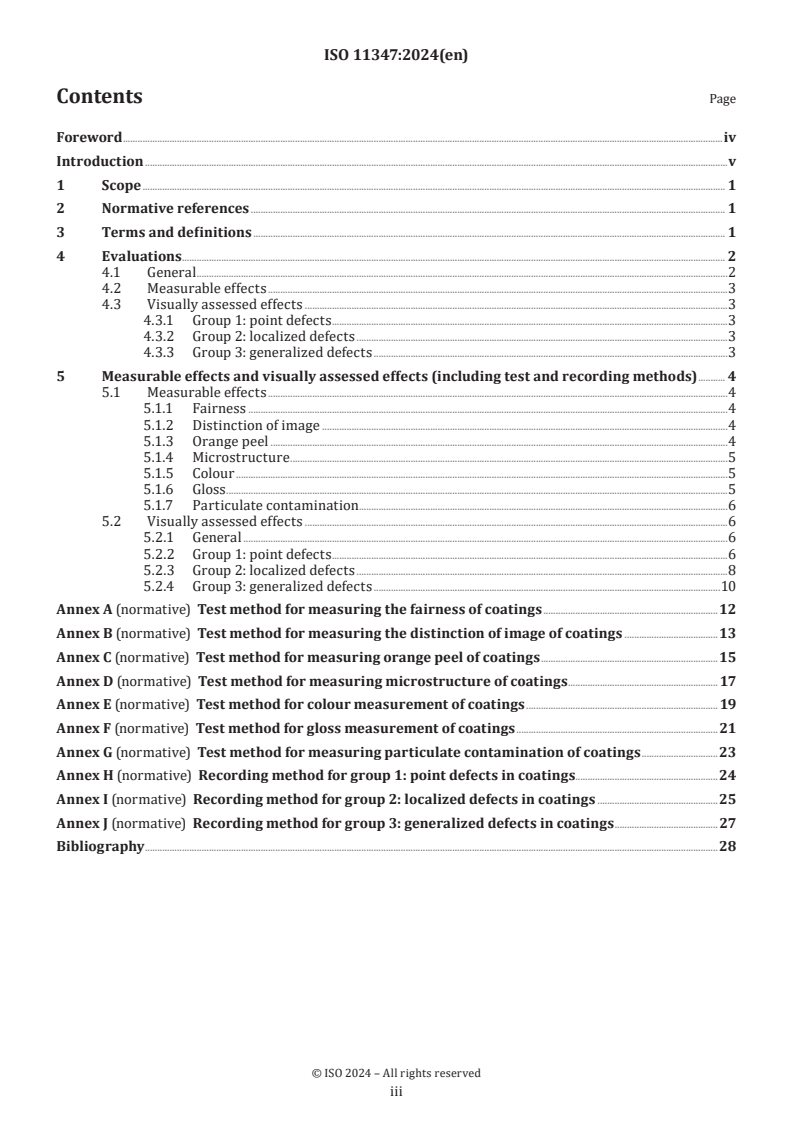
Contents Page
Foreword .iv
Introduction .v
1 Scope . 1
2 Normative references . 1
3 Terms and definitions . 1
4 Evaluations. 2
4.1 General .2
4.2 Measurable effects .3
4.3 Visually assessed effects .3
4.3.1 Group 1: point defects .3
4.3.2 Group 2: localized defects .3
4.3.3 Group 3: generalized defects .3
5 Measurable effects and visually assessed effects (including test and recording methods) . 4
5.1 Measurable effects .4
5.1.1 Fairness .4
5.1.2 Distinction of image .4
5.1.3 Orange peel .4
5.1.4 Microstructure .5
5.1.5 Colour .5
5.1.6 Gloss .5
5.1.7 Particulate contamination .6
5.2 Visually assessed effects .6
5.2.1 General .6
5.2.2 Group 1: point defects .6
5.2.3 Group 2: localized defects .8
5.2.4 Group 3: generalized defects .10
Annex A (normative) Test method for measuring the fairness of coatings .12
Annex B (normative) Test method for measuring the distinction of image of coatings .13
Annex C (normative) Test method for measuring orange peel of coatings .15
Annex D (normative) Test method for measuring microstructure of coatings . 17
Annex E (normative) Test method for colour measurement of coatings . 19
Annex F (normative) Test method for gloss measurement of coatings .21
Annex G (normative) Test method for measuring particulate contamination of coatings .23
Annex H (normative) Recording method for group 1: point defects in coatings.24
Annex I (normative) Recording method for group 2: localized defects in coatings .25
Annex J (normative) Recording method for group 3: generalized defects in coatings .27
Bibliography .28
iii
Foreword
ISO (the International Organization for Standardization) is a worldwide federation of national standards
bodies (ISO member bodies). The work of preparing International Standards is normally carried out through
ISO technical committees. Each member body interested in a subject for which a technical committee
has been established has the right to be represented on that committee. International organizations,
governmental and non-governmental, in liaison with ISO, also take part in the work. ISO collaborates closely
with the International Electrotechnical Commission (IEC) on all matters of electrotechnical standardization.
The procedures used to develop this document and those intended for its further maintenance are described
in the ISO/IEC Directives, Part 1. In particular, the different approval criteria needed for the different types
of ISO document should be noted. This document was drafted in accordance with the editorial rules of the
ISO/IEC Directives, Part 2 (see www.iso.org/directives).
ISO draws attention to the possibility that the implementation of this document may involve the use of (a)
patent(s). ISO takes no position concerning the evidence, validity or applicability of any claimed patent
rights in respect thereof. As of the date of publication of this document, ISO had not received notice of (a)
patent(s) which may be required to implement this document. However, implementers are cautioned that
this may not represent the latest information, which may be obtained from the patent database available at
www.iso.org/patents. ISO shall not be held responsible for identifying any or all such patent rights.
Any trade name used in this document is information given for the convenience of users and does not
constitute an endorsement.
For an explanation of the voluntary nature of standards, the meaning of ISO specific terms and expressions
related to conformity assessment, as well as information about ISO's adherence to the World Trade
Organization (WTO) principles in the Technical Barriers to Trade (TBT), see www.iso.org/iso/foreword.html.
This document was prepared by Technical Committee ISO/TC 8 Ships and marine technology, Subcommittee
SC 12, Large yachts.
This second edition cancels and replaces the first edition (ISO 11347:2012) which has been technically
revised.
The main changes are as follows:
— updated normative references and bibliography;
— updated the terms and definitions in Clause 3;
— updated the test and recording methods.
Any feedback or questions on this document should be directed to the user’s national standards body. A
complete listing of these bodies can be found at www.iso.org/members.html.
iv
Introduction
This document defines the measurement and assessment processes used for above waterline exterior
surface appearance and quality requirements for large yachts. The purpose of this document is to provide
practical measurement processes for the assessment of agreed acceptance criteria for the visual appearance
of yacht coatings.
Measurement processes are based on known generic inspection equipment that is available at the time of
producing this document. It is not the purpose of this document to provide an exhaustive list of inspection
equipment which is available at the time of publication.
v
International Standard ISO 11347:2024(en)
Ships and marine technology — Large yachts — Measurement
and assessment of the visual appearance of coatings
1 Scope
This document specifies technical requirements for the measurement and assessment of the visual
appearance of the superficial coating of large yachts. It is valid for coatings above the waterline.
For the purpose of this document, large yachts are of length of hull (L ) higher or equal to 24 m (as defined
H
according to ISO 8666), in use for sport or leisure and commercial operations.
This document describes how the final finish can be evaluated before its acceptance.
2 Normative references
The following documents are referred to in the text in such a way that some or all of their content constitutes
requirements of this document. For dated references, only the edition cited applies. For undated references,
the latest edition of the referenced document (including any amendments) applies.
ISO 2813, Paints and varnishes — Determination of gloss value at 20°, 60° and 85°
ISO 4618, Paints and varnishes — Vocabulary
ISO 4628-2, Paints and varnishes — Evaluation of degradation of coatings — Designation of quantity and size of
defects, and of intensity of uniform changes in appearance — Part 2: Assessment of degree of blistering
ISO 4628-4, Paints and varnishes — Evaluation of degradation of coatings — Designation of quantity and size of
defects, and of intensity of uniform changes in appearance — Part 4: Assessment of degree of cracking
3 Terms and definitions
For the purposes of this document, the terms and definitions given in ISO 4618 and the following apply.
ISO and IEC maintain terminology databases for use in standardization at the following addresses:
— ISO Online browsing platform: available at https:// www .iso .org/ obp
— IEC Electropedia: available at https:// www .electropedia .org/
3.1
clouding
appearance of lighter and darker patches in a top coat (3.12) film, most commonly observed in special effect
(metallic flake) coatings
3.2
curing
term in polymer chemistry that refers to the toughening or hardening of a polymer material by cross linking
of polymer chains
3.3
cut line
visible, raised, hard edge of a coating created when the applied coating borders masking/fine line tape
3.4
fairness
particular range of wavelengths of defects from 300 mm to 1 000 mm
3.5
fingerprint
damage of wet film due to accidental contact by either operators or objects, or both
3.6
hull
main body of a yacht which provides flotation
3.7
polishing mark
mark from top coat (3.12) polishing, resulting in low gloss areas
3.8
print through
visual effect of inconsistencies or faults in the underlying coating/substrate structure
3.9
sanding mark
raised or indented lines (curved or straight) visible in the top coat (3.12) as a result of the sanding process
under the top coat
3.10
striping
appearance of lighter and darker repetitive shades in a top coat (3.12) film, most commonly observed in
special effect (metallic flake) coatings
3.11
surface texture
local deviation of a surface from a perfectly flat plane, generally measured in terms of its roughness,
waviness and form
3.12
top coat
final coat of a coating system
3.13
visual observation
process conducted by an observer with normal or corrected-to-normal vision without magnification under a
uniform artificial illuminance between 500 lx and 1 000 lx, or normal daylight
Note 1 to entry: Visual observations should be conducted at a distance of >75 cm (or approximate arm’s length) and at
an incident angle of ≥30°.
3.14
wipe mark
surface disturbance in the top coat (3.12) paint film as a result of a substrate contamination
4 Evaluations
4.1 General
This document specifies methods for evaluating the appearance of the external coating of large yachts. This
evaluation can be carried out by using a combination of measurements using either equipment or visual
observations, or both.
Even if measured separately, measurements and visual observations should converge to determine the
overall assessment of visual appearance.
4.2 Measurable effects
The following effects should be measured when evaluating fairness:
— distinction of image (DOI)
— orange peel
— microstructure
— colour
— gloss (see ISO 2813)
— particulate contamination
For the above parameters provide descriptions, measurement and test methods.
4.3 Visually assessed effects
4.3.1 Group 1: point defects
— Cratering
— Fisheyes
— Dimples
— Pinholes
4.3.2 Group 2: localized defects
— Sags/runs
— Brush marks
— Sanding marks
— Wipe marks
— Polishing marks
— Water marks
— Cut lines
— Tape marks
— Blistering, which shall be measured in accordance with ISO 4628-2
— Cracking/crazing, which shall be measured in accordance with ISO 4628-4
4.3.3 Group 3: generalized defects
— Blushing
— Blooming
— Print through
— Over spray
— Cissing
— Striping/Clouding
Other visual effects including wrinkling, flaking, peeling, cracking, fish eyes, fingerprints, and lack of opacity
should not be present in the coated surfaces of large yachts.
5 Measurable effects and visually assessed effects (including test and recording
methods)
5.1 Measurable effects
5.1.1 Fairness
5.1.1.1 Description
Fairness relates to the large-scale smoothness and smooth distribution of reflection lines on both a flat and
a curved surface.
Fairness may be measured at any point during the fairing and coating processes.
5.1.1.2 Test method
For the purposes of this document, a measurement by linear bar and feeler gauge shall be performed.
Fairness measurement shall be in accordance with the test method outlined in Annex A.
5.1.2 Distinction of image
5.1.2.1 Description
Distinction of image (DOI) is a measure of how clearly a reflected image appears in a reflective surface.
5.1.2.2 Test method
For the purposes of this document, an optoelectronic measurement device (such as wave-scan technology,
goniophotometer, or equivalent) shall be used.
DOI measurement shall be in accordance with the test method outlined in Annex B.
5.1.3 Orange peel
5.1.3.1 Description
Orange peel is a coating property resulting in a surface appearance characteristic of the skin of an orange.
The coarseness of the resulting texture can vary and has a significant influence on the image-forming
qualities of the finish. Surface profiles of gloss and high gloss coatings are measured in wavelengths in the
range of 0,1 mm to 30 mm.
5.1.3.2 Test method
For the purposes of this document, an optoelectronic measurement device shall be used.
Orange peel measurement shall be in accordance with the test method outlined in Annex C.
5.1.4 Microstructure
5.1.4.1 Description
Microstructure refers to structures smaller than 0,1 mm within the paint film that influence the visual
perception.
5.1.4.2 Test method
For the purposes of this document, an optoelectronic measurement device (such as wave-scan
technology, goniophotometer, or equivalent) shall be used. A wave-scan device measures dullness, while a
goniophotometer measures haze value.
Microstructure measurement shall be in accordance with the test method outlined in Annex D.
5.1.5 Colour
5.1.5.1 Description
Visual colour perception is influenced by varying colour sensitivity in each person and by varying
environmental conditions such as lightness and colour. Colour perception mainly depends on three factors:
light source, observer and surface condition.
The light source and observer are defined by the International Commission on Illumination (CIE) and their
spectral functions are stored in the spectrophotometers for colour measurement. Optical properties of a
surface are then the only variables that are required to be measured.
To monitor colour consistency in a project, a standard reference shall be established and evaluated in terms
of deviation from the standard and not in absolute value.
5.1.5.2 Test method
For the purposes of this document, a spectrophotometer shall be used unless otherwise specified. The
spectrophotometer measures the amount of light reflected by a coated surface along the wavelength
spectrum of visible light, and the readings are taken from the spectrum data.
The colour measurement shall be in accordance with the test method outlined in Annex E.
5.1.6 Gloss
5.1.6.1 Description
Gloss is an optical property of a surface, characterized by its ability to reflect light specularly. The factors
involved in visual evaluation are the surface condition, the illumination and the observer. On a glossy surface,
the majority of the light is reflected in the specular direction. The specular gloss, or specular reflection
measurement, is a reading of the amount of reflected light intensity and is compared to the amount of
reflected light from a black glass standard with a defined refractive index.
5.1.6.2 Test method
For the purposes of this document, a specular gloss-meter shall be used as defined in ISO 2813. The gloss-meter
measures the specular reflection. The light intensity is registered over a small range of reflection angles.
NOTE There are three different geometries defined. Within super yacht measurements, typically 60 degree
geometry is used. For high gloss, 20 degree geometry can be used and for low gloss, 85 degree geometry can also be
used. All measurement values are in gloss units (GU).
Gloss measurement shall be in accordance with the test method outlined in Annex F.
5.1.7 Particulate contamination
5.1.7.1 Description
Particulate contamination is when particles of dust, hair or fibres are embedded within the coating during
application or before complete curing.
Surface particles on the coating that can be removed through washing or wiping with a chamois, without
leaving a mark may be excluded from the scope of this document.
Visibility of particles can vary according to the observation point with respect to the surface and the light
conditions.
5.1.7.2 Test method
For the purposes of this document, a measurement by a magnifier with a scale or a ruler shall be performed.
Particle number and size measurement shall be in accordance with the test method outlined in Annex G.
5.2 Visually assessed effects
5.2.1 General
Visibility of the defects can vary according to the observation point with respect to the surface and the
light conditions. Group 1 (5.2.2) consists of point defects which are typically isolated or observed in small
clusters. Group 2 (5.2.3) consists of localized defects which can be observed as a single defect or a cluster
of defects in one or more localized areas. Group 3 (5.2.4) consists of generalized defects typically observed
over large areas.
5.2.2 Group 1: point defects
5.2.2.1 Cratering
5.2.2.1.1 Description
Formation in a film or coat of small circular depressions that persist after drying. Figure 1 illustrates
cratering.
Key
1 coating layer
2 substrate
Figure 1 — Cratering
5.2.2.1.2 Recording method
Cratering shall be recorded in accordance with the method outlined in Annex H.
5.2.2.2 Fisheyes
5.2.2.2.1 Description
A fisheye is a small spot of lack of paint, occasionally encircled by a ring of paint thicker than the surrounding
paint film, caused by a contamination on the surface before application. Figure 2 shows a fisheye.
Key
1 coating layer
2 substrate
Figure 2 — Fisheye
5.2.2.2.2 Recording method
Fisheyes shall be recorded in accordance with the method outlined in Annex H.
5.2.2.3 Dimples
5.2.2.3.1 Description
Dimples are a small circular depression in a top coat paint film that does not reach the underlying substrate.
Figure 3 illustrates a dimple.
Key
1 coating layer
2 substrate
Figure 3 — Dimple
5.2.2.3.2 Recording method
Dimple recording requirements shall be in accordance with the recording method outlined in Annex H.
5.2.2.4 Pinholes
5.2.2.4.1 Description
A pinhole is the presence of a small hole in the film or coat, resembling that made by a pin (see ISO 4618).
Figure 4 shows a pinhole.
Key
1 coating layer
2 substrate
Figure 4 — Pinhole
5.2.2.4.2 Recording method
Pinhole shall be recorded in accordance with the method outlined in Annex H.
5.2.3 Group 2: localized defects
5.2.3.1 Sags
5.2.3.1.1 Description
Sags occur when a number of factors influencing the flow of the wet coat film result in visible downward
movements before paint curing.
5.2.3.1.2 Recording method
To record the extent of a sag, a straight ruler or similar equipment shall be used.
Sags shall be recorded in accordance with the method outlined in Annex I.
5.2.3.2 Brush marks
5.2.3.2.1 Description
Brush marks are ridges in the paintwork following a brush application, where the paint has not flowed out
and still exhibits the brush tip marks.
5.2.3.2.2 Recording method
Brush marks shall be recorded in accordance with the method outlined in Annex I.
5.2.3.3 Sanding marks
5.2.3.3.1 Description
Sanding marks occur when scratches and lines originating from mechanical or manual sanding, performed
as a means of preparing the surface of the substrate or a previous paint layer, appear in the surface after the
top coat has been applied.
5.2.3.3.2 Recording method
Sanding marks shall be recorded in accordance with the method outlined in Annex I.
5.2.3.4 Wipe marks
5.2.3.4.1 Description
Wipe marks are a surface disturbance in the top coat paint film as a result of a substrate contamination, i.e.
typically residual cleaning solvent or other wipe residues.
5.2.3.4.2 Recording method
Wipe marks shall be recorded in accordance with the method outlined in Annex I.
5.2.3.5 Polishing marks
5.2.3.5.1 Description
Polishing marks are ultra-fine scratches and marks on polished areas.
5.2.3.5.2 Recording method
Polishing marks shall be recorded in accordance with the method outlined in Annex I.
5.2.3.6 Water marks
5.2.3.6.1 Description
Water marks occur when water stains or etchings appear on the coated surface. They are usually circular,
white- or light-coloured, caused by mineral deposits and pollutants from the environment.
5.2.3.6.2 Recording method
Watermarks shall be recorded in accordance with the method outlined in Annex I.
5.2.3.7 Cut lines
5.2.3.7.1 Description
Cut lines are the visible, raised, hard edge of a coating created when the applied coating borders masking/
fine line tape.
When the masking tape is removed, a raised, hard edge is created. If the applied wet film thickness and the
consequent dry film thickness are high, then this raised edge can be highly visible.
5.2.3.7.2 Recording method
Cut lines shall be recorded in accordance with the method outlined in Annex I.
5.2.3.8 Tape marks
5.2.3.8.1 Description
A tape mark is a down-glossing (sometimes contaminated with tape residues) as a result of tape being
applied to an insufficiently cured paint coating or left on the coating for too long.
5.2.3.8.2 Recording method
Tape marks shall be recorded in accordance with the method outlined in Annex I.
5.2.3.9 Blistering
5.2.3.9.1 Description
Blisters appear as bubbles protruding from the coated surface, or as small holes and craters in the top coat,
due to opening or release of bubbles.
5.2.3.9.2 Recording method
For the purposes of this document, counting and
...