

ISO 17604:2015
(Main)Microbiology of the food chain — Carcass sampling for microbiological analysis
General Information
- Abstract
ISO 17604:2015 specifies sampling methods for the detection and enumeration of microorganisms on the surface of carcasses or parts of carcasses of slaughtered meat animals. The microbiological sampling can be carried out as part of - process hygiene control (to validate and or verify process control, e.g. total counts and Enterobacteriaceae) in slaughter establishments for large mammals, poultry, and game, - risk-based assurance systems for product safety, and - monitoring or surveillance programmes for the prevalence and/or numbers of pathogenic microorganisms. This International Standard includes the use of excision and swabbing techniques depending on the reason for sample collection. It also includes the use of carcass rinsing for the examination of carcasses of poultry and some small animals. Annex A shows sampling sites on the carcasses of various animal species.
- Status
- Published
- Publication Date
- 25-Aug-2015
- Technical Committee
- ISO/TC 34/SC 9 - Microbiology
- Drafting Committee
- ISO/TC 34/SC 9 - Microbiology
- Current Stage
- 9093 - International Standard confirmed
- Start Date
- 10-Jun-2026
- Completion Date
- 29-Aug-2026
Buy Documents


ISO 17604:2015 - Microbiology of the food chain -- Carcass sampling for microbiological analysis

ISO 17604:2015 - Microbiology of the food chain — Carcass sampling for microbiological analysis/26/2015


ISO 17604:2015 - Microbiologie de la chaîne alimentaire -- Prélevement d'échantillons sur des carcasses en vue de leur analyse microbiologique

ISO 17604:2015 - Microbiologie de la chaîne alimentaire — Prélèvement d'échantillons sur des carcasses en vue de leur analyse microbiologique/19/2015
Overview
ISO 17604:2015 - Microbiology of the food chain - Carcass sampling for microbiological analysis - specifies internationally harmonized methods for collecting microbiological samples from the surfaces of slaughtered animal carcasses. The standard covers sampling for process hygiene control, risk‑based assurance systems (including HACCP‑based verification), and monitoring or surveillance programmes to detect and enumerate indicator organisms and pathogens on carcasses of large mammals, poultry, small animals and game. Annex A identifies typical sampling sites on different species.
Key topics and technical requirements
- Sampling objectives and plans: Sampling must be driven by the purpose (process control, surveillance, risk‑based systems) and consider production volume, slaughterhouse practices, and historical monitoring data.
- Sampling points on the production line: Examples include after dehiding/flaying, after evisceration, after washing or polishing, immediately before or after chilling - choose points by risk and likelihood of contamination.
- Sampling sites on carcasses: Select areas most likely to be contaminated; consistency in site selection is important for trend analysis. Annex A illustrates frequent high‑risk sites.
- Sampling techniques: The standard permits and describes excision methods (cork borer, template excision, skin sampling), swabbing methods (wet/dry stick swabs, sponge/tampon/small cloth), and carcass rinsing (commonly used for poultry and some small animals). Choice depends on sensitivity required, practicality and whether destructive sampling is acceptable.
- Sample handling: Guidance covers storage, transport and initial laboratory preparation (swabs, excised tissue, and rinses) prior to microbiological examination.
- Repeatability and method performance: Notes that excision and rinsing often give better repeatability than swabbing, but excision samples a smaller area and is destructive.
Practical applications and users
ISO 17604:2015 is applicable to:
- Slaughterhouse QA and process hygiene teams implementing routine verification and validation of sanitation and HACCP controls.
- Food safety laboratories performing detection and enumeration of total counts, Enterobacteriaceae and targeted pathogens.
- Regulators and public‑health agencies designing monitoring and surveillance programmes to assess prevalence of pathogens.
- Meat processors and exporters seeking harmonized sampling methods for trade and compliance.
Practical benefits include improved comparability of results, informed risk‑based sampling strategies, and more reliable trend analysis for process control and food safety assurance.
Related standards
ISO 17604 references and complements general microbiological preparation and examination standards such as:
- ISO 6887‑1 / ISO 6887‑2 (sample preparation and dilutions)
- ISO 7218 (general requirements and guidance for microbiological examinations)
Keywords: ISO 17604:2015, carcass sampling, microbiology of the food chain, excision, swabbing, carcass rinsing, sampling plan, slaughter establishments, poultry, large mammals, HACCP, process hygiene control, surveillance programmes.
Relations
- Effective Date
- 25-Aug-2026
- Effective Date
- 25-Aug-2026
- Effective Date
- 25-Aug-2026
- Effective Date
- 12-Feb-2026
- Effective Date
- 06-Jun-2022
- Effective Date
- 22-Sep-2012
- Effective Date
- 22-Sep-2012
Buy Documents
ISO 17604:2015 - Microbiology of the food chain -- Carcass sampling for microbiological analysis
ISO 17604:2015 - Microbiology of the food chain — Carcass sampling for microbiological analysis/26/2015
ISO 17604:2015 - Microbiologie de la chaîne alimentaire -- Prélevement d'échantillons sur des carcasses en vue de leur analyse microbiologique
ISO 17604:2015 - Microbiologie de la chaîne alimentaire — Prélèvement d'échantillons sur des carcasses en vue de leur analyse microbiologique/19/2015
Frequently Asked Questions
ISO 17604:2015 is a standard published by the International Organization for Standardization (ISO). Its full title is "Microbiology of the food chain — Carcass sampling for microbiological analysis". This standard covers: ISO 17604:2015 specifies sampling methods for the detection and enumeration of microorganisms on the surface of carcasses or parts of carcasses of slaughtered meat animals. The microbiological sampling can be carried out as part of - process hygiene control (to validate and or verify process control, e.g. total counts and Enterobacteriaceae) in slaughter establishments for large mammals, poultry, and game, - risk-based assurance systems for product safety, and - monitoring or surveillance programmes for the prevalence and/or numbers of pathogenic microorganisms. This International Standard includes the use of excision and swabbing techniques depending on the reason for sample collection. It also includes the use of carcass rinsing for the examination of carcasses of poultry and some small animals. Annex A shows sampling sites on the carcasses of various animal species.
ISO 17604:2015 specifies sampling methods for the detection and enumeration of microorganisms on the surface of carcasses or parts of carcasses of slaughtered meat animals. The microbiological sampling can be carried out as part of - process hygiene control (to validate and or verify process control, e.g. total counts and Enterobacteriaceae) in slaughter establishments for large mammals, poultry, and game, - risk-based assurance systems for product safety, and - monitoring or surveillance programmes for the prevalence and/or numbers of pathogenic microorganisms. This International Standard includes the use of excision and swabbing techniques depending on the reason for sample collection. It also includes the use of carcass rinsing for the examination of carcasses of poultry and some small animals. Annex A shows sampling sites on the carcasses of various animal species.
ISO 17604:2015 is classified under the following ICS (International Classification for Standards) categories: 07.100.30 - Food microbiology. The ICS classification helps identify the subject area and facilitates finding related standards.
ISO 17604:2015 has the following relationships with other standards: It is inter standard links to EN ISO 23548:2025, EN ISO 6887-2:2017, EN ISO 20042:2021, EN ISO 17604:2015, ISO/IEC 8825-3:2002/Amd 1:2005, ISO 17604:2003/Amd 1:2009, ISO 17604:2003. Understanding these relationships helps ensure you are using the most current and applicable version of the standard.
ISO 17604:2015 is available in PDF format for immediate download after purchase. The document can be added to your cart and obtained through the secure checkout process. Digital delivery ensures instant access to the complete standard document.
Standards Content (Sample)
INTERNATIONAL ISO
STANDARD 17604
Second edition
2015-08-15
Microbiology of the food chain —
Carcass sampling for microbiological
analysis
Microbiologie de la chaîne alimentaire — Prélèvement d’échantillons
sur des carcasses en vue de leur analyse microbiologique
Reference number
©
ISO 2015
© ISO 2015, Published in Switzerland
All rights reserved. Unless otherwise specified, no part of this publication may be reproduced or utilized otherwise in any form
or by any means, electronic or mechanical, including photocopying, or posting on the internet or an intranet, without prior
written permission. Permission can be requested from either ISO at the address below or ISO’s member body in the country of
the requester.
ISO copyright office
Ch. de Blandonnet 8 • CP 401
CH-1214 Vernier, Geneva, Switzerland
Tel. +41 22 749 01 11
Fax +41 22 749 09 47
copyright@iso.org
www.iso.org
ii © ISO 2015 – All rights reserved
Contents Page
Foreword .iv
Introduction .v
1 Scope . 1
2 Normative references . 1
3 Terms and definitions . 1
4 General principles . 2
5 Sampling plans . 2
6 Sampling points on the production line . 3
7 Sampling sites on carcasses . 3
7.1 Large mammals . 3
7.2 Poultry, small mammals, and other small animals. 4
7.3 Game . 4
8 Sampling techniques . 4
8.1 General . 4
8.2 Excision methods . 4
8.2.1 Cork borer method . 4
8.2.2 Template excision method . 5
8.2.3 Skin sampling. 5
8.3 Swabbing methods . 6
8.3.1 Wet and dry stick swab method . 6
8.3.2 Sponge, tampon swab, and small cloth method . 6
8.4 Carcass rinsing method . 7
8.4.1 Reagent . . 7
8.4.2 Equipment . 7
8.4.3 Collection of samples . 7
9 Storage and transport of samples . 8
10 Microbiological examination of samples . 8
10.1 General . 8
10.2 Initial preparation of samples . 8
10.2.1 Swabbing methods . 8
10.2.2 Excised samples . 8
10.2.3 Carcass rinse samples. 8
10.3 Enumeration and detection of microorganisms . 8
Annex A (informative) Sampling sites . 9
Bibliography .13
Foreword
ISO (the International Organization for Standardization) is a worldwide federation of national standards
bodies (ISO member bodies). The work of preparing International Standards is normally carried out
through ISO technical committees. Each member body interested in a subject for which a technical
committee has been established has the right to be represented on that committee. International
organizations, governmental and non-governmental, in liaison with ISO, also take part in the work.
ISO collaborates closely with the International Electrotechnical Commission (IEC) on all matters of
electrotechnical standardization.
The procedures used to develop this document and those intended for its further maintenance are
described in the ISO/IEC Directives, Part 1. In particular the different approval criteria needed for the
different types of ISO documents should be noted. This document was drafted in accordance with the
editorial rules of the ISO/IEC Directives, Part 2 (www.iso.org/directives).
Attention is drawn to the possibility that some of the elements of this document may be the subject of
patent rights. ISO shall not be held responsible for identifying any or all such patent rights. Details of
any patent rights identified during the development of the document will be in the Introduction and/or
on the ISO list of patent declarations received (www.iso.org/patents).
Any trade name used in this document is information given for the convenience of users and does not
constitute an endorsement.
For an explanation on the meaning of ISO specific terms and expressions related to conformity
assessment, as well as information about ISO’s adherence to the WTO principles in the Technical
Barriers to Trade (TBT) see the following URL: Foreword - Supplementary information.
The committee responsible for this document is ISO/TC 34, Food products, Subcommittee SC 9,
Microbiology.
This second edition cancels and replaces the first edition (ISO 17604:2003), which has been technically
revised. It also incorporates the Amendment ISO 17604:2003/Amd.1:2009.
iv © ISO 2015 – All rights reserved
Introduction
It is generally agreed that the determination of microbial counts and the prevalence and/or numbers
of pathogenic microorganisms on carcasses is essential for validation and verification in risk-based
slaughter hygiene assurance systems [e.g. those employing the hazard analysis critical control points
(HACCP) principles and quality assurance systems].
Moreover, many laboratories are involved in (regional, national, and international) monitoring or
surveillance programmes on the prevalence and/or counts of pathogenic microorganisms to gather
information for risk assessment. The design of such monitoring and surveillance programmes will
benefit from the use of standardized and internationally accepted sampling procedures.
A harmonized sampling method, as described in this International Standard, can also be of interest for
trade in meat and meat products.
INTERNATIONAL STANDARD ISO 17604:2015(E)
Microbiology of the food chain — Carcass sampling for
microbiological analysis
1 Scope
This International Standard specifies sampling methods for the detection and enumeration of
microorganisms on the surface of carcasses or parts of carcasses of slaughtered meat animals. The
microbiological sampling can be carried out as part of
— process hygiene control (to validate and or verify process control, e.g. total counts and
Enterobacteriaceae) in slaughter establishments for large mammals, poultry, and game,
— risk-based assurance systems for product safety, and
— monitoring or surveillance programmes for the prevalence and/or numbers of pathogenic
microorganisms.
This International Standard includes the use of excision and swabbing techniques depending on the reason
for sample collection. It also includes the use of carcass rinsing for the examination of carcasses of poultry
and some small animals. Annex A shows sampling sites on the carcasses of various animal species.
2 Normative references
The following documents, in whole or in part, are normatively referenced in this document and are
indispensable for its application. For dated references, only the edition cited applies. For undated
references, the latest edition of the referenced document (including any amendments) applies.
ISO 6887-1, Microbiology of food and animal feeding stuffs — Preparation of test samples, initial suspension
and decimal dilutions for microbiological examination — Part 1: General rules for the preparation of the
initial suspension and decimal dilutions
ISO 6887-2, Microbiology of food and animal feeding stuffs — Preparation of test samples, initial suspension
and decimal dilutions for microbiological examination — Part 2: Specific rules for the preparation of meat
and meat products
ISO 7218, Microbiology of food and animal feeding stuffs — General requirements and guidance for
microbiological examinations
3 Terms and definitions
For the purposes of this document, the following terms and definitions apply.
3.1
carcass
body of an animal after slaughter and dressing
3.2
excision technique
removal of measured areas of the surface tissue or skin by cutting
3.3
game
wild mammal or bird that is hunted for human consumption and farmed mammal or bird, including
ratite (e.g. ostrich, emu), other than domestic ungulates and birds
3.4
large mammal
cattle (including buffaloes, bison), sheep, pigs (including wild boar), various types of deer (including
reindeer, antelopes), horses (including donkeys and mules)
3.5
poultry
small-sized or medium-sized bird
EXAMPLE chicken, duck, goose, turkey, pigeon, pheasant, quail, grouse.
3.6
sampling plan
description of the examination of a required number of sample units by a defined analytical method,
including the criteria for acceptance
3.7
sampling point
stage on the production line where a sample is taken
3.8
sampling site
place on the carcass where a sample is taken
3.9
small mammal and other small animal
lagomorph (e.g. hare, rabbit), rodent, turtle, frog
3.10
swabbing method
technique using absorbent material attached to the end of a stick or wire, or a sponge or piece of
absorbent material, to pick up microorganisms from surfaces
4 General principles
The choice of sampling method depends mainly on the aim of the microbiological examination, the
sensitivity required, and practical considerations. Excision, swabbing, and rinsing methods may be
used, as permitted by this International Standard.
The excision of surface tissue generally harvests a higher number of microorganisms from the surface
than other methods. Not all the microorganisms harvested will grow on the media and under the
incubation conditions used. The repeatability and reproducibility of excision and rinsing methods are
less variable than swabbing, because swabbing methods are more difficult to standardize.
However, only a small proportion of the carcass is sampled by excision methods, which might result in
significant inaccuracies when total contamination is low and heterogeneously distributed, or when the
presence of the target microorganisms is sparse. Excision methods are destructive, and can sometimes
affect the value of the meat, but are preferred when sampling frozen surfaces.
Swabbing or rinsing techniques enable the examination of larger areas. Smaller areas targeting verified
areas of greatest contamination may be examined using either excision or swabbing methods. Rinsing
the whole carcass is an effective and practicable method for the examination of poultry (excluding large
bird carcasses) and carcasses of some small mammals and other small animals.
5 Sampling plans
Sampling plans should relate to the purpose of testing and be applied according to the circumstances.
They are not considered in detail.
2 © ISO 2015 – All rights reserved
The process stage, the time since start-up of the slaughtering process, the frequency of sampling, and, if
relevant, the following, should be taken into account:
— the slaughterhouse practices for each animal;
— the design of risk-based process control assurance or harmonized monitoring programmes;
— the production volume;
— previous results of monitoring (trend analysis);
— the prevalence of relevant pathogenic microorganisms in the region from which the animal originates;
— relevant national, regional and/or international regulations.
In the case of process control, the time and frequency of sampling should relate to the level of
slaughter hygiene.
In the case of monitoring and surveillance for pathogens, the sampling time, sites on the carcass, and
frequency should maximize the chance of detecting and/or counting the pathogens sought.
6 Sampling points on the production line
Sampling points should be selected according to risk-based principles, and relate, when relevant, to the
higher probability of detecting contamination during the process or at points in the slaughter process,
as appropriate to measure the hygiene of specific production steps or the entire slaughter process.
Examples of sampling points are the following:
— after the carcass polishing machine (pigs);
— after the carcass washing machine (pigs and poultry);
— after flaying (dehiding) (large mammals, game slaughtered in an abattoir, and others);
— after evisceration (all animals);
— immediately before chilling or freezing (all animals);
— immediately after chilling (poultry, small mammals, and other small animals);
— after chilling or freezing (all animals);
— in the chill room (all animals).
During the chilling period, depending on the chill room conditions, microorganisms might become
sublethally damaged or die, might be overgrown by psychrotrophic microorganisms, or they might
become more firmly attached to the meat, resulting in underestimation. This effect will be reduced if
the sampling is carried out as soon as possible after slaughter.
7 Sampling sites on carcasses
7.1 Large mammals
The sampling sites chosen depend on the slaughterhouse practices, which can vary for different
slaughterhouses and for different animals. The purpose is to examine the sites with the highest
prevalence and/or level of contamination (see Table A.1). Figure A.1, Figure A.2, and Figure A.3 illustrate
the sites most often identified as more highly contaminated. Other sampling sites may be specified in
regulations, in guides of good practices, or in other techn
...
INTERNATIONAL ISO
STANDARD 17604
Second edition
2015-08-15
Microbiology of the food chain —
Carcass sampling for microbiological
analysis
Microbiologie de la chaîne alimentaire — Prélèvement d’échantillons
sur des carcasses en vue de leur analyse microbiologique
Reference number
©
ISO 2015
© ISO 2015, Published in Switzerland
All rights reserved. Unless otherwise specified, no part of this publication may be reproduced or utilized otherwise in any form
or by any means, electronic or mechanical, including photocopying, or posting on the internet or an intranet, without prior
written permission. Permission can be requested from either ISO at the address below or ISO’s member body in the country of
the requester.
ISO copyright office
Ch. de Blandonnet 8 • CP 401
CH-1214 Vernier, Geneva, Switzerland
Tel. +41 22 749 01 11
Fax +41 22 749 09 47
copyright@iso.org
www.iso.org
ii © ISO 2015 – All rights reserved
Contents Page
Foreword .iv
Introduction .v
1 Scope . 1
2 Normative references . 1
3 Terms and definitions . 1
4 General principles . 2
5 Sampling plans . 2
6 Sampling points on the production line . 3
7 Sampling sites on carcasses . 3
7.1 Large mammals . 3
7.2 Poultry, small mammals, and other small animals. 4
7.3 Game . 4
8 Sampling techniques . 4
8.1 General . 4
8.2 Excision methods . 4
8.2.1 Cork borer method . 4
8.2.2 Template excision method . 5
8.2.3 Skin sampling. 5
8.3 Swabbing methods . 6
8.3.1 Wet and dry stick swab method . 6
8.3.2 Sponge, tampon swab, and small cloth method . 6
8.4 Carcass rinsing method . 7
8.4.1 Reagent . . 7
8.4.2 Equipment . 7
8.4.3 Collection of samples . 7
9 Storage and transport of samples . 8
10 Microbiological examination of samples . 8
10.1 General . 8
10.2 Initial preparation of samples . 8
10.2.1 Swabbing methods . 8
10.2.2 Excised samples . 8
10.2.3 Carcass rinse samples. 8
10.3 Enumeration and detection of microorganisms . 8
Annex A (informative) Sampling sites . 9
Bibliography .13
Foreword
ISO (the International Organization for Standardization) is a worldwide federation of national standards
bodies (ISO member bodies). The work of preparing International Standards is normally carried out
through ISO technical committees. Each member body interested in a subject for which a technical
committee has been established has the right to be represented on that committee. International
organizations, governmental and non-governmental, in liaison with ISO, also take part in the work.
ISO collaborates closely with the International Electrotechnical Commission (IEC) on all matters of
electrotechnical standardization.
The procedures used to develop this document and those intended for its further maintenance are
described in the ISO/IEC Directives, Part 1. In particular the different approval criteria needed for the
different types of ISO documents should be noted. This document was drafted in accordance with the
editorial rules of the ISO/IEC Directives, Part 2 (www.iso.org/directives).
Attention is drawn to the possibility that some of the elements of this document may be the subject of
patent rights. ISO shall not be held responsible for identifying any or all such patent rights. Details of
any patent rights identified during the development of the document will be in the Introduction and/or
on the ISO list of patent declarations received (www.iso.org/patents).
Any trade name used in this document is information given for the convenience of users and does not
constitute an endorsement.
For an explanation on the meaning of ISO specific terms and expressions related to conformity
assessment, as well as information about ISO’s adherence to the WTO principles in the Technical
Barriers to Trade (TBT) see the following URL: Foreword - Supplementary information.
The committee responsible for this document is ISO/TC 34, Food products, Subcommittee SC 9,
Microbiology.
This second edition cancels and replaces the first edition (ISO 17604:2003), which has been technically
revised. It also incorporates the Amendment ISO 17604:2003/Amd.1:2009.
iv © ISO 2015 – All rights reserved
Introduction
It is generally agreed that the determination of microbial counts and the prevalence and/or numbers
of pathogenic microorganisms on carcasses is essential for validation and verification in risk-based
slaughter hygiene assurance systems [e.g. those employing the hazard analysis critical control points
(HACCP) principles and quality assurance systems].
Moreover, many laboratories are involved in (regional, national, and international) monitoring or
surveillance programmes on the prevalence and/or counts of pathogenic microorganisms to gather
information for risk assessment. The design of such monitoring and surveillance programmes will
benefit from the use of standardized and internationally accepted sampling procedures.
A harmonized sampling method, as described in this International Standard, can also be of interest for
trade in meat and meat products.
INTERNATIONAL STANDARD ISO 17604:2015(E)
Microbiology of the food chain — Carcass sampling for
microbiological analysis
1 Scope
This International Standard specifies sampling methods for the detection and enumeration of
microorganisms on the surface of carcasses or parts of carcasses of slaughtered meat animals. The
microbiological sampling can be carried out as part of
— process hygiene control (to validate and or verify process control, e.g. total counts and
Enterobacteriaceae) in slaughter establishments for large mammals, poultry, and game,
— risk-based assurance systems for product safety, and
— monitoring or surveillance programmes for the prevalence and/or numbers of pathogenic
microorganisms.
This International Standard includes the use of excision and swabbing techniques depending on the reason
for sample collection. It also includes the use of carcass rinsing for the examination of carcasses of poultry
and some small animals. Annex A shows sampling sites on the carcasses of various animal species.
2 Normative references
The following documents, in whole or in part, are normatively referenced in this document and are
indispensable for its application. For dated references, only the edition cited applies. For undated
references, the latest edition of the referenced document (including any amendments) applies.
ISO 6887-1, Microbiology of food and animal feeding stuffs — Preparation of test samples, initial suspension
and decimal dilutions for microbiological examination — Part 1: General rules for the preparation of the
initial suspension and decimal dilutions
ISO 6887-2, Microbiology of food and animal feeding stuffs — Preparation of test samples, initial suspension
and decimal dilutions for microbiological examination — Part 2: Specific rules for the preparation of meat
and meat products
ISO 7218, Microbiology of food and animal feeding stuffs — General requirements and guidance for
microbiological examinations
3 Terms and definitions
For the purposes of this document, the following terms and definitions apply.
3.1
carcass
body of an animal after slaughter and dressing
3.2
excision technique
removal of measured areas of the surface tissue or skin by cutting
3.3
game
wild mammal or bird that is hunted for human consumption and farmed mammal or bird, including
ratite (e.g. ostrich, emu), other than domestic ungulates and birds
3.4
large mammal
cattle (including buffaloes, bison), sheep, pigs (including wild boar), various types of deer (including
reindeer, antelopes), horses (including donkeys and mules)
3.5
poultry
small-sized or medium-sized bird
EXAMPLE chicken, duck, goose, turkey, pigeon, pheasant, quail, grouse.
3.6
sampling plan
description of the examination of a required number of sample units by a defined analytical method,
including the criteria for acceptance
3.7
sampling point
stage on the production line where a sample is taken
3.8
sampling site
place on the carcass where a sample is taken
3.9
small mammal and other small animal
lagomorph (e.g. hare, rabbit), rodent, turtle, frog
3.10
swabbing method
technique using absorbent material attached to the end of a stick or wire, or a sponge or piece of
absorbent material, to pick up microorganisms from surfaces
4 General principles
The choice of sampling method depends mainly on the aim of the microbiological examination, the
sensitivity required, and practical considerations. Excision, swabbing, and rinsing methods may be
used, as permitted by this International Standard.
The excision of surface tissue generally harvests a higher number of microorganisms from the surface
than other methods. Not all the microorganisms harvested will grow on the media and under the
incubation conditions used. The repeatability and reproducibility of excision and rinsing methods are
less variable than swabbing, because swabbing methods are more difficult to standardize.
However, only a small proportion of the carcass is sampled by excision methods, which might result in
significant inaccuracies when total contamination is low and heterogeneously distributed, or when the
presence of the target microorganisms is sparse. Excision methods are destructive, and can sometimes
affect the value of the meat, but are preferred when sampling frozen surfaces.
Swabbing or rinsing techniques enable the examination of larger areas. Smaller areas targeting verified
areas of greatest contamination may be examined using either excision or swabbing methods. Rinsing
the whole carcass is an effective and practicable method for the examination of poultry (excluding large
bird carcasses) and carcasses of some small mammals and other small animals.
5 Sampling plans
Sampling plans should relate to the purpose of testing and be applied according to the circumstances.
They are not considered in detail.
2 © ISO 2015 – All rights reserved
The process stage, the time since start-up of the slaughtering process, the frequency of sampling, and, if
relevant, the following, should be taken into account:
— the slaughterhouse practices for each animal;
— the design of risk-based process control assurance or harmonized monitoring programmes;
— the production volume;
— previous results of monitoring (trend analysis);
— the prevalence of relevant pathogenic microorganisms in the region from which the animal originates;
— relevant national, regional and/or international regulations.
In the case of process control, the time and frequency of sampling should relate to the level of
slaughter hygiene.
In the case of monitoring and surveillance for pathogens, the sampling time, sites on the carcass, and
frequency should maximize the chance of detecting and/or counting the pathogens sought.
6 Sampling points on the production line
Sampling points should be selected according to risk-based principles, and relate, when relevant, to the
higher probability of detecting contamination during the process or at points in the slaughter process,
as appropriate to measure the hygiene of specific production steps or the entire slaughter process.
Examples of sampling points are the following:
— after the carcass polishing machine (pigs);
— after the carcass washing machine (pigs and poultry);
— after flaying (dehiding) (large mammals, game slaughtered in an abattoir, and others);
— after evisceration (all animals);
— immediately before chilling or freezing (all animals);
— immediately after chilling (poultry, small mammals, and other small animals);
— after chilling or freezing (all animals);
— in the chill room (all animals).
During the chilling period, depending on the chill room conditions, microorganisms might become
sublethally damaged or die, might be overgrown by psychrotrophic microorganisms, or they might
become more firmly attached to the meat, resulting in underestimation. This effect will be reduced if
the sampling is carried out as soon as possible after slaughter.
7 Sampling sites on carcasses
7.1 Large mammals
The sampling sites chosen depend on the slaughterhouse practices, which can vary for different
slaughterhouses and for different animals. The purpose is to examine the sites with the highest
prevalence and/or level of contamination (see Table A.1). Figure A.1, Figure A.2, and Figure A.3 illustrate
the sites most often identified as more highly contaminated. Other sampling sites may be specified in
regulations, in guides of good practices, or in other techn
...
NORME ISO
INTERNATIONALE 17604
Deuxième édition
2015-08-15
Microbiologie de la chaîne
alimentaire — Prélèvement
d’échantillons sur des carcasses en
vue de leur analyse microbiologique
Microbiology of the food chain — Carcass sampling for
microbiological analysis
Numéro de référence
©
ISO 2015
DOCUMENT PROTÉGÉ PAR COPYRIGHT
© ISO 2015, Publié en Suisse
Droits de reproduction réservés. Sauf indication contraire, aucune partie de cette publication ne peut être reproduite ni utilisée
sous quelque forme que ce soit et par aucun procédé, électronique ou mécanique, y compris la photocopie, l’affichage sur
l’internet ou sur un Intranet, sans autorisation écrite préalable. Les demandes d’autorisation peuvent être adressées à l’ISO à
l’adresse ci-après ou au comité membre de l’ISO dans le pays du demandeur.
ISO copyright office
Ch. de Blandonnet 8 • CP 401
CH-1214 Vernier, Geneva, Switzerland
Tel. +41 22 749 01 11
Fax +41 22 749 09 47
copyright@iso.org
www.iso.org
ii © ISO 2015 – Tous droits réservés
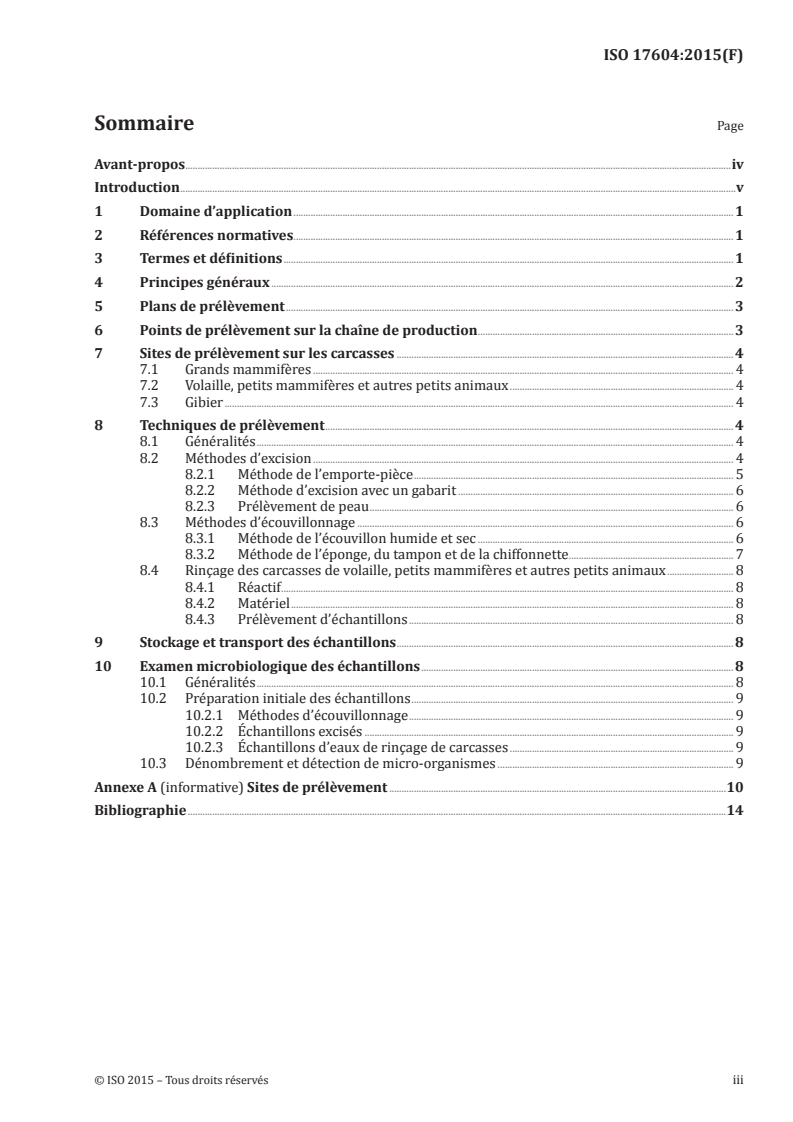
Sommaire Page
Avant-propos .iv
Introduction .v
1 Domaine d’application . 1
2 Références normatives . 1
3 Termes et définitions . 1
4 Principes généraux . 2
5 Plans de prélèvement . 3
6 Points de prélèvement sur la chaîne de production . 3
7 Sites de prélèvement sur les carcasses . 4
7.1 Grands mammifères . 4
7.2 Volaille, petits mammifères et autres petits animaux . 4
7.3 Gibier . 4
8 Techniques de prélèvement . 4
8.1 Généralités . 4
8.2 Méthodes d’excision . 4
8.2.1 Méthode de l’emporte-pièce . 5
8.2.2 Méthode d’excision avec un gabarit . 6
8.2.3 Prélèvement de peau . 6
8.3 Méthodes d’écouvillonnage . 6
8.3.1 Méthode de l’écouvillon humide et sec . 6
8.3.2 Méthode de l’éponge, du tampon et de la chiffonnette . 7
8.4 Rinçage des carcasses de volaille, petits mammifères et autres petits animaux . 8
8.4.1 Réactif . 8
8.4.2 Matériel . 8
8.4.3 Prélèvement d’échantillons . 8
9 Stockage et transport des échantillons . 8
10 Examen microbiologique des échantillons . 8
10.1 Généralités . 8
10.2 Préparation initiale des échantillons . 9
10.2.1 Méthodes d’écouvillonnage . 9
10.2.2 Échantillons excisés . 9
10.2.3 Échantillons d’eaux de rinçage de carcasses . 9
10.3 Dénombrement et détection de micro-organismes . 9
Annexe A (informative) Sites de prélèvement .10
Bibliographie .14
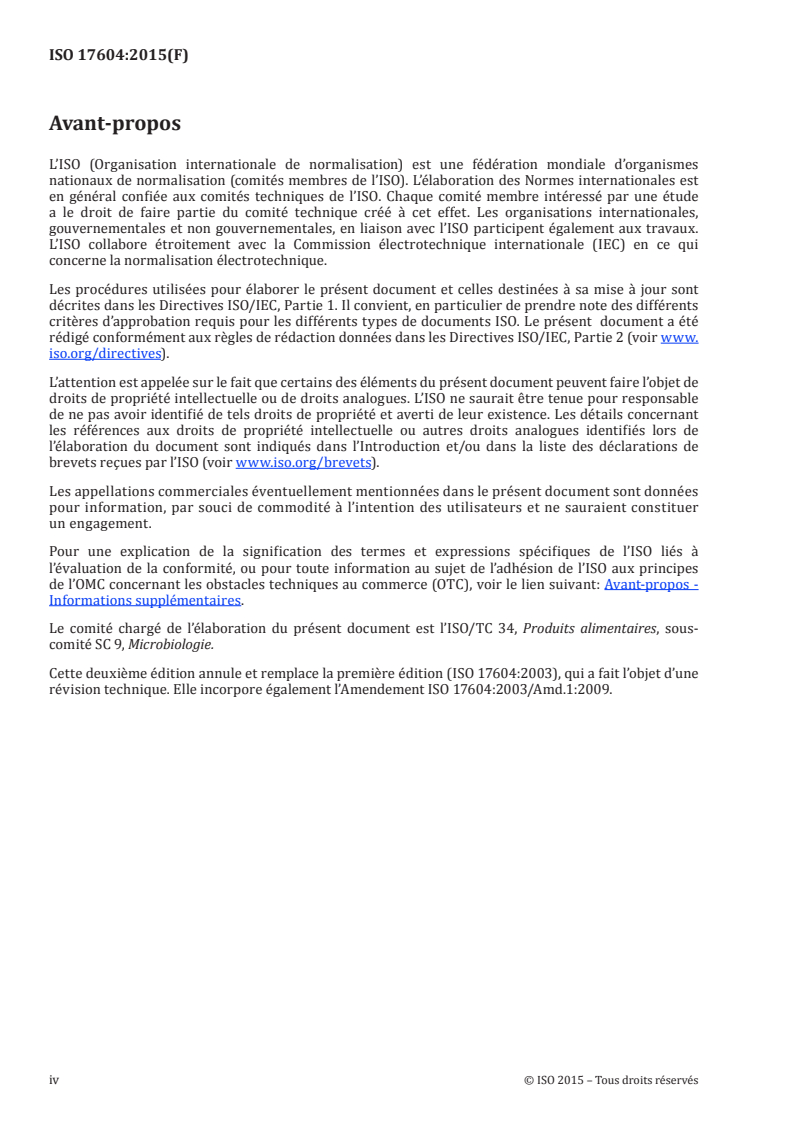
Avant-propos
L’ISO (Organisation internationale de normalisation) est une fédération mondiale d’organismes
nationaux de normalisation (comités membres de l’ISO). L’élaboration des Normes internationales est
en général confiée aux comités techniques de l’ISO. Chaque comité membre intéressé par une étude
a le droit de faire partie du comité technique créé à cet effet. Les organisations internationales,
gouvernementales et non gouvernementales, en liaison avec l’ISO participent également aux travaux.
L’ISO collabore étroitement avec la Commission électrotechnique internationale (IEC) en ce qui
concerne la normalisation électrotechnique.
Les procédures utilisées pour élaborer le présent document et celles destinées à sa mise à jour sont
décrites dans les Directives ISO/IEC, Partie 1. Il convient, en particulier de prendre note des différents
critères d’approbation requis pour les différents types de documents ISO. Le présent document a été
rédigé conformément aux règles de rédaction données dans les Directives ISO/IEC, Partie 2 (voir www.
iso.org/directives).
L’attention est appelée sur le fait que certains des éléments du présent document peuvent faire l’objet de
droits de propriété intellectuelle ou de droits analogues. L’ISO ne saurait être tenue pour responsable
de ne pas avoir identifié de tels droits de propriété et averti de leur existence. Les détails concernant
les références aux droits de propriété intellectuelle ou autres droits analogues identifiés lors de
l’élaboration du document sont indiqués dans l’Introduction et/ou dans la liste des déclarations de
brevets reçues par l’ISO (voir www.iso.org/brevets).
Les appellations commerciales éventuellement mentionnées dans le présent document sont données
pour information, par souci de commodité à l’intention des utilisateurs et ne sauraient constituer
un engagement.
Pour une explication de la signification des termes et expressions spécifiques de l’ISO liés à
l’évaluation de la conformité, ou pour toute information au sujet de l’adhésion de l’ISO aux principes
de l’OMC concernant les obstacles techniques au commerce (OTC), voir le lien suivant: Avant-propos -
Informations supplémentaires.
Le comité chargé de l’élaboration du présent document est l’ISO/TC 34, Produits alimentaires, sous-
comité SC 9, Microbiologie.
Cette deuxième édition annule et remplace la première édition (ISO 17604:2003), qui a fait l’objet d’une
révision technique. Elle incorpore également l’Amendement ISO 17604:2003/Amd.1:2009.
iv © ISO 2015 – Tous droits réservés
Introduction
Il est généralement admis que la détermination du nombre de bactéries et de la prévalence et/ou
du nombre de micro-organismes pathogènes sur les carcasses est essentielle à la validation et à la
vérification dans les systèmes d’assurance de l’hygiène de l’abattage basés sur la maîtrise des dangers
(par exemple, ceux employant les principes de l’analyse des dangers et points critiques pour leur
maîtrise (HACCP) et les systèmes d’assurance qualité basés sur ceux-ci).
De plus, de nombreux laboratoires sont impliqués dans les programmes de contrôle ou les programmes de
surveillance (régionaux, nationaux et internationaux) portant sur la prévalence et/ou le dénombrement
de micro-organismes pathogènes pour recueillir des informations relatives à l’évaluation des risques.
La conception de ces programmes de contrôle et de surveillance bénéficiera de l’utilisation de modes
opératoires de prélèvement normalisés et reconnus au niveau international.
Une méthode de prélèvement normalisée, telle que décrite dans la présente Norme internationale, peut
également être utile pour le commerce de la viande et des produits à base de viande.
NORME INTERNATIONALE ISO 17604:2015(F)
Microbiologie de la chaîne alimentaire — Prélèvement
d’échantillons sur des carcasses en vue de leur analyse
microbiologique
1 Domaine d’application
La présente Norme internationale spécifie les méthodes de prélèvement relatives à la détection et au
dénombrement de micro-organismes sur la surface de carcasses ou de parties de carcasses d’animaux à
viande abattus. Le prélèvement microbiologique peut être effectué dans le cadre de:
— contrôles d’hygiène des procédés (pour valider ou vérifier le contrôle du procédé, par exemple le
dénombrement total et les Enterobacteriaceae) dans les abattoirs destinés aux grands mammifères,
aux volailles et au gibier;
— systèmes d’assurance de la sécurité des produits basés sur la maîtrise des dangers; et
— programmes de contrôle ou de surveillance relatifs à la prévalence et/ou au nombre de micro-
organismes pathogènes.
La présente Norme internationale comprend l’utilisation de techniques d’excision et d’écouvillonnage
en fonction de l’objectif du prélèvement d’échantillons. Elle inclut également l’utilisation de la technique
du rinçage des carcasses en vue de l’examen de carcasses de volailles et de certains petits animaux.
L’Annexe A illustre les sites de prélèvement sur les carcasses de plusieurs espèces animales.
2 Références normatives
Les documents ci-après, dans leur intégralité ou non, sont des références normatives indispensables à
l’application du présent document. Pour les références datées, seule l’édition citée s’applique. Pour les
références non datées, la dernière édition du document de référence s’applique (y compris les éventuels
amendements).
ISO 6887-1, Microbiologie des aliments — Préparation des échantillons, de la suspension mère et des
dilutions décimales en vue de l’examen microbiologique — Partie 1: Règles générales pour la préparation de
la suspension mère et des dilutions décimales
ISO 6887-2, Microbiologie des aliments — Préparation des échantillons, de la suspension mère et des
dilutions décimales en vue de l’examen microbiologique — Partie 2: Règles spécifiques pour la préparation
des viandes et produits à base de viande
ISO 7218, Microbiologie des aliments — Règles générales pour les examens microbiologiques
3 Termes et définitions
Pour les besoins du présent document, les termes et définitions suivants s’appliquent.
3.1
carcasse
corps d’un animal après abattage et habillage
3.2
technique d’excision
retrait de surfaces définies de tissu superficiel ou de peau par découpe (ablation)
3.3
gibier
mammifère ou oiseau sauvage chassé pour la consommation humaine et mammifère ou oiseau d’élevage,
notamment ratites (par exemple, autruches, émeus), autres que les ongulés et oiseaux domestiques
3.4
grand mammifère
bovin (notamment buffle, bison), ovin, porcin (notamment sanglier sauvage), plusieurs types de cervidé
(notamment renne, antilope), équin (notamment âne et mulet)
3.5
volaille
oiseau de petite ou moyenne taille
EXEMPLE Poulet, canard, oie, dinde, pigeon, faisan, caille, tétra.
3.6
plan de prélèvement
description de l’examen d’un nombre requis d’unités de prélèvement par une méthode d’analyse définie,
y compris le critère d’acceptation
3.7
point de prélèvement
emplacement sur la chaîne de production où l’échantillon est prélevé
3.8
site de prélèvement
site sur la carcasse où l’échantillon est prélevé
3.9
petit mammifère et autre petit animal
lagomorphe (lièvre, lapin), rongeur, tortue, grenouille
3.10
méthode d’écouvillonnage
technique utilisant un matériau absorbant fixé à l’extrémité d’un manche ou d’une tige en métal, ou une
éponge ou un morceau de matière absorbante, pour décrocher des micro-organismes des surfaces
4 Principes généraux
Le choix de la méthode de prélèvement dépend principalement de l’objectif de l’examen microbiologique,
de la sensibilité requise et des aspects pratiques. La présente Norme internationale permet l’utilisation
de méthodes d’excision, d’écouvillonnage et de rinçage.
L’excision du tissu superficiel permet en général de récolter un plus grand nombre de micro-organismes
de la surface que les autres méthodes. Tous les micro-organismes récoltés ne peuvent se développer sur
le milieu et dans les conditions d’incubation utilisés. La répétabilité et la reproductibilité des méthodes
d’excision et de rinçage sont moins variables que l’écouvillonnage car les méthodes d’écouvillonnage
sont plus difficiles à standardiser.
Toutefois, seule une petite proportion de la carcasse est prélevée par les méthodes d’excision, ce qui
peut produire des inexactitudes importantes lorsque la contamination totale est faible et répartie de
façon hétérogène, ou lorsque la présence des micro-organismes cibles est irrégulière. Les méthodes
d’excision sont destructives et peuvent parfois réduire la valeur de la viande, mais elles sont privilégiées
lors du prélèvement sur des surfaces congelées.
Les techniques d’écouvillonnage ou de rinçage permettent d’examiner de plus grandes zones. Des zones
plus petites, sur des zones vérifiées de forte contamination, peuvent être examinées par des méthodes
d’excision ou d’écouvillonnage. Le rinçage de l’ensemble de la carcasse est une méthode efficace et
2 © ISO 2015 – Tous droits réservés
pratique pour examiner la volaille (hormis les carcasses de gros oiseaux) et les carcasses de certains
petits mammifères et autres petits animaux.
5 Plans de prélèvement
Il convient que les plans de prélèvement soient adaptés à l’objectif de l’essai et appliqués en fonction des
circonstances. Ils ne sont pas pris en compte de façon détaillée.
Il convient de tenir compte du déroulement du procédé, du moment depuis le début du procédé
d’abattage et de la fréquence de prélèvement ainsi que, le cas échéant, des éléments suivants:
— des pratiques de l’abattoir pour chaque animal;
— de la conception des programmes d’assurance du contrôle du procédé ou de contrôle harmonisé
basés sur la maîtrise des dangers;
— du volume de production;
— des précédents résultats de contrôle (analyse de tendances);
— de la prévalence de micro-organismes pathogènes pertinents dans la région d’origine de l’animal;
— des réglementations nationales, régionales et/ou internationales en vigueur.
Dans le cas du contrôle du procédé, il convient que le moment et la fréquence de prélèvement
correspondent au niveau d’hygiène de l’abattage.
Dans le cas du contrôle et de la surveillance des pathogènes, il convient que le moment de prélèvement,
les sites de prélèvement sur la carcasse et la fréquence de prélèvement augmentent les chances de
détecter et/ou de dénombrer les pathogènes recherchés.
6 Points de prélèvement sur la chaîne de production
Il convient que les points de prélèvement soient sélectionnés en fonction des principes basés sur la
maîtrise des dangers, et qu’ils correspondent, le cas échéant, à la plus grande probabilité de détection
de contamination pendant le procédé ou à certains moments du procédé d’abattage appropriés pour
évaluer l’hygiène des étapes de production spécifiques ou pendant l’ensemble du procédé d’abattage.
Des exemples de points de prélèvement sont les suivants:
— après la machine à polir les carcasses (porcs);
— après le rinçage des carcasses (porcs et volaille);
— après dépouille (dépeçage) (grands mammifères, gibier abattu dans un abattoir et autres);
— après éviscération (tous les animaux);
— immédiatement avant réfrigération ou congélation (tous les animaux);
— immédiatement après réfrigération (volaille, petits mammifères et autres petits animaux);
— après réfrigération ou congélation (tous les animaux);
— dans la chambre froide (tous les animaux).
Il convient que le prélèvement pour la détection ou le dénombrement de micro-organismes soit de
préférence immédiatement réalisé avant la réfrigération. Pendant la période de réfrigération, en
fonction des conditions de la chambre froide, les micro-organismes peuvent subir des dommages
sublétaux ou mourir, peuvent être dominés par des micro-organismes psychotrophes et peuvent se fixer
plus fermement à la viande, ce qui peut conduire à une sous-estimation. Par conséquent, si la chambre
froide doit être utilisée comme point de prélèvement, il convient que le prélèvement soit réalisé le plus
tôt possible après l’abattage.
7 Sites de prélèvement sur les carcasses
7.1 Grands mammifères
Les sites de prélèvement choisis dépendent des pratiques d’abattage, qui peuvent être différentes selon
les abattoirs et les animaux. L’objectif est d’examiner les sites ayant la contamination la plus élevée et/ou
le plus fort niveau de contamination (voir le Tableau A.1). La Figure A.1, la Figure A.2 et la Figure A.3
illustrent les sites les plus souvent identifiés comme les plus fortement contaminés. D’autres sites de
prélèvement peuvent être spécifiés dans les réglementations, les guides de bonnes pratiques ou d’autres
guides techniques du domaine. Il est important que le choix des sites de prélèvement soit homogène dans
le temps, afin de pouvoir détecter tout changement de profil des observations sur une période de temps
(analyse de tendances). Il est généralement préférable de prélever plus de carcasses sur les sites les plus
susceptibles d’être contaminés plutôt que plus de sites par carcasse. Les déterminations de prévalence
des programmes de surveillance bénéficieront généralement de plus grandes zones de prélèvement.
7.2 Volaille, petits mammifères et autres petits animaux
Une méthode courante consiste à rincer l’ensemble de ces carcasses de petite taill
...
NORME ISO
INTERNATIONALE 17604
Deuxième édition
2015-08-15
Microbiologie de la chaîne
alimentaire — Prélèvement
d’échantillons sur des carcasses en
vue de leur analyse microbiologique
Microbiology of the food chain — Carcass sampling for
microbiological analysis
Numéro de référence
©
ISO 2015
DOCUMENT PROTÉGÉ PAR COPYRIGHT
© ISO 2015, Publié en Suisse
Droits de reproduction réservés. Sauf indication contraire, aucune partie de cette publication ne peut être reproduite ni utilisée
sous quelque forme que ce soit et par aucun procédé, électronique ou mécanique, y compris la photocopie, l’affichage sur
l’internet ou sur un Intranet, sans autorisation écrite préalable. Les demandes d’autorisation peuvent être adressées à l’ISO à
l’adresse ci-après ou au comité membre de l’ISO dans le pays du demandeur.
ISO copyright office
Ch. de Blandonnet 8 • CP 401
CH-1214 Vernier, Geneva, Switzerland
Tel. +41 22 749 01 11
Fax +41 22 749 09 47
copyright@iso.org
www.iso.org
ii © ISO 2015 – Tous droits réservés
Sommaire Page
Avant-propos .iv
Introduction .v
1 Domaine d’application . 1
2 Références normatives . 1
3 Termes et définitions . 1
4 Principes généraux . 2
5 Plans de prélèvement . 3
6 Points de prélèvement sur la chaîne de production . 3
7 Sites de prélèvement sur les carcasses . 4
7.1 Grands mammifères . 4
7.2 Volaille, petits mammifères et autres petits animaux . 4
7.3 Gibier . 4
8 Techniques de prélèvement . 4
8.1 Généralités . 4
8.2 Méthodes d’excision . 4
8.2.1 Méthode de l’emporte-pièce . 5
8.2.2 Méthode d’excision avec un gabarit . 6
8.2.3 Prélèvement de peau . 6
8.3 Méthodes d’écouvillonnage . 6
8.3.1 Méthode de l’écouvillon humide et sec . 6
8.3.2 Méthode de l’éponge, du tampon et de la chiffonnette . 7
8.4 Rinçage des carcasses de volaille, petits mammifères et autres petits animaux . 8
8.4.1 Réactif . 8
8.4.2 Matériel . 8
8.4.3 Prélèvement d’échantillons . 8
9 Stockage et transport des échantillons . 8
10 Examen microbiologique des échantillons . 8
10.1 Généralités . 8
10.2 Préparation initiale des échantillons . 9
10.2.1 Méthodes d’écouvillonnage . 9
10.2.2 Échantillons excisés . 9
10.2.3 Échantillons d’eaux de rinçage de carcasses . 9
10.3 Dénombrement et détection de micro-organismes . 9
Annexe A (informative) Sites de prélèvement .10
Bibliographie .14
Avant-propos
L’ISO (Organisation internationale de normalisation) est une fédération mondiale d’organismes
nationaux de normalisation (comités membres de l’ISO). L’élaboration des Normes internationales est
en général confiée aux comités techniques de l’ISO. Chaque comité membre intéressé par une étude
a le droit de faire partie du comité technique créé à cet effet. Les organisations internationales,
gouvernementales et non gouvernementales, en liaison avec l’ISO participent également aux travaux.
L’ISO collabore étroitement avec la Commission électrotechnique internationale (IEC) en ce qui
concerne la normalisation électrotechnique.
Les procédures utilisées pour élaborer le présent document et celles destinées à sa mise à jour sont
décrites dans les Directives ISO/IEC, Partie 1. Il convient, en particulier de prendre note des différents
critères d’approbation requis pour les différents types de documents ISO. Le présent document a été
rédigé conformément aux règles de rédaction données dans les Directives ISO/IEC, Partie 2 (voir www.
iso.org/directives).
L’attention est appelée sur le fait que certains des éléments du présent document peuvent faire l’objet de
droits de propriété intellectuelle ou de droits analogues. L’ISO ne saurait être tenue pour responsable
de ne pas avoir identifié de tels droits de propriété et averti de leur existence. Les détails concernant
les références aux droits de propriété intellectuelle ou autres droits analogues identifiés lors de
l’élaboration du document sont indiqués dans l’Introduction et/ou dans la liste des déclarations de
brevets reçues par l’ISO (voir www.iso.org/brevets).
Les appellations commerciales éventuellement mentionnées dans le présent document sont données
pour information, par souci de commodité à l’intention des utilisateurs et ne sauraient constituer
un engagement.
Pour une explication de la signification des termes et expressions spécifiques de l’ISO liés à
l’évaluation de la conformité, ou pour toute information au sujet de l’adhésion de l’ISO aux principes
de l’OMC concernant les obstacles techniques au commerce (OTC), voir le lien suivant: Avant-propos -
Informations supplémentaires.
Le comité chargé de l’élaboration du présent document est l’ISO/TC 34, Produits alimentaires, sous-
comité SC 9, Microbiologie.
Cette deuxième édition annule et remplace la première édition (ISO 17604:2003), qui a fait l’objet d’une
révision technique. Elle incorpore également l’Amendement ISO 17604:2003/Amd.1:2009.
iv © ISO 2015 – Tous droits réservés
Introduction
Il est généralement admis que la détermination du nombre de bactéries et de la prévalence et/ou
du nombre de micro-organismes pathogènes sur les carcasses est essentielle à la validation et à la
vérification dans les systèmes d’assurance de l’hygiène de l’abattage basés sur la maîtrise des dangers
(par exemple, ceux employant les principes de l’analyse des dangers et points critiques pour leur
maîtrise (HACCP) et les systèmes d’assurance qualité basés sur ceux-ci).
De plus, de nombreux laboratoires sont impliqués dans les programmes de contrôle ou les programmes de
surveillance (régionaux, nationaux et internationaux) portant sur la prévalence et/ou le dénombrement
de micro-organismes pathogènes pour recueillir des informations relatives à l’évaluation des risques.
La conception de ces programmes de contrôle et de surveillance bénéficiera de l’utilisation de modes
opératoires de prélèvement normalisés et reconnus au niveau international.
Une méthode de prélèvement normalisée, telle que décrite dans la présente Norme internationale, peut
également être utile pour le commerce de la viande et des produits à base de viande.
NORME INTERNATIONALE ISO 17604:2015(F)
Microbiologie de la chaîne alimentaire — Prélèvement
d’échantillons sur des carcasses en vue de leur analyse
microbiologique
1 Domaine d’application
La présente Norme internationale spécifie les méthodes de prélèvement relatives à la détection et au
dénombrement de micro-organismes sur la surface de carcasses ou de parties de carcasses d’animaux à
viande abattus. Le prélèvement microbiologique peut être effectué dans le cadre de:
— contrôles d’hygiène des procédés (pour valider ou vérifier le contrôle du procédé, par exemple le
dénombrement total et les Enterobacteriaceae) dans les abattoirs destinés aux grands mammifères,
aux volailles et au gibier;
— systèmes d’assurance de la sécurité des produits basés sur la maîtrise des dangers; et
— programmes de contrôle ou de surveillance relatifs à la prévalence et/ou au nombre de micro-
organismes pathogènes.
La présente Norme internationale comprend l’utilisation de techniques d’excision et d’écouvillonnage
en fonction de l’objectif du prélèvement d’échantillons. Elle inclut également l’utilisation de la technique
du rinçage des carcasses en vue de l’examen de carcasses de volailles et de certains petits animaux.
L’Annexe A illustre les sites de prélèvement sur les carcasses de plusieurs espèces animales.
2 Références normatives
Les documents ci-après, dans leur intégralité ou non, sont des références normatives indispensables à
l’application du présent document. Pour les références datées, seule l’édition citée s’applique. Pour les
références non datées, la dernière édition du document de référence s’applique (y compris les éventuels
amendements).
ISO 6887-1, Microbiologie des aliments — Préparation des échantillons, de la suspension mère et des
dilutions décimales en vue de l’examen microbiologique — Partie 1: Règles générales pour la préparation de
la suspension mère et des dilutions décimales
ISO 6887-2, Microbiologie des aliments — Préparation des échantillons, de la suspension mère et des
dilutions décimales en vue de l’examen microbiologique — Partie 2: Règles spécifiques pour la préparation
des viandes et produits à base de viande
ISO 7218, Microbiologie des aliments — Règles générales pour les examens microbiologiques
3 Termes et définitions
Pour les besoins du présent document, les termes et définitions suivants s’appliquent.
3.1
carcasse
corps d’un animal après abattage et habillage
3.2
technique d’excision
retrait de surfaces définies de tissu superficiel ou de peau par découpe (ablation)
3.3
gibier
mammifère ou oiseau sauvage chassé pour la consommation humaine et mammifère ou oiseau d’élevage,
notamment ratites (par exemple, autruches, émeus), autres que les ongulés et oiseaux domestiques
3.4
grand mammifère
bovin (notamment buffle, bison), ovin, porcin (notamment sanglier sauvage), plusieurs types de cervidé
(notamment renne, antilope), équin (notamment âne et mulet)
3.5
volaille
oiseau de petite ou moyenne taille
EXEMPLE Poulet, canard, oie, dinde, pigeon, faisan, caille, tétra.
3.6
plan de prélèvement
description de l’examen d’un nombre requis d’unités de prélèvement par une méthode d’analyse définie,
y compris le critère d’acceptation
3.7
point de prélèvement
emplacement sur la chaîne de production où l’échantillon est prélevé
3.8
site de prélèvement
site sur la carcasse où l’échantillon est prélevé
3.9
petit mammifère et autre petit animal
lagomorphe (lièvre, lapin), rongeur, tortue, grenouille
3.10
méthode d’écouvillonnage
technique utilisant un matériau absorbant fixé à l’extrémité d’un manche ou d’une tige en métal, ou une
éponge ou un morceau de matière absorbante, pour décrocher des micro-organismes des surfaces
4 Principes généraux
Le choix de la méthode de prélèvement dépend principalement de l’objectif de l’examen microbiologique,
de la sensibilité requise et des aspects pratiques. La présente Norme internationale permet l’utilisation
de méthodes d’excision, d’écouvillonnage et de rinçage.
L’excision du tissu superficiel permet en général de récolter un plus grand nombre de micro-organismes
de la surface que les autres méthodes. Tous les micro-organismes récoltés ne peuvent se développer sur
le milieu et dans les conditions d’incubation utilisés. La répétabilité et la reproductibilité des méthodes
d’excision et de rinçage sont moins variables que l’écouvillonnage car les méthodes d’écouvillonnage
sont plus difficiles à standardiser.
Toutefois, seule une petite proportion de la carcasse est prélevée par les méthodes d’excision, ce qui
peut produire des inexactitudes importantes lorsque la contamination totale est faible et répartie de
façon hétérogène, ou lorsque la présence des micro-organismes cibles est irrégulière. Les méthodes
d’excision sont destructives et peuvent parfois réduire la valeur de la viande, mais elles sont privilégiées
lors du prélèvement sur des surfaces congelées.
Les techniques d’écouvillonnage ou de rinçage permettent d’examiner de plus grandes zones. Des zones
plus petites, sur des zones vérifiées de forte contamination, peuvent être examinées par des méthodes
d’excision ou d’écouvillonnage. Le rinçage de l’ensemble de la carcasse est une méthode efficace et
2 © ISO 2015 – Tous droits réservés
pratique pour examiner la volaille (hormis les carcasses de gros oiseaux) et les carcasses de certains
petits mammifères et autres petits animaux.
5 Plans de prélèvement
Il convient que les plans de prélèvement soient adaptés à l’objectif de l’essai et appliqués en fonction des
circonstances. Ils ne sont pas pris en compte de façon détaillée.
Il convient de tenir compte du déroulement du procédé, du moment depuis le début du procédé
d’abattage et de la fréquence de prélèvement ainsi que, le cas échéant, des éléments suivants:
— des pratiques de l’abattoir pour chaque animal;
— de la conception des programmes d’assurance du contrôle du procédé ou de contrôle harmonisé
basés sur la maîtrise des dangers;
— du volume de production;
— des précédents résultats de contrôle (analyse de tendances);
— de la prévalence de micro-organismes pathogènes pertinents dans la région d’origine de l’animal;
— des réglementations nationales, régionales et/ou internationales en vigueur.
Dans le cas du contrôle du procédé, il convient que le moment et la fréquence de prélèvement
correspondent au niveau d’hygiène de l’abattage.
Dans le cas du contrôle et de la surveillance des pathogènes, il convient que le moment de prélèvement,
les sites de prélèvement sur la carcasse et la fréquence de prélèvement augmentent les chances de
détecter et/ou de dénombrer les pathogènes recherchés.
6 Points de prélèvement sur la chaîne de production
Il convient que les points de prélèvement soient sélectionnés en fonction des principes basés sur la
maîtrise des dangers, et qu’ils correspondent, le cas échéant, à la plus grande probabilité de détection
de contamination pendant le procédé ou à certains moments du procédé d’abattage appropriés pour
évaluer l’hygiène des étapes de production spécifiques ou pendant l’ensemble du procédé d’abattage.
Des exemples de points de prélèvement sont les suivants:
— après la machine à polir les carcasses (porcs);
— après le rinçage des carcasses (porcs et volaille);
— après dépouille (dépeçage) (grands mammifères, gibier abattu dans un abattoir et autres);
— après éviscération (tous les animaux);
— immédiatement avant réfrigération ou congélation (tous les animaux);
— immédiatement après réfrigération (volaille, petits mammifères et autres petits animaux);
— après réfrigération ou congélation (tous les animaux);
— dans la chambre froide (tous les animaux).
Il convient que le prélèvement pour la détection ou le dénombrement de micro-organismes soit de
préférence immédiatement réalisé avant la réfrigération. Pendant la période de réfrigération, en
fonction des conditions de la chambre froide, les micro-organismes peuvent subir des dommages
sublétaux ou mourir, peuvent être dominés par des micro-organismes psychotrophes et peuvent se fixer
plus fermement à la viande, ce qui peut conduire à une sous-estimation. Par conséquent, si la chambre
froide doit être utilisée comme point de prélèvement, il convient que le prélèvement soit réalisé le plus
tôt possible après l’abattage.
7 Sites de prélèvement sur les carcasses
7.1 Grands mammifères
Les sites de prélèvement choisis dépendent des pratiques d’abattage, qui peuvent être différentes selon
les abattoirs et les animaux. L’objectif est d’examiner les sites ayant la contamination la plus élevée et/ou
le plus fort niveau de contamination (voir le Tableau A.1). La Figure A.1, la Figure A.2 et la Figure A.3
illustrent les sites les plus souvent identifiés comme les plus fortement contaminés. D’autres sites de
prélèvement peuvent être spécifiés dans les réglementations, les guides de bonnes pratiques ou d’autres
guides techniques du domaine. Il est important que le choix des sites de prélèvement soit homogène dans
le temps, afin de pouvoir détecter tout changement de profil des observations sur une période de temps
(analyse de tendances). Il est généralement préférable de prélever plus de carcasses sur les sites les plus
susceptibles d’être contaminés plutôt que plus de sites par carcasse. Les déterminations de prévalence
des programmes de surveillance bénéficieront généralement de plus grandes zones de prélèvement.
7.2 Volaille, petits mammifères et autres petits animaux
Une méthode courante consiste à rincer l’ensemble de ces carcasses de petite taill
...