


ISO/IEC 8825-3:2002/Amd 1:2005
(Amendment)Information technology — ASN.1 encoding rules: Specification of Encoding Control Notation (ECN) — Part 3: — Amendment 1: Extensibility support
Information technology — ASN.1 encoding rules: Specification of Encoding Control Notation (ECN) — Part 3: — Amendment 1: Extensibility support
Technologies de l'information — Règles de codage ASN.1: Spécification de la notation de contrôle de codage (ECN) — Partie 3: — Amendement 1: Prise en charge de l'extensibilité
General Information
- Status
- Withdrawn
- Publication Date
- 16-Nov-2005
- Withdrawal Date
- 16-Nov-2005
- Drafting Committee
- ISO/IEC JTC 1/SC 6/WG 7 - Network, transport and future network
- Current Stage
- 9599 - Withdrawal of International Standard
- Start Date
- 15-Dec-2009
- Completion Date
- 12-Feb-2026
Relations
- Consolidated By
ISO 17604:2015 - Microbiology of the food chain — Carcass sampling for microbiological analysis - Effective Date
- 06-Jun-2022
- Effective Date
- 06-Jun-2022
- Effective Date
- 17-Mar-2009
- Effective Date
- 15-Apr-2008
Get Certified
Connect with accredited certification bodies for this standard

BSI Group
BSI (British Standards Institution) is the business standards company that helps organizations make excellence a habit.

NYCE
Mexican standards and certification body.
Sponsored listings
Frequently Asked Questions
ISO/IEC 8825-3:2002/Amd 1:2005 is a standard published by the International Organization for Standardization (ISO). Its full title is "Information technology — ASN.1 encoding rules: Specification of Encoding Control Notation (ECN) — Part 3: — Amendment 1: Extensibility support". This standard covers: Information technology — ASN.1 encoding rules: Specification of Encoding Control Notation (ECN) — Part 3: — Amendment 1: Extensibility support
Information technology — ASN.1 encoding rules: Specification of Encoding Control Notation (ECN) — Part 3: — Amendment 1: Extensibility support
ISO/IEC 8825-3:2002/Amd 1:2005 is classified under the following ICS (International Classification for Standards) categories: 35.100.60 - Presentation layer. The ICS classification helps identify the subject area and facilitates finding related standards.
ISO/IEC 8825-3:2002/Amd 1:2005 has the following relationships with other standards: It is inter standard links to ISO 17604:2015, ISO/IEC 8825-3:2002, ISO/IEC 8825-3:2008; is excused to ISO/IEC 8825-3:2002. Understanding these relationships helps ensure you are using the most current and applicable version of the standard.
ISO/IEC 8825-3:2002/Amd 1:2005 is available in PDF format for immediate download after purchase. The document can be added to your cart and obtained through the secure checkout process. Digital delivery ensures instant access to the complete standard document.
Standards Content (Sample)
INTERNATIONAL ISO/IEC
STANDARD 8825-3
First edition
2002-12-15
AMENDMENT 1
2005-11-15
Information technology — ASN.1
encoding rules: Specification of
Encoding Control Notation (ECN)
AMENDMENT 1: Extensibility support
Technologies de l'information — Règles de codage ASN.1:
Spécification de la notation de contrôle de codage (ECN)
AMENDEMENT 1: Prise en charge de l'extensibilité
Reference number
ISO/IEC 8825-3:2002/Amd.1:2005(E)
©
ISO/IEC 2005
ISO/IEC 8825-3:2002/Amd.1:2005(E)
PDF disclaimer
This PDF file may contain embedded typefaces. In accordance with Adobe's licensing policy, this file may be printed or viewed but
shall not be edited unless the typefaces which are embedded are licensed to and installed on the computer performing the editing. In
downloading this file, parties accept therein the responsibility of not infringing Adobe's licensing policy. The ISO Central Secretariat
accepts no liability in this area.
Adobe is a trademark of Adobe Systems Incorporated.
Details of the software products used to create this PDF file can be found in the General Info relative to the file; the PDF-creation
parameters were optimized for printing. Every care has been taken to ensure that the file is suitable for use by ISO member bodies. In
the unlikely event that a problem relating to it is found, please inform the Central Secretariat at the address given below.
© ISO/IEC 2005
All rights reserved. Unless otherwise specified, no part of this publication may be reproduced or utilized in any form or by any means,
electronic or mechanical, including photocopying and microfilm, without permission in writing from either ISO at the address below or
ISO's member body in the country of the requester.
ISO copyright office
Case postale 56 • CH-1211 Geneva 20
Tel. + 41 22 749 01 11
Fax + 41 22 749 09 47
E-mail copyright@iso.org
Web www.iso.org
Published in Switzerland
ii © ISO/IEC 2005 – All rights reserved
ISO/IEC 8825-3:2002/Amd.1:2005(E)
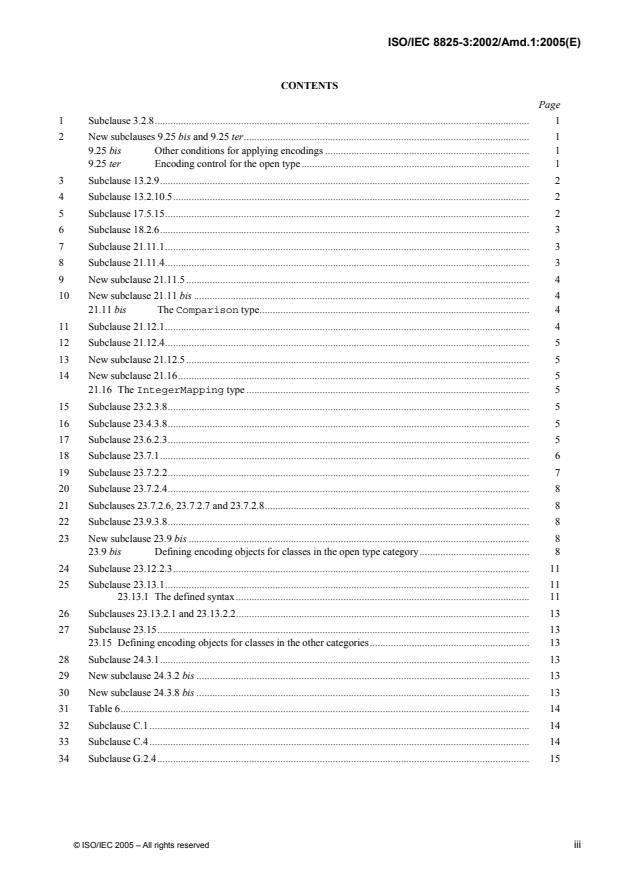
CONTENTS
Page
1 Subclause 3.2.8. 1
2 New subclauses 9.25 bis and 9.25 ter. 1
9.25 bis Other conditions for applying encodings . 1
9.25 ter Encoding control for the open type . 1
3 Subclause 13.2.9. 2
4 Subclause 13.2.10.5. 2
5 Subclause 17.5.15. 2
6 Subclause 18.2.6. 3
7 Subclause 21.11.1. 3
8 Subclause 21.11.4. 3
9 New subclause 21.11.5. 4
10 New subclause 21.11 bis . 4
21.11 bis The Comparison type. 4
11 Subclause 21.12.1. 4
12 Subclause 21.12.4. 5
13 New subclause 21.12.5. 5
14 New subclause 21.16. 5
21.16 The IntegerMapping type . 5
15 Subclause 23.2.3.8. 5
16 Subclause 23.4.3.8. 5
17 Subclause 23.6.2.3. 5
18 Subclause 23.7.1. 6
19 Subclause 23.7.2.2. 7
20 Subclause 23.7.2.4. 8
21 Subclauses 23.7.2.6, 23.7.2.7 and 23.7.2.8. 8
22 Subclause 23.9.3.8. 8
23 New subclause 23.9 bis . 8
23.9 bis Defining encoding objects for classes in the open type category. 8
24 Subclause 23.12.2.3. 11
25 Subclause 23.13.1. 11
23.13.1 The defined syntax . 11
26 Subclauses 23.13.2.1 and 23.13.2.2. 13
27 Subclause 23.15. 13
23.15 Defining encoding objects for classes in the other categories. 13
28 Subclause 24.3.1. 13
29 New subclause 24.3.2 bis . 13
30 New subclause 24.3.8 bis . 13
31 Table 6. 14
32 Subclause C.1 . 14
33 Subclause C.4 . 14
34 Subclause G.2.4. 15
© ISO/IEC 2005 – All rights reserved iii
ISO/IEC 8825-3:2002/Amd.1:2005(E)
Foreword
ISO (the International Organization for Standardization) and IEC (the International Electrotechnical
Commission) form the specialized system for worldwide standardization. National bodies that are members of
ISO or IEC participate in the development of International Standards through technical committees
established by the respective organization to deal with particular fields of technical activity. ISO and IEC
technical committees collaborate in fields of mutual interest. Other international organizations, governmental
and non-governmental, in liaison with ISO and IEC, also take part in the work. In the field of information
technology, ISO and IEC have established a joint technical committee, ISO/IEC JTC 1.
International Standards are drafted in accordance with the rules given in the ISO/IEC Directives, Part 2.
The main task of the joint technical committee is to prepare International Standards. Draft International
Standards adopted by the joint technical committee are circulated to national bodies for voting. Publication as
an International Standard requires approval by at least 75 % of the national bodies casting a vote.
Attention is drawn to the possibility that some of the elements of this document may be the subject of patent
rights. ISO and IEC shall not be held responsible for identifying any or all such patent rights.
Amendment 1 to International Standard ISO/IEC 8825-3:2002 was prepared by Joint Technical Committee
ISO/IEC JTC 1, Information technology, Subcommittee SC 6, Telecommunications and information exchange
between systems, in collaboration with ITU-T. The identical text is published as Amendment 1 to ITU-T
Rec. X.692.
iv © ISO/IEC 2005 – All rights reserved
ISO/IEC 8825-3:2002/Amd.1:2005 (E)
INTERNATIONAL STANDARD
ITU-T RECOMMENDATION
Information technology –
ASN.1 encoding rules:
Specification of Encoding Control Notation (ECN)
Amendment 1
Extensibility support
NOTE – All new or changed text in this amendment is underlined in clauses being replaced. When new clauses with a heading
are inserted, only the heading is underlined. Deleted text is present but marked with a strike-through. When merging all such text
into the base Recommendation | International standard, the underlining is to be removed and struck-through text taken out.
1 Subclause 3.2.8
Replace 3.2.8 with:
3.2.8 conditional encoding: An encoding which is to be applied only if some specified condition bounds condition
or size range condition is satisfied.
NOTE – The condition may be a bounds condition or a size range condition, or other more complex conditions.
2 New subclauses 9.25 bis and 9.25 ter
Insert new clauses 9.25 bis and 9.25 ter and update the contents:
9.25 bis Other conditions for applying encodings
9.25 bis.1 There are a number of different conditions that can be tested in order to select an appropriate encoding. These
include the actual value and the range of bounds.
9.25 bis.2 It is also possible to require that all of a given list of conditions are to be satisfied.
9.25 bis.3 A test for a condition uses either a single enumeration value (such as "bounded-without-negatives")
which contains the entire test in the specification of the one enumeration, or a triple of enumerations.
9.25 bis.4 If a triple is used, the first identifies (by an enumeration) the item that is being tested (for example
"test-upper-bound"), the second is the nature of the test (for example "greater-than"), and the third provides an
integer value for the test.
9.25 ter Encoding control for the open type
9.25 ter.1 Open types frequently provide a means of extensibility using an identification field, with new values for the
identification field and new types for the open type being added in successive versions (and often being available for
vendor-specific extensions).
9.25 ter.2 Both these features mean that a decoder may be asked to decode an open type when that particular
implementation has no knowledge of the type that has been encoded into it.
9.25 ter.3 The encoding support provided for the open type is the same as that for most other classes in the bitfield
category, but with the added ability to specify that a different encoding object set is to be applied to the type which is to
be encoded into the open type.
NOTE – This is in recognition that many protocols choose to use a different style of encoding (often based on a type-length-value
approach) for the type contained in an open type, while retaining a more compact style of encoding for the fields of the message
containing the open type.
ITU-T Rec. X.692 (2002)/Amd.1 (08/2004) 1
ISO/IEC 8825-3:2002/Amd.1:2005 (E)
9.25 ter.4 The model used for decoding an open type recognizes that a decoder will not know what type fills the open
type (table and relational constraints are not visible to either PER or to ECN), but that the application may be able to
determine this from some other field in the protocol, or in a previous message, or (for vendor-specific additions) based
on calling address.
9.25 ter.5 The model is therefore that, having dealt with any specified pre-padding, and determined the encoding space
and any value pre- and post-padding, the decoder will ask the application for the type which has been encoded. (In the
case of tools, the application will almost certainly have pre-configured the tool with a list of the known types that might
be present, and would simply return a pointer to one of these.) Decoding can now proceed normally.
9.25 ter.6 The application may, however, say "unknown" (see 9.25 ter.4), and the decoder then needs to know how to
determine the end of this unknown encoding. This is satisfied by enabling the ECN specifier in this case to provide an
encoding structure, and (optionally) an encoding object set to use with it, which is to be used by decoders for decoding
unknown types in the open type. There is syntax provided in clause 23 for this purpose.
NOTE – An example of such an encoding structure could be one that specifies an encoding that is commonly known as a "Type,
Length, Value" encoding, whose end can be determined without knowledge of the type being encoded.
3 Subclause 13.2.9
Replace subclause 13.2.9 with:
13.2.9 At later stages in these procedures, the application point may be on any of the following:
a) An encoding class name. This is completely encodable using the specification in an encoding object of
the same class (see 17.1.7).
b) An encoding constructor (see 16.2.12). The construction procedures can be determined by the
specification contained in an encoding object of the encoding constructor class, but that encoding object
does not determine the encoding of the components. The specification of the encoding object that is
applied may require that one or more of the components of the constructor are replaced by other
(parameterized) structures before the application point passes to the components.
c) A class in the bitstring or octetstring category that has a contained type as a property associated with the
values (see 11.3.4.3 d). The encoding of the contained type depends on whether there is an ENCODED BY
present, and on the specification of the encoding object being applied (see 22.11).
d) A class in the open type category. The encoding of the component of the open type depends on whether
there is an ENCODED WITH present, and on the specification of the encoding object being applied (see
23.9 bis.2).
e) A component which is an encoding class (possibly preceded by one or more classes in the tag category),
followed by an encoding class in the optionality category. The procedures and encodings for determining
presence or absence are determined by the specification contained in an encoding object of the class in
the optionality category. This encoding object may also require the replacement of the encoding class
(together with all its preceding classes in the tag category) with a (parameterized) replacement structure
before that class is encoded. The application point then passes to the first class in the tag category
(if any), or to the component, or to its replacement.
f) An encoding class preceded by an encoding class in the tag category. The tag number associated with the
class in the tag category is encoded using the specification in an encoding object of the class in the tag
category, and the application point then passes to the tagged class.
g) Any other built-in encoding class. This is completely encodable using the specification contained in an
encoding object of that class.
4 Subclause 13.2.10.5
Replace the Note in 13.2.10.5 with:
NOTE – If the encoding object being applied to a class in the open type category contains an ENCODED WITH, this determines
the encoding object set that is applied to the component, otherwise the combined encoding object set that is being applied to this
class is applied to the component (see 23.9 bis.2).
5 Subclause 17.5.15
Replace 17.5.15 with:
2 ITU-T Rec. X.692 (2002)/Amd.1 (08/2004)
ISO/IEC 8825-3:2002/Amd.1:2005 (E)
17.5.15 If a REFERENCE is needed as an actual parameter of any of the encoding objects or encoding object sets used
in this production, then it can either be supplied as a dummy parameter of the encoding object that is being defined, or it
can be supplied as a "ComponentIdList" (see 15.3.1 for the syntax of the "ComponentIdList" – the meaning of the
"ComponentIdList" in this context is specified below).
17.5.15 bis If the governor is not a constructor in the repetition category, then the first (or only) "identifier" in the
"ComponentIdList" shall be the "identifier" of a textually present "NamedType" (at some level of nesting – see
17.5.15 ter) of the construction that is obtained by de-referencing the governor. It identifies the entire definition of that
"NamedType" component, whether that definition is textually present or not.
17.5.15 ter If there is more than one such matching identifier, then the chosen matching identifier shall be
determined by the first match in a scan (in textual order) of the outer-level identifiers, then by a scan (in textual order)
of the second level identifiers, then by a scan (in textual order) of the third-level identifiers, and so on.
17.5.15 quat Each subsequent "identifier" of the "ComponentIdList" (if any) shall be an "identifier" in a
"NamedType" of the structure identified by the previous part of the "ComponentIdList", and identifies the entire
definition of that "NamedType" component, whether it is textually present or not in the definition of the structure
identified by the previous part of the "ComponentIdList".
17.5.15 quin If the governor is a constructor in the repetition category, then the actual parameter for the REFERENCE
shall be a "ComponentIdList" whose first "identifier" identifies a component that is textually present in the
"EncodingStructure" in the "RepetitionStructure" obtained by de-referencing the repetition (see 17.5.15 ter). Subclauses
17.5.15 ter and 17.5.15 quat then apply.
17.5.15 sex If the REFERENCE is required to identify a container, it can also be supplied as:
a) STRUCTURE (provided the constructor for the structure being encoded is not an alternatives category)
when it refers to that structure;
b) OUTER when it refers to the container of the complete encoding.
NOTE – The "EncodeStructure" is the only production in which REFERENCEs can be supplied, except through the use of
dummy parameters or the use of OUTER, or where references are in support of flag-to-be-used or flag-to-be-set in
the definition of an encoding object for a class in the repetition category which uses replacement.
6 Subclause 18.2.6
Replace the Note in 18.2.6 with:
NOTE – The combined encoding object set applied by these encoding objects to the type chosen for use with the #OPEN-TYPE
class is always the same as the combined encoding object set applied to the #OPEN-TYPE class as these encoding objects do not
contain an ENCODED WITH (see 13.2.10.5 and 13.2.9 d).
7 Subclause 21.11.1
Replace 21.11.1 with:
21.11.1 The "RangeCondition" type is:
RangeCondition ::= ENUMERATED
{unbounded-or-no-lower-bound,
semi-bounded-with-negatives,
bounded-with-negatives,
semi-bounded-without-negatives,
bounded-without-negatives,
test-lower-bound,
test-upper-bound,
test-range}
8 Subclause 21.11.4
Replace 21.11.4 with:
21.11.4 The predicate is satisfied for each of the first five enumeration values of 21.11.1 if and only if the following
conditions are satisfied by the bounds on the encoding class in the integer category:
a) unbounded-or-no-lower-bound: either there are no bounds, or else there is only an upper bound but
no lower bound.
ITU-T Rec. X.692 (2002)/Amd.1 (08/2004) 3
ISO/IEC 8825-3:2002/Amd.1:2005 (E)
b) semi-bounded-with-negatives: there is a lower bound that is less than zero, but no upper bound.
c) bounded-with-negatives: there is a lower bound that is less than zero, and an upper bound.
d) semi-bounded-without-negatives: there is a lower bound that is greater than or equal to zero, but
no upper bound.
e) bounded-without-negatives: there is a lower bound that is greater than or equal to zero, and an
upper bound.
NOTE – For any given set of bounds, exactly one predicate will be satisfied.
9 New subclause 21.11.5
Add a new subclause 21.11.5:
21.11.5 If the last three enumeration values of 21.11.1 are used, a value of the "Comparison" type (see 21.11 bis)
shall be provided, together with an integer comparator value. If the other enumeration values are used, these shall not
be provided.
10 New subclause 21.11 bis
Add a new subclause 21.11 bis after 21.11 and add to the contents list:
21.11 bis The Comparison type
21.11 bis.1 The "Comparison" type is:
Comparison ::= ENUMERATED
{equal-to,
not-equal-to,
greater-than,
less-than,
greater-than-or-equal-to,
less-than-or-equal-to}
21.11 bis.2 There is no default value for an encoding property of this type.
21.11 bis.3 An encoding property of type "Comparison" is used to test an identified property of a class against an
integer value (the comparator).
21.11 bis.4 The predicate using a "Comparison" is satisfied for each enumeration value if and only if the identified
property satisfies the following conditions:
a) equal-to: its value equals that of the specified integer comparator value.
b) not-equal-to: its value is different from that of the specified integer comparator value.
c) greater-than: its value is greater than that of the specified integer comparator value.
d) less-than: its value is less than that of the specified integer comparator value.
e) greater-than-or-equal-to: its value is greater than or equal to that of the specified integer
comparator value.
f) less-than-or-equal-to: its value is less than or equal to that of the specified integer comparator
value.
11 Subclause 21.12.1
Replace 21.12.1 with:
21.12.1 The "SizeRangeCondition" type is:
SizeRangeCondition ::= ENUMERATED
{no-ub-with-zero-lb,
ub-with-zero-lb,
no-ub-with-non-zero-lb,
ub-with-non-zero-lb,
fixed-size,
4 ITU-T Rec. X.692 (2002)/Amd.1 (08/2004)
ISO/IEC 8825-3:2002/Amd.1:2005 (E)
test-lower-bound,
test-upper-bound,
test-range}
12 Subclause 21.12.4
Replace 21.12.4 with:
21.12.4 The predicate is satisfied for each of the first five enumeration values of 21.12.1 if and only if the effective
size constraint satisfies the following conditions:
a) no-ub-with-zero-lb: there is no upper bound on the size and the lower bound is zero.
b) ub-with-zero-lb: there is an upper bound on the size and the lower bound is zero.
c) no-ub-with-non-zero-lb: there is no upper bound on the size and the lower bound is non-zero.
d) ub-with-non-zero-lb: there is an upper bound on the size and the lower bound is non-zero.
e) fixed-size: the lower bound and the upper bound on the size are the same value.
NOTE – Only the "fixed-size" case overlaps with other predicates.
13 New subclause 21.12.5
Add a new subclause 21.12.5 after 21.12.4:
21.12.5 If the last three enumeration values of 21.12.1 are used, a value of the "Comparison" type (see 21.11 bis)
shall be provided, together with an integer comparator value. If the other enumeration values are used, these shall not
be provided.
14 New subclause 21.16
Add a new subclause 21.16:
21.16 The IntegerMapping type
21.16.1 The "IntegerMapping" type is:
IntegerMapping ::= SET OF SEQUENCE {
source SET OF INTEGER,
result INTEGER} (CONSTRAINED BY {/* the intersection of the source
components shall be empty */})
21.16.2 The "IntegerMapping" is used to specify explicitly an ints-to-ints transform.
15 Subclause 23.2.3.8
Replace 23.2.3.8 with:
23.2.3.8 If an encoding object in the "REPETITION-ENCODINGS"
...
NORME ISO/CEI
INTERNATIONALE 8825-3
Première édition
2002-12-15
AMENDEMENT 1
2005-11-15
Technologies de l'information — Règles
de codage ASN.1: Spécification de la
notation de contrôle de codage (ECN)
AMENDEMENT 1: Prise en charge de
l'extensibilité
Information technology — ASN.1 encoding rules: Specification of
Encoding Control Notation (ECN)
AMENDMENT 1: Extensibility support
Numéro de référence
ISO/CEI 8825-3:2002/Amd.1:2005(F)
©
ISO/CEI 2005
ISO/CEI 8825-3:2002/Amd.1:2005(F)
PDF – Exonération de responsabilité
Le présent fichier PDF peut contenir des polices de caractères intégrées. Conformément aux conditions de licence d'Adobe, ce fichier
peut être imprimé ou visualisé, mais ne doit pas être modifié à moins que l'ordinateur employé à cet effet ne bénéficie d'une licence
autorisant l'utilisation de ces polices et que celles-ci y soient installées. Lors du téléchargement de ce fichier, les parties concernées
acceptent de fait la responsabilité de ne pas enfreindre les conditions de licence d'Adobe. Le Secrétariat central de l'ISO décline toute
responsabilité en la matière.
Adobe est une marque déposée d'Adobe Systems Incorporated.
Les détails relatifs aux produits logiciels utilisés pour la création du présent fichier PDF sont disponibles dans la rubrique General Info
du fichier; les paramètres de création PDF ont été optimisés pour l'impression. Toutes les mesures ont été prises pour garantir
l'exploitation de ce fichier par les comités membres de l'ISO. Dans le cas peu probable où surviendrait un problème d'utilisation,
veuillez en informer le Secrétariat central à l'adresse donnée ci-dessous.
© ISO/CEI 2005
Droits de reproduction réservés. Sauf prescription différente, aucune partie de cette publication ne peut être reproduite ni utilisée sous
quelque forme que ce soit et par aucun procédé, électronique ou mécanique, y compris la photocopie et les microfilms, sans l'accord écrit
de l'ISO à l'adresse ci-après ou du comité membre de l'ISO dans le pays du demandeur.
ISO copyright office
Case postale 56 • CH-1211 Geneva 20
Tel. + 41 22 749 01 11
Fax. + 41 22 749 09 47
E-mail copyright@iso.org
Web www.iso.org
Version française parue en 2006
Publié en Suisse
ii © ISO/CEI 2005 – Tous droits réservés
ISO/CEI 8825-3:2002/Amd.1:2005(F)
TABLE DES MATIÈRES
Page
1 Paragraphe 3.2.8. 1
2 Nouveaux paragraphes 9.25 bis et 9.25 ter. 1
9.25 bis Autres conditions d'application des codages. 1
9.25 ter Contrôle de codage pour le type ouvert. 1
3 Paragraphe 13.2.9. 2
4 Paragraphe 13.2.10.5. 2
5 Paragraphe 17.5.15. 3
6 Paragraphe 18.2.6. 3
7 Paragraphe 21.11.1. 3
8 Paragraphe 21.11.4. 4
9 Paragraphe 21.11.5. 4
10 Nouveaux paragraphes 21.11 bis. 4
21.11 bis Le type Comparison. 4
11 Paragraphe 21.12.1. 5
12 Paragraphe 21.12.4. 5
13 Nouveau paragraphe 21.12.5. 5
14 Nouveau paragraphe 21.16. 5
21.16 Le type IntegerMapping. 5
15 Paragraphe 23.2.3.8. 5
16 Paragraphe 23.4.3.8. 6
17 Paragraphe 23.6.2.3. 6
18 Paragraphe 23.7.1. 6
19 Paragraphe 23.7.2.2. 8
20 Paragraphe 23.7.2.4. 8
21 Paragraphe 23.7.2.6, 23.7.2.7 et 23.7.2.8 . 8
22 Paragraphe 23.9.3.8. 8
23 Nouveau paragraphe 23.9 bis. 8
23.9 bis Définition des objets de codage pour les classes de la catégorie des types ouverts . 9
24 Paragraphe 23.12.2.3. 11
25 Paragraphe 23.13.1. 11
26 Paragraphes 23.13.2.1 et 23.13.2.2. 13
27 Paragraphe 23.15. 13
23.15 Définition des objets de codage pour classes d'autres catégories. 13
28 Paragraphe 24.3.1. 14
29 Nouvea paragraphe 24.3.2 bis. 14
30 Nouveau paragraphe 24.3.8 bis. 14
31 Tableau 6. 14
32 Paragraphe C.1 . 14
33 Paragraphe C.4 . 15
34 Paragraphe G.2.4 . 15
© ISO/CEI 2005 – Tous droits réservés iii
ISO/CEI 8825-3:2002/Amd.1:2005(F)
Avant-propos
L'ISO (Organisation internationale de normalisation) et la CEI (Commission électrotechnique internationale)
forment le système spécialisé de la normalisation mondiale. Les organismes nationaux membres de l'ISO ou
de la CEI participent au développement de Normes internationales par l'intermédiaire des comités techniques
créés par l'organisation concernée afin de s'occuper des domaines particuliers de l'activité technique. Les
comités techniques de l'ISO et de la CEI collaborent dans des domaines d'intérêt commun. D'autres
organisations internationales, gouvernementales et non gouvernementales, en liaison avec l'ISO et la CEI
participent également aux travaux. Dans le domaine des technologies de l'information, l'ISO et la CEI ont créé
un comité technique mixte, l'ISO/CEI JTC 1.
Les Normes internationales sont rédigées conformément aux règles données dans les Directives ISO/CEI,
Partie 2.
La tâche principale du comité technique mixte est d'élaborer les Normes internationales. Les projets de
Normes internationales adoptés par le comité technique mixte sont soumis aux organismes nationaux pour
vote. Leur publication comme Normes internationales requiert l'approbation de 75 % au moins des
organismes nationaux votants.
L'attention est appelée sur le fait que certains des éléments du présent document peuvent faire l'objet de
droits de propriété intellectuelle ou de droits analogues. L'ISO et la CEI ne sauraient être tenues pour
responsables de ne pas avoir identifié de tels droits de propriété et averti de leur existence.
L'Amendement 1 à la Norme internationale ISO/CEI 8825-3:2002 a été élaboré par le comité technique mixte
ISO/CEI JTC 1, Technologies de l'information, sous-comité SC 6, Téléinformatique, en collaboration avec
l'UIT-T. Le texte identique est publié en tant qu’Amendement 1 à la Rec. UIT-T X.692.
iv © ISO/CEI 2005 – Tous droits réservés
ISO/CEI 8825-3:2002/Amd.1:2005 (F)
NORME INTERNATIONALE
RECOMMANDATION UIT-T
Technologies de l'information – Règles de codage ASN.1:
Spécification de la notation de contrôle de codage (ECN)
Amendement 1
Prise en charge de l'extensibilité
NOTE – Tout texte nouveau ou modifié dans le présent amendement est souligné dans les paragraphes à remplacer. En cas
d'adjonction de nouveaux paragraphes comportant un titre, seul le titre est souligné. Les parties de texte supprimées sont
conservées, mais elles sont biffées d'un trait fin. Lorsque ces parties de texte seront incorporées dans la Recommandation | Norme
internationale de base, le soulignement et les passages biffés seront supprimés.
1 Paragraphe 3.2.8
Remplacer le § 3.2.8 par le texte suivant:
3.2.8 codage conditionnel: codage qui doit être appliqué seulement si une condition spécifiée aux limites ou une
condition de catégorie de longueur est satisfaite.
NOTE – Il peut s'agir d'une condition aux limites, d'une condition de catégorie de longueur ou d'autres conditions plus
complexes.
2 Nouveaux paragraphes 9.25 bis et 9.25 ter
Ajouter les nouveaux § 9.25bis et 9.25ter et actualiser en conséquence la table des matières:
9.25 bis Autres conditions d'application des codages
9.25 bis.1 Différentes conditions peuvent être testées afin de sélectionner un codage approprié, parmi lesquelles la
valeur réelle et la catégorie de limites.
9.25 bis.2 On peut aussi exiger que toutes les conditions répertoriées pour la circonstance soient réalisées.
9.25 bis.3 Un essai portant sur une condition utilise soit une seule valeur d'énumération (telle que "bounded-without-
negatives") qui contient l'intégralité de l'essai dans la spécification de cette énumération unique, soit une combinaison
de trois énumérations.
9.25 bis.4 En cas d'utilisation de trois énumérations, la première identifie l'item qui est soumis à l'essai (par exemple
"test-upper-bound"), la seconde indique la nature de l'essai (par exemple "greater-than") et la troisième spécifie
une valeur entière pour l'essai.
9.25 ter Contrôle de codage pour le type ouvert
9.25 ter.1 Les types ouverts constituent souvent un moyen d'extensibilité utilisant un champ d'identification, de
nouvelles valeurs pour le champ d'identification et de nouveaux types pour le type ouvert étant ajoutés dans les versions
successives (et souvent mis à disposition pour les extensions propres au vendeur).
9.25 ter.2 Ces deux fonctionnalités permettent de demander à un décodeur de décoder un type ouvert lorsque
l'implémentation considérée ignore le type qui a été codé dans ce type ouvert.
9.25 ter.3 Le codage pris en charge pour le type ouvert est le même que pour la plupart des autres classes de la catégorie
des champs binaires, mais avec la capacité supplémentaire de spécifier qu'un ensemble d'objets de codage différent doit
être appliqué au type qui doit être codé dans le type ouvert.
NOTE – Cela est dû au fait que de nombreux protocoles utilisent de préférence un mode de codage différent (souvent fondé sur
le principe "type, longueur, valeur") pour le type contenu dans un type ouvert, tout en conservant un mode de codage plus
compact pour les champs du message contenant le type ouvert.
Rec. UIT-T X.692 (2002)/Amd.1 (08/2004) 1
ISO/CEI 8825-3:2002/Amd.1:2005 (F)
9.25 ter.4 Le modèle utilisé pour le codage d'un type ouvert tient compte non seulement du fait qu'un décodeur ne saura
pas quel type est contenu dans le type ouvert (les contraintes tabulaires et relationnelles étant invisibles pour les règles
de codage compact (PER) ou pour la notation de contrôle de codage (ECN)), mais aussi du fait que l'application sera
peut-être à même de déterminer la nature de ce type à partir d'un autre champ figurant dans le protocole, ou dans un
message précédent ou (pour les adjonctions propres au vendeur) d'après l'adresse appelante.
9.25 ter.5 Le modèle est donc le suivant: après avoir pris en charge le prébourrage spécifié, et déterminé l'espace de
codage ainsi que la valeur éventuelle de prébourrage et de postbourrage, le décodeur demandera à l'application de lui
indiquer le type qui a été codé. (Dans le cas d'outils, l'application aura presque certainement préconfiguré l'outil à l'aide
d'une liste de types connus pouvant être présents, et n'aura qu'à renvoyer un pointeur indiquant l'un d'entre eux.) Le
décodage peut maintenant continuer normalement.
9.25 ter.6 L'application peut, toutefois, indiquer dans sa réponse "type inconnu" (voir le § 9.25 ter.4) et, dans ce cas, le
décodeur doit savoir comment déterminer la fin de ce codage inconnu. A cette fin, on active le spécificateur ECN, dans
le cas considéré ici, pour disposer d'une structure de codage, et (à titre facultatif) d'un ensemble d'objets de codage à
utiliser avec cette structure, que devront utiliser les décodeurs pour décoder les types inconnus dans le type ouvert. La
syntaxe à utiliser à cette fin est définie au § 23.
NOTE – Un exemple d'une telle structure de codage pourrait être une structure qui spécifie un codage communément appelé
codage "type, longueur, valeur", dont on peut déterminer la fin sans connaître le type qui est en cours de codage.
3 Paragraphe 13.2.9
Remplacer le § 13.2.9 par le suivant:
13.2.9 A des étapes ultérieures de ces procédures, le point d'application peut être un des suivants:
a) un nom de classe de codage. Ce nom est complètement codable au moyen de la spécification contenue
dans un objet de codage de la même classe (voir § 17.1.7);
b) un constructeur de codage (voir § 16.2.12). Les procédures de construction peuvent être déterminées par
la spécification contenue dans un objet de codage de la classe des constructeurs de codage, mais cet objet
de codage ne détermine pas le codage des composants. La spécification de l'objet de codage qui est
appliquée peut nécessiter qu'un ou plusieurs des composants du constructeur soient remplacés par
d'autres structures (paramétrées) avant que le point d'application passe aux composants;
c) une classe de la catégorie des chaînes de bits ou d'octets qui possède un type contenu en tant que
propriété associée aux valeurs (voir § 11.3.4.3 d). Le codage du type contenu dépend de savoir si varie
selon qu'une construction ENCODED BY est présente et de selon l'application de la spécification de
l'objet de codage (voir § 22.11);
d) une classe de la catégorie des types ouverts. Le codage du composant du type ouvert varie selon qu'une
construction ENCODED WITH est présente et selon l'application de la spécification de l'objet de codage
(voir § 23.9 bis.2);
de) un composant qui est une classe de codage (éventuellement précédée par une ou plusieurs classes de la
catégorie des étiquettes), suivie par une classe de codage dans la catégorie des offres d'options. Les
procédures et codages permettant de déterminer la présence ou l'absence sont déterminés par la
spécification contenue dans un objet de codage de la classe de la catégorie des offres d'options. Cet objet
de codage peut également nécessiter le remplacement de la classe de codage (ainsi que toutes ses classes
précédentes dans la catégorie des étiquettes) par une structure (paramétrée) de remplacement avant que
cette classe soit codée. Le point d'application passe alors à la première classe de la catégorie des
étiquettes (éventuelle), ou au composant, ou à son remplacement;
ef) une classe de codage précédée par une classe de codage de la catégorie des étiquettes. Les numéros
d'étiquette associés à la classe de la catégorie des étiquettes sont codés au moyen de la spécification
contenue dans un objet de codage de la classe de la catégorie des étiquettes et le point d'application passe
ensuite à la classe étiquetée;
fg) toute autre classe de codage intégrée. Cet élément est complètement codable au moyen de la
spécification contenue dans un objet de codage de cette classe.
4 Paragraphe 13.2.10.5
Remplacer la NOTE figurant dans le § 13.2.10.5 par la suivante:
NOTE – Si l'objet de codage appliqué à une classe de la catégorie des types ouverts contient une construction ENCODED
WITH, cela détermine l'ensemble d'objets de codage qui est appliqué au composant. Autrement, l'ensemble d'objets de codage
combinés appliqué à cette classe est appliqué au composant (voir § 23.9 bis.2).
2 Rec. UIT-T X.692 (2002)/Amd.1 (08/2004)
ISO/CEI 8825-3:2002/Amd.1:2005 (F)
5 Paragraphe 17.5.15
Remplacer le § 17.5.15 par le suivant:
17.5.15 Si une référemce REFERENCE est nécessaire en tant que paramètre réel d'un quelconque des objets de
codage ou ensembles d'objets de codage utilisés dans cette production, dans ce cas elle peut soit être fournie en tant que
paramètre fictif de l'objet de codage qui est défini, ou être fournie en tant que liste "ComponentIdList" (voir le § 15.3.1
pour la syntaxe de la liste "ComponentIdList" – la signification de la liste "ComponentIdList" dans ce contexte est
spécifiée ci-dessous).
17.5.15 bis Si le gouverneur n'est pas un constructeur de la catégorie des répétitions, dans ce cas le premier (ou seul)
identificateur "identifier" de la liste "ComponentIdList" doit être l'identificateur "Identifier" d'un "NamedType"
textuellement présent (à un certain niveau d'emboîtement – voir le § 17.5.15 ter) de la construction qui est obtenue par
référencement du gouverneur. Cet identificateur identifie l'entière définition de ce composant "NamedType", que cette
définition soit textuellement présente ou non.
17.5.15 ter S'il existe plusieurs identificateurs concordants de ce type, dans ce cas l'identificateur concordant choisi
doit être déterminé par la première concordance lors d'une exploration (dans l'ordre du texte) des identificateurs du
niveau extérieur, puis par une exploration (dans l'ordre du texte) des identificateurs du deuxième niveau, puis par une
exploration (dans l'ordre du texte) des identificateurs du troisième niveau, et ainsi de suite.
17.5.15 quarto Chaque identificateur "identifier" suivant de la liste "ComponentIdList" (le cas échéant) doit être un
identificateur "identifier" dans un composant "NamedType" de la structure identifiée par la partie précédente de la liste
"ComponentIdList" et identifie l'entière définition de ce composant "NamedType", qu'il soit textuellement présent ou
non dans la définition de la structure identifiée par la partie précédente de la liste "ComponentIdList".
17.5.15 quinto Si le gouverneur est un constructeur de la catégorie des répétitions, dans ce cas le paramètre réel
pour la référence REFERENCE doit être une liste "ComponentIdList" dont le premier identificateur "identifier" identifie
un composant qui est textuellement présent dans la structure "EncodingStructure" contenue dans la structure
"RepetitionStructure" obtenue par déréférencement de la répétition (voir § 17.5.15 ter). Dans ce cas, les § 17.5.15 ter et
17.5.15 quarto s'appliquent.
17.5.15 sexto Si la référence REFERENCE est requise afin de désigner un conteneur, elle peut également être
fournie comme suit:
a) STRUCTURE (à condition que le constructeur de la structure codée ne soit pas une catégorie d'options)
lorsque cette référence renvoie à cette structure;
b) OUTER lorsque cette référence renvoie au conteneur du codage complet.
NOTE − La production "EncodeStructure" est la seule production dans laquelle des références REFERENCE peuvent être
fournies, sauf au moyen de paramètres fictifs ou de la construction OUTER, ou lorsque les références visent un flag-to-
be-used" ou un flag-to-be-set dans la définition d'un objet de codage pour une classe de la catégorie des répétitions
qui utilise le remplacement.
6 Paragraphe 18.2.6
Remplacer la Note du § 18.2.6 par la suivante:
NOTE – L'ensemble d'objets de codage combinés appliqués par ces objets de codage au type choisi pour utilisation avec la classe
#OPEN-TYPE est toujours le même que l'ensemble d'objets de codage combinés appliqué à la classe #OPEN-TYPE du fait
que ces objets de codage ne contiennent pas un ENCODED WITH (voir § 13.2.10.5 et 13.2.9 d)).
7 Paragraphe 21.11.1
Remplacer le § 21.11.1 par le suivant:
21.11.1 Le type "RangeCondition" est le suivant:
RangeCondition ::= ENUMERATED
{unbounded-or-no-lower-bound,
semi-bounded-with-negatives,
bounded-with-negatives,
semi-bounded-without-negatives,
bounded-without-negatives,
test-lower-bound,
test-upper-bound,
test-range}
Rec. UIT-T X.692 (2002)/Amd.1 (08/2004) 3
ISO/CEI 8825-3:2002/Amd.1:2005 (F)
8 Paragraphe 21.11.4
Remplacer le § 21.11.4 par le suivant:
21.11.4 Le prédicat est satisfait pour chaque chacune des cinq premières valeurs d'énumération du § 21.11.1 si et
seulement si les conditions suivantes sont satisfaites par les limites relatives à la classe de codage dans la catégorie des
entiers:
a) unbounded-or-no-lower-bound: soit il n'y a pas de limites, ou il y a seulement une limite
supérieure mais aucune limite inférieure.
b) semi-bounded-with-negatives: il y a une limite inférieure qui est inférieure à zéro, mais
aucune limite supérieure.
c) bounded-with-negatives: il y a une limite inférieure qui est inférieure à zéro et une limite
supérieure.
d) semi-bounded-without-negatives: il y a une limite inférieure qui est supérieure ou égale à
zéro, mais aucune limite supérieure.
e) bounded-without-negatives: il y a une limite inférieure qui est supérieure ou égale à zéro, et
une limite supérieure.
NOTE – Pour tout ensemble donné de limites, exactement un seul prédicat sera satisfait.
9 Paragraphe 21.11.5
Ajouter le nouveau § 21.11.5 suivant:
21.11.5 Si les trois dernières valeurs d'énumération du § 21.11.1 sont utilisées, une valeur du type "Comparison"
(voir § 21.11 bis) doit être fournie, ainsi qu'une valeur comparator entière. Si les autres valeurs d'énumération sont
utilisées, les valeurs précitées ne doivent pas être fournies.
10 Nouveau paragraphe 21.11 bis
Ajouter, après le § 21.11, le nouveau § 21.11 bis suivant, et l'ajouter à la table des matières:
21.11 bis Le type Comparison
21.11 bis.1 Le type "Comparison" est le suivant:
Comparison ::= ENUMERATED
{equal-to,
not-equal-to,
greater-than,
less-than,
greater-than-or-equal-to,
less-than-or-equal-to}
21.11 bis.2 Il n'y a pas de valeur par défaut pour une propriété de codage de ce type.
21.11 bis.3 Une propriété de codage de type "Comparison" est utilisée pour vérifier une propriété identifiée d'une
classe par rapport à une valeur entière (le comparator).
21.11 bis.4 Le prédicat utilisant une comparaison "Comparison" est satisfait pour chaque valeur d'énumération si et
seulement si la propriété identifiée satisfait aux conditions suivantes:
a) equal-to: sa valeur est égale à celle de la valeur comparator entière spécifiée.
b) not-equal-to: sa valeur est différente de celle de la valeur comparator entière spécifiée.
c) greater-than: sa valeur est supérieure à celle de la valeur comparator entière spécifiée.
d) less-than: sa valeur est inférieure à celle de la valeur comparator entière spécifiée.
e) greater-than-or-equal-to: sa valeur est supérieure ou égale à celle de la valeur comparator
entière spécifiée.
f) less-than-or-equal-to: sa valeur est inférieure ou égale à celle de la valeur comparator entière
spécifiée.
4 Rec. UIT-T X.692 (2002)/Amd.1 (08/2004)
ISO/CEI 8825-3:2002/Amd.1:2005 (F)
11 Paragraphe 21.12.1
Remplacer le § 21.12.1 par le suivant:
21.12.1 Le type "SizeRangeCondition" est le suivant:
SizeRangeCondition ::= ENUMERATED
{no-ub-with-zero-lb,
ub-with-zero-lb,
no-ub-with-non-zero-lb,
ub-with-non-zero-lb,
fixed-size,
test-lower-bound,
test-upper-bound,
test-range}
12 Paragraphe 21.12.4
Remplacer le § 21.12.4 par le suivant:
21.12.4 Le prédicat est satisfait pour chaque chacune des cinq premières valeurs d'énumération du § 21.12.1 si et
seulement si la contrainte de longueur effective répond aux conditions suivantes:
a) no-ub-with-zero-lb: il n'y a pas de limite supérieure sur la taille et la limite inférieure est zéro.
b) ub-with-zero-lb: il y a une limite supérieure sur la taille et la limite inférieure est zéro.
c) no-ub-with-non-zero-lb: il n'y a pas de limite supérieure sur la taille et la limite inférieure est
différente de zéro.
d) ub-with-non-zero-lb: il y a une limite supérieure sur la taille et la limite inférieure est différente de
zéro.
e) fixed-size: la limite inférieure et la limite supérieure sur la taille ont la même valeur.
NOTE − Seul le cas de la valeur "fixed-size" recouvre d'autres prédicats.
13 Nouveau paragraphe 21.12.5
Ajouter, après le 21.12.4, le nouveau § 21.12.5 suivant:
21.12.5 Si les trois dernières valeurs d'énumération du § 21.12.1 sont utilisées, une valeur du type "Comparison"
(voir § 21.11 bis) doit être fournie, ainsi qu'une valeur comparator entière. Si les autres valeurs d'énumération sont
utilisées, les valeurs précitées ne doivent pas être fournies.
14 Nouveau paragraphe 21.16
Ajouter le nouveau § 21.16 suivant:
21.16 Le type IntegerMapping
21.16.1 Le type "IntegerMapping" est le suivant:
IntegerMapping ::= SET OF SEQUENCE {
source SET OF INTEGER,
result INTEGER} (CONSTRAINED BY {/* l'intersection des composants
de la source doit être vide */})
21.16.2 Le type "IntegerMapping" est utilisé pour spécifier explicitement une transformée "ints-to-ints".
15 Paragraphe 23.2.3.8
Remplacer le § 23.2.3.8 par le suivant:
23.2.3.8 Si un
...
Questions, Comments and Discussion
Ask us and Technical Secretary will try to provide an answer. You can facilitate discussion about the standard in here.
Loading comments...