


ISO/IEC 38500:2015
(Main)Information technology - Governance of IT for the organization
Information technology - Governance of IT for the organization
ISO/IEC 38500:2015 provides guiding principles for members of governing bodies of organizations (which can comprise owners, directors, partners, executive managers, or similar) on the effective, efficient, and acceptable use of information technology (IT) within their organizations. It also provides guidance to those advising, informing, or assisting governing bodies. They include the following: executive managers; members of groups monitoring the resources within the organization; external business or technical specialists, such as legal or accounting specialists, retail or industrial associations, or professional bodies; internal and external service providers (including consultants); auditors. ISO/IEC 38500:2015 applies to the governance of the organization's current and future use of IT including management processes and decisions related to the current and future use of IT. These processes can be controlled by IT specialists within the organization, external service providers, or business units within the organization. ISO/IEC 38500:2015 defines the governance of IT as a subset or domain of organizational governance, or in the case of a corporation, corporate governance. ISO/IEC 38500:2015 is applicable to all organizations, including public and private companies, government entities, and not-for-profit organizations. ISO/IEC 38500:2015 is applicable to organizations of all sizes from the smallest to the largest, regardless of the extent of their use of IT. The purpose of ISO/IEC 38500:20015 is to promote effective, efficient, and acceptable use of IT in all organizations by: assuring stakeholders that, if the principles and practices proposed by the standard are followed, they can have confidence in the organization's governance of IT, informing and guiding governing bodies in governing the use of IT in their organization, and establishing a vocabulary for the governance of IT.
Technologies de l'information — Gouvernance des technologies de l'information pour l'entreprise
General Information
Relations
Frequently Asked Questions
ISO/IEC 38500:2015 is a standard published by the International Organization for Standardization (ISO). Its full title is "Information technology - Governance of IT for the organization". This standard covers: ISO/IEC 38500:2015 provides guiding principles for members of governing bodies of organizations (which can comprise owners, directors, partners, executive managers, or similar) on the effective, efficient, and acceptable use of information technology (IT) within their organizations. It also provides guidance to those advising, informing, or assisting governing bodies. They include the following: executive managers; members of groups monitoring the resources within the organization; external business or technical specialists, such as legal or accounting specialists, retail or industrial associations, or professional bodies; internal and external service providers (including consultants); auditors. ISO/IEC 38500:2015 applies to the governance of the organization's current and future use of IT including management processes and decisions related to the current and future use of IT. These processes can be controlled by IT specialists within the organization, external service providers, or business units within the organization. ISO/IEC 38500:2015 defines the governance of IT as a subset or domain of organizational governance, or in the case of a corporation, corporate governance. ISO/IEC 38500:2015 is applicable to all organizations, including public and private companies, government entities, and not-for-profit organizations. ISO/IEC 38500:2015 is applicable to organizations of all sizes from the smallest to the largest, regardless of the extent of their use of IT. The purpose of ISO/IEC 38500:20015 is to promote effective, efficient, and acceptable use of IT in all organizations by: assuring stakeholders that, if the principles and practices proposed by the standard are followed, they can have confidence in the organization's governance of IT, informing and guiding governing bodies in governing the use of IT in their organization, and establishing a vocabulary for the governance of IT.
ISO/IEC 38500:2015 provides guiding principles for members of governing bodies of organizations (which can comprise owners, directors, partners, executive managers, or similar) on the effective, efficient, and acceptable use of information technology (IT) within their organizations. It also provides guidance to those advising, informing, or assisting governing bodies. They include the following: executive managers; members of groups monitoring the resources within the organization; external business or technical specialists, such as legal or accounting specialists, retail or industrial associations, or professional bodies; internal and external service providers (including consultants); auditors. ISO/IEC 38500:2015 applies to the governance of the organization's current and future use of IT including management processes and decisions related to the current and future use of IT. These processes can be controlled by IT specialists within the organization, external service providers, or business units within the organization. ISO/IEC 38500:2015 defines the governance of IT as a subset or domain of organizational governance, or in the case of a corporation, corporate governance. ISO/IEC 38500:2015 is applicable to all organizations, including public and private companies, government entities, and not-for-profit organizations. ISO/IEC 38500:2015 is applicable to organizations of all sizes from the smallest to the largest, regardless of the extent of their use of IT. The purpose of ISO/IEC 38500:20015 is to promote effective, efficient, and acceptable use of IT in all organizations by: assuring stakeholders that, if the principles and practices proposed by the standard are followed, they can have confidence in the organization's governance of IT, informing and guiding governing bodies in governing the use of IT in their organization, and establishing a vocabulary for the governance of IT.
ISO/IEC 38500:2015 is classified under the following ICS (International Classification for Standards) categories: 35.020 - Information technology (IT) in general; 35.080 - Software. The ICS classification helps identify the subject area and facilitates finding related standards.
ISO/IEC 38500:2015 has the following relationships with other standards: It is inter standard links to ISO/IEC 38500:2024, ISO/IEC 38500:2008. Understanding these relationships helps ensure you are using the most current and applicable version of the standard.
You can purchase ISO/IEC 38500:2015 directly from iTeh Standards. The document is available in PDF format and is delivered instantly after payment. Add the standard to your cart and complete the secure checkout process. iTeh Standards is an authorized distributor of ISO standards.
Standards Content (Sample)
INTERNATIONAL ISO/IEC
STANDARD 38500
Second edition
2015-02-15
Information technology — Governance
of IT for the organization
Technologies de l’information — Gouvernance des technologies de
l’information pour l’entreprise
Reference number
©
ISO/IEC 2015
© ISO/IEC 2015
All rights reserved. Unless otherwise specified, no part of this publication may be reproduced or utilized otherwise in any form
or by any means, electronic or mechanical, including photocopying, or posting on the internet or an intranet, without prior
written permission. Permission can be requested from either ISO at the address below or ISO’s member body in the country of
the requester.
ISO copyright office
Case postale 56 • CH-1211 Geneva 20
Tel. + 41 22 749 01 11
Fax + 41 22 749 09 47
E-mail copyright@iso.org
Web www.iso.org
Published in Switzerland
ii © ISO/IEC 2015 – All rights reserved
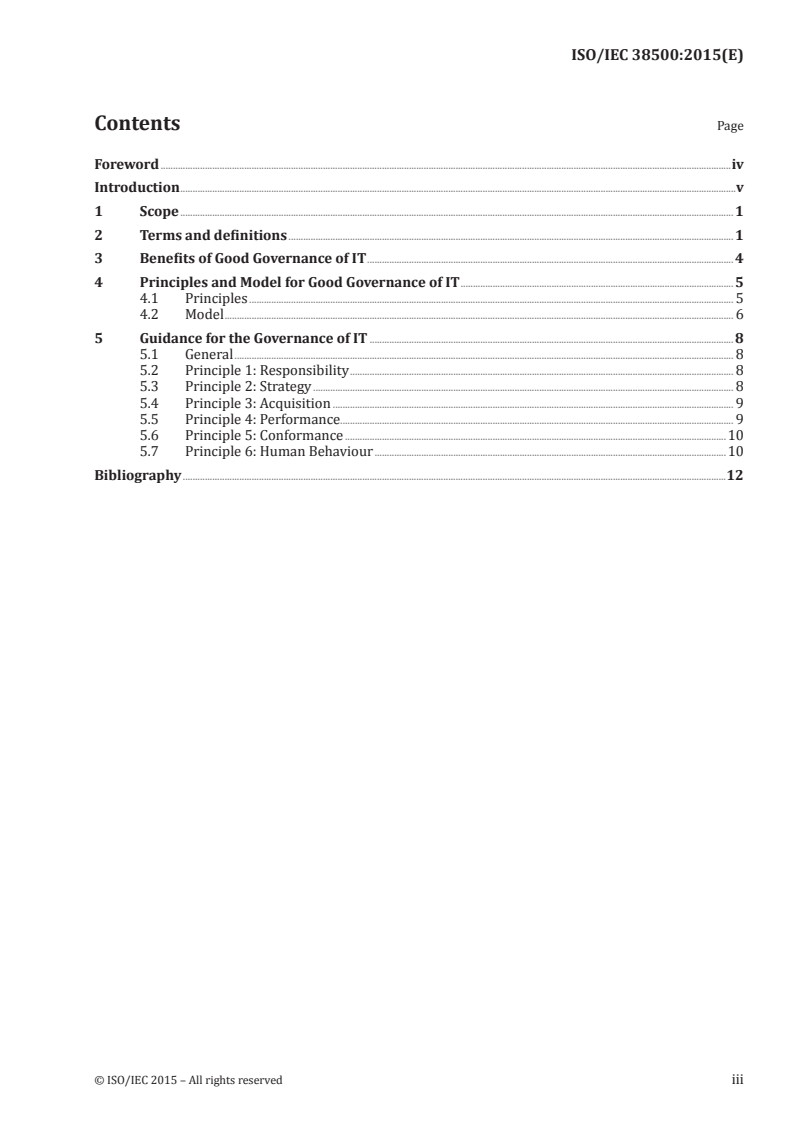
Contents Page
Foreword .iv
Introduction .v
1 Scope . 1
2 Terms and definitions . 1
3 Benefits of Good Governance of IT . 4
4 Principles and Model for Good Governance of IT . 5
4.1 Principles . 5
4.2 Model . 6
5 Guidance for the Governance of IT . 8
5.1 General . 8
5.2 Principle 1: Responsibility . 8
5.3 Principle 2: Strategy . 8
5.4 Principle 3: Acquisition . 9
5.5 Principle 4: Performance. 9
5.6 Principle 5: Conformance .10
5.7 Principle 6: Human Behaviour .10
Bibliography .12
© ISO/IEC 2015 – All rights reserved iii
Foreword
ISO (the International Organization for Standardization) and IEC (the International Electrotechnical
Commission) form the specialized system for worldwide standardization. National bodies that are
members of ISO or IEC participate in the development of International Standards through technical
committees established by the respective organization to deal with particular fields of technical
activity. ISO and IEC technical committees collaborate in fields of mutual interest. Other international
organizations, governmental and non-governmental, in liaison with ISO and IEC, also take part in the
work. In the field of information technology, ISO and IEC have established a joint technical committee,
ISO/IEC JTC 1.
The procedures used to develop this document and those intended for its further maintenance are
described in the ISO/IEC Directives, Part 1. In particular the different approval criteria needed for
the different types of document should be noted. This document was drafted in accordance with the
editorial rules of the ISO/IEC Directives, Part 2 (see www.iso.org/directives).
Attention is drawn to the possibility that some of the elements of this document may be the subject
of patent rights. ISO and IEC shall not be held responsible for identifying any or all such patent rights.
Details of any patent rights identified during the development of the document will be in the Introduction
and/or on the ISO list of patent declarations received (see www.iso.org/patents).
Any trade name used in this document is information given for the convenience of users and does not
constitute an endorsement.
For an explanation on the meaning of ISO specific terms and expressions related to conformity
assessment, as well as information about ISO’s adherence to the WTO principles in the Technical Barriers
to Trade (TBT) see the following URL: Foreword - Supplementary information
ISO/IEC 38500 was prepared by Joint Technical Committee ISO/IEC JTC1, Information technology, SC40,
IT Service Management and IT Governance.
This second edition cancels and replaces the first edition (ISO/IEC 38500:2008), clauses, sub-clauses,
and figures of which have been technically revised.
iv © ISO/IEC 2015 – All rights reserved
Introduction
The objective of this International Standard is to provide principles, definitions, and a model for
governing bodies to use when evaluating, directing, and monitoring the use of information technology
(IT) in their organizations.
This International Standard is a high level, principles-based advisory standard. In addition to providing
broad guidance on the role of a governing body, it encourages organizations to use appropriate standards
to underpin their governance of IT.
Most organizations use IT as a fundamental business tool and few can function effectively without it. IT
is also a significant factor in the future business plans of many organizations.
Expenditure on IT can represent a significant proportion of an organization’s expenditure of financial
and human resources. However, a return on this investment is often not realized fully and the adverse
effects on organizations can be significant.
The main reasons for these negative outcomes are the emphasis on the technical, financial, and
scheduling aspects of IT activities rather than emphasis on the whole business context of use of IT.
This International Standard provides principles, definitions, and a model for good governance of IT, to
assist those at the highest level of organizations to understand and fulfil their legal, regulatory, and
ethical obligations in respect of their organizations’ use of IT.
This International Standard is aligned with the definition of corporate governance that was published
as a Report of the Committee on the Financial Aspects of Corporate Governance (the Cadbury Report) in
1992. The Cadbury Report also provided the foundation definition of corporate governance in the OECD
Principles of Corporate Governance in 1999 (revised in 2004). Governance is distinct from management,
and for the avoidance of confusion, the two concepts are defined in this International Standard and
elaborated in ISO/IEC TR 38502.
This International Standard is addressed primarily to the governing body. In some (typically smaller)
organizations, the members of the governing body can also be executive managers. This International
Standard is applicable for all organizations, from the smallest to the largest, regardless of purpose,
design, and ownership structure.
The implementation of governance of IT is covered by ISO/IEC TS 38501.
© ISO/IEC 2015 – All rights reserved v
INTERNATIONAL STANDARD ISO/IEC 38500:2015(E)
Information technology — Governance of IT for the
organization
1 Scope
This International Standard provides guiding principles for members of governing bodies of
organizations (which can comprise owners, directors, partners, executive managers, or similar) on the
effective, efficient, and acceptable use of information technology (IT) within their organizations.
It also provides guidance to those advising, informing, or assisting governing bodies. They include
the following:
— executive managers;
— members of groups monitoring the resources within the organization;
— external business or technical specialists, such as legal or accounting specialists, retail or industrial
associations, or professional bodies;
— internal and external service providers (including consultants);
— auditors.
This International Standard applies to the governance of the organization’s current and future use of
IT including management processes and decisions related to the current and future use of IT. These
processes can be controlled by IT specialists within the organization, external service providers, or
business units within the organization.
This International Standard defines the governance of IT as a subset or domain of organizational
governance, or in the case of a corporation, corporate governance.
This International Standard is applicable to all organizations, including public and private companies,
government entities, and not-for-profit organizations. This International Standard is applicable to
organizations of all sizes from the smallest to the largest, regardless of the extent of their use of IT.
The purpose of this International Standard is to promote effective, efficient, and acceptable use of IT in
all organizations by
— assuring stakeholders that, if the principles and practices proposed by the standard are followed,
they can have confidence in the organization’s governance of IT,
— informing and guiding governing bodies in governing the use of IT in their organization, and
— establishing a vocabulary for the governance of IT.
2 Terms and definitions
For the purposes of this document, the following terms and definitions apply.
2.1
acceptable
meets stakeholder expectations that are capable of being shown as reasonable or merited
2.2
accountable
answerable for actions, decisions, and performance
© ISO/IEC 2015 – All rights reserved 1
2.3
accountability
state of being accountable
Note 1 to entry: Accountability relates to an allocated responsibility. The responsibility can be based on regulation
or agreement or through assignment as part of delegation.
2.4
corporate governance
system by which corporations are directed and controlled
Note 1 to entry: Corporate governance is organizational governance applied to corporations.
Note 2 to entry: From Cadbury 1992 and OECD 1999.
Note 3 to entry: Definition is included to clarify evolution in terminology from previous edition.
2.5
direct
communicate desired purposes and outcomes to
Note 1 to entry: In the context of governance of IT, direct involves setting objectives, strategies, and policies to be
adopted by the members of the organization to ensure that use of IT meets business objectives.
Note 2 to entry: Objectives, strategies, and policies can be set by managers if they have authority delegated by the
governing body.
2.6
evaluate
consider and make informed judgements
Note 1 to entry: In the context of governance of IT, evaluate involves judgements about the internal and external,
current and future circumstances and opportunities relating to the organization’s current and future use of IT.
2.7
executive manager
person who has authority delegated from the governing body for implementation of strategies and
policies to fulfil the purpose of the organization
Note 1 to entry: Executive managers can include roles which report to the governing body or the head of the
organization or have overall accountability for major reporting function, for example Chief Executive Officers
(CEOs), Heads of Government Organizations, Chief Financial Officers (CFOs), Chief Operating Officers (COOs),
Chief Information Officers (CIOs), and similar roles.
Note 2 to entry: In management standards, executive managers can be referred to as top management.
2.8
governance
system of directing and controlling
2.9
governing body
person or group of people who are accountable for the performance and conformance of the organization
2.10
governance of IT
system by which the current and future use of IT is directed and controlled
Note 1 to entry: Governance of IT is a component or a subset of organizational governance.
Note 2 to entry: The term governance of IT is equivalent to the terms corporate governance of IT, enterprise
governance of IT, and organizational governance of IT.
2 © ISO/IEC 2015 – All rights reserved
2.11
human behaviour
interaction among humans and other elements of the system
Note 1 to entry: Human behaviour includes culture, needs, and aspirations of people as individuals and as groups.
Note 2 to entry: In respect of IT, there are numerous groups or communities of humans, each with their own needs,
aspirations, and behaviours. For example, people who use information systems might exhibit needs relating to
accessibility and ergonomics, as well as availability and performance. People whose job roles are changing because
of the use of IT might exhibit needs relating to communication, training, and reassurance. People involved in
building and operating IT capabilities might exhibit needs relating to working conditions and development of skills.
2.12
information technology (IT)
resources used to acquire, process, store, and disseminate information
Note 1 to entry: This term also includes “communications technology (CT)” and the composite term “information
and communications technology (ICT)”.
2.13
investment
allocation of resources to achieve defined objectives and other benefits
2.14
management
exercise of control and supervision within the authority and accountability established by governance
Note 1 to entry: The term management is often used as a collective term for those with responsibility for controlling
an organization or parts of an organization. The term managers is used to avoid confusion with management systems.
2.15
managers
group of people responsible for control and supervision of an organization or parts of an organization
Note 1 to entry: Executive managers are a category of managers.
2.16
monitor
review as a basis for appropriate decisions and adjustments
Note 1 to entry: Monitor involves routinely obtaining information about progress against plans as well as the
periodic examination of overall achievements against agreed strategies and outcomes to provide a basis for
decision making and adjustments to plans.
Note 2 to entry: Monitor includes reviewing compliance with relevant legislation, regulations, and
organizational policies.
2.17
organization
person or group of people that has its own functions with responsibilities, authorities, and relationships
to achieve its objectives
Note 1 to entry: The concept of organization includes, but is not limited to sole-trader, company, corporation, firm,
enterprise, authority, partnership, charity, or institution, or part or combination thereof, whether incorporated
or not, public, or private.
[SOURCE: Consolidated ISO Supplement 2013- Procedures specific to ISO, Annex XL, Appendix 2. The
note has been added in this International Standard].
2.18
organizational governance
system by which organizations are directed and controlled
© ISO/IEC 2015 – All rights reserved 3
2.19
policy
intentions and direction of an organization as formally expressed by its governing body or executive
managers acting with appropriate authority
2.20
proposal
compila
...
Questions, Comments and Discussion
Ask us and Technical Secretary will try to provide an answer. You can facilitate discussion about the standard in here.
Loading comments...