

ISO/IEC 38500:2024
(Main)Information technology — Governance of IT for the organization
General Information
- Abstract
This document provides guiding principles for members of governing bodies of organizations and those that support them on the effective, efficient and acceptable use of information technology (IT) within their organizations. This document is applicable to: — the governance of the organization’s current, and future, use of IT; — the governance of IT as a domain of governance of organizations. In terms of audience, this document is applicable to: — all organizations, including public and private companies, government entities, and not-for-profit organizations; — organizations of all sizes, from the smallest to the largest, regardless of the extent of their use of IT.
- Status
- Published
- Publication Date
- 22-Feb-2024
- Technical Committee
- ISO/IEC JTC 1/SC 40 - IT service management and IT governance
- Drafting Committee
- ISO/IEC JTC 1/SC 40 - IT service management and IT governance
- Current Stage
- 6060 - International Standard published
- Start Date
- 23-Feb-2024
- Due Date
- 31-Aug-2023
- Completion Date
- 23-Feb-2024
Overview
ISO/IEC 38500:2024 - Information technology - Governance of IT for the organization provides high‑level, non‑sector‑specific guidance for members of governing bodies and those who support them on the effective, efficient and acceptable use of information technology. Applicable to the governance of an organization’s current and future use of IT and to IT as a domain of organizational governance, the standard is intended for all organizations - public, private, government and not‑for‑profit - of any size.
Key outcomes emphasized include effective performance, responsible stewardship, and ethical behaviour in the use of IT. This third edition updates and aligns the IT governance principles with broader governance guidance (notably ISO 37000).
Key topics
- Principles for IT governance: purpose, value generation, strategy, oversight, accountability, stakeholder engagement, leadership, data and decisions, risk governance, social responsibility, and long‑term viability/performance.
- Model for governance of IT: practical governance practices framed as Engage stakeholders → Evaluate → Direct → Monitor.
- Framework elements: direction, capability, policy, delegation, performance measurement, and accountability mechanisms to support consistent governance across the organization.
- Outcomes and implications: guidance on expected governance outcomes (effectiveness, stewardship, ethics) and governance implications for decision‑making about IT.
- Audience and scope: guidance explicitly tailored for governing bodies, boards, governance committees, senior executives and their advisors responsible for IT oversight.
Keywords: ISO/IEC 38500:2024, IT governance, governance of IT, information technology governance, board IT oversight, IT strategy, risk governance, data governance.
Applications
- Help boards and senior leadership establish or refine an IT governance framework that aligns IT strategy with organizational objectives and stakeholder expectations.
- Guide CIOs, IT directors and governance committees in setting direction, delegating authority, and defining performance metrics for technology investments and operations.
- Support the development of policies and accountabilities for data‑driven decision making, risk management (including cyber risk oversight), and ethical use of technology.
- Provide a common reference for auditors, advisors and consultants when assessing governance maturity or designing governance improvement programs.
Who would use this standard
- Board members, governing bodies and governance advisors
- C‑suite executives (CEO, CFO, CIO, CDO)
- IT governance professionals, internal auditors and risk managers
- Organizations of all sizes seeking a consistent approach to IT governance
Related standards
- ISO 37000 (Governance of organizations) - alignment noted in the 2024 edition
- Organizations may integrate ISO/IEC 38500:2024 with sector‑specific and technology‑specific standards to operationalize governance requirements.
Relations
- Effective Date
- 06-Jun-2022
Get Certified
Connect with accredited certification bodies for this standard

BSI Group
BSI (British Standards Institution) is the business standards company that helps organizations make excellence a habit.

NYCE
Mexican standards and certification body.
Sponsored listings
Frequently Asked Questions
ISO/IEC 38500:2024 is a standard published by the International Organization for Standardization (ISO). Its full title is "Information technology — Governance of IT for the organization". This standard covers: This document provides guiding principles for members of governing bodies of organizations and those that support them on the effective, efficient and acceptable use of information technology (IT) within their organizations. This document is applicable to: — the governance of the organization’s current, and future, use of IT; — the governance of IT as a domain of governance of organizations. In terms of audience, this document is applicable to: — all organizations, including public and private companies, government entities, and not-for-profit organizations; — organizations of all sizes, from the smallest to the largest, regardless of the extent of their use of IT.
This document provides guiding principles for members of governing bodies of organizations and those that support them on the effective, efficient and acceptable use of information technology (IT) within their organizations. This document is applicable to: — the governance of the organization’s current, and future, use of IT; — the governance of IT as a domain of governance of organizations. In terms of audience, this document is applicable to: — all organizations, including public and private companies, government entities, and not-for-profit organizations; — organizations of all sizes, from the smallest to the largest, regardless of the extent of their use of IT.
ISO/IEC 38500:2024 is classified under the following ICS (International Classification for Standards) categories: 35.020 - Information technology (IT) in general. The ICS classification helps identify the subject area and facilitates finding related standards.
ISO/IEC 38500:2024 has the following relationships with other standards: It is inter standard links to ISO/IEC 38500:2015. Understanding these relationships helps ensure you are using the most current and applicable version of the standard.
ISO/IEC 38500:2024 is available in PDF format for immediate download after purchase. The document can be added to your cart and obtained through the secure checkout process. Digital delivery ensures instant access to the complete standard document.
Standards Content (Sample)
International
Standard
ISO/IEC 38500
Third edition
Information technology —
2024-02
Governance of IT for the
organization
Technologies de l'information — Gouvernance des technologies
de l'information pour l'entreprise
Reference number
© ISO/IEC 2024
All rights reserved. Unless otherwise specified, or required in the context of its implementation, no part of this publication may
be reproduced or utilized otherwise in any form or by any means, electronic or mechanical, including photocopying, or posting on
the internet or an intranet, without prior written permission. Permission can be requested from either ISO at the address below
or ISO’s member body in the country of the requester.
ISO copyright office
CP 401 • Ch. de Blandonnet 8
CH-1214 Vernier, Geneva
Phone: +41 22 749 01 11
Email: copyright@iso.org
Website: www.iso.org
Published in Switzerland
© ISO/IEC 2024 – All rights reserved
ii
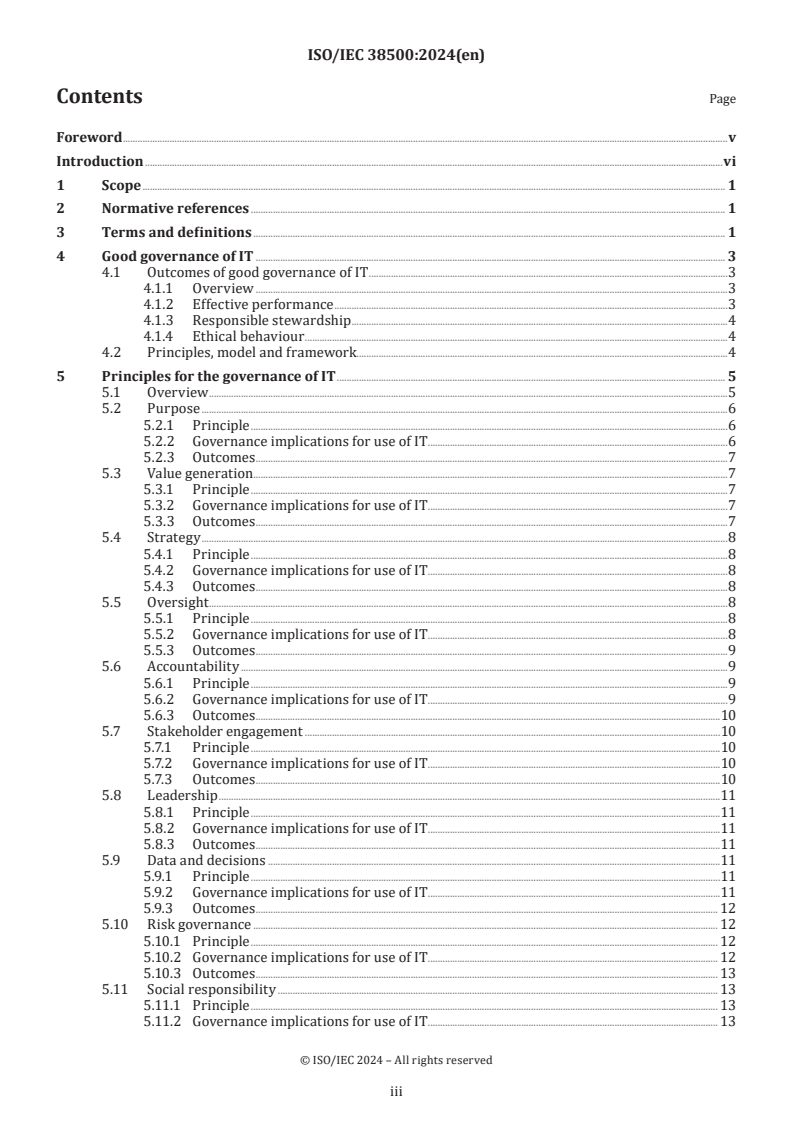
Contents Page
Foreword .v
Introduction .vi
1 Scope . 1
2 Normative references . 1
3 Terms and definitions . 1
4 Good governance of IT . 3
4.1 Outcomes of good governance of IT .3
4.1.1 Overview .3
4.1.2 Effective performance .3
4.1.3 Responsible stewardship .4
4.1.4 Ethical behaviour .4
4.2 Principles, model and framework.4
5 Principles for the governance of IT . 5
5.1 Overview .5
5.2 Purpose .6
5.2.1 Principle .6
5.2.2 Governance implications for use of IT .6
5.2.3 Outcomes .7
5.3 Value generation.7
5.3.1 Principle .7
5.3.2 Governance implications for use of IT .7
5.3.3 Outcomes .7
5.4 Strategy .8
5.4.1 Principle .8
5.4.2 Governance implications for use of IT .8
5.4.3 Outcomes .8
5.5 Oversight . .8
5.5.1 Principle .8
5.5.2 Governance implications for use of IT .8
5.5.3 Outcomes .9
5.6 Accountability .9
5.6.1 Principle .9
5.6.2 Governance implications for use of IT .9
5.6.3 Outcomes .10
5.7 Stakeholder engagement .10
5.7.1 Principle .10
5.7.2 Governance implications for use of IT .10
5.7.3 Outcomes .10
5.8 Leadership .11
5.8.1 Principle .11
5.8.2 Governance implications for use of IT .11
5.8.3 Outcomes .11
5.9 Data and decisions .11
5.9.1 Principle .11
5.9.2 Governance implications for use of IT .11
5.9.3 Outcomes . 12
5.10 Risk governance . 12
5.10.1 Principle . 12
5.10.2 Governance implications for use of IT . 12
5.10.3 Outcomes . 13
5.11 Social responsibility . 13
5.11.1 Principle . 13
5.11.2 Governance implications for use of IT . 13
© ISO/IEC 2024 – All rights reserved
iii
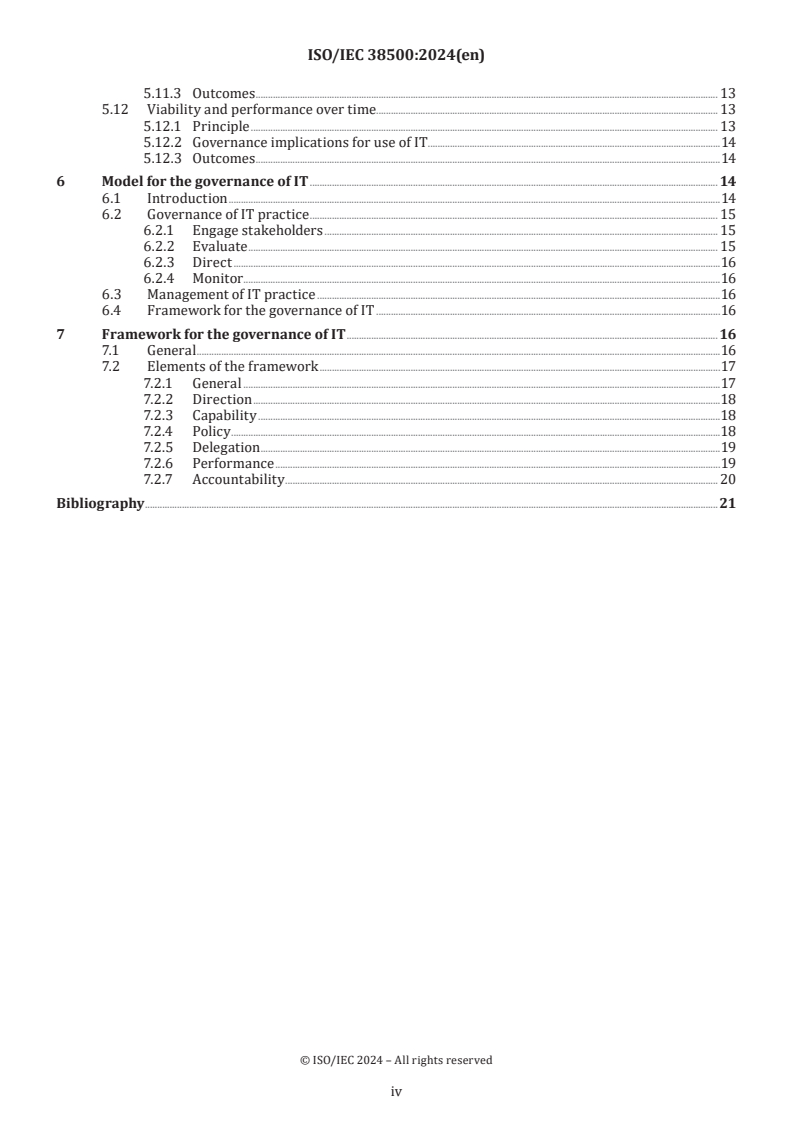
5.11.3 Outcomes . 13
5.12 Viability and performance over time. 13
5.12.1 Principle . 13
5.12.2 Governance implications for use of IT .14
5.12.3 Outcomes .14
6 Model for the governance of IT . 14
6.1 Introduction .14
6.2 Governance of IT practice . 15
6.2.1 Engage stakeholders . 15
6.2.2 Evaluate . 15
6.2.3 Direct .16
6.2.4 Monitor .16
6.3 Management of IT practice .16
6.4 Framework for the governance of IT .16
7 Framework for the governance of IT .16
7.1 General .16
7.2 Elements of the framework .17
7.2.1 General .17
7.2.2 Direction .18
7.2.3 Capability .18
7.2.4 Policy .18
7.2.5 Delegation .19
7.2.6 Performance .19
7.2.7 Accountability . 20
Bibliography .21
© ISO/IEC 2024 – All rights reserved
iv
Foreword
ISO (the International Organization for Standardization) and IEC (the International Electrotechnical
Commission) form the specialized system for worldwide standardization. National bodies that are
members of ISO or IEC participate in the development of International Standards through technical
committees established by the respective organization to deal with particular fields of technical activity.
ISO and IEC technical committees collaborate in fields of mutual interest. Other international organizations,
governmental and non-governmental, in liaison with ISO and IEC, also take part in the work.
The procedures used to develop this document and those intended for its further maintenance are described
in the ISO/IEC Directives, Part 1. In particular, the different approval criteria needed for the different types
of document should be noted. This document was drafted in accordance with the editorial rules of the ISO/
IEC Directives, Part 2 (see www.iso.org/directives or www.iec.ch/members_experts/refdocs).
ISO and IEC draw attention to the possibility that the implementation of this document may involve the
use of (a) patent(s). ISO and IEC take no position concerning the evidence, validity or applicability of any
claimed patent rights in respect thereof. As of the date of publication of this document, ISO and IEC had not
received notice of (a) patent(s) which may be required to implement this document. However, implementers
are cautioned that this may not represent the latest information, which may be obtained from the patent
database available at www.iso.org/patents and https://patents.iec.ch. ISO and IEC shall not be held
responsible for identifying any or all such patent rights.
Any trade name used in this document is information given for the convenience of users and does not
constitute an endorsement.
For an explanation of the voluntary nature of standards, the meaning of ISO specific terms and expressions
related to conformity assessment, as well as information about ISO's adherence to the World Trade
Organization (WTO) principles in the Technical Barriers to Trade (TBT) see www.iso.org/iso/foreword.html.
In the IEC, see www.iec.ch/understanding-standards.
This document was prepared by Joint Technical Committee ISO/IEC JTC 1, Information technology,
Subcommittee SC 40, IT service management and IT governance.
This third edition cancels and replaces the second edition (ISO/IEC 38500:2015), which has been technically
revised.
The main changes are as follows:
— the principles for governance of IT and alignment to the principles of governance in ISO 37000 have been
elaborated;
— the model has been updated to include "engage stakeholders";
— a framework for the governance of IT has been updated from ISO/IEC TR 38502.
A list of all parts in the ISO/IEC 38500 series can be found on the ISO and IEC websites.
Any feedback or questions on this document should be directed to the user’s national standards
body. A complete listing of these bodies can be found at www.iso.org/members.html and
www.iec.ch/national-committees.
© ISO/IEC 2024 – All rights reserved
v
Introduction
The use of information technology (IT) is critical to the success of most organizations, not only as a
supporting function, but also as part of the organization’s capability to transform the organization. IT enables
new business models and can substantially improve the organization’s outcomes to meet the organization’s
stakeholder needs and expectations. The growing threat of cybersecurity and risks emanating from
emerging technologies increases this focus.
The increasing potential of current and future IT requires the appropriate application of governance of IT to
ensure that it fulfils the purpose of the organization in an effective, responsible and ethical manner, and that
it aligns with the organization’s strategic direction.
The objective of this document is to provide guidance to governing bodies on the responsible, innovative,
sustainable and strategic use of IT, data and digital capabilities, so their organizations can fulfil their
purpose in a manner expected by their stakeholders. This document provides principle-based guidelines
and therefore does not include specific implementation detail.
It utilizes three tools for the governing body and associated governance and management practices to
achieve good governance of IT:
1) Principles for the governance of IT — applying these principles to the responsible and strategic use of IT
can lead to an organization that is more agile and adaptive.
2) Model for the governance of IT — the model shows the main governance tasks and interactions
throughout the organization, leading to a clarity of decision-making and responsibilities for all aspects
of the use of IT.
3) Framework for the governance of IT — the framework describes the elements through which the
organization’s governance of IT arrangements operate, which helps to ensure the critical actions of
governance are considered and applied to the use of IT by the organization.
As the governance of IT is a domain of the governance of organizations, this document aligns to ISO 37000
and its principles of governance. This document can also be used in conjunction with other governance codes
and principles for effective governance. This document can be used independently or to upgrade current
governance based on the previous edition of ISO/IEC 38500.
This document is addressed primarily to the governing body but recognizes that governance occurs
throughout the organization. It therefore provides guidance on the practice of governance of IT across the
organization including the interaction and collaboration of all personnel, regardless of their job description.
© ISO/IEC 2024 – All rights reserved
vi
International Standard ISO/IEC 38500:2024(en)
Information technology — Governance of IT for the
organization
1 Scope
This document provides guiding principles for members of governing bodies of organizations and those
that support them on the effective, efficient and acceptable use of information technology (IT) within their
organizations.
This document is applicable to:
— the governance of the organization’s current, and future, use of IT;
— the governance of IT as a domain of governance of organizations.
In terms of audience, this document is applicable to:
— all organizations, including public and private companies, government entities, and not-for-profit
organizations;
— organizations of all sizes, from the smallest to the largest, regardless of the extent of their use of IT.
2 Normative references
The following documents are referred to in the text in such a way that some or all of their content constitutes
requirements of this document. For dated references, only the edition cited applies. For undated references,
the latest edition of the referenced document (including any amendments) applies.
ISO 37000, Governance of organizations — Guidance
3 Terms and definitions
For the purposes of this document, the terms and definitions given in ISO 37000 and the following apply.
ISO and IEC maintain terminology databases for use in standardization at the following addresses:
— ISO Online browsing platform: available at https:// www .iso .org/ obp
— IEC Electropedia: available at https:// www .electropedia .org/
3.1
direct
communicate desired purposes and outcomes
Note 1 to entry: Within the context of the governance of IT, directing involves setting objectives, strategies and policies
to be adopted by the members of the organization, to ensure that the use of IT meets business objectives.
Note 2 to entry: Objectives, strategies and policies can be set by management if they have the relevant authority
delegated to them by the governing body.
© ISO/IEC 2024 – All rights reserved
3.2
evaluate
consider and make informed judgements
Note 1 to entry: Within the context of the governance of IT, evaluating involves making judgements about the
circumstances and opportunities (internal and external, current and future) relating to the organization's current,
and future use of IT.
3.3
governance
human-based system comprising directing, overseeing and accountability
3.4
governance of IT
system by which the current and future use of IT is governed
Note 1 to entry: Governance of IT is a component or a domain of governance of organizations.
Note 2 to entry: The term "governance of IT" is equivalent to the terms "corporate governance of IT", "enterprise
governance of IT" and "organizational governance of IT".
3.5
information technology
IT
resources used to acquire, process, store and disseminate information or data
Note 1 to entry: Resources can include computer or communication equipment, sensors, software, cloud computing
and other software-based services.
3.6
investment
allocation of resources to achieve defined objectives and other benefits
3.7
management
fulfilment of the organization’s objectives within the authority and accountability established by governance
Note 1 to entry: The term "management" is often used as a collective term for those with responsibility for controlling
an organization or parts of an organization.
3.8
monitor
review as a basis for appropriate decisions and adjustments
Note 1 to entry: Monitoring involves routinely obtaining information about progress against plans as well as the
periodic examination of overall achievements against agreed strategies and outcomes to provide a basis for decision-
making and adjustments to plans.
Note 2 to entry: Monitoring includes reviewing compliance with relevant legislation, regulations and organizational
policies.
3.9
use of IT
planning, design, development, deployment, operation, management and application of IT to fulfil business
objectives and create value for the organization
Note 1 to entry: The use of IT includes both the demand for, and the supply of, IT.
3.10
digital capability
IT to enable or support a service, product or process of the organization
© ISO/IEC 2024 – All rights reserved
4 Good governance of IT
4.1 Outcomes of good governance of IT
4.1.1 Overview
This document provides guidance on the governance implications of the use of IT, data and digital capabilities
by an organization. Throughout the concept, this term is simplified as the phrase “the governance of
IT”. While the governing body retains ultimate accountability for the whole organization, the practice of
governance of IT can occur throughout the organization.
The governance of IT in this context is applied broadly to the use of information technology including
emerging technology, data and digital capabilities. Information technology includes computers, sensors,
software, cloud computing services and techniques which are used to gather, store, process, disseminate
and transform data. Digital capabilities, often innovative, enable or support the services, products or
processes of the organization that can create value for stakeholders. Digital capabilities of the organization
are supported, or enabled, by using information technology and data.
The governance of IT is a domain of the governance of organizations, so this document aligns to ISO 37000
and its principles for governance. This document provides guidance on how the governance outcomes are
realized by the organization as a result of effective governance of IT.
ISO 37000 describes governance of organizations as laying the foundation for the fulfilment of the purpose
of the organization in an effective, responsible and ethical manner in line with stakeholder expectations.
It sets out eleven governance principles to guide governing bodies in discharging their duties such that the
organizations realize the three intended governance outcomes, which are defined as:
— effective performance,
— responsible stewardship, and
— ethical behaviour.
IT and the data from which it creates and unlocks value, have become increasingly effective and strategically
significant to most organizations. This makes the governance of IT increasingly important for the
organization – and stakeholders have high expectations of the outcomes of effective governance of IT.
4.1.2 Effective performance
What constitutes effective performance of IT by the organization is determined by the governing body and its
understanding of the organization’s context and stakeholder expectations. To achieve effective performance,
clearly stated performance expectations are established as a basis for operational management, oversight of
delivery and use of IT.
The effective performance of IT by the organization can also be measured by evaluating the following points:
— alignment of digital capabilities to support and enable the fulfilment of organizational purpose;
— appropriate investment in IT, including degree of digitalization and innovation required by the
organization;
— appropriate value extraction from resources, including IT assets such as computers and software,
but also the data and digital services used and the people creating, maintaining and using the digital
capabilities;
— the linkage between data costs and how data use delivers better decision-making in the organization
and its stakeholders;
— the degree to which digital capabilities are delivering agility and adaptability to the organization so it
can sense, learn and adapt to address future opportunities, potential risks and new obligations.
© ISO/IEC 2024 – All rights reserved
4.1.3 Responsible stewardship
The resources under the stewardship of the organization include the digital capabilities of the organization
as well as the data it has created and data from others (such as vendors, customers, employees and other
stakeholders).
Expectations for responsible stewardship should be clearly stated and can include:
— consideration for ensuring that automated decisions are reasonable and justified (see ISO/IEC 38507);
— ensuring that data relating to stakeholder information is appropriately protected and used;
— ensuring the security and resilience of the digital capabilities and data;
— demonstrating appropriate risk governance, duty of care and good decision-making in the usage of
digital capabilities;
— adapting to the changing stakeholder requirements of transparency, explainability and impact
assessments.
4.1.4 Ethical behaviour
The organization relies on stakeholder engagement and international norms of behaviour to define its
ethical practices and drive appropriate conduct. In the context of the use of IT, this means that such use
is appropriately governed and expectations are clearly stated to ensure that use remains within these
parameters (including human behaviour), and any impact from such use does not adversely affect relevant
stakeholders or the economic or natural environment.
By adhering to the principles of the governance of IT and applying the model and framework to the
organization’s use of IT, the governing body ensures that ethical behaviour is supported and encouraged.
Expectations for ethical behaviour can include:
— consideration of IT asset ownership and data rights and obligations;
— consideration of access and rights of use;
— consideration of social and environmental issues;
— maintenance of confidentiality;
— integrity and transparency in fulfilling obligations and commitments;
— compliance to regulations.
4.2 Principles, model and framework
This document provides three tools for the governing body and associated governance and management
practices to use to achieve effective governance of IT. Table 1 describes these tools, how they are used and
the benefits of using them.
© ISO/IEC 2024 – All rights reserved
Table 1 — Governance of IT — Overview of tools
Tool Explanation Use Benefit(s)
Principles for Provides the fundamental truth Application of these principles A more agile, adaptive, respon-
the governance and assumptions that serve in tasks, interactions and frame- sible and strategic use of IT to
of IT as the foundation for beliefs, work elements allows faster and support and enable the objec-
behaviours and reasoning. more aligned decision-making, tives of the organization.
particularly in the absence of
clearly-defined rules (e.g. new
markets, business rules, tech-
nologies or innovations in any of
these areas).
Model for the Shows the main tasks and The model is used to clearly Clarity of decision-making and
governance of interactions throughout the delineate governance responsi- responsibilities for all aspects
IT organization that are necessary bilities and decisions from those of the use of IT.
for the implementation of the of management, while under-
governance of IT. standing how these two prac-
tices interact within an overall
framework for the governance
of IT.
Framework for Describes the elements through The governance practice collab- Helps to ensure the critical
the governance which the organization’s gov- orates throughout the organiza- actions of governance are con-
of IT ernance of IT arrangements tion to detail the six elements of sidered and applied to the use of
operate. the framework. The principles IT by the organization.
are applied throughout the
collaboration and the model
guides the responsibilities and
decision-making throughout.
5 Principles for the governance of IT
5.1 Overview
The benefit of a principle-based document is that such an International Standard can identify the outcomes
of applying the principles without specifying explicit methodologies, structures, processes and techniques.
As the foundational document for the governance of IT, it is essential that the document can be applied with
no consideration to the specific implementation for an organization. The system of governance adopted
by the organization should be outcome-driven to best fit the organization, including but not limited to, its
compliance needs.
The principles for the governance of IT provide the fundamental truth and assumptions that serve as the
foundation for beliefs, behaviours and reasoning (see Table 1). They provide a useful foundation for the
governance of IT and will provide particular value when new or innovative use of IT is considered. The
principles can be applied to individual situations and elements of IT, as well as across the whole ecosystem
of an organization.
As the governance of IT is a domain of the governance of organization, the "principle" statements (Table 2,
5.2 to 5.12) are those of ISO 37000:2021, Clause 6. Table 2 details the category and grouping of the principles
and is taken from ISO 37000:2021, Table 1.
The governance implications of the use of IT and consequent outcomes are detailed, highlighting both the
specific and unique aspects of the principles for an organization with respect to IT.
© ISO/IEC 2024 – All rights reserved
Table 2 — Organizational governance principles overview
Category Category description Principle
The pursuit of purpose is at the centre of all organizations and is of Purpose (5.2)
primary importance for the governance of organizations.
Therefore, this principle is the primary consideration for governance
Primary
and the central point of all the other principles in this document. All
other principles are to be read in the context of the application of this
principle.
The four foundational governance principles are the essence to ensur- Value generation (5.3)
ing that effective governance of an organization takes place.
Core to the ability to effectively govern an organization is:
— determining the organization’s approach to value generation;
— directing and engaging with strategy to generate that value;
— overseeing that the organization performs and behaves according
to the expectations set by the governing body;
Foundational — demonstrating accountability for the organization’s performance, Strategy (5.4)
behaviour, decisions and activities.
Oversight (5.5)
Accountability (5.6)
The six enabling principles address the governance responsibilities Stakeholder engage-
pertinent to today’s organizations: to meet evolving stakeholder ex- ment (5.7)
pectations and the changing natural environment, social and economic
Leadership (5.8)
context.
Data and decisions (5.9)
Enabling
Risk governance (5.10)
Social responsibility
(5.11)
Viability and perfor-
mance over time (5.12)
5.2 Purpose
5.2.1 Principle
"The governing body should ensure that the organization’s reason for existence is clearly defined as an
organizational purpose. This organizational purpose should define the organization’s intentions towards the
natural environment, society and the organization’s stakeholder. The governing body should also ensure that the
associated set of organizational values is clearly defined." [SOURCE: ISO 37000:2021, 6.1.1]
5.2.2 Governance implications for use of IT
When defining the purpose of the organization, the governing body should consider how the use of IT can
enable or enhance the organizational purpose as well as the values of the organization. Consideration
should be given to the implications of new and emerging technologies, communicated in a way that makes
appropriate use of IT and is embedded through continued, demonstrated commitment.
As technology changes, the purpose of the organization should be reviewed to address the potential for
a wider, more focussed or stronger purpose by leveraging these changes. Additionally, the use of new
technology services should be reviewed to ensure such use remains aligned to the agreed organization’s
purpose.
© ISO/IEC 2024 – All rights reserved
5.2.3 Outcomes
The expected outcomes of the use of IT for the application of the principle are as follows.
— Extended or improved purpose: by leveraging the use of IT appropriately, the organization can enhance
its value offerings.
— Alignment of IT to purpose: addressing the use of IT along with the organizational purpose and values
helps to align the use of IT.
— Empower personnel: clarifying the alignment of the use of IT to the organizational purpose empowers
personnel to make decisions and act in alignment with the purpose.
5.3 Value generation
5.3.1 Principle
"The governing body should define the organization’s value generation objectives such that they fulfil the
organizational purpose in accordance with the organizational values and the natural environment, social and
economic context within which it operates." [SOURCE: ISO 37000:2021, 6.2.1]
5.3.2 Governance implications for use of IT
IT plays an important role in an organization’s value generation as it can provide new or improved products
or services in a timely, cost-effective and high-quality manner. It can also be used to differentiate the
organization’s value to its stakeholders including customers and suppliers. The use of IT can have significant
impacts, both positive and negative, on the organization’s value generation model and therefore, the role of
IT in the definition and generation of organizational value should be determined and communicated. The
concept of a value generation model is defined in ISO 37000:2021, 6.2.3.
Organizations are faced with an environment of continuous change, often driven by IT, data and digital
capabilities. The governing body should consider the impact of technology change on its value generation
model and ensure that implications are well understood and appropriate for the organization’s purpose,
values and ability or necessity to change or transform.
In determining the impacts of IT, data and digital capabilities on the value generation model, the competitive
environment, emerging and future technology trends, alternative technology solutions and trends in
stakeholder expectations should be considered.
Organizations should also ensure the opportunities and threats to the organization’s value generation model
from digital innovation or transformation are monitored. Opportunities for innovation should be identified
and assessed.
Governance should ensure that the digital capabilities of the organization are appropriate for both current
use and the desired future use, at a pace of change required by the organization. Investment in IT, data
and digital capabilities is critical and significantly impacts the value generation model for an organization.
Investment in both the organization’s current environment and its future plans should be considered for
impact on value for the organization.
5.3.3 Outcomes
The expected outcomes of the use of IT for the application of the principle are as follows.
— Defined value generation objectives: there are defined objectives as to how the organization proposes
to use IT to support and enable its value generation model and to guide the organizational priorities and
investment in IT.
— Communicated value generation objectives: the contribution and integration of the organization’s
digital capabilities as a critical enabler to the value generation model are understood and aligned to its
strategy and communicated to its relevant stakeholders.
© ISO/IEC 2024 – All rights reserved
— Adaptability: there are mechanisms in place to regularly assess the potential impact of new technology
solutions and to leverage these for the organization's value generation model and competitive solutions.
5.4 Strategy
5.4.1 Principle
"The governing body should direct and engage with the organizational strategy, in accordance with the value
generation model, to fulfil the organizational purpose." [SOURCE: ISO 37000:2021, 6.3.1]
5.4.2 Governance implications for use of IT
The overall organizational strategy should consider the impact of IT on the organization’s current and future
needs and expectations. The potential value and role that emerging IT can provide to the organization
in a timely manner as well as the pace and approach used to integrate new or emerging IT should form
fundamental elements of the organizational strategy.
The IT strategy should align with, and be included in, the organizational strategy. It should identify where
the strategic choices impact on the use of IT, the increasing demand for digital services and the impact of
cyber security, resilience, total cost of ownership, flexibility and resources. Particular attention should be
given to whether the organization can adapt its strategy to integrate new technology opportunities and
to adapt to changing internal and external demand. The IT strategy for the supply and use of IT should be
critically reviewed, considering the ecosystem within which the organization operates now and into the
future.
Essential IT services, such as online identity management, data storage and communications should be
examined to ensure a reasonable balance between costs, flexibility and organizational autonomy and
independence.
5.4.3 Outcomes
The expected outcomes of the use of IT for the application of the principle are as follows.
— Dig
...