

ISO 6893:2024
(Main)Jewellery and precious metals — Inspection of batches of small diamonds — Terminology, classification and test methods
General Information
- Abstract
This document specifies the terminology, classification and test methods that are used for the inspection of batches of unmounted polished colourless diamonds with single mass smaller than or equal to 0,25 ct (carat). While the inspection of a batch is made one diamond at a time, the use of this document is not to be claimed for one single diamond only nor for fancy coloured diamonds, nor for synthetic diamonds, nor for treated diamonds, neither for assembled stones.
- Status
- Published
- Publication Date
- 08-Apr-2024
- Technical Committee
- ISO/TC 174 - Jewellery and precious metals
- Drafting Committee
- ISO/TC 174 - Jewellery and precious metals
- Current Stage
- 6060 - International Standard published
- Start Date
- 09-Apr-2024
- Due Date
- 20-Jan-2025
- Completion Date
- 09-Apr-2024
Buy Documents

ISO 6893:2024 - Jewellery and precious metals — Inspection of batches of small diamonds — Terminology, classification and test methods Released:9. 04. 2024
ISO 6893:2024 - Joaillerie, bijouterie et métaux précieux — Contrôle des lots de petits diamants — Terminologie, classification et méthodes d’examen/19/2024

REDLINE ISO 6893:2024 - Joaillerie, bijouterie et métaux précieux — Contrôle des lots de petits diamants — Terminologie, classification et méthodes d’examen/19/2024
Overview
ISO 6893:2024 - Jewellery and precious metals - Inspection of batches of small diamonds defines standardized terminology, classification and test methods for inspecting batches of unmounted, polished colourless small diamonds with individual mass ≤ 0.25 ct. The standard is intended for batch inspection (often by sampling) and explicitly excludes use for single-diamond certification, fancy coloured, synthetic, treated or assembled stones. ISO 6893:2024 complements ISO 24016 and ISO 18323 to harmonize quality assessment across the jewellery and watchmaking supply chain.
Key topics and technical requirements
ISO 6893:2024 organizes practical inspection work into clear technical areas and procedures, including:
- Terminology and classification - common definitions for batch characteristics and grading attributes to ensure consistent communication.
- Batch specifications and inspection principles - defining homogeneity requirements and the scope for sampling-based inspections.
- Authentication - procedures to confirm diamonds are natural, unmounted and appropriate for batch inspection.
- Sieving and mass estimation - methods to sieve, count and weigh diamonds to estimate total mass or batch size safely and accurately.
- Mass and dimensional measurements - weighing procedures, expression of batch mass, traditional and automated measurement methods (e.g., profile projector, automated dimensioning).
- Sampling plans and inspection strategy - guidance on drawing samples, sampling plans, multiple-criteria inspection and decision rules suitable for large batches.
- Cut-related attributes - assessing shape, proportions, polish and symmetry with test methods and grading descriptors for homogeneous and inhomogeneous batches.
- Colour, fluorescence and clarity testing - visual and instrumental testing (including spectrometry for fluorescence) and standardised grade descriptions.
- Reporting - required content for a test report documenting inspection results and conformity.
(Informative annexes include figures for round brilliant cut and a sampling-control flowchart.)
Practical applications
ISO 6893:2024 is practical for:
- Quality control in diamond trading, manufacturing and supply-chain acceptance testing.
- Jewellery and watchmaking companies that purchase small diamond batches for setting and assembly.
- Independent gemological laboratories developing batch inspection services.
- Procurement, inspection and compliance teams seeking consistent grading and dispute reduction.
- Customs, certification or logistics partners handling high-volume small-diamond consignments.
Benefits include harmonized inspection methods, reduced commercial disputes, reliable batch descriptions, and increased consumer confidence in jewellery products.
Related standards
- ISO 24016 (grading of polished diamonds over 0.25 ct)
- ISO 18323 (diamond grading terminology and communication)
For full test procedures, sampling tables and grading definitions consult the official ISO 6893:2024 publication available from your national standards body or www.iso.org.
Buy Documents
ISO 6893:2024 - Jewellery and precious metals — Inspection of batches of small diamonds — Terminology, classification and test methods Released:9. 04. 2024
ISO 6893:2024 - Joaillerie, bijouterie et métaux précieux — Contrôle des lots de petits diamants — Terminologie, classification et méthodes d’examen/19/2024
REDLINE ISO 6893:2024 - Joaillerie, bijouterie et métaux précieux — Contrôle des lots de petits diamants — Terminologie, classification et méthodes d’examen/19/2024
Frequently Asked Questions
ISO 6893:2024 is a standard published by the International Organization for Standardization (ISO). Its full title is "Jewellery and precious metals — Inspection of batches of small diamonds — Terminology, classification and test methods". This standard covers: This document specifies the terminology, classification and test methods that are used for the inspection of batches of unmounted polished colourless diamonds with single mass smaller than or equal to 0,25 ct (carat). While the inspection of a batch is made one diamond at a time, the use of this document is not to be claimed for one single diamond only nor for fancy coloured diamonds, nor for synthetic diamonds, nor for treated diamonds, neither for assembled stones.
This document specifies the terminology, classification and test methods that are used for the inspection of batches of unmounted polished colourless diamonds with single mass smaller than or equal to 0,25 ct (carat). While the inspection of a batch is made one diamond at a time, the use of this document is not to be claimed for one single diamond only nor for fancy coloured diamonds, nor for synthetic diamonds, nor for treated diamonds, neither for assembled stones.
ISO 6893:2024 is classified under the following ICS (International Classification for Standards) categories: 01.040.39 - Precision mechanics. Jewellery (Vocabularies); 39.060 - Jewellery. The ICS classification helps identify the subject area and facilitates finding related standards.
ISO 6893:2024 is available in PDF format for immediate download after purchase. The document can be added to your cart and obtained through the secure checkout process. Digital delivery ensures instant access to the complete standard document.
Standards Content (Sample)
International
Standard
ISO 6893
First edition
Jewellery and precious metals —
2024-04
Inspection of batches of small
diamonds — Terminology,
classification and test methods
Joaillerie, bijouterie et métaux précieux — Contrôle des lots
de petits diamants — Terminologie, classification et méthodes
d’examen
Reference number
© ISO 2024
All rights reserved. Unless otherwise specified, or required in the context of its implementation, no part of this publication may
be reproduced or utilized otherwise in any form or by any means, electronic or mechanical, including photocopying, or posting on
the internet or an intranet, without prior written permission. Permission can be requested from either ISO at the address below
or ISO’s member body in the country of the requester.
ISO copyright office
CP 401 • Ch. de Blandonnet 8
CH-1214 Vernier, Geneva
Phone: +41 22 749 01 11
Email: copyright@iso.org
Website: www.iso.org
Published in Switzerland
ii
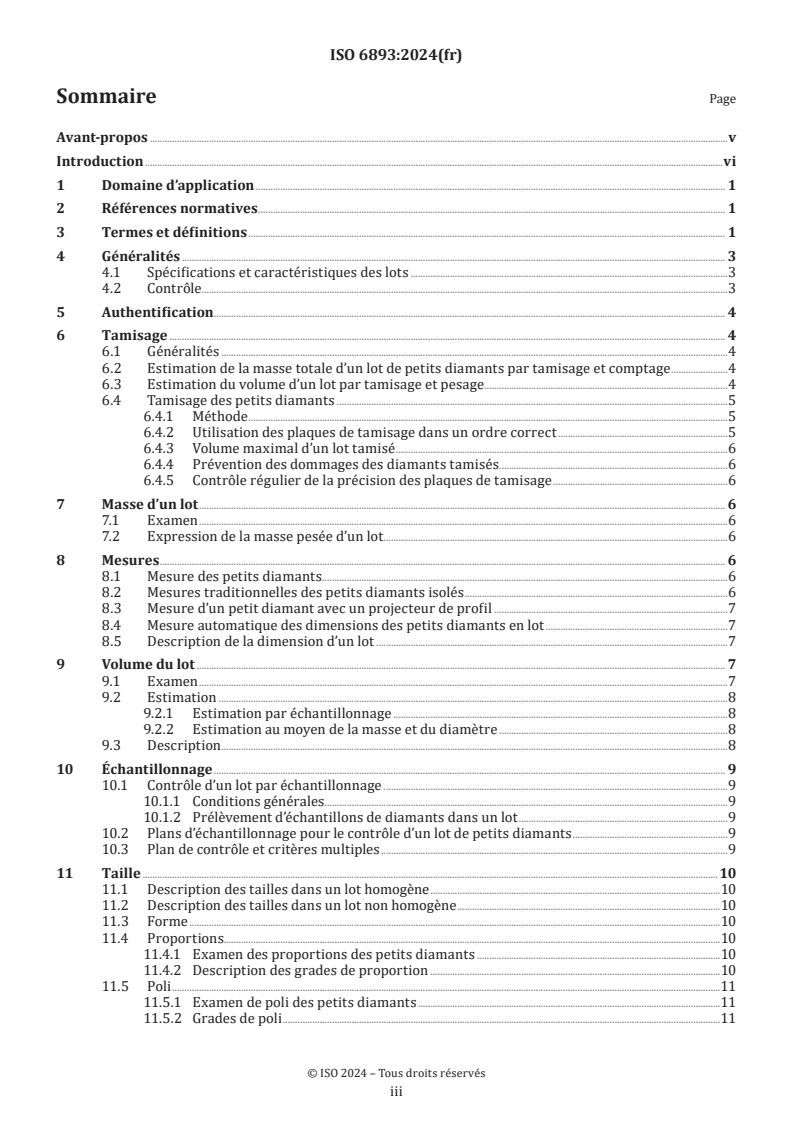
Contents Page
Foreword .v
Introduction .vi
1 Scope . 1
2 Normative references . 1
3 Terms and definitions . 1
4 General . 3
4.1 Batch specifications and characteristics .3
4.2 Inspection .3
5 Authentication . 4
6 Sieving . 4
6.1 General .4
6.2 Estimating the total mass of a small diamond batch by sieving and counting .4
6.3 Estimating a batch size by sieving and weighing .4
6.4 Sieving small diamonds .4
6.4.1 Method . .4
6.4.2 Using sieving plates in a correct order .5
6.4.3 Maximum size of a sieved batch .5
6.4.4 Preventing damages of sieved diamonds .5
6.4.5 Regular control of sieve plates accuracy .6
7 Mass of a batch . 6
7.1 Testing .6
7.2 Expression of the weighed mass of a batch .6
8 Measurements . 6
8.1 Measuring small diamonds .6
8.2 Traditional measurements of single small diamonds .6
8.3 Measuring a small diamond with a profile projector .6
8.4 Measuring automatically dimensions of small diamonds in batch .7
8.5 Description of dimension for a batch . .7
9 Batch size . 7
9.1 Testing .7
9.2 Estimation .7
9.2.1 Estimation by sampling . .7
9.2.2 Estimation using mass and diameter.8
9.3 Description .8
10 Sampling . 8
10.1 Inspecting a batch by sampling .8
10.1.1 General conditions .8
10.1.2 Drawing diamond samples from a batch .8
10.2 Sampling plans for the inspection of a batch of small diamonds .9
10.3 Inspection plan and multiple criteria .9
11 Cut . 9
11.1 Description of cut in a homogenous batch .9
11.2 Description of cut in an inhomogenous batch .9
11.3 Shape .9
11.4 Proportions.9
11.4.1 Testing the proportions of small diamonds .9
11.4.2 Description of proportion grades .10
11.5 Polish .10
11.5.1 Testing the polish of small diamonds .10
11.5.2 Polish grades .10
iii
11.6 Symmetry .11
11.6.1 Testing the symmetry of small diamonds .11
11.6.2 Symmetry grades .11
12 Colour .11
12.1 Testing the colour of small diamonds .11
12.2 Colour grades .11
13 Fluorescence .12
13.1 Testing the fluorescence of small diamonds . 12
13.1.1 Testing the fluorescence by visual means . 12
13.1.2 Testing the fluorescence by spectrometry. 13
13.2 Description of the fluorescence . 13
14 Clarity .13
14.1 Testing the clarity of small diamonds . 13
14.2 Clarity grades . 13
15 Content of a test report . 14
Annex A (informative) Corresponding figures for round brilliant cut .16
Annex B (informative) Flowchart for «sampling control» .18
Bibliography .21
iv
Foreword
ISO (the International Organization for Standardization) is a worldwide federation of national standards
bodies (ISO member bodies). The work of preparing International Standards is normally carried out through
ISO technical committees. Each member body interested in a subject for which a technical committee
has been established has the right to be represented on that committee. International organizations,
governmental and non-governmental, in liaison with ISO, also take part in the work. ISO collaborates closely
with the International Electrotechnical Commission (IEC) on all matters of electrotechnical standardization.
The procedures used to develop this document and those intended for its further maintenance are described
in the ISO/IEC Directives, Part 1. In particular, the different approval criteria needed for the different types
of ISO document should be noted. This document was drafted in accordance with the editorial rules of the
ISO/IEC Directives, Part 2 (see www.iso.org/directives).
ISO draws attention to the possibility that the implementation of this document may involve the use of (a)
patent(s). ISO takes no position concerning the evidence, validity or applicability of any claimed patent
rights in respect thereof. As of the date of publication of this document, ISO had not received notice of (a)
patent(s) which may be required to implement this document. However, implementers are cautioned that
this may not represent the latest information, which may be obtained from the patent database available at
www.iso.org/patents. ISO shall not be held responsible for identifying any or all such patent rights.
Any trade name used in this document is information given for the convenience of users and does not
constitute an endorsement.
For an explanation of the voluntary nature of standards, the meaning of ISO specific terms and expressions
related to conformity assessment, as well as information about ISO's adherence to the World Trade
Organization (WTO) principles in the Technical Barriers to Trade (TBT), see www.iso.org/iso/foreword.html.
This document was prepared by Technical Committee ISO/TC 174, Jewellery and precious metals.
Any feedback or questions on this document should be directed to the user’s national standards body. A
complete listing of these bodies can be found at www.iso.org/members.html.
v
Introduction
ISO 24016 describes the terminology, the classification and test methods that apply for the grading of
polished diamonds over 0,25 ct (carat). This category is commonly named “large diamonds” as opposed to
the category of “small diamonds”.
From an economic perspective, on the jewellery and watchmaking industries, the low price of each single
small diamond – compared to that of a large diamond - is widely compensated by the enormous quantity of
small diamonds used.
As for a large diamond, the quality of a small diamond is mainly defined by its carat mass, its colour, its
clarity and its cut. But, specifically the inspection of small diamonds faces one main challenge. They are sold
by batches, sometimes as large as 10 000 units. When these batches are homogeneous, an inspection per
sampling is possible.
This document is proposed to companies involved in the small diamond trade and willing, in the frame of
their commercial relationship, to agree on both a defined quality and its inspection methodology.
It is agreed by both parties that the batches that are supplied for inspection by sampling are on a level
of the supply chain that provides the necessary homogeneity. Small diamonds are already controlled in
different countries and today there is a need for harmonizing the technical principles of inspection of small
diamonds. This harmonization will benefit the jewellery and watchmaking industries in large, because their
reputations are inextricably linked to a stringent compliance with their product quality specifications.
This document aims to clarify and ease the relationship between diamantaires and companies decorating
their products with small diamonds, which consequently strengthens the end consumer confidence in the
jewellery, watchmaking and all other luxury industries.
This document completes ISO 18323 and ISO 24016.
vi
International Standard ISO 6893:2024(en)
Jewellery and precious metals — Inspection of batches of small
diamonds — Terminology, classification and test methods
1 Scope
This document specifies the terminology, classification and test methods that are used for the inspection
of batches of unmounted polished colourless diamonds with single mass smaller than or equal to 0,25 ct
(carat).
While the inspection of a batch is made one diamond at a time, the use of this document is not to be claimed
for one single diamond only nor for fancy coloured diamonds, nor for synthetic diamonds, nor for treated
diamonds, neither for assembled stones.
2 Normative references
The following documents are referred to in the text in such a way that some or all of their content constitutes
requirements of this document. For dated references, only the edition cited applies. For undated references,
the latest edition of the referenced document (including any amendments) applies.
ISO 2859-1:1999, Sampling procedures for inspection by attributes — Part 1: Sampling schemes indexed by
acceptance quality limit (AQL) for lot-by-lot inspection
ISO 18323, Jewellery — Consumer confidence in the diamond industry
ISO 24016, Jewellery and precious metals — Grading polished diamonds — Terminology, classification and
test methods
3 Terms and definitions
For the purposes of this document, the terms and definitions given in ISO 18323, ISO 24016 and the
following apply.
ISO and IEC maintain terminology databases for use in standardization at the following addresses:
— ISO Online browsing platform: available at https:// www .iso .org/ obp
— IEC Electropedia: available at https:// www .electropedia .org/
3.1
diamond
mineral consisting essentially of carbon crystallised in the isometric (cubic) crystal system, with a hardness
on the Mohs’ scale of 10, a specific gravity of approximately 3,52 and a refractive index of approximately
2,42, created by nature
Note 1 to entry: The denomination “diamond” without further specification always implies “natural diamond”. These
two terms are equivalent and carry the same meaning.
[SOURCE: ISO 24016:2020, 3.1.1]
3.2
small diamonds
diamonds (3.1) of individual mass smaller than or equal to 0,25 ct
3.3
batch
series of small diamonds (3.2) conforming to the batch specification (3.4)
3.4
batch specification
written or verbal description of a batch (3.3) of small diamonds (3.2) comprising authenticity, cut (3.6),
batch size (3.5), and/or dimension, and/or colour grade, and/or clarity grade, and/or cut grade (3.12) and/or
proportion grade (3.11) and/or symmetry grade (3.9), and/or polish grade (3.8)
3.5
batch size
quantity of small diamonds (3.2) in a batch (3.3)
3.6
cut
shape, proportions, polish and symmetry of a diamond (3.1)
Note 1 to entry: The term finish encompasses polish and symmetry.
[SOURCE: ISO 24016:2020, 3.5]
3.7
cutting style
facets arrangement of a polished diamond (3.1)
EXAMPLE brilliant, step cut
3.8
polish grade
grade taking into consideration the surface condition of a diamond (3.1)
3.9
symmetry grade
grade taking into consideration the exactness of the shape of a diamond (3.1), the arrangement of its facets
and in some circumstances its girdle regularity
3.10
finish grade
grade combining the symmetry grade (3.9) and the polish grade (3.8)
3.11
proportion grade
grade combining table size, crown height and/or crown angle, pavilion depth and/or pavilion angle, star
length, pavilion half facet length, girdle thickness, total depth and in some circumstances culet size
3.12
cut grade
grade combining the proportion grade (3.11) and the finish grade (3.10)
3.13
inspection
examination of the specifications of small diamonds (3.2) and determination of its conformity with detailed
requirements or, on the basis of professional judgement, with general requirements
Note 1 to entry: Examination can include direct or indirect observations, which can include measurements or the
output of instruments.
[SOURCE: ISO 17000:2020, 6.3, modified — The original text “an object of conformity assessment” has been
replaced by “the specifications of small diamonds”, Note 2 and Note 3 to entry have been removed]
3.14
sieving
process of separating round small diamonds (3.2) according to their diameter, by means of one or more sieves
[SOURCE: ISO 2395:1990, 3.3.1, modified — the original text “a mixture of particules” is replaced by “round
small diamonds” and the original word “size” is replaced by “diameter”, note 1 has been removed.]
4 General
4.1 Batch specifications and characteristics
Single diamonds shall be tested only as part of a batch.
For keeping a consistent quality management on a long-term basis, after its clear definition, the same
specification for the same characteristics should be maintained as long as possible.
At least the following characteristics shall specify a batch of small diamonds:
— the total carat mass;
— dimension class/sieve number;
— colour grade;
— clarity grade;
— cutting style;
— shape.
The following characteristics may be specified:
— batch size;
— finish grade;
— proportion grade;
— cut grade;
— crown height;
— girdle thickness;
— nature of the girdle;
— degree of fluorescence;
— tightened dimensions tolerance for roundness, for maximum total depth or any other customized
dimensions tolerance.
4.2 Inspection
To ensure impartiality during inspection, the inspection plan that applies to the inspected batch shall not be
communicated to the inspector.
For the inspection of a batch by sampling, the inspector shall know the sample size to apply.
NOTE Figure B.1 shows a flowchart which describes the preparation of a batch for sampling.
Batch size: 200
Code letter: G (General inspection level II)
Sample size: 32
When multiple criteria (e.g. colour and clarity) are inspected, one diamond that would be defective for
several criteria is only counted once as a defective diamond only if the inspector considers that the defective
criteria are linked together (e.g. a very bad clarity grade affects the colour). This case is also considered in
ISO 2859-1:1999, 4.1.
EXAMPLE 1 Assuming that a batch contains one diamond with a colour grade J and a clarity grade P2, the inspector
can count the defective diamond only once because he considers that presence of numerous large inclusions is linked
to the J colour grade.
EXAMPLE 2 Assuming that a batch contains one diamond with a colour grade J and a clarity VVS, the inspector can
count the defective diamond twice because he can consider that the clarity grade is not linked to the colour grade.
5 Authentication
The nomenclature used for describing the authenticity of a diamond batch shall conform to the rules
specified in ISO 18323.
Prior to any inspection, the authentication of all diamonds in a batch shall be ensured by appropriate
diamond verification means.
The method and devices that were used for authenticating a diamond batch shall always be available.
Non-destructive methods for authenticating small diamonds may include and are not limited
...
Norme
internationale
ISO 6893
Première édition
Joaillerie, bijouterie et métaux
2024-04
précieux — Contrôle des lots de
petits diamants — Terminologie,
classification et méthodes d’examen
Jewellery and precious metals — Inspection of batches of small
diamonds — Terminology, classification and test methods
Numéro de référence
DOCUMENT PROTÉGÉ PAR COPYRIGHT
© ISO 2024
Tous droits réservés. Sauf prescription différente ou nécessité dans le contexte de sa mise en œuvre, aucune partie de cette
publication ne peut être reproduite ni utilisée sous quelque forme que ce soit et par aucun procédé, électronique ou mécanique,
y compris la photocopie, ou la diffusion sur l’internet ou sur un intranet, sans autorisation écrite préalable. Une autorisation peut
être demandée à l’ISO à l’adresse ci-après ou au comité membre de l’ISO dans le pays du demandeur.
ISO copyright office
Case postale 401 • Ch. de Blandonnet 8
CH-1214 Vernier, Genève
Tél.: +41 22 749 01 11
E-mail: copyright@iso.org
Web: www.iso.org
Publié en Suisse
ii
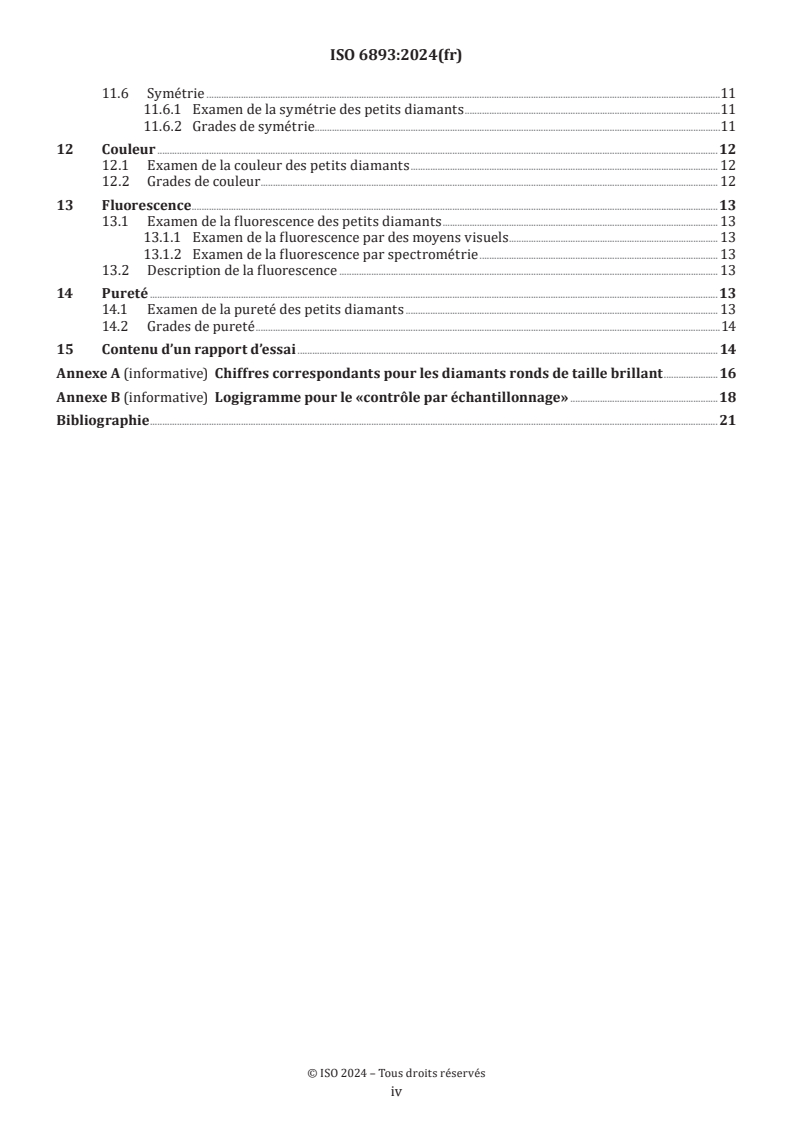
Sommaire Page
Avant-propos .v
Introduction .vi
1 Domaine d’application . 1
2 Références normatives . 1
3 Termes et définitions . 1
4 Généralités . 3
4.1 Spécifications et caractéristiques des lots .3
4.2 Contrôle . .3
5 Authentification . . 4
6 Tamisage . 4
6.1 Généralités .4
6.2 Estimation de la masse totale d’un lot de petits diamants par tamisage et comptage .4
6.3 Estimation du volume d’un lot par tamisage et pesage .4
6.4 Tamisage des petits diamants .5
6.4.1 Méthode .5
6.4.2 Utilisation des plaques de tamisage dans un ordre correct .5
6.4.3 Volume maximal d’un lot tamisé .6
6.4.4 Prévention des dommages des diamants tamisés .6
6.4.5 Contrôle régulier de la précision des plaques de tamisage .6
7 Masse d’un lot . 6
7.1 Examen .6
7.2 Expression de la masse pesée d’un lot .6
8 Mesures . 6
8.1 Mesure des petits diamants .6
8.2 Mesures traditionnelles des petits diamants isolés .6
8.3 Mesure d’un petit diamant avec un projecteur de profil .7
8.4 Mesure automatique des dimensions des petits diamants en lot .7
8.5 Description de la dimension d’un lot .7
9 Volume du lot . 7
9.1 Examen .7
9.2 Estimation .8
9.2.1 Estimation par échantillonnage .8
9.2.2 Estimation au moyen de la masse et du diamètre .8
9.3 Description .8
10 Échantillonnage . 9
10.1 Contrôle d’un lot par échantillonnage .9
10.1.1 Conditions générales . .9
10.1.2 Prélèvement d’échantillons de diamants dans un lot .9
10.2 Plans d’échantillonnage pour le contrôle d’un lot de petits diamants .9
10.3 Plan de contrôle et critères multiples .9
11 Taille . 10
11.1 Description des tailles dans un lot homogène .10
11.2 Description des tailles dans un lot non homogène .10
11.3 Forme .10
11.4 Proportions.10
11.4.1 Examen des proportions des petits diamants .10
11.4.2 Description des grades de proportion .10
11.5 Poli .11
11.5.1 Examen de poli des petits diamants .11
11.5.2 Grades de poli .11
iii
11.6 Symétrie .11
11.6.1 Examen de la symétrie des petits diamants .11
11.6.2 Grades de symétrie.11
12 Couleur .12
12.1 Examen de la couleur des petits diamants . 12
12.2 Grades de couleur . . 12
13 Fluorescence .13
13.1 Examen de la fluorescence des petits diamants . 13
13.1.1 Examen de la fluorescence par des moyens visuels . 13
13.1.2 Examen de la fluorescence par spectrométrie . 13
13.2 Description de la fluorescence . 13
14 Pureté .13
14.1 Examen de la pureté des petits diamants . 13
14.2 Grades de pureté .14
15 Contenu d’un rapport d’essai . 14
Annexe A (informative) Chiffres correspondants pour les diamants ronds de taille brillant .16
Annexe B (informative) Logigramme pour le «contrôle par échantillonnage» .18
Bibliographie .21
iv
Avant-propos
L’ISO (Organisation internationale de normalisation) est une fédération mondiale d’organismes nationaux
de normalisation (comités membres de l’ISO). L’élaboration des Normes internationales est en général
confiée aux comités techniques de l’ISO. Chaque comité membre intéressé par une étude a le droit de faire
partie du comité technique créé à cet effet. Les organisations internationales, gouvernementales et non
gouvernementales, en liaison avec l’ISO participent également aux travaux. L’ISO collabore étroitement avec
la Commission électrotechnique internationale (IEC) en ce qui concerne la normalisation électrotechnique.
Les procédures utilisées pour élaborer le présent document et celles destinées à sa mise à jour sont
décrites dans les Directives ISO/IEC, Partie 1. Il convient, en particulier, de prendre note des différents
critères d’approbation requis pour les différents types de documents ISO. Le présent document
a été rédigé conformément aux règles de rédaction données dans les Directives ISO/IEC, Partie 2
(voir www.iso.org/directives).
L’ISO attire l’attention sur le fait que la mise en application du présent document peut entraîner l’utilisation
d’un ou de plusieurs brevets. L’ISO ne prend pas position quant à la preuve, à la validité et à l’applicabilité de
tout droit de brevet revendiqué à cet égard. À la date de publication du présent document, l’ISO n’avait pas
reçu notification qu’un ou plusieurs brevets pouvaient être nécessaires à sa mise en application. Toutefois,
il y a lieu d’avertir les responsables de la mise en application du présent document que des informations
plus récentes sont susceptibles de figurer dans la base de données de brevets, disponible à l’adresse
www.iso.org/brevets. L’ISO ne saurait être tenue pour responsable de ne pas avoir identifié tout ou partie de
tels droits de brevet.
Les appellations commerciales éventuellement mentionnées dans le présent document sont données pour
information, par souci de commodité, à l’intention des utilisateurs et ne sauraient constituer un engagement.
Pour une explication de la nature volontaire des normes, la signification des termes et expressions
spécifiques de l’ISO liés à l’évaluation de la conformité, ou pour toute information au sujet de l’adhésion de
l’ISO aux principes de l’Organisation mondiale du commerce (OMC) concernant les obstacles techniques au
commerce (OTC), voir www.iso.org/avant-propos.
Le présent document a été élaboré par le comité technique ISO/TC 174, Joaillerie, bijouterie et métaux précieux.
Il convient que l’utilisateur adresse tout retour d’information ou toute question concernant le présent
document à l’organisme national de normalisation de son pays. Une liste exhaustive desdits organismes se
trouve à l’adresse www.iso.org/fr/members.html.
v
Introduction
L’ISO 24016 décrit la terminologie, les graduations et les méthodes d’examen qui sont utilisées pour la
classification des diamants taillés de plus de 0,25 ct (carat). Cette catégorie est communément appelée
«grands diamants» par opposition à la catégorie des «petits diamants».
D’un point de vue économique, dans les secteurs de la bijouterie et de l’horlogerie, le faible prix de chaque
petit diamant – comparé à celui d’un grand diamant – est largement compensé par l’énorme quantité de
petits diamants utilisés.
Comme pour un grand diamant, la qualité d’un petit diamant est principalement définie par sa masse en
carats, sa couleur, sa pureté et sa taille. Mais le contrôle spécifique des petits diamants se heurte à une
difficulté majeure. Ils sont vendus par lots, parfois jusqu’à 10 000 unités. Lorsque ces lots sont homogènes,
un contrôle par échantillonnage est possible.
Ce document est proposé aux entreprises impliquées dans le commerce des petits diamants et désireuses,
dans le cadre de leurs relations commerciales, de se mettre d’accord sur une qualité définie et sur sa méthode
de contrôle.
Les deux parties conviennent que les lots fournis pour le contrôle par échantillonnage se trouvent à un
niveau de la chaîne d’approvisionnement qui assure l’homogénéité nécessaire. Les petits diamants sont
déjà contrôlés dans différents pays et il est aujourd’hui nécessaire d’harmoniser les principes techniques du
contrôle des petits diamants. Cette harmonisation profitera largement aux industries de la bijouterie et de
l’horlogerie, dont la réputation est inextricablement liée au respect rigoureux des spécifications de qualité
de leurs produits.
Ce document vise à clarifier et à faciliter les relations entre les diamantaires et les entreprises qui décorent
leurs produits avec des petits diamants, ce qui renforce la confiance du consommateur final dans les secteurs
de la joaillerie, de l’horlogerie et de toutes les autres industries de luxe.
Ce document complète l’ISO 18323 et l’ISO 24016.
vi
Norme internationale ISO 6893:2024(fr)
Joaillerie, bijouterie et métaux précieux — Contrôle des
lots de petits diamants — Terminologie, classification et
méthodes d’examen
1 Domaine d’application
Le présent document spécifie la terminologie, les graduations et les méthodes d’examen utilisées pour le
contrôle des lots de diamants incolores taillés non montés dont la masse individuelle est inférieure ou égale
à 0,25 ct (carat).
Alors que le contrôle d’un lot se fait diamant par diamant, l’utilisation de ce document ne doit pas être
revendiquée pour un diamant isolé, ni pour les diamants de couleur, ni pour les diamants synthétiques, ni
pour les diamants traités, ni pour les pierres assemblées.
2 Références normatives
Les documents suivants sont cités dans le texte de sorte qu’ils constituent, pour tout ou partie de leur
contenu, des exigences du présent document. Pour les références datées, seule l’édition citée s’applique. Pour
les références non datées, la dernière édition du document de référence s’applique (y compris les éventuels
amendements).
ISO 2859-1:1999, Règles d'échantillonnage pour les contrôles par attributs — Partie 1: Procédures
d'échantillonnage pour les contrôles lot par lot, indexés d'après le niveau de qualité acceptable (NQA)
ISO 18323, Bijouterie — Confiance du consommateur dans l'industrie du diamant
ISO 24016, Joaillerie et métaux précieux — Classification des diamants taillés — Terminologie, graduations et
méthodes d’essai
3 Termes et définitions
Pour les besoins du présent document, les termes et définitions donnés dans l’ISO 18323, l’ISO 24016 ainsi
que les suivants, s’appliquent.
L’ISO et l’IEC tiennent à jour des bases de données terminologiques destinées à être utilisées en normalisation,
consultables aux adresses suivantes:
— ISO Online browsing platform: disponible à l’adresse https:// www .iso .org/ obp
— IEC Electropedia: disponible à l’adresse https:// www .electropedia .org/
3.1
diamant
minéral constitué principalement de carbone cristallisé dans le système cristallin isométrique (cubique),
ayant une dureté de 10 sur l’échelle de Mohs, une densité d’environ 3,52 et un indice de réfraction d’environ
2,42, créé par des processus naturels
Note 1 à l'article: La dénomination «diamant» sans autre spécification doit toujours s’entendre comme «diamant
naturel». Ces deux termes sont en effet équivalents et ont le même sens.
[SOURCE: ISO 24016:2020, 3.1.1]
3.2
petits diamants
diamants (3.1) d’une masse individuelle inférieure ou égale à 0,25 ct
3.3
lot
série de petits diamants (3.2) conformes à la spécification du lot (3.4)
3.4
spécification du lot
description écrite ou verbale d’un lot (3.3) de petits diamants (3.2) comprenant l’authenticité, la taille (3.6),
le volume du lot (3.5), et/ou la dimension, et/ou le grade de couleur, et/ou le grade de pureté, et/ou le grade
de taille (3.12) et/ou le grade de proportion (3.11) et/ou le grade de symétrie (3.9) et/ou le grade de poli (3.8)
3.5
volume du lot
quantité de petits diamants (3.2) dans un lot (3.3)
3.6
taille
forme, proportions, poli et symétrie d’un diamant (3.1)
Note 1 à l'article: Le terme fini englobe le poli et la symétrie.
[SOURCE: ISO 24016:2020, 3.5]
3.7
style de taille
disposition des facettes d’un diamant (3.1) taillé
EXEMPLE brillant, taille à degrés
3.8
grade de poli
grade prenant en considération l’état de surface d’un diamant (3.1)
3.9
grade de symétrie
grade prenant en considération l’exactitude de la forme d’un diamant (3.1), la disposition de ses facettes et,
dans certains cas, la régularité de son rondiste
3.10
grade de fini
grade combinant le grade de symétrie (3.9) et le grade de poli (3.8)
3.11
grade de proportion
grade combinant la largeur de la table, la hauteur de la couronne et/ou l’angle de la couronne, la hauteur
de la culasse et/ou l’angle de la culasse, la longueur des étoiles, la longueur des demi-facettes de la culasse,
l’épaisseur du rondiste, la hauteur totale et dans certaines circonstances la dimension de la colette
3.12
grade de taille
grade combinant le grade de proportion (3.11) et le grade de fini (3.10)
3.13
contrôle
examen des spécifications des petits diamants (3.2) et détermination de leur conformité aux exigences
détaillées ou, sur la base d’un jugement professionnel, à des exigences générales
Note 1 à l'article: L’examen peut inclure des observations directes ou indirectes, qui peuvent comprendre des
mesurages ou des données de sortie d’instruments.
[SOURCE: ISO 17000:2020, 6.3, modifié — Le texte original «d’un objet de l’évaluation de la conformité» a été
remplacé par «des spécifications des petits diamants», la Note 2 et la Note 3 à l’article ont été supprimées]
3.14
tamisage
opération de séparation des petits diamants (3.2) ronds selon leur diamètre, en employant un ou plusieurs tamis
[SOURCE: ISO 2395:1990, 3.3.1, modifié — Le texte original «d’un ensemble de particules» est remplacé
par «des petits diamants ronds» et le mot original «grosseur» est remplacé par «diamètre», la Note 1 a été
supprimée]
4 Généralités
4.1 Spécifications et caractéristiques des lots
Les diamants isolés doivent être examinés uniquement dans le cadre d’un lot.
Pour maintenir une gestion de la qualité cohérente à long terme, après sa définition clairement établie, il
convient de conserver aussi longtemps que possible la même spécification pour les mêmes caractéristiques.
Un lot de petits diamants doit au moins être spécifié par les caractéristiques suivantes:
— masse totale en carats;
— classe de dimension/numéro de tamis;
— grade de couleur;
— grade de pureté;
— style de taille;
— forme.
Les caractéristiques suivantes peuvent être spécifiées:
— volume du lot;
— grade de fini;
— grade de proportion;
— grade de taille;
— hauteur de la couronne;
— épaisseur du rondiste;
— nature du rondiste;
— degré de fluorescence;
— tolérances de dimensions resserrées pour la rondeur, pour la hauteur totale maximale ou toute autre
tolérance de dimensions personnalisée.
4.2 Contrôle
Pour assurer l’impartialité durant le contrôle, le plan de contrôle qui s’applique au lot contrôlé ne doit pas
être communiqué à l’examinateur.
Pour le contrôle d’un lot par échantillonnage, l’examinateur doit connaître le volume de l’échantillon à
appliquer.
NOTE La Figure B.1 représente un logigramme qui décrit la préparation d’un lot pour l’échantillonnage.
Volume du lot: 200
Lettre-code: G (niveau II de contrôle général)
Volume de l’échantillon: 32
Lorsque des critères multiples (par exemple couleur et pureté) sont contrôlés, un diamant qui serait
défectueux pour plusieurs critères n’est compté qu’une fois comme un diamant défectueux si l’examinateur
considère que les critères de défaut sont liés entre eux (par exemple un très mauvais grade de pureté influe
sur la couleur). Ce cas est aussi pris en considération dans l’ISO 2859-1:1999, 4.1.
EXEMPLE 1 En supposant qu’un lot contient un diamant avec un grade de couleur J et un grade de pureté P2,
l’examinateur peut compter le diamant défectueux seulement une fois, car il considère que la présence des nombreuses
grandes inclusions est liée au grade de couleur J.
EXEMPLE 2 En supposant qu’un lot contient un diamant avec un grade de couleur J et une pureté VVS, l’examinateur
peut compter le diamant défectueux deux fois, car il considère que le grade de pureté n’est pas lié au grade de couleur.
5 Authentification
La nomenclature utilisée pour décrire l’authenticité d’un lot de diamants doit être conforme aux règles
spécifiées dans l’ISO 18323.
Avant tout contrôle, l’authentification de tous les diamants d’un lot doit être assurée par des moyens de
vérification appropriés.
La méthode et les systèmes utilisés pour authentifier un lot de diamants doivent toujours être disponibles.
Les méthodes non destructives d’authentification des petits diamants peuvent inclure, sans s’y limiter, la
spectroscopie d’absorption infrarouge, la spectroscopie de photoluminescence et l’imagerie de luminescence.
6 Tamisage
6.1 Généralités
Le tamisage est couramment utilisé dans l’industrie du petit diamant pour regrouper les petits diamants
ronds et taillés de diamètres similaires. Un tamis est composé d’une série de plaques et de bols de tamisage,
généralement métalliques. Chaque plaque est percée de plusieurs trous de même diamètre. Le numéro du
tamis est généralement inscrit sur la plaque de tamisage et indique le diamètre correspondant des trous du
tamis. Par exemple, une plaque de tamisage portant le numéro −0000 retient les pierres d’un diamètre de
0,80 mm et plus (voir le Tableau 1).
6.2 Estimation de la masse totale d’un lot de petits diamants par tamisage et comptage
La masse d’un lot peut être estimée par tamisage et comptage (voir le Tableau A.1), mais sa masse exacte
doit être déterminée par pesage sur une balance.
6.3 Estimation du volume d’un lot par tamisage et pes
...
Formatted
...
Style Definition
...
Style Definition
...
Style Definition
...
Style Definition
...
Style Definition
...
Date: Première édition
Style Definition
...
Style Definition
...
2024-01-2204
Style Definition
...
ISO/TC 174/WG 2
Style Definition
...
Style Definition
...
Secretariat: DIN
Style Definition
...
Style Definition
...
Style Definition
...
Style Definition
...
Style Definition
...
Joaillerie, bijouterie et métaux précieux — Contrôle des lots de petits
Style Definition
...
diamants — Terminologie, classification et méthodes d’examen
Style Definition
...
Style Definition
...
Jewellery and precious metals — Inspection of batches of small diamonds — Terminology, classification and
test methods Style Definition
...
Style Definition
...
Style Definition
...
Style Definition
...
Style Definition
...
Style Definition
...
Style Definition
...
Style Definition
...
Style Definition
...
Style Definition
...
Style Definition
...
Style Definition
...
Style Definition
...
Style Definition
...
Style Definition
...
Style Definition
...
Style Definition
...
Style Definition
...
Style Definition
...
Style Definition
...
Style Definition
...
Style Definition
...
Style Definition
...
Style Definition
...
Style Definition
...
Style Definition
...
Style Definition
...
Style Definition
...
Style Definition
...
Style Definition
...
Style Definition
...
Style Definition
...
Style Definition
...
Style Definition
...
Style Definition
...
Style Definition
...
Style Definition
...
Style Definition
...
St l D fi iti
Formatted: Right: 1.5 cm, Bottom: 1 cm, Gutter: 0 cm,
Header distance from edge: 1.27 cm, Footer distance
from edge: 0.5 cm
All rights reserved. Unless otherwise specified, or required in the context of its implementation, no part of this publication
may be reproduced or utilized otherwise in any form or by any means, electronic or mechanical, including photocopying,
Formatted: Default Paragraph Font
or posting on the internet or an intranet, without prior written permission. Permission can be requested from either ISO
Formatted: Default Paragraph Font
at the address below or ISO’s member body in the country of the requester.
Formatted: Adjust space between Latin and Asian text,
Tous droits réservés. Sauf prescription différente ou nécessité dans le contexte de sa mise en oeuvre, aucune partie de
Adjust space between Asian text and numbers
cette publication ne peut être reproduite ni utilisée sous quelque forme que ce soit et par aucun procédé, électronique
ou mécanique, y compris la photocopie, ou la diffusion sur l’internet ou sur un intranet, sans autorisation écrite préalable.
Une autorisation peut être demandée à l’ISO à l’adresse ci-après ou au comité membre de l’ISO dans le pays du
demandeur.
ISO copyright office
Formatted: zzCopyright address, Adjust space between
CP 401 • Ch. de Blandonnet 8
Latin and Asian text, Adjust space between Asian text
CH-1214 Vernier, Geneva
and numbers
Phone: + 41 22 749 01 11
EmailE-mail: copyright@iso.org
Website: www.iso.orgwww.iso.org
Published in Switzerland
Formatted: Footer, Left, Space After: 0 pt, Tab stops:
Not at 17.2 cm
ii
Formatted: Font: 11 pt, Bold, Font color: Auto
Formatted: Font: 11 pt, Bold
Contents
Formatted: HeaderCentered, Left, Space After: 0 pt,
Line spacing: single
Foreword . v
Introduction . vi
1 Scope . 1
2 Normative references . 1
3 Terms and definitions . 1
4 General. 3
4.1 Batch specifications and characteristics . 3
4.2 Inspection . 4
5 Authentication . 4
6 Sieving . 4
6.1 General. 4
6.2 Estimating the total mass of a small diamond batch by sieving and counting . 4
6.3 Estimating a batch size by sieving and weighing . 4
6.4 Sieving small diamonds . 4
6.4.1 Method . 4
6.4.2 Using sieving plates in a correct order . 5
6.4.3 Maximum size of a sieved batch . 5
6.4.4 Preventing damages of sieved diamonds . 5
6.4.5 Regular control of sieve plates accuracy . 5
7 Mass . 6
7.1 Mass of a batch . 6
7.1.1 Testing . 6
7.1.2 Expression of the weighed mass of a batch . 6
8 Measurements . 6
8.1 Measuring small diamonds . 6
8.2 Traditional measurements of single small diamonds . 6
8.3 Measuring a small diamond with a profile projector . 6
8.4 Measuring automatically dimensions of small diamonds in batch. 6
8.5 Description of dimension for a batch . 7
9 Quantity . 7
9.1 Batch size . 7
9.1.1 Testing . 7
9.1.2 Estimation. 7
9.1.3 Expression of a batch size . 8
10 Sampling . 8
10.1 General conditions for inspecting a batch by sampling . 8
10.1.1 Drawing diamond samples from a batch . 8
10.2 Sampling plans for the inspection of a batch of small diamonds . 8
Formatted: Font: 10 pt
10.2.1 Defining a sampling plan for the inspection of a batch of small diamonds . 8
Formatted: Font: 10 pt
11 Cut . 9
Formatted: Font: 10 pt
11.1 Description of cut in a homogenous batch . 9
11.2 Description of cut in an inhomogenous batch . 9
Formatted: FooterCentered, Left, Space Before: 0 pt,
11.3 Shape . 9
Tab stops: Not at 17.2 cm
11.4 Proportions . 9
Formatted: Font: 11 pt
11.4.1 Testing the proportions of small diamonds . 9
Formatted: FooterPageRomanNumber, Left, Space
11.4.2 Description of proportion grades . 10
After: 0 pt, Tab stops: Not at 17.2 cm
© ISO 2024 – All rights reserved – Tous droits réservés
iii
Formatted: Font: Bold
Formatted: HeaderCentered
11.5 Polish . 10
11.5.1 Testing the polish of small diamonds . 10
11.5.2 Polish grades . 10
11.6 Symmetry . 10
11.6.1 Testing the symmetry of small diamonds . 10
11.6.2 Symmetry grades . 10
12 Colour . 11
12.1 Testing the colour of small diamonds . 11
12.2 Colour grades . 11
13 Fluorescence . 12
13.1 Testing the fluorescence of small diamonds . 12
13.1.1 Testing the fluorescence by visual means . 12
13.1.2 Testing the fluorescence by spectrometry . 12
13.2 Description of the fluorescence . 12
14 Clarity . 12
14.1 Testing the clarity of small diamonds . 12
14.2 Clarity grades . 12
15 Content of a test report . 13
Annex A (informative) . 15
Annex B (informative) . 17
Formatted: FooterPageRomanNumber
iv
Formatted: Font: 11 pt, Bold, Font color: Auto
Formatted: Font: 11 pt, Bold
Foreword
Formatted: HeaderCentered, Left, Space After: 0 pt,
Line spacing: single
ISO (the International Organization for Standardization) is a worldwide federation of national standards
bodies (ISO member bodies). The work of preparing International Standards is normally carried out through
ISO technical committees. Each member body interested in a subject for which a technical committee has been
established has the right to be represented on that committee. International organizations, governmental and
non-governmental, in liaison with ISO, also take part in the work. ISO collaborates closely with the
International Electrotechnical Commission (IEC) on all matters of electrotechnical standardization.
The procedures used to develop this document and those intended for its further maintenance are described
in the ISO/IEC Directives, Part 1. In particular, the different approval criteria needed for the different types of
ISO document should be noted. This document was drafted in accordance with the editorial rules of the
ISO/IEC Directives, Part 2 (see www.iso.org/directives).
ISO draws attention to the possibility that the implementation of this document may involve the use of (a)
patent(s). ISO takes no position concerning the evidence, validity or applicability of any claimed patent rights
in respect thereof. As of the date of publication of this document, ISO had not received notice of (a) patent(s)
which may be required to implement this document. However, implementers are cautioned that this may not
represent the latest information, which may be obtained from the patent database available at
www.iso.org/patents. ISO shall not be held responsible for identifying any or all such patent rights.
Any trade name used in this document is information given for the convenience of users and does not
constitute an endorsement.
For an explanation of the voluntary nature of standards, the meaning of ISO specific terms and expressions
related to conformity assessment, as well as information about ISO's adherence to the World Trade
Organization (WTO) principles in the Technical Barriers to Trade (TBT), see www.iso.org/iso/foreword.html.
This document was prepared by Technical Committee ISO/TC 174, Jewellery and precious metals.
Any feedback or questions on this document should be directed to the user’s national standards body. A
complete listing of these bodies can be found at www.iso.org/members.html.
Publié en Suisse
Formatted: Font: 10 pt
Formatted: Font: 10 pt
Formatted: Font: 10 pt
Formatted: FooterCentered, Left, Space Before: 0 pt,
Tab stops: Not at 17.2 cm
Formatted: Font: 11 pt
Formatted: FooterPageRomanNumber, Left, Space
After: 0 pt, Tab stops: Not at 17.2 cm
© ISO 2024 – All rights reserved – Tous droits réservés
v
Formatted: Font: Bold
Formatted: HeaderCentered
Sommaire
Avant-propos . viii
Introduction . ix
1 Domaine d’application . 1
2 Références normatives . 1
3 Termes et définitions . 2
4 Généralités . 5
4.1 Spécifications et caractéristiques des lots . 5
4.2 Contrôle . 6
5 Authentification . 7
6 Tamisage . 8
6.1 Généralités . 8
6.2 Estimation de la masse totale d’un lot de petits diamants par tamisage et comptage . 8
6.3 Estimation du volume d’un lot par tamisage et pesage . 8
6.4 Tamisage des petits diamants . 8
6.4.1 Méthode . 8
6.4.2 Utilisation des plaques de tamisage dans un ordre correct . 10
6.4.3 Volume maximal d’un lot tamisé . 10
6.4.4 Prévention des dommages des diamants tamisés . 10
6.4.5 Contrôle régulier de la précision des plaques de tamisage . 10
7 Masse d’un lot . 11
7.1 Examen . 11
7.2 Expression de la masse pesée d’un lot . 11
8 Mesures . 11
8.1 Mesure des petits diamants . 11
8.2 Mesures traditionnelles des petits diamants isolés . 11
8.3 Mesure d’un petit diamant avec un projecteur de profil . 12
8.4 Mesure automatique des dimensions des petits diamants en lot . 12
8.5 Description de la dimension d’un lot . 13
9 Volume du lot . 13
9.1 Examen . 13
9.2 Estimation. 14
9.2.1 Estimation par échantillonnage . 14
9.2.2 Estimation au moyen de la masse et du diamètre. 14
9.3 Description . 15
10 Échantillonnage . 15
10.1 Contrôle d’un lot par échantillonnage . 15
10.1.1 Conditions générales . 15
10.1.2 Prélèvement d’échantillons de diamants dans un lot . 16
10.2 Plans d’échantillonnage pour le contrôle d’un lot de petits diamants . 16
10.3 Plan de contrôle et critères multiples . 17
11 Taille . 17
11.1 Description des tailles dans un lot homogène . 17
11.2 Description des tailles dans un lot non homogène . 17
11.3 Forme . 18
11.4 Proportions . 18
11.4.1 Examen des proportions des petits diamants . 18
Formatted: FooterPageRomanNumber
vi
Formatted: Font: 11 pt, Bold, Font color: Auto
Formatted: Font: 11 pt, Bold
11.4.2 Description des grades de proportion . 19
Formatted: HeaderCentered, Left, Space After: 0 pt,
11.5 Poli . 19
Line spacing: single
11.5.1 Examen de poli des petits diamants . 19
11.5.2 Grades de poli . 19
11.6 Symétrie . 20
11.6.1 Examen de la symétrie des petits diamants . 20
11.6.2 Grades de symétrie . 21
12 Couleur . 22
12.1 Examen de la couleur des petits diamants . 22
12.2 Grades de couleur . 22
13 Fluorescence . 23
13.1 Examen de la fluorescence des petits diamants . 23
13.1.1 Examen de la fluorescence par des moyens visuels . 23
13.1.2 Examen de la fluorescence par spectrométrie . 24
13.2 Description de la fluorescence . 24
14 Pureté . 24
14.1 Examen de la pureté des petits diamants . 24
14.2 Grades de pureté . 25
15 Contenu d’un rapport d’essai . 26
Annex A (informative) Chiffres correspondants pour les diamants ronds de taille brillant . 28
Bibliographie . 36
Formatted: Font: 10 pt
Formatted: Font: 10 pt
Formatted: Font: 10 pt
Formatted: FooterCentered, Left, Space Before: 0 pt,
Tab stops: Not at 17.2 cm
Formatted: Font: 11 pt
Formatted: FooterPageRomanNumber, Left, Space
After: 0 pt, Tab stops: Not at 17.2 cm
© ISO 2024 – All rights reserved – Tous droits réservés
vii
Formatted: Font: Bold
Formatted: HeaderCentered
Avant-propos
L’ISO (Organisation internationale de normalisation) est une fédération mondiale d’organismes nationaux de
normalisation (comités membres de l’ISO). L’élaboration des Normes internationales est en général confiée
aux comités techniques de l’ISO. Chaque comité membre intéressé par une étude a le droit de faire partie du
comité technique créé à cet effet. Les organisations internationales, gouvernementales et non
gouvernementales, en liaison avec l’ISO participent également aux travaux. L’ISO collabore étroitement avec
la Commission électrotechnique internationale (IEC) en ce qui concerne la normalisation électrotechnique.
Les procédures utilisées pour élaborer le présent document et celles destinées à sa mise à jour sont décrites
dans les Directives ISO/IEC, Partie 1. Il convient, en particulier, de prendre note des différents critères
d’approbation requis pour les différents types de documents ISO. Le présent document a été rédigé
conformément aux règles de rédaction données dans les Directives ISO/IEC, Partie 2
(voir www.iso.org/directives).
L’ISO attire l’attention sur le fait que la mise en application du présent document peut entraîner l’utilisation
d’un ou de plusieurs brevets. L’ISO ne prend pas position quant à la preuve, à la validité et à l’applicabilité de
tout droit de brevet revendiqué à cet égard. À la date de publication du présent document, l’ISO n’avait pas
reçu notification qu’un ou plusieurs brevets pouvaient être nécessaires à sa mise en application. Toutefois, il
y a lieu d’avertir les responsables de la mise en application du présent document que des informations plus
récentes sont susceptibles de figurer dans la base de données de brevets, disponible à l’adresse
www.iso.org/brevets. L’ISO ne saurait être tenue pour responsable de ne pas avoir identifié tout ou partie de
tels droits de brevet.
Les appellations commerciales éventuellement mentionnées dans le présent document sont données pour
information, par souci de commodité, à l’intention des utilisateurs et ne sauraient constituer un engagement.
Pour une explication de la nature volontaire des normes, la signification des termes et expressions spécifiques
de l’ISO liés à l’évaluation de la conformité, ou pour toute information au sujet de l’adhésion de l’ISO aux
principes de l’Organisation mondiale du commerce (OMC) concernant les obstacles techniques au commerce
(OTC), voir www.iso.org/avant-propos.
Le présent document a été élaboré par le comité technique ISO/TC 174, Joaillerie, bijouterie et métaux précieux.
Il convient que l’utilisateur adresse tout retour d’information ou toute question concernant le présent
document à l’organisme national de normalisation de son pays. Une liste exhaustive desdits organismes se
trouve à l’adresse www.iso.org/fr/members.html.
Formatted: FooterPageRomanNumber
viii
Formatted: Font: 11 pt, Bold, Font color: Auto
Formatted: Font: 11 pt, Bold
Introduction
Formatted: HeaderCentered, Left, Space After: 0 pt,
Line spacing: single
ISO 24016 describes the terminology, the classification and test methods that apply for the grading of polished
Formatted: Adjust space between Latin and Asian text,
diamonds over 0,25 ct (carat). This category is commonly named “large diamonds” as opposed to the category
Adjust space between Asian text and numbers
of “small diamonds”.
From an economic perspective, on the jewellery and watchmaking industries, the low price of each single small
diamond – compared to that of a large diamond - is widely compensated by the enormous quantity of small
diamonds used.
As for a large diamond, the quality of a small diamond is mainly defined by its carat mass, its colour, its clarity
and its cut. But, specifically the inspection of small diamonds faces one main challenge. They are sold by
batches, sometimes as large as 10 000 units. When these batches are homogeneous, an inspection per
sampling is possible.
This document is proposed to companies involved in the small diamond trade and willing, in the frame of their
commercial relationship, to agree on both a defined quality and its inspection methodology.
It is agreed by both parties that the batches that are supplied for inspection by sampling are on a level of the
supply chain that provides the necessary homogeneity. Small diamonds are already controlled in different
countries and today there is a need for harmonizing the technical principles of inspection of small diamonds.
This harmonization will benefit the jewellery and watchmaking industries in large, because their reputations
are inextricably linked to a stringent compliance with their product quality specifications.
This document aims to clarify and ease the relationship between diamantaires and companies decorating their
products with small diamonds, which consequently strengthens the end consumer confidence in the jewellery,
watchmaking and all other luxury industries.
ThisL’ISO 24016 décrit la terminologie, les graduations et les méthodes d’examen qui sont utilisées pour la
classification des diamants taillés de plus de 0,25 ct (carat). Cette catégorie est communément appelée
«grands diamants» par opposition à la catégorie des «petits diamants».
D’un point de vue économique, dans les secteurs de la bijouterie et de l’horlogerie, le faible prix de chaque
petit diamant – comparé à celui d’un grand diamant – est largement compensé par l’énorme quantité de petits
diamants utilisés.
Comme pour un grand diamant, la qualité d’un petit diamant est principalement définie par sa masse en carats,
sa couleur, sa pureté et sa taille. Mais le contrôle spécifique des petits diamants se heurte à une difficulté
majeure. Ils sont vendus par lots, parfois jusqu’à 10 000 unités. Lorsque ces lots sont homogènes, un contrôle
par échantillonnage est possible.
Ce document est proposé aux entreprises impliquées dans le commerce des petits diamants et désireuses,
dans le cadre de leurs relations commerciales, de se mettre d’accord sur une qualité définie et sur sa méthode
de contrôle.
Les deux parties conviennent que les lots fournis pour le contrôle par échantillonnage se trouvent à un niveau
Formatted: Font: 10 pt
de la chaîne d’approvisionnement qui assure l’homogénéité nécessaire. Les petits diamants sont déjà contrôlés
Formatted: Font: 10 pt
dans différents pays et il est aujourd’hui nécessaire d’harmoniser les principes techniques du contrôle des
petits diamants. Cette harmonisation profitera largement aux industries de la bijouterie et de l’horlogerie, Formatted: Font: 10 pt
dont la réputation est inextricablement liée au respect rigoureux des spécifications de qualité de leurs
Formatted: FooterCentered, Left, Space Before: 0 pt,
produits.
Tab stops: Not at 17.2 cm
Formatted: Font: 11 pt
Ce document vise à clarifier et à faciliter les relations entre les diamantaires et les entreprises qui décorent
leurs produits avec des petits diamants, ce qui renforce la confiance du consommateur final dans les secteurs
Formatted: FooterPageRomanNumber, Left, Space
de la joaillerie, de l’horlogerie et de toutes les autres industries de luxe.
After: 0 pt, Tab stops: Not at 17.2 cm
© ISO 2024 – All rights reserved – Tous droits réservés
ix
Formatted: Font: Bold
Formatted: HeaderCentered
Ce document completes ISO complète l’ISO 18323 and ISO et l’ISO 24016.
Formatted: Default Paragraph Font, French (France)
Formatted: Default Paragraph Font, French (France)
Formatted: Adjust space between Latin and Asian text,
Adjust space between Asian text and numbers
Formatted: FooterPageRomanNumber
x
International Standard ISO 6893:2024(en)
Formatted: Right: 1.5 cm, Bottom: 1 cm, Gutter: 0 cm,
Jewellery and precious metals — Inspection of batches of small
Header distance from edge: 1.27 cm, Footer distance
from edge: 0.5 cm
diamonds — Terminology, classification and test methods
1 Scope
This document specifies the terminology, classification and test methods that are used for the inspection of
batches of unmounted polished colourless diamonds with single mass smaller than or equal to 0,25 ct (carat).
While the inspection of a batch is made one diamond at a time, the use of this document is not to be claimed
for one single diamond only nor for fancy coloured diamonds, nor for synthetic diamonds, nor for treated
diamonds, neither for assembled stones.
2 Normative references
The following documents are referred to in the text in such a way that some or all of their content constitutes
requirements of this document. For dated references, only the edition cited applies. For undated references,
the latest edition of the referenced document (including any amendments) applies.
ISO 2859-1:1999, Sampling procedures for inspection by attributes — Part 1: Sampling schemes indexed
by acceptance quality limit (AQL) for lot-by-lot inspection
ISO 18323, Jewellery — Consumer confidence in the diamond industry
ISO 24016, Jewellery and precious metals — Grading polished diamonds — Terminology, classification and
test methods
3 Terms and definitions
For the purposes of thisJoaillerie, bijouterie et métaux précieux —
Contrôle des lots de petits diamants — Terminologie, classification et
méthodes d’examen
1 Domaine d’application
Le présent document spécifie la terminologie, les graduations et les méthodes d’examen utilisées pour le
contrôle des lots de diamants incolores taillés non montés dont la masse individuelle est inférieure ou égale à
0,25 ct (carat).
Alors que le contrôle d’un lot se fait diamant par diamant, l’utilisation de ce document ne doit pas être
revendiquée pour un diamant isolé, ni pour les diamants de couleur, ni pour les diamants synthétiques, ni
pour les diamants traités, ni pour les pierres assemblées.
2 Références normatives
Les documents suivants sont cités dans le texte de sorte qu’ils constituent, pour tout ou partie de leur contenu,
des exigences du présent document. Pour les références datées, seule l’édition citée s’applique. Pour les
Formatted: Footer, Left, Space After: 0 pt, Line
spacing: single, Tab stops: Not at 17.2 cm
ISO/DIS 6893:2023(E2024(fr) Formatted: Font: 11 pt, Bold
Formatted: Font: 11 pt, Bold
Formatted: Font: 11 pt, Bold
références non datées, la dernière édition du document de référence s’applique (y compris les éventuels
Formatted: HeaderCentered, Space After: 0 pt, Line
amendements).
spacing: single
ISO 2859-1:1999, Règles d'échantillonnage pour les contrôles par attributs — Partie 1: Procédures
d'échantillonnage pour les contrôles lot par lot, indexés d'après le niveau de qualité acceptable (NQA)
ISO 18323, Bijouterie — Confiance du consommateur dans l'industrie du diamant
ISO 24016, Joaillerie et métaux précieux — Classification des diamants taillés — Terminologie, graduations et
méthodes d’essai
3 Termes et définitions
Pour les besoins du présent document, the terms and definitions given in ISO les termes et définitions donnés
Formatted: Adjust space between Latin and Asian text,
dans l’ISO 18323, ISO l’ISO 24016 and the following applyainsi que les suivants, s’appliquent. Adjust space between Asian text and numbers
Formatted: Default Paragraph Font, French (France)
ISO and IEC maintain terminology databases for use in standardization at the following addresses:
Formatted: Default Paragraph Font, French (France)
— L’ISO et l’IEC tiennent à jour des bases de données terminologiques destinées à être utilisées en
normalisation, consultables aux adresses suivantes:
— ISO Online browsing platform: available atdisponible à l’adresse
Formatted: French (France)
https://www.iso.org/obphttps://www.iso.org/obp
Formatted: French (France)
— — IEC Electropedia: available atdisponible à l’adresse
Formatted: French (France)
https://www.electropedia.org/https://www.electropedia.org/
Formatted: French (France)
3.1
Formatted: Adjust space between Latin and Asian text,
diamond Adjust space between Asian text and numbers
mineral consisting essentially of carbon crystallised in the isometric (cubic) crystal system, with a hardness
on the Mohs’ scale of 10, a specific gravity of approximately 3,52 and a refractive index of approximately 2,42,
created by nature
Note 1 to entry: The denomination “diamond” without further specification always implies “natural diamond”. These two
terms are equivalent and carry the same meaning.
diamant
minéral constitué principalement de carbone cristallisé dans le système cristallin isométrique (cubique),
ayant une dureté de 10 sur l’échelle de Mohs, une densité d’environ 3,52 et un indice de réfraction d’environ
2,42, créé par des processus naturels
Note 1 à l'article: La dénomination «diamant» sans autre spécification doit toujours s’entendre comme «diamant
naturel». Ces deux termes sont en effet équivalents et ont le même sens. Formatted: Default Paragraph Font
Formatted: Default Paragraph Font
[SOURCE: ISO 24016:2020, 3.1.1]
Formatted: Default Paragraph Font
3.2
Formatted: Default Paragraph Font
small diamonds
Formatted: Adjust space between Latin and Asian text,
diamonds (3.1) of individual mass smaller than or equal to 0,25 ct
Adjust space between Asian text and numbers
Formatted: Font: 11 pt
3.petits diamants
diamants (3.1) d’une masse individuelle inférieure ou égale à 0,25 ct
Formatted: FooterPageRomanNumber, Space After: 0
pt, Line spacing: single
2 © ISO 2023 – All rights reserved
Formatted: Font: 11 pt, Bold, Font color: Auto
Formatted: Font: 11 pt, Bold
3.3
Formatted: HeaderCentered, Left, Space After: 0 pt,
lot
Line spacing: single
série de petits diamants (3.2) conformes à la spécification du lot (3.4)
3.4
Formatted: Adjust space between Latin and Asian text,
batch
Adjust space between Asian text and numbers
series of small diamonds (3.2) conforming to the batch specification (3.4)
3.4
batch specification
written or verbal description of a batch (3.3) of small diamonds (3.2) comprising authenticity, cut (3.6), batch
size (3.5), and/or dimension, and/or colour grade, and/or clarity grade, and/or cut grade (3.12) and/or
proportion grade (3.11) and/or symmetry grade (3.9), and/or polish grade (3.8)
3.5
batch size
quantity of small diamonds (3.2) in a batch (3.3)
3.6
cut
shapespécification du lot
description écrite ou verbale d’un lot (3.3) de petits diamants (3.2) comprenant l’authenticité, la taille (3.6), le
volume du lot (3.5), et/ou la dimension, et/ou le grade de couleur, et/ou le grade de pureté, et/ou le grade de
taille (3.12) et/ou le grade de proportion (3.11) et/ou le grade de symétrie (3.9) et/ou le grade de poli (3.8)
3.5
volume du lot
quantité de petits diamants (3.2) dans un lot (3.3)
3.6
taille
forme, proportions, polish and symmetry of a diamond (3.1)poli et symétrie d’un diamant (3.1)
Formatted: Adjust space between Latin and Asian text,
Adjust space between Asian text and numbers
Note 1 to entry: The term finish encompasses polish and symmetry.
Note 1 à l'article: Le terme fini englobe le poli et la symétrie.
[SOURCE: ISO 24016:2020, 3.5]
Formatted: Default Paragraph Font
Formatted: Default Paragraph Font
3.7
Formatted: Default Paragraph Font
cutting style de taille
facets arrangement of a polished diamond (3.1)
Formatted: Default Paragraph Font
Formatted: Adjust space between Latin and Asian text,
EXAMPLES brilliant, step cut
Adjust space between Asian text and numbers
disposition des facettes d’un diamant (3.1) taillé
Formatted: Adjust space between Latin and Asian text,
EXEMPLE brillant, taille à degrés
Adjust space between Asian text and numbers
3.
...