


ISO/PAS 22853:2005
(Main)Ships and marine technology — Computer applications — Specification of Maritime Safety Markup Language (MSML)
Ships and marine technology — Computer applications — Specification of Maritime Safety Markup Language (MSML)
ISO 22853:2005 specifies the XML application MSML (Maritime Safety Markup Language). MSML is a language for structuring information and the goal is to create an open standard that can be used generally in the maritime sector. MSML is implemented using XML Schema, which is contained in a separate document that could be used at validation. The first purpose of MSML is to make it possible to record safety related information in relation to repair and maintenance. The second purpose is to define an extensible structure that could be developed in future versions of MSML. Note that MSML should not primarily be seen as a support for normal work onboard. Instead, it is an add-on support for transfers of safety related information to/from the vessel. MSML enables security handling and since MSML concerns safety aspects there is information support for preventing accidents; minimizing extent of damage; minimizing criticality of consequences. These aspects concern both vessel and bases ashore (denoted shore bases in this Publicly Available Specification). MSML consists of the following constituents: data model that defines the data of interest. The basic parts of the data model are vessel static and dynamic areas, shore base static and dynamic areas and vessel shore base relation. Each of these can be created successively and thus validation can be made even if information is not complete; administrative support that defines the handling of the XML application instance as a file; security support that defines the handling of data security. MSML enables digital signatures and encryption via the W3C recommendations 'XML Encryption Syntax and Processing' and 'XML-Signature Syntax and Processing'.
Navires et technologie maritime — Applications informatiques — Spécification du language de la sécurité maritime
General Information
- Status
- Withdrawn
- Publication Date
- 22-Sep-2005
- Withdrawal Date
- 22-Sep-2005
- Technical Committee
- ISO/TC 8 - Ships and marine technology
- Drafting Committee
- ISO/TC 8 - Ships and marine technology
- Current Stage
- 9599 - Withdrawal of International Standard
- Start Date
- 24-Apr-2019
- Completion Date
- 14-Feb-2026
Relations
- Consolidated By
ISO/FDIS 16119-5 - Agricultural and forestry machinery — Environmental requirements for sprayers — Part 5: Aerial spray systems - Effective Date
- 06-Jun-2022
Get Certified
Connect with accredited certification bodies for this standard

BSI Group
BSI (British Standards Institution) is the business standards company that helps organizations make excellence a habit.

DNV
DNV is an independent assurance and risk management provider.

Lloyd's Register
Lloyd's Register is a global professional services organisation specialising in engineering and technology.
Sponsored listings
Frequently Asked Questions
ISO/PAS 22853:2005 is a technical specification published by the International Organization for Standardization (ISO). Its full title is "Ships and marine technology — Computer applications — Specification of Maritime Safety Markup Language (MSML)". This standard covers: ISO 22853:2005 specifies the XML application MSML (Maritime Safety Markup Language). MSML is a language for structuring information and the goal is to create an open standard that can be used generally in the maritime sector. MSML is implemented using XML Schema, which is contained in a separate document that could be used at validation. The first purpose of MSML is to make it possible to record safety related information in relation to repair and maintenance. The second purpose is to define an extensible structure that could be developed in future versions of MSML. Note that MSML should not primarily be seen as a support for normal work onboard. Instead, it is an add-on support for transfers of safety related information to/from the vessel. MSML enables security handling and since MSML concerns safety aspects there is information support for preventing accidents; minimizing extent of damage; minimizing criticality of consequences. These aspects concern both vessel and bases ashore (denoted shore bases in this Publicly Available Specification). MSML consists of the following constituents: data model that defines the data of interest. The basic parts of the data model are vessel static and dynamic areas, shore base static and dynamic areas and vessel shore base relation. Each of these can be created successively and thus validation can be made even if information is not complete; administrative support that defines the handling of the XML application instance as a file; security support that defines the handling of data security. MSML enables digital signatures and encryption via the W3C recommendations 'XML Encryption Syntax and Processing' and 'XML-Signature Syntax and Processing'.
ISO 22853:2005 specifies the XML application MSML (Maritime Safety Markup Language). MSML is a language for structuring information and the goal is to create an open standard that can be used generally in the maritime sector. MSML is implemented using XML Schema, which is contained in a separate document that could be used at validation. The first purpose of MSML is to make it possible to record safety related information in relation to repair and maintenance. The second purpose is to define an extensible structure that could be developed in future versions of MSML. Note that MSML should not primarily be seen as a support for normal work onboard. Instead, it is an add-on support for transfers of safety related information to/from the vessel. MSML enables security handling and since MSML concerns safety aspects there is information support for preventing accidents; minimizing extent of damage; minimizing criticality of consequences. These aspects concern both vessel and bases ashore (denoted shore bases in this Publicly Available Specification). MSML consists of the following constituents: data model that defines the data of interest. The basic parts of the data model are vessel static and dynamic areas, shore base static and dynamic areas and vessel shore base relation. Each of these can be created successively and thus validation can be made even if information is not complete; administrative support that defines the handling of the XML application instance as a file; security support that defines the handling of data security. MSML enables digital signatures and encryption via the W3C recommendations 'XML Encryption Syntax and Processing' and 'XML-Signature Syntax and Processing'.
ISO/PAS 22853:2005 is classified under the following ICS (International Classification for Standards) categories: 35.240.60 - IT applications in transport; 47.020.99 - Other standards related to shipbuilding and marine structures. The ICS classification helps identify the subject area and facilitates finding related standards.
ISO/PAS 22853:2005 has the following relationships with other standards: It is inter standard links to ISO/FDIS 16119-5. Understanding these relationships helps ensure you are using the most current and applicable version of the standard.
ISO/PAS 22853:2005 is available in PDF format for immediate download after purchase. The document can be added to your cart and obtained through the secure checkout process. Digital delivery ensures instant access to the complete standard document.
Standards Content (Sample)
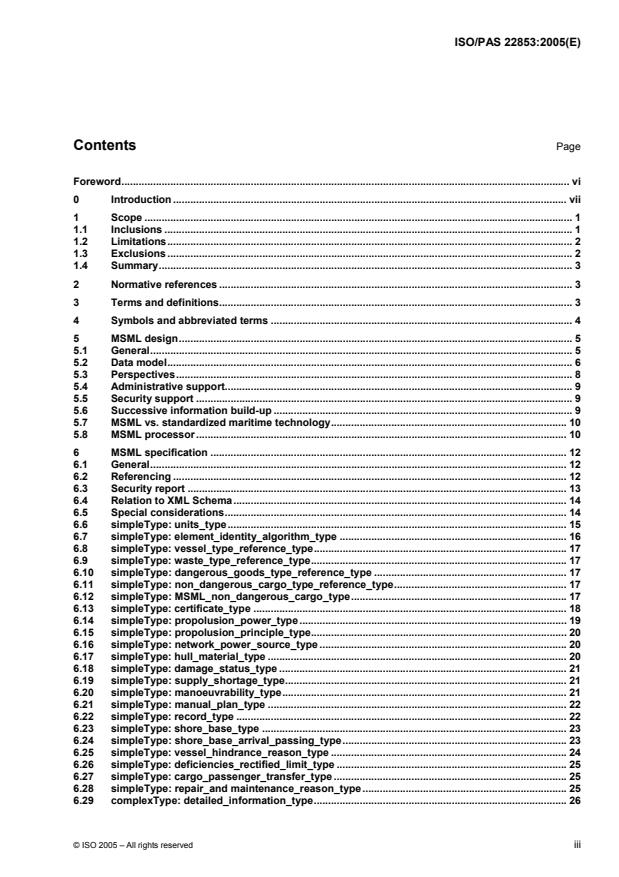
PUBLICLY ISO/PAS
AVAILABLE 22853
SPECIFICATION
First edition
2005-10-01
Ships and marine technology —
Computer applications — Specification of
Maritime Safety Markup Language
(MSML)
Navires et technologie maritime — Applications informatiques —
Spécification du language de la sécurité maritime
Reference number
©
ISO 2005
PDF disclaimer
This PDF file may contain embedded typefaces. In accordance with Adobe's licensing policy, this file may be printed or viewed but
shall not be edited unless the typefaces which are embedded are licensed to and installed on the computer performing the editing. In
downloading this file, parties accept therein the responsibility of not infringing Adobe's licensing policy. The ISO Central Secretariat
accepts no liability in this area.
Adobe is a trademark of Adobe Systems Incorporated.
Details of the software products used to create this PDF file can be found in the General Info relative to the file; the PDF-creation
parameters were optimized for printing. Every care has been taken to ensure that the file is suitable for use by ISO member bodies. In
the unlikely event that a problem relating to it is found, please inform the Central Secretariat at the address given below.
© ISO 2005
All rights reserved. Unless otherwise specified, no part of this publication may be reproduced or utilized in any form or by any means,
electronic or mechanical, including photocopying and microfilm, without permission in writing from either ISO at the address below or
ISO's member body in the country of the requester.
ISO copyright office
Case postale 56 • CH-1211 Geneva 20
Tel. + 41 22 749 01 11
Fax + 41 22 749 09 47
E-mail copyright@iso.org
Web www.iso.org
Published in Switzerland
ii © ISO 2005 – All rights reserved
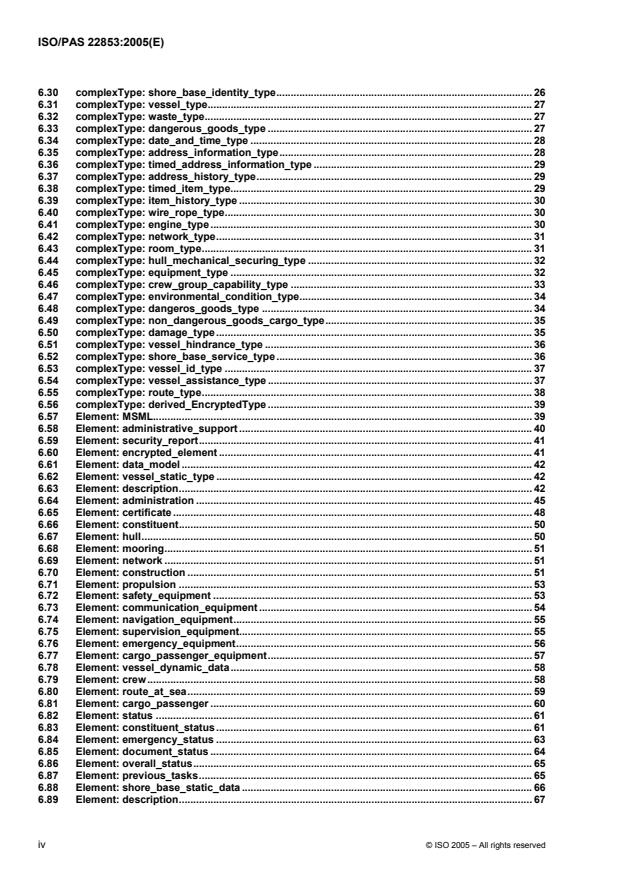
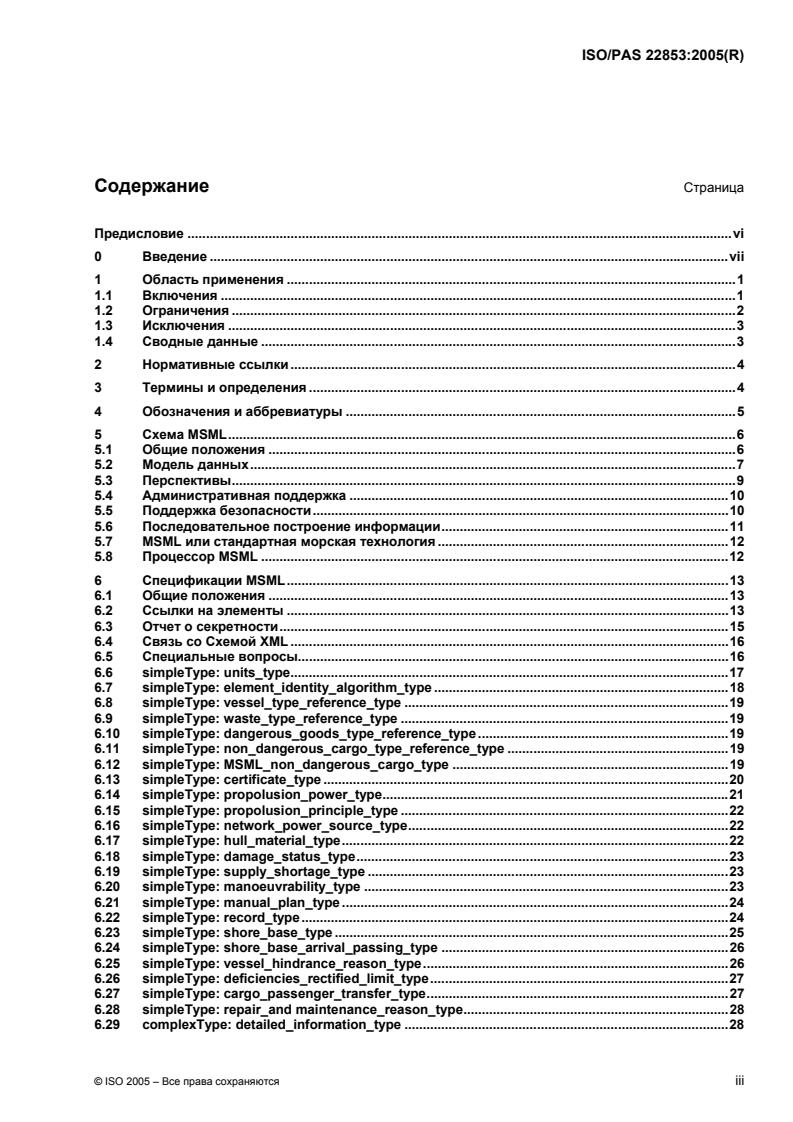
Contents Page
Foreword. vi
0 Introduction . vii
1 Scope . 1
1.1 Inclusions . 1
1.2 Limitations. 2
1.3 Exclusions . 2
1.4 Summary. 3
2 Normative references . 3
3 Terms and definitions. 3
4 Symbols and abbreviated terms . 4
5 MSML design. 5
5.1 General. 5
5.2 Data model. 6
5.3 Perspectives. 8
5.4 Administrative support. 9
5.5 Security support . 9
5.6 Successive information build-up . 9
5.7 MSML vs. standardized maritime technology. 10
5.8 MSML processor . 10
6 MSML specification . 12
6.1 General. 12
6.2 Referencing . 12
6.3 Security report . 13
6.4 Relation to XML Schema. 14
6.5 Special considerations. 14
6.6 simpleType: units_type. 15
6.7 simpleType: element_identity_algorithm_type . 16
6.8 simpleType: vessel_type_reference_type. 17
6.9 simpleType: waste_type_reference_type. 17
6.10 simpleType: dangerous_goods_type_reference_type . 17
6.11 simpleType: non_dangerous_cargo_type_reference_type. 17
6.12 simpleType: MSML_non_dangerous_cargo_type. 17
6.13 simpleType: certificate_type . 18
6.14 simpleType: propolusion_power_type. 19
6.15 simpleType: propolusion_principle_type. 20
6.16 simpleType: network_power_source_type . 20
6.17 simpleType: hull_material_type . 20
6.18 simpleType: damage_status_type . 21
6.19 simpleType: supply_shortage_type. 21
6.20 simpleType: manoeuvrability_type. 21
6.21 simpleType: manual_plan_type . 22
6.22 simpleType: record_type . 22
6.23 simpleType: shore_base_type . 23
6.24 simpleType: shore_base_arrival_passing_type. 23
6.25 simpleType: vessel_hindrance_reason_type . 24
6.26 simpleType: deficiencies_rectified_limit_type . 25
6.27 simpleType: cargo_passenger_transfer_type . 25
6.28 simpleType: repair_and maintenance_reason_type. 25
6.29 complexType: detailed_information_type. 26
6.30 complexType: shore_base_identity_type. 26
6.31 complexType: vessel_type. 27
6.32 complexType: waste_type. 27
6.33 complexType: dangerous_goods_type . 27
6.34 complexType: date_and_time_type . 28
6.35 complexType: address_information_type. 28
6.36 complexType: timed_address_information_type . 29
6.37 complexType: address_history_type. 29
6.38 complexType: timed_item_type. 29
6.39 complexType: item_history_type . 30
6.40 complexType: wire_rope_type. 30
6.41 complexType: engine_type. 30
6.42 complexType: network_type. 31
6.43 complexType: room_type. 31
6.44 complexType: hull_mechanical_securing_type . 32
6.45 complexType: equipment_type . 32
6.46 complexType: crew_group_capability_type . 33
6.47 complexType: environmental_condition_type. 34
6.48 complexType: dangeros_goods_type . 34
6.49 complexType: non_dangerous_goods_cargo_type. 35
6.50 complexType: damage_type. 35
6.51 complexType: vessel_hindrance_type . 36
6.52 complexType: shore_base_service_type . 36
6.53 complexType: vessel_id_type . 37
6.54 complexType: vessel_assistance_type . 37
6.55 complexType: route_type. 38
6.56 complexType: derived_EncryptedType . 39
6.57 Element: MSML. 39
6.58 Element: administrative_support . 40
6.59 Element: security_report. 41
6.60 Element: encrypted_element . 41
6.61 Element: data_model . 42
6.62 Element: vessel_static_type . 42
6.63 Element: description. 42
6.64 Element: administration . 45
6.65 Element: certificate . 48
6.66 Element: constituent. 50
6.67 Element: hull. 50
6.68 Element: mooring. 51
6.69 Element: network . 51
6.70 Element: construction . 51
6.71 Element: propulsion . 53
6.72 Element: safety_equipment . 53
6.73 Element: communication_equipment . 54
6.74 Element: navigation_equipment. 55
6.75 Element: supervision_equipment. 55
6.76 Element: emergency_equipment. 56
6.77 Element: cargo_passenger_equipment. 57
6.78 Element: vessel_dynamic_data. 58
6.79 Element: crew. 58
6.80 Element: route_at_sea. 59
6.81 Element: cargo_passenger . 60
6.82 Element: status . 61
6.83 Element: constituent_status. 61
6.84 Element: emergency_status . 63
6.85 Element: document_status . 64
6.86 Element: overall_status. 65
6.87 Element: previous_tasks. 65
6.88 Element: shore_base_static_data . 66
6.89 Element: description. 67
iv © ISO 2005 – All rights reserved
6.90 Element: administration. 68
6.91 Element: service . 68
6.92 Element: shore_base_dynamic_data.74
6.93 Element: service_status. 75
6.94 Element: overall_status . 76
6.95 Element: vessel_shore_base_relation. 76
6.96 Element: administration. 77
6.97 Element: status . 77
6.98 Element: vessel_shore_task. 78
6.99 Element: perspective. 80
6.100 Element: repair_and_maintenance . 80
6.101 Element: ashore . 81
6.102 Element: onboard . 83
6.103 Element: status . 85
6.104 Element: inspection. 86
7 MSML instance processing . 88
Bibliography . 89
Foreword
ISO (the International Organization for Standardization) is a worldwide federation of national standards bodies
(ISO member bodies). The work of preparing International Standards is normally carried out through ISO
technical committees. Each member body interested in a subject for which a technical committee has been
established has the right to be represented on that committee. International organizations, governmental and
non-governmental, in liaison with ISO, also take part in the work. ISO collaborates closely with the
International Electrotechnical Commission (IEC) on all matters of electrotechnical standardization.
International Standards are drafted in accordance with the rules given in the ISO/IEC Directives, Part 2.
The main task of technical committees is to prepare International Standards. Draft International Standards
adopted by the technical committees are circulated to the member bodies for voting. Publication as an
International Standard requires approval by at least 75 % of the member bodies casting a vote.
In other circumstances, particularly when there is an urgent market requirement for such documents, a
technical committee may decide to publish other types of normative document:
⎯ an ISO Publicly Available Specification (ISO/PAS) represents an agreement between technical experts in
an ISO working group and is accepted for publication if it is approved by more than 50 % of the members
of the parent committee casting a vote;
⎯ an ISO Technical Specification (ISO/TS) represents an agreement between the members of a technical
committee and is accepted for publication if it is approved by 2/3 of the members of the committee casting
a vote.
An ISO/PAS or ISO/TS is reviewed after three years in order to decide whether it will be confirmed for a
further three years, revised to become an International Standard, or withdrawn. If the ISO/PAS or ISO/TS is
confirmed, it is reviewed again after a further three years, at which time it must either be transformed into an
International Standard or be withdrawn.
Attention is drawn to the possibility that some of the elements of this document may be the subject of patent
rights. ISO shall not be held responsible for identifying any or all such patent rights.
ISO/PAS 22853 was prepared by Technical Committee ISO/TC 8, Ships and marine technology,
Subcommittee SC 10, Computer applications.
vi © ISO 2005 – All rights reserved
0 Introduction
0.1 General
This Publicly Available Specification specifies the XML application MSML (Maritime Safety Markup Language).
MSML is a language for structuring information and the goal is to create an open standard that can be used
generally in the maritime sector. MSML is implemented using XML Schema, which is contained in a separate
document that could be used at validation. The first purpose of MSML is to make it possible to record safety
related information in relation to repair and maintenance. The second purpose is to define an extensible
structure that could be developed in future versions of MSML. Note that MSML should not primarily be seen
as a support for normal work onboard. Instead, it is an add-on support for transfers of safety related
information to/from the vessel.
MSML enables security handling and since MSML concerns safety aspects there is information support for
• preventing accidents;
• minimizing extent of damage;
• minimizing criticality of consequences.
These aspects concern both vessel and bases ashore (denoted shore bases in this Publicly Available
Specification).
MSML consists of the following constituents:
• data model that defines the data of interest. The basic parts of the data model are vessel static and
dynamic areas, shore base static and dynamic areas and vessel shore base relation. Each of these can be
created successively and thus validation can be made even if information is not complete;
• administrative support that defines the handling of the XML application instance as a file;
• security support that defines the handling of data security. MSML enables digital signatures and
encryption via the W3C recommendations “XML Encryption Syntax and Processing” and “XML-Signature
Syntax and Processing”.
The data model can be seen from different perspectives and the following are defined:
• inspection that contains information related to externally made inspections;
• repair and maintenance that contains the corresponding information;
A fundamental property of MSML is that it does not consider the actual use of data, e.g. there is no
specification of MSML messages. This makes it practical to use MSML in a large variety of applications and
without modifying the definition of MSML.
This Publicly Available Specification contains nearly the same information as the XML Schema representation
but expressed in plain English. In this way, it is possible to discuss and evaluate MSML without knowing the
syntax details of XML Schema. This Publicly Available Specification also contains rules and guidelines
associated with MSML.
Planning, performing, recording and evaluating repair and maintenance are crucial for safe transports at sea.
Preventive actions are especially cost-effective; is it possible to plan repair and maintenance at the optimal
place and time? Fulfilling these aspects will prevent accidents and thus save money and effort for all involved
parties. For these reasons the Maritime Safety Markup Language (MSML) is defined. It is an XML application
specified using XML Schema (see [10] and [11]).
Since the purpose of MSML is to handle safety aspects in relation to repair and maintenance, there is
information support for
• preventing accidents, e.g. vessel status, previous repairs, remaining deficiencies;
• minimizing extent of damage, e.g. personnel training, personal equipment, and pollution control;
• minimizing criticality of consequences, e.g. status of emergency equipment.
The information support concerns both vessel and shore base (e.g. a port) and is valid also for other safety
related aspects than repair and maintenance; thus, future extensions can be made smoothly.
MSML is vessel-centric in the sense that all relevant aspects of the vessel and its task are included while only
one of possibly many tasks of a port is included (only the berth used for the vessel). Port is a typical example
of a shore base as defined in this Publicly Available Specification. By using MSML it is also possible to
associate a vessel and a shore base and the information can flow in the following ways:
• vessel-to-vessel, e.g. support information if communication with shore base cannot be made;
• vessel-to-shore base, e.g. sending status information;
• shore base-to-vessel, e.g. sending recommended actions such as go to nearest drydock for inspection;
• shore base-to-shore base, e.g. preparing the next port to visit for the vessel.
However, there is no support in MSML for relating a vessel with another vessel and relating a shore base with
another shore base, i.e. there is no support for storing information that describes such a relation. For example,
a vessel giving instructions to another vessel must be handled outside MSML (but of course a vessel could
just send its information to another vessel if necessary).This means that more than one MSML instance has to
be used for
• relating more than one vessel with a shore base;
• relating more than one shore base with a vessel;
• relating a vessel with another vessel;
• relating a shore base with another shore base.
There are several reasons for this design:
• keeping down the size of MSML, i.e. not making the definition too complex;
• keeping down the size of MSML instances, i.e. not letting transfers take too long a time;
• encouraging vessel-to-vessel communication via shore base;
• letting shore base to shore base communication be handled outside MSML.
An example of a possible message sequence using MSML is a vessel approaching a port with the intention of
delivering its cargo.
1. The vessel stores vessel data and sends the information to the port.
2. The port checks if there is a berth for the vessel, if it is allowed to enter the port, if there are no alarms, if
a pilot is available, if repair and maintenance is accurate, etc. The port stores port data and sends data to
vessel.
3. The vessel checks port data and requests an acknowledgement.
4. The port relates vessel and port data and sends acknowledgement.
viii © ISO 2005 – All rights reserved
MSML puts no requirements on how much information shall be stored before transactions take place. On the
contrary, information could be built up successively using a number of information exchanges between vessel
and shore base. This could be made by partly filled in information or by using fragments of information and
even using mirrored versions of information. However, a natural unit is a basic MSML instance since it can be
validated using the rules specified in MSML. MSML puts no requirements on the originator of the MSML
instance; it could be the vessel, the shore base or another party. Figure 1 shows an example: Vessel 1 and
Port 1 have a mutual agreement, as do Vessel 2 and Port 1; Vessel 2 and Port 2 have not yet established an
agreement, but both have prepared information relative to the respective side.
MSML Instance
(complete)
Port 1
Vessel 1
Port 2
MSML Instance MSML Instance
Vessel 2
(partly filled) (partly filled)
Figure 1 — Example of originator of the MSML instance
0.2 Background
The creation of MSML is a result of the MANATEE project within the Fifth European Community Framework
Programme (IST–2001-38091). A motivation for MSML is given in the MANATEE project description:
• “Enhancing the information and communication channels between ship and shore leading towards a
unique e-work platform used and shared between maritime business companies and official Port Authorities,
mostly Governmental Bodies as well as all the other interested parties;”
• “Providing simplified access to ship-borne and shore-based databases and information by users aboard
and ashore for decision-making support;”
• “Exchanging information on ship’s control system, on-shore supervision and control systems, on-shore
and on-ship administrative systems, books, documents, circulars, faxes, telexes, improving the connectivity
between the on board control systems and the information systems on-shore;”
• “Increasing the use of on-line updated information regarding meteorological data and hazard indication.”
The goal is to create an open standard that can be used generally for safety aspects in the maritime sector.
Currently the focus is on repair and maintenance but other aspects can be included in the future.
For the definition of MSML many different resources have been considered. One fundamental source of
information is directives and regulations. Those that have been considered relevant concerning maritime use
and in relation with repair and maintenance are listed in Annex A. There are also other initiatives related to
MSML however not directly affecting the contents.
MSML Instance
(complete)
• Marine Trading Markup Language (MTML), see [2], is a language for trade and addresses:
– trade transactions,
– price,
– delivery schedule,
– goods or services.
MTML is outside the scope of MSML.
• SIRENAC database (see [3]) contains the following information:
– ship identification (name, IMO number, flag, ship type, gross registered tonnage, year of build),
– class related deficiencies (“Yes” or “No”), total number of deficiencies,
– detention (port of detention, date of release from detention, duration of detention in days, reason(s) for
detention),
– classification society,
– owner/operator.
SIRENAC contains a subset of the MSML information support.
• EQUASIS database (see [4]) contains the following information:
– ship identification,
– management,
– classification,
– safety management certificate,
– P&I information,
– list of Port State Controls,
– banning orders,
– association membership,
– manning information,
– condensed history,
– list of ships under the same management.
EQUASIS contains a subset of the MSML information support.
• For the Condition Assessment Program (CAP), see [7], the verification focus is on vessel condition and
addresses the following aspects for hull:
– rating for each structural group and strength evaluation,
– survey record,
x © ISO 2005 – All rights reserved
– report for fatigue strength assessment,
– rating for corrosion protection systems of water ballast tanks and coated cargo tanks,
– photographic report,
– thickness measurement record.
It addresses the following aspects for machinery/cargo systems:
– rating for each item,
– survey record,
– photographic report.
The CAP results are too detailed for MSML but a reference from MSML can be given to CAP documents.
• ISO 10303, Industrial automation systems and integration — Product data representation and exchange
(STEP), see [6], is a set of construction related standards where the following are relevant for maritime use:
– AP215 Ship arrangement,
– AP216 Ship moulded forms,
– AP218 Ship structures,
– AP226 Ship mechanical systems,
– AP217 Ship piping.
The information support in STEP is for a limited part of the MSML scope and too detailed for MSML.
• The focus of SafeSeaNet (see [5]) is to enable safe transports at sea by keeping better track of vessels
and their routes. An important part is the network architecture that defines a distributed database with
references to further information. Also, SafeSeaNet defines messages. Since SafeSeaNet concerns safety at
sea there is, to a certain extent, an information overlap with MSML. Detailed information is not currently
available but is probably a subset of the MSML information support.
• TELEMAS (Tele-maintenance and support through intelligent resource management for ship operation),
see [9], aims to increase efficiency and safety of ship operation by combining specific developments together
with existing IT systems and tools. Detailed information is not currently available but is probably a subset of
the MSML information support.
• OPTIMISE (Optimal Maintenance Intervention of Ships in Europe) is focused on hull structural issues
such as corrosion, strain damage and cracking (see [8]). Detailed information is not currently available but is
probably a subset of the MSML information support.
• System initiatives such as VTS (Vessel Traffic Systems), VTMIS (Vessel Traffic Management and
Information Services) and Integrated Ship Control systems (ISC) are not directly considered since the
component aspects of such systems are addressed by MSML and not the system as such.
If a closer relationship with MSML is needed in the future it could be accomplished by modifying MSML,
expanding it or making transformations between different representations. Transformations for XML based
information can take place using e.g. XSLT or when accessing a non-native database. Both the underlying
data model and grammar could be of interest for modifications.
PUBLICLY AVAILABLE SPECIFICATION ISO/PAS 22853:2005(E)
Ships and marine technology — Computer applications —
Specification of Maritime Safety Markup Language (MSML)
1 Scope
1.1 Inclusions
This Publicly Available Specification specifies the XML application MSML (Maritime Safety Markup Language).
MSML is a language for structuring information and the goal is to create an open standard that can be used
generally in the maritime sector. This Publicly Available Specification emphasizes the following aspects of
MSML:
• functional applicability in the maritime arena with focus on repair and maintenance and related safety
aspects;
• secure transfer of information between vessel and shore base;
• extensibility to incorporate increased functionality;
• use of standardized XML support whenever needed.
The basis of MSML is the data model which defines what kind of maritime data, related to vessel and shore
base, it is possible to store. The data model represents the current state and only limited historic information is
kept in the data model. This Publicly Available Specification defines the following information areas of the data
model:
• the vessel,
• the actual use and status of the vessel,
• the shore base,
• the actual use and status of one berth of the shore base,
• the relation between the vessel and the shore base,
• the history of repair and maintenance and what has been done on each occasion.
The data model of MSML makes it possible to describe the following states:
• a vessel with/without defined task,
• a berth of a shore base with/without defined task,
• a vessel and a berth of a shore base with/without relation.
Defining states makes it possible to define transactions, i.e. sequences of actions for fulfilling specific
intentions. We have the general transactions:
• assigning task to/removing task from vessel,
• assigning task to/removing task from a berth of a shore base (for a specific vessel),
• assigning relation/removing relation vessel - a berth of a shore base,
• assigning/removing specific pieces of data,
• reading data.
This Publicly Available Specification defines perspectives associated with the data model of MSML. The term
indicates that the MSML data model can be seen from different views. Perspectives contain information that is
orthogonal to the data model. Two perspectives are defined:
• inspection – an inherent perspective that makes it possible to reference results of vessel inspections;
• repair and maintenance – currently the main focus of MSML.
There are also other sources of information that are associated with MSML. The data model of MSML
assumes that information concerning individual crew and passenger members is handled adequately using
the muster list and passenger list, respectively. However, for the data model of MSML groups of individuals
are considered. The primary purpose of MSML is to make it possible to identify available capabilities and
resources and not to handle individuals. However, a reference is included in MSML where to find detailed
information.
A certain amount of shore base information is included in the data model of MSML. The main reason to
include this information is to support vessel safety related aspects and vessel repair and maintenance.
1.2 Limitations
An MSML instance will contain extensive history information only if included in the definition of a perspective.
For example, repair and maintenance contains an extensive history of what has been changed and when, but
there is no extensive history information for e.g. bunkering. The reason for including history is that actions
made in the past can affect future events and decisions. However, some minor historic information is included
in the data model of MSML (i.e. not within perspectives), e.g. the history of vessel name changes. If other
types of extensive history information are needed, a new version of the MSML instance has to be stored for
each significant change and this must be handled outside the scope of MSML (probably using a native XML
database).
The data model of MSML should not primarily be seen as a support for normal work onboard. Instead it is an
add-on support for transfers of safety related information to/from the vessel from/to external units and within
the vessel. For example, current propeller revolutions per minute cannot be extracted from the computerized
MSML system, instead the value is read directly from the ordinary equipment. In the same way the shore base
part of the MSML data model is seen as a support to the safety related vessel information and not from normal
work ashore. Generally, normal dynamic information during a voyage between two shore bases is not
included within MSML. On the other hand, alarms and malfunctioning units are generally safety related and of
interest internally and externally and thus included in the data model of MSML. If alarms are set automatically
or not is a question outside the scope of MSML.
1.3 Exclusions
The following aspects are not included in the scope of MSML:
• aspects concerning costs and fees;
• geographic information;
• logs, e.g. log of communication;
• specific cargo information, e.g. tracing, Smart and Secure Tradelanes;
• presentation of information;
2 © ISO 2005 – All rights reserved
• users and their authorities;
• actual use of data and instances, e.g. definition of messages;
• bindings to protocols.
1.4 Summary
To sum up the main characteristics of MSML, it
• contains an XML-based data model for information exchange and processing in safety-critical maritime
applications;
• does not describe how data is used;
• supports information security and extensibility;
• is a framework and future open standard for the maritime safety sector.
The principal system dependences on MSML are shown in Figure 2.
System specific
Standard
System design
MSML
Definition of
messages
System
implementation
Figure 2 — Principal system dependences on MSML
We see that MSML will affect system design and definition of messages but MSML is not affected. Thus
MSML can remain a stable standard for a wide variety of applications.
2 Normative references
The following referenced documents are indispensable for the application of this document. For dated
references, only the edition cited applies. For undated references, the latest edition of the referenced
document (including any amendments) applies.
ISO 6709:1983, Standard representation of latitude, longitude and altitude for geographic point locations
3 Terms and definitions
For the purposes of this document, the following terms and definitions apply.
3.1
element content
〈XML element〉 content only consisting of other elements
NOTE See [1].
3.2
MSML instance
document containing vessel and shore base data which can be validated using the rules set up by MSML
3.3
port
shore base consisting of one or more wharfs
3.4
shore base
land-based station used for supporting vessels and/or interests on land
NOTE In most cases a port is used as a shore base, but it could also be a station just recording vessels passing by
and sending information to, for example, authorities.
3.5
validation
checking that an MSML instance fulfils the rules given by MSML
3.6
voyage
sea journey starting from a shore base and including zero or more intermediate shore bases before reaching
the final shore base
NOTE Different users will have different definitions of the number of shore bases included in the voyage.
3.7
wrapper element
XML element that is only used for enclosing other elements
4 Symbols and abbreviated terms
AIS Automatic Identification System
BCH code Bulk CHemical code
EPIRB Emergency Position Indicating Radio Beacon
GMDSS Global Maritime Distress and Safety System
GMT Greenwich Mean Time
HAZMAT HAZardous MATerials
IBC International Bulk Carrier
ICS International Chamber of Shipping
IGC International Gas Carrier
IMDG International Maritime Dangerous Goods
IMO International Maritime Organization
INF Irradiated Nuclear Fuel
INMARSAT INternational MARitime SATellite
...
ОБЩЕДОСТУПНЫЕ ISO/PAS
ТЕХНИЧЕСКИЕ 22853
ТРЕБОВАНИЯ
Первое издание
2005-10-01
Суда и морские технологии.
Компьютерные применения.
Спецификация языка разметки
безопасности плавания (MSML)
Ships and marine technology — Computer applications — Specification
of Maritime Safety Markup Language (MSML)
Ответственность за подготовку русской версии несёт ГOST R
(Российская Федерация) в соответствии со статьёй 18.1 Устава ISO
Ссылочный номер
©
ISO 2005
Отказ от ответственности при работе в PDF
Настоящий файл PDF может содержать интегрированные шрифты. В соответствии с условиями лицензирования, принятыми
фирмой Adobe, этот файл можно распечатать или смотреть на экране, но его нельзя изменить, пока не будет получена
лицензия на интегрированные шрифты и они не будут установлены на компьютере, на котором ведется редактирование. В
случае загрузки настоящего файла заинтересованные стороны принимают на себя ответственность за соблюдение
лицензионных условий фирмы Adobe. Центральный секретариат ISO не несет никакой ответственности в этом отношении.
Adobe – торговый знак фирмы Adobe Systems Incorporated.
Подробности, относящиеся к программным продуктам, использованным для создания настоящего файла PDF, можно найти в
рубрике General Info файла; параметры создания PDF были оптимизированы для печати. Были приняты во внимание все
меры предосторожности с тем, чтобы обеспечить пригодность настоящего файла для использования комитетами-членами
ISO. В редких случаях возникновения проблемы, связанной со сказанным выше, просьба проинформировать Центральный
секретариат по адресу, приведенному ниже.
ДОКУМЕНТ ЗАЩИЩЕН АВТОРСКИМ ПРАВОМ
Все права сохраняются. Если не указано иное, никакую часть настоящей публикации нельзя копировать или использовать в
какой-либо форме или каким-либо электронным или механическим способом, включая фотокопии и микрофильмы, без
предварительного письменного согласия ISO, которое должно быть получено после запроса о разрешении, направленного по
адресу, приведенному ниже, или в комитет-член ISO в стране запрашивающей стороны.
ISO copyright office
Case postale 56 • CH-1211 Geneva 20
Tel. + 41 22 749 01 11
Fax + 41 22 749 09 47
E-mail copyright @ iso.org
Web www.iso.org
Опубликовано в Швейцарии
ii © ISO 2005 – Все права сохраняютя
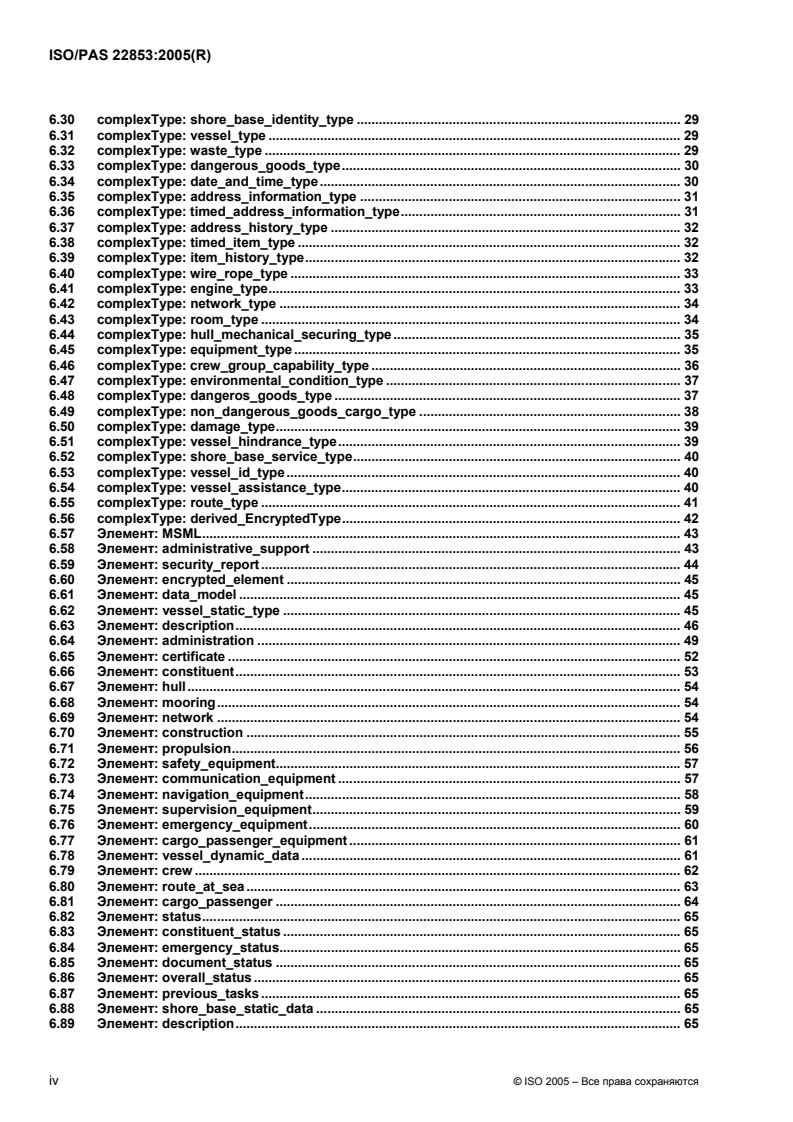
Содержание Страница
Предисловие .vi
0 Введение .vii
1 Область применения .1
1.1 Включения .1
1.2 Ограничения .2
1.3 Исключения .3
1.4 Сводные данные .3
2 Нормативные ссылки .4
3 Термины и определения .4
4 Обозначения и аббревиатуры .5
5 Схема MSML.6
5.1 Общие положения .6
5.2 Модель данных.7
5.3 Перспективы.9
5.4 Административная поддержка .10
5.5 Поддержка безопасности.10
5.6 Последовательное построение информации.11
5.7 MSML или стандартная морская технология .12
5.8 Процессор MSML .12
6 Спецификации MSML.13
6.1 Общие положения .13
6.2 Ссылки на элементы .13
6.3 Отчет о секретности.15
6.4 Связь со Схемой XML .16
6.5 Специальные вопросы.16
6.6 simpleType: units_type.17
6.7 simpleType: element_identity_algorithm_type .18
6.8 simpleType: vessel_type_reference_type .19
6.9 simpleType: waste_type_reference_type .19
6.10 simpleType: dangerous_goods_type_reference_type .19
6.11 simpleType: non_dangerous_cargo_type_reference_type .19
6.12 simpleType: MSML_non_dangerous_cargo_type .19
6.13 simpleType: certificate_type .20
6.14 simpleType: propolusion_power_type.21
6.15 simpleType: propolusion_principle_type .22
6.16 simpleType: network_power_source_type.22
6.17 simpleType: hull_material_type.22
6.18 simpleType: damage_status_type.23
6.19 simpleType: supply_shortage_type .23
6.20 simpleType: manoeuvrability_type .23
6.21 simpleType: manual_plan_type .24
6.22 simpleType: record_type.24
6.23 simpleType: shore_base_type .25
6.24 simpleType: shore_base_arrival_passing_type .26
6.25 simpleType: vessel_hindrance_reason_type.26
6.26 simpleType: deficiencies_rectified_limit_type.27
6.27 simpleType: cargo_passenger_transfer_type.27
6.28 simpleType: repair_and maintenance_reason_type.28
6.29 complexType: detailed_information_type .28
6.30 complexType: shore_base_identity_type . 29
6.31 complexType: vessel_type . 29
6.32 complexType: waste_type . 29
6.33 complexType: dangerous_goods_type. 30
6.34 complexType: date_and_time_type. 30
6.35 complexType: address_information_type . 31
6.36 complexType: timed_address_information_type. 31
6.37 complexType: address_history_type .32
6.38 complexType: timed_item_type . 32
6.39 complexType: item_history_type. 32
6.40 complexType: wire_rope_type . 33
6.41 complexType: engine_type. 33
6.42 complexType: network_type . 34
6.43 complexType: room_type . 34
6.44 complexType: hull_mechanical_securing_type. 35
6.45 complexType: equipment_type. 35
6.46 complexType: crew_group_capability_type . 36
6.47 complexType: environmental_condition_type . 37
6.48 complexType: dangeros_goods_type . 37
6.49 complexType: non_dangerous_goods_cargo_type . 38
6.50 complexType: damage_type. 39
6.51 complexType: vessel_hindrance_type. 39
6.52 complexType: shore_base_service_type. 40
6.53 complexType: vessel_id_type. 40
6.54 complexType: vessel_assistance_type. 40
6.55 complexType: route_type . 41
6.56 complexType: derived_EncryptedType. 42
6.57 Элемент: MSML. 43
6.58 Элемент: administrative_support . 43
6.59 Элемент: security_report. 44
6.60 Элемент: encrypted_element . 45
6.61 Элемент: data_model . 45
6.62 Элемент: vessel_static_type .45
6.63 Элемент: description. 46
6.64 Элемент: administration . 49
6.65 Элемент: certificate . 52
6.66 Элемент: constituent. 53
6.67 Элемент: hull. 54
6.68 Элемент: mooring. 54
6.69 Элемент: network . 54
6.70 Элемент: construction . 55
6.71 Элемент: propulsion. 56
6.72 Элемент: safety_equipment.57
6.73 Элемент: communication_equipment . 57
6.74 Элемент: navigation_equipment. 58
6.75 Элемент: supervision_equipment. 59
6.76 Элемент: emergency_equipment. 60
6.77 Элемент: cargo_passenger_equipment . 61
6.78 Элемент: vessel_dynamic_data . 61
6.79 Элемент: crew . 62
6.80 Элемент: route_at_sea. 63
6.81 Элемент: cargo_passenger . 64
6.82 Элемент: status. 65
6.83 Элемент: constituent_status .65
6.84 Элемент: emergency_status. 65
6.85 Элемент: document_status . 65
6.86 Элемент: overall_status. 65
6.87 Элемент: previous_tasks. 65
6.88 Элемент: shore_base_static_data . 65
6.89 Элемент: description. 65
iv © ISO 2005 – Все права сохраняются
6.90 Элемент: administration .65
6.91 Элемент: service.65
6.92 Элемент: shore_base_dynamic_data.65
6.93 Элемент: service_status.65
6.94 Элемент: overall_status.65
6.95 Элемент: vessel_shore_base_relation.65
6.96 Элемент: administration .65
6.97 Элемент: status .65
6.98 Элемент: vessel_shore_task.65
6.99 Элемент: perspective.65
6.100 Элемент: repair_and_maintenance .65
6.101 Элемент: ashore .65
6.102 Элемент: onboard.65
6.103 Элемент: status .65
6.104 Элемент: inspection.65
7 Обработка сообщения MSML .65
Библиография.65
Предисловие
Международная организация по стандартизации (ISO) является всемирной федерацией национальных
организаций по стандартизации (комитетов-членов ISO). Разработка международных стандартов
обычно осуществляется техническими комитетами ISO. Каждый комитет-член, заинтересованный в
деятельности, для которой был создан технический комитет, имеет право быть представленным в этом
комитете. Международные организации, правительственные и неправительственные, имеющие связи
с ISO, также принимают участие в работах. Что касается стандартизации в области электротехники, то
ISO работает в тесном сотрудничестве с Международной электротехнической комиссией (IEC).
Проекты международных стандартов разрабатываются в соответствии с правилами Директив ISO/IEC,
Часть 2.
Основной задачей технических комитетов является разработка международных стандартов. Проекты
международных стандартов, принятые техническими комитетами, рассылаются комитетам-членам на
голосование. Для опубликования их в качестве международного стандарта требуется одобрение не
менее 75 % комитетов-членов, принимающих участие в голосовании.
При других обстоятельствах, особенно когда на рынке существует настоятельная потребность в таких
документах, технический комитет может принять решение опубликовать другие типы нормативных
документов:
an ISO Publicly Available Specification (ISO/PAS), представляющие собой соглашение между
техническими экспертами рабочей группы ISO и принимаемые для публикации, если они одобрены
более чем 50 % членов ведущего комитета, принявших участие в голосовании;
an ISO Technical Specification (ISO/TS), представляющие собой соглашение между членами
технического комитета и принимаемые для публикации, если они одобрены более чем 2/3 членов
ведущего комитета, принявших участие в голосовании.
ISO/PAS или ISO/TS пересматриваются через три года с целью принятия решения, будут ли они
утверждены на следующие три года, переработаны для выпуска в качестве Международного
Стандарта, или отменены. Если ISO/PAS или ISO/TS подтверждаются, они пересматриваются через
следующие три года, когда они должны быть либо преобразованы в Международный Стандарт, либо
отменены.
Необходимо учитывать возможность, что некоторые элементы настоящего документа могут быть
объектом патентных прав. ISO не несет ответственность за определение каких-либо или всех таких
патентных прав.
Стандарт ISO/PAS 22853 был подготовлен Техническим комитетом ISO/TC 8, Суда и морские
технологии, Подкомитетом SC 10, Применение компьютеров.
vi © ISO 2005 – Все права сохраняются
0 Введение
0.1 Общие положения
Настоящие Publicly Available Specification определяют применение языка XML (Расширяемый язык
разметки) в языке MSML (Язык разметки в области безопасности на море). MSML представляет собой
язык для структурирования информации и предназначен для создания открытого стандарта, который
может обычно использоваться в морском секторе. MSML реализуется на основе схемы XML, которая
содержится в отдельных документах, применяемых для валидации. Первичная цель MSML состоит в
обеспечении возможности регистрировать информацию в области безопасности, относящуюся к
ремонту и техническому обслуживанию. Вторая цель заключается в определении расширяемой
структуры, которая поддается развитию в будущих версиях MSML. Отметим, что MSML не следует в
первую очередь рассматривать как вспомогательное средство для обычных работ на борту. Напротив,
этот язык представляет собой дополнительное средство для передачи связанной с безопасностью
информации на судно/с судна.
MSML обеспечивает управление безопасностью и, поскольку MSML рассматривает аспекты
безопасности, включает информационное обеспечение следующих вопросов
• предотвращение аварийных ситуаций;
• минимизация степени повреждений;
• минимизация степени критичности последствий аварийных ситуаций.
Эти аспекты рассмотрения относятся как к судам, так и к базам на берегу (обозначаемым в настоящих
Общедоступных технических требованиях как береговая база).
MSML состоит из следующих компонент:
• модель данных, которая определяет представляющие интерес данные. Основные части модели
данных – статические и динамические зоны судов, статические и динамические зоны береговых баз и
взаимосвязи судов с береговыми базами. Каждая из этих частей может быть создана последовательно
и поэтому проверка их достоверности может выполняться даже при отсутствии полной информации;
• административная поддержка, определяющая обработку отдельных случаев применения XML в
виде документа;
• поддержание режима секретности, определяющее степень секретности обработки данных.
MSML допускает цифровые подписи и шифрование согласно рекомендациям W3C “Синтаксис и
процесс шифрования XML” and “ Синтаксис и процесс подписи XML ”.
Модель данных может рассматриваться с различных точек зрения и определяет следующее:
• проверка, содержащая информацию, относящуюся к внешним проверкам;
• ремонт и техническое обслуживание, включающее соответствующую информацию;
Фундаментальное свойство MSML заключается в том, что он не рассматривает фактическое
применение данных, например спецификация сообщений MSML отсутствует. На практике это
позволяет использовать MSML для большого разнообразия применений без модификации
определения MSML.
Настоящие Общедоступные технические требования содержат почти ту же информацию, как Схема
представления XML, но выраженную на простом английском языке. В связи с этим становится
возможным рассматривать и оценивать MSML без знания деталей синтаксиса Схемы XML. Данные
Общедоступные технические требования включают также правила и руководящие указания,
относящиеся к MSML
Планирование, выполнение, регистрация и оценка ремонта и технического обслуживания имеют
критическое значение для безопасности транспорта на море. Превентивные действия особенно
эффективны с точки зрения затрат; возможно ли планирование ремонта и технического обслуживания
в оптимально выбранном месте и времени? Соблюдение этих условий позволяет предотвратить
аварийные ситуации и, таким образом, получить экономию денег и усилий всех заинтересованных
сторон. В связи с этими причинами был разработан Язык разметки в области безопасности на море
(MSML). Он представляет собой применение языка XML с использованием Схемы XML (см. [10] и [11]).
Поскольку цель применения MSML заключается в работе с аспектами безопасности, связанными с
ремонтом и техническим обслуживанием, он осуществляет информационную поддержку в следующих
областях
• предотвращение аварийных ситуаций, например указание состояния судов, предыдущих ремонтов,
оставшихся дефектов;
• минимизация степени повреждения, например путем обучения персонала, с помощью
персонального оборудования и контроля загрязнения;
• минимизация степени критичности последствий, например путем указания состояния аварийного
оборудования.
Информационная поддержка относится как к судам, так и к береговым базам (например портам), и
действует также в отношении других аспектов обеспечения безопасности, кроме ремонта и
технического обслуживания; в связи с этим будущие расширения языка следует выполнять постепенно.
В центре внимания языка MSML находятся суда, в том смысле, что в него включены все относящиеся к
судам и их работе аспекты, тогда как из многих возможных работ порта включена только одна (якорная
стоянка судов). Порт представляет собой типичный пример береговой базы согласно определению
данных Publicly Available Specification. При использовании MSML возможно также совместно
рассматривать суда и береговые базы и соответствующая информация может передаваться
следующими путями:
• от судна к судну, например в виде вспомогательной информации, если коммуникации с береговой
базой невозможны;
• от судна на береговую базу, например путем посылки информации о статусе;
• из береговой базы на судно, например путем посылки рекомендаций относительно действий,
например захода в ближайший сухой док для проверки;
• от береговой базы на береговую базу, например относительно подготовки следующего порта для
захода судна.
Однако в MSML отсутствует поддержка связи одного судна с другим судном, и связи одной береговой
базы с другой береговой базой, т.е. не поддерживается хранение информации, описывающей такие
связи. Например, судно, передающее инструкции на другое судно, должно учитываться вне системы
MSML (но конечно судно может при необходимости послать информацию на другое судно). Это
означает, что в перечисленных ниже случаях должно использоваться более чем одно сообщение
MSML
• связь более чем одного судна с береговой базой;
• связь более чем одной береговой базы с судном;
viii © ISO 2005 – Все права сохраняются
• связь судна с другим судном;
• связь одной береговой базы с другой береговой базой.
Для применения такой схемы имеется несколько причин:
• уменьшение размера MSML, т.е. исключение слишком сложных определений;
• уменьшение размера сообщений MSML, т.е. исключение слишком большого времени передачи;
• поддержание коммуникаций судно – судно через береговую базу;
• создание возможности обработки коммуникаций береговая база – береговая база без
использования MSML.
Примером возможной последовательности сообщений с помощью MSML может служить приближение
судна к порту с намерением разгрузки груза.
1. Судно сохраняет данные о судне и посылает информацию в порт.
2. Порт проверяет наличие якорной стоянки для судна, и если она есть, дает разрешение на заход в
порт, при условии отсутствия сигнала тревоги, наличия лоцмана, точного указания ремонта и
технического обслуживания и т.д. Порт сохраняет свои данные и посылает их на судно.
3. Судно проверяет данные порта и запрашивает подтверждение.
4. Порт сопоставляет данные судна и порта и посылает подтверждение.
MSML не устанавливает требования в отношении количества сохраняемой информации перед
обработкой запросов. С другой стороны, информация может быть построена последовательно с
использованием ряда обменов информацией между судном и береговой базой. Это может быть
выполнено путем частичного заполнения информации или используя фрагменты информации и даже
зеркальные версии информации. Однако естественным блоком является базовое сообщение MSML,
поскольку оно может быть проверено по правилам, установленным в MSML. MSML не устанавливает
требования к генератору сообщений MSML; в качестве такового может быть судно, береговая база,
или другая сторона. На рисунке 1 показан пример: Судно 1 и Порт 1 имеют взаимное соглашение, как и
Судно 2 и Порт 1; Судно 2 и Порт 2 пока не имеют соглашения, однако оба подготовили информацию
для соответствующей стороны.
Рисунок 1 — Пример генератора сообщения MSML
0.2 Обоснование
Создание языка MSML явилось результатом проекта MANATEE в рамках Пятой программы
Европейского Сообщества (IST–2001-38091). Обоснование разработки MSML приведено в описании
проекта MANATEE:
• “Расширение каналов передачи информации и коммуникации между судами и береговыми
организациями, направленное на использование уникальной платформы e-work, и разделяемое между
морскими бизнес компаниями и официальными Портовыми Властями, в основном
Правительственными организациями, а также всеми другими заинтересованными сторонами;”
• “Предоставление упрощенного доступа к находящимся на судах и базирующимся на берегу базам
данных и информации пользователям на судах и берегу в целях поддержки при принятии решений;”
• “Обмен информации между системами управления судами, системами берегового контроля и
управления, административными системами на судах и берегу, книгами, документами, циркулярами,
телексами, улучшение возможностей связи между бортовыми системами управления и
информационными системами на берегу;”
• “Повышение использования обновляемой в оперативном режиме информации в области
метеорологии и указания опасностей. ”
Цель этих работ заключается в создании открытого стандарта, который можно широко использовать
применительно к аспектам безопасности в морском секторе. В настоящее время основное внимание
уделяется ремонту и техническому обслуживанию, однако другие аспекты могут быть включены в
будущем.
x © ISO 2005 – Все права сохраняются
При разработке определений MSML были учтены многие различные ресурсы. Одним из основных
источников информации являются директивы и постановления. Те из них, которые непосредственно
относятся к морскому сектору и связаны с ремонтом и техническим обслуживанием, перечислены в
Приложении А. Были также предприняты и другие инициативы в области разработки MSML, однако они
не нашли отражения в его содержании.
• Язык разметки в области морской торговли (MTML), см. [2], представляет собой язык для торговых
отношений и включает следующее:
– торговые сделки,
– цены,
– график поставок,
– товары или услуги.
MTML не входит в область действия MSML.
• База данных SIRENAC (см. [3]) включает следующую информацию:
– данные для идентификации судна (имя, номер IMO, флаг, тип судна, валовой регистровый
тоннаж, год постройки),
– связанные с классом недостатки (“Да” или “нет”), полное число недостатков,
– задержка сверх срока (порт задержки, дата выпуска из задержки, длительность задержки в днях,
причина (ы) задержки),
– классификационное общество,
– владелец/оператор.
SIRENAC содержит подмножество вспомогательной информации MSML.
• База данных EQUASIS (см. [4]) включает следующую информацию:
– данные для идентификации судна,
– администрация,
– классификация,
– сертификат организации работ по технике безопасности,
– информация о взаимном страховании (P&I),
– перечень органов контроля судов государства порта,
– запрещающие регламенты,
– членство в ассоциации,
– информация о команде,
– краткая история,
– перечень судов, находящихся под управлением той же администрации.
EQUASIS содержит подмножество вспомогательной информации MSML.
• В Программе оценки состояния (CAP), см. [7], основное внимание при проверке уделяется
состоянию судна и следующим данным относительно основного корпуса судна:
– характеристика каждой структурной группы и оценка прочности,
– протокол обследования,
– отчет об оценке усталостной прочности,
– характеристика систем защиты от коррозии балластных отсеков и закрытых грузовых отсеков,
– отчет с фотографиями,
– протокол измерений толщины.
Это относится к следующим аспектам систем механического оборудования/груза:
– характеристики каждого объекта,
– протокол обследования,
– фотографический отчет.
Результаты CAP слишком подробны для применения в MSML, но MSML может содержать ссылки на
документы CAP.
• ISO 10303, Системы промышленной автоматизации и интеграция. Представление данных о
продукции и обмен данными (STEP), см. [6], представляет собой набор относящихся к конструкциям
стандартов, из которых следующие применимы к использованию в области морских судов:
– AP215 Компоновка судов,
– AP216 Литые формы судов,
– AP218 Конструкции на судах,
– AP226 Механические системы судов,
– AP217 Трубопроводы на судах.
Информационная поддержка в STEP применима к ограниченной части области применения MSML и
слишком подробна для MSML.
• Основное внимание в документе SafeSeaNet (см. [5]) уделяется безопасному транспорту на море
путем поддержания удовлетворительных морских путей для судов и выбора маршрутов. Важной
частью является архитектура сетей, определяющая распределенные базы данных со ссылками на
более подробную информацию. SafeSeaNet определяет также сообщения. Поскольку SafeSeaNet
касается вопросов безопасности на море, существует некоторое перекрытие информации с MSML.
Подробные сведения относительно этого документа в настоящее время отсутствуют, но он вероятно
является подмножеством информационной поддержки MSML.
• TELEMAS (Управляемое на расстоянии техническое обслуживание и поддержка путем управления
интеллектуальными ресурсами эксплуатации судов), см. [9], имеет своей целью повышение
xii © ISO 2005 – Все права сохраняются
эффективности и безопасности эксплуатации судов путем комбинирования специальных разработок с
существующими системами и инструментами IT. Подробные сведения относительно этого документа в
настоящее время отсутствуют, но он вероятно является подмножеством информационной поддержки
MSML.
• Документ OPTIMISE (Оптимальный подход к техническому обслуживанию судов в Европе)
основное внимание уделяет вопросам конструкций корпусов, например коррозии, разрушению и
образованию трещин в корпусах под напряжением (см. [8]). Подробные сведения относительно этого
документа в настоящее время отсутствуют, но он вероятно является подмножеством информационной
поддержки MSML.
• Системные разработки типа VTS (Системы движения судов), VTMIS (Управление движением судов
и службы информации) а также Интегрированные системы управления судами (ISC) непосредственно
не рассматриваются, поскольку компонентные аспекты таких систем рассматриваются в MSML, но не
системы как таковые в целом.
Если в будущем потребуются более тесные взаимосвязи с MSML, это может быть достигнуто путем
модификации MSML, включая ее расширение или преобразование между различными
представлениями. Преобразования информации, основанной на XML, могут быть выполнены с
использованием например XSLT, или путем доступа к неограниченным национальными данными
базам данных. При выполнении модификаций может представлять интерес исходная модель данных и
грамматика.
ОБЩЕДОСТУПНЫЕ ТЕХНИЧЕСКИЕ ТРЕБОВАНИЯ ISO/PAS 22853:2005(R)
Судовые и морские технологии. Компьютерные
применения. Спецификация языка разметки безопасности
плавания (MSML)
1 Область применения
1.1 Включения
Настоящие Publicly Available Specification определяют применение языка XML (Расширяемый язык
разметки) в языке MSML (Язык разметки в области безопасности на море). MSML представляет собой
язык для структурирования информации и предназначен для создания открытого стандарта, который
может обычно использоваться в морском секторе. Данные Общедоступные технические требования
выделяют следующие аспекты MSML:
• функциональная применимость в морском деле при особом внимании к ремонту и техническому
обслуживанию и связанным с ними вопросам безопасности;
• безопасная передача информации между судном и береговой базой;
• возможность расширения для повышения функциональных возможностей;
• использование поддержки стандартного XML во всех случаях, когда это необходимо.
Основой MSML является модель данных, устанавливающая, какой тип данных в области морского
транспорта, относящихся к судам и береговым базам, можно сохранять. Модель данных представляет
текущее состояние и только ограниченный объем исторической информации удерживается в модели.
Настоящие Publicly Available Specification определяют следующие области информации модели
данных:
• Судно,
• фактическое использование и статус судна,
• береговая база,
• фактическое использование и статус якорной стоянки на береговой базе,
• связи между судном и береговой базой,
• история ремонта и технического обслуживания и что было сделано в каждом случае.
Модель данных MSML делает возможным описание следующих состояний:
• судно имеющее/не имеющее определенные задачи,
• якорная стоянка на береговой базе, имеющая/не имеющая определенные задачи,
• судно и якорная стоянка на береговой базе, имеющие/не имеющие взаимосвязи.
Задание состояний делает возможным определение операций, т.е. последовательности действий для
выполнения определенных намерений. Мы устанавливаем следующие общие операции:
• назначение задачи/снятие задачи с судна,
• назначение задачи/снятие задачи с якорной стоянки береговой базы (для конкретных судов),
• назначение связей/снятие связей судно – якорная стоянка береговой базы,
• присвоение/удаление конкретных частей данных,
• считывание данных.
Настоящие Publicly Available Specification определяют представления, связанные с моделью данных
MSML. Этот термин указывает, что модель данных MSML можно рассматривать с различных точек
зрения. Определяются два типа представлений:
• контроль – внутренняя точка зрения, позволяющая делать ссылки на результаты проверок судов;
• ремонт и техническое обслуживание – в настоящее время основной предмет MSML.
Существуют также другие источники информации, связанные с MSML. Модель данных MSML
предполагает, что информация, касающаяся отдельных членов команды и пассажиров,
обрабатывается удовлетворительно с использованием списка личного состава и перечня пассажиров,
соответственно. Однако в модели данных MSML учитываются также группы отдельных лиц. Первичной
целью MSML является обеспечение возможности определения наличных средств и ресурсов, а не
работа с отдельными лицами. Тем не менее, в MSML включена ссылка, где найти подробную
информацию.
В модель данных MSML включено некоторое количество информации о береговых базах. Основная
причина включения этой информации состоит в необходимости поддержки связанных с безопасностью
судов аспектов ремонта и технического обслуживания.
1.2 Ограничения
Сообщение MSML будет содержать расширенные данные о предшествующем периоде только если
они требуются для определения перспектив. Например, ремонт и техническое обслуживание требуют
более подробных данных относительно характера и времени предыдущих технических изменений,
однако эти данные не требуются, например, в случае заправки топливом. Причина включения
предыдущих данных состоит в том, что действия в прошлом могут повлиять на решения и события в
будущем. Тем не менее в модель данных MSML (т.е. не относящуюся к перспективам) включают
незначительные сведения из раннего периода, например историю изменений наименований судна.
Если требуются другие типы более полной информации из раннего периода, следует сохранить новую
версию сообщения MSML, касающуюся каждого существенного изменения, и это должно подвергаться
обработке вне области применения MSML (вероятно с применением собственной базы данных XML).
Модель данных MSML не следует рассматривать в первую очередь как поддержку нормальной работы
на борту. Она представляет собой дополнительную поддержку передачи относящейся к безопасности
информации на/с судна из/на внешние единицы и внутри судна. Например, текущие данные о числе
оборотов винта в минуту не могут быть получены из компьютерной системы MSML, они считываются
непосредственно на обычном оборудовании. Таким же образом часть модели данных MSML,
относящуюся к береговой базе, следует рассматривать как поддержку связанной с безопасностью
судна информации, а не как часть нормальной работы на берегу. В целом нормальная динамическая
информация в течение перехода между двумя береговыми базами не включается в MSML. С другой
стороны, блоки тревожной сигнализации и сигнализации о неправильном функционировании обычно
связаны с безопасностью и представляют интерес с внутренней и внешней стороны, и поэтому
включены в модель данных MSML. Автоматический или нет характер тревожной сигнализации выходит
за пределы области применения MSML.
2 © ISO 2005 – Все права сохраняютя
1.3 Исключения
Следующие аспекты не включены в область применения MSML:
• ас
...
Questions, Comments and Discussion
Ask us and Technical Secretary will try to provide an answer. You can facilitate discussion about the standard in here.
Loading comments...