

ISO 28005-1:2024
(Main)Ships and marine technology — Electronic port clearance (EPC) — Part 1: Message structures and application programming interfaces
General Information
- Abstract
This document defines the principles, methods and requirements for message exchanges between ships, ship representatives, and other shore parties via a peer-to-peer communication system. This document defines the message structure, including how the data content is assembled from other parts of the ISO 28005 series, and how digital signatures for authentication, integrity, and confidentiality of the message can be used. It also specifies a transport protocol, the basic message exchange patterns, and the protocol related roles of each party in the message exchange. Furthermore, it specifies how more specific message implementation guides (MIGs) are provided for each type of communication application.
- Status
- Published
- Publication Date
- 08-Dec-2024
- Technical Committee
- ISO/TC 8/SC 11 - Intermodal and Short Sea Shipping
- Drafting Committee
- ISO/TC 8/SC 11 - Intermodal and Short Sea Shipping
- Current Stage
- 6060 - International Standard published
- Start Date
- 09-Dec-2024
- Due Date
- 12-Oct-2024
- Completion Date
- 09-Dec-2024

Overview - ISO 28005-1:2024 (Electronic port clearance, Part 1)
ISO 28005-1:2024 defines the message structures and application programming interfaces (APIs) for Electronic Port Clearance (EPC) in the ships and marine technology domain. The standard establishes principles, methods and requirements for secure, peer-to-peer message exchanges between ships, ship representatives and shore parties. It covers how message content is assembled from the ISO 28005 series, the use of digital signatures for authentication, integrity and confidentiality, a specified transport protocol, basic message exchange patterns and role definitions for each participant. The document also defines how Message Implementation Guides (MIGs) are produced for specific communication applications.
Key technical topics and requirements
- Message structures and XSD definitions: clear rules for XML Schema (XSD) files, including file structure, naming and versioning, character set and namespace handling.
- XML design principles: conventions such as avoiding XML attributes, default minOccurs/maxOccurs values, element ordering and signalling empty tags.
- Standardized data types: adapted epc:* types (e.g., epc:date, epc:dateTime, epc:string, epc:anyURI) and general ISO 28005 data types for common maritime data elements.
- Security requirements: use of digital signatures and authentication tokens to ensure message integrity, confidentiality and non-repudiation.
- Transport protocol and exchange patterns: a specified transport method and defined protocol roles and basic message exchange patterns for peer-to-peer EPC messaging.
- Message Implementation Guides (MIGs): mechanism to create application-specific guides for particular clearance workflows and message types.
- Cross-reference to ISO 28005 series: mechanisms to assemble data content from other parts of the series (e.g., ISO 28005-2).
Practical applications and users
ISO 28005-1 is intended for organizations that implement or operate electronic port clearance and ship-to-shore messaging:
- Ship operators and ship agents - automate pre-arrival notifications, clearance requests and reduce paperwork.
- Port authorities and maritime administrations - receive standardized, authenticated messages for regulatory checks and arrival clearance.
- Port community systems and terminal operators - integrate EPC APIs into local workflows and systems.
- Software vendors and system integrators - implement the XSDs, APIs, security mechanisms and MIGs to enable interoperable solutions.
- Regulatory bodies - specify compliance requirements and support national e‑clearance frameworks.
Related standards
- ISO 28005 series (other parts provide complementary data models and implementation guidance)
- ISO 28005-2:2021 referenced for data type definitions and integration
Keywords: ISO 28005-1, Electronic port clearance, EPC, message structures, APIs, XSD, digital signatures, transport protocol, maritime communications, Message Implementation Guides (MIGs).
Relations
- Effective Date
- 06-Jun-2022
Get Certified
Connect with accredited certification bodies for this standard

BSI Group
BSI (British Standards Institution) is the business standards company that helps organizations make excellence a habit.

DNV
DNV is an independent assurance and risk management provider.

Lloyd's Register
Lloyd's Register is a global professional services organisation specialising in engineering and technology.
Sponsored listings
Frequently Asked Questions
ISO 28005-1:2024 is a standard published by the International Organization for Standardization (ISO). Its full title is "Ships and marine technology — Electronic port clearance (EPC) — Part 1: Message structures and application programming interfaces". This standard covers: This document defines the principles, methods and requirements for message exchanges between ships, ship representatives, and other shore parties via a peer-to-peer communication system. This document defines the message structure, including how the data content is assembled from other parts of the ISO 28005 series, and how digital signatures for authentication, integrity, and confidentiality of the message can be used. It also specifies a transport protocol, the basic message exchange patterns, and the protocol related roles of each party in the message exchange. Furthermore, it specifies how more specific message implementation guides (MIGs) are provided for each type of communication application.
This document defines the principles, methods and requirements for message exchanges between ships, ship representatives, and other shore parties via a peer-to-peer communication system. This document defines the message structure, including how the data content is assembled from other parts of the ISO 28005 series, and how digital signatures for authentication, integrity, and confidentiality of the message can be used. It also specifies a transport protocol, the basic message exchange patterns, and the protocol related roles of each party in the message exchange. Furthermore, it specifies how more specific message implementation guides (MIGs) are provided for each type of communication application.
ISO 28005-1:2024 is classified under the following ICS (International Classification for Standards) categories: 35.240.60 - IT applications in transport; 47.020.99 - Other standards related to shipbuilding and marine structures. The ICS classification helps identify the subject area and facilitates finding related standards.
ISO 28005-1:2024 has the following relationships with other standards: It is inter standard links to ISO 28005-1:2013. Understanding these relationships helps ensure you are using the most current and applicable version of the standard.
ISO 28005-1:2024 is available in PDF format for immediate download after purchase. The document can be added to your cart and obtained through the secure checkout process. Digital delivery ensures instant access to the complete standard document.
Standards Content (Sample)
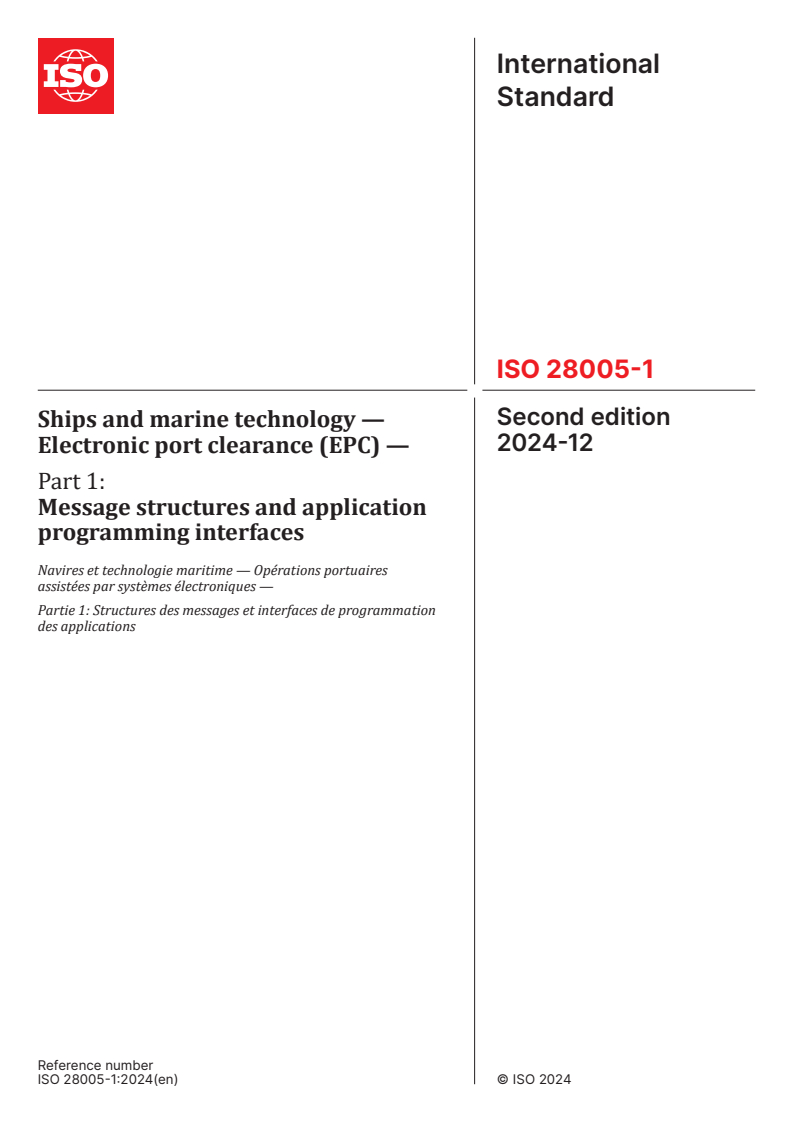
International
Standard
ISO 28005-1
Second edition
Ships and marine technology —
2024-12
Electronic port clearance (EPC) —
Part 1:
Message structures and application
programming interfaces
Navires et technologie maritime — Opérations portuaires
assistées par systèmes électroniques —
Partie 1: Structures des messages et interfaces de programmation
des applications
Reference number
© ISO 2024
All rights reserved. Unless otherwise specified, or required in the context of its implementation, no part of this publication may
be reproduced or utilized otherwise in any form or by any means, electronic or mechanical, including photocopying, or posting on
the internet or an intranet, without prior written permission. Permission can be requested from either ISO at the address below
or ISO’s member body in the country of the requester.
ISO copyright office
CP 401 • Ch. de Blandonnet 8
CH-1214 Vernier, Geneva
Phone: +41 22 749 01 11
Email: copyright@iso.org
Website: www.iso.org
Published in Switzerland
ii
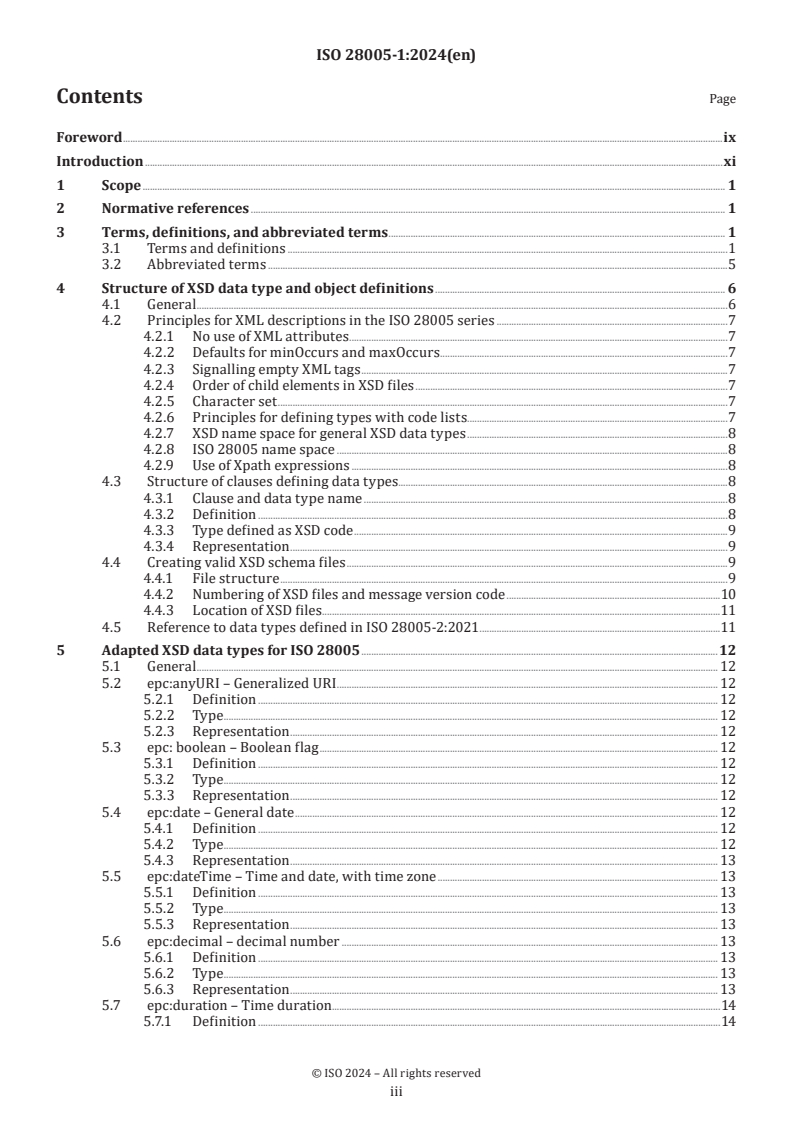
Contents Page
Foreword .ix
Introduction .xi
1 Scope . 1
2 Normative references . 1
3 Terms, definitions, and abbreviated terms . 1
3.1 Terms and definitions .1
3.2 Abbreviated terms .5
4 Structure of XSD data type and object definitions . 6
4.1 General .6
4.2 Principles for XML descriptions in the ISO 28005 series .7
4.2.1 No use of XML attributes .7
4.2.2 Defaults for minOccurs and maxOccurs .7
4.2.3 Signalling empty XML tags .7
4.2.4 Order of child elements in XSD files .7
4.2.5 Character set .7
4.2.6 Principles for defining types with code lists.7
4.2.7 XSD name space for general XSD data types .8
4.2.8 ISO 28005 name space .8
4.2.9 Use of Xpath expressions .8
4.3 Structure of clauses defining data types.8
4.3.1 Clause and data type name .8
4.3.2 Definition .8
4.3.3 Type defined as XSD code .9
4.3.4 Representation .9
4.4 Creating valid XSD schema files .9
4.4.1 File structure .9
4.4.2 Numbering of XSD files and message version code .10
4.4.3 Location of XSD files .11
4.5 Reference to data types defined in ISO 28005-2:2021 .11
5 Adapted XSD data types for ISO 28005 .12
5.1 General . 12
5.2 epc:anyURI – Generalized URI . 12
5.2.1 Definition . 12
5.2.2 Type . 12
5.2.3 Representation . 12
5.3 epc: boolean – Boolean flag . 12
5.3.1 Definition . 12
5.3.2 Type . 12
5.3.3 Representation . 12
5.4 epc:date – General date . 12
5.4.1 Definition . 12
5.4.2 Type . 12
5.4.3 Representation . 13
5.5 epc:dateTime – Time and date, with time zone . 13
5.5.1 Definition . 13
5.5.2 Type . 13
5.5.3 Representation . 13
5.6 epc:decimal – decimal number . 13
5.6.1 Definition . 13
5.6.2 Type . 13
5.6.3 Representation . 13
5.7 epc:duration – Time duration.14
5.7.1 Definition .14
iii
5.7.2 Type .14
5.7.3 Representation .14
5.8 epc:int – Integer number.14
5.8.1 Definition .14
5.8.2 Type .14
5.8.3 Representation .14
5.9 epc:string – General string .14
5.9.1 Definition .14
5.9.2 Type .14
5.9.3 Representation . 15
5.10 epc:token – Computer-understandable string . 15
5.10.1 Definition . 15
5.10.2 Type . 15
5.10.3 Representation . 15
5.11 epc:xpath – Identification of an XML data item . 15
5.11.1 Definition . 15
5.11.2 Type . 15
5.11.3 Representation . 15
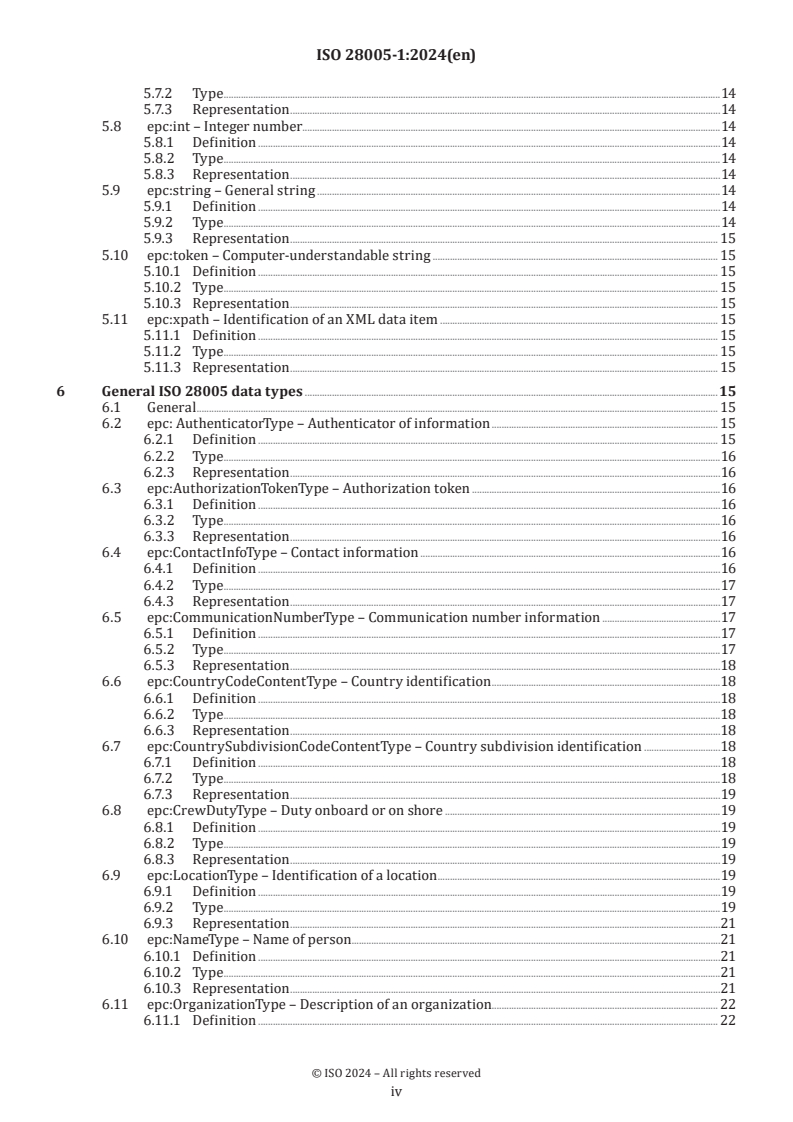
6 General ISO 28005 data types .15
6.1 General . 15
6.2 epc: AuthenticatorType – Authenticator of information . 15
6.2.1 Definition . 15
6.2.2 Type .16
6.2.3 Representation .16
6.3 epc:AuthorizationTokenType – Authorization token .16
6.3.1 Definition .16
6.3.2 Type .16
6.3.3 Representation .16
6.4 epc:ContactInfoType – Contact information .16
6.4.1 Definition .16
6.4.2 Type .17
6.4.3 Representation .17
6.5 epc:CommunicationNumberType – Communication number information .17
6.5.1 Definition .17
6.5.2 Type .17
6.5.3 Representation .18
6.6 epc:CountryCodeContentType – Country identification .18
6.6.1 Definition .18
6.6.2 Type .18
6.6.3 Representation .18
6.7 epc:CountrySubdivisionCodeContentType – Country subdivision identification .18
6.7.1 Definition .18
6.7.2 Type .18
6.7.3 Representation .19
6.8 epc:CrewDutyType – Duty onboard or on shore .19
6.8.1 Definition .19
6.8.2 Type .19
6.8.3 Representation .19
6.9 epc:LocationType – Identification of a location .19
6.9.1 Definition .19
6.9.2 Type .19
6.9.3 Representation .21
6.10 epc:NameType – Name of person.21
6.10.1 Definition .21
6.10.2 Type .21
6.10.3 Representation .21
6.11 epc:OrganizationType – Description of an organization. 22
6.11.1 Definition . 22
iv
6.11.2 Type . 22
6.11.3 Representation . 22
6.12 epc:PostalAddressType – A postal mail address . 22
6.12.1 Definition . 22
6.12.2 Type . 22
6.12.3 Representation . 23
6.13 epc:ShipIDType – Ship identity . 23
6.13.1 Definition . 23
6.13.2 Type . 23
6.13.3 Representation . 23
6.14 epc:ReportingSystemType – Name of a reporting system .24
6.14.1 Definition .24
6.14.2 Type .24
6.14.3 Representation .24
6.15 epc:AttachmentType – Reference to an attached document .24
6.15.1 Definition .24
6.15.2 Type .24
6.15.3 Representation .24
6.16 epc:ReferenceCodeType – General reference code . 25
6.16.1 Definition . 25
6.16.2 Type . 25
6.16.3 Representation . 25
6.17 epc:SystemIdType – Identity code for a software system . 25
6.17.1 Definition . 25
6.17.2 Type . 25
6.17.3 Representation . 25
6.18 epc:SignatureCertificateIdType – Name of digital signature holder . 26
6.18.1 Definition . 26
6.18.2 Type . 26
6.18.3 Representation . 26
6.19 epc:VersionType – Version code . 26
6.19.1 Definition . 26
6.19.2 Type . 26
6.19.3 Representation .27
7 I SO 28005 design principles .27
7.1 Harmonization with the IMO reference data model .27
7.2 Fully automated machine to machine .27
7.3 Using carrier independent and internet-based protocols . 28
7.4 General format of message sequence diagrams . 28
7.5 Sender and receiver versus client and server — asynchronous message transfers . 29
7.6 Generalization of service . 30
7.7 Different levels of sessions . . 30
7.7.1 HTTP session . 30
7.7.2 Session .31
7.7.3 Session context .32
7.8 One service per request and session . 33
7.9 Linking receivers to service providers . 33
7.10 Service request states . 33
7.10.1 Message processing . 33
7.10.2 State diagram for service requests . 34
7.10.3 Message functions . 36
7.10.4 Specification of request timeout . 36
7.10.5 Message and service request return values .37
7.11 Send data once only .37
7.12 Message context .37
7.13 General message structure . . 39
7.14 Digital signatures . 40
7.15 Secure data transfer . 40
v
7.16 Additional authorization for accessing API. 40
7.17 Message implementation guide .41
7.18 Other formats than XML for the message body .41
7.19 No explicit service discovery .41
8 Message exchange patterns . 41
8.1 General rules .41
8.1.1 Application of this specification .41
8.1.2 Use of reference codes .42
8.1.3 Use of final flag in message header .42
8.1.4 Use of service timeout or session context end .43
8.1.5 Status and error codes .43
8.1.6 Multiple senders . . 44
8.1.7 Interleaving update requests with status messages . .45
8.2 Sequence diagrams .45
8.2.1 Pattern 1: Service request and updates .45
8.2.2 Pattern 2: Status poll .47
8.2.3 Pattern 3: Simple report .47
8.2.4 Pattern 4: Request information . 48
8.2.5 Pattern 5: Subscribe to service or information . 48
9 Using HTTP multi-part message .49
9.1 General . 49
9.2 Example of an ISO 28005-1 multi-part message. 50
9.3 Content-Type: multipart/form-data . 50
9.4 Content-Encoding: gzip .51
9.5 Prose text.51
9.6 Content-Type: application, image or other .51
9.7 Content-Disposition: form-data; name = name; filename = file.name; .51
10 Definitions related to the message header part .52
10.1 General .52
10.2 epc:MessageFunctionCodeContentType – Message function code .52
10.2.1 Definition .52
10.2.2 Type .52
10.2.3 Representation .52
10.3 epc:ReplyInformationType – Type of sender response code .52
10.3.1 Definition .52
10.3.2 Type .52
10.3.3 Representation . 53
10.4 epc:MessageBodyFormatContentType – Format of body data . 53
10.4.1 Definition . 53
10.4.2 Type . 53
10.4.3 Representation . 53
10.5 epc:ServiceTypeCodeContentType – Code for identification of service type . 53
10.5.1 Definition . 53
10.5.2 Type . 54
10.5.3 Representation . 54
10.6 epc:ServiceCodeContentType – Code for identification of a service in a group . 54
10.6.1 Definition . 54
10.6.2 Type . 54
10.6.3 Representation . 54
10.7 epc:StatusType – General message and service request status and error codes . 54
10.7.1 Definition . 54
10.7.2 Type . 54
10.7.3 Representation . 55
10.8 epc:SpecialAttachmentType – Description of special attachment . 55
10.8.1 Definition .
...