


ISO 10438-2:2003
(Main)Petroleum, petrochemical and natural gas industries — Lubrication, shaft-sealing and control-oil systems and auxiliaries — Part 2: Special-purpose oil systems
Petroleum, petrochemical and natural gas industries — Lubrication, shaft-sealing and control-oil systems and auxiliaries — Part 2: Special-purpose oil systems
ISO 10438-2:2003 specifies requirements for oil systems supplying oil to compressors requiring seal oil, and to other machines, in special-purpose applications for use in the petroleum, petrochemical and natural gas industries. It is intended to be used in conjunction with ISO 10438-1. ISO 10438 in its entirety specifies requirements for lubrication systems, oil-type shaft-sealing systems, self-acting gas seal systems, control-oil systems and other auxiliaries for general- or special-purpose applications. These systems can serve equipment such as compressors, gears, pumps and drivers. None of the parts of ISO 10438 is applicable to internal combustion engines.
Industries du pétrole, de la pétrochimie et du gaz naturel — Systèmes de lubrification, systèmes d'étanchéité, systèmes d'huile de régulation et leurs auxiliaires — Partie 2: Systèmes d'huile pour applications spéciales
General Information
- Status
- Withdrawn
- Publication Date
- 08-Dec-2003
- Withdrawal Date
- 08-Dec-2003
- Technical Committee
- ISO/TC 67/SC 6 - Processing equipment and systems
- Drafting Committee
- ISO/TC 67/SC 6 - Processing equipment and systems
- Current Stage
- 9599 - Withdrawal of International Standard
- Start Date
- 03-Dec-2007
- Completion Date
- 14-Feb-2026
Relations
- Effective Date
- 12-Feb-2026
- Effective Date
- 28-Feb-2023
- Effective Date
- 15-Apr-2008
Get Certified
Connect with accredited certification bodies for this standard

ABS Quality Evaluations Inc.
American Bureau of Shipping quality certification.

Element Materials Technology
Materials testing and product certification.

ABS Group Brazil
ABS Group certification services in Brazil.
Sponsored listings
Frequently Asked Questions
ISO 10438-2:2003 is a standard published by the International Organization for Standardization (ISO). Its full title is "Petroleum, petrochemical and natural gas industries — Lubrication, shaft-sealing and control-oil systems and auxiliaries — Part 2: Special-purpose oil systems". This standard covers: ISO 10438-2:2003 specifies requirements for oil systems supplying oil to compressors requiring seal oil, and to other machines, in special-purpose applications for use in the petroleum, petrochemical and natural gas industries. It is intended to be used in conjunction with ISO 10438-1. ISO 10438 in its entirety specifies requirements for lubrication systems, oil-type shaft-sealing systems, self-acting gas seal systems, control-oil systems and other auxiliaries for general- or special-purpose applications. These systems can serve equipment such as compressors, gears, pumps and drivers. None of the parts of ISO 10438 is applicable to internal combustion engines.
ISO 10438-2:2003 specifies requirements for oil systems supplying oil to compressors requiring seal oil, and to other machines, in special-purpose applications for use in the petroleum, petrochemical and natural gas industries. It is intended to be used in conjunction with ISO 10438-1. ISO 10438 in its entirety specifies requirements for lubrication systems, oil-type shaft-sealing systems, self-acting gas seal systems, control-oil systems and other auxiliaries for general- or special-purpose applications. These systems can serve equipment such as compressors, gears, pumps and drivers. None of the parts of ISO 10438 is applicable to internal combustion engines.
ISO 10438-2:2003 is classified under the following ICS (International Classification for Standards) categories: 75.180.20 - Processing equipment. The ICS classification helps identify the subject area and facilitates finding related standards.
ISO 10438-2:2003 has the following relationships with other standards: It is inter standard links to EN ISO 10438-2:2003, ISO/R 98:1959, ISO 10438-2:2007. Understanding these relationships helps ensure you are using the most current and applicable version of the standard.
ISO 10438-2:2003 is available in PDF format for immediate download after purchase. The document can be added to your cart and obtained through the secure checkout process. Digital delivery ensures instant access to the complete standard document.
Standards Content (Sample)
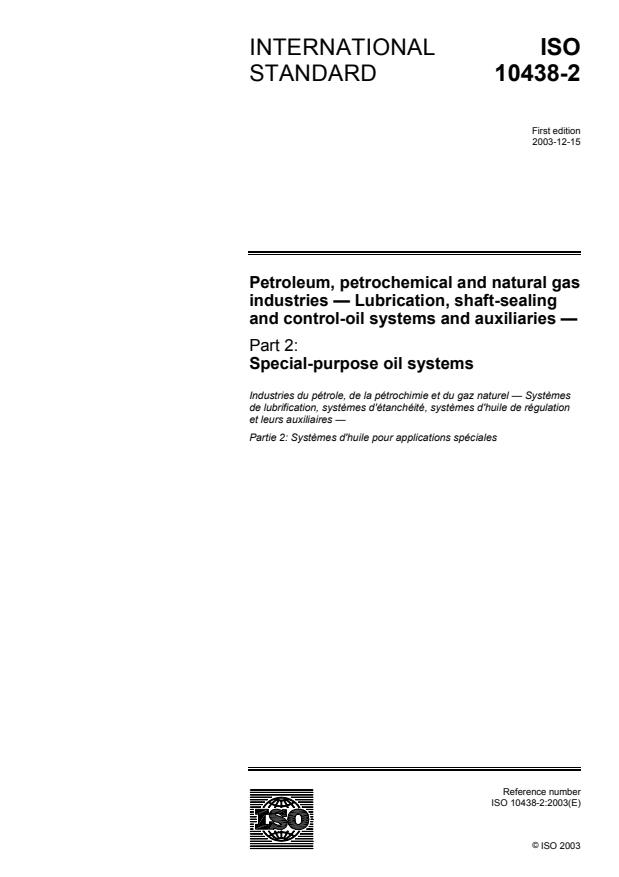
INTERNATIONAL ISO
STANDARD 10438-2
First edition
2003-12-15
Petroleum, petrochemical and natural gas
industries — Lubrication, shaft-sealing
and control-oil systems and auxiliaries —
Part 2:
Special-purpose oil systems
Industries du pétrole, de la pétrochimie et du gaz naturel — Systèmes
de lubrification, systèmes d'étanchéité, systèmes d'huile de régulation
et leurs auxiliaires —
Partie 2: Systèmes d'huile pour applications spéciales
Reference number
©
ISO 2003
PDF disclaimer
This PDF file may contain embedded typefaces. In accordance with Adobe's licensing policy, this file may be printed or viewed but
shall not be edited unless the typefaces which are embedded are licensed to and installed on the computer performing the editing. In
downloading this file, parties accept therein the responsibility of not infringing Adobe's licensing policy. The ISO Central Secretariat
accepts no liability in this area.
Adobe is a trademark of Adobe Systems Incorporated.
Details of the software products used to create this PDF file can be found in the General Info relative to the file; the PDF-creation
parameters were optimized for printing. Every care has been taken to ensure that the file is suitable for use by ISO member bodies. In
the unlikely event that a problem relating to it is found, please inform the Central Secretariat at the address given below.
© ISO 2003
All rights reserved. Unless otherwise specified, no part of this publication may be reproduced or utilized in any form or by any means,
electronic or mechanical, including photocopying and microfilm, without permission in writing from either ISO at the address below or
ISO's member body in the country of the requester.
ISO copyright office
Case postale 56 • CH-1211 Geneva 20
Tel. + 41 22 749 01 11
Fax + 41 22 749 09 47
E-mail copyright@iso.org
Web www.iso.org
Published in Switzerland
ii © ISO 2003 – All rights reserved
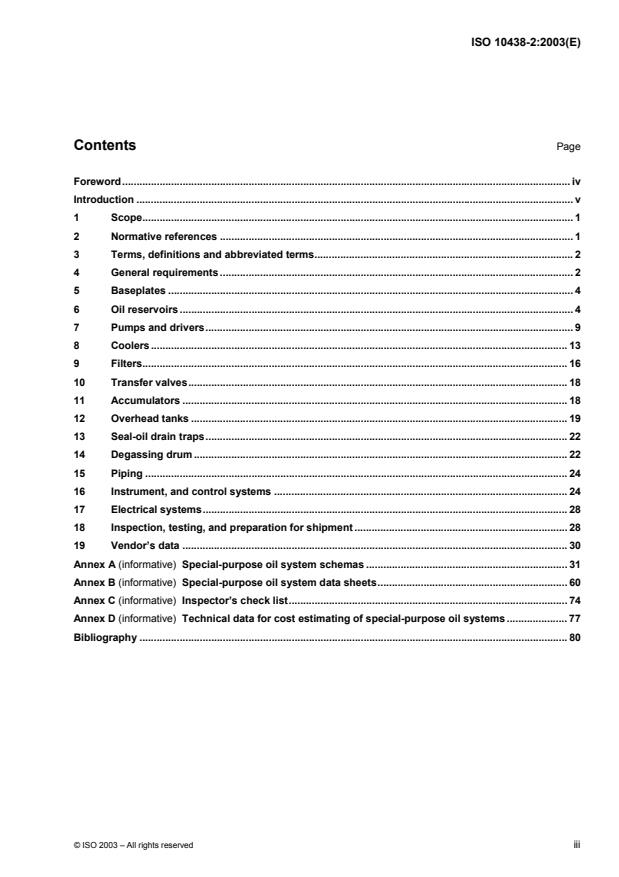
Contents Page
Foreword. iv
Introduction . v
1 Scope. 1
2 Normative references. 1
3 Terms, definitions and abbreviated terms. 2
4 General requirements. 2
5 Baseplates. 4
6 Oil reservoirs. 4
7 Pumps and drivers. 9
8 Coolers. 13
9 Filters. 16
10 Transfer valves. 18
11 Accumulators. 18
12 Overhead tanks. 19
13 Seal-oil drain traps. 22
14 Degassing drum. 22
15 Piping. 24
16 Instrument, and control systems . 24
17 Electrical systems. 28
18 Inspection, testing, and preparation for shipment . 28
19 Vendor’s data. 30
Annex A (informative) Special-purpose oil system schemas . 31
Annex B (informative) Special-purpose oil system data sheets. 60
Annex C (informative) Inspector’s check list. 74
Annex D (informative) Technical data for cost estimating of special-purpose oil systems . 77
Bibliography . 80
Foreword
ISO (the International Organization for Standardization) is a worldwide federation of national standards bodies
(ISO member bodies). The work of preparing International Standards is normally carried out through ISO
technical committees. Each member body interested in a subject for which a technical committee has been
established has the right to be represented on that committee. International organizations, governmental and
non-governmental, in liaison with ISO, also take part in the work. ISO collaborates closely with the
International Electrotechnical Commission (IEC) on all matters of electrotechnical standardization.
International Standards are drafted in accordance with the rules given in the ISO/IEC Directives, Part 2.
The main task of technical committees is to prepare International Standards. Draft International Standards
adopted by the technical committees are circulated to the member bodies for voting. Publication as an
International Standard requires approval by at least 75 % of the member bodies casting a vote.
Attention is drawn to the possibility that some of the elements of this document may be the subject of patent
rights. ISO shall not be held responsible for identifying any or all such patent rights.
ISO 10438-2 was prepared by Technical Committee ISO/TC 67, Materials, equipment and offshore structures
for petroleum, petrochemical and natural gas industries, Subcommittee SC 6, Processing equipment and
systems.
ISO 10438 consists of the following parts, under the general title Petroleum, petrochemical and natural gas
industries — Lubrication, shaft-sealing and control-oil systems and auxiliaries:
Part 1: General requirements
Part 2: Special-purpose oil systems
Part 3: General-purpose oil systems
Part 4: Self-acting gas seal support systems
iv © ISO 2003 – All rights reserved
Introduction
ISO 10438 is based on API Std 614, 4th edn., April 1999, divided into four parts as follows:
Part 1: General requirements is based on Chapter 1 of API Std 614;
Part 2: Special-purpose oil systems (this part) is based on Chapter 2 of API Std 614;
Part 3: General-purpose oil systems is based on Chapter 3 of API Std 614;
Part 4: Self-acting gas seal support systems is based on Chapter 4 of API Std 614.
Users of this part of ISO 10438 should be aware that further or differing requirements might be needed for
individual applications. This part of ISO 10438 is not intended to inhibit a vendor from offering, or the
purchaser from accepting alternative equipment or engineering solutions for the individual application. This
may be particularly appropriate where there is innovative or developing technology. Where an alternative is
offered, the vendor should identify any variations from this part of ISO 10438 and provide details.
This part of ISO 10438 requires the purchaser to specify certain details and features.
A bullet (z) at the beginning of a clause or subclause indicates that either a decision is required or further
information is to be provided by the purchaser. This information or decision should be indicated on suitable
data sheets; otherwise it should be stated in the quotation request (inquiry) or in the order.
INTERNATIONAL STANDARD ISO 10438-2:2003(E)
Petroleum, petrochemical and natural gas industries —
Lubrication, shaft-sealing and control-oil systems and
auxiliaries —
Part 2:
Special-purpose oil systems
1 Scope
This part of ISO 10438 specifies requirements for oil systems supplying oil to compressors requiring seal oil,
and to other machines, in special-purpose applications for use in the petroleum, petrochemical and natural
gas industries as well as in other industries by agreement. It is intended to be used in conjunction with
ISO 10438-1. ISO 10438 in its entirety specifies requirements for lubrication systems, oil-type shaft-sealing
systems, self-acting gas seal systems, control-oil systems and other auxiliaries for general- or special-purpose
applications. These systems can serve equipment such as compressors, gears, pumps and drivers.
None of the parts of ISO 10438 is applicable to internal combustion engines.
2 Normative references
The following referenced documents are indispensable for the application of this document. For dated
references, only the edition cited applies. For undated references, the latest edition of the referenced
document (including any amendments) applies.
ISO 4572, Hydraulic fluid power — Filters — Multi-pass method for evaluating filtration performance
ISO 10438-1:2003, Petroleum, petrochemical and natural gas industries — Lubrication, shaft-sealing and
control-oil systems and auxiliaries — Part 1: General requirements
ISO 13709, Centrifugal pumps for petroleum, petrochemical, and natural gas industries
ISO 14691, Petroleum and natural gas industries — Flexible couplings for mechanical power transmission —
General purpose applications
IEC 60079 (all parts), Electrical apparatus for explosive gas atmospheres
API RP 520, Parts I and II, Sizing, selection and installation of pressure-relieving devices in refineries
API Std 526, Flanged steel safety relief valves
API Std 611, General-purpose steam turbines for petroleum, chemical, and gas industry services
API Std 676, Positive displacement pumps — Rotary
API RP 686, Machinery installation and installation design
3 Terms, definitions and abbreviated terms
For the purposes of this document, the terms, definitions and abbreviated terms given in ISO 10438-1 apply.
4 General requirements
4.1 The equipment (including auxiliaries) covered by this part of ISO 10438 shall be designed and
constructed for a minimum service life of 20 years and at least 3 years of uninterrupted operation. It is
recognized that this is a design criterion.
4.2 The oil system shall be suitable for special-purpose applications as defined in ISO 10438-1. The system
shall be designed as a separate console, or if approved by the purchaser, it may be designed to be integral
with the baseplate of the equipment it serves. The design shall allow for transfer between and shutdown of the
main and spare components of the system for maintenance without interrupting the operation of the system or
the equipment the system serves.
4.3 The vendor shall assume unit responsibility for all equipment and all auxiliary systems included in the
scope of the order.
4.4 The materials of construction of all major components shall be clearly stated in the vendor's proposal.
Materials shall be identified by reference to applicable international or national standards including the
material grade.
z 4.5 The purchaser shall specify the required oil supply conditions and the heat load.
4.6 Control of the sound pressure level (SPL) of all equipment furnished shall be a joint effort of the
purchaser and the vendor. The equipment furnished by the vendor shall conform to the maximum allowable
sound pressure level specified by the purchaser.
z 4.7 The purchaser shall specify whether the seal-oil and lube-oil systems are to be separate or combined. If
separate systems are specified, the means of preventing interchange of oil between the two systems shall be
described in the vendor’s proposal.
z 4.8 Where oil is supplied from a common system to two or more machines (such as a compressor, a gear
and a motor), the oil’s characteristics shall be specified by the purchaser on the basis of mutual agreement
with all vendors supplying equipment served by the common oil system.
NOTE The usual lubricant employed in a common oil system is a hydrocarbon oil that corresponds to ISO Grade 32,
in accordance with ISO 8068.
4.9 The system shall be designed to supply oil to all equipment specified.
4.10 Oil recycled for control purposes shall originate upstream of the filters.
NOTE This minimizes the potential for generation of static electricity (or a static charge) that can result when filtered
oil bypasses the equipment and is recycled directly to the reservoir. This is very important especially if explosive gas might
also be present in the reservoir.
4.11 The seal-oil system shall be designed to serve the full range of equipment operating conditions
specified. These conditions may include but are not limited to the following:
a) settling-out pressures;
b) process relief-valve settings;
c) shop test and field run-ins;
d) startup conditions.
2 © ISO 2003 – All rights reserved
4.12 In addition to the above requirements, seal-oil systems shall be designed to operate safely prior to
process startup or any other idling condition specified, with the system in total automatic control and with the
compressor at atmospheric pressure.
z 4.13 The purchaser shall specify whether the installation is indoors (heated or unheated) or outdoors (with or
without a roof) as well as the weather and environmental conditions in which the equipment will operate
(including maximum and minimum temperatures and unusual humidity, dust, or corrosion conditions).
4.14 The arrangement of the equipment, including piping and auxiliaries, shall be developed jointly by the
purchaser and the vendor. The arrangement shall provide adequate clearance areas and safe access for
operation and maintenance.
z 4.15 If applicable, the purchaser shall specify minimum requirements for clearance around and access to
components (especially clearance around and access to coolers, filters and hand valves).
z 4.16 Motors, electrical components and electrical installations shall be suitable for the area classification
(class, group, and division or zone) specified by the purchaser and shall meet the requirements of the
applicable part(s) of IEC 60079, as well as local codes specified and furnished by the purchaser.
4.17 Pumps, filters, strainers, coolers, traps, valves, and all other components that retain oil under pressure
and are external to the reservoir shall be made of steel.
4.18 Valved vents, drains, and piping shall be furnished to permit draining, cleaning, and refilling of idle
components while the equipment is in operation.
z 4.19 The purchaser shall specify when and where double-block-and-bleed valves are required for isolating a
component and how they are to be arranged (see Figure A.30).
4.20 Coolers, filters, overhead oil tanks, drain traps, accumulators and other pressure vessels within the
scope of the pressure design code shall conform to that code.
4.21 The oil system shall perform on the test stand and on its permanent foundation within the specified
acceptance criteria. After installation, the performance of the oil system shall be the joint responsibility of the
purchaser and the vendor.
4.22 The vendor shall advise the purchaser of, and both parties shall mutually agree upon, any special
provisions that are necessary to ensure that an adequate supply of lube or seal oil or both is maintained in the
event of complete failure of the lube- or seal-oil supply system. These provisions may include emergency
pumps, accumulators, rundown tanks and special arrangements for equipment safety and protection when the
equipment decelerates. Provisions shall be adequate for coast-down time, cool-off time, and block-in time as
applicable; the purchaser shall specify the required block-in time. The purchaser and the vendor shall mutually
agree upon the system and its components.
4.23 Block valves which interrupt the oil flow to the equipment shall not be installed in oil supply lines
downstream of the filters unless the block valves are part of a component block and bypass arrangement.
4.24 Welding of piping and pressure-containing parts, as well as any dissimilar-metal welds and weld repairs,
shall be performed and inspected by operators and procedures qualified in accordance with the pressure
design code.
z 4.25 In addition to the requirements of 4.24, the purchaser may specify that 100 % radiography, magnetic
particle inspection, or liquid penetrant inspection of welds is required (see also ISO 10438-1).
4.26 All welding other than that covered by the pressure design code or the piping systems design code,
such as welding on baseplates, non-pressure ducting, lagging and control panels, shall be in accordance with
a structural welding standard (e.g. AWS D1.1), unless otherwise specified.
5 Baseplates
z 5.1 The system shall be designed as a console, as a single or multiple package, or as another arrangement
as specified by the purchaser. Each package shall have a structural steel baseplate with all system
components and related valves and manifolds mounted on the baseplate. The major components (pumps,
filters, coolers, and reservoir) shall be mounted directly on structural steel.
5.2 Package baseplates shall be the drain-gutter type with one or more drain connections at least DN40
(NPS 1 1/2) in size unless otherwise specified. Baseplates, mounted components, and decking shall be
arranged and installed to ensure drainage and to avoid the retention of liquid.
5.3 The baseplate shall be provided with lifting lugs for at least a four-point lift. The baseplate shall be
designed so that after the components and all piping mounted on it are drained of oil, the package can be
lifted without permanently distorting or otherwise damaging either the baseplate or any component mounted
on it.
5.4 Unless otherwise specified, non-skid metal decking covering all walk and work areas shall be provided
on the top of the baseplate.
5.5 Unless otherwise specified, all baseplates shall be provided with at least one opening or hole in each
bulkhead section through which grout can be poured and vented. Each opening shall have a clear area of no
2 2
less than 125 cm (20 in ) and no dimension less than 100 mm (4 in), and each shall permit filling and venting
of the entire cavity with grout under the baseplate without creating air pockets. Each hole in which the grout is
to be poured shall be accessible, i.e. no component or piping shall be disturbed, and no tripping hazards in
walk and work areas shall be created. Each hole shall also be provided with steel curbing 13 mm (1/2 in) high
to prevent accumulated oil or water from entering the grout. Vent holes at least 13 mm (1/2 in) in diameter
shall be provided for each bulkhead compartment.
z 5.6 If specified, the baseplate shall be suitable for column mounting (that is, of sufficient rigidity to be
supported at specified points) without continuous grouting under structural members. The baseplate design
shall be mutually agreed between the purchaser and the vendor.
5.7 When epoxy grout is specified, the vendor shall precoat all the grouting surfaces of the mounting plates
with a catalysed epoxy primer applied to degreased white metal. The epoxy primer shall be compatible with
epoxy grout. The vendor shall submit instructions for field preparation of the epoxy primer to the purchaser.
5.8 The bottom of the baseplate between structural members shall be open. When the baseplate is
installed on a concrete foundation, accessibility for grouting under all load-carrying structural members shall
be provided.
6 Oil reservoirs
6.1 General
Unless otherwise specified, reservoirs shall be separate from the equipment baseplate and shall be rigid
enough to prevent sagging and vibration. Components bolted to the reservoir shall be mounted on pads; no
bolt holes shall extend into the reservoir. To prevent deposit accumulations, reinforcing ribs on the walls of the
reservoir shall be external.
NOTE For special features see 6.12.
6.2 Protection from dirt and water
6.2.1 Reservoirs shall be sealed to prevent dirt and water from entering. Top-surface openings shall be
raised at least 25 mm (1 in) and shall have a gasket.
4 © ISO 2003 – All rights reserved
6.2.2 Unless otherwise approved, pumps, coolers, or filters shall not be mounted on top of the reservoir. It
is possible that this will be a user consideration for off-shore or other installations where available space is
limited.
6.2.3 The tops of reservoirs shall be sloped at least 1:100 (1/8 in/ft). It may not be possible to implement
this requirement for reservoirs integrated with main equipment baseplate.
6.3 Oil connections and internal piping
6.3.1 All oil return flow streams shall be hydraulically located as far away from the pump suction
connections as possible.
NOTE The use of the term “hydraulically located as far away” is intended to convey the concept that it is possible to
direct return flow streams by internal piping or baffling to avoid disturbing the oil flow at pump inlets. This internal piping or
baffling could be used in lieu of external connections physically located at such a distance from the pump suctions that
they avoid disturbing the oil flow at the pump inlets.
6.3.2 All atmospheric oil return connections (including fill connections) shall be located above the maximum
operating level and shall transport oil (via open-top stilling tubes or degassing trays) as shown in Figure A.24.
Stilling tubes shall have bottom baffles.
6.3.3 Control back-pressure valve and return stream control valve connections shall be separate and shall
discharge oil via internal piping below the pump suction-loss level as shown in Figure A.24. Pressurized oil
shall not be returned to stilling tubes or degassing trays. Internal piping shall have bottom baffles.
6.3.4 Pump suction connections shall be located near the high end of the sloped reservoir bottom and at
least 50 mm (2 in) above it.
6.3.5 Except as specified in 6.9, reservoir pipe connections shall be flanged.
6.4 Manways and drains
To ensure complete drainage, the bottom of each reservoir shall slope continuously, at least 1:50 (1/4 in/ft), to
a low point. A flanged drain connection (with a valve and a blind flange) at least DN50 (NPS 2) in size shall be
provided. Manway openings shall be provided which will permit unobstructed entry for inspection and cleaning
of all interior compartments. If entry is required for cleaning and unless otherwise specified, manways shall be
located on top of the reservoir and each manway shall be at least 600 mm × 600 mm or 450 mm in diameter
(24 in × 24 in or 18 in in diameter). Internal manways are not acceptable.
6.5 Features and appendages
6.5.1 The oil reservoir shall have the following features and appendages:
a) the capacity to settle moisture and foreign matter adequately and to provide allowance for rundown from
the entire system;
b) provisions to eliminate air and minimize migration of foreign matter to each pump suction;
c) a reflex-type, welding-pad oil level glass (with stainless steel weld pad and carbon steel cover) arranged
to cover the span from at least 25 mm (1 in) above the rundown level to 50 mm (2 in) below the pump
suction-loss level. The oil level glass shall be located as far away as possible from the oil return lines and
be visible from the perimeter of the unit. The maximum and minimum operating levels, rundown level and
suction-loss level shall be indicated on the level glass. If more than one level glass is provided, they shall
be offset;
d) a fill opening at least 50 mm (2 in) in size which automatically closes (normally held shut by a spring) and
is equipped with a stainless steel, fine-mesh strainer basket that has an open area equal to 200 % of the
internal pipe area;
e) a blind-flanged vent connection at least 50 mm (2 in) in size;
f) a weatherproof, corrosion-resistant filter-breather cap at least 50 mm (2 in) in size (for reservoirs
containing seal oil, see 6.5.2);
g) internal baffles that are not gas tight;
h) if the train is driven by a gas or steam turbine and the oil reservoir contains the seal oil, a separate
connection shall be provided on the reservoir for the compressor seal-oil return line;
NOTE This line prevents pressurization of the turbine lube oil drain header if the compressor seals fail.
i) individual non-pressurized reservoir return lines shall enter the reservoir above the rundown level (see
6.6.1.1).
6.5.2 On reservoirs containing seal oil, a specially sized vent is required to handle the total flow of gas
coming from the failed seal(s) through the oil drain lines. The vendor shall provide the purchaser with the vent
size and the sizing criteria.
Vents routed to flare systems or vapour recovery systems shall be provided with an overpressure protection
device. The sizing of this device shall be jointly developed by the purchaser and the vendor.
6.6 Capacity and configurations
NOTE Sizing criteria is covered in 6.6.3.
6.6.1 Definitions of levels
6.6.1.1 The rundown level (1 in Figure 1) is the highest level that oil in the reservoir can reach when the
entire system is shut down.
6.6.1.2 The maximum operating level (2 in Figure 1) is the highest level that oil can reach during normal
operation of the equipment.
6.6.1.3 The minimum operating level (3 in Figure 1) is the lowest level that oil can reach during normal
operation of the equipment.
6.6.1.4 The suction-loss level (4 in Figure 1) is the level above the pump suction level (5 in Figure 1), at
which the pump begins to lose prime. The pump suction level is defined by the pump suction vortex and net
positive suction head requirements.
6.6.1.5 The charge capacity is the total volume below the rundown level.
6.6.1.6 The normal operating range is any level between the maximum and minimum operating levels.
6.6.1.7 The retention capacity is the total volume below the minimum operating level.
6.6.1.8 Retention time is the time allowed for disengagement of entrained air or gas.
6.6.1.9 The rundown capacity is the volume between the rundown level and the maximum operating level.
6.6.1.10 The working capacity is the volume between the minimum operating level and the suction-loss
level.
6 © ISO 2003 – All rights reserved
Dimensions in millimetres (inches)
Key
1 rundown level 5 pump suction level
2 maximum operating level 6 alternative pump suction arrangements
3 minimum operating level 7 manufacturer's standard glass length
4 suction-loss level
A manufacturer's standard gauge glass may be used in this arrangement with the bottom of the gauge no less
than 50 mm below the minimum operating level and with any excess length being above maximum operating
level.
Figure 1 — Reservoir levels and oil level glass details
6.6.2 Low level alarm
A low-level alarm shall actuate at the minimum operating level.
6.6.3 Criteria for sizing a reservoir
6.6.3.1 The working capacity between the minimum operating level (3 in Figure 1) and the suction-loss
level (4 in Figure 1) shall be sufficient for at least 5 min of normal flow.
6.6.3.2 The minimum retention capacity shall be calculated based on 8 min of normal oil flow.
6.6.3.3 The rundown capacity shall allow for all of the oil contained in all of the components, such as
bearings and seal housings, overhead seal tanks, rundown tanks, accumulators, control elements, and
vendor-furnished piping that drain back to the reservoir. The rundown capacity shall also allow for at least an
additional 10 % of these volumes for the purchaser’s interconnecting piping.
NOTE Rundown can cause some backup in the drain lines entering the reservoir.
6.6.3.4 Where sour oil is present in a seal-oil system, the capacity between the minimum and maximum
operating levels shall be at least 50 mm (2 in) of reservoir height, and, based on the manufacturer’s estimated
seal-oil usage rate when the seals have worn to two times their maximum design clearance, the capacity shall
be sufficient to permit at least 3 days of operation without requiring that oil be added to the reservoir.
The usage rate shall be provided by the seal manufacturer. This is of special concern when the sour oil is not
returned to the reservoir.
6.6.3.5 In a lube-oil system, the capacity between the minimum and maximum operating levels shall be at
least 50 mm (2 in) of reservoir height.
6.6.3.6 The free surface of the oil in the reservoir shall be a minimum of 60 cm for each litre per minute
(0,25 ft for each gallon per minute) of normal flow.
6.7 Heating
6.7.1 Heaters shall be provided if the minimum site temperature on the data sheet is less than the minimum
oil startup temperature.
Users may specify special provision for lube oil coolers to allow steam to be introduced to the water side and
act as a heater prior to startup. Details of alternate arrangements such as this shall be mutually discussed.
z 6.7.2 The purchaser shall specify if heaters are to be steam or electric.
6.7.2.1 When a steam heater is specified, a removable element external to the oil reservoir shall be
provided for heating the charge capacity of oil before startup in cold weather. The device shall have the
capacity to heat the oil in the reservoir from the specified minimum site ambient temperature to the
manufacturer’s required minimum oil startup temperature within 12 h. Unless otherwise specified, the reservoir
heat loss during heating shall be determined based on an uninsulated reservoir, the minimum site ambient
temperature, and a 16 km/h (10 mile/h) wind. The vendor shall provide data to support this.
6.7.2.2 When an electric heater is specified, a thermostatically controlled removable electric immersion
heating element shall be provided for heating the charge capacity of oil before startup in cold weather. The
device shall have the capacity to heat the oil in the reservoir from the specified minimum site ambient
temperature to the manufacturer’s required startup temperature within 12 h. It shall have a maximum surface
2 2
heat flow density of 2 W/cm (15 W/in ). Heater elements in contact with the oil shall be sheathed in austenitic
stainless steel; copper or copper-bearing materials shall not contact the oil. Unless otherwise specified, the
reservoir heat loss during heating shall be determined based on an uninsulated reservoir, the minimum site
ambient temperature and a 16 km/h (10 mile/h) wind. The vendor shall provide data to support this.
Electric immersion heaters should be interlocked by the purchaser to be de-energized when the oil level drops
below the minimum operating level.
6.7.2.3 Electric immersion heaters shall be installed in a manner that allows the heaters to be removed
during operation. They shall be top-, or side-mounted and installed vertically, on an angle, or horizontally. If
oil-filled tubes with vented expansion chambers are used, the oil inside the tubes shall be the same as in the
reservoir and its temperature maintained at a minimum of 10 °C (18 °F) below its flash point.
6.7.2.4 In all installations, but especially if top-mounted vertical or angle heaters are used, the heater
element shall be located below the pump suction loss level.
6.8 Provision for insulation
z If specified by the purchaser, reservoirs shall be fitted with insulation clips. The purchaser shall furnish and
install the insulation.
6.9 Auxiliary connections
Above the rundown oil level, each reservoir shall be provided with connections that are at least DN25 (NPS 1)
in size. These connections may be threaded and plugged or flanged and blanked. These two connections may
8 © ISO 2003 – All rights reserved
be used for such services as purge gas, makeup oil supply, and oil conditioner return. One connection shall
be located to ensure an effective sweep of purge gas toward the vents.
6.10 Provision for oil conditioner
6.10.1 Unless otherwise specified, the vendor shall provide below the minimum operating level a DN25
(NPS 1) flanged, valved, and blinded connection (see Figure A.24) that will be used to connect an oil
conditioner.
6.10.2 The vendor shall also provide inside the reservoir a pipe loop with a siphon breaker hole at the top
which has a maximum diameter of 6 mm (1/4 in). This pipe loop shall prevent the oil level from falling more
than 50 mm (NPS 2) below the minimum operating level due to the action of the conditioner.
6.11 Welds
Joints, pads, and connections shall be both internally and externally welded to eliminate cavities, potential
sources of corrosion, and contamination. The reservoir’s wall-to-top junctions may be welded from the outside
if a full-penetration weld is used. All welds shall be continuous. Internal joints shall be made smooth by
grinding or other suitable means as necessary to eliminate pockets and provide an unbroken finish.
6.12 Special features
z 6.12.1 If specified, reservoir tops shall be provided with the following:
a) an accessible ladder with extended handrails;
b) handrails around the perimeter of the reservoir top;
c) non-skid-surface decking (checker or diamond plate or hot-dipped galvanized steel grating).
6.12.2 For equipment mounted on the reservoir, the reservoir shall provide sufficient structural stiffness to
properly support the equipment.
6.13 Materials
Unless otherwise specified, reservoirs and all appendages welded to reservoirs shall be fabricated from a
readily weldable grade of austenitic stainless steel. Pipe connections shall be as specified in ISO 10438-1.
Carbon steel appendages such as ladders and handrails may be bolted to clips welded to the reservoir.
6.14 Grounding
Two grounding clips or pads diagonally opposed to each other (see Figure A.24) shall be welded to the
reservoir. The pads shall accommodate a 13 mm (1/2 in UNC) bolt.
7 Pumps and drivers
7.1 The oil system shall include a main oil pump and a standby oil pump. The main and standby pumps
shall be identical and suitable for continuous operation. The purchaser shall specify whether horizontal
centrifugal or rotary pumps shall be used. Except as modified in this part of ISO 10438, pumps shall conform
to ISO 13709 or API Std 676, respectively.
NOTE For the purpose of this provision, API 610 is equivalent to ISO 13709.
7.2 Unless otherwise specified, pumps shall be external to the reservoir.
NOTE In cases where the purchaser allows the use of submerged pumps, ISO 10438-3 gives guidance on material
and structural requirements.
z 7.3 If specified, an emergency oil pump shall be furnished to allow safe shutdown without damage to the
equipment in the event that both the main and standby pumps fail. The purchaser shall define the
requirements for safe shutdown.
7.4 Unless otherwise specified, oil pumps not submerged inside the reservoir shall be equipped with
mechanical seals that have carbon rings with mating tungsten or silicon carbide rings; elastomer gaskets and
O-rings; and end plates with throttle bushings as outlined in ISO 13709.
NOTE For the purpose of this provision, API 610 is equivalent to ISO 13709.
z 7.5 The purchaser shall specify if the main oil pump will be turbine or motor driven.
It is recommended that the purchaser supply electric feeds from independent sources when two motor-driven
pumps are used.
NOTE Standby pumps are always motor driven due to relatively long startup times for turbine-driven pumps.
7.6 Each pump shall have its own driver.
7.7 Shaft-driven pumps may be provided only if approved by the purchaser.
7.8 Motors shall comply with the standards specified by the purchaser.
7.9 Steam turbines shall conform to API Std 611.
7.10 The minimum criteria listed below shall be used when sizing pumps.
a) In all cases, pumps shall be sized to deliver the required capacity when pumping lube oil at the highest
temperature and the corresponding minimum viscosity.
b) Each pump shall be capable of the following plus an allowance for normal wear:
1) supplying the normal oil flow required by the equipment plus the greater of 20 % of the normal oil
flow or 40 l/min (10 gal/min);
2) transient oil requirements.
c) Accumulators may be provided to meet transient control oil requirements, if approved by the purchaser.
Accumulators shall be sized according to 11.1. Equipment supplier shall define all transient conditions.
d) In booster systems, the capacity of the main pump, as established in 7.10 a) and 7.10 b) shall be increased
by the amount required to supply both the main and the standby booster oil pumps simultaneously.
e) Rotary pumps shall be capable of passing the total flow, as established in 7.10 a) and 7.10 b), at the
relief-valve set pressure while not exceeding 90 % of the pump manufacturer’s maximum differential
pressure rating at the minimum operating viscosity. The pump shall also be capable of operating
continuously at the normal flow, relief valve set pressure, and minimum operating viscosity.
NOTE This selection criterion avoids pump rotor contact during operation under extreme conditions.
7.11 The normal operating capacity of the centrifugal pumps shall be between 50 % and 110 % of their best
efficiency point. From their normal operating point to shutoff, centrifugal pumps shall have a continuous rise in
head of at least 5 % and, with the installation of a new impeller, shall be capable of a future increase in head
of at least 10 %.
10 © ISO 2003 – All rights reserved
7.12 Pump drivers shall be sized according to whichever of the following requires the larger driver:
a) the applicable pump standard; or
b) the conditions given in 7.13 and 7.14.
Motor drivers for centrifugal pumps shall have a power rating which covers the “end-of-curve” requirements of
the supplied impeller with a minimum nameplate rating of 1,0 kW (1,0 hp).
7.13 Centrifugal pumps shall deliver the specified system pressure over the pump’s stable flow range when
the temperature of the pumped oil is 10 °C (50 °F).
7.14 Rotary pumps shall be capable of operating at the specified pump relief valve setting (including
accumulation) when the temperature of the pumped oil is 10 °C (50 °F).
z 7.15 Purchaser shall specify the minimum inlet steam temperature and pressure and the highest exhaust
pressure under which the turbine is expected to operate.
7.16 Check valves shall be provided on each pump discharge to prevent the flow of oil backwards through a
standby or idling pump.
7.17 For rotary pump systems, the vendor shall furnish external oil-pressure-limiting valves that shall be
installed on the components or in the piping supplied by the vendor. Oil-pressure-limiting valve settings,
including an allowance for no more than 10 % accumulation, shall be determined after all of the possible
equipment and component failures are considered. The settings shall protect the oil system components and
piping. Fully accumulated pressure shall not exceed 110 % of the design pressure.
7.18 Oil-pressure-limiting valves shall be pressure-modulating devices (as opposed to snap-acting or pop-
type safety relief valves) with a pressure increase proportional to flow above the valve cracking pressure (that
is, the pressure at which the valve begins to open). These devices shall be mounted externally to the reservoir
and shall operate smoothly, without chattering and without causing a drop in supply pressure to the equipment.
Pressure-limiting-valve piping shall be sized for the full flow of each pump; the valves shall not chatter, and the
piping shall not vibrate. The minimum pressure-limiting-valve cracking pressure shall be 10 % or 170 kPa
(1,7 bar, 25 psi) higher than the highest required operating pressure, whichever is greater. To avoid
unnecessary delay in opening, pressure-limiting valves shall be located as close to the oil pump discharge as
possible at an elevation as near to or below the minimum operating level as possible. Pressure-limiting valves
shall not be used for continuous pressure regulation.
For high-pressure applications (typically above 5 500 kPa (55 bar or 800 psi gauge), where pressure-modulating
valves cannot be provided, provisions for venting or otherwise relieving pumps may be required.
7.19 The oil system shall be provided with pressure-regulating devices that prevent fluctuation of the oil
pressure to the equipment when both the main and the standby pump are in operation or when either the main
or the standby pump is in operation and the other pump is started, brought up to operating speed, or stopped.
Each device shall have an adequate response time and shall operate smoothly in a stable manner without
chattering, or producing pressure or flow transients that can cause the equipment to shut down [see
18.3.3.9 d)]. These pressure-regulating devices shall be located so that an excessive rise in oil temperature
resulting from a recirculation of uncooled oil is avoided [see, for example, Figure A.12, Footnote g)].
Bypass pressure-regulating valves shall be sized to cover a range from the maximum usage of one pump to
the minimum usage of two pumps.
System back-pressure regulating valves shall be sized to pass the excess flow when one and/or both pumps
are in operation.
7.20 All pumps (except booster pumps) shall be installed with flooded suctions to ensure self-priming and
shall be installed with suction block valves and with discharge block and check valves. Vertically mounted
pumps shall be continuously vented to assure the entire pump remains flooded. Suction piping shall be
continuously vented or arranged to avoid pockets in which air can accumulate or become trapped. Each pump
shall have a separate suction line from the reservoir. The pump suction lines shall be designed to avoid
excessive piping loads on the pump casing flanges in accordance with API RP 686. Designs for suction piping,
suction b
...
Questions, Comments and Discussion
Ask us and Technical Secretary will try to provide an answer. You can facilitate discussion about the standard in here.
Loading comments...