

ISO 13705:2012
(Main)Petroleum, petrochemical and natural gas industries — Fired heaters for general refinery service
General Information
- Abstract
ISO 13705:2012 specifies requirements and gives recommendations for the design, materials, fabrication, inspection, testing, preparation for shipment, and erection of fired heaters, air heaters, fans and burners for general refinery service. ISO 13705:2012 is not intended to apply to the design of steam reformers or pyrolysis furnaces.
- Status
- Published
- Publication Date
- 05-Dec-2012
- Technical Committee
- ISO/TC 67/SC 6 - Processing equipment and systems
- Drafting Committee
- ISO/TC 67/SC 6/WG 8 - Process heat transfer equipment
- Current Stage
- 9060 - Close of review
- Completion Date
- 04-Mar-2029
Buy Documents


ISO 13705:2012 - Petroleum, petrochemical and natural gas industries — Fired heaters for general refinery service Released:12/6/2012


ISO 13705:2012 - Industries du pétrole, de la pétrochimie et du gaz naturel — Réchauffeurs a bruleurs pour usage général dans les raffineries Released:8/9/2013
Overview
ISO 13705:2012 - "Petroleum, petrochemical and natural gas industries - Fired heaters for general refinery service" - is an international standard that specifies requirements and recommendations for the design, materials, fabrication, inspection, testing, preparation for shipment, and erection of fired heaters, air preheaters (APHs), fans and burners used in general refinery service. Published as the third edition in 2012 by ISO/TC 67 SC 6, this standard is focused on fired-process heater systems used across petroleum, petrochemical and natural gas facilities. Note: it does not apply to steam reformers or pyrolysis furnaces.
Key Topics and Requirements
ISO 13705:2012 covers comprehensive technical topics relevant to fired heaters and associated equipment, including:
- Design considerations for combustion, process integration, mechanical structure and pressure-related design codes
- Tubes, headers, piping and manifolds - selection, materials, fabrication and allowable movements/loads
- Tube supports, structures and appurtenances - stress curves, loads and materials for long-term reliability
- Refractories and insulation - brick, castable, ceramic-fibre and multi-component linings
- Stacks, ducts and breeching - static and dynamic design, wind-induced vibration and materials
- Burners, fans and auxiliary equipment - burner systems, sootblowers, fans, dampers and controls
- Instrumentation and connections for flue gas, air and tube-skin monitoring
- Shop fabrication, field erection, testing and inspection - welding examination, castings, testing protocols and preparation for shipment
- Informative and normative annexes - equipment data sheets, purchaser’s checklist, fan and air-preheat system guidance, heater efficiency measurement, stack design and noise measurement
The standard provides both prescriptive requirements and recommendations, and includes buyer/vendor responsibilities and documentation guidance.
Applications and Who Uses It
ISO 13705 is intended for organizations involved in the lifecycle of refinery fired heaters:
- Design and process engineers (refinery, petrochemical, gas processing)
- Mechanical, piping and structural engineers specifying heaters, tubes, headers and supports
- Equipment vendors and fabricators delivering fired heaters, burners, fans and APHs
- EPC contractors, inspection bodies and QA/QC teams overseeing fabrication and erection
- Plant operators and maintenance teams implementing testing, performance measurement and safety practices
Use cases include new heater design, retrofit and upgrading of fired heaters, supplier selection and inspection, and performance/efficiency evaluation.
Related Standards
ISO 13705 references and aligns with several standards, for example:
- ISO 13704 (heater-tube thickness calculation)
- ISO 15649 (piping)
- IEC 60079 (electrical apparatus for explosive atmospheres)
- ISO 1461, ISO 1940-1, ISO 8501-1, ISO 10684 (coatings, balancing, surface prep, fasteners)
Keywords: ISO 13705:2012, fired heaters, refinery heaters, petroleum industry standards, heater design, burner systems, air preheater, heater inspection, heater fabrication.
Relations
- Effective Date
- 12-Feb-2026
- Effective Date
- 28-Feb-2009
Buy Documents
ISO 13705:2012 - Petroleum, petrochemical and natural gas industries — Fired heaters for general refinery service Released:12/6/2012
ISO 13705:2012 - Industries du pétrole, de la pétrochimie et du gaz naturel — Réchauffeurs a bruleurs pour usage général dans les raffineries Released:8/9/2013
Get Certified
Connect with accredited certification bodies for this standard

Element Materials Technology
Materials testing and product certification.

ABS Group Brazil
ABS Group certification services in Brazil.

ABS Quality Evaluations Inc.
American Bureau of Shipping quality certification.
Sponsored listings
Frequently Asked Questions
ISO 13705:2012 is a standard published by the International Organization for Standardization (ISO). Its full title is "Petroleum, petrochemical and natural gas industries — Fired heaters for general refinery service". This standard covers: ISO 13705:2012 specifies requirements and gives recommendations for the design, materials, fabrication, inspection, testing, preparation for shipment, and erection of fired heaters, air heaters, fans and burners for general refinery service. ISO 13705:2012 is not intended to apply to the design of steam reformers or pyrolysis furnaces.
ISO 13705:2012 specifies requirements and gives recommendations for the design, materials, fabrication, inspection, testing, preparation for shipment, and erection of fired heaters, air heaters, fans and burners for general refinery service. ISO 13705:2012 is not intended to apply to the design of steam reformers or pyrolysis furnaces.
ISO 13705:2012 is classified under the following ICS (International Classification for Standards) categories: 75.180.20 - Processing equipment. The ICS classification helps identify the subject area and facilitates finding related standards.
ISO 13705:2012 has the following relationships with other standards: It is inter standard links to EN ISO 13705:2012, ISO 13705:2006. Understanding these relationships helps ensure you are using the most current and applicable version of the standard.
ISO 13705:2012 is available in PDF format for immediate download after purchase. The document can be added to your cart and obtained through the secure checkout process. Digital delivery ensures instant access to the complete standard document.
Standards Content (Sample)
INTERNATIONAL ISO
STANDARD 13705
Third edition
2012-12-15
Petroleum, petrochemical and natural gas
industries — Fired heaters for general
refinery service
Industries du pétrole, de la pétrochimie et du gaz naturel —
Réchauffeurs à brûleurs pour usage général dans les raffineries
Reference number
©
ISO 2012
© ISO 2012
All rights reserved. Unless otherwise specified, no part of this publication may be reproduced or utilized in any form or by any means,
electronic or mechanical, including photocopying and microfilm, without permission in writing from either ISO at the address below or
ISO's member body in the country of the requester.
ISO copyright office
Case postale 56 • CH-1211 Geneva 20
Tel. + 41 22 749 01 11
Fax + 41 22 749 09 47
E-mail copyright@iso.org
Web www.iso.org
Published in Switzerland
ii © ISO 2012 – All rights reserved
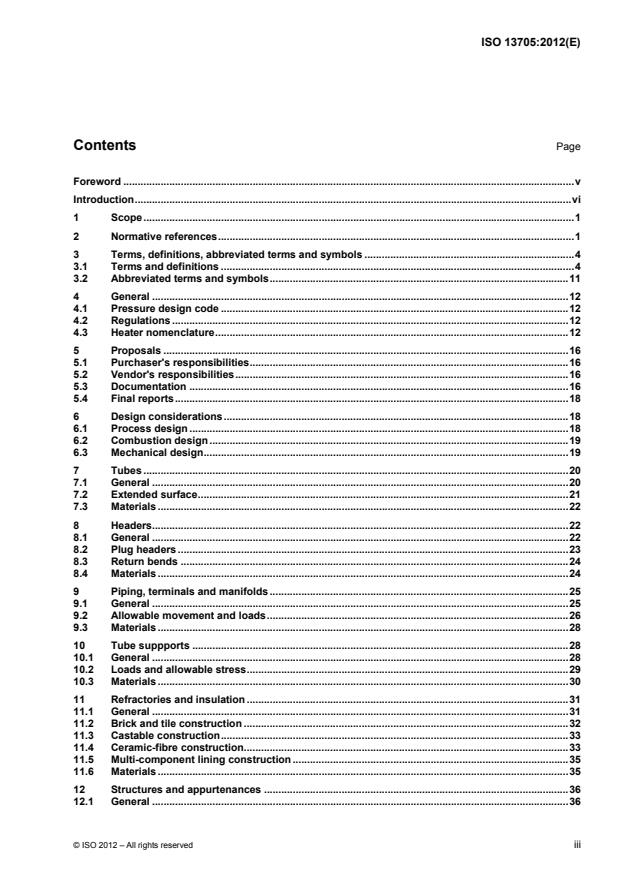
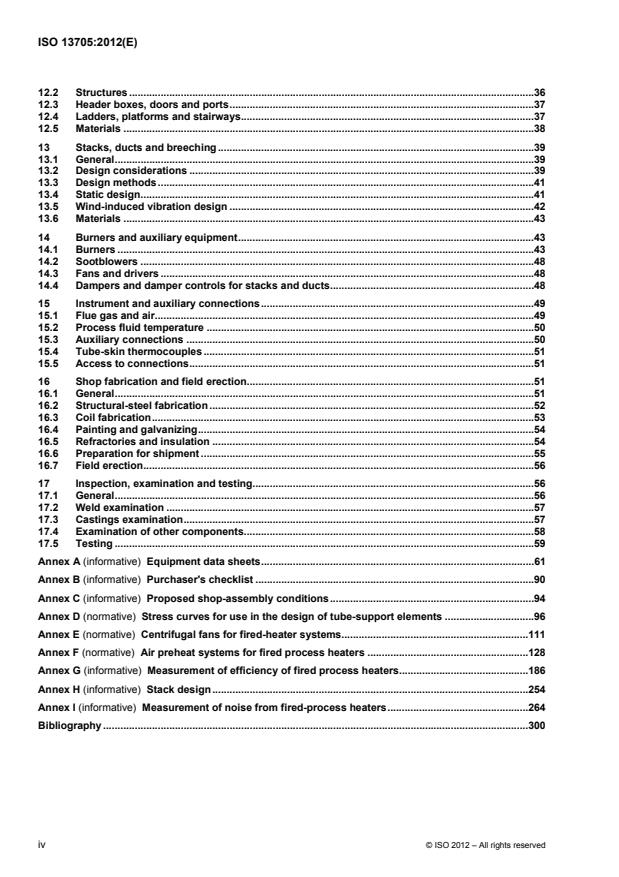
Contents Page
Foreword .v
Introduction.vi
1 Scope.1
2 Normative references.1
3 Terms, definitions, abbreviated terms and symbols .4
3.1 Terms and definitions .4
3.2 Abbreviated terms and symbols.11
4 General .12
4.1 Pressure design code .12
4.2 Regulations .12
4.3 Heater nomenclature.12
5 Proposals .16
5.1 Purchaser's responsibilities.16
5.2 Vendor's responsibilities.16
5.3 Documentation .16
5.4 Final reports.18
6 Design considerations.18
6.1 Process design .18
6.2 Combustion design .19
6.3 Mechanical design.19
7 Tubes .20
7.1 General .20
7.2 Extended surface.21
7.3 Materials .22
8 Headers.22
8.1 General .22
8.2 Plug headers .23
8.3 Return bends .24
8.4 Materials .24
9 Piping, terminals and manifolds .25
9.1 General .25
9.2 Allowable movement and loads.26
9.3 Materials .28
10 Tube suppports .28
10.1 General .28
10.2 Loads and allowable stress.29
10.3 Materials .30
11 Refractories and insulation .31
11.1 General .31
11.2 Brick and tile construction .32
11.3 Castable construction.33
11.4 Ceramic-fibre construction.33
11.5 Multi-component lining construction .35
11.6 Materials .35
12 Structures and appurtenances .36
12.1 General .36
12.2 Structures .36
12.3 Header boxes, doors and ports.37
12.4 Ladders, platforms and stairways.37
12.5 Materials .38
13 Stacks, ducts and breeching.39
13.1 General.39
13.2 Design considerations .39
13.3 Design methods.41
13.4 Static design.41
13.5 Wind-induced vibration design .42
13.6 Materials .43
14 Burners and auxiliary equipment.43
14.1 Burners .43
14.2 Sootblowers .48
14.3 Fans and drivers .48
14.4 Dampers and damper controls for stacks and ducts.48
15 Instrument and auxiliary connections.49
15.1 Flue gas and air.49
15.2 Process fluid temperature .50
15.3 Auxiliary connections .50
15.4 Tube-skin thermocouples .51
15.5 Access to connections.51
16 Shop fabrication and field erection.51
16.1 General.51
16.2 Structural-steel fabrication.52
16.3 Coil fabrication.53
16.4 Painting and galvanizing.54
16.5 Refractories and insulation .54
16.6 Preparation for shipment .55
16.7 Field erection.56
17 Inspection, examination and testing.56
17.1 General.56
17.2 Weld examination .57
17.3 Castings examination.57
17.4 Examination of other components.58
17.5 Testing .59
Annex A (informative) Equipment data sheets.61
Annex B (informative) Purchaser's checklist .90
Annex C (informative) Proposed shop-assembly conditions.94
Annex D (normative) Stress curves for use in the design of tube-support elements .96
Annex E (normative) Centrifugal fans for fired-heater systems.111
Annex F (normative) Air preheat systems for fired process heaters .128
Annex G (informative) Measurement of efficiency of fired process heaters.186
Annex H (informative) Stack design.254
Annex I (informative) Measurement of noise from fired-process heaters.264
Bibliography .300
iv © ISO 2012 – All rights reserved
Foreword
ISO (the International Organization for Standardization) is a worldwide federation of national standards bodies
(ISO member bodies). The work of preparing International Standards is normally carried out through ISO
technical committees. Each member body interested in a subject for which a technical committee has been
established has the right to be represented on that committee. International organizations, governmental and
non-governmental, in liaison with ISO, also take part in the work. ISO collaborates closely with the
International Electrotechnical Commission (IEC) on all matters of electrotechnical standardization.
International Standards are drafted in accordance with the rules given in the ISO/IEC Directives, Part 2.
The main task of technical committees is to prepare International Standards. Draft International Standards
adopted by the technical committees are circulated to the member bodies for voting. Publication as an
International Standard requires approval by at least 75 % of the member bodies casting a vote.
Attention is drawn to the possibility that some of the elements of this document may be the subject of patent
rights. ISO shall not be held responsible for identifying any or all such patent rights.
ISO 13705 was prepared by Technical Committee ISO/TC 67, Materials, equipment and offshore structures
for petroleum, petrochemical and natural gas industries, Subcommittee SC 6, Processing equipment and
systems.
This third edition cancels and replaces the second edition (ISO 13705:2006), which has been technically
revised.
Introduction
Users of this International Standard should be aware that further or differing requirements may be needed for
individual applications. This International Standard is not intended to inhibit a vendor from offering, or the
purchaser from accepting, alternative equipment or engineering solutions for the individual application. This
may be particularly applicable where there is innovative or developing technology. Where an alternative is
offered, the vendor should identify any variations from this International Standard and provide details.
In International Standards, the SI system of units is used. Where practical in this International Standard, US
Customary (USC) units are included in brackets for information.
A bullet (●) at the beginning of a clause or subclause indicates that either a decision is required or further
information is to be provided by the purchaser. This information should be indicated on data sheets (see
examples in Annex A) or stated in the enquiry or purchase order. Decisions should be indicated on a checklist
(see example in Annex B).
vi © ISO 2012 – All rights reserved
INTERNATIONAL STANDARD ISO 13705:2012(E)
Petroleum, petrochemical and natural gas industries — Fired
heaters for general refinery service
1 Scope
This International Standard specifies requirements and gives recommendations for the design, materials,
fabrication, inspection, testing, preparation for shipment, and erection of fired heaters, air heaters (APHs),
fans and burners for general refinery service.
This International Standard is not intended to apply to the design of steam reformers or pyrolysis furnaces.
2 Normative references
The following referenced documents are indispensable for the application of this document. For dated
references, only the edition cited applies. For undated references, the latest edition of the referenced
document (including any amendments) applies.
ISO 1461, Hot dip galvanized coatings on fabricated iron and steel articles — Specifications and test methods
ISO 1940-1:2003, Mechanical vibration — Balance quality requirements for rotors in a constant (rigid) state —
Part 1: Specification and verification of balance tolerances
ISO 8501-1, Preparation of steel substrates before application of paints and related products — Visual
assessment of surface cleanliness — Part 1: Rust grades and preparation grades of uncoated steel
substrates and of steel substrates after overall removal of previous coatings
ISO 10684, Fasteners — Hot dip galvanized coatings
ISO 13704, Petroleum, petrochemical and natural gas industries — Calculation of heater-tube thickness in
petroleum refineries
ISO 15649, Petroleum and natural gas industries — Piping
IEC 60079 (all parts), Electrical apparatus for explosive gas atmospheres
EN 10025-2:2004 , Hot rolled products of structural steels — Part 2: Technical delivery conditions for non-
alloy structural steels
ABMA Standard 9 , Load Ratings and Fatigue Life for Ball Bearings
AMCA 210 , Laboratory Methods of Testing Fans for Aerodynamic Performance Rating
AMCA 801:2001, Industrial Process/Power Generation Fans — Specifications and Guidelines
1 European Committee for Standardization (CEN), Rue de Stassart 36, B-1050 Brussels, Belgium.
2 American Bearing Manufacturers Association, 2025 M. Street, NW, Suite 800, Washington, DC 20036, USA.
3 Air Movement and Control Association, 30 West University Drive, Arlington Heights, IL 60004, USA.
ASME B 17.1 , Keys and Keyseats
ASME Boiler and Pressure Vessel Code, Section VIII, Pressure Vessels
ASTM A 36 , Standard Specification for Carbon Structural Steel
ASTM A 53, Standard Specification for Pipe, Steel, Black and Hot-Dipped, Zinc-Coated, Welded and Seamless
ASTM A 105, Standard Specification for Carbon Steel Forgings for Piping Applications
ASTM A 106, Standard Specification for Seamless Carbon Steel Pipe for High-Temperature Service
ASTM A 123, Standard Specification for Zinc (Hot-Dip Galvanized) Coatings on Iron and Steel Products
ASTM A 143, Standard Practice for Safeguarding Against Embrittlement of Hot-Dip Galvanized Structural
Steel Products and Procedure for Detecting Embrittlement
ASTM A 153, Standard Specification for Zinc Coating (Hot-Dip) on Iron and Steel Hardware
ASTM A 181, Standard Specification for Carbon Steel Forgings, for General-Purpose Piping
ASTM A 182, Standard Specification for Forged or Rolled Alloy and Stainless-Steel Pipe Flanges, Forged
Fittings, and Valves and Parts for High-Temperature Service
ASTM A 192, Standard Specification for Seamless Carbon Steel Boiler Tubes for High-Pressure Service
ASTM A 193, Standard Specification for Alloy-Steel and Stainless Steel Bolting for High-Temperature or High-
Pressure Service and Other Special Purpose Applications
ASTM A 194, Standard Specification for Carbon and Alloy Steel Nuts for Bolts for High-Pressure or High-
Temperature Service, or Both
ASTM A 209, Standard Specification for Seamless Carbon-Molybdenum Alloy-Steel Boiler and Superheater Tubes
ASTM A 210, Standard Specification for Seamless Medium-Carbon Steel Boiler and Superheater Tubes
ASTM A 213, Standard Specification for Seamless Ferritic and Austenitic Alloy-Steel Boiler, Superheater, and
Heat-Exchanger Tubes
ASTM A 216, Standard Specification for Steel Castings, Carbon, Suitable for Fusion Welding, for High-
Temperature Service
ASTM A 217, Standard Specification for Steel Castings, Martensitic Stainless and Alloy, for Pressure-
Containing Parts, Suitable for High-Temperature Service
ASTM A 234, Standard Specification for Piping Fittings of Wrought Carbon Steel and Alloy Steel for Moderate
and High Temperature Service
ASTM A 240, Standard Specification for Chromium and Chromium-Nickel Stainless Steel Plate, Sheet, and
Strip for Pressure Vessels and for General Applications
ASTM A 242, Standard Specification for High-Strength Low-Alloy Structural Steel
ASTM A 283, Standard Specification for Low and Intermediate Tensile Strength Carbon Steel Plates
ASTM A 297, Standard Specification for Steel Castings, Iron-Chromium and Iron-Chromium-Nickel, Heat
Resistant, for General Application
ASTM A 307, Standard Specification for Carbon Steel Bolts and Studs, 60 000 PSI Tensile Strength
4 American Society of Mechanical Engineers, 3 Park Avenue, New York, NY 10017, USA.
5 American Society for Testing and Materials, 100 Barr Harbor Drive, West Conshohocken, PA 19428-2959, USA.
2 © ISO 2012 – All rights reserved
ASTM A 312, Standard Specification for Seamless, Welded, and Heavily Cold Worked Austenitic Stainless
Steel Pipes
ASTM A 320, Standard Specification for Alloy Steel and Stainless Steel Bolting Materials for Low-
Temperature Service
ASTM A 325, Standard Specification for Structural Bolts, Steel, Heat Treated, 120/105 ksi Minimum Tensile
Strength
ASTM A 335, Standard Specification for Seamless Ferritic Alloy-Steel Pipe for High-Temperature Service
ASTM A 351, Standard Specification for Castings, Austenitic, for Pressure-Containing Parts
ASTM A 376, Standard Specification for Seamless Austenitic Steel Pipe for High-Temperature Central-Station
Service
ASTM A 384, Standard Practice for Safeguarding Against Warpage and Distortion During Hot-Dip Galvanizing
of Steel Assemblies
ASTM A 385, Standard Practice for Providing High-Quality Zinc Coatings (Hot-Dip)
ASTM A 387, Standard Specification for Pressure Vessel Plates, Alloy Steel, Chromium-Molybdenum
ASTM A 403, Standard Specification for Wrought Austenitic Stainless Steel Piping Fittings
ASTM A 447, Standard Specification for Steel Castings, Chromium-Nickel-Iron Alloy (25-12 Class), for High-
Temperature Service
ASTM A 560, Standard Specification for Castings, Chromium-Nickel Alloy
ASTM A 572, Standard Specification for High-Strength Low-Alloy Columbium-Vanadium Structural Steel
ASTM A 608, Standard Specification for Centrifugally Cast Iron-Chromium-Nickel High-Alloy Tubing for
Pressure Application at High Temperatures
ASTM B 366, Standard Specification for Factory-Made Wrought Nickel and Nickel Alloy Fittings
ASTM B 407, Standard Specification for Nickel-Iron-Chromium Alloy Seamless Pipe and Tube
ASTM B 564, Standard Specification for Nickel Alloy Forgings
ASTM B 633, Standard Specification for Electrodeposited Coatings of Zinc on Iron and Steel
ASTM C 27, Standard Classification of Fireclay and High-Alumina Refractory Brick
ASTM C 155, Standard Classification of Insulating Firebrick
ASTM C 332, Standard Specification for Lightweight Aggregates for Insulating Concrete
ASTM C 401, Standard Classification of Alumina and Alumina-Silicate Castable Refractories
ASTM C 612, Standard Specification for Mineral Fiber Block and Board Thermal Insulation
AWS D 1.1, Structural Welding Code — Steel
AWS D 14.6, Specification for Welding of Rotating Elements of Equipment
NFPA 70 , National Electrical Code
SSPC SP 6/NACE No 3 , Commercial Blast Cleaning
6 American Welding Society, 550 NW Le Jeune Road, Miami, FL 33126, USA.
7 National Fire Protection Association, 1 Batterymarch Park, Quincy, MA 02269-9101, USA.
8 The Society for Protective Coatings, 40, 24th Street, Pittsburg, PA 15222-4643, USA.
3 Terms, definitions, abbreviated terms and symbols
For the purposes of this document, the following terms and definitions apply.
NOTE Terms and definitions related to centrifugal fans are given in Annex E.
3.1 Terms and definitions
3.1.1
air heater
air preheater
APH
heat transfer apparatus through which combustion air is passed and heated by a medium of higher
temperature, such as combustion products, steam or other fluid
3.1.2
anchor
tieback
metallic or refractory device that holds the refractory or insulation in place
3.1.3
arch
flat or sloped portion of the heater radiant section opposite the floor
3.1.4
atomizer
device used to reduce a liquid fuel oil to a fine mist, using steam, air or mechanical means
3.1.5
backup layer
refractory layer behind the hot-face layer
3.1.6
balanced-draught heater
heater that uses forced-draught fans to supply combustion air and induced-draught fans to remove flue gases
3.1.7
breeching
heater section where flue gases are collected after the last convection coil for transmission to the stack or the
outlet ductwork
3.1.8
bridgewall
gravity wall
wall that separates two adjacent heater zones
3.1.9
bridgewall temperature
temperature of flue gas leaving the radiant section
3.1.10
burner
device that introduces fuel and air into a heater at the desired velocities, turbulence and concentration to
establish and maintain proper ignition and combustion
NOTE Burners are classified by the type of fuel fired, such as oil, gas, or a combination of gas and oil, which may be
designated as “dual fuel” or “combination”.
4 © ISO 2012 – All rights reserved
3.1.11
butterfly damper
single-blade damper, which pivots about its centre
3.1.12
casing
metal plate used to enclose the fired heater
3.1.13
castable
insulating concrete poured or gunned in place to form a rigid refractory shape or structure
3.1.14
ceramic fibre
fibrous refractory insulation which can be in the form of refractory ceramic fibre (RCF) or man-made vitreous
fibre (MMVF)
NOTE Applicable forms include bulk, blanket, board, modules, paper, coatings, pumpables and vacuum-formed
shapes.
3.1.15
convection section
portion of the heater in which the heat is transferred to the tubes primarily by convection
3.1.16
corbel
projection from the refractory surface generally used to prevent flue gas from bypassing the tubes of the
convection section if they are on a staggered pitch
3.1.17
corrosion allowance
material thickness added to allow for material loss during the design life of the component
3.1.18
corrosion rate
rate of reduction in the material thickness due to chemical attack from the process fluid or flue gas or both
3.1.19
crossover
interconnecting piping between any two heater-coil sections
3.1.20
damper
device for introducing a variable resistance in order to regulate the flow of flue gas or air
3.1.21
direct-APH
heat exchanger that transfers heat directly between the flue gas and the combustion air
NOTE A regenerative APH uses heated rotating elements and a recuperative design uses stationary tubes, plates or
cast-iron elements to separate the two heating media.
3.1.22
draught
negative pressure (vacuum) of the air and/or flue gas measured at any point in the heater
3.1.23
draught loss
pressure drop (including buoyancy effect) through duct conduits or across tubes and equipment in air and flue
gas systems
3.1.24
duct
conduit for air or flue gas flow
3.1.25
fuel efficiency
total heat absorbed divided by the total input of heat derived from the combustion of fuel only (lower heating
value basis)
NOTE This definition excludes sensible heat of the fuels and applies to the net amount of heat exported from the unit.
3.1.26
thermal efficiency
total heat absorbed divided by the total input of heat derived from the combustion of fuel plus sensible heats
from air, fuel and any atomizing medium
3.1.27
erosion
reduction in material thickness due to mechanical attack from a fluid
3.1.28
excess air
amount of air above the stoichiometric requirement for complete combustion
NOTE Excess air is expressed as a percentage.
3.1.29
extended surface
heat-transfer surface in the form of fins or studs attached to the heat-absorbing surface
3.1.30
extension ratio
ratio of total outside exposed surface to the outside surface of the bare tube
3.1.31
flue gas
gaseous product of combustion including excess air
3.1.32
forced-draught heater
heater for which combustion air is supplied by a fan or other mechanical means
3.1.33
fouling allowance
factor to allow for a layer of residue that increases the pressure drop
NOTE 1 This residue is usually a build-up of coke or scale on the inner surface of a coil.
NOTE 2 The fouling allowance is used in calculating the fouled pressure drop.
3.1.34
fouling resistance
factor used to calculate the overall heat transfer coefficient
NOTE The inside fouling resistance is used to calculate the maximum metal temperature for design. The external
fouling resistance is used to compensate the loss of performance due to deposits on the external surface of the tubes or
extended surface.
6 © ISO 2012 – All rights reserved
3.1.35
guillotine
isolation blind
single-blade device used to isolate equipment or heaters
3.1.36
header
return bend
cast or wrought fitting shaped in a 180° bend and used to connect two or more tubes
3.1.37
header box
internally insulated compartment, separated from the flue gas stream, which is used to enclose a number of
headers or manifolds
NOTE Access is afforded by means of hinged doors or removable panels.
3.1.38
heat absorption
total heat absorbed by the coils, excluding any combustion air preheat
3.1.39
average heat flux density
heat absorbed divided by the exposed heating surface of the coil section
NOTE Average flux density for an extended-surface tube is indicated on a bare surface basis with extension ratio
noted.
3.1.40
maximum heat flux density
maximum local rate of heat transfer in the coil section
3.1.41
total heat release
heat liberated from the specified fuel, using the lower heating value of the fuel
3.1.42
volumetric heat release
heat released (net) divided by the net volume of the radiant section, excluding the coils and refractory dividing
walls
3.1.43
higher heating value
gross heating value
total heat obtained from the combustion of a specified fuel at 15 °C (60 °F)
3.1.44
lower heating value
net heating value
higher heating value minus the latent heat of vaporization of the water formed by combustion of hydrogen in
the fuel
3.1.45
hot-face layer
refractory layer exposed to the highest temperatures in a multilayer or multi-component lining
3.1.46
hot-face temperature
temperature of the refractory surface in contact with the flue gas or heated combustion air
3.1.47
indirect APH
fluid-to-air heat-transfer device
NOTE The heat transfer can be accomplished by using a heat-transfer fluid, process stream or utility stream that has
been heated by the flue gas or other means. A heat pipe APH uses a vaporizing/condensing fluid to transfer heat between
the flue gas and air.
3.1.48
induced-draught heater
heater that uses a fan to remove flue gases and to maintain a negative pressure in the heater to induce
combustion air without a forced-draught fan
3.1.49
interface temperature
calculated temperature between each layer of multilayer or multi-component refractory construction
3.1.50
jump over
interconnecting pipework within a heater coil section
3.1.51
louvre damper
damper consisting of several blades, each of which pivots about its centre and is linked to the other blades for
simultaneous operation
3.1.52
manifold
chamber for the collection and distribution of fluid to or from multiple parallel flow paths
3.1.53
man-made vitreous fibre
MMVF
synthetic amorphous glass insulation fibre, based on a calcium, magnesium and silicate chemistry, that has
enhanced solubility in body fluids
3.1.54
metal fibre reinforcement
stainless-steel needles added to castable for improved toughness and durability
3.1.55
monolithic lining
single-component lining system
3.1.56
mortar
refractory-material preparation used for laying and bonding refractory bricks
3.1.57
multi-component lining
refractory system consisting of two or more layers of different refractory types
NOTE Examples of refractory types are castable, insulating firebrick, firebrick, block, board and ceramic fibre.
3.1.58
multilayer lining
refractory system consisting of two or more layers of the same refractory type
3.1.59
natural-draught heater
heater in which a stack effect induces the combustion air and removes the flue gases
8 © ISO 2012 – All rights reserved
3.1.60
normal heat release
design heat absorption of the heater divided by the calculated fuel efficiency
3.1.61
pass
stream
flow circuit consisting of one or more tubes in series
3.1.62
pilot
small burner that provides ignition energy to light the main burner
3.1.63
plenum
windbox
chamber surrounding the burners that is used to distribute air to the burners or reduce combustion noise
3.1.64
plug header
cast return bend provided with one or more openings for the purpose of inspection or mechanical tube
cleaning
3.1.65
pressure design code
recognized pressure vessel standard specified or agreed by the purchaser
EXAMPLE ASME Boiler and Pressure Vessel Code, Section VIII.
3.1.66
pressure drop
difference between the inlet and the outlet static pressures between termination points, excluding the static
differential head
3.1.67
primary air
portion of the total combustion air that first mixes with the fuel
3.1.68
protective coating
corrosion-resistant material applied to a metal surface
EXAMPLE Coating on casing plates behind porous refractory materials to protect against sulfur in the flue gases.
3.1.69
radiant section
portion of the heater in which heat is transferred to the tubes primarily by radiation
3.1.70
radiation loss
setting loss
heat lost to the surroundings from the casing of the heater and the ducts and auxiliary equipment (when heat
recovery systems are used)
3.1.71
secondary air
air supplied to the fuel to supplement primary air
3.1.72
setting
heater casing, brickwork, refractory and insulation, including the tiebacks
3.1.73
shield section
shock section
tubes that shield the remaining convection-section tubes from direct flame radiation
3.1.74
sootblower
device used to remove soot or other deposits from heat-absorbing surfaces in the convection section
NOTE Steam is normally the medium used for soot-blowing.
3.1.75
stack
vertical conduit used to discharge flue gas to the atmosphere
3.1.76
strake
spoiler
metal attachment to a stack that can prevent the formation of von Karman vortices that can cause wind-
induced vibration
3.1.77
structural design code
structural design standard specified or agreed by the purchaser
EXAMPLE International Building Code.
3.1.78
target wall
reradiating wall
vertical refractory firebrick wall which is exposed to direct flame impingement on one or both sides
3.1.79
temperature allowance
number of degrees Celsius (Fahrenheit) to be added to the process fluid temperature to account for flow mal-
distribution and operating unknowns
NOTE The temperature allowance is added to the calculated maximum tube-metal temperature or the equivalent
tube-metal temperature to obtain the design metal temperature
3.1.80
terminal
flanged or welded connection to or from the coil providing for inlet and outlet of fluids
3.1.81
tube guide
device used with vertical tubes to restrict horizontal movement while allowing the tube to expand axially
3.1.82
tube retainer
device used to restrain horizontal radiant tubes from lifting off the intermediate tube supports during operation
3.1.83
tube support
tube sheet
device used to support tubes
10 © ISO 2012 – All rights reserved
3.1.84
vapour barrier
metallic foil placed between layers of refractory as a barrier to flue gas flow
3.2 Abbreviated terms and symbols
3.2.1 Abbreviated terms
APH air preheater
NO oxides of nitrogen, i.e. nitrous oxide, nitric oxide
x
PMI positive materials identification
SCR selective catalytic reduction
3.2.2 Symbols
C fitting loss coefficient from Table F.2
C pressure-drop correction factor for temperature taken from Figure F.8 b)
C roughness correction factor, as follows:
⎯ very rough (e.g. brick): 1,0
⎯ medium-rough (e.g. castable refractory): 0,68
⎯ smooth (e.g. unlined steel): 0,45
d largest diameter
max
d duct inside diameter, in millimetres or inches
D shell diameter, expressed in millimetres (inches)
F minimum yield strength of ring stiffener at the shell design temperature, expressed in newtons per
yr
square millimetre (pounds per square inch)
F minimum yield strength of shell material at design temperature, expressed in newtons per square
ys
millimetre (pounds per square inch)
h stack height, expressed in metres (feet)
h higher heating value
H
h lower heating value
L
H ring spacing, expressed in millimetres (inches)
s
M maximum circumferential moment per unit length of shell, expressed in newton metres per metre
(inch-pounds per inch)
∆P corrected pressure drop per 30 linear metres (100 linear feet), expressed in mm H O (in H O)
2 2
∆P uncorrected pressure drop taken from Figure F.8 a)
2 −1
q areic mass flow rate, in kilograms per square metre per second (kg/m ⋅s ) or pounds per square foot
m,a
−1
per second (lb/ft ⋅s )
S Scruton number
C
t corroded shell thickness, expressed in millimetres (inches)
v linear velocity, in metres per second [feet per second (ft/s)]
v critical wind velocity
c
X calculated value, expressed in metres (feet)
Z section modulus of ring, expressed in cubic millimetres (cubic inches)
α critical compressive stress, in newtons per square metre (pounds per square inch)
cr
δ permitted deviation (execution tolerance)
ρ flow density, in kilograms per cubic metre (kg/m ) [pounds per cubic foot (lb/ft )]
µ viscosity, in millipascal-seconds (mPa◊s) [centipoise (cP)]
4 General
4.1 Pressure design code
z The pressure design code shall be specified or agreed by the purchaser. Pressure components shall comply
with the pressure design code and the supplemental requirements in this International Standard.
4.2 Regulations
z The purchaser and the vendor shall mutually determine the measures required to comply with any local or
national regulations applicable to the equipment.
4.3 Heater nomenclature
In a fired heater, heat liberated by the combustion of fuels is transferred to fluids contained in tubular coils
within an internally insulated enclosure. The type of heater is normally described by the structural
configuration, radiant-tube coil configuration and burner arrangement. Some examples of structural
configurations are cylindrical, box, cabin and multi-cell box. Examples of radiant-tube coil configurations
include vertical, horizontal, helical and arbor. Examples of burner arrangements include up-fired, down-fired
and wall-fired. The wall-fired arrangement can be further classified as sidewall, endwall and multilevel.
Figure 1 illustrates some typical heater types.
Figure 2 illustrates typical burner arrangements.
Various combinations of Figures 1 and 2 can be used. For example, Figure 1 c) can employ burner
arrangements as in Figure 2 a), b) or c). Similarly, Figure 1 d) can employ burner arrangements as in
Figure 2 a) or d).
Figure 3 shows typical components.
Annex F gives guidelines for the design, selection and evaluation of air preheat (APH) systems. Figures F.1,
F.2 and F.3 show typical APH systems.
12 © ISO 2012 – All rights reserved
a) Box heater b) Cylindrical heater c) Cabin heater
with arbor coil with helical coil with horizontal tube coil
d) Box heater e) Cylindrical heater f) Box heater
with vertical tube coil with vertical coil with horizontal tube coil
Figure 1 — Typical heater types
a) Up-fired b) Endwall-fired
c) Sidewall-fired d) Sidewall-fired multilevel
Figure 2 — Typical burner arrangements (elevation view)
14 © ISO 2012 – All rights reserved
Key
1 access door 7 convection section 13 header box 19 end-tube sheet
2 arch 8 corbel 14 radiant section 20 pier
3 breeching 9 crossover 15 shield tube 21 stack/duct
4 bridgewall 10 radiant tube 16 observation door 22 platform
5 burner 11 extended surface 17 tube support 23 process in
6 casing 12 return bend 18 refractory lining 24 process out
Figure 3 — Heater components
5 Proposals
5.1 Purchaser's responsibilities
5.1.1 The purchaser's enquiry shall include data sheets, checklists and other applicable information outlined
in this International Standard. This information shall include any special requirements or exceptions to this
International Standard.
5.1.2 The purchaser is responsible for providing the correct process specification to enable the vendor to
prepare the fired-heater design. The purchaser should complete, as a minimum
...
NORME ISO
INTERNATIONALE 13705
Troisième édition
2012-12-15
Industries du pétrole, de la pétrochimie et
du gaz naturel — Réchauffeurs à brûleurs
pour usage général dans les raffineries
Petroleum, petrochemical and natural gas industries — Fire heaters for
general refinery service
Numéro de référence
©
ISO 2012
DOCUMENT PROTÉGÉ PAR COPYRIGHT
© ISO 2012
Droits de reproduction réservés. Sauf indication contraire, aucune partie de cette publication ne peut être reproduite ni utilisée sous
quelque forme que ce soit et par aucun procédé, électronique ou mécanique, y compris la photocopie, l’affichage sur l’internet ou sur un
Intranet, sans autorisation écrite préalable. Les demandes d’autorisation peuvent être adressées à l’ISO à l’adresse ci-après ou au comité
membre de l’ISO dans le pays du demandeur.
ISO copyright office
Case postale 56 • CH-1211 Geneva 20
Tel. + 41 22 749 01 11
Fax + 41 22 749 09 47
E-mail copyright@iso.org
Web www.iso.org
Version française parue en 2013
Publié en Suisse
ii © ISO 2012 – Tous droits réservés
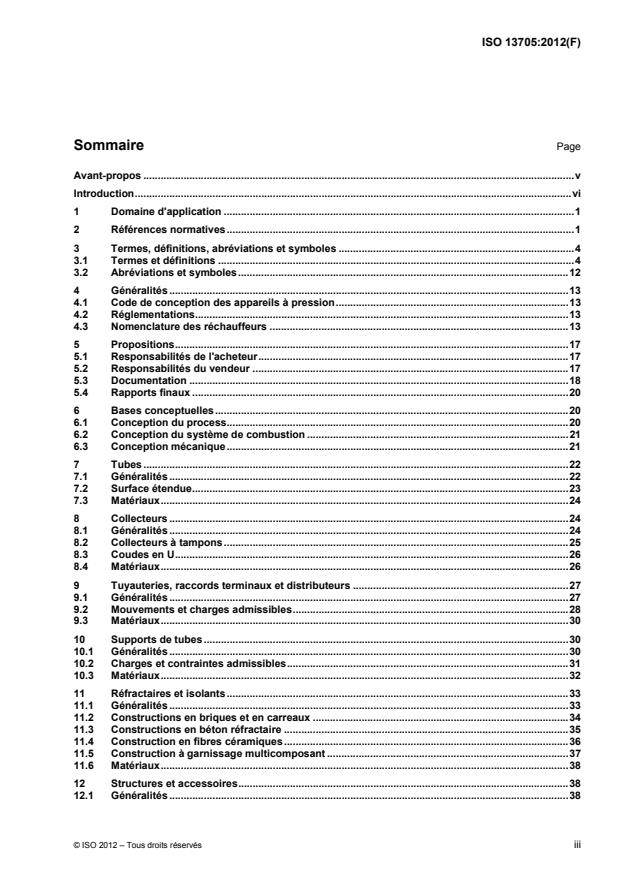
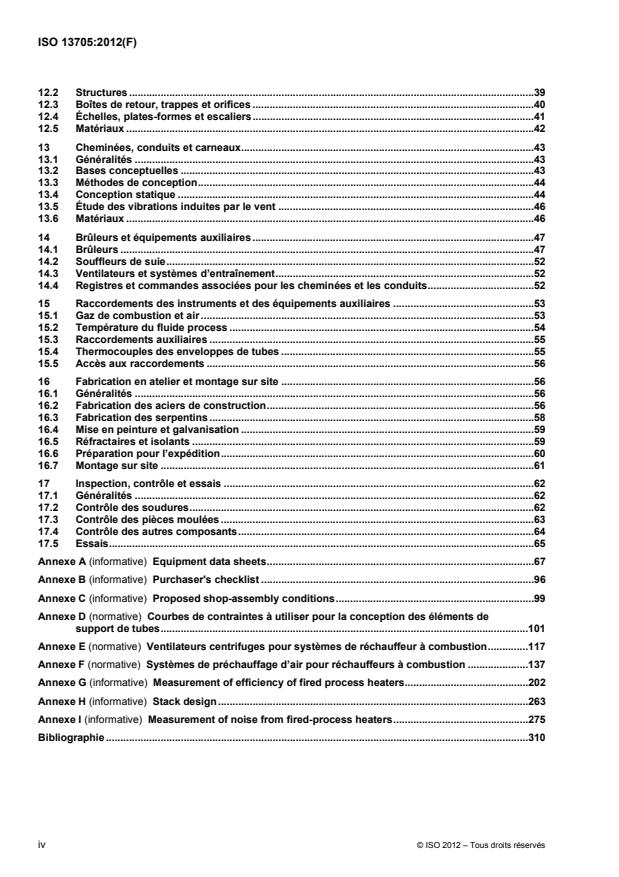
Sommaire Page
Avant-propos .v
Introduction.vi
1 Domaine d'application .1
2 Références normatives.1
3 Termes, définitions, abréviations et symboles .4
3.1 Termes et définitions .4
3.2 Abréviations et symboles.12
4 Généralités .13
4.1 Code de conception des appareils à pression.13
4.2 Réglementations.13
4.3 Nomenclature des réchauffeurs .13
5 Propositions.17
5.1 Responsabilités de l'acheteur.17
5.2 Responsabilités du vendeur .17
5.3 Documentation .18
5.4 Rapports finaux .20
6 Bases conceptuelles.20
6.1 Conception du process.20
6.2 Conception du système de combustion .21
6.3 Conception mécanique.21
7 Tubes .22
7.1 Généralités .22
7.2 Surface étendue.23
7.3 Matériaux.24
8 Collecteurs .24
8.1 Généralités .24
8.2 Collecteurs à tampons.25
8.3 Coudes en U.26
8.4 Matériaux.26
9 Tuyauteries, raccords terminaux et distributeurs .27
9.1 Généralités .27
9.2 Mouvements et charges admissibles.28
9.3 Matériaux.30
10 Supports de tubes.30
10.1 Généralités .30
10.2 Charges et contraintes admissibles.31
10.3 Matériaux.32
11 Réfractaires et isolants.33
11.1 Généralités .33
11.2 Constructions en briques et en carreaux .34
11.3 Constructions en béton réfractaire .35
11.4 Construction en fibres céramiques.36
11.5 Construction à garnissage multicomposant .37
11.6 Matériaux.38
12 Structures et accessoires.38
12.1 Généralités .38
12.2 Structures .39
12.3 Boîtes de retour, trappes et orifices .40
12.4 Échelles, plates-formes et escaliers.41
12.5 Matériaux .42
13 Cheminées, conduits et carneaux.43
13.1 Généralités .43
13.2 Bases conceptuelles .43
13.3 Méthodes de conception.44
13.4 Conception statique .44
13.5 Étude des vibrations induites par le vent .46
13.6 Matériaux .46
14 Brûleurs et équipements auxiliaires.47
14.1 Brûleurs .47
14.2 Souffleurs de suie.52
14.3 Ventilateurs et systèmes d’entraînement.52
14.4 Registres et commandes associées pour les cheminées et les conduits.52
15 Raccordements des instruments et des équipements auxiliaires .53
15.1 Gaz de combustion et air .53
15.2 Température du fluide process .54
15.3 Raccordements auxiliaires .55
15.4 Thermocouples des enveloppes de tubes .55
15.5 Accès aux raccordements .56
16 Fabrication en atelier et montage sur site .56
16.1 Généralités .56
16.2 Fabrication des aciers de construction.56
16.3 Fabrication des serpentins .58
16.4 Mise en peinture et galvanisation .59
16.5 Réfractaires et isolants .59
16.6 Préparation pour l’expédition.60
16.7 Montage sur site .61
17 Inspection, contrôle et essais .62
17.1 Généralités .62
17.2 Contrôle des soudures.62
17.3 Contrôle des pièces moulées .63
17.4 Contrôle des autres composants.64
17.5 Essais.65
Annexe A (informative) Equipment data sheets.67
Annexe B (informative) Purchaser's checklist .96
Annexe C (informative) Proposed shop-assembly conditions.99
Annexe D (normative) Courbes de contraintes à utiliser pour la conception des éléments de
support de tubes.101
Annexe E (normative) Ventilateurs centrifuges pour systèmes de réchauffeur à combustion.117
Annexe F (normative) Systèmes de préchauffage d’air pour réchauffeurs à combustion .137
Annexe G (informative) Measurement of efficiency of fired process heaters.202
Annexe H (informative) Stack design.263
Annexe I (informative) Measurement of noise from fired-process heaters.275
Bibliographie .310
iv © ISO 2012 – Tous droits réservés
Avant-propos
L'ISO (Organisation internationale de normalisation) est une fédération mondiale d'organismes nationaux de
normalisation (comités membres de l'ISO). L'élaboration des Normes internationales est en général confiée
aux comités techniques de l'ISO. Chaque comité membre intéressé par une étude a le droit de faire partie du
comité technique créé à cet effet. Les organisations internationales, gouvernementales et non
gouvernementales, en liaison avec l'ISO participent également aux travaux. L'ISO collabore étroitement avec
la Commission électrotechnique internationale (CEI) en ce qui concerne la normalisation électrotechnique.
Les Normes internationales sont rédigées conformément aux règles données dans les Directives ISO/CEI,
Partie 2.
La tâche principale des comités techniques est d'élaborer les Normes internationales. Les projets de Normes
internationales adoptés par les comités techniques sont soumis aux comités membres pour vote. Leur
publication comme Normes internationales requiert l'approbation de 75 % au moins des comités membres
votants.
L'attention est appelée sur le fait que certains des éléments du présent document peuvent faire l'objet de
droits de propriété intellectuelle ou de droits analogues. L'ISO ne saurait être tenue pour responsable de ne
pas avoir identifié de tels droits de propriété et averti de leur existence.
L'ISO 13705 a été élaborée par le comité technique ISO/TC 67, Matériel, équipement et structures en mer
pour les industries pétrolière, pétrochimique et du gaz naturel, sous-comité SC 6, Systèmes et équipements
de traitement.
Cette troisième édition annule et remplace la deuxième édition (ISO 13705:2006), qui a fait l'objet d'une
révision technique.
Introduction
Il convient que les utilisateurs de la présente Norme internationale soient informés que des exigences
supplémentaires ou différentes peuvent se révéler indispensables pour des applications individuelles. La
présente Norme internationale n’a pas pour objet d’empêcher un vendeur de proposer, ou un acheteur
d’accepter, des équipements alternatifs ou des solutions techniques alternatives pour une application
particulière. De telles solutions alternatives peuvent notamment être applicables lorsqu’il s’agit de
technologies innovatrices ou en cours de développement. Lorsqu’une alternative est proposée, il convient que
le vendeur identifie tout écart par rapport à la présente Norme internationale et en fournisse les détails.
Dans les Normes Internationales, le système d’unités SI est utilisé. Dans la présente Norme internationale, les
unités américaines usuelles (USC) sont, dans la mesure du possible, indiquées entre parenthèses à titre
d’information.
Le symbole (●) en début de paragraphe ou d’alinéa indique qu’une décision est nécessaire ou que des
informations complémentaires sont à fournir par l’acheteur. Il convient que ces informations soient indiquées
sur les feuilles de données (voir les exemples à l’Annexe A) ou précisées dans l’appel d’offres ou la
commande d’achat. Il convient de consigner les décisions sur une liste de contrôle (voir l’exemple à
l’Annexe B).
vi © ISO 2012 – Tous droits réservés
NORME INTERNATIONALE ISO 13705:2012(F)
Industries du pétrole, de la pétrochimie et du gaz naturel —
Réchauffeurs à brûleurs pour usage général dans les raffineries
1 Domaine d'application
La présente Norme internationale spécifie les exigences et donne des recommandations pour la conception,
les matériaux, la fabrication, l’inspection, les essais, la préparation pour l’expédition et le montage des
réchauffeurs, des préchauffeurs d’air (APH), des ventilateurs et des brûleurs à usage général dans les
raffineries.
La présente Norme internationale n’est pas destinée à s’appliquer à la conception des reformeurs à vapeur ou
des fours à pyrolyse.
2 Références normatives
Les documents de référence suivants sont indispensables pour l’application du présent document. Pour les
références datées, seule l'édition citée s'applique. Pour les références non datées, la dernière édition du
document de référence s'applique (y compris les éventuels amendements).
ISO 1461, Revêtements par galvanisation à chaud sur produits finis en fonte et en acier — Spécifications et
méthodes d'essai.
ISO 1940-1:2003, Vibrations mécaniques — Exigences en matière de qualité dans l'équilibrage pour les
rotors en état rigide (constant) — Partie 1: Spécifications et vérification des tolérances d'équilibrage.
ISO 8501-1, Préparation des subjectiles d'acier avant application de peintures et de produits assimilés —
Évaluation visuelle de la propreté d'un subjectile — Partie 1: Degrés de rouille et degrés de préparation des
subjectiles d'acier non recouverts et des subjectiles d'acier après décapage sur toute la surface des
revêtements précédents.
ISO 10684, Éléments de fixation — Revêtements de galvanisation à chaud.
ISO 13704, Industries du pétrole et du gaz naturel — Calcul de l'épaisseur des tubes de fours de raffineries
du pétrole.
ISO 15649, Industries du pétrole et du gaz naturel — Tuyauterie.
CEI 60079 (toutes les parties), Matériel électrique pour atmosphères explosives gazeuses.
1)
ISO 10025-2:2004 , Produits laminés à chaud en aciers de construction — Partie 2: Conditions techniques
de livraison pour les aciers de construction non alliés.
2)
ABMA Standard 9 , Load Ratings and Fatigue Life for Ball Bearings.
3)
AMCA 210 , Laboratory Methods of Testing Fans for Aerodynamic Performance Rating.
1)
Comité européen de normalisation (CEN), Rue de Stassart 36, B-1050 Bruxelles, Belgique.
2)
American Bearing Manufacturers Association, 2025 M. Street, NW, Suite 800, Washington, DC 20036, USA.
3)
Air Movement and Control Association, 30 West University Drive, Arlington Heights, IL 60004, USA.
AMCA 801:2001, Industrial Process/Power Generation Fans — Specifications and Guidelines.
4)
ASME B 17.1 , Keys and Keyseats.
ASME Boiler and Pressure Vessel Code, Section VIII, Pressure Vessels.
5)
ASTM A 36 , Standard Specification for Carbon Structural Steel.
ASTM A 53, Standard Specification for Pipe, Steel, Black and Hot-Dipped, Zinc-Coated, Welded and
Seamless.
ASTM A 105, Standard Specification for Carbon Steel Forgings for Piping Applications.
ASTM A 106, Standard Specification for Seamless Carbon Steel Pipe for High-Temperature Service.
ASTM A 123, Standard Specification for Zinc (Hot-Dip Galvanized) Coatings on Iron and Steel Products.
ASTM A 143, Standard Practice for Safeguarding Against Embrittlement of Hot-Dip Galvanized Structural
Steel Products and Procedure for Detecting Embrittlement.
ASTM A 153, Standard Specification for Zinc Coating (Hot-Dip) on Iron and Steel Hardware.
ASTM A 181, Standard Specification for Carbon Steel Forgings, for General-Purpose Piping.
ASTM A 182, Standard Specification for Forged or Rolled Alloy and Stainless-Steel Pipe Flanges, Forged
Fittings, and Valves and Parts for High-Temperature Service.
ASTM A 192, Standard Specification for Seamless Carbon Steel Boiler Tubes for High-Pressure Service.
ASTM A 193, Standard Specification for Alloy-Steel and Stainless Steel Bolting for High-Temperature or High-
Pressure Service and Other Special Purpose Applications.
ASTM A 194, Standard Specification for Carbon and Alloy Steel Nuts for Bolts for High-Pressure or High-
Temperature Service, or Both.
ASTM A 209, Standard Specification for Seamless Carbon-Molybdenum Alloy-Steel Boiler and Superheater
Tubes.
ASTM A 210, Standard Specification for Seamless Medium-Carbon Steel Boiler and Superheater Tubes.
ASTM A 213, Standard Specification for Seamless Ferritic and Austenitic Alloy-Steel Boiler, Superheater, and
Heat-Exchanger Tubes.
ASTM A 216, Standard Specification for Steel Castings, Carbon, Suitable for Fusion Welding, for High-
Temperature Service.
ASTM A 217, Standard Specification for Steel Castings, Martensitic Stainless and Alloy, for Pressure-
Containing Parts, Suitable for High-Temperature Service.
ASTM A 234, Standard Specification for Piping Fittings of Wrought Carbon Steel and Alloy Steel for Moderate
and High Temperature Service.
4)
American Society of Mechanical Engineers, 3 Park Avenue, New York, NY 10017, USA.
5)
American Society for Testing and Materials, 100 Barr Harbor Drive, West Conshohocken, PA 19428-2959, USA.
2 © ISO 2012 – Tous droits réservés
ASTM A 240, Standard Specification for Chromium and Chromium-Nickel Stainless Steel Plate, Sheet, and
Strip for Pressure Vessels and for General Applications.
ASTM A 242, Standard Specification for High-Strength Low-Alloy Structural Steel.
ASTM A 283, Standard Specification for Low and Intermediate Tensile Strength Carbon Steel Plates
ASTM A 297, Standard Specification for Steel Castings, Iron-Chromium and Iron-Chromium-Nickel, Heat
Resistant, for General Application.
ASTM A 307, Standard Specification for Carbon Steel Bolts and Studs, 60 000 PSI Tensile Strength.
ASTM A 312, Standard Specification for Seamless, Welded, and Heavily Cold Worked Austenitic Stainless
Steel Pipes.
ASTM A 320, Standard Specification for Alloy Steel and Stainless Steel Bolting Materials for Low-
Temperature Service.
ASTM A 325, Standard Specification for Structural Bolts, Steel, Heat Treated, 120/105 ksi Minimum Tensile
Strength.
ASTM A 335, Standard Specification for Seamless Ferritic Alloy-Steel Pipe for High-Temperature Service.
ASTM A 351, Standard Specification for Castings, Austenitic, for Pressure-Containing Parts.
ASTM A 376, Standard Specification for Seamless Austenitic Steel Pipe for High-Temperature Central-Station
Service.
ASTM A 384, Standard Practice for Safeguarding Against Warpage and Distortion During Hot-Dip Galvanizing
of Steel Assemblies.
ASTM A 385, Standard Practice for Providing High-Quality Zinc Coatings (Hot-Dip).
ASTM A 387, Standard Specification for Pressure Vessel Plates, Alloy Steel, Chromium-Molybdenum.
ASTM A 403, Standard Specification for Wrought Austenitic Stainless Steel Piping Fittings.
ASTM A 447, Standard Specification for Steel Castings, Chromium-Nickel-Iron Alloy (25-12 Class), for High-
Temperature Service.
ASTM A 560, Standard Specification for Castings, Chromium-Nickel Alloy.
ASTM A 572, Standard Specification for High-Strength Low-Alloy Columbium-Vanadium Structural Steel.
ASTM A 608, Standard Specification for Centrifugally Cast Iron-Chromium-Nickel High-Alloy Tubing for
Pressure Application at High Temperatures.
ASTM B 366, Standard Specification for Factory-Made Wrought Nickel and Nickel Alloy Fittings.
ASTM B 407, Standard Specification for Nickel-Iron-Chromium Alloy Seamless Pipe and Tube.
ASTM B 564, Standard Specification for Nickel Alloy Forgings.
ASTM B 633, Standard Specification for Electrodeposited Coatings of Zinc on Iron and Steel.
ASTM C 27, Standard Classification of Fireclay and High-Alumina Refractory Brick.
ASTM C 155, Standard Classification of Insulating Firebrick.
ASTM C 332, Standard Specification for Lightweight Aggregates for Insulating Concrete.
ASTM C 401, Standard Classification of Alumina and Alumina-Silicate Castable Refractories.
ASTM C 612, Standard Specification for Mineral Fiber Block and Board Thermal Insulation.
6)
AWS D 1.1, Structural Welding Code — Steel.
AWS D 14.6, Specification for Welding of Rotating Elements of Equipment.
7)
NFPA 70 , National Electrical Code.
8)
SSPC SP 6/NACE No.3 , Commercial Blast Cleaning.
3 Termes, définitions, abréviations et symboles
Pour les besoins du présent document, les termes et définitions suivants s’appliquent.
NOTE Les termes et définitions se rapportant aux ventilateurs centrifuges sont donnés dans l’Annexe E.
3.1 Termes et définitions
3.1.1
réchauffeur d’air
préchauffeur d'air
APH
appareil de transfert thermique à travers lequel circule de l'air de combustion par un milieu à température
supérieure, tel que des produits de combustion, de la vapeur ou un autre fluide
3.1.2
ancrage
tirant d’ancrage
dispositif métallique ou réfractaire maintenant le réfractaire ou l’isolant en place
3.1.3
voûte
partie plate ou incline de la zone de rayonnement du réchauffeur, opposée à la sole
3.1.4
atomiseur
dispositif servant à réduire un mazout liquide en brouillard fin, en utilisant de la vapeur, de l’air ou des moyens
mécaniques
3.1.5
couche de renfort
couche réfractaire située derrière la couche de face chaude
3.1.6
réchauffeur à tirage équilibré
réchauffeur comprenant des ventilateurs à tirage forcé pour l’alimentation en air de combustion et des
ventilateurs à tirage induit pour l’extraction des gaz de combustion
6)
American Welding Society, 550 NW Le Jeune Road, Miami, FL 33126, USA.
7)
National Fire Protection Association, 1 Batterymarch Park, Quincy, MA 02269-9101, USA.
8)
The Society for Protective Coatings, 40, 24th Street, Pittsburg, PA 15222-4643, USA.
4 © ISO 2012 – Tous droits réservés
3.1.7
carneau
zone du réchauffeur où les gaz de combustion sont recueillis après le dernier serpentin de convection avant
d’être transférés dans la cheminée ou le réseau de conduits d’évacuation
3.1.8
mur d’autel
barrage fixe
paroi séparant deux zones adjacentes du réchauffeur
3.1.9
température du mur d'autel
température des gaz de combustion à la sortie de la zone de rayonnement
3.1.10
brûleur
dispositif assurant l’introduction du combustible et de l’air dans un réchauffeur aux vitesses, turbulence et
concentration désirées pour établir et maintenir une inflammation et une combustion correctes
NOTE Les brûleurs sont classés par type de combustible brûlé (mazout, gaz ou combinaison de gaz et de mazout,
auquel cas il s’agit de brûleurs « biocombustibles » ou « mixtes »).
3.1.11
registre à papillon
registre comportant une seule lame qui pivote autour de son axe
3.1.12
blindage
tôle métallique de confinement du réchauffeur
3.1.13
béton réfractaire
béton isolant coulé ou projeté sur place pour obtenir une forme ou structure réfractaire rigide
3.1.14
fibre céramique
isolant réfractaire fibreux pouvant se présenter sous la forme d'une fibre céramique réfractaire (RCF) ou d'une
fibre vitreuse artificielle (MMVF)
NOTE Les fibres peuvent être en vrac, sous forme de matelas, panneaux, modules, papier ou revêtements, de
formes pompables ou obtenues sous vide.
3.1.15
zone de convection
partie du réchauffeur où la chaleur est transmise aux tubes principalement par convection
3.1.16
encorbellement
saillie par rapport à la surface du réfractaire, servant généralement à empêcher les gaz de combustion de
contourner les tubes de la zone de convection s'ils sont sur un pas en quinconce
3.1.17
surépaisseur de corrosion
épaisseur de matériau supplémentaire destinée à compenser la perte de matière au cours de la durée de vie
du composant
3.1.18
vitesse de corrosion
vitesse de réduction de l'épaisseur du matériau due aux attaques chimiques par le fluide process et/ou les
gaz de combustion
3.1.19
croisement
interconnexion de tuyauterie entre deux zones de serpentin du réchauffeur
3.1.20
registre
dispositif destiné à introduire une résistance variable afin de réguler le débit des gaz de combustion ou de l'air
3.1.21
APH direct
échangeur thermique assurant un transfert de chaleur direct entre les gaz de combustion et l’air de
combustion
NOTE L’échangeur APH à régénération utilise des éléments rotatifs chauffés et une conception à récupération utilise
des tubes statiques, des tôles ou des éléments en fonte pour séparer les deux fluides caloporteurs.
3.1.22
tirage
pression négative (dépression) de l'air et/ou des gaz de combustion, mesurée en un point du réchauffeur
3.1.23
perte de tirage
perte de charge (incluant l'effet de la poussée d'Archimède) dans les conduits ou à travers les tubes et
équipements des réseaux d'air et de gaz de combustion
3.1.24
conduit
canalisation d'écoulement d'air ou de gaz de combustion
3.1.25
rendement du combustible
quantité totale de chaleur absorbée divisée par l'apport thermique total résultant de la seule combustion du
combustible (base du pouvoir calorifique inférieur)
NOTE Cette définition exclut la chaleur sensible des combustibles et s'applique à la quantité nette de chaleur
exportée à partir de l'unité.
3.1.26
rendement thermique
quantité totale de chaleur absorbée divisée par l'apport thermique total résultant de la combustion du
combustible plus les chaleurs sensibles de l'air, du combustible et de tout fluide d'atomisation
3.1.27
érosion
réduction d'épaisseur du matériau due à l'attaque mécanique d'un fluide
3.1.28
excès d’air
quantité d'air supérieure à la quantité stœchiométrique requise pour une combustion complète
NOTE L'excès d'air est exprimé en pourcentage.
6 © ISO 2012 – Tous droits réservés
3.1.29
surface étendue
surface de transfert de chaleur se présentant sous forme d'ailettes ou de goujons fixés sur la surface
absorbant la chaleur
3.1.30
taux d'extension
rapport entre la surface extérieure exposée totale et la surface extérieure du tube nu
3.1.31
gaz de combustion
produit de combustion gazeux incluant l'excès d'air
3.1.32
réchauffeur à tirage forcé
réchauffeur équipé d'un ventilateur ou d'un autre dispositif mécanique assurant l'alimentation en air de
combustion
3.1.33
facteur d'encrassement
coefficient à appliquer dans les calculs pour tenir compte de la présence d'une couche de résidu qui accentue
la perte de charge
NOTE 1 Ce résidu se présente généralement sous la forme d'une accumulation de coke ou de calamine sur la surface
interne d'un serpentin.
NOTE 2 Le facteur d'encrassement sert à calculer la perte de charge due à l'encrassement.
3.1.34
résistance à l'encrassement
facteur servant à calculer le coefficient de transfert thermique global
NOTE La résistance interne à l'encrassement sert à calculer la température maximale du métal pour la conception. La
résistance externe à l'encrassement sert à compenser la perte de performance due aux dépôts formés sur la surface
externe des tubes ou sur la surface étendue.
3.1.35
guillotine
obturateur d'isolement
dispositif à une seule lame servant à isoler les équipements ou réchauffeurs
3.1.36
collecteur
coude en U
raccord moulé ou forgé formé dans un coude à 180° et servant à raccorder au moins deux tubes
3.1.37
boîte de retour
compartiment intérieurement isolé, séparé du flux de gaz de combustion et servant à confiner plusieurs
collecteurs ou distributeurs
NOTE L’accès est protégé par des trappes battantes ou des panneaux amovibles.
3.1.38
absorption de chaleur
quantité totale de chaleur absorbée par les serpentins, à l'exclusion du préchauffage de l'air de combustion
3.1.39
densité moyenne du flux thermique
quantité de chaleur absorbée divisée par la surface de chauffe exposée de la zone de serpentins
NOTE La densité moyenne du flux d'un tube à surface étendue est indiquée sur la base d'une surface nue, en
précisant le taux d'extension.
3.1.40
densité maximale du flux thermique
vitesse locale maximale du transfert de chaleur dans la zone de serpentins
3.1.41
dégagement de chaleur totale
quantité de chaleur libérée par le combustible spécifié, en utilisant le pouvoir calorifique inférieur dudit
combustible
3.1.42
dégagement de chaleur volumique
quantité de chaleur libérée (nette) divisée par le volume net de la zone de rayonnement, à l’exclusion des
serpentins et des cloisons réfractaires
3.1.43
pouvoir calorifique supérieur
pouvoir calorifique brut
quantité totale de chaleur obtenue par la combustion d'un combustible spécifié à 15 °C (60 °F)
3.1.44
pouvoir calorifique inférieur
pouvoir calorifique net
pouvoir calorifique supérieur moins la chaleur latente de vaporisation de l'eau formée par la combustion de
l'hydrogène contenu dans le combustible
3.1.45
couche de face chaude
couche réfractaire exposée aux plus hautes températures dans un garnissage à couches ou composants
multiples
3.1.46
température de face chaude
température de la surface réfractaire en contact avec les gaz de combustion ou l'air de combustion chauffé
3.1.47
système APH indirect
dispositif de transfert de chaleur entre un fluide et l'air
NOTE Le transfert de chaleur peut s'effectuer en utilisant un fluide caloporteur ou un flux de process ou d'utilité qui a
été chauffé par les gaz de combustion ou par un autre moyen. Un système APH à tubes de chaleur utilise un fluide de
vaporisation/condensation pour transférer la chaleur entre les gaz de combustion et l'air.
3.1.48
réchauffeur à tirage induit
réchauffeur équipé d'un ventilateur servant à extraire les gaz de combustion et maintenir une pression
négative dans le réchauffeur afin d'entraîner l'air de combustion sans utiliser de ventilateur à tirage forcé
3.1.49
température d'interface
température calculée entre chaque couche d'un réfractaire multicouche ou multicomposant
8 © ISO 2012 – Tous droits réservés
3.1.50
traverse
tuyauterie d'interconnexion dans une zone de serpentins du réchauffeur
3.1.51
registre à volet
registre constitué de plusieurs lames qui pivotent individuellement autour de leur axe et sont mutuellement
reliées pour un actionnement simultané
3.1.52
distributeur
chambre assurant la collecte et la distribution de fluide vers/depuis plusieurs circuits d'écoulement parallèles
3.1.53
fibre vitreuse artificielle
MMVF
fibre d'isolation synthétique en verre amorphe, à base de calcium, de magnésium et de silicates, présentant
une solubilité accrue dans les liquides organiques
3.1.54
fibres métalliques de renfort
aiguilles d'acier inoxydable ajoutées au béton réfractaire pour en améliorer la ténacité et la durabilité
3.1.55
garnissage monolithique
système de garnissage à un seul composant
3.1.56
mortier
préparation de matériau réfractaire utilisée pour la pose et l'assemblage des briques réfractaires
3.1.57
garnissage multicomposant
système réfractaire composé d'au moins deux couches réfractaires de types différents
NOTE Le béton réfractaire, la brique réfractaire isolante, la brique réfractaire, le bloc, le panneau et la fibre
céramique sont des exemples de types de réfractaires.
3.1.58
garnissage multicouche
système réfractaire composé d'au moins deux couches réfractaires de type identique
3.1.59
réchauffeur à tirage naturel
réchauffeur dans lequel l'effet de cheminée entraîne l'air de combustion et extrait les gaz de combustion
3.1.60
dégagement de chaleur normal
quantité de chaleur de calcul absorbée par le réchauffeur divisée par le rendement calculé du combustible
3.1.61
passe
flux
circuit d'écoulement composé d'un ou plusieurs tubes en série
3.1.62
veilleuse
petit brûleur fournissant l'énergie d'inflammation requise pour allumer le brûleur principal
3.1.63
plénum
boîte à vent
chambre de confinement des brûleurs, servant à distribuer l'air aux brûleurs ou à atténuer le bruit de
combustion
3.1.64
collecteur à tampon
coude en U moulé comportant une ou plusieurs ouvertures pour l'inspection ou le nettoyage mécanique des
tubes
3.1.65
code de conception des appareils à pression
norme reconnue pour les récipients sous pression, spécifiée ou convenue avec l'acheteur
EXEMPLE Code ASME des appareils sous pression, Section VIII.
3.1.66
perte de charge
différence entre les pressions statiques d'entrée et de sortie entre des points terminaux, à l'exclusion de la
charge différentielle statique
3.1.67
air primaire
portion de la quantité totale d'air de combustion initialement mélangé au combustible
3.1.68
revêtement protecteur
matériau résistant à la corrosion appliqué sur une surface métallique
EXEMPLE Revêtement appliqué sur les tôles de blindage derrière les matériaux réfractaires poreux afin de les
protéger contre le soufre contenu dans les gaz de combustion.
3.1.69
zone de rayonnement
partie du réchauffeur où la chaleur est transmise aux tubes principalement par rayonnement
3.1.70
perte par rayonnement
perte de l'installation
chaleur cédée par le blindage du réchauffeur, les conduits et les équipements auxiliaires (lorsque des
systèmes de récupération de chaleur sont utilisés) et dissipée dans l'environnement ambiant
3.1.71
air secondaire
air fourni au combustible en complément de l'air primaire
3.1.72
installation
blindage, briquetage, réfractaire et isolation du réchauffeur, tirants d'ancrage inclus
3.1.73
zone d'écran
zone de choc
tubes assurant la protection des tubes restants de la zone de convection contre le rayonnement direct d’une
flamme
10 © ISO 2012 – Tous droits réservés
3.1.74
souffleur de suie
dispositif servant à ôter la suie ou autres dépôts des surfaces thermiquement absorbantes de la zone de
convection
NOTE La vapeur est le fluide normalement utilisé pour le soufflage de la suie.
3.1.75
cheminée
conduit vertical servant à décharger les gaz de combustion dans l'atmosphère
3.1.76
virure
déflecteur
accessoire métallique installé dans une cheminée pour empêcher la formation de vortex de von Karman
susceptibles d'engendrer des vibrations dues au vent
3.1.77
code de conception des structures
norme de conception des structures spécifiée ou acceptée par l'acheteur
EXEMPLE Code international du bâtiment.
3.1.78
paroi soumise à la flamme
paroi de rerayonnement
paroi verticale en briques réfractaires dont les deux faces sont directement exposées à la flamme
3.1.79
tolérance de température
nombre de degrés Celsius (Fahrenheit) à ajouter à la température du fluide process pour tenir compte des
variations de débit et des paramètres de fonctionnement inconnus
NOTE La tolérance de température est ajoutée à la température maximale calculée du métal des tubes ou à la
température équivalente du métal des tubes pour obtenir la température de calcul du métal.
3.1.80
raccordement terminal
assemblage à brides ou soudé vers/depuis le serpentin, permettant l'entrée et la sortie des fluides
3.1.81
guide de tube
dispositif servant à restreindre le mouvement horizontal des tubes verticaux tout en permettant leur dilatation
axiale
3.1.82
dispositif de retenue de tube
dispositif empêchant les tubes radiants horizontaux de décoller les supports de tubes intermédiaires en
service
3.1.83
support de tube
plaque tubulaire
dispositif servant à supporter les tubes
3.1.84
barrière de vapeur
film métallique placé entre les couches de réfractaire pour servir de barrière à l'écoulement des gaz de
combustion
3.2 Abréviations et symboles
3.2.1 Abréviations
APH préchauffeur d’air
NO oxydes d’azote, c’est-à-dire, oxyde nitreux, oxyde nitrique
x
PMI identification positive des matériaux
SCR réduction catalytique sélective
3.2.2 Symboles
C coefficient de pertes dues aux raccords (Tableau F.2)
C facteur de correction de perte de charge en fonction de la température (Figure F.8 b)
C facteur de correction de rugosité:
⎯ rugosité élevée (brique par exemple): 1,0
⎯ rugosité moyenne (béton réfractaire par exemple): 0,68
⎯ rugosité faible (acier non double par exemple): 0,45
d diamètre maximal
max
d diamètre interne du conduit, en millimètres (pouces)
D diamètre enveloppe, en millimètres (pouces)
F limite d’élasticité minimale du raidisseur annulaire à la température de calcul de l’enveloppe, en
yr
newtons par millimètre carré (livres par pouce carré)
F limite d’élasticité minimale du matériau d’enveloppe à la température de calcul, en newtons par
ys
millimètre carré (livres par pouce carré)
h hauteur de cheminée, en mètres (pieds)
h pouvoir calorifique supérieur
H
h pouvoir calorifique inférieur
L
H espacement des manchettes, en millimètres (pouces)
s
M moment circonférentiel maximal par longueur unitaire d'enveloppe, en newton mètres par mètre
(livres-pouce par pouce)
∆P perte de charge corrigée pour 30 mètres linéaires (100 pieds linéaires), en mm de H O (in de H O)
2 2
∆P perte de charge non corrigée (Figure 8 a)
12 © ISO 2012 – Tous droits réservés
q débit massique aréique, en kilogrammes par mètre carré par seconde (kg/m ⋅s) ou en livres par pied
m,a
carré par seconde (lb/ft •s)
S nombre de Scruton
C
t épaisseur d'enveloppe corrodée, en millimètres (pouces)
v vitesse linéaire, en mètres par seconde [pieds par seconde (ft/s)]
v vitesse critique du vent
c
X valeur calculée, exprimée en mè
...