

ISO 4358:2023
(Main)Test methods for civil multi-copter unmanned aircraft system
General Information
- Abstract
This document specifies test methods for civil electric multi-copter unmanned aircraft systems (UAS). This document is intended to be a general standard for testing the overall UAS functionality with the support of subsystems. It is applicable to the category of civil electric multi-copter UAS with maximum take-off mass (MTOM) level I to level V according to ISO 21895. The configuration control and subsystem (e.g. energy system and flight control system tests) test methods are out of the scope of this document. In addition, test methods for operations in snow and icing conditions are not included either, manufacturers have procedures identified to cope with flight in those conditions.
- Status
- Published
- Publication Date
- 03-May-2023
- Technical Committee
- ISO/TC 20/SC 16 - Unmanned aircraft systems
- Drafting Committee
- ISO/TC 20/SC 16/WG 5 - Testing and evaluation
- Current Stage
- 6060 - International Standard published
- Start Date
- 04-May-2023
- Due Date
- 04-Feb-2023
- Completion Date
- 04-May-2023
Overview
ISO 4358:2023 - Test methods for civil multi‑copter unmanned aircraft system - is an international standard that defines general test methods to evaluate the overall functionality and performance of civil electric multi‑copter UAS. Applicable to multi‑copter UAS with maximum take‑off mass (MTOM) Levels I–V (per ISO 21895), the standard provides a common framework for systematic inspection, functional checks, flight performance, navigation, data‑link, environmental and electromagnetic compatibility (EMC) testing. Subsystem configuration control and detailed subsystem tests (for example detailed energy‑system or flight‑control bench tests) and snow/icing operational tests are explicitly out of scope.
Key Topics and Requirements
ISO 4358:2023 organizes test methods around practical validation needs and includes requirements for:
- Test planning and documentation: preparation of design documents, operator’s manual and a test plan; test article and instrumentation requirements; personnel qualifications.
- General test principles: environmental conditions, test interruption/recovery and reporting requirements.
- Basic inspection: completeness, appearance, size, mass and centre of gravity, rotating parts, connectors.
- Functional inspection: identification, self‑test, data recording, return‑to‑home, automatic obstacle avoidance, failure protections, warnings, motor start/lock and control‑mode switching.
- Flight performance tests: maximum take‑off weight, flight range, altitude, horizontal speed, climb rate, altitude and speed hold, endurance, fixed‑point hovering, positioning/navigation accuracy, trajectory tracking and wind resistance capability.
- Navigation tests: static attitude and positioning accuracy.
- Data‑link tests: remote‑control and telemetry distance and information transmission range (Annex A provides remote control/telemetry distance procedure).
- Environmental tests: high/low temperature, rain, humidity/heat, vibration and shock.
- EMC tests: emissions and immunity principles for safe operation near other electronic systems.
Applications and Who Uses It
ISO 4358:2023 is used by:
- UAS manufacturers for product validation, quality assurance and pre‑certification testing.
- Independent test laboratories to perform standardized, repeatable evaluations.
- Regulatory and certification bodies to assess compliance and operational safety.
- Operators, procurement teams and R&D groups to benchmark performance, inform maintenance and guide design improvements.
Practical benefits include improved product quality, consistent testability across models, clearer safety evidence and a common vocabulary for multi‑copter performance evaluation.
Related Standards
- ISO 21895 - Categorization and classification of civil UAS (MTOM levels referenced).
- ISO 21384‑4 - UAS vocabulary and terms used by ISO 4358.
Get Certified
Connect with accredited certification bodies for this standard

BSI Group
BSI (British Standards Institution) is the business standards company that helps organizations make excellence a habit.

Bureau Veritas
Bureau Veritas is a world leader in laboratory testing, inspection and certification services.

DNV
DNV is an independent assurance and risk management provider.
Sponsored listings
Frequently Asked Questions
ISO 4358:2023 is a standard published by the International Organization for Standardization (ISO). Its full title is "Test methods for civil multi-copter unmanned aircraft system". This standard covers: This document specifies test methods for civil electric multi-copter unmanned aircraft systems (UAS). This document is intended to be a general standard for testing the overall UAS functionality with the support of subsystems. It is applicable to the category of civil electric multi-copter UAS with maximum take-off mass (MTOM) level I to level V according to ISO 21895. The configuration control and subsystem (e.g. energy system and flight control system tests) test methods are out of the scope of this document. In addition, test methods for operations in snow and icing conditions are not included either, manufacturers have procedures identified to cope with flight in those conditions.
This document specifies test methods for civil electric multi-copter unmanned aircraft systems (UAS). This document is intended to be a general standard for testing the overall UAS functionality with the support of subsystems. It is applicable to the category of civil electric multi-copter UAS with maximum take-off mass (MTOM) level I to level V according to ISO 21895. The configuration control and subsystem (e.g. energy system and flight control system tests) test methods are out of the scope of this document. In addition, test methods for operations in snow and icing conditions are not included either, manufacturers have procedures identified to cope with flight in those conditions.
ISO 4358:2023 is classified under the following ICS (International Classification for Standards) categories: 49.020 - Aircraft and space vehicles in general. The ICS classification helps identify the subject area and facilitates finding related standards.
ISO 4358:2023 is available in PDF format for immediate download after purchase. The document can be added to your cart and obtained through the secure checkout process. Digital delivery ensures instant access to the complete standard document.
Standards Content (Sample)
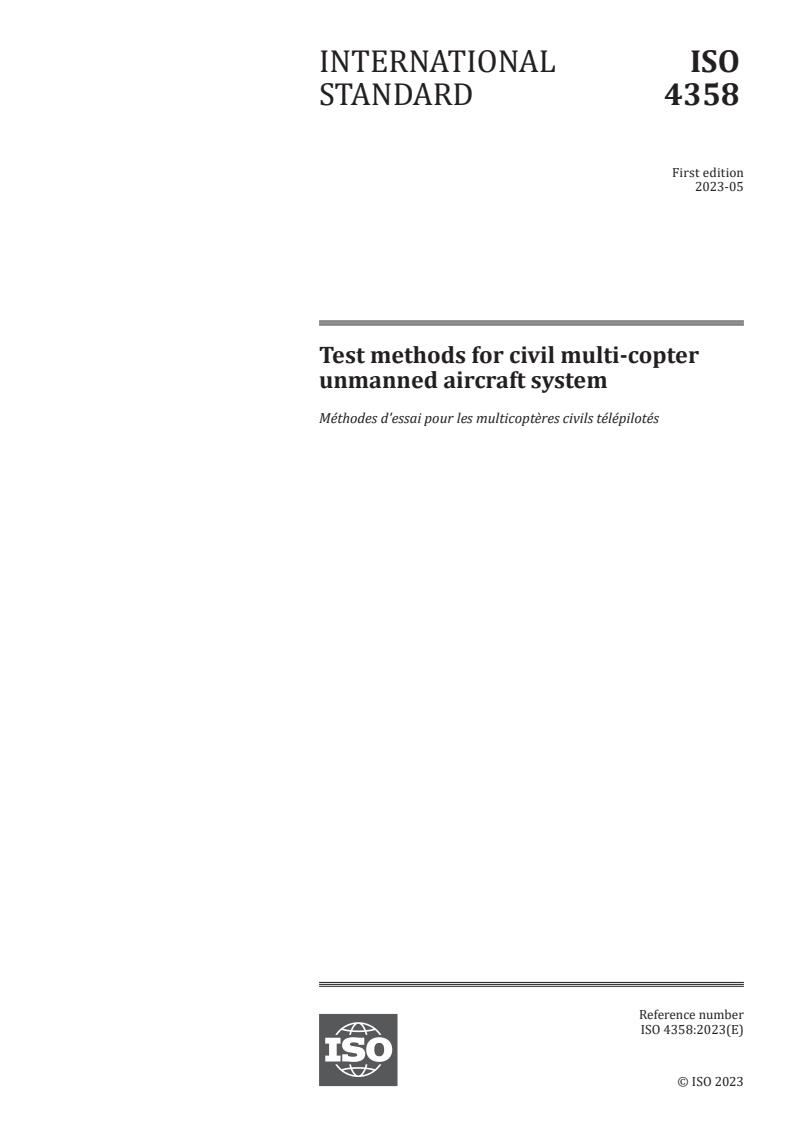
INTERNATIONAL ISO
STANDARD 4358
First edition
2023-05
Test methods for civil multi-copter
unmanned aircraft system
Méthodes d'essai pour les multicoptères civils télépilotés
Reference number
© ISO 2023
All rights reserved. Unless otherwise specified, or required in the context of its implementation, no part of this publication may
be reproduced or utilized otherwise in any form or by any means, electronic or mechanical, including photocopying, or posting on
the internet or an intranet, without prior written permission. Permission can be requested from either ISO at the address below
or ISO’s member body in the country of the requester.
ISO copyright office
CP 401 • Ch. de Blandonnet 8
CH-1214 Vernier, Geneva
Phone: +41 22 749 01 11
Email: copyright@iso.org
Website: www.iso.org
Published in Switzerland
ii
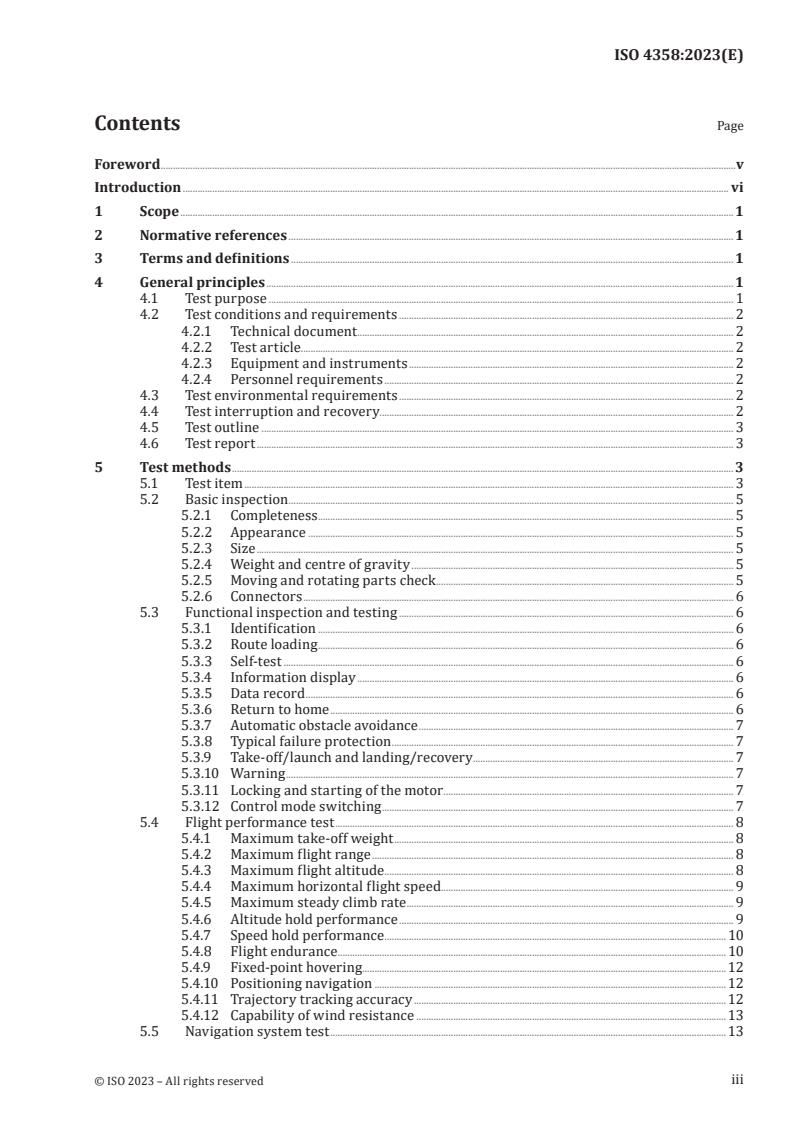
Contents Page
Foreword .v
Introduction . vi
1 Scope . 1
2 Normative references . 1
3 Terms and definitions . 1
4 General principles . 1
4.1 Test purpose . 1
4.2 Test conditions and requirements . 2
4.2.1 Technical document . 2
4.2.2 Test article . . 2
4.2.3 Equipment and instruments . 2
4.2.4 Personnel requirements . 2
4.3 Test environmental requirements . 2
4.4 Test interruption and recovery. 2
4.5 Test outline . 3
4.6 Test report . 3
5 Test methods . 3
5.1 Test item . 3
5.2 Basic inspection . 5
5.2.1 Completeness . 5
5.2.2 Appearance . 5
5.2.3 Size . 5
5.2.4 Weight and centre of gravity . 5
5.2.5 Moving and rotating parts check . 5
5.2.6 Connectors . 6
5.3 Functional inspection and testing . 6
5.3.1 Identification . 6
5.3.2 Route loading . 6
5.3.3 Self-test . 6
5.3.4 Information display . 6
5.3.5 Data record . 6
5.3.6 Return to home . 6
5.3.7 Automatic obstacle avoidance . 7
5.3.8 Typical failure protection . 7
5.3.9 Take-off/launch and landing/recovery . 7
5.3.10 Warning . 7
5.3.11 Locking and starting of the motor . 7
5.3.12 Control mode switching . 7
5.4 Flight performance test . 8
5.4.1 Maximum take-off weight . 8
5.4.2 Maximum flight range . 8
5.4.3 Maximum flight altitude . 8
5.4.4 Maximum horizontal flight speed. 9
5.4.5 Maximum steady climb rate . 9
5.4.6 Altitude hold performance . 9
5.4.7 Speed hold performance . 10
5.4.8 Flight endurance . 10
5.4.9 Fixed-point hovering . .12
5.4.10 Positioning navigation .12
5.4.11 Trajectory tracking accuracy .12
5.4.12 Capability of wind resistance . 13
5.5 Navigation system test . 13
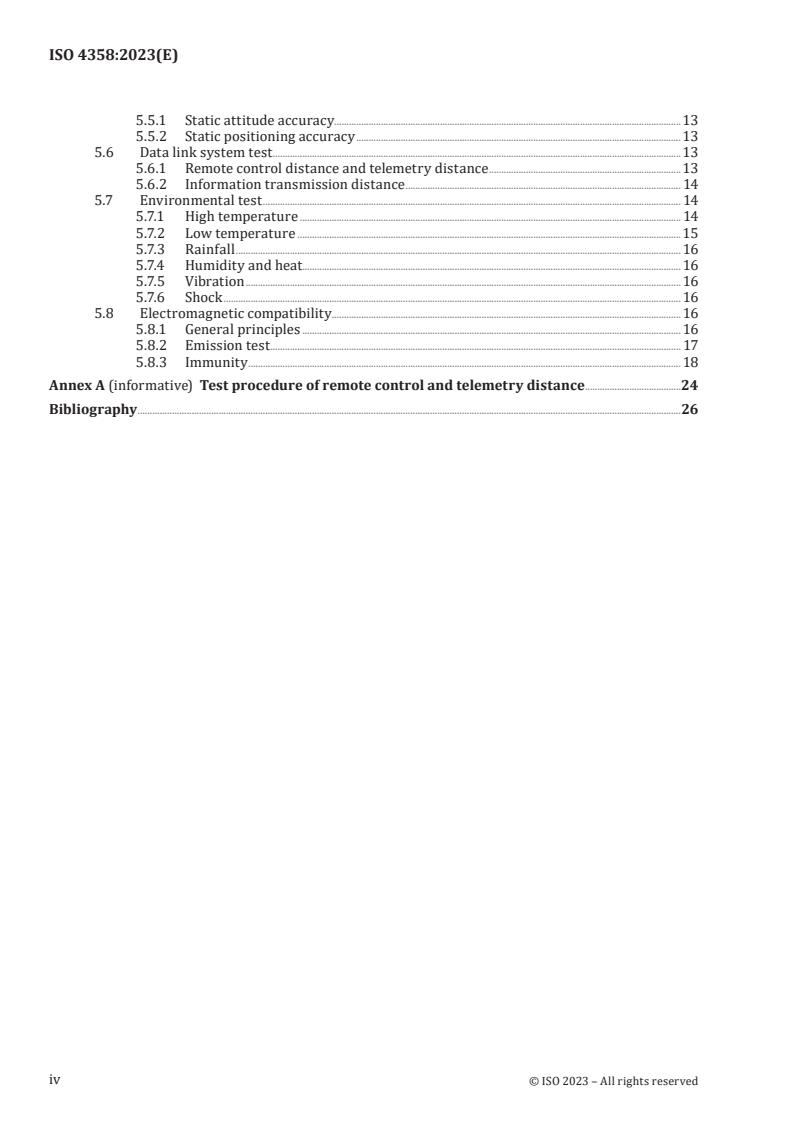
iii
5.5.1 Static attitude accuracy.13
5.5.2 Static positioning accuracy . 13
5.6 Data link system test .13
5.6.1 Remote control distance and telemetry distance .13
5.6.2 Information transmission distance . 14
5.7 Environmental test . 14
5.7.1 High temperature . 14
5.7.2 Low temperature .15
5.7.3 Rainfall . 16
5.7.4 Humidity and heat. 16
5.7.5 Vibration . 16
5.7.6 Shock . 16
5.8 Electromagnetic compatibility. 16
5.8.1 General principles . 16
5.8.2 Emission test . 17
5.8.3 Immunity . 18
Annex A (informative) Test procedure of remote control and telemetry distance .24
Bibliography .26
iv
Foreword
ISO (the International Organization for Standardization) is a worldwide federation of national standards
bodies (ISO member bodies). The work of preparing International Standards is normally carried out
through ISO technical committees. Each member body interested in a subject for which a technical
committee has been established has the right to be represented on that committee. International
organizations, governmental and non-governmental, in liaison with ISO, also take part in the work.
ISO collaborates closely with the International Electrotechnical Commission (IEC) on all matters of
electrotechnical standardization.
The procedures used to develop this document and those intended for its further maintenance are
described in the ISO/IEC Directives, Part 1. In particular, the different approval criteria needed for the
different types of ISO documents should be noted. This document was drafted in accordance with the
editorial rules of the ISO/IEC Directives, Part 2 (see www.iso.org/directives).
Attention is drawn to the possibility that some of the elements of this document may be the subject of
patent rights. ISO shall not be held responsible for identifying any or all such patent rights. Details of
any patent rights identified during the development of the document will be in the Introduction and/or
on the ISO list of patent declarations received (see www.iso.org/patents).
Any trade name used in this document is information given for the convenience of users and does not
constitute an endorsement.
For an explanation of the voluntary nature of standards, the meaning of ISO specific terms and
expressions related to conformity assessment, as well as information about ISO's adherence to
the World Trade Organization (WTO) principles in the Technical Barriers to Trade (TBT), see
www.iso.org/iso/foreword.html.
This document was prepared by Technical ISO/TC 20, Aircraft and space vehicles, Subcommittee SC 16,
Unmanned aircraft systems.
Any feedback or questions on this document should be directed to the user’s national standards body. A
complete listing of these bodies can be found at www.iso.org/members.html.
v
Introduction
Multi-copter unmanned aircraft system (UAS) is the most popular UAS in the market at the time of
publication of this document, but the quality of products can vary significantly. However, it is difficult
to evaluate the function and performance of these products as there is no unified standard test method
and means to evaluate and test the multi-copter UAS. Therefore, the development of test method
standards for civil multi-copter UAS is intended to provide a basis for product testing, in order to
improve the product quality of the multi-copter UAS as a whole.
vi
INTERNATIONAL STANDARD ISO 4358:2023(E)
Test methods for civil multi-copter unmanned aircraft
system
1 Scope
This document specifies test methods for civil electric multi-copter unmanned aircraft systems (UAS).
This document is intended to be a general standard for testing the overall UAS functionality with the
support of subsystems.
It is applicable to the category of civil electric multi-copter UAS with maximum take-off mass (MTOM)
level I to level V according to ISO 21895. The configuration control and subsystem (e.g. energy system
and flight control system tests) test methods are out of the scope of this document. In addition, test
methods for operations in snow and icing conditions are not included either, manufacturers have
procedures identified to cope with flight in those conditions.
2 Normative references
The following documents are referred to in the text in such a way that some or all of their content
constitutes requirements of this document. For dated references, only the edition cited applies. For
undated references, the latest edition of the referenced document (including any amendments) applies.
ISO 21384-4, Unmanned aircraft systems — Part 4: Vocabulary
ISO 21895, Categorization and classification of civil unmanned aircraft systems
3 Terms and definitions
For the purposes of this document, the terms and definitions given in ISO 21384-4, ISO 21895 and the
following apply.
ISO and IEC maintain terminology databases for use in standardization at the following addresses:
— ISO Online browsing platform: available at https:// www .iso .org/ obp
— IEC Electropedia: available at https:// www .electropedia .org/
3.1
mission profile
specified mission to be performed, including the event and the environment sequence that the test
article experiences
3.2
multi-copter UAS
rotorcraft lifted by two or more power-driven rotors on a substantially vertical axis, capable of
hovering, taking off and landing vertically
4 General principles
4.1 Test purpose
The purpose of the test is to:
a) check whether the functionality, performance of the UAS meets the design requirements;
b) make recommendations on design modifications and whether to conduct supplementary tests.
4.2 Test conditions and requirements
4.2.1 Technical document
The following documents should be prepared before the test:
a) the design documents, figures and interface file which are relevant to the test;
b) operator’s manual;
c) test plan
4.2.2 Test article
The test article shall fulfil the following requirements.
a) The test article shall conform to the product manuals.
b) The number of test article shall meet the test requirements.
c) The test article shall have quality inspection certificates such as the enterprise qualification
certificate.
4.2.3 Equipment and instruments
Test instruments and equipment (including special equipment and auxiliary equipment) shall be
verified and calibrated, and shall be qualified within the flight test limitations and within the validity
period. All the test instruments used should meet the expected use requirements; and its measurement
uncertainty or maximum allowable error should be less than the agreed allowable error range of the
measured parameter. For test process management, refer to ISO/IEC 17025.
4.2.4 Personnel requirements
Testers shall be able to operate the test article and the test equipment proficiently. Testers shall have
the corresponding competence and qualification, if required.
4.3 Test environmental requirements
Unless otherwise specified, all tests shall be performed by measuring and recording test conditions,
including temperature, relative humidity, atmosphere pressure and wind speed.
4.4 Test interruption and recovery
Test interruption and recovery methods are specified as follows.
a) The test is terminated on one of the following conditions.
1) Key indicator(s) of the test article is (are) unqualified.
2) The test article cannot work normally due to a malfunction and cannot be repaired.
b) When the following situations occur during the test, supplementary tests should be carried out as
appropriate.
1) Individual test article failed, the cause has been identified and corrected.
2) The original design or test article configuration was changed.
3) The test article is replaced with the components or devices that affect the technical
performance.
4.5 Test outline
The test plan shall include but not limited to the following:
a) mission profile description;
b) test purpose;
c) test time and location;
d) the number and technical status of the test article and test auxiliary;
e) test article, test classification methods;
f) test requirements;
g) test interruption and recovery;
h) acceptance criteria;
i) test organization;
j) test support;
k) test safety;
m) appendix (e.g. template of data record, collection of formulae).
4.6 Test report
The test report shall include but not limited to the following:
a) serial ID of the test article and pictures of the test article overview and the key components;
b) test general introduction;
c) test item, and necessary specification;
d) test acceptance criteria;
e) test safety (procedures and limitation, etc.);
f) test results;
g) main problems that have occurred in the test and the corresponding treatments;
h) conclusion;
i) issues and suggestions;
i) appendix (e.g. test data histories).
5 Test methods
5.1 Test item
UAS test items are shown in Table 1.
Table 1 — Test item information table
No. Test items Subclause number
1 Completeness 5.2.1
2 Appearance 5.2.2
3 Size 5.2.3
Basic
inspection
4 Weight and centre of gravity 5.2.4
5 Moving and rotating parts check 5.2.5
6 Connectors 5.2.6
7 Identification 5.3.1
8 Route loading 5.3.2
8 Self-test 5.3.3
10 Information display 5.3.4
11 Data record 5.3.5
Functional
12 Return to home 5.3.6
inspection and
13 Automatic obstacle avoidance 5.3.7
testing
14 Typical failure protection 5.3.8
15 Take-off/launch and landing/recovery 5.3.9
16 Warning 5.3.10
17 Locking and starting of motor 5.3.11
18 Control mode switching 5.3.12
19 Maximum take-off mass 5.4.1
20 Maximum flight range 5.4.2
21 Maximum flight altitude 5.4.3
22 Maximum horizontal flight speed 5.4.4
23 Maximum steady climb rate 5.4.5
24 Altitude hold performance 5.4.6
Flight performance
test
25 Speed hold performance 5.4.7
26 Flight endurance 5.4.8
27 Fixed-point hovering 5.4.9
28 Positioning navigation 5.4.10
29 Trajectory tracking accuracy 5.4.11
30 Capability of wind resistance 5.4.12
31 Static attitude accuracy 5.5.1
Navigation system
test
32 Static positioning accuracy 5.5.2
33 Remote control distance and telemetry distance 5.6.1
Data link system
test
34 Information transmission distance 5.6.2
35 High temperature 5.7.1
36 Low temperature 5.7.2
37 Rainfall 5.7.3
Environmental
test
38 Humidity and heat 5.7.4
39 Vibration 5.7.5
40 Shock 5.7.6
TTabablele 1 1 ((ccoonnttiinnueuedd))
No. Test items Subclause number
41 Conductive emission 5.8.2.1
42 Radiation emission 5.8.2.2
Radiated, radio-frequency, electromagnetic field
43 5.8.3.1
immunity
44 Power frequency magnetic field immunity 5.8.3.2
Electromagnetic
45 compatibility Electrostatic discharge immunity 5.8.3.3
test
46 Electrical fast transient/burst immunity 5.8.3.4
47 Surge immunity 5.8.3.5
Immunity to conducted disturbances, induced by
48 5.8.3.6
radio-frequency fields
49 Voltage sag and short supply Interruption 5.8.3.7
5.2 Basic inspection
5.2.1 Completeness
Visual inspection should be adopted for completeness checking. The test article shall be inspected and
recorded item by item by following product lists.
5.2.2 Appearance
Visual inspection shall be applied for appearance checking. The inspected items generally include:
a) the uniformity of equipment coating, the correctness and clarity of product identities (brand, size,
type, model, weight, etc.), and the robustness of stickers (no curl or erase);
b) the completeness of label or mark for connectors, switches, control sticks;
c) damages such as cracks, scratches, corrosions.
5.2.3 Size
The characteristic size of UA and its components (e.g. length, width, height, wheelbase, propeller/rotor
radius) shall be measured and recorded referring to product specifications with size error range.
5.2.4 Weight and centre of gravity
The weight of the UA and its components shall be measured. The centre of gravity shall be within the
allowable range specified by the manufacturer. Measurement methods generally include the following.
a) Mass measurement tools shall be employed for measuring the weight of the UA and its components
(unit: gram). The measurement should include conditions in which the UA is equipped with different
mission loads.
b) The position of centre of gravity is estimated; and it shall be checked with the designed position.
c) Tests shall be performed with the most critical centre of gravity.
5.2.5 Moving and rotating parts check
Visual inspection shall be employed for checking moving parts such as switches, buttons, foldable arms
and control surfaces; and for rotating parts of the vertical lifting elements (hub, blades, blade dumpers,
pitch control mechanism, and all other parts that rotate with the assembly). Mechanical movement
is supposed to be smooth and reliable, without the occurrence of looseness, stagnation, shortage,
deformation, etc.
5.2.6 Connectors
Connectors of the UAS shall be inspected according to indicators; results shall be recorded accordingly.
Inspected items are specified by the manufacturer and may generally include:
a) fool-proofing and locking design, in-place indication;
b) operating friendliness, firm installation and connection robustness;
c) protective design for exposed connecters;
d) skewed, retracted and damaged pins;
e) non-sparking design of power connectors.
5.3 Functional inspection and testing
5.3.1 Identification
While in flight, the identification function of UAS shall be inspected through UAS surveillance system
or a simulated surveillance system. The checked items include:
a) the accuracy of current flight data;
b) whether the identification of UAS and operator meet the requirements of the authority;
c) whether the reporting frequency meets the requirement of the authority.
5.3.2 Route loading
A route of typical flight mission shall be loaded to the UA prior to flight. In this loading process, the
status report shall be examined. Then, how the UA follows the route shall be investigated.
5.3.3 Self-test
Once the power of UAS is engaged, visual inspection shall be used to check the voice or light indications
of self-test results.
5.3.4 Information display
When UAS is powered on at the ground, the display of remote pilot station shall be examined through
visual inspection. Inspected contents should be checked according to the manufacturer's specification.
5.3.5 Data record
The UAS shall be flown in a typical flight mission. After the flight, the recorded data should be read and
inspected. The check items include the integrity of recorded data, the correctness of flight data and
mission data. Both onboard and remote pilot station data record shall be tested.
5.3.6 Return to home
The activation and the manual intervention for abandoning mission shall be checked to confirm that it
can be performed according to the manufacturer's intention.
5.3.7 Automatic obstacle avoidance
For UA with obstacle avoidance function, within the range of automatic obstacle avoidance specified
by the manufacturer, the UA shall be manipulated to fly towards obstacles at the speed specified by
the manufacturer until the distance is less than the safety distance specified by the manufacturer.
Inspection should be made that whether the UA can avoid collision. Then, the UA shall be kept away
from obstacles and the capability of regaining aircraft control should be inspected. Obstacles can be
wall, glass, utility pole, power line, etc.
5.3.8 Typical failure protection
For different failure situations, visual inspection shall be made towards the protection actions such as
returning to home, landing and hovering. The failure situations and corresponding testing procedures
are as follows.
a) Satellite navigation signal interruption: under normal flight conditions, the UA is manipulated to fly
into the space that obstructs satellite navigation signal (such as roofed buildings) until the signal is
blocked completely. A corresponding failsafe operation that manufacturer states shall be examined
through visual inspection.
b) Link interruption: under normal flight conditions, when the remote control and remote pilot station
are turned off, a failsafe operation that manufacturer states shall be investigated through visual
inspection.
c) Low battery: under normal flight conditions, the UA is kept flying until the energy is exhausted to
the low power state specified by the manufacturer. A failsafe operation stated by the manufacturer
which protects the UA from low battery failure shall be investigated through visual inspection.
5.3.9 Take-off/launch and landing/recovery
The following tests shall be performed on ground on a flat surface and a slope of less than 10°.
a) An automatic take-off command described in the operator’s manual shall be sent to the UA; and
then inspection shall be made whether the UA is out of control, such as flipping or leaping.
b) An automatic landing command described in the operator’s manual shall be sent to the UA; then
inspection shall be made whether the UA is out of control, such as flipping or falling.
5.3.10 Warning
For UAS equipped with an alarm function, once the abnormal condition specified in 5.3.8 occurs, aural
or visual alarm in the UAS shall be checked through visual inspection.
5.3.11 Locking and starting of the motor
The UAS shall be powered on and then pass the self-test procedure. In the locking status, control sticks
shall be pushed and pull; and then whether motor responds should be checked; once motors are started,
it can be checked whether the motors drive propeller/rotor blades and rotate at idle speed. Then the
power throttle shall be pushed, visual inspection should be made towards the accelerating rotation of
propeller/rotor blades.
5.3.12 Control mode switching
Under normal flight conditions, the UA shall be manipulated to switch between manual control mode
and automatic control mode. Whether the UA performs smooth transition flight shall be observed.
There shall be no out-of-control, such as falling or flip-over.
5.4 Flight performance test
5.4.1 Maximum take-off weight
The UAS used in the test shall function correctly; and the battery shall have sufficient energy. Instead of
actual mission payload, the corresponding dummy mission payload should be attached to the UA such
that the total mass of the UA reaches the designed nominal value of maximum take-off mass. The UA
shall be manipulated by following a prescribed typical mission profile. Then, whether the UA is capable
to accomplish the mission normally shall be examined. Information of the test site shall be recorded,
such as air temperature, atmospheric pressure, wind speed and altitude.
5.4.2 Maximum flight range
The UAS used in the test shall function correctly; and the battery shall have sufficient energy. It shall
carry mission payload or the dummy mission payload specified by the manufacturer; and a route
has been present to the UA. The UA shall take off vertically and reach a typical operational height
specified by the manufacturer (if the typical operational height is not specified, a median in the range
of operational height should be chosen); and the current position is recorded as position A. Then, the
UA shall fly straight to position B at a typical operational speed specified by the manufacturer (if the
typical operational speed is not specified, a median in the range of operational speed should be chosen).
The distance between position B and position A shall be equal to the maximum flight range which is
specified by the manufacturer. Subsequently, The UA shall return to a position within the range of
5 m from position A. The battery energy of UA shall be examined; and its value shall not be less than
10 % of fully charged battery energy (low energy state specified by the manufacturer). If the battery
energy is not sufficient to support UA returning to home, the position C shall be recorded where battery
energy reaches the low energy state specified by the manufacturer. The maximum flight range should
be evaluated according to Formula (1):
RL=+()L (1)
where
R is the maximum flight range, in metres (m);
L is the distance between position B and position A, in metres (m);
L is the distance between position B and position C, in metres (m).
The described test procedure should be performed 3 times; and the minimum value of R shall be
chosen. Information of the test site shall be recorded, such as air temperature, atmospheric pressure,
wind speed and altitude.
5.4.3 Maximum flight altitude
The nominal value of maximum flight altitude H under the standard atmospheric conditions of the
0max
test UA shall be converted into the value H under the current environmental conditions, according
max
to Formula (2). The UA shall be functioning with fully charged battery, carrying the dummy mission
payload specified by the manufacturer. The UA shall be manipulated to fly vertically and climb to the
height H . It shall fly forward, backward, sideward, take turns, and then keep hovering for 3 min.
max
In this procedure, the test equipment shall measure the position data (the sampling frequency of this
equipment shall not be less than 10 Hz). The remote pilot station should assist the determination of
whether the UA responds to commands normally. Information of the test site shall be recorded, such
as air temperature, atmospheric pressure, wind speed and altitude. After the flight, the flight data
recorded by the test equipment shall be read and used to determine the validity of this test. The altitude
here means the altitude above sea level.
HH=− H (2)
maxm0 ax
where
H is the altitude of take-off point, in metres (m);
H is the nominal value of the maximum flight altitude under standard atmospheric condition,
0max
in metres (m);
H is the equivalent height under the current atmospheric condition, in metres (m).
max
5.4.4 Maximum horizontal flight speed
A route shall be set to a functioning UA which is with full battery power and carries the dummy mission
payload specified by the manufacturer. The UA shall take off vertically to reach a specified operation
altitude. Then, it accelerates in horizontal flight until its flight speed keeps stable at the maximum
horizontal flight speed V (within an error range agreed by the requestor for testing and the test
hm
performer) with maximum continuous power at stated altitude, weight and configuration. The speed
shall be hold for 5 s. In the entire test campaign, a test equipment shall measure position data (the
sampling frequency of the test equipment is no less than 10 Hz); and remote pilot station can assist the
determination of the flight speed the UA.
After the flight, flight data recorded by the test equipment shall be analysed. An interval of the stable
flight speed should be sampled; and the average value of sample is taken as the maximum horizontal
flight speed in a single flight. The procedures described in this subclause shall be repeated for
4 tests in total; and these tests are in 2 pairs which are in the opposite flight direction. An average
value of the 4 tests shall be taken as the final result. The change of the altitude for maximum flight
should be considered. Test condition information shall be recorded, such as weight, configuration, air
temperature, atmospheric pressure, wind speed and altitude.
5.4.5 Maximum steady climb rate
A route shall be set to a functioning UA which is charged with sufficient energy and carries the
dummy mission payload specified by the manufacturer. The UA shall be manipulated to fly vertically.
It accelerates with maximum continuous power until its climb rate stabilizes at the maximum steady
climb rate V (within an error range agreed by the requestor for testing and the test performer). A test
vm
equipment shall measure the position data of the UA (the sampling frequency of the test equipment is
no less than 10 Hz); and the remote pilot station should assist in inspecting the climb speed.
After the flight, flight data collected by the test equipment shall be analysed. An interval of the stable
climb rate should be sampled; and an average value of sample is considered as the maximum climb rate
in a single flight test. The procedures described in this subclause shall be repeated for 3 tests; and the
minimum value of the tests is taken as the maximum climb rate. Information of the test site shall be
recorded, such as air temperature, atmospheric pressure, wind speed and altitude.
5.4.6 Altitude hold performance
A route shall be sent to a functioning UA which is charged with sufficient energy and carries the dummy
mission payload specified by the manufacturer. The UA shall be manipulated to fly in the following
procedures.
a) Take off vertically to reach a prescribed height H , and then fly horizontally at speed V for 30 s.
1 1
b) Climb to the height H and then fly horizontally at speed V for 30 s.
2 2
c) Climb to the height H and then fly horizontally at speed V for 30 s.
3 3
In the above procedures, H and V shall be evenly selected within the ranges of operational altitude
i i
and speed which are specified by the manufacturer. For instance, in the case that an operation
altitude is 30 m, values can be selected within the ranges of 0 m to 10 m (including 10 m), 10 m to 20 m
(including 20 m), 20 m to 30 m (including 30 m), respectively.
After the flight, the flight data collected by the test equipment (the sampling frequency is no less than
10 Hz) shall be analysed. In the three procedures described in this subclause, the accuracy of altitude
hold performance should be evaluated: An interval of flight data can be sampled in which height is
′
within the range (0,95 H , 1,05 H ) in each procedure; and the mean H and standard deviation σ can be
i i i
i
′
evaluated. HH− is considered as the error of altitude hold performance at the height H and σ is the
ii i i
fluctuation magnitude of altitude hold performance. Information of the test site shall be recorded, such
as air temperature, atmospheric pressure, wind speed and altitude.
NOTE i = 1, 2, 3.
5.4.7 Speed hold performance
A route shall be set to a functioning UA which is charged with sufficient energy and carries the dummy
mission payload specified by the manufacturer. The UA shall be manipulated to fly in the following
procedures.
a) Take off vertically to reach a prescribed height H , and then fly horizontally at speed V for 30 s.
1 1
b) Climb to altitude H and fly horizontally at speed V for 30 s.
2 2
c) Climb to altitude H and fly horizontally at speed V for 30 s.
3 3
In these procedures, H and V shall be evenly selected within the ranges of operation altitude and speed
i i
which are specified by the manufacturer. For instance, in the case that an operation altitude is 30 m,
values can be selected within the ranges of 0 m to 10 m (including 10 m), 10 m to 20 m (including 20 m),
20 m to 30 m (including 30 m), respectively. H and V can also be combined to generate test grids.
i i
After the flight, the flight data collected by the test equipment (the sampling frequency is no less than
10 Hz) shall be analysed. In the three procedures described in this subclause, the accuracy of speed
hold performance should be evaluated: An interval of flight data can be sampled in which height is
within the range (0,95 V ,1,05 V ) in each procedure; and the mean V ′ and standard deviation σ can be
i i i i
evaluated. VV′− is considered as the error of speed hold performance at the height H and σ is the
ii i i
fluctuation magnitude of speed hold performance. Information of the test site shall be recorded, such as
air temperature, atmospheric pressure, wind speed and altitude.
NOTE i = 1, 2, 3.
5.4.8 Flight endurance
5.4.8.1 General rules
The purpose of this test is to evaluate the flight endurance under appropriate conditions. The check
list for the factors influencing the enduring includes propulsion system, aerodynamics and batter
performance. The UA shall be functional; and its battery shall be fully charged. The voltage threshold
of low battery warning shall be set to the value corresponding to 10 % of battery energy (the low
battery warning status should be also determined according to the manufacturer). The test shall be
performed under two conditions, namely no-load and full-load. If the payload of UA is non-removable,
it is considered that the standard configuration of UA corresponds to the full-load condition; and the
method for full-load condition shall be applied in tests.
5.4.8.2 No-load hover
Under no-load condition, the UA shall be manipulated to take off vertically and hover at the height
of 10 m (error range can be determined by agreement between the requestor for testing and the
test performer) above the ground. It shall keep hovering until low battery warning alarms and then
performs a forced landing. A timing device should be utilized for timing during the flight. Time keeping
shall be stopped when performing the forced landing; and the run time of hovering shall be recorded.
NOTE Landing points can be determined by agreement between the requestor for testing and the test
performer.
The procedures described in this subclause should be repeated for 3 times; and the minimum value
among that of 3 tests is regarded as the result. Information of the test site shall be recorded, such as air
temperature, atmospheric pressure, wind speed and altitude.
5.4.8.3 No-load horizontal flight
A route shall be set to the UA. Under no-load condition, the UA shall be manipulated to take off vertically
and to reach a height of 10 m (error range can be determined by agreement between the requestor
for testing and the test performer) above the ground. The UA shall fly at a typical operational speed
specified by the manufacturer (if not specified, a median in the range of operational speed should be
chosen) within maximum operating radius; and it shall follow an elliptical route whose short axis is
greater than 200 m. It keeps flying until the low battery warning alarms
...