

ISO 5305:2024
(Main)Noise measurements for UAS (unmanned aircraft systems)
General Information
- Abstract
This document specifies methods for recording the time history of instantaneous sound pressure in several positions around rotor powered unmanned aircraft systems (UAS) with a maximum take-off mass (MTOM) of less than 150 kg in accordance with ISO 21895[9]. The UAS can be either electrically powered or fuel-powered. It is not applicable to the tilt-rotor or tilt-wing UAS. It does not account for the UAS noise certification or regulation This document can also be applied to measure the sound pressure from a UAS with either multiple rotors or a single rotor. This document specifies: a) recommendations and requirements for three different test facilities for the noise measurements of various categories of multirotor-powered UAS: — requirements and recommendations of UAS noise tests in anechoic chambers (Clause 7); — requirements and recommendations of UAS noise tests in anechoic wind tunnels (Clause 8); — requirements and recommendations of UAS noise tests in outdoor environments (Clause 9); b) requirements and recommendations for the configuration of noise measurement for multirotor-powered UAS in hover, vertical take-off and landing, and horizontal cruise; c) recommendations for the test configuration and procedures to minimize the influence of meteorological effects.
- Status
- Published
- Publication Date
- 28-Jan-2024
- Technical Committee
- ISO/TC 20/SC 16 - Unmanned aircraft systems
- Drafting Committee
- ISO/TC 20/SC 16/WG 5 - Testing and evaluation
- Current Stage
- 6060 - International Standard published
- Start Date
- 29-Jan-2024
- Due Date
- 12-Sep-2023
- Completion Date
- 29-Jan-2024
Overview
ISO 5305:2024 - "Noise measurements for UAS (unmanned aircraft systems)" defines standardized methods to record the time history of instantaneous sound pressure around rotor‑powered UAS with a maximum take‑off mass (MTOM) of less than 150 kg. The standard applies to electrically or fuel‑powered single‑ and multi‑rotor UAS, excluding tilt‑rotor and tilt‑wing types. ISO 5305:2024 specifies test environments (anechoic chambers, anechoic wind tunnels, outdoor sites) and measurement configurations for hover, vertical take‑off/landing (VTOL), and horizontal cruise. Note: it provides measurement methodology but does not itself set noise certification or regulatory limits.
Key Topics and Requirements
- Measurement scope: Time‑history recording of instantaneous sound pressure at multiple observer positions around the UAS.
- Test facilities:
- Anechoic chamber tests (Clause 7): chamber size, qualification, microphone arrangements (4‑microphone and multi‑microphone approaches).
- Anechoic wind tunnel tests (Clause 8): wind‑tunnel requirements, refraction corrections, microphone clearance.
- Outdoor tests (Clause 9): site selection, microphone layout, meteorological constraints and measurement corrections.
- Flight configurations: Defined procedures for hover, yaw, take‑off/landing, and cruise noise measurements.
- Instrumentation and calibration: Requirements for sensors, data acquisition and calibration to ensure accurate sound pressure capture.
- Environmental control: Recommendations to minimize meteorological effects (wind, temperature gradients, background noise) and to meet acoustic far‑field conditions.
- Position/speed control: Requirements for UAS positional accuracy and speed during tests to ensure repeatability.
- Uncertainty and reporting: Guidance on uncertainty sources, evaluation and mandatory reporting elements (test methods, selected noise metrics, UAS data, environment, results).
Applications and Users
ISO 5305:2024 is intended for professionals conducting standardized UAS noise measurements, including:
- UAS manufacturers developing quieter vehicles or validating acoustic performance.
- Acoustic test laboratories and research institutions performing controlled noise tests.
- Urban planners and environmental consultants assessing community noise impacts from UAS operations.
- Regulatory bodies and policymakers using measurement methods as a reference (the standard itself does not certify compliance).
Practical uses include product development, comparative noise testing of multirotor designs, operational noise assessments for urban/delivery UAS, and research into noise mitigation strategies.
Related Standards
- ISO 21895 (referenced normative document) - used in conjunction with ISO 5305:2024 for MTOM and related classification guidance.
Keywords: UAS noise measurements, unmanned aircraft systems noise, anechoic chamber, anechoic wind tunnel, outdoor noise tests, sound pressure, multirotor UAS, noise measurement procedures.
Get Certified
Connect with accredited certification bodies for this standard

BSI Group
BSI (British Standards Institution) is the business standards company that helps organizations make excellence a habit.

Bureau Veritas
Bureau Veritas is a world leader in laboratory testing, inspection and certification services.

DNV
DNV is an independent assurance and risk management provider.
Sponsored listings
Frequently Asked Questions
ISO 5305:2024 is a standard published by the International Organization for Standardization (ISO). Its full title is "Noise measurements for UAS (unmanned aircraft systems)". This standard covers: This document specifies methods for recording the time history of instantaneous sound pressure in several positions around rotor powered unmanned aircraft systems (UAS) with a maximum take-off mass (MTOM) of less than 150 kg in accordance with ISO 21895[9]. The UAS can be either electrically powered or fuel-powered. It is not applicable to the tilt-rotor or tilt-wing UAS. It does not account for the UAS noise certification or regulation This document can also be applied to measure the sound pressure from a UAS with either multiple rotors or a single rotor. This document specifies: a) recommendations and requirements for three different test facilities for the noise measurements of various categories of multirotor-powered UAS: — requirements and recommendations of UAS noise tests in anechoic chambers (Clause 7); — requirements and recommendations of UAS noise tests in anechoic wind tunnels (Clause 8); — requirements and recommendations of UAS noise tests in outdoor environments (Clause 9); b) requirements and recommendations for the configuration of noise measurement for multirotor-powered UAS in hover, vertical take-off and landing, and horizontal cruise; c) recommendations for the test configuration and procedures to minimize the influence of meteorological effects.
This document specifies methods for recording the time history of instantaneous sound pressure in several positions around rotor powered unmanned aircraft systems (UAS) with a maximum take-off mass (MTOM) of less than 150 kg in accordance with ISO 21895[9]. The UAS can be either electrically powered or fuel-powered. It is not applicable to the tilt-rotor or tilt-wing UAS. It does not account for the UAS noise certification or regulation This document can also be applied to measure the sound pressure from a UAS with either multiple rotors or a single rotor. This document specifies: a) recommendations and requirements for three different test facilities for the noise measurements of various categories of multirotor-powered UAS: — requirements and recommendations of UAS noise tests in anechoic chambers (Clause 7); — requirements and recommendations of UAS noise tests in anechoic wind tunnels (Clause 8); — requirements and recommendations of UAS noise tests in outdoor environments (Clause 9); b) requirements and recommendations for the configuration of noise measurement for multirotor-powered UAS in hover, vertical take-off and landing, and horizontal cruise; c) recommendations for the test configuration and procedures to minimize the influence of meteorological effects.
ISO 5305:2024 is classified under the following ICS (International Classification for Standards) categories: 49.020 - Aircraft and space vehicles in general. The ICS classification helps identify the subject area and facilitates finding related standards.
ISO 5305:2024 is available in PDF format for immediate download after purchase. The document can be added to your cart and obtained through the secure checkout process. Digital delivery ensures instant access to the complete standard document.
Standards Content (Sample)
International
Standard
ISO 5305
First edition
Noise measurements for UAS
2024-01
(unmanned aircraft systems)
Mesures de bruit pour les UAS (aéronefs sans pilote)
Reference number
© ISO 2024
All rights reserved. Unless otherwise specified, or required in the context of its implementation, no part of this publication may
be reproduced or utilized otherwise in any form or by any means, electronic or mechanical, including photocopying, or posting on
the internet or an intranet, without prior written permission. Permission can be requested from either ISO at the address below
or ISO’s member body in the country of the requester.
ISO copyright office
CP 401 • Ch. de Blandonnet 8
CH-1214 Vernier, Geneva
Phone: +41 22 749 01 11
Email: copyright@iso.org
Website: www.iso.org
Published in Switzerland
ii
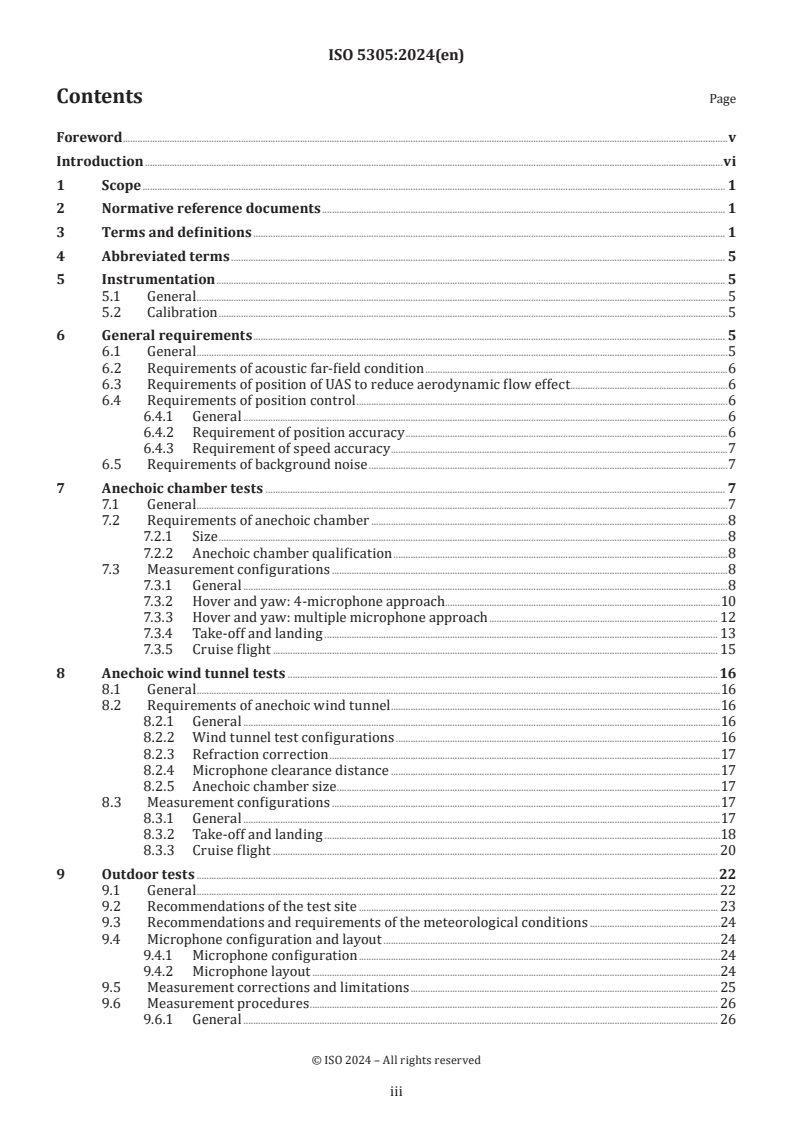
Contents Page
Foreword .v
Introduction .vi
1 Scope . 1
2 Normative reference documents . 1
3 Terms and definitions . 1
4 Abbreviated terms . 5
5 Instrumentation . 5
5.1 General .5
5.2 Calibration .5
6 General requirements . 5
6.1 General .5
6.2 Requirements of acoustic far-field condition .6
6.3 Requirements of position of UAS to reduce aerodynamic flow effect .6
6.4 Requirements of position control .6
6.4.1 General .6
6.4.2 Requirement of position accuracy .6
6.4.3 Requirement of speed accuracy .7
6.5 Requirements of background noise .7
7 Anechoic chamber tests . 7
7.1 General .7
7.2 Requirements of anechoic chamber .8
7.2.1 Size .8
7.2.2 Anechoic chamber qualification .8
7.3 Measurement configurations .8
7.3.1 General .8
7.3.2 Hover and yaw: 4-microphone approach.10
7.3.3 Hover and yaw: multiple microphone approach . 12
7.3.4 Take-off and landing . 13
7.3.5 Cruise flight . 15
8 Anechoic wind tunnel tests .16
8.1 General .16
8.2 Requirements of anechoic wind tunnel .16
8.2.1 General .16
8.2.2 Wind tunnel test configurations .16
8.2.3 Refraction correction .17
8.2.4 Microphone clearance distance .17
8.2.5 Anechoic chamber size .17
8.3 Measurement configurations .17
8.3.1 General .17
8.3.2 Take-off and landing .18
8.3.3 Cruise flight . 20
9 Outdoor tests .22
9.1 General . 22
9.2 Recommendations of the test site . 23
9.3 Recommendations and requirements of the meteorological conditions .24
9.4 Microphone configuration and layout .24
9.4.1 Microphone configuration .24
9.4.2 Microphone layout .24
9.5 Measurement corrections and limitations . 25
9.6 Measurement procedures . 26
9.6.1 General . 26
iii
9.6.2 Hover and yaw . 26
9.6.3 Take-off and landing . 26
9.6.4 Cruise flight .27
10 Uncertainties .27
10.1 General .27
10.2 Uncertainty sources and requirements .27
10.3 Evaluation of the uncertainty . 28
11 Information to report .29
11.1 Test methods . 29
11.2 Selected noise metrics . 29
11.3 UAS under test . 29
11.4 Test environment . 29
11.5 Data acquisition system . 29
11.6 Measurement . 30
11.7 Results . . 30
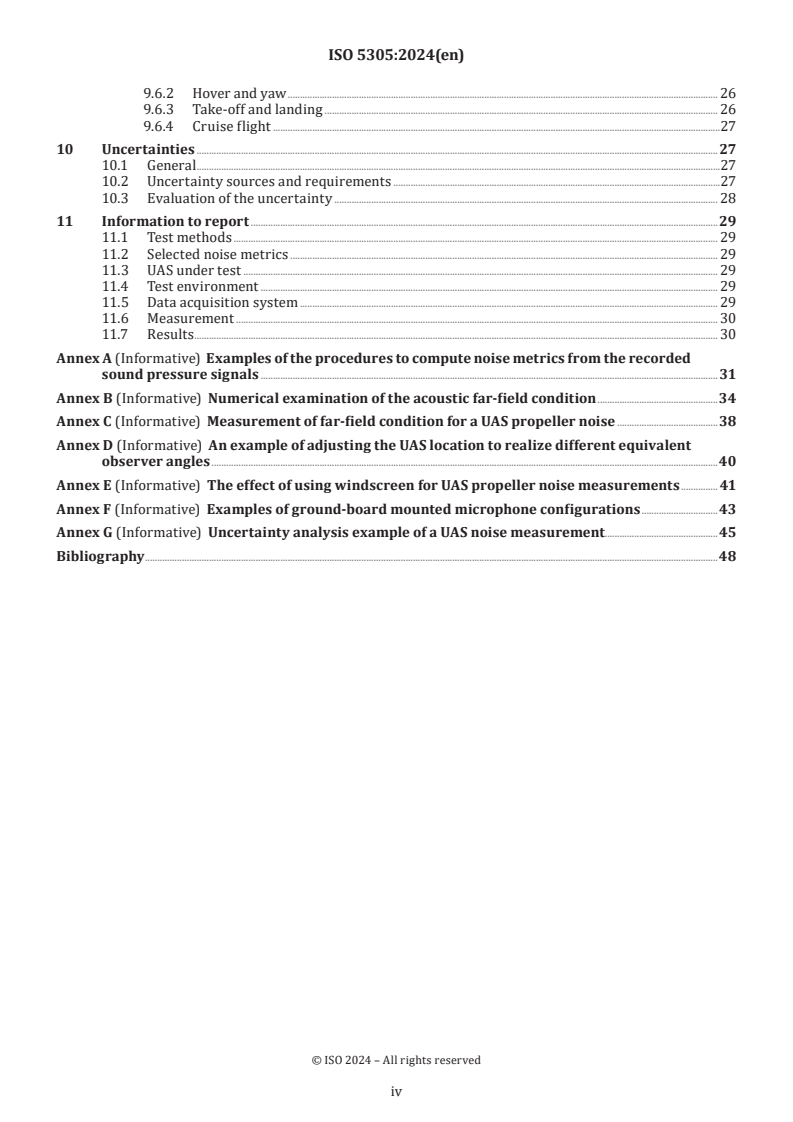
Annex A (Informative) Examples of the procedures to compute noise metrics from the recorded
sound pressure signals .31
Annex B (Informative) Numerical examination of the acoustic far-field condition .34
Annex C (Informative) Measurement of far-field condition for a UAS propeller noise .38
Annex D (Informative) An example of adjusting the UAS location to realize different equivalent
observer angles .40
Annex E (Informative) The effect of using windscreen for UAS propeller noise measurements . 41
Annex F (Informative) Examples of ground-board mounted microphone configurations .43
Annex G (Informative) Uncertainty analysis example of a UAS noise measurement .45
Bibliography .48
iv
Foreword
ISO (the International Organization for Standardization) is a worldwide federation of national standards
bodies (ISO member bodies). The work of preparing International Standards is normally carried out through
ISO technical committees. Each member body interested in a subject for which a technical committee
has been established has the right to be represented on that committee. International organizations,
governmental and non-governmental, in liaison with ISO, also take part in the work. ISO collaborates closely
with the International Electrotechnical Commission (IEC) on all matters of electrotechnical standardization.
The procedures used to develop this document and those intended for its further maintenance are described
in the ISO/IEC Directives, Part 1. In particular, the different approval criteria needed for the different types
of ISO document should be noted. This document was drafted in accordance with the editorial rules of the
ISO/IEC Directives, Part 2 (see www.iso.org/directives).
ISO draws attention to the possibility that the implementation of this document may involve the use of (a)
patent(s). ISO takes no position concerning the evidence, validity or applicability of any claimed patent
rights in respect thereof. As of the date of publication of this document, ISO had not received notice of (a)
patent(s) which may be required to implement this document. However, implementers are cautioned that
this may not represent the latest information, which may be obtained from the patent database available at
www.iso.org/patents. ISO shall not be held responsible for identifying any or all such patent rights.
Any trade name used in this document is information given for the convenience of users and does not
constitute an endorsement.
For an explanation of the voluntary nature of standards, the meaning of ISO specific terms and expressions
related to conformity assessment, as well as information about ISO's adherence to the World Trade
Organization (WTO) principles in the Technical Barriers to Trade (TBT), see www.iso.org/iso/foreword.html.
This document was prepared by Technical Committee ISO/TC 20, Aircraft and space vehicles, Subcommittee
SC 16, Unmanned aircraft systems.
Any feedback or questions on this document should be directed to the user’s national standards body. A
complete listing of these bodies can be found at www.iso.org/members.html.
v
Introduction
Within the last decade, multirotor unmanned aircraft systems (UAS) have greatly impacted the global
market with unique and cost-effective vehicle systems for photography, industrial surveying, logistics,
modern agricultural, civil engineering inspection, etc. A UAS can exert a significant impact on the living
environments of the human and wildlife during its operation at low altitudes. The adverse environmental
impacts include UAS noise. In urban applications, the UAS noise can be more annoying than road traffic or
[1]
aircraft noise at similar noise levels .
The characteristics of UAS noise vary in different operating conditions. The modern agricultural UAS are
designed to operate at a few meters above ground level. The logistic UAS are operated mainly in cruise
conditions. The UAS for civil engineering inspection may operate in both hover and cruise conditions.
[2]
The flight conditions of UAS are different from large civil transport aircraft and traditional rotorcraft .
Therefore, the noise characteristics are perceived differently, making the existing noise test codes used for
large aircraft, helicopter, and tilt-rotor vehicles unsuitable. These test codes were developed for aircraft
that typically operate far above civilians and urban regions, which are remotely related to the multirotor
UAS. Currently, there is no internationally agreed procedures for measuring UAS noise in different working
conditions.
[3]
The recently published European Commission Delegated Regulation EU 2019/945 for UAS details a noise
[4]
test code following ISO 3744 . The EU 2019/945 considers UAS with maximum take-off mass (MTOM) up
to 25 kg. The test code measures the sound power level of UAS in indoor and outdoor environments. The
[5]
regulation was later amended by EU regulation 2020/1058 as regards new UAS classes. However, the
measurement is limited only to the UAS in hover. In addition, the microphone arrangement is not specified
to avoid the influence of unsteady aerodynamic flow induced by the UAS on the acoustic measurement. Also,
the directional nature of the noise produced by UAS was not considered. Recently, a guidance on the noise
[6]
measurement of UAS lighter than 600 kg was published by EASA .
This document specifies the noise measurement methods for multirotor-powered UAS with an MTOM less
than 150 kg. The noise due to the multirotor-powered UAS contains both tonal and broadband content, both
of which may have a significant impact on humans. The tonal noise can cause annoyance because humans
[7]
are sensitive to pitch characteristics , while the broadband noise can affect the human brainstem auditory
[8]
evoked response . Both the tonal and broadband noise produced by multirotor-powered UAS is dependent
on the working conditions, leading to significant differences at different microphone locations.
This document aims at characterizing the UAS noise in different working conditions, but the efforts are left to
the manufactures or client requirement to decide the needed measurements. It is not necessary to perform
all measurements, and the measurer should select the measurement method according to the purpose. It
provides procedures for performing noise measurements at the typical UAS flight-phases including hover,
take-off, landing, and cruise. Configurations of the microphones are specified to ensure measurements are
made at different locations to quantify the directivity of UAS noise. It also specifies the requirements of how
measurements are conducted with the acoustic far-field conditions satisfied. This document focuses on the
methods of measuring the sound pressure signals of the UAS under different working conditions, based on
which post-processing of the recorded data can be conducted. For example, by computing the narrow-band
noise spectra, the tonal noise components can be extracted. However, requirements for signal processing
and evaluation of the measured data are not specified in this document. Instead, depending on the test
condition, several common noise metrics are recommended, and the procedures to compute these metrics
based on the recorded data are given in Annex A. This document can promote the understanding of the
noise characteristics of UAS and provide reference methods for both manufacturers and regulatory bodies
to assess the UAS noise.
vi
International Standard ISO 5305:2024(en)
Noise measurements for UAS (unmanned aircraft systems)
1 Scope
This document specifies methods for recording the time history of instantaneous sound pressure in
several positions around rotor powered unmanned aircraft systems (UAS) with a maximum take-off mass
[9]
(MTOM) of less than 150 kg in accordance with ISO 21895 . The UAS can be either electrically powered
or fuel-powered. It is not applicable to the tilt-rotor or tilt-wing UAS. It does not account for the UAS noise
certification or regulation
This document can also be applied to measure the sound pressure from a UAS with either multiple rotors or
a single rotor.
This document specifies:
a) recommendations and requirements for three different test facilities for the noise measurements of
various categories of multirotor-powered UAS:
— requirements and recommendations of UAS noise tests in anechoic chambers (Clause 7);
— requirements and recommendations of UAS noise tests in anechoic wind tunnels (Clause 8);
— requirements and recommendations of UAS noise tests in outdoor environments (Clause 9);
b) requirements and recommendations for the configuration of noise measurement for multirotor-
powered UAS in hover, vertical take-off and landing, and horizontal cruise;
c) recommendations for the test configuration and procedures to minimize the influence of meteorological
effects.
2 Normative reference documents
The following documents are referred to in the text in such a way that some or all of their content constitutes
requirements of this document. For dated references, only the edition cited applies. For undated references,
the latest edition of the referenced document (including any amendments) applies.
ISO 26101-1, Acoustics — Test methods for the qualification of the acoustic environment — Part 1: Qualification
of free-field environments
ISO/IEC Guide 98-3, Uncertainty of measurement — Part 3: Guide to the expression of uncertainty in
measurement (GUM: 1995)
IEC 60942, Electroacoustics — Sound calibrators
IEC 61094-4, Electroacoustics — Measurement microphones – Part 4: Specifications for working standard
microphones
IEC 61260-1, Electroacoustics — Octave-band and fractional-octave-band filters - Part 1: Specifications
IEC 61672-1, Electroacoustics — Sound level meters – Part 1: Specifications
3 Terms and definitions
For the purposes of this document, the following terms and definitions apply.
ISO and IEC maintain terminology databases for use in standardization at the following addresses:
— ISO Online browsing platform: available at https:// www .iso .org/ obp
— IEC Electropedia: available at https:// www .electropedia .org/
3.1
anechoic chamber
test room in which a free sound field is obtained
[10]
[SOURCE: ISO 3745:2012 , 3.7, modified — The admitted terms have been removed.]
3.2
anechoic wind tunnel
wind tunnel enclosed in an anechoic chamber (3.1) for indoor testing
Note 1 to entry: It has sufficiently low background noise (3.3) and the reflection of the sound from the test section is
minimized.
3.3
background noise
noise from all sources other than the noise source under test
Note 1 to entry: Background noise also includes the airborne noise, structure-borne noise and electrical noise in the
instrumentation.
3.4
sound pressure
p
difference between an instantaneous total pressure and the corresponding static pressure
Note 1 to entry: Sound pressure is expressed in pascals (Pa).
3.5
A-weighted sound pressure level
L
p,A
ten times the logarithm to the base 10 of the ratio of the square of A-weighed frequency-band-limited sound
pressure p to the square of the reference pressure of p =20 μPa
p
A
L =10 log
p,A 10
2
p
[11]
Note 1 to entry: See the definition for "sound pressure level" in ISO/TR 25417 .
Note 2 to entry: The frequency band shall be reported.
3.6
slow time-weighted A-weighted sound pressure level
L
p,A,S
ten times the logarithm to the base 10 of the ratio of the running time average of the time weighted square of
the A-weighted frequency-band-limited sound pressure to the square of the reference pressure of p =20 μPa
t−ξ
−
t
τ
2
s
pe()ξξd
A
∫
t
τ
s
Lt() =10 log
p,A,S 10
p
where
τ = 1 s is the exponential time constant for the slow time weighting;
s
t is the starting time;
t is the time
[SOURCE: IEC 61672-1: 2013, 3.6, modified — Only applies to the slow time weighting.]
3.7
maximum slow time-weighted A-weighted sound pressure level
L
p,A,Smax
greatest slow time-weighted A-weighted sound pressure level within a stated time interval
[SOURCE: IEC 61672-1: 2013, 3.7, modified — Only applies to the slow time weighting.]
3.8
A-weighted sound exposure
E
A,T
integral of the square of A-weighted frequency-band-limited sound pressure p over a stated time interval
A
or event of duration T (starting at t and ending at t )
1 2
t
Ep= ttd
()
AA,T
∫
t
Note 1 to entry: The frequency band and frequency resolution shall be reported.
[10]
Note 2 to entry: See the definition for "sound exposure" in ISO/TR 25417 .
3.9
A-weighted sound exposure level
L
E,A,T
ten times the logarithm to the base 10 of the ratio of the sound exposure, E , to a reference value
A,T
−10 2
E =×410 Pa s
E
A,T
L =10 log
ET,,A 10
E
0
3.10
nominal height
target height of the unmanned aircraft system (UAS) (3.16) under test
3.11
hover
operation condition of an unmanned aircraft system (UAS) (3.16) that the vertical and horizontal positions
and orientation are relatively unchanged
3.12
yaw
operation condition of an unmanned aircraft system (UAS) (3.16) that the vertical position is relatively
unchanged, while the UAS is rotating with respect to the vertically oriented axis
3.13
take-off
operation condition of an unmanned aircraft system (UAS) (3.16) that the height is kept increasing
Note 1 to entry: In this document, it is restricted to vertical motion and the speed is constant except for the initial
acceleration process.
3.14
landing
operation condition of an unmanned aircraft system (UAS) (3.16) that the height is kept decreasing
Note 1 to entry: In this document, it is restricted to vertical motion and the speed is constant except for the final
deacceleration process.
3.15
cruise
operation condition of an unmanned aircraft system (UAS) (3.16) that moves unidirectionally at a fixed height
Note 1 to entry: In this document, it means that the speed is constant.
3.16
UAS
unmanned aircraft system
aircraft and its associated elements which are operated remotely or autonomously
Note 1 to entry: In this document, it refers to the vehicles equipped with single or multiple rotors.
Note 2 to entry: This document is not valid to the tilt-rotor or tilt-wing UAS.
3.17
UAS diameter
D
A
unmanned aircraft system diameter
diameter of the smallest cylinder that encompasses the projection shape of the unmanned aircraft system
(UAS) (3.16) on a plane
3.18
UAS centre
unmanned aircraft system centre
centre of the cylinder that encompasses the projection of the unmanned aircraft system (UAS) (3.16) shape on
a plane
3.19
propeller diameter
D
R
diameter of each propeller employed for the multi-propeller powered unmanned aircraft system (UAS) (3.16)
Note 1 to entry: A schematic of D and D is shown in Figure 1.
A R
Figure 1 — A schematic of UAS diameter D and propeller diameter D
A R
4 Abbreviated terms
MTOM maximum take-off mass
PSD power spectral density
RPM revolution per minute
5 Instrumentation
5.1 General
The instruments shall record the time history of measured instantaneous sound pressure signals in the
frequency range from 20 Hz to 20 kHz. The sound pressure data shall be stored as digital information in a
non-compressed file format at a sampling frequency of at least 48 kHz.
For measurements in anechoic chambers and anechoic wind tunnels as described in this document, the
microphones shall be either free-field microphone type WS2F or WS3F as defined in IEC 61094-4.
For outdoor measurements using ground boards as described in this document, the microphones shall be
pressure microphones type WS2P or WS3P as defined in IEC 61094-4.
The instruments for measuring sound pressure signals, including microphone(s) as well as cable(s),
windscreen(s), recording devices, and other accessories, if used, shall meet the relevant requirements for
a class 1 instrument according to IEC 61672-1, as appropriate over the range of meteorological conditions
specified in the method. Filters shall meet the requirements for a class 1 instrument according to IEC 61260-1.
5.2 Calibration
Before and after the measurements, a sound calibrator meeting the requirements of IEC 60942 class 1
shall be applied to each microphone to verify the calibration of the entire measuring system at one or more
frequencies within the frequency range of interest. Without any adjustment, the difference between the
readings made before and after each series of measurements shall be less than or equal to 0,5 dB. If this
value is exceeded, the results of the series of measurements shall be discarded.
The calibration of the sound calibrator, the conformity of the instrumentation system with the requirements
of IEC 61672-1 and the conformity of the filter set with the requirements of IEC 61260-1 shall be verified at
intervals in a laboratory making calibrations traceable to appropriate standards.
The sound calibrator should be calibrated at intervals not exceeding 1 year; the conformity of the
instrumentation system with the requirements of IEC 61672-1 should be verified at intervals not exceeding 1
year; and the conformity of the filter set with the requirements of IEC 61260-1 should be verified at intervals
not exceeding 1 year.
6 General requirements
6.1 General
The characteristics of UAS noise shall be addressed in the measurements.
a) The condition of noise measurements shall satisfy the far-field condition.
b) The UAS noise is directional, and the sound pressure at different locations shall be measured.
c) The unsteady aerodynamic flow induced by the UAS rotors can affect the noise measurements if
impinging to the microphones. Therefore, aerodynamic requirements on the measurement locations are
specified in 6.3.
The tests can be conducted in either an anechoic chamber, an anechoic wind tunnel or outdoors, depending
on the MTOM, size and flight speed of the UAS. The measurement requirements in the anechoic chamber,
anechoic wind tunnel and outdoor tests are specified in Clause 7, Clause 8 and Clause 9, respectively.
NOTE This document focuses on methods to record the sound pressure signals in both indoor and outdoor
tests. Requirements and recommendations in different facilities are provided, but the selection of the facility is not
compulsorily specified.
6.2 Requirements of acoustic far-field condition
The far-field condition is dependent on the properties of noise sources, including frequency, and the spatial
distribution of the noise source (including its size). When the far-field condition is satisfied, the noise level
decreases inversely with the microphone distance, and the UAS noise can be characterized by acoustic
directivity. Therefore, there is a requirement for a minimum distance between the UAS and the microphones,
which depends on the size of the UAS. For UAS noise measurements, to ensure the acoustic far-field condition,
the microphone distance R shall be at least 5D , i.e.
A
RD≥5 (1)
A
For sound at a high frequency, the significant interference pattern can affect the validity of the far-field
condition proposed in Formula (1). However, the effect can be minimized when summing in a frequency
band, for example, a 1/3-octave band, is performed. An illustration of the validity of the far-field condition
using numerical experiments is given in Annex B. An experimental measurement of the acoustic far-field
condition for a UAS propeller in an anechoic chamber following ISO 26101-1 is given in Annex C.
6.3 Requirements of position of UAS to reduce aerodynamic flow effect
To avoid an aerodynamic ground effect on the UAS propellers, the height of the UAS to the ground shall be at
least the maximum of H =12, m and 2D , where D is the UAS diameter.
s A A
HD≥max,()2 H (2)
0 As
[12]
NOTE 1 The aerodynamic ground effect for propellers was described by Betz in the 1930s .
NOTE 2 The height of UAS refers to the height of UAS centre to ground.
6.4 Requirements of position control
6.4.1 General
The variation in the position of the UAS can lead to noise measurement uncertainties. The location of the
UAS shall be recorded with the measurement error within 3 %. The orientation angle of the UAS shall be
recorded with a measurement error within 3 .
NOTE 1 The requirements in this subclause only apply for UAS in flight conditions. For wind tunnel tests, the UAS is
mounted at fixed locations.
NOTE 2 For flight conditions, this document only considers unidirectional motion at constant speed.
6.4.2 Requirement of position accuracy
For the UAS in hover and yaw, during the measurement period (at least 20 s), the deviation of the UAS
position shall be within ±5 % of the shortest distance between UAS and microphone. For example, if the
shortest observer distance is taken as RD=5 , the requirement for the deviation of UAS position shall be
A
Δy ≤02, 5D during the measurement, where y is the coordinate of the UAS centre from the closest
A
microphone position.
For the UAS in the take-off and landing conditions for anechoic chamber tests, during the measurement
period (at least 5 s), the position accuracy in the lateral direction shall be within 01, L , where L is the
distance of the target UAS path to the lateral microphones (see Figure 5). For outdoor tests, the position
accuracy in the horizontal direction shall be within 0,1 H , where H is the height of the centre of the UAS
above the ground at the mid-point of the flight path.
For the UAS in the cruise condition in anechoic chamber tests, during the measurement period (at least 5 s),
the position accuracy of the lateral location shall be within 01, L , where L is the lateral distance of the
target UAS to the lateral microphones. The accuracy in the vertical direction shall be within 01, H , where H
is the nominal height of the UAS.
For outdoor tests, the location of the centre of the UAS shall be determined to be within 01, H in the vertical
direction and within 01, H to the target flight path in the lateral direction, where H is the nominal height of
the centre of the UAS above the ground during the cruise.
6.4.3 Requirement of speed accuracy
For the tests of UAS in take-off, landing and cruise, the speed of the UAS shall have reached the target
operation speed at the middle point of the flight path. The deviation of the UAS speed at the middle point of
the flight path shall be within ±5 % of the target operation speed.
6.5 Requirements of background noise
During the measurements, the A-weighted sound pressure level L of the UAS noise shall be sufficiently
p,A
higher than that of the background noise. The frequency band used to compute L shall be reported. The
p,A
procedures to compute the sound pressure level in different frequency bands are given in Annex A.
In tests in anechoic chambers and anechoic wind tunnels, L of the background noise at the microphone
p,A
locations shall be at least 6 dB, preferably more than 15 dB, below the corresponding sound pressure level of
the measured UAS noise.
If the 6-dB criterion is not satisfied, data may still be taken and reported, but the accuracy of the results can
be reduced. In this case, the frequency ranges that do not satisfy the background noise requirement shall be
clearly stated.
In outdoor tests, at the measurement positions, the background noise (including wind noise at the
microphones) measured in each of the frequency bands of interest shall be at least 6 dB below the uncorrected
level of the source measured in the presence of this background noise. In practice, suitable windscreens are
needed to meet the signal to noise ratio requirement.
7 Anechoic chamber tests
7.1 General
Tests using an anechoic chamber can provide a controllable condition for noise measurements of UAS at
different flight conditions.
However, the finite size of the anechoic chamber can limit the size and operation speeds of the UAS. This
document specifies the requirements for the anechoic chamber and the details of noise measurement.
NOTE The anechoic chamber tests are often applicable to light and small UAS, for example, with the MTOM less
than 4 kg.
For UAS with MTOM ranges from 4 kg to 25 kg, anechoic chamber tests are also suitable once the
requirements for far-field conditions, aerodynamic flow effects and clearance distances are met. Otherwise,
the tests should be conducted in either wind tunnels or the outdoor environment.
Environmental conditions having an adverse effect on the microphones used for the measurements, for
example, strong electric or magnetic fields, high or low temperatures, high humidity, shall be avoided. The
instructions of the manufacturer of the measuring instrumentation regarding adverse environmental
conditions shall be followed.
7.2 Requirements of anechoic chamber
7.2.1 Size
The anechoic chamber shall provide sufficient space for noise measurements of UAS. The distance can be
influenced by the requirements on the distances between the UAS to microphones, UAS to walls, floor, and
ceiling (or wedge tips if there are wedges) in the anechoic chamber, the UAS operation distance, and the
microphone distance to the walls, floor, and ceiling (or wedge tips).
7.2.2 Anechoic chamber qualification
The validity of the inverse square law defined in ISO 26101-1 shall be ensured for all source positions and
measurement directions specified in this document.
The maximum allowed deviation from the inverse square law in any of the measured directions for any of
the microphone positions shall not exceed the values given in Table 1.
Table 1 — Maximum allowed deviation from the inverse square law for anechoic chamber
qualification.
One-third-octave mid-band frequency (Hz) Allowable deviation (dB)
± 1,5
125 to 630
± 1,0
800 to 5 000
≥6 300 ± 1,5
For the source positions (UAS locations) defined in 7.3.2 and 7.3.3, the sound source used in ISO 26101-1
shall be positioned in the positions closest to the wall, floor and ceilings and shall be tested with microphone
traverse directions along the measurement directions defined by the microphone positions.
All microphones shall be placed within the region in the anechoic chamber satisfying the qualification. This
distance of the microphone to the walls, floor, and ceiling (or the wedge tips) is denoted as H .
m
7.3 Measurement configurations
7.3.1 General
This subclause specifies the requirements of microphone configurations and UAS operation in anechoic
chamber tests. The microphones shall be placed on acoustically treated support to minimize reflections.
When the location and attitude of the UAS, and the location of a microphone, are fixed, observer angles θ
and ϕ can be determined, a schematic of which is shown in Figure 2.
Key
1 UAS
2 plane of rotation
observer angles
θ ,ϕ
distance of the UAS centre to the microphone
R
The UAS may be operated in either a hover, yaw, take-off, or landing condition.
Figure 2 — A schematic of the observer angles for UAS noise measurement
Various microphones are needed to measure the directivity of the UAS noise at different observer angles.
— For hover and yaw conditions, θ shall be measured at least from 0 to 150 with a resolution of 30 or
smaller. The directions shall be maintained with an accuracy of ±5 .
— For take-off and landing conditions, θ shall be measured at least from 0 to 90 relative to the middle
position of the UAS flight path. The resolution shall be 45 or smaller. The directions shall be maintained
with an accuracy of ±5 .
— For cruise conditions, θ shall be measured at observer angles range from 0 to 135 relative to the
middle position of the UAS flight path. The resolution shall be 45 or smaller. The directions shall be
maintained with an accuracy of ±5 .
For hover, take-off, landing and cruise conditions, the directivity of the UAS noise at different ϕ shall be
measured by adjusting the UAS orientation with an angle resolution of 30 or smaller.
In yaw and hover states, the UAS may also be fixed on rigid support to allow for measurements to reduce
the variations in UAS position. The support shall be acoustically treated to avoid reflections. In this case, the
UAS flight system should be adapted such that the propeller rotation speeds are directly controlled to yield
the target thrust.
Multiple microphones are needed to cover the target observer angles. 7.3.2 and 7.3.3 give recommendations
of microphone arrangement and measurement procedures by using onl
...