

ISO 15964:2025
(Main)Detection and avoidance systems for uncrewed aircraft systems
General Information
- Abstract
This document specifies safety and quality requirements for detection and avoidance (DAA) systems used between uncrewed aircraft systems (UAS) and other objects including aircraft. This document includes the requirements for radars and optical sensors used for DAA and is derived to meet the requirements for UAS operations involving DAA set out in ISO 21384-3.
- Status
- Published
- Publication Date
- 24-Apr-2025
- Technical Committee
- ISO/TC 20/SC 16 - Unmanned aircraft systems
- Drafting Committee
- ISO/TC 20/SC 16 - Unmanned aircraft systems
- Current Stage
- 6060 - International Standard published
- Start Date
- 25-Apr-2025
- Due Date
- 05-May-2025
- Completion Date
- 25-Apr-2025
Overview
ISO 15964:2025 - Detection and avoidance systems for uncrewed aircraft systems - specifies safety and quality requirements for onboard detection and avoidance (DAA) systems used by uncrewed aircraft systems (UAS). The standard covers functional and architectural requirements for DAA capabilities (including radar and optical sensors) and is derived to meet UAS operational requirements set out in ISO 21384-3. ISO 15964:2025 targets safe UAS operations in low‑altitude and complex environments such as urban areas.
Key Topics
- Core DAA functions: environmental perception, situational awareness, target avoidance, fault detection/isolation, fault indication and correction.
- System architecture: recommended interfaces between the DAA detection/recognition unit, processing unit, UAS control system and UTM/operator. Information exchange includes detection/recognition status, manoeuvre status and DAA health.
- Sensor scope: requirements and guidance for short‑range, mid‑range and long‑range sensors, including microwave radar, laser radar (LiDAR), cameras, infrared, ultrasonic and volumetric sensors, or combinations thereof.
- Safety and performance: safety performance criteria for detection, recognition, safe separation distance, avoidance manoeuvres, landing scenarios, fail‑safe behavior, fault diagnosis and management, power‑on self‑test, initialization and in‑flight monitoring.
- Operational considerations: airspace requirements, effective staging of sensors, human intervention modes, and state‑machine definitions for sensor and processing behaviors.
- Quality and verification: guidance on system quality, fault management, and integration with UAS traffic management (UTM).
Applications
ISO 15964 is practical for any organization developing, integrating or certifying DAA capabilities for UAS, including:
- UAS manufacturers and system integrators implementing onboard collision‑avoidance systems.
- Sensor and component suppliers (radar, LiDAR, camera, infrared).
- UAS operators and fleet managers deploying in urban, logistics, inspection, disaster response or infrastructure monitoring missions.
- Certification bodies, test houses and regulators assessing DAA safety and compliance.
- UTM providers and airspace planners coordinating DAA‑enabled operations.
Adopting ISO 15964 helps ensure reliable collision avoidance, improved situational awareness, and safer low‑altitude UAS operations.
Related Standards
- ISO 21384-3:2023 - Unmanned aircraft systems - Part 3: Operational procedures (requirements ISO 15964 is derived to meet)
- ISO 21384-4 - Unmanned aircraft systems - Part 4: Vocabulary
Keywords: ISO 15964, detection and avoidance, DAA systems, UAS, uncrewed aircraft, radar, optical sensors, safety requirements, collision avoidance, ISO 21384-3.
Get Certified
Connect with accredited certification bodies for this standard

BSI Group
BSI (British Standards Institution) is the business standards company that helps organizations make excellence a habit.

Bureau Veritas
Bureau Veritas is a world leader in laboratory testing, inspection and certification services.

DNV
DNV is an independent assurance and risk management provider.
Sponsored listings
Frequently Asked Questions
ISO 15964:2025 is a standard published by the International Organization for Standardization (ISO). Its full title is "Detection and avoidance systems for uncrewed aircraft systems". This standard covers: This document specifies safety and quality requirements for detection and avoidance (DAA) systems used between uncrewed aircraft systems (UAS) and other objects including aircraft. This document includes the requirements for radars and optical sensors used for DAA and is derived to meet the requirements for UAS operations involving DAA set out in ISO 21384-3.
This document specifies safety and quality requirements for detection and avoidance (DAA) systems used between uncrewed aircraft systems (UAS) and other objects including aircraft. This document includes the requirements for radars and optical sensors used for DAA and is derived to meet the requirements for UAS operations involving DAA set out in ISO 21384-3.
ISO 15964:2025 is classified under the following ICS (International Classification for Standards) categories: 49.020 - Aircraft and space vehicles in general. The ICS classification helps identify the subject area and facilitates finding related standards.
ISO 15964:2025 is available in PDF format for immediate download after purchase. The document can be added to your cart and obtained through the secure checkout process. Digital delivery ensures instant access to the complete standard document.
Standards Content (Sample)
International
Standard
ISO 15964
First edition
Detection and avoidance systems
2025-04
for uncrewed aircraft systems
Systèmes de détection et d'évitement pour les aéronefs sans pilote
Reference number
© ISO 2025
All rights reserved. Unless otherwise specified, or required in the context of its implementation, no part of this publication may
be reproduced or utilized otherwise in any form or by any means, electronic or mechanical, including photocopying, or posting on
the internet or an intranet, without prior written permission. Permission can be requested from either ISO at the address below
or ISO’s member body in the country of the requester.
ISO copyright office
CP 401 • Ch. de Blandonnet 8
CH-1214 Vernier, Geneva
Phone: +41 22 749 01 11
Email: copyright@iso.org
Website: www.iso.org
Published in Switzerland
ii
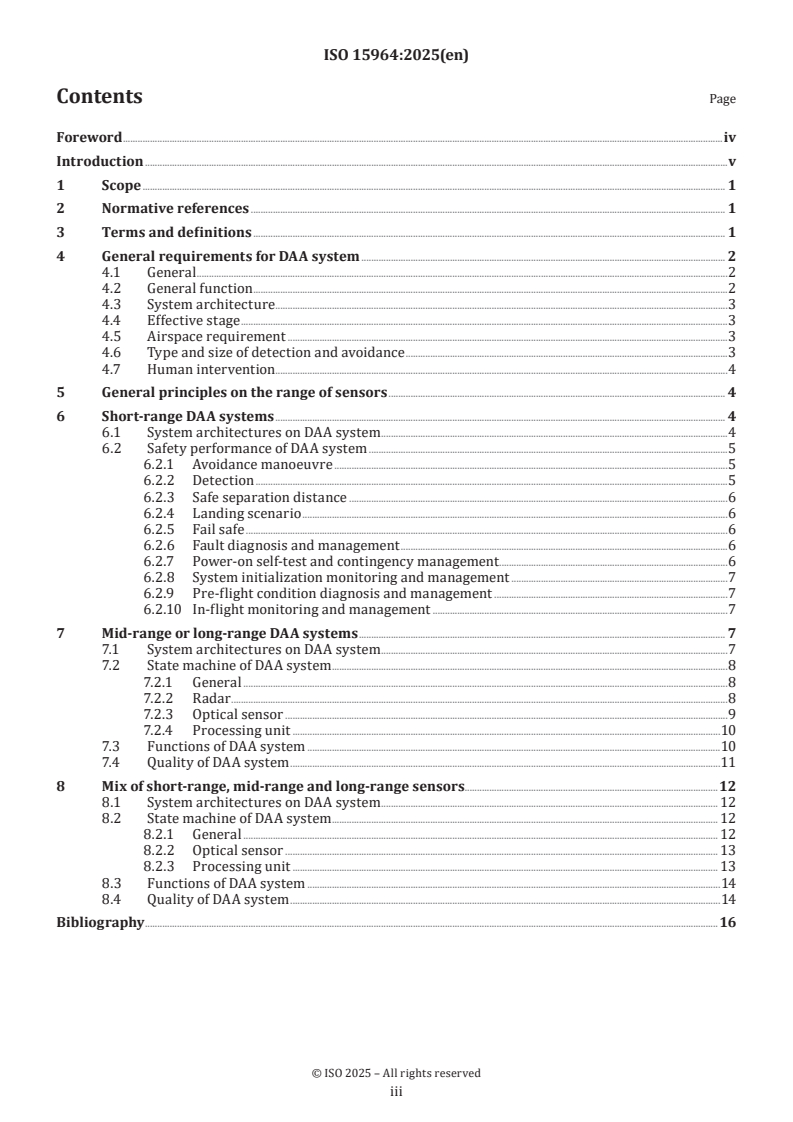
Contents Page
Foreword .iv
Introduction .v
1 Scope . 1
2 Normative references . 1
3 Terms and definitions . 1
4 General requirements for DAA system . 2
4.1 General .2
4.2 General function .2
4.3 System architecture . .3
4.4 Effective stage .3
4.5 Airspace requirement .3
4.6 Type and size of detection and avoidance .3
4.7 Human intervention.4
5 General principles on the range of sensors . 4
6 Short-range DAA systems . 4
6.1 System architectures on DAA system .4
6.2 Safety performance of DAA system .5
6.2.1 Avoidance manoeuvre .5
6.2.2 Detection .5
6.2.3 Safe separation distance .6
6.2.4 Landing scenario .6
6.2.5 Fail safe .6
6.2.6 Fault diagnosis and management .6
6.2.7 Power-on self-test and contingency management .6
6.2.8 System initialization monitoring and management .7
6.2.9 Pre-flight condition diagnosis and management .7
6.2.10 In-flight monitoring and management .7
7 Mid-range or long-range DAA systems . 7
7.1 System architectures on DAA system .7
7.2 State machine of DAA system .8
7.2.1 General .8
7.2.2 Radar .8
7.2.3 Optical sensor .9
7.2.4 Processing unit .10
7.3 Functions of DAA system .10
7.4 Quality of DAA system .11
8 Mix of short-range, mid-range and long-range sensors.12
8.1 System architectures on DAA system . 12
8.2 State machine of DAA system . 12
8.2.1 General . 12
8.2.2 Optical sensor . 13
8.2.3 Processing unit . 13
8.3 Functions of DAA system .14
8.4 Quality of DAA system .14
Bibliography .16
iii
Foreword
ISO (the International Organization for Standardization) is a worldwide federation of national standards
bodies (ISO member bodies). The work of preparing International Standards is normally carried out through
ISO technical committees. Each member body interested in a subject for which a technical committee
has been established has the right to be represented on that committee. International organizations,
governmental and non-governmental, in liaison with ISO, also take part in the work. ISO collaborates closely
with the International Electrotechnical Commission (IEC) on all matters of electrotechnical standardization.
The procedures used to develop this document and those intended for its further maintenance are described
in the ISO/IEC Directives, Part 1. In particular, the different approval criteria needed for the different types
of ISO document should be noted. This document was drafted in accordance with the editorial rules of the
ISO/IEC Directives, Part 2 (see www.iso.org/directives).
ISO draws attention to the possibility that the implementation of this document may involve the use of (a)
patent(s). ISO takes no position concerning the evidence, validity or applicability of any claimed patent
rights in respect thereof. As of the date of publication of this document, ISO had not received notice of (a)
patent(s) which may be required to implement this document. However, implementers are cautioned that
this may not represent the latest information, which may be obtained from the patent database available at
www.iso.org/patents. ISO shall not be held responsible for identifying any or all such patent rights.
Any trade name used in this document is information given for the convenience of users and does not
constitute an endorsement.
For an explanation of the voluntary nature of standards, the meaning of ISO specific terms and expressions
related to conformity assessment, as well as information about ISO's adherence to the World Trade
Organization (WTO) principles in the Technical Barriers to Trade (TBT), see www.iso.org/iso/foreword.html.
This document was prepared by Technical Committee ISO/TC 20, Aircraft and space vehicles, Subcommittee
SC 16, Uncrewed aircraft system.
Any feedback or questions on this document should be directed to the user’s national standards body. A
complete listing of these bodies can be found at www.iso.org/members.html.
iv
Introduction
With rapid technological advancements, uncrewed aerial systems (UAS) are continuing to become more
autonomous in operation and accessible to consumers. Today, the use of UAS technology is not only prevalent
for entertainment purposes but also extending into various industrial applications such as logistics, disaster
release, powerline inspection. There is an increasing number of UAS operations in low altitude airspace
where the safety considerations can be quite complex, especially in the context of urban areas. All types
of UAS operating in such areas must be able to avoid ground objects like high-rise buildings, cranes, public
utilities such as power grid and mobile network antennas, along with other users of the same airspace such
as low-flying helicopters, other UASs and kites. Micro-weather patterns also pose a challenge because of
their uncertainty, invisibility, and unpredictability.
A detection and avoidance (DAA) system is one of the key onboard systems to address these challenges.
By sensing the surrounding situations, the DAA system can examine the size and distance of a particular
obstacle, apply trajectory planning and then calculate the possibility of collision. It orders the flight control
system to make UAS deceleration, completely stop or offset the obstacle in a fully autonomous manner. The
function and performance of the DAA system is closely related to its safety speed, which has a direct impact
on the scope of UAS. Failure detection also causes instability and unexpected deceleration.
To ensure a safe and secure operating environment, it is of significant importance to develop a standard
for DAA systems, which includes the general requirements for key components and functions as well as
associated performance.
v
International Standard ISO 15964:2025(en)
Detection and avoidance systems for uncrewed aircraft systems
1 Scope
This document specifies safety and quality requirements for detection and avoidance (DAA) systems used
between uncrewed aircraft systems (UAS) and other objects including aircraft. This document includes the
requirements for radars and optical sensors used for DAA and is derived to meet the requirements for UAS
operations involving DAA set out in ISO 21384-3.
2 Normative references
The following documents are referred to in the text in such a way that some or all of their content constitutes
requirements of this document. For dated references, only the edition cited applies. For undated references,
the latest edition of the referenced document (including any amendments) applies.
ISO 21384-3:2023, Unmanned aircraft systems — Part 3: Operational procedures
ISO 21384-4, Unmanned aircraft systems — Part 4: Vocabulary
3 Terms and definitions
For the purposes of this document, the terms and definitions given in ISO 21384-4 and the following apply.
ISO and IEC maintain terminology databases for use in standardization at the following addresses:
— ISO Online browsing platform: available at https:// www .iso .org/ obp
— IEC Electropedia: available at https:// www .electropedia .org/
3.1
field of view
angular range of a target observed by a sensor along a dimension
3.2
fail safe
condition that the system can operate safely in the event of the failure of any single component
3.3
fault diagnosis and isolation
process to check and isolate the fault point when there is any system fault so that the fault does not affect the
safety of system
3.4
detection and recognition unit
system comprised of sensors and the processing unit (3.5) including its software systems, equipped with an
interface to send information into a UAS traffic management (UTM) function or an operator
3.5
processing unit
unit that transmits and processes the information from interfaced systems such as sensors and UAS control
systems (3.6)
3.6
UAS control system
system that transmits and processes the control signals of UAS and actuator of UAS
3.7
detection
determination of the presence or absence of targets, which can trigger the sequence of DAA operations
3.8
recognition
determination of the types of the object(s) of interest such as cooperative UAs, non-cooperative UAs, and
other hazards, and supportive information such as distance to the object(s) of interest and possibly their
velocity and full trajectory, providing predictions of their future location
3.9
manoeuvre
action performed by a UAS to change its trajectory or speed to avoid collision
EXAMPLE Manoeuvre actions are horizontal turn, hovering, deceleration, acceleration, climb, and descent.
3.10
DAA system
detection and avoidance system
on-board subsystem to perform the non-cooperative detection and avoidance of objects and targets such as
crewed and uncrewed aircraft, with or without UAS traffic management (UTM), to achieve a safe and secure
operating environment
Note 1 to entry: It is supposed that the DAA and UTM systems work in conjunction.
4 General requirements for DAA system
4.1 General
This clause specifies general requirements for DAA systems to ensure safety and quality for each detection
target type. Operational performance requirements of systems based on object and target types are
specified.
4.2 General function
The DAA system shall include the following functions:
a) environmental perception: being able to sense the surrounding environment during the flight and
detect the objects;
b) situational awareness: determining whether a potential risk affecting the flight safety exists based on
obstacle detection and related data analysis (e.g. flight speed, course, altitude and absolute position,
high-precision map);
c) target avoidance: conducting a decision-making process for traffic avoidance and executing manoeuvres
to avoid targets in accordance with situational awareness message;
d) fault detection and isolation: monitoring the operation of obstacle avoidance system and finding out the
faults that can cause system anomalies;
e) fault indication: conveying the fault message timely in case of a fault;
f) fault correction: correcting the fault without affecting the operation of the obstacle avoidance system in
the event of a fault to eliminate the negative impact.
4.3 System architecture
Figure 1 shows the general architecture of a DAA system. The DAA system should have an interface with
UTM or operator, for the purpose of conveying information on the detection and avoidance. The information
exchanged between the UAS control unit and the UTM or operator is as follows:
a) detection status;
b) recognition status;
c) manoeuvre status;
d) check manoeuvre status;
e) DAA status (optional, provide the ability to be controlled).
The system should use sensors for environmental perception. Recommended sensors include microwave
radar, laser radar, camera, infrared sensor, ultrasonic sensor, volumetric sensor, or a combination thereof.
The system should be equipped with a fault diagnosis and isolation function.
Figure 1 — DAA general architecture
4.4 Effective stage
The DAA system shall be effective throughout the flight envelope.
4.5 Airspace requirement
As for airspace, all classes of airspace shall be covered.
4.6 Type and size of detection and avoidance
The detection and avoidance system shall include static objects and dynamic objects. Static objects refer to
objects that are stationary to the ground, such as buildings, trees, towers, poles, and wires. Dynamic objects
include birds and aircraft.
4.7 Human intervention
The system shall specify the level of human intervention in accordance with the following three categories
as specified in ISO 21384-3.
a) Human in the loop:
1) Reporting from the UAS itself: reporting for each step is carried out.
2) UTM or an operator reviews all reports and decides on avoidance.
3) The UAS itself does not perform avoidance by itself unless commanded by UTM or an operator.
b) Human on the loop:
1) Reporting from the UAS itself: reporting for each step is carried out.
2) UTM or an operator reviews the reports for steps 2 and 4 as defined in 7.4, for which the decision is
required as specified in ISO 21384-3:2023, Figure 1.
3) The UAS itself may perform avoidance by itself without being commanded by UTM or an operator.
4) Reports are required for steps 4, 5 and 6 as defined in 7.4.
c) Human out of the loop:
1) Reporting from the UAS itself: only reports available from the UAS itself are required. (Incidents
deviating from procedures specified in ISO 21384-3:2023, Figure 1 are assumed.)
2) UTM or an operator reviews the reports fo
...