

ISO 5309:2023
(Main)Civil small and light unmanned aircraft systems (UAS) — Vibration test methods
General Information
- Abstract
This document specifies the test conditions and methods to be used for the vibration testing of unmanned aircraft system (UAS, including unmanned aircraft and ground station) which applies to level II through V according to ISO 21895.
- Status
- Published
- Publication Date
- 03-Dec-2023
- Technical Committee
- ISO/TC 20/SC 16 - Unmanned aircraft systems
- Drafting Committee
- ISO/TC 20/SC 16/WG 5 - Testing and evaluation
- Current Stage
- 6060 - International Standard published
- Start Date
- 04-Dec-2023
- Due Date
- 12-Sep-2023
- Completion Date
- 04-Dec-2023

Overview
ISO 5309:2023 - "Civil small and light unmanned aircraft systems (UAS) - Vibration test methods" specifies test conditions and methods for vibration testing of small and light UAS (including unmanned aircraft and ground stations). It applies to UAS classified Level II through V per ISO 21895 and defines how to simulate the vibration environments experienced during flight, engine/rotor operation, and transportation to verify functional performance (excluding long-term durability).
Key topics and technical requirements
- Types of vibration tests
- Standard vibration test (to simulate in-service flight/engine/rotor vibration)
- Transportation vibration test (to simulate vibration during transport)
- Test forms include random, sinusoidal, and sine‑on‑random.
- Measurement-first approach
- Use actual measured vibration data wherever possible; fallback magnitudes are provided in the standard (see referenced tables).
- Test axes and duration
- Tests are performed in the three orthogonal axes of the test article.
- Typical test duration is 1 hour per axis unless another duration is specified.
- Specific guidance by configuration and powerplant
- Test selection depends on UAS configuration (multicopter, fixed‑wing, helicopter) and engine type (electric motor, piston, turbine, mixed).
- Tables map test types and magnitudes to maximum take-off mass and level categories (e.g., categories showing thresholds like ≤10 kg, ≤50 kg, >50 kg).
- Control, tolerance and procedure
- The standard defines control-level tolerances for random and sinusoidal inputs, installation and check procedures before/after tests, and reporting requirements.
- Deliverables
- Requirements for a detailed test report and informative annex on information to provide to relevant functions.
Practical applications - who uses ISO 5309
- UAS manufacturers and designers - to validate that aircraft electronics, structures, sensors, and payload mounts function under expected vibration environments.
- Test laboratories - to design and perform standardized vibration tests (random, sinusoidal, sine‑on‑random) and vehicle field tests.
- Certification and compliance engineers - to demonstrate conformity with industry vibration requirements for Levels II–V.
- Maintenance, procurement and system integrators - to define acceptance tests for transported or field‑deployed UAS and ground stations.
Related standards and keywords
- Normative references: ISO 2041, ISO 21384‑4, ISO 21895 (classification).
- SEO keywords: ISO 5309, UAS vibration testing, vibration test methods, civil small and light unmanned aircraft systems, random vibration, sinusoidal test, sine‑on‑random, PSD (power spectral density), transportation vibration test, ground station vibration.
ISO 5309 provides a practical, measurement‑oriented framework for verifying UAS performance under realistic vibration loads encountered in flight and transport, supporting safer and more robust small UAS design and certification.
Get Certified
Connect with accredited certification bodies for this standard

BSI Group
BSI (British Standards Institution) is the business standards company that helps organizations make excellence a habit.

Bureau Veritas
Bureau Veritas is a world leader in laboratory testing, inspection and certification services.

DNV
DNV is an independent assurance and risk management provider.
Sponsored listings
Frequently Asked Questions
ISO 5309:2023 is a standard published by the International Organization for Standardization (ISO). Its full title is "Civil small and light unmanned aircraft systems (UAS) — Vibration test methods". This standard covers: This document specifies the test conditions and methods to be used for the vibration testing of unmanned aircraft system (UAS, including unmanned aircraft and ground station) which applies to level II through V according to ISO 21895.
This document specifies the test conditions and methods to be used for the vibration testing of unmanned aircraft system (UAS, including unmanned aircraft and ground station) which applies to level II through V according to ISO 21895.
ISO 5309:2023 is classified under the following ICS (International Classification for Standards) categories: 17.160 - Vibrations, shock and vibration measurements; 49.020 - Aircraft and space vehicles in general. The ICS classification helps identify the subject area and facilitates finding related standards.
ISO 5309:2023 is available in PDF format for immediate download after purchase. The document can be added to your cart and obtained through the secure checkout process. Digital delivery ensures instant access to the complete standard document.
Standards Content (Sample)
INTERNATIONAL ISO
STANDARD 5309
First edition
2023-12
Civil small and light unmanned
aircraft systems (UAS) — Vibration
test methods
Aéronefs sans pilote (UAS) civils petits et légers — Méthodes d'essais
de vibrations
Reference number
© ISO 2023
All rights reserved. Unless otherwise specified, or required in the context of its implementation, no part of this publication may
be reproduced or utilized otherwise in any form or by any means, electronic or mechanical, including photocopying, or posting on
the internet or an intranet, without prior written permission. Permission can be requested from either ISO at the address below
or ISO’s member body in the country of the requester.
ISO copyright office
CP 401 • Ch. de Blandonnet 8
CH-1214 Vernier, Geneva
Phone: +41 22 749 01 11
Email: copyright@iso.org
Website: www.iso.org
Published in Switzerland
ii
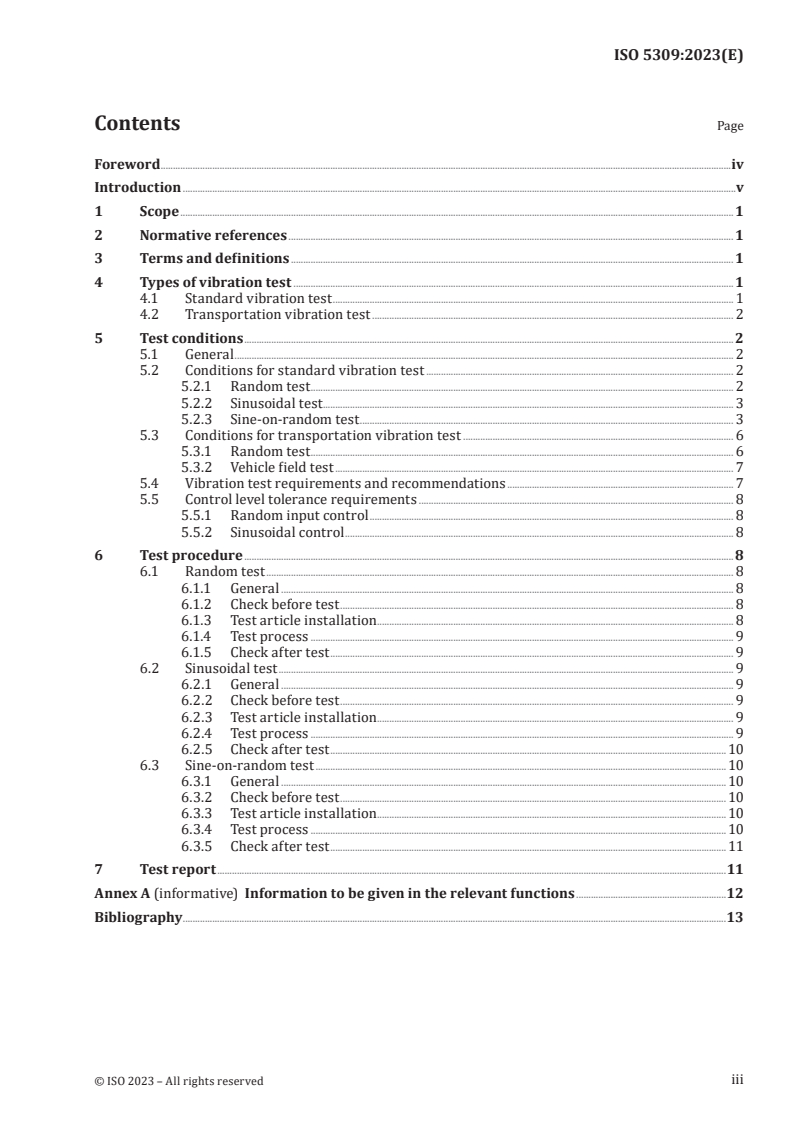
Contents Page
Foreword .iv
Introduction .v
1 Scope . 1
2 Normative references . 1
3 Terms and definitions . 1
4 Types of vibration test .1
4.1 Standard vibration test . 1
4.2 Transportation vibration test . 2
5 Test conditions .2
5.1 General . 2
5.2 Conditions for standard vibration test . 2
5.2.1 Random test . 2
5.2.2 Sinusoidal test . . 3
5.2.3 Sine-on-random test . 3
5.3 Conditions for transportation vibration test . 6
5.3.1 Random test . 6
5.3.2 Vehicle field test . 7
5.4 Vibration test requirements and recommendations . 7
5.5 Control level tolerance requirements . 8
5.5.1 Random input control . 8
5.5.2 Sinusoidal control . 8
6 Test procedure .8
6.1 Random test . 8
6.1.1 General . 8
6.1.2 Check before test . 8
6.1.3 Test article installation . 8
6.1.4 Test process . 9
6.1.5 Check after test . 9
6.2 Sinusoidal test . 9
6.2.1 General . 9
6.2.2 Check before test . 9
6.2.3 Test article installation . 9
6.2.4 Test process . 9
6.2.5 Check after test . 10
6.3 Sine-on-random test . 10
6.3.1 General . 10
6.3.2 Check before test . 10
6.3.3 Test article installation . 10
6.3.4 Test process . 10
6.3.5 Check after test . 11
7 Test report .11
Annex A (informative) Information to be given in the relevant functions .12
Bibliography .13
iii
Foreword
ISO (the International Organization for Standardization) is a worldwide federation of national standards
bodies (ISO member bodies). The work of preparing International Standards is normally carried out
through ISO technical committees. Each member body interested in a subject for which a technical
committee has been established has the right to be represented on that committee. International
organizations, governmental and non-governmental, in liaison with ISO, also take part in the work.
ISO collaborates closely with the International Electrotechnical Commission (IEC) on all matters of
electrotechnical standardization.
The procedures used to develop this document and those intended for its further maintenance are
described in the ISO/IEC Directives, Part 1. In particular, the different approval criteria needed for the
different types of ISO document should be noted. This document was drafted in accordance with the
editorial rules of the ISO/IEC Directives, Part 2 (see www.iso.org/directives).
ISO draws attention to the possibility that the implementation of this document may involve the use
of (a) patent(s). ISO takes no position concerning the evidence, validity or applicability of any claimed
patent rights in respect thereof. As of the date of publication of this document, ISO had not received
notice of (a) patent(s) which may be required to implement this document. However, implementers are
cautioned that this may not represent the latest information, which may be obtained from the patent
database available at www.iso.org/patents. ISO shall not be held responsible for identifying any or all
such patent rights.
Any trade name used in this document is information given for the convenience of users and does not
constitute an endorsement.
For an explanation of the voluntary nature of standards, the meaning of ISO specific terms and
expressions related to conformity assessment, as well as information about ISO's adherence to
the World Trade Organization (WTO) principles in the Technical Barriers to Trade (TBT), see
www.iso.org/iso/foreword.html.
This document was prepared by Technical ISO/TC 20, Aircraft and space vehicles, Subcommittee SC 16,
Unmanned aircraft systems.
Any feedback or questions on this document should be directed to the user’s national standards body. A
complete listing of these bodies can be found at www.iso.org/members.html.
iv
Introduction
In recent years, the market for lightweight and small civil unmanned aircraft systems (UAS) has
developed rapidly. Application areas range from consumer-grade unmanned aircraft vehicles fitted
with a camera to industrial-grade unmanned aircraft vehicles used in various safety and inspection
operations (e.g. in agriculture, electrical distribution and public safety). As a consequence of being
transported from job site to job site, the UAS is exposed to a vibration environment during its lifetime.
This document sets out a vibration environment that reflects the situation the UAS experiences during
transportation and flight, and to which it can be tested so as to verify whether the test article complies
with the applicable performance standards (excluding durability requirements) when subjected to
vibration levels specified for the appropriate installation.
v
INTERNATIONAL STANDARD ISO 5309:2023(E)
Civil small and light unmanned aircraft systems (UAS) —
Vibration test methods
1 Scope
This document specifies the test conditions and methods to be used for the vibration testing of
unmanned aircraft system (UAS, including unmanned aircraft and ground station) which applies to
level II through V according to ISO 21895.
2 Normative references
The following documents are referred to in the text in such a way that some or all of their content
constitutes requirements of this document. For dated references, only the edition cited applies. For
undated references, the latest edition of the referenced document (including any amendments) applies.
ISO 2041, Mechanical vibration, shock and condition monitoring — Vocabulary
ISO 21384-4, Unmanned aircraft systems — Part 4: Vocabulary
ISO 21895, Categorization and classification of civil unmanned aircraft systems
3 Terms and definitions
For the purposes of this document, the terms and definitions given in ISO 2041 and ISO 21384-4 and
the following apply.
ISO and IEC maintain terminology databases for use in standardization at the following addresses:
— ISO Online browsing platform: available at https:// www .iso .org/ obp
— IEC Electropedia: available at https:// www .electropedia .org/
3.1
power spectral density
PSD
degree of variation in energy for each frequency to the acceleration signal in a specific frequency range
as a function of frequency
4 Types of vibration test
4.1 Standard vibration test
Standard vibration test is performed to verify whether the UA can work normally when it is subjected
to a vibration environment expected during flight, including engine(s) running and rotor(s) turning on
ground (e.g. ground resonance prevention). The test may be performed under the conditions involving
random test, sinusoidal test, and sine-on-random test.
Measured values should be collected from representative operations and used in testing whenever
possible.
4.2 Transportation vibration test
Transportation vibration test is performed to verify whether UAS can work normally after it is subjected
to conditions involving vibration induced by transportation.
5 Test conditions
5.1 General
The types of vibration test to which the UA (S) is to be exposed to is dependent on the powerplant type
described in Table 1.
Generally speaking, sinusoidal vibration test is applicable to verify whether the design of the product
meets the requirements and whether the product is intact after sinusoidal vibration test. Random
vibration test mainly simulates the vibration adaptability of products under broadband excitation,
especially when the resonance point cannot be determined. Sine-on-random vibration test is mainly
used to assess the adaptability of the test article under the condition of superposition of broadband
excitation and sinusoidal fixed frequency.
Table 1 — Types of vibration test
a
UA configuration Engine/power plant type Type of vibration test
Electric motor Standard vibration Random; sinusoidal
Multicopter
Random test or vehicle field
/ Transportation vibration
test
Electric motor Sinusoidal
Turbine engine, piston engine Sinusoidal
Standard vibration
Envelope value according
Fixed-wing
Mixed power plant to the type of mixed power
plant
Random test or vehicle field
/ Transportation vibration
test
Electric motor Random; sinusoidal
Sine-on-random (known
frequency)
Turbine engine, piston engine
Random (unknown fre-
Standard vibration
quency)
Unmanned helicopter
Envelope value according
Mixed power plant to the type of mixed power
plant
Random test or vehicle field
/ Transportation vibration
test
Ground station (vehi- Random test or vehicle field
/ Transportation vibration
cle-mounted/carried) test
a
The engine/power plant types include but are not limited to electric motor, piston engine, turbine engine, mixed power
plant, rocket engine, and compressed air power plant according to ISO 21895. In this document, only the commonly used
engine/power plant types are considered (e.g. electric motor, piston engine, turbine engine, and mixed power plant).
5.2 Conditions for standard vibration test
5.2.1 Random test
a) Measurements: measured values shall be used wherever possible. If measured values are not
available, the values shown in Table 2 shall be used.
b) Axial direction: test shall be performed in each of the test article's three orthogonal axes.
c) Test duration: 1 h for each axis or the time specified by relevant specification of the test article.
5.2.2 Sinusoidal test
a) Measurements: measured values shall be used wherever possible. If measured values are not
available, the values shown in Table 2 shall be used.
b) Axial direction: test shall be performed in each of the test article's three orthogonal axes.
c) Test duration: 1 h for each axis or the time specified by relevant specification of the test article.
5.2.3 Sine-on-random test
a) Measurements: measured values shall be used wherever possible. If measured values are not
available, the values shown in Table 2 shall be used.
b) Axial direction: test shall be performed in each of the test article's three orthogonal axes.
c) Test duration: 1 h for each axis or the time specified by relevant specification of the test article.
Table 2 — Standard vibration test magnitude
UA configura- Engine/power Maximum take-off mass
Type of vibration Magnitude
tion plant type kg
Refer to Table 3 and
Level II, III, IV Random; sinusoidal
Table 4 for details
Refer to Table 3 and
≤ 10 Random; sinusoidal
Table 4 for details
Level IV
Refer to Table 5 and
Multicopter Electric motor > 10 Random; sinusoidal
Table 6 for details
Refer to Table 5 and
≤ 50 Random; sinusoidal
Table 6 for details
Level V
a
Refer to Table 7 and
> 50 Random; sinusoidal
a
Table 8 for details
a
Refer to Table 9 for
Electric motor Level II, III, IV, V Sinusoidal
details
a
Fixed-wing Turbine engine, Refer to Table 10
Level V Sinusoidal
piston engine for detail
...