

ISO 5332:2023
(Main)Civil small and light unmanned aircraft systems (UAS) under low-pressure conditions — Test methods
General Information
- Abstract
This document specifies test method to determine the operation ability of unmanned aircraft systems (UAS) at low-air-pressure conditions. This document is applicable to the category of civil small and light UAS, which applies to maximum take-off mass (MTOM) level II through V according to ISO 21895.
- Status
- Published
- Publication Date
- 18-Oct-2023
- Technical Committee
- ISO/TC 20/SC 16 - Unmanned aircraft systems
- Drafting Committee
- ISO/TC 20/SC 16/WG 5 - Testing and evaluation
- Current Stage
- 6060 - International Standard published
- Start Date
- 19-Oct-2023
- Due Date
- 12-Sep-2023
- Completion Date
- 19-Oct-2023
Overview
ISO 5332:2023 - Civil small and light unmanned aircraft systems (UAS) under low‑pressure conditions - Test methods - specifies standardized environmental test methods to determine the operational capability of civil small and light UAS when exposed to low‑air‑pressure (high‑altitude) conditions. It applies to UAS in MTOM levels II through V as defined in ISO 21895 and defines chamber conditions, procedures, acceptance checks and reporting requirements for functional performance at reduced pressure and temperature combinations.
Key topics and technical requirements
- Test scope: Functional performance verification of small and light civil UAS at low air pressure; certain functional checks are performed inside a test chamber (Annex A).
- Representative test points: Example low‑pressure test conditions include:
- –46 °C at 40 kPa (≈ 7 150 m)
- –19 °C at 70 kPa (≈ 3 000 m)
- –32 °C at 55 kPa (≈ 4 850 m) (Also includes high‑temperature/low‑pressure variants; pressures can be calculated per referenced formula.)
- Allowed tolerances: temperature ±2 °C; air pressure ±5 %; relative humidity ±3 %.
- Rates of change: temperature change ≤ 3 °C/min; pressure change ≤ 4.8 kPa/min.
- Preconditioning: temperature stabilization times based on UAS mass (≤1.5 kg: 1 h; ≤15 kg: 2 h; ≤150 kg: 4 h), with guidance referencing IEC 60068‑2‑39.
- Test chamber requirements: valid calibration, ability to maintain specified conditions, contamination control for chamber intake air, and continuous monitoring of temperature and pressure.
- Procedures: pretest functional inspection at standard atmosphere (15–35 °C; 84–107 kPa; RH ≤85 %), conditioning (sequence guidance), recovery to standard conditions, and post‑test inspection and reporting.
- Failure handling: rules for interruption, restart, replacement or repair of test articles.
- Documentation: minimum test report contents include model/serial, standards used, methods, results, deviations and date.
Applications and who uses it
- UAS manufacturers conducting environmental qualification for high‑altitude operation.
- Independent test laboratories and certification bodies performing conformity and performance assessments.
- R&D and engineering teams validating flight control, sensors, data storage, camera systems, VTOL takeoff/landing, obstacle avoidance and other functional items under reduced pressure.
- Operators planning missions in mountainous or high‑altitude regions who need documented evidence of operational suitability.
Related standards
- ISO 21895 - MTOM level definitions for small and light UAS (referenced for applicability).
- ISO 21384‑4 - UAS vocabulary and terms referenced.
- IEC 60068‑2‑39 and IEC 60721‑2‑3 - referenced for temperature stabilization and atmospheric calculations.
Keywords: ISO 5332:2023, UAS test methods, low‑air‑pressure testing, unmanned aircraft systems, environmental testing, high‑altitude UAS.
Get Certified
Connect with accredited certification bodies for this standard

BSI Group
BSI (British Standards Institution) is the business standards company that helps organizations make excellence a habit.

Bureau Veritas
Bureau Veritas is a world leader in laboratory testing, inspection and certification services.

DNV
DNV is an independent assurance and risk management provider.
Sponsored listings
Frequently Asked Questions
ISO 5332:2023 is a standard published by the International Organization for Standardization (ISO). Its full title is "Civil small and light unmanned aircraft systems (UAS) under low-pressure conditions — Test methods". This standard covers: This document specifies test method to determine the operation ability of unmanned aircraft systems (UAS) at low-air-pressure conditions. This document is applicable to the category of civil small and light UAS, which applies to maximum take-off mass (MTOM) level II through V according to ISO 21895.
This document specifies test method to determine the operation ability of unmanned aircraft systems (UAS) at low-air-pressure conditions. This document is applicable to the category of civil small and light UAS, which applies to maximum take-off mass (MTOM) level II through V according to ISO 21895.
ISO 5332:2023 is classified under the following ICS (International Classification for Standards) categories: 49.020 - Aircraft and space vehicles in general. The ICS classification helps identify the subject area and facilitates finding related standards.
ISO 5332:2023 is available in PDF format for immediate download after purchase. The document can be added to your cart and obtained through the secure checkout process. Digital delivery ensures instant access to the complete standard document.
Standards Content (Sample)
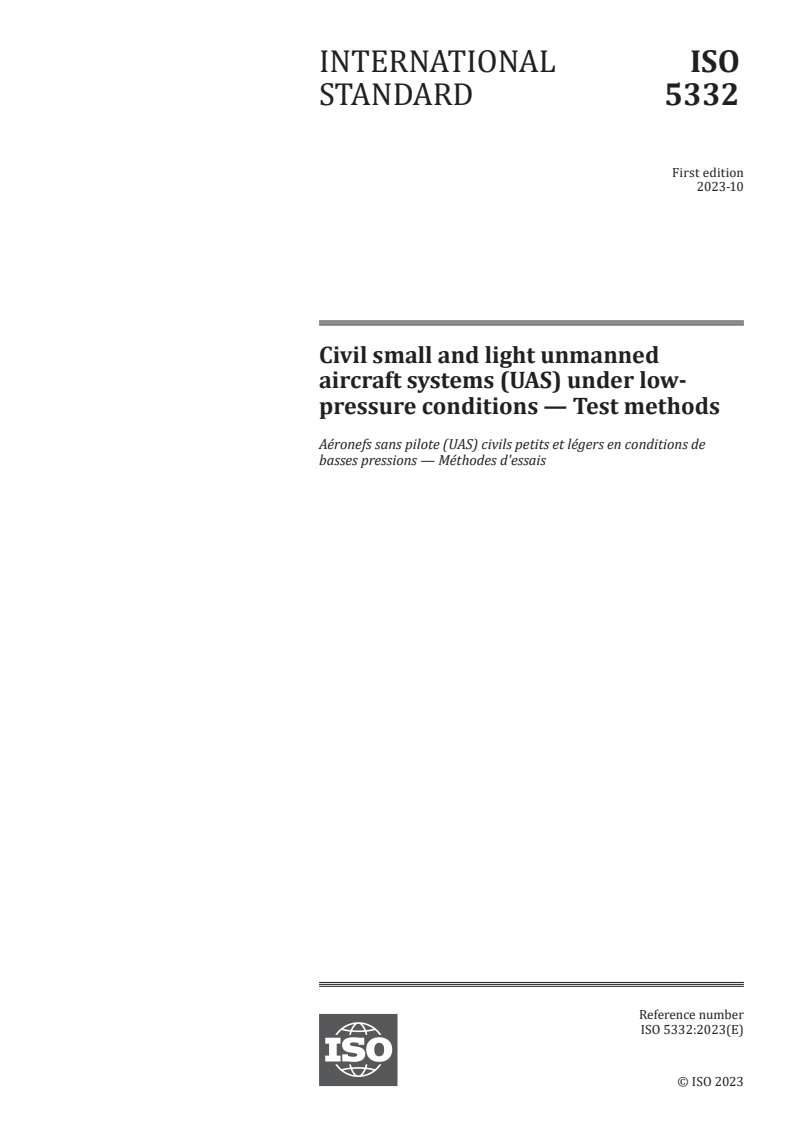
INTERNATIONAL ISO
STANDARD 5332
First edition
2023-10
Civil small and light unmanned
aircraft systems (UAS) under low-
pressure conditions — Test methods
Aéronefs sans pilote (UAS) civils petits et légers en conditions de
basses pressions — Méthodes d'essais
Reference number
© ISO 2023
All rights reserved. Unless otherwise specified, or required in the context of its implementation, no part of this publication may
be reproduced or utilized otherwise in any form or by any means, electronic or mechanical, including photocopying, or posting on
the internet or an intranet, without prior written permission. Permission can be requested from either ISO at the address below
or ISO’s member body in the country of the requester.
ISO copyright office
CP 401 • Ch. de Blandonnet 8
CH-1214 Vernier, Geneva
Phone: +41 22 749 01 11
Email: copyright@iso.org
Website: www.iso.org
Published in Switzerland
ii
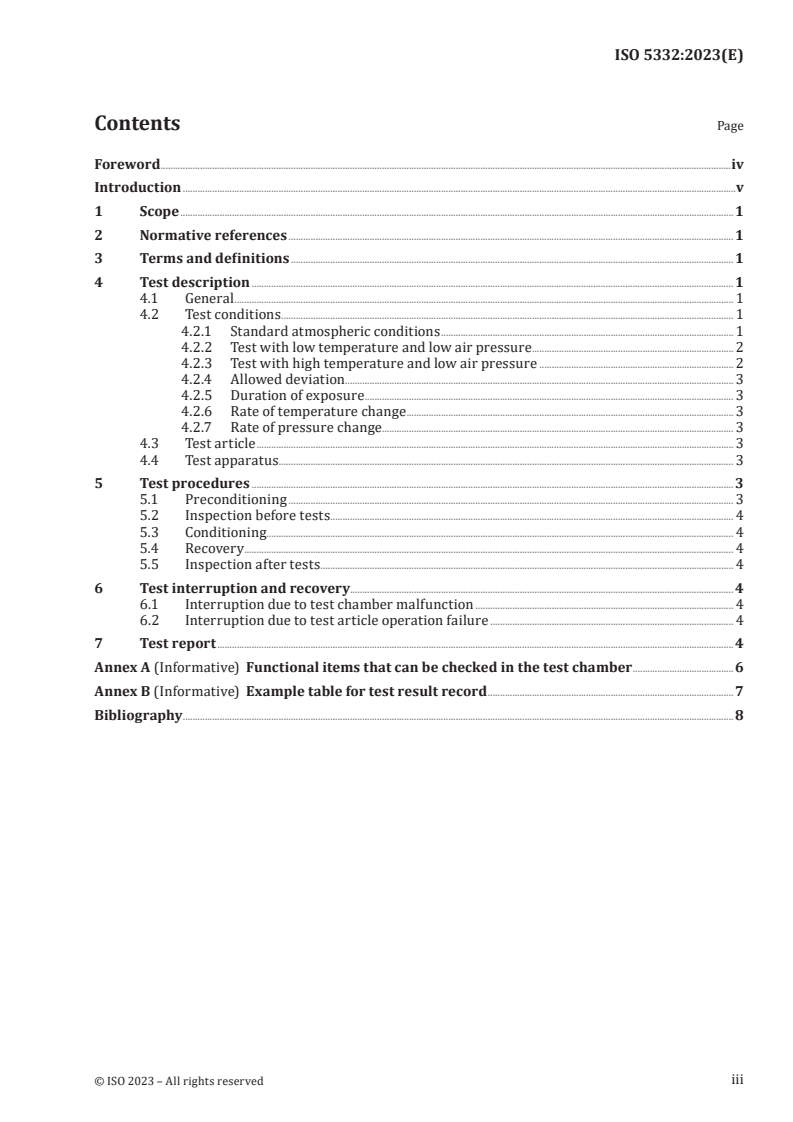
Contents Page
Foreword .iv
Introduction .v
1 Scope . 1
2 Normative references . 1
3 Terms and definitions . 1
4 Test description . 1
4.1 General . 1
4.2 Test conditions . 1
4.2.1 Standard atmospheric conditions . 1
4.2.2 Test with low temperature and low air pressure . 2
4.2.3 Test with high temperature and low air pressure . 2
4.2.4 Allowed deviation . . . 3
4.2.5 Duration of exposure . 3
4.2.6 Rate of temperature change . 3
4.2.7 Rate of pressure change . . 3
4.3 Test article . 3
4.4 Test apparatus. 3
5 Test procedures . 3
5.1 Preconditioning . 3
5.2 Inspection before tests . 4
5.3 Conditioning. 4
5.4 Recovery . 4
5.5 Inspection after tests . . 4
6 Test interruption and recovery. 4
6.1 Interruption due to test chamber malfunction . 4
6.2 Interruption due to test article operation failure . 4
7 Test report . 4
Annex A (Informative) Functional items that can be checked in the test chamber .6
Annex B (Informative) Example table for test result record . 7
Bibliography . 8
iii
Foreword
ISO (the International Organization for Standardization) is a worldwide federation of national standards
bodies (ISO member bodies). The work of preparing International Standards is normally carried out
through ISO technical committees. Each member body interested in a subject for which a technical
committee has been established has the right to be represented on that committee. International
organizations, governmental and non-governmental, in liaison with ISO, also take part in the work.
ISO collaborates closely with the International Electrotechnical Commission (IEC) on all matters of
electrotechnical standardization.
The procedures used to develop this document and those intended for its further maintenance are
described in the ISO/IEC Directives, Part 1. In particular, the different approval criteria needed for the
different types of ISO document should be noted. This document was drafted in accordance with the
editorial rules of the ISO/IEC Directives, Part 2 (see www.iso.org/directives).
ISO draws attention to the possibility that the implementation of this document may involve the use
of (a) patent(s). ISO takes no position concerning the evidence, validity or applicability of any claimed
patent rights in respect thereof. As of the date of publication of this document, ISO had not received
notice of (a) patent(s) which may be required to implement this document. However, implementers are
cautioned that this may not represent the latest information, which may be obtained from the patent
database available at www.iso.org/patents. ISO shall not be held responsible for identifying any or all
such patent rights.
Any trade name used in this document is information given for the convenience of users and does not
constitute an endorsement.
For an explanation of the voluntary nature of standards, the meaning of ISO specific terms and
expressions related to conformity assessment, as well as information about ISO's adherence to
the World Trade Organization (WTO) principles in the Technical Barriers to Trade (TBT), see
www.iso.org/iso/foreword.html.
This document was prepared by Technical Committee ISO/TC 20, Aircraft and space vehicles,
Subcommittee SC 16, Unmanned aircraft systems.
Any feedback or questions on this document should be directed to the user’s national standards body. A
complete listing of these bodies can be found at www.iso.org/members.html.
iv
Introduction
The market of civil unmanned aircraft systems (UAS) is developing rapidly. UAS are widely used
not only by consumers, such as for aerial photography, but also for industrial purposes, for example,
powerline inspection, vegetation protection, and environmental monitoring. In high-altitude areas, the
demand for UAS is also increasing. However, there are currently no standards specifically for testing
the functional performance of UAS under such environmental conditions. Therefore, it is necessary to
propose a scientific method to test the UAS under low -air -pressure conditions.
Other elements of the UAS, for example personnel, can also adversely affect low-pressure performance.
Although they are not addressed
...