

ISO 10938:2016
(Main)Ophthalmic optics — Chart displays for visual acuity measurement — Printed, projected and electronic
General Information
- Abstract
ISO 10938:2016 applies to displays of optotypes generated by chart projectors and all other visual acuity measurement systems that use recognition of high-contrast optotypes and that are designed for general use, including optotypes printed on media (either opaque or intended for transillumination), those generated electronically, and those produced by optical projection.
- Status
- Published
- Publication Date
- 21-Sep-2016
- Technical Committee
- ISO/TC 172/SC 7 - Ophthalmic optics and instruments
- Drafting Committee
- ISO/TC 172/SC 7/WG 6 - Ophthalmic instruments and test methods
- Current Stage
- 9093 - International Standard confirmed
- Start Date
- 07-Dec-2021
- Completion Date
- 29-Aug-2026
Buy Documents



ISO 10938:2016 - Ophthalmic optics -- Chart displays for visual acuity measurement -- Printed, projected and electronic


ISO 10938:2016 - Ophthalmic optics — Chart displays for visual acuity measurement — Printed, projected and electronic/22/2016

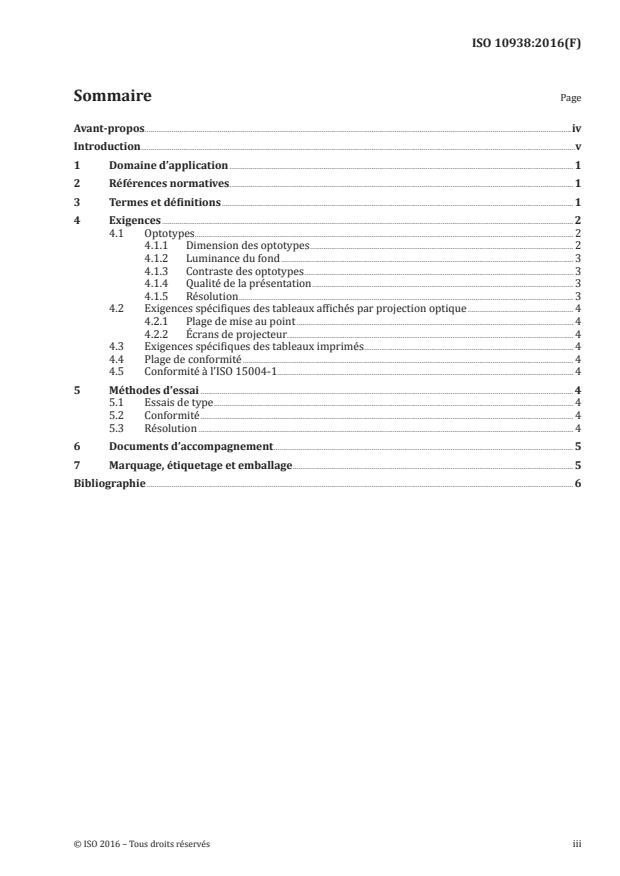
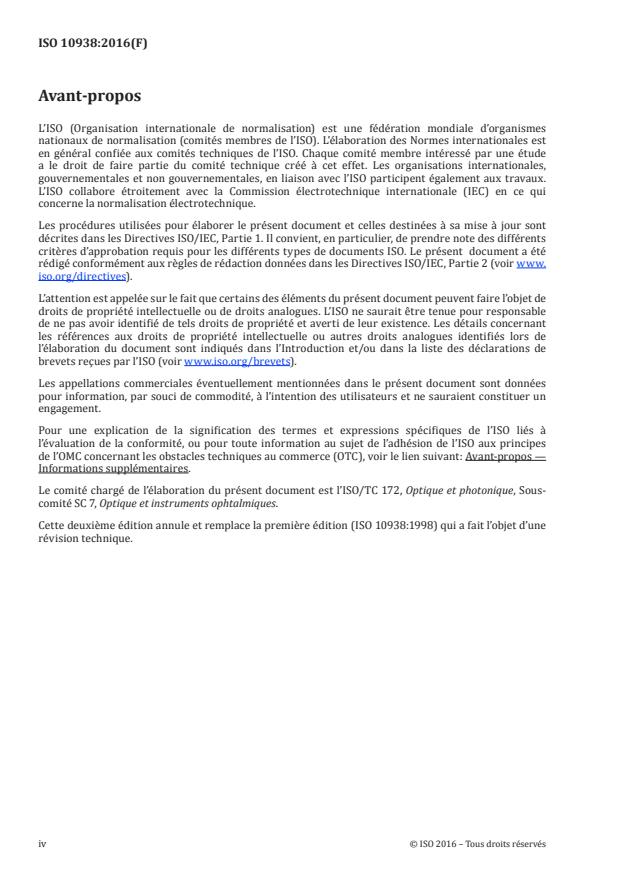
ISO 10938:2016 - Optique ophtalmique -- Dispositifs d'affichage de tableaux d'optotypes destinés au mesurage de l'acuité visuelle -- Tableaux d'optotypes imprimés, projetés et affichés par des moyens électroniques
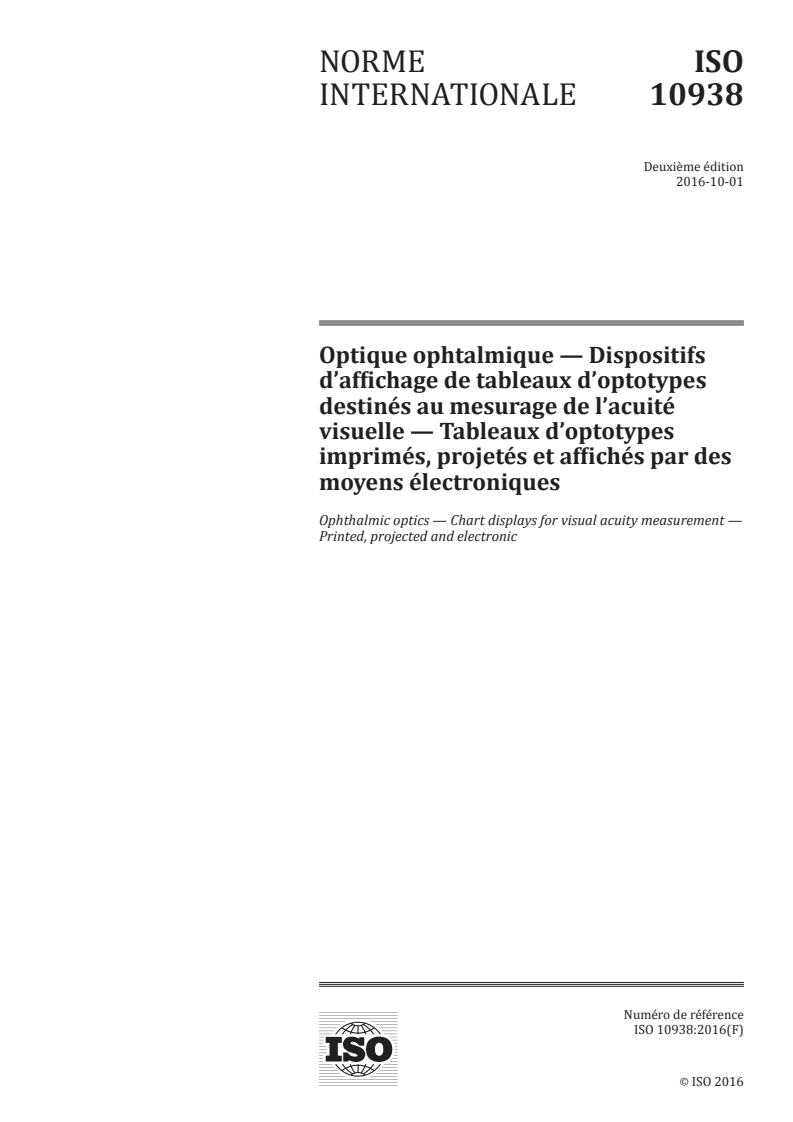

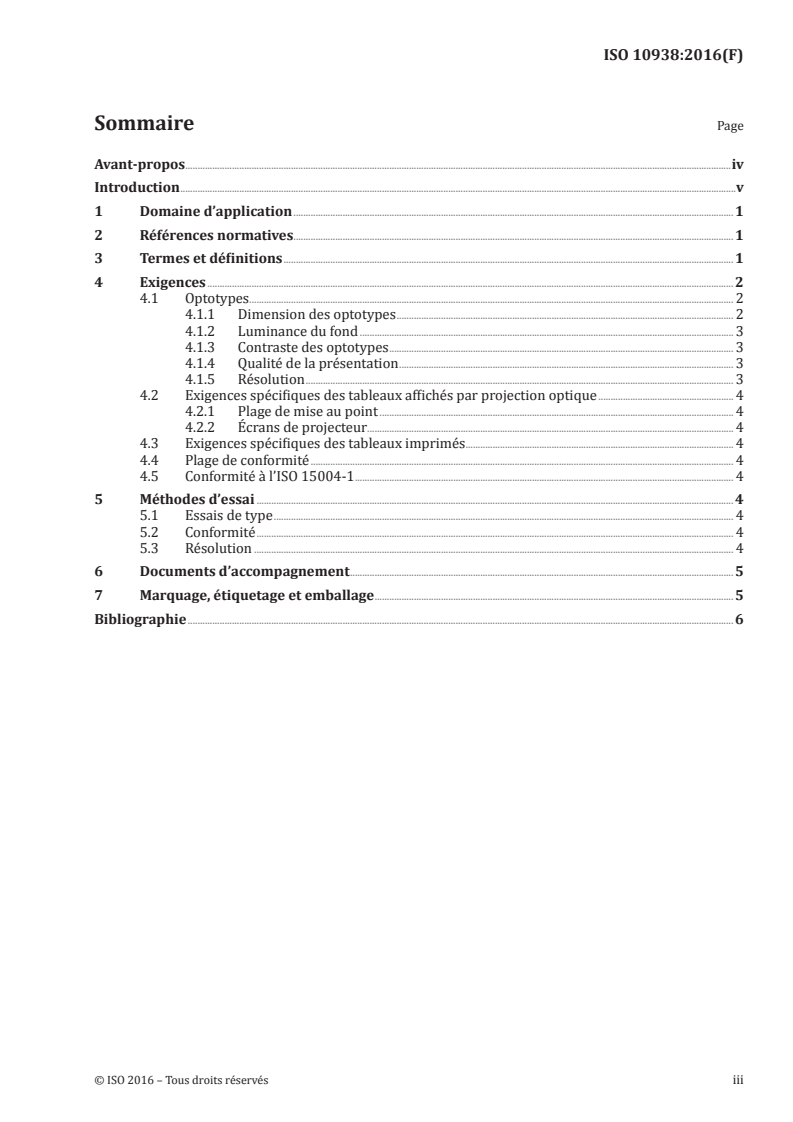
ISO 10938:2016 - Optique ophtalmique — Dispositifs d'affichage de tableaux d'optotypes destinés au mesurage de l'acuité visuelle — Tableaux d'optotypes imprimés, projetés et affichés par des moyens électroniques/22/2016
Overview
ISO 10938:2016 - Ophthalmic optics - Chart displays for visual acuity measurement - printed, projected and electronic - specifies requirements for high‑contrast optotypes used in clinical visual acuity charts. It applies to optotypes presented on printed media (opaque or transilluminated), optical chart projectors and electronic displays designed for general clinical use. The standard sets performance, measurement and documentation rules that help ensure consistent, reliable visual acuity testing across devices and settings.
Key topics and technical requirements
- Optotypes: Sizes must be specified by a critical dimension (e.g., Landolt ring gap). Comparability with the standard optotype (ISO 8596) is recommended.
- Background luminance: Specified range 80–320 cd/m² (recommended 200 cd/m²). Luminance uniformity limits are defined near the optotype and across the field.
- Contrast: Optotype luminance must be ≤ 15% of the background luminance (accounting for room lighting). Optotypes must have sharply defined edges at specified observation distances.
- Printed charts: Manufacturer must state the designed test distance.
- Projected charts: Resolution requirement expressed as line/mm - minimum is 4× the spatial frequency corresponding to the limb width of the 1.0 decimal optotype. Focus range required: 2.9 m to 6.1 m. Manufacturer must specify suitable projector screens.
- Electronic displays: Pixel size must be small enough that displayed optotypes perform equivalently to those meeting contrast and edge requirements. Notes address greyscaling/anti‑aliasing effects and calibration tolerance (ISO 8596 allows ±5% optotype size variability).
- Range of compliance: Manufacturer must specify the test distances and acuity grades covered (recommended minimum range 0.1–1.25 decimal acuity).
- Conformity & test methods: All tests are type tests. Measuring instruments should have error <10% of the smallest value measured. Resolution testing can use a Ronchi ruling and viewing protocols.
- Documentation & marking: Devices must be supplied with setup/use/maintenance instructions, specification of luminance and acuity ranges, and be permanently marked with manufacturer, model/serial and claim of compliance. Active ophthalmic instruments must also meet ISO 15004‑1.
Applications and users
ISO 10938 is used by:
- Manufacturers of printed acuity charts, chart projectors and electronic acuity systems (design, QA and product specs)
- Clinical equipment procurement and optical clinics (acceptance testing and correct setup)
- Calibration and test laboratories (type testing and conformity verification)
- Regulators and standards bodies assessing device safety and performance
This standard improves measurement consistency, patient safety and interoperability of ophthalmic visual acuity displays.
Related standards
- ISO 8596 - Visual acuity testing: standard optotype and presentation
- ISO 15004‑1 - Fundamental requirements and test methods for ophthalmic instruments
- ISO/TR 19498 - Methods for correlation of optotypes (informative)
Relations
- Effective Date
- 12-Feb-2026
- Effective Date
- 06-Jun-2022
- Effective Date
- 09-Mar-2013
Buy Documents
ISO 10938:2016 - Ophthalmic optics -- Chart displays for visual acuity measurement -- Printed, projected and electronic
ISO 10938:2016 - Ophthalmic optics — Chart displays for visual acuity measurement — Printed, projected and electronic/22/2016
ISO 10938:2016 - Optique ophtalmique -- Dispositifs d'affichage de tableaux d'optotypes destinés au mesurage de l'acuité visuelle -- Tableaux d'optotypes imprimés, projetés et affichés par des moyens électroniques
ISO 10938:2016 - Optique ophtalmique — Dispositifs d'affichage de tableaux d'optotypes destinés au mesurage de l'acuité visuelle — Tableaux d'optotypes imprimés, projetés et affichés par des moyens électroniques/22/2016
Get Certified
Connect with accredited certification bodies for this standard

BSI Group
BSI (British Standards Institution) is the business standards company that helps organizations make excellence a habit.

TÜV Rheinland
TÜV Rheinland is a leading international provider of technical services.

TÜV SÜD
TÜV SÜD is a trusted partner of choice for safety, security and sustainability solutions.
Sponsored listings
Frequently Asked Questions
ISO 10938:2016 is a standard published by the International Organization for Standardization (ISO). Its full title is "Ophthalmic optics — Chart displays for visual acuity measurement — Printed, projected and electronic". This standard covers: ISO 10938:2016 applies to displays of optotypes generated by chart projectors and all other visual acuity measurement systems that use recognition of high-contrast optotypes and that are designed for general use, including optotypes printed on media (either opaque or intended for transillumination), those generated electronically, and those produced by optical projection.
ISO 10938:2016 applies to displays of optotypes generated by chart projectors and all other visual acuity measurement systems that use recognition of high-contrast optotypes and that are designed for general use, including optotypes printed on media (either opaque or intended for transillumination), those generated electronically, and those produced by optical projection.
ISO 10938:2016 is classified under the following ICS (International Classification for Standards) categories: 11.040.70 - Ophthalmic equipment. The ICS classification helps identify the subject area and facilitates finding related standards.
ISO 10938:2016 has the following relationships with other standards: It is inter standard links to EN ISO 10938:2016, ISO/IEC 15408-2:2005, ISO 10938:1998. Understanding these relationships helps ensure you are using the most current and applicable version of the standard.
ISO 10938:2016 is available in PDF format for immediate download after purchase. The document can be added to your cart and obtained through the secure checkout process. Digital delivery ensures instant access to the complete standard document.
Standards Content (Sample)
INTERNATIONAL ISO
STANDARD 10938
Second edition
2016-10-01
Ophthalmic optics — Chart displays
for visual acuity measurement —
Printed, projected and electronic
Optique ophtalmique — Dispositifs d’affichage de tableaux
d’optotypes destinés au mesurage de l’acuité visuelle — Tableaux
d’optotypes imprimés, projetés et affichés par des moyens
électroniques
Reference number
©
ISO 2016
© ISO 2016, Published in Switzerland
All rights reserved. Unless otherwise specified, no part of this publication may be reproduced or utilized otherwise in any form
or by any means, electronic or mechanical, including photocopying, or posting on the internet or an intranet, without prior
written permission. Permission can be requested from either ISO at the address below or ISO’s member body in the country of
the requester.
ISO copyright office
Ch. de Blandonnet 8 • CP 401
CH-1214 Vernier, Geneva, Switzerland
Tel. +41 22 749 01 11
Fax +41 22 749 09 47
copyright@iso.org
www.iso.org
ii © ISO 2016 – All rights reserved
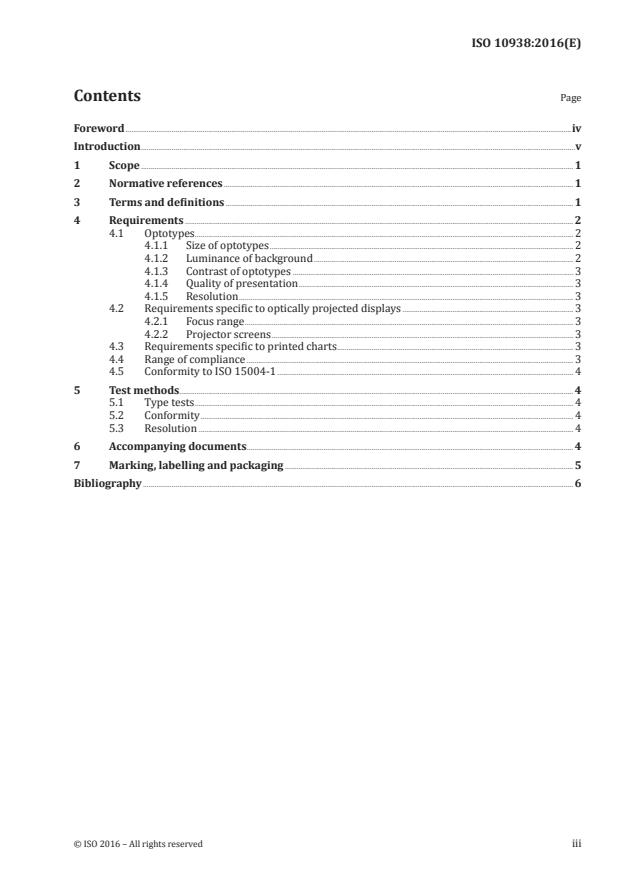
Contents Page
Foreword .iv
Introduction .v
1 Scope . 1
2 Normative references . 1
3 Terms and definitions . 1
4 Requirements . 2
4.1 Optotypes . . 2
4.1.1 Size of optotypes . 2
4.1.2 Luminance of background . 2
4.1.3 Contrast of optotypes . 3
4.1.4 Quality of presentation . 3
4.1.5 Resolution . 3
4.2 Requirements specific to optically projected displays . 3
4.2.1 Focus range . 3
4.2.2 Projector screens . 3
4.3 Requirements specific to printed charts . 3
4.4 Range of compliance . 3
4.5 Conformity to ISO 15004-1 . 4
5 Test methods . 4
5.1 Type tests . 4
5.2 Conformity . 4
5.3 Resolution . 4
6 Accompanying documents . 4
7 Marking, labelling and packaging . 5
Bibliography . 6
Foreword
ISO (the International Organization for Standardization) is a worldwide federation of national standards
bodies (ISO member bodies). The work of preparing International Standards is normally carried out
through ISO technical committees. Each member body interested in a subject for which a technical
committee has been established has the right to be represented on that committee. International
organizations, governmental and non-governmental, in liaison with ISO, also take part in the work.
ISO collaborates closely with the International Electrotechnical Commission (IEC) on all matters of
electrotechnical standardization.
The procedures used to develop this document and those intended for its further maintenance are
described in the ISO/IEC Directives, Part 1. In particular the different approval criteria needed for the
different types of ISO documents should be noted. This document was drafted in accordance with the
editorial rules of the ISO/IEC Directives, Part 2 (see www.iso.org/directives).
Attention is drawn to the possibility that some of the elements of this document may be the subject of
patent rights. ISO shall not be held responsible for identifying any or all such patent rights. Details of
any patent rights identified during the development of the document will be in the Introduction and/or
on the ISO list of patent declarations received (see www.iso.org/patents).
Any trade name used in this document is information given for the convenience of users and does not
constitute an endorsement.
For an explanation on the meaning of ISO specific terms and expressions related to conformity assessment,
as well as information about ISO’s adherence to the World Trade Organization (WTO) principles in the
Technical Barriers to Trade (TBT) see the following URL: www.iso.org/iso/foreword.html.
The committee responsible for this document is ISO/TC 172, Optics and photonics, Subcommittee SC 7,
Ophthalmic optics and instruments.
This second edition cancels and replaces the first edition (ISO 10938:1998), which has been technically
revised.
iv © ISO 2016 – All rights reserved
Introduction
The purpose of this International Standard is to provide for standardization of certain characteristics
of displays of optotypes used for measurement of visual acuity in general clinical practice. These
characteristics include size specification, luminance, contrast, and resolution of the optotypes. It
applies to displays intended for measurement of visual acuity over a limited, but clinically useful, range
of acuities.
The principles of standardized visual acuity measurement, including the arrangement of optotypes
on the display, are presented in standards adopted by the National Academy of Sciences in the United
States of America and the Consilium Ophthalmologicum Universal as referenced in the Bibliography.
This International Standard is not intended to address these principles, but they are included in an
annex in ISO 8596.
Due to practical design considerations and physical limitations of most general-purpose clinical visual
acuity measurement systems, the chart design features specified in the reference standards can usually
be met for only a limited range of acuity presentations. Other chart display designs are often required
for special clinic visual acuity measurements, such as for low-vision patients or for research purposes.
INTERNATIONAL STANDARD ISO 10938:2016(E)
Ophthalmic optics — Chart displays for visual acuity
measurement — Printed, projected and electronic
1 Scope
This International Standard applies to displays of optotypes generated by chart projectors and all
other visual acuity measurement systems that use recognition of high-contrast optotypes and that
are designed for general use, including optotypes printed on media (either opaque or intended for
transillumination), those generated electronically, and those produced by optical projection.
2 Normative references
The following documents, in whole or in part, are normatively referenced in this document and are
indispensable for its application. For dated references, only the edition cited applies. For undated
references, the latest edition of the referenced document (including any amendments) applies.
ISO 8596, Ophthalmic optics — Visual acuity testing — Standard optotype and its presentation
ISO 15004-1, Ophthalmic instruments — Fundamental requirements and test methods
...
INTERNATIONAL ISO
STANDARD 10938
Second edition
2016-10-01
Ophthalmic optics — Chart displays
for visual acuity measurement —
Printed, projected and electronic
Optique ophtalmique — Dispositifs d’affichage de tableaux
d’optotypes destinés au mesurage de l’acuité visuelle — Tableaux
d’optotypes imprimés, projetés et affichés par des moyens
électroniques
Reference number
©
ISO 2016
© ISO 2016, Published in Switzerland
All rights reserved. Unless otherwise specified, no part of this publication may be reproduced or utilized otherwise in any form
or by any means, electronic or mechanical, including photocopying, or posting on the internet or an intranet, without prior
written permission. Permission can be requested from either ISO at the address below or ISO’s member body in the country of
the requester.
ISO copyright office
Ch. de Blandonnet 8 • CP 401
CH-1214 Vernier, Geneva, Switzerland
Tel. +41 22 749 01 11
Fax +41 22 749 09 47
copyright@iso.org
www.iso.org
ii © ISO 2016 – All rights reserved
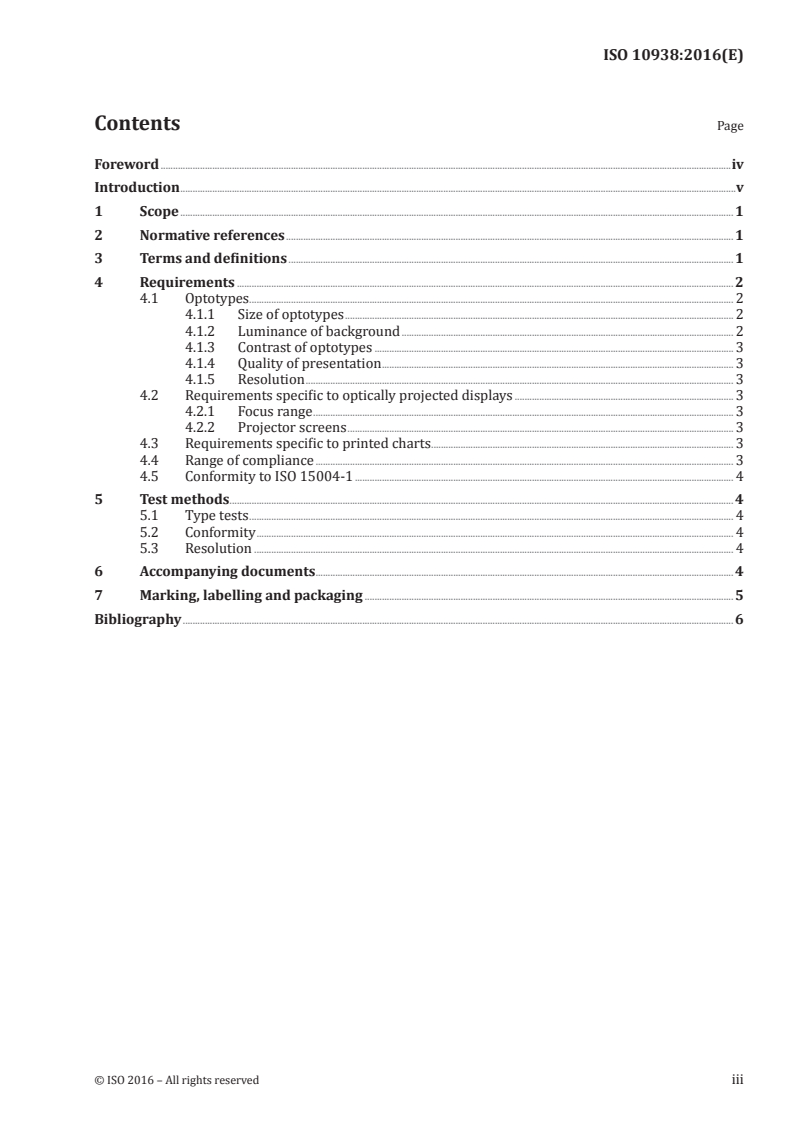
Contents Page
Foreword .iv
Introduction .v
1 Scope . 1
2 Normative references . 1
3 Terms and definitions . 1
4 Requirements . 2
4.1 Optotypes . . 2
4.1.1 Size of optotypes . 2
4.1.2 Luminance of background . 2
4.1.3 Contrast of optotypes . 3
4.1.4 Quality of presentation . 3
4.1.5 Resolution . 3
4.2 Requirements specific to optically projected displays . 3
4.2.1 Focus range . 3
4.2.2 Projector screens . 3
4.3 Requirements specific to printed charts . 3
4.4 Range of compliance . 3
4.5 Conformity to ISO 15004-1 . 4
5 Test methods . 4
5.1 Type tests . 4
5.2 Conformity . 4
5.3 Resolution . 4
6 Accompanying documents . 4
7 Marking, labelling and packaging . 5
Bibliography . 6
Foreword
ISO (the International Organization for Standardization) is a worldwide federation of national standards
bodies (ISO member bodies). The work of preparing International Standards is normally carried out
through ISO technical committees. Each member body interested in a subject for which a technical
committee has been established has the right to be represented on that committee. International
organizations, governmental and non-governmental, in liaison with ISO, also take part in the work.
ISO collaborates closely with the International Electrotechnical Commission (IEC) on all matters of
electrotechnical standardization.
The procedures used to develop this document and those intended for its further maintenance are
described in the ISO/IEC Directives, Part 1. In particular the different approval criteria needed for the
different types of ISO documents should be noted. This document was drafted in accordance with the
editorial rules of the ISO/IEC Directives, Part 2 (see www.iso.org/directives).
Attention is drawn to the possibility that some of the elements of this document may be the subject of
patent rights. ISO shall not be held responsible for identifying any or all such patent rights. Details of
any patent rights identified during the development of the document will be in the Introduction and/or
on the ISO list of patent declarations received (see www.iso.org/patents).
Any trade name used in this document is information given for the convenience of users and does not
constitute an endorsement.
For an explanation on the meaning of ISO specific terms and expressions related to conformity assessment,
as well as information about ISO’s adherence to the World Trade Organization (WTO) principles in the
Technical Barriers to Trade (TBT) see the following URL: www.iso.org/iso/foreword.html.
The committee responsible for this document is ISO/TC 172, Optics and photonics, Subcommittee SC 7,
Ophthalmic optics and instruments.
This second edition cancels and replaces the first edition (ISO 10938:1998), which has been technically
revised.
iv © ISO 2016 – All rights reserved
Introduction
The purpose of this International Standard is to provide for standardization of certain characteristics
of displays of optotypes used for measurement of visual acuity in general clinical practice. These
characteristics include size specification, luminance, contrast, and resolution of the optotypes. It
applies to displays intended for measurement of visual acuity over a limited, but clinically useful, range
of acuities.
The principles of standardized visual acuity measurement, including the arrangement of optotypes
on the display, are presented in standards adopted by the National Academy of Sciences in the United
States of America and the Consilium Ophthalmologicum Universal as referenced in the Bibliography.
This International Standard is not intended to address these principles, but they are included in an
annex in ISO 8596.
Due to practical design considerations and physical limitations of most general-purpose clinical visual
acuity measurement systems, the chart design features specified in the reference standards can usually
be met for only a limited range of acuity presentations. Other chart display designs are often required
for special clinic visual acuity measurements, such as for low-vision patients or for research purposes.
INTERNATIONAL STANDARD ISO 10938:2016(E)
Ophthalmic optics — Chart displays for visual acuity
measurement — Printed, projected and electronic
1 Scope
This International Standard applies to displays of optotypes generated by chart projectors and all
other visual acuity measurement systems that use recognition of high-contrast optotypes and that
are designed for general use, including optotypes printed on media (either opaque or intended for
transillumination), those generated electronically, and those produced by optical projection.
2 Normative references
The following documents, in whole or in part, are normatively referenced in this document and are
indispensable for its application. For dated references, only the edition cited applies. For undated
references, the latest edition of the referenced document (including any amendments) applies.
ISO 8596, Ophthalmic optics — Visual acuity testing — Standard optotype and its presentation
ISO 15004-1, Ophthalmic instruments — Fundamental requirements and test methods
...
NORME ISO
INTERNATIONALE 10938
Deuxième édition
2016-10-01
Optique ophtalmique — Dispositifs
d’affichage de tableaux d’optotypes
destinés au mesurage de l’acuité
visuelle — Tableaux d’optotypes
imprimés, projetés et affichés par des
moyens électroniques
Ophthalmic optics — Chart displays for visual acuity measurement —
Printed, projected and electronic
Numéro de référence
©
ISO 2016
DOCUMENT PROTÉGÉ PAR COPYRIGHT
© ISO 2016, Publié en Suisse
Droits de reproduction réservés. Sauf indication contraire, aucune partie de cette publication ne peut être reproduite ni utilisée
sous quelque forme que ce soit et par aucun procédé, électronique ou mécanique, y compris la photocopie, l’affichage sur
l’internet ou sur un Intranet, sans autorisation écrite préalable. Les demandes d’autorisation peuvent être adressées à l’ISO à
l’adresse ci-après ou au comité membre de l’ISO dans le pays du demandeur.
ISO copyright office
Ch. de Blandonnet 8 • CP 401
CH-1214 Vernier, Geneva, Switzerland
Tel. +41 22 749 01 11
Fax +41 22 749 09 47
copyright@iso.org
www.iso.org
ii © ISO 2016 – Tous droits réservés
Sommaire Page
Avant-propos .iv
Introduction .v
1 Domaine d’application . 1
2 Références normatives . 1
3 Termes et définitions . 1
4 Exigences . 2
4.1 Optotypes . . 2
4.1.1 Dimension des optotypes . 2
4.1.2 Luminance du fond . 3
4.1.3 Contraste des optotypes . 3
4.1.4 Qualité de la présentation . 3
4.1.5 Résolution . 3
4.2 Exigences spécifiques des tableaux affichés par projection optique . 4
4.2.1 Plage de mise au point . 4
4.2.2 Écrans de projecteur . . . 4
4.3 Exigences spécifiques des tableaux imprimés . 4
4.4 Plage de conformité . 4
4.5 Conformité à l’ISO 15004-1 . 4
5 Méthodes d’essai . 4
5.1 Essais de type . 4
5.2 Conformité . 4
5.3 Résolution . 4
6 Documents d’accompagnement . 5
7 Marquage, étiquetage et emballage . 5
Bibliographie . 6
Avant-propos
L’ISO (Organisation internationale de normalisation) est une fédération mondiale d’organismes
nationaux de normalisation (comités membres de l’ISO). L’élaboration des Normes internationales est
en général confiée aux comités techniques de l’ISO. Chaque comité membre intéressé par une étude
a le droit de faire partie du comité technique créé à cet effet. Les organisations internationales,
gouvernementales et non gouvernementales, en liaison avec l’ISO participent également aux travaux.
L’ISO collabore étroitement avec la Commission électrotechnique internationale (IEC) en ce qui
concerne la normalisation électrotechnique.
Les procédures utilisées pour élaborer le présent document et celles destinées à sa mise à jour sont
décrites dans les Directives ISO/IEC, Partie 1. Il convient, en particulier, de prendre note des différents
critères d’approbation requis pour les différents types de documents ISO. Le présent document a été
rédigé conformément aux règles de rédaction données dans les Directives ISO/IEC, Partie 2 (voir www.
iso.org/directives).
L’attention est appelée sur le fait que certains des éléments du présent document peuvent faire l’objet de
droits de propriété intellectuelle ou de droits analogues. L’ISO ne saurait être tenue pour responsable
de ne pas avoir identifié de tels droits de propriété et averti de leur existence. Les détails concernant
les références aux droits de propriété intellectuelle ou autres droits analogues identifiés lors de
l’élaboration du document sont indiqués dans l’Introduction et/ou dans la liste des déclarations de
brevets reçues par l’ISO (voir www.iso.org/brevets).
Les appellations commerciales éventuellement mentionnées dans le présent document sont données
pour information, par souci de commodité, à l’intention des utilisateurs et ne sauraient constituer un
engagement.
Pour une explication de la signification des termes et expressions spécifiques de l’ISO liés à
l’évaluation de la conformité, ou pour toute information au sujet de l’adhésion de l’ISO aux principes
de l’OMC concernant les obstacles techniques au commerce (OTC), voir le lien suivant: Avant-propos —
Informations supplémentaires.
Le comité chargé de l’élaboration du présent document est l’ISO/TC 172, Optique et photonique, Sous-
comité SC 7, Optique et instruments ophtalmiques.
Cette deuxième édition annule et remplace la première édition (ISO 10938:1998) qui a fait l’objet d’une
révision technique.
iv © ISO 2016 – Tous droits réservés
Introduction
Le but de la présente Norme internationale est de normaliser certaines caractéristiques des dispositifs
d’affichage d’optotypes utilisés pour mesurer l’acuité visuelle dans la pratique clinique courante. Ces
caractéristiques comprennent les spécifications concernant les dimensions, la luminance, le contraste
et la résolution des optotypes. La présente Norme internationale est applicable aux dispositifs
d’affichage destinés au mesurage d’acuités visuelles comprises dans une plage limitée mais utile sur le
plan clinique.
Les principes applicables au mesurage normalisé de l’acuité visuelle, y compris la disposition des
optotypes affichés, sont spécifiés dans des documents de référence adoptés par la National Academy of
Sciences aux États-Unis et par le Consilium Ophtalmologicum Universal, voir les références présentées
dans la Bibliographie. La présente Norme internationale n’a pas pour but d’aborder ces principes, mais
ceux-ci sont mentionnés en annexe dans l’ISO 8596.
En raison d’aspects pratiques de la conception, et du fait des limites physiques propres à la plupart des
systèmes cliniques de mesurage de l’acuité visuelle d’usage général, les caractéristiques de conception
des tableaux d’optotypes spécifiées dans ces documents de référence ne peuvent généralement être
respectées que pour une petite partie des différentes présentations de tableaux possibles. D’autres
types de dispositifs d’affichage de tableaux d’optotypes sont souvent nécessaires pour les mesurages
cliniques spécifiques de l’acuité visuelle, par exemple pour des patients malvoyants ou à des fins de
recherche.
NORME INTERNATIONALE ISO 10938:2016(F)
Optique ophtalmique — Dispositifs d’affichage de tableaux
d’optotypes destinés au mesurage de l’acuité visuelle —
Tableaux d’optotypes imprimés, projetés et affichés par
des moyens électroniques
1 Domaine d’application
La présente Norme internationale est applicable à l’affichage d’optotypes au moyen de projecteurs de
tableaux et de tout autre système de mesurage de l’acuité visuelle qui reposent sur la reconnaissance
d’optotypes à fort contraste et qui sont destinés à un usage général, y compris les optotypes imprimés
sur des supports (opaques ou destinés à être projetés par transparence), ceux affichés par des moyens
électroniques ou par projection optique.
2 Références normatives
Les documents ci-après, dans leur intégralité ou non, sont des références normatives indispensables à
l’application du présent document. Pour les références datées, seule l’édition citée s’applique. Pour les
références non datées, la dernière édition du document de référence s’applique (y compris les éventuels
amendements).
ISO 8596, Optique ophtalmique — Essai d’acuité visuelle — Optotype normalisé et sa présentation
ISO 15004-1, Instruments ophtalmiques — Exigences fondamentales et méthodes d’essai — Partie 1:
Exigences générales applicables à tous les instruments ophtalmiques
3 Termes et définitions
Pour les besoins du présent document, les termes et définitions suivants s’appliquent.
3.1
optotype
symbole utilisé pour mesurer l’acuité visuelle
3.2
optotype normalisé
anneau de Landolt dont l’ouverture peut être positionnée à huit emplacements différents
Note 1 à l’article: L’anneau de Landolt est spécifié dans l’ISO 8596.
3.3
fraction de Snellen
notation destinée à spécifier l’angle apparent d’un optotype (3.1), exprimée sous forme de fraction dont
le numérateur est la distance à laquelle l’acuité visuelle est déterminée, généralement en mètres ou en
feet, et dont le dénominateur est la distance à laquelle le détail critique (3.9) de l’optotype sous-tend un
angle d’une min
...
NORME ISO
INTERNATIONALE 10938
Deuxième édition
2016-10-01
Optique ophtalmique — Dispositifs
d’affichage de tableaux d’optotypes
destinés au mesurage de l’acuité
visuelle — Tableaux d’optotypes
imprimés, projetés et affichés par des
moyens électroniques
Ophthalmic optics — Chart displays for visual acuity measurement —
Printed, projected and electronic
Numéro de référence
©
ISO 2016
DOCUMENT PROTÉGÉ PAR COPYRIGHT
© ISO 2016, Publié en Suisse
Droits de reproduction réservés. Sauf indication contraire, aucune partie de cette publication ne peut être reproduite ni utilisée
sous quelque forme que ce soit et par aucun procédé, électronique ou mécanique, y compris la photocopie, l’affichage sur
l’internet ou sur un Intranet, sans autorisation écrite préalable. Les demandes d’autorisation peuvent être adressées à l’ISO à
l’adresse ci-après ou au comité membre de l’ISO dans le pays du demandeur.
ISO copyright office
Ch. de Blandonnet 8 • CP 401
CH-1214 Vernier, Geneva, Switzerland
Tel. +41 22 749 01 11
Fax +41 22 749 09 47
copyright@iso.org
www.iso.org
ii © ISO 2016 – Tous droits réservés
Sommaire Page
Avant-propos .iv
Introduction .v
1 Domaine d’application . 1
2 Références normatives . 1
3 Termes et définitions . 1
4 Exigences . 2
4.1 Optotypes . . 2
4.1.1 Dimension des optotypes . 2
4.1.2 Luminance du fond . 3
4.1.3 Contraste des optotypes . 3
4.1.4 Qualité de la présentation . 3
4.1.5 Résolution . 3
4.2 Exigences spécifiques des tableaux affichés par projection optique . 4
4.2.1 Plage de mise au point . 4
4.2.2 Écrans de projecteur . . . 4
4.3 Exigences spécifiques des tableaux imprimés . 4
4.4 Plage de conformité . 4
4.5 Conformité à l’ISO 15004-1 . 4
5 Méthodes d’essai . 4
5.1 Essais de type . 4
5.2 Conformité . 4
5.3 Résolution . 4
6 Documents d’accompagnement . 5
7 Marquage, étiquetage et emballage . 5
Bibliographie . 6
Avant-propos
L’ISO (Organisation internationale de normalisation) est une fédération mondiale d’organismes
nationaux de normalisation (comités membres de l’ISO). L’élaboration des Normes internationales est
en général confiée aux comités techniques de l’ISO. Chaque comité membre intéressé par une étude
a le droit de faire partie du comité technique créé à cet effet. Les organisations internationales,
gouvernementales et non gouvernementales, en liaison avec l’ISO participent également aux travaux.
L’ISO collabore étroitement avec la Commission électrotechnique internationale (IEC) en ce qui
concerne la normalisation électrotechnique.
Les procédures utilisées pour élaborer le présent document et celles destinées à sa mise à jour sont
décrites dans les Directives ISO/IEC, Partie 1. Il convient, en particulier, de prendre note des différents
critères d’approbation requis pour les différents types de documents ISO. Le présent document a été
rédigé conformément aux règles de rédaction données dans les Directives ISO/IEC, Partie 2 (voir www.
iso.org/directives).
L’attention est appelée sur le fait que certains des éléments du présent document peuvent faire l’objet de
droits de propriété intellectuelle ou de droits analogues. L’ISO ne saurait être tenue pour responsable
de ne pas avoir identifié de tels droits de propriété et averti de leur existence. Les détails concernant
les références aux droits de propriété intellectuelle ou autres droits analogues identifiés lors de
l’élaboration du document sont indiqués dans l’Introduction et/ou dans la liste des déclarations de
brevets reçues par l’ISO (voir www.iso.org/brevets).
Les appellations commerciales éventuellement mentionnées dans le présent document sont données
pour information, par souci de commodité, à l’intention des utilisateurs et ne sauraient constituer un
engagement.
Pour une explication de la signification des termes et expressions spécifiques de l’ISO liés à
l’évaluation de la conformité, ou pour toute information au sujet de l’adhésion de l’ISO aux principes
de l’OMC concernant les obstacles techniques au commerce (OTC), voir le lien suivant: Avant-propos —
Informations supplémentaires.
Le comité chargé de l’élaboration du présent document est l’ISO/TC 172, Optique et photonique, Sous-
comité SC 7, Optique et instruments ophtalmiques.
Cette deuxième édition annule et remplace la première édition (ISO 10938:1998) qui a fait l’objet d’une
révision technique.
iv © ISO 2016 – Tous droits réservés
Introduction
Le but de la présente Norme internationale est de normaliser certaines caractéristiques des dispositifs
d’affichage d’optotypes utilisés pour mesurer l’acuité visuelle dans la pratique clinique courante. Ces
caractéristiques comprennent les spécifications concernant les dimensions, la luminance, le contraste
et la résolution des optotypes. La présente Norme internationale est applicable aux dispositifs
d’affichage destinés au mesurage d’acuités visuelles comprises dans une plage limitée mais utile sur le
plan clinique.
Les principes applicables au mesurage normalisé de l’acuité visuelle, y compris la disposition des
optotypes affichés, sont spécifiés dans des documents de référence adoptés par la National Academy of
Sciences aux États-Unis et par le Consilium Ophtalmologicum Universal, voir les références présentées
dans la Bibliographie. La présente Norme internationale n’a pas pour but d’aborder ces principes, mais
ceux-ci sont mentionnés en annexe dans l’ISO 8596.
En raison d’aspects pratiques de la conception, et du fait des limites physiques propres à la plupart des
systèmes cliniques de mesurage de l’acuité visuelle d’usage général, les caractéristiques de conception
des tableaux d’optotypes spécifiées dans ces documents de référence ne peuvent généralement être
respectées que pour une petite partie des différentes présentations de tableaux possibles. D’autres
types de dispositifs d’affichage de tableaux d’optotypes sont souvent nécessaires pour les mesurages
cliniques spécifiques de l’acuité visuelle, par exemple pour des patients malvoyants ou à des fins de
recherche.
NORME INTERNATIONALE ISO 10938:2016(F)
Optique ophtalmique — Dispositifs d’affichage de tableaux
d’optotypes destinés au mesurage de l’acuité visuelle —
Tableaux d’optotypes imprimés, projetés et affichés par
des moyens électroniques
1 Domaine d’application
La présente Norme internationale est applicable à l’affichage d’optotypes au moyen de projecteurs de
tableaux et de tout autre système de mesurage de l’acuité visuelle qui reposent sur la reconnaissance
d’optotypes à fort contraste et qui sont destinés à un usage général, y compris les optotypes imprimés
sur des supports (opaques ou destinés à être projetés par transparence), ceux affichés par des moyens
électroniques ou par projection optique.
2 Références normatives
Les documents ci-après, dans leur intégralité ou non, sont des références normatives indispensables à
l’application du présent document. Pour les références datées, seule l’édition citée s’applique. Pour les
références non datées, la dernière édition du document de référence s’applique (y compris les éventuels
amendements).
ISO 8596, Optique ophtalmique — Essai d’acuité visuelle — Optotype normalisé et sa présentation
ISO 15004-1, Instruments ophtalmiques — Exigences fondamentales et méthodes d’essai — Partie 1:
Exigences générales applicables à tous les instruments ophtalmiques
3 Termes et définitions
Pour les besoins du présent document, les termes et définitions suivants s’appliquent.
3.1
optotype
symbole utilisé pour mesurer l’acuité visuelle
3.2
optotype normalisé
anneau de Landolt dont l’ouverture peut être positionnée à huit emplacements différents
Note 1 à l’article: L’anneau de Landolt est spécifié dans l’ISO 8596.
3.3
fraction de Snellen
notation destinée à spécifier l’angle apparent d’un optotype (3.1), exprimée sous forme de fraction dont
le numérateur est la distance à laquelle l’acuité visuelle est déterminée, généralement en mètres ou en
feet, et dont le dénominateur est la distance à laquelle le détail critique (3.9) de l’optotype sous-tend un
angle d’une min
...