

ISO 24673:2021
(Main)Concentrated date juice — Specifications and test methods
General Information
- Abstract
This document specifies the requirements and test methods for concentrated date juice.
- Status
- Published
- Publication Date
- 03-Oct-2021
- Technical Committee
- ISO/TC 34/SC 3 - Fruits and vegetables and their derived products
- Drafting Committee
- ISO/TC 34/SC 3 - Fruits and vegetables and their derived products
- Current Stage
- 6060 - International Standard published
- Start Date
- 04-Oct-2021
- Due Date
- 09-Jan-2023
- Completion Date
- 04-Oct-2021
Buy Documents
ISO 24673:2021 - Concentrated date juice -- Specifications and test methods
ISO 24673:2021 - Concentrated date juice — Specifications and test methods/4/2021
Overview
ISO 24673:2021 titled Concentrated Date Juice - Specifications and Test Methods is an international standard published by the International Organization for Standardization (ISO). This standard specifies the essential requirements and test methods for concentrated date juice, a concentrated syrup extracted from date fruit (Phoenix dactylifera). It defines physicochemical, sensorial, and packaging criteria to ensure product quality and consistency.
Concentrated date juice is widely used as a natural sweetener and flavour enhancer in the food industry. It is valued for its nutritional benefits, preservation properties, and versatility. The standard supports manufacturers, quality controllers, and regulatory bodies by providing harmonized criteria and testing protocols, facilitating compliance and trade.
Key Topics
Scope and Definitions
The standard covers concentrated date juice produced by removing water until the soluble solids content is at least 20%. It may be clear or turbid and is unfermented but capable of fermenting after reconstitution.Physicochemical Specifications
- Brix (soluble solids): 70 ± 2 g/100 g at 20 °C
- Acidity: Maximum 0.5 g/100 g
- Ash content: 1.5 to 3 g/100 g
- pH range: 4.0 to 4.5
- Density: 1.35 ± 0.05 g/cm³ at 20 °C
- Sulfur dioxide: Less than 20 ppm
- Sucrose: Less than 5 g/100 g
- Fructose/Glucose ratio: 0.5 to 1.5 g/100 g
- Hydroxymethylfurfural (HMF): Less than 10 ppm
Sensorial Characteristics
- Appearance: Clear and viscous liquid
- Taste: Typical, free from off-flavors
- Colour: Colourless to yellow
Test Methods
The standard references internationally recognized ISO and EN test methods for all requirements such as refractometric Brix determination, titratable acidity, pH measurement, ash content, and enzymatic sugar analysis, ensuring reliable and reproducible results.Packaging and Labelling
Packaging must use clean, food-grade materials that maintain the technological and sensory quality of the juice. Labelling requirements include product name, manufacturer details, batch number, net/gross mass, expiry date, and other purchaser-specific markings.
Applications
Food Industry Sweetener and Ingredient
Concentrated date juice is used as a natural sweetening agent in various food products including ice cream, jams, jellies, soft drinks, desserts, teas, and coffees. Its sugar composition offers a healthier alternative to refined sugars.Nutritional Enhancement
The juice contributes nutritional value and flavor enhancement while maintaining product preservation without chemical additives, aligning with clean-label and health-conscious food trends.Quality Control and Compliance
ISO 24673:2021 supports manufacturers and laboratories in verifying product quality, ensuring consistency across batches, and meeting regulatory standards in international trade involving date juice concentrates.Trade and Export
The standardized requirements facilitate smoother import-export processes by harmonizing expectations about quality and labelling, reducing technical barriers and fostering global commerce.
Related Standards
- ISO 750 - Determination of titratable acidity in fruit and vegetable products
- ISO 1842 - pH determination
- ISO 2173 - Refractometric method for soluble solids
- ISO 5522 - Total sulfur dioxide content
- ISO 7466 - 5-Hydroxymethylfurfural (5-HMF) content measurement
- EN 1131, EN 1133, EN 1135, EN 1140, EN 12146 - Various test methods for density, formol number, ash, glucose/fructose, and sucrose content in fruit juices
- CODEX STAN 192-201 - General standard for food additives, relevant to clarifying agents and preservatives used in fruit juice processing
By adhering to ISO 24673:2021, producers and processors of concentrated date juice can ensure high-quality, safe, and standardized products that meet international market and consumer expectations. This standard plays a critical role in quality assurance, food safety, and the growth of natural sweetener alternatives in the global food industry.
Buy Documents
ISO 24673:2021 - Concentrated date juice -- Specifications and test methods
ISO 24673:2021 - Concentrated date juice — Specifications and test methods/4/2021
Get Certified
Connect with accredited certification bodies for this standard

BSI Group
BSI (British Standards Institution) is the business standards company that helps organizations make excellence a habit.

Bureau Veritas
Bureau Veritas is a world leader in laboratory testing, inspection and certification services.

DNV
DNV is an independent assurance and risk management provider.
Sponsored listings
Frequently Asked Questions
ISO 24673:2021 is a standard published by the International Organization for Standardization (ISO). Its full title is "Concentrated date juice — Specifications and test methods". This standard covers: This document specifies the requirements and test methods for concentrated date juice.
This document specifies the requirements and test methods for concentrated date juice.
ISO 24673:2021 is classified under the following ICS (International Classification for Standards) categories: 67.160.20 - Non-alcoholic beverages. The ICS classification helps identify the subject area and facilitates finding related standards.
ISO 24673:2021 is available in PDF format for immediate download after purchase. The document can be added to your cart and obtained through the secure checkout process. Digital delivery ensures instant access to the complete standard document.
Standards Content (Sample)
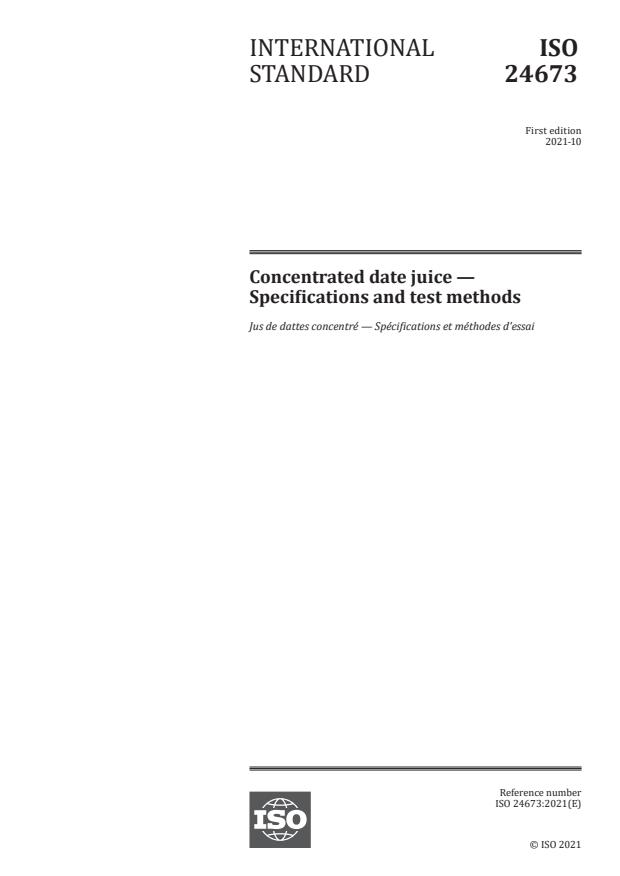
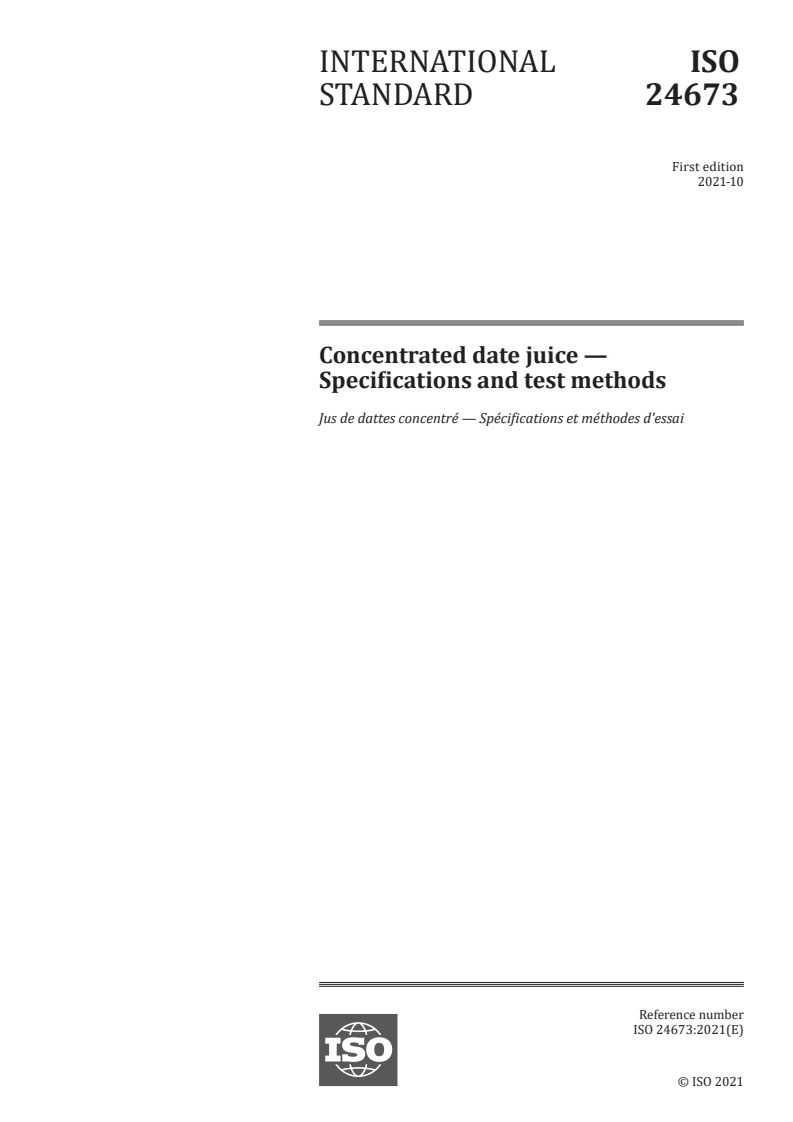
INTERNATIONAL ISO
STANDARD 24673
First edition
2021-10
Concentrated date juice —
Specifications and test methods
Jus de dattes concentré — Spécifications et méthodes d'essai
Reference number
© ISO 2021
All rights reserved. Unless otherwise specified, or required in the context of its implementation, no part of this publication may
be reproduced or utilized otherwise in any form or by any means, electronic or mechanical, including photocopying, or posting on
the internet or an intranet, without prior written permission. Permission can be requested from either ISO at the address below
or ISO’s member body in the country of the requester.
ISO copyright office
CP 401 • Ch. de Blandonnet 8
CH-1214 Vernier, Geneva
Phone: +41 22 749 01 11
Email: copyright@iso.org
Website: www.iso.org
Published in Switzerland
ii
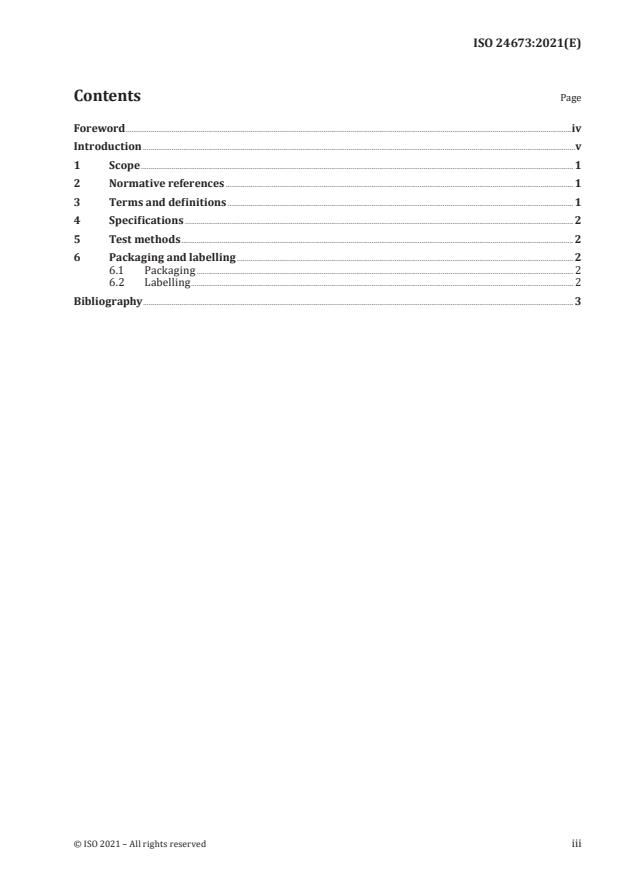
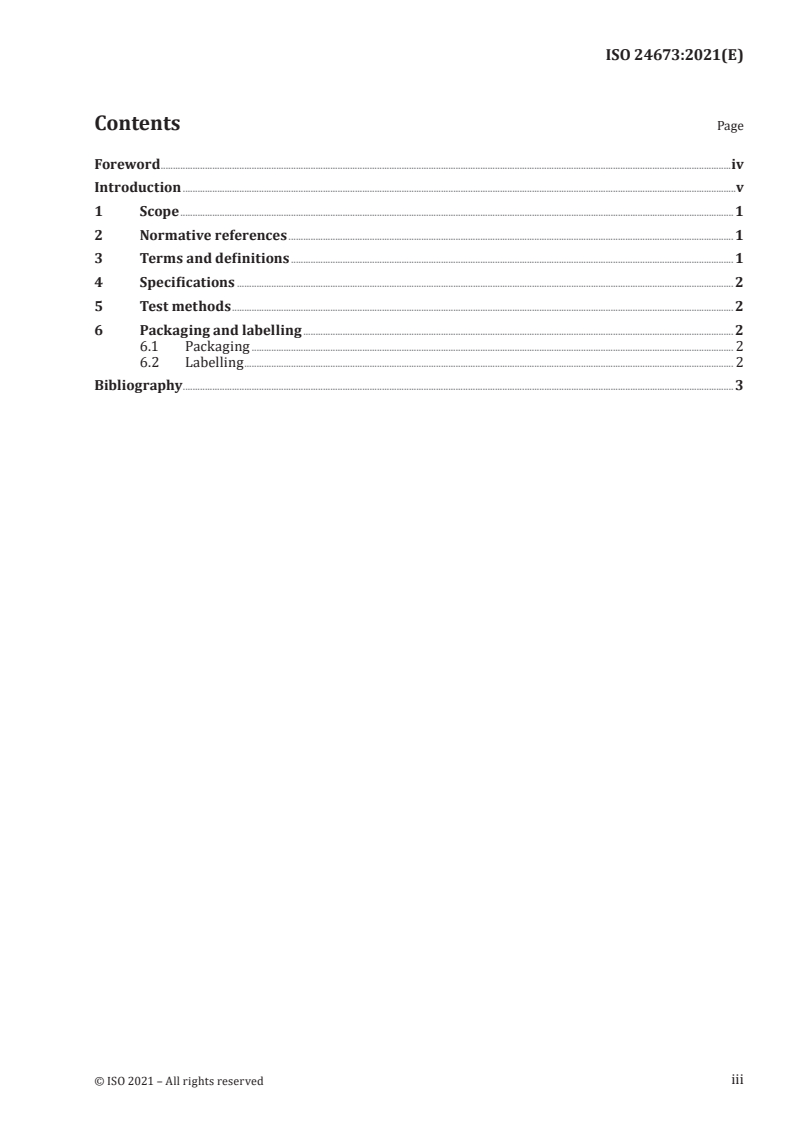
Contents Page
Foreword .iv
Introduction .v
1 Scope . 1
2 Normative references . 1
3 Terms and definitions . 1
4 Specifications . 2
5 Test methods . 2
6 Packaging and labelling . 2
6.1 Packaging . 2
6.2 Labelling . 2
Bibliography . 3
iii
Foreword
ISO (the International Organization for Standardization) is a worldwide federation of national standards
bodies (ISO member bodies). The work of preparing International Standards is normally carried out
through ISO technical committees. Each member body interested in a subject for which a technical
committee has been established has the right to be represented on that committee. International
organizations, governmental and non-governmental, in liaison with ISO, also take part in the work.
ISO collaborates closely with the International Electrotechnical Commission (IEC) on all matters of
electrotechnical standardization.
The procedures used to develop this document and those intended for its further maintenance are
described in the ISO/IEC Directives, Part 1. In particular, the different approval criteria needed for the
different types of ISO documents should be noted. This document was drafted in accordance with the
editorial rules of the ISO/IEC Directives, Part 2 (see www.iso.org/directives).
Attention is drawn to the possibility that some of the elements of this document may be the subject of
patent rights. ISO shall not be held responsible for identifying any or all such patent rights. Details of
any patent rights identified during the development of the document will be in the Introduction and/or
on the ISO list of patent declarations received (see www.iso.org/patents).
Any trade name used in this document is information given for the convenience of users and does not
constitute an endorsement.
For an explanation of the voluntary nature of standards, the meaning of ISO specific terms and
expressions related to conformity assessment, as well as information about ISO’s adherence to
the World Trade Organization (WTO) principles in the Technical Barriers to Trade (TBT), see
www.iso.org/iso/foreword.html.
This document was prepared by Technical Committee ISO/TC 34, Food products, Subcommittee SC 3,
Fruits and vegetables and their derived products.
Any feedback or questions on this document should be directed to the u
...
INTERNATIONAL ISO
STANDARD 24673
First edition
2021-10
Concentrated date juice —
Specifications and test methods
Jus de dattes concentré — Spécifications et méthodes d'essai
Reference number
© ISO 2021
All rights reserved. Unless otherwise specified, or required in the context of its implementation, no part of this publication may
be reproduced or utilized otherwise in any form or by any means, electronic or mechanical, including photocopying, or posting on
the internet or an intranet, without prior written permission. Permission can be requested from either ISO at the address below
or ISO’s member body in the country of the requester.
ISO copyright office
CP 401 • Ch. de Blandonnet 8
CH-1214 Vernier, Geneva
Phone: +41 22 749 01 11
Email: copyright@iso.org
Website: www.iso.org
Published in Switzerland
ii
Contents Page
Foreword .iv
Introduction .v
1 Scope . 1
2 Normative references . 1
3 Terms and definitions . 1
4 Specifications . 2
5 Test methods . 2
6 Packaging and labelling . 2
6.1 Packaging . 2
6.2 Labelling . 2
Bibliography . 3
iii
Foreword
ISO (the International Organization for Standardization) is a worldwide federation of national standards
bodies (ISO member bodies). The work of preparing International Standards is normally carried out
through ISO technical committees. Each member body interested in a subject for which a technical
committee has been established has the right to be represented on that committee. International
organizations, governmental and non-governmental, in liaison with ISO, also take part in the work.
ISO collaborates closely with the International Electrotechnical Commission (IEC) on all matters of
electrotechnical standardization.
The procedures used to develop this document and those intended for its further maintenance are
described in the ISO/IEC Directives, Part 1. In particular, the different approval criteria needed for the
different types of ISO documents should be noted. This document was drafted in accordance with the
editorial rules of the ISO/IEC Directives, Part 2 (see www.iso.org/directives).
Attention is drawn to the possibility that some of the elements of this document may be the subject of
patent rights. ISO shall not be held responsible for identifying any or all such patent rights. Details of
any patent rights identified during the development of the document will be in the Introduction and/or
on the ISO list of patent declarations received (see www.iso.org/patents).
Any trade name used in this document is information given for the convenience of users and does not
constitute an endorsement.
For an explanation of the voluntary nature of standards, the meaning of ISO specific terms and
expressions related to conformity assessment, as well as information about ISO’s adherence to
the World Trade Organization (WTO) principles in the Technical Barriers to Trade (TBT), see
www.iso.org/iso/foreword.html.
This document was prepared by Technical Committee ISO/TC 34, Food products, Subcommittee SC 3,
Fruits and vegetables and their derived products.
Any feedback or questions on this document should be directed to the u
...