

ISO 8024:2023
(Main)Concentrated black mulberry juice — Specifications
General Information
- Abstract
This document specifies the characteristics, sampling, packaging and marking of concentrated mulberry juice. This document is applicable to concentrated black mulberry juice that is physically processed and packaged for human consumption.
- Status
- Published
- Publication Date
- 12-Oct-2023
- Technical Committee
- ISO/TC 34/SC 3 - Fruits and vegetables and their derived products
- Drafting Committee
- ISO/TC 34/SC 3 - Fruits and vegetables and their derived products
- Current Stage
- 6060 - International Standard published
- Start Date
- 13-Oct-2023
- Due Date
- 02-Nov-2024
- Completion Date
- 13-Oct-2023
Overview
ISO 8024:2023 - Concentrated black mulberry juice - Specifications defines the requirements for concentrated black mulberry juice that is physically processed and packaged for human consumption. The standard covers product identity, fundamental physical and chemical characteristics, sampling references, packaging and marking. It applies to unfermented concentrated black mulberry juice (physically preserved) whose soluble solids (Brix) are increased by at least 50% relative to the reconstituted juice, in line with CODEX CXS 247.
Key topics and technical requirements
- Product scope: Applies to concentrated black mulberry juice intended for human consumption; product is unfermented and preservable by physical methods.
- Concentration rule: Brix increase of at least 50% over reconstituted juice reference (Codex guidance).
- Physical and chemical specifications (Table 1 - test methods referenced):
- Brix: Min. 22 g/100 g (ISO 2173)
- Ash: 0.15–0.75 g/100 ml (ISO 5516)
- Titratable acidity (at pH 8.1): Min. 3 g/100 ml (ISO 750)
- pH: 2 to 4 (ISO 1842)
- Invert sugar: Min. 7 g/100 ml (EN 12630)
- Ethanol: Max. 3 g/l (ISO 2448)
- Formol number: Min. 12 g/100 ml (EN 1133)
- Sucrose: Max. 1 g/100 ml (EN 12630)
- Sulphur dioxide (SO2): Max. 10 mg/kg (ISO 5522)
- Foreign materials: Absence; sensorial profile: liquid, slightly sour taste, dark red colour.
- Contaminants and residues: Heavy metals to comply with CODEX CXS 193-1995 (lead testing per ISO 6633); pesticide residues to meet Codex MRLs.
- Packaging & labeling: Requires clean, food-grade packaging that does not affect product quality. Labelling to follow CODEX CXS 1-1985 plus particulars: product name, manufacturer/packer address, batch/code number, net/gross mass, producer, expiry date, and purchaser-required marks (e.g., harvest year).
Applications and users
- Food and beverage manufacturers producing concentrated black mulberry juice or mulberry-based ingredients.
- Quality control and analytical laboratories performing Brix, acidity, pH, sugar, ethanol, SO2, heavy metal and pesticide testing.
- Regulatory authorities, importers/exporters and trade auditors verifying compliance with international food safety and labelling requirements.
- Retailers and packers ensuring packaging, marking and sensory quality meet international specifications.
Related standards and references
- ISO methods: ISO 2173, ISO 750, ISO 2448, ISO 5516, ISO 5522, ISO 6633, ISO 1842, etc.
- EN methods: EN 12630, EN 1133.
- Codex references: CODEX CXS 247 (fruit juices), CXS 193 (contaminants), CXS 1-1985 (labelling), Codex pesticide MRL database.
Keywords: ISO 8024:2023, concentrated black mulberry juice, specifications, Brix, titratable acidity, pH, SO2, pesticide residues, food-grade packaging, Codex.
Get Certified
Connect with accredited certification bodies for this standard

BSI Group
BSI (British Standards Institution) is the business standards company that helps organizations make excellence a habit.

Bureau Veritas
Bureau Veritas is a world leader in laboratory testing, inspection and certification services.

DNV
DNV is an independent assurance and risk management provider.
Sponsored listings
Frequently Asked Questions
ISO 8024:2023 is a standard published by the International Organization for Standardization (ISO). Its full title is "Concentrated black mulberry juice — Specifications". This standard covers: This document specifies the characteristics, sampling, packaging and marking of concentrated mulberry juice. This document is applicable to concentrated black mulberry juice that is physically processed and packaged for human consumption.
This document specifies the characteristics, sampling, packaging and marking of concentrated mulberry juice. This document is applicable to concentrated black mulberry juice that is physically processed and packaged for human consumption.
ISO 8024:2023 is classified under the following ICS (International Classification for Standards) categories: 67.160.20 - Non-alcoholic beverages. The ICS classification helps identify the subject area and facilitates finding related standards.
ISO 8024:2023 is available in PDF format for immediate download after purchase. The document can be added to your cart and obtained through the secure checkout process. Digital delivery ensures instant access to the complete standard document.
Standards Content (Sample)
INTERNATIONAL ISO
STANDARD 8024
First edition
2023-10
Concentrated black mulberry juice —
Specifications
Reference number
© ISO 2023
All rights reserved. Unless otherwise specified, or required in the context of its implementation, no part of this publication may
be reproduced or utilized otherwise in any form or by any means, electronic or mechanical, including photocopying, or posting on
the internet or an intranet, without prior written permission. Permission can be requested from either ISO at the address below
or ISO’s member body in the country of the requester.
ISO copyright office
CP 401 • Ch. de Blandonnet 8
CH-1214 Vernier, Geneva
Phone: +41 22 749 01 11
Email: copyright@iso.org
Website: www.iso.org
Published in Switzerland
ii
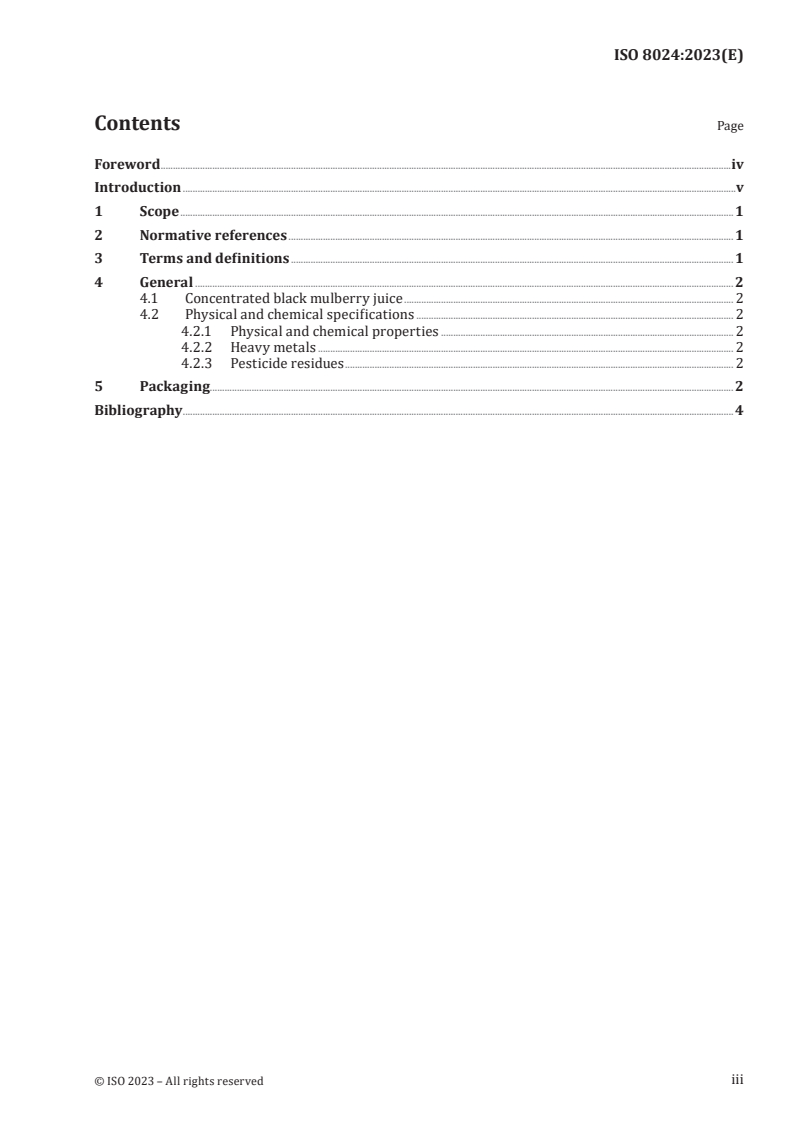
Contents Page
Foreword .iv
Introduction .v
1 Scope . 1
2 Normative references . 1
3 Terms and definitions . 1
4 General . 2
4.1 Concentrated black mulberry juice . 2
4.2 Physical and chemical specifications . 2
4.2.1 Physical and chemical properties . 2
4.2.2 Heavy metals . 2
4.2.3 Pesticide residues . 2
5 Packaging. 2
Bibliography . 4
iii
Foreword
ISO (the International Organization for Standardization) is a worldwide federation of national standards
bodies (ISO member bodies). The work of preparing International Standards is normally carried out
through ISO technical committees. Each member body interested in a subject for which a technical
committee has been established has the right to be represented on that committee. International
organizations, governmental and non-governmental, in liaison with ISO, also take part in the work.
ISO collaborates closely with the International Electrotechnical Commission (IEC) on all matters of
electrotechnical standardization.
The procedures used to develop this document and those intended for its further maintenance are
described in the ISO/IEC Directives, Part 1. In particular, the different approval criteria needed for the
different types of ISO document should be noted. This document was drafted in accordance with the
editorial rules of the ISO/IEC Directives, Part 2 (see www.iso.org/directives).
ISO draws attention to the possibility that the implementation of this document may involve the use
of (a) patent(s). ISO takes no position concerning the evidence, validity or applicability of any claimed
patent rights in respect thereof. As of the date of publication of this document, ISO had not received
notice of (a) patent(s) which may be required to implement this document. However, implementers are
cautioned that this may not represent the latest information, which may be obtained from the patent
database available at www.iso.org/patents. ISO shall not be held responsible for identifying any or all
such patent rights.
Any trade name used in this document is information given for the convenience of users and does not
constitute an endorsement.
For an explanation of the voluntary nature of standards, the meaning of ISO specific terms and
expressions related to conformity assessment, as well as information about ISO's adherence to
the World Trade Organization (WTO) principles in the Technical Barriers to Trade (TBT), see
www.iso.org/iso/foreword.html.
This document was prepared by Technical Committee ISO/TC 34, Food products, Subcommittee SC 3,
Fruits and vegetables and their derived products.
Any feedback or questions on this document should be directed to the user’s national standards body. A
complete listing of these bodies can be found at www.iso.org/members.html.
iv
Introduction
Mulberry is a flowering tree species belonging to the Moraceae family and is native to southwest Asia.
Planting this tree in its native habitat has such a long history that it is difficult to pinpoint the natural
range of its different species. In the genus Morus (nigra), the mulberry tree is the smallest, and its height
can reach about 9 m; if left untreated, it will remain a shrub at a young age. This tree has a long life and
has sometimes been known to bear fruit for several hundred years.
The presence of many nutrients and the synergistic role of these nutrients on each other has made this
fruit a good source to meet the daily needs of various micronutrients. Mu
...