

ISO 27769:2016
(Main)Wood-based panels — Wet process fibreboard
General Information
- Abstract
ISO 27769:2016 provides a classification matrix and related mandatory tests for two types of wet process fibreboard made from wood: softboards and hardboards and specifies the relevant manufacturing property requirements.
- Status
- Published
- Publication Date
- 07-Dec-2016
- Technical Committee
- ISO/TC 89/SC 1 - Fibre boards
- Drafting Committee
- ISO/TC 89/SC 1 - Fibre boards
- Current Stage
- 9093 - International Standard confirmed
- Start Date
- 28-Apr-2022
- Completion Date
- 29-Aug-2026
Buy Documents
ISO 27769:2016 - Wood-based panels -- Wet process fibreboard
ISO 27769:2016 - Wood-based panels — Wet process fibreboard/8/2016
Overview
ISO 27769:2016 - Wood-based panels - Wet process fibreboard defines a harmonized system for classifying and testing two types of wet-process wood fibreboard: softboards and hardboards. The standard provides a classification matrix, mandatory tests, thickness ranges and manufacturing property requirements for these wet process fibreboards. It excludes medium boards and dry-process fibreboards (see ISO 16895).
Keywords: ISO 27769:2016, wet process fibreboard, softboards, hardboards, wood-based panels, classification matrix, mandatory tests.
Key Topics and Requirements
- Scope and definitions
- Covers wet process fibreboard with forming-line moisture >20% where bonding is from felting and inherent fibre adhesion.
- Density guidance: softboards < 400 kg/m3; medium boards 400–<840 kg/m3 (not covered); hardboards ≥ 800 kg/m3. Manufacturers may classify products within ±20% of a nominated density if other properties match.
- Classification matrix
- Grades organized by conditions of use: Regular (REG - dry), Moisture Resistant (MR - humid), High Moisture Resistant (HMR - high-humidity), Exterior (EXT).
- Product types: General Purpose (GP) and Load-Bearing (LB) for both softboards and hardboards; supplementary attributes (FR, I, F) may be added.
- Mandatory tests
- Lists required test methods and which apply to each grade. Typical mandatory tests include:
- Dimensions tolerance (ISO 9426)
- Density and density variation (ISO 9427)
- Moisture content (ISO 16979)
- Bending strength (MOR) and modulus of elasticity (ISO 16978)
- Internal bond strength (IB) - for hardboards (ISO 16984)
- Thickness swelling after immersion (ISO 16983)
- Moisture resistance/boil tests and wet bending (ISO 16998, ISO 20585)
- All property requirements apply at factory dispatch.
- Lists required test methods and which apply to each grade. Typical mandatory tests include:
- Thickness ranges
- Defined ranges for specifying product thickness for softboards and hardboards (e.g., ≤10 mm, >10–≤19 mm, etc.).
- Structural use
- For complex load-bearing/structural applications, characteristic strength and stiffness values must be provided per ISO 16572 or equivalent standards.
Practical Applications and Users
Who uses ISO 27769:2016:
- Board manufacturers for product classification, labelling and factory quality control
- Testing laboratories to select mandatory test methods and report results
- Specifiers, architects and engineers selecting fibreboard for furniture, partitions, backer-boards, underlays, siding and certain structural uses
- Procurement and compliance teams ensuring materials meet specified moisture-resistance and load-bearing grades
- DIY product suppliers and exporters aligning with international market classes
Practical benefits:
- Clear product categories for market consistency
- Defined test methods to verify performance for different environments (dry to exterior)
- Guidance for when additional structural testing (ISO 16572) is required
Related Standards
- ISO 16895 - Dry-process fibreboards
- ISO 16572 - Determination of characteristic values for structural use
- ISO 17064 - Terms and definitions for fibre boards
- Normative test methods referenced in ISO 27769 (ISO 9426, ISO 9427, ISO 16978, ISO 16983, ISO 16984, ISO 16985, ISO 16998, ISO 20585, ISO 16979, ISO 16981, ISO 3340)
Use ISO 27769:2016 when you need a standardized approach to classify, test and specify wet process fibreboard products for consistent performance across international markets.
Relations
- Effective Date
- 06-Jun-2022
- Effective Date
- 05-Nov-2015
- Effective Date
- 05-Nov-2015
Buy Documents
ISO 27769:2016 - Wood-based panels -- Wet process fibreboard
ISO 27769:2016 - Wood-based panels — Wet process fibreboard/8/2016
Get Certified
Connect with accredited certification bodies for this standard

Gozdarski inštitut Slovenije
Slovenian Forestry Institute. Forest management certification support, timber testing.
Sponsored listings
Frequently Asked Questions
ISO 27769:2016 is a standard published by the International Organization for Standardization (ISO). Its full title is "Wood-based panels — Wet process fibreboard". This standard covers: ISO 27769:2016 provides a classification matrix and related mandatory tests for two types of wet process fibreboard made from wood: softboards and hardboards and specifies the relevant manufacturing property requirements.
ISO 27769:2016 provides a classification matrix and related mandatory tests for two types of wet process fibreboard made from wood: softboards and hardboards and specifies the relevant manufacturing property requirements.
ISO 27769:2016 is classified under the following ICS (International Classification for Standards) categories: 79.060.20 - Fibre and particle boards. The ICS classification helps identify the subject area and facilitates finding related standards.
ISO 27769:2016 has the following relationships with other standards: It is inter standard links to ISO 9300:2022, ISO 27769-2:2009, ISO 27769-1:2009. Understanding these relationships helps ensure you are using the most current and applicable version of the standard.
ISO 27769:2016 is available in PDF format for immediate download after purchase. The document can be added to your cart and obtained through the secure checkout process. Digital delivery ensures instant access to the complete standard document.
Standards Content (Sample)
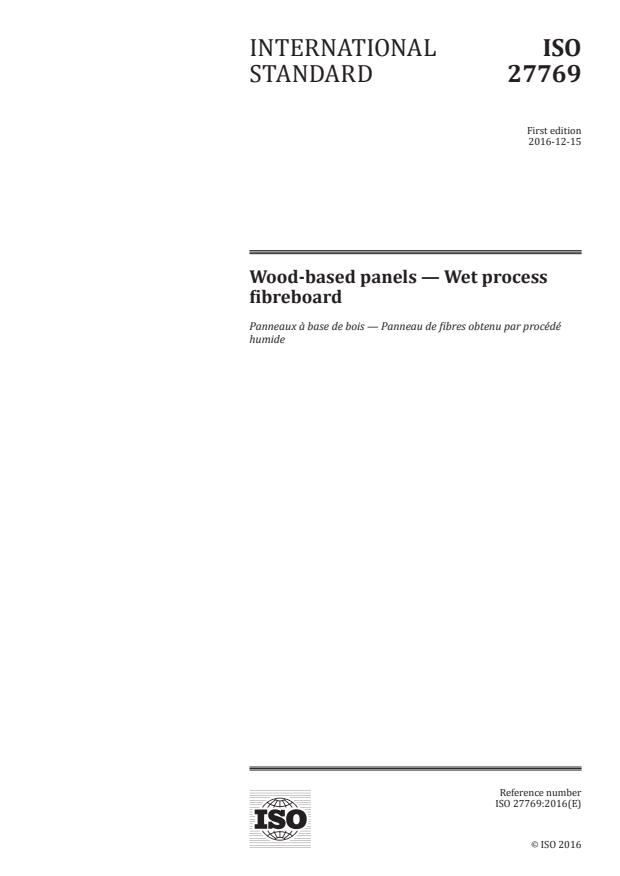
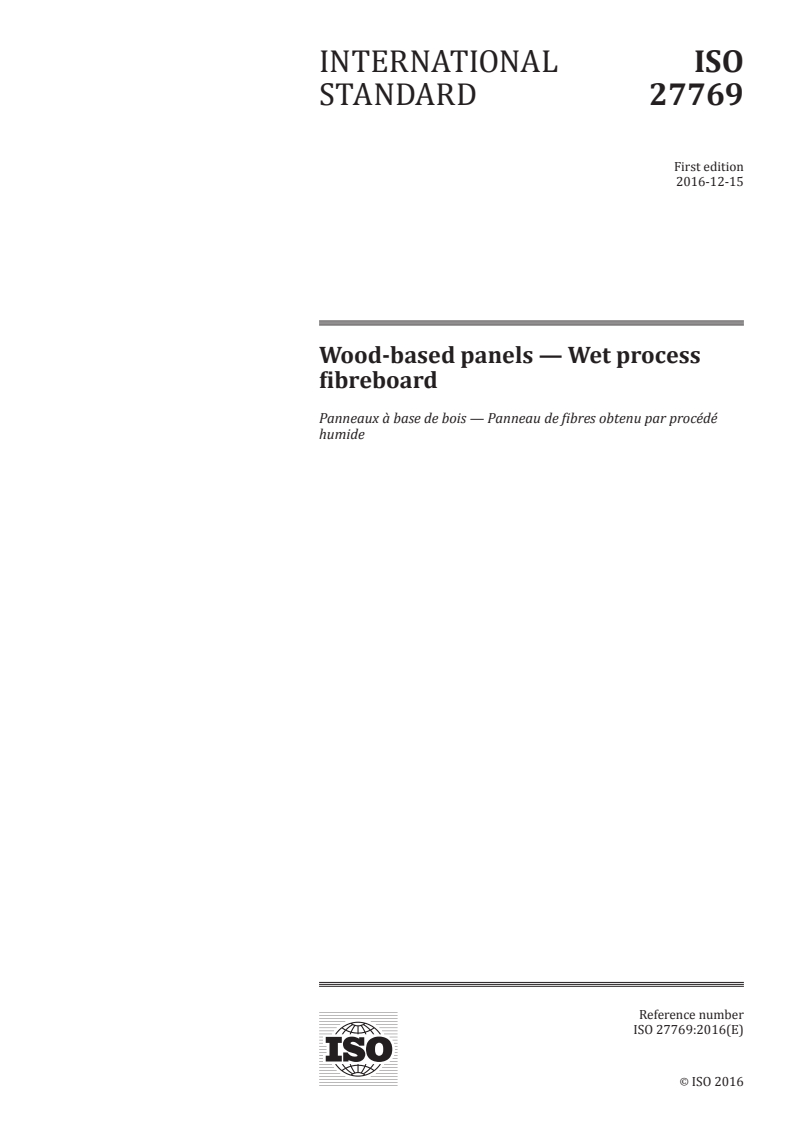
INTERNATIONAL ISO
STANDARD 27769
First edition
2016-12-15
Wood-based panels — Wet process
fibreboard
Panneaux à base de bois — Panneau de fibres obtenu par procédé
humide
Reference number
©
ISO 2016
© ISO 2016, Published in Switzerland
All rights reserved. Unless otherwise specified, no part of this publication may be reproduced or utilized otherwise in any form
or by any means, electronic or mechanical, including photocopying, or posting on the internet or an intranet, without prior
written permission. Permission can be requested from either ISO at the address below or ISO’s member body in the country of
the requester.
ISO copyright office
Ch. de Blandonnet 8 • CP 401
CH-1214 Vernier, Geneva, Switzerland
Tel. +41 22 749 01 11
Fax +41 22 749 09 47
copyright@iso.org
www.iso.org
ii © ISO 2016 – All rights reserved
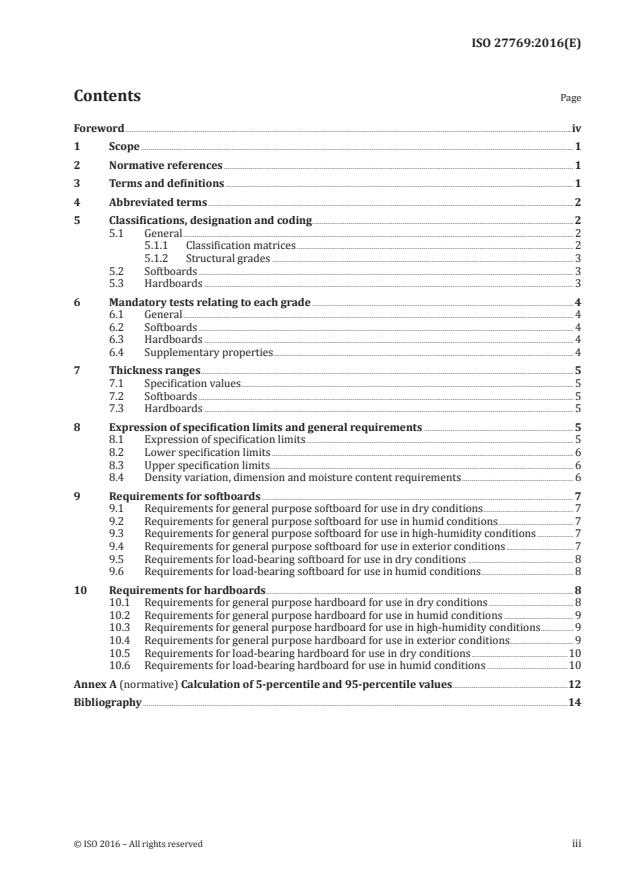
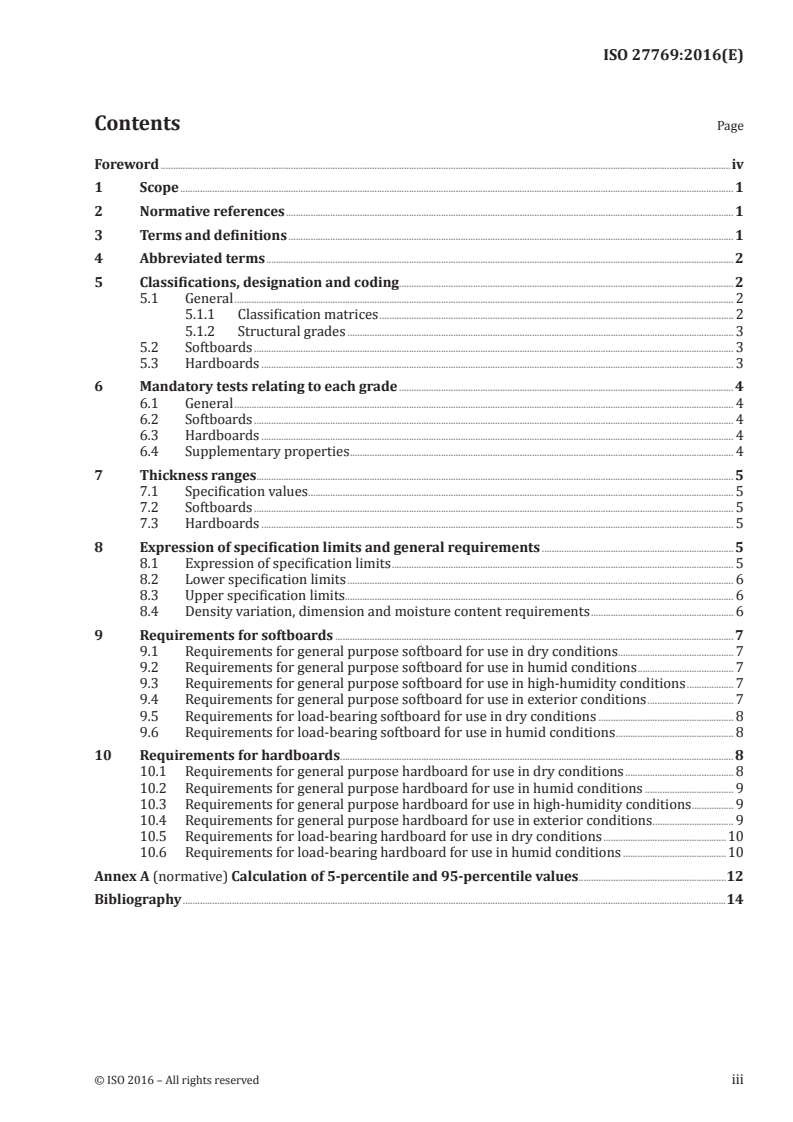
Contents Page
Foreword .iv
1 Scope . 1
2 Normative references . 1
3 Terms and definitions . 1
4 Abbreviated terms . 2
5 Classifications, designation and coding . 2
5.1 General . 2
5.1.1 Classification matrices . 2
5.1.2 Structural grades . 3
5.2 Softboards . 3
5.3 Hardboards . 3
6 Mandatory tests relating to each grade . 4
6.1 General . 4
6.2 Softboards . 4
6.3 Hardboards . 4
6.4 Supplementary properties . 4
7 Thickness ranges . 5
7.1 Specification values . 5
7.2 Softboards . 5
7.3 Hardboards . 5
8 Expression of specification limits and general requirements . 5
8.1 Expression of specification limits . 5
8.2 Lower specification limits . 6
8.3 Upper specification limits. 6
8.4 Density variation, dimension and moisture content requirements . 6
9 Requirements for softboards . 7
9.1 Requirements for general purpose softboard for use in dry conditions . 7
9.2 Requirements for general purpose softboard for use in humid conditions . 7
9.3 Requirements for general purpose softboard for use in high-humidity conditions . 7
9.4 Requirements for general purpose softboard for use in exterior conditions . 7
9.5 Requirements for load-bearing softboard for use in dry conditions . 8
9.6 Requirements for load-bearing softboard for use in humid conditions . 8
10 Requirements for hardboards . 8
10.1 Requirements for general purpose hardboard for use in dry conditions . 8
10.2 Requirements for general purpose hardboard for use in humid conditions . 9
10.3 Requirements for general purpose hardboard for use in high-humidity conditions . 9
10.4 Requirements for general purpose hardboard for use in exterior conditions . 9
10.5 Requirements for load-bearing hardboard for use in dry conditions .10
10.6 Requirements for load-bearing hardboard for use in humid conditions .10
Annex A (normative) Calculation of 5-percentile and 95-percentile values .12
Bibliography .14
Foreword
ISO (the International Organization for Standardization) is a worldwide federation of national standards
bodies (ISO member bodies). The work of preparing International Standards is normally carried out
through ISO technical committees. Each member body interested in a subject for which a technical
committee has been established has the right to be represented on that committee. International
organizations, governmental and non-governmental, in liaison with ISO, also take part in the work.
ISO collaborates closely with the International Electrotechnical Commission (IEC) on all matters of
electrotechnical standardization.
The procedures used to develop this document and those intended for its further maintenance are
described in the ISO/IEC Directives, Part 1. In particular the different approval criteria needed for the
different types of ISO documents should be noted. This document was drafted in accordance with the
editorial rules of the ISO/IEC Directives, Part 2 (see www.iso.org/directives).
Attention is drawn to the possibility that some of the elements of this document may be the subject of
patent rights. ISO shall not be held responsible for identifying any or all such patent rights. Details of
any patent rights identified during the development of the document will be in the Introduction and/or
on the ISO list of patent declarations received (see www.iso.org/patents).
Any trade name used in this document is information given for the convenience of users and does not
constitute an endorsement.
For an explanation on the meaning of ISO specific terms and expressions related to conformity assessment,
as well as information about ISO’s adherence to the World Trade Organization (WTO) principles in the
Technical Barriers to Trade (TBT) see the following URL: www.iso.org/iso/foreword.html.
The committee responsible for this document is ISO/TC 89, Wood-based panels, Subcommittee SC 01,
Fibre boards.
This first edition cancels and replaces ISO 27769-1:2009 and ISO 27769-2:2009, which have been
technically revised.
iv © ISO 2016 – All rights reserved
INTERNATIONAL STANDARD ISO 27769:2016(E)
Wood-based panels — Wet process fibreboard
1 Scope
This document provides a classification matrix and related mandatory tests for two types of wet process
fibreboard made from wood: softboards and hardboards and specifies the relevant manufacturing
property requirements.
NOTE 1 Wet process fibreboards are divided into three types: softboards, medium boards and hardboards.
This document is not applicable to medium boards.
NOTE 2 Fibreboards are broadly divided into two groups based on the manufacturing process, namely the
dry-process group and the wet process group. This document is not applicable to dry-process fibreboards (see
ISO 16895).
NOTE 3 The values listed in this document relate to product properties used to classify fibreboards into one
of the different types. The values are not characteristic values to be used for design purposes. When fibreboard
is classified as load-bearing and nominated for structural applications, characteristic strength and stiffness
values are established based upon testing in accordance with ISO 16572 or equivalent ASTM or EN Standards.
Alternatively, for specific load-bearing applications (e.g. walls, roofs, floors and I-joist webs), the load-bearing
fibreboard would meet the specific performance requirements for that intended application.
2 Normative references
The following documents are referred to in the text in such a way that some or all of their content
constitutes requirements of this document. For dated references, only the edition cited applies. For
undated references, the latest edition of the referenced document (including any amendments) applies.
ISO 3340, Fibre building boards — Determination of sand content
ISO 9426, Wood-based panels — Determination of dimensions of panels
ISO 9427, Wood-based panels — Determination of density
ISO 16978, Wood-based panels — Determination of modulus of elasticity in bending and of bending strength
ISO 16979, Wood-based panels — Determination of moisture content
ISO 16981, Wood-based panels — Determination of surface soundness
ISO 16983, Wood-based panels — Determination of swelling in thickness after immersion in water
ISO 16984, Wood-based panels — Determination of tensile strength perpendicular to the plane of the panel
ISO 16985, Wood-based panels — Determination of dimensional changes associated with changes in
relative humidity
ISO 16998, Wood-based panels — Determination of moisture resistance — Boil test
ISO 20585, Wood-based panels — Determination of wet bending strength after immersion in water at 70 °C
or 100 °C (boiling temperature)
3 Terms and definitions
For the purposes of this document, the terms and definitions given in ISO 17064 and the following apply.
ISO and IEC maintain terminological databases for use in standardization at the following addresses:
— IEC Electropedia: available at http://www.electropedia.org/
— ISO Online browsing platform: available at http://www.iso.org/obp
3.1
wet process fibreboard
wood fibreboard with a forming line moisture content of greater than 20 % and whose primary bonding
results from the felting of the wood fibres and their inherent adhesive properties
Note 1 to entry: According to the density, the types of fibreboard are the following:
a) softboards, of density <400 kg/m ;
3 3
b) medium boards, of density ≥400 kg/m to <840 kg/m ;
c) hardboards, of density ≥800 kg/m .
Note 2 to entry: Tables for the classification of medium boards are not included in this document. They can be
included as they become available on the international market.
Note 3 to entry: Density ranges given in product descriptions in 5.2 and 5.3 are a guide. Manufacturers can
classify a product as a particular type if the product is within 20 % of the nominated density range and if it has
all of the properties of the nominated type.
4 Abbreviated terms
The following abbreviated terms are used in the preparation of the classification matrices:
REG regular for use in dry conditions only
MR moisture resistant for use in humid conditions
HMR high moisture resistant for use in high-humidity conditions
EXT exterior for exterior use above ground
LB load-bearing for structural or load-bearing use
GP general purpose for use in general applications and furniture, not requiring the
specific properties of load-bearing grades
DIY do-it-yourself for use in home projects, rather than by professional tradespersons
NOTE For definitions of the terms dry, humid, high humid, load-bearing and structural, see ISO 17064.
5 Classifications, designation and coding
5.1 General
5.1.1 Classification matrices
Overall classification matrices, which include all major classes available at the time of publication, are
given in Table 1 for softboards and in Table 2 for hardboards.
2 © ISO 2016 – All rights reserved
5.1.2 Structural grades
When a product is used in a complex load-bearing or structural application, additional information
shall be available in the form of characteristic values derived from structural testing (see ISO 16572),
experimental test results or history of use to validate its performance under the proposed conditions.
5.2 Softboards
An overall classification matrix, which includes all major classes available at the time of publication,
is shown in Table 1. Table 1 allows for future grades to be included as they become available on the
international markets.
Table 1 — Classification matrix for softboards
Conditions of use
Softboard type
Dry, regular Humid High humid Exterior
REG MR HMR EXT
SB-GP General purpose General purpose General purpose General purpose
softboard softboard softboard softboard
Application Partitions, acoustic,
Partitions, acoustic Advertising Joints
examples rigid underlays
MR load-bearing
SB-LB No existing product No existing product No existing product
softboard
Application
Rigid underlays
examples
Additional attributes such as fire retardant (FR), insect retardant (I) and fungi retardant (F), may be added to the softboard
classification of Table 1.
5.3 Hardboards
An overall classification matrix, which includes all major classes ava
...
INTERNATIONAL ISO
STANDARD 27769
First edition
2016-12-15
Wood-based panels — Wet process
fibreboard
Panneaux à base de bois — Panneau de fibres obtenu par procédé
humide
Reference number
©
ISO 2016
© ISO 2016, Published in Switzerland
All rights reserved. Unless otherwise specified, no part of this publication may be reproduced or utilized otherwise in any form
or by any means, electronic or mechanical, including photocopying, or posting on the internet or an intranet, without prior
written permission. Permission can be requested from either ISO at the address below or ISO’s member body in the country of
the requester.
ISO copyright office
Ch. de Blandonnet 8 • CP 401
CH-1214 Vernier, Geneva, Switzerland
Tel. +41 22 749 01 11
Fax +41 22 749 09 47
copyright@iso.org
www.iso.org
ii © ISO 2016 – All rights reserved
Contents Page
Foreword .iv
1 Scope . 1
2 Normative references . 1
3 Terms and definitions . 1
4 Abbreviated terms . 2
5 Classifications, designation and coding . 2
5.1 General . 2
5.1.1 Classification matrices . 2
5.1.2 Structural grades . 3
5.2 Softboards . 3
5.3 Hardboards . 3
6 Mandatory tests relating to each grade . 4
6.1 General . 4
6.2 Softboards . 4
6.3 Hardboards . 4
6.4 Supplementary properties . 4
7 Thickness ranges . 5
7.1 Specification values . 5
7.2 Softboards . 5
7.3 Hardboards . 5
8 Expression of specification limits and general requirements . 5
8.1 Expression of specification limits . 5
8.2 Lower specification limits . 6
8.3 Upper specification limits. 6
8.4 Density variation, dimension and moisture content requirements . 6
9 Requirements for softboards . 7
9.1 Requirements for general purpose softboard for use in dry conditions . 7
9.2 Requirements for general purpose softboard for use in humid conditions . 7
9.3 Requirements for general purpose softboard for use in high-humidity conditions . 7
9.4 Requirements for general purpose softboard for use in exterior conditions . 7
9.5 Requirements for load-bearing softboard for use in dry conditions . 8
9.6 Requirements for load-bearing softboard for use in humid conditions . 8
10 Requirements for hardboards . 8
10.1 Requirements for general purpose hardboard for use in dry conditions . 8
10.2 Requirements for general purpose hardboard for use in humid conditions . 9
10.3 Requirements for general purpose hardboard for use in high-humidity conditions . 9
10.4 Requirements for general purpose hardboard for use in exterior conditions . 9
10.5 Requirements for load-bearing hardboard for use in dry conditions .10
10.6 Requirements for load-bearing hardboard for use in humid conditions .10
Annex A (normative) Calculation of 5-percentile and 95-percentile values .12
Bibliography .14
Foreword
ISO (the International Organization for Standardization) is a worldwide federation of national standards
bodies (ISO member bodies). The work of preparing International Standards is normally carried out
through ISO technical committees. Each member body interested in a subject for which a technical
committee has been established has the right to be represented on that committee. International
organizations, governmental and non-governmental, in liaison with ISO, also take part in the work.
ISO collaborates closely with the International Electrotechnical Commission (IEC) on all matters of
electrotechnical standardization.
The procedures used to develop this document and those intended for its further maintenance are
described in the ISO/IEC Directives, Part 1. In particular the different approval criteria needed for the
different types of ISO documents should be noted. This document was drafted in accordance with the
editorial rules of the ISO/IEC Directives, Part 2 (see www.iso.org/directives).
Attention is drawn to the possibility that some of the elements of this document may be the subject of
patent rights. ISO shall not be held responsible for identifying any or all such patent rights. Details of
any patent rights identified during the development of the document will be in the Introduction and/or
on the ISO list of patent declarations received (see www.iso.org/patents).
Any trade name used in this document is information given for the convenience of users and does not
constitute an endorsement.
For an explanation on the meaning of ISO specific terms and expressions related to conformity assessment,
as well as information about ISO’s adherence to the World Trade Organization (WTO) principles in the
Technical Barriers to Trade (TBT) see the following URL: www.iso.org/iso/foreword.html.
The committee responsible for this document is ISO/TC 89, Wood-based panels, Subcommittee SC 01,
Fibre boards.
This first edition cancels and replaces ISO 27769-1:2009 and ISO 27769-2:2009, which have been
technically revised.
iv © ISO 2016 – All rights reserved
INTERNATIONAL STANDARD ISO 27769:2016(E)
Wood-based panels — Wet process fibreboard
1 Scope
This document provides a classification matrix and related mandatory tests for two types of wet process
fibreboard made from wood: softboards and hardboards and specifies the relevant manufacturing
property requirements.
NOTE 1 Wet process fibreboards are divided into three types: softboards, medium boards and hardboards.
This document is not applicable to medium boards.
NOTE 2 Fibreboards are broadly divided into two groups based on the manufacturing process, namely the
dry-process group and the wet process group. This document is not applicable to dry-process fibreboards (see
ISO 16895).
NOTE 3 The values listed in this document relate to product properties used to classify fibreboards into one
of the different types. The values are not characteristic values to be used for design purposes. When fibreboard
is classified as load-bearing and nominated for structural applications, characteristic strength and stiffness
values are established based upon testing in accordance with ISO 16572 or equivalent ASTM or EN Standards.
Alternatively, for specific load-bearing applications (e.g. walls, roofs, floors and I-joist webs), the load-bearing
fibreboard would meet the specific performance requirements for that intended application.
2 Normative references
The following documents are referred to in the text in such a way that some or all of their content
constitutes requirements of this document. For dated references, only the edition cited applies. For
undated references, the latest edition of the referenced document (including any amendments) applies.
ISO 3340, Fibre building boards — Determination of sand content
ISO 9426, Wood-based panels — Determination of dimensions of panels
ISO 9427, Wood-based panels — Determination of density
ISO 16978, Wood-based panels — Determination of modulus of elasticity in bending and of bending strength
ISO 16979, Wood-based panels — Determination of moisture content
ISO 16981, Wood-based panels — Determination of surface soundness
ISO 16983, Wood-based panels — Determination of swelling in thickness after immersion in water
ISO 16984, Wood-based panels — Determination of tensile strength perpendicular to the plane of the panel
ISO 16985, Wood-based panels — Determination of dimensional changes associated with changes in
relative humidity
ISO 16998, Wood-based panels — Determination of moisture resistance — Boil test
ISO 20585, Wood-based panels — Determination of wet bending strength after immersion in water at 70 °C
or 100 °C (boiling temperature)
3 Terms and definitions
For the purposes of this document, the terms and definitions given in ISO 17064 and the following apply.
ISO and IEC maintain terminological databases for use in standardization at the following addresses:
— IEC Electropedia: available at http://www.electropedia.org/
— ISO Online browsing platform: available at http://www.iso.org/obp
3.1
wet process fibreboard
wood fibreboard with a forming line moisture content of greater than 20 % and whose primary bonding
results from the felting of the wood fibres and their inherent adhesive properties
Note 1 to entry: According to the density, the types of fibreboard are the following:
a) softboards, of density <400 kg/m ;
3 3
b) medium boards, of density ≥400 kg/m to <840 kg/m ;
c) hardboards, of density ≥800 kg/m .
Note 2 to entry: Tables for the classification of medium boards are not included in this document. They can be
included as they become available on the international market.
Note 3 to entry: Density ranges given in product descriptions in 5.2 and 5.3 are a guide. Manufacturers can
classify a product as a particular type if the product is within 20 % of the nominated density range and if it has
all of the properties of the nominated type.
4 Abbreviated terms
The following abbreviated terms are used in the preparation of the classification matrices:
REG regular for use in dry conditions only
MR moisture resistant for use in humid conditions
HMR high moisture resistant for use in high-humidity conditions
EXT exterior for exterior use above ground
LB load-bearing for structural or load-bearing use
GP general purpose for use in general applications and furniture, not requiring the
specific properties of load-bearing grades
DIY do-it-yourself for use in home projects, rather than by professional tradespersons
NOTE For definitions of the terms dry, humid, high humid, load-bearing and structural, see ISO 17064.
5 Classifications, designation and coding
5.1 General
5.1.1 Classification matrices
Overall classification matrices, which include all major classes available at the time of publication, are
given in Table 1 for softboards and in Table 2 for hardboards.
2 © ISO 2016 – All rights reserved
5.1.2 Structural grades
When a product is used in a complex load-bearing or structural application, additional information
shall be available in the form of characteristic values derived from structural testing (see ISO 16572),
experimental test results or history of use to validate its performance under the proposed conditions.
5.2 Softboards
An overall classification matrix, which includes all major classes available at the time of publication,
is shown in Table 1. Table 1 allows for future grades to be included as they become available on the
international markets.
Table 1 — Classification matrix for softboards
Conditions of use
Softboard type
Dry, regular Humid High humid Exterior
REG MR HMR EXT
SB-GP General purpose General purpose General purpose General purpose
softboard softboard softboard softboard
Application Partitions, acoustic,
Partitions, acoustic Advertising Joints
examples rigid underlays
MR load-bearing
SB-LB No existing product No existing product No existing product
softboard
Application
Rigid underlays
examples
Additional attributes such as fire retardant (FR), insect retardant (I) and fungi retardant (F), may be added to the softboard
classification of Table 1.
5.3 Hardboards
An overall classification matrix, which includes all major classes ava
...