

ISO 9300:2022
(Main)Measurement of gas flow by means of critical flow nozzles
General Information
- Abstract
This document specifies the geometry and method of use (installation in a system and operating conditions) of critical flow nozzles (CFNs) used to determine the mass flow rate of a gas flowing through a system basically without the need to calibrate the CFN. It also gives the information necessary for calculating the flow rate and its associated uncertainty. This document is applicable to nozzles in which the gas flow accelerates to the critical velocity at the minimum flowing section, and only where there is steady flow of single-phase gas. When the critical velocity is attained in the nozzle, the mass flow rate of the gas flowing through the nozzle is the maximum possible for the existing inlet condition, while the CFN can only be used within specified limits, e.g. the CFN throat to inlet diameter ratio and Reynolds number. This document deals with the toroidal- and cylindrical-throat CFNs for which direct calibration experiments have been made in sufficient number to enable the resulting coefficients to be used with certain predictable limits of uncertainty.
- Status
- Published
- Publication Date
- 15-Jun-2022
- Technical Committee
- ISO/TC 30/SC 2 - Pressure differential devices
- Drafting Committee
- ISO/TC 30/SC 2/WG 19 - Critical flow Venturi nozzles
- Current Stage
- 9092 - International Standard to be revised
- Start Date
- 07-Nov-2024
- Completion Date
- 29-Aug-2026
Buy Documents



ISO 9300:2022 - Measurement of gas flow by means of critical flow nozzles Released:16. 06. 2022



ISO 9300:2022 - Measurement of gas flow by means of critical flow nozzles Released:16. 06. 2022
Overview
ISO 9300:2022 - Measurement of gas flow by means of critical flow nozzles (CFNs) - is the international standard that specifies the geometry, installation, operating conditions and calculation methods for using critical flow nozzles to determine the mass flow rate of single‑phase gases, generally without the need for individual nozzle calibration. The third edition updates discharge‑coefficient models, adds new nozzle/configuration options, and provides calculation and uncertainty guidance (including use of REFPROP for gas properties).
Key technical topics and requirements
- CFN types covered: toroidal‑throat and cylindrical‑throat CFNs (directly calibrated data support their use). The edition also introduces quadrant CFNs and detachable diffusers.
- Geometry & materials: standardized nozzle geometry, throat and contraction/diffuser requirements to ensure predictable performance.
- Operating limits: applicability only when flow reaches critical (choked) velocity at the throat and for steady single‑phase gas flow; use is constrained by throat-to-inlet diameter ratio, Reynolds‑number ranges and downstream/back‑pressure conditions.
- Measurement inputs: upstream/downstream pressure tappings, temperature and density measurement, and recommended installation configurations for pipes and chambers.
- Calculations: theoretical and practical formulas for mass flow, discharge coefficient (Cd), critical flow function (C*), conversions to stagnation pressure/temperature, and viscosity determination.
- Uncertainty analysis: methods to estimate measurement uncertainty, including correlated uncertainty components and practical computation approaches.
- Informative annexes: empirical discharge‑coefficient curves, critical flow function values for pure gases and air, diameter correction methods, and data‑fitting procedures.
Practical applications and users
ISO 9300:2022 is intended for organizations and professionals who require high‑accuracy gas mass flow measurement where CFNs are suitable:
- Flow metrology and calibration laboratories
- Gas custody transfer and billing systems where mass flow must be determined reliably
- Process and utility plants (natural gas, industrial gases) needing traceable flow measurement
- CFN manufacturers and test facilities designing or qualifying nozzles and diffusers
- Research institutions performing experimental gas flow testing
Benefits include a standardized, calibration‑minimized approach to mass‑flow determination, transparent uncertainty budgeting, and reproducible installation and calculation practices.
Related standards and context
ISO 9300:2022 was prepared by ISO/TC 30 (Measurement of fluid flow in closed conduits) and references general ISO/IEC editorial and conformity procedures. For complete implementation, consult companion ISO flow‑measurement standards and national metrology guidance.
Keywords: ISO 9300:2022, critical flow nozzle, CFN, gas flow measurement, mass flow rate, discharge coefficient, critical flow function, choked flow, flow metrology, REFPROP, uncertainty.
Relations
- Consolidates
EN ISO 9300:2022 - Measurement of gas flow by means of critical flow nozzles (ISO 9300:2022) - Effective Date
- 12-Feb-2026
- Effective Date
- 06-Jun-2022
- Effective Date
- 23-Apr-2020
Buy Documents
ISO 9300:2022 - Measurement of gas flow by means of critical flow nozzles Released:16. 06. 2022
ISO 9300:2022 - Measurement of gas flow by means of critical flow nozzles Released:16. 06. 2022
Get Certified
Connect with accredited certification bodies for this standard

BSMI (Bureau of Standards, Metrology and Inspection)
Taiwan's standards and inspection authority.
Sponsored listings
Frequently Asked Questions
ISO 9300:2022 is a standard published by the International Organization for Standardization (ISO). Its full title is "Measurement of gas flow by means of critical flow nozzles". This standard covers: This document specifies the geometry and method of use (installation in a system and operating conditions) of critical flow nozzles (CFNs) used to determine the mass flow rate of a gas flowing through a system basically without the need to calibrate the CFN. It also gives the information necessary for calculating the flow rate and its associated uncertainty. This document is applicable to nozzles in which the gas flow accelerates to the critical velocity at the minimum flowing section, and only where there is steady flow of single-phase gas. When the critical velocity is attained in the nozzle, the mass flow rate of the gas flowing through the nozzle is the maximum possible for the existing inlet condition, while the CFN can only be used within specified limits, e.g. the CFN throat to inlet diameter ratio and Reynolds number. This document deals with the toroidal- and cylindrical-throat CFNs for which direct calibration experiments have been made in sufficient number to enable the resulting coefficients to be used with certain predictable limits of uncertainty.
This document specifies the geometry and method of use (installation in a system and operating conditions) of critical flow nozzles (CFNs) used to determine the mass flow rate of a gas flowing through a system basically without the need to calibrate the CFN. It also gives the information necessary for calculating the flow rate and its associated uncertainty. This document is applicable to nozzles in which the gas flow accelerates to the critical velocity at the minimum flowing section, and only where there is steady flow of single-phase gas. When the critical velocity is attained in the nozzle, the mass flow rate of the gas flowing through the nozzle is the maximum possible for the existing inlet condition, while the CFN can only be used within specified limits, e.g. the CFN throat to inlet diameter ratio and Reynolds number. This document deals with the toroidal- and cylindrical-throat CFNs for which direct calibration experiments have been made in sufficient number to enable the resulting coefficients to be used with certain predictable limits of uncertainty.
ISO 9300:2022 is classified under the following ICS (International Classification for Standards) categories: 17.120.10 - Flow in closed conduits. The ICS classification helps identify the subject area and facilitates finding related standards.
ISO 9300:2022 has the following relationships with other standards: It is inter standard links to EN ISO 9300:2022, ISO 27769:2016, ISO 9300:2005. Understanding these relationships helps ensure you are using the most current and applicable version of the standard.
ISO 9300:2022 is available in PDF format for immediate download after purchase. The document can be added to your cart and obtained through the secure checkout process. Digital delivery ensures instant access to the complete standard document.
Standards Content (Sample)
INTERNATIONAL ISO
STANDARD 9300
Third edition
2022-06
Measurement of gas flow by means of
critical flow nozzles
Mesurage de débit de gaz au moyen de tuyères en régime critique
Reference number
© ISO 2022
All rights reserved. Unless otherwise specified, or required in the context of its implementation, no part of this publication may
be reproduced or utilized otherwise in any form or by any means, electronic or mechanical, including photocopying, or posting on
the internet or an intranet, without prior written permission. Permission can be requested from either ISO at the address below
or ISO’s member body in the country of the requester.
ISO copyright office
CP 401 • Ch. de Blandonnet 8
CH-1214 Vernier, Geneva
Phone: +41 22 749 01 11
Email: copyright@iso.org
Website: www.iso.org
Published in Switzerland
ii
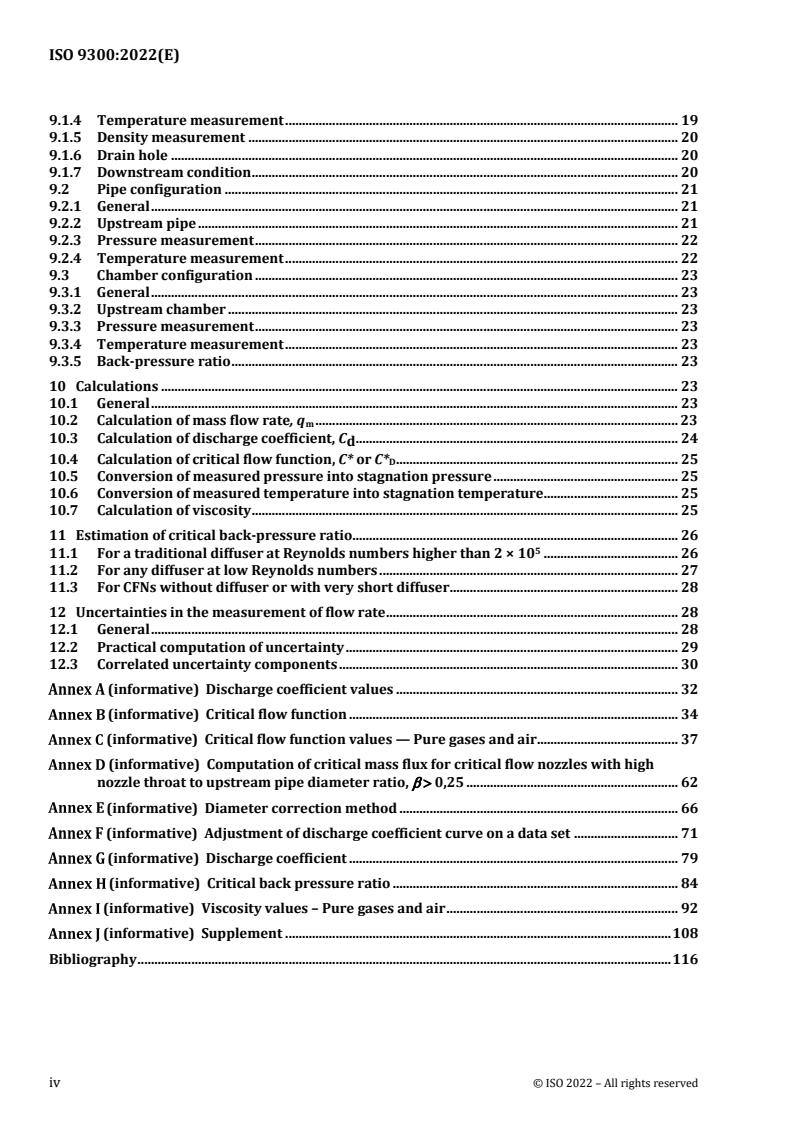
Contents Page
Foreword . v
1 Scope . 1
2 Normative references . 1
3 Terms and definitions . 1
3.1 Pressure . 1
3.2 Temperature . 2
3.3 Nozzle . 2
3.4 Flow . 3
3.5 Flow rate . 4
3.6 Gas . 5
4 Symbols and abbreviations . 6
5 Basic equations . 9
5.1 Gas behaviour . 9
5.1.1 Isentropic process . 9
5.1.2 State equation . 9
5.2 Isentropic flow of a perfect gas . 9
5.2.1 Flowing area . 9
5.2.2 Static pressure . 9
5.2.3 Static temperature . 10
5.3 Theoretical variables at the critical point . 10
5.3.1 General . 10
5.3.2 Critical pressure . 10
5.3.3 Critical temperature . 10
5.3.4 Critical density . 10
5.3.5 Critical velocity . 10
5.4 Theoretical mass flow rates . 10
5.4.1 General . 10
5.4.2 Theoretical mass flow rate of a perfect gas . 10
5.4.3 Theoretical mass flow rate of real gas . 11
5.5 Mass flow rate . 11
6 General requirements . 11
7 Applications for which the method is suitable . 12
8 CFN . 12
8.1 General requirements for both the standard CFN types . 12
8.1.1 General . 12
8.1.2 Materials . 12
8.1.3 Contraction and throat . 13
8.1.4 Diffuser . 13
8.2 Requirements for each standard types of CFN . 14
8.2.1 Standard CFNs . Error! Bookmark not defined.
8.2.2 Toroidal-throat CFN . 15
8.2.3 Cylindrical-throat CFN . 16
9 Installation requirements . 18
9.1 General requirements for both the standard configurations . 18
9.1.1 Standard configurations . 18
9.1.2 Upstream pressure tapping . 18
9.1.3 Downstream pressure tapping . 19
9.1.4 Temperature measurement . 19
9.1.5 Density measurement . 20
9.1.6 Drain hole . 20
9.1.7 Downstream condition . 20
9.2 Pipe configuration . 21
9.2.1 General . 21
9.2.2 Upstream pipe . 21
9.2.3 Pressure measurement . 22
9.2.4 Temperature measurement . 22
9.3 Chamber configuration . 23
9.3.1 General . 23
9.3.2 Upstream chamber . 23
9.3.3 Pressure measurement . 23
9.3.4 Temperature measurement . 23
9.3.5 Back-pressure ratio . 23
10 Calculations . 23
10.1 General . 23
10.2 Calculation of mass flow rate, q . 23
m
10.3 Calculation of discharge coefficient, C . 24
d
10.4 Calculation of critical flow function, C* or C* . 25
D
10.5 Conversion of measured pressure into stagnation pressure . 25
10.6 Conversion of measured temperature into stagnation temperature. 25
10.7 Calculation of viscosity . 25
11 Estimation of critical back-pressure ratio. 26
11.1 For a traditional diffuser at Reynolds numbers higher than 2 × 10 . 26
11.2 For any diffuser at low Reynolds numbers . 27
11.3 For CFNs without diffuser or with very short diffuser . 28
12 Uncertainties in the measurement of flow rate . 28
12.1 General . 28
12.2 Practical computation of uncertainty . 29
12.3 Correlated uncertainty components . 30
(informative) Discharge coefficient values . 32
(informative) Critical flow function . 34
(informative) Critical flow function values — Pure gases and air . 37
(informative) Computation of critical mass flux for critical flow nozzles with high
nozzle throat to upstream pipe diameter ratio, β > 0,25 . 62
(informative) Diameter correction method . 66
(informative) Adjustment of discharge coefficient curve on a data set . 71
(informative) Discharge coefficient . 79
(informative) Critical back pressure ratio . 84
(informative) Viscosity values – Pure gases and air . 92
(informative) Supplement . 108
Bibliography . 116
iv © ISO 2022 – All rights reserved
Foreword
ISO (the International Organization for Standardization) is a worldwide federation of national
standards bodies (ISO member bodies). The work of preparing International Standards is normally
carried out through ISO technical committees. Each member body interested in a subject for which a
technical committee has been established has the right to be represented on that committee.
International organizations, governmental and non-governmental, in liaison with ISO, also take part in
the work. ISO collaborates closely with the International Electrotechnical Commission (IEC) on all
matters of electrotechnical standardization.
The procedures used to develop this document and those intended for its further maintenance are
described in the ISO/IEC Directives, Part 1. In particular, the different approval criteria needed for the
different types of ISO documents should be noted. This document was drafted in accordance with the
editorial rules of the ISO/IEC Directives, Part 2 (see www.iso.org/directives).
Attention is drawn to the possibility that some of the elements of this document may be the subject of
patent rights. ISO shall not be held responsible for identifying any or all such patent rights. Details of
any patent rights identified during the development of the document will be in the Introduction and/or
on the ISO list of patent declarations received (see www.iso.org/patents).
Any trade name used in this document is information given for the convenience of users and does not
constitute an endorsement.
For an explanation of the voluntary nature of standards, the meaning of ISO specific terms and
expressions related to conformity assessment, as well as information about ISO's adherence to the
World Trade Organization (WTO) principles in the Technical Barriers to Trade (TBT), see
www.iso.org/iso/foreword.html.
ISO 9300 was prepared by Technical Committee ISO/TC 30, Measurement of fluid flow in closed conduits,
Subcommittee SC 2, Pressure differential devices, in collaboration with the European Committee for
Standardization (CEN) Technical Committee CEN/SS F05, Measuring instruments, in accordance with
the Agreement on technical cooperation between ISO and CEN (Vienna Agreement).
This third edition cancels and replaces the second edition (ISO 9300:2005), which has been technically
revised.
The main changes are as follows:
— the discharge coefficient curve is given by a single equation each for the toroidal- and cylindrical-
throat critical flow nozzles (CFNs) that covers both the laminar and turbulent boundary layer
regimes;
— the discharge coefficient curve of the cylindrical-throat CFN is updated based on the recent
experimental and theoretical data;
— the quadrant CFN and detachable diffuser are introduced;
— the basic equations used to measure the discharge coefficient are listed;
— the premature unchoking phenomenon is explained to give attention to the unpredictable
unchoking at low Reynolds numbers;
— REFPROP is introduced for the calculations of critical flow function and viscosity as well as their
fitted curves are given for some pure gases and air;
— the diameter correction method is introduced to fit the experimental discharge coefficient data to a
reference curve;
— the detailed method to match the discharge coefficient curve on an experimental data set is
described;
— the background of the specifications is given.
Any feedback or questions on this document should be directed to the user’s national standards body. A
complete listing of these bodies can be found at www.iso.org/members.html.
vi © ISO 2022 – All rights reserved
INTERNATIONAL STANDARD ISO 9300:2022(E)
Measurement of gas flow by means of critical flow nozzles
1 Scope
This document specifies the geometry and method of use (installation in a system and operating
conditions) of critical flow nozzles (CFNs) used to determine the mass flow rate of a gas flowing through
a system basically without the need to calibrate the CFN. It also gives the information necessary for
calculating the flow rate and its associated uncertainty.
This document is applicable to nozzles in which the gas flow accelerates to the critical velocity at the
minimum flowing section, and only where there is steady flow of single-phase gas. When the critical
velocity is attained in the nozzle, the mass flow rate of the gas flowing through the nozzle is the
maximum possible for the existing inlet condition, while the CFN can only be used within specified
limits, e.g. the CFN throat to inlet diameter ratio and Reynolds number. This document deals with the
toroidal- and cylindrical-throat CFNs for which direct calibration experiments have been made in
sufficient number to enable the resulting coefficients to be used with certain predictable limits of
uncertainty.
2 Normative references
There are no normative references in this document.
3 Terms and definitions
For the purposes of this document, the following terms and definitions apply.
ISO and IEC maintain terminology databases for use in standardization at the following addresses:
— ISO Online browsing platform: available at https://www.iso.org/obp
— IEC Electropedia: available at https://www.electropedia.org/
3.1 Pressure
3.1.1
static pressure
pressure of the flowing gas (see Annex J)
Note 1 to entry: The static pressure is measured through a wall pressure tapping (3.1.3).
3.1.2
stagnation pressure
pressure which would exist in a flowing gas stream if the stream were brought to rest by an isentropic
process
3.1.3
wall pressure tapping
hole drilled in the wall of a conduit to measure the static pressure (3.1.1) of the flowing gas in the
conduit
3.2 Temperature
3.2.1
static temperature
temperature of the flowing gas (see Annex J)
Note 1 to entry: The static temperature cannot be measured exactly by a temperature sensor fixed in the conduit .
3.2.2
stagnation temperature
temperature which would exist in a flowing gas stream if the stream were brought to rest by an
isentropic process (see Annex J).
3.2.3
recovery temperature (wall temperature, measured temperature)
temperature of the gas touching the wall (see Annex J)
Note 1 to entry: The temperature sensor fixed on a conduit measures the recovery temperature.
3.3 Nozzle
3.3.1
contraction
portion of the nozzle (3.3.5) upstream of the throat (3.3.2) intended to accelerate the flow and attain the
supposed flow field at the critical point (3.4.4)
3.3.2
throat
portion of the nozzle (3.3.5) where the cross section is minimum
Note 1 to entry: This document deals with nozzles with toroidal- and cylindrical-throats.
3.3.3
diffuser
divergent portion of the nozzle (3.3.5) behind the throat (3.3.2) intended to recover the pressure
3.3.4
traditional diffuser
frustum diffuser (3.3.3) machined as one piece
3.3.5
nozzle
device inserted in a system intended to use for measurement of the flow rate through system, which
consists of contraction (3.3.1) and throat (3.3.2), or contraction (3.3.1), throat (3.3.2), and diffuser
(3.3.3)
3.3.6
critical flow nozzle
CFN
nozzle (3.3.5) that attains the critical flow (3.4.2)
2 © ISO 2022 – All rights reserved
3.3.7
normal precision nozzle
NPN
nozzle (3.3.5) machined by a lathe, with the surface polished to achieve the desired roughness
3.3.8
high precision nozzle
HPN
nozzle (3.3.5) machined by a lathe that can achieve mirror finish without polishing the surface, thus it
has the form exactly as designed
3.4 Flow
3.4.1
isentropic flow
theoretical flow along which the thermodynamic process is adiabatic and reversible (see Annex J)
3.4.2
critical flow
flow in a nozzle (3.3.5) that has attained the maximum flow rate of the nozzle (3.3.5) for a given set of
inlet conditions (see Annex J)
3.4.3
choke
attaining the critical flow (3.4.2) in a nozzle (3.3.5) (see Annex J)
3.4.4
critical point
location in the CFN (3.3.6) where the flow attains the critical velocity (3.4.11)
3.4.5
critical pressure
p *
static pressure (3.1.1) at the critical point (3.4.4) (see Annex J)
3.4.6
critical pressure of perfect gas
p *
P
theoretical static pressure (3.1.1) at the critical point (3.4.4) assuming the isentropic flow (3.4.1) of
perfect gas (3.6.1)
3.4.7
critical temperature
T *
static temperature (3.2.1) at the critical point (3.4.4)
3.4.8
critical temperature of perfect gas
T *
P
theoretical static temperature (3.2.1) at the critical point (3.4.4) assuming the isentropic flow (3.4.1) of
perfect gas (3.6.1)
3.4.9
critical density
ρ*
density at the critical point (3.4.4)
3.4.10
critical density of perfect gas
ρ *
P
theoretical density at the critical point (3.4.4) assuming the isentropic flow (3.4.1) of perfect gas (3.6.1)
3.4.11
critical velocity
c*
flow velocity at the critical point (3.4.4) (see Annex J)
3.4.12
critical velocity of perfect gas
c*
P
theoretical flow velocity at the critical point (3.4.4) assuming the isentropic flow (3.4.1) of perfect gas
(3.6.1)
3.5 Flow rate
3.5.1
mass flow rate
q
m
mass of the gas passing through the CFN (3.3.6) per unit time
Note 1 to entry: In this document, the term "mass flow rate" without any adjective always refers to the true mass
flow rate through the CFN.
3.5.2
theoretical mass flow rate of perfect gas
q
th,P
theoretical mass flow rate through the CFN (3.3.6) assuming one-dimensional isentropic flow (3.4.1) of
perfect gas (3.6.1)
3.5.3
theoretical mass flow rate of real gas
q
th,R
theoretical mass flow rate through the CFN (3.3.6) assuming one-dimensional isentropic flow (3.4.1) of
real gas (3.6.1)
3.5.4
volume flow rate
q
V
volume of the gas passing through the conduit, in which the CFN (3.3.6) is installed, per unit time at a
designated location (see Annex J)
Note 1 to entry: The volume flow rate at the designated location, where the density is ρ, is given by:
q
m
q =
V
ρ
4 © ISO 2022 – All rights reserved
3.5.5
Reynolds number
4q
m
R =
e
πdµ
dimensionless parameter calculated from the throat diameter, mass flow rate (3.5.1), and gas dynamic
viscosity at CFN (3.3.6) inlet stagnation condition (see Annex J)
3.5.6
discharge coefficient
q
m
C =
d
q
th,R
ratio of the mass flow rate (3.5.1) to theoretical one of real gas (3.6.1) at the same inlet stagnation
condition
3.5.7
critical pressure ratio
ratio of the critical pressure (3.4.5) of perfect gas (3.6.1) to the inlet stagnation pressure (3.1.2)
3.5.8
back-pressure ratio
ratio of the static pressure (3.1.1) at the diffuser exit to the inlet stagnation pressure (3.1.2)
3.5.9
local Mach number
M
a
ratio of the flow velocity to local acoustic one
3.5.10
Mach number in the upstream conduit
M
aC
ratio of the mean axial flow velocity over the cross-section of upstream conduit to the acoustic velocity
at the same location
Note to entry: It is not necessary for MaC to be accurate and it may be approximated by:
q 1
m
M =
aC
πD R
γ T
ρ
4 M
3.5.11
uncertainty
parameter, associated with the results of a measurement, that characterizes the dispersion of the values
that could reasonably be attributed to the measurand
3.6 Gas
3.6.1
perfect gas
theoretical gas whose isentropic exponent (3.6.6) equals to the specific heat that is constant at any gas
condition and also compressibility factor (3.6.3) is always unity
3.6.2
real gas
actual gas whose isentropic exponent (3.6.6) and compressibility factor (3.6.3) depend on its pressure
and temperature
3.6.3
compressibility factor
Z
correction factor for the deviation of the real gas constant from the universal one (see Annex J)
3.6.4
critical flow function
C *
dimensionless function that relates the thermodynamic properties of the gas at the throat of CFN (3.3.6)
to its inlet stagnation condition assuming one-dimensional isentropic flow (3.4.1)
3.6.5
critical flow function for the flow rate equation using density
C **= CZ
D0
alternative critical flow function (3.6.4) to be used in the equation of mass flow rate (3.5.1) that uses
density
3.6.6
isentropic exponent
κ
ratio of the relative variation in pressure to the corresponding relative variation in density under
isentropic process
4 Symbols and abbreviations
Symbol Description Dimension SI unit
a, b, c, d, e, f, n Coefficients for Formula (17) Dimensionless —
2 2
A Flowing area L m
2 2
A* Flowing area at the critical point L m
2 2
A Cross-sectional area of nozzle exit L m
Cross-sectional area at the critical point at the operating CFN
2 2
A L m
nt
temperature
−1
-1
c Local acoustic velocity LT m·s
−1
-1
Local acoustic velocity at the critical point LT m·s
c*
−1
-1
Local acoustic velocity at the critical point of perfect gas LT m·s
c*
P
C Parameter for the equation of C* Dimensionless —
c*
C Parameter for the equation of µ Dimensionless —
μ
C Discharge coefficient Dimensionless —
d
target
C Target discharge coefficient obtained when applying the DCM Dimensionless —
d
ISO
C Discharge coefficient calculated by using Formula (17) Dimensionless —
d
Critical flow function Dimensionless —
C *
Critical flow function for the flow rate equation using density Dimensionless —
C *
D
Critical flow function of perfect gas Dimensionless —
C *
P
Critical flow function of dry air Dimensionless —
C *
DA
Critical flow function of humid air Dimensionless —
C *
HA
6 © ISO 2022 – All rights reserved
Symbol Description Dimension SI unit
b b
Coefficient to calculate C*
C
ij,
Covariance Dimensionless —
c
v
D Diameter of the inlet conduit L m
d Throat diameter corrected by the DCM L m
DCM
d Throat diameter at the operating CFN temperature L m
nt
d Measured throat diameter (at temperature T ) L m
nt0 nt0
d Throat diameter used at the calibration for the DCM L m
ORI
d Diameter of the wall pressure tapping breakthrough into the conduit L m
p
H Relative humidity % —
R
k Coverage factor Dimensionless —
l Diffuser length L m
l1 Distance between Etoile straightener outlet and nozzle inlet plane L m
l2 Length of Etoile straightener L m
−1
M Molar mass M kg mol
M Local Mach number Dimensionless —
a
Local Mach number at the CFN exit assuming the fully subsonic flow in —
M Dimensionless
a2
the diffuser
M Local Mach number at the location of the inlet pressure tapping Dimensionless —
aC
−1 −2
p Static pressure of the gas ML T Pa
−1 −2
p Stagnation pressure of the gas at the CFN inlet ML T Pa
Static pressure of the gas measured through the upstream wall
−1 −2
p ML T Pa
pressure tapping
−1 −2
p Static pressure of the gas at the diffuser exit ML T Pa
Theoretical static pressure of the gas at the diffuser exit when the
−1 −2
p ML T Pa
2i
nozzle is choked but the flow in the diffuser is fully subsonic
−1 −2
p Static pressure in the gas at densitometer ML T Pa
den
P The Prandtl number Dimensionless —
r
−1 −2
p* Static pressure at the critical point ML T Pa
−1 −2
Theoretical static pressure at the critical point of perfect gas ML T Pa
p *
P
−1 −1
q Mass flow rate (True mass flow rate) MT kg·s
m
−1 −1
Theoretical mass flow rate of perfect gas MT kg·s
qth,P
−1 −1
Theoretical mass flow rate of real gas MT kg·s
qth,R
−1 −1
q Volume flow rate MT kg·s
V
2 −2 −1 −1 −1
R Universal gas constant (8,314 5 J/(mol·K)) M L T Θ J·mol K
R Arithmetic average roughness L m
a
Re Reynolds number Dimensionless —
ORI
Re The Reynolds number at the calibration for the DCM Dimensionless —
R Recovery factor Dimensionless —
f
r Radius of inlet contraction L m
c
r Critical back-pressure ratio Dimensionless —
CBP
r Radius in the vicinity of throat inlet in cylindrical-throat CFN L m
nt
T Static temperature of the gas Θ K
T Stagnation temperature of the gas at the CFN inlet Θ K
T Measured temperature of the gas at the CFN inlet Θ K
T Static temperature at densitometer Θ K
den
T Measured temperature Θ K
m
Symbol Description Dimension SI unit
T Temperature when throat diameter was measured Θ K
nt0
T* Static temperature at the critical point Θ K
Theoretical static temperature at the critical point of perfect gas Θ K
T *
P
T Parameter for the equation of C* Θ K
c*
T Parameter for the equation of μ Θ K
μ
b
𝑢𝑢 Standard uncertainty (k = 1) —
b
𝑢𝑢 Combined standard uncertainty (k = 1) —
𝑐𝑐
b
U Expanded uncertainty (with specified coverage factor, k) U
b
V Coefficient to calculate viscosity U
i,j
b
U Expanded uncertainty (with specified coverage factor, k) U
xi Mole fraction of the i-th component Dimensionless —
Z Compressibility factor Dimensionless —
Ζ0 Compressibility factor at upstream stagnation condition Dimensionless —
Ζden Compressibility factor at densitometer Dimensionless —
−1 −1
α Linear expansion coefficient of the nozzle material Θ K
β Diameter ratio of the throat and conduit (dnt/D) Dimensionless —
a a
δ Absolute uncertainty
γ Heat capacity ratio Dimensionless —
κ Isentropic exponent Dimensionless —
−1 −1
µ Dynamic viscosity of the gas at the inlet stagnation conditions ML T Pa·s
−1 −1
µ Dynamic viscosity of the gas ML T Pa·s
θ Angle of the frustum diffuser wall against the nozzle AOS Dimensionless rad
-3
ρ Density of the gas ML kg
−3 −3
ρ Gas density at the inlet stagnation conditions at nozzle inlet ML kg·m
−3 −3
ρ Gas density measured by a densitometer ML kg·m
den
−3 −3
ρ∗ Theoretical density of the gas at the critical point ML kg·m
−3 −3
Theoretical density of the gas at the critical point of perfect gas ML kg·m
ρ *
P
M = mass
L = length
T = time
Θ = temperature
a
Same as the corresponding quantity.
b
Depending on each terms of the equation.
8 © ISO 2022 – All rights reserved
Abbreviation Description
AOS axis of symmetry
CFN critical flow nozzle
CL center line
DCM diameter correction method
HPN high precision nozzle
NPN normal precision nozzle
IP inlet plane
PUP premature unchoking phenomenon
TLS tangential line of surface
5 Basic equations
5.1 Gas behaviour
5.1.1 Isentropic process
The pressure, temperature, and density of gas in the isentropic process are related by Formulae (1) and
(2);
γ−1
p
=const. (1)
γ
T
p
= const. (2)
γ
ρ
5.1.2 State equation
The behaviour of real gas is described by Formula (3);
p RZ
= T (3)
ρ M
5.2 Isentropic flow of a perfect gas
5.2.1 Flowing area
The flowing area is related to the local Mach number by Formula (4);
11γ+
2γ−1
1 (γ−12) M +
a
(4)
AA=
nt
M γ+ 1
a
5.2.2 Static pressure
The static pressure is related to the local Mach number by Formula (5);
γ
−
γ−1
γ−1
(5)
p 1+ Mp
a0
2
=
5.2.3 Static temperature
The static temperature is related to the local Mach number by Formula (6);
(6)
T= T
21+−(γ ) M
a
5.3 Theoretical variables at the critical point
5.3.1 General
The theoretical variables at the critical point are derived assuming the isentropic flow of perfect gas.
5.3.2 Critical pressure
The theoretical static pressure at the critical point is given by Formula (7);
γ
2 γ−1
(7)
pp* =
P 0
γ+ 1
5.3.3 Critical temperature
The theoretical static temperature at the critical point is given by Formula (8);
(8)
TT* =
P0
γ+1
5.3.4 Critical density
The theoretical density at the critical point is given by Formula (9);
γ−1
(9)
ρρ* =
P0
γ+ 1
5.3.5 Critical velocity
The theoretical flow velocity at the critical point is given by Formula (10);
R
(10)
cT**= γ
P P
M
5.4 Theoretical mass flow rates
5.4.1 General
The theoretical mass flow rates are derived assuming one-dimensional isentropic flow of perfect or real
gas.
5.4.2 Theoretical mass flow rate of a perfect gas
The theoretical mass flow rate of a perfect gas is defined by the product of flowing area, local acoustic
velocity, and density at the critical point assuming one-dimensional isentropic flow of a perfect gas, i.e.
Z = 1 and k = γ, which is given by Formula (11);
10 © ISO 2022 – All rights reserved
p
(11)
q ≡=A **c ρ * A *C *
th,P P P P
R
T
M
5.4.3 Theoretical mass flow rate of real gas
The theoretical mass flow rate of real gas is defined by the product of flowing area, local acoustic
velocity, and density at the critical point assuming one-dimensional isentropic flow of real gas, which is
given by Formula (12);
p
(12)
q ≡=A **c ρ * A *C *
th,R
R
T
M
5.5 Mass flow rate
The mass flow rate of CFN is given by Formulae (13) or (14);
(13)
q = C q
m d th,R
or
(14)
q = C A **C p ρ
( )
m d D 0 0
6 General requirements
a) The flow shall be steady-state and single-phase with no condensation to the critical point (throat).
b) A sufficiently low back-pressure ratio shall be applied on the CFN to maintain the critical flow.
NOTE The typical pressure ratio required to operate the CFN with a sufficiently long diffuser can be about 0,8 at high
5 3
Reynolds numbers, e.g., greater than 2×10 (corresponding to ca. 50 m /h CFN at the atmospheric pressure); however, it
is often necessary to keep the ratio lower than 0,5 at low Reynolds numbers or sometimes 0,25 at very low Reynolds
numbers (see Clause 11 and Annex H).
c) The thermodynamic properties of the gas, C * and M (or and ρ when a densitometer is used),
C *
D
are required at low uncertainties (see 10.4).
NOTE For a gas mixture, accurate gas composition is required to calculate C * at sufficiently low uncertainty.
If the following requirements cannot be achieved, the CFN will have to be flow calibrated at the same
condition as in its application.
d) The gas should have no significant relaxation effect (see B.5).
e) The temperatures of the gas and CFN should be stable (see Annex J).
f) The form and surface in the contraction and throat should be accurately machined as specified in
Clause 8 (see Annex G).
g) The form of the CFN will be verified periodically, especially in the contraction and throat (see
Annex G).
NOTE The contraction and throat can be deformed over time by the impact of any solids contained in the gas.
The contraction and throat shall retain their cleanliness and hence surface finish. If this cannot be
guaranteed, the measurement shall not be claimed to conform to this document, and flow calibration is
recommended.
7 Applications for which the method is suitable
Each application should be evaluated to determine whether a CFN or some other device is the most
suitable.
The most common applications for CFNs are to act as working or reference standards to calibrate other
flowmeters, as check or transfer standards to verify or compare calibration facilities, as controllers of
flow rates, and so on.
Important considerations are:
a) The mass and volume flow rates through the CFN are independent of the downstream condition.
b) The volume flow rate through the conduit where the CFN is installed is almost constant at any
upstream pressure if the temperature is stable.
NOTE Multiple CFNs installed in parallel (e.g. the chamber configuration) are required to vary the volume flow rate
through the CFN system for a fixed upstream pressure (see 9.3 and Annex J).
Some other considerations are:
c) Accurate measurements of the pressure and temperature (or density when using a densitometer)
are required only at the upstream location of the CFN.
d) The downstream pressure should be monitored or estimated to confirm that the CFN is choked.
e) The mass flow rate measured by the CFN is proportional to the inlet stagnation pressure;
accordingly, the maximum mass flow rate that can be achieved by the CFN is practically limited by
the maximum inlet pressures. (see Annex J)
8 CFN
8.1 General requirements for both the standard CFN types
8.1.1 General
This section specifies the common requirements to the toroidal- and cylindrical-throat CFNs.
To perform the measurement of flow rate at the uncertainty specified in 10.3.2 by using the discharge
coefficient specified in 10.3.1, the CFN shall comply with the specifications in 8.1.2 to 8.1.4 and 8.2.
Verification of the form and dimensions by CMM are mandatory, and if the manufacturing tolerances
specified in this section including the roughness cannot be achieved or verified by inspections, flow
calibration is recommended.
8.1.2 Materials
The CFN shall be made of material suitable for the intended application. Some considerations are that:
12 © ISO 2022 – All rights reserved
a) it should be possible to finish or machine the surface to the conditions required in 8.1.3 and 8.2,
NOTE Some materials are unsuitable due to pits, voids and lack of homogeneity.
b) the material, together with any surface treatment used, shall not be subject to corrosion in the
intended service, and
c) the material should be dimensionally stable and should have known and repeatable thermal
expansion characteristics, so that the throat diameter correction in Formula (16) can be made.
8.1.3 Contraction and throat
The contraction and throat of the CFN shall be
a) axisymmetric around the centreline (axis of symmetry, AOS) of the CFN,
b) smoothly finished so that the surface roughness should be
-6
for d > 13 mm: R = 15 × 10 d as a maximum requirement, and
nt a nt
for d ≤ 13 mm: R = 200 nm as a maximum requirement
nt a
c) free from dirt or any other contaminants.
It is difficult to machine the contraction and throat as specified, on which the discharge coefficient
directly depends, and also to measure the throat diameter accurately, particularly in small nozzles, thus
great care should be taken.
Great care is also necessary when polishing the contraction and throat because it may result in
significant deformation of the surface.
8.1.4 Diffuser
The only requirement on the diffuser is that it shall not disturb the flow at the throat; therefore, the
form of diffuser is not specified.
[2]
Besides the traditional diffuser, the requirement allows no diffuser, detachable diffusers , and steps
[12]
exactly at the throat and/or in the diffuser (see Annex J).
The traditional diffuser should be integrated in the nozzle by being machined as one piece. It should be
controlled such that any steps, discontinuities, irregularities, and lack of concentricity do not exceed 1%
of the local diameter. The length should be not less than d . If there is a diameter discontinuity in the
nt
diffuser, then the diameter should increase (not decrease) toward the downstream. The arithmetic
-4
average roughness of the conical divergent section should not exceed 10 d . In the specified Reynolds
nt
number range, the critical back-pressure ratio of a traditional diffuser may be estimated in accordance
with Clause 11.
Some phenomenon (premature unchoking phenomenon, PUP, see Annex H) impacts diffuser
[4][12]
performance in an unpredictable manner at low Reynolds numbers . If the critical back-pressure
ratio is essential for the system operation at low Reynolds numbers, e.g., lower than 2 × 10 , the actual
critical back-pressure ratio should be measured experimentally using the very CFN with its own conduit
for the application because the phenomenon may depend significantly on a slight difference of the CFN
[9][11]
form and/or quality as well as its installing condition .
[10]
It is recommended to make the diffuser as long as possible , at least 4d , to reduce the risk of the
nt
occurrence of PUP. If the diffuser is detachable, it can be exchanged by a longer one if the need arises.
Additional detachable diffusers may be attached behind the integrated diffuser without affecting the
discharge coefficient (see Figure J.1).
The inlet of the diffuser, regardless of whether it is integrated or detachable, shall be machined very
carefully not to damage or block the throat, so as when attaching the detachable diffuser.
8.2 Requirements for each standard type of CFN
14 © ISO 2022 – All rights reserved
8.2.1 Toroidal-throat CFN
There are two forms of the standard CFNs:
a) toroidal-throat CFN;
b) cylindrical-throat CFN.
Besides the requirements in 8.1, the toroidal- and cylindrical-throat CFNs shall comply with 8.2.2 and
8.2.3, respectively.
8.2.2 Toroidal-throat CFN
8.2.2.1 Besides the requ
...
NORME ISO
INTERNATIONALE 9300
Troisième édition
2022-06
Mesurage de débit de gaz au moyen de
tuyères en régime critique
Measurement of gas flow by means of critical flow nozzles
Numéro de référence
DOCUMENT PROTÉGÉ PAR COPYRIGHT
© ISO 2022
Tous droits réservés. Sauf prescription différente ou nécessité dans le contexte de sa mise en œuvre, aucune partie de cette
publication ne peut être reproduite ni utilisée sous quelque forme que ce soit et par aucun procédé, électronique ou mécanique,
y compris la photocopie, ou la diffusion sur l’internet ou sur un intranet, sans autorisation écrite préalable. Une autorisation peut
être demandée à l’ISO à l’adresse ci-après ou au comité membre de l’ISO dans le pays du demandeur.
ISO copyright office
Case postale 401 • Ch. de Blandonnet 8
CH-1214 Vernier, Genève
Tél.: +41 22 749 01 11
E-mail: copyright@iso.org
Web: www.iso.org
Publié en Suisse
ii
Sommaire Page
Avant-propos . v
1 Domaine d’application . 1
2 Références normatives . 1
3 Termes et définitions . 1
3.1 Pression . 1
3.2 Température . 2
3.3 Tuyère . 2
3.4 Écoulement . 3
3.5 Débit . 4
3.6 Gaz . 6
4 Symboles et abréviations . 6
5 Équations de base . 9
5.1 Comportement du gaz . 9
5.1.1 Procédé isentropique . 9
5.1.2 Équation d’état . 9
5.2 Écoulement isentropique d’un gaz parfait . 10
5.2.1 Section d’écoulement . 10
5.2.2 Pression statique . 10
5.2.3 Température statique . 10
5.3 Variables théoriques au point critique . 10
5.3.1 Généralités . 10
5.3.2 Pression critique . 10
5.3.3 Température critique . 10
5.3.4 Masse volumique critique . 11
5.3.5 Vitesse critique . 11
5.4 Débits-masses théoriques . 11
5.4.1 Généralités . 11
5.4.2 Débit-masse théorique d’un gaz parfait . 11
5.4.3 Débit-masse théorique d’un gaz réel . 11
5.5 Débit-masse . 11
6 Exigences générales . 12
7 Applications pour lesquelles la méthode est adaptée . 12
8 CFN . 13
8.1 Exigences générales relatives aux types CFN normalisées . 13
8.1.1 Généralités . 13
8.1.2 Matériaux. 13
8.1.3 Convergent et col . 14
8.1.4 Divergent . 14
8.2 Exigences relatives à chaque type de CFN normalisées . 15
8.2.1 CFN normalisées . 15
8.2.2 CFN à col toroïdal . 15
8.2.3 CFN à col cylindrique . 16
9 Exigences relatives à l’installation . 18
9.1 Exigences générales relatives aux configurations normalisées . 18
9.1.1 Configurations normalisées . 18
9.1.2 Prise de pression en amont . 18
9.1.3 Prise de pression en aval . 19
9.1.4 Mesurage de la température . 19
9.1.5 Mesurage de la masse volumique . 20
9.1.6 Orifice de purge . 20
9.1.7 Conditions en aval . 20
9.2 Configuration en tube . 21
9.2.1 Généralités . 21
9.2.2 Tube en amont. 21
9.2.3 Mesurage de la pression . 22
9.2.4 Mesurage de la température . 22
9.3 Configuration en enceinte . 23
9.3.1 Généralités . 23
9.3.2 Enceinte en amont . 23
9.3.3 Mesurage de la pression . 23
9.3.4 Mesurage de la température . 23
9.3.5 Rapport de contre-pression . 23
10 Calculs . 23
10.1 Généralités . 23
10.2 Calcul du débit-masse, q . 24
m
10.3 Calcul du coefficient de décharge, C . 24
d
10.4 Calcul de la fonction critique, C* ou C* . 25
D
10.5 Conversion de la pression mesurée en pression d’arrêt . 25
10.6 Conversion de la température mesurée en température d’arrêt . 25
10.7 Calcul de la viscosité . 26
11 Estimation du rapport de contre-pression critique . 26
11.1 Pour un divergent traditionnel avec un nombre de Reynolds supérieur à 2 × 10 . 26
11.2 Pour tout divergent avec un faible nombre de Reynolds . 27
11.3 Pour les CFN sans divergent ou avec un divergent très court . 28
12 Incertitudes de mesure du débit . 28
12.1 Généralités . 28
12.2 Calcul pratique de l’incertitude . 29
12.3 Composantes d’incertitude corrélées . 30
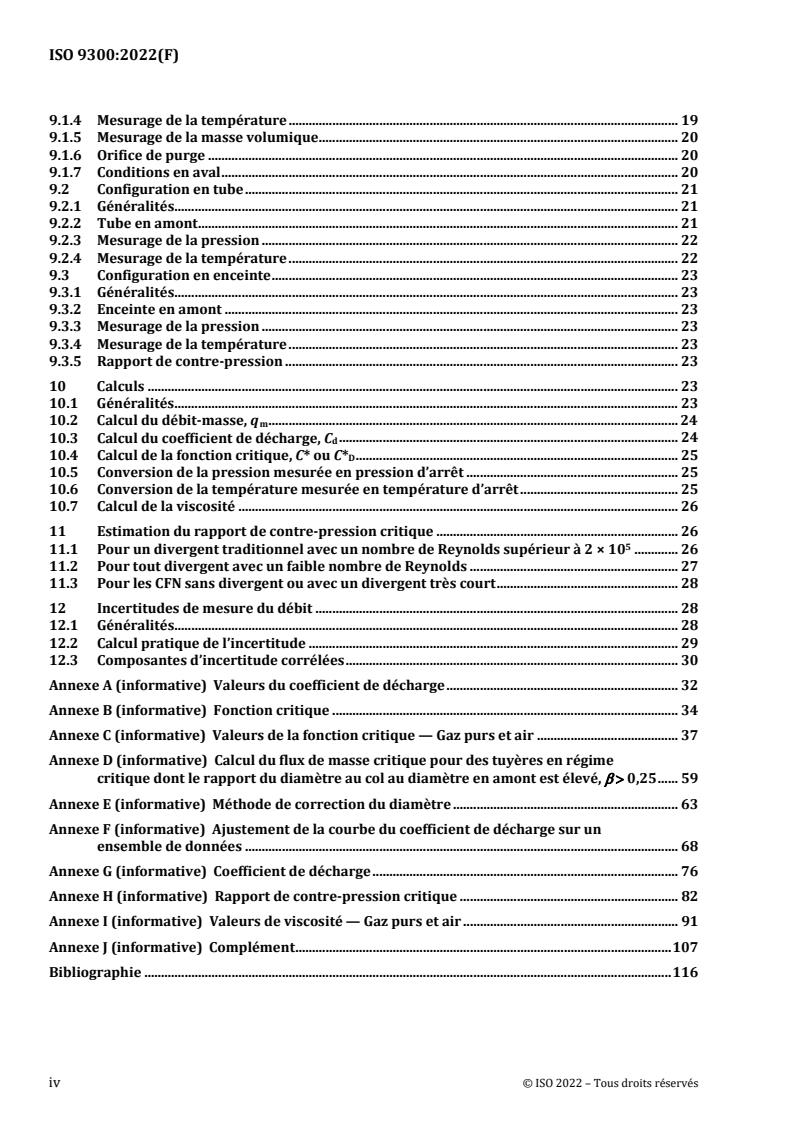
Annexe A (informative) Valeurs du coefficient de décharge . 32
Annexe B (informative) Fonction critique . 34
Annexe C (informative) Valeurs de la fonction critique — Gaz purs et air . 37
Annexe D (informative) Calcul du flux de masse critique pour des tuyères en régime
critique dont le rapport du diamètre au col au diamètre en amont est élevé, β > 0,25 . 59
Annexe E (informative) Méthode de correction du diamètre . 63
Annexe F (informative) Ajustement de la courbe du coefficient de décharge sur un
ensemble de données . 68
Annexe G (informative) Coefficient de décharge . 76
Annexe H (informative) Rapport de contre-pression critique . 82
Annexe I (informative) Valeurs de viscosité — Gaz purs et air . 91
Annexe J (informative) Complément . 107
Bibliographie . 116
iv © ISO 2022 – Tous droits réservés
Avant-propos
L’ISO (Organisation internationale de normalisation) est une fédération mondiale d’organismes
nationaux de normalisation (comités membres de l’ISO). L’élaboration des Normes internationales est
en général confiée aux comités techniques de l’ISO. Chaque comité membre intéressé par une étude a le
droit de faire partie du comité technique créé à cet effet. Les organisations internationales,
gouvernementales et non gouvernementales, en liaison avec l’ISO participent également aux travaux.
L’ISO collabore étroitement avec la Commission électrotechnique internationale (IEC) en ce qui
concerne la normalisation électrotechnique.
Les procédures utilisées pour élaborer le présent document et celles destinées à sa mise à jour sont
décrites dans les Directives ISO/IEC, Partie 1. Il convient, en particulier de prendre note des différents
critères d’approbation requis pour les différents types de documents ISO. Le présent document a été
rédigé conformément aux règles de rédaction données dans les Directives ISO/IEC, Partie 2
(voir www.iso.org/directives).
L’attention est appelée sur le fait que certains des éléments du présent document peuvent faire l’objet
de droits de propriété intellectuelle ou de droits analogues. L’ISO ne saurait être tenue pour
responsable de ne pas avoir identifié de tels droits de propriété et averti de leur existence. Les détails
concernant les références aux droits de propriété intellectuelle ou autres droits analogues identifiés
lors de l’élaboration du document sont indiqués dans l’Introduction et/ou dans la liste des déclarations
de brevets reçues par l’ISO (voir www.iso.org/brevets).
Les appellations commerciales éventuellement mentionnées dans le présent document sont données
pour information, par souci de commodité, à l’intention des utilisateurs et ne sauraient constituer un
engagement.
Pour une explication de la nature volontaire des normes, la signification des termes et expressions
spécifiques de l’ISO liés à l’évaluation de la conformité, ou pour toute information au sujet de l’adhésion
de l’ISO aux principes de l’Organisation mondiale du commerce (OMC) concernant les obstacles
techniques au commerce (OTC), voir le lien suivant: www.iso.org/iso/fr/avant-propos.
L’ISO 9300 a été élaborée par le comité technique ISO/TC 30, Mesure de débit des fluides dans les
conduites fermées, sous-comité SC 2, Appareils déprimogènes, en collaboration avec le comité technique
CEN/SS F05, Instruments de mesure, du comité européen de normalisation (CEN), conformément à
l’Accord de coopération technique entre l’ISO et le CEN (Accord de Vienne).
Cette troisième édition annule et remplace la deuxième édition (ISO 9300:2005), qui a fait l’objet d’une
révision technique.
Les principales modifications sont les suivantes:
— la courbe du coefficient de décharge est fournie par une seule équation pour chaque tuyère en
régime critique (CFN) à col cylindrique et à col toroïdal qui couvre à la fois les régimes des couches
limites laminaires et turbulentes;
— la courbe du coefficient de décharge de la CFN à col cylindrique est mise à jour à partir des données
théoriques et expérimentales récentes;
— les notions de CFN à quadrant et de divergent démontable sont introduites;
— une liste des équations de base utilisées pour mesurer le coefficient de décharge est établie;
— le phénomène de désamorçage prématuré est expliqué pour attirer l’attention sur le désamorçage
imprévisible à de faibles nombres de Reynolds;
— le REFPROP est introduit pour les calculs de fonction de débit critique et de viscosité, tandis que
leurs courbes ajustées sont fournies pour certains gaz purs et l’air;
— la méthode de correction du diamètre est présentée afin d’adapter les données expérimentales
relatives au coefficient de décharge à une courbe de référence;
— la méthode détaillée visant à faire correspondre la courbe du coefficient de décharge à un ensemble
de données expérimentales est décrite;
— le contexte des spécifications est présenté.
Il convient que l’utilisateur adresse tout retour d’information ou toute question concernant le présent
document à l’organisme national de normalisation de son pays. Une liste exhaustive desdits organismes
se trouve à l’adresse www.iso.org/fr/members.html.
vi © ISO 2022 – Tous droits réservés
NORME INTERNATIONALE ISO 9300:2022(F)
Mesurage de débit de gaz au moyen de tuyères
en régime critique
1 Domaine d’application
Le présent document spécifie la géométrie et le mode d’emploi (installation dans un circuit et
conditions opératoires) de tuyères en régime critique (CFN) utilisées pour déterminer le débit-masse
de gaz traversant le circuit sans besoins d'étalonner la CFN. Il donne également les informations
nécessaires au calcul du débit et de l’incertitude associée.
Le présent document s’applique aux tuyères au sein desquelles l’écoulement gazeux est accéléré jusqu’à
atteindre la vitesse critique à la section d’écoulement minimum et uniquement lorsqu’il existe un
écoulement stationnaire monophasique de gaz. Lorsque la vitesse critique est atteinte dans la tuyère,
le débit-masse du gaz traversant la tuyère est le plus grand débit-masse possible pour les conditions
existant à l’entrée, tandis que les CFN peuvent être utilisées uniquement à l’intérieur des limites
spécifiées, par exemple pour le rapport du diamètre au col au diamètre à l’entrée de la CFN et pour le
nombre de Reynolds. Le présent document traite des CFN à col toroïdal et cylindrique pour lesquelles
des étalonnages directs ont été effectués en nombre suffisant, pour permettre de déterminer les
coefficients avec une marge prévisible d’incertitude.
2 Références normatives
Le présent document ne contient aucune référence normative.
3 Termes et définitions
Pour les besoins du présent document, les termes et définitions suivants s’appliquent.
L’ISO et l’IEC tiennent à jour des bases de données terminologiques destinées à être utilisées en
normalisation, consultables aux adresses suivantes:
— ISO Online browsing platform: disponible à l’adresse https://www.iso.org/obp;
— IEC Electropedia: disponible à l’adresse https://www.electropedia.org/.
3.1 Pression
3.1.1
pression statique
pression du gaz en écoulement (voir l’Annexe J)
Note 1 à l’article: La pression statique est mesurée par une prise de pression à la paroi (3.1.3).
3.1.2
pression d’arrêt d’un gaz
pression qui règnerait dans le gaz si l’écoulement gazeux était amené au repos par un procédé
isentropique
3.1.3
prise de pression à la paroi
orifice percé dans la paroi d’une conduite afin de mesurer la pression statique (3.1.1) du gaz en
écoulement dans la conduite
3.2 Température
3.2.1
température statique d’un gaz
température du gaz en écoulement (voir l’Annexe J)
Note 1 à l’article: La température statique ne peut pas être mesurée exactement à l’aide d’un capteur de
température fixé dans la conduite.
3.2.2
température d’arrêt d’un gaz
température qui règnerait dans le gaz si l’écoulement gazeux était amené au repos par un procédé
isentropique (voir l’Annexe J).
3.2.3
température de récupération (température de paroi, température mesurée)
température du gaz touchant la paroi (voir l’Annexe J)
Note 1 à l’article: Le capteur de température fixé sur une conduite mesure la température de récupération.
3.3 Tuyère
3.3.1
convergent
portion de la tuyère (3.3.5) située en amont du col (3.3.2) destinée à accélérer le débit et à atteindre la
plage d’écoulement définie au point critique (3.4.4)
3.3.2
col
portion de la tuyère (3.3.5) dans laquelle la section circulaire est minimale
Note 1 à l’article: Le présent document traite des tuyères dotées de cols toroïdaux et cylindriques.
3.3.3
divergent
portion divergente de la tuyère (3.3.5) derrière le col (3.3.2) destinée à récupérer la pression
3.3.4
divergent traditionnel
tronc de cône de divergent (3.3.3) usiné en une seule pièce
3.3.5
tuyère
dispositif inséré dans un système destiné à mesurer le débit s’écoulant dans le système, constitué d’un
convergent (3.3.1) et d’un col (3.3.2), ou d’un convergent (3.3.1), d’un col (3.3.2) et d’un divergent (3.3.3)
2 © ISO 2022 – Tous droits réservés
3.3.6
tuyère en régime critique (critical flow nozzle)
CFN
tuyère (3.3.5) capable d’atteindre l’écoulement critique (3.4.2)
3.3.7
tuyère à exactitude normale (normal precision nozzle)
NPN
tuyère (3.3.5) usinée au moyen d’un tour et dont la surface est polie pour obtenir la rugosité désirée
3.3.8
tuyère de haute exactitude (high precision nozzle)
HPN
tuyère (3.3.5) usinée au moyen d’un tour pouvant être dotée d’une finition brillante sans en polir
la surface, sa forme correspond donc exactement à la conception
3.4 Écoulement
3.4.1
écoulement isentropique
écoulement théorique selon lequel le procédé thermodynamique est adiabatique et réversible
(voir l’Annexe J)
3.4.2
écoulement critique
écoulement dans une tuyère (3.3.5) qui a atteint le débit maximum de la tuyère (3.3.5) pour un
ensemble donné de conditions d’entrée (voir l’Annexe J)
3.4.3
régime sonique
atteinte de l’écoulement critique (3.4.2) dans une tuyère (3.3.5) (voir l’Annexe J)
3.4.4
point critique
emplacement dans la CFN (3.3.6) où le débit atteint la vitesse critique (3.4.11)
3.4.5
pression critique
p *
pression statique (3.1.1) au point critique (3.4.4) (voir l’Annexe J)
3.4.6
pression critique d’un gaz parfait
p *
P
pression statique (3.1.1) théorique au point critique (3.4.4) en supposant un écoulement
isentropique (3.4.1) d’un gaz parfait (3.6.1)
3.4.7
température critique
T *
température statique (3.2.1) au point critique (3.4.4)
3.4.8
température critique d’un gaz parfait
T *
P
température statique (3.2.1) théorique au point critique (3.4.4) en supposant un écoulement
isentropique (3.4.1) d’un gaz parfait (3.6.1)
3.4.9
masse volumique critique
ρ*
masse volumique au point critique (3.4.4)
3.4.10
masse volumique critique d’un gaz parfait
ρ *
P
masse volumique théorique au point critique (3.4.4) en supposant un écoulement isentropique (3.4.1)
d’un gaz parfait (3.6.1)
3.4.11
vitesse critique
c*
vitesse d’écoulement au point critique (3.4.4) (voir l’Annexe J)
3.4.12
vitesse critique d’un gaz parfait
c*
P
vitesse d’écoulement théorique au point critique (3.4.4) en supposant un écoulement isentropique (3.4.1)
d’un gaz parfait (3.6.1)
3.5 Débit
3.5.1
débit-masse
q
m
masse du gaz passant par la CFN (3.3.6) par unité de temps
Note 1 à l’article: Dans le présent document, le terme «débit-masse» sans adjectif se réfère toujours au
débit-masse réel dans la CFN.
3.5.2
débit-masse théorique d’un gaz parfait
q
th,P
masse théorique de la CFN (3.3.6) en supposant un écoulement isentropique (3.4.1) monodimensionnel
d’un gaz parfait (3.6.1)
3.5.3
débit-masse théorique d’un gaz réel
q
th,R
masse théorique de la CFN (3.3.6) en supposant un écoulement isentropique (3.4.1) monodimensionnel
d’un gaz réel (3.6.1)
3.5.4
débit-volume
q
V
volume de gaz s’écoulant par la conduite dans laquelle la CFN (3.3.6) est installée, par unité de temps à
un emplacement donné (voir l’Annexe J)
4 © ISO 2022 – Tous droits réservés
Note 1 à l’article: Le débit-volume à l’emplacement désigné, où la masse volumique est ρ, est donné par:
q
m
q =
V
ρ
3.5.5
nombre de Reynolds
4q
m
R =
e
πdµ
paramètre sans dimension calculé à partir du diamètre du col, du débit-masse (3.5.1) et de la viscosité
dynamique du gaz dans les conditions d’arrêt à l’entrée de la CFN (3.3.6) (voir l’Annexe J)
3.5.6
coefficient de décharge
q
m
C =
d
q
th,R
rapport du débit-masse (3.5.1) au débit-masse théorique d’un gaz réel (3.6.1) dans les mêmes
conditions d’arrêt à l’entrée
3.5.7
rapport de pression critique
rapport de la pression critique (3.4.5) d’un gaz parfait (3.6.1) à la pression d’arrêt (3.1.2) à l’entrée
3.5.8
rapport de contre-pression
rapport de la pression statique (3.1.1) à la sortie du divergent à la pression d’arrêt (3.1.2) à l’entrée
3.5.9
nombre de Mach local
M
a
rapport de la vitesse d’écoulement à la vitesse du son locale
3.5.10
nombre de Mach dans la conduite en amont
M
aC
rapport de la vitesse d’écoulement axiale moyenne sur la section circulaire de la conduite en amont à la
vitesse du son au même emplacement
Note à l’article: Il n’est pas nécessaire que la valeur MaC soit exacte et elle peut être estimée par la formule
suivante:
q
m
M =
aC
R
πD
γ T
ρ
M
3.5.11
incertitude
paramètre, associé au résultat d’un mesurage, qui caractérise la dispersion des valeurs qui pourraient
raisonnablement être attribuées au mesurande
3.6 Gaz
3.6.1
gaz parfait
gaz théorique dont l’exposant isentropique (3.6.6) est égal à la chaleur spécifique, qui est constante dans
toutes les conditions gazeuses et dont le facteur de compressibilité (3.6.3) est toujours égal à l’unité
3.6.2
gaz réel
gaz réel dont l’exposant isentropique (3.6.6) et le facteur de compressibilité (3.6.3) dépendent de sa
pression et de sa température
3.6.3
facteur de compressibilité
Z
facteur de correction de l’écart de la constante du gaz réel par rapport à la constante universelle
(voir l’Annexe J)
3.6.4
fonction critique
C *
fonction sans dimension qui met en relation les propriétés thermodynamiques du gaz au col de
la CFN (3.3.6) et les conditions d’arrêt à l’entrée en supposant un écoulement isentropique (3.4.1)
monodimensionnel
3.6.5
fonction critique pour l’équation de débit utilisant la masse volumique
C **= CZ
D0
fonction critique (3.6.4) alternative à utiliser dans l’équation du débit-masse (3.5.1) qui utilise la masse
volumique
3.6.6
exposant isentropique
κ
rapport de la variation relative de la pression à la variation relative de la masse volumique
correspondante lors d’un procédé isentropique
4 Symboles et abréviations
Symbole Description Dimension Unité SI
a, b, c, d, e, f, n Coefficients de la Formule (17) Sans dimension —
2 2
A Section d’écoulement L m
2 2
A* Surface d’écoulement au point critique L m
2 2
A
Aire de la section circulaire de sortie de la tuyère L m
Aire de la section circulaire au point critique à la température de
2 2
A L m
nt
fonctionnement de la CFN
−1 −1
c Vitesse du son locale LT m·s
−1 −1
c* Vitesse du son locale au point critique LT m·s
−1 −1
c*
Vitesse du son locale au point critique d’un gaz parfait LT m·s
P
C Paramètre de l’équation de C* Sans dimension —
c*
—
Cμ Paramètre de l’équation de µ Sans dimension
6 © ISO 2022 – Tous droits réservés
Symbole Description Dimension Unité SI
C Coefficient de décharge Sans dimension —
d
cible
C —
Coefficient de décharge cible obtenu en appliquant la méthode DCM Sans dimension
d
ISO
C —
Coefficient de décharge calculé en utilisant la Formule (17) Sans dimension
d
C * Fonction critique Sans dimension —
—
C *
Fonction critique pour l’équation de débit utilisant la masse volumique Sans dimension
D
—
C *
Fonction critique d’un gaz parfait Sans dimension
P
C *
Fonction critique de l’air sec Sans dimension —
DA
C *
—
HA Fonction critique de l’air humide Sans dimension
b b
C
Coefficient de calcul de C*
ij,
c
Covariance Sans dimension —
v
D Diamètre de la conduite d’entrée L m
dDCM Diamètre du col corrigé par DCM L m
dnt Diamètre du col à la température de fonctionnement de la CFN L m
dnt0 Diamètre du col mesuré (à la température Tnt0) L m
dORI Diamètre du col utilisé lors de l’étalonnage pour la DCM L m
dp Diamètre de la débouchure de la prise de pression à la paroi dans la conduite L m
HR Humidité relative % —
k Facteur d’élargissement Sans dimension —
l Longueur du divergent L m
Distance entre la sortie du redresseur en étoile et le plan d’entrée de la
l1 L m
tuyère
l Longueur du redresseur en étoile L m
−1
M Masse molaire M kg mol
M —
Nombre de Mach local Sans dimension
a
Nombre de Mach local à la sortie de la CFN en supposant un écoulement —
M
Sans dimension
a2
entièrement subsonique dans le divergent
M —
Nombre de Mach local au niveau de la prise de pression d’entrée Sans dimension
aC
−1 −2
p Pression statique du gaz ML T Pa
−1 −2
p
Pression d’arrêt du gaz à l’entrée de la CFN ML T Pa
−1 −2
p
Pression statique du gaz mesuré par la prise de pression à la paroi en amont ML T Pa
−1 −2
p
Pression statique du gaz à la sortie du divergent ML T Pa
Pression statique théorique du gaz à la sortie du divergent lorsque la tuyère
−1 −2
p
est en régime sonique, mais que l’écoulement dans le divergent est ML T Pa
2i
entièrement subsonique
−1 −2
p Pression statique du gaz au niveau du capteur de masse volumique ML T Pa
den
P
Nombre de Prandtl Sans dimension —
r
−1 −2
p* Pression statique au point critique ML T Pa
−1 −2
p *
Pression statique théorique au point critique d’un gaz parfait ML T Pa
P
−1 −1
q Débit-masse (débit-masse réel) MT kg·s
m
−1 −1
qth,P Débit-masse théorique d’un gaz parfait MT kg·s
−1 -1
qth,R Débit-masse théorique d’un gaz réel MT kg·s
−1 −1
q
Débit-volume MT kg·s
V
2 −2 −1 −1 −1
R Constante universelle des gaz (8,314 5 J/(mol·K)) M L T Θ J·mol K
R Moyenne arithmétique de la rugosité L m
a
Symbole Description Dimension Unité SI
Re Nombre de Reynolds Sans dimension —
ORI
Re Nombre de Reynolds utilisé lors de l’étalonnage pour la DCM Sans dimension —
Rf Taux de récupération Sans dimension —
r Rayon du convergent de l’entrée L m
c
r
Rapport de contre-pression critique Sans dimension —
CBP
r
Rayon du voisinage de l’entrée du col pour une CFN à col cylindrique L m
nt
T Température statique du gaz Θ K
T
Température d’arrêt du gaz à l’entrée de la CFN Θ K
T
Température mesurée du gaz à l’entrée de la CFN Θ K
T
Température statique au capteur de masse volumique Θ K
den
T
Température mesurée Θ K
m
T
Température lorsque le diamètre du col a été mesuré Θ K
nt0
T* Température statique au point critique Θ K
T * Température statique théorique au point critique d’un gaz parfait Θ K
P
T Paramètre de l’équation de C* Θ K
c*
Tμ Paramètre de l’équation de μ Θ K
b
𝑢𝑢 Incertitude-type (k = 1) —
b
𝑢𝑢 Incertitude-type combinée (k = 1) —
𝑐𝑐
b
U Incertitude élargie (avec un facteur d’élargissement spécifié, k) U
b
Vi,j Coefficient de calcul de la viscosité U
b
U Incertitude élargie (avec un facteur d’élargissement spécifié, k) U
e
xi Fraction molaire du i composant Sans dimension —
Z Facteur de compressibilité Sans dimension —
Ζ Facteur de compressibilité dans des conditions de stagnation en amont Sans dimension —
Facteur de compressibilité au capteur de masse volumique Sans dimension —
Ζden
−1 −1
α Coefficient de dilatation linéaire du matériau de la tuyère Θ K
Rapport des diamètres du col et de la conduite (d /D) Sans dimension —
β nt
a a
δ Incertitude absolue
Rapport de capacité thermique Sans dimension —
γ
κ Exposant isentropique Sans dimension —
−1 −1
µ Viscosité dynamique du gaz dans des conditions d’arrêt à l’entrée ML T Pa·s
−1 −1
Viscosité dynamique du gaz ML T Pa·s
µ
θ Angle de la paroi du tronc de cône du divergent par rapport à l’AOS de la tuyère Sans dimension rad
−3
Masse volumique du gaz ML kg
ρ
−3 −3
ρ
Masse volumique du gaz dans les conditions d’arrêt à l’entrée de la tuyère ML kg·m
−3 −3
ρ
Masse volumique du gaz mesurée par un capteur de masse volumique ML kg·m
den
−3 −3
ρ∗ Masse volumique théorique du gaz au point critique ML kg·m
−3 −3
ρ * Masse volumique théorique d’un gaz parfait au point critique ML kg·m
P
8 © ISO 2022 – Tous droits réservés
Symbole Description Dimension Unité SI
M = masse
L = longueur
T = temps
Θ = température
a
La même que celle de la grandeur correspondante.
b
En fonction de chaque terme de l’équation.
Abréviation Description
AOS axe de symétrie (axis of symmetry)
CFN tuyère en régime critique (critical flow nozzle)
CL ligne de référence (center line)
DCM méthode de correction du diamètre (diameter correction method)
HPN tuyère de haute exactitude (high precision nozzle)
NPN tuyère à exactitude normale (normal precision nozzle)
IP plan d’entrée (inlet plane)
PUP phénomène de désamorçage prématuré (premature unchoking phenomenon)
TLS ligne de surface tangentielle (tangential line of surface)
5 Équations de base
5.1 Comportement du gaz
5.1.1 Procédé isentropique
La pression, la température et la masse volumique du gaz lors du procédé isentropique sont liées par les
Formules (1) et (2):
γ −1
p
=const. (1)
γ
T
p
= const. (2)
γ
ρ
5.1.2 Équation d’état
Le comportement du gaz réel est décrit par la Formule (3):
p RZ
= T
(3)
ρ M
5.2 Écoulement isentropique d’un gaz parfait
5.2.1 Section d’écoulement
La section d’écoulement est liée au nombre de Mach local selon la Formule (4):
11γ +
2 γ −1
γ −12M +
1 ( )
a
AA= (4)
nt
M γ + 1
a
5.2.2 Pression statique
La pression statique est liée au nombre de Mach local selon la Formule (5):
γ
−
γ −1
2 γ −1
p 1+ Mp (5)
a0
2
5.2.3 Température statique
La température statique est liée au nombre de Mach local selon la Formule (6):
T = T (6)
21+−(γ ) M
a
5.3 Variables théoriques au point critique
5.3.1 Généralités
Les variables théoriques au point critique sont dérivées en supposant un écoulement isentropique d’un
gaz parfait.
5.3.2 Pression critique
La pression statique théorique au point critique est donnée par la Formule (7):
γ
γ −1
pp* = (7)
P 0
γ + 1
5.3.3 Température critique
La température statique théorique au point critique est donnée par la Formule (8):
TT* = (8)
P0
γ +1
10 © ISO 2022 – Tous droits réservés
=
5.3.4 Masse volumique critique
La masse volumique théorique au point critique est donnée par la Formule (9):
γ −1
ρρ* = (9)
P0
γ + 1
5.3.5 Vitesse critique
La vitesse critique théorique au point critique est donnée par la Formule (10):
R
cT**= γ (10)
P P
M
5.4 Débits-masses théoriques
5.4.1 Généralités
Les débits-masses théoriques sont dérivés en supposant un écoulement isentropique
monodimensionnel d’un gaz réel ou d’un gaz parfait.
5.4.2 Débit-masse théorique d’un gaz parfait
Le débit-masse théorique d’un gaz parfait est défini par le produit de la section d’écoulement, de la
vitesse du son locale et de la masse volumique au point critique en supposant un écoulement
isentropique monodimensionnel d’un gaz parfait, c’est-à-dire Z = 1 et k = γ, qui est donné par
la Formule (11):
p
q ≡=A **c ρ * A *C * (11)
th,P P P P
R
T
M
5.4.3 Débit-masse théorique d’un gaz réel
Le débit-masse théorique d’un gaz réel est défini par le produit de la section d’écoulement, de la vitesse
du son locale et de la masse volumique au point critique en supposant un écoulement isentropique
monodimensionnel d’un gaz réel, qui est donné par la Formule (12):
p
q ≡=A **c ρ * A *C * (12)
th,R
R
T
M
5.5 Débit-masse
Le débit-masse de la CFN est donné par la Formule (13) ou (14):
q = C q
(13)
m d th,R
ou
q = C A **C p ρ (14)
( )
m d D 0 0
6 Exigences générales
a) L’écoulement doit être stationnaire et monophasique sans condensation au point critique (col).
b) Un rapport de contre-pression suffisant doit être appliqué à la CFN pour maintenir l’écoulement
critique.
NOTE Le rapport de pression généralement requis pour faire fonctionner la CFN avec un divergent
suffisamment long peut être d’environ 0,8 pour un nombre de Reynolds élevé, par exemple supérieur
5 3
à 2 × 10 (correspondant à environ 50 m /h pour la CFN à la pression atmosphérique). Cependant, il est très
souvent nécessaire que le taux soit inférieur à 0,5 pour un nombre de Reynolds faible ou même parfois
à 0,25 pour un nombre de Reynolds très faible (voir l’Article 11 et l’Annexe H).
c) Les propriétés thermodynamiques du gaz, C * et M (ou et ρ si un capteur de masse volumique
C *
D
est utilisé) doivent présenter des incertitudes faibles (voir 10.4).
NOTE Pour un mélange de gaz, la composition exacte du gaz est nécessaire pour calculer C * avec une
incertitude suffisamment faible.
Si les exigences suivantes ne peuvent être atteintes, le débit de la CFN doit être étalonné dans les
mêmes conditions que les conditions d’application.
d) Il convient que le gaz ne présente aucun effet de relaxation significatif (voir B.5).
e) Il convient que la température du gaz et de la CFN soit stable (voir l’Annexe J).
f) Il convient que la forme et la surface du convergent et du col soient usinées avec une exactitude
suffisante comme spécifié à l’Article 8 (voir l’Annexe G).
g) La forme de la CFN est vérifiée régulièrement, en particulier au niveau du convergent et du col
(voir l’Annexe G).
NOTE Le convergent et le col peuvent se déformer au fil du temps en raison de l’impact des éventuels
solides contenus dans le gaz.
Le convergent et le col doivent conserver leur propreté et donc leur finition. Si ces exigences ne peuvent
pas être satisfaites, le mesurage ne doit pas être déclaré comme étant conforme au présent document et
l’étalonnage de l’écoulement en débit est recommandé.
7 Applications pour lesquelles la méthode est adaptée
Pour toute application, il convient de déterminer s’il est préférable d’utiliser un CFN ou un autre
appareil.
Les applications les plus courantes des CFN sont d’être utilisées en tant qu’étalons de travail ou de
référence pour étalonner d’autres débitmètres, en tant qu’étalons de contrôle ou de transfert afin de
vérifier ou de comparer les installations d’étalonnage, en tant que dispositifs de contrôle des débits, etc.
Les éléments importants à prendre en compte sont les suivants:
a) le débit-volume et le débit-masse de la CFN sont indépendants des conditions en aval;
b) le débit-volume traversant la conduite où la CFN est installée est presque constant, quelle que soit
la pression en amont si la température est stable.
12 © ISO 2022 – Tous droits réservés
NOTE Plusieurs CFN installées en parallèle (par exemple dans une configuration en enceinte) sont
nécessaires pour faire varier le débit-volume dans le système de CFN pour une pression en amont fixe (voir
9.3 et l’Annexe J).
Les éléments suivants sont également à prendre en compte:
c) des mesurages exacts de la pression et de la température (ou de la masse volumique en cas
d’utilisation d’un capteur de masse volumique) sont requis uniquement à l’emplacement en amont
de la CFN;
d) il convient de surveiller ou d’estimer la pression en aval afin de confirmer que la CFN est en régime
sonique;
e) le débit-masse mesuré par la CFN est proportionnel à la pression d’arrêt à l’entrée,
respectivement, le débit-masse maximum pouvant être atteint par la CFN est limité en pratique
par les pressions d’entrée maximales (voir l’Annexe J).
8 CFN
8.1 Exigences générales relatives aux types CFN normalisés
8.1.1 Généralités
Cette section spécifie les exigences générales relatives aux CFN à col toroïdal et à col cylindrique.
Afin de réaliser le mesurage du débit avec l’incertitude spécifiée en 10.3.2 en utilisant le coefficient de
décharge spécifié en 10.3.1, la CFN doit être conforme aux spécifications mentionnées aux
paragraphes 8.1.2 à 8.1.4 et en 8.2.
La vérification de la forme et des dimensions par CMM est obligatoire. Si les tolérances de fabrication
spécifiées dans la présente section, y compris la rugosité, ne peuvent être atteintes ou vérifiées par les
inspections, alors un étalonnage de l’écoulement est recommandé.
8.1.2 Matériaux
La CFN doit être fabriquée dans un matériau adapté à l’application envisagée. En particulier, il est à
noter que:
a) il convient que le matériau permette d’exécuter la finition ou l’usinage de surface aux conditions
requises en 8.1.3 et 8.2;
NOTE Certains matériaux présentant des piqûres, des vides ou un manque d’homogénéité sont inadéquats.
b) le matériau et son éventuel traitement de surface ne doivent pas être sujets à la corrosion lors de
l’utilisation envisagée;
c) il convient que le matériau soit dimensionnellement stable et ait des caractéristiques de dilatation
thermique connues et répétables de façon à permettre une correction appropriée du diamètre du
col à la Formule (16).
8.1.3 Convergent et col
Le convergent et le col
...