


ISO 3648:1976
(Main)Aviation fuels — Estimation of specific energy
Aviation fuels — Estimation of specific energy
Carburants aviation — Estimation de l'énergie massique
General Information
- Status
- Withdrawn
- Publication Date
- 30-Apr-1976
- Withdrawal Date
- 30-Apr-1976
- Current Stage
- 9599 - Withdrawal of International Standard
- Start Date
- 14-Jul-1994
- Completion Date
- 14-Feb-2026
Relations
- Effective Date
- 15-Apr-2008
Get Certified
Connect with accredited certification bodies for this standard

ABS Quality Evaluations Inc.
American Bureau of Shipping quality certification.

Element Materials Technology
Materials testing and product certification.

ABS Group Brazil
ABS Group certification services in Brazil.
Sponsored listings
Frequently Asked Questions
ISO 3648:1976 is a standard published by the International Organization for Standardization (ISO). Its full title is "Aviation fuels — Estimation of specific energy". This standard covers: Aviation fuels — Estimation of specific energy
Aviation fuels — Estimation of specific energy
ISO 3648:1976 is classified under the following ICS (International Classification for Standards) categories: 75.160.20 - Liquid fuels. The ICS classification helps identify the subject area and facilitates finding related standards.
ISO 3648:1976 has the following relationships with other standards: It is inter standard links to ISO 3648:1994. Understanding these relationships helps ensure you are using the most current and applicable version of the standard.
ISO 3648:1976 is available in PDF format for immediate download after purchase. The document can be added to your cart and obtained through the secure checkout process. Digital delivery ensures instant access to the complete standard document.
Standards Content (Sample)
eiib
INTERNATIONAL STANDARD @ 3648
‘*Xe
INTERNATIONAL ORGANIZATION FOR STANDARDIZATION *ME)KnYHAPOLlHAI OPrAHM3AUMX Il0 CTAHIIAPTH3AUHH*ORGANlSATlON INTERNATIONALE DE NORMALISATION
Aviation fuels - Estimation of net heat of combustion
Carburants aviation - Estimation du pouvoir calorifique inférieur
First edition - 1976-05-01
UDC 665.733.3 : 665.743.3 : 536.662 Ref. No. IS0 3648-1976 (E)
Descriptors : petroleum products, aviation fuels, tests, determination, calorific value.
Co
Co d
c)
s
Price based on 6 pages
FOREWORD
IS0 (the International Organization for Standardization) is a worldwide federation
of national standards institutes (IS0 Member Bodies). The work of developing
International Standards is carried out through IS0 Technical Committees. Every
Member Body interested in a subject for which a Technical Committee has been set
up has the right to be represented on that Committee. International organizations,
governmental and non-governmental, in liaison with ISO, also take part in the work.
Draft International Standards adopted by the Technical Committees are circulated
to the Member Bodies for approval before their acceptance as International
Standards by the IS0 Council.
International Standard IS0 3648 was drawn up by Technical Committee
iSO/TC 28, Petroleum products, and circulated to the Member Bodies in November
1974.
It has been approved by the Member Bodies of the following countries :
Australia Germany Spain
Austria I ran Sweden
Belgium Israel Turkey
Brazil Mexico United Kingdom
Bulgaria Netherlands U.S.A.
Canada Portugal Yugoslavia
Czechoslovakia South Africa, Rep. of
No Member Body expressed disapproval of the document.
This International Standard should be considered as an interim document, until
new correlations can be established exclusively in SI units between the net heat of
combustion and the product of the aniline point and density which will give results
at least as reliable as the present method.
O International Organization for Standardization, 1976
Printed in Switzerland
INTERNATIONAL STANDARD IS0 3648-1976 (E)
Aviation fuels - Estimation of net heat of combustion
1 SCOPE AND FIELD Of APPLICATION IS0 3675, Crude petroleum and liquid petroleum products
- Determination of density or relative density -
1.1 This International Standard specifies a method for the
Hydrometer method. 1
estimation of the net heat of combustion of aviation fuels,
IS0 4260, Petroleum products - Determination of sulphur
in megajoules per kilogram or British thermal units per
content - Wickbold combustion method.’
pound. It is not applicable to pure hydrocarbons.
1.2 The method is purely empirical and is applicable only
to liquid hydrocarbon fuels which conform to the
3 PRINCIPLE
requirements of specifications for aviation gasolines, or
aircraft turbine and jet engine fuels of types Aviation
3.1 Correlations have been established between the net
turbine fuel, wide cut; Aviation turbine fuel, high flash; and
heat of combustion and the product of the aniline point in
Aviation turbine fuel, kerosine (see note 1). The method is
degrees Fahrenheit and .API gravity. These relations,
intended for use as a guide in cases where an experimentally
assuming the sample to be sulphur-free, are given by the
determined heat of combustion is not available and cannot
following equations :
be made conveniently, and where an estimate is considered
satisfactory. It is not intended, for specifications and
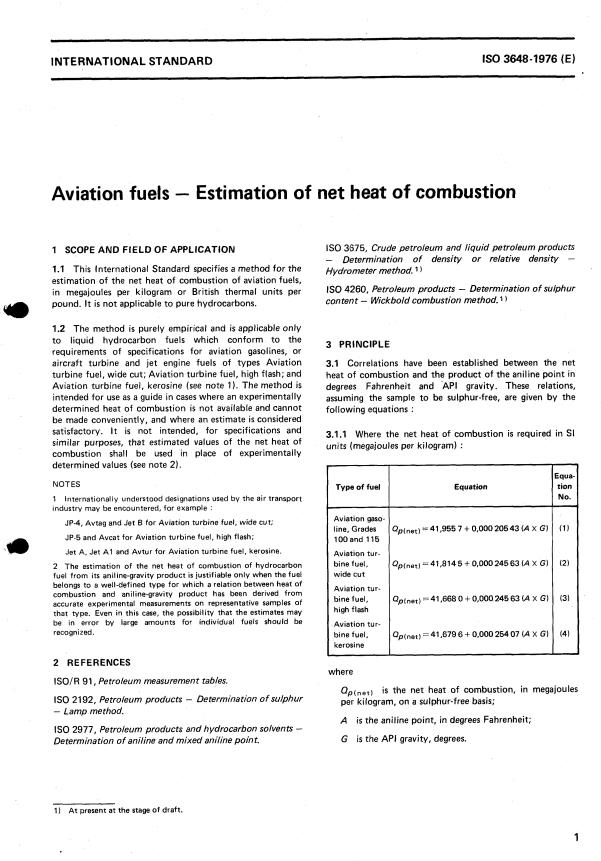
3.1.1 Where the net heat of combustion is required in SI
similar purposes, that estimated values of the net heat of
units (megajoules per kilogram) :
combustion shall be used in place of experimentally
determined values (see note 2).
NOTES
Type of fuel Equation
1 Internationally understood designations used by the air transport
industry may be encountered, for example :
Aviation gaso-
JP4, Avtag and Jet 6 for Aviation turbine fuel, wide cut;
line, Grades Qp(net)=41,9557+0,00020543(A X G)
JP-5 and Avcat for Aviation turbine fuel, high flash;
100and 115
Jet A, Jet Al and Avtur for Aviation turbine fuel, kerosine.
Aviation tur-
Qp(net) =41,8145 + 0,00024563 (A X G)
bine fuel,
2 The estimation of the net heat of combustion of hydrocarbon
wide cut
fuel from its aniline-gravity product is justifiable only when the fuel
belongs to a well-defined type for which a relation between heat of
Aviation tur-
combustion and aniline-gravity product has been derived from
Qpfner) = 41,668 O + 0,000 245 63 (A X G)
bine fuel,
accurate experimental measurements on representative samples of
high flash
that type. Even in this case, the possibility that the estimates may
be in error by large amounts for individual fuels should be
Aviation tur-
recognized.
bine fuel,
= 41,679 6 + 0,000 254 07 (A X G)
kerosine
2 REFERENCES
where
ISOiR 91, Petroleum measurement tables.
is the net heat of combustion, in megajoules
IS0 2192, Petroleum products - Determination of sulphur
per kilogram, on a sulphur-free basis;
- Lamp method.
A is the aniline point, in degrees Fahrenheit;
IS0 2977, Petroleum products and hydrocarbon solvents -
G is the API gravity, degrees.
Determination of aniline and mixed aniline point.
-~ ~
1) At present at the stage of draft.
IS0 3648-1976 (E)
3.3 The empirical linear equations (I), (21, (31, (4) and
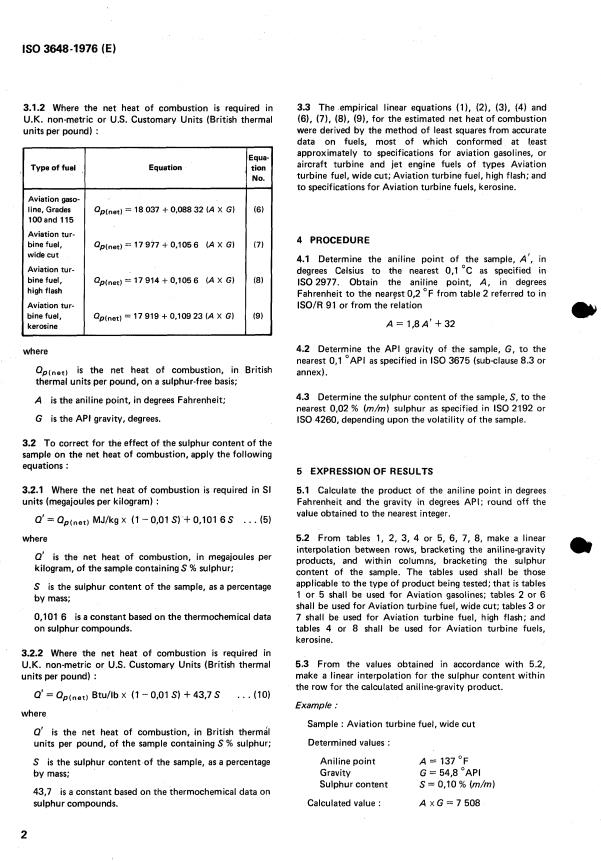
3.1.2 Where the net heat of combustion is required in
(61, (71, (81, (91, for the estimated net heat of combustion
U.K. non-metric or U.S. Customary Units (British thermal
were derived by the method of least squares from accurate
data on fuels, most of which conformed at I.east
-
approximately to specifications for aviation gasolines, or
Equa
aircraft turbine and jet engine fuels of types Aviation
Type of fuel Equation tion
turbine fuel, wide cut; Aviation turbine fuel, high flash; and
No.
to specifications for Aviation turbine fuels, kerosine.
Aviation gaso-
line, Grades = 18 037 f 0,088 32 (A X G)
lOOand 115
Aviation tur-
4 PROCEDURE
bine fuel, Qp(net) = 17 977 + 0,105 6 (A X G)
wide cut
4.1 Determine the aniline point of the sample, A', in
Aviation tur-
degrees Celsius to the nearest 0,l OC as specified in
bine fuel, Qp(net) = 17 914 + 0,105 6 (A X G)
IS0 2977. Obtain the aniline point, A, in degrees
high flash
Fahrenheit to the nearest 0,2 OF from table 2 referred to in
Aviation tur- ISO/R 91 or from the relation
bine fuel, Qp(net) = 17 919 + 0,109 23 (A X G)
A=1,8Af+32
kerosine
4.2 Determine the API gravity of the sample, G, to the
where
nearest 0,l OAP1 as specified in IS0 3675 (sub-clause 8.3 or
Qp(net) is the net heat of combustion, in British
annex).
thermal units per pound, on a sulphur-free basis;
4.3 Determine the sulphur content of the sample, S, to the
A is the aniline point, in degrees Fahrenheit;
nearest 0,02 % (rn/m) sulphur as specified in IS0 2192 or
G is the API gravity, degrees.
IS0 4260, depending upon the volatility of the sample.
3.2 To correct for the effect of the sulphur content of the
sample on the net heat of combustion, apply the following
equations :
5 EXPRESSION OF RESULTS
3.2.1 Where the net heat of combustion is required in SI
5.1 Calculate the product of the aniline point in degrees
units (megajoules per kilogram) :
Fahrenheit and the gravity in degrees API; round off the
value obtained to the nearest integer.
Q' = Qp(net) MJ/kg x (1 - 0,Ol S) + 0,101 6 S . . . (5)
5.2 From tables 1, 2, 3, 4 or 5, 6, 7, 8, make a linear
where
interpolation between rows, bracketing the aniline-gravity
0' is the net heat of combustion, in megajoules per
products, and within columns, bracketing the sulphur
kilogram, of the sample containing S % sulphur;
content of the sample. The tables used shall be those
applicable to the type of product being tested; that is tables
S is the sulphur content of the sample, as a percentage
1 or 5 shall be used for Aviation gasolines; tables 2 or 6
by mass;
shall be used for Aviation turbine fuel, wide cut; tables 3 or
0,101 6 is a constant based on the thermochemical data 7 shall be used for Aviation turbine fuel, high flash; and
on sulphur compounds. tables 4 or 8 shall be used for Aviation turbine fuels,
kerosine.
3.2.2 Where the net heat of combustion is required in
5.3 From the values obtained in accordance with 5.2,
U.K. non-metric or U.S. Customary Units (British thermal
make a linear interpolation for the sulphur content within
units per pound) :
the row for the calculated aniline-gravity product.
0'~Qp(~~t) BtdlbX (l-O,OIS)+43,7S . (IO)
Example :
where
Sample : Aviation turbine fuel, wide cut
0' is the net heat of combustion, in British thermal
Determined values :
units per pound, of the sample containing S % sulphur;
Aniline point A = 137 OF
S is the sulphur content of the sample, as a percentage
by mass; Gravity G = 54,8 "API
Sulphur content s = 0,lO % (rn/rn)
43,7 is a constant based on the thermochemical data on
A xG = 7 508
sulphur compounds. Calculated value :
IS0 3648-1976
6.1 Repeatability
By interpolation from table 2
The difference between two test results, obtained by the
same operator with the same apparatus under constant
0.1 % 0.2 %
operating conditions on identical test material, would in the
sulphur sulphur sulphur
long run, in the normal and correct operation of the test
method, exceed the following value only in one case in
twenty :
0,012 MJ/kg (see note in 6.2)
5 Btu/lb
6.2 Reproducibility
0% 0,l % 0.2 % The difference between two single and independent results
AXG
sulphur sulphur sulphur
obtained by different operators working in different
laboratories on identical test material, would in the long
7 400 18 758 18 729
run, in the normal and correct operation of the test
7 508" 18 769"" 18755**" 18740**
method, exceed the following value only in one case in
twenty :
7 600 18 779 18 750
0,035 MJ/kg (see note)
Value calculated from determined values.
15 Btu/lb
**
First step : Interpolation between rows in columns bracketing
NOTE - These values and all other values involved have been
the sulphur content.
calculated using the following equation :
*+*
Second step : Interpolation within a row between columns.
1 Btu/lb = 0.002 326 MJ/kg
Estimated net heat of combustion : 43,63 MJ/kg
18 755 Btu/lb
7 TESTREPORT
Report the result in megajoules per kilogram or British
6 PRECISION
thermal units per pound as the estimated net heat
...
Questions, Comments and Discussion
Ask us and Technical Secretary will try to provide an answer. You can facilitate discussion about the standard in here.
Loading comments...