

ISO 12156-1:2023
(Main)Diesel fuel — Assessment of lubricity using the high-frequency reciprocating rig (HFRR) — Part 1: Test method
General Information
- Abstract
This document specifies a test method using the high-frequency reciprocating rig (HFRR) with a digital camera, for assessing the lubricating property of petroleum-based middle distillate fuels, paraffinic diesel fuels, and biodiesel blends, with or without lubricity enhancing additives, and with HFRR wear scar diameters (WSDs) of 350 μm to 700 μm. This test method applies to fuels used in diesel engines. NOTE It is not known if this test method can predict the performance of all additive/fuel combinations.
- Status
- Published
- Publication Date
- 17-Sep-2023
- Current Stage
- 6060 - International Standard published
- Start Date
- 18-Sep-2023
- Due Date
- 27-Mar-2024
- Completion Date
- 18-Sep-2023
Buy Documents
ISO 12156-1:2023 - Diesel fuel — Assessment of lubricity using the high-frequency reciprocating rig (HFRR) — Part 1: Test method Released:18. 09. 2023
ISO 12156-1:2023 - Carburant diesel — Évaluation du pouvoir lubrifiant au banc alternatif a haute fréquence (HFRR) — Partie 1: Méthode d'essai Released:18. 09. 2023
Overview
ISO 12156-1:2023 defines a standardized test method for assessing diesel fuel lubricity using the High‑Frequency Reciprocating Rig (HFRR) with a digital camera. The standard covers testing of petroleum-based middle distillate fuels, paraffinic diesel fuels and biodiesel blends (with or without lubricity additives) for HFRR wear scar diameters (WSDs) between 350 μm and 700 μm. The method is intended for fuels used in diesel engines and provides repeatable, laboratory-based measurements of lubricating performance.
Key topics and technical requirements
- Test principle: A steel ball oscillates against a stationary steel plate immersed in the test fuel; the resulting wear scar diameter (WSD) on the ball is measured as the lubricity indicator.
- HFRR test conditions (specified):
- Fluid volume: 2 ± 0.2 ml
- Stroke length: 1.00 ± 0.02 mm
- Frequency: 50 ± 1 Hz
- Fluid temperature: 60 ± 2 °C
- Test mass: 200 ± 1 g
- Test duration: 75 ± 0.1 min
- Apparatus and materials: reservoir with controlled heating, oscillating mechanism with electronic calibration and data capture, 100Cr6 steel test plates (annealed, Vickers hardness HV30 = 190–210) lapped/polished to Ra < 0.02 μm, and specified steel balls.
- Measurement: Digital camera imaging and procedures for measuring WSD; Annex A gives informative guidance on wear scar measurement.
- Calibration and verification: Use of two reference fluids (High and Low lubricity, Fluid A and Fluid B) to verify rig performance; calibration of temperature, frequency, stroke, test duration and rig performance is required.
- Precision statement & updates: 2023 edition broadens scope, adds a precision statement using linear transformation per ISO 4259‑1, and removes the prior “Method B” Visual Observation.
Practical applications and users
Who benefits:
- Fuel producers and blenders - quality control for diesel fuel and biodiesel blends.
- Additive developers - screening and evaluation of lubricity additives.
- Engine and injection system manufacturers - assessing fuel compatibility and risk of component wear (pumps, injectors).
- Independent test laboratories - accredited HFRR testing and reporting.
- Regulators and procurement bodies - specifying lubricity requirements for supplied fuels.
Common uses:
- Routine lubricity testing for product release and specification compliance.
- Comparative testing of biodiesel blends and paraffinic fuels.
- Research, failure analysis and additive performance assessment.
Note: ISO 12156-1:2023 states that it may not predict performance for all additive/fuel combinations - users should interpret results alongside field data and component-specific assessments.
Related standards
Normative references cited include: ISO 683-17, ISO 3170, ISO 3171, ISO 3290-1, ISO 5272, ISO 6507-1, ISO 6508-1, ISO 21920-3, and ASTM D4306 (practice for sampling). These support material, sampling and measurement requirements embedded in the HFRR test method.
Keywords: ISO 12156-1:2023, diesel fuel lubricity, HFRR, high-frequency reciprocating rig, wear scar diameter (WSD), biodiesel blends, lubricity test method, fuel quality.
Relations
- Effective Date
- 12-Feb-2026
- Effective Date
- 01-Oct-2022
- Effective Date
- 01-Oct-2022
Buy Documents
ISO 12156-1:2023 - Diesel fuel — Assessment of lubricity using the high-frequency reciprocating rig (HFRR) — Part 1: Test method Released:18. 09. 2023
ISO 12156-1:2023 - Carburant diesel — Évaluation du pouvoir lubrifiant au banc alternatif a haute fréquence (HFRR) — Partie 1: Méthode d'essai Released:18. 09. 2023
Get Certified
Connect with accredited certification bodies for this standard

Element Materials Technology
Materials testing and product certification.

ABS Group Brazil
ABS Group certification services in Brazil.

ABS Quality Evaluations Inc.
American Bureau of Shipping quality certification.
Sponsored listings
Frequently Asked Questions
ISO 12156-1:2023 is a standard published by the International Organization for Standardization (ISO). Its full title is "Diesel fuel — Assessment of lubricity using the high-frequency reciprocating rig (HFRR) — Part 1: Test method". This standard covers: This document specifies a test method using the high-frequency reciprocating rig (HFRR) with a digital camera, for assessing the lubricating property of petroleum-based middle distillate fuels, paraffinic diesel fuels, and biodiesel blends, with or without lubricity enhancing additives, and with HFRR wear scar diameters (WSDs) of 350 μm to 700 μm. This test method applies to fuels used in diesel engines. NOTE It is not known if this test method can predict the performance of all additive/fuel combinations.
This document specifies a test method using the high-frequency reciprocating rig (HFRR) with a digital camera, for assessing the lubricating property of petroleum-based middle distillate fuels, paraffinic diesel fuels, and biodiesel blends, with or without lubricity enhancing additives, and with HFRR wear scar diameters (WSDs) of 350 μm to 700 μm. This test method applies to fuels used in diesel engines. NOTE It is not known if this test method can predict the performance of all additive/fuel combinations.
ISO 12156-1:2023 is classified under the following ICS (International Classification for Standards) categories: 75.160.20 - Liquid fuels. The ICS classification helps identify the subject area and facilitates finding related standards.
ISO 12156-1:2023 has the following relationships with other standards: It is inter standard links to EN ISO 12156-1:2023, ISO 11687-1:2020, ISO 12156-1:2018. Understanding these relationships helps ensure you are using the most current and applicable version of the standard.
ISO 12156-1:2023 is available in PDF format for immediate download after purchase. The document can be added to your cart and obtained through the secure checkout process. Digital delivery ensures instant access to the complete standard document.
Standards Content (Sample)
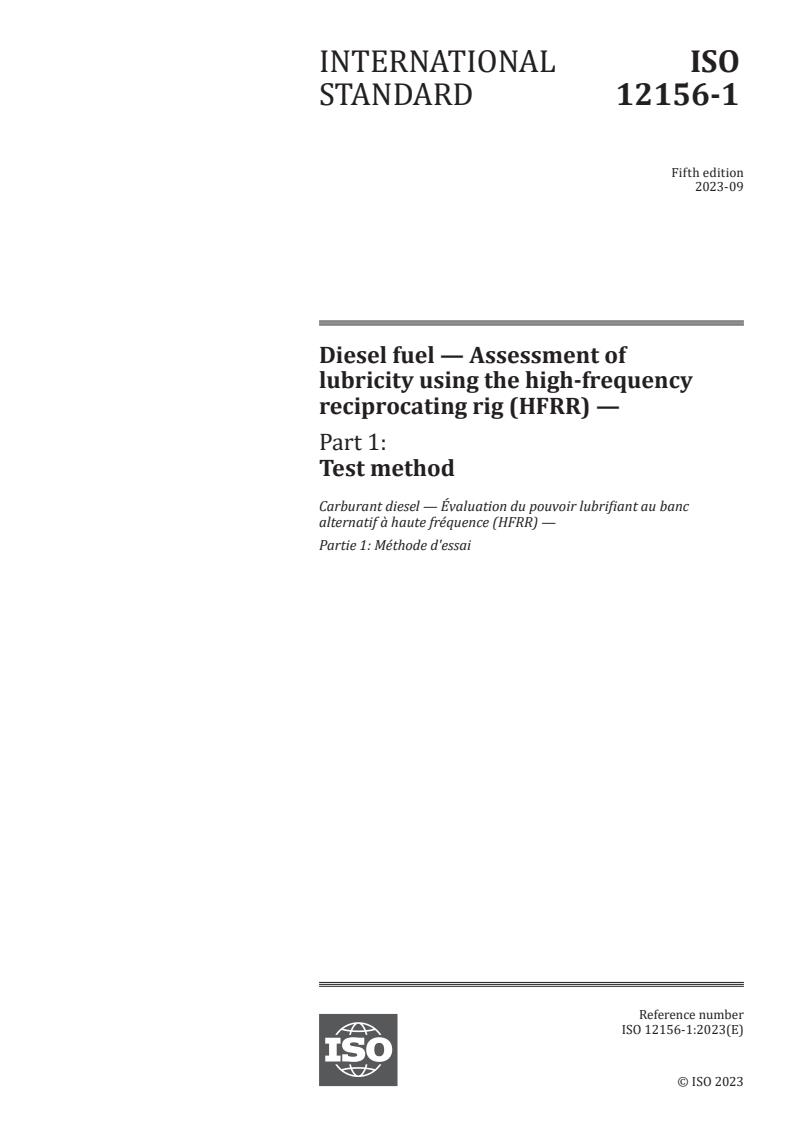
INTERNATIONAL ISO
STANDARD 12156-1
Fifth edition
2023-09
Diesel fuel — Assessment of
lubricity using the high-frequency
reciprocating rig (HFRR) —
Part 1:
Test method
Carburant diesel — Évaluation du pouvoir lubrifiant au banc
alternatif à haute fréquence (HFRR) —
Partie 1: Méthode d'essai
Reference number
© ISO 2023
All rights reserved. Unless otherwise specified, or required in the context of its implementation, no part of this publication may
be reproduced or utilized otherwise in any form or by any means, electronic or mechanical, including photocopying, or posting on
the internet or an intranet, without prior written permission. Permission can be requested from either ISO at the address below
or ISO’s member body in the country of the requester.
ISO copyright office
CP 401 • Ch. de Blandonnet 8
CH-1214 Vernier, Geneva
Phone: +41 22 749 01 11
Email: copyright@iso.org
Website: www.iso.org
Published in Switzerland
ii
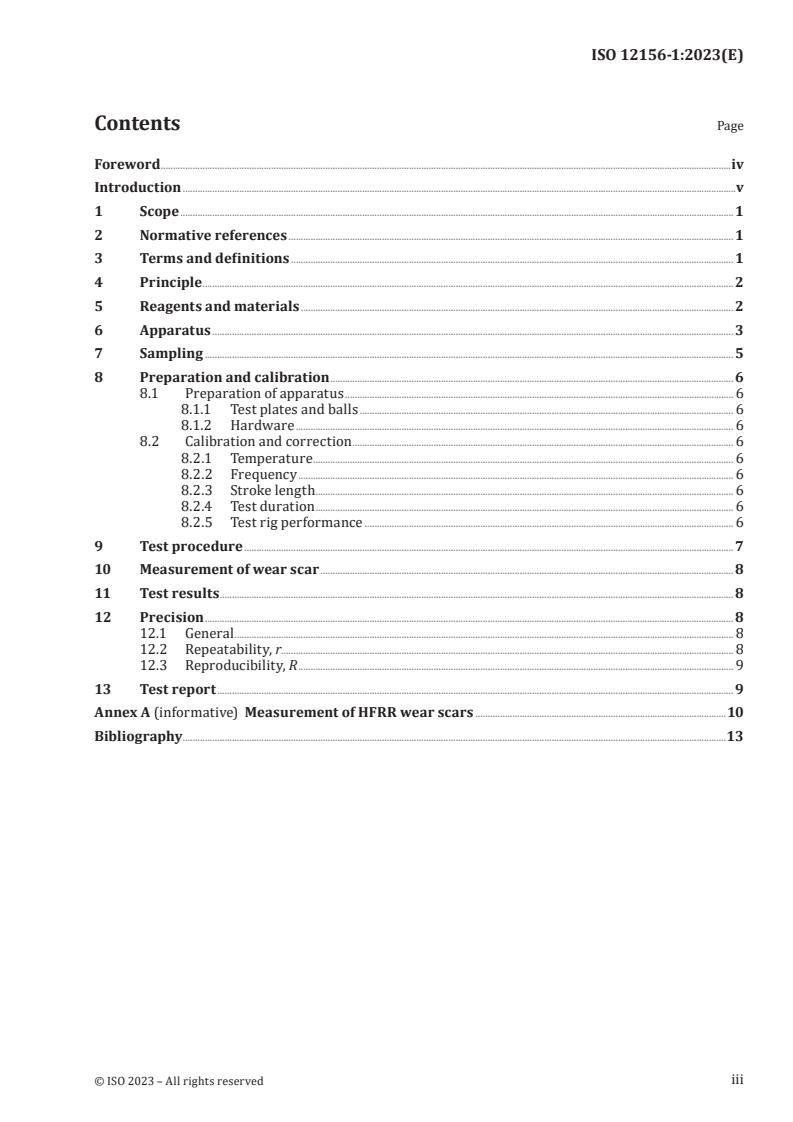
Contents Page
Foreword .iv
Introduction .v
1 Scope . 1
2 Normative references . 1
3 Terms and definitions . 1
4 Principle . 2
5 Reagents and materials . 2
6 Apparatus . 3
7 Sampling . 5
8 Preparation and calibration . 6
8.1 Preparation of apparatus . 6
8.1.1 Test plates and balls . 6
8.1.2 Hardware . 6
8.2 Calibration and correction . 6
8.2.1 Temperature . 6
8.2.2 Frequency . 6
8.2.3 Stroke length . 6
8.2.4 Test duration . 6
8.2.5 Test rig performance . 6
9 Test procedure .7
10 Measurement of wear scar . 8
11 Test results . 8
12 Precision . 8
12.1 General . 8
12.2 Repeatability, r. 8
12.3 Reproducibility, R . 9
13 Test report . 9
Annex A (informative) Measurement of HFRR wear scars .10
Bibliography .13
iii
Foreword
ISO (the International Organization for Standardization) is a worldwide federation of national standards
bodies (ISO member bodies). The work of preparing International Standards is normally carried out
through ISO technical committees. Each member body interested in a subject for which a technical
committee has been established has the right to be represented on that committee. International
organizations, governmental and non-governmental, in liaison with ISO, also take part in the work.
ISO collaborates closely with the International Electrotechnical Commission (IEC) on all matters of
electrotechnical standardization.
The procedures used to develop this document and those intended for its further maintenance are
described in the ISO/IEC Directives, Part 1. In particular, the different approval criteria needed for the
different types of ISO document should be noted. This document was drafted in accordance with the
editorial rules of the ISO/IEC Directives, Part 2 (see www.iso.org/directives).
ISO draws attention to the possibility that the implementation of this document may involve the use
of (a) patent(s). ISO takes no position concerning the evidence, validity or applicability of any claimed
patent rights in respect thereof. As of the date of publication of this document, ISO had not received
notice of (a) patent(s) which may be required to implement this document. However, implementers are
cautioned that this may not represent the latest information, which may be obtained from the patent
database available at www.iso.org/patents. ISO shall not be held responsible for identifying any or all
such patent rights.
Any trade name used in this document is information given for the convenience of users and does not
constitute an endorsement.
For an explanation of the voluntary nature of standards, the meaning of ISO specific terms and
expressions related to conformity assessment, as well as information about ISO's adherence to
the World Trade Organization (WTO) principles in the Technical Barriers to Trade (TBT), see
www.iso.org/iso/foreword.html.
This document was prepared by Technical Committee ISO/TC 28, Petroleum and related products, fuels
and lubricants from natural or synthetic sources, in collaboration with the European Committee for
Standardization (CEN) Technical Committee CEN/TC 19, Gaseous and liquid fuels, lubricants and related
products of petroleum, synthetic and biological origin, in accordance with the Agreement on technical
cooperation between ISO and CEN (Vienna Agreement).
This fifth edition cancels and replaces the fourth edition (ISO 12156-1:2018), which has been technically
revised.
The main changes are as follows:
— the scope has been broadened;
— a new precision statement has been added using linear transformation as required by ISO 4259-1;
— “Method B” Visual Observation has been removed.
A list of all parts in the ISO 12156 series can be found on the ISO website.
Any feedback or questions on this document should be directed to the user’s national standards body. A
complete listing of these bodies can be found at www.iso.org/members.html.
iv
Introduction
All diesel fuel injection equipment has some reliance on diesel fuel as a lubricant. Wear due to excessive
friction resulting in shortened life of engine components, such as diesel fuel injection pumps and
injectors, has sometimes been ascribed to lack of lubricity in the fuel.
The relationship of test results to diesel injection equipment component distress due to wear has been
demonstrated for some fuel/hardware combinations where boundary lubrication is a factor in the
operation of the component. Test results from fuels tested using this procedure have been found to
correlate with many fuel/hardware combinations and provide an adequate prediction of the lubricating
quality of the fuel. The correlation of biodiesel blends has been validated through 15 years of field
experience and anecdotal data.
v
INTERNATIONAL STANDARD ISO 12156-1:2023(E)
Diesel fuel — Assessment of lubricity using the high-
frequency reciprocating rig (HFRR) —
Part 1:
Test method
WARNING — Application of this document may involve the use of hazardous materials, operations,
and equipment. This document does not purport to address all the safety problems associated
with its use. It is the responsibility of the user of this document to establish appropriate safety
and health practices, and to determine the applicability of any other restrictions for this
purpose.
1 Scope
This document specifies a test method using the high-frequency reciprocating rig (HFRR) with a digital
camera, for assessing the lubricating property of petroleum-based middle distillate fuels, paraffinic
diesel fuels, and biodiesel blends, with or without lubricity enhancing additives, and with HFRR wear
scar diameters (WSDs) of 350 μm to 700 μm.
This test method applies to fuels used in diesel engines.
NOTE It is not known if this test method can predict the performance of all additive/fuel combinations.
2 Normative references
The following documents are referred to in the text in such a way that some or all of their content
constitutes requirements of this document. For dated references, only the edition cited applies. For
undated references, the latest edition of the referenced document (including any amendments) applies.
ISO 683-17, Heat-treated steels, alloy steels and free-cutting steels — Part 17: Ball and roller bearing steels
ISO 3170, Petroleum liquids — Manual sampling
ISO 3171, Petroleum liquids — Automatic pipeline sampling
ISO 3290-1, Rolling bearings — Balls — Part 1: Steel balls
ISO 5272, Toluene for industrial use — Specifications
ISO 6507-1, Metallic materials — Vickers hardness test — Part 1: Test method
ISO 6508-1, Metallic materials — Rockwell hardness test — Part 1: Test method
ISO 21920-3, Geometrical product specifications (GPS) — Surface texture: Profile — Part 3: Specification
operators
ASTM D4306: 2020, Practice for Aviation Fuel Sample Containers for Tests Affected by Trace Contamination
3 Terms and definitions
For the purposes of this document, the following terms and definitions apply.
ISO and IEC maintain terminology databases for use in standardization at the following addresses:
— ISO Online browsing platform: available at https:// www .iso .org/ obp
— IEC Electropedia: available at https:// www .electropedia .org/
3.1
boundary lubrication
condition in which the friction and wear between two surfaces in relative motion are determined by
the properties of the surfaces and the properties of the contacting fluid, other than bulk viscosity
Note 1 to entry: Metal to metal contact occurs and the chemistry of the system is involved. Physically adsorbed
or chemically reacted soft films (usually very thin) support contact loads. As a result, some wear is inevitable.
3.2
lubricity
qualitative term describing the ability of a fluid to affect friction between, and wear to, surfaces in
relative motion under load
Note 1 to entry: In this test method, the lubricity of a fluid is evaluated by the wear scar, measured in micrometres,
produced on an oscillating ball from contact with a stationary disk immersed in the fluid operating under closely
controlled conditions.
3.3
wear scar diameter
WSD
mean diameter of the wear scar produced on the test ball
4 Principle
A sample of the fluid under test is placed in a test reservoir which is maintained at the specified test
temperature. A fixed steel ball is held in a vertically mounted chuck and forced against a horizontally
mounted stationary steel plate with an applied load. The test ball is oscillated at a fixed frequency and
stroke length while the interface with the plate is fully immersed in the fluid. The metallurgies of the
ball and plate, test fluid temperature, load, frequency, stroke length, and the ambient air conditions
of temperature and humidity during the test are specified. The wear scar generated on the test ball is
taken as a measure of the fluid lubricity.
5 Reagents and materials
5.1 Compressed air, if required for drying the equipment listed in 8.1.1 and 8.1.2. The compressed
air shall be supplied at a pressure of 140 kPa to 210 kPa, and contain less than 0,1 ml/m hydrocarbons,
and less than 50 ml/m water.
WARNING — Use with extreme caution in the presence of combustible material.
5.2 Acetone, analytical reagent grade.
WARNING — Extremely flammable. Vapours can cause flash fire.
1)
5.3 Reference fluids
WARNING — Flammable.
1) Reference fluids A and B are available from ASTM Monitoring Center (https:// www .astmtmc .org). This
information is given for the convenience of users of this document and does not constitute an endorsement by ISO of
the products named. Equivalent products may be used if they can be shown to lead to the same results.
Two reference fluids, Fluid “A” – High (Good) lubricity reference and Fluid “B” – Low (Poor) lubricity
reference, shall be used for verifying the performance of the test apparatus. They shall be clearly
marked with the HFRR value (WSD) and its expanded uncertainty, expressed in micrometres. Store
reference fluids in clean, borosilicate glass with an aluminium foil-lined insert cap or fully epoxy-lined
metal container. Store in a dark location.
5.4 Gloves, appropriate for the reagents used.
5.5 Heptane
...
NORME ISO
INTERNATIONALE 12156-1
Cinquième édition
2023-09
Carburant diesel — Évaluation du
pouvoir lubrifiant au banc alternatif à
haute fréquence (HFRR) —
Partie 1:
Méthode d'essai
Diesel fuel — Assessment of lubricity using the high-frequency
reciprocating rig (HFRR) —
Part 1: Test method
Numéro de référence
DOCUMENT PROTÉGÉ PAR COPYRIGHT
© ISO 2023
Tous droits réservés. Sauf prescription différente ou nécessité dans le contexte de sa mise en œuvre, aucune partie de cette
publication ne peut être reproduite ni utilisée sous quelque forme que ce soit et par aucun procédé, électronique ou mécanique,
y compris la photocopie, ou la diffusion sur l’internet ou sur un intranet, sans autorisation écrite préalable. Une autorisation peut
être demandée à l’ISO à l’adresse ci-après ou au comité membre de l’ISO dans le pays du demandeur.
ISO copyright office
Case postale 401 • Ch. de Blandonnet 8
CH-1214 Vernier, Genève
Tél.: +41 22 749 01 11
E-mail: copyright@iso.org
Web: www.iso.org
Publié en Suisse
ii
Sommaire Page
Avant-propos .iv
Introduction .v
1 Domaine d'application .1
2 Références normatives .1
3 Termes et définitions . 2
4 Principe. 2
5 Produits et réactifs . 2
6 Appareillage . 3
7 Échantillonnage .6
8 Préparation et étalonnage . 6
8.1 Préparation de l’appareillage . 6
8.1.1 Plaques et billes d'essai . 6
8.1.2 Matériel . 6
8.2 Étalonnage et correction . 6
8.2.1 Température . 6
8.2.2 Fréquence . 6
8.2.3 Course . 7
8.2.4 Durée d'essai . 7
8.2.5 Performance du banc d'essai . 7
9 Mode opératoire . 7
10 Mesurage de la marque d'usure .8
11 Résultats de l’essai . 8
12 Fidélité . 9
12.1 Généralités . 9
12.2 Répétabilité, r . 9
12.3 Reproductibilité, R . . 9
13 Rapport d'essai . 9
Annexe A (informative) Mesurage des marques d'usure sur banc alternatif à haute
fréquence .10
Bibliographie .14
iii
Avant-propos
L'ISO (Organisation internationale de normalisation) est une fédération mondiale d'organismes
nationaux de normalisation (comités membres de l'ISO). L'élaboration des Normes internationales est
en général confiée aux comités techniques de l'ISO. Chaque comité membre intéressé par une étude
a le droit de faire partie du comité technique créé à cet effet. Les organisations internationales,
gouvernementales et non gouvernementales, en liaison avec l'ISO participent également aux travaux.
L'ISO collabore étroitement avec la Commission électrotechnique internationale (IEC) en ce qui
concerne la normalisation électrotechnique.
Les procédures utilisées pour élaborer le présent document et celles destinées à sa mise à jour sont
décrites dans les Directives ISO/IEC, Partie 1. Il convient, en particulier, de prendre note des différents
critères d'approbation requis pour les différents types de documents ISO. Le présent document a
été rédigé conformément aux règles de rédaction données dans les Directives ISO/IEC, Partie 2 (voir
www.iso.org/directives).
L’ISO attire l’attention sur le fait que la mise en application du présent document peut entraîner
l’utilisation d’un ou de plusieurs brevets. L’ISO ne prend pas position quant à la preuve, à la validité
et à l’applicabilité de tout droit de brevet revendiqué à cet égard. À la date de publication du présent
document, l’ISO n'avait pas reçu notification qu’un ou plusieurs brevets pouvaient être nécessaires à sa
mise en application. Toutefois, il y a lieu d’avertir les responsables de la mise en application du présent
document que des informations plus récentes sont susceptibles de figurer dans la base de données de
brevets, disponible à l'adresse www.iso.org/brevets. L’ISO ne saurait être tenue pour responsable de ne
pas avoir identifié tout ou partie de tels droits de propriété.
Les appellations commerciales éventuellement mentionnées dans le présent document sont données
pour information, par souci de commodité, à l’intention des utilisateurs et ne sauraient constituer un
engagement.
Pour une explication de la nature volontaire des normes, la signification des termes et expressions
spécifiques de l'ISO liés à l'évaluation de la conformité, ou pour toute information au sujet de l'adhésion
de l'ISO aux principes de l’Organisation mondiale du commerce (OMC) concernant les obstacles
techniques au commerce (OTC), voir www.iso.org/avant-propos.
Le présent document a été élaboré par le comité technique ISO/TC 28, Produits pétroliers et produits
connexes, combustibles et lubrifiants d’origine synthétique ou biologique en collaboration avec le comité
technique CEN/TC 19, Carburants et combustibles gazeux et liquides, lubrifiants et produits connexes,
d'origine pétrolière, synthétique et biologique, du Comité européen de normalisation (CEN) conformément
à l’Accord de coopération technique entre l’ISO et le CEN (Accord de Vienne).
Cette cinquième édition de l’ISO 12156-1 annule et remplace la quatrième édition (ISO 12156-1:2018),
qui a fait l’objet d’une révision technique.
Les principales modifications sont les suivantes:
— le domaine d'application a été élargi;
— l'inclusion d'une nouvelle déclaration de fidélité utilisant la transformation linéaire, comme l'exige
l'ISO 4259-1;
— la suppression de la «méthode B», méthode d’observation visuelle.
Une liste de toutes les parties de la série ISO 12156 se trouve sur le site Web de l’ISO.
Il convient que l’utilisateur adresse tout retour d’information ou toute question concernant le présent
document à l’organisme national de normalisation de son pays. Une liste exhaustive desdits organismes
se trouve à l’adresse www.iso.org/fr/members.html.
iv
Introduction
Tous les équipements d’injection de carburant diesel utilisent dans une certaine mesure le carburant
diesel comme lubrifiant. L'usure due à un frottement excessif entraînant un raccourcissement de la
durée de vie des composants du moteur, tels que pompes d’injection et injecteurs de carburant diesel, a
quelquefois été attribuée au manque de pouvoir lubrifiant du carburant.
Le lien entre les résultats d'essai et les avaries de composants d'équipements d'injection de carburant
diesel dues à l'usure a été démontré pour certaines combinaisons de matériel et de carburant pour
lesquelles la lubrification en régime limite est un facteur du fonctionnement du composant. Les
résultats avec les carburants soumis à des essais selon la présente méthode se sont révélés pertinents
avec plusieurs combinaisons de matériel et de carburant et ont permis de prédire de façon adéquate la
qualité lubrifiante du carburant. La corrélation avec les mélanges gazole/EMAG a été validée sur 15 ans
d’expérience de terrain et de données empiriques.
v
NORME INTERNATIONALE ISO 12156-1:2023(F)
Carburant diesel — Évaluation du pouvoir lubrifiant au
banc alternatif à haute fréquence (HFRR) —
Partie 1:
Méthode d'essai
AVERTISSEMENT — L’utilisation du présent document peut nécessiter des matériaux, opérations
et équipements présentant des risques. Le présent document ne prétend pas aborder tous les
problèmes de sécurité associés à son utilisation. Il appartient à l'utilisateur de ce document
d'établir les pratiques appropriées en matière de sécurité et d'hygiène et de déterminer
l’applicabilité de toute autre restriction à cette fin.
1 Domaine d'application
Le présent document spécifie une méthode d'essai utilisant un banc alternatif à haute fréquence
(HFRR) pour évaluer à l’aide d’un appareil photo numérique les propriétés lubrifiantes des carburants
diesel, des carburants diesel paraffiniques et des mélanges biodiesel, avec ou sans additif améliorant de
pouvoir lubrifiant, et avec des diamètres de marque d’usure (WSD) HFRR compris entre 350 μm et 700
μm.
Cette méthode d’essai est applicable aux carburants utilisés dans les moteurs diesel.
NOTE Il n’est pas établi que cette méthode d’essai estimera la performance de toutes les combinaisons
additifs/carburants.
2 Références normatives
Les documents suivants cités dans le texte constituent, pour tout ou partie de leur contenu, des
exigences du présent document. Pour les références datées, seule l’édition citée s’applique. Pour les
références non datées, la dernière édition du document de référence s’applique (y compris les éventuels
amendements).
ISO 683-17, Aciers pour traitement thermique, aciers alliés et aciers pour décolletage — Partie 17: Aciers
pour roulements
ISO 3170, Produits pétroliers liquides — Échantillonnage manuel
ISO 3171, Produits pétroliers liquides — Échantillonnage automatique en oléoduc
ISO 3290-1, Roulements — Billes — Partie 1: Billes de roulement en acier
ISO 5272, Toluène à usage industriel — Spécifications
ISO 6507-1, Matériaux métalliques — Essai de dureté Vickers — Partie 1: Méthode d’essai
ISO 6508-1, Matériaux métalliques — Essai de dureté Rockwell — Partie 1: Méthode d’essai
ISO 21920-3, Spécification géométrique des produits (GPS) — État de surface: Méthode du profil — Partie 3:
Opérateurs de spécification
1)
A S T M D 4306: 2020, Practice for Aviation Fuel Sample Containers for Tests Affected by Trace Contamination
1) Disponible en anglais seulement.
3 Termes et définitions
Pour les besoins du présent document, les termes et définitions suivants s’appliquent.
L’ISO et l’IEC tiennent à jour des bases de données terminologiques destinées à être utilisées en
normalisation, consultables aux adresses suivantes:
— ISO Online browsing platform: disponible à l’adresse https:// www .iso .org/ obp
— IEC Electropedia: disponible à l’adresse https:// www .electropedia .org/
3.1
limite de lubrification
régime de lubrification dans lequel la friction et l’usure entre deux surfaces en mouvement relatif sont
déterminées par les propriétés des surfaces et celles du fluide à leur contact, autre que la viscosité de
volume
Note 1 à l'article: Il y a des contacts métal/métal et la chimie du système est impliquée. Des films légers
(généralement très minces) adsorbés physiquement ou traités chimiquement supportent les charges de contact.
En conséquence, l’usure est inévitable.
3.2
pouvoir lubrifiant
lubrifiance
terme qualitatif décrivant la capacité d’un fluide à diminuer la friction entre des surfaces en mouvement
relatif sous une charge ainsi que leur usure
Note 1 à l'article: Dans cette méthode d’essai, la lubrifiance d’un fluide est déterminée en mesurant la marque
d'usure, en micromètres, produite par le contact d'une bille oscillante sur un disque fixe immergé dans le liquide
dans des conditions étroitement contrôlées.
3.3
diamètre de la marque d’usure
WSD
diamètre moyen de la marque d'usure produite sur la bille d'essai
4 Principe
Un échantillon du liquide soumis à essai est placé dans un réservoir maintenu à la température
spécifiée. Une bille d'acier fixée dans un mandrin vertical est frottée sous charge constante contre une
plaque en acier maintenue fixe et horizontale. La bille d'essai oscille à fréquence constante, sur une
course fixe. Le contact s'opère en complète immersion dans le réservoir de liquide. Les nuances des
aciers de la bille et de la plaque, la température du fluide d’essai, la charge, la fréquence, la course et les
conditions ambiantes de l’air en température et humidité durant l’essai sont spécifiées. Les dimensions
de la marque d'usure générée sur la bille d'essai sont prises comme mesure du pouvoir lubrifiant du
liquide.
5 Produits et réactifs
5.1 Air comprimé, utilisé si besoin est, pour sécher le matériel listé au 8.1.1 et 8.1.2, délivré à une
pression comprise entre 140 kPa et 210 kPa et contenant moins de 0,1 ml/m d'hydrocarbures et moins
de 50 ml/m d'eau.
AVERTISSEMENT — Utiliser avec d'extrêmes précautions en présence de matériaux
combustibles.
5.2 Acétone, qualité produit analytique.
AVERTISSEMENT — Extrêmement inflammable. Les vapeurs peuvent provoquer un incendie
instantané.
2)
5.3 Liquide de référence
AVERTISSEMENT — Inflammable.
Deux liquides de référence, Liquide «A» - Référence de haute lubrifiance (bonne) et Liquide «B»
- Référence de basse lubrifiance (faible), doivent être utilisés pour vérifier les performances de
l'appareillage d'essai. Ils doivent être clairement marqués avec la valeur établie au banc alternatif à haute
fréquence (WSD) et son incertitude élargie, exprimée en micromètres. Stocker les fluides de référence
dans un récipient de verre borosilicaté propre bouché par un couvercle en feuille d’aluminium ou dans
un récipient métallique à revêtement époxy intégral. Stocker les produits dans un endroit sombre.
5.4 Gants, appropriés aux produits employés.
5.5 Heptane, qualité réactif.
AVERTISSEMENT — Extrêmement inflammable. Les vapeurs peuvent provoquer un incendie
instantané.
5.6 Isooctane, qualité réactif.
AVERTISSEMENT — Extrêmement inflammable. Les vapeurs peuvent provoquer un incendie
instantané.
5.7 Propan-2-ol, qualité réactif.
AVERTISSEMENT — Extrêmement inflammable. Les vapeurs peuvent provoquer un incendie
instantané.
5.8 Mouchoir en tissu, léger, non pelucheux, sans hydrocarbures, jetable.
5.9 Toluène, en conformité avec l’ISO 5272.
AVERTISSEMENT — Extrêmement inflammable. Les vapeurs peuvent provoquer un incendie
instantané. Peut être fatal si avalé ou inhalé. Peut causer des somnolences ou vertiges. Suspecté
de causer des dommages aux fœtus. Peut provoquer des dommages aux organes suite à des
expositions prolongées ou répétées.
6 Appareillage
3)
6.1 Appareillage d’essai (voir Figure 1) capable d'assurer le déplacement alternatif à fréquence
constante et course fi
...