


ISO 18060
(Main)Sustainable tourism - Indicators for organizations in the tourism value chain - Requirements and guidance for use
Sustainable tourism - Indicators for organizations in the tourism value chain - Requirements and guidance for use
This document defines and establishes methodologies for a set of indicators to steer and measure the performance of organizations in terms of sustainable tourism. This document can be used as a guide for implementing these sustainable tourism indicators. This document applies to any organization or group of organizations that wish to: a) measure, evaluate, and monitor the performance of an organization's sustainability management. b) ensure its compliance with its defined sustainability policy. c) measure, evaluate and monitor the results of sustainable practices implemented at the destination. d) evaluate the fulfilment of the established sustainability objectives. e) monitor compliance with applicable legislation.
Tourisme durable — Indicateurs pour les organisations dans la chaîne de valeur du tourisme — Exigences et recommandations d'utilisation
General Information
- Status
- Not Published
- Technical Committee
- ISO/TC 228 - Tourism and related services
- Drafting Committee
- ISO/TC 228 - Tourism and related services
- Current Stage
- 6000 - International Standard under publication
- Start Date
- 07-Nov-2025
- Completion Date
- 10-Jan-2026
Overview
ISO 18060 is an international standard that provides requirements and guidance for the use of sustainable tourism indicators by organizations within the tourism value chain. Published by ISO and managed by Technical Committee ISO/TC 228, this standard aims to help tourism organizations measure, evaluate, and improve their sustainability performance across environmental, social, and economic dimensions.
The standard establishes clear methodologies for a comprehensive set of indicators which organizations can use to:
- Monitor and manage sustainability in alignment with defined policies and objectives
- Ensure compliance with environmental and social legislation
- Track the impact of sustainable tourism practices implemented at destinations
- Enhance sustainable management performance consistent with global best practices
ISO 18060 benefits tourism businesses, communities, and destinations by fostering responsible tourism that balances profitability with environmental protection and socio-cultural well-being.
Key Topics
Sustainability Strategy Development
Guidance on integrating sustainability into organizational strategy to achieve measurable goals.Indicator Selection and Use
Methodologies for selecting relevant indicators to monitor performance in energy efficiency, water usage, waste management, biodiversity, social factors, and economic outcomes.Environmental Dimension Indicators
Indicators cover water consumption, energy use, waste reduction, biodiversity conservation, soil and air quality, and climate change mitigation.Social Dimension Indicators
Metrics related to community satisfaction, employee welfare and training, supplier engagement, resident interests, and cultural heritage preservation.Economic Dimension Indicators
Focus on financial health, investment in sustainable practices, customer satisfaction, and cost management.Compliance Monitoring
Ensures organizations follow applicable legislation related to sustainability, promoting legal and ethical business practices.
Applications
ISO 18060 is designed for diverse organizations within the tourism value chain including:
- Hotels, resorts, and accommodation providers
- Tour operators and travel agencies
- Destination management organizations
- Restaurants and local suppliers
- Public and private stakeholders supporting sustainable tourism development
Adopting this standard enables organizations to:
- Improve resource efficiency, such as reducing energy and water consumption
- Minimize waste generation and enhance recycling efforts
- Strengthen community relations and preserve local culture
- Increase employee satisfaction and safety
- Boost economic sustainability by enhancing profitability and reducing costs
- Demonstrate commitment to sustainable tourism through clear, measurable indicators to customers, regulators, and partners
Using ISO 18060, organizations can better respond to growing consumer demand for responsible tourism and increasingly stringent regulatory frameworks worldwide.
Related Standards
ISO 18060 complements several related international standards and guidelines in sustainable tourism and environmental management, including:
- ISO 14001 – Environmental management systems
- ISO 20121 – Event sustainability management systems
- GSTC Criteria – Global Sustainable Tourism Council benchmarks
- UNWTO Guidelines – United Nations World Tourism Organization recommendations on sustainable tourism development
By aligning ISO 18060 with these frameworks, organizations can implement integrated, effective sustainability programs that meet international market expectations and regulations.
Embrace sustainability in tourism organizations with ISO 18060 to achieve measurable performance improvements, foster destination resilience, and promote responsible travel worldwide.
ISO/FDIS 18060 - Sustainable tourism — Indicators for organizations in the tourism value chain — Requirements and guidance for use Released:28. 08. 2025
REDLINE ISO/FDIS 18060 - Sustainable tourism — Indicators for organizations in the tourism value chain — Requirements and guidance for use Released:28. 08. 2025
Frequently Asked Questions
ISO 18060 is a draft published by the International Organization for Standardization (ISO). Its full title is "Sustainable tourism - Indicators for organizations in the tourism value chain - Requirements and guidance for use". This standard covers: This document defines and establishes methodologies for a set of indicators to steer and measure the performance of organizations in terms of sustainable tourism. This document can be used as a guide for implementing these sustainable tourism indicators. This document applies to any organization or group of organizations that wish to: a) measure, evaluate, and monitor the performance of an organization's sustainability management. b) ensure its compliance with its defined sustainability policy. c) measure, evaluate and monitor the results of sustainable practices implemented at the destination. d) evaluate the fulfilment of the established sustainability objectives. e) monitor compliance with applicable legislation.
This document defines and establishes methodologies for a set of indicators to steer and measure the performance of organizations in terms of sustainable tourism. This document can be used as a guide for implementing these sustainable tourism indicators. This document applies to any organization or group of organizations that wish to: a) measure, evaluate, and monitor the performance of an organization's sustainability management. b) ensure its compliance with its defined sustainability policy. c) measure, evaluate and monitor the results of sustainable practices implemented at the destination. d) evaluate the fulfilment of the established sustainability objectives. e) monitor compliance with applicable legislation.
ISO 18060 is classified under the following ICS (International Classification for Standards) categories: 03.200.01 - Leisure and tourism in general; 13.020.20 - Environmental economics. Sustainability. The ICS classification helps identify the subject area and facilitates finding related standards.
ISO 18060 is available in PDF format for immediate download after purchase. The document can be added to your cart and obtained through the secure checkout process. Digital delivery ensures instant access to the complete standard document.
Standards Content (Sample)
FINAL DRAFT
International
Standard
ISO/FDIS 18060
ISO/TC 228
Sustainable tourism — Indicators
Secretariat: UNE
for organizations in the tourism
Voting begins on:
value chain — Requirements and
2025-09-11
guidance for use
Voting terminates on:
2025-11-06
RECIPIENTS OF THIS DRAFT ARE INVITED TO SUBMIT,
WITH THEIR COMMENTS, NOTIFICATION OF ANY
RELEVANT PATENT RIGHTS OF WHICH THEY ARE AWARE
AND TO PROVIDE SUPPOR TING DOCUMENTATION.
IN ADDITION TO THEIR EVALUATION AS
BEING ACCEPTABLE FOR INDUSTRIAL, TECHNO
LOGICAL, COMMERCIAL AND USER PURPOSES, DRAFT
INTERNATIONAL STANDARDS MAY ON OCCASION HAVE
TO BE CONSIDERED IN THE LIGHT OF THEIR POTENTIAL
TO BECOME STAN DARDS TO WHICH REFERENCE MAY BE
MADE IN NATIONAL REGULATIONS.
Reference number
ISO/FDIS 18060:2025(en) © ISO 2025
FINAL DRAFT
ISO/FDIS 18060:2025(en)
International
Standard
ISO/FDIS 18060
ISO/TC 228
Sustainable tourism — Indicators
Secretariat: UNE
for organizations in the tourism
Voting begins on:
value chain — Requirements and
guidance for use
Voting terminates on:
RECIPIENTS OF THIS DRAFT ARE INVITED TO SUBMIT,
WITH THEIR COMMENTS, NOTIFICATION OF ANY
RELEVANT PATENT RIGHTS OF WHICH THEY ARE AWARE
AND TO PROVIDE SUPPOR TING DOCUMENTATION.
© ISO 2025
IN ADDITION TO THEIR EVALUATION AS
All rights reserved. Unless otherwise specified, or required in the context of its implementation, no part of this publication may
BEING ACCEPTABLE FOR INDUSTRIAL, TECHNO
LOGICAL, COMMERCIAL AND USER PURPOSES, DRAFT
be reproduced or utilized otherwise in any form or by any means, electronic or mechanical, including photocopying, or posting on
INTERNATIONAL STANDARDS MAY ON OCCASION HAVE
the internet or an intranet, without prior written permission. Permission can be requested from either ISO at the address below
TO BE CONSIDERED IN THE LIGHT OF THEIR POTENTIAL
or ISO’s member body in the country of the requester.
TO BECOME STAN DARDS TO WHICH REFERENCE MAY BE
MADE IN NATIONAL REGULATIONS.
ISO copyright office
CP 401 • Ch. de Blandonnet 8
CH-1214 Vernier, Geneva
Phone: +41 22 749 01 11
Email: copyright@iso.org
Website: www.iso.org
Published in Switzerland Reference number
ISO/FDIS 18060:2025(en) © ISO 2025
ii
ISO/FDIS 18060:2025(en)
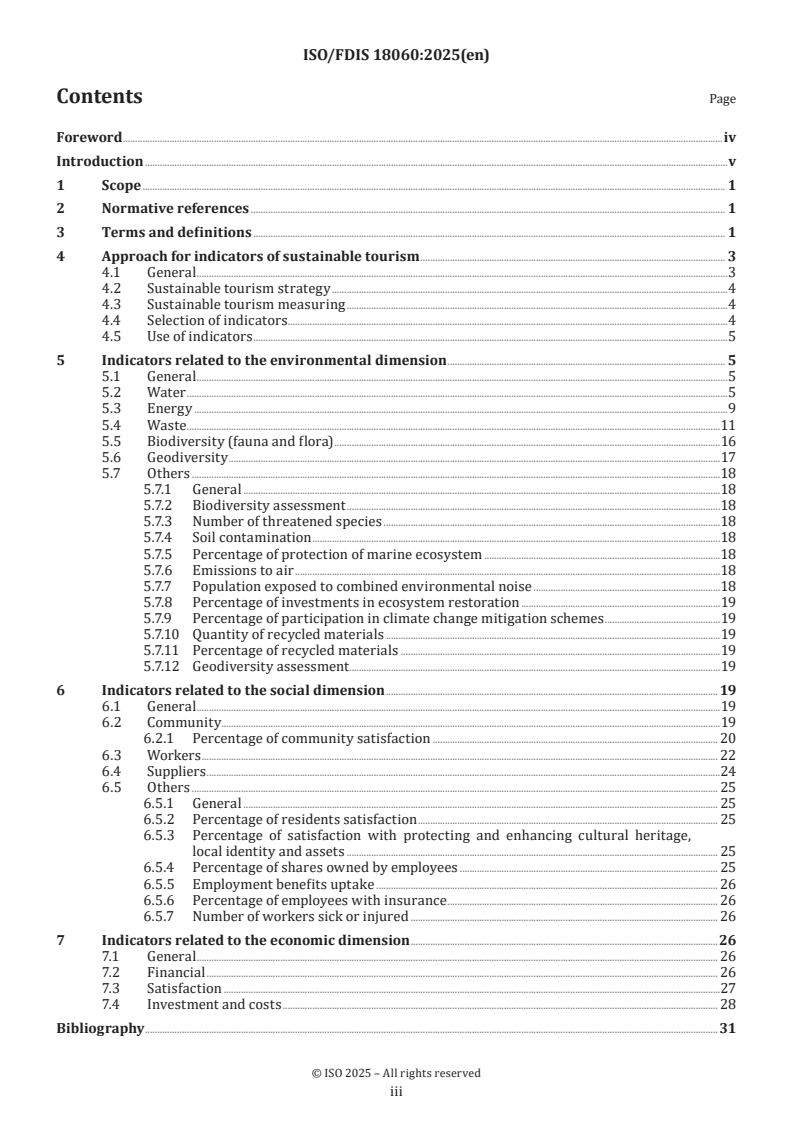
Contents Page
Foreword .iv
Introduction .v
1 Scope . 1
2 Normative references . 1
3 Terms and definitions . 1
4 Approach for indicators of sustainable tourism . 3
4.1 General .3
4.2 Sustainable tourism strategy .4
4.3 Sustainable tourism measuring .4
4.4 Selection of indicators .4
4.5 Use of indicators .5
5 Indicators related to the environmental dimension . 5
5.1 General .5
5.2 Water .5
5.3 Energy .9
5.4 Waste .11
5.5 Biodiversity (fauna and flora) .16
5.6 Geodiversity .17
5.7 Others .18
5.7.1 General .18
5.7.2 Biodiversity assessment .18
5.7.3 Number of threatened species .18
5.7.4 Soil contamination .18
5.7.5 Percentage of protection of marine ecosystem .18
5.7.6 Emissions to air .18
5.7.7 Population exposed to combined environmental noise .18
5.7.8 Percentage of investments in ecosystem restoration .19
5.7.9 Percentage of participation in climate change mitigation schemes .19
5.7.10 Quantity of recycled materials .19
5.7.11 Percentage of recycled materials .19
5.7.12 Geodiversity assessment . . .19
6 Indicators related to the social dimension . 19
6.1 General .19
6.2 Community.19
6.2.1 Percentage of community satisfaction . 20
6.3 Workers . 22
6.4 Suppliers .24
6.5 Others . 25
6.5.1 General . 25
6.5.2 Percentage of residents satisfaction . 25
6.5.3 Percentage of satisfaction with protecting and enhancing cultural heritage,
local identity and assets . 25
6.5.4 Percentage of shares owned by employees . 25
6.5.5 Employment benefits uptake . 26
6.5.6 Percentage of employees with insurance . 26
6.5.7 Number of workers sick or injured . 26
7 Indicators related to the economic dimension .26
7.1 General . 26
7.2 Financial . 26
7.3 Satisfaction .27
7.4 Investment and costs . 28
Bibliography .31
iii
ISO/FDIS 18060:2025(en)
Foreword
ISO (the International Organization for Standardization) is a worldwide federation of national standards
bodies (ISO member bodies). The work of preparing International Standards is normally carried out through
ISO technical committees. Each member body interested in a subject for which a technical committee
has been established has the right to be represented on that committee. International organizations,
governmental and non-governmental, in liaison with ISO, also take part in the work. ISO collaborates closely
with the International Electrotechnical Commission (IEC) on all matters of electrotechnical standardization.
The procedures used to develop this document and those intended for its further maintenance are described
in the ISO/IEC Directives, Part 1. In particular, the different approval criteria needed for the different types
of ISO document should be noted. This document was drafted in accordance with the editorial rules of the
ISO/IEC Directives, Part 2 (see www.iso.org/directives).
ISO draws attention to the possibility that the implementation of this document may involve the use of (a)
patent(s). ISO takes no position concerning the evidence, validity or applicability of any claimed patent
rights in respect thereof. As of the date of publication of this document, ISO had not received notice of (a)
patent(s) which may be required to implement this document. However, implementers are cautioned that
this may not represent the latest information, which may be obtained from the patent database available at
www.iso.org/patents. ISO shall not be held responsible for identifying any or all such patent rights.
Any trade name used in this document is information given for the convenience of users and does not
constitute an endorsement.
For an explanation of the voluntary nature of standards, the meaning of ISO specific terms and expressions
related to conformity assessment, as well as information about ISO's adherence to the World Trade
Organization (WTO) principles in the Technical Barriers to Trade (TBT), see www.iso.org/iso/foreword.html.
This document was prepared by Technical Committee ISO/TC 228, Sustainable Tourism.
Any feedback or questions on this document should be directed to the user’s national standards body. A
complete listing of these bodies can be found at www.iso.org/members.html.
iv
ISO/FDIS 18060:2025(en)
Introduction
The sustainability approach for tourism organizations should go beyond the implementation of sustainable
practices, connecting the results obtained with these practices with the impacts generated by the
organization.
Sustainability is directly related to the negative and positive impacts arising from tourism activities.
Organizations that want to be more sustainable should establish objectives to either minimize negative
impacts or maximize positive impacts, or both. Furthermore, sustainability has an integrated approach,
and organizations can contribute to other organizations (private or public) and destinations in terms of
sustainability.
Experience in other sectors of the economy shows that effective management depends on a consistent set of
indicators. Therefore, this document aims to serve as a source of consultation and guidance for organizations
that wish to measure sustainability management performance using indicators.
From this perspective, performance indicators, such as those presented in this document, are essential so
that tourism organizations can monitor the results obtained by planning and implementing actions related
to significant environmental, social, and economic impacts.
These indicators can be used by tourism organizations that seek to reduce their costs and, at the same time,
increase their profitability, putting into practice the concepts of a more sustainable management. This
management allows, in the environmental dimension:
— the achievement of greater energy efficiency;
— the optimization of the use of inputs, raw materials and water resources;
— a reduction of waste generation; and
— an increase in the awareness and motivation of employees regarding the preservation of the tourist
destination where the organization is located.
In the social dimension, such management engenders:
— better-trained employees;
— reduced turnover;
— improvements in the work environment;
— closer partnerships with suppliers and other related organizations;
— recognition; and
— improvement of the image and reputation, enhancing the destination through community development
and protection of its cultural values.
In the economic dimension, improving management provides greater financial health for the company,
allowing the development of strategies for greater profitability associated with the growth and development
of the business and satisfying the needs of tourists.
Organizations of all types in the tourism sector are increasingly concerned about achieving and
demonstrating correct performance in relation to sustainability, managing the impact of their activities,
products or services, and taking into account their sustainability policy and objectives.
This behaviour is part of the context of increasingly demanding legislation, the development of economic
and social policies, other measures aimed at encouraging the protection of the environment and cultural
heritage, and a growing concern among interested parties, in particular customers, in relation to quality
and environmental and sociocultural issues.
v
ISO/FDIS 18060:2025(en)
Using the methodologies outlined in this document, organizations can enhance their sustainability
performance, contribute to the conservation of destinations, and meet the growing demand for responsible
tourism practices.
Thus, adopting sustainability indicators as a mechanism to measure compliance with sustainability
objectives is an effective way to monitor business performance and ensure that the organization's strategy
is working.
vi
FINAL DRAFT International Standard ISO/FDIS 18060:2025(en)
Sustainable tourism — Indicators for organizations in the
tourism value chain — Requirements and guidance for use
1 Scope
This document defines and establishes methodologies for a set of indicators to steer and measure the
performance of organizations in terms of sustainability.
The requirements and guidance in this document can be used to implement these tourism sustainability
indicators.
This document is applicable to any organization in the tourism value chain that wishes to:
a) monitor, measure, analyse and evaluate the sustainability performance of the organization;
b) ensure its conformity with its defined sustainability policy;
c) measure, evaluate and monitor the results of sustainable practices implemented at the organization;
d) evaluate the fulfilment of the established sustainability objectives;
e) monitor compliance with applicable legislation.
2 Normative references
There are no normative references in this document.
3 Terms and definitions
For the purposes of this document, the following terms and definitions apply.
ISO and IEC maintain terminology databases for use in standardization at the following addresses:
— ISO Online browsing platform: available at https:// www .iso .org/ obp
— IEC Electropedia: available at https:// www .electropedia .org/
3.1
indicator
quantitative, qualitative, or descriptive measure
[SOURCE: ISO 37100:2016, 3.5.1]
3.2
destination
tourism destination
geographical area, including cultural, social, economic and environmental aspects, where tourism activities
occur, consisting of services, attractions, resources and infrastructures necessary for a tourist experience
3.3
governance
management of the set of initiatives or actions that express the ability of an organization or organized
society to manage matters of collective interest based on the cooperative involvement of social, economic
and institutional actors with a view to sustainable territorial development
ISO/FDIS 18060:2025(en)
3.4
sustainability
state of the global system, including environmental, social and economic aspects, in which the needs of the
present are met without compromising the ability of future generations to meet their own needs
Note 1 to entry: The environmental, social and economic aspects interact, are interdependent and are often referred
to as the three dimensions of sustainability.
Note 2 to entry: Sustainability is the goal of sustainable development (3.5).
[SOURCE: ISO Guide 82:2019, 3.1]
3.5
sustainable development
organizing principle for achieving human development goals while at the same time sustaining the ability
of natural systems to provide the natural resources and ecosystem services upon which the economy and
society depend
Note 1 to entry: The desired result is a state of society where living conditions and resources are used to continue to
meet human needs without undermining the integrity and stability of the natural system.
Note 2 to entry: Sustainable development can be defined as development that meets the needs of the present without
compromising the ability of future generations to meet their own needs.
[SOURCE: ISO 23405:2022, 3.1.2]
3.6
sustainable tourism
tourism sector that takes full account of its current and future economic, social and environmental impacts,
addressing the needs of visitors, employees, the industry, host communities and climate change among
others, while working closely with interested parties on the implementation of sustainability (3.4) policies
[SOURCE: ISO 23405:2022, 3.1.3]
3.7
sustainability aspect
activities, elements, practices, products or services of organizations and other providers in the tourism
sector which can interact with the dimensions of sustainability (3.4) (environmental, social and economic)
Note 1 to entry: A significant aspect of sustainability is one that has or can have a significant impact.
Note 2 to entry: Some examples of sustainability aspects are energy and water consumption, solid waste generation or
recyclable packaging.
[SOURCE: ISO 23405:2022, 3.1.4]
3.8
sustainability objective
intent to achieve global sustainability (3.4), resulting from the sustainability policy that an organization or
destination sets itself to achieve, being quantified whenever possible
[SOURCE: ISO 23405:2022, 3.1.5]
3.9
impact on sustainability
change to the environment, society or economy, wholly or partially resulting from an organization's
sustainability (3.4) aspects
Note 1 to entry: Impacts on sustainability can be adverse or beneficial.
[SOURCE: ISO 23405:2022, 3.1.4]
ISO/FDIS 18060:2025(en)
3.10
interested party
stakeholder
person (3.12) or organization that can affect, be affected by, or perceive itself to be affected by a decision or
activity
Note 1 to entry: In this document, a person can be considered as a tourist, client, participant, guest, customer, visitor,
workers or a member of the local community, among others
[SOURCE: ISO 21401:2018, 3.17, modified — note 1 to entry has been added.]
3.11
tourism value chain
sequence of primary and support activities which are strategically fundamental for the performance of the
tourism sector
3.12
person
individual who impacts the sustainability (3.4) of the organization and is considered to calculate the indicator
Note 1 to entry: A person can be a tourist, customer, visitor, guest, traveller, participant, employee, supplier and other user.
3.13
solid waste
non-soluble, discarded solid materials, including sewage sludge, municipal garbage, industrial wastes,
agricultural refuse, demolition wastes and mining residues
[SOURCE: ISO 37120:2018, 3.13]
4 Approach for indicators of sustainable tourism
4.1 General
Experience in other sectors of the economy shows that effective management depends on a consistent set of
indicators. Therefore, this document aims to serve as a source of consultation and guidance for organizations
that wish to measure sustainability management performance using indicators.
Indicators should be used and adopted in close accordance with:
— the sustainability objectives established by the organization,
— the Sustainability Development Goals (SDGs) established by United Nations (UN), and
— environmental, social and governance (ESG) criteria and reporting, if applicable.
Considering these aspects, indicators shall be defined for the three dimensions of sustainability
(environmental, socio-cultural and economic). The proposed indicators can be considered as the basis for
each organization. Thus, it will be possible for certain organizations to use indicators other than those
proposed in this document.
Indicators shall be clear, understandable, measurable, comparable, repeatable and reliable.
The implementation of the indicators has a direct relationship with the governance of the organization and
the destination; therefore, it should be considered as a success factor for sustainable development.
NOTE In this document, most indicators are quantitative.
ISO/FDIS 18060:2025(en)
4.2 Sustainable tourism strategy
Considering that an organization’s performance in terms of sustainability is related to how each organization
manages the impacts generated in their operations and across its value chain, it is expected that performance
can potentially be improved with the adoption of sustainability as part of the business strategy.
When sustainability is part of a business strategy the organization objectives and sustainability objectives
become part of the same set.
Thus, the adoption of sustainability indicators as a mechanism to measure conformity to sustainability
objectives is an effective way to monitor business performance and to ensure that an organization's strategy
is working.
4.3 Sustainable tourism measuring
Sustainability is directly related to the negative and positive impacts generated by tourism activities. Those
organizations that want to be more sustainable should establish objectives to minimize the negative impact
or maximize the positive impact for which they are responsible.
In this context, there exists a close relationship between activities, aspects, impacts, objectives, sustainable
practices and indicators as shown in Figure 1.
Figure 1 — Logic of sustainability management performance using indicators
Interested parties should be consulted when objectives and indicators are being defined.
Adopting a set of standard indicators could be useful to establish a process of benchmarking, to cocreate a
common strategy and to share results between organizations and their interested parties.
4.4 Selection of indicators
This document contains a set of indicators that shall be chosen in accordance with the needs of each
organization. A process of selection shall be established based on criteria that allows an organization to use
indicators as a tool for monitoring its performance in terms of sustainability.
Working with a very large number of indicators generally results in an ineffective system, as it is challenging
to manage a large number of independent variables at the same time.
When an organization defines criteria for selecting indicators, it should take into account the following,
when applicable:
a) the SDGs;
ISO/FDIS 18060:2025(en)
b) strategy and policies;
c) objectives of sustainability;
d) sustainability aspects and impacts on sustainability;
e) needs and expectations of interested parties;
f) legal requirements and compliance obligations;
g) available resources.
It is recommended that organizations select indicators from all dimensions of sustainability (environmental,
social and economic).
4.5 Use of indicators
The organization shall consider a baseline period of time to establish a reference for setting and periodically
monitoring the performance of sustainability. The indicators selected shall be calculated for periods of time
(baseline and nowadays) which allow for comparison of the results under the same conditions.
EXAMPLE 1 January 2021 and January 2022.
EXAMPLE 2 2020 and 2021 (for annual periodicity).
The organization can decide if the time period is different from the proposed frequency and should justify
its decision.
5 Indicators related to the environmental dimension
5.1 General
The organization shall adopt indicators related to the main aspects and environmental impacts of tourism
activities. Examples of such indicators are shown in Tables 1 to 24.
5.2 Water
Table 1 — Consumption of water/person
Purpose The water/person consumption indicator is based on the environmental impact generated
by the organization in the use and consumption of water.
NOTE This indicator can be associated with the economic dimension, due to the impact on the
cost of organization, but also with the social dimension, due to the potential impact of reducing
the availability of this resource to the community.
Calculation Monthly
frequency
Calculation formula The total water consumption per capita [litres (l) or metres cubed (m )/person] shall be cal-
culated as the total volume of the organization’s water consumption in the period (numerator)
divided by the total number of persons (denominator). The result shall be expressed as the total
water consumption per capita in litres or m /person.
Counting rules The total volume of water consumed in the month shall be calculated. If the organization handles
its own funding, this should be accounted for in the calculation of the indicator.
To calculate the denominator of the formula, the organization shall count those persons who
contributed to the consumption of water per month.
Exceptions to Persons who are considered visitors, spending less time inside the organization’s facilities,
counting rules should not be counted.
NOTE Visitors cannot contribute with the consumption of water.
ISO/FDIS 18060:2025(en)
TTabablele 1 1 ((ccoonnttiinnueuedd))
Data source The relevant information can come from different sources, for example:
— the supply company indicating in the bill the volume of water consumed;
— the organization, through its own capture, with an estimate or calculation of the volume
of water captured or stored, or both.
The information about the number of persons shall be collected within the organization's in-
ternal control.
Table 2 — Consumption of water/person/ night (or day)
Purpose The water/person/night consumption indicator is based on the environmental impact
generated by the organization in the use and consumption of water.
NOTE 1 This indicator can be associated with the economic dimension, due to the impact on the
cost of the organization. It can also be associated with the social dimension, due to the potential
impact of reducing the availability of this resource to the community.
NOTE 2 This indicator is normally used by accommodation establishments.
Calculation Monthly
frequency
Calculation formula The total water consumption per capita (litres or m /person/night) shall be calculated as the
total volume of the organization’s water consumption in the period (numerator) divided by the
total number of persons and nights (denominator). The result shall be expressed as the total
water consumption per capita in litres or m /person/night.
Counting rules The total volume of water consumed in the month shall be considered. If the organization handles
its own funding, this should be considered in the calculation of the indicator.
To calculate the denominator of the formula, the organization shall count those persons who
contributed to the consumption of water, and number of nights that each person stayed at the
organization.
Exceptions to Persons who are considered visitors, spending less time inside the organization’s facilities,
counting rules should not be counted.
Data source The relevant information can come from different sources:
— the supply company indicating in the bill the volume of water consumed;
— the organization, through its own capture, with an estimate or calculation of the amount
of water captured or stored, or both.
The information about the number of persons shall be in internal controls of the organization
(e.g. number of guests in accommodation establishments).
ISO/FDIS 18060:2025(en)
Table 3 — Consumption of water
Purpose The water consumption indicator is based on the environmental impact generated by the
organization in the use and consumption of water.
NOTE This indicator can be associated with the economic dimension, due to the impact on the
cost of organization, but also with the social dimension, due to the potential impact of reducing
the availability of this resource to the community.
Calculation Monthly
frequency
Calculation formula The total water consumption (litres or m ) shall be calculated as the total volume of the or-
ganization’s water consumption in the period. The result shall be expressed as the total water
consumption in litres or m
Counting rules The total volume of water consumed in the month shall be considered. If the organization handles
its own funding, this should be considered in the calculation of the indicator.
Exceptions to Not applicable.
counting rules
Data source The relevant information can come from different sources, for example:
— the supply company indicating in the bill the volume of water consumed;
— the organization, through its own capture, with an estimate or calculation of the volume
of water captured or stored, or both.
Table 4 — Recycled water (grey water)
Purpose The recycled water (grey water) indicator is based on the environmental impact generated
by the organization in the use and consumption of water.
NOTE 1 This indicator can be associated with the economic dimension, due to the impact on the
cost of the organization. It can also be associated with the social dimension, due to the potential
impact of reducing the availability of this resource to the community.
NOTE 2 Recycled water received from third party organization can be considered in the calcu-
lation, if applicable.
Calculation Monthly
frequency
Calculation formula The total volume of recycled water (litres or m ) shall be calculated as the total volume of the
organization’s recycled water consumption in the period (numerator) divided by the total of
water consumed (denominator). The result shall be expressed as the percentage of total recycled
water used for the tourism organization's operations.
Counting rules To calculate the total recycled water consumption (numerator) of the formula, the organization
shall measure or estimate the volume of recycled water used by the tourism organization's
operations.
To calculate the denominator of the formula, the organization shall count the total volume of
water consumed, including its own funding.
NOTE 3 Recycled water is normally used for washing external areas, watering gardens or in a
water closet (WC).
Exceptions to Not applicable.
counting rules
Data source The relevant information can come from different sources:
— the place and task where the amount of grey water was used (e.g. washing external areas
or watering gardens);
— the storage of grey water;
— the supply company indicating in the bill the volume of water consumed;
— the organization, through its own capture, with an estimate or calculation of the volume
of water captured or stored, or both.
ISO/FDIS 18060:2025(en)
Table 5 — Percentage of rainwater
Purpose The percentage of rainwater indicator is based on the environmental impact generated
by the organization in the use and consumption of water.
NOTE 1 This indicator can be associated with the economic dimension, due to the impact on the
cost of the organization. It can also be associated with the social dimension, due to the potential
impact of reducing the availability of this resource to the community.
Calculation Monthly
frequency
Calculation formula The total volume of rainwater (litres or m ) shall be calculated as the total volume of the or-
ganization’s rainwater consumption in the period (numerator) divided by the total volume of
water consumed (denominator), then multiplied by 100. The result shall be expressed as the
percentage of total rainwater used for the tourism organization's operations.
Counting rules To calculate the total rainwater consumption (numerator) of the formula, the organization shall
measure or estimate the volume of rainwater used by the tourism organization's operations.
To calculate the denominator of the formula, the organization shall count the total volume of
water consumed, including internal water sources.
NOTE 2 Rainwater can normally be used for washing external areas, watering gardens or in a
water closet (WC).
Exceptions to Not applicable.
counting rules
Data source The relevant information can come from different sources:
— the place and task where the amount of rainwater was used (e.g. washing external areas or
watering gardens);
— the storage of rainwater;
— the supply company indicating in the bill the volume of water consumed;
— the organization, through its own capture, with an estimate or calculation of the volume
of water captured or stored, or both.
ISO/FDIS 18060:2025(en)
5.3 Energy
Table 6 — Consumption of energy/person
Purpose The energy consumption indicator/person is based on the environmental impact gener-
ated by the organization in the use and consumption of electricity.
NOTE This indicator can be associated with the economic dimension, due to the impact on the
cost of organization. It can also be associated with the social dimension, due to the potential
impact of reducing the availability of this resource to the community.
Calculation Monthly
frequency
Calculation formula The total energy consumption per capita (KWh/person) shall be calculated as the total amount
of the organization’s energy consumption in the period (numerator) divided by the total number
of person (denominator). The result shall be expressed as the total energy consumption per
capita in KWh/person.
Counting rules The total energy consumption in the month shall be considered. The organization should consider
all energy sources (own and external) in the calculation of the indicator.
To calculate the denominator of the formula, the organization shall count those persons who
contributed to the consumption of energy per month.
Exceptions to Not applicable.
counting rules
Data source The relevant information can come from different sources:
— energy consumed in the bill provided by the supply organization;
— the organization, through its own capture, with an estimate or calculation of the amount
of energy captured or stored, or both;
— internal controls by the organization or supply organization, or both, to capture the
number of persons.
Table 7 — Consumption of energy/person/night (or day)
Purpose The energy consumption indicator/visitor/night is based on the environmental impact
generated by the organization in the use and consumption of energy.
NOTE This indicator can be associated with the economic dimension, due to the impact on the
cost of organization. It can also be associated with the social dimension, due to the potential
impact of reducing the availability of this resource to the community.
Calculation Monthly
frequency
Calculation formula The total energy consumption per capita (KWh/person/night) shall be calculated as the total
amount of the organization’s energy consumption in the period (numerator) divided by the total
number of person and days (denominator). The result shall be expressed as the total energy
consumption per capita in KWh/person/night.
Counting rules The total energy consumption in the month shall be considered. The organization should consider
all energy sources (own and external) in the calculation of the indicator.
To calculate the denominator of the formula, the organization shall count those persons who
contributed to the consumption of energy per month
Exceptions to Not applicable.
counting rules
Data source The relevant information can come from different sources:
— energy consumed in the bill provided by the supply organization;
— the organization, through its own capture, with an estimate or calculation of the amount
of energy captured or stored, or both;
— internal controls by the organization or supply organization, or both, to capture the
number of persons.
ISO/FDIS 18060:2025(en)
Table 8 — Consumption of energy
Purpose The energy consumption indicator is based on the environmental impact generated by
the organization in the use and consumption of electricity.
NOTE This indicator can be associated with the economic dimension, due to the impact on the
cost of organization. It can also be associated with the social dimension, due to the potential
impact of reducing the availability of this resource to the community.
Calculation Monthly
frequency
Calculation formula The total energy consumption (KWh) shall be calculated as the total amount of the organi-
zation’s energy consumption in the period .The result shall be expressed as the total energy
consumption in KWh.
Counting rules The total energy consumption in the month shall be considered. The organization should consider
all energy sources (own and external) in the calculation of the indicator.
To calculate the denominator of the formula, the organization shall count those persons who
contributed to the consumption of energy per month.
Exceptions to Not applicable.
counting rules
Data source The relevant information can come from different sources:
— energy consumed in the bill provided by the supply organization;
— the organization, through its own capture, with an estimate or calculation of the amount
of energy captured or stored, or both;
— internal controls by the organization or supply organization, or both.
Table 9 — Percentage of renewable energy
Purpose The percentage of renewable energy indicator is based on the environmental impact
generated by the organization in the use and consumption of electricity from renewable
sources.
NOTE This indicator can be associated with the economic dimension, due to the impact on the
cost of the organization. It can also be associated with the social dimension, due to the potential
impact of reducing the availability of this resource to the community.
Calculation Monthly
frequency
Calculation formula The total renewable energy consumption (KWh) shall be calculated as the total amount of the
organization’s renewable energy consumption in the period (numerator) divided by the total
energy consumption (denominator), then multiplied by 100. The result shall be expressed as
percentage of renewable energy consumption over total energy consumption.
Counting rules Both the total renewable energy consumption in the month and the total energy consumption
in the month shall be incorporated into the calculation. The organization should consider all
energy sources (own and external) in the calculation of the indicator.
To calculate the denominator of the formula, the organization shall count those persons who
contributed to the co
...
Style Definition
...
Style Definition
...
Style Definition
...
ISO/DISFDIS 18060:2024(E)
Style Definition
...
ISO /TC 228/WG 13
Style Definition
...
Style Definition
Secretariat: UNE .
Style Definition
...
Date: 2024-06-042025-08-27
Style Definition
...
Style Definition
...
Style Definition
...
Style Definition
...
Style Definition
...
Style Definition
Sustainable tourism — Indicators for organizations in the tourism
...
Style Definition
value chain — Requirements and guidance for use .
Style Definition
...
Style Definition
...
Style Definition
...
Style Definition
...
Style Definition
...
Style Definition
...
Style Definition
...
Style Definition
...
FDIS stage
Style Definition
...
Style Definition
...
Style Definition
...
Style Definition
...
Style Definition
...
Style Definition
...
Style Definition
...
Style Definition
...
Style Definition
...
Style Definition
...
Style Definition
...
Style Definition
...
Style Definition
...
Style Definition
...
Style Definition
...
Style Definition
...
Style Definition
...
Style Definition
...
Style Definition
...
Style Definition
...
Style Definition
...
Style Definition
...
Style Definition
...
Style Definition
...
Style Definition
...
Style Definition
...
Style Definition
...
Style Definition
...
Style Definition
...
Style Definition
...
Style Definition
...
Style Definition
...
Style Definition
...
Style Definition
...
Style Definition
...
Style Definition
...
Style Definition
...
Style Definition
...
Style Definition
...
Style Definition
...
Style Definition
...
Formatted
...
Formatted
...
Formatted
...
ISO/DISFDIS 18060:2024(E2025(en) Formatted: Font: 11 pt
Formatted: Font: 11 pt
Formatted: Font: 11 pt
Formatted: HeaderCentered, Space After: 0 pt, Line
spacing: single
All rights reserved. Unless otherwise specified, or required in the context of its implementation, no part of this publication
may be reproduced or utilized otherwise in any form or by any means, electronic or mechanical, including photocopying, Formatted: Default Paragraph Font
or posting on the internet or an intranet, without prior written permission. Permission can be requested from either ISO
Formatted: No page break before, Adjust space
at the address below or ISO’s member body in the country of the requester.
between Latin and Asian text, Adjust space between
Asian text and numbers
ISO copyright office
Formatted: Adjust space between Latin and Asian text,
CP 401 • Ch. de Blandonnet 8
Adjust space between Asian text and numbers
CH-1214 Vernier, Geneva
Phone: + 41 22 749 01 11
Formatted: English (United Kingdom)
Formatted: English (United Kingdom)
Fax: +41 22 749 09 47
EmailE-mail: copyright@iso.org
Formatted: German (Germany)
Website: www.iso.orgwww.iso.org
Formatted: zzCopyright address, Adjust space between
Latin and Asian text, Adjust space between Asian text
Published in Switzerland
and numbers
Formatted: German (Germany)
Formatted: English (United Kingdom)
Formatted: FooterPageRomanNumber
ii © ISO 2024 – All rights reserved
ii
ISO/DISFDIS 18060:2024(E2025(en) Formatted: Font: 11 pt
Formatted: Font: 11 pt
Formatted: Font: 11 pt
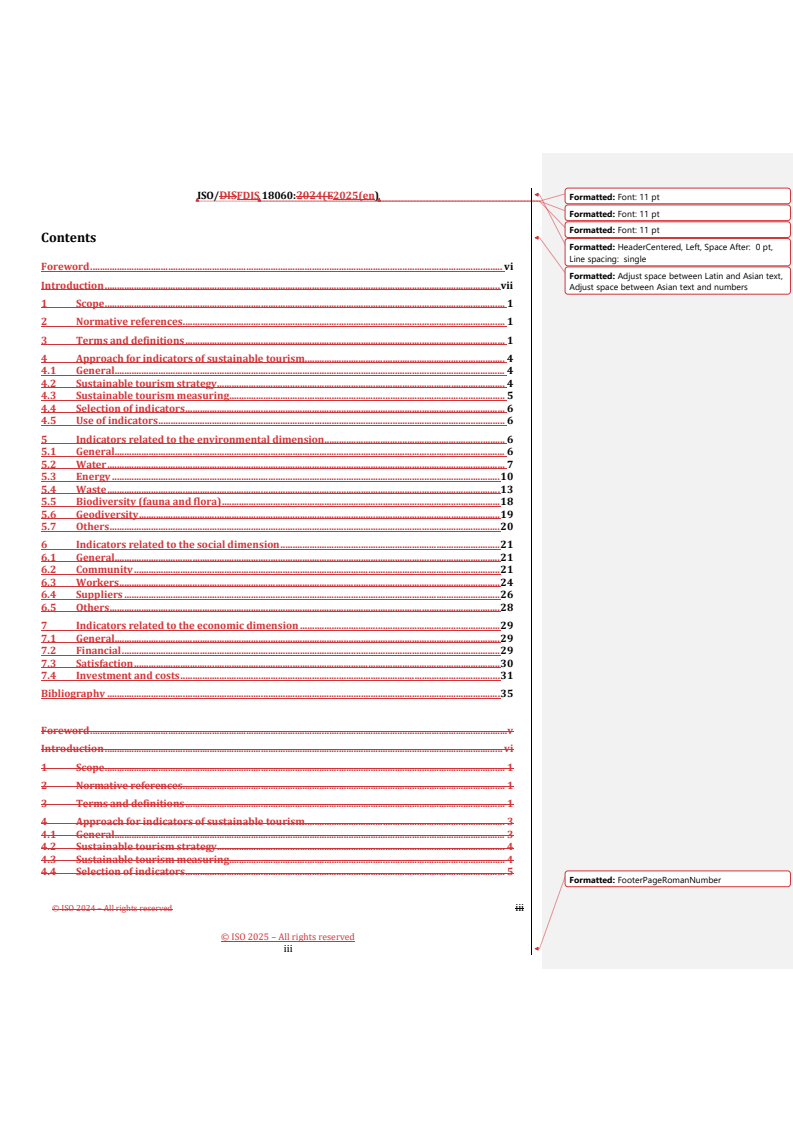
Contents
Formatted: HeaderCentered, Left, Space After: 0 pt,
Line spacing: single
Foreword . vi
Formatted: Adjust space between Latin and Asian text,
Introduction . vii
Adjust space between Asian text and numbers
1 Scope . 1
2 Normative references . 1
3 Terms and definitions . 1
4 Approach for indicators of sustainable tourism . 4
4.1 General. 4
4.2 Sustainable tourism strategy . 4
4.3 Sustainable tourism measuring . 5
4.4 Selection of indicators . 6
4.5 Use of indicators . 6
5 Indicators related to the environmental dimension . 6
5.1 General. 6
5.2 Water . 7
5.3 Energy . 10
5.4 Waste . 13
5.5 Biodiversity (fauna and flora) . 18
5.6 Geodiversity . 19
5.7 Others . 20
6 Indicators related to the social dimension . 21
6.1 General. 21
6.2 Community . 21
6.3 Workers . 24
6.4 Suppliers . 26
6.5 Others . 28
7 Indicators related to the economic dimension . 29
7.1 General. 29
7.2 Financial . 29
7.3 Satisfaction . 30
7.4 Investment and costs . 31
Bibliography . 35
Foreword . v
Introduction . vi
1 Scope . 1
2 Normative references . 1
3 Terms and definitions . 1
4 Approach for indicators of sustainable tourism . 3
4.1 General. 3
4.2 Sustainable tourism strategy . 4
4.3 Sustainable tourism measuring . 4
4.4 Selection of indicators . 5
Formatted: FooterPageRomanNumber
iii
ISO/DISFDIS 18060:2024(E2025(en) Formatted: Font: 11 pt
Formatted: Font: 11 pt
Formatted: Font: 11 pt
4.5 Use of indicators . 6
Formatted: HeaderCentered, Space After: 0 pt, Line
5 Indicators related to the environmental dimension . 6
spacing: single
5.1 General. 6
5.2 Water . 6
5.2.1 Consumption of water/person . 6
5.2.2 Consumption of water/person/ night . 7
5.2.3 Recycled water (grey water) . 8
5.2.4 Rainwater . 8
5.2.5 Others . 9
5.3 Energy . 9
5.3.1 Consumption of energy/ person / night (or day) . 9
5.3.2 Renewable energy . 10
5.4 Waste . 11
5.4.1 Generation of solid waste/ person / night (or day) . 11
5.4.2 Generation of hazardous waste (or percentual of hazardous waste) . 12
5.4.3 Generation of food waste/ person . 12
5.4.4 Generation of food loss . 13
5.4.5 Waste disposed – Recycled . 14
5.4.6 Quantity of recycled materials . 14
5.4.7 Percentage of recycled materials . 14
5.4.8 Single use plastics . 15
5.4.9 Composted waste . 15
5.4.10 Landfill waste . 16
5.4.11 Minimization of solid waste . 17
5.4.12 Others . 18
5.5 Biodiversity, fauna, and flora . 18
5.5.1 Percentage of revenue invested in environmental initiatives . 18
5.5.2 Number of conservation actions for natural areas, flora and fauna . 18
5.5.3 Native vegetation planted or removed . 19
5.5.4 Others . 20
6 Indicators related to the social dimension . 20
6.1 General. 20
6.2 Community . 21
6.2.1 Ratio spending to investment applied to social actions . 21
6.2.2 Number of social effective actions . 21
6.2.3 Community satisfaction . 22
6.2.4 Number of actions to support the promotion of local culture and people reached . 23
6.2.5 Percentage of workers from local communities . 23
6.2.6 Others . 24
6.3 Workers . 24
6.3.1 Number of training support actions . 24
6.3.2 Number of hours of training in subjects related to sustainable tourism . 25
6.3.3 Leadership positions — Female . 25
6.3.4 Percentage of workers with disabilities . 26
6.3.5 Number of actions to support the promotion of preventing exploitation and
discrimination . 27
6.3.6 Actions to prevent diseases with all interested parties affected by tourism activities . 27
6.3.7 Others . 28
6.4 Suppliers . 29
6.4.1 Percentage of local (products and services) suppliers . 29
6.4.2 Percentage of local procurement . 29
Formatted: FooterPageRomanNumber
iv © ISO 2024 – All rights reserved
iv
ISO/DISFDIS 18060:2024(E2025(en) Formatted: Font: 11 pt
Formatted: Font: 11 pt
Formatted: Font: 11 pt
7 Indicators related to the economic dimension . 30
Formatted: HeaderCentered, Left, Space After: 0 pt,
7.1 Financial . 30
Line spacing: single
7.1.1 Profitability of the organization . 30
7.1.2 Contribution margin . 31
7.2 Satisfaction . 32
7.2.1 Level of tourist satisfaction . 32
7.2.2 Workers satisfaction . 32
7.3 Investment and costs . 33
7.3.1 Income (workers) . 33
7.3.2 Investment on digitalization and cibersecurity . 34
7.3.3 Investment in communicating sustainability policy and actions . 34
7.3.4 Investment in environmental protection/ conservation of the destination . 35
7.3.5 Investment in accessibility . 35
Formatted: FooterPageRomanNumber
v
ISO/DISFDIS 18060:2024(E2025(en) Formatted: Font: 11 pt
Formatted: Font: 11 pt
Formatted: Font: 11 pt
Foreword
Formatted: HeaderCentered, Space After: 0 pt, Line
spacing: single
ISO (the International Organization for Standardization) is a worldwide federation of national standards
bodies (ISO member bodies). The work of preparing International Standards is normally carried out through Formatted: Adjust space between Latin and Asian text,
Adjust space between Asian text and numbers
ISO technical committees. Each member body interested in a subject for which a technical committee has been
established has the right to be represented on that committee. International organizations, governmental and
non-governmental, in liaison with ISO, also take part in the work. ISO collaborates closely with the
International Electrotechnical Commission (IEC) on all matters of electrotechnical standardization.
The procedures used to develop this document and those intended for its further maintenance are described
in the ISO/IEC Directives, Part 1. In particular, the different approval criteria needed for the different types of
ISO documentsdocument should be noted. This document was drafted in accordance with the editorial rules
of the ISO/IEC Directives, Part 2 (see www.iso.org/directiveswww.iso.org/directives).
Attention is drawnISO draws attention to the possibility that some of the elementsimplementation of this
document may beinvolve the subjectuse of (a) patent(s). ISO takes no position concerning the evidence,
validity or applicability of any claimed patent rights. in respect thereof. As of the date of publication of this
document, ISO had not received notice of (a) patent(s) which may be required to implement this document.
However, implementers are cautioned that this may not represent the latest information, which may be
obtained from the patent database available at www.iso.org/patents. ISO shall not be held responsible for
identifying any or all such patent rights. Details of any patent rights identified during the development of the
document will be in the Introduction and/or on the ISO list of patent declarations received (see
www.iso.org/patents).
Any trade name used in this document is information given for the convenience of users and does not
constitute an endorsement.
For an explanation of the voluntary nature of standards, the meaning of ISO specific terms and expressions
related to conformity assessment, as well as information about ISO's adherence to the World Trade
Organization (WTO) principles in the Technical Barriers to Trade (TBT), see
www.iso.org/iso/foreword.htmlwww.iso.org/iso/foreword.html.
This document was prepared by Technical Committee ISO/TC 228, Sustainable Tourism.
Any feedback or questions on this document should be directed to the user’s national standards body. A
complete listing of these bodies can be found at www.iso.org/members.html.www.iso.org/members.html.
Formatted: Adjust space between Latin and Asian text,
Adjust space between Asian text and numbers
Formatted: FooterPageRomanNumber
vi © ISO 2024 – All rights reserved
vi
ISO/DISFDIS 18060:2024(E2025(en) Formatted: Font: 11 pt
Formatted: Font: 11 pt
Formatted: Font: 11 pt
Introduction
Formatted: HeaderCentered, Left, Space After: 0 pt,
Line spacing: single
The sustainability approach for tourism organizations should go beyond the implementation of sustainable
practices, connecting the results obtained with these practices with the impacts generated by the organization.
Sustainability is directly related to tourism activities'the negative and positive impacts. Those organizations
arising from tourism activities. Organizations that want to be more sustainable should establish objectives to
either minimize the negative impactimpacts or maximize the positive impacts, or both. Furthermore,
sustainability has an integrated approach, and organizations can contribute to other organizations (private or
public) and destinations in terms of sustainability.
Experience in other sectors of the economy shows that effective management depends on a consistent set of
indicators. Therefore, this document aims to serve as a source of consultation and guidance for organizations
that wish to implementmeasure sustainability management performance using indicators.
From this perspective, performance indicators, such as those presented in this document, are essential so that
tourism organizations can monitor the results obtained by planning and implementing actions related to
significant environmental, social, and economic impacts.
These indicators can be used by tourism organizations that seek to reduce their costs and, at the same time,
increase their profitability, putting into practice the concepts of a more sustainable management. This
management allows, in the environmental dimension:
— — the achievement of greater energy efficiency;
— — the optimization of the use of inputs, raw materials and water resources;
— — a reduction of waste generation; and
— — an increase in the awareness and motivation of employees regarding the preservation of the tourist
Formatted: List Continue 1, Indent: Left: 0 cm, First
destination where the organization is located.
line: 0 cm, Adjust space between Latin and Asian text,
Adjust space between Asian text and numbers
In the social dimension, such management engenders:
Formatted: Adjust space between Latin and Asian text,
Adjust space between Asian text and numbers
— — better-trained employees;
— — reduced turnover;
— — improvements in the work environment;
— — closer partnerships with suppliers and other related organizations;
— — recognition; and
— — improvement of the image and reputation, enhancing the destination through community
Formatted: List Continue 1, Indent: Left: 0 cm, First
development and protection of its cultural values.
line: 0 cm, Adjust space between Latin and Asian text,
Adjust space between Asian text and numbers
In the economic dimension, improving management provides greater financial health for the company,
Formatted: Adjust space between Latin and Asian text,
allowing the development of strategies for greater profitability associated with the growth and development
Adjust space between Asian text and numbers
of the business and satisfying the needs of tourists.
Formatted: FooterPageRomanNumber
vii
ISO/DISFDIS 18060:2024(E2025(en) Formatted: Font: 11 pt
Formatted: Font: 11 pt
Formatted: Font: 11 pt
Organizations of all types in the tourism sector are increasingly concerned about achieving and demonstrating
Formatted: HeaderCentered, Space After: 0 pt, Line
correct performance in relation to sustainability, managing the impact of their activities, products or services,
spacing: single
and taking into account their sustainability policy and objectives.
This behaviour is part of the context of increasingly demanding legislation, the development of economic and
social policies, other measures aimed at encouraging the protection of the environment and cultural heritage,
and a growing concern among interested parties, in particular customers, in relation to quality and
environmental and sociocultural issues.
Using the methodologies outlined in this document, organizations can enhance their sustainability
Formatted: Body Text, Adjust space between Latin and
performance, contribute to the conservation of destinations, and meet the growing demand for responsible
Asian text, Adjust space between Asian text and
tourism practices. numbers, Tab stops: Not at 0 cm + 1.4 cm + 2.1 cm +
2.8 cm + 3.5 cm + 4.2 cm + 4.9 cm + 5.6 cm + 6.3
Thus, adopting sustainability indicators as a mechanism to measure compliance with sustainability objectives cm + 7 cm
is an effective way to monitor business performance and assureensure that the organization's strategy is
Formatted: Adjust space between Latin and Asian text,
working.
Adjust space between Asian text and numbers
Formatted: FooterPageRomanNumber
viii © ISO 2024 – All rights reserved
viii
DRAFT INTERNATIONAL STANDARD ISO/DIS 18060:2024(E)
Sustainable Tourism tourism — Indicators for organizations in the
tourism value chain — Requirements and guidance for use
1 Scope
This document defines and establishes methodologies for a set of indicators to steer and measure the
performance of organizations in terms of sustainability.
ThisThe requirements and guidance in this document can be used as guidance for implementingto implement
these tourism sustainablesustainability indicators.
This document is applicable to any organization in the tourism value chain that wishes to:
a) a) monitor, measure, analyzeanalyse and evaluate the sustainability performance of an
Formatted: Numbered + Level: 1 + Numbering Style: a,
organization's sustainability managementthe organization;
b, c, … + Start at: 1 + Alignment: Left + Aligned at: 0
cm + Indent at: 0 cm, Adjust space between Latin and
b) b) ensure its conformity with its defined sustainability policy;
Asian text, Adjust space between Asian text and
numbers, Tab stops: Not at 0.7 cm + 1.4 cm + 2.1 cm
c) c) measure, evaluate and monitor the results of sustainable practices implemented at the + 2.8 cm + 3.5 cm + 4.2 cm + 4.9 cm + 5.6 cm + 6.3
cm + 7 cm
organization;
d) d) evaluate the fulfilment of the established sustainability objectives;
e) e) monitor compliance with applicable legislation.
Formatted: Adjust space between Latin and Asian text,
Adjust space between Asian text and numbers
2 Normative references
Formatted: Adjust space between Latin and Asian text,
Adjust space between Asian text and numbers, Tab
There are no normative references in this document.
stops: Not at 0.7 cm + 1.4 cm + 2.1 cm + 2.8 cm +
3.5 cm + 4.2 cm + 4.9 cm + 5.6 cm + 6.3 cm + 7 cm
3 Terms and definitions
Formatted: Dutch (Netherlands)
Formatted: TermNum2, Adjust space between Latin
For the purposes of this document, the following terms and definitions apply.
and Asian text, Adjust space between Asian text and
numbers
ISO and IEC maintain terminologicalterminology databases for use in standardization at the following
addresses:
Formatted: English (United Kingdom)
Formatted: Default Paragraph Font, English (United
— — ISO Online browsing platform: available at https://www.iso.org/obphttps://www.iso.org/obp
Kingdom)
Formatted: English (United Kingdom)
— — IEC Electropedia: available at http://www.electropedia.org/https://www.electropedia.org/
Formatted: Default Paragraph Font, English (United
3.1 3.1
Kingdom)
indicator
Formatted: English (United Kingdom)
quantitative, qualitative, or descriptive measure
Formatted: Default Paragraph Font, English (United
[SOURCE: ISO 37100:2016, 3.5.1]
Kingdom)
Formatted: English (United Kingdom)
Formatted: Default Paragraph Font, English (United
Kingdom)
Formatted: English (United Kingdom)
ISO/DISFDIS 18060:2024(E2025(en) Formatted: Font: 11 pt
Formatted: Font: 11 pt
Formatted: Font: 11 pt
3.2 3.2
Formatted: HeaderCentered, Space After: 0 pt, Line
destination
spacing: single
tourism destination
geographical area, including cultural, social, economic and environmental aspects, where tourism activities
Formatted: Dutch (Netherlands)
occur, consisting of services, attractions, resources and infrastructures necessary for a tourist experience
Formatted: English (United Kingdom)
3.3 3.3
governance
management of the set of initiatives or actions that express the ability of an organization or organized society
to manage matters of collective interest based on the cooperative involvement of social, economic and
institutional actors with a view to sustainable territorial development
3.4 3.4
sustainability
state of the global system, including environmental, social and economic aspects, in which the needs of the
Formatted: Adjust space between Latin and Asian text,
present are met without compromising the ability of future generations to meet their own needs
Adjust space between Asian text and numbers, Tab
stops: Not at 0.7 cm + 1.4 cm + 2.1 cm + 2.8 cm +
Note 1 to entry: The environmental, social and economic aspects interact, are interdependent and are
3.5 cm + 4.2 cm + 4.9 cm + 5.6 cm + 6.3 cm + 7 cm
often referred to as the three dimensions of sustainability.
Formatted: Default Paragraph Font
Note 2 to entry: Sustainability is the goal of sustainable development (3.5).(3.5).
Formatted: Default Paragraph Font
Formatted: Default Paragraph Font
[SOURCE: ISO Guide 82:2019, 3.1]
Formatted: Default Paragraph Font
3.5 3.5
Formatted: Default Paragraph Font
sustainable development
organizing principle for achieving human development goals while at the same time sustaining the ability of Formatted: Adjust space between Latin and Asian text,
natural systems to provide the natural resources and ecosystem services upon which the economy and society Adjust space between Asian text and numbers
depend
Formatted: Adjust space between Latin and Asian text,
Adjust space between Asian text and numbers, Tab
Note 1 to entry: The desired result is a state of society where living conditions and resources are used
stops: Not at 0.7 cm + 1.4 cm + 2.1 cm + 2.8 cm +
to continue to meet human needs without undermining the integrity and stability of the natural system.
3.5 cm + 4.2 cm + 4.9 cm + 5.6 cm + 6.3 cm + 7 cm
Formatted: Default Paragraph Font
Note 2 to entry: Sustainable development can be defined as development that meets the needs of the
present without compromising the ability of future generations to meet their own needs.
Formatted: Default Paragraph Font
Formatted: Default Paragraph Font
[SOURCE: ISO 23405:2022, 3.1.2]
Formatted: Default Paragraph Font
3.6 3.6
Formatted: Adjust space between Latin and Asian text,
sustainable tourism
Adjust space between Asian text and numbers
tourism sector that takes full account of its current and future economic, social and environmental impacts,
Formatted: Font: Italic
addressing the needs of visitors, employees, the industry, host communities and climate change among others,
while working closely with interested parties on the implementation of sustainability policies(3.4) policies Formatted: Default Paragraph Font
Formatted: Default Paragraph Font
[SOURCE: ISO 23405:2022, 3.1.3]
Formatted: Default Paragraph Font
3.7 3.7
Formatted: Default Paragraph Font
sustainability aspect
Formatted: Font: Italic
activities, elements, practices, products or services of organizations and other providers in the tourism sector
Formatted: Adjust space between Latin and Asian text,
which can interact with the dimensions of sustainability (3.4) (environmental, social and economic)
Adjust space between Asian text and numbers, Tab
Note 1 to entry: A significant aspect of sustainability is one that has or can have a significant impact. stops: Not at 0.7 cm + 1.4 cm + 2.1 cm + 2.8 cm +
3.5 cm + 4.2 cm + 4.9 cm + 5.6 cm + 6.3 cm + 7 cm
Formatted: FooterPageNumber
2 © ISO 2024 – All rights reserved
ISO/DISFDIS 18060:2024(E2025(en) Formatted: Font: 11 pt
Formatted: Font: 11 pt
Formatted: Font: 11 pt
Note 2 to entry: Some examples of sustainability aspects are energy and water consumption, solid
Formatted: HeaderCentered, Left, Space After: 0 pt,
waste generation or recyclable packaging.
Line spacing: single
[SOURCE: ISO 23405:2022, 3.1.4]
Formatted: Default Paragraph Font
Formatted: Default Paragraph Font
3.8 3.8
sustainability objective
Formatted: Default Paragraph Font
intent to achieve global sustainability, (3.4), resulting from the sustainability policy that an organization or
Formatted: Default Paragraph Font
destination sets itself to achieve, being quantified whenever possible
Formatted: Adjust space between Latin and Asian text,
Adjust space between Asian text and numbers
[SOURCE: ISO 23405:2022, 3.1.5]
Formatted: Font: Italic
3.9 3.9
Formatted: Default Paragraph Font
impact on sustainability
change to the environment, society or economy, wholly or partially resulting from an organization's Formatted: Default Paragraph Font
sustainability aspects(3.4) aspects
Formatted: Default Paragraph Font
Formatted: Default Paragraph Font
Note 1 to entry: Impacts on sustainability can be adverse or beneficial.
Formatted: Font: Italic
[SOURCE: ISO 23405:2022, 3.1.4]
Formatted: Adjust space between Latin and Asian text,
Adjust space between Asian text and numbers, Tab
3.10 3.10
stops: Not at 0.7 cm + 1.4 cm + 2.1 cm + 2.8 cm +
interested party
3.5 cm + 4.2 cm + 4.9 cm + 5.6 cm + 6.3 cm + 7 cm
stakeholder
Formatted: Default Paragraph Font
personperson (0) or organization that can affect, be affected by, or perceive itself to be affected by a decision
or activity
Formatted: Default Paragraph Font
Formatted: Default Paragraph Font
Note 1 to entry: In this document, a person can be considered as a tourist, client, participant, guest,
customer, visitor, workers or a member of the local community, among others
Formatted: Default Paragraph Font
Formatted: Adjust space between Latin and Asian text,
[SOURCE: ISO 21401:2018, 3.17, modified, a — note 1 to entry has been added].]
Adjust space between Asian text and numbers
Formatted: Adjust space between Latin and Asian text,
3.11 3.11
Adjust space between Asian text and numbers, Tab
tourism value chain
stops: Not at 0.7 cm + 1.4 cm + 2.1 cm + 2.8 cm +
sequence of primary and support activities which are strategically fundamental for the performance of the
3.5 cm + 4.2 cm + 4.9 cm + 5.6 cm + 6.3 cm + 7 cm
tourism sector.
Formatted: Default Paragraph Font
3.12
Formatted: Default Paragraph Font
Person
Formatted: Default Paragraph Font
3.12
Formatted: Default Paragraph Font
person
individual who impacts the sustainability (3.4) of the organization and is considered to calculate the indicator.
Formatted: Adjust space between Latin and Asian text,
Adjust space between Asian text and numbers
Note 1 to entry Person: A person can be a tourist, customer, visitor, guest, traveller, participant, employee, supplier and
Formatted: Font: Italic
other users. user.
Formatted: Adjust space between Latin and Asian text,
Adjust space between Asian text and numbers
3.13
sustainability aspect
activities, elements, practices, products or services of accommodation establishments in the tourism sector
which can interact with the dimensions of sustainability (environmental, social and economic)
Note 1 to entry: A significant aspect of sustainability is one that has or can have a significant impact.
Formatted: FooterPageNumber
ISO/DISFDIS 18060:2024(E2025(en) Formatted: Font: 11 pt
Formatted: Font: 11 pt
Formatted: Font: 11 pt
Note 2 to entry: Some examples of sustainability aspects are energy consumption, solid waste generation, recyclable
Formatted: HeaderCentered, Space After: 0 pt, Line
packaging and water consumption.
spacing: single
[SOURCE: ISO 21401:2018, 3.38]
3.13 3.14
Formatted: TermNum2, Adjust space between Latin
solid waste
and Asian text, Adjust space between Asian text and
non-soluble, discarded solid materials, including sewage sludge, municipal garbage, industrial wastes,
numbers
agricultural refuse, demolition wastes and mining residues
Formatted: Widow/Orphan control, Adjust space
between Latin and Asian text, Adjust space between
([SOURCE: ISO 37120:2018, 3.13)]
Asian text and numbers
Formatted: Adjust space between Latin and Asian text,
4 Approach for indicators of sustainable tourism
Adjust space between Asian text and numbers
Formatted: Font: 11 pt, Not Bold, Font color: Auto
4.1 General
Formatted: Source, Line spacing: single, Font
Experience in other sectors of the economy shows that effective management depends on a consistent set of
Alignment: Auto
indicators. Therefore, this document aims to serve as a source of consultation and guidance for organizations
Formatted: Adjust space between Latin and Asian text,
that wish to implement ameasure sustainability management systemperformance using indicators.
Adjust space between Asian text and numbers
Formatted: Adjust space between Latin and Asian text,
Indicators should be used and adopted in close accordance with:
Adjust space between Asian text and numbers, Tab
stops: Not at 0.71 cm
— — the sustainability objectives established by the organization,
Formatted: Adjust space between Latin and Asian text,
— — the sustainability development goalsSustainability Development Goals (SDGs) established by United
Adjust space between Asian text and numbers
Nations (UN), and
Formatted: Adjust space between Latin and Asian text,
Adjust space between Asian text and numbers, Tab
— — environmental, social and governance (ESG) criteria and reporting, if applicable.
stops: Not at 0.7 cm + 1.4 cm + 2.1 cm + 2.8 cm +
3.5 cm + 4.2 cm + 4.9 cm + 5.6 cm + 6.3 cm + 7 cm
Considering these aspects, indicators shall be defined for the three dimensions of sustainability
Formatted: Adjust space between Latin and Asian text,
(environmental, socio-cultural and economic). The proposed indicators can be considered as the basis for each
Adjust space between Asian text and numbers
organization. Thus, it will be possible for certain organizations to use indicators other than those proposed in
this document.
Indicators shall be clear, understandable, measurable, comparable, repeatable and reliable.
The implementation of the indicators has a direct relationship with the governance of the organization and
the destination; therefore, it should be considered as a success factor for sustainable development.
NOTE In this document, most indicators are quantitative.
Formatted: Adjust space between Latin and Asian text,
Adjust space between Asian text and numbers, Tab
4.2 Sustainable tourism strategy
stops: Not at 0.7 cm + 1.4 cm + 2.1 cm + 2.8 cm +
3.5 cm + 4.2 cm + 4.9 cm + 5.6 cm + 6.3 cm + 7 cm
Considering that an organization’s performance in terms of sustainability is related to how each organization
Formatted: Adjust space between Latin and Asian text,
manages the impacts generated in their operations and across its value chain, it is expected that performance
Adjust space between Asian text and numbers, Tab
can potentially be improved with the adoption of sustainability as part of the business strategy.
stops: Not at 0.71 cm
Formatted: Adjust space between Latin and Asian text,
When sustainability is part of a business strategy the organization objectives and sustainability objectives
Adjust space between Asian text and numbers
become part of the same set.
Thus, the adoption of sustainability indicators as a mechanism to measure conformity to sustainability
objectives is an effective way to monitor business performance and to assureensure that an organization's
strategy is working.
Formatted: FooterPageNumber
4 © ISO 2024 – All rights reserved
ISO/DISFDIS 18060:2024(E2025(en) Formatted: Font: 11 pt
Formatted: Font: 11 pt
Formatted: Font: 11 pt
4.3 Sustainable tourism measuring
Formatted: HeaderCentered, Left, Space After: 0 pt,
Line spacing: single
Sustainability is directly related to the negative and positive impacts generated by tourism activities. Those
organizations that want to be more sustainable should establish objectives to minimize the negative impact
Formatted: Adjust space b
...
Questions, Comments and Discussion
Ask us and Technical Secretary will try to provide an answer. You can facilitate discussion about the standard in here.
Loading comments...