

ISO/IEC TR 18001:2004
(Main)Information technology — Radio frequency identification for item management — Application requirements profiles
General Information
- Abstract
ISO/IEC TR 18001:2004 provides: the result of three surveys identifying the applications for radio frequency identification (RFID) in an item management environment, and the resultant classification of these applications based on various operational parameters, including operating range and memory size; an explanation of some of the issues associated with the parameters of distance and number of tags within an RFID interrogator's field-of-view; a means by which classification of RF tags may be accomplished based on the application requirements defined in the survey results; recommendations for areas of standardization to the parent committee (ISO/IEC JTC 1/SC 31/WG 4) based on the results of these surveys.
- Status
- Published
- Publication Date
- 17-Oct-2004
- Technical Committee
- ISO/IEC JTC 1/SC 31 - Automatic identification and data capture techniques
- Drafting Committee
- ISO/IEC JTC 1/SC 31/WG 4 - Radio communications
- Current Stage
- 9093 - International Standard confirmed
- Start Date
- 11-Jun-2021
- Completion Date
- 29-Aug-2026

Overview
ISO/IEC TR 18001:2004 - Information technology - Radio frequency identification for item management - Application requirements profiles - is a Technical Report that compiles survey-based profiles of RFID applications in item management environments. It summarizes results from industry and academic surveys (AIM, ANSI MH10/SC8, Dortmund University and others), classifies RFID applications by operational parameters, explains key system issues (distance, tag density, memory) and recommends areas for further standardization to ISO/IEC JTC 1/SC 31/WG 4.
Keywords: ISO/IEC TR 18001:2004, RFID, application requirements profiles, item management, tag classification, operating range, memory size.
Key Topics
- Application classification: Profiles derived from multiple surveys that categorize RFID use cases for item management (e.g., baggage handling, warehouse logistics).
- Operational parameters: Focus on operating range and memory size, including practical memory groupings (e.g., <128 bytes, 128 bytes–1 kB).
- Tag and reader interactions: Issues affecting performance such as tag orientation, overlap of tags, and influence of metallic materials on read range.
- Scalability and throughput: Guidance on access time, detecting and reading numerous tags within an interrogator’s field-of-view, and multi-interrogator environments.
- Frequency-specific issues: Treatment of different air-interface technologies (low frequency, 13.56 MHz, 2.45 GHz, UHF 860–960 MHz, and active 433 MHz), with comparative discussion of trade-offs in range and environment sensitivity.
- System comparisons: Analysis of RFID vs bar code systems for sorting and tracking tasks.
- Standardization recommendations: Identified technical subjects for further work by the parent committee.
Applications and Who Uses It
This Technical Report is practical for professionals implementing or specifying RFID in item management:
- RFID system integrators and solution architects - to map technology choice to application requirements (range, memory, throughput).
- Tag and reader manufacturers - for design considerations related to orientation, materials and frequency selection.
- Supply chain, logistics and retail managers - to understand how RFID performance affects inventory, returnable asset tracking, and sorting systems.
- Standards developers and test labs - to guide future standardization efforts and test method priorities.
- Typical real-world uses include warehouse logistics, returnable plastic container tracking, baggage handling, factory automation and high-density retail inventory.
Related Standards
- ISO/IEC 18000 series (air interface parameters for multiple frequencies)
- ISO/IEC 19762 (AIDC harmonized vocabulary)
ISO/IEC TR 18001:2004 is intended as a reference for matching RFID technologies to application requirements and for identifying gaps where additional standards or tests are needed.
Relations
- Effective Date
- 06-Jun-2022
Get Certified
Connect with accredited certification bodies for this standard

BSI Group
BSI (British Standards Institution) is the business standards company that helps organizations make excellence a habit.

NYCE
Mexican standards and certification body.
Sponsored listings
Frequently Asked Questions
ISO/IEC TR 18001:2004 is a technical report published by the International Organization for Standardization (ISO). Its full title is "Information technology — Radio frequency identification for item management — Application requirements profiles". This standard covers: ISO/IEC TR 18001:2004 provides: the result of three surveys identifying the applications for radio frequency identification (RFID) in an item management environment, and the resultant classification of these applications based on various operational parameters, including operating range and memory size; an explanation of some of the issues associated with the parameters of distance and number of tags within an RFID interrogator's field-of-view; a means by which classification of RF tags may be accomplished based on the application requirements defined in the survey results; recommendations for areas of standardization to the parent committee (ISO/IEC JTC 1/SC 31/WG 4) based on the results of these surveys.
ISO/IEC TR 18001:2004 provides: the result of three surveys identifying the applications for radio frequency identification (RFID) in an item management environment, and the resultant classification of these applications based on various operational parameters, including operating range and memory size; an explanation of some of the issues associated with the parameters of distance and number of tags within an RFID interrogator's field-of-view; a means by which classification of RF tags may be accomplished based on the application requirements defined in the survey results; recommendations for areas of standardization to the parent committee (ISO/IEC JTC 1/SC 31/WG 4) based on the results of these surveys.
ISO/IEC TR 18001:2004 is classified under the following ICS (International Classification for Standards) categories: 35.040 - Information coding; 35.040.50 - Automatic identification and data capture techniques. The ICS classification helps identify the subject area and facilitates finding related standards.
ISO/IEC TR 18001:2004 has the following relationships with other standards: It is inter standard links to ISO 4545-1:2017. Understanding these relationships helps ensure you are using the most current and applicable version of the standard.
ISO/IEC TR 18001:2004 is available in PDF format for immediate download after purchase. The document can be added to your cart and obtained through the secure checkout process. Digital delivery ensures instant access to the complete standard document.
Standards Content (Sample)
TECHNICAL ISO/IEC
REPORT TR
First edition
2004-10-15
Information technology — Radio
frequency identification for item
management — Application requirements
profiles
Technologies de l'information — Identification par radiofréquence
(RFID) pour la gestion d'objets — Profils de conditions d'application
Reference number
©
ISO/IEC 2004
PDF disclaimer
This PDF file may contain embedded typefaces. In accordance with Adobe's licensing policy, this file may be printed or viewed but
shall not be edited unless the typefaces which are embedded are licensed to and installed on the computer performing the editing. In
downloading this file, parties accept therein the responsibility of not infringing Adobe's licensing policy. The ISO Central Secretariat
accepts no liability in this area.
Adobe is a trademark of Adobe Systems Incorporated.
Details of the software products used to create this PDF file can be found in the General Info relative to the file; the PDF-creation
parameters were optimized for printing. Every care has been taken to ensure that the file is suitable for use by ISO member bodies. In
the unlikely event that a problem relating to it is found, please inform the Central Secretariat at the address given below.
© ISO/IEC 2004
All rights reserved. Unless otherwise specified, no part of this publication may be reproduced or utilized in any form or by any means,
electronic or mechanical, including photocopying and microfilm, without permission in writing from either ISO at the address below or
ISO's member body in the country of the requester.
ISO copyright office
Case postale 56 • CH-1211 Geneva 20
Tel. + 41 22 749 01 11
Fax + 41 22 749 09 47
E-mail copyright@iso.org
Web www.iso.org
Published in Switzerland
ii © ISO/IEC 2004 – All rights reserved
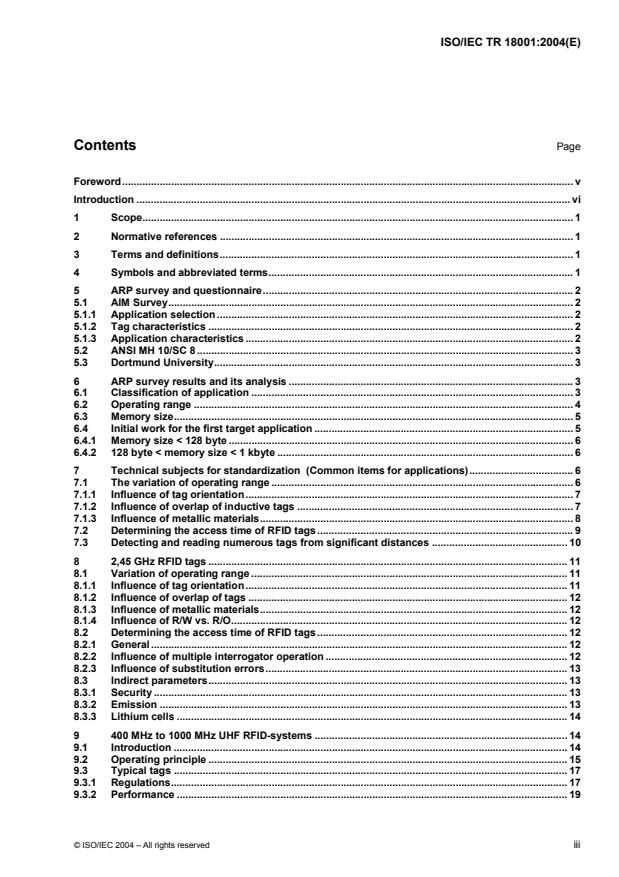
Contents Page
Foreword. v
Introduction . vi
1 Scope. 1
2 Normative references. 1
3 Terms and definitions. 1
4 Symbols and abbreviated terms. 1
5 ARP survey and questionnaire. 2
5.1 AIM Survey. 2
5.1.1 Application selection. 2
5.1.2 Tag characteristics. 2
5.1.3 Application characteristics. 2
5.2 ANSI MH 10/SC 8 . 3
5.3 Dortmund University. 3
6 ARP survey results and its analysis . 3
6.1 Classification of application . 3
6.2 Operating range. 4
6.3 Memory size. 5
6.4 Initial work for the first target application . 5
6.4.1 Memory size < 128 byte . 6
6.4.2 128 byte < memory size < 1 kbyte . 6
7 Technical subjects for standardization (Common items for applications). 6
7.1 The variation of operating range . 6
7.1.1 Influence of tag orientation. 7
7.1.2 Influence of overlap of inductive tags . 7
7.1.3 Influence of metallic materials. 8
7.2 Determining the access time of RFID tags. 9
7.3 Detecting and reading numerous tags from significant distances . 10
8 2,45 GHz RFID tags . 11
8.1 Variation of operating range . 11
8.1.1 Influence of tag orientation. 11
8.1.2 Influence of overlap of tags . 12
8.1.3 Influence of metallic materials. 12
8.1.4 Influence of R/W vs. R/O. 12
8.2 Determining the access time of RFID tags. 12
8.2.1 General. 12
8.2.2 Influence of multiple interrogator operation . 12
8.2.3 Influence of substitution errors. 13
8.3 Indirect parameters. 13
8.3.1 Security. 13
8.3.2 Emission. 13
8.3.3 Lithium cells. 14
9 400 MHz to 1000 MHz UHF RFID-systems . 14
9.1 Introduction. 14
9.2 Operating principle. 15
9.3 Typical tags. 17
9.3.1 Regulations. 17
9.3.2 Performance. 19
© ISO/IEC 2004 – All rights reserved iii
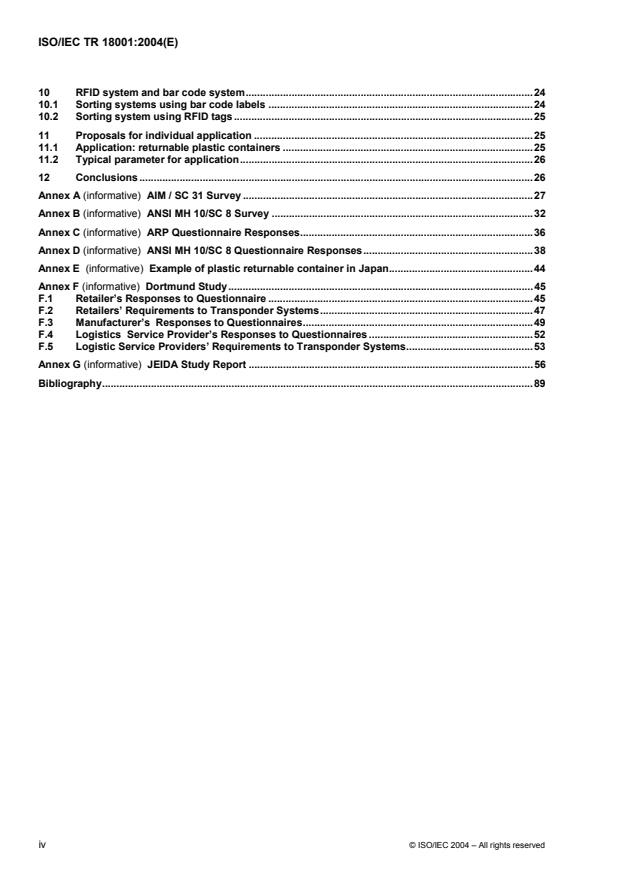
10 RFID system and bar code system.24
10.1 Sorting systems using bar code labels .24
10.2 Sorting system using RFID tags.25
11 Proposals for individual application .25
11.1 Application: returnable plastic containers .25
11.2 Typical parameter for application.26
12 Conclusions.26
Annex A (informative) AIM / SC 31 Survey .27
Annex B (informative) ANSI MH 10/SC 8 Survey .32
Annex C (informative) ARP Questionnaire Responses.36
Annex D (informative) ANSI MH 10/SC 8 Questionnaire Responses.38
Annex E (informative) Example of plastic returnable container in Japan.44
Annex F (informative) Dortmund Study.45
F.1 Retailer’s Responses to Questionnaire .45
F.2 Retailers’ Requirements to Transponder Systems.47
F.3 Manufacturer’s Responses to Questionnaires.49
F.4 Logistics Service Provider’s Responses to Questionnaires .52
F.5 Logistic Service Providers’ Requirements to Transponder Systems.53
Annex G (informative) JEIDA Study Report .56
Bibliography.89
iv © ISO/IEC 2004 – All rights reserved
Foreword
ISO (the International Organization for Standardization) and IEC (the International Electrotechnical
Commission) form the specialized system for worldwide standardization. National bodies that are members of
ISO or IEC participate in the development of International Standards through technical committees
established by the respective organization to deal with particular fields of technical activity. ISO and IEC
technical committees collaborate in fields of mutual interest. Other international organizations, governmental
and non-governmental, in liaison with ISO and IEC, also take part in the work. In the field of information
technology, ISO and IEC have established a joint technical committee, ISO/IEC JTC 1.
International Standards are drafted in accordance with the rules given in the ISO/IEC Directives, Part 2.
The main task of the joint technical committee is to prepare International Standards. Draft International
Standards adopted by the joint technical committee are circulated to national bodies for voting. Publication as
an International Standard requires approval by at least 75 % of the national bodies casting a vote.
In exceptional circumstances, the joint technical committee may propose the publication of a Technical Report
of one of the following types:
— type 1, when the required support cannot be obtained for the publication of an International Standard,
despite repeated efforts;
— type 2, when the subject is still under technical development or where for any other reason there is the
future but not immediate possibility of an agreement on an International Standard;
— type 3, when the joint technical committee has collected data of a different kind from that which is
normally published as an International Standard (“state of the art”, for example).
Technical Reports of types 1 and 2 are subject to review within three years of publication, to decide whether
they can be transformed into International Standards. Technical Reports of type 3 do not necessarily have to
be reviewed until the data they provide are considered to be no longer valid or useful.
Attention is drawn to the possibility that some of the elements of this document may be the subject of patent
rights. ISO and IEC shall not be held responsible for identifying any or all such patent rights.
ISO/IEC TR 18001, which is a Technical Report of type 3, was prepared by Joint Technical Committee
ISO/IEC JTC 1, Information technology, Subcommittee SC 31, Automatic identification and data capture
techniques.
© ISO/IEC 2004 – All rights reserved v
Introduction
The Air Interface Standards of ISO/IEC JTC 1/SC 31 are contained in the various Parts of ISO/IEC 18000,
under the general title Information technology — Radio frequency identification for item management:
Part 1: Reference architecture and definition of parameters to be standardized
Part 2: Parameters for air interface communications below 135 kHz
Part 3: Parameters for air interface communications at 13,56 MHz
Part 4: Parameters for air interface communications at 2,45 GHz
Part 6: Parameters for air interface communications at 860 MHz to 960 MHz
Part 7: Parameters for active air interface communications at 433 MHz
If antenna design, power levels, and the active/passive nature of the implementation design are held equal,
each of these technologies have differing performance and operating parameters, including the distance
achievable between tag and interrogator.
Specific implementations of the various Parts above may result in different performance and operating
parameter trade-offs. Such trade-offs may include the ability to operate as intended under adverse
environmental conditions such as noise or interference or other physical environment variations.
To understand the applicability of each frequency or technology it is necessary to understand the applications
within which this technology will be used. A profile of the application requirements must be developed.
This Technical Report addresses these Application Requirements Profiles, providing the application detail
from which one should be able to assess the applicability of the various technologies.
Seven distinct and separate efforts are included within this Technical Report.
AIM circulated a questionnaire in late 1998 to which 29 responses were received. These responses serve as
the primary basis for this Technical Report.
In early 1999, a United States application standards committee, ANSI MH 10/SC 8, circulated another
questionnaire to which 19 responses were received. These responses are included as validation of the AIM
survey.
In 1999, a German University study was released covering RFID in the retail supply chain from
manufacturer to transporter to retailer, involving 82 responses. These responses are consolidated in this
ARP report.
In early 2000, Japan’s contribution on RFID tags study.
In 2000, Sweden’s contribution on 2,45 GHz RFID tags study.
In 2001, Australia’s contribution on UHF.
In 2001, AIM’s contribution on UHF.
vi © ISO/IEC 2004 – All rights reserved
TECHNICAL REPORT ISO/IEC TR 18001:2004(E)
Information technology — Radio frequency identification for
item management — Application requirements profiles
1 Scope
This Technical Report provides:
The result of three surveys identifying the applications for radio frequency identification (RFID) in an item
management environment, and the resultant classification of these applications based on various
operational parameters, including operating range and memory size.
An explanation of some of the issues associated with the parameters of distance and number of tags
within an RFID interrogator’s field-of-view.
A means by which classification of RF tags may be accomplished based on the application requirements
defined in the survey results.
Recommendations for areas of standardization to the parent committee (ISO/IEC JTC 1/SC 31/WG 4)
based on the results of these surveys.
2 Normative references
The following referenced documents are indispensable for the application of this document. For dated
references, only the edition cited applies. For undated references, the latest edition of the referenced
document (including any amendments) applies.
ISO/IEC 19762 (all parts), Information technology — Automatic identification and data capture (AIDC)
1)
techniques — Harmonized vocabulary
3 Terms and definitions
For the purposes of this document, the terms and definitions given in ISO/IEC 19762 (all parts) apply.
4 Symbols and abbreviated terms
ARP Application Requirements Profile
EAS Electronic Article Surveillance
FA Fixed Asset
RFID Radio Frequency Identification
WORM Write Once Read Many
1) To be published.
© ISO/IEC 2004 – All rights reserved 1
5 ARP survey and questionnaire
In the preparation of this Technical Report three surveys were conducted: one by AIM, one by the U.S.
Accredited Standards Committee (ASC) ANSI MH 10/SC 8, and one by Dortmund University, Germany.
5.1 AIM Survey
The AIM Survey was circulated through ISO/IEC JTC 1/SC 31 national bodies asking potential respondents to
access the survey form at the web site: http://www.rfid.org. The survey that was circulated (SC 31/WG 4
N0046) is attached as Annex A to this Technical Report.
To define the application requirements for standardization, the questionnaire that was circulated by AIM
consisted of three categories:
5.1.1 Application selection
a. Baggage Handling (includes airline)
b. Factory Automation
c. Warehouse Logistics / Inventory Control
d. Distribution
e. Security / Article Surveillance
f. Asset Tracking
g. Container Control
h. Pallet Control
i. Door to door delivery services
j. Others
5.1.2 Tag characteristics
a. Are tags re-usable or disposable?
b. What is the tag’s memory size?
c. Is there a requirement for a unique tag ID?
d. Is the memory requirement read only, write once read many, or read and write?
e. Is there a requirement for physical size or thickness?
5.1.3 Application characteristics
a. Does the application employ a single antenna or multiple antennae?
b. Does the application use hand-held or fixed position reader / writer / antenna?
c. What are the required maximum read and write distances?
d. What is the maximum speed in front of reader / writer?
e. What amount data is transferred during read and write operations?
f. What is the minimum separation distance between tags?
2 © ISO/IEC 2004 – All rights reserved
g. Does the packaging or container have metallic materials?
h. Is the tag orientation controlled or not controlled?
i. Will one or multiple tags be in the field of view at one time; is an anti-collision protocol required?
j. Does the application require the encryption, authentication, or another security system?
k. What are the environmental requirements, e.g., temperature, vibration, water proof, chemical.
The results of the AIM Survey are included as Annex A.
5.2 ANSI MH 10/SC 8
The ANSI MH 10/SC 8 Survey was circulated to ANSI MH 10 members asking potential respondents to
complete the survey and returning it to the administrator of ANSI MH 10/SC 8. The survey that was circulated
is attached as Annex B to this Technical Report. Annex D provides a summary of the responses to the ANSI
MH 10/SC 8 Survey.
5.3 Dortmund University
The Dortmund University Survey was circulated to a select group of German companies involved in the retail
trade as either retail goods manufacturers, transporters, or retailers. Annex F provides a summary of the
responses to the Dortmund University Survey.
6 ARP survey results and its analysis
From the circulation of the AIM ARP Survey, 29 responses were received from 8 countries. These results are
shown in Annex C. Figure 1 shows an application table relating memory size and operating range based on
the response Questionnaire. Eight key items were selected from 27 items in the Questionnaire (N0046).
The 8 items are
a. Application,
b. Memory size,
c. Read/Write,
d. Reuse/Disposal,
e. Tag Frequency,
f. Operating Range,
g. Multiple Tag Read (Anti-collision), and
h. Encryption.
6.1 Classification of application
For the RFID tag system, tag memory size and operating range are key factors. Figure 1 shows the summary
of the applications assembled by read range and tag memory requirements. Figure 2 shows the classification
of the two parameters in 3 categories.
© ISO/IEC 2004 – All rights reserved 3
6.2 Operating range
The operating ranges are different in each application, ranging from 0.1 m and up to 100 m. See Annex A and
Tables 1 and 2. Even in applications named identically, it may be difficult to find identical operating ranges.
The operating range is a key factor for users when implementing RFID systems. For users, it is helpful that the
operating range is classified in three ranges, e.g., short range, medium range and long range.
There are different approaches to propose the operating ranges. One aspect is the take into account the
desired compatibility with the application requirements of contactless IC cards, the ARP group proposed the
ranges within ISO/IEC 14443 and ISO/IEC 15693. The ARP Rapporteur Group has therefore defined
operating ranges as follows.
Table 1 — Operating Range Classifications
short range ≤ 0.1 m
0.1 m ≤ medium range ≤ 0.7 m
0.7 m ≤ long range
Table 2 — Typical Operating Range Requirements by Application
< 10 cm 10 – 70 cm 70 cm – 5 m
11 Pallet ID (FA) 3 Asset Tracking 25 Vehicle Management
30 Pallet Control
1 kbyte
23 FA Auto Warehouse 2 Toll Collection
24 FA Logistics Pallet 4 Warehouse/Logistics *
8 Pallet Control *
10 Asset Tracking *
16 Gasoline
Memory 21 Waste Management
Size
22 Inventory Control
5 Log Tracking
6 Log Tracking
MR TAG
128 byte
7 Access Control 9 Access & Tracking
14 Library 12 Baggage Handling *
26 Pallet Control 13 Baggage Handling *
15 Waste Management *
18 Video Tape Rental *
27 Container Control *
28 Luggage *
29 Asset Tracking
31 EAS
Note – * is the target application. The numbers of Figure 1 correspond to the numbers in the table of Annex C.
4 © ISO/IEC 2004 – All rights reserved
Operating Distance Memory Size
Large
2 m Long
1 kbyte
Medium
0.7 m Medium 128 byte
0.1 m Short Small
Figure 1 – Definition of Operation Distance and Memory Size
6.3 Memory size
The memory size of RF tags (see Annex A and Tables 2 and 3) differs in each application. They extend from 8
byte to 128 kbyte. This report provides classification to three sizes: small, medium, and large. They are
defined as follows.
Table 3 — Classification of Memory Size
small size ≤ 128 byte
128 byte ≤ medium size ≤ 1 kbyte
1 kbyte ≤ large size
6.4 Initial work for the first target application
Based on the responses received, the ARP Rapporteur Group has determined that the initial application focus
work should be based on the pallet and /or a container (crate, returnable plastic container etc), and not the
contents of containers.
The work should concentrate in two specific areas of the matrix (Operating Range – Memory size –
Application) in Table 2.
© ISO/IEC 2004 – All rights reserved 5
6.4.1 Memory size < 128 byte
Operating range > 70 cm
WORM
Application:
Waste (domestic),
Baggage Handling
Books / Videos (libraries)
Container Control
6.4.2 128 byte < memory size < 1 kbyte
Operating range > 70 cm
Read / Write
Application:
Warehouse Logistics.
Pallet Control (returnable plastic container)
Asset tracking
7 Technical subjects for standardization (Common items for applications)
Signal
Power
Tag
X
Reader/Writer Signal
Antenna
Y
Figure 2 – The Principal of RF Tag Communications
7.1 The variation of operating range
The reader/writer antenna transmits power and signals to the tags by propagated electromagnetic waves or
inductive coupling, and tags emit the response signal to the reader/writer antenna. At inductive frequencies,
the operating range (X, Y, Z directions) is affected to a greater extent by the antenna size of the reader/writer
and the antenna size of the tag, than are systems operating at UHF or microwave frequencies.
The operating range when writing is less than reading due to current dissipation. The tags with battery cell
have a greater operating range than tags without a battery cell.
In general, an extended operating range requires a significantly larger antenna for both the reader/writer and
the tag. The interference level in the environment can also have a significant effect on operating range.
Further, there are many factors that affect the operating range including tag orientation, overlap with other
tags environmental noise, absorption, reflection, shadowing and the effects caused by the presence of
metallic material etc.
6 © ISO/IEC 2004 – All rights reserved
7.1.1 Influence of tag orientation
Contrasted to bar codes systems, RFID systems have an advantage of a wider operating range. Like bar
codes, the RFID tags can be attached to various surfaces, e.g., the side of the container.
When the orientation (polarization) of tag is changed, the operating range is changed. For example, the 90-
degree change of orientation may cause the 20-100% deterioration of the operating range. These are shown
in Figure 3.
Tag 2
Tag 1
Reader/Writer
Tag 2
Tag 1
Reader/Writer
Figure 3 – The Influence of Tag Orientation
Tags can be read from one side or from both sides, where the former type gives better reading range at a
certain output power. If the tag cannot be oriented during the reading process, dual-sided reading adds value
to the application.
The tag can be freely oriented around the interrogator’s radiation axis if circular polarization is used in the
system. It is possible to read the tag horizontally as well as vertically, without consideration of how the
interrogators are installed.
The tag can be freely oriented in relation to the interrogator if circular polarization is used and if the tag is
designed for omni-directional reading. This configuration is of value if the objects are completely unaligned,
such as various items on a conveyor belt or where people use the tag for personal access and find it difficult
to orient the tag in a special way.
7.1.2 Influence of overlap of inductive tags
When the RFID tags are attached to the smaller size items, such as books or letters, the distance between tag
to tag may become very short. For example, at inductive frequencies when the two tags are overlapped at
50% of the tag size, the operating range may be reduced by about 30% compared to the case of one tag. The
degree of reduction is different in each tag system, particularly for different carrier frequencies and tag size.
The influence is caused by the variation of resonance frequency f that expressed in formula below,
f =
2π LC
© ISO/IEC 2004 – All rights reserved 7
L [H]:Inductance of tag antenna coil
C [F]: Capacity of tag's tuning capacitor
Operating Range
two tags one tag
Reader/Writer
Antenna
Figure 4 – The Influence of Tag Orientation
7.1.3 Influence of metallic materials
In the RFID tags system, if the tags are attached to the surface of metallic material, particularly ferrous
material, the operating range is affected and in worst case tags cannot be accessed by reader/writer.
The presence of liquids, which include ions in solution, affects operating range as well as metal. The influence
of liquid presence increases with the frequency.
The minimum distance between tag and metallic material should be required to ensure the access of tag.
d
Metallic
Tag
Reader/Writer
Note: “d” is the gap between tag and the metallic material
Figure 5 – The Influence of Metallic Material
8 © ISO/IEC 2004 – All rights reserved
7.2 Determining the access time of RFID tags
In RFID systems, the reader/writer antenna may need to access moving tags. The communication time "TC"
between reader/writer and tags can be estimated, not considering the internal processing time of both the
reader/writer and tag, as follows,
Dc
Tc = × ACN
Dr
The tag moves distance “L” at the velocity Vtag, in the operating range of the reader/writer. TR is the time that
the tag remains within the operating range of the reader/writer antenna field, would be estimated:
Operating Range
L
TR =
Vtag
Velocity
Y
For successful communications,
Reader/
Tag
Writer
T = (TC + Tdct) is required
R
Antenna
X
Figure 6 – Access Time Variation
If multiple tag access is required, and the number of tags is " Ntag", then
T > (T + Tdct) × Ntag
R C
TR (sec): time within the operating range
TC (sec): communication time between reader/writer and tag
Dr (bps): data transmission rate where reading rate = writing rate
DC (bit): data capacity of communications
ACN (times): average communication time between reader/writer and tag
Vtag (m/sec): velocity of tag
L (m): distance the tag moves through the operating range
N : number of tags
tag
Tdct (sec): maximum time to detect a tag
The access time of each tag is a function of the capacity of data for communication. The total access time for
all tags within the operating range is a function of the number of tags within the operating range and the data
capacity of communications.
© ISO/IEC 2004 – All rights reserved 9
To design a sorting system using RFID tags, the following conditions should be considered:
Number of tags within the operating range.
Access time of each tag.
Operating range of reader/writer antenna and orientation insensitive design of tags and-or reader/writer
antenna.
Velocity of the tags (equal to the velocity of the conveyor).
Since these conditions can vary in individual applications, those integrating the RFID system should ensure
that the end users understand these the variations of RF tag access time.
7.3 Detecting and reading numerous tags from significant distances
Anti-collision devices work efficiently – meaning a low probability of missing detection and time of
identification compatible with present duration of items in reading field – when the number of items
remains low enough. In other words, multi-items identification as defined in Normalization works is
well fitted to sequential needs (simultaneous shift of few items in detection field).
Another approach of multi-items identification was extended to solve problems generated by
simultaneous presence of very numerous items forming a large volume. In order to sharpen the
application profile, identification of a hundred of any sized items, located in hazardous positions,
forming a few cubic meter volume: as example, a pallet filled up with cardboard boxes, bottles, non-
metallic supply caddies, postal bags, hostel-linen bags and so on.
The main technologic solutions elected are directly issued from the application profile's definition.
First, about frequency carrier selection.
Many physical features must be taken in account:
Size of identification volume.
Radio Frequency Noise regulations.
Antennas coupling, first within reader and tags, and then within close tags.
Physical characteristics of items to be identified: liquids, solids, diamagnetic metallic conductors and so
on.
Technological build up feasibility.
The above may determine the minimum and maximum values for magnetic induction within reader
and tags and to select low frequency carriers (below 135 kHz) rather than High Frequencies (13,56
MHz).
Secondly, the completely random positioning of items to be identified enforces specific technical
issues:
Tags may be affixed to items and positioned in any angle to the reader’s antenna axis. So, in order to
get acceptable magnetic coupling, reader antennas are multi-axes antennas.
Tags may be very close to each other, like stamps on letters in postal bags, stacked, like casino chips,
head to tail, and so on. Thus, magnetic coupling within tag can induce fading in a reader's receptor, and
mutual inductance between two close tags can rise to double, making uncertain a good tuning of tags
antennas on back frequency carrier.
10 © ISO/IEC 2004 – All rights reserved
These observations provide two important technological features
First, tags do not respond to the resonance frequency of their antenna coils and return signals will not
realize any Q-Factor benefit. Second, signals emitted by tags may be fully synchronized and
carefully set in the same phase to prevent fading.
Communication between reader and tags is able to become more simplified by above design.
The reader sends requests to tags and all tags are answering in a manner in which each tag’s
response is added to the response of the tag population.
So no complex anti-collision loops are needed to determine simultaneous tag responses, and no anti-
collision algorithms are needed, saving long duration multiple request and response communication
between reader and tags. The saving in the duration of the process increases as the number of tags
increases.
In order to get the unique identification of each tag, a simple enumeration method is used, ensuring
total reliability. The communication algorithms determines, element by element, the tag's UID by
simultaneous interrogation of all tags present in active volume. The algorithms tests in succession
the possible values (for example 0 to 9 if the elements are numbered as decimal values) of the first
element of the UID with a predetermined slot of time, then the same operation is repeated for all
subsequent elements of the UID' within predetermined slots of time. When the UID of tags have
similarities like common prefix or sequential code numbers, the system is even more efficient
because of the optimization of the algorithm.
The system described above ensures reliable identification of numerous items arriving
simultaneously, like batches of goods. Identification time duration is a function of items number and is
an adaptable parameter depending on family application requested.
8 2,45 GHz RFID tags
8.1 Variation of operating range
In addition to range, a most important standardization criterion is speed. Both are influenced by tag orientation,
overlap of tags, metallic materials, amount, and direction of data transfer (i.e. if the system is R/O or R/W),
multiple interrogators near each other and the acceptable substitution error level. Parameters of indirect
concern are data security, emission considerations and tag cost/disposal.
8.1.1 Influence of tag orientation
When large objects are to be conveniently identified, the long reading range of 2,45 GHz systems also needs
a directed field of view in order to avoid unintentional reading of "wrong" objects, such as in adjacent driving
lanes. Microwave antennas can provide this directionality.
The tags can be readable from one side or from both sides, where the former type gives better reading range
at a certain output power. If the tag cannot be fixed to an object, or if the objects are not oriented during the
reading process, dual-sided reading adds value to the application.
The tag can be freely oriented around the interrogator’s radiation axis if circular polarization is used in the
system. It becomes possible to read the tag horizontally as well as vertically, without consideration of how the
interrogators are installed. This is of great interest in most applications.
The tag can be completely freely oriented in relation to the interrogator if circular polarization is used and if the
tag is designed for omni-directional reading. This configuration is of value if the objects are completely
unaligned, such as various items on a conveyor belt or where people use the tag for personal access and find
it difficult to orient the tag in a special way.
© ISO/IEC 2004 – All rights reserved 11
8.1.2 Influence of overlap of tags
2,45 GHz RFID systems, usually used for large objects, can identify these safely also in a group. However,
the bigger the object, the fewer to identify at a time since only a limited number of big objects can be roomed
in the field of view. At 2,45 GHz, this number is typically < 5 and such requirements are typically found when
loading a transport vehicle or moving a container through a portal.
8.1.3 Influence of metallic materials
Properly designed, 2,45 GHz tags can be placed, without range degradation, directly on a metal object such
as a container, a railcar or a truck. Some tags however use dipole antennas that are short-circuited by the
metal and need spacing from the metal to be readable at full distance.
2,45 GHz penetrates most non-metallic materials, e.g. a car window, without significant attenuation. Thin, sun-
protecting metal layers used in some windshields can have considerable range-reduction effect, but such
windows are usually only used in bus windshields (not side-windows) and in some vans. It is unlikely that
metal layer side-windows will be used extensively, since they are expensive and also block the function of
mobile phones.
Panels are seldom used in front of the interrogator, if it is not to be a hidden installation such as for corporate
asset protection from employee theft. Here the interrogator can be placed out of sight above the ceiling and
oriented downwards. It reads through the ceiling, that usually does not reduce the range (if not in metal). It is
not recommended to locate the interrogator behind concrete walls, e.g. for garage access, since this will have
significant range reduction effect.
8.1.4 Influence of R/W vs. R/O
2,45 GHz systems can without considerable cost increase be designed to allow tag programming via the
microwaves. This allows for convenient and safe formatting of the tags (e.g. memory size, multiplicity, and
data speed) and for programming with data in decentralized, stand-alone, systems.
The theoretical writing distance at 100 mW EIRP is in the order of five meters for active tags. Commercially
available passive tags demonstrate a writing distance of between 1 and 2 meters at 4 W EIRP. The tag
memory size to use depends on the application, but the trend over the five years has been towards smaller
memories. It makes the tags cheaper and Internet and other networks have made centralized data easy to
manage.
A long writing distance is not always good, and many applications write the tag only once or a few times
during its life. Writing with microwaves is however very convenient when issuing tags “en masse”, since no
galvanic connecting is needed. Hence, systems with write distances <0,5 m become increasingly popular. In
long-distance writing systems, it must be secured that tags are not unintentionally written since this will lead to
system confusion.
Regardless of R/W or R/O, both systems need a unique and non-alterable code in the tag for increased
security. The distribution, use and maintenance of tags are then much easier.
8.2 Determining the access time of RFID tags
8.2.1 General
The nature of microwaves allows for high passage speeds.
8.2.2 Influence of multiple interrogator operation
Congestion reduces the communication speed because of message collisions. 2,45 GHz RFID installations
sometimes comprise up to 100 interrogators inside a radius where interference can occur if not protective
measures, such as channel selection are taken. Reader density varies between the applications and can be
as little as 2 at the entrance/exit of a remote car park, while in most commercial garages, automatic cargo
12 © ISO/IEC 2004 – All rights reserved
handling terminals and automatic factory lines up to 25 interrogators or more are installed inside the
interference zone.
A consequence is that a standardized system should be able to roam at least 25 channels in a frequency
band that is allocated by the frequency authorities. UHF tag systems use low data speed in the microwave link
and typically need a channel spacing of only 300 kHz or less, implying that an 8 MHz band would allow for 26
channels. In most cases, this would be enough.
8.2.3 Influence of substitution errors
The passage speed is limited by safety requirements; a train application might require a substitution error
-9
likelihood in the region of 10 , and with the relatively high bit rate available in all 2,45 GHz systems there is no
reason to lower this requirement in other applications. Using 32 bit CRC is one method to meet said
requirement.
8.3 Indirect parameters
8.3.1 Security
For most applications, adequate security can be achieved by factory coding of the tag, i.e. using tags where
an identifier is included in each message from the tag and where the identifier is unique to the tag and non-
alterable by the user. If One Time Programming (OTP) tags are used, it must be ensured that unauthorized
access to programming equipment and virgin tags is impossible. A higher security is achieved if the tags are
programmed already at chip manufacture, since it is hard to duplicate the chips. In both cases, a standard
may imply that a numbering management organization is established.
If the tag makes use of both a fixed and writeable memory, it can be encrypted e.g. according to DES to
protect against unauthorized viewing and duplication of the tag data. For easy key distribution, an
asy
...