

ISO 19880-8:2019/Amd 1:2021
(Amendment)Gaseous hydrogen — Fuelling stations — Part 8: Fuel quality control — Amendment 1: Alignment with Grade D of ISO 14687
General Information
- Abstract
- Status
- Withdrawn
- Publication Date
- 09-Aug-2021
- Technical Committee
- ISO/TC 197 - Hydrogen technologies
- Drafting Committee
- ISO/TC 197/WG 28 - Hydrogen quality control
- Current Stage
- 9599 - Withdrawal of International Standard
- Start Date
- 13-Dec-2024
- Completion Date
- 29-Aug-2026
Buy Documents



ISO 19880-8:2019/Amd 1:2021 - Alignment with Grade D of ISO 14687

ISO 19880-8:2019/Amd 1:2021 - Gaseous hydrogen — Fuelling stations — Part 8: Fuel quality control — Amendment 1: Alignment with Grade D of ISO 14687/10/2021
Overview
ISO 19880-8:2019/Amd 1:2021 is an important amendment to the international standard focusing on gaseous hydrogen fuelling stations, specifically addressing fuel quality control. This amendment aligns the quality requirements of hydrogen fuel dispensed to Polymer Electrolyte Membrane (PEM) fuel cell road vehicles with Grade D of ISO 14687. The document provides comprehensive guidelines for monitoring and controlling impurities in hydrogen fuel to ensure safety, reliability, and optimal fuel cell performance.
Key Topics
Fuel Quality Alignment
This amendment harmonizes the fuel quality control criteria at hydrogen fuelling stations with the stringent impurity thresholds defined in Grade D of ISO 14687. This ensures compatibility and safety for PEM fuel cell vehicles.Impurity Thresholds and Severity Classes
The document outlines specific threshold values for various impurities such as inert gases (nitrogen, argon, helium), oxygen, carbon monoxide, methane, water, sulfur compounds, ammonia, hydrocarbons (excluding methane), formaldehyde, formic acid, halogens, and particulates. Each impurity is associated with a severity class indicating the potential impact on fuel cell systems.Risk Assessment and Impact on Fuel Cells
It is mandatory to evaluate the consequences if any impurity exceeds the threshold specified in ISO 14687 Grade D. A “Level 1” concentration is defined for some impurities, indicating higher severity levels that require additional monitoring or corrective actions.Probability of Impurities Occurring
The amendment includes detailed probabilities of impurity occurrence from various hydrogen production processes such as Steam Methane Reforming (SMR), pipeline delivery, and alkaline electrolysis. It also identifies typical barriers and control measures deployed in these processes to reduce contamination risks.Routine Analysis and Monitoring
Guidelines for routine sampling, monitoring points, and frequency of contaminant analysis are provided. Key contaminants like total sulfur, total hydrocarbons, carbon monoxide, nitrogen, argon, water, and oxygen are monitored annually downstream of the purification stage.
Applications
Hydrogen Fuelling Stations
ISO 19880-8:2019/Amd 1:2021 applies directly to the operation and quality control systems of hydrogen fuelling stations, ensuring the fuel meets the necessary purity for the safe and efficient use of hydrogen fuel cell vehicles.PEM Fuel Cell Vehicle Operators
Operators benefit from improved fuel quality assurance, minimizing the risk of performance degradation or damage due to fuel impurities.Hydrogen Fuel Producers and Distributors
The standard supports producers and distributors by offering clear impurity limits and control requirements, fostering consistency across the supply chain.Regulatory Authorities and Inspection Bodies
Authorities can use this amendment as a benchmark for compliance assessments and to promote safety and interoperability in hydrogen infrastructure.
Related Standards
ISO 14687: Hydrogen Fuel Quality
The primary standard for hydrogen fuel quality specifying grades and impurity limits, with Grade D dedicated to fuel for road vehicle PEM fuel cells. ISO 19880-8:2019/Amd 1 specifically aligns its control criteria to Grade D.ISO 19880 Series: Hydrogen Fuelling Stations
The broader series outlining design, safety, and operational requirements for hydrogen fuelling stations.ISO/IEC Directives, Part 1 & Part 2
Guidelines used by ISO for the preparation and publication of standards, ensuring consistency and international applicability.
Practical Value
Implementing ISO 19880-8:2019/Amd 1:2021 ensures hydrogen fuel purity at fuelling stations matches stringent international requirements, crucial for:
- Extending the lifetime and performance of PEM fuel cells.
- Reducing operational risks linked to fuel impurities.
- Enhancing consumer confidence in hydrogen fuel as an alternative energy source.
- Facilitating global harmonization of hydrogen infrastructure standards.
- Supporting the transition to a clean hydrogen economy with reliable refuelling networks.
By adhering to the amendment’s impurity classification, severity levels, and monitoring protocols, stakeholders can maintain optimal fuel quality control, safeguarding fuel cell technology and accelerating sustainable hydrogen vehicle adoption.
Relations
- Effective Date
- 14-Oct-2020
- Effective Date
- 06-Jun-2022
Buy Documents
ISO 19880-8:2019/Amd 1:2021 - Alignment with Grade D of ISO 14687
ISO 19880-8:2019/Amd 1:2021 - Gaseous hydrogen — Fuelling stations — Part 8: Fuel quality control — Amendment 1: Alignment with Grade D of ISO 14687/10/2021
Get Certified
Connect with accredited certification bodies for this standard

TÜV Rheinland
TÜV Rheinland is a leading international provider of technical services.

TÜV SÜD
TÜV SÜD is a trusted partner of choice for safety, security and sustainability solutions.

DEKRA Certification Inc.
DEKRA US certification services.
Sponsored listings
Frequently Asked Questions
ISO 19880-8:2019/Amd 1:2021 is a standard published by the International Organization for Standardization (ISO). Its full title is "Gaseous hydrogen — Fuelling stations — Part 8: Fuel quality control — Amendment 1: Alignment with Grade D of ISO 14687". This standard covers: Gaseous hydrogen — Fuelling stations — Part 8: Fuel quality control — Amendment 1: Alignment with Grade D of ISO 14687
Gaseous hydrogen — Fuelling stations — Part 8: Fuel quality control — Amendment 1: Alignment with Grade D of ISO 14687
ISO 19880-8:2019/Amd 1:2021 is classified under the following ICS (International Classification for Standards) categories: 43.060.40 - Fuel systems; 71.100.20 - Gases for industrial application. The ICS classification helps identify the subject area and facilitates finding related standards.
ISO 19880-8:2019/Amd 1:2021 has the following relationships with other standards: It is inter standard links to ISO 19880-8:2019, ISO 19880-8:2024. Understanding these relationships helps ensure you are using the most current and applicable version of the standard.
ISO 19880-8:2019/Amd 1:2021 is available in PDF format for immediate download after purchase. The document can be added to your cart and obtained through the secure checkout process. Digital delivery ensures instant access to the complete standard document.
Standards Content (Sample)
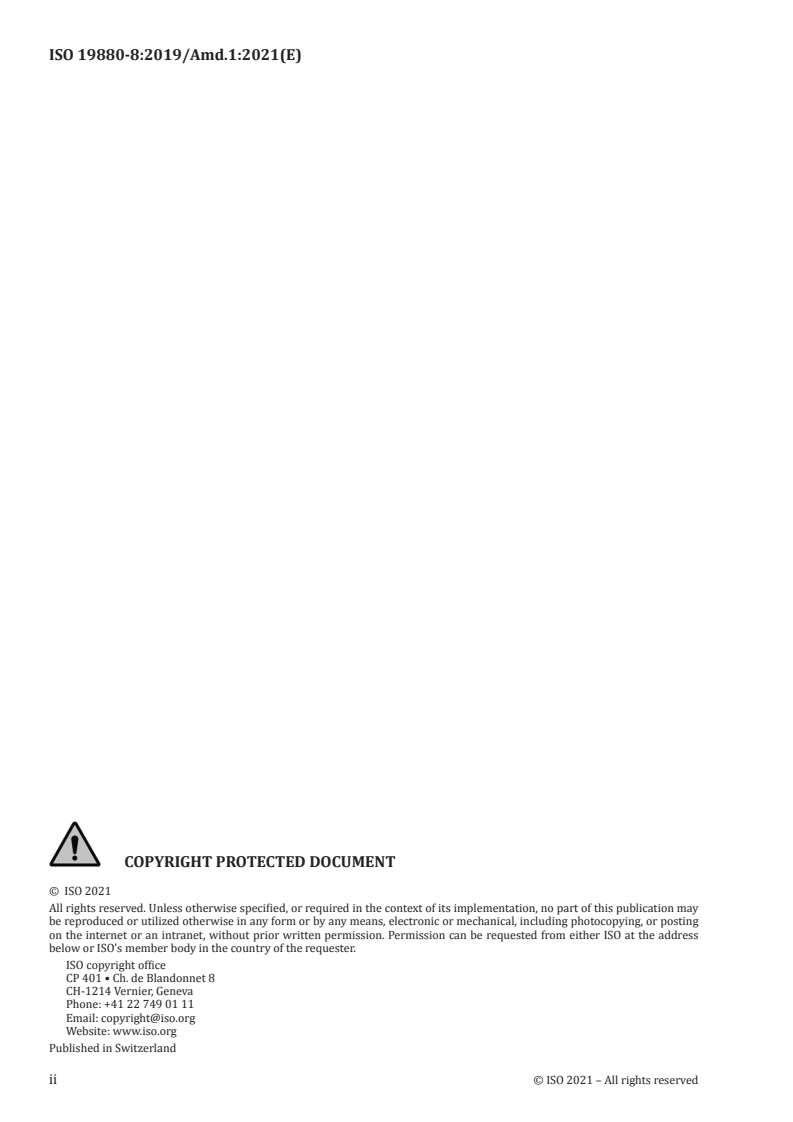
INTERNATIONAL ISO
STANDARD 19880-8
First edition
2019-10
AMENDMENT 1
2021-08
Gaseous hydrogen — Fuelling
stations —
Part 8:
Fuel quality control
AMENDMENT 1: Alignment with Grade D
of ISO 14687
Hydrogène gazeux — Stations de remplissage —
Partie 8: Contrôle qualité du carburant
AMENDEMENT 1: Alignement avec le Grade D de l'ISO 14687
Reference number
ISO 19880-8:2019/Amd.1:2021(E)
©
ISO 2021
ISO 19880-8:2019/Amd.1:2021(E)
© ISO 2021
All rights reserved. Unless otherwise specified, or required in the context of its implementation, no part of this publication may
be reproduced or utilized otherwise in any form or by any means, electronic or mechanical, including photocopying, or posting
on the internet or an intranet, without prior written permission. Permission can be requested from either ISO at the address
below or ISO’s member body in the country of the requester.
ISO copyright office
CP 401 • Ch. de Blandonnet 8
CH-1214 Vernier, Geneva
Phone: +41 22 749 01 11
Email: copyright@iso.org
Website: www.iso.org
Published in Switzerland
ii © ISO 2021 – All rights reserved
ISO 19880-8:2019/Amd.1:2021(E)
Foreword
ISO (the International Organization for Standardization) is a worldwide federation of national standards
bodies (ISO member bodies). The work of preparing International Standards is normally carried out
through ISO technical committees. Each member body interested in a subject for which a technical
committee has been established has the right to be represented on that committee. International
organizations, governmental and non-governmental, in liaison with ISO, also take part in the work.
ISO collaborates closely with the International Electrotechnical Commission (IEC) on all matters of
electrotechnical standardization.
The procedures used to develop this document and those intended for its further maintenance are
described in the ISO/IEC Directives, Part 1. In particular, the different approval criteria needed for the
different types of ISO documents should be noted. This document was drafted in accordance with the
editorial rules of the ISO/IEC Directives, Part 2 (see www .iso .org/ directives).
Attention is drawn to the possibility that some of the elements of this document may be the subject of
patent rights. ISO shall not be held responsible for identifying any or all such patent rights. Details of
any patent rights identified during the development of the document will be in the Introduction and/or
on the ISO list of patent declarations received (see www .iso .org/ patents).
Any trade name used in this document is information given for the convenience of users and does not
constitute an endorsement.
For an explanation of the voluntary nature of standards, the meaning of ISO specific terms and
expressions related to conformity assessment, as well as information about ISO's adherence to the
World Trade Organization (WTO) principles in the Technical Barriers to Trade (TBT) see www .iso .org/
iso/ foreword .html.
This document was prepared by Technical Committee TC 197, Hydrogen technologies.
A list of all parts in the ISO 19880 series can be found on the ISO website.
Any feedback or questions on this document should be directed to the user’s national standards body. A
complete listing of these bodies can be found at www .iso .org/ members .html.
ISO 19880-8:2019/Amd.1:2021(E)
Gaseous hydrogen — Fuelling stations —
Part 8:
Fuel quality control
AMENDMENT 1: Alignment with Grade D of ISO 14687
Clause 5, first paragraph
Replace the paragraph with the following:
The quality requirements of hydrogen fuel dispensed to PEM fuel cells for road vehicles are listed
in Grade D of ISO 14687.
8.4, first paragraph
Replace the paragraph with the following:
It is necessary to evaluate the possible consequences on a fuel cell vehicle if any impurity exceeds
the threshold value of ISO 14687 Grade D.
8.4, second paragraph
Replace the paragraph with the following:
An estimation of the concentration above the ISO 14687 Grade D threshold values at which the
severity increases (if applicable) is named “Level 1” and is given in column 5 for each impurity
where the “severity class” is not already 4.
Table 4
Replace Table 4 with the following table:
ISO 19880-8:2019/Amd.1:2021(E)
Table 4 — Impact of impurities on fuel cell powertrain
Severity class
Severity class
ISO 14687 (from ISO 14687
(greater than
Impurity Grade D Grade D Level 1 value
Level 1
a
threshold value threshold value
threshold)
to Level 1)
[μmol/mol] [μmol/mol]
b b
Total non-H gases 300 UD UD 4
b b
Helium He 300 UD UD 4
b b
Nitrogen N 300 UD UD 4
b b
Argon Ar 300 UD UD 4
c c
Oxygen O 5 UD UD 4
Carbon dioxide CO 2 1 3 4
d
Carbon monoxide CO 0,2 2-3 1 4
Methane CH 100 1 300 4
Water H O 5 4 N/A 4
Total sulphur H S
0,004 4 N/A 4
compounds basis
Ammonia NH 0,1 4 N/A 4
Total hydrocarbons CH
4 d
2 1-4 N/A 4
except methane basis
d
Formaldehyde HCHO 0,2 2-3 1 4
d
Formic acid HCOOH 0,2 2-3 1 4
Halogens 0,05 4 N/A 4
Maximum particulate
concentration (liquid 1 mg/kg 4 N/A 4
e
and solid)
Key
UD: undetermined
N/A: not applicable
a
The threshold value is according to hydrogen specification of Grade D of ISO 14687.
b
The severity class (from ISO 14687 Grade D threshold value to Level 1) and Level 1 value for this impurity is
undetermined because no specific study has been conducted yet in alignment with the new threshold value. It needs to be
covered in the next edition of this document.
c
The severity class (from ISO 14687 Grade D threshold value to Level 1) and Level 1 value for oxygen are undetermined
because data are lacking to confirm those values. It needs to be covered in the next edition of this document.
d
A higher value is to be considered for risk assessment approach until more specific data is available.
e
Particulates are based upon mass density mg/kg.
A.15 first paragraph
Replace “ISO 14687-2” with “Grade D of ISO 14687” in the second last sentence.
Table B.1
Replace Table B.1 with the following table:
2 © ISO 2021 – All rights reserved
ISO 19880-8:2019/Amd.1:2021(E)
Table B.1 — Probability of occurrence for off-site SMR
Probabil-
Possible causes ity
Impurity Threshold Typical barriers employed in this process
For the source studied with
barriers
μmol/mol
— PSA
Inert gas Present in natural gas and syn-
a
300 UD
N gas PSA malfunction
— Double analysis PSA outlet <100 μmol/mol
Inert gas Only ATR and POx present in O — PSA. Not sized to remove Ar. Ar content may be higher if H comes from ATR, POX or
2 2
a
300 UD
Ar typical 0,6 % in syngas from ATR feeds with high Ar content
Not present in syngas. O is un-
stable in the condition of reform-
O 5 — PSA cannot be used with significant O content for safety reasons 0
2 2
ing and shift reactions. Combines
with H , CO, and CH
2 4
— PSA adsorption strength of MS, activated carbon, silicagel higher for CO than CO. A
CO 2 Present in syngas (%) 0
CO content lower than 10μmol/mol insures a CO content lower than 2 μmol/mol
Normal operation below thresh-
CO 0,2 old. Occasional peaks at μmol/ — Double analysis at the PSA outlet + trip if the CO>1-10 μmol/mol at PSA outlet 4
mol level
— In most cases CO is sizing the PSA, therefore CO<10 μmol/mol ==> C H < 100 μmol/mol
CH 100 Present in syngas at % level 2
depending on users' specification (Europe pipeline 2 μmol/mol).
— PSA adsorbed in alumina and MS adsorption strength higher than CO .
H O 5 Syngas saturated in H O 0
2 2
A CO content lower than 10 μmol/mol insures a H O content lower than 5 μmol/mol.
Key
UD: undetermined
a
The probability of occurrence for this impurity is undetermined because no specific study has been conducted yet.
ISO 19880-8:2019/Amd.1:2021(E)
4 © ISO 2021 – All rights reserved
Table B.1 (continued)
Probabil-
Possible causes ity
Impurity Threshold Typical barriers employed in this process
For the source studied with
barriers
μmol/mol
— Desulphuration upstream reformer (typical values: normal < 10 ppb,
maximum < 20 ppb, guarantee < 50 ppb)
— Typical dilution factor 2,5 (1 mole natural gas produces 2,5 mole H )
— Pre-reformer catalyst poisoning by sulphur is irreversible. Sulphur trapped at this stage.
In case of breakthrough, process condition cannot be achieved
TS 0,004 TS from natural gas — Reformer catalyst poisoning by sulphur is irreversible. Sulphur trapped at this stage. 0
In case of breakthrough, process condition cannot be achieved
— Shift catalyst poisoning by sulphur is irreversible. Sulphur trapped at this stage.
In case of breakthrough, process condition cannot be achieved
— PSA adsorption of H S before CO, CO , species
2 2
— H S adsorption in pipe and vessels. Strong affinity with steel
— PSA adsorption strength of alumina and molecular sieve higher than CO. A CO content
NH 0,1 Traces present in syngas 0
lower than 10μmol/mol insures a NH content lower than 0,1 μmol/mol
Traces of C2+ after reforming — PSA C2 C3, C4, C5+adsorbed by activated carbon layer. A CO content lower than
THC 2 0
reaction 10 μmol/mol insures a THC (C H excluded) content lower than 2 μmol/mol
— PSA. Formaldehyde adsorption strength of alumina and molecular sieve higher than
May be present in syngas. CO. A CO content lower than 10 μmol/mol insures a HCHO content lower than 0,1 μmol/
a
HCHO 0,2 UD
essentially liquid mol. To guarantee 0,01 μmol/mol would require more experience of measuring at
those levels
— PSA. Formic adsorption strength of alumina and molecular sieve higher than CO.
May be present in syngas
HCOOH 0,2 A CO content lower than 10 μmol/mol insures a HCOOH content lower than 0,2 μmol/ 0
essentially liquid
mol
Key
UD: undetermined
a
The probability of occurrence for this impurity is undetermined because no specific study has been conducted yet.
ISO 19880-8:2019/Amd.1:2021(E)
Table B.1 (continued)
Probabil-
Possible causes ity
Impurity Threshold Typical barriers employed in this process
For the source studied with
barriers
μmol/mol
— Any Cl present in natural gas would be stopped by HDS
— Pre-reformer catalyst poisoning by Cl irreversible Cl trapped at this stage. If
breakthrough, process condition cannot be achieved
— Reformer catalyst poisoning by Cl irreversible. Cl trapped at this stage I break through,
Halogens 0,05 Present in natural gas 0
process condition cannot be achieved
— Shift catalyst poisoning by Cl irreversible. Cl trapped at this stage. I break through,
process condition cannot be achieved
— PSA adsorption of Cl before CO, CO , species
Not present in natural gas in N
Europe (<10 μmol/mol). Passes
He 300 0
through the whole process. Dilu-
tion factor 2,5
Key
UD: undetermined
a
The probability of occurrence for this impurity is undetermined because no specific study has been conducted yet.
ISO 19880-8:2019/Amd.1:2021(E)
Table B.2
Replace Table B.2 with the following table:
Table B.2 — Probability of occurrence for pipeline
Typical barriers Probability
Causes possible
Impurity Threshold employed in with
For the item studied
this process barriers
μmol/mol
Air intake if some areas are at negative
Inert gas pressure Inlet pressure PSL trip on
a
300 UD
N From seal gas or purge gas compressors
Wrong purging after maintenance
1 % Ar in the air.
Inert gas 100 μmol/mol would
a
300 No potential UD
Ar mean 1 % air in the pipe
Never been observed
Air intake if some areas are at negative Inlet pressure PSL trip on
O 5 1
pressure compressors
2 μmol/mol of C O would
mean 0,5 % air in the
CO 2 From Air: CO at 400 μmol/mol in the air 0
2 2
pipe
Never been observed
CO 0,2 No potential 0
CH 100 No potential 0
H > 40 bar ==> leak from
H O 5 Wrong drying after pressure hydraulic test H O to H unlikely during 0
2 2 2
operation.
TS 0,004 No potential 0
NH 0,1 No potential 0
THC 2 No potential 0
a
HCHO 0,2 No potential UD
HCOOH 0,2 No potential 0
Halogens 0,05 From cleaning material after maintenance 1
He 300 No potential 0
Key
UD: undetermined
a
The probability of occurrence for this impurity is undetermined because no specific study has been conducted yet. It
needs to be covered in the next edition of this document.
6 © ISO 2021 – All rights reserved
ISO 19880-8:2019/Amd.1:2021(E)
Table B.3
Replace Table B.3 with the following table:
Table B.3 — Probability of occurrence for fuelling station to be source of impurities
Causes possible
Impurity Threshold Existing barriers Probability
For the source studied
μmol/mol
Inert gas N purging operation, air intake during
2 a
300 UD
N normal operation or maintenance
1 % Ar in the air.
100 μmol/mol would
Inert gas Air intake during normal operation or
a
300 mean 1 % air in the UD
Ar maintenance
fuelling station
Never been observed
Air intake during normal operatio
...
INTERNATIONAL ISO
STANDARD 19880-8
First edition
2019-10
AMENDMENT 1
2021-08
Gaseous hydrogen — Fuelling
stations —
Part 8:
Fuel quality control
AMENDMENT 1: Alignment with Grade D
of ISO 14687
Hydrogène gazeux — Stations de remplissage —
Partie 8: Contrôle qualité du carburant
AMENDEMENT 1: Alignement avec le Grade D de l'ISO 14687
Reference number
ISO 19880-8:2019/Amd.1:2021(E)
©
ISO 2021
ISO 19880-8:2019/Amd.1:2021(E)
© ISO 2021
All rights reserved. Unless otherwise specified, or required in the context of its implementation, no part of this publication may
be reproduced or utilized otherwise in any form or by any means, electronic or mechanical, including photocopying, or posting
on the internet or an intranet, without prior written permission. Permission can be requested from either ISO at the address
below or ISO’s member body in the country of the requester.
ISO copyright office
CP 401 • Ch. de Blandonnet 8
CH-1214 Vernier, Geneva
Phone: +41 22 749 01 11
Email: copyright@iso.org
Website: www.iso.org
Published in Switzerland
ii © ISO 2021 – All rights reserved
ISO 19880-8:2019/Amd.1:2021(E)
Foreword
ISO (the International Organization for Standardization) is a worldwide federation of national standards
bodies (ISO member bodies). The work of preparing International Standards is normally carried out
through ISO technical committees. Each member body interested in a subject for which a technical
committee has been established has the right to be represented on that committee. International
organizations, governmental and non-governmental, in liaison with ISO, also take part in the work.
ISO collaborates closely with the International Electrotechnical Commission (IEC) on all matters of
electrotechnical standardization.
The procedures used to develop this document and those intended for its further maintenance are
described in the ISO/IEC Directives, Part 1. In particular, the different approval criteria needed for the
different types of ISO documents should be noted. This document was drafted in accordance with the
editorial rules of the ISO/IEC Directives, Part 2 (see www .iso .org/ directives).
Attention is drawn to the possibility that some of the elements of this document may be the subject of
patent rights. ISO shall not be held responsible for identifying any or all such patent rights. Details of
any patent rights identified during the development of the document will be in the Introduction and/or
on the ISO list of patent declarations received (see www .iso .org/ patents).
Any trade name used in this document is information given for the convenience of users and does not
constitute an endorsement.
For an explanation of the voluntary nature of standards, the meaning of ISO specific terms and
expressions related to conformity assessment, as well as information about ISO's adherence to the
World Trade Organization (WTO) principles in the Technical Barriers to Trade (TBT) see www .iso .org/
iso/ foreword .html.
This document was prepared by Technical Committee TC 197, Hydrogen technologies.
A list of all parts in the ISO 19880 series can be found on the ISO website.
Any feedback or questions on this document should be directed to the user’s national standards body. A
complete listing of these bodies can be found at www .iso .org/ members .html.
ISO 19880-8:2019/Amd.1:2021(E)
Gaseous hydrogen — Fuelling stations —
Part 8:
Fuel quality control
AMENDMENT 1: Alignment with Grade D of ISO 14687
Clause 5, first paragraph
Replace the paragraph with the following:
The quality requirements of hydrogen fuel dispensed to PEM fuel cells for road vehicles are listed
in Grade D of ISO 14687.
8.4, first paragraph
Replace the paragraph with the following:
It is necessary to evaluate the possible consequences on a fuel cell vehicle if any impurity exceeds
the threshold value of ISO 14687 Grade D.
8.4, second paragraph
Replace the paragraph with the following:
An estimation of the concentration above the ISO 14687 Grade D threshold values at which the
severity increases (if applicable) is named “Level 1” and is given in column 5 for each impurity
where the “severity class” is not already 4.
Table 4
Replace Table 4 with the following table:
ISO 19880-8:2019/Amd.1:2021(E)
Table 4 — Impact of impurities on fuel cell powertrain
Severity class
Severity class
ISO 14687 (from ISO 14687
(greater than
Impurity Grade D Grade D Level 1 value
Level 1
a
threshold value threshold value
threshold)
to Level 1)
[μmol/mol] [μmol/mol]
b b
Total non-H gases 300 UD UD 4
b b
Helium He 300 UD UD 4
b b
Nitrogen N 300 UD UD 4
b b
Argon Ar 300 UD UD 4
c c
Oxygen O 5 UD UD 4
Carbon dioxide CO 2 1 3 4
d
Carbon monoxide CO 0,2 2-3 1 4
Methane CH 100 1 300 4
Water H O 5 4 N/A 4
Total sulphur H S
0,004 4 N/A 4
compounds basis
Ammonia NH 0,1 4 N/A 4
Total hydrocarbons CH
4 d
2 1-4 N/A 4
except methane basis
d
Formaldehyde HCHO 0,2 2-3 1 4
d
Formic acid HCOOH 0,2 2-3 1 4
Halogens 0,05 4 N/A 4
Maximum particulate
concentration (liquid 1 mg/kg 4 N/A 4
e
and solid)
Key
UD: undetermined
N/A: not applicable
a
The threshold value is according to hydrogen specification of Grade D of ISO 14687.
b
The severity class (from ISO 14687 Grade D threshold value to Level 1) and Level 1 value for this impurity is
undetermined because no specific study has been conducted yet in alignment with the new threshold value. It needs to be
covered in the next edition of this document.
c
The severity class (from ISO 14687 Grade D threshold value to Level 1) and Level 1 value for oxygen are undetermined
because data are lacking to confirm those values. It needs to be covered in the next edition of this document.
d
A higher value is to be considered for risk assessment approach until more specific data is available.
e
Particulates are based upon mass density mg/kg.
A.15 first paragraph
Replace “ISO 14687-2” with “Grade D of ISO 14687” in the second last sentence.
Table B.1
Replace Table B.1 with the following table:
2 © ISO 2021 – All rights reserved
ISO 19880-8:2019/Amd.1:2021(E)
Table B.1 — Probability of occurrence for off-site SMR
Probabil-
Possible causes ity
Impurity Threshold Typical barriers employed in this process
For the source studied with
barriers
μmol/mol
— PSA
Inert gas Present in natural gas and syn-
a
300 UD
N gas PSA malfunction
— Double analysis PSA outlet <100 μmol/mol
Inert gas Only ATR and POx present in O — PSA. Not sized to remove Ar. Ar content may be higher if H comes from ATR, POX or
2 2
a
300 UD
Ar typical 0,6 % in syngas from ATR feeds with high Ar content
Not present in syngas. O is un-
stable in the condition of reform-
O 5 — PSA cannot be used with significant O content for safety reasons 0
2 2
ing and shift reactions. Combines
with H , CO, and CH
2 4
— PSA adsorption strength of MS, activated carbon, silicagel higher for CO than CO. A
CO 2 Present in syngas (%) 0
CO content lower than 10μmol/mol insures a CO content lower than 2 μmol/mol
Normal operation below thresh-
CO 0,2 old. Occasional peaks at μmol/ — Double analysis at the PSA outlet + trip if the CO>1-10 μmol/mol at PSA outlet 4
mol level
— In most cases CO is sizing the PSA, therefore CO<10 μmol/mol ==> C H < 100 μmol/mol
CH 100 Present in syngas at % level 2
depending on users' specification (Europe pipeline 2 μmol/mol).
— PSA adsorbed in alumina and MS adsorption strength higher than CO .
H O 5 Syngas saturated in H O 0
2 2
A CO content lower than 10 μmol/mol insures a H O content lower than 5 μmol/mol.
Key
UD: undetermined
a
The probability of occurrence for this impurity is undetermined because no specific study has been conducted yet.
ISO 19880-8:2019/Amd.1:2021(E)
4 © ISO 2021 – All rights reserved
Table B.1 (continued)
Probabil-
Possible causes ity
Impurity Threshold Typical barriers employed in this process
For the source studied with
barriers
μmol/mol
— Desulphuration upstream reformer (typical values: normal < 10 ppb,
maximum < 20 ppb, guarantee < 50 ppb)
— Typical dilution factor 2,5 (1 mole natural gas produces 2,5 mole H )
— Pre-reformer catalyst poisoning by sulphur is irreversible. Sulphur trapped at this stage.
In case of breakthrough, process condition cannot be achieved
TS 0,004 TS from natural gas — Reformer catalyst poisoning by sulphur is irreversible. Sulphur trapped at this stage. 0
In case of breakthrough, process condition cannot be achieved
— Shift catalyst poisoning by sulphur is irreversible. Sulphur trapped at this stage.
In case of breakthrough, process condition cannot be achieved
— PSA adsorption of H S before CO, CO , species
2 2
— H S adsorption in pipe and vessels. Strong affinity with steel
— PSA adsorption strength of alumina and molecular sieve higher than CO. A CO content
NH 0,1 Traces present in syngas 0
lower than 10μmol/mol insures a NH content lower than 0,1 μmol/mol
Traces of C2+ after reforming — PSA C2 C3, C4, C5+adsorbed by activated carbon layer. A CO content lower than
THC 2 0
reaction 10 μmol/mol insures a THC (C H excluded) content lower than 2 μmol/mol
— PSA. Formaldehyde adsorption strength of alumina and molecular sieve higher than
May be present in syngas. CO. A CO content lower than 10 μmol/mol insures a HCHO content lower than 0,1 μmol/
a
HCHO 0,2 UD
essentially liquid mol. To guarantee 0,01 μmol/mol would require more experience of measuring at
those levels
— PSA. Formic adsorption strength of alumina and molecular sieve higher than CO.
May be present in syngas
HCOOH 0,2 A CO content lower than 10 μmol/mol insures a HCOOH content lower than 0,2 μmol/ 0
essentially liquid
mol
Key
UD: undetermined
a
The probability of occurrence for this impurity is undetermined because no specific study has been conducted yet.
ISO 19880-8:2019/Amd.1:2021(E)
Table B.1 (continued)
Probabil-
Possible causes ity
Impurity Threshold Typical barriers employed in this process
For the source studied with
barriers
μmol/mol
— Any Cl present in natural gas would be stopped by HDS
— Pre-reformer catalyst poisoning by Cl irreversible Cl trapped at this stage. If
breakthrough, process condition cannot be achieved
— Reformer catalyst poisoning by Cl irreversible. Cl trapped at this stage I break through,
Halogens 0,05 Present in natural gas 0
process condition cannot be achieved
— Shift catalyst poisoning by Cl irreversible. Cl trapped at this stage. I break through,
process condition cannot be achieved
— PSA adsorption of Cl before CO, CO , species
Not present in natural gas in N
Europe (<10 μmol/mol). Passes
He 300 0
through the whole process. Dilu-
tion factor 2,5
Key
UD: undetermined
a
The probability of occurrence for this impurity is undetermined because no specific study has been conducted yet.
ISO 19880-8:2019/Amd.1:2021(E)
Table B.2
Replace Table B.2 with the following table:
Table B.2 — Probability of occurrence for pipeline
Typical barriers Probability
Causes possible
Impurity Threshold employed in with
For the item studied
this process barriers
μmol/mol
Air intake if some areas are at negative
Inert gas pressure Inlet pressure PSL trip on
a
300 UD
N From seal gas or purge gas compressors
Wrong purging after maintenance
1 % Ar in the air.
Inert gas 100 μmol/mol would
a
300 No potential UD
Ar mean 1 % air in the pipe
Never been observed
Air intake if some areas are at negative Inlet pressure PSL trip on
O 5 1
pressure compressors
2 μmol/mol of C O would
mean 0,5 % air in the
CO 2 From Air: CO at 400 μmol/mol in the air 0
2 2
pipe
Never been observed
CO 0,2 No potential 0
CH 100 No potential 0
H > 40 bar ==> leak from
H O 5 Wrong drying after pressure hydraulic test H O to H unlikely during 0
2 2 2
operation.
TS 0,004 No potential 0
NH 0,1 No potential 0
THC 2 No potential 0
a
HCHO 0,2 No potential UD
HCOOH 0,2 No potential 0
Halogens 0,05 From cleaning material after maintenance 1
He 300 No potential 0
Key
UD: undetermined
a
The probability of occurrence for this impurity is undetermined because no specific study has been conducted yet. It
needs to be covered in the next edition of this document.
6 © ISO 2021 – All rights reserved
ISO 19880-8:2019/Amd.1:2021(E)
Table B.3
Replace Table B.3 with the following table:
Table B.3 — Probability of occurrence for fuelling station to be source of impurities
Causes possible
Impurity Threshold Existing barriers Probability
For the source studied
μmol/mol
Inert gas N purging operation, air intake during
2 a
300 UD
N normal operation or maintenance
1 % Ar in the air.
100 μmol/mol would
Inert gas Air intake during normal operation or
a
300 mean 1 % air in the UD
Ar maintenance
fuelling station
Never been observed
Air intake during normal operatio
...