


ISO 13704:2001
(Main)Petroleum and natural gas industries — Calculation of heater-tube thickness in petroleum refineries
Petroleum and natural gas industries — Calculation of heater-tube thickness in petroleum refineries
Industries du pétrole et du gaz naturel — Calcul de l'épaisseur des tubes de fours de raffineries de pétrole
General Information
- Status
- Withdrawn
- Publication Date
- 12-Dec-2001
- Withdrawal Date
- 12-Dec-2001
- Technical Committee
- ISO/TC 67/SC 6 - Processing equipment and systems
- Drafting Committee
- ISO/TC 67/SC 6/WG 8 - Process heat transfer equipment
- Current Stage
- 9599 - Withdrawal of International Standard
- Start Date
- 15-Nov-2007
- Completion Date
- 14-Feb-2026
Relations
- Effective Date
- 06-Jun-2022
- Effective Date
- 15-Apr-2008
- Effective Date
- 15-Apr-2008
Get Certified
Connect with accredited certification bodies for this standard

ABS Quality Evaluations Inc.
American Bureau of Shipping quality certification.

Element Materials Technology
Materials testing and product certification.

ABS Group Brazil
ABS Group certification services in Brazil.
Sponsored listings
Frequently Asked Questions
ISO 13704:2001 is a standard published by the International Organization for Standardization (ISO). Its full title is "Petroleum and natural gas industries — Calculation of heater-tube thickness in petroleum refineries". This standard covers: Petroleum and natural gas industries — Calculation of heater-tube thickness in petroleum refineries
Petroleum and natural gas industries — Calculation of heater-tube thickness in petroleum refineries
ISO 13704:2001 is classified under the following ICS (International Classification for Standards) categories: 75.180.20 - Processing equipment. The ICS classification helps identify the subject area and facilitates finding related standards.
ISO 13704:2001 has the following relationships with other standards: It is inter standard links to ISO 13704:2001/Cor 1:2004, ISO 13704:2007; is excused to ISO 13704:2001/Cor 1:2004. Understanding these relationships helps ensure you are using the most current and applicable version of the standard.
ISO 13704:2001 is available in PDF format for immediate download after purchase. The document can be added to your cart and obtained through the secure checkout process. Digital delivery ensures instant access to the complete standard document.
Standards Content (Sample)
INTERNATIONAL ISO
STANDARD 13704
First edition
2001-12-15
Petroleum and natural gas industries —
Calculation of heater-tube thickness in
petroleum refineries
Industries du pétrole et du gaz naturel — Calcul de l'épaisseur des tubes
de tours de raffineries de pétrole
Reference number
©
ISO 2001
PDF disclaimer
This PDF file may contain embedded typefaces. In accordance with Adobe's licensing policy, this file may be printed or viewed but shall not
be edited unless the typefaces which are embedded are licensed to and installed on the computer performing the editing. In downloading this
file, parties accept therein the responsibility of not infringing Adobe's licensing policy. The ISO Central Secretariat accepts no liability in this
area.
Adobe is a trademark of Adobe Systems Incorporated.
Details of the software products used to create this PDF file can be found in the General Info relative to the file; the PDF-creation parameters
were optimized for printing. Every care has been taken to ensure that the file is suitable for use by ISO member bodies. In the unlikely event
that a problem relating to it is found, please inform the Central Secretariat at the address given below.
© ISO 2001
All rights reserved. Unless otherwise specified, no part of this publication may be reproduced or utilized in any form or by any means, electronic
or mechanical, including photocopying and microfilm, without permission in writing from either ISO at the address below or ISO's member body
in the country of the requester.
ISO copyright office
Case postale 56 • CH-1211 Geneva 20
Tel. + 41 22 749 01 11
Fax + 41 22 749 09 47
E-mail copyright@iso.ch
Web www.iso.ch
Printed in Switzerland
ii © ISO 2001 – All rights reserved
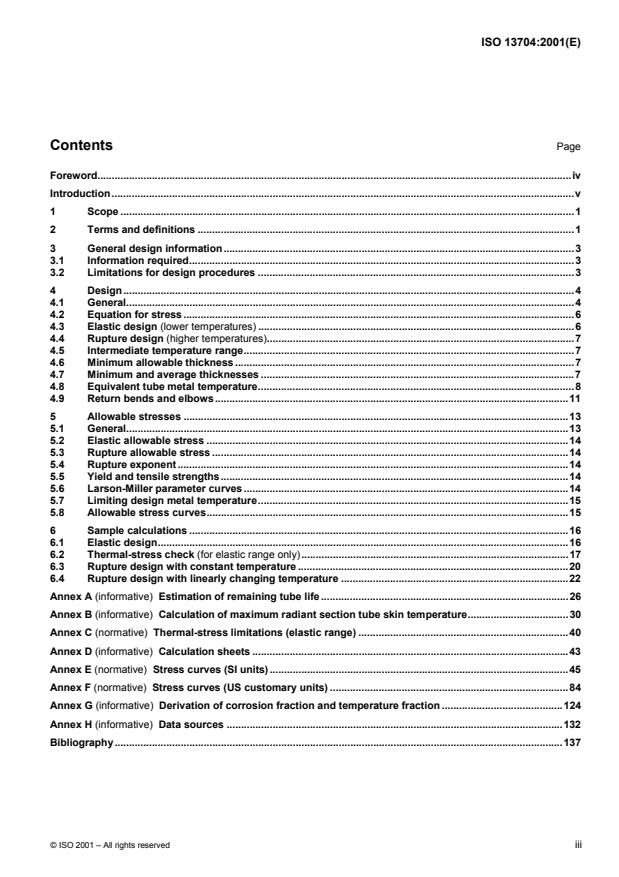
Contents Page
Foreword.iv
Introduction.v
1 Scope .1
2 Terms and definitions .1
3 General design information.3
3.1 Information required.3
3.2 Limitations for design procedures .3
4 Design.4
4.1 General.4
4.2 Equation for stress .6
4.3 Elastic design (lower temperatures) .6
4.4 Rupture design (higher temperatures).7
4.5 Intermediate temperature range.7
4.6 Minimum allowable thickness .7
4.7 Minimum and average thicknesses .7
4.8 Equivalent tube metal temperature.8
4.9 Return bends and elbows.11
5 Allowable stresses .13
5.1 General.13
5.2 Elastic allowable stress .14
5.3 Rupture allowable stress .14
5.4 Rupture exponent .14
5.5 Yield and tensile strengths.14
5.6 Larson-Miller parameter curves .14
5.7 Limiting design metal temperature.15
5.8 Allowable stress curves.15
6 Sample calculations .16
6.1 Elastic design.16
6.2 Thermal-stress check (for elastic range only).17
6.3 Rupture design with constant temperature .20
6.4 Rupture design with linearly changing temperature .22
Annex A (informative) Estimation of remaining tube life .26
Annex B (informative) Calculation of maximum radiant section tube skin temperature.30
Annex C (normative) Thermal-stress limitations (elastic range) .40
Annex D (informative) Calculation sheets .43
Annex E (normative) Stress curves (SI units).45
Annex F (normative) Stress curves (US customary units) .84
Annex G (informative) Derivation of corrosion fraction and temperature fraction .124
Annex H (informative) Data sources .132
Bibliography.137
Foreword
ISO (the International Organization for Standardization) is a worldwide federation of national standards bodies (ISO
member bodies). The work of preparing International Standards is normally carried out through ISO technical
committees. Each member body interested in a subject for which a technical committee has been established has
the right to be represented on that committee. International organizations, governmental and non-governmental, in
liaison with ISO, also take part in the work. ISO collaborates closely with the International Electrotechnical
Commission (IEC) on all matters of electrotechnical standardization.
International Standards are drafted in accordance with the rules given in the ISO/IEC Directives, Part 3.
The main task of technical committees is to prepare International Standards. Draft International Standards adopted
by the technical committees are circulated to the member bodies for voting. Publication as an International
Standard requires approval by at least 75 % of the member bodies casting a vote.
Attention is drawn to the possibility that some of the elements of this International Standard may be the subject of
patent rights. ISO shall not be held responsible for identifying any or all such patent rights.
ISO 13704 was prepared by Technical Committee ISO/TC 67, Materials, equipment and offshore structures for
petroleum and natural gas industries, Subcommittee SC 6, Processing equipment and systems.
Annexes C, E and F form an integral part of this International Standard. Annexes A, B, D, G and H are for
information only.
iv © ISO 2001 – All rights reserved
Introduction
[30]
This International Standard is based on API standard 530 , fourth edition, October 1996.
INTERNATIONAL STANDARD ISO 13704:2001(E)
Petroleum and natural gas industries — Calculation of heater-tube
thickness in petroleum refineries
1 Scope
This International Standard specifies the requirements and gives recommendations for the procedures and design
criteria used for calculating the required wall thickness of new tubes for petroleum refinery heaters. These
procedures are appropriate for designing tubes for service in both corrosive and non-corrosive applications. These
procedures have been developed specifically for the design of refinery and related process fired heater tubes
(direct-fired, heat-absorbing tubes within enclosures). These procedures are not intended to be used for the design
of external piping.
This International Standard does not give recommendations for tube retirement thickness; annex A describes a
technique for estimating the life remaining for a heater tube.
2 Terms and definitions
For the purposes of this International Standard, the following terms and definitions apply.
2.1
actual inside diameter
D
i
inside diameter of a new tube
NOTE The actual inside diameter is used to calculate the tube skin temperature in annex B and the thermal stress in
annex C.
2.2
corrosion allowance
d
CA
additional material thickness added to allow for material loss during the design life of the component
2.3
design life
t
DL
operating time used as a basis for tube design
NOTE The design life is not necessarily the same as the retirement or replacement life.
2.4
design metal temperature
T
d
tube metal, or skin, temperature used for design
NOTE This is determined by calculating the maximum tube metal temperature (T in annex B) or the equivalent tube
max
metal temperature (T in 2.7) and adding an appropriate temperature allowance (see 2.15). A procedure for calculating the
eq
maximum tube metal temperature from the heat flux density is included in annex B. When the equivalent tube metal
temperature is used, the maximum operating temperature can be higher than the design metal temperature.
2.5
elastic allowable stress
s
el
allowable stress for the elastic range (see 5.2)
NOTE See 3.2.3 for information about tubes that have longitudinal welds.
2.6
elastic design pressure
p
el
maximum pressure that the heater coil will sustain for short periods of time
NOTE This pressure is usually related to relief valve settings, pump shut-in pressures, etc.
2.7
equivalent tube metal temperature
T
eq
calculated constant metal temperature that in a specified period of time produces the same creep damage as does
a linearly changing metal temperature (see 4.8)
2.8
inside diameter
∗
D
i
inside diameter of a tube with the corrosion allowance removed; used in the design calculations
NOTE The inside diameter of an as-cast tube is the inside diameter of the tube with the porosity and corrosion allowances
removed.
2.9
minimum thickness
d
min
minimum required thickness of a new tube, taking into account all appropriate allowances [see equation (5)]
2.10
outside diameter
D
o
outside diameter of a new tube
2.11
rupture allowable stress
s
r
allowable stress for the creep-rupture range (see 4.4)
NOTE See 3.2.3 for information about tubes that have longitudinal welds.
2.12
rupture design pressure
p
r
maximum operating pressure that the coil section will sustain during normal operation
2.13
rupture exponent
n
parameter used for design in the creep-rupture range
See figures in annexes E and F.
2.14
stress thickness
d
σ
thickness, excluding all thickness allowances, calculated from an equation that uses an allowable stress
2 © ISO 2001 – All rights reserved
2.15
temperature allowance
T
A
part of the design metal temperature that is included for process- or flue-gas maldistribution, operating unknowns,
and design inaccuracies
NOTE The temperature allowance is added to the calculated maximum tube metal temperature or to the equivalent tube
metal temperature to obtain the design metal temperature (see 2.4).
3 General design information
3.1 Information required
The usual design parameters (design pressures, design fluid temperature, corrosion allowance, and tube material)
shall be defined. In addition, the following information shall be furnished:
a) the design life of the heater tube;
b) whether the equivalent-temperature concept is to be applied, and if so, furnish the operating conditions at the
start and at the end of the run;
c) the temperature allowance, if any;
d) the corrosion fraction (if different from that shown in Figure 1);
e) whether elastic-range thermal-stress limits are to be applied.
If any of items a) to e) are not furnished, use the following applicable parameters:
f) a design life equal to 100 000 h;
g) a design metal temperature based on the maximum metal temperature (the equivalent-temperature concept
shall not apply);
h) a temperature allowance equal to 15 °C (25 °F);
i) the corrosion fraction given in Figure 1;
j) the elastic-range thermal-stress limits.
3.2 Limitations for design procedures
3.2.1 The allowable stresses are based on a consideration of yield strength and rupture strength only; plastic or
creep strain has not been considered. Using these allowable stresses might result in small permanent strains in
some applications; however, these small strains will not affect the safety or operability of heater tubes.
3.2.2 No considerations are included for adverse environmental effects such as graphitization, carburization, or
hydrogen attack. Limitations imposed by hydrogen attack can be developed from the Nelson curves in
[15]
API RP 941 .
3.2.3 These design procedures have been developed for seamless tubes. When they are applied to tubes that
have a longitudinal weld, the allowable stress values should be multiplied by the appropriate joint efficiency factor.
Joint efficiency factors shall not be applied to circumferential welds.
3.2.4 These design procedures have been developed for thin tubes (tubes with a thickness-to-outside-diameter
ratio, d /D , of less than 0,15). Additional considerations may apply to the design of thicker tubes.
min o
3.2.5 No considerations are included for the effects of cyclic pressure or cyclic thermal loading.
3.2.6 The design loading includes only internal pressure. Limits for thermal stresses are provided in annex C.
Limits for stresses developed by mass, supports, end connections, and so forth are not discussed in this
International Standard.
3.2.7 Most of the Larson-Miller parameter curves in 5.6 are not Larson-Miller curves in the traditional sense but
are derived from the 100 000-h rupture strength as explained in H.3. Consequently, the curves might not provide a
reliable estimate of the rupture strength for a design life that is less than 20 000 h or more than 200 000 h.
4 Design
4.1 General
There is a fundamental difference between the behaviour of carbon steel in a hot-oil heater tube operating at
300 °C (575 °F) and that of chromium-molybdenum steel in a catalytic-reformer heater tube operating at 600 °C
(1 110 °F). The steel operating at the higher temperature will creep, or deform permanently, even at stress levels
well below the yield strength. If the tube metal temperature is high enough for the effects of creep to be significant,
the tube will eventually fail due to creep rupture, although no corrosion or oxidation mechanism is active. For the
steel operating at the lower temperature, the effects of creep will be non-existent or negligible. Experience indicates
that in this case the tube will last indefinitely unless a corrosion or an oxidation mechanism is active.
Since there is a fundamental difference between the behaviour of the materials at these two temperatures, there
are two different design considerations for heater tubes: elastic design and creep-rupture design. Elastic design is
design in the elastic range, at lower temperatures, in which allowable stresses are based on the yield strength (see
4.3). Creep-rupture design (which is referred to below as rupture design) is the design for the creep-rupture range,
at higher temperatures, in which allowable stresses are based on the rupture strength (see 4.4).
The temperature that separates the elastic and creep-rupture ranges of a heater tube is not a single value; it is a
range of temperatures that depends on the alloy. For carbon steel, the lower end of this temperature range is about
425 °C (800 °F); for Type 347 stainless steel, the lower end of this temperature range is about 590 °C (1 100 °F).
The considerations that govern the design range also include the elastic design pressure, the rupture design
pressure, the design life and the corrosion allowance.
The rupture design pressure is usually less than the elastic design pressure. The characteristic that differentiates
these two pressures is the relative length of time over which they are sustained. The rupture design pressure is a
long-term loading condition that remains relatively uniform over a period of years. The elastic design pressure is
usually a short-term loading condition that typically lasts only hours or days. The rupture design pressure is used in
the rupture design equation, since creep damage accumulates as a result of the action of the operating, or long-
term stress. The elastic design pressure is used in the elastic design equation to prevent excessive stresses in the
tube during periods of operation at the maximum pressure.
The tube shall be designed to withstand the rupture design pressure for long periods of operation. If the normal
operating pressure increases during an operating run, the highest pressure shall be taken as the rupture design
pressure.
In the temperature range near or above the point where the elastic and rupture allowable stress curves cross, both
elastic and rupture design equations are to be used. The larger value of d should govern the design (see 4.5). A
min
sample calculation that uses these methods is included in clause 6. Calculation sheets (see annex D) are available
for summarizing the calculations of minimum thickness and equivalent tube metal temperature.
The allowable minimum thickness of a new tube is given in Table 1.
All of the design equations described in this clause are summarized in Table 2.
4 © ISO 2001 – All rights reserved
B = d /d
CA σ
pD
ro
d =
s
2s + p
d is the corrosion allowance
rr
CA
D is the outside diameter p is the rupture design pressure
o r
n is the rupture exponent
s is the rupture allowable stress
r
a
Note change of scale.
Figure 1 — Corrosion fraction
4.2 Equation for stress
In both the elastic range and the creep-rupture range, the design equation is based on the mean-diameter equation
for stress in a tube. In the elastic range, the elastic design pressure (p ) and the elastic allowable stress (s ) are
el el
used. In the creep-rupture range, the rupture design pressure (p ) and the rupture allowable stress (s ) are used.
r r
The mean-diameter equation gives a good estimate of the pressure that will produce yielding through the entire
tube wall in thin tubes (see 3.2.4 for a definition of thin tubes). The mean-diameter equation also provides a good
correlation between the creep rupture of a pressurized tube and a uniaxial test specimen. It is therefore a good
[16], [17], [18] and [19]
equation to use in both the elastic range and the creep-rupture range . The mean diameter
equation for stress is as follows:
ppʈD D
ʈ
oi
s = -=11+ (1)
Á˜
Á˜
˯
22˯dd
where
1)
s is the stress, expressed in megapascals [pounds per square inch ];
p is the pressure, expressed in megapascals (pounds per square inch);
D is the outside diameter, expressed in millimetres (inches);
o
D is the inside diameter, expressed in millimetres (inches), including the corrosion allowance;
i
d is the thickness, expressed in millimetres (inches).
The equations for the stress thickness (d ) in 4.3 and 4.4 are derived from equation (1).
σ
4.3 Elastic design (lower temperatures)
The elastic design is based on preventing failure by bursting when the pressure is at its maximum (that is, when a
pressure excursion has reached p ) near the end of the design life after the corrosion allowance has been used up.
el
With the elastic design, d and d (see 4.6) are calculated as follows:
σ min
*
pD pD
el o el i
dd==or (2)
ss
22ss+-p p
el el el el
d = d + d (3)
min σ CA
where
*
D is the inside diameter, expressed in millimetres (inches), with corrosion allowance removed;
i
s is the elastic allowable stress, expressed in megapascals (pounds per square inch), at the design metal
el
temperature.
1) 2
The unit “pounds per square inch (psi)” is referred to as “pound-force per square inch (lbf/in )” in ISO 31.
6 © ISO 2001 – All rights reserved
4.4 Rupture design (higher temperatures)
The rupture design is based on preventing failure by creep rupture during the design life. With the rupture design,
d and d (see 4.6) are calculated as follows:
σ min
*
pD pD
ro ri
dd==or (4)
ss
22ss+-p p
rr rr
d = d + f d (5)
min σ corr CA
where
s is the rupture allowable stress, expressed in megapascals (pounds per square inch), at the design metal
r
temperature and the design life;
f is the corrosion fraction given as a function of B and n in Figure 1;
corr
where
B = d /d
CA σ
n is the rupture exponent at the design metal temperature (shown in the figures given in annexes E
and F).
The derivation of the corrosion fraction is described in annex G. It is recognized in this derivation that stress is
reduced by the corrosion allowance; correspondingly, the rupture life is increased.
This design equation is suitable for heater tubes; however, if special circumstances require that the user choose a
more conservative design, a corrosion fraction of unity (f = 1) may be specified.
corr
4.5 Intermediate temperature range
At temperatures near or above the point where the curves of s and s intersect in the figures given in annexes E
el r
and F, either elastic or rupture considerations will govern the design. In this temperature range, both the elastic and
rupture designs are to be applied. The larger value of d shall govern the design.
min
4.6 Minimum allowable thickness
The minimum thickness (d ) of a new tube (including the corrosion allowance) shall not be less than that shown
min
in Table 1. For ferritic steels, the values shown are the minimum allowable thicknesses of Schedule 40 average
wall pipe. For austenitic steels, the values are the minimum allowable thicknesses of Schedule 10S average wall
pipe. (Table 5 shows which alloys are ferritic and which are austenitic). The minimum allowable thicknesses are
0,875 times the average thicknesses. These minima are based on industry practice. The minimum allowable
thickness is not the retirement or replacement thickness of a used tube.
4.7 Minimum and average thicknesses
The minimum thickness (d ) is calculated as described in 4.3 and 4.4. Tubes that are purchased to this minimum
min
thickness will have a greater average thickness. A thickness tolerance is specified in each ASTM specification. For
most of the ASTM specifications shown in the figures given in annexes E and F, the tolerance on the minimum
0 0
thickness is % for hot-finished tubes and % for cold-drawn tubes. This is equivalent to tolerances on
(+28 ) (+22)
the average thickness of ±12,3 % and ±9,9 %, respectively. The remaining ASTM specifications require that the
minimum thickness be greater than 0,875 times the average thickness, which is equivalent to a tolerance on the
average thickness of +12,5 %.
With a % tolerance, a tube that is purchased to a 12,7 mm (0,500 in) minimum-thickness specification will
(+28 )
have the following average thickness:
(12,7)(1 + 0,28/2) = 14,5 mm (0,570 in)
To obtain a minimum thickness of 12,7 mm (0,500 in) in a tube purchased to a ± 12,5 % tolerance on the average
thickness, the average thickness shall be specified as follows:
(12,7) / (0,875) = 14,5 mm (0,571 in)
All thickness specifications shall indicate whether the specified value is a minimum or an average thickness. The
tolerance used to relate the minimum and average wall thicknesses shall be the tolerance given in the ASTM
specification to which the tubes will be purchased.
Table 1 — Minimum allowable thickness of new tubes
Minimum thickness
Tube outside diameter
Ferritic steel tubes Austenitic steel tubes
mm (in) mm (in) mm (in)
60,3 (2,375) 3,4 (0,135) 2,4 (0,095)
73,0 (2,875) 4,5 (0,178) 2,7 (0,105)
88,9 (3,50) 4,8 (0,189) 2,7 (0,105)
101,6 (4,00) 5,0 (0,198) 2,7 (0,105)
114,3 (4,50) 5,3 (0,207) 2,7 (0,105)
141,3 (5,563) 5,7 (0,226) 3,0 (0,117)
168,3 (6,625) 6,2 (0,245) 3,0 (0,117)
219,1 (8,625) 7,2 (0,282) 3,3 (0,130)
273,1 (10,75) 8,1 (0,319) 3,7 (0,144)
4.8 Equivalent tube metal temperature
In the creep-rupture range, the accumulation of damage is a function of the actual operating temperature. For
applications in which there is a significant difference between start-of-run and end-of-run metal temperatures, a
design based on the maximum temperature might be excessive, since the actual operating temperature will usually
be less than the maximum.
For a linear change in metal temperature from start of run (T ) to end of run (T ), an equivalent tube metal
sor eor
temperature (T ) can be calculated as shown below. A tube operating at the equivalent tube metal temperature
eq
will sustain the same creep damage as one that operates from the start-of-run to end-of-run temperatures.
T = T + ƒ (T − T ) (6)
T
eq sor eor sor
where
T is the equivalent tube metal temperature, expressed in degrees Celsius (Fahrenheit);
eq
T is the tube metal temperature, expressed in degrees Celsius (Fahrenheit), at start of run;
sor
T is the tube metal temperature, expressed in degrees Celsius (Fahrenheit), at end of run;
eor
ƒ is the temperature fraction given in Figure 2.
T
The derivation of the temperature fraction is described in annex G. The temperature fraction is a function of two
parameters, V and N:
*
ʈ
ʈ
DTA
Vn= ln
0Á˜
Á˜
*
˯s
T
˯ 0
sor
8 © ISO 2001 – All rights reserved
ʈ
Dd
Nn=
Á˜
˯d
where
n is the rupture exponent at T ;
0 sor
∗
∆T (= T − T ) is the temperature change, expressed in kelvins (degrees Rankine), during operating
eor sor
period, K (°R);
∗
T = T + 273 K (T + 460 °R);
sor
sor sor
ln is the natural logarithm;
∆d = f t is the change in thickness, expressed in millimetres (inches), during the operating period;
corr op
f is the corrosion rate, expressed in millimetres per year (in inches per year);
corr
t is the duration of operating period, expressed in years;
op
d is the initial thickness, expressed in millimetres (inches), at the start of the run;
s is the initial stress, expressed in megapascals (pounds per square inch), at start of run using
equation (1);
A is the material constant, expressed in megapascals (pounds per square inch). The constant A is given in
Table 3. The significance of the material constant is explained in G.5.
Figure 2 — Temperature fraction
Table 2 — Summary of working equations
Elastic design (lower temperatures):
*
pD pD
el o el i
dd==or (2)
ss
22ss+-p p
el el el el
d = d + d (3)
min σ CA
Rupture design (higher temperatures):
*
pD pD
ro ri
dd==or (4)
ss
22ss+-p p
rr rr
d = d + f d (5)
min σ corr CA
where
d is the stress thickness, expressed in millimetres (inches)
σ
p is the elastic design gauge pressure, expressed in megapascals (pounds per square inch)
el
p is the rupture design gauge pressure, expressed in megapascals (pounds per square inch)
r
D is the outside diameter, expressed in millimetres (inches)
o
*
D is the inside diameter, expressed in millimetres (inches), with the corrosion allowance removed
i
s is the elastic allowable stress, expressed in megapascals (pounds per square inch), at the design metal
el
temperature
s is the rupture allowable stress, expressed in megapascals (pounds per square inch) at the design metal
r
temperature and design life
d is the minimum thickness, expressed in millimetres (inches), including corrosion allowance
min
d is the corrosion allowance, expressed in millimetres (inches)
CA
f is the corrosion fraction, given in Figure 1 as a function of B and n
corr
B =dd
CA s
n is the rupture exponent at the design metal temperature
Equivalent tube metal temperature:
TT=+f()T −T (6)
eq sor T eor sor
∗
∆T (= T − T ) is the temperature change, expressed in kelvins (degrees Rankine), during the
eor sor
operating period
T is the tube metal temperature, expressed in degrees Celsius (Fahrenheit), at the start of the run
sor
T is the tube metal temperature, expressed in degrees Celsius (Fahrenheit), at the end of the run
eor
∗
T = T + 273 K (T + 460 °R)
sor sor sor
A is the material constant, expressed in megapascals (pounds per square inch) from Table 3
s is the initial stress, expressed in megapascals (pounds per square inch), at the start of the run using
equation (1);
∆d = f t is the change in thickness, expressed in millimetres (inches), during the operating period
corr op
d is the initial thickness, expressed in millimetres (inches), at the start of the run
where
f is the corrosion rate, expressed in millimetres per year (inches per year)
corr
t is the duration, expressed in years, of the operating period
op
10 © ISO 2001 – All rights reserved
Table 3 — Material constant for temperature fraction
Constant A
Material Type or grade
MPa (psi)
5 8
Low-carbon steel
7,46 × 10 (1,08 × 10 )
5 7
Medium-carbon steel B
2,88 × 10 (4,17 ×10 )
7 9
C-½Mo steel T1 or P1
2,01 × 10 (2,91 × 10 )
7 9
1-¼Cr-½Mo steel T11 or P11
5,17 × 10 (7,49 × 10 )
5 8
2-¼Cr-1Mo steel T22 or P22
8,64 × 10 (1,25 × 10 )
6 8
3Cr-1Mo steel T21 or P21
2,12 × 10 (3,07 × 10 )
5 7
5Cr-½Mo steel T5 or P5
5,49 × 10 (7,97 × 10 )
5 7
5Cr-½Mo-Si steel T5b or P5b
2,88 × 10 (4,18 × 10 )
5 7
7Cr-½Mo steel T7 or P7
1,64 × 10 (2,37 × 10 )
6 9
9Cr-1Mo steel T9 or P9
7,54 × 10 (1,09 × 10 )
6 8
9Cr-1Mo V steel T91 or P91
2,23 × 10 (3,24 × 10 )
6 8
18Cr-8Ni steel 304 or 304H
1,55 × 10 (2,25 × 10 )
6 8
16Cr-12Ni-2Mo steel 316 or 316H
1,24 × 10 (1,79 × 10 )
6 8
16Cr-12Ni-2Mo steel 316L
1,37 × 10 (1,99 × 10 )
6 8
18Cr-10Ni-Ti steel 321
1,32 × 10 (1,92 × 10 )
5 7
18Cr-10Ni-Ti steel 321H
2,76 × 10 (4,00 × 10 )
a 6 8
347 or 347H
18Cr-10Ni-Nb steel 1,23 × 10 (1,79 × 10 )
5 7
Ni-Fe-Cr Alloy 800H / 800HT
1,03 × 10 (1,50 × 10 )
5 7
25Cr-20Ni HK40
2,50 × 10 (3,63 × 10 )
a
Formerly called columbium, Cb.
The temperature fraction and the equivalent temperature shall be calculated for the first operating cycle. In
applications that involve very high corrosion rates, the temperature fraction for the last cycle will be greater than
that for the first. In such cases, the calculation of the temperature fraction and the equivalent temperature should
be based on the last cycle.
If the temperature change from start of run to end of run is other than linear, a judgment shall be made regarding
the use of the value of f given in Figure 2.
T
Note that the calculated thickness of a tube is a function of the equivalent temperature, which in turn is a function of
the thickness (through the initial stress). A few iterations might be necessary to arrive at the design. (See the
sample calculation in 6.4.).
4.9 Return bends and elbows
The following design procedure shall be applied to austenitic stainless steel return bends and elbows (see
Figure 3) located in the firebox and operating in the elastic range. In this situation, the allowable stress does not
vary much with temperature. This design procedure may also be applied in other situations, if applicable.
r = outer radius
o
r = inner radius
i
Figure 3 — Return bend and elbow geometry
The stress variations in a return bend or elbow are far more complex than in a straight tube. The hoop stresses at
the inner radius of a return bend are higher than in a straight tube of the same thickness. In the situation defined
above, the minimum thickness at the inner radius might need to be greater than the minimum thickness of the
attached tube.
Because fabrication processes for forged return bends generally result in greater thickness at the inner radius, the
higher stresses at the inner radius can be sustained without failure in most situations.
The hoop stress, expressed in megapascals (pounds per square inch), along the inner radius of the bend, s, is
i
given by:
2rr-
cl m
ss= (7)
i
2rr-
()
cl m
where
r is the centre line radius of the bend, expressed in millimetres (inches);
cl
r is the mean radius of the tube, expressed in millimetres (inches);
m
s is the stress, expressed in megapascals (pounds per square inch), given by equation (1).
The hoop stress, expressed in megapascals (pounds per square inch), along the outer radius s is given by:
o
2rr+
cl m
ss= (8)
o
2(rr+ )
cl m
Using the approximation that r is almost equal to D /2, equation (7) can be solved for the stress thickness at the
m o
inner radius. For elastic design the stress thickness is given by equation (9).
Dp
oel
d = (9)
s i
2Nps +
iel el
12 © ISO 2001 – All rights reserved
where
d is the stress thickness, expressed in millimetres (inches), at the inner radius.
σ i
r
cl
42-
D
o
N = (10)
i
r
cl
D -1
o
s is the elastic allowable stress, expressed in megapascals (pounds per square inch), at the design metal
el
temperature.
The design metal temperature shall be the estimated temperature at the inner radius plus an appropriate
temperature allowance.
Using the approximation given above, equation (8) can be solved for the stress thickness at the outer radius. For
elastic design the stress thickness is as follows:
Dp
oel
d = (11)
s o
2Nps +
oel el
where
d is the stress thickness, expressed in millimetres (inches), at the outer radius.
σ o
r
cl
42+
D
o
N = (12)
o
r
cl
D +1
o
s is the elastic allowable stress, expressed in megapascals (pounds per square inch), at the design metal
el
temperature.
The design metal temperature shall be the estimated temperature at the outer radius plus an appropriate
temperature allowance.
The minimum thickness at the inside radius, d , and outside radius, d , shall be calculated using equation (9) and
σi σ o
equation (11). The corrosion allowance, d , shall be added to the minimum calculated thickness.
CA
The minimum thickness along the neutral axis of the bend shall be the same as for a straight tube.
This design procedure is for return bends and elbows located in the firebox that may operate at temperatures close
to that of the tubes. This procedure might not be applicable to these fittings if they are located in header boxes
since they will operate at lower temperatures. Other considerations, such as hydrostatic test pressure, could govern
the design of fittings located in header boxes.
5 Allowable stresses
5.1 General
The allowable stresses for various heater-tube alloys are plotted against design metal temperature in Figures E.1
to E.19 in annex E (SI units) and Figures F.1 to F.19 in annex F (US customary units). The values shown in these
figures are recommended only for the design of heater tubes. These figures show two different allowable stresses,
the elastic allowable stress and the rupture allowable stress. The bases for these allowable stresses are given in
5.2 and 5.3 (see also 3.2.3).
5.2 Elastic allowable stress
The elastic allowable stress (s ) is two-thirds of the yield strength at temperature for ferritic steels and 90 % of the
el
yield strength at temperature for austenitic steels. The data sources for the yield strength are given in annex H.
If a different design basis is desired for special circumstances, the user shall specify the basis, and the alternative
elastic allowable stress shall be developed from the yield strength.
5.3 Rupture allowable stress
The rupture allowable stress (s ) is 100 % of the minimum rupture strength for a specified design life. Annex H
r
defines the minimum rupture strength and provides the data sources. The 20 000-h, 40 000-h, 60 000-h and
100 000-h rupture allowable stresses were developed from the Larson-Miller parameter curves for the minimum
rupture strength shown on the right-hand side of Figures E.1 to E.19 (Figures F.1 to F.19). For a design life other
than those shown the corresponding rupture allowable stress shall be developed from the Larson-Miller parameter
curves for the minimum rupture strength (see 5.6).
If a different design basis is desired, the user shall specify the basis, and the alternative rupture allowable stress
shall be developed from the Larson-Miller parameter curves for the minimum or average rupture strength. If the
resulting rupture allowable stress is greater than the minimum rupture strength for the design life, the effects of
creep on the tube design equation should be considered.
5.4 Rupture exponent
Figures E.1 to E.19 (Figures F.1 to F.19) show the rupture exponent (n) as a function of the design metal
temperature. The rupture exponent is used for design in the creep-rupture range (see 4.4). The meaning of the
rupture exponent is discussed in H.4.
5.5 Yield and tensile strengths
Figures E.1 to E.19 (Figures F.1 to F.19) also show the yield and tensile strengths. These curves are included only
for reference. Their sources are given in annex H.
5.6 Larson-Miller parameter curves
On the right-hand side of Figures E.1 to E.19 (Figures F.1 to F.19) are plots of the minimum and average
100 000-h rupture strengths against the Larson-Miller parameter. The Larson-Miller parameter is calculated from
the design metal temperature (T ) and the design life (t ) as follows.
d DL
When T is expressed in degrees Celsius:
d
−3
(T + 273) (C + lg t ) × 10
LM
d DL
When T is expressed in degrees Fahrenheit:
d
−3
(T + 460) (C + lg t ) × 10
LM
d DL
The Larson-Miller constant C is stated in the curves. (See H.3 for a detailed description of these curves).
LM
The plot of the minimum rupture strength against the Larson-Miller parameter is included so that the rupture
allowable stress can be determined for any design life. The curves shall not be used to determine rupture allowable
stresses for temperatures higher than the limiting design metal temperatures shown in Table 4 and Figures E.1 to
E.19 (Figures F.1 to F.19). Furthermore, the curves could give inaccurate rupture allowable stresses for times less
than 20 000 h or greater than 200 000 h (see H.3).
The curves for minimum and average rupture strength can be used to calculate remaining tube life, as shown in
annex A.
14 © ISO 2001 – All rights reserved
5.7 Limiting design metal temperature
The limiting design metal temperature for each heater-tube alloy is given in Table 4. The limiting design metal
temperature is the upper limit of the reliability of the rupture strength data. Higher temperatures, i.e. up to 30 °C
(50 °F) below the lower critical temperature, are permitted for short-term operating conditions, such as those that
exist during steam-air decoking or regeneration. Operation at higher temperatures can result in changes in the
alloy's microstructure. Lower critical temperatures for ferritic steels are shown in Table 4. Austenitic steels do not
have lower critical temperatures. Other considerations may require lower operating-temperature limits such as
oxidation, graphitization, carburization, and hydrogen attack. These factors shall be considered when furnace tubes
are designed.
Table 4 — Limiting design metal temperature for heater-tube alloys
Limiting design metal
Lower critical temperature
temperature
Materials Type or grade
°C (°F) °C (°F)
Carbon steel B 540 (1 000) 720 (1 325)
C-½Mo steel T1 or P1 595 (1 100) 720 (1 325)
1¼Cr-½Mo steel T11 or P11 595 (1 100) 775 (1 430)
2¼Cr-1Mo steel T22 or P22 650 (1 200) 805 (1 480)
3Cr-1Mo steel T21 or P21 650 (1 200) 815 (1 500)
5Cr-½Mo steel T5 or P5 650 (1 200) 820 (1 510)
5Cr-½Mo-Si steel T5b or P5b 705 (1 300) 845 (1 550)
7Cr-½Mo steel T7 or P7 705 (1 300) 825 (1 515)
9Cr-1Mo steel T9 or P9 705 (1 300) 825 (1 515)
a a
9Cr-1Mo-V steel T91 or P91 650 (1 200 ) 830 (1 525)
18Cr-8Ni steel 304 or 304H 815 (1 500) — —
16Cr-12Ni-2Mo steel 316 or 316H 815 (1 500) — —
16Cr-12Ni-2Mo steel 316L 815 (1 500) — —
18Cr-10Ni-Ti steel 321 or 321H 815 (1 500) — —
18Cr-10Ni-Nb steel 347 or 347H 815 (1 500) — —
a a
Ni-Fe-Cr Alloy 800H/800HT — —
985 (1 800 )
a a
25Cr-20Ni HK40 — —
1 010 (1 850 )
a
This is the upper limit on the reliability of the rupture strength data (see annex H); however, these materials are commonly used
for heater tubes at higher temperatures in applications where the internal pressure is so low that rupture strength does not govern the
design.
5.8 Allowable stress curves
Figures E.1 to E.19 provide the elastic allowable stress and the rupture allowable stress in SI units for most
common heater-tube alloys. Figures F.1 to F.19 show the same data in US customary units.
The sources for these curves are provided in annex H. The figure number for each alloy is shown in Table 5.
...
Questions, Comments and Discussion
Ask us and Technical Secretary will try to provide an answer. You can facilitate discussion about the standard in here.
Loading comments...