

ISO/PRF 25264-1
(Main)Sustainable mobility and transportation — Photovoltaic power supply management for mobility — Part 1: Role model
- Abstract
This document defines the roles, role architecture, function models, and typical scenarios of a photovoltaic power supply management system for highway mobility services. The following are within the scope of this documents: a) The basic role model, operational layer role model, and service layer role model of the photovoltaic power supply management system for mobility; b) The role architecture of various stakeholders involved in providing photovoltaic power supply management services, along with their respective duties and responsibilities; c) Typical scenarios for providing photovoltaic power supply services.
- Status
- Not Published
- Current Stage
- 5020 - FDIS ballot initiated: 2 months. Proof sent to secretariat
- Start Date
- 09-Oct-2026
- Completion Date
- 10-Oct-2026
Buy Documents

ISO/PRF 25264-1 - Sustainable mobility and transportation — Photovoltaic power supply management for mobility — Part 1: Role model
REDLINE ISO/PRF 25264-1 - Sustainable mobility and transportation — Photovoltaic power supply management for mobility — Part 1: Role model
ISO/PRF 25264-1 is an ISO document for sustainable mobility and transportation. It specifies a role model for photovoltaic power supply management for highway mobility services, including the roles, role architecture, function models and typical scenarios used to organise such systems. It is written for the stakeholders who plan, build, operate or oversee photovoltaic power supply services on highways.
What does ISO/PRF 25264-1 specify?
ISO/PRF 25264-1 specifies a general framework for a photovoltaic power supply management system for highway mobility services. It covers the basic role model, the operational layer role model, the service layer role model and typical application scenarios.
The document is organised into clauses on scope, normative references, terms and definitions, an overview, the basic role model, the operational layer role and function model, the service layer role and function model, and typical scenarios. Clause 2 has no normative references, so the document stands on its own as a framework document.
The scope also says the framework can be applied to other mobility modes by reference. In practice, that means readers can use the role model as a basis for similar transport-energy systems, while still adapting it to local conditions.
What are the key requirements of ISO/PRF 25264-1?
ISO/PRF 25264-1 is mainly a role-and-responsibility document. Its key content is who does what, how the system is layered, and where photovoltaic power supply is used in highway settings.
Clause 4 - overall framework and national adaptation
Clause 4 presents the overall framework and says country-specific application will differ. It asks implementers to consider government support, the level of system development, the adaptability of transport infrastructure, climatic conditions and public concerns. In practice, a project team needs a local feasibility assessment before adopting the model.
Clause 5 - basic role model
Clause 5 divides the system into an operational layer and a service layer. The operational layer focuses on stakeholders, responsibilities and their relationships, while the service layer focuses on the physical infrastructure and management platforms that deliver the service. This matters because the document is not a component design guide - it is a coordination model.
Clauses 5.2 to 5.6 - main roles in the basic model
Local authorities are responsible for approval, supervision, policy guidance, safety report collection and certification body authorisation. Service providers are the system owners and fund construction and operation; they supply electricity, collect fees, manage daily operation and maintenance, handle contingency plans and consider recovery or reuse of decommissioned modules. Users include highway operation and maintenance units and highway travellers, who receive power-related and support services.
Clause 6 - operational layer role and function model
Clause 6 identifies the facility construction party, the facility operation party and the energy facility owning party. The construction party plans and builds the facilities, the operation party runs them and coordinates with electricity consumption facility owners, and the owning party directly provides services to users. This is the part readers use to assign project, operation and ownership duties.
Clause 7 - service layer role and function model
Clause 7 describes the energy supply side, energy load side, energy storage facilities, power grid and platform. The supply side uses photovoltaic panels on slopes, roofs, parking sheds, tunnel shading sheds, ramp areas and other locations; surplus energy can go to storage or the grid. The load side includes service area operations, charging and battery swapping, tunnel lighting, snow removal, ice melting and vehicle-to-infrastructure (V2I) systems. The platform covers preprocessing, a database, monitoring, intelligent energy allocation and dynamic pricing, reporting and data security.
Clause 8 - typical scenarios
Clause 8 applies the model to service areas, tunnels and roads. These scenarios show where photovoltaic facilities can be placed and what loads they can support, which helps planners match the role model to real highway assets.
What terms does ISO/PRF 25264-1 define?
Clause 3 formally defines two terms. The document also relies on several role names that are central to understanding it.
- highway mobility service - services that support travellers during highway journeys, including basic travel needs and subsidiary needs such as rest, dining, entertainment and shopping.
- photovoltaic power supply management system for highway mobility service - an integrated system that uses photovoltaic facilities along highways for energy generation, storage, distribution and service provision.
- service provider - the owner of the photovoltaic power supply system that funds construction and operation and supplies electrical energy services to users.
- energy load side - the part of the system that consumes electricity, such as service areas, charging, tunnel lighting and V2I infrastructure.
- platform - the management platform that receives full-process data and supports energy dispatching management and services.
Who uses ISO/PRF 25264-1?
ISO/PRF 25264-1 is used by local authorities, highway administrations, service providers, facility construction and operation parties, energy facility owners and certification authorities. It also helps planners and operators of service areas, tunnels, roadside infrastructure, charging facilities and renewable-energy projects understand how to organise responsibilities.
For buyers and project teams, the value of the document is in role allocation. It helps decide who approves, who builds, who operates, who monitors and who provides services.
Which standards are used with ISO/PRF 25264-1?
Clause 2 states that there are no normative references. The document does, however, point to related standards and parts that support use of the model:
- ISO/AWI 25264-2 - future part on data and platform, based on this role model.
- ISO/TR 4445 - conceptual basis mentioned for the basic role model.
- IEC 61215-1 - cited for installation, layout, commissioning and management of photovoltaic facilities in typical scenarios.
- IEC TS 61836 - cited for solar photovoltaic energy terms, definitions and symbols.
- IEC 62446-1 - cited for testing, documentation and maintenance of grid-connected photovoltaic systems.
What does the ISO/PRF 25264-1 document contain?
ISO/PRF 25264-1 contains a structured framework rather than technical sizing rules. It includes three figures for the basic, operational and service layer role models, plus text describing the responsibilities and relationships of the main roles.
It also includes scenario descriptions for service areas, tunnels and roads, showing how photovoltaic power supply can support different highway loads. The document does not reproduce detailed design values, test data or installation procedures; those are pointed to in related IEC standards and the future Part 2.
Buy Documents
ISO/PRF 25264-1 - Sustainable mobility and transportation — Photovoltaic power supply management for mobility — Part 1: Role model
REDLINE ISO/PRF 25264-1 - Sustainable mobility and transportation — Photovoltaic power supply management for mobility — Part 1: Role model
Get Certified
Connect with accredited certification bodies for this standard

DNV
DNV is an independent assurance and risk management provider.

BSI Group
BSI (British Standards Institution) is the business standards company that helps organizations make excellence a habit.

Bureau Veritas
Bureau Veritas is a world leader in laboratory testing, inspection and certification services.
Sponsored listings
Frequently Asked Questions
ISO/PRF 25264-1 is a draft published by the International Organization for Standardization (ISO). Its full title is "Sustainable mobility and transportation — Photovoltaic power supply management for mobility — Part 1: Role model". This standard covers: This document defines the roles, role architecture, function models, and typical scenarios of a photovoltaic power supply management system for highway mobility services. The following are within the scope of this documents: a) The basic role model, operational layer role model, and service layer role model of the photovoltaic power supply management system for mobility; b) The role architecture of various stakeholders involved in providing photovoltaic power supply management services, along with their respective duties and responsibilities; c) Typical scenarios for providing photovoltaic power supply services.
This document defines the roles, role architecture, function models, and typical scenarios of a photovoltaic power supply management system for highway mobility services. The following are within the scope of this documents: a) The basic role model, operational layer role model, and service layer role model of the photovoltaic power supply management system for mobility; b) The role architecture of various stakeholders involved in providing photovoltaic power supply management services, along with their respective duties and responsibilities; c) Typical scenarios for providing photovoltaic power supply services.
ISO/PRF 25264-1 is classified under the following ICS (International Classification for Standards) categories: 03.220.20 - Road transport; 13.020.20 - Environmental economics. Sustainability; 27.160 - Solar energy engineering. The ICS classification helps identify the subject area and facilitates finding related standards.
ISO/PRF 25264-1 is available in PDF format for immediate download after purchase. The document can be added to your cart and obtained through the secure checkout process. Digital delivery ensures instant access to the complete standard document.
Standards Content (Sample)
International
Standard
ISO 25264-1
First edition
Sustainable mobility and
transportation — Photovoltaic
power supply management for
mobility —
Part 1:
Role model
Mobilité durable et transport — Gestion de l’alimentation
photovoltaïque pour la mobilité —
Partie 1: Modèle de rôle
PROOF/ÉPREUVE
Reference number
ISO 25264-1:2026(en) © ISO 2026
ISO 25264-1:2026(en)
© ISO 2026
All rights reserved.
This ISO publication is protected by copyright and is owned by ISO and/or its licensors.
The content of this ISO publication is provided under licence, not sold. Use is subject to the applicable licence terms issued by ISO,
an ISO member body, or an authorized third-party distributor.
Except as required for implementation or expressly permitted by a separate licence, no part of this ISO publication may be
reproduced, distributed, modified, used, or made available in any form or by any means – electronic or mechanical, including
photocopying, scanning, recording, or posting on internal or external digital platforms.
Any use beyond the scope of the granted rights is prohibited and may result in legal action.
ISO copyright office
CP 401 • CH-1214 Vernier, Geneva
Phone: +41 22 749 01 11
Email: copyright@iso.org
Website: www.iso.org
Published in Switzerland
PROOF/ÉPREUVE
ii
ISO 25264-1:2026(en)
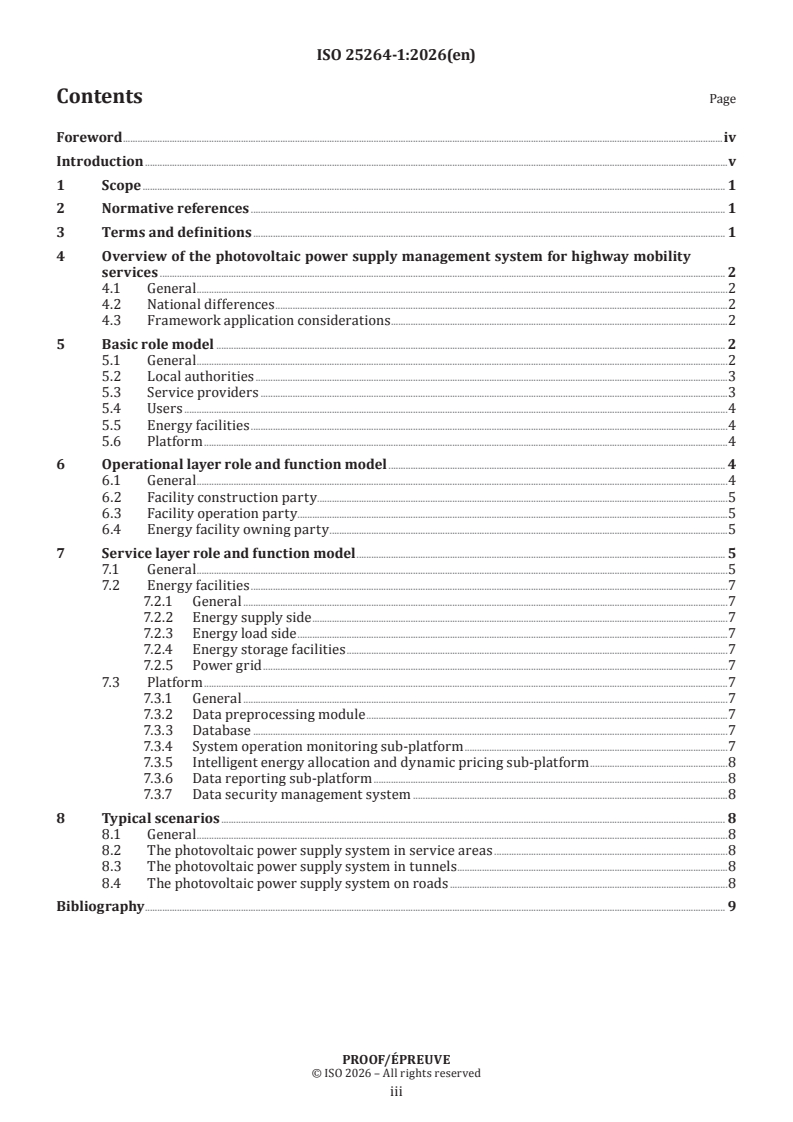
Contents Page
Foreword .iv
Introduction .v
1 Scope . 1
2 Normative references . 1
3 Terms and definitions . 1
4 Overview of the photovoltaic power supply management system for highway mobility
services . 2
4.1 General .2
4.2 National differences .2
4.3 Framework application considerations .2
5 Basic role model . 2
5.1 General .2
5.2 Local authorities .3
5.3 Service providers .3
5.4 Users .4
5.5 Energy facilities .4
5.6 Platform .4
6 Operational layer role and function model . 4
6.1 General .4
6.2 Facility construction party . .5
6.3 Facility operation party .5
6.4 Energy facility owning party .5
7 Service layer role and function model . 5
7.1 General .5
7.2 Energy facilities .7
7.2.1 General .7
7.2.2 Energy supply side .7
7.2.3 Energy load side .7
7.2.4 Energy storage facilities .7
7.2.5 Power grid .7
7.3 Platform .7
7.3.1 General .7
7.3.2 Data preprocessing module .7
7.3.3 Database .7
7.3.4 System operation monitoring sub-platform .7
7.3.5 Intelligent energy allocation and dynamic pricing sub-platform .8
7.3.6 Data reporting sub-platform .8
7.3.7 Data security management system .8
8 Typical scenarios . 8
8.1 General .8
8.2 The photovoltaic power supply system in service areas .8
8.3 The photovoltaic power supply system in tunnels .8
8.4 The photovoltaic power supply system on roads .8
Bibliography . 9
PROOF/ÉPREUVE
iii
ISO 25264-1:2026(en)
Foreword
ISO (the International Organization for Standardization) is a worldwide federation of national standards
bodies (ISO member bodies). The work of preparing International Standards is normally carried out through
ISO technical committees. Each member body interested in a subject for which a technical committee
has been established has the right to be represented on that committee. International organizations,
governmental and non-governmental, in liaison with ISO, also take part in the work. ISO collaborates closely
with the International Electrotechnical Commission (IEC) on all matters of electrotechnical standardization.
The procedures used to develop this document and those intended for its further maintenance are described
in the ISO/IEC Directives, Part 1. In particular, the different approval criteria needed for the different types
of ISO documents should be noted. This document was drafted in accordance with the editorial rules of the
ISO/IEC Directives, Part 2 (see www.iso.org/directives).
ISO draws attention to the possibility that the implementation of this document may involve the use of (a)
patent(s). ISO takes no position concerning the evidence, validity or applicability of any claimed patent
rights in respect thereof. As of the date of publication of this document, ISO had not received notice of (a)
patent(s) which may be required to implement this document. However, implementers are cautioned that
this may not represent the latest information, which may be obtained from the patent database available at
www.iso.org/patents. ISO shall not be held responsible for identifying any or all such patent rights.
Any trade name used in this document is information given for the convenience of users and does not
constitute an endorsement.
For an explanation of the voluntary nature of standards, the meaning of ISO specific terms and expressions
related to conformity assessment, as well as information about ISO's adherence to the World Trade
Organization (WTO) principles in the Technical Barriers to Trade (TBT), see www.iso.org/iso/foreword.html.
This document was prepared by Technical Committee ISO/TC 268, Sustainable cities and communities,
Subcommittee SC 2, Sustainable mobility and transportation.
[1]
A list of all parts in the ISO 25264-1 (all parts) series can be found on the ISO website.
Any feedback or questions on this document should be directed to the user’s national standards body. A
complete listing of these bodies can be found at www.iso.org/members.html.
PROOF/ÉPREUVE
iv
ISO 25264-1:2026(en)
Introduction
The pursuit of green, sustainable and efficient energy supply has been a crucial development goal for
sustainable mobility and transportation. The photovoltaic power supply management system utilizes
available land resources along highways, such as roadsides, building rooftops, light-reducing canopies, and
road surfaces, to deploy photovoltaic power supply facilities, providing power services for highway travel.
This document considers various application scenarios of the photovoltaic power supply system in highway
operations, integrates the goals of building digitalized and intelligent power systems, and outlines basic
roles, processes and other contents. It aims to achieve comprehensive perception, intelligent analysis and
optimized management of the photovoltaic power supply system, thereby promoting green and sustainable
development in highway transportation and providing guidance to stakeholders. This document serves as a
reference for energy conservation and emission reduction efforts within the highway system, contributing
to the reduction of highway operation electricity costs, enhancing land resource utilization and providing
an example for the integrated development of transportation and energy.
This document focuses on the general framework description of the photovoltaic power supply management
system for mobility services, while illustrating the architecture of typical application scenarios.
[1]
The ISO 25264-1 (all parts) series currently consists of the following parts:
— This document: Role model
[2]
— ISO/AWI 25264-2 : Data and platform (under development)
This document defines the roles and role architecture that underpin all subsequent parts. ISO/AWI 25264-2
specifies data categories, flows and platform functions needed to operationalize the system, based on the
role model.
PROOF/ÉPREUVE
v
International Standard ISO 25264-1:2026(en)
Sustainable mobility and transportation — Photovoltaic
power supply management for mobility —
Pa
...
ISO/TC 268/SC 2
Secretariat: JISC
Sustainable mobility and transportation — Photovoltaic power
supply management for mobility —
Part 1:
Role model
Mobilité durable et transport — Gestion de l’alimentation photovoltaïque pour la mobilité —
Partie 1: Modèle de rôle
PROOF
ISO/DISPRF 25264-1:2026(en)
All rights reserved.
This ISO publication is protected by copyright and is owned by ISO and/or its licensors.
The content of this ISO publication is provided under licence, not sold. Use is subject to the applicable licence terms issued
by ISO, an ISO member body, or an authorized third-party distributor.
Except as required for implementation or expressly permitted by a separate licence, no part of this ISO publication may
be reproduced, distributed, modified, used, or made available in any form or by any means – electronic or mechanical,
including photocopying, scanning, recording, or posting on internal or external digital platforms.
Any use beyond the scope of the granted rights is prohibited and may result in legal action.
ISO copyright office
CP 401 • CH-1214 Vernier, Geneva
Phone: + 41 22 749 01 11
Email: copyright@iso.org
Website: www.iso.org
Published in Switzerland
ii
ISO/DISPRF 25264-1:2026(en)
Contents
Foreword . iv
Introduction . v
1 Scope . 1
2 Normative references . 1
3 Terms and definitions . 1
4 Overview of the photovoltaic power supply management system for highway mobility
services . 2
4.1 General . 2
4.2 National differences . 2
4.3 Framework application considerations . 2
5 Basic role model . 2
5.1 General . 2
5.2 Local authorities . 5
5.3 Service providers . 5
5.4 Users . 5
5.5 Energy facilities . 6
5.6 Platform . 6
6 Operational layer role and function model . 6
6.1 General . 6
6.2 Facility construction party . 7
6.3 Facility operation party . 8
6.4 Energy facility owning party . 8
7 Service layer role and function model . 8
7.1 General . 8
7.2 Energy facilities . 11
7.3 Platform . 11
8 Typical scenarios . 12
8.1 General . 12
8.2 The photovoltaic power supply system in service areas . 12
8.3 The photovoltaic power supply system in tunnels . 12
8.4 The photovoltaic power supply system on roads . 12
Bibliography . 13
iii
ISO/DISPRF 25264-1:2026(en)
Foreword
ISO (the International Organization for Standardization) is a worldwide federation of national standards
bodies (ISO member bodies). The work of preparing International Standards is normally carried out through
ISO technical committees. Each member body interested in a subject for which a technical committee has been
established has the right to be represented on that committee. International organizations, governmental and
non-governmental, in liaison with ISO, also take part in the work. ISO collaborates closely with the
International Electrotechnical Commission (IEC) on all matters of electrotechnical standardization.
The procedures used to develop this document and those intended for its further maintenance are described
in the ISO/IEC Directives, Part 1. In particular, the different approval criteria needed for the different types of
ISO documents should be noted. This document was drafted in accordance with the editorial rules of the
ISO/IEC Directives, Part 2 (see www.iso.org/directives).
ISO draws attention to the possibility that the implementation of this document may involve the use of (a)
patent(s). ISO takes no position concerning the evidence, validity or applicability of any claimed patent rights
in respect thereof. As of the date of publication of this document, ISO had not received notice of (a) patent(s)
which may be required to implement this document. However, implementers are cautioned that this may not
represent the latest information, which may be obtained from the patent database available at
www.iso.org/patents. ISO shall not be held responsible for identifying any or all such patent rights.
Any trade name used in this document is information given for the convenience of users and does not
constitute an endorsement.
For an explanation of the voluntary nature of standards, the meaning of ISO specific terms and expressions
related to conformity assessment, as well as information about ISO's adherence to the World Trade
Organization (WTO) principles in the Technical Barriers to Trade (TBT), see www.iso.org/iso/foreword.html.
This document was prepared by Technical Committee ISO/TC 268, Sustainable cities and communities,
Subcommittee SC 2, Sustainable mobility and transportation.
A list of all parts in the ISO 25264-1 (all parts)ISO 25264 series can be found on the ISO website.
Any feedback or questions on this document should be directed to the user’s national standards body. A
complete listing of these bodies can be found at www.iso.org/members.html.
iv
ISO/DISPRF 25264-1:2026(en)
Introduction
The pursuit of green, sustainable and efficient energy supply has been a crucial development goal for
sustainable mobility and transportation. The photovoltaic power supply management system utilizes
available land resources along highways, such as roadsides, building rooftops, light-reducing canopies, and
road surfaces, to deploy photovoltaic power supply facilities, providing power services for highway travel.
This document considers various application scenarios of the photovoltaic power supply system in highway
operations, integrates the goals of building digitalized and intelligent power systems, and outlines basic roles,
processes and other contents. It aims to achieve comprehensive perception, intelligent analysis and optimized
management of the photovoltaic power supply system, thereby promoting green and sustainable development
in highway transportation and providing guidance to stakeholders. This document serves as a reference for
energy conservation and emission reduction efforts within the highway system, contributing to the reduction
of highway operation electricity costs, enhancing land resource utilization and providing an example for the
integrated development of transportation and energy.
This document focuses on the general framework description of the photovoltaic power supply management
system for mobility services, while illustrating the architecture of typical application scenarios.
The ISO 25264-1 (all parts)ISO 25264 series, under the general title photovoltaic power supply management
for mobility, currently consists of the following available parts:
— Part 1: (This part)document: Role Modelmodel
[2]
— ISO/AWI 25264-2 Part 2: (Future part): Data and Platformplatform (under development)
Part 1This document defines the roles and role architecture that underpin all subsequent parts. Part ISO/AWI
25264-2 specifies data categories, flows and platform functions needed to operationalize the system, based
on the role model.
v
ISO/DISPRF 25264-1:2026(en)
Sustainable mobility and transportation — Photovoltaic power supply
management for mobility —
Part 1:
Role model
1 Scope
This document is part of a series standards, definingdefines the roles, role architecture, function models, and
typical scenarios of a photovoltaic power supply management system for highway mobility services. It
provides a framework that is applicable to other mobility modes by reference.
The following are within the scope of this document:
a) Thethe basic role model, operational layer role model and service layer role model of the photovoltaic
power supply management system for mobility;
b) Thethe role architecture of various stakeholders involved in providing photovoltaic power supply
management services, along with their respective duties and responsibilities;
c) Typicaltypical scenarios for providing photovoltaic power supply services.
2 Normative references
There are no normative references in this document.
3 Terms and definitions
For the purposes of this document, the following terms and definitions apply.
ISO and IEC maintain terminology databases for use in standardization at the following addresses:
— ISO Online browsing platform: available at https://www.iso.org/obphttps://www.iso.org/obp
— IEC Electropedia: available at https://www.electropedia.org/https://www.electropedia.org/
3.1
highway mobility service
accommodating the varied demands of travellers during highway travel, this service aims to fulfil both basic
travel requirements (such as the operation of roadside electromechanical equipment and electric vehicle
charging) and subsidiary travel needs (including rest, dining, entertainment, shopping at service areas, etc.),.)
supported by photovoltaic power supply systems to enhance sustainability, thereby ensuring that travellers'
needs are met during their journey
3.2
photovoltaic power supply management system for highway mobility service
an integrated system utilizing photovoltaic facilities along highways for energy generation, storage,
distribution and service provision to support mobility operations
ISO/DISPRF 25264-1:2026(en)
4 General requirement
5.0 Overview
4 Overview of the photovoltaic power supply management system for highway
mobility services
5.14.1 General
This clause provides an overall overview of the photovoltaic power supply management system for highway
mobility services. Clause 5 describes the basic role model of the system, Clause 6 outlines the operational layer
role and function model, Clause
...