

ISO 5833:2026
(Main)Implants for surgery — Acrylic resin cements
- Abstract
This document specifies the physical, mechanical, packaging and labelling requirements for curing polymerizing radio-opaque and non-radio-opaque resin cements based on poly (methacrylic acid esters). This document applies to two types of cement, intended respectively for use with a syringe or in the dough state, for the fixation of internal orthopaedic prostheses and supplied as units containing premeasured amounts of sterile powder and of sterile liquid in forms suitable for mixing at the time of implantation. All requirements in this document apply to, and all test methods are intended to be performed on, a sterile product. The requirements in this document are not intended to apply to acrylic resin cements for other applications, such as stabilization of spinal fractures, fixation of bone screws, bone anchors or augments, etc., although the test methods described can be applicable. This document does not cover the hazards associated with the use of the cement in respect of either the patient or the user of the cement.
- Status
- Published
- Publication Date
- 08-Oct-2026
- Technical Committee
- ISO/TC 150/SC 1 - Materials
- Drafting Committee
- ISO/TC 150/SC 1/WG 5 - Plastics
- Current Stage
- 6060 - International Standard published
- Start Date
- 09-Oct-2026
- Completion Date
- 09-Oct-2026
ISO 5833:2026 is an International Standard from ISO for acrylic resin cements used in surgery. It specifies physical, mechanical, packaging and labelling requirements, plus test methods, for sterile poly(methacrylic acid ester)-based cements used to fix internal orthopaedic prostheses.
The standard is aimed at manufacturers, test laboratories, quality teams and buyers who need to specify or verify cement supplied as sterile powder and liquid units for syringe use, dough-state use, or both.
What does ISO 5833:2026 specify?
ISO 5833:2026 specifies requirements for curing, polymerizing, radio-opaque and non-radio-opaque acrylic resin cements. It applies to two intended use forms - syringe and dough state - and it limits those requirements to sterile product tested as supplied for implantation.
The standard is not written for other acrylic resin cement applications such as spinal fracture stabilization, bone screw fixation, bone anchors or augments. It also keeps patient and user hazards outside its scope.
The document is arranged in 12 clauses, 6 normative annexes and a bibliography.
| Annex | What it covers |
|---|---|
| Annex A | Stability of the liquid component |
| Annex B | Doughing time for dough-state use |
| Annex C | Maximum temperature and setting time of the mixed cement |
| Annex D | Intrusion for dough-state use |
| Annex E | Compressive strength of polymerized cement |
| Annex F | Bending modulus and bending strength of polymerized cement |
What are the key requirements of ISO 5833:2026?
Liquid and powder component checks
ISO 5833:2026 requires the liquid component to be clean, stable and correctly filled, and the powder component to be free from visible defects and correctly filled. In practice, this means the supplier must control both ingredients before mixing, because the cement performance depends on consistent component quality.
Clause 4 requires the liquid component to be free from particles and contaminants, and Annex A is used to check stability after accelerated ageing. Clause 5 requires the powder component to be free from agglomerates and extraneous material, and it requires measurement of the initiator agent concentration.
For buyers and quality managers, these checks matter because they verify that the cement kit contents match the label and remain suitable for use during storage.
Mixed cement performance
ISO 5833:2026 splits the mixed-cement requirements by intended use: syringe use, dough-state use, or dual use. The core idea is that the manufacturer must show the cement can be handled the way it is marketed and still meet the required mechanical performance after curing.
For dough-state use, Clause 7 requires the mixture to meet the setting-property tests in Annexes B, C, D, E and F, including doughing time and intrusion. For syringe use, Clause 6 requires the setting-property tests in Annexes B, C, E and F and adds an extrusion-viscosity evaluation using ASTM F451-21 methods.
For dual-use cement, Clause 8 requires both the intrusion and extrusion checks. That means the manufacturer has to prove the same product behaves acceptably in both handling modes.
Clause 9 then requires monitoring of leachable monomer from set and polymerized cement using ASTM F451-21. In practice, this supports control of residual material after cure and is relevant to product safety evaluation.
Packaging, labelling and biocompatibility
ISO 5833:2026 requires the cement components to be packaged and sterilized separately, with suitable protection against contamination, damage and leakage. The liquid component is sterilized by ultrafiltration before aseptic filling. A unit package must also carry the reference to the standard, content description, manufacturer details, sterility warning, storage instruction, batch or lot numbers and expiry date.
The accompanying documentation has to tell the user how to prepare and use the cement, which handling precautions apply, whether the product is for syringe use, dough-state use or both, and that the whole unit components are to be used together. It also warns against re-sterilization and against keeping opened packs for later use.
Clause 12 links the cement to biocompatibility assessment. When a new application or a significant modification is being considered, evaluation in accordance with the ISO 10993 series is expected on the final finished device, meaning the set and polymerized cement as actually used.
What terms does ISO 5833:2026 define?
- unit of cement - A package containing one sterile premeasured powder component and one sterile premeasured liquid component; if the radio-opaque agent is supplied separately, it is included in the unit.
- doughing time - The time from mixing until the cement can separate cleanly from a gloved finger, used to judge when dough-state handling is reached.
- setting time - The time during cure when the temperature of the polymerizing mass reaches the defined setting temperature, used to track how fast the cement hardens.
- maximum temperature - The highest temperature reached by the curing cement during the exothermic reaction, important because it reflects heat generated during setting.
- intrusion - The extent to which dough-state cement enters the perforations of the test mould after loading and setting, used as a handling and flow check.
- polymerized cement - The cured cement after setting, also referred to in the standard as set cement.
- initiator agent - The component in the powder that starts polymerization; its concentration is measured because it affects cure behaviour.
Who uses ISO 5833:2026?
ISO 5833:2026 is used by manufacturers of acrylic bone cement, especially suppliers of sterile powder-and-liquid units for internal orthopaedic prostheses. It is also used by laboratory staff who run setting, mechanical, packaging and labelling tests on finished products.
Quality managers use the standard to define release criteria, incoming inspection and batch documentation. Buyers and procurement teams use it to specify the handling form they need - syringe, dough state or dual use - and to check that packaging and documentation match the intended clinical use.
Regulatory and product development teams use Clause 12 and the annex test methods when evaluating changes, new applications or revised formulations.
What changed in ISO 5833:2026 from the previous edition?
ISO 5833:2026 cancels and replaces ISO 5833:2002. The third edition was technically revised.
The main changes stated in the document are:
- the scope was clarified so the requirements do not apply to acrylic resin cements for other applications
- ASTM F451-21 was added as a normative reference
- Clause 3 now cites terms and definitions from ASTM F451
- a new requirement was added for initiator agent concentration
- Clauses 6 and 7 were revised and Clause 8 was added for dual use
- extrusion viscosity testing was added for syringe use
- the intrusion and dual-use test conditions were clarified
- monitoring of leachable monomer was added
- a biocompatibility clause was added
- reporting sections in the annexes were revised
- bibliographical references were added
Which standards are used with ISO 5833:2026?
ASTM F451-21 is the main referenced standard in ISO 5833:2026. It supplies terms and definitions and is also cited for extrusion-viscosity methods and leachable monomer monitoring.
The ISO 10993 series is referenced for biocompatibility evaluation when new applications or significant modifications are being considered. In practice, it provides the framework for biological assessment of the final finished cement.
What does the ISO 5833:2026 document contain?
ISO 5833:2026 contains requirement clauses for the liquid component, powder component, mixed cement, set and polymerized cement, packaging, labelling and biocompatibility. It also contains normative test annexes for stability, doughing time, maximum temperature and setting time, intrusion, compressive strength, and bending modulus and bending strength.
The annexes provide test principles, apparatus, test conditions, procedures, calculation methods and reporting items. Several annexes also include figures of test moulds and test rigs, which are used to standardize specimen preparation and measurement.
The body of the standard uses tables to link cement type with the relevant setting-property and mechanical-property requirements. For users, those tables show which tests apply to each intended use and where the acceptance criteria are defined.
Relations
- Effective Date
- 09-Dec-2023
Get Certified
Connect with accredited certification bodies for this standard

BSI Group
BSI (British Standards Institution) is the business standards company that helps organizations make excellence a habit.

TÜV Rheinland
TÜV Rheinland is a leading international provider of technical services.

TÜV SÜD
TÜV SÜD is a trusted partner of choice for safety, security and sustainability solutions.
Sponsored listings
Frequently Asked Questions
ISO 5833:2026 is a standard published by the International Organization for Standardization (ISO). Its full title is "Implants for surgery — Acrylic resin cements". This standard covers: This document specifies the physical, mechanical, packaging and labelling requirements for curing polymerizing radio-opaque and non-radio-opaque resin cements based on poly (methacrylic acid esters). This document applies to two types of cement, intended respectively for use with a syringe or in the dough state, for the fixation of internal orthopaedic prostheses and supplied as units containing premeasured amounts of sterile powder and of sterile liquid in forms suitable for mixing at the time of implantation. All requirements in this document apply to, and all test methods are intended to be performed on, a sterile product. The requirements in this document are not intended to apply to acrylic resin cements for other applications, such as stabilization of spinal fractures, fixation of bone screws, bone anchors or augments, etc., although the test methods described can be applicable. This document does not cover the hazards associated with the use of the cement in respect of either the patient or the user of the cement.
This document specifies the physical, mechanical, packaging and labelling requirements for curing polymerizing radio-opaque and non-radio-opaque resin cements based on poly (methacrylic acid esters). This document applies to two types of cement, intended respectively for use with a syringe or in the dough state, for the fixation of internal orthopaedic prostheses and supplied as units containing premeasured amounts of sterile powder and of sterile liquid in forms suitable for mixing at the time of implantation. All requirements in this document apply to, and all test methods are intended to be performed on, a sterile product. The requirements in this document are not intended to apply to acrylic resin cements for other applications, such as stabilization of spinal fractures, fixation of bone screws, bone anchors or augments, etc., although the test methods described can be applicable. This document does not cover the hazards associated with the use of the cement in respect of either the patient or the user of the cement.
ISO 5833:2026 is classified under the following ICS (International Classification for Standards) categories: 11.040.40 - Implants for surgery, prosthetics and orthotics. The ICS classification helps identify the subject area and facilitates finding related standards.
ISO 5833:2026 has the following relationships with other standards: It is inter standard links to ISO 5833:2002. Understanding these relationships helps ensure you are using the most current and applicable version of the standard.
ISO 5833:2026 is available in PDF format for immediate download after purchase. The document can be added to your cart and obtained through the secure checkout process. Digital delivery ensures instant access to the complete standard document.
Standards Content (Sample)
International
Standard
ISO 5833
Third edition
Implants for surgery — Acrylic resin
2026-10
cements
Implants chirurgicaux — Ciments à base de résine acrylique
Reference number
© ISO 2026
All rights reserved. Unless otherwise specified, or required in the context of its implementation, no part of this publication may
be reproduced or utilized otherwise in any form or by any means, electronic or mechanical, including photocopying, or posting on
the internet or an intranet, without prior written permission. Permission can be requested from either ISO at the address below
or ISO’s member body in the country of the requester.
ISO copyright office
CP 401 • Ch. de Blandonnet 8
CH-1214 Vernier, Geneva
Phone: +41 22 749 01 11
Email: copyright@iso.org
Website: www.iso.org
Published in Switzerland
ii
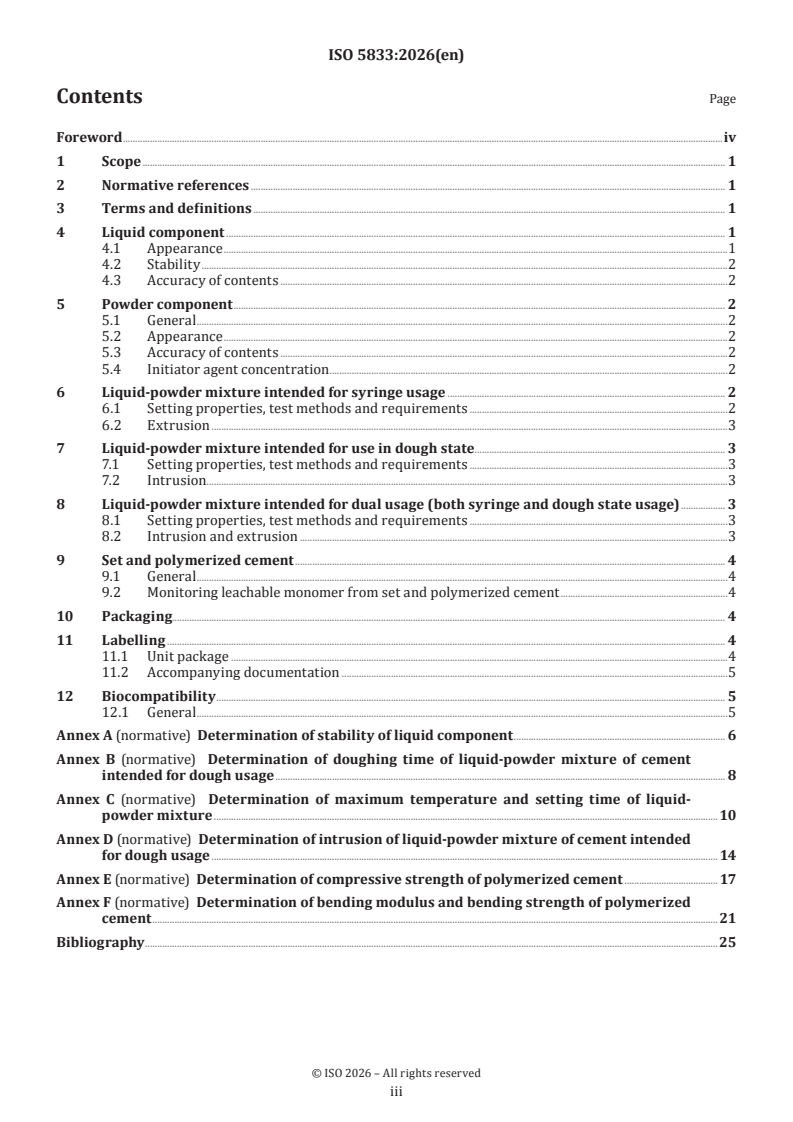
Contents Page
Foreword .iv
1 Scope . 1
2 Normative references . 1
3 Terms and definitions . 1
4 Liquid component . 1
4.1 Appearance .1
4.2 Stability .2
4.3 Accuracy of contents .2
5 Powder component . 2
5.1 General .2
5.2 Appearance .2
5.3 Accuracy of contents .2
5.4 Initiator agent concentration . .2
6 Liquid-powder mixture intended for syringe usage . 2
6.1 Setting properties, test methods and requirements .2
6.2 Extrusion .3
7 Liquid-powder mixture intended for use in dough state. 3
7.1 Setting properties, test methods and requirements .3
7.2 Intrusion.3
8 Liquid-powder mixture intended for dual usage (both syringe and dough state usage) . 3
8.1 Setting properties, test methods and requirements .3
8.2 Intrusion and extrusion .3
9 Set and polymerized cement . 4
9.1 General .4
9.2 Monitoring leachable monomer from set and polymerized cement .4
10 Packaging. 4
11 Labelling . 4
11.1 Unit package .4
11.2 Accompanying documentation .5
12 Biocompatibility . 5
12.1 General .5
Annex A (normative) Determination of stability of liquid component . 6
Annex B (normative) Determination of doughing time of liquid-powder mixture of cement
intended for dough usage . 8
Annex C (normative) Determination of maximum temperature and setting time of liquid-
powder mixture . 10
Annex D (normative) Determination of intrusion of liquid-powder mixture of cement intended
for dough usage . 14
Annex E (normative) Determination of compressive strength of polymerized cement . 17
Annex F (normative) Determination of bending modulus and bending strength of polymerized
cement .21
Bibliography .25
iii
Foreword
ISO (the International Organization for Standardization) is a worldwide federation of national standards
bodies (ISO member bodies). The work of preparing International Standards is normally carried out through
ISO technical committees. Each member body interested in a subject for which a technical committee
has been established has the right to be represented on that committee. International organizations,
governmental and non-governmental, in liaison with ISO, also take part in the work. ISO collaborates closely
with the International Electrotechnical Commission (IEC) on all matters of electrotechnical standardization.
The procedures used to develop this document and those intended for its further maintenance are described
in the ISO/IEC Directives, Part 1. In particular, the different approval criteria needed for the different types
of ISO document should be noted. This document was drafted in accordance with the editorial rules of the
ISO/IEC Directives, Part 2 (see www.iso.org/directives).
ISO draws attention to the possibility that the implementation of this document may involve the use of (a)
patent(s). ISO takes no position concerning the evidence, validity or applicability of any claimed patent
rights in respect thereof. As of the date of publication of this document, ISO had not received notice of (a)
patent(s) which may be required to implement this document. However, implementers are cautioned that
this may not represent the latest information, which may be obtained from the patent database available at
www.iso.org/patents. ISO shall not be held responsible for identifying any or all such patent rights.
Any trade name used in this document is information given for the convenience of users and does not
constitute an endorsement.
For an explanation of the voluntary nature of standards, the meaning of ISO specific terms and expressions
related to conformity assessment, as well as information about ISO's adherence to the World Trade
Organization (WTO) principles in the Technical Barriers to Trade (TBT), see www.iso.org/iso/foreword.html.
This document was prepared by Technical Committee ISO/TC 150, Implants for surgery, Subcommittee SC 1,
Materials.
This third edition cancels and replaces the second edition (ISO 5833:2002), which has been technically
revised.
The main changes are as follows:
— the scope has been amended to specify that the requirements in this document do not apply to acrylic
resin cements for other applications;
— ASTM F451-21 has been added as a normative reference;
— terms and definitions of ASTM F451 have been cited in Clause 3;
— subclause 5.4 on initiator agent concentration has been added, which includes a requirement for the
measuring the concentration of the initiator agent;
— Clauses 6 and 7 have been revised and a new Clause 8 has been added which include the requirements
for liquid-powder mixture intended for syringe usage, use in dough state, and dual usage (both syringe
and dough state usage), respectively.
— a requirement to perform an extrusion viscosity test has been added to 6.2;
— a clarification for when to perform an intrusion test has been added to 7.2;
— a clarification for when to perform both an intrusion and extrusion test has been added to 8.2;
— subclause 9.2 on monitoring leachable monomer from set and polymerized cement has been added to
provide a requirement to measure leaching monomer from set and polymerized cement over time;
— a new Clause 12 has been added on biocompatibility;
— the reporting sections in all Annexes have been revised;
iv
— bibliographical references have been added.
Any feedback or questions on this document should be directed to the user’s national standards body. A
complete listing of these bodies can be found at www.iso.org/members.html.
v
International Standard ISO 5833:2026(en)
Implants for surgery — Acrylic resin cements
1 Scope
This document specifies the physical, mechanical, packaging and labelling requirements for curing
polymerizing radio-opaque and non-radio-opaque resin cements based on poly (methacrylic acid esters).
This document applies to two types of cement, intended respectively for use with a syringe or in the dough
state, for the fixation of internal orthopaedic prostheses and supplied as units containing premeasured
amounts of sterile powder and of sterile liquid in forms suitable for mixing at the time of implantation.
All requirements in this document apply to, and all test methods are intended to be performed on, a sterile
product.
The requirements in this document are not intended to apply to acrylic resin cements for other applications,
such as stabilization of spinal fractures, fixation of bone screws, bone anchors or augments, etc., although
the test methods described can be applicable.
This document does not cover the hazards associated with the use of the cement in respect of either the
patient or the user of the cement.
2 Normative references
The following documents are referred to in the text in such a way that some or all of their content constitutes
requirements of this document. For dated references, only the edition cited applies. For undated references,
the latest edition of the referenced document (including any amendments) applies.
ASTM F451-21, Standard specification for acrylic bone cement
3 Terms and definitions
For the purposes of this document, the terms and definitions given in ASTM F451 and the following apply.
ISO and IEC maintain terminology databases for use in standardization at the following addresses:
— ISO Online browsing platform: available at https:// www .iso .org/ obp
— IEC Electropedia: available at https:// www .electropedia .org/
3.1
unit of cement
package containing one pouch or vial of sterile premeasured powder component and one pouch or vial of
sterile premeasured liquid component
Note 1 to entry: For cements in which the radio-opaque agent is supplied separately, the unit of cement includes the
vial or package of premeasured radio-opaque powder component.
4 Liquid component
4.1 Appearance
When inspected by normal or corrected vision, the liquid component shall be free from particles and other
contaminants.
4.2 Stability
The stability test shall be performed as described in Annex A. The flow time of the samples of liquid
component shall not increase by more than 10 %.
4.3 Accuracy of contents
When measured to an accuracy of ±0,1 ml, the volume of the liquid component of each of five units shall be
within 5 % of that stated on the package [see 10.1 b)].
5 Powder component
5.1 General
The powder component includes the polymer particles, initiator agents and, if applicable, the radio-opaque
agent. In some cases, the radio-opaque agent is supplied separately.
5.2 Appearance
When inspected by normal or corrected vision, the powder shall be free from agglomerates and extraneous
material.
5.3 Accuracy of contents
When weighed to an accuracy of ±0,1 g, the mass of the powder component of each of five units shall be
within 5 % of that stated on the package [see 10.1 b)].
The components used for the determinations specified in 4.3 and 5.3 may be used subsequently for other
tests described in this document, with the condition that there is no loss of mass or volume for each cement
component produced and all the requirements of Clause 4 and Clause 5 are met.
5.4 Initiator agent concentration
The concentration of the initiator agent shall be measured. If benzoyl peroxide is used as an initiator, the
amount of dibenzoyl peroxide (BPO) in the powder portion can be determined using the protocol described
in ASTM F451-21, Clause A.1, Clause A.2 or equivalent.
6 Liquid-powder mixture intended for syringe usage
6.1 Setting properties, test methods and requirements
When determined by the methods given in Annexes B, C, E and F, the setting properties and the properties of
the set and polymerized cement shall conform with the values given in Tables 1 and 2.
Table 1 — Requirements and test methods for setting properties of liquid-powder mixtures
Doughing time Setting time Maximum temperature
Maximum Maximum
Test Test Test
Mixture Average deviation Average Average deviation from
method method method
from average average
min min min °C °C
Syringe usage
— — — 6,5 to 15 Annex C 90 °C ±5 Annex C
(see Clause 6)
Dough state
usage (see ≤ 5 1,5 Annex B 3 to 15 Annex C 90 °C ±5 Annex C
Clause 7)
Table 2 — Requirements and test methods for set and polymerized cement
Test Requirement Test method
Compressive strength ≥ 70 MPa Annex E
Bending modulus ≥ 1 800 MPa Annex F
Bending strength ≥ 50 MPa Annex F
6.2 Extrusion
The manufacturer shall evaluate the viscosity profile of the cement during its curing process using the test
method(s) described in ASTM F451-21, 7.9.1 (extrusion, capillary viscosity) or 7.9.2 (extrusion, rotational
shear viscosity), or both.
7 Liquid-powder mixture intended for use in dough state
7.1 Setting properties, test methods and requirements
When determined by the methods given in Annexes B, C, D, E and F, the setting properties and the properties
of the set and polymerized cement shall conform with the values given in Tables 1 and 2.
7.2 Intrusion
The intrusion test shall by performed as described in Annex D. The average intrusion of at least one sample
shall be not less than 2 mm.
8 Liquid-powder mixture intended for dual usage (both syringe and dough state
usage)
8.1 Setting properties, test methods and requirements
When determined by the methods given in Annexes B, C, D, E and F, the setting properties and the properties
of the set and polymerized cement shall conform with the values given in Tables 1 and 2.
8.2 Intrusion and extrusion
If the mixture is to be used as a dual usage cement, then both intrusion and extrusion tests shall be
performed and shall conform to the requirements in 6.2 and 7.2.
9 Set and polymerized cement
9.1 General
Table 2 presents the requirements and test methods for set and polymerized cement, which is also known as
cured cement.
9.2 Monitoring leachable monomer from set and polymerized cement
Leaching monomer from set and polymerized cement shall be measured and monitored in accordance with
ASTM F451-21, Clause A.5.
10 Packaging
10.1 Each component of the cement shall be packaged and sterilized separately using a suitable method.
The liquid component shall be sterilized by ultrafiltration prior to being filled into an aseptic container. Each
component shall be packaged in a double-layer sealed container. The components of a single unit of cement
shall be further packaged in a container that shall contain the accompanying documentation as described in
11.2 and shall present the information as described in 11.1.
Each component of the cement shall be packaged and sterilized in a double-layer sealed container and then
packaged in an outer container which shall contain the accompanying documentation.
10.2 In the case of cement being sold with two cement units per container, the requirements of 10.1 shall
apply.
10.3 The materials of the package should not contaminate or permit contamination of the contents. The
packaging should prevent damage to, or leakage of, the contents during transit and storage and should be
designed so that it is easy to open and facilitates aseptic presentation of the contents.
11 Labelling
11.1 Unit package
At least the following information shall appear on the unit package of each cement unit:
a) a reference to this document, i.e. ISO 5833:2026;
b) a description of the contents, including the mass of the powder component and the mass or volume of
the liquid component, and the generic names of the constituents;
c) the name and address of the manufacturer, and the supplier if different from the manufacturer;
d) a warning that the package contains flammable liquid;
e) a statement that the contents are sterile and a warning against the use of an opened or damaged
package;
f) an instruction to store the package at a temperature below 25 °C and away from strong light;
g) the batch or lot numbers of the liquid and the powder component and the expiry date of the material;
ensure that all individual components of cement are clearly identified and with an expiry date in
addition to the entire package.
NOTE Legal requirements for labelling can apply in some countries.
11.2 Accompanying documentation
The following information in a) to h) shall at least appear on the accompanying documentation (see Clause 9)
[the information in i) is recommended only]:
a) instructions for handling the components and preparing the cement for use, including details of the
equipment needed and an instruction to mix the entire contents of the cement component packages (i.e.
the powder and liquid components in a unit of cement shall be used together and not used separately);
the instructions shall emphasize the importance of minimizing the entrapment of air;
b) instructions and recommendations for using the cement, including necessary precautions, and drawing
attention to the expiry date marked on the package;
c) a statement drawing attention to the toxic, hazardous and irritant properties associated with the
handling and use of the components and the cement;
d) a statement that high ambient or component temperatures will decrease, and low ambient or component
temperatures will increase, the doughing, working and setting times of the cement;
e) whether the cement is intended for use with a syringe or in the dough state, or both (dual usage);
f) the relative proportions of the powder and liquid components, expressed as a percent mass or volume
fraction;
g) a warning against re-sterilization of either the powder or liquid components;
h) a statement that, once opened, any pack should be completely used or discarded and not retained for use
on a later occasion;
i) in addition, it is recommended to include a graphical or tabular representation of the effect of
temperature on the length of the phases in cement curing, prepared from experimental data on the
particular brand and type of cement.
12 Biocompatibility
12.1 General
[1],[2]
The biocompatibility of acrylic bone cement has been reported in the literature . While no known
surgical implant material has ever been shown to cause absolutely no adverse reactions in the human
body, long-term clinical experience and laboratory studies with the material referred to in this document
has shown that an acceptable level of biological response can be expected when the material is used in
appropriate applications. When new applications of the material, or significant modification to the material
or its physical forms are being considered, an evaluation in accordance with the applicable biocompatibility
standards from the ISO 10993 series should be performed. Any biocompatibility testing should be conducted
on the final, finished device (that is, the set and polymerized cement according to the instructions for use).
Annex A
(normative)
Determination of stability of liquid component
A.1 Principle
The flow time (viscosity) of the liquid component is det
...