

ISO 5834-1:2025
(Main)Implants for surgery — Ultra-high-molecular-weight polyethylene — Part 1: Powder form
General Information
- Abstract
This document specifies the requirements and corresponding test methods for ultra-high-molecular-weight polyethylene (UHMWPE) powder moulding materials for use in the manufacturing of moulded forms that are subsequently used in the manufacturing of surgical implants. This document is not applicable to UHMWPE moulding materials that were blended with any additives or different forms of polyethylene.
- Status
- Published
- Publication Date
- 03-Jul-2025
- Technical Committee
- ISO/TC 150/SC 1 - Materials
- Drafting Committee
- ISO/TC 150/SC 1/WG 5 - Plastics
- Current Stage
- 6060 - International Standard published
- Start Date
- 04-Jul-2025
- Due Date
- 05-Dec-2025
- Completion Date
- 04-Jul-2025
Buy Documents
ISO 5834-1:2025 - Implants for surgery — Ultra-high-molecular-weight polyethylene — Part 1: Powder form Released:4. 07. 2025
ISO 5834-1:2025 - Implants for surgery — Ultra-high-molecular-weight polyethylene — Part 1: Powder form
Overview
ISO 5834-1:2025 is an international standard published by ISO specifying the requirements and test methods for ultra-high-molecular-weight polyethylene (UHMWPE) powder moulding materials. These materials are used in the production of moulded forms that serve as precursors for manufacturing surgical implants. This standard focuses exclusively on UHMWPE in powder form without blends or added polyethylene types, ensuring purity and consistency critical for medical applications.
The 2025 edition is the fifth iteration of this standard, updating normative references and harmonizing properties with ASTM F648-21. It aims to facilitate reliable and safe use of UHMWPE powder in surgical implant manufacturing, contributing to improved implant quality and biocompatibility.
Key Topics
Scope of Application
Covers UHMWPE powder materials used as raw input for moulded forms in surgical implants. Not applicable to UHMWPE blended with additives or other polyethylene forms.Classification and Flow Properties
UHMWPE powders are classified into Type 1, Type 2, or Type 3 based on flow properties such as elongational stress and viscosity number. These properties reflect polymer molecular weight and affect processing and final implant performance.Manufacturing Requirements
The UHMWPE powder must be a homopolymer derived from ethylene polymerization. Batch traceability is mandatory for quality assurance and recall management.Limits on Contaminants
Strict limits are established for ash content and trace elements including titanium, aluminium, calcium, and chlorine. Contamination control ensures material purity essential for implant safety.Test Methods
Detailed standardized test methods cover:- Elongational stress (per ISO 21304-2)
- Viscosity number (per ISO 1628-3)
- Ash content measurement (per ISO 3451-1)
- Trace elements detection via atomic absorption/emission spectroscopy and ion chromatography
- Particulate matter quantification ensuring minimal foreign particles in the powder
Certification and Labelling
Each powder batch must come with a test certificate confirming compliance. Packaging requires clear labelling with manufacturer details, lot number, mass, and standard reference number.
Applications
ISO 5834-1:2025 is essential for manufacturers and quality control laboratories involved in the production and verification of UHMWPE powders destined for surgical implant fabrication. The standard’s practical applications include:
- Assuring material purity and consistency for improved implant biocompatibility and performance.
- Guiding manufacture and testing protocols to meet stringent regulatory and clinical requirements.
- Supporting traceability and documentation, critical for patient safety and regulatory compliance.
- Enhancing communication between material suppliers and implant manufacturers with standardized classifications and testing methods.
- Facilitating quality assurance in producing hip and knee joint replacements, spinal implants, and other orthopedic devices relying on UHMWPE components.
Related Standards
- ISO 5834-2:2025 - Covers the requirements for the moulded forms produced from UHMWPE powder, complementing Part 1 by addressing the next production stage.
- ISO 21304 Series - Includes specifications and test methods related to UHMWPE moulding and extrusion materials.
- ISO 1628-3 - Test method for determining the viscosity of polyethylenes in dilute solution.
- ISO 3451-1 - Methods for ash content determination in plastics.
- ASTM F648-21 - A harmonized standard detailing UHMWPE for surgical implants, aligned with this ISO edition to ensure global consistency.
By adhering to ISO 5834-1:2025, stakeholders in biomedical materials and implant manufacturing can ensure that UHMWPE powders meet rigorous international standards for safety, purity, and performance. This enables the production of high-quality surgical implants that contribute to better patient outcomes and long-term implant reliability.
Relations
- Effective Date
- 09-Dec-2023
Buy Documents
ISO 5834-1:2025 - Implants for surgery — Ultra-high-molecular-weight polyethylene — Part 1: Powder form Released:4. 07. 2025
ISO 5834-1:2025 - Implants for surgery — Ultra-high-molecular-weight polyethylene — Part 1: Powder form
Get Certified
Connect with accredited certification bodies for this standard

BSI Group
BSI (British Standards Institution) is the business standards company that helps organizations make excellence a habit.

TÜV Rheinland
TÜV Rheinland is a leading international provider of technical services.

TÜV SÜD
TÜV SÜD is a trusted partner of choice for safety, security and sustainability solutions.
Sponsored listings
Frequently Asked Questions
ISO 5834-1:2025 is a standard published by the International Organization for Standardization (ISO). Its full title is "Implants for surgery — Ultra-high-molecular-weight polyethylene — Part 1: Powder form". This standard covers: This document specifies the requirements and corresponding test methods for ultra-high-molecular-weight polyethylene (UHMWPE) powder moulding materials for use in the manufacturing of moulded forms that are subsequently used in the manufacturing of surgical implants. This document is not applicable to UHMWPE moulding materials that were blended with any additives or different forms of polyethylene.
This document specifies the requirements and corresponding test methods for ultra-high-molecular-weight polyethylene (UHMWPE) powder moulding materials for use in the manufacturing of moulded forms that are subsequently used in the manufacturing of surgical implants. This document is not applicable to UHMWPE moulding materials that were blended with any additives or different forms of polyethylene.
ISO 5834-1:2025 is classified under the following ICS (International Classification for Standards) categories: 11.040.40 - Implants for surgery, prosthetics and orthotics. The ICS classification helps identify the subject area and facilitates finding related standards.
ISO 5834-1:2025 has the following relationships with other standards: It is inter standard links to ISO 5834-1:2019. Understanding these relationships helps ensure you are using the most current and applicable version of the standard.
ISO 5834-1:2025 is available in PDF format for immediate download after purchase. The document can be added to your cart and obtained through the secure checkout process. Digital delivery ensures instant access to the complete standard document.
Standards Content (Sample)
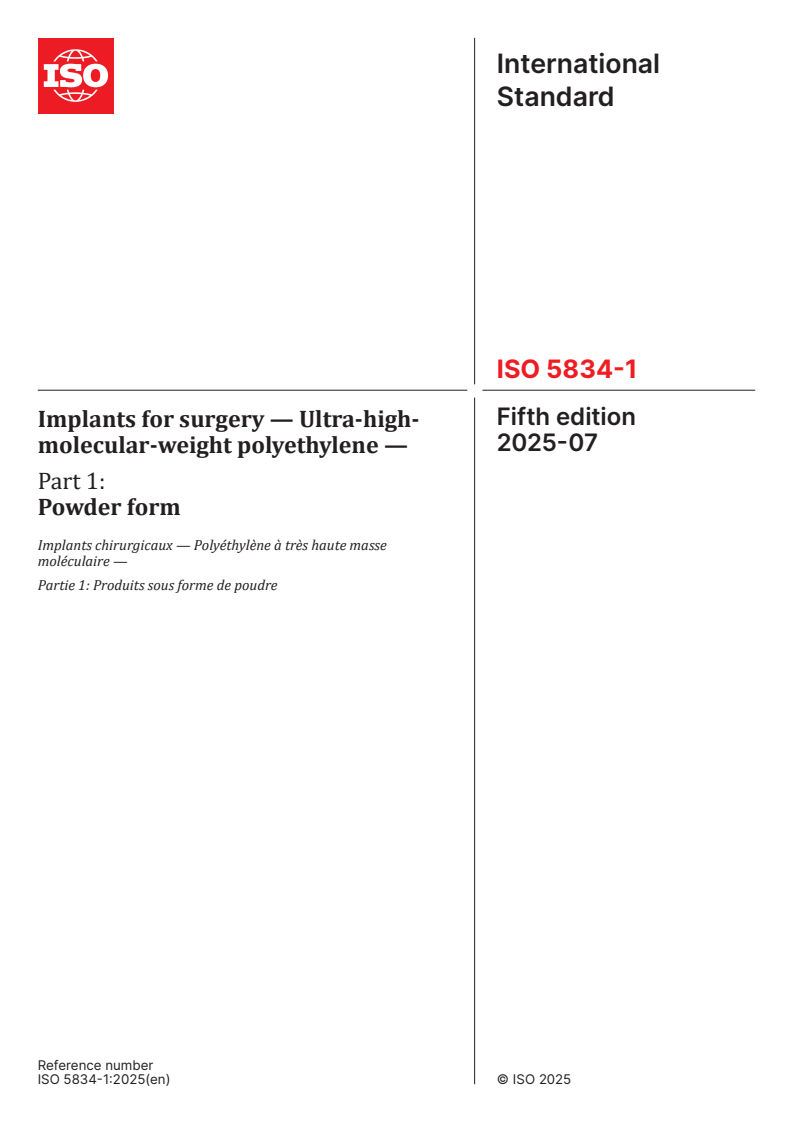
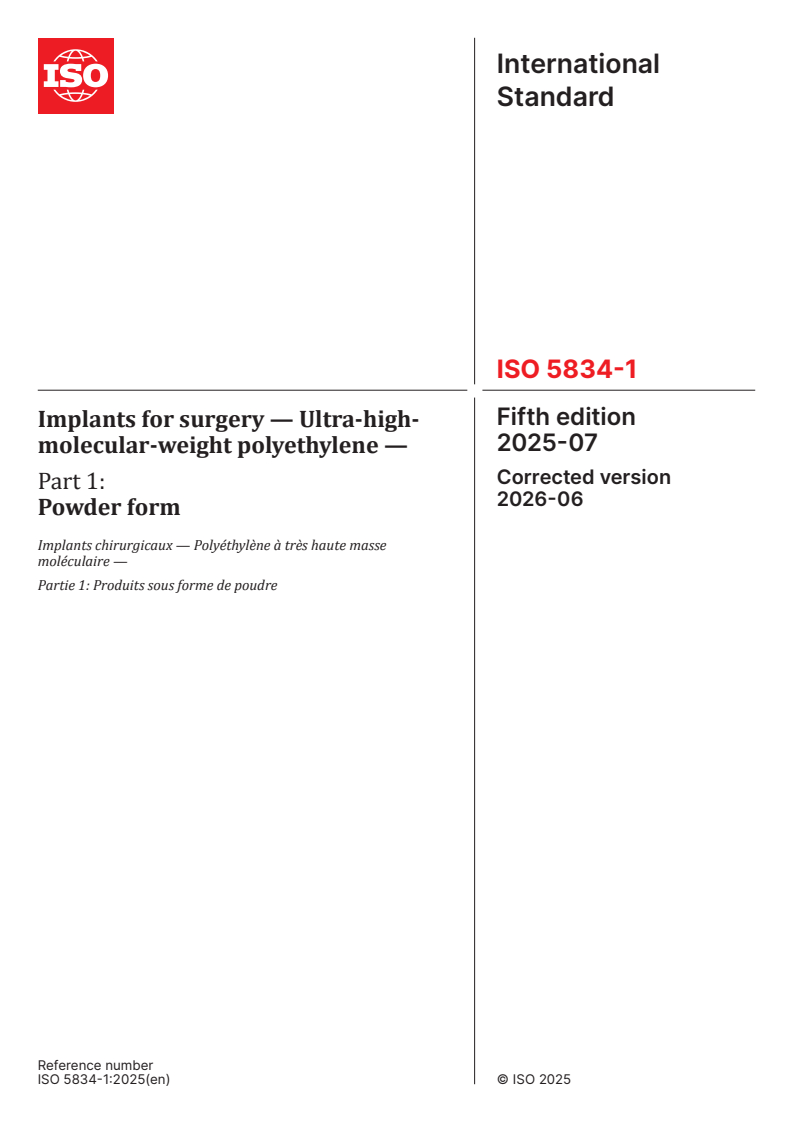
International
Standard
ISO 5834-1
Fifth edition
Implants for surgery — Ultra-high-
2025-07
molecular-weight polyethylene —
Part 1:
Powder form
Implants chirurgicaux — Polyéthylène à très haute masse
moléculaire —
Partie 1: Produits sous forme de poudre
Reference number
© ISO 2025
All rights reserved. Unless otherwise specified, or required in the context of its implementation, no part of this publication may
be reproduced or utilized otherwise in any form or by any means, electronic or mechanical, including photocopying, or posting on
the internet or an intranet, without prior written permission. Permission can be requested from either ISO at the address below
or ISO’s member body in the country of the requester.
ISO copyright office
CP 401 • Ch. de Blandonnet 8
CH-1214 Vernier, Geneva
Phone: +41 22 749 01 11
Email: copyright@iso.org
Website: www.iso.org
Published in Switzerland
ii
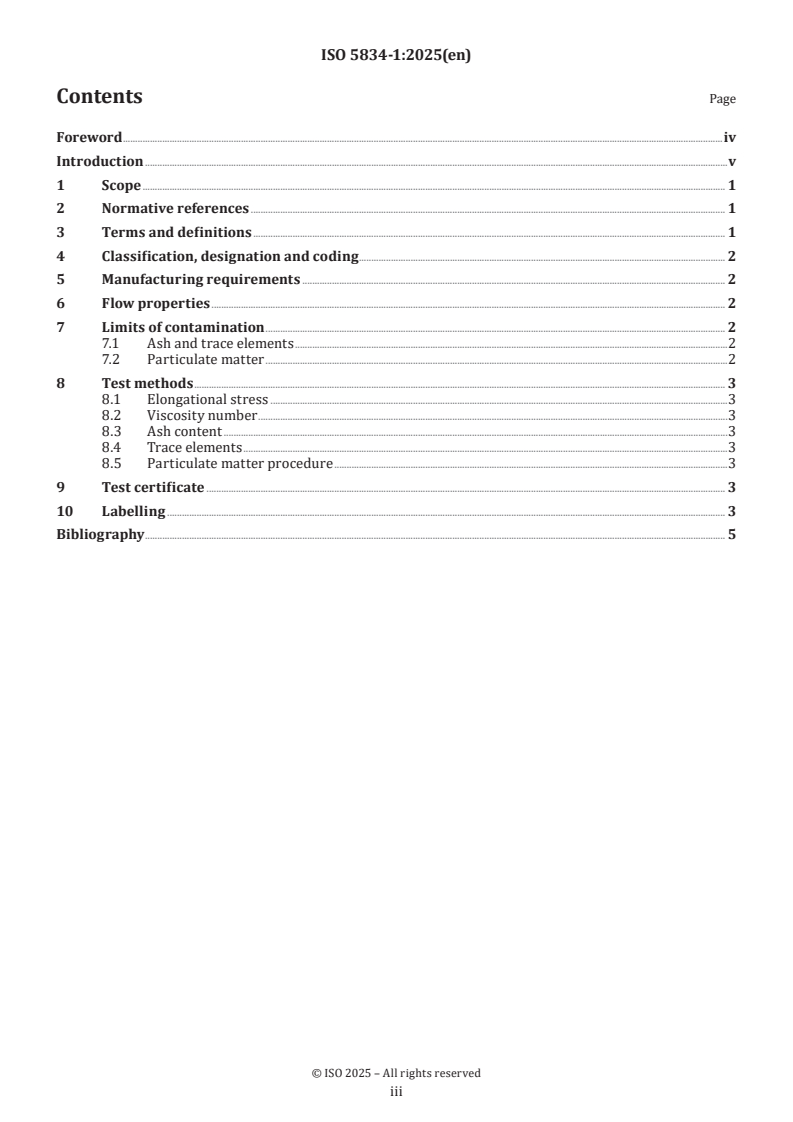
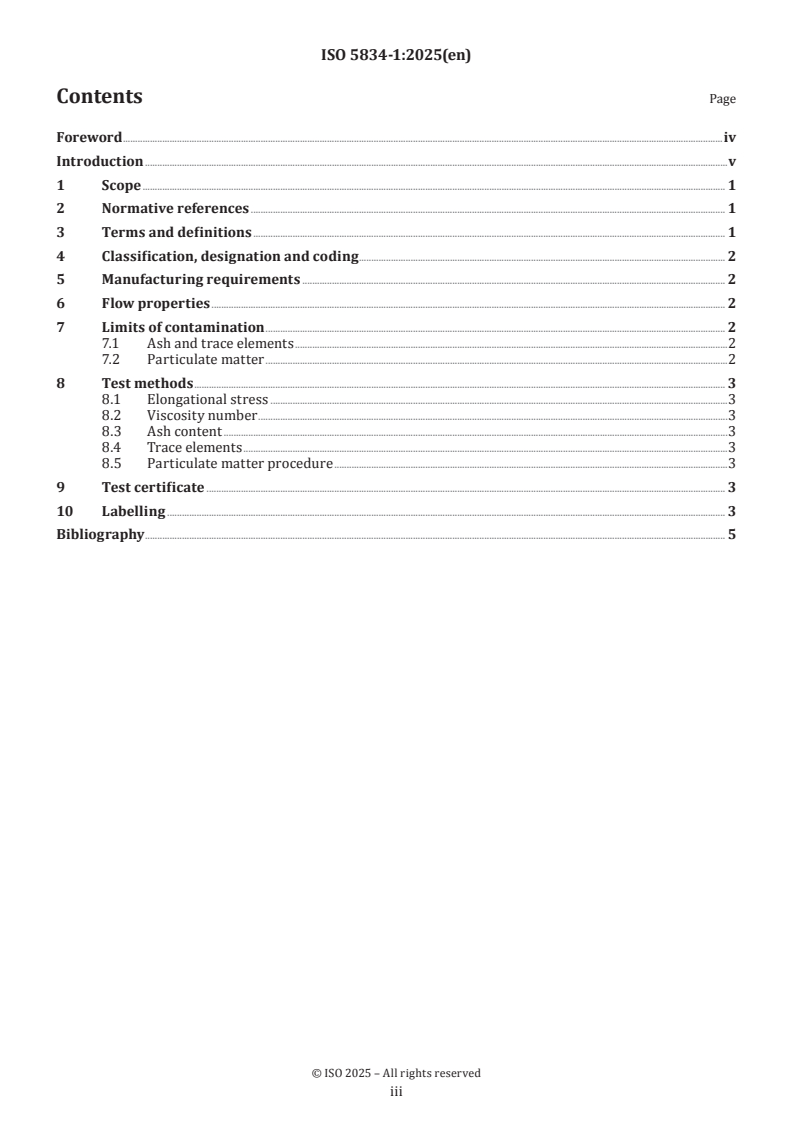
Contents Page
Foreword .iv
Introduction .v
1 Scope . 1
2 Normative references . 1
3 Terms and definitions . 1
4 Classification, designation and coding . 2
5 Manufacturing requirements . 2
6 Flow properties . 2
7 Limits of contamination . 2
7.1 Ash and trace elements .2
7.2 Particulate matter .2
8 Test methods . 3
8.1 Elongational stress .3
8.2 Viscosity number .3
8.3 Ash content .3
8.4 Trace elements .3
8.5 Particulate matter procedure .3
9 Test certificate . 3
10 Labelling . 3
Bibliography . 5
iii
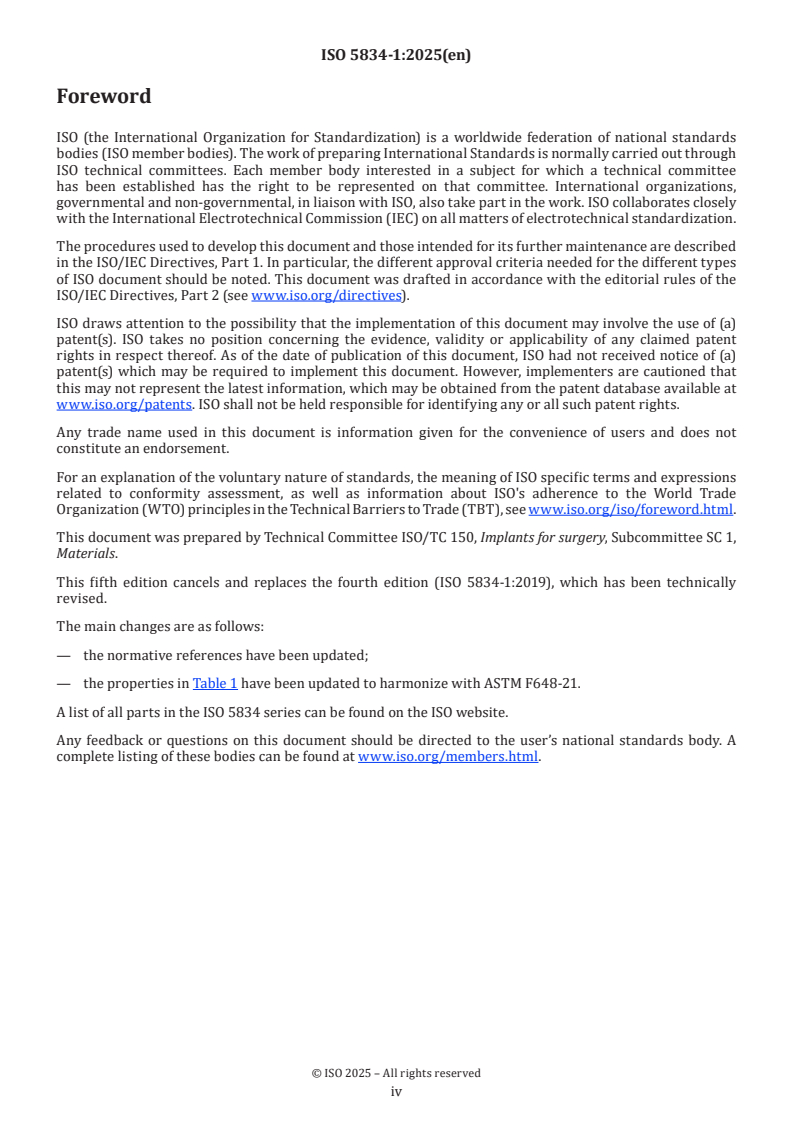
Foreword
ISO (the International Organization for Standardization) is a worldwide federation of national standards
bodies (ISO member bodies). The work of preparing International Standards is normally carried out through
ISO technical committees. Each member body interested in a subject for which a technical committee
has been established has the right to be represented on that committee. International organizations,
governmental and non-governmental, in liaison with ISO, also take part in the work. ISO collaborates closely
with the International Electrotechnical Commission (IEC) on all matters of electrotechnical standardization.
The procedures used to develop this document and those intended for its further maintenance are described
in the ISO/IEC Directives, Part 1. In particular, the different approval criteria needed for the different types
of ISO document should be noted. This document was drafted in accordance with the editorial rules of the
ISO/IEC Directives, Part 2 (see www.iso.org/directives).
ISO draws attention to the possibility that the implementation of this document may involve the use of (a)
patent(s). ISO takes no position concerning the evidence, validity or applicability of any claimed patent
rights in respect thereof. As of the date of publication of this document, ISO had not received notice of (a)
patent(s) which may be required to implement this document. However, implementers are cautioned that
this may not represent the latest information, which may be obtained from the patent database available at
www.iso.org/patents. ISO shall not be held responsible for identifying any or all such patent rights.
Any trade name used in this document is information given for the convenience of users and does not
constitute an endorsement.
For an explanation of the voluntary nature of standards, the meaning of ISO specific terms and expressions
related to conformity assessment, as well as information about ISO's adherence to the World Trade
Organization (WTO) principles in the Technical Barriers to Trade (TBT), see www.iso.org/iso/foreword.html.
This document was prepared by Technical Committee ISO/TC 150, Implants for surgery, Subcommittee SC 1,
Materials.
This fifth edition cancels and replaces the fourth edition (ISO 5834-1:2019), which has been technically
revised.
The ma
...
International
Standard
ISO 5834-1
Fifth edition
Implants for surgery — Ultra-high-
2025-07
molecular-weight polyethylene —
Corrected version
Part 1:
2026-06
Powder form
Implants chirurgicaux — Polyéthylène à très haute masse
moléculaire —
Partie 1: Produits sous forme de poudre
Reference number
© ISO 2025
All rights reserved. Unless otherwise specified, or required in the context of its implementation, no part of this publication may
be reproduced or utilized otherwise in any form or by any means, electronic or mechanical, including photocopying, or posting on
the internet or an intranet, without prior written permission. Permission can be requested from either ISO at the address below
or ISO’s member body in the country of the requester.
ISO copyright office
CP 401 • Ch. de Blandonnet 8
CH-1214 Vernier, Geneva
Phone: +41 22 749 01 11
Email: copyright@iso.org
Website: www.iso.org
Published in Switzerland
ii
Contents Page
Foreword .iv
Introduction .v
1 Scope . 1
2 Normative references . 1
3 Terms and definitions . 1
4 Classification, designation and coding . 2
5 Manufacturing requirements . 2
6 Flow properties . 2
7 Limits of contamination . 2
7.1 Ash and trace elements .2
7.2 Particulate matter .2
8 Test methods . 3
8.1 Elongational stress .3
8.2 Viscosity number .3
8.3 Ash content .3
8.4 Trace elements .3
8.5 Particulate matter procedure .3
9 Test certificate . 3
10 Labelling . 3
Bibliography . 5
iii
Foreword
ISO (the International Organization for Standardization) is a worldwide federation of national standards
bodies (ISO member bodies). The work of preparing International Standards is normally carried out through
ISO technical committees. Each member body interested in a subject for which a technical committee
has been established has the right to be represented on that committee. International organizations,
governmental and non-governmental, in liaison with ISO, also take part in the work. ISO collaborates closely
with the International Electrotechnical Commission (IEC) on all matters of electrotechnical standardization.
The procedures used to develop this document and those intended for its further maintenance are described
in the ISO/IEC Directives, Part 1. In particular, the different approval criteria needed for the different types
of ISO document should be noted. This document was drafted in accordance with the editorial rules of the
ISO/IEC Directives, Part 2 (see www.iso.org/directives).
ISO draws attention to the possibility that the implementation of this document may involve the use of (a)
patent(s). ISO takes no position concerning the evidence, validity or applicability of any claimed patent
rights in respect thereof. As of the date of publication of this document, ISO had not received notice of (a)
patent(s) which may be required to implement this document. However, implementers are cautioned that
this may not represent the latest information, which may be obtained from the patent database available at
www.iso.org/patents. ISO shall not be held responsible for identifying any or all such patent rights.
Any trade name used in this document is information given for the convenience of users and does not
constitute an endorsement.
For an explanation of the voluntary nature of standards, the meaning of ISO specific terms and expressions
related to conformity assessment, as well as information about ISO's adherence to the World Trade
Organization (WTO) principles in the Technical Barriers to Trade (TBT), see www.iso.org/iso/foreword.html.
This document was prepared by Technical Committee ISO/TC 150, Implants for surgery, Subcommittee SC 1,
Materials.
This fifth edition cancels and replaces the fourth edition (ISO 5834-1:2019), which has been technically
revised.
The main changes are as follows:
— the normative references have been upd
...