

ISO 26683-2:2013
(Main)Intelligent transport systems — Freight land conveyance content identification and communication — Part 2: Application interface profiles
General Information
- Abstract
ISO 26683-2:2013 provides application interface profiles for land cargo transport data agglomeration and transfer (within the context and architecture described in ISO 26683-1), using one or more of the international standards listed and defined in Annex A of 26683-1. ISO 26683-2:2013 defines a number of application interface profiles for land cargo transport data to provide more land cargo transport visibility by using current technical standards, specifications and technologies related to cargo transport.
- Status
- Published
- Publication Date
- 14-Feb-2013
- Technical Committee
- ISO/TC 204 - Intelligent transport systems
- Drafting Committee
- ISO/TC 204/WG 7 - General fleet management and commercial/freight
- Current Stage
- 9060 - Close of review
- Completion Date
- 04-Mar-2029


Overview
ISO 26683-2:2013 is part of the ISO 26683 series on Intelligent Transport Systems for freight land conveyance content identification and communication. This part defines application interface profiles used to agglomerate and transfer land cargo transport data (within the architecture given in ISO 26683-1). Its purpose is to increase cargo visibility and enable interoperable data exchange using current technical standards and technologies (RFID, DSRC/CALM, cellular, bar codes, etc.).
Key SEO keywords: ISO 26683-2:2013, intelligent transport systems, freight land conveyance, application interface profiles, cargo visibility, RFID, DSRC, CALM, data agglomeration.
Key Topics
- Application interface profiles: A taxonomy of optional profiles (e.g., L1, L2, L3 and D1 profile families) that specify methods and modes for transferring cargo content data.
- Profile examples: Profiles referencing technologies such as ISO 15628 DSRC, ISO 21215 (CALM M5Hz), ISO 10374 (automatic identification), GSM/UMTS/LTE/IMS, ISO/IEC 18000 (RFID), and barcode/OCR-based agglomeration.
- Data agglomeration: Methods to aggregate item-level data from tags, trailers, or multiple transport units to on-board equipment (OBE) or infrastructure interrogators.
- Levels of transfer: Defined transfer contexts - e.g., tag-to-interrogator, trailer-to-OBE, OBE-to-infrastructure - aligning with the architectural context in Part 1.
- Conformance and testing: Requirements for testing, conformance assessment, marking/labeling and declarations (security and further profiles handled in Parts 3–4).
- Normative references: Extensive cross-references to related ISO and ISO/IEC standards for RFID, bar code symbologies, UBL/UN/CEFACT and ITS communications.
Applications
Who uses ISO 26683-2:2013 and why:
- Logistics and transport operators: To implement interoperable cargo visibility solutions that audit consignment contents, especially for sealed containers and multi-haulier flows.
- Systems integrators and ITS engineers: To design vehicle-mounted OBE, trailer interrogators and roadside infrastructure that aggregate and forward cargo data.
- RFID and barcode solution providers: To align tag/reader interaction models and data encoding with ITS profile requirements.
- Shippers, consignors and consignees: To obtain higher-fidelity real-time or near-real-time visibility and to support electronic auditing of cargo.
- Regulatory and port authorities: To support inspection, safety and customs processes through standardized data interfaces.
Practical benefits include improved end-to-end cargo visibility, standardized data agglomeration methods, and interoperability across technologies (RFID, DSRC/CALM, cellular, barcodes).
Related standards
- ISO 26683-1 (Context, architecture and referenced standards)
- ISO 15628 (DSRC application layer)
- ISO/IEC 18000 series (RFID air interface)
- ISO 10374 (Automatic identification for freight containers)
- ISO 17262 / 17263 (AVI numbering, system parameters)
- ISO 17687, UBL, UN/CEFACT (data dictionaries and message sets)
For implementers, ISO 26683-2:2013 is a practical profile library to build interoperable, standards-based freight visibility solutions across land transport networks.
Relations
- Effective Date
- 01-Oct-2011
Get Certified
Connect with accredited certification bodies for this standard

BSI Group
BSI (British Standards Institution) is the business standards company that helps organizations make excellence a habit.

BRCGS (Brand Reputation Compliance Global Standards)
Global food safety and quality standards owner.

NYCE
Mexican standards and certification body.
Sponsored listings
Frequently Asked Questions
ISO 26683-2:2013 is a standard published by the International Organization for Standardization (ISO). Its full title is "Intelligent transport systems — Freight land conveyance content identification and communication — Part 2: Application interface profiles". This standard covers: ISO 26683-2:2013 provides application interface profiles for land cargo transport data agglomeration and transfer (within the context and architecture described in ISO 26683-1), using one or more of the international standards listed and defined in Annex A of 26683-1. ISO 26683-2:2013 defines a number of application interface profiles for land cargo transport data to provide more land cargo transport visibility by using current technical standards, specifications and technologies related to cargo transport.
ISO 26683-2:2013 provides application interface profiles for land cargo transport data agglomeration and transfer (within the context and architecture described in ISO 26683-1), using one or more of the international standards listed and defined in Annex A of 26683-1. ISO 26683-2:2013 defines a number of application interface profiles for land cargo transport data to provide more land cargo transport visibility by using current technical standards, specifications and technologies related to cargo transport.
ISO 26683-2:2013 is classified under the following ICS (International Classification for Standards) categories: 35.240.60 - IT applications in transport; 55.180.01 - Freight distribution of goods in general. The ICS classification helps identify the subject area and facilitates finding related standards.
ISO 26683-2:2013 has the following relationships with other standards: It is inter standard links to ISO/TS 26683-2:2012. Understanding these relationships helps ensure you are using the most current and applicable version of the standard.
ISO 26683-2:2013 is available in PDF format for immediate download after purchase. The document can be added to your cart and obtained through the secure checkout process. Digital delivery ensures instant access to the complete standard document.
Standards Content (Sample)
INTERNATIONAL ISO
STANDARD 26683-2
First edition
2013-02-15
Intelligent transport systems —
Freight land conveyance content
identification and communication —
Part 2:
Application interface profiles
Systèmes intelligents de transport — Identification et communication
du contenu des marchandises transportées par voie terrestre —
Partie 2: Profils d’interface d’application
Reference number
©
ISO 2013
© ISO 2013
All rights reserved. Unless otherwise specified, no part of this publication may be reproduced or utilized otherwise in any form
or by any means, electronic or mechanical, including photocopying, or posting on the internet or an intranet, without prior
written permission. Permission can be requested from either ISO at the address below or ISO’s member body in the country of
the requester.
ISO copyright office
Case postale 56 • CH-1211 Geneva 20
Tel. + 41 22 749 01 11
Fax + 41 22 749 09 47
E-mail copyright@iso.org
Web www.iso.org
Published in Switzerland
ii © ISO 2013 – All rights reserved
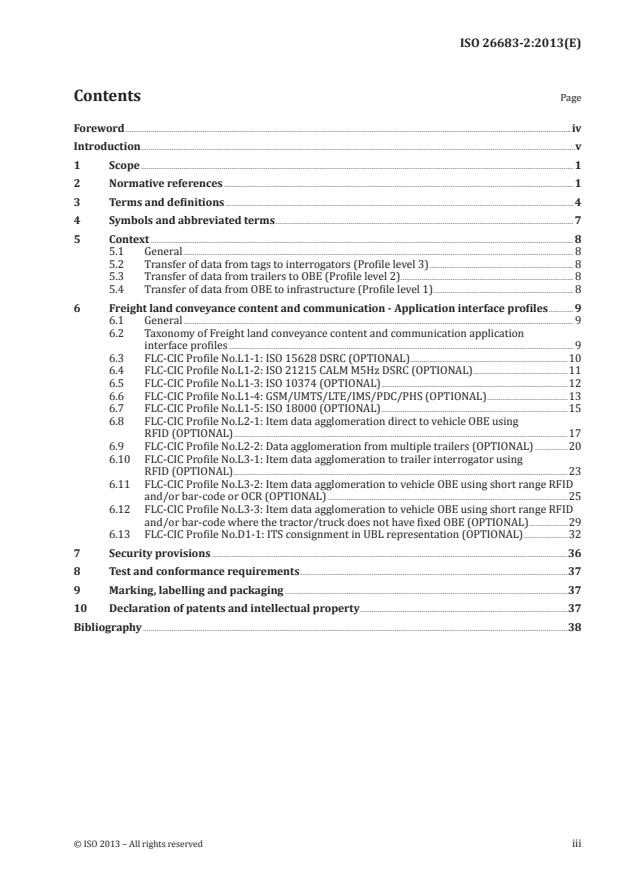
Contents Page
Foreword .iv
Introduction .v
1 Scope . 1
2 Normative references . 1
3 Terms and definitions . 4
4 Symbols and abbreviated terms . 7
5 Context . 8
5.1 General . 8
5.2 Transfer of data from tags to interrogators (Profile level 3) . 8
5.3 Transfer of data from trailers to OBE (Profile level 2) . 8
5.4 Transfer of data from OBE to infrastructure (Profile level 1). 8
6 Freight land conveyance content and communication ‑ Application interface profiles .9
6.1 General . 9
6.2 Taxonomy of Freight land conveyance content and communication application
interface profiles . 9
6.3 FLC-CIC Profile No.L1-1: ISO 15628 DSRC (OPTIONAL) .10
6.4 FLC-CIC Profile No.L1-2: ISO 21215 CALM M5Hz DSRC (OPTIONAL) .11
6.5 FLC-CIC Profile No.L1-3: ISO 10374 (OPTIONAL) .12
6.6 FLC-CIC Profile No.L1-4: GSM/UMTS/LTE/IMS/PDC/PHS (OPTIONAL) .13
6.7 FLC-CIC Profile No.L1-5: ISO 18000 (OPTIONAL) .15
6.8 FLC-CIC Profile No.L2-1: Item data agglomeration direct to vehicle OBE using
RFID (OPTIONAL) .17
6.9 FLC-CIC Profile No.L2-2: Data agglomeration from multiple trailers (OPTIONAL) .20
6.10 FLC-CIC Profile No.L3-1: Item data agglomeration to trailer interrogator using
RFID (OPTIONAL) .23
6.11 FLC-CIC Profile No.L3-2: Item data agglomeration to vehicle OBE using short range RFID
and/or bar-code or OCR (OPTIONAL) .25
6.12 FLC-CIC Profile No.L3-3: Item data agglomeration to vehicle OBE using short range RFID
and/or bar-code where the tractor/truck does not have fixed OBE (OPTIONAL) .29
6.13 FLC-CIC Profile No.D1-1: ITS consignment in UBL representation (OPTIONAL) .32
7 Security provisions .36
8 Test and conformance requirements .37
9 Marking, labelling and packaging .37
10 Declaration of patents and intellectual property .37
Bibliography .38
Foreword
ISO (the International Organization for Standardization) is a worldwide federation of national standards
bodies (ISO member bodies). The work of preparing International Standards is normally carried out
through ISO technical committees. Each member body interested in a subject for which a technical
committee has been established has the right to be represented on that committee. International
organizations, governmental and non-governmental, in liaison with ISO, also take part in the work.
ISO collaborates closely with the International Electrotechnical Commission (IEC) on all matters of
electrotechnical standardization.
The procedures used to develop this document and those intended for its further maintenance are
described in the ISO/IEC Directives, Part 1. In particular the different approval criteria needed for the
different types of ISO documents should be noted. This document was drafted in accordance with the
editorial rules of the ISO/IEC Directives, Part 2. www.iso.org/directives
Attention is drawn to the possibility that some of the elements of this document may be the subject of
patent rights. ISO shall not be held responsible for identifying any or all such patent rights. Details of
any patent rights identified during the development of the document will be in the Introduction and/or
on the ISO list of patent declarations received. www.iso.org/patents
Any trade name used in this document is information given for the convenience of users and does not
constitute an endorsement.
The committee responsible for this document is ISO/TC 204, Intelligent Transport Systems
This first edition of ISO 26683-2 cancels and replaces ISO/TS 26683-2:2012.
ISO 26683 consists of the following parts, under the general title Freight land conveyance content
identification and communication:
— Part 1: Context, architecture and referenced standards
— Part 2: Application interface profiles
The following parts are under preparation:
— Part 3: Monitoring cargo stress measurement information during road transport [Technical
Specification]
— Part 4: Security profile [Technical Specification]
iv © ISO 2013 – All rights reserved
Introduction
In a scenario of land international transport and logistics, it is often difficult for a consignor and a
consignee to know the physical real time location of cargo after consigning the cargo to a transport
and logistics service provider. Where a cargo is transferred from one haulier (i.e. haulage contractor) to
another, obtaining information of the manifest at a detailed level is often difficult. Auditing the actual
content of a consignment en route, and monitoring cargo stress measurement information during road
transport, is also difficult, especially in the case of sealed containers such as sealed ISO intermodal
containers. It is a different task to that of progressing order administration from consignor to consignee.
There is no single organization responsible for standards through the intermodal supply chain. The
ISO 26683 series is a co-ordinating standard that builds on, uses and can provide data to instantiations
which use ISO/TS 24533, ISO 17687, UN/CEFACT, ISO 7372, EDIFACT, UBL, ISO 17261, ISO 17262,
ISO 17263 and other standards.
Even where comprehensive international freight transport systems are in place, they rely on the level of
detail that exists within its controlling computer system, and without the ability to monitor the actual
contents, there is no possibility to:
a) audit the actual contents of the consignment. This is particularly difficult in the case of a sealed
intermodal container (ISO 668 and subsequent related standards for freight containers);
b) monitor the condition of the contents of the consignment (cargo stress measurement information).
The ISO 26683 series of standards are therefore complementary to the context of ISO 24533 and can
provide sources of data required by such systems, and an electronic auditing capability. ISO 17687 does
not address the means by which its data are collected and 26683 provides several optional means to
collect its data.
The ISO 26683 series envisages that a combination of existing technologies can be used to
agglomerate/aggregate relevant data and use a tractor/truck mounted communications means to
realize real time cargo visibility of land transport, and is thus not dependent on future technologies
(although will be suitable for future technical means to deliver its profile data).
Part 1 specifies the context and architecture and provides a list of reference standards for the ISO 26683
series. Further details concerning the complementary nature of the ISO 26683 series of standards
to ISO 24533, EFM, ISO 17687, IEEE 1512.3, UN/CEFACT, particularly UN/CEFACT UMM, ISO 7372,
OASIS/UBL can be found ISO 26683-1, Clauses 5 and 6.
ISO 26683 is designed to present data concerning end-to-end cargo application systems. It does not
provide end to end system (consignor to consignee) system design.
This part of ISO 26683 is the second part of a multi-part series of standards and provides optional
application interface profiles for ‘Freight land conveyance content identification and communication’
(FLC-CIC). It is limited to the land aspects of transport.
This part of ISO 26683 defines application interface profiles to agglomerate/aggregate and transfer land
cargo transport data to an interrogator in order to provide improved land cargo transport data and to
specify one or more modes of transfer using available ICT technologies.
Part 3 will specify the handling of on-board cargo stress measurement information during road transport
Part 4 will provide a security profile requirements and definitions.
INTERNATIONAL STANDARD ISO 26683-2:2013(E)
Intelligent transport systems — Freight land conveyance
content identification and communication —
Part 2:
Application interface profiles
1 Scope
This part of ISO 26683 provides application interface profiles for land cargo transport data agglomeration
and transfer (within the context and architecture described in ISO 26683-1), using one or more of the
international standards listed and defined in Annex A of 26683-1.
NOTE ISO 26683 is designed to present information on end-to-end cargo application systems. It does not
provide end to end system (consignor to consignee) system design.
This part of ISO 26683 defines a number of application interface profiles for land cargo transport data
to provide more land cargo transport visibility by using current technical standards, specifications and
technologies related to cargo transport.
2 Normative references
The following referenced documents are indispensable for the application of this document. For dated
references, only the edition cited applies. For undated references, the latest edition of the referenced
document (including any amendments) applies.
NOTE The principal list of normatively referenced standards for this part of ISO 26683 and summary of their
content is to be found in ISO 26683-1.
ISO 7372, Trade data interchange — Trade data elements directory
ISO 9897, Freight containers — Container equipment data exchange (CEDEX) — General communication codes
ISO 10368, Freight thermal containers — Remote condition monitoring
ISO 10374, Freight containers — Automatic identification
ISO/TS 10891, Freight containers — Radio frequency identification (RFID) — Licence plate tag
ISO 15394, Packaging — Bar code and two-dimensional symbols for shipping, transport and receiving labels
ISO/IEC 15418, Information technology — Automatic identification and data capture techniques — GS1
Application Identifiers and ASC MH10 Data Identifiers and maintenance
ISO/IEC 15420, Information technology — Automatic identification and data capture techniques —
EAN/UPC bar code symbology specification
ISO/IEC 15424, Information technology — Automatic identification and data capture techniques — Data
Carrier Identifiers (including Symbology Identifiers)
ISO/IEC 15438, Information technology — Automatic identification and data capture techniques — PDF417
bar code symbology specification
ISO/IEC 15459-2, Information technology — Automatic identification and data capture techniques —
Unique identification — Part 2: Registration procedures
ISO/IEC 15459-1, Information technology — Automatic identification and data capture techniques —
Unique identification — Part 1: Individual transport units
ISO/IEC 15459-3, Information technology — Automatic identification and data capture techniques —
Unique identification — Part 3: Common rules
ISO/IEC 15459-4, Information technology — Automatic identification and data capture techniques —
Unique identification — Part 4: Individual products and product packages
ISO/IEC 15459-5, Information technology — Automatic identification and data capture techniques —
Unique identification — Part 5: Individual returnable transport items (RTIs)
ISO/IEC 15459-6, Information technology — Automatic identification and data capture techniques —
Unique identification — Part 6: Groupings
ISO/IEC 15459-8, Information technology — Unique identifiers — Part 8: Grouping of transport units
ISO 15628, Intelligent transport systems — Dedicated short range communication (DSRC) — DSRC
application layer
ISO/IEC 15961, Information technology — Radio frequency identification (RFID) for item management —
Data protocol: application interface
ISO/IEC 15962, Information technology — Radio frequency identification (RFID) for item management —
Data protocol: data encoding rules and logical memory functions
ISO/IEC 16022, Information technology — Automatic identification and data capture techniques — Data
Matrix bar code symbology specification
ISO/IEC 16023, Information technology — International symbology specification — MaxiCode
ISO/IEC 16388, Information technology — Automatic identification and data capture techniques — Code
39 bar code symbology specification
ISO 17261, Intelligent transport systems — Automatic vehicle and equipment identification — Intermodal
goods transport architecture and terminology
ISO 17262, Intelligent transport systems — Automatic vehicle and equipment identification — Numbering
and data structures
ISO 17263, Intelligent transport systems — Automatic vehicle and equipment identification — System parameters
ISO 17264, Intelligent transport systems — Automatic vehicle and equipment identification — Interfaces
ISO 17364, Supply chain applications of RFID — Returnable transport items (RTIs) and returnable
packaging items (RPIs)
ISO 17365, Supply chain applications of RFID — Transport units
ISO 17366, Supply chain applications of RFID — Product packaging
ISO 17367, Supply chain applications of RFID — Product tagging
ISO 17687, Transport Information and Control Systems (TICS) — General fleet management and commercial
freight operations — Data dictionary and message sets for electronic identification and monitoring of
hazardous materials/dangerous goods transportation
ISO/IEC 18000-6, Information technology — Radio frequency identification for item management — Part
6: Parameters for air interface communications at 860 MHz to 960 MHz General
ISO/IEC 18004, Information technology — Automatic identification and data capture techniques — QR
Code bar code symbology specification
2 © ISO 2013 – All rights reserved
ISO 18185-1, Freight containers — Electronic seals — Part 1: Communication protocol
ISO 21212, Intelligent transport systems — Communications access for land mobiles (CALM) — 2G
Cellular systems
ISO 21213, Intelligent transport systems — Communications access for land mobiles (CALM) — 3G
Cellularsystems
ISO 21214, Intelligent transport systems — Communications access for land mobiles (CALM) — Infra-red systems
ISO 21215, Intelligent transport systems — Communications access for land mobiles (CALM) — M5
ISO 21216, Intelligent transport systems — Communication access for land mobiles (CALM) — Millimetre
wave air interface
ISO/IEC/IEEE 21450, Information technology — Smart transducer interface for sensors and actuators —
Common functions, communication protocols, and Transducer Electronic Data Sheet (TEDS) formats
ISO/IEC/IEEE 21451-1, Information technology — Smart transducer interface for sensors and actuators —
Part 1: Network Capable Application Processor (NCAP) information model
ISO/IEC/IEEE 21451-2, Information technology — Smart transducer interface for sensors and actuators —
Part 2: Transducer to microprocessor communication protocols and Transducer Electronic Data Sheet
(TEDS) formats
ISO/IEC/IEEE 21451-4, Information technology — Smart transducer interface for sensors and actuators —
Part 4: Mixed-mode communication protocols and Transducer Electronic Data Sheet (TEDS) formats
ISO 22742, Packaging — Linear bar code and two-dimensional symbols for product packaging
ISO/TS 24533, Intelligent transport systems — Electronic information exchange to facilitate the movement
of freight and its intermodal transfer — Road transport information exchange methodology
ISO 25111, Intelligent transport systems — Communications access for land mobiles (CALM) — General
requirements for using public networks
ISO 26683-1, Intelligent transport systems — Freight land conveyance content identification and
communication — Part 1: Context, architecture and referenced standards
ISO 28219, Packaging — Labelling and direct product marking with linear bar code and two-dimensional symbols
ISO 29282, Intelligent transport systems — Communications access for land mobiles (CALM) — Satellite networks
ISO 29283, ITS CALM Mobile Wireless Broadband applications using Communications in accordance
with IEEE 802.20
CEFACT/TMG/N093 UN/CEFACT Modelling Methodology (UMM)
1)
OASIS Universal Business Language v2
2)
OASIS UBL Common Library transport library
OASIS UBL-CommonAggregateComponents-2.1
CEFACT UMM Foundation Module V1.0 (2006)
CEFACT UMM Base Module V1.0 (2006)
CEFACT User Guide UMM 1.0
UN/CEFACT Core Components Library CCL 10B
1) http://docs.oasis-open.org/ubl/os-UBL-2.1.zip
2) http://docs.oasis-open.org/ubl/prd1-UBL-2.1/UBL-2.1.xml
3 Terms and definitions
For the purposes of this document, the following terms and definitions apply.
3.1
application interface
communication point where one part of a system communicates with another in order to service an
application
Note 1 to entry: The communication point is typically but not necessarily wireless in the scenarios of ISO 26683.
3.2
application interface profile
series and sequence of behaviour and protocols including, where appropriate, the identification of
chosen classes, conforming subsets, options and parameters of those base standards necessary to
accomplish a defined function at an interface in a particular way such that it can be used interoperably
between two parties
Note 1 to entry: Profiles, which define conforming subsets or combinations of base profiles identify the use
of particular options available in the base standards, and provide a basis for the development of uniform,
internationally recognized, interoperability and conformance tests.
3.3
audit
methodical examination/verification/evaluation of the information associated with items in a cargo
and other relevant data
3.4
base standard
approved international standard used as the basis of an application interface or an application
interface profile
3.5
cargo
goods or produce transported, generally for commercial gain, by ship, aircraft, train, van or truck
Note 1 to entry: In modern times, containers are used in most intermodal long-haul cargo transport.
3.6
cargo stress measurement information
data collected from sensors associated with an item, container or conveyance that provides information
about parameters that may affect the condition of the cargo
EXAMPLE Temperature, position/attitude (upright cargo), pressure, shock, dampness, etc.
3.7
carrier
party undertaking or arranging transport of goods between named points
[UN/TDED 3126: UN/CEFACT definition 1001 code CA]
3.8
consignment
separately identifiable amount of goods items (available to be) transported from one consignor to one
consignee via one or more than one modes of transport and specified in one single transport document
3.9
consignee
party to which goods are consigned/shipped
[UN/TDED 3132: UN/CEFACT definition 3035 code CN]
4 © ISO 2013 – All rights reserved
3.10
consignor
shipper, sender, party which, by contract with a carrier, consigns or sends goods with the carrier, or has
them conveyed by him
[UN/TDED 3336: UN/CEFACT definition 3035 code CZ ]
3.11
container
receptacle for the transport of goods, especially one readily transferable from one form of transport to
another
[UN/TDED 3336: UN/CEFACT definition 8053 code CN Container]
3.12
conveyance
means of transport
3.13
data carrier
means or function which carries data objects from one point to another point
3.14
freight
goods
any commodity transported
3.15
freight forwarder
party arranging the carriage of goods including connected services and/or associated formalities on
behalf of a consignor or consignee
[UN/TDED 3336: UN/CEFACT definition 3035 code FW]
3.16
identifier
unique and unambiguous expression in a written format either by a code, by numbers or by the combination
of both to distinguish variations from one to another among a class of substances, items, or objects
3.17
intermodal freight container
large cargo carrying object (of various formats) used for transport or storage that conforms to ISO 6346
and designed and constructed to permit it to be used interchangeably in two or more modes of transport
3.18
ISO intermodal freight container
ISO intermodal container
ISO container
large cargo carrying object used for transport or storage that conforms to ISO 668, Series 1 containers
3.19
international standardized profile
internationally agreed-to, harmonized document which describes one or more profiles
3.20
interoperability
ability of two or more systems to exchange information and to make mutual use of the information that
has been exchanged
Note 1 to entry: Sometimes called “open systems”.
3.21
ITS station
communication point for ITS system
3.22
land transport
mode of transport that is effected using roads and railways and may in some cases include use of
inland waterways
Note 1 to entry: See transport.
3.23
land transport conveyance
transport means to effect the land transport sector(s) of a cargo
3.24
manifest
specification of all cargo on board the transportation means (all modes) containing details of contents,
shipper, consignee, and other details that may be required by customs or consular authorities
3.25
rollercage
cage with casters for transporting loose items
3.26
security
protection of information and data against danger, damage, degradation of quality, loss and criminal
activity so that unauthorized persons or systems cannot read or modify them and authorized persons
or systems are not denied access to them
Note 1 to entry: Security has to be compared to related concepts: Safety, continuity, reliability. The key difference
between security and reliability is that security must take into account the actions of people attempting to
cause destruction.
3.27
security profile
characterization of security requirements
3.28
shipment
identifiable collection of one or more goods items (available to be) transported together from the original
shipper, to the ultimate consignee
Note 1 to entry: A shipment may be transported in one or a multiple number of consignments.
3.29
taxonomy
classification scheme for referencing profiles or sets of profiles unambiguously
3.30
transport
transportation
movement of people and goods from one location to another performed by modes, such as air, rail, road, water,
cable, pipeline and space and the field comprises the attributes of infrastructure, vehicles, and operations
3.31
transport means
vehicles, trailers, vessels, aircraft, or combination thereof, used for the transport of goods to perform a
journey
6 © ISO 2013 – All rights reserved
3.32
tracking
function of maintaining status information of goods, goods items, consignments or equipment
3.33
visibility
ability to audit the content of a land conveyance while en-route or at strategic points of an overland journey
4 Symbols and abbreviated terms
For the purposes of this document, the following symbols and abbreviated terms apply.
3GPP 3rd generation partnership project
AEI automatic equipment identification
AVI automatic vehicle identification
CALM communication access for land mobiles
CEFACT See UN/CEFACT
CCL core component library
DSRC dedicated short range communication
ebXML electronic Business eXtensible Mark-up Language
EDIFACT electronic data interchange for administration, commerce and transport
EFM electronic freight management
FLC-CIC freight land conveyance content and communication
GSM global system mobile
HAZMAT hazardous materials/dangerous goods
IATA International Air Transport Association
ITS intelligent transport systems
JTC1 Joint Technical Committee 1
LTE (3GPP) long term evolution (sometimes called 4G)
OASIS Organization for the Advancement of Structured Information Standards
OBE on-board equipment
OBU on-board unit
OCR optical character recognition
PDC personal digital cellular (Japanese advanced 2G mobile communications
standard)
PHS personal handy-phone system
RFID radio frequency identification
SSL secure sockets layer
TDED trade data elements directory
UBL universal business language (OASIS)
ULD unit load device (IATA container)
UMTS Universal Mobile Telecommunications System
UN United Nations (Organization)
UN/CEFACT United Nations, through its Centre for Trade Facilitation and Electronic Busi-
ness
UN/EDIFACT United Nations electronic data interchange for administration, commerce and
transport
UN/TDED United Nations trade data elements directory
WCO World Customs Organization
XML eXtensible Mark-up Language
5 Context
5.1 General
The context, architecture and list and summary of referenced standards are provided in ISO 26683-1.
This part of ISO 26683 provides definitions of profiles that may be used to provide interoperable
movement of data from items to OBE and from OBE to an interrogating station.
All profiles defined in this part of ISO 26683 are OPTIONAL. That is to say that there is no requirement
to use these profiles, but where selected and used in conformance, they provide a declared basis for
interoperability.
5.2 Transfer of data from tags to interrogators (Profile level 3)
To be in accordance with the referenced standard(s) (See ISO 26683-1, 6.6/Normative Annex A) specified
in the application interface profile used.
5.3 Transfer of data from trailers to OBE (Profile level 2)
For closed fleets to be at the determination of the fleet operator.
For open fleets where interrogation is to occur outside of the closed system, to be in accordance with the
referenced standard(s) (See ISO 26683-1, 6.6/Normative Annex A) specified in the application interface
profile used.
5.4 Transfer of data from OBE to infrastructure (Profile level 1)
Level 1 profiles shall be in accordance with ISO 17261, ISO 17262, ISO 17263, ISO 17264 and/or the
standards referenced in the appropriate application interface profile defined in this part of ISO 26683.
8 © ISO 2013 – All rights reserved
6 Freight land conveyance content and communication ‑ Application interface
profiles
6.1 General
There is no single communication application interface profile defined in ISO 26683. Rather, ISO 26683
provides interoperability where the communication medium has been selected and is in compliance
to one or more of the communications standards referenced in 6.6/Annex A of ISO 26683-1. Where
appropriate, the nature of the application interface exchanges are defined in the profiles.
The profiles defined in this clause respect the high level profile format defined in ISO 10000-1.
6.2 Taxonomy of Freight land conveyance content and communication application in-
terface profiles
The taxonomy of the ISO 26683 profiles provide ‘Profiles’ at three complementary levels in respect
of communication profiles. In addition, there is a data layer profile which is portable in respect of
where they occur.
Level 1: (L1): OBE to infrastructure (roadside)
Level 2: (L2): Trailer(s) to OBE/ or items directly to OBE
Level 3: (L3): Item to OBE trailer interrogator
Level D1: Data presentation - representation formatted to client requirements
Figure 1 provides a visual representation.
Figure 1 — Taxonomy of ISO 26683‑2 data presentation and transfer profiles
Explanation of Figure 1:
Level 1: (L1): OBE to infrastructure (roadside)
This is the wireless link from the vehicle to the infrastructure.
Level 2: (L2): Trailer(s) to OBE/ or items directly to OBE.
In the case of a rigid body truck this is the data harvesting concerning the items and sensors in the truck
to the OBE (L2-1 item(s) direct to OBE Profiles, and sensor(s) direct to OBE Profiles).
In the case of a prime mover/trailer(s) combination, this is the link from the trailer(s) to the OBE in the
prime mover (L2-2).
Level 3: (L3): Item to OBE trailer interrogator, is the harvesting of data regarding the content of the
trailer, or its sensors within the trailer (prior to the harvesting of the trailer data to the OBE).
6.3 FLC‑CIC Profile No.L1‑1: ISO 15628 DSRC (OPTIONAL)
6.3.1 FLC‑CIC ‑ Profile No.L1‑1: scenario illustration
The scenario for this profile is that freight land conveyance data are collected from an en-route cargo
via on-board dedicated short-range communications (DSRC) equipment using an ISO 15628 DSRC
application layer.
See Figures 4 to 10 of ISO 26683-1 for illustrations of different views of the scenario.
6.3.2 FLC‑CIC ‑ Profile No.L1‑1: Interchange reference points
The interchange reference points may occur at any point of the cargo journey where:
a) there is installed DSRC equipment capable of supporting the ISO 15628 application layer;
b) there is on-board DSRC equipment capable of supporting the ISO 15628 application layer;
c) there are means provided to collect and store the freight land conveyance content identifications,
and related data, in the on-board equipment (OBE).
6.3.3 FLC‑CIC ‑ Profile No.L1‑1: Scope
To provide an application interface profile to enable freight land conveyance data shall be collected
from an en-route cargo with interoperable comportment using on-board dedicated short-range
communications (DSRC) equipment that supports an ISO 15628 DSRC application layer interface.
NOTE This is an enabling profile for vehicles/interrogation stations that are equipped with an ISO 15628
application layer capability. This profile does not require that vehicles and interrogation stations are so equipped.
The means by which on-board equipment collects and audits data concerning the content identification
of the cargo is not defined in this profile (ISO 26683 Profile No 1), and is a commercial decision. Other
profiles in this part of ISO 26683 may provide standard profiles to achieve this function, but the use of
such profiles is optional and is not required in order shall conform to ISO 26683 Profile No.L1-1.
Profile No.L1-1 may also be suitable to transfer ‘Dangerous Goods’/HAZMAT data (ISO 17687).
6.3.4 FLC‑CIC ‑ Profile No.L1‑1: Referenced standards
Profile L1-1 shall use data defined in one or more of the following referenced standards:
ISO 15628, Transport information and control systems (ITS) — Dedicated short range communication
(DSRC) — DSRC application layer.
10 © ISO 2013 – All rights reserved
ISO 17262, Intelligent transport systems — Automatic vehicle and equipment identification — Numbering
and data structures, and especially the CS10 data definition (7.4 in current version at the time of the
publication of this part of ISO 26683).
6.3.5 FLC‑CIC ‑ Profile No.L1‑1: Requirements
6.3.5.1 The on board equipment shall collate and audit identification data of items in the freight land
conveyance cargo and data associated with it. The means by which this is achieved is not standardised in
this Profile.
6.3.5.2 The wireless communications medium, both at the interrogation point of interrogation
(commonly known as roadside), and on board equipment shall use an appropriate wireless communications
interface and to support and be in compliance with ISO 15628.
6.3.5.3 The data concept(s) for the freight land conveyance shall conform to ISO 17262, CS10.
6.3.6 FLC‑CIC ‑ Profile No.L1‑1: Conformance provisions
In order to claim conformance to ISO 26683, Profile No.L1-1 shall comply with all of the standards
referenced in ISO 26683 FLC-CIC - Profile No.L1-1 as listed in 6.3.4 above and this shall be achieved by
self declaration.
There are no specific conformance tests designed to test compliance at the date of publication of this
part of ISO 26683.
6.4 FLC‑CIC Profile No.L1‑2: ISO 21215 CALM M5Hz DSRC (OPTIONAL)
6.4.1 FLC‑CIC ‑ Profile No.L1‑2: Scenario illustration
The scenario for this profile is that freight land conveyance data are collected from an en-route cargo via
on-board DSRC equipment using 5 GHz communications stations as determined in ISO 21215.
See Figures 4 to 10 of ISO 26683-1 for illustrations of different views of the scenario.
6.4.2 FLC‑CIC ‑ Profile No.L1‑2: Interchange reference points
The interchange reference points may occur at any point of the cargo journey where:
a) there is/are installed 5 GHz communications station(s) as determined in ISO 21215.
b) there is an on-board 5 GHz communications station as determined in ISO 21215.
c) there are means provided to collect and store the freight land conveyance content identifications
and related data in the on-board equipment.
6.4.3 FLC‑CIC ‑ Profile No.L1‑2: Scope
To provide an application interface profile to enable freight land conveyance data shall be collected from
an en-route cargo with interoperable comportment using on-board dedicated 5 GHz equipment that
supports ISO 21215, Intelligent transport systems – Communications for land mobiles (CALM) – M5.
NOTE This is an enabling profile for vehicles/interrogation stations that are equipped with ISO 21215
compliant equipment. This profile does not require that vehicles and interrogation stations are so equipped.
The means by which on-board equipment collects and audits data concerning the content identification
of the cargo is not defined in this profile (ISO 26683 Profile No. 2) and is a commercial decision. Other
profiles in this part of ISO 26683 may provide standard profiles to achieve this function, but the use of
such profiles is not required in order shall conform to ISO 26683 Profile No.L1-2.
Profile No.L1-2 may also be suitable to transfer ‘Dangerous Goods’/HAZMAT data (ISO 17687).
6.4.4 FLC‑CIC ‑ Profile No.L1‑2: Referenced standards
Profile L1-2 shall use data defined in one or more of the following referenced standards:
ISO 21215, Intelligent transport systems — Communications access for land mobiles (CALM) — M5
ISO 15628, Transport information and control systems (ITS) — Dedicated short range communication
(DSRC) — DSRC application layer
ISO 17262, Intelligent transport systems — Automatic vehicle and equipment identification — Numbering
and data structures, and especially the CS10 data definition (7.4 in current version at the time of the
publication of this part of ISO 26683).
6.4.5 FLC‑CIC ‑ Profile No.L1‑2: Requirements
6.4.5.1 The on board equipment shall collate and audit identification data of items in the freight land
conveyance cargo and data associated with it. The means by which this is achieved is not standardised in
this Profile.
6.4.5.2 The wireless communications medium, both at the interrogation point of interrogation
(commonly known as roadside), and on board equipment shall use an appropriate wireless communications
interface and to support and be in compliance with ISO 21215.
6.4.5.3 The wireless communications medium, both at the interrogation point of interrogation (commonly
known as roadside), and on board equipment shall support and be in compliance with ISO 15628.
6.4.5.4 The data concept(s) for the freight land conveyance shall conform to ISO 17262, CS10.
6.4.6 FLC‑CIC ‑ Profile No.L1‑2: Conformance provisions
In order to claim conformance to ISO 26683, Profile No.L1-2 shall comply with all of the standards
referenced in ISO 26683 FLC-CIC - Profile No.L1-2 as listed in 6.4.4 above and this shall be achieved by
self declaration.
There are no specific conformance tests designed to test compliance at the date of publication of this
part of ISO 26683.
6.5 FLC‑CIC Profile No.L1‑3: ISO 10374 (OPTIONAL)
6.5.1 FLC‑CIC ‑ Profile No.L1‑3: Scenario illustration
The scenario for this profile is that freight land conveyance data are collected from an en-route cargo via
on-board equipment using communications as determined in ISO 10374.
See Figures 4 to 10 of ISO 26683-1 for illustrations of different views of the scenario.
6.5.2 FLC‑CIC ‑ Profile No.L1‑3: Interchange reference points
The interchange reference points may occur at any point of the cargo journey where:
a) there is/are installed interrogator(s) as determined in ISO 10374.
b) there is an on-board transponder as determined in ISO 10374.
12 © ISO 2013 – All rights reserved
6.5.3 FLC‑CIC ‑ Profile No.L1‑3: Scope
To provide an application interface profile to enable freight land conveyance data shall be collected from
an en-route cargo with interoperable comportment using on-board transponder that is compliant to
ISO 10374 and has been programmed to act as a data repository for on-board freight land conveyance
content identification.
NOTE This is an enabling profile for vehicles/interrogation stations that are equipped with ISO 10374
compliant equipment. This profile does not require that vehicles and interrogation stations are so equipped.
The means by which on-board equipment collects and audits data concerning the content identification
of the cargo is not defined in this profile (ISO 26683 Profile No. 3) and is a commercial decision. Other
profiles in this part of ISO 26683 may provide standard profiles to achieve this function, but the use of
such profiles is not required in order shall conform to ISO 26683 Profile No.L1-3.
Profile No.L1-3 may also be suitable to transfer some ‘Dangerous Goods’/HAZMAT data (ISO 17687) if
this is built into the revision of ISO 10374.
6.5.4 FLC‑CIC ‑ Profile No.L1‑3: Referenced standards
Profile L1-3 shall use data defined in one or more of the following referenced standards:
ISO 10374, Freight containers — Automatic identification
6.5.5 FLC‑CIC ‑ Profile No.L1‑3: Requirements
6.5.5.1 The on board equipment shall collate and audit identification data of items in the freight land
conveyance cargo and/or data associated with it. The means by which this is achieved is not standardised
in this Profile.
6.5.5.2 The wireless communications medium, both at the interrogation point of interrogation
(commonly known as roadside), and on board equipment shall use an appropriate wireless communications
interface and to support and be in compliance with ISO 10374.
6.5.6 FLC‑CIC ‑ Profile No.L1‑3: Conformance provisions
In order to claim conformance to ISO 26683, Profile No.L1-3 shall comply with all of the standards
referenced in ISO 26683 FLC-CIC - Profile No.L1-3 as listed in 6.5.4 above and this shall be achieved by
self declaration.
There are no specific conformance tests designed to test compliance at the date of publication of this
part of ISO 26683.
6.6 FLC‑CIC Profile No.L1‑4: GSM/UMTS/LTE/IMS/PDC/PHS (OPTIONAL)
6.6.1 FLC‑CIC ‑ Profile No.L1‑4: Scenario illustration
The scenario for this profile is that freight land conveyance data are collected from an en-route cargo via
on-board wireless communications equipment using communications as determined by 3GPP.
NOTE 3GPP (3rd Generation Partnership project) produces Technical Specifications and Technical Reports
for 3G Mobile System based on evolved GSM core networks and the radio access technologies that they support
(i.e. Universal Terrestrial Radio Access (UTRA) both Frequency Division Duplex (FDD) and Time Division Duplex
(TDD) modes). The scope was subsequently amended to include the maintenance and development of the Global
System for Mobile communication (GSM) Technical Specifications and Technical Reports including evolved radio
access technologies [e.g. General Packet Radio Service (GPRS) and Enhanced Data rates for GSM Evolution (EDGE)].
See Figures 4 to 10 of ISO 26683-1 for illustrations of different views of the scen
...