

ISO 7151:2024
(Main)Surgical instruments — Non-cutting, articulated instruments — General requirements and test methods
General Information
- Abstract
This document specifies general requirements and corresponding test methods for a general range of non-cutting instruments in surgery.
- Status
- Published
- Publication Date
- 25-Apr-2024
- Technical Committee
- ISO/TC 170 - Surgical instruments
- Drafting Committee
- ISO/TC 170 - Surgical instruments
- Current Stage
- 6060 - International Standard published
- Start Date
- 26-Apr-2024
- Due Date
- 02-Sep-2024
- Completion Date
- 26-Apr-2024
Overview
ISO 7151:2024 Surgical Instruments - Non-cutting, Articulated Instruments - General Requirements and Test Methods is an international standard developed by ISO. This third edition specifies the general requirements and corresponding test methods for a general range of non-cutting, articulated surgical instruments. Covering key elements such as materials, corrosion resistance, workmanship, and surface condition, ISO 7151:2024 provides clear guidelines for the design, manufacture, and quality assurance of these critical medical devices.
This standard is essential for manufacturers, suppliers, and users in the surgical instrument supply chain who require confidence in the durability, safety, and performance of non-cutting, articulated surgical instruments.
Key Topics
ISO 7151:2024 addresses several important aspects of non-cutting, articulated surgical instruments:
- Material Requirements: Stipulates the use of specific grades of stainless steel for different parts, ensuring strength and biocompatibility.
- Heat Treatment and Hardness: Defines acceptable Rockwell and Vickers hardness ranges for finished instruments, as well as requirements for tungsten carbide inserts.
- Corrosion Resistance: Mandates testing for resistance to copper sulfate and boiling water as specified in ISO 13402, ensuring instrument integrity under repeated sterilization.
- Workmanship: Sets expectations for the precise meshing of serrations, absence of sharp edges, and properly functioning joints.
- Surface Condition: Details requirements for mirror or reflection-reducing finishes, removal of imperfections, and final passivation to ensure cleanliness and biocompatibility.
- Elasticity and Functional Performance: Requires elasticity and function testing for haemostatic forceps and needle holders to ensure reliable operation without deformation.
- Marking: Instruments must be marked at minimum with the manufacturer’s trademark and comply with ISO 20417 marking standards.
Applications
ISO 7151:2024 is widely applied in the following contexts:
- Manufacturing and Quality Assurance: Provides a benchmark for manufacturers to ensure conformity and consistency across batches, supporting regulatory compliance and market acceptance.
- Procurement and Supply Chain: Enables hospitals, clinics, and procurement agencies to evaluate and select instruments that meet internationally recognized safety and performance requirements.
- Inspection and Testing Laboratories: Offers standardized methodologies for testing hardness, corrosion resistance, surface characteristics, and mechanical function, helping validate product quality.
- Regulatory Compliance: Supports medical device regulatory submissions and helps organizations meet global market entry requirements by conforming to internationally harmonized standards.
Related Standards
Organizations involved in the production or use of surgical instruments should be aware of these related standards:
- ISO 7153-1: Specifies materials, especially grades of stainless steel, for surgical instruments.
- ISO 6507-1 & ISO 6508-1: Define Vickers and Rockwell hardness test methods for metallic materials.
- ISO 13402: Details test methods for determining resistance to autoclaving, corrosion, and thermal exposure for surgical and dental hand instruments.
- ISO 10993-1: Provides guidance for biological evaluation of medical devices within a risk management process.
- ISO 20417: Specifies medical device information to be supplied by the manufacturer for regulatory and user needs.
ISO 7151:2024 delivers practical, up-to-date requirements and test methods for non-cutting, articulated surgical instruments, ensuring safety, performance, and compliance in surgical settings worldwide. For any entity dealing with surgical instruments, aligning with this standard is key to delivering safe and effective products.
Relations
- Effective Date
- 06-Jun-2022
Get Certified
Connect with accredited certification bodies for this standard

BSI Group
BSI (British Standards Institution) is the business standards company that helps organizations make excellence a habit.

TÜV Rheinland
TÜV Rheinland is a leading international provider of technical services.

TÜV SÜD
TÜV SÜD is a trusted partner of choice for safety, security and sustainability solutions.
Sponsored listings
Frequently Asked Questions
ISO 7151:2024 is a standard published by the International Organization for Standardization (ISO). Its full title is "Surgical instruments — Non-cutting, articulated instruments — General requirements and test methods". This standard covers: This document specifies general requirements and corresponding test methods for a general range of non-cutting instruments in surgery.
This document specifies general requirements and corresponding test methods for a general range of non-cutting instruments in surgery.
ISO 7151:2024 is classified under the following ICS (International Classification for Standards) categories: 11.040.30 - Surgical instruments and materials. The ICS classification helps identify the subject area and facilitates finding related standards.
ISO 7151:2024 has the following relationships with other standards: It is inter standard links to ISO 7151:1988. Understanding these relationships helps ensure you are using the most current and applicable version of the standard.
ISO 7151:2024 is available in PDF format for immediate download after purchase. The document can be added to your cart and obtained through the secure checkout process. Digital delivery ensures instant access to the complete standard document.
Standards Content (Sample)
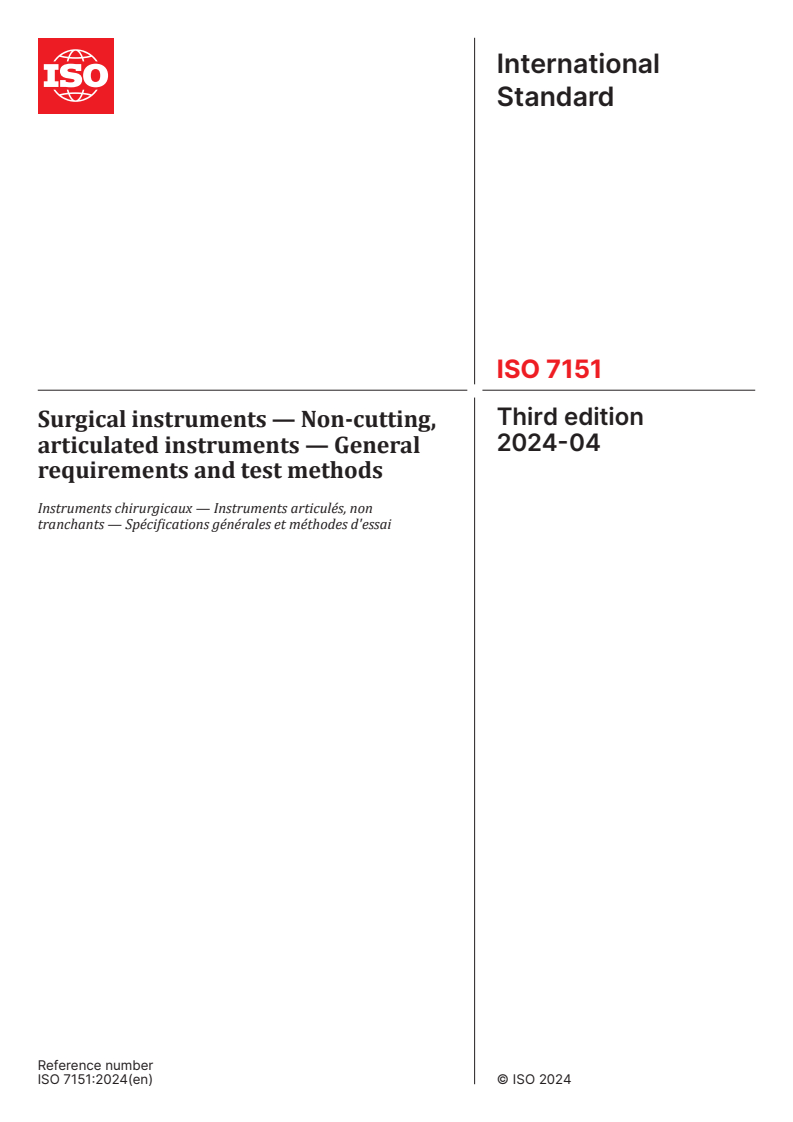
International
Standard
ISO 7151
Third edition
Surgical instruments — Non-cutting,
2024-04
articulated instruments — General
requirements and test methods
Instruments chirurgicaux — Instruments articulés, non
tranchants — Spécifications générales et méthodes d'essai
Reference number
© ISO 2024
All rights reserved. Unless otherwise specified, or required in the context of its implementation, no part of this publication may
be reproduced or utilized otherwise in any form or by any means, electronic or mechanical, including photocopying, or posting on
the internet or an intranet, without prior written permission. Permission can be requested from either ISO at the address below
or ISO’s member body in the country of the requester.
ISO copyright office
CP 401 • Ch. de Blandonnet 8
CH-1214 Vernier, Geneva
Phone: +41 22 749 01 11
Email: copyright@iso.org
Website: www.iso.org
Published in Switzerland
ii
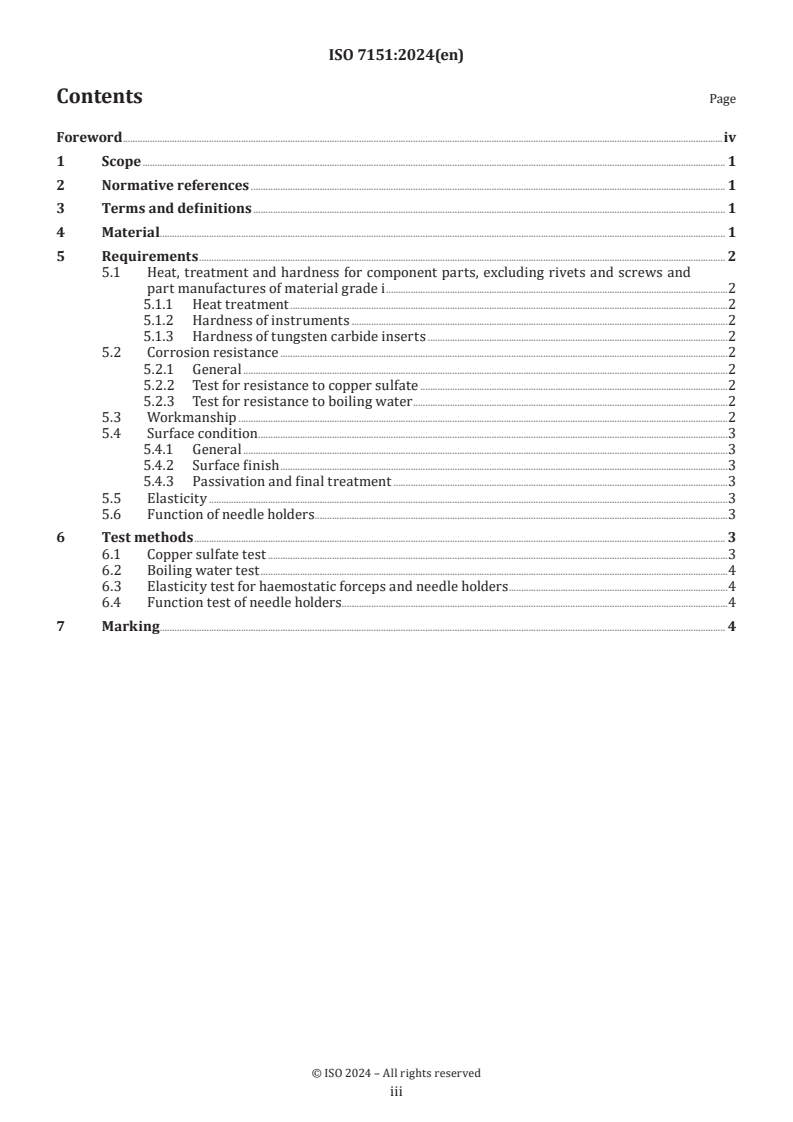
Contents Page
Foreword .iv
1 Scope . 1
2 Normative references . 1
3 Terms and definitions . 1
4 Material. 1
5 Requirements . 2
5.1 Heat, treatment and hardness for component parts, excluding rivets and screws and
part manufactures of material grade i .2
5.1.1 Heat treatment .2
5.1.2 Hardness of instruments .2
5.1.3 Hardness of tungsten carbide inserts .2
5.2 Corrosion resistance .2
5.2.1 General .2
5.2.2 Test for resistance to copper sulfate .2
5.2.3 Test for resistance to boiling water .2
5.3 Workmanship .2
5.4 Surface condition .3
5.4.1 General .3
5.4.2 Surface finish .3
5.4.3 Passivation and final treatment .3
5.5 Elasticity .3
5.6 Function of needle holders .3
6 Test methods . 3
6.1 Copper sulfate test .3
6.2 Boiling water test .4
6.3 Elasticity test for haemostatic forceps and needle holders .4
6.4 Function test of needle holders.4
7 Marking . . 4
iii
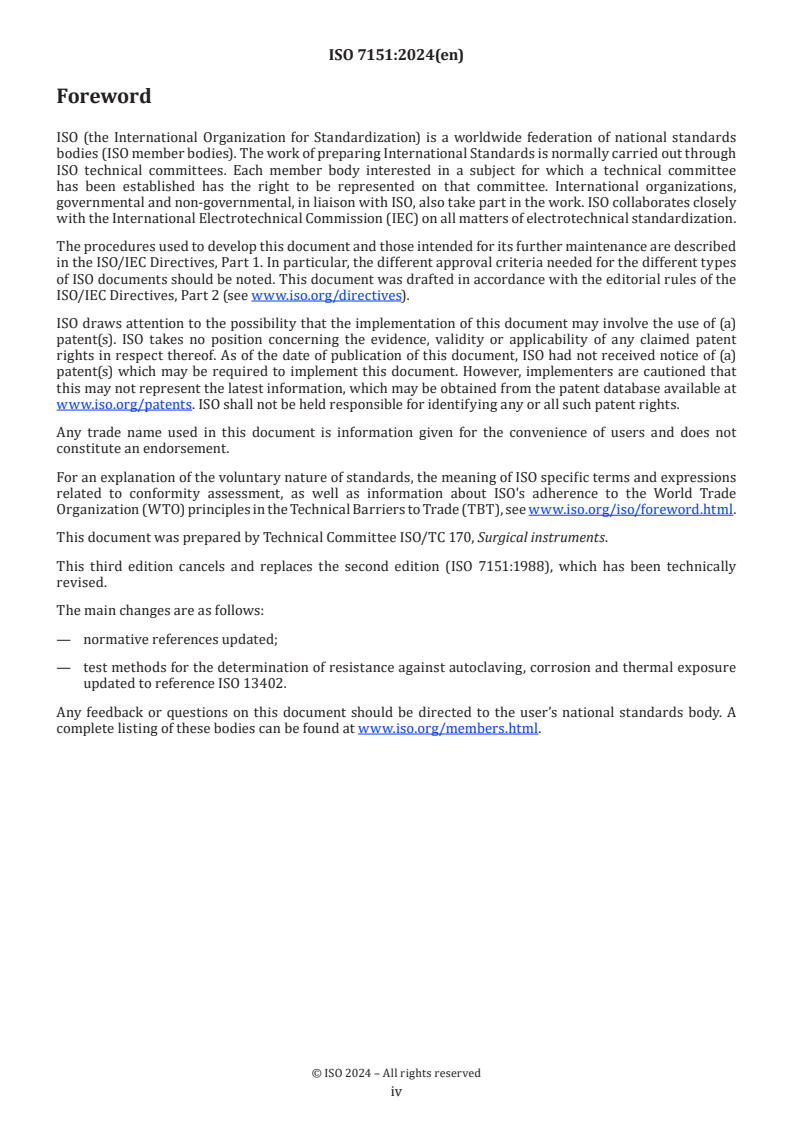
Foreword
ISO (the International Organization for Standardization) is a worldwide federation of national standards
bodies (ISO member bodies). The work of preparing International Standards is normally carried out through
ISO technical committees. Each member body interested in a subject for which a technical committee
has been established has the right to be represented on that committee. International organizations,
governmental and non-governmental, in liaison with ISO, also take part in the work. ISO collaborates closely
with the International Electrotechnical Commission (IEC) on all matters of electrotechnical standardization.
The procedures used to develop this document and those intended for its further maintenance are described
in the ISO/IEC Directives, Part 1. In particular, the different approval criteria needed for the different types
of ISO documents should be noted. This document was drafted in accordance with the editorial rules of the
ISO/IEC Directives, Part 2 (see www.iso.org/directives).
ISO draws attention to the possibility that the implementation of this document may involve the use of (a)
patent(s). ISO takes no position concerning the evidence, validity or applicability of any claimed patent
rights in respect thereof. As of the date of publication of this document, ISO had not received notice of (a)
patent(s) which may be required to implement this document. However, implementers are cautioned that
this may not represent the latest information, which may be obtained from the patent database available at
www.iso.org/patents. ISO shall not be held responsible for identifying any or all such patent rights.
Any trade name used in this document is information given for the convenience of users and does not
constitute an endorsement.
For an explanation of the voluntary nature of standards, the meaning of ISO specific terms and expressions
related to conformity assessment, as well as information about I
...