

ISO/IEC 15459-5:2014
(Main)Information technology — Automatic identification and data capture techniques — Unique identification — Part 5: Individual returnable transport items (RTIs)
General Information
- Abstract
ISO/IEC 15459-5:2014 specifies a unique string of characters for the identification of individual returnable transport items (RTIs). The character string is intended to be represented in a bar code label or other automatic identification and data capture (AIDC) media attached to the item to meet management needs. To address management needs, different classes of identities are recognized in the various parts of ISO/IEC 15459, which allows different requirements to be met by the identities associated with each class. The rules for the identification of RTIs, with the identity being relevant for the complete lifecycle of the item, are defined and supported by example.
- Status
- Published
- Publication Date
- 11-Nov-2014
- Technical Committee
- ISO/IEC JTC 1/SC 31 - Automatic identification and data capture techniques
- Drafting Committee
- ISO/IEC JTC 1/SC 31/WG 2 - Data and structure
- Current Stage
- 9093 - International Standard confirmed
- Start Date
- 31-Oct-2025
- Completion Date
- 29-Aug-2026
Buy Documents
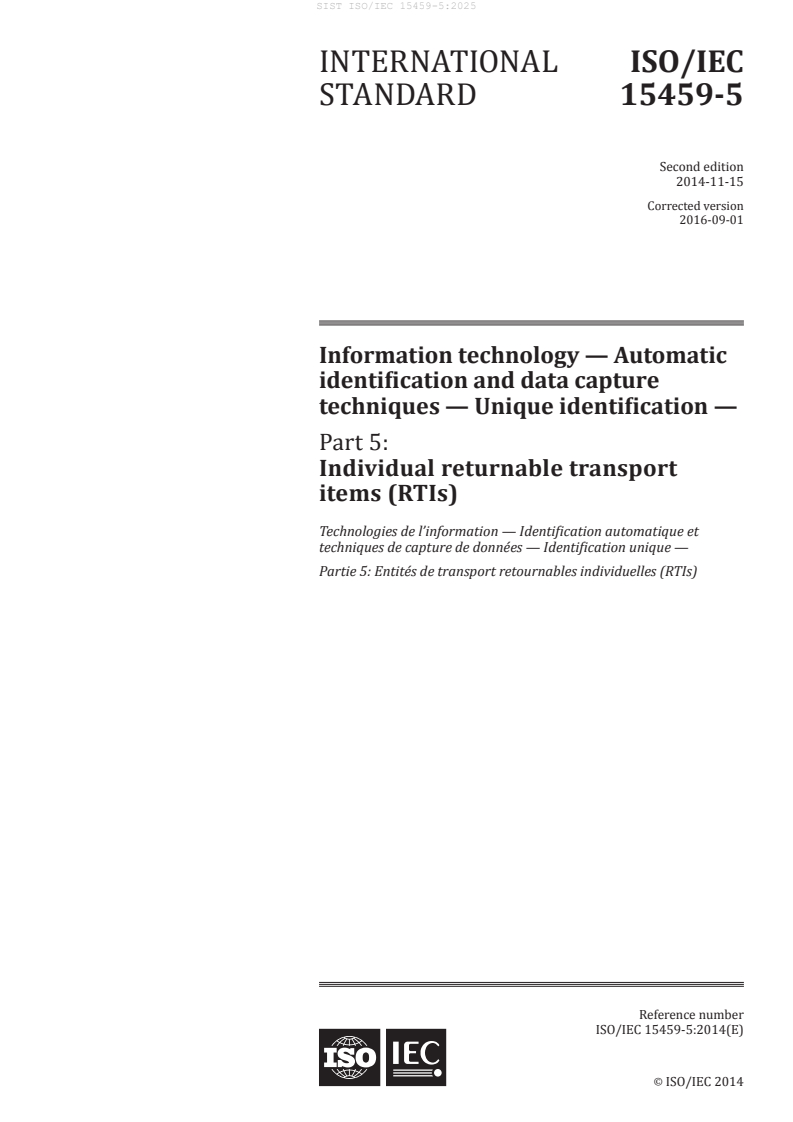


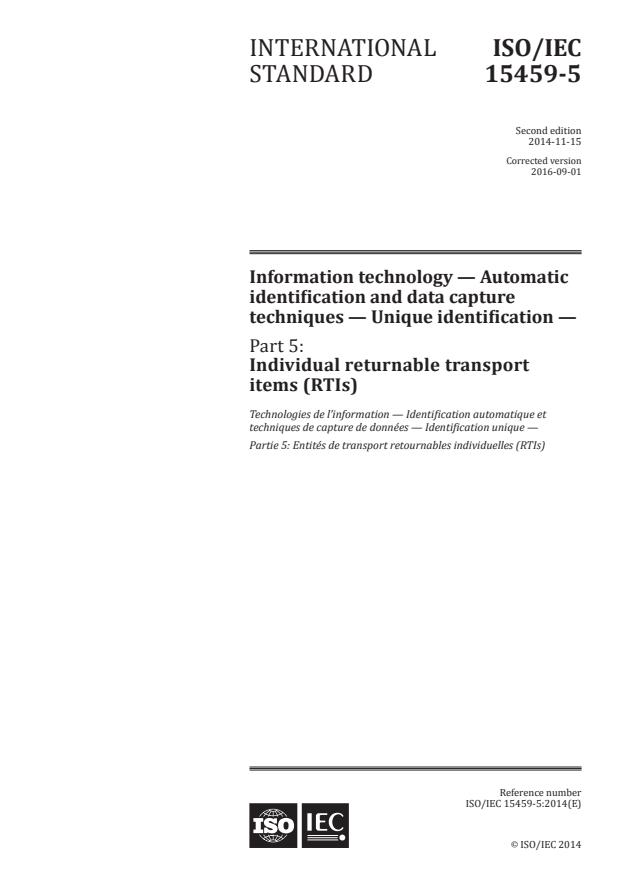

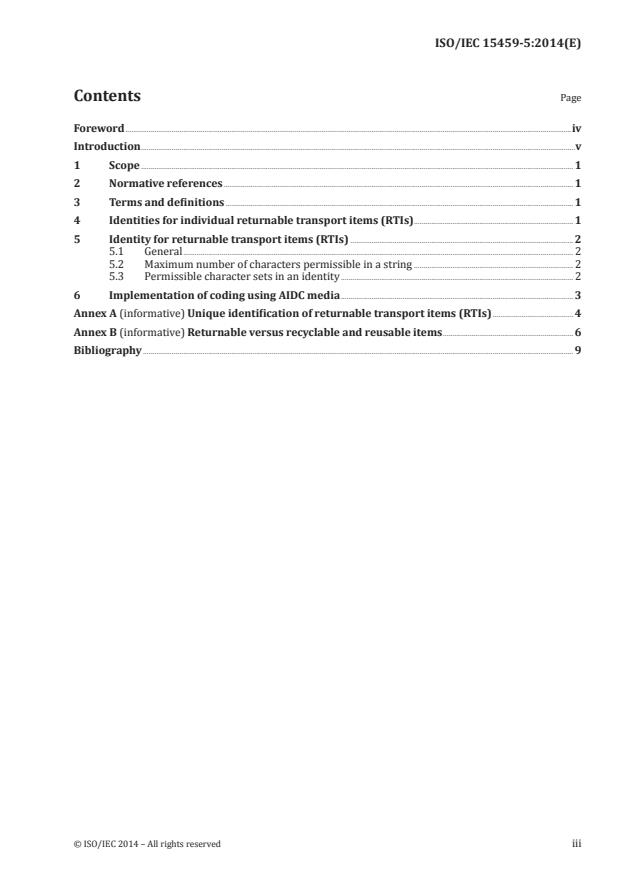
ISO/IEC 15459-5:2014 - Information technology — Automatic identification and data capture techniques — Unique identification — Part 5: Individual returnable transport items (RTIs) Released:9/7/2016
Overview
ISO/IEC 15459-5:2014 specifies a standardized method for uniquely identifying individual returnable transport items (RTIs) using a concise string of characters encoded on a bar code label or other AIDC (automatic identification and data capture) media. The identity is intended to remain valid for the complete lifecycle of the RTI and to act as a prime key for database lookup, tracking, and management across multiple parties in the supply chain.
Keywords: ISO/IEC 15459-5, Returnable Transport Items, RTI identification, AIDC, unique identification, barcode, supply chain asset tracking
Key Topics
- Identity structure: An RTI identity typically includes an Issuing Agency Code (IAC), Company Identification Number (CIN) and a string/component (ID) uniquely assigned by the identity issuer.
- Maximum length: The identity string is limited to 50 characters; for efficiency in linear barcodes it is recommended to keep the string to 20 characters or fewer where possible.
- Permissible characters: Characters must come from the invariant character set ISO/IEC 646. Using only uppercase letters and digits yields more compact encodings.
- Qualifiers and formats: Qualifiers can follow formats supported by ISO/IEC 15434 or ISO/IEC 9834-1. Examples include GS1 Application Identifiers 8003/8004, ASC MH10 Data Identifier 25B, or object identifiers for high-capacity AIDC carriers (e.g., OID forms like "1 0 15459 5").
- Issuing Agency rules: Identity issuance and additional character-repertoire rules are governed by the authorized Issuing Agency (e.g., GS1, ODETTE).
- AIDC implementation: Any AIDC technology (e.g., GS1-128 bar codes, high-capacity carriers) can carry the identity; application standards may be built on the ISO/IEC 15459 identity as the primary key.
Applications
- Reusable packaging and pooling: Unique marking of pallets, crates, cages, totes and other RTIs for return logistics and pooling operations.
- Asset lifecycle management: Persistent identifier for maintenance records, inspection history, and ownership tracking through the RTI lifecycle.
- Logistics and warehousing: Automated scanning for inbound/outbound processing, inventory control, and reverse logistics.
- Industry adoption: Automotive (e.g., ODETTE), retail and logistics organizations (e.g., GS1), pool operators, manufacturers and 3PLs that manage reusable transport assets.
Who should use it
- Logistics managers, asset managers, supply chain engineers, carriers, pool operators, barcode/AIDC integrators and standards implementers who need consistent, interoperable RTI identifiers across organizations.
Related Standards
- ISO/IEC 15459 series (parts 2 and 3)
- ISO/IEC 646 (character set)
- ISO/IEC 15434, ISO/IEC 9834-1 (qualifier/data formats)
- ISO/IEC 19762-1 (AIDC vocabulary)
- GS1 General Specifications, ASC MH10 (industry application guidance)
ISO/IEC 15459-5 provides a practical, interoperable foundation for RTI identification to reduce errors, enable automated scanning and support cross-company tracking of reusable transport items.
Relations
- Effective Date
- 20-Feb-2026
- Effective Date
- 09-Feb-2026
- Effective Date
- 11-Jul-2009
Buy Documents
ISO/IEC 15459-5:2014 - Information technology — Automatic identification and data capture techniques — Unique identification — Part 5: Individual returnable transport items (RTIs) Released:9/7/2016
Get Certified
Connect with accredited certification bodies for this standard

BSI Group
BSI (British Standards Institution) is the business standards company that helps organizations make excellence a habit.

NYCE
Mexican standards and certification body.
Sponsored listings
Frequently Asked Questions
ISO/IEC 15459-5:2014 is a standard published by the International Organization for Standardization (ISO). Its full title is "Information technology — Automatic identification and data capture techniques — Unique identification — Part 5: Individual returnable transport items (RTIs)". This standard covers: ISO/IEC 15459-5:2014 specifies a unique string of characters for the identification of individual returnable transport items (RTIs). The character string is intended to be represented in a bar code label or other automatic identification and data capture (AIDC) media attached to the item to meet management needs. To address management needs, different classes of identities are recognized in the various parts of ISO/IEC 15459, which allows different requirements to be met by the identities associated with each class. The rules for the identification of RTIs, with the identity being relevant for the complete lifecycle of the item, are defined and supported by example.
ISO/IEC 15459-5:2014 specifies a unique string of characters for the identification of individual returnable transport items (RTIs). The character string is intended to be represented in a bar code label or other automatic identification and data capture (AIDC) media attached to the item to meet management needs. To address management needs, different classes of identities are recognized in the various parts of ISO/IEC 15459, which allows different requirements to be met by the identities associated with each class. The rules for the identification of RTIs, with the identity being relevant for the complete lifecycle of the item, are defined and supported by example.
ISO/IEC 15459-5:2014 is classified under the following ICS (International Classification for Standards) categories: 35.040 - Information coding; 35.040.50 - Automatic identification and data capture techniques. The ICS classification helps identify the subject area and facilitates finding related standards.
ISO/IEC 15459-5:2014 has the following relationships with other standards: It is inter standard links to EN 62090:2017, EN 17230:2020, ISO/IEC 15459-5:2007. Understanding these relationships helps ensure you are using the most current and applicable version of the standard.
ISO/IEC 15459-5:2014 is available in PDF format for immediate download after purchase. The document can be added to your cart and obtained through the secure checkout process. Digital delivery ensures instant access to the complete standard document.
Standards Content (Sample)
SLOVENSKI STANDARD
01-junij-2025
Informacijska tehnologija - Tehnike za samodejno razpoznavanje in zajem
podatkov - Enotna identifikacija - 5. del: Posamezni vračljivi transportni predmeti
Information technology — Automatic identification and data capture techniques —
Unique identification — Part 5: Individual returnable transport items (RTIs)
Technologies de l'information — Identification automatique et techniques de capture de
données — Identification unique — Partie 5: Entités de transport retournables
individuelles (RTIs)
Ta slovenski standard je istoveten z: ISO/IEC 15459-5:2014
ICS:
35.040.50 Tehnike za samodejno Automatic identification and
razpoznavanje in zajem data capture techniques
podatkov
2003-01.Slovenski inštitut za standardizacijo. Razmnoževanje celote ali delov tega standarda ni dovoljeno.
INTERNATIONAL ISO/IEC
STANDARD 15459-5
Second edition
2014-11-15
Corrected version
2016-09-01
Information technology — Automatic
identification and data capture
techniques — Unique identification —
Part 5:
Individual returnable transport
items (RTIs)
Technologies de l’information — Identification automatique et
techniques de capture de données — Identification unique —
Partie 5: Entités de transport retournables individuelles (RTIs)
Reference number
©
ISO/IEC 2014
© ISO/IEC 2014, Published in Switzerland
All rights reserved. Unless otherwise specified, no part of this publication may be reproduced or utilized otherwise in any form
or by any means, electronic or mechanical, including photocopying, or posting on the internet or an intranet, without prior
written permission. Permission can be requested from either ISO at the address below or ISO’s member body in the country of
the requester.
ISO copyright office
Ch. de Blandonnet 8 • CP 401
CH-1214 Vernier, Geneva, Switzerland
Tel. +41 22 749 01 11
Fax +41 22 749 09 47
copyright@iso.org
www.iso.org
ii © ISO/IEC 2014 – All rights reserved
Contents Page
Foreword .iv
Introduction .v
1 Scope . 1
2 Normative references . 1
3 Terms and definitions . 1
4 Identities for individual returnable transport items (RTIs) . 1
5 Identity for returnable transport items (RTIs) . 2
5.1 General . 2
5.2 Maximum number of characters permissible in a string . 2
5.3 Permissible character sets in an identity . 2
6 Implementation of coding using AIDC media . 3
Annex A (informative) Unique identification of returnable transport items (RTIs) .4
Annex B (informative) Returnable versus recyclable and reusable items .6
Bibliography . 9
© ISO/IEC 2014 – All rights reserved iii
Foreword
ISO (the International Organization for Standardization) and IEC (the International Electrotechnical
Commission) form the specialized system for worldwide standardization. National bodies that are
members of ISO or IEC participate in the development of International Standards through technical
committees established by the respective organization to deal with particular fields of technical
activity. ISO and IEC technical committees collaborate in fields of mutual interest. Other international
organizations, governmental and non-governmental, in liaison with ISO and IEC, also take part in the
work. In the field of information technology, ISO and IEC have established a joint technical committee,
ISO/IEC JTC 1.
The procedures used to develop this document and those intended for its further maintenance are
described in the ISO/IEC Directives, Part 1. In particular the different approval criteria needed for
the different types of document should be noted. This document was drafted in accordance with the
editorial rules of the ISO/IEC Directives, Part 2 (see www.iso.org/directives).
Attention is drawn to the possibility that some of the elements of this document may be the subject
of patent rights. ISO and IEC shall not be held responsible for identifying any or all such patent
rights. Details of any patent rights identified during the development of the document will be in the
Introduction and/or on the ISO list of patent declarations received (see www.iso.org/patents).
Any trade name used in this document is information given for the convenience of users and does not
constitute an endorsement.
For an explanation on the meaning of ISO specific terms and expressions related to conformity
assessment, as well as information about ISO’s adherence to the WTO principles in the Technical
Barriers to Trade (TBT) see the following URL: Foreword - Supplementary information
The committee responsible for this document is ISO/IEC JTC 1, Information technology; Subcommittee
SC 31, Automatic identification and data capture techniques.
This second edition cancels and replaces the first edition (ISO/IEC 15459-5:2007), which has been
technically revised.
This corrected version of ISO/IEC 15459-5:2014 incorporates the following correction plus other minor
editorial modifications. Clause 5.3 has been modified as follows:
“5.3 Permissible character sets in an identity
The identity shall use alphabetic, numeric and special characters from the invariant character set
ISO/IEC 646, see Annex A in ISO/IEC 15459-3.
More compact data encoding may be attained by using only upper case alphabetic characters and
numeric digits.
An Issuing Agency may have additional requirements on the repertoire of characters found within
identities using its IAC.
Any data processing system shall be capable of processing identities using the full repertoire of
characters permitted by ISO/IEC 646.”
A list of all parts in the ISO/IEC 15459 series can be found on the ISO website.
iv © ISO/IEC 2014 – All rights reserved
Introduction
Unique identities can occur at many different levels, at item level, on the transport unit, on the
returnable transport item, at grouping levels, and elsewhere. Such entities are often handled by several
parties, both public and private, throughout their lifecycle. Each of these parties must be able to identify
and trace such distinct entities so that reference can be made to associated information such as quality
inspection data, the chemical substance contained, the batch or lot number of parts, components or raw
materials, etc.
The associated information is typically held in some kind of database. The information can be accessed
using EDI exchange or another appropriate access protocol, e.g. a directory access protocol. There are
considerable benefits if the identity of the entity is represented as a bar code or other AIDC (Automatic
Identification and Data Capture) media and attached to or made a constituent part of that which is
being uniquely identified so that
— it can be read electronically, thus minimizing errors;
— one identity can be used by all parties;
— each party can use the identity to look up its computer files to find the data associated with the entity.
All AIDC technologies have the potential to encode an identity. It is expected that application standards,
using various automatic identification technologies, will be developed based upon the identity as a prime
key. These application standards, which can include additional rules for which level of identification
should be used, are often made available from the Issuing Agency.
The identity for returnable transport items (RTIs) defined in this part of ISO/IEC 15459, and represented
in AIDC media attached to the RTIs, meets the needs defined in ISO/IEC 15459-3, Common rules.
© ISO/IEC 2014 – All rights reserved v
INTERNATIONAL STANDARD ISO/IEC 15459-5:2014(E)
Information technology — Automatic identification and
data capture techniques — Unique identification —
Part 5:
Individual returnable transport items (RTIs)
1 Scope
This part of ISO/IEC 15459 specifies a unique string of characters for the identification of individual
returnable transport items (RTIs). The character string is intended to be represented in a bar code
label or other AIDC media attached to the item to meet management needs. To address management
needs different classes of identities are recognized in the various parts of ISO/IEC 15459, which allows
different requirements to be met by the identities associated with each class.
The rules for the identification for RTIs, with the identity being relevant for the complete life cycle of
the item, are defined and supported by example.
2 Normative references
The following documents, in whole or in part, are normatively referenced in this document and are
indispensable for its application. For dated references, only the edition cited applies. For undated
references, the latest edition of the referenced document (including any amendments) applies.
ISO/IEC 646, Information technology — ISO 7-bit coded character set for information interchange
ISO/IEC 15459-2, Information technology — Automatic identification and data capture techniques —
Unique identification — Part 2: Registration procedures
ISO/IEC 15459-3, Information technology — Automatic identification and data capture techniques —
Unique identification — Part 3: Common rules
ISO/IEC 19762-1, Information technology — Automatic identification and data capture (AIDC)
techniques — Harmonized vocabulary — Part 1: General terms relating to AIDC
GS1 General Specifications
3 Terms and definitions
For the purposes of this document, the terms and definitions given in ISO/IEC 19762-1 and
ISO/IEC 15459-3 apply.
ISO and IEC maintain terminological databases for use in standardization at the following addresses:
— IEC Ele
...
INTERNATIONAL ISO/IEC
STANDARD 15459-5
Second edition
2014-11-15
Corrected version
2016-09-01
Information technology — Automatic
identification and data capture
techniques — Unique identification —
Part 5:
Individual returnable transport
items (RTIs)
Technologies de l’information — Identification automatique et
techniques de capture de données — Identification unique —
Partie 5: Entités de transport retournables individuelles (RTIs)
Reference number
©
ISO/IEC 2014
© ISO/IEC 2014, Published in Switzerland
All rights reserved. Unless otherwise specified, no part of this publication may be reproduced or utilized otherwise in any form
or by any means, electronic or mechanical, including photocopying, or posting on the internet or an intranet, without prior
written permission. Permission can be requested from either ISO at the address below or ISO’s member body in the country of
the requester.
ISO copyright office
Ch. de Blandonnet 8 • CP 401
CH-1214 Vernier, Geneva, Switzerland
Tel. +41 22 749 01 11
Fax +41 22 749 09 47
copyright@iso.org
www.iso.org
ii © ISO/IEC 2014 – All rights reserved
Contents Page
Foreword .iv
Introduction .v
1 Scope . 1
2 Normative references . 1
3 Terms and definitions . 1
4 Identities for individual returnable transport items (RTIs) . 1
5 Identity for returnable transport items (RTIs) . 2
5.1 General . 2
5.2 Maximum number of characters permissible in a string . 2
5.3 Permissible character sets in an identity . 2
6 Implementation of coding using AIDC media . 3
Annex A (informative) Unique identification of returnable transport items (RTIs) .4
Annex B (informative) Returnable versus recyclable and reusable items .6
Bibliography . 9
© ISO/IEC 2014 – All rights reserved iii
Foreword
ISO (the International Organization for Standardization) and IEC (the International Electrotechnical
Commission) form the specialized system for worldwide standardization. National bodies that are
members of ISO or IEC participate in the development of International Standards through technical
committees established by the respective organization to deal with particular fields of technical
activity. ISO and IEC technical committees collaborate in fields of mutual interest. Other international
organizations, governmental and non-governmental, in liaison with ISO and IEC, also take part in the
work. In the field of information technology, ISO and IEC have established a joint technical committee,
ISO/IEC JTC 1.
The procedures used to develop this document and those intended for its further maintenance are
described in the ISO/IEC Directives, Part 1. In particular the different approval criteria needed for
the different types of document should be noted. This document was drafted in accordance with the
editorial rules of the ISO/IEC Directives, Part 2 (see www.iso.org/directives).
Attention is drawn to the possibility that some of the elements of this document may be the subject
of patent rights. ISO and IEC shall not be held responsible for identifying any or all such patent
rights. Details of any patent rights identified during the development of the document will be in the
Introduction and/or on the ISO list of patent declarations received (see www.iso.org/patents).
Any trade name used in this document is information given for the convenience of users and does not
constitute an endorsement.
For an explanation on the meaning of ISO specific terms and expressions related to conformity
assessment, as well as information about ISO’s adherence to the WTO principles in the Technical
Barriers to Trade (TBT) see the following URL: Foreword - Supplementary information
The committee responsible for this document is ISO/IEC JTC 1, Information technology; Subcommittee
SC 31, Automatic identification and data capture techniques.
This second edition cancels and replaces the first edition (ISO/IEC 15459-5:2007), which has been
technically revised.
This corrected version of ISO/IEC 15459-5:2014 incorporates the following correction plus other minor
editorial modifications. Clause 5.3 has been modified as follows:
“5.3 Permissible character sets in an identity
The identity shall use alphabetic, numeric and special characters from the invariant character set
ISO/IEC 646, see Annex A in ISO/IEC 15459-3.
More compact data encoding may be attained by using only upper case alphabetic characters and
numeric digits.
An Issuing Agency may have additional requirements on the repertoire of characters found within
identities using its IAC.
Any data processing system shall be capable of processing identities using the full repertoire of
characters permitted by ISO/IEC 646.”
A list of all parts in the ISO/IEC 15459 series can be found on the ISO website.
iv © ISO/IEC 2014 – All rights reserved
Introduction
Unique identities can occur at many different levels, at item level, on the transport unit, on the
returnable transport item, at grouping levels, and elsewhere. Such entities are often handled by several
parties, both public and private, throughout their lifecycle. Each of these parties must be able to identify
and trace such distinct entities so that reference can be made to associated information such as quality
inspection data, the chemical substance contained, the batch or lot number of parts, components or raw
materials, etc.
The associated information is typically held in some kind of database. The information can be accessed
using EDI exchange or another appropriate access protocol, e.g. a directory access protocol. There are
considerable benefits if the identity of the entity is represented as a bar code or other AIDC (Automatic
Identification and Data Capture) media and attached to or made a constituent part of that which is
being uniquely identified so that
— it can be read electronically, thus minimizing errors;
— one identity can be used by all parties;
— each party can use the identity to look up its computer files to find the data associated with the entity.
All AIDC technologies have the potential to encode an identity. It is expected that application standards,
using various automatic identification technologies, will be developed based upon the identity as a prime
key. These application standards, which can include additional rules for which level of identification
should be used, are often made available from the Issuing Agency.
The identity for returnable transport items (RTIs) defined in this part of ISO/IEC 15459, and represented
in AIDC media attached to the RTIs, meets the needs defined in ISO/IEC 15459-3, Common rules.
© ISO/IEC 2014 – All rights reserved v
INTERNATIONAL STANDARD ISO/IEC 15459-5:2014(E)
Information technology — Automatic identification and
data capture techniques — Unique identification —
Part 5:
Individual returnable transport items (RTIs)
1 Scope
This part of ISO/IEC 15459 specifies a unique string of characters for the identification of individual
returnable transport items (RTIs). The character string is intended to be represented in a bar code
label or other AIDC media attached to the item to meet management needs. To address management
needs different classes of identities are recognized in the various parts of ISO/IEC 15459, which allows
different requirements to be met by the identities associated with each class.
The rules for the identification for RTIs, with the identity being relevant for the complete life cycle of
the item, are defined and supported by example.
2 Normative references
The following documents, in whole or in part, are normatively referenced in this document and are
indispensable for its application. For dated references, only the edition cited applies. For undated
references, the latest edition of the referenced document (including any amendments) applies.
ISO/IEC 646, Information technology — ISO 7-bit coded character set for information interchange
ISO/IEC 15459-2, Information technology — Automatic identification and data capture techniques —
Unique identification — Part 2: Registration procedures
ISO/IEC 15459-3, Information technology — Automatic identification and data capture techniques —
Unique identification — Part 3: Common rules
ISO/IEC 19762-1, Information technology — Automatic identification and data capture (AIDC)
techniques — Harmonized vocabulary — Part 1: General terms relating to AIDC
GS1 General Specifications
3 Terms and definitions
For the purposes of this document, the terms and definitions given in ISO/IEC 19762-1 and
ISO/IEC 15459-3 apply.
ISO and IEC maintain terminological databases for use in standardization at the following addresses:
— IEC Electropedia: available at http://www.electropedia.org/
— ISO Online browsing platform: available at http://www.iso.org/obp
4 Identities for individual returnable transport items (RTIs)
Each individual RTI shall be unambiguously identified by a qualifier and a string as defined in Clause 5
so that individual items of this type can be distinguished from items of other types.
© ISO/IEC 2014 – All rights reserved 1
The qualifier component of an identity for a returnable transport item may use any data format
supported
...