

ISO 9717:2024
(Main)Metallic and other inorganic coatings — Phosphate conversion coating of metals
General Information
- Abstract
This document specifies the requirements for phosphate conversion coatings which are usually destined for application on ferrous materials, aluminium, zinc, and their alloys (see Annex B).
- Status
- Published
- Publication Date
- 09-Jul-2024
- Technical Committee
- ISO/TC 107/SC 8 - Chemical conversion coatings
- Drafting Committee
- ISO/TC 107/SC 8 - Chemical conversion coatings
- Current Stage
- 6060 - International Standard published
- Start Date
- 10-Jul-2024
- Due Date
- 02-Aug-2024
- Completion Date
- 10-Jul-2024
Buy Documents

ISO 9717:2024 - Metallic and other inorganic coatings — Phosphate conversion coating of metals/10/2024

ISO 9717:2024 - Revêtements métalliques et autres revêtements inorganiques — Couches de conversion au phosphate sur métaux/10/2024
Overview
ISO 9717:2024 – Metallic and other inorganic coatings - Phosphate conversion coating of metals is the latest revision from the International Organization for Standardization (ISO) that specifies the requirements for phosphate conversion coatings. These coatings are commonly applied to ferrous materials, aluminum, zinc, and their alloys to enhance corrosion resistance, improve paint adhesion, facilitate cold forming processes, and modify surface friction properties.
Phosphate conversion coatings are developed by treating metal substrates with chemical solutions, principally based on dihydrogen orthophosphates. The result is a crystalline, porous layer that can be further sealed for enhanced protection. This standard addresses factors such as coating type designation, process requirements, post treatments, and quality assurance procedures.
Key Topics
Coating Types and Designation
The standard defines various phosphate conversion coatings such as iron (Feph), manganese (Mnph), zinc (Znph), zinc-calcium (ZnCaph), and mixed-metal coatings. Each type serves specific performance and application needs.Material Applicability
Phosphate coatings specified in ISO 9717 are applicable to a range of metals including steel, aluminum, zinc, and their alloys. Selection considers the substrate and intended end-use.Quality and Performance Requirements
Requirements include:- Even surface coverage without defects
- Coating mass per unit area, measured gravimetrically
- Compliance with specified appearance criteria
- Implementation of suitable post treatments for corrosion protection
Risk Management
Particular consideration is given to hydrogen embrittlement risk, especially for high-strength steels, ensuring correct processing and potential heat treatment as per customer requirements.Testing and Inspection
Corrosion resistance is typically verified using neutral salt spray tests (ISO 9227). Sampling and testing requirements may reference ISO 3892 and ISO 4519. The area-related mass is preferred for characterization over traditional thickness measures due to the coating’s porous structure.
Applications
Phosphate conversion coatings offer significant benefits across multiple industrial applications:
Corrosion Resistance
Often applied to components in automotive, construction, and appliance manufacturing to protect base metals during storage, transport, and service.Adhesion Improvement
These coatings promote adhesion of paints, varnishes, and organic coatings, enhancing the durability and quality of finished products.Cold Forming Operations
Zinc and manganese phosphate coatings are commonly used as preparation layers for processes such as wire drawing, tube forming, and cold extrusion, reducing friction and wear.Surface Modification
Manganese phosphate coatings, in particular, are used to alter tribological properties-reducing friction and improving the sliding action of mechanical components.Temporary and Final Coatings
With appropriate post treatments (varnish, oils, waxes), phosphate coatings can provide both interim and long-term protection depending on the exposure conditions.
Related Standards
ISO 9717:2024 is complemented by a range of related standards, ensuring a comprehensive approach to quality and applicability:
- ISO 2080: Vocabulary for surface treatment and coatings
- ISO 3892: Methods for determining coating mass
- ISO 4519: Sampling procedures for metallic coatings
- ISO 9227: Salt spray corrosion test procedures
- ISO 9588: Post-coating treatments to minimize hydrogen embrittlement
- ISO 27830: Designation requirements for metallic and inorganic coatings
Adherence to these standards ensures robust performance, safety, and compatibility of phosphate conversion coatings in industrial applications.
ISO 9717:2024 sets forth an internationally recognized framework for phosphate conversion coatings, guiding manufacturers, processors, and end-users toward optimized surface protection and functional performance. Integrating this standard into your processes supports compliance, product reliability, and enhanced commercialization in competitive markets.
Relations
- Referred By
EN ISO 8742:2026 - Fasteners - Grooved pins - One-third-length center grooves (ISO 8742:2026) - Effective Date
- 15-Jul-2026
- Effective Date
- 15-Jul-2026
- Referred By
EN ISO 8745:2025 - Fasteners - Taper grooved pins - Half-length progressive grooves (ISO 8745:2025) - Effective Date
- 09-Feb-2026
- Effective Date
- 09-Feb-2026
- Effective Date
- 09-Feb-2026
- Effective Date
- 09-Feb-2026
- Referred By
EN ISO 8744:2025 - Fasteners - Taper grooved pins - Full-length progressive grooves (ISO 8744:2025) - Effective Date
- 09-Feb-2026
- Referred By
EN ISO 13672:2025 - Fasteners - Parallel grooved pins - Half-length diamond grooves (ISO 13672:2025) - Effective Date
- 09-Feb-2026
- Effective Date
- 09-Feb-2026
- Effective Date
- 09-Feb-2026
- Effective Date
- 09-Feb-2026
- Effective Date
- 12-Feb-2026
- Effective Date
- 06-Jun-2022
- Revises
ISO 9717:2017 - Metallic and other inorganic coatings — Phosphate conversion coating of metals - Effective Date
- 06-Jun-2022
Buy Documents
ISO 9717:2024 - Metallic and other inorganic coatings — Phosphate conversion coating of metals/10/2024
ISO 9717:2024 - Revêtements métalliques et autres revêtements inorganiques — Couches de conversion au phosphate sur métaux/10/2024
Get Certified
Connect with accredited certification bodies for this standard

DVS-ZERT GmbH
German welding certification society.
CARES (UK Certification Authority for Reinforcing Steels)
UK certification for reinforcing steels and construction.
EWF/IIW (European/International Welding Federation)
International welding personnel certification.
Sponsored listings
Frequently Asked Questions
ISO 9717:2024 is a standard published by the International Organization for Standardization (ISO). Its full title is "Metallic and other inorganic coatings — Phosphate conversion coating of metals". This standard covers: This document specifies the requirements for phosphate conversion coatings which are usually destined for application on ferrous materials, aluminium, zinc, and their alloys (see Annex B).
This document specifies the requirements for phosphate conversion coatings which are usually destined for application on ferrous materials, aluminium, zinc, and their alloys (see Annex B).
ISO 9717:2024 is classified under the following ICS (International Classification for Standards) categories: 25.220.20 - Surface treatment. The ICS classification helps identify the subject area and facilitates finding related standards.
ISO 9717:2024 has the following relationships with other standards: It is inter standard links to EN ISO 8742:2026, EN ISO 8743:2026, EN ISO 8745:2025, EN ISO 8747:2025, EN ISO 13670:2025, EN ISO 8739:2025, EN ISO 8744:2025, EN ISO 13672:2025, EN ISO 8746:2025, EN ISO 8740:2025, EN ISO 8741:2025, EN ISO 9717:2024, ISO 11681-2:2022, ISO 9717:2017. Understanding these relationships helps ensure you are using the most current and applicable version of the standard.
ISO 9717:2024 is available in PDF format for immediate download after purchase. The document can be added to your cart and obtained through the secure checkout process. Digital delivery ensures instant access to the complete standard document.
Standards Content (Sample)
International
Standard
ISO 9717
Fourth edition
Metallic and other inorganic
2024-07
coatings — Phosphate conversion
coating of metals
Revêtements métalliques et autres revêtements inorganiques —
Couches de conversion au phosphate sur métaux
Reference number
© ISO 2024
All rights reserved. Unless otherwise specified, or required in the context of its implementation, no part of this publication may
be reproduced or utilized otherwise in any form or by any means, electronic or mechanical, including photocopying, or posting on
the internet or an intranet, without prior written permission. Permission can be requested from either ISO at the address below
or ISO’s member body in the country of the requester.
ISO copyright office
CP 401 • Ch. de Blandonnet 8
CH-1214 Vernier, Geneva
Phone: +41 22 749 01 11
Email: copyright@iso.org
Website: www.iso.org
Published in Switzerland
ii
Contents Page
Foreword .iv
Introduction .vi
1 Scope . 1
2 Normative references . 1
3 Terms and definitions . 1
4 Information to be supplied by the purchaser to the processor . 1
5 Coating types and their importance . 2
5.1 Coating types .2
5.2 Designation of phosphate conversion coating .2
5.3 Example for designation of phosphate conversion coating .3
6 Requirements . 3
6.1 Appearance .3
6.2 Coating mass per unit area .3
6.3 Post treatment .3
6.4 Correlation of coating thickness and area related mass .4
7 Heat treatment . 4
Annex A (normative) Determination of phosphate conversion coating resistance to neutral salt
spray test . 5
Annex B (informative) General information . 8
Annex C (informative) Identification of phosphate conversion coating .11
Bibliography .13
iii
Foreword
ISO (the International Organization for Standardization) is a worldwide federation of national standards
bodies (ISO member bodies). The work of preparing International Standards is normally carried out through
ISO technical committees. Each member body interested in a subject for which a technical committee
has been established has the right to be represented on that committee. International organizations,
governmental and non-governmental, in liaison with ISO, also take part in the work. ISO collaborates closely
with the International Electrotechnical Commission (IEC) on all matters of electrotechnical standardization.
The procedures used to develop this document and those intended for its further maintenance are described
in the ISO/IEC Directives, Part 1. In particular, the different approval criteria needed for the different types
of ISO document should be noted. This document was drafted in accordance with the editorial rules of the
ISO/IEC Directives, Part 2 (see www.iso.org/directives).
ISO draws attention to the possibility that the implementation of this document may involve the use of (a)
patent(s). ISO takes no position concerning the evidence, validity or applicability of any claimed patent
rights in respect thereof. As of the date of publication of this document, ISO had not received notice of (a)
patent(s) which may be required to implement this document. However, implementers are cautioned that
this may not represent the latest information, which may be obtained from the patent database available at
www.iso.org/patents. ISO shall not be held responsible for identifying any or all such patent rights.
Any trade name used in this document is information given for the convenience of users and does not
constitute an endorsement.
For an explanation of the voluntary nature of standards, the meaning of ISO specific terms and expressions
related to conformity assessment, as well as information about ISO's adherence to the World Trade
Organization (WTO) principles in the Technical Barriers to Trade (TBT), see www.iso.org/iso/foreword.html.
This document was prepared by Technical Committee ISO/TC 107, Metallic and other inorganic coatings,
Subcommittee SC 8, Chemical conversion coatings, in collaboration with the European Committee for
Standardization (CEN) Technical Committee CEN/TC 262, Metallic and other inorganic coatings, including for
corrosion protection and corrosion testing of metals and alloys, in accordance with the Agreement on technical
cooperation between ISO and CEN (Vienna Agreement).
This fourth edition cancels and replaces the third edition (ISO 9717:2017), which has been technically
revised.
The main changes are as follows:
— the introduction has been clarified (1 bracket shifted);
— 5.1 Table 1 formatted and for Znph second line added to describe types of Znph; new Table 1 copied on
Table C.1
— 5.2 and ff.: all terms are uniformed from “phosphate coating” or “conversion coating” to “phosphate
conversion coating” (when applicable);
— 5.2 and ff.: “after-treatment” was changed to “post treatment”; other definitions and spelling changed
according to ISO 2080;
— 6.3 Table 2: definition of T1 recharged, second sentence deleted (this is content of T2);
— 6.3: last sentence updated to describe impact of neutral salt spray test;
— 6.4: revision of 6.4, thickness measurement replaced by area related mass;
— Annex B: last sentence of B.1 deleted: Table B.1 updated;
— Annex B: Table B.1 and B.3 headlines updated;
— Annex B: Table B.4 headline updated;
iv
— Annex C: the element nickel has been added to C.1, C.2.3, C.2.5 and C.4; ICP was added as method to C.2.3;
XRF was added as method to C.3.
Any feedback or questions on this document should be directed to the user’s national standards body. A
complete listing of these bodies can be found at www.iso.org/members.html.
v
Introduction
Phosphate conversion coatings are produced by treating substrates with appropriate solutions. The main
constituents of these solutions are the appropriate dihydrogen orthophosphates.
They are intended to
— impart corrosion resistance,
— improve adhesion to paints and other organic finishes,
— facilitate cold-forming operations, such as wire drawing, tube drawing and extrusion, and
— modify surface frictional properties to facilitate sliding.
Phosphate conversion coatings are produced by treatment with solutions, the main constituents of which are
the appropriate dihydrogen orthophosphates. These phosphate conversion coatings are applied principally
to ferrous materials and zinc, and differ in coating mass per unit area and apparent density, depending on
— the construction material and surface condition of the components,
— previous mechanical and chemical treatment of the components, and
— processing conditions for phosphating.
All phosphate conversion coatings are crystalline and porous but can be sealed substantially by subsequent
sealant processes.
vi
International Standard ISO 9717:2024(en)
Metallic and other inorganic coatings — Phosphate
conversion coating of metals
WARNING — This document calls for the use of substances and/or procedures that could be injurious
to health if adequate safety measures are not taken. This document does not address any health
hazards, safety or environmental matters associated with its use. It is the responsibility of the
producers, purchasers and/or users of this document to establish appropriate health, safety and
environmentally acceptable practices and take appropriate actions.
1 Scope
This document specifies the requirements for phosphate conversion coatings which are usually destined for
application on ferrous materials, aluminium, zinc, and their alloys (see Annex B).
2 Normative references
The following documents are referred to in the text in such a way that some or all of their content constitutes
requirements of this document. For dated references, only the edition cited applies. For undated references,
the latest edition of the referenced document (including any amendments) applies.
ISO 2080, Metallic and other inorganic coatings — Surface treatment, metallic and other inorganic coatings —
Vocabulary
ISO 3892, Conversion coatings on metallic materials — Determination of coating mass per unit area —
Gravimetric methods
ISO 4519, Electrodeposited metallic coatings and related finishes — Sampling procedures for inspection by
attributes
ISO 9227, Corrosion tests in artificial atmospheres — Salt spray tests
ISO 9588, Metallic and other inorganic coatings — Post-coating treatments of iron or steel to reduce the risk of
hydrogen embrittlement
3 Terms and definitions
For the purposes of this document, the terms and definitions given in ISO 2080 apply.
ISO and IEC maintain terminology databases for use in standardization at the following addresses:
— ISO Online browsing platform: available at https:// www .iso .org/ obp
— IEC Electropedia: available at https:// www .electropedia .org/
4 Information to be supplied by the purchaser to the processor
The following information shall be provided by the purchaser:
a) a description of the phosphate conversion coating according to this document, i.e., ISO 9717 (see 5.2);
b) in cases of phosphating steel parts with tensile strength ≥ 1 000 MPa, also in locally restricted areas
(e.g. for case-hardened or cold-formed structures or in weld seam areas) the safety against brittle
fracture (hydrogen embrittlement) is of primary importance. The phosphating process shall be carried
out in such a manner that a risk of hydrogen embrittlement is kept to a minimum. Appropriate measures
to minimize the risk of hydrogen embrittlement shall be specified by the purchaser and applied by the
supplier. Any heat treatment in accordance with specifications or recommendations cannot ensure
complete prevention of hydrogen embrittlement. The effectiveness of a heat treatment, if any, shall be
verified by the supplier;
c) the sampling procedure, the acceptable quality limit or any other requirements and tests that deviate
from ISO 4519;
d) the surface treatment or phosphating;
e) the desired appearance of the treated surface;
f) the desired corrosion resistance;
g) the quality appearance and surface condition of the basis metal, if any, if these properties affect the
performance and/or appearance of phosphate conversion coatings;
h) where applicable, technical measures to minimize the risk of hydrogen embrittlement as specified by
the purchaser.
5 Coating types and their importance
5.1 Coating types
The phosphate conversion coating shall be designated in accordance with Table 1.
Table 1 — Designation of phosphate conversion coatings
Elements present in phosphate con-
Coating type
version coating
Iron (II) Feph
Manganese Mnph
Zinc (no Calcium)
Znph
Zinc and Mn, Ni, Fe(II) (no Calcium)
Zinc and Calcium ZnCaph
Zinc, Mn and Ni Triph
There are various phosphate conversion coating types of zinc phosphate that are altered because of the
build-in of iron and/or nickel and/or manganese. This altered metal is usually present as a double salt, such
as Zn ME(PO ) × 4 H O, whereby ME can be Fe(II), Ni and/or Mn. Zn will continue to be the main metal
2 4 2 2
element of those phosphate conversion coatings, which do not have separate markings in order to avoid
confusion. It should also be noted that metal taken from the basis material is included in the phosphate
conversion coating.
Information for phosphate conversion coating characteristics can be found in Annex B and the identification
methods can be found in Annex C.
5.2 Designation of phosphate conversion coating
The designation of the phosphate conversion coating shall consist of the following information.
a) number of this document, i.e., ISO 9717, and the designation “phosphate conversion coating”;
b) followed by a hyphen (–);
c) designation of the metal layer the phosphate layer will be applied upon: by means of the material
chemical symbol (or the symbol of the primary alloy components);
d) followed by a solidus (/);
e) a symbol describing the type of phosphate conversion coating (see Table 1);
f) followed by a solidus (/);
g) a symbol, which indicates the function of the phosphate conversion coating as follows:
1) r = adhesion promoter and/or corrosion protection;
2) z = simplification of cold forming;
3) g = reduction of friction;
4) e = electrical insulation;
h) followed by a solidus (/);
i) a number, which indicates the surface-related mass per square metre with a measurement uncertainty
of ±30 %.
If the phosphate conversion coating receives a supplementary treatment, the following information shall be
added to the designation:
j) solidus (/);
k) a symbol, which defines the supplementary treatment (see Table 2).
Repeat this process if necessary.
Solidi (/) shall be used to separate data fields in the designation corresponding to the different sequential
processing steps. Double separators or solidi indicate that a step in the process is either not required or has
been omitted (see ISO 27830).
5.3 Example for designation of phosphate conversion coating
A phosphate conversion coating of zinc phosphate type Znph, which has been applied on a ferrous material
to prevent corrosion (r), with an area related mass of for example (3 ± 0,9) g/m (3) and a post treatment
with a sealant (T2) and a painting (T1), has the following designation:
Phosphate conversion coating ISO 9717 — Fe/Znph/r/3/T2/T1
6 Requirements
6.1 Appearance
Zinc phosphate, zinc calcium phosphate and manganese phosphate conversion coatings shall evenly cover
the metal surface and shall not show any white stains, corrosion products or fingerprints.
NOTE Slight fluctuations in the appearance of phosphate conversion coatings because of contact with frames,
local changes in surface roughness, properties of the basis material, or through minor contact inside the drum do not
constitute any reason for claim.
6.2 Coating mass per unit area
The coating mass is measured in accordance with the procedures specified in ISO 3892.
6.3 Post treatment
Untreated phosphate conversion coatings do not provide a corrosion protection. A suitable post treatment
can affect a temporary protection. Table 2 shows the symbols when post treatments are required.
Table 2 — Symbols for post treatment
Symbol Type of treatment
Application of varnishes, electrocoat or organic coatings (as
T1
monolayer or multilayer)
a
T2 Application of inorganic or organic sealants
T3 Dy
...
Norme
internationale
ISO 9717
Quatrième édition
Revêtements métalliques et autres
2024-07
revêtements inorganiques —
Couches de conversion au
phosphate sur métaux
Metallic and other inorganic coatings — Phosphate conversion
coating of metals
Numéro de référence
DOCUMENT PROTÉGÉ PAR COPYRIGHT
© ISO 2024
Tous droits réservés. Sauf prescription différente ou nécessité dans le contexte de sa mise en œuvre, aucune partie de cette
publication ne peut être reproduite ni utilisée sous quelque forme que ce soit et par aucun procédé, électronique ou mécanique,
y compris la photocopie, ou la diffusion sur l’internet ou sur un intranet, sans autorisation écrite préalable. Une autorisation peut
être demandée à l’ISO à l’adresse ci-après ou au comité membre de l’ISO dans le pays du demandeur.
ISO copyright office
Case postale 401 • Ch. de Blandonnet 8
CH-1214 Vernier, Genève
Tél.: +41 22 749 01 11
E-mail: copyright@iso.org
Web: www.iso.org
Publié en Suisse
ii
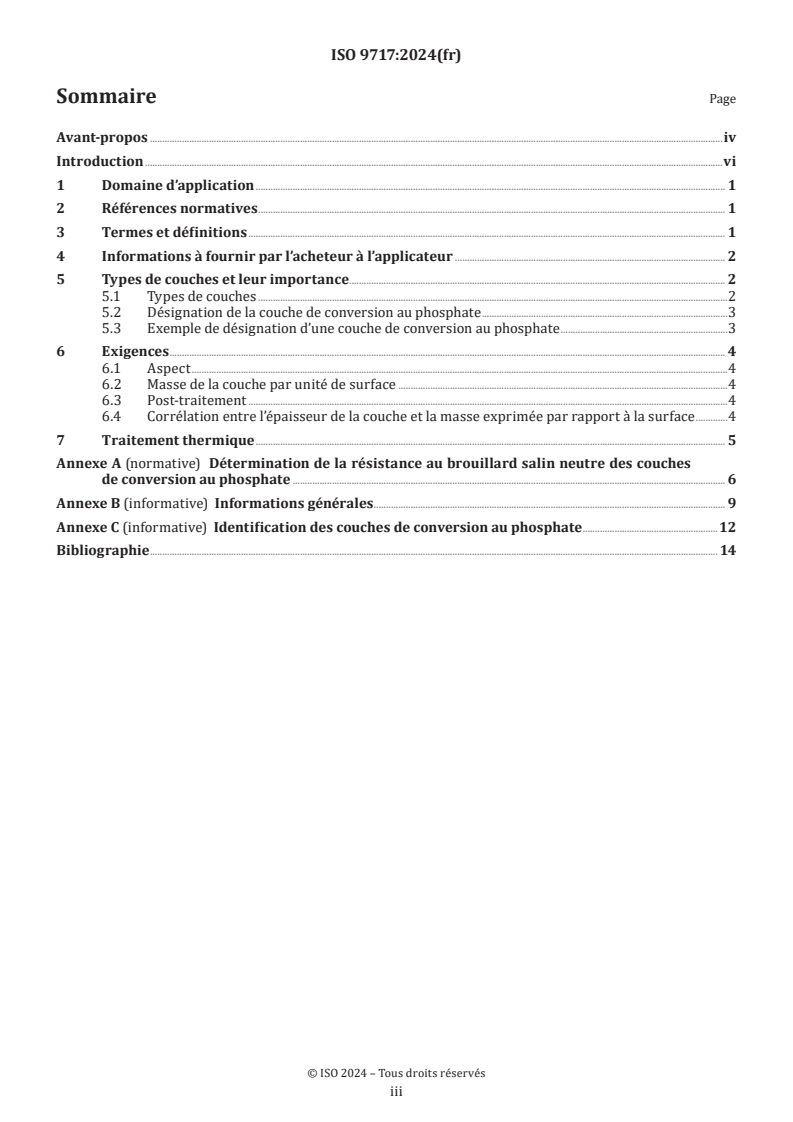
Sommaire Page
Avant-propos .iv
Introduction .vi
1 Domaine d’application . 1
2 Références normatives . 1
3 Termes et définitions . 1
4 Informations à fournir par l’acheteur à l’applicateur . 2
5 Types de couches et leur importance . 2
5.1 Types de couches .2
5.2 Désignation de la couche de conversion au phosphate .3
5.3 Exemple de désignation d’une couche de conversion au phosphate .3
6 Exigences . 4
6.1 Aspect .4
6.2 Masse de la couche par unité de surface .4
6.3 Post-traitement .4
6.4 Corrélation entre l’épaisseur de la couche et la masse exprimée par rapport à la surface .4
7 Traitement thermique . 5
Annexe A (normative) Détermination de la résistance au brouillard salin neutre des couches
de conversion au phosphate . 6
Annexe B (informative) Informations générales . . 9
Annexe C (informative) Identification des couches de conversion au phosphate .12
Bibliographie . 14
iii
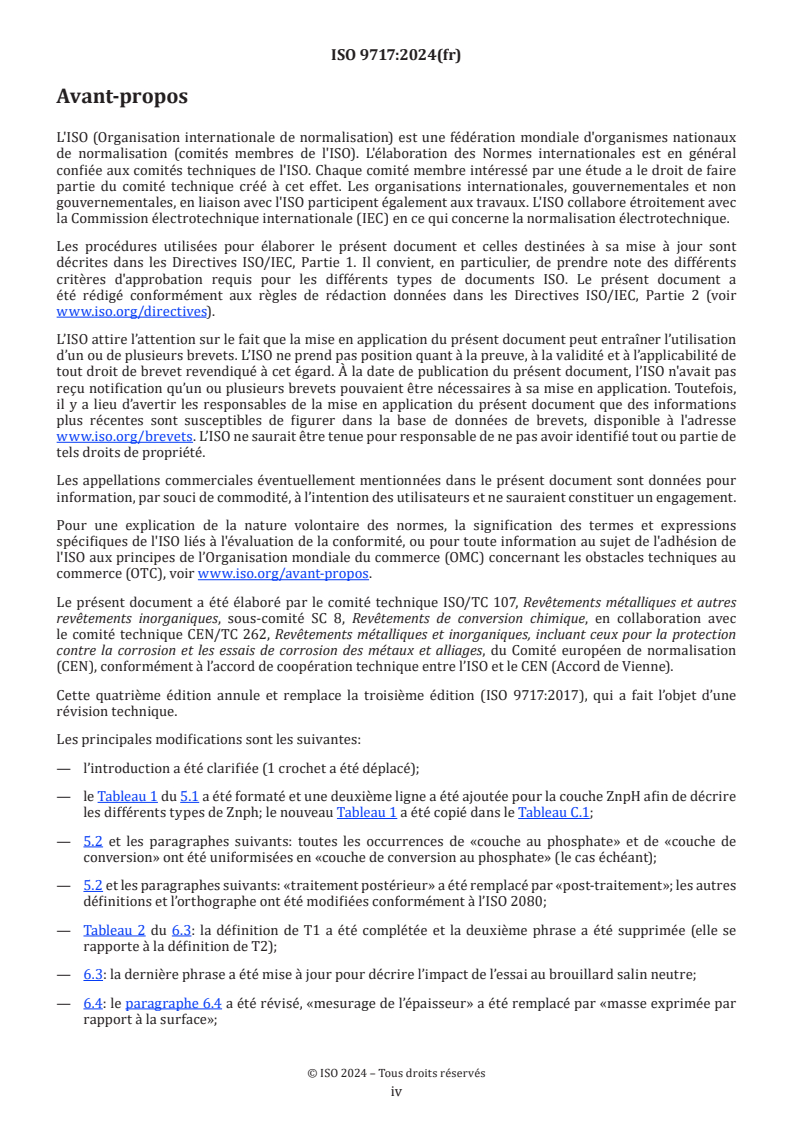
Avant-propos
L'ISO (Organisation internationale de normalisation) est une fédération mondiale d'organismes nationaux
de normalisation (comités membres de l'ISO). L'élaboration des Normes internationales est en général
confiée aux comités techniques de l'ISO. Chaque comité membre intéressé par une étude a le droit de faire
partie du comité technique créé à cet effet. Les organisations internationales, gouvernementales et non
gouvernementales, en liaison avec l'ISO participent également aux travaux. L'ISO collabore étroitement avec
la Commission électrotechnique internationale (IEC) en ce qui concerne la normalisation électrotechnique.
Les procédures utilisées pour élaborer le présent document et celles destinées à sa mise à jour sont
décrites dans les Directives ISO/IEC, Partie 1. Il convient, en particulier, de prendre note des différents
critères d'approbation requis pour les différents types de documents ISO. Le présent document a
été rédigé conformément aux règles de rédaction données dans les Directives ISO/IEC, Partie 2 (voir
www.iso.org/directives).
L’ISO attire l’attention sur le fait que la mise en application du présent document peut entraîner l’utilisation
d’un ou de plusieurs brevets. L’ISO ne prend pas position quant à la preuve, à la validité et à l’applicabilité de
tout droit de brevet revendiqué à cet égard. À la date de publication du présent document, l’ISO n'avait pas
reçu notification qu’un ou plusieurs brevets pouvaient être nécessaires à sa mise en application. Toutefois,
il y a lieu d’avertir les responsables de la mise en application du présent document que des informations
plus récentes sont susceptibles de figurer dans la base de données de brevets, disponible à l'adresse
www.iso.org/brevets. L’ISO ne saurait être tenue pour responsable de ne pas avoir identifié tout ou partie de
tels droits de propriété.
Les appellations commerciales éventuellement mentionnées dans le présent document sont données pour
information, par souci de commodité, à l’intention des utilisateurs et ne sauraient constituer un engagement.
Pour une explication de la nature volontaire des normes, la signification des termes et expressions
spécifiques de l'ISO liés à l'évaluation de la conformité, ou pour toute information au sujet de l'adhésion de
l'ISO aux principes de l’Organisation mondiale du commerce (OMC) concernant les obstacles techniques au
commerce (OTC), voir www.iso.org/avant-propos.
Le présent document a été élaboré par le comité technique ISO/TC 107, Revêtements métalliques et autres
revêtements inorganiques, sous-comité SC 8, Revêtements de conversion chimique, en collaboration avec
le comité technique CEN/TC 262, Revêtements métalliques et inorganiques, incluant ceux pour la protection
contre la corrosion et les essais de corrosion des métaux et alliages, du Comité européen de normalisation
(CEN), conformément à l’accord de coopération technique entre l’ISO et le CEN (Accord de Vienne).
Cette quatrième édition annule et remplace la troisième édition (ISO 9717:2017), qui a fait l’objet d’une
révision technique.
Les principales modifications sont les suivantes:
— l’introduction a été clarifiée (1 crochet a été déplacé);
— le Tableau 1 du 5.1 a été formaté et une deuxième ligne a été ajoutée pour la couche ZnpH afin de décrire
les différents types de Znph; le nouveau Tableau 1 a été copié dans le Tableau C.1;
— 5.2 et les paragraphes suivants: toutes les occurrences de «couche au phosphate» et de «couche de
conversion» ont été uniformisées en «couche de conversion au phosphate» (le cas échéant);
— 5.2 et les paragraphes suivants: «traitement postérieur» a été remplacé par «post-traitement»; les autres
définitions et l’orthographe ont été modifiées conformément à l’ISO 2080;
— Tableau 2 du 6.3: la définition de T1 a été complétée et la deuxième phrase a été supprimée (elle se
rapporte à la définition de T2);
— 6.3: la dernière phrase a été mise à jour pour décrire l’impact de l’essai au brouillard salin neutre;
— 6.4: le paragraphe 6.4 a été révisé, «mesurage de l’épaisseur» a été remplacé par «masse exprimée par
rapport à la surface»;
iv
— Annexe B: la dernière phrase de B.1 a été supprimée et le Tableau B.1 a été mis à jour;
— Annexe B: les titres des Tableaux B.1 et B.3 ont été mis à jour;
— Annexe B: le titre du Tableau B.4 a été mis à jour;
— Annexe C: l’élément nickel a été ajouté aux paragraphes C.1, C.2.3, C.2.5 et C.4; la méthode ICP a été
ajoutée au paragraphe C.2.3; la méthode XRF a été ajoutée au paragraphe C.3.
Il convient que l’utilisateur adresse tout retour d’information ou toute question concernant le présent
document à l’organisme national de normalisation de son pays. Une liste exhaustive desdits organismes se
trouve à l’adresse www.iso.org/fr/members.html.
v
Introduction
Les couches de conversion au phosphate sont obtenues en traitant des substrats avec des solutions
appropriées. Les principaux constituants de ces solutions sont les orthophosphates dihydrogénés appropriés.
Elles sont destinées à:
— conférer au métal une bonne résistance à la corrosion;
— améliorer l’adhérence aux peintures et autres finitions organiques;
— faciliter les opérations de formage à froid, du type tréfilage, étirage et extrusion de tubes; et
— modifier les propriétés tribologiques de la surface pour faciliter le glissement.
Les couches de conversion au phosphate sont obtenues par traitement à l’aide de solutions dont les
constituants principaux sont les orthophosphates dihydrogénés appropriés. Ces couches de conversion
au phosphate sont formées principalement sur les métaux ferreux et le zinc, et ont une masse par unité de
surface et une masse volumique apparente différentes selon:
— le matériau de construction et l’état de surface des articles;
— les traitements mécanique et chimique antérieurs des articles; et
— les conditions de phosphatation.
Toutes les couches de conversion au phosphate sont crystallines et poreuses, mais peuvent être
convenablement colmatées par des procédés postérieurs utilisant des produits de colmatage.
vi
Norme internationale ISO 9717:2024(fr)
Revêtements métalliques et autres revêtements inorganiques —
Couches de conversion au phosphate sur métaux
AVERTISSEMENT — Le présent document nécessite l’utilisation de substances et/ou de modes
opératoires qui peuvent s’avérer préjudiciables pour la santé si des mesures de sécurité adéquates
ne sont pas prises. Le présent document ne traite pas des risques pour la santé, ni des questions
liées à la sécurité et à l’environnement en rapport avec son utilisation. Il incombe aux producteurs,
acheteurs et/ou utilisateurs du présent document d’établir des pratiques d’hygiène et de sécurité
appropriées ainsi que des pratiques écologiques acceptables et de prendre des mesures appropriées.
1 Domaine d’application
Le présent document spécifie les exigences relatives aux couches de conversion au phosphate qui sont
généralement destinées à être produites sur les matériaux ferreux, l’aluminium, le zinc et leurs alliages (voir
l’Annexe B).
2 Références normatives
Les documents suivants sont cités dans le texte de sorte qu’ils constituent, pour tout ou partie de leur
contenu, des exigences du présent document. Pour les références datées, seule l’édition citée s’applique. Pour
les références non datées, la dernière édition du document de référence s’applique (y compris les éventuels
amendements).
ISO 2080, Revêtements métalliques et autres revêtements inorganiques — Traitement de surface, revêtements
métalliques et autres revêtements inorganiques — Vocabulaire
ISO 3892, Couches de conversion sur matériaux métalliques — Détermination de la masse de revêtement par
unité de surface — Méthodes gravimétriques
ISO 4519, Dépôts électrolytiques et finitions apparentées — Méthodes d'échantillonnage pour le contrôle par
attributs
ISO 9227, Essais de corrosion en atmosphères artificielles — Essais aux brouillards salins
ISO 9588, Revêtements métalliques et autres revêtements inorganiques — Traitements après revêtement sur fer
ou acier pour diminuer le risque de fragilisation par l'hydrogène
3 Termes et définitions
Pour les besoins du présent document, les termes et les définitions de l’ISO 2080 s’appliquent.
L’ISO et l’IEC tiennent à jour des bases de données terminologiques destinées à être utilisées en normalisation,
consultables aux adresses suivantes:
— ISO Online browsing platform: disponible à l’adresse https:// www .iso .org/ obp
— IEC Electropedia: disponible à l’adresse https:// www .electropedia .org/
4 Informations à fournir par l’acheteur à l’applicateur
Les informations suivantes doivent être fournies par l’acheteur:
a) une description de la couche de conversion au phosphate conformément au présent document, à savoir
l’ISO 9717 (voir 5.2);
b) dans les cas de phosphatation de pièces en acier ayant une résistance à la traction ≥ 1 000 MPa, qui
sont également situées dans des emplacements restreints localement (structures en acier cémenté
ou formées à froid, ou au voisinage d’un cordon de soudure, par exemple), la protection contre toute
rupture fragile (fragilisation par l’hydrogène) est de première importance. Le procédé de phosphatation
doit être effectué de manière à réduire au minimum le risque de fragilisation par l’hydrogène. Des
mesures appropriées destinées à réduire le plus possible le risque de fragilisation par l’hydrogène
doivent être spécifiées par l’acheteur et appliquées par le fournisseur. Tout traitement thermique réalisé
conformément aux spécifications ou recommandations ne peut garantir une prévention totale de la
fragilisation par l’hydrogène. L’efficacité d’un traitement thermique, le cas échéant, doit être vérifiée par
le fournisseur;
c) la méthode d’échantillonnage, le niveau de qualité acceptable ou autres exigences et essais divergeant
par rapport à l’ISO 4519;
d) le traitement de surface ou la phosphatation;
e) l’aspect désiré de la surface traitée;
f) la résistance à la corrosion désirée;
g) la qualité, l’aspect et l’état de surface du métal de base, si l’une de ces propriétés influe sur la performance
et/ou l’aspect des couches de conversion au phosphate;
h) lorsque cela est applicable, les mesures techniques destinées à réduire le plus possible le risque de
fragilisation par l’hydrogène, tel que spécifié par l’acheteur.
5 Types de couches et leur importance
5.1 Types de couches
La couche de conversion au phosphate doit être désignée conformément au Tableau 1.
Tableau 1 — Désignation des couches de conversion au phosphate
Éléments présents dans la couche de
Type de couche
conversion au phosphate
Fer (II) Feph
Manganèse Mnph
Zinc (pas de calcium)
Zinc et Mn, Ni, Fe(II) Znph
(pas de calcium)
Zinc et calcium ZnCaph
Zinc, Mn et Ni Triph
Divers types de couches de conversion au phosphate de zinc sont modifiés par l’accumulation de fer et/ou
de nickel et/ou de manganèse. Le métal modifié est souvent présent sous la forme d’un sel double, comme
le Zn ME(PO ) × 4 H O, où ME peut être du Fe(II), du Ni et/ou du Mn. Zn demeure le principal élément
2 4 2 2
métallique de ces couches de conversion au phosphate auxquelles il n’est pas attribué de marquages distincts
pour éviter toute confusion. Il convient également de noter que la couche de conversion au phosphate
contient du métal provenant du matériau de base.
Les informations relatives aux caractéristiques de la couche de conversion au phosphate sont données dans
l’Annexe B et les méthodes d’identification sont indiquées dans l’Annexe C.
5.2 Désignation de la couche de conversion au phosphate
La désignation de la couche de conversion au phosphate doit comprendre les informations suivantes:
a) la référence du présent document, à savoir l’ISO 9717, et la désignation «couche de conversion au
phosphate»;
b) suivie d’un tiret (–);
c) la désignation de la couche de métal sur laquelle la couche de phosphate sera appliquée au moyen du
symbole chimique du matériau (ou du symbole des principaux composants de l’alliage);
d) suivie d’une barre oblique (/);
e) un symbole décrivant le type de couche de conversion au phosphate (voir le Tableau 1);
f) suivi d’une barre oblique (/);
g) un symbole indiquant la fonction de la couche de conversion au phosphate comme suit:
1) r = promoteur d’adhérence et/ou protection contre la corrosion;
2) z = simplification du formage à froid;
3) g = réduction du frottement;
4) e = isolation électrique;
h) suivi d’une barre oblique (/);
i) un nombre indiquant la masse exprimée par rapport à la surface par mètre carré avec une incertitude
de mesure de ±30 %.
Si la couche de conversion au phosphate reçoit un traitement supplémentaire, les informations suivantes
doivent être ajoutées à la désignation:
j) une barre oblique (/);
k) un symbole qui définit le traitement supplémentaire (voir le Tableau 2).
Répéter ce processus si nécessaire.
Utiliser la barre oblique (/) pour séparer, dans la désignation, les champs de données correspondant aux
différentes étapes du processus. Des doubles séparateurs ou barres obliques indiquent, soit qu’une étape du
processus n’est pas requise, soit qu’elle a été omise (voir l’ISO 27830).
5.3 Exemple de désignation d’une couche de conversion au phosphate
La désignation d’une couche de conversion au phosphate de zinc, de type Znph, formée sur un matériau
ferreux pour prévenir toute corrosion (r), avec une masse exprimée par rapport à la surface par exemple
de (3 ± 0,9) g/m (3) et un post-traitement avec un produit de colmatage (T2) et une peinture (T1), est la
suivante:
Couche de conversion au phosphate ISO 9717 — Fe/Znph/r/3/T2/T1
6 Exigences
6.1 Aspect
Les couches de conversion au phosphate de zinc, au phosphate de zinc-calcium et au phosphate de manganèse
doivent couvrir uniformément la surface métallique et ne doivent pas présenter de taches blanches, de
produits de corrosion ou de traces de doigts.
NOTE De légères fluctuations de l’aspect des couches de conversion au phosphate provoquées par un contact avec
les cadres, des modifications locales de la rugosité de la surface, des propriétés du matériau de base ou engendrées par
un léger contact à l’intérieur du tambour ne sont pas des motifs de réclamation.
6.2 Masse de la couche par unité de surface
La masse de la couche est mesurée conformément aux modes opératoires spécifiés dans l’ISO 3892.
6.3 Post-traitement
Les couches de conversion au phosphate non traitées ne fournissent pas de protection contre la corrosion.
Un post-traitement approprié peut affecter une protection temporaire. Le Tableau 2 indique les symboles
qui doivent être utilisés s’il est requis de procéder à des post-traitements.
Tableau 2 — Symboles pour le post-traitement
Symbole Type de traitement
Application de vernis, de revêtements électrolytiques ou de
T1
revêtements organiques (en monocouche ou multicouche)
Application de produits de colmatage inorganiques ou orga-
T2
a
niques
T3 Teinture
T4 Application de graisse ou d’huile ou d’autres lubrifiants
T5 Application de cire
T6 Application de savon
a
Pour les surfaces phosphatées, on applique généralement des solutions à base
d’eau contenant du Zr, du Ti, du Cr et/ou des polymères.
La résistance à la corrosion des articles soumis à un post-traitement doit être v
...