

ISO 13472-2:2025
(Main)Acoustics — Measurement of sound absorption properties of road surfaces in situ — Part 2: Spot method for reflective surfaces
General Information
- Abstract
This document specifies a test method for measuring in situ the sound absorption coefficient of road surfaces for the one-third octave band frequencies ranging from 250 Hz to 1 600 Hz under normal incidence conditions. If necessary for practical applications the diameter of the tube can be reduced to 80 mm. This will increase the upper boundary of the frequency range to 2 000 Hz one-third octave band (see REF Section_sec_5.4 \r \h 5.4 08D0C9EA79F9BACE118C8200AA004BA90B020000000800000010000000530065006300740069006F006E005F007300650063005F0035002E0034000000 ) but reduces the area under test. The test method is intended for the following applications: — determination of the sound absorption coefficient (and, if of interest, also the complex acoustical impedance) of semi-dense to dense road surfaces; — determination of the sound absorption properties of test tracks according to ISO 10844[ REF Reference_ref_4 \r \h 2 08D0C9EA79F9BACE118C8200AA004BA90B0200000008000000100000005200650066006500720065006E00630065005F007200650066005F0034000000 ] or other similar standards and test surfaces defined in national and international type approval regulations for road vehicles and their tyres; — verification of the compliance of the sound absorption coefficient of a road surface with design-specifications or other requirements.
- Status
- Published
- Publication Date
- 13-May-2025
- Technical Committee
- ISO/TC 43/SC 1 - Noise
- Drafting Committee
- ISO/TC 43/SC 1 - Noise
- Current Stage
- 6060 - International Standard published
- Start Date
- 14-May-2025
- Due Date
- 28-Mar-2025
- Completion Date
- 14-May-2025


Overview - ISO 13472-2:2025 (Spot method for reflective road surfaces)
ISO 13472-2:2025 specifies an in situ spot method to measure the sound absorption coefficient of road surfaces under normal incidence conditions. The standard covers one-third octave band measurements from 250 Hz to 1 600 Hz (extendable to 2 000 Hz if an 80 mm impedance tube is used instead of 100 mm). The method is designed for reflective, semi‑dense to dense road surfaces and uses an impedance tube and two‑microphone transfer‑function analysis derived from ISO 10534‑2 signal processing principles.
Key technical topics and requirements
- Frequency range and tube sizes: Valid one‑third octave bands 250 Hz–1 600 Hz (100 mm tube); upper limit 2 000 Hz if tube diameter reduced to 80 mm. Smaller tube reduces the area under test (~0.005–0.008 m²).
- Measurement principle: Impedance tube mounted on the surface; propagation from source to surface and back; transfer‑function based analysis between microphone positions.
- Signal processing & quality: Specifies FFT resolution, sampling and block length, and coherence requirements for reliable transfer‑function estimation. Alternative microphone arrangements and alternating transfer functions (Annex C) mitigate destructive interference at microphone positions.
- Calibration and references: System stabilization, calibration, and a reference measurement procedure are required. Thermometer and barometer data must be recorded for environmental correction.
- Limits and validity: Not reliable for surfaces with sound absorption > 0.15 (air leakage effects). Surfaces with α ≤ 0.10 are considered reflective.
- Reporting and uncertainty: Measurement uncertainty assessment, conformity checks, and a standardized test report format (Annex E) are required.
Practical applications and users
ISO 13472-2 is intended for practitioners who need precise, in situ normal‑incidence absorption data for low‑absorbing road surfaces:
- Acoustic consultants and researchers performing pavement acoustic characterization.
- Road authorities and pavement engineers verifying compliance with design specifications.
- Test track operators and vehicle/tyre approval bodies assessing surface properties per ISO 10844 and national type‑approval regulations.
- Laboratories comparing in situ results with impedance‑tube core measurements (ISO 10534 series) for quality control and material development.
Benefits include non‑destructive testing, suitability for small spot measurements, and compatibility with impedance‑tube laboratory methods for comparative assessment.
Related standards
- ISO 13472‑1 (extended surface method)
- ISO 10534‑1 / ISO 10534‑2 (impedance tube techniques)
- ISO 10844 (test tracks)
- ISO 354 (reverberation room; different measurement field)
- ISO/IEC Guide 98‑3 (uncertainty of measurement)
- ASTM E1050 (comparable impedance tube method)
Keywords: ISO 13472-2, sound absorption, road surfaces, in situ measurement, impedance tube, spot method, reflective surfaces, one-third octave.
Relations
- Effective Date
- 06-Jun-2022
Get Certified
Connect with accredited certification bodies for this standard

BSMI (Bureau of Standards, Metrology and Inspection)
Taiwan's standards and inspection authority.
Zavod za gradbeništvo Slovenije (ZAG) - Inšpekcija
ZAG inspection body for construction products, structures, and materials.
Sponsored listings
Frequently Asked Questions
ISO 13472-2:2025 is a standard published by the International Organization for Standardization (ISO). Its full title is "Acoustics — Measurement of sound absorption properties of road surfaces in situ — Part 2: Spot method for reflective surfaces". This standard covers: This document specifies a test method for measuring in situ the sound absorption coefficient of road surfaces for the one-third octave band frequencies ranging from 250 Hz to 1 600 Hz under normal incidence conditions. If necessary for practical applications the diameter of the tube can be reduced to 80 mm. This will increase the upper boundary of the frequency range to 2 000 Hz one-third octave band (see REF Section_sec_5.4 \r \h 5.4 08D0C9EA79F9BACE118C8200AA004BA90B020000000800000010000000530065006300740069006F006E005F007300650063005F0035002E0034000000 ) but reduces the area under test. The test method is intended for the following applications: — determination of the sound absorption coefficient (and, if of interest, also the complex acoustical impedance) of semi-dense to dense road surfaces; — determination of the sound absorption properties of test tracks according to ISO 10844[ REF Reference_ref_4 \r \h 2 08D0C9EA79F9BACE118C8200AA004BA90B0200000008000000100000005200650066006500720065006E00630065005F007200650066005F0034000000 ] or other similar standards and test surfaces defined in national and international type approval regulations for road vehicles and their tyres; — verification of the compliance of the sound absorption coefficient of a road surface with design-specifications or other requirements.
This document specifies a test method for measuring in situ the sound absorption coefficient of road surfaces for the one-third octave band frequencies ranging from 250 Hz to 1 600 Hz under normal incidence conditions. If necessary for practical applications the diameter of the tube can be reduced to 80 mm. This will increase the upper boundary of the frequency range to 2 000 Hz one-third octave band (see REF Section_sec_5.4 \r \h 5.4 08D0C9EA79F9BACE118C8200AA004BA90B020000000800000010000000530065006300740069006F006E005F007300650063005F0035002E0034000000 ) but reduces the area under test. The test method is intended for the following applications: — determination of the sound absorption coefficient (and, if of interest, also the complex acoustical impedance) of semi-dense to dense road surfaces; — determination of the sound absorption properties of test tracks according to ISO 10844[ REF Reference_ref_4 \r \h 2 08D0C9EA79F9BACE118C8200AA004BA90B0200000008000000100000005200650066006500720065006E00630065005F007200650066005F0034000000 ] or other similar standards and test surfaces defined in national and international type approval regulations for road vehicles and their tyres; — verification of the compliance of the sound absorption coefficient of a road surface with design-specifications or other requirements.
ISO 13472-2:2025 is classified under the following ICS (International Classification for Standards) categories: 17.140.30 - Noise emitted by means of transport; 93.080.20 - Road construction materials. The ICS classification helps identify the subject area and facilitates finding related standards.
ISO 13472-2:2025 has the following relationships with other standards: It is inter standard links to ISO 13472-2:2010. Understanding these relationships helps ensure you are using the most current and applicable version of the standard.
ISO 13472-2:2025 is available in PDF format for immediate download after purchase. The document can be added to your cart and obtained through the secure checkout process. Digital delivery ensures instant access to the complete standard document.
Standards Content (Sample)
International
Standard
ISO 13472-2
Second edition
Acoustics — Measurement of sound
2025-05
absorption properties of road
surfaces in situ —
Part 2:
Spot method for reflective surfaces
Acoustique — Mesurage in situ des propriétés d'absorption
acoustique des revêtements de chaussées —
Partie 2: Méthode ponctuelle pour les surfaces réfléchissantes
Reference number
© ISO 2025
All rights reserved. Unless otherwise specified, or required in the context of its implementation, no part of this publication may
be reproduced or utilized otherwise in any form or by any means, electronic or mechanical, including photocopying, or posting on
the internet or an intranet, without prior written permission. Permission can be requested from either ISO at the address below
or ISO’s member body in the country of the requester.
ISO copyright office
CP 401 • Ch. de Blandonnet 8
CH-1214 Vernier, Geneva
Phone: +41 22 749 01 11
Email: copyright@iso.org
Website: www.iso.org
Published in Switzerland
ii
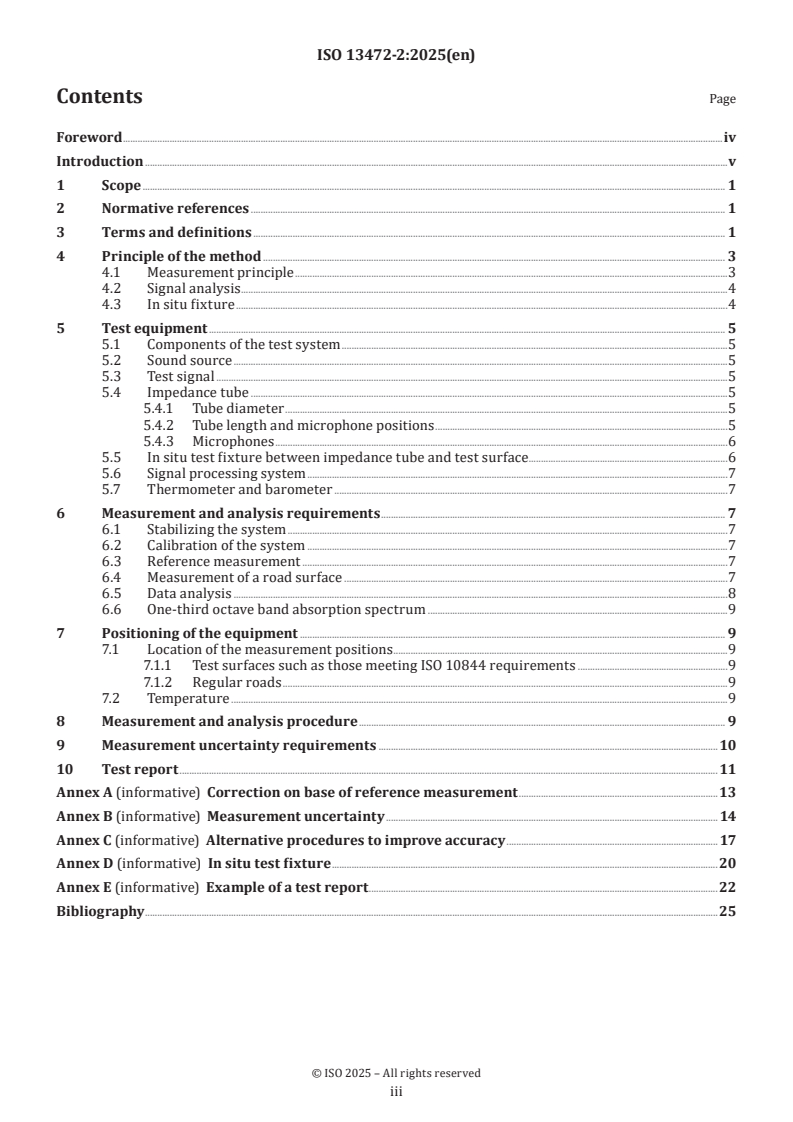
Contents Page
Foreword .iv
Introduction .v
1 Scope . 1
2 Normative references . 1
3 Terms and definitions . 1
4 Principle of the method . 3
4.1 Measurement principle .3
4.2 Signal analysis . .4
4.3 In situ fixture .4
5 Test equipment . 5
5.1 Components of the test system .5
5.2 Sound source .5
5.3 Test signal .5
5.4 Impedance tube .5
5.4.1 Tube diameter .5
5.4.2 Tube length and microphone positions .5
5.4.3 Microphones .6
5.5 In situ test fixture between impedance tube and test surface .6
5.6 Signal processing system .7
5.7 Thermometer and barometer .7
6 Measurement and analysis requirements . 7
6.1 Stabilizing the system .7
6.2 Calibration of the system .7
6.3 Reference measurement .7
6.4 Measurement of a road surface .7
6.5 Data analysis .8
6.6 One-third octave band absorption spectrum .9
7 Positioning of the equipment . 9
7.1 Location of the measurement positions .9
7.1.1 Test surfaces such as those meeting ISO 10844 requirements .9
7.1.2 Regular roads .9
7.2 Temperature .9
8 Measurement and analysis procedure . 9
9 Measurement uncertainty requirements . 10
10 Test report .11
Annex A (informative) Correction on base of reference measurement .13
Annex B (informative) Measurement uncertainty . 14
Annex C (informative) Alternative procedures to improve accuracy . 17
Annex D (informative) In situ test fixture .20
Annex E (informative) Example of a test report .22
Bibliography .25
iii
Foreword
ISO (the International Organization for Standardization) is a worldwide federation of national standards
bodies (ISO member bodies). The work of preparing International Standards is normally carried out through
ISO technical committees. Each member body interested in a subject for which a technical committee
has been established has the right to be represented on that committee. International organizations,
governmental and non-governmental, in liaison with ISO, also take part in the work. ISO collaborates closely
with the International Electrotechnical Commission (IEC) on all matters of electrotechnical standardization.
The procedures used to develop this document and those intended for its further maintenance are described
in the ISO/IEC Directives, Part 1. In particular, the different approval criteria needed for the different types
of ISO document should be noted. This document was drafted in accordance with the editorial rules of the
ISO/IEC Directives, Part 2 (see www.iso.org/directives).
ISO draws attention to the possibility that the implementation of this document may involve the use of (a)
patent(s). ISO takes no position concerning the evidence, validity or applicability of any claimed patent
rights in respect thereof. As of the date of publication of this document, ISO had not received notice of (a)
patent(s) which may be required to implement this document. However, implementers are cautioned that
this may not represent the latest information, which may be obtained from the patent database available at
www.iso.org/patents. ISO shall not be held responsible for identifying any or all such patent rights.
Any trade name used in this document is information given for the convenience of users and does not
constitute an endorsement.
For an explanation of the voluntary nature of standards, the meaning of ISO specific terms and expressions
related to conformity assessment, as well as information about ISO's adherence to the World Trade
Organization (WTO) principles in the Technical Barriers to Trade (TBT), see www.iso.org/iso/foreword.html.
This document was prepared by Technical Committee ISO/TC 43, Acoustics, Subcommittee SC 1, Noise.
This second edition cancels and replaces the first edition (ISO 13472-2:2010), which has been technically
revised.
The main changes are as follows:
— mandatory choice of the transfer function formulation and quality requirements for the coherence
function;
— an alternative microphone arrangement and application of alternating transfer functions are presented
to cancel the distortion due to destructive interference at the microphone positions.
A list of all parts in the ISO 13472 series can be found on the ISO website.
Any feedback or questions on this document should be directed to the user’s national standards body. A
complete listing of these bodies can be found at www.iso.org/members.html.
iv
Introduction
This method provides a means to evaluate the sound absorption characteristics of a road surface without
damaging the surface. The field of application is limited to low absorption surfaces such as those in
[2]
accordance with ISO 10844 and similar surfaces. Due to air leakage the method is not reliable if the
measured sound absorption coefficient exceeds 0,15. Surfaces with a sound absorption coefficient of 0,10 or
below are considered reflective.
The method in this document is based on propagation of the test signal from the source to the road surface
and back to the receiver through an impedance tube with a diameter of 80 mm to 100 mm. The tube covers
2 2
an area of approximately 0,005 m to 0,008 m and a frequency range, in one-third octave bands, from
250 Hz to 1 600 Hz for a 100 mm diameter, or from 250 Hz to 2 000 Hz, for an 80 mm diameter tube. It uses
the test procedure and signal processing described in ISO 10534-2, but because of the defined frequency
range of application, the dimensions of the system are not freely adjustable.
The essential part in the ISO 10534-2 procedure is the determination of the transfer function between two
microphones at different distances from the sample at the end of the tube. In this case of a reflecting sample
at specific frequencies destructive interferences (nodes) will occur at the microphone positions jeopardizing
the correct determination of the transfer function between the microphone pair.
Therefore in this document the ISO 10534-2 procedure is extended with a preference for transfer function
H calculated as the ratio of the auto spectrum S at the lowest microphone position and the cross
spectrum S and requirements on the resolution, the sample frequency and the block length in the FFT
analysis added with a requirement on the average narrow band coherence within a one-third octave band.
Recommendations for improvement of the accuracy by alternative microphone arrangement, variation in
transfer function and type of random noise are presented in Annex C.
[3]
This method is complementary to the extended surface method (ISO 13472-1 ) that covers an area of
approximately 3 m and a frequency range, in one-third octave bands, from 250 Hz to 4 000 Hz.
Both methods should give similar results in the valid frequency range, but their fields of application and
therefore their accuracy will differ strongly. The method described in ISO 13472-1 has limited accuracy at
small sound absorption values and is therefore unfit to check compliance of surfaces with the requirements
in ISO 10844 or similar regulations, while the method described in this standard fails at higher sound
absorption values.
Within their ranges of applicability the methods are applicable also to acoustic materials other than road
surfaces.
The measurement results by this method are comparable with the results of the impedance tube method,
[5]
performed on bore cores taken from the surface such as ISO 10534-1, ISO 10534-2 and ASTM E 1050-19 .
The measurement results obtained with this method are in general not comparable with the results of the
[1]
reverberation room method (ISO 354 ), because the method described in this International Standard uses a
plane progressive wave at normal incidence, while the reverberation room method uses a diffuse sound field.
v
International Standard ISO 13472-2:2025(en)
Acoustics — Measurement of sound absorption properties of
road surfaces in situ —
Part 2:
Spot method for reflective surfaces
1 Scope
This document specifies a test method for measuring in situ the sound absorption coefficient of road
surfaces for the one-third octave band frequencies ranging from 250 Hz to 1 600 Hz under normal incidence
conditions. If necessary for practical applications the diameter of the tube can be reduced to 80 mm. This
will increase the upper boundary of the frequency range to 2 000 Hz one-third octave band (see 5.4) but
reduces the area under test.
The test method is intended for the following applications:
— determination of the sound absorption coefficient (and, if of interest, also the complex acoustical
impedance) of semi-dense to dense road surfaces;
[2]
— determination of the sound absorption properties of test tracks according to ISO 10844 or other
similar standards and test surfaces defined in national and international type approval regulations for
road vehicles and their tyres;
— verification of the compliance of the sound absorption coefficient of a road surface with design-
specifications or other requirements.
2 Normative references
The following documents are referred to in the text in such a way that some or all of their content constitutes
requirements of this document. For dated references, only the edition cited applies. For undated references,
the latest edition of the referenced document (including any amendments) applies.
ISO 10534-2:2023, Acoustics — Determination of acoustic properties in impedance tubes — Part 2: Two-
microphone technique for normal sound absorption coefficient and normal surface impedance
ISO/IEC Guide 98-3, Uncertainty of measurement — Part 3: Guide to the expression of uncertainty in
measurement
3 Terms and definitions
For the purposes of this document, the following terms and definitions apply.
ISO and IEC maintain terminology databases for use in standardization at the following addresses:
— ISO Online browsing platform: available at https:// www .iso .org/ obp
— IEC Electropedia: available at https:// www .electropedia .org/
3.1
frequency range
frequency interval in which measurements are valid, specified in one-third octave bands
Note 1 to entry: See IEC 61260-1.
Note 2 to entry: The frequency range is specified in one-third octave bands. This means that its lowest frequency is
the lower limit of the lower one-third octave band specified and its highest frequency is the upper limit of the highest
one-third octave band specified. A frequency range specified in one-third octave bands of 250 Hz to 1 600 Hz centre
frequency implies a frequency range specified in narrow bands of 224 Hz to 1 778 Hz.
3.2
sound absorption coefficient at normal incidence
α
fraction of the sound power of a plane wave at normal incidence on the test object that is absorbed within
the test object
3.3
sound pressure reflection factor at normal incidence
r
complex ratio of the pressure of the reflected wave to the pressure of the incident wave at the surface of the
test object for a plane wave at normal incidence
3.4
plane of reference
hypothetical plane defined by the underside of the sealing device at which the sound pressure reflection
factor and the normal surface impedance is calculated
3.5
cross spectrum
S
*
product p ⋅ p determined by the complex sound pressure p and p at two microphone positions 1 and 2
2 1 1 2
Note 1 to entry: * means the complex conjugate.
3.6
auto spectrum
S
*
product p ⋅ p determined by the complex sound pressure p at a microphone position 1
1 1 1
3.7
transfer function
H
transfer function from microphone position 1 to 2, defined by the complex ratio p /p = (S /S )
2 1 22 21
Note 1 to entry: The transfer function can also be defined as (S /S ) but applying that definition will lead a slightly
12 11
higher error when averaged over one-third octave bands (see Reference [7]).
3.8
coherence function
γ
2 2
coherence between the signals at positions 1 and 2 defined by γ = |S | /(S ⋅ S )
12 12 11 22
3.9
normal surface impedance
Z
ratio of the complex sound pressure to the normal component of the complex sound particle velocity in the
reference plane
4 Principle of the method
4.1 Measurement principle
The measurement principle is based on a standard impedance tube utilizing a two microphones arrangement
(see ISO 10534-2 or ASTM E 1050-19). A sound signal from a loudspeaker located at one end propagates
through the tube. The open end of the tube is placed on the surface to be measured without distortion of the
surface. The complex acoustic transfer function between two microphone positions at different heights is
determined and used to compute the normal-incidence sound absorption coefficient and related quantities.
The procedure enables a single skilled operator to perform such measurements.
The application of this procedure on reflective surfaces exhibits destructive interferences at the microphone
positions at specific frequencies. The occurrence of such destructive interferences jeopardizes the accurate
calculation of the transfer function signalled by the loss of coherence between the signals at both microphone
positions. The quality loss due to interference is addressed in this document by defining a minimal resolution
in the FFT analysis and a minimal number of averages over the auto spectra and cross spectra that are used
to calculate the transfer function. The coherence in narrow bands over a one-third octave band is used as a
quality criteria.
Annex C describes various methods to improve the coherence.
There is no need for a calibration for microphones as required in typical acoustic measurements, but it
does require a specific verification of the microphone pair(s) for amplitude and phase relationship between
microphones and the determination of the internal energy loss of the system.
The absorption coefficient covers the one-third octave band frequency range from 250 Hz to 1 600 Hz in
case of a 100 mm tube diameter and 250 Hz to 2 000 Hz in case of an 80 mm tube diameter.
The set-up of the system is given in Figure 1.
Key
1 loudspeaker
2 vibration isolation
3 microphone 1
microphone 2
optional microphone 3
4 sealing between tube and in situ device
5 in situ test fixture
6 sealing between fixture and surface under test (see Annex D)
7 surface under test
8 sound source and signal analyser
Figure 1 — Configuration of the measuring device and related equipment
4.2 Signal analysis
[5]
The signal processing is described in ISO 10534-2 and ASTM E1050-19 . It consists of the measurement of
the complex transfer function H between the pair(s) of microphones 1 and 2 in the presence of the sample
under test. The transfer function is used to calculate the complex pressure reflection factor from which the
acoustic absorption is derived. The procedure described in ISO 10534-2 and ASTM E1050-19 includes a sub-
procedure to calibrate amplitude and phase response of the microphones.
In order to control the error in the test result, primarily caused by the nodes, it is also necessary to determine
the coherence between the pair(s) of microphones.
The narrowband coherence values are used as quality criterium. At least 80 % of all narrowband frequencies
within a one-third octave band shall have a coherence value of 80 % or higher.
NOTE This criterium is comparable to that stipulated in EN 15461.
In case of application of three microphones (see C.1) the coherence is also used to select the optimal
microphone pair
The sound reflection factor, sound absorption coefficient and acoustic impedance is determined according
to the procedure defined in ISO 10534-2:2023, 8.7 to 8.10.
For this document preference is given to a transfer function H calculated as the ratio of the auto spectrum
S at the lowest microphone position and the cross spectrum S ; H = S /S . Although the narrow band
22 21 22 21
error is similar to a calculation based on the conventional H = S /S the one-third octave result is averaged
12 11
over more narrow band results, thus reducing the effect of the narrow band error on the overall one-third
octave result.
4.3 In situ fixture
In the present method the test sample holder described in ISO 10534-2 is replaced by an in situ test fixture
that enables an airtight connection between the inside of the test tube and the surface of the road under test.
The test tube and the fixture can either be integrated into a single piece or it can be connected by a fixing
device and an airtight seal such as a rubber O-ring.
At the underside of the in situ test fixture, sealing to the road surface is obtained by a ring of plastic
deformable material that creates an airtight sealing of the fixture to the surface texture of the road. Sealing
is improved with a small groove made in the fixture (see Annex D).
5 Test equipment
5.1 Components of the test system
The test equipment comprises a signal generator, a sound source, a tube, two or three microphones mounted
flush with the inside wall of the tube at the specified positions, an in situ test fixture device to maintain an
airtight fit to the surface and a signal processing unit capable of doing complex Fourier transforms (FFT) in
two channels simultaneously.
5.2 Sound source
The sound source shall meet the requirements defined in ISO 10534-2. It exhibits the following
characteristics:
— be sealed to and vibration-isolated from the tube to minimize structure born sound excitation of the tube;
— have a uniform power response over the frequency range of interest.
5.3 Test signal
The test signal shall be broad band with a uniform spectral density over the frequency range of interest.
A signal generator capable of producing a compatible test signal is often incorporated in a frequency analysis
system. When employing alternative signals it is recommended that the time blocks in the frequency analysis
be synchronized with repetitions in the test signal pattern.
NOTE A source that generates a periodic random noise signal prevents loss of coherence due to FFT leakage.
5.4 Impedance tube
5.4.1 Tube diameter
The diameter of the tube shall be between 80 mm and 100 mm. A larger diameter than 100 mm jeopardizes
measurements at the upper boundary of the highest required one-third octave-band of 1 600 Hz.
In cases of uneven surfaces such that can exist at proving grounds for heavy vehicles, an 80 mm diameter is
preferred to obtain satisfactorily sealing between the in situ fixture and the road surface.
NOTE 1 Not meeting the maximal diameter requirement affects the frequency range. The upper frequency f at a
u
given diameter is given by Formula (1). See also ISO 10534-2:
c
o
f =05, 8 (1)
u
d
with c = the speed of sound in m/s and d = the diameter of the tube in metres.
o
The tube from 0,1 m above the upper microphone to the sample shall be straight with a uniform circular
cross section and with smooth, non-porous walls, without holes or slits and rigid as to prevent unwanted
loss of sound energy.
NOTE 2 Loss of energy due to vibrations of the walls is generally prevented by using a metal tube with a thickness
of at least 5 % of the tube diameter.
The tube shall have a small ventilation hole of 1 mm to 2 mm in the vicinity of the loudspeaker as to prevent
build-up of static pressure inside the tube.
5.4.2 Tube length and microphone positions
Microphones shall be mounted flush with the inner side wall. At minimum two microphones shall be used.
The spacing between them is defined by the required frequency range. For the designated frequency range
of 250 Hz to 1 600 Hz in one-third octave bands a lower and upper boundary of the working frequency range
of about 220 Hz to 1 800 Hz is required.
The minimum spacing shall be larger than 5 % of the longest wavelength related to the lower boundary of
the working frequency range f given by Formula (2). See also ISO 10534-2:
min
c
s>00, 5 (2)
f
min
A minimum frequency of 220 Hz implies a minimum spacing between the lowest and highest microphone
position of 80 mm. The distance of 80 mm also meets the requirement for the upper working frequency f
max
given by Formula (3). See also ISO 10534-2:
c
s<04, 5 (3)
f
max
The optional third microphone position is located halfway.
The spacing between each microphone pair shall be known with an accuracy of 0,5 mm.
The length shall be long enough to make a plane wave develop between the source and the position of the
highest microphones. This requirement is met when the highest microphone is located not less than three
tube diameters from the sound source. Non-plane waves from the flat road sample are generally suppressed
within one tube diameter. In the case of a tube diameter of 100 mm, these requirements are realized by a
tube with a minimum length of 480 mm and with the lowest microphone mounted 100 mm from the plane of
reference. For an 80 mm tube a minimum length of 400 mm suffices.
NOTE A spacing of 80 mm implies an upper microphone height of about 180 mm above the surface. It can be
derived assuming a reflective surface, that at a frequency of about 450 Hz a node will appear. In that case the lower
and optional middle microphone can be used (see C.1). At this frequency the condition of Formula (2) is still met.
5.4.3 Microphones
Two or (optionally) three nominally identical microphones shall be mounted at the specified positions. The
microphone diameter shall be small in comparison with the spacing between the microphone ports. It is
recommended that the microphone diameter be less than 20 % of the smallest spacing used. For the side
wall mounting, microphones of the pressure type are recommended.
The microphone mountings shall give an airtight sealing between microphone housing and wall of the tube.
In the mounting of the microphones care shall be taken, following the manufacturer’s recommendation, that
the venting holes are not blocked as this can result in static pressure built up over the diaphragm that will
alter the phase response.
5.5 In situ test fixture between impedance tube and test surface
Similar to a detachable holder (ISO 10534-2:2023, 5.7) an in situ test fixture shall make an airtight fit
between the end of the tube opposite the sound source and the surface to be measured. Any air leakage
through this interface will appear as absorption in the measurement results. The in situ test fixture, like
the detachable holder, shall conform to the interior shape and dimensions of the main part of the impedance
tube. The connecting joint of the in situ test fixture shall be finished carefully, shall exhibit no slit or hole
and the use of a sealant (such as a rubber O-ring) is required for sealing it to the main part of the impedance
tube. Additionally, a groove shall be cut in the in situ test fixture on the specimen side to accept a “bead” of
sealing material such as water soluble modelling clay for sealing the fixture to the road.
Practically, the in situ test fixture should have a larger outer diameter than the main part of the tube. The
additional diameter is not used in the measurement, but will aid in stability when the system is mounted
upright (see Annex D for picture and dimensions of an in situ test fixture).
The sealing material shall fill irregularities due to surface texture but shall not penetrate into the surface
and shall not spread out on the surface.
5.6 Signal processing system
The signal processing unit consists of a multi-channel signal analyser capable of determining the narrow
band auto spectrum at each of the microphone positions and cross spectrum between microphone pair(s).
The device shall be capable of FFT operations with a bandwidth of ≤1,0 Hz, a sample frequency of ≥5 kHz
and a block length of ≥1,0 s.
In case one or more of the three improvement procedures in Annex C are applied an FFT bandwidth ≤5 Hz is
acceptable.
The device and signal processing procedure shall further meet the requirements stated in ISO 10534-2.
5.7 Thermometer and barometer
The temperature shall be known and shall be measured with a precision of ±1 °C or better as stated by
the manufacturer. If the complex impedance of the surface is also to be determined, then the atmospheric
pressure shall be known and shall be measured with a precision of ±0,5 kPa or better as stated by the
manufacturer.
6 Measurement and analysis requirements
6.1 Stabilizing the system
Since the measurement principle relies strongly on accurate phase and amplitude measurements, the system
shall be thermally stable, including the electronic parts, the loudspeaker coil and the tube. Therefore, before
starting measurements, the system shall be switched on and operate for at
...