


ISO 4306-1:1985
(Main)Lifting appliances — Vocabulary — Part 1: General
Lifting appliances — Vocabulary — Part 1: General
Appareils de levage — Vocabulaire — Partie 1: Généralités
General Information
- Status
- Withdrawn
- Publication Date
- 29-May-1985
- Withdrawal Date
- 29-May-1985
- Technical Committee
- ISO/TC 96/SC 2 - Terminology
- Drafting Committee
- ISO/TC 96/SC 2 - Terminology
- Current Stage
- 9599 - Withdrawal of International Standard
- Start Date
- 13-Mar-1990
- Completion Date
- 14-Feb-2026
Relations
- Effective Date
- 15-Apr-2008
- Effective Date
- 15-Apr-2008
Frequently Asked Questions
ISO 4306-1:1985 is a standard published by the International Organization for Standardization (ISO). Its full title is "Lifting appliances — Vocabulary — Part 1: General". This standard covers: Lifting appliances — Vocabulary — Part 1: General
Lifting appliances — Vocabulary — Part 1: General
ISO 4306-1:1985 is classified under the following ICS (International Classification for Standards) categories: 01.040.53 - Materials handling equipment (Vocabularies); 53.020.20 - Cranes. The ICS classification helps identify the subject area and facilitates finding related standards.
ISO 4306-1:1985 has the following relationships with other standards: It is inter standard links to ISO 4306-1:1990, SIST ISO 4306-1:1997. Understanding these relationships helps ensure you are using the most current and applicable version of the standard.
ISO 4306-1:1985 is available in PDF format for immediate download after purchase. The document can be added to your cart and obtained through the secure checkout process. Digital delivery ensures instant access to the complete standard document.
Standards Content (Sample)
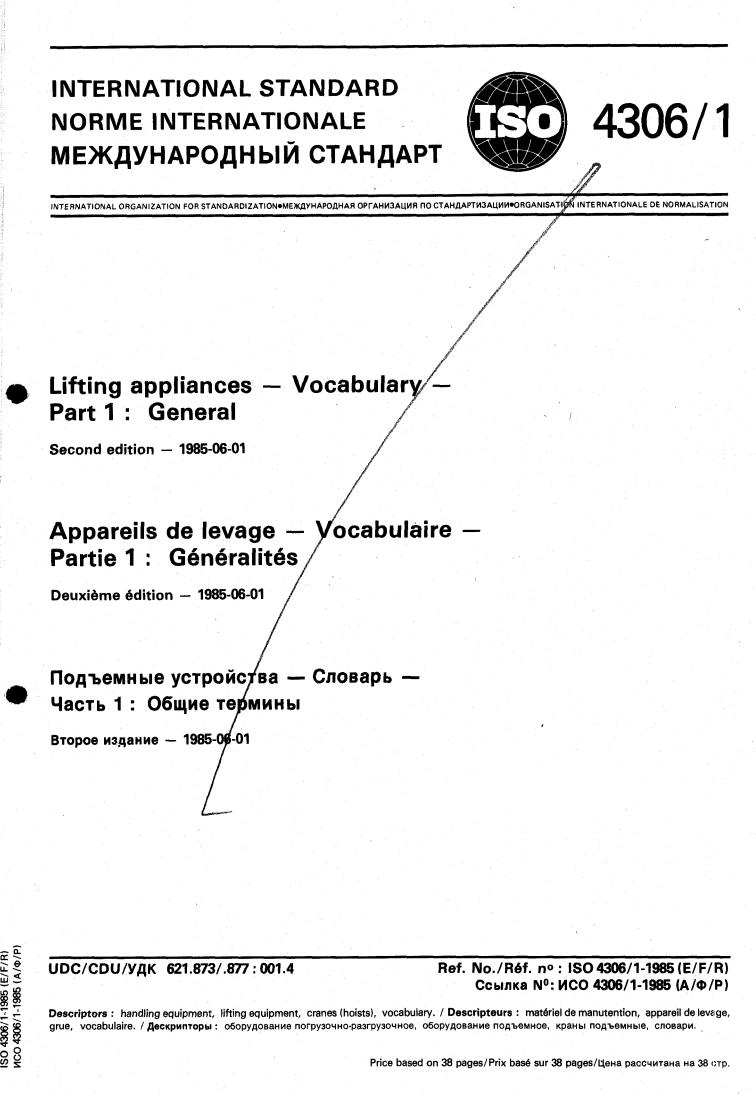
INTERNATIONAL STANDARD
NORME INTERNATIONALE
MEXAYHAPOAHbIÜl CTAHAAPT
ERNATIONALE DE NORMALISATION
INTERNATIONAL ORGANIZATION FOR STANDARDIZATION.MEXI(L1YHAPOAHAR OPrAHH3AUHR no CTAHAAPTH3AUMH.ORGANISATî
Lifting appliances -
Part 1 : General
Second edition - 1985-06-01
Appareils de levage -
Partie 1 : Généralit
Deuxième édition - 1985-06-01
UDCICDUIYflK 621.873/.877 : 001.4 Ref. No./Réf. no : ISO43û6/1-1985 (E/F/R)
CCblJlKa No: MCO 4306/1-1985 (A/@/P)
Descriptors : handling equipment, lifting equipment, cranes (hoists), vocabulary. / Descripteurs : matériel de manutention, appareil de levriige,
vocabulaire. / Aecrprtnropbi : 060pyROBaHine norpy3owio-pa3rpy3o~~oe, 060pyflo~a~~e noAaewoe, KpaHbi noflaewibie, cnoeapin.
grue,
Price based on 38 pages/Prix basé sur 38 pages/ueHa paccwiaHa Ha 38 CTP.
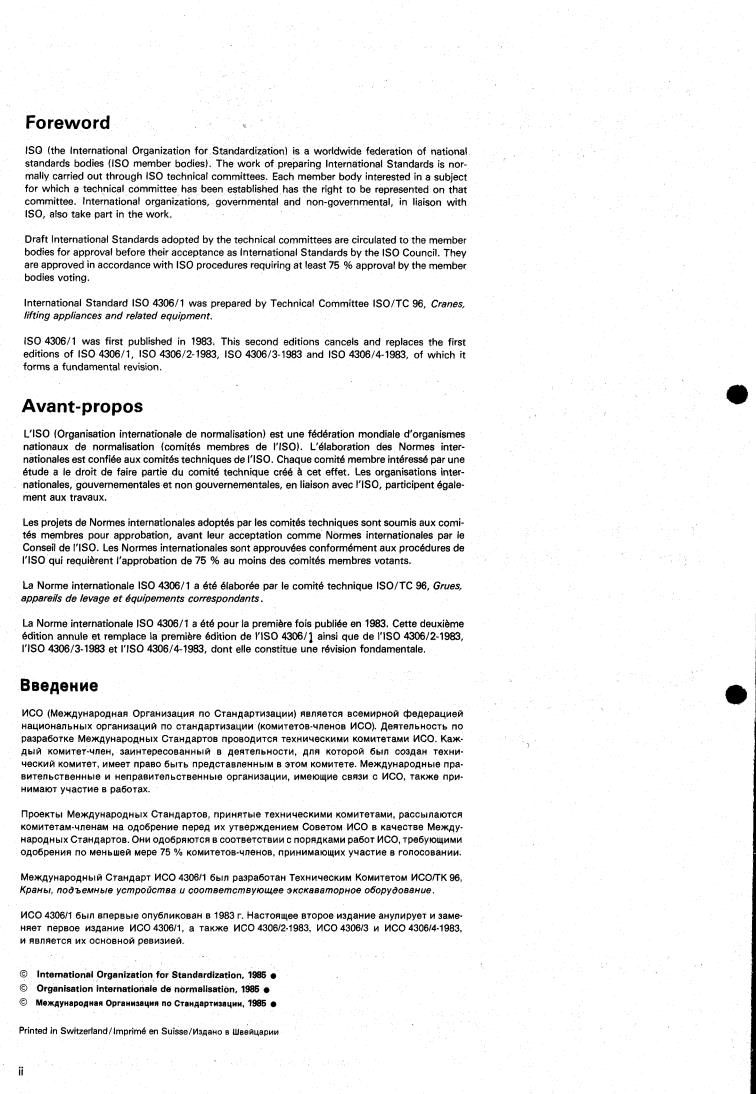
Foreword
IS0 (the International Organization for Standardization) is a worldwide federation of national
standards bodies (IS0 member bodies). The work of preparing International Standards is nor-
mally carried out through IS0 technical committees. Each member body interested in a subject
for which a technical committee has been established has the right to be represented on that
committee. International organizations, governmental and non-governmental, in liaison with
ISO, also take part in the work.
Draft International Standards adopted by the technical committees are circulated to the member
bodies for approval before their acceptance as International Standards by the IS0 Council. They
are approved in accordance with IS0 procedures requiring at least 75 % approval by the member
bodies voting.
International Standard IS0 4306/1 was prepared by Technical Committee ISO/TC 96, Cranes,
lifting appliances and related equipment.
IS0 4306/1 was first published in 1983. This second editions cancels and replaces the first
editions of IS0 4306/1, IS0 4306/2-1983, IS0 4306/3-1983 and IS0 4306/4-1983, of which it
forms a fundamental revision.
Avant-propos
L'ISO (Organisation internationale de normalisation) est une fédération mondiale d'organismes
nationaux de normalisation (comités membres de I'ISO). L'élaboration des Normes inter-
nationales est confiée aux comités techniques de I'ISO. Chaque comité membre intéressé par une
étude a le droit de faire partie du comité technique créé à cet effet. Les organisations inter-
nationales, gouvernementales et non gouvernementales, en liaison avec I'ISO, participent égale-
ment aux travaux.
Les projets de Normes internationales adoptés par les comités techniques sont soumis aux comi-
tés membres pour approbation, avant leur acceptation comme Normes internationales par le
Conseil de I'ISO. Les Normes internationales sont approuvées conformément aux procédures de
I'ISO qui requièrent l'approbation de 75 % au moins des comités membres votants.
La Norme internationale IS0 430611 a été élaborée par le comité technique ISO/TC 96, Grues,
appareils de levage et équipements correspondants.
La Norme internationale IS0 4306/1 a été pour la première fois publiée en 1983. Cette deuxième
édition annule et remplace la première édition de I'ISO 4306/] ainsi que de I'ISO 4306/2-1983,
I'ISO 4306/3-1983 et I'ISO 4306/4-1983, dont elle constitue une révision fondamentale.
MCO (MeXflyHapoflHafl Opra~~saq~fl no C~a~flap~~aau~~) flBnfleTcn eceMMpHofi aegepaqHeA
Hal&4OHalibHblX OpraHM3aqMfi no CTaHflâpTM3aqMM (KOMMTeTOB-qfleHOB MCO). @flTeflbHOCTb no
pa3pa60TKe MeXflyHapOflHbiX CTaHflapTOB ilpOBOflMTCfl TeXHMqeCKMMM KOMMTeTâMM MCO. Ka%-
flblfi KOMMTeT-WIeH, 3aMHTepeCOBaHHbi6l B fleflTeflbHOCTM, flnfl KOTOPOA 6bifl CO3flaH TeXHM-
WCKMA KOMMTBT, MMeeT npaB0 6blTb ïipeflCTaBfleHHblM E 3TOM KOMMTeTe. MeXflyHapOflHble npa-
BMTeflbCTBûHHble M HenpaBMTenbCTBeHHble OpraHM3aqMM, MMeIOLqMe CBfl3M C MCO, TaKXe npM-
HMMâIOT y'4aCTMe E pa6OTaX.
nPOeKTbl MeXflyHapOflHbIX CTaHflapTOB, npMHflTble TeXHMW2CKMMl-i KOMMTeTaMM, PaCCbIflaIOTCfl
KOMMTeTaM-qlleHaM Ha OflO6peHMe nepefl MX yTüepXfleHMeM COBeTOM UcO B Kâ'4eCTBB Memfly.
HapOflHblX CTaHgapTOü. OHM OflO6pflIOTCfl B COOTBeTCTBMM C nOpflflKâMM pa6OT MCO, Tpe6yIOLqMMM
OflO6peHMfl no MeHbWefi Mepe 75 % KOMMTBTOB-qneHOE, npMHMMak3~MX YqaCTMe B rOflOCOBaHMM.
MeXflyHapOflHbiA CTaHflapT MCO 430611 6bifl pa3pa60TaH TeXHMW?CKMM KOMMTeTOM MCO/l% 96,
Kpanbr, nodaeMnbie ycmpoücmsa U coom~emcmsyro~ee 3~c~asamopnoe oôopydoeanue.
MCO 430611 6bifl enepebie ony6n~~osa~ B 1983 r. HacToflLqee wopoe ~afla~~e atiynvipye.r M 3a~e
tifle7 nepeoe nqa~~e MCO 430611, a Tatwe MCO 430612-1983, MCO 430613 M MCO 430614-1983,
M RBnfleTcfl MX OCHOBHO~~ pes~3~eA.
@ International Organization for Standardization, 1985 0
@ Organisation internationale de normalisation, 1985 0
@ Memflynapoflnaa Oprannaaqua no Cianflapinaaquu, 1985 0
Printed in Switzerland/lmprimé en Suisse/Hs~a~o B WeeGigapMn
ii
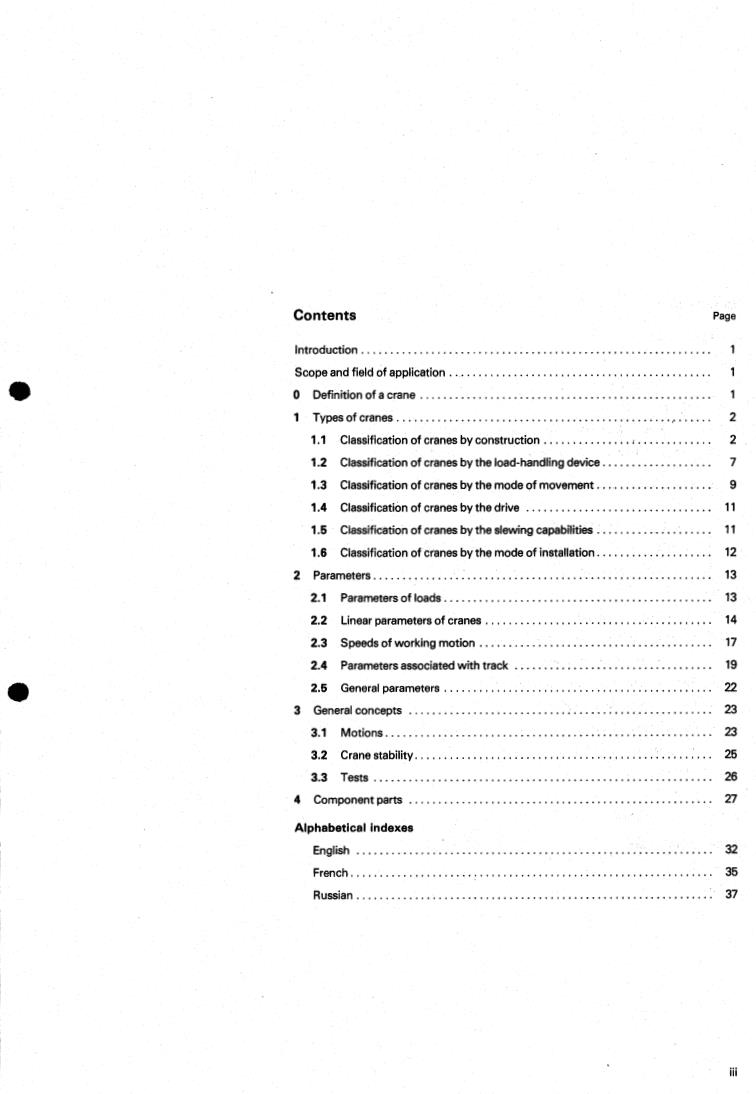
Con tents Page
............................................................
Introduction 1
Scope and field of application .
..................................................
O Definition of a crane 1
.....................................................
1 Typesofcranes., 2
.............................
1 . 1 Classification of cranes by construction 2
1.2 Classification of cranes by the load-handling device . 7
1.3 Classification of cranes by the mode of movement . 9
1.4 Classification of cranes by the drive .
1.5 Classification of cranes by the slewing capabilities . 11
1.6 Classification of cfanes by the mode of installation .
..........................................................
2 Parameters 13
..............................................
2.1 Parameters of loads 13
.......................................
2.2 Linear parameters of cranes 14
........................................
2.3 Speeds of working motion 17
..................................
2.4 Parameters associated with track 19
..............................................
2.5 General parameters 22
....................................................
3 General concepts 23
........................................................
3.1 Motions 23
...................................................
3.2 Crane stability 25
..........................................................
3.3 Tests 26
....................................................
4 Componentparts 27
Alphabetical indexes
............................................................
English
............................................................
French . 35
............................................................
Russian 37
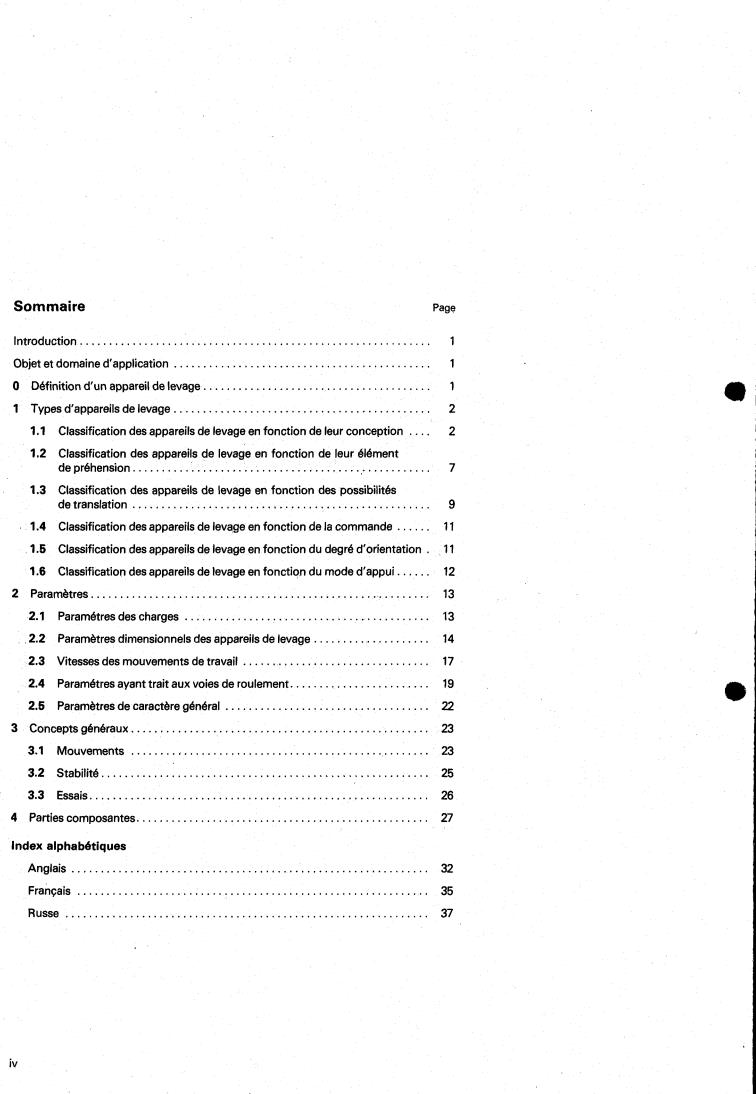
Sommaire Page
Introduction . 1
Objet et domaine d'application . 1
O Définition d'un appareil de levage . 1
1 Types d'appareils de levage . 2
1.1 Classification des appareils de levage en fonction de leur conception . 2
1.2 Classification des appareils de levage en fonction de leur élément
de préhension . 7
1.3 Classification des appareils de levage en fonction des possibilités
de translation . 9
1.4 Classification des appareils de levage en fonction de la commande .
1.5 Classification des appareils de levage en fonction du degré d'orientation . 11
1.6 Classification des appareils de levage en fonction du mode d'appui . 12
2 Paramètres . 13
2.1 Paramétres des charges . 13
2.2 Paramètres dimensionnels des appareils de levage . 14
2.3 Vitesses des mouvements de travail . 17
2.4 Paramétres ayant trait aux voies de roulement . 19
2.5 Paramètres de caractère général . 22
3 Concepts généraux . 23
3.1 Mouvements . 23
3.2 Stabilité . 25
3.3 Essais . 26
4 Parties composantes . 27
Index alphabétiques
Anglais . 32
Français . 35
Russe . . 37
BBeAeHUe .
06beKT H 06naCTb flpUMeHeHHfl . .
O OnpeAeneHHeKpaHa .
1 TMflbi KpaHOB .
1.1 KnaCCH~HKal(HflKpaH0BflOKOHCTPYK~UM .
1.2 KnaccMcpwKaqbIfl KpaHoe no BMRY rpy303axea~~oro opraHa .
1.3 KnaccHcpMKaqHfl KpaHOB no B03MOXHOCTM llepeMeqeHMfl .
1.4 Knaccw$wKaqMfl KpaHOB Il0 BHRY flpHBOAa .
1.5 KnaCCH~HKa~MflKpaHOB~OCTe~eHUflOBOpOTa .
1.6 KnaccHcpHKauMfl KpaHOB il0 CflOCO6yOnHpaHMfl .
2 ilapaMeTpbi .
2.1 Harpy3~~ . .
2.2 nHHt?fiHble napâMeTpbl KpaHOB . . 14
2.3 CKOPOCTU pa6owx flBH>cceHHfi .
2.4 flapaMeTpbl, CBfl3aHHble C IlOAKpaHOBbiMM flYTflMU .
2.5 TIapaMeTpbi o6qero xapaKTepa . .
3 OCHOBHbleflOHflTHfl . .
3.1 ABHMeHHfl . . 23
3.2 YCTOfi'IMBOCTbKpaHa .
3.3 MCflblTaHHfl .
4 Y3nbi . 27
h@âBMTHbiû yKâ3aTeJlM
AHrnMfiCKMH . 32
@PaHqY3CKM6l . 35
I
INTERNATIONAL STANDARD
IS0 4306/1-1985 (E/F/R)
NORME INTERNATIONALE
MCO 4306/1-1985 (A/@/PI
MEXRYHAPORHbla CTAHRAPT
Lifting appliances - Appareils de levage -
Vocabulaire -
Vocabulary -
Partie 1 : Généralités
Part 1 : General
BBepleH ue
Introduction
Introduction
MCO 4306 npeAcTaenfleT co6oA cnoeapb
IS0 4306 establishes a vocabulary in L'ISO 4306 établit un vocabulaire, en
TepMHHOB Ha aHrnMlkKOM, @pâHuy3CKOM
anglais, français et russe, des termes les
English, French and Russian of the
M PYCCKOM R~~IK~X, HaH60nee WMPOKO
plus courants utilisés dans le domaine des
most commonly used terms in the field
npVIMeHfleMblX B 06naCTVI KpaHOCTPOeHMfl,
grues, appareils de levage et équipements
of cranes, lifting appliances and related
ïiOAbeMHblX YCTpOfiCTB VI COOTBeTCTBylo-
correspondants. Elle comprend les parties
equipment. It consists of the following
UerO 3KCKaBaTOPHOTO 060py~oea~~~. OH
parts : suivantes :
COCTOHT ~3 cneAyioulMx qacTen :
Partie 1 : Généralités.
Part 1 : General.
Partie 2 : Grues mobiles.
Part 2 : Mobile cranes.
Partie 3 : Grues à tour.
Part 3 : Tower cranes.
Partie 4 : Portiques et grues de bord.
Part 4: Portal and pedestal cranes.
Partie 5 : Ponts roulants et grues à por-
Part 5: Overhead travelling and
gantry cranes. tique.
Objet et domaine
Scope and field
d'a p p I i ca ti o n
of application
La présente partie de I'ISO 4306 définit les
This part of IS0 4306 defines terms
termes relatifs aux types principaux
concerning the main types of cranes,
d'appareils de levage, aux paramètres, aux
parameters, general concepts and com-
concepts généraux et aux parties
ponent parts. A future addendum will
composantes. Un additif ultérieur définira
define limiting and indicating devices.
les termes relatifs aux limiteurs et
indicateurs.
NOTE - Diagrams illustrate some of the
definitions and are given only for general
guidance. NOTE - Des schémas complémentaires
illustrent certaines définitions et sont donnés
uniquement à titre indicatif.
OnpeneneHue Kpana
Définition d'un appareil de
O Definition of a crane
levage
appareil de levage (grue, pont roulant,
crane: Cyclic action machine intended
portique, blondin, etc.): Appareil à fonc-
for hoisting and moving in space of a
tionnement discontinu destiné à lever et
load suspended by means of a hook or
manutentionner, dans l'espace, les charges
other load-handling device.
suspendues à l'aide d'un crochet ou d'un
autre accessoire de préhension.
IS0 4306/1-1985 (E/F/R)
MCO 4306/1-1985 (A/@/P)
1 Types of cranes
Types d’appareils de levage
THllbi KpâHOB
Classification of cranes by construction
1.1
Classification des appareils de levage en fonction de leur conception
KJIûCCH~HKaqHR KpâHOB fl0 KOHCTPYKqHH
1.1.1 overhead type crane : Crane with its load-handling device hung from
a crab or a hoist or a jib crane capable of travelling along a bridge.
appareil de levage du type pont: Appareil de levage dont le
dispositif de préhension est suspendu à un chariot, à un palan ou à une
grue susceptible de se déplacer le long d‘un pont.
KpaH MOCTOBOïO THnâ : KpaH, y KOTOpOrO rpy303aXBaTHbllh OpraH
noAeeuieH K rpy30~0A Tenenwe, Tam M~M cTpenoeoMy KpaHy, nepe-
MelqâiOlqMMCR no MOCTY.
1.1.1.1 overhead travelling crane: Crane with its bridge girders directly
supported on rail tracks by travelling carriages.
pont roulant: Appareil de levage dont les éléments porteurs
s’appuient directement sur un chemin de roulement.
KpaH MOCTOüOA: KpaH, HeCyuMe 3neMeHTbl KOHCTPYKLWIM KOTO-
poi0 OnMpaDTCR HenOCpeC(CTBeHH0 Ha flOAKpâHOBbllh nyTb.
1.1.1.2 portal bridge crane: Crane with the bridge girders supported on
the rail tracks by legs.
pont portique: Appareil de levage dont les éléments porteurs
s’appuient sur un chemin de roulement par l’intermédiaire de palées
d’appui.
1.1.1.3 semi-portal bridge crane: Crane with its bridge girders supported
on the rail track directly at one end and by legs at the other end.
pont semi-portique: Appareil de levage dont les éléments porteurs
s’appuient sur un chemin de roulement, d’un côté directement et de
l’autre côté par l’intermédiaire de palées d’appui.
KpaH llOnyKO3nOBOÜ: KpaH, HeCylqMe 3lleMeHTbl KOHCTPYKUMM KOTO-
poi0 OnMpaiOTCR Ha nOC(KpaH0Bbilh nyTb, C OAHOA CTOPOHbl HenO-
CpeACTBeHHO, a C C(pyr0lh - npM flOMO~M OnOpHOlh CTOlhKM.
I
IS0 4306/1-1985 (E/F/R)
MCO 4306/1-1985 (A/O/P)
cable type crane: Crane with a load-handling device suspended from
1.1.2
a trolley travelling along track ropes secured to masts.
appareil de levage du type blondin: Appareil de levage dont le
dispositif de préhension est suspendu à un chariot qui se déplace le
long de câbles porteurs fixés à des palées-supports.
KpâH Kû6eflbHOrO THnû : KpaH, y KOTOpOrO rpy303aXBaTHbIfi OpraH
noAeeuieH K rpy~o~oh Tenexwe, nepeuewaowehcu no Hecyqm KaHa-
TaM, 3aKpenneHHbiM Ha ABYX OnOpaX.
1.1.2.1 cable crane: Crane whose supporting elements are ropes secured
to the tops of supporting masts.
blondin: Appareil de levage dont les éléments porteurs sont des
câbles fixés en haut des palées-supports.
KpaH Kû6enbHbIh: KpaH, HeCYU(MMM 3fleMeHTaMM y KOTOpOrO RBJlR-
,,W,/
i0TCR KaHaTbl, 3aKpenJleHHble B BepXHeh qâCTM OflOpHbiX MâiIT.
1.1.2.2 portal cable crane: Crane whose supporting elements are ropes
secured at the ends of a portal bridge mounted on two legs.
pont portique à câble: Appareil de levage dont les éléments por-
teurs sont des câbles fixés aux extrémités d'un pont monté sur des
palées-supports.
KpaH Kû6eflbHbih MOCTOüOh: KpaH, HeCYwMMM 3fleMeHTaMM y KOTO-
pOr0 RBflRiOTCU KaHaTbl, 3aKpenfleHHbIe Ha KOHLpX MOCTa, YCTaHOB-
iIeHHOr0 Ha OflOpHbiX CTOhKaX.
1.1.3 jib type crane: Crane with a load-handling device suspended either
from a jib or from a crab travelling along the jib.
appareil de levage du type grue: Appareil de levage dont le disposi-
tif de préhension est suspendu à la flèche ou au chariot qui se déplace
le long de la flèche.
KpûH CTpenOüOrO THnâ : KpaH, y KOTOpOrO rpy303aXBâTHblh OpraH
noAeeuteH K cTpene MnM TenexKe, nepeMe4atowehcR no cTpene.
1.1.3.1 portal slewing crane: Travelling slewing crane mounted on a por-
tal capable of allowing railcars or road vehicles to pass under it.
grue orientable sur portique: Grue mobile à flèche orientable,
montée sur un portique permettant le passage de véhicules, wagons
ou camions.
KpûH n0pTâflbHblh: KpaH nepe&BMXHOh nOBOpOTHblh Ha nOpTalle,
npeAHa3HaqeHHOM AJlR flp0nyCKa XeJie3HO~OpOXHOrO MnM a6TOMO-
(i~nbnoro TpaHcnopTa.
IS0 4306/1-1985 (E/F/R)
MCO 4306/1-1985 (A/@/P)
1 .I .3.2 semi-portal slewing crane : Travelling slewing crane mounted on a
semi-portal capable of allowing railcars or road vehicles to pass
under it.
grue orientable sur semi-portique: Grue mobile à flèche orienta-
ble, montée sur un semi-portique permettant le passage de véhicules,
wagons ou camions.
KpaH nepeaBMXHOR, nOBOpOTHblh, Ha no-
KpâH nOJlynOpTâJlbHblïl:
nynop-rane, npea~a3~are~~o~ anR nponycKa xene3~o~oporn~oro
MJlM aBTOMO6MJl bHOrO TpaHCnOpTâ.
1.1.3.3 mobile crane: Jib crane, which may be fitted with a mast (tower
attachment), capable of travelling, laden or unladen, without the
need for fixed runways and which relies on gravity for stability.
grue mobile: Grue à flèche qui peut être pourvue d'un mât
(équipement tour), capable de se déplacer, chargée ou non chargée,
sans avoir besoin de chemin fixe et qui demeure stable sous
l'influence de la gravité.
KpâH CTpenOBOA CâMOXO#ibI~: KpâH CTpeJlOBOrO TMna, KOTOpblh
MOXeT 6blTb CHa6XeH 6auieHHO-CTpeJlOBblM 060pyjqOBaHMeM M MO-
XeT nepeMeqaTbCR, B HeHârpyXeHHOM MnM HarpyXeHHOM COCTOR-
HMM, 6e3 ilOp,KpâHOBOrO nyTM, COXPaHRfi CBOO YCTOfi'4MBOCTb BCfle&
CTBMe CMJl bl TRXeCTM.
1.1.3.4 tower crane: Slewing jib type crane with jib located at the top of a
vertical tower.
grwe à tour: Grue à flèche orientable dont la flèche est montée sur la
partie supérieure d'un pylône vertical.
KpâH 6ûuieHHblh: KpaH nOBOpOTHblh CO CTpenOh, 3âKpenfleHHOM B
BepxHeU C(acTw sepwKanbHo pacnonoxenHoA 6auiHM.
1.1.3.5 railway crane:
Crane installed on a special platform travelling on
railway tracks.
grue sur voie ferrée: Grue montée sur une plate-forme qui se
déplace sur voie ferrée.
KpâH XeJle3HO~OpOXHblh: KpaH, CMOHTMpOBaHHblM Ha nJlâTC@OpMe,
nepeaBMratoueAcR no ~ene3~oflopox~o~y nyw.
1.1.3.6 floating crane: Crane mounted on a special self-propelled or towed
pontoon designed for its support and transport.
grue flottante: Grue montée sur un ponton destiné spécialement à
la porter et à la déplacer.
KpaH nJlâBy'4blh: KpaH Ha CaMOXOAHOM MnM HeCaMOXOAHOM nOHTO-
ne, npea~a3~aqe~~o~ QnR ero ycTaHosKM M nepeaBMxenwt.
IS0 430611-1985 (E/F/R)
MCO 4306/1-1985 (A/@/P)
1.1.3.7 deck crane: Slewing crane mounted on a ship's deck and intended
for loading and unloading the ship.
grue de bord: Grue à flèche orientable, montée à bord d'un navire
et destinée au chargement et au déchargement de celui-ci.
KpâH CTpeJlOBOM CYAOBOM: KpaH nOBOpOTHblh, yCTâHOBfleHHbil? Ha
6Op~y CyAHa H npeg~a3~aqen~bit7 AnR er0 3arpy3~~ M pa3rpy3~~.
I
I
I ---
I--
1.1.3.8 derrick crane (mast crane) : Slewing crane with a jib hinged at the
lower part of a vertical mast which is supported at the top and the
bottom.
mât de charge (grue-derrick) : Grue à flèche orientable dont la flè-
che est articulée sur un mât muni d'un appui en bas et d'un appui en
haut.
KpâH MâWOübIh : KpâH nOBOpOTHbiM, CO CTpenOu, 3âKpenneHHOh
uapHHpHo Ha Mawe, MMetoU(eh HMXHDD M eepxHtoto OnOpbi.
1.1.3.8.1 guy-derrick crane: Derrick crane with the top of the mast held by
means of guy ropes.
grue-derrick à haubans: Grue-derrick dont le haut du mât est
fixé à l'aide de tirants à câbles (haubans).
KpaH MaWOüblh üâHTOübiM: KpaH Mâ'4TOBblh C 3âKpenneHMeM
BepXa MaclTb1 nOCpeACTBOM KâHâTHblX OTTR>KeK-BâHTOB.
1.1.3.8.2 rigid-braced derrick crane: Derrick crane with the top of the
mast held by means of rigid bracing.
grue-derrick à appui rigide: Grue-derrick dont le haut du mât est
fixé à l'aide de tirants rigides.
1.1.3.9 cantilever crane : Jib crane with a load-handling device suspended
either from a rigidly secured cantilever (a jib) or from a crab travelling
along the cantilever.
grue à potence: Appareil de levage du type grue dont le dispositif
de préhension est suspendu à une potence (flèche) fixée rigidement
ou à un chariot qui se déplace le long de la potence (flèche).
KpaH KOHCOJlbHblÜ: KpaH CTpenOBOrO TMnâ, rpy303aXBâTHblh OpraH
KoToporo no4eeuiei-i K xecTKo aa~penne~~oh KOHCO~M (cTpene) M~M
K Teneme, nepeMelyato4ehcR no KOHCO~M (cTpene).
1.1.3.9.1 pillar jib crane: Cantilever crane either capable of rotating on a
pillar fixed at its base to a foundation, or secured to a pillar which
can rotate in a support socket in its foundation.
grue à fût (potence sur colonne) : Grue à potence, soit orienta-
ble sur une colonne dont la base est fixée à la fondation, soit fixée à
une colonne orientable dans le logement de fondation.
KpaH KOHCOJlbHblÜ Ha KOJlOHHe: KpaH KOHCOnbHbih, MMetolyMM
B03MOXHOCTb BpâlyaTbCfi Ha KOnOHHe, OCHOBâHMe KOTOPOM npM-
KpenneHO K @yHnâMeHTy, nw60 npMKpenlleHHblh K KOnOHHe, KOTO-
pâR MOXWT Bpâ~aTbCR 6 nOAnRTHMKe, pa3MeqeHHOM 6 @)"na-
MeHTe.
1.1.3.9.2 wall crane: Crane either fixed to a wall or capable of travelling on
elevated tracks secured to a wall or bearing structure.
grue murale: Grue fixée à un mur, ou susceptible de se déplacer le
long d'un chemin de roulement aérien fixé à un mur ou à une char-
pente de bâtiment.
KpaH HaCTeHHblÜ: KpâH CTauMOHaPHblh, npMKpeWleHHbIh K CTe-
He, n~60 nepeMeU@lO~MhCR no Hafl3eMHOMY KpaHOBOMy nyTM, 3â-
KpenneHHOMy HaCTeHe MnM HeCyu(eh KOHCTPYKUMM.
1.1.3.9.3 walking crane: Cantilever crane that travels along ground rail
track and is supported by elevated guides.
grue vélocip6de: Grue à potence se déplaçant sur une voie de
roulement à rail au sol et maintenue par un guide supérieur.
Kpan BenocwneAHbiÜ: KpaH KoHconbHbik, nepeMeqatolyMAcR no
H~~~MHOM~ penbcosoMy nyTM M y4epmweaeubih 6epxHeh Hanpae-
nivolyen.
IS0 4306/1-1985 (E/F/R)
MCO 4306/1-1985 (A/@/P)
1.2 Classification of cranes by the load-handling device
Classification des appareils de levage en fonction de leur élément de préhension
KnaccH@nKaqHR Kpawoe no BnAy rpy303axea~noro opraHa
1.2.1 hook crane: Crane with a hook as the load-handling device.
appareil de levage à crochet: Appareil de levage dont l'élément de
préhension est un crochet.
KpaH KptOKOôOh: KpaH, 060pyAOBaHHbiR rpy303aXBaTHblM OprâHOM
B BMAe KpDKa.
1.2.2 grabbing crane: Crane with a grab as the load-handling device.
appareil de levage à benne preneuse: Appareil de levage dont l'élé-
ment de préhension est une benne preneuse.
KpaH rpehc#mpHbih: KpaH, 060PY~OBâHHblh rpY303âXBaTHblM Opra-
HOM B BviAe rpeR+epa.
1.2.3 magnet crane: Crane with an electromagnet as the load-handling
device.
appareil de levage à électroporteur: Appareil de levage dont l'élé-
ment de préhension est un électroporteur.
KpaH MârHHTHblk: KpaH, 060py~OBâHHbI~ rPY303âXBaTHblM OpraHOM
B BMAe 3fleKTpOMarHMTa.
1.2.4 box-handling crane with magnet: Overhead type crane with an
electromagnet as the load-handling device and also having a device for
handling charging boxes.
pont roulant électroporteur pour auges à mitrailles (pont roulant
à auges et à électroporteur) : Appareil de levage du type pont dont
l'élément de préhension est un électroporteur et qui est muni d'un dis-
positif à manutentionner les auges à mitrailles.
KpaH MyIlbROMarHHTH blh: KpaH MOCTOBOrO TMnâ, 060PYQOBâHHblfi
rpy303aXBaTHblM OpraHOM B BMAe 3JleKTpOMarHMTâ M np~cnoco6ne-
HMeM Ann nepeMeUeHMR Mynbp.
1.2.5 box-handling crane with grab: Overhead type crane with a grab as
the load-handling device and also having a device for handling charging
boxes.
pont roulant à benne preneuse pour auges à mitrailles: Appareil
de levage du type pont dont l'élément de préhension est une benne pre-
neuse et qui est muni d'un dispositif à manutentionner les auges à
mitrailles.
IS0 4306/1-1985 (E/F/R)
MCO 4306/1-1985 (A/CD/P)
1.2.6 open-hearth furnace charging crane: Overhead type crane
equipped with a device for handling charging boxes.
de
pont roulant chargeur de four Martin (pont roulant chargeur
four): Appareil de levage du type pont équipé d'un dispositif 5 'O ' 'ni
manutentionner les auges à mitrailles.
7777-
MOCTOBOrO TMnâ, 060pyAOBaHH bll?
KpaH MyJlb~OûâBâJlO~HbI6l: KpaH
XO6OTOM Anfi 3âXBaTa Mynba.
1.2.7 electrode-handling crane: Overhead type crane equipped with i
grip for removing electrodes from electrolysers.
pont roulant arrache-goujons: Appareil de levage du type poni
équipé d'un dispositif à extraire les goujons des électrolyseurs.
KpâH uiTbipeBO6l: KpaH MOCTOBOrO TMnâ, 060py~OBaHHbifi 3âXBaTOM
A~R ~3~neqen~~ wbipeiii ~3 ane~~ponw~epoe.
1.2.8 overhead travelling stacking crane: Overhead type crane
equipped with a suspended mast carrying the stacking forks.
pont roulant gerbeur: Appareil de levage du type pont équipé d'un
fût suspendu verticalement et portant un dispositif à gerber les colis.
KpâH-uiTâ6ûllep: KpaH MOCTOBOrO TMnâ, 060py~OBâHHbIU BepTM-
~CT~OUCTBOM A~R u~a6en~poea~w~ rpy~oe.
KanbnoA KononnoU c
1.2.9 ladle crane: Overhead type crane equipped with mechanisms for
lifting and tipping foundry ladles.
pont roulant de coulée: Appareil de levage du type pont équipé
des mécanismes à lever et basculer la poche de coulée.
KpaH JlHTe6lHbl6l: KpaH MOCTOBOrO TMnâ, 060py~OBâHHbIl? ~exaH~3-
Y
MâMM noAbeMa M O~POKM~blBâHHfi nMTefiHOr0 KOBWâ.
1.2.10 ingot charging crane: Overhead type crane equipped with a
slewing column the lower part of which carries horizontal dogs for
gripping and charging ingots.
pont roulant chargeur de lingots: Appareil de levage du type pont
équipé d'un fût pivotant dont la partie inférieure porte la pince hori-
zontale à enfourner les lingots.
KpâH flOCâ~O'4Hbi6l: MOCTOBOrO THna, 060pYAOBâHHblU Bpâ-
KpâH
4aioqeficfl KO~OHHOU c ~O~H~OHT~~~H~IMM KneQaMH B HMnweh ee
rlacTM ~nri 3ax~a~a H nocaAKcM B neqb ~~~OTOBOK.
1.2.11
forge crane: Overhead type crane equipped with a device for lifting,
handling and turning forgings.
pont roulant de forge: Appareil de levage du type pont équipé d'un
dispositif à lever, manutentionner et virer les pièces à forger.
KOBO'lHblÜ:
KpâH KpâH MOCTOBOrO TMnâ, 060py~OBâHHblh ilpMCn0-
C06neHMeM A~R noAbeMa, nepeMe4eHm M nosopoTa noKoBoK.
IS0 4306/1-1985 (E/F/R)
MCO 4306/1-1985 (A/O/P)
1.2.12 stripper crane: Overhead type crane equipped with a device for
removing ingots from moulds.
pont roulant démouleur (pont strippeur) : Appareil de levage du
type pont équipé d'un dispositif à extraire les lingots des lingotières.
KpaH AJlR pa3AeBaHHR CJlHTKOB (CTpHflnepHbiH): KpaH MOCTOBOrO
TMna, 060pyAOBaHHbiL? YCTpOhCTBOM AJlR BblTanKHBaHHR CnHTKOB
~3 VI~~OXHVIL(.
1.2.13 soaking pit crane: Overhead type crane equipped with tongs in-
tended for charging the pit furnace.
pont roulant de four pit: Appareil de levage du type pont équipé
d'une pince et destiné au service d'un four pit.
KpaH KOJlOA~eBbih: KpaH MOCTOBOrO TVlnâ, 060PyAOBaHHbih Kneiqe-
BbiM ~~XB~TOM H npe~~a3~aqe~~biL? Anfl 06cnymn~a~~fl Konoaqe-
Bbix neqeh.
1.3 Classification of cranes by the mode of movement
Classification des appareils de levage en fonction des possibilités de translation
KnaccM@IKaqMFi KpaHOB no BOBMOXHOCTH llepeMeu(eHHFi
Crane fixed on a foundation or on any other
1.3.1 fixed base crane:
stationary base.
appareil de levage fixe (stationnaire) : Appareil de levage fixé à une
fondation ou à une autre base fixe.
1.3.2 climbing crane: Crane mounted on elements of a building being built
and travelling upwards by its own mechanisms as the height of the
building increases.
appareil de levage à autosurélévation: Grue installée sur l'ossature
d'un ouvrage en cours de construction et qui se déplace de bas en
haut, par l'intermédiaire de ses propres mécanismes, au fur et à mesure
que la construction progresse.
KpaH CaMOnO~%eMHbih: KpaH, YCTaHOBneHH blL? Ha KOHCTPYKUHAX
BO~BOAMMO~O coopymekiuifl M nepeMeiqaioq~ hcfl Bsepx npM noMoiqM
C06CTBeHHblX MeXâHM3MOB il0 Mepe B03BeAeHMA COOPYXeHMR.
IS0 4306/1-1985 (E/F/R)
MCO 4306/1-1985 (A/@/P)
1.3.3 portable crane: Crane mounted on a base capable of being movec
from site to site manually or by means of auxiliary equipment.
appareil de levage déplaçable: Appareil de levage monté sur une
plate-forme et susceptible d'être déplacé d'un endroit à un autre, soil
manuellement, soit à l'aide d'un moyen auxiliaire.
1.3.4 radial crane: Crane capable of moving around a stationary vertical
axis in operation.
appareil de levage pivotant: Appareil de levage susceptible de se
déplacer autour d'un point fixe au cours du travail.
Kpan pa4HanbnbiH: KpaH HMetouyLh BO~MOXHOCT~ nepeMeuenm
npM pa60Te OTHOCMTen bHO OAHOLh CTaU,MOHapHOLh OnOpbl.
1.3.5
travelling crane: Crane capable of moving itself during operation.
appareil de levage mobile: Appareil de levage susceptible de se
déplacer en cours de travail.
Kpan nepeABnxnoü: KpaH, MMetoOU(MLh BO~MOXHOCT~ nepeAeuxenMn
npM pa6o~e.
1.3.5.1 self-propelled crane: Travelling crane equipped with a mechanism
for travelling while in operation and for moving from site to site.
grue automotrice: Grue mobile équipée d'un mécanisme permet-
tant les translations sur son aire de travail et les déplacements sur
route.
KpaH CahlOXO~HbIh: Kpan nepeABMXHOA, 060PYAOBâHHblLh MeXâHM3-
MOM pnn nepeAeMxeHMR npM pa6o~e M TpaHcnopTMposKe.
1.3.5.2 Travelling crane not provided with power for travel-
trailer crane:
ling which can be towed as a trailer by a tractor.
grue remorquée: Grue mobile qui n'est pas équipée d'un méca-
nisme de translation et qui est déplacée par remorquage à l'aide d'un
tracteur (remorqueur).
Kpan npnqennoü: KpaH nepeAeMxHoLh, He 060pYAOBaHHblW Mexa-
HMJMOM A~R nepeABMxeHm M nepeMeuaeMbiLh B npM4ene 3a mra-
C(OM (6YKCMpOM).
IS0 4306/1-1985 (E/F/RI
MCO 4306/1-1985 (A/@/P)
1.4 Classification of cranes by the drive
Classification des appareils de levage en fonction de la commande
KflaCCHC#"â~HFi KpaHO6 Il0 BH~ynpHBO~a
1.4.1 manual crane: Crane with manually-driven mechanisms.
appareil de levage à main : Appareil de levage dont les mécanismes
sont entraînés à la main.
KpaH PyriHOÜ: KpaH C pyc(HblM npMBOAOM er0 MeXâHM3MOB.
1.4.2 electric crane: Crane with electrically-driven mechanisms.
appareil de levage électrique: Appareil de levage dont les mécanis-
mes sont commandés électriquement.
KpaH 3JleKTpHWCKHÜ: KpaH C 3neKTpMqeCKMM npHBOAOM er0 MeXa-
HM3MOB.
1.4.3 hydraulic crane: Crane with hydraulically-driven mechanisms.
appareil de levage hydraulique: Appareil de levage dont les méca-
nismes sont commandés hydrauliquement.
Kpan rHRpaenHrecKHü: KpaH c rMRpasnMrecKMM npMBoAoM ero Me-
XâHM3MOB.
1.5 Classification of cranes by the slewing capabilities
Classification des appareils de levage en fonction du degré d'orientation
KIIaCCHc#N4KaLpIfI Kpanoe no cienenH no6opol.a
1.5.1 slewing crane : Crane with slewing platform capable of rotating with
the load in a plane in relation to its undercarriage or base.
grue orientable : Grue dont la partie tournante peut pivoter avec une
charge, par rapport au châssis de roulement ou à la partie fixe.
KpûH TlOBOpOTHbiÜ: KpaH, MMetOu(HA B03MOXHOCTb Bpau(eHMfl (B Ilna-
He) nOEOpOTHOh '4âCTM BMeCTe C rPY30M OTHOCMTenbHO OnOpHOA W-
CTM KpaHa.
1.5.1.1 limited slewing crane: Slewing crane with a slewing platform
capable of turning between two extreme positions separated by an
angle less than 360O.
grue à orientation limitée: Grue orientable dont la partie tournante
peut pivoter, d'une position limite à l'autre, d'un angle inférieur ZI
360 O.
KpaH HeTlOJlHOllOBOpOTH blÜ: KpaH nOBOpOTHbifi, HMetOu(Mh B03MOx-
HocTb Bpau(etiMfl noeopoTHoA qacTM OT OF\HOrO KpaUHero nonoxe-
HMFI AO Apyroro Ha yron MeHee 360'.
IS0 4306/1-1985 (E/F/R)
MCO 4306/1-1985 (A/@/P)
1.5.1.2 full-circle slewing crane: Slewing crane with a slewing plat-
form capable of turning between two extreme positions
separated by an angle greater than 360’.
grue à orientation totale: Grue orientable dont la partie
tournante peut effectuer une rotation d’un angle supérieur à
360 O.
KpâH flOflHOflOBOpOTHbih: KpaH nOBOpOTHbih, MMeK)olqMh B03-
MOXHOCTb Bpa~eHMFi nOBOpOTHOh ‘4aCTM OT OAHOrO KpâhHe-
ro nonoxewfl AO Gpyroro Ha yron 6onee 360O.
1.5.2 non-slewing crane: Crane not capable of rotating the load in relation
to its undercarriage.
grue non orientable: Grue qui n’a pas la possibilité d‘orientation de la
charge par rapport au châssis porteur.
KpâH H0flOBOpOlHblh: KpaH, He MMeOqMh B03MOXHOCTM BpaueHMR
rpy3a (B IlnaHe) OTHOCMTenbHO OnOpHOh ‘iâCTM.
1.6 Classification of cranes by the mode of installation
Classification des appareils de levage en fonction du mode d’appui
Knaccw#3HKaqnFi Kpanoe nocnoco6yonnpann~i
1.6.1 supported crane: Overhead or underslung crane running on elevated
crane track.
appareil de levage posé: Pont roulant posé sur un chemin de roule-
ment aérien.
KpâH OflOpHbl#: KpaH MOCTOBOh, 0nMpâK)qMhCR Ha Hafl3eMHbIh Kpa-
HOBbln nyTb.
1.6.2 underslung crane: Overhead crane suspended from the lower bar of
the crane track.
appareil de levage suspendu : Pont roulant suspendu aux ailes infé-
rieures du chemin de roulement.
KpâH IlO~BeCHOh: KpaH MOCTOBOh, nO,4BeUeHHblh K HMXHVIM IlOnKaM
no~KpaHoBoro nyTM.
IS0 430611-1985 (E/F/R)
MCO 4306/1-198!5 (A/@/P)
2 Parameters
Paramètres
iïapanneïpbi
2.1 Parameters of loads
Paramètres des charges
Ha rpy3~~
2.1.1 load moment M = L.Q : Product of radius, L, and its respective
load, 0.
moment de la charge par rapport à l'axe d'orientation, M = L-Q :
Produit de la portée, L, par la charge nominale correspondante, Q.
MoMenT rpy3o~oa M = L.Q: npo~3se~e~~e BenMwti BbineTa L M
COOTBeTCTBylOqeh @My rpy30nOfll~eMHOCTM 0.
2.1.2 load tipping moment MA = A.Q : Product of the distance, A,
from the load axis to the tipping axis and its respective load, O.
moment de basculement, MA = A.Q: Produit de la portée, A,
à partir de l'axe de basculement, par la charge nominale cor-
respondante, Q.
MOMeHT rPYIOBOI( OnpOKH~biBaloqHa MA = A'Q : npOM3BefleHMe
BenMqMH BblneTa OT pe6pa OnPOKMflblBâHMR A M COOTBeTCTByD~eM
eMy rPY30iiOAbeMHOCTM 0.
2.1.3 design mass, G, : Mass of a crane without ballast, counterweight,
fuel, oils, lubricants and water; for jib cranes, the design mass is to be
taken complete with its main jib (boom) and counterweight (tail ballast)
but without ballast, fuel, oil, lubricants or water.
masse nette, G, : Masse d'un appareil de levage sans lest ni
contrepoids, carburant, lubrifiant ni eau. Pour les grues à flèche, la
masse nette est la masse de la grue assemblée avec la flèche principale
et le contrepoids, mais sans lest ni carburant, ni lubrifiant, ni eau.
KoncrpyKrHsnan Macca, G, : Macca Kpana 6e3 6annac~a M npomBo-
Beca B ~e3anpa~ne~~o~ COCTORHMM, T.e. Ge3 Tonnma, Macna, CM~~O+
HblX MaTepMaJiOB M BOflbl. flnR CTpeflOBbiX KpaHOB npMHMMaeTCR B
c6ope c OCHOBHOM cTpenoh M npoTMBoeecoM B ~esanpa~ne~~o~ co-
CTORHMM.
2.1.4 total mass, Go : Mass of the crane including the mass of ballast,
counterweight, fuel, oils, lubricants and water filled to the recom-
mended levels.
masse totale, Go : Masse totale d'un appareil de levage en ordre de
marche, avec lest, contrepoids, carburant, lubrifiant et eau.
o6qa~ Macca, Go : nonHan Macca KpaHa B sanpa~ne~~o~ COCTORHMM
C 6annaCTOM M iipOTMB0BeCOM.
IS0 4306/1-1985 (E/F/R)
MCO 4306/1-1985 (A/@/P)
~ ~~
2.1.5 wheel load, P : Maximum vertical load transferred by one chassis
wheel to the track or ground.
charge sur un appui, P: Valeur de la charge maximale verticale
qu'un appui transmet au chemin de roulement ou au sol.
AaBJleHH0 KOJWCâ, P : BenwwHa HaM6Onbuie6l BepTMKanbH06l Harpy3-
KM, IlepeAaBaeMafl OAHHM XOflOBbiM KOneCOM Ha nOflKpaHOBbi6l nyTb
M~M Ha non.
IP
2.2 Linear parameters of cranes
Paramètres dimensionnels des appareils de levage
flMHeAHble IlapâMeTpbi KpaHOB
2.2.1 radius, L : Horizontal distance between the axis of slewing of the
turntable of the crane and the vertical axis of an unladen load-handling
device when the crane is erected on a level site.
portée, L : Distance horizontale entre l'axe d'orientation de la partie
tournante et l'axe vertical de l'élément de préhension sans charge,
l'appareil de levage étant installé sur un terrain horizontal.
Bbinei, L : PaccTomMe no ropmo~~ann OT OCM spawenm noeopoT-
HOGI qacw no BepTMKanbHoA oc^ rpy303axea~~oro opra~a 6e3 ~arpy3-
KM npM YCTaHOBKe KpaHa Ha rOpM30HTanbHOM nnO~a~Ke.
2.2.2 outreach to tipping axis, A : Horizontal distance from the tipping
axis to the vertical axis of the load-handling device measured under
no-load conditions and when the crane is erected on a level site.
portée à partir de l'axe de basculement, A : Distance horizontale
entre l'axe de basculement et l'axe vertical de l'élément de préhension
sans charge, l'appareil de levage étant installé sur un terrain horizontal.
BblJWT O1 pe6pa OnpOKH~blBaHblR, A : PaCCTORHMe no rOpM30HTaiiM
OT pe6pa OnpOKMAbiBaHMFi A0 BepTMKanbHO6l OCW rpy303aXBaTHOrO
OpraHa 6e3 HarPy3KM npM YCTaHOBKe KpaHa Ha rOPM30HTanbHO6l
nnoqaAKe.
2.2.3 outreach from rail, I : Maximum horizontal distance between the axis
of the crane rail closest to the cantilever and the axis of the load-
handling device when located on the cantilever.
portée de bec, I : Distance horizontale maximale entre l'axe du che-
min de roulement le plus proche du bec et l'axe de l'élément de préhen-
sion placé sur ce bec.
Bbinei KoHconn, I: Ha~6onbwee paccToRHMe no rop~3o~~an~ OT OCM
onopbi Kpana 6n~xaMweA K KOHCO~H, RO OCM rpy303axea~~oro opra-
Ha, pacnonoxeHHoro Ha KOHCO~M.
IS0 4306/1-1985 (E/F/R)
MCO 4306/1-1985 (A/Q/P)
2.2.4 hook approach, C : Minimum horizontal distance between the centre
of the track rail and the vertical axis of the load-handling device.
/
cote d’approche (appareil de type pont), C : Distance horizontale
/
minimale entre l’axe de la voie de roulement et l’axe vertical du
‘O’ ;
dispositif de préhension.
IlOnXOçl, c : MMHMMallbHOe PâCCTORHMe no rOpM30HTaflM OT OCM Kpa-
HoBor0 penbca 40 BepTMKanbHoA OCM rpy303axea~~oro opraHa.
/
/
/
/ /
/
/
/
/y/, , , , //,////,y
2.2.5 tail radius. r : Maximum radius of the slewing part of the crane that
lies opposite to the boom.
zone de débattement arrière, r: Rayon maximal de la partie
tournante de la grue du côté opposé à la flèche.
ra6apn~ O~AHHH, r : Ha~6onbui~U paAMyc noeopoTHoA iIacTM KpaHa
CO CTOPOHbl, npOTMBOnOflOXHOfi Cipelle.
2.2.6 load-lifting height, H : Vertical distance from the level of the plane
on which the crane is resting up to the load-handling device when it is
located at its uppermost working position :
- for hooks and forks, up to their bearing surface;
- for other load-handling attachments, up to their lowest point
(when closed).
For overhead type cranes, the lifting height is to be measured from the
ground level. The lifting height is to be determined without load, the
crane being erected on a level site.
course de levage, H : Distance verticale entre le niveau d’appui de
et le dispositif de préhension se trouvant en
l’appareil de levage
position supérieure:
- pour crochets et fourches, la cote est prise à leur surface d’appui;
- pour les autres dispositifs de préhension, la cote est prise à leur
point le plus bas (en position fermée).
Pour les ponts roulants, la hauteur de levage est déterminée à partir du
niveau du sol. La hauteur de levage est à déterminer sans charge,
l’appareil de levage étant installé sur un terrain horizontal.
BblCOTa IlOA%eMa, H : PaCCTORHMe no BepTMKaflM OT YpOBHR CTORHKM
~o rpy303axea~~oro opraHa, HaxoARUerocn B BepxHeM nonomeHMM :
- Anfl KPIOKOB M BMJi - A0 MX OnOpHOu nOBepXHOCTM;
- Ann npoqMx rpy303axea~~bix opraHoe - ~o MX HMxHeA TO~KM
(B 3âMKHYTOM ~OIlOXeHklM).
Alln MOCTOBblX KpaHOB BblCOTa noAbeMa flpMHi4MaeTCR OT YPOBHR
nona. BbicoTa noAaeMa onpeAenReTcfl 6e3 ~arpy3~~ npM ycTanosKe
KpaHa Ha rOpM30HTaflbHO6l nnOu(aAKe.
IS0 4306/1-1985 (E/F/R)
MCO 4306/1-1985 (A/O/P)
2.2.7 load-lowering height, h : Vertical distance between the crane
bearing level and the load-handling device located at its lowest: working
position :
- for hooks and forks, up to their bearing surface;
- for other load-handling attachments, up to their lowest point
(when closed).
For overhead type cranes, the load-lowering height is to be measured
up to the rail level. The load lowering height is to be determined
without any load, the crane being erected on a level site.
profondeur de descente, h : Distance verticale entre le niveau
d’appui de l‘appareil de levage et le dispositif de préhension se trouvant
en position de travail inférieure:
- pour crochets et fourches, la cote est prise à leur surface d’appui;
- pour les autres dispositifs de préhension, la cote est prise à leur
point le plus bas (en position fermée).
Pour les ponts roulants, la profondeur de descente est déterminée
jusqu’au niveau du rail. La profondeur de descente est à déterminer
sans charge, l’appareil de levage étant installé sur un terrain horizontal.
rJly6UHâ OnyCKâHUri, h : PâCCTORHMe no BepTMKaflM OT YPOBHR CTORH-
KM KpaHa ~o rpy303axea~~oro opraHa, HaxoAR4erocR B HMxHeM pa-
60qe~ nonoxeHMM:
- Anfl KPDKOB M BMn - A0 MX OnOpHOh flOBepXHOCTM;
- AflR npO‘iMX rpy303aXBaTHblX OprâHOB -BO MX HMXHeh TOqKM
(6 3âMKHyTOM COCTORHMM).
AflR MOCTOBblX KpaHOB rny6MHa OnyCKâHMR npMHMMaeTCR OT YPOBHR
penbca. rny6~~a onycKaHm onpeAenReTcfl 6e3 ~arpy3~~ npw ycTa-
HOBKe KpaHâ Ha rOPM30HTâJlbHOh nflOu(a#Ke.
2.2.8 lifting range, D : Vertical distance between the highest and the
lowest working positions of the load-handling device [D = H + h (see
2.2.6 and 2.2.711.
amplitude de levage, D : Distance verticale entre la position de tra-
vail supérieure et la position de travail inférieure du dispositif de préhen-
sion ID = H + h (voir 2.2.6 et 2.2.7)l.
fiuana30~ nofiaenna, D : PaccTontivie no BepTmanM MexAy BepxHwM
M HMXHMM pa60qMM~ nonoxeHMRMM rpy303axea~~oro opraHa
b
[D = H + h (CM. 2.2.6 M 2.2.7)l.
!.2.9 crane track height, Ho : Vertical distance between the ground (floor)
level and the rail head level of the crane track.
hauteur du chemin de roulement, Ho : Distance verticale entre le
niveau du sol et le niveau supérieur du champignon du rail.
BblCOTâ nO~KpâHOBOr0 nyTU, Ho: PaCCTORHMe no BepTMKaflM OT YpOB-
HR nona (3e~nt-1) 40 YPOBHR ronoBoK penbcoe noAKpaHoeoro riyTM.
IS0 4306/1-1985 (E/F/R)
MCO 4306/1-1985 (A/@/P)
2.3 Speeds of working motion
Vitesses des mouvements de travail
CKOpOCW pa6orluix ABblXeHHïl
2.3.1 load-lifting (-lowering) speed, V, : Rate of vertical displacement of
the working load under steady conditions of motion.
vitesse de levage (de descente) de la charge, V, : Vitesse de
déplacement vertical de la charge levée, en régime établi.
CKOPOCTb nOA%eMa (OnyCKâHHR) rpy3â vn : CKOPOCTb BepTMKan bHOrO
nepeMeu(eHM8 pa6orero rpysa B ycTaHoBMBuleMcfl pexme ABMxe-
HMFI.
...
Questions, Comments and Discussion
Ask us and Technical Secretary will try to provide an answer. You can facilitate discussion about the standard in here.
Loading comments...