

ISO 11816-1:2024
(Main)Milk and milk products — Determination of alkaline phosphatase activity — Part 1: Fluorimetric method for milk and milk-based drinks
General Information
- Abstract
This document specifies a fluorimetric method for the determination of alkaline phosphatase (ALP) (EC 3.1.3.1) activity in raw and heat-treated whole milk, semi-skimmed milk, skimmed milk and flavoured milks. This method is applicable to milk and milk-based drinks from cows, sheep and goats. It is also applicable to milk powder after reconstitution. The instrument used for the determination of ALP can read activities up to 7 000 milliunits per litre (mU/l). If the activity is higher than 7 000 mU/l, it is diluted with ALP-free milk so as to obtain a measurement not higher than 7 000 mU/l.
- Status
- Published
- Publication Date
- 11-Jan-2024
- Technical Committee
- ISO/TC 34/SC 5 - Milk and milk products
- Drafting Committee
- ISO/TC 34/SC 5 - Milk and milk products
- Current Stage
- 6060 - International Standard published
- Start Date
- 12-Jan-2024
- Due Date
- 27-Oct-2023
- Completion Date
- 12-Jan-2024
Buy Documents
ISO 11816-1:2024 - Milk and milk products — Determination of alkaline phosphatase activity — Part 1: Fluorimetric method for milk and milk-based drinks Released:12. 01. 2024
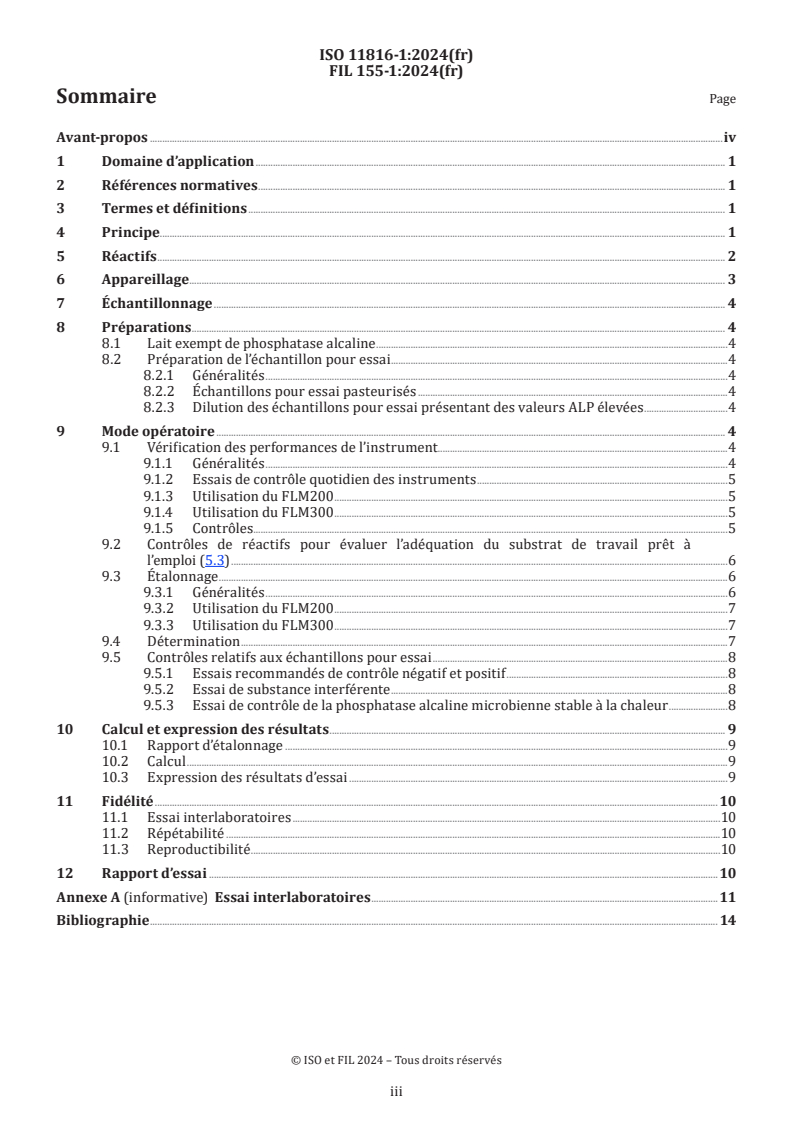
ISO 11816-1:2024 - Lait et produits laitiers — Détermination de l'activité de la phosphatase alcaline — Partie 1: Méthode fluorimétrique pour le lait et les boissons a base de lait Released:12. 01. 2024
Overview
ISO 11816-1:2024 sets out the internationally recognized fluorimetric method for determining alkaline phosphatase (ALP) activity in milk and milk products. The standard applies to a wide range of dairy types, including raw and heat-treated milk, whole, semi-skimmed, skimmed, and flavored milks from cows, sheep, and goats. This method is also suitable for reconstituted milk powder. The primary purpose of assessing ALP activity is to verify the effectiveness of pasteurization and other heat treatments, ensuring food safety and quality in dairy production.
Key Topics
- Alkaline Phosphatase (ALP) Activity: ALP (EC 3.1.3.1) is a naturally occurring enzyme in raw milk whose presence after heat treatment is an indicator of incomplete pasteurization or contamination.
- Fluorimetric Method: The method specified utilizes a sensitive fluorimetric assay where enzyme activity is measured based on fluorescence generated during substrate hydrolysis.
- Sample Types: Applicable to various milk types (whole, semi-skimmed, skimmed, flavored) from cows, sheep, and goats, as well as reconstituted milk powders.
- Measurement Range: The fluorimetric instrument can read ALP activity up to 7,000 milliunits per litre (mU/l). Samples exceeding this value require dilution with ALP-free milk.
- Controls and Calibration: Procedures include instrument verification, calibration with known standards, and daily use of positive and negative control samples to ensure test accuracy.
- Laboratory Best Practices: The procedure emphasizes the need for precision in sampling, reagent preparation, pipetting, and quality control to ensure reliable and reproducible results.
Applications
- Quality Assurance in Dairy Processing: The determination of ALP activity is a critical control point for dairy processors to confirm the adequacy of pasteurization. Excess residual ALP suggests possible survival of pathogenic microorganisms.
- Regulatory Compliance: Food safety authorities and industry stakeholders use this standardized test to comply with national and international dairy safety regulations.
- Product Integrity: The method helps prevent non-conforming products from reaching the marketplace by detecting post-pasteurization contamination or improper heat treatment.
- Research and Development: Dairy R&D labs employ this method in studies involving new processing techniques or novel dairy product formulations.
- Routine Quality Control: Routine use in quality control laboratories ensures ongoing safety and consistency in milk products.
Related Standards
- ISO 707 | IDF 50: Provides guidance on sampling methods for milk and milk products to ensure samples are representative for analysis.
- ISO 11816-2: Details complementary phosphatase activity determination methods for other dairy products.
- IDF 155 Series: The broader series covers multiple analytical techniques for analyzing enzymes in milk and milk products.
- Other Food Safety Standards: Compliance with ISO 11816-1 may be required under broader food safety management systems, such as those referenced in ISO 22000 for food safety management.
Practical Value
Implementing ISO 11816-1:2024 in commercial laboratories and dairy facilities guarantees a globally harmonized approach for monitoring heat treatment efficacy in milk and milk-based drinks. It protects consumer health, supports international trade in dairy goods, and underpins regulatory assurance programs. Organizations using this standard benefit from:
- Consistent, traceable results across different laboratories.
- Increased confidence for stakeholders and consumers in product safety.
- Efficient identification and reduction of non-compliant batches.
In summary, ISO 11816-1:2024 is fundamental for any dairy producer, laboratory, or regulatory body seeking reliable, standardized, and accurate measurement of alkaline phosphatase in milk and milk-based beverages.
Relations
- Effective Date
- 12-Feb-2026
- Effective Date
- 08-Oct-2022
- Effective Date
- 01-Oct-2022
Buy Documents
ISO 11816-1:2024 - Milk and milk products — Determination of alkaline phosphatase activity — Part 1: Fluorimetric method for milk and milk-based drinks Released:12. 01. 2024
ISO 11816-1:2024 - Lait et produits laitiers — Détermination de l'activité de la phosphatase alcaline — Partie 1: Méthode fluorimétrique pour le lait et les boissons a base de lait Released:12. 01. 2024
Get Certified
Connect with accredited certification bodies for this standard

BSI Group
BSI (British Standards Institution) is the business standards company that helps organizations make excellence a habit.

Bureau Veritas
Bureau Veritas is a world leader in laboratory testing, inspection and certification services.

DNV
DNV is an independent assurance and risk management provider.
Sponsored listings
Frequently Asked Questions
ISO 11816-1:2024 is a standard published by the International Organization for Standardization (ISO). Its full title is "Milk and milk products — Determination of alkaline phosphatase activity — Part 1: Fluorimetric method for milk and milk-based drinks". This standard covers: This document specifies a fluorimetric method for the determination of alkaline phosphatase (ALP) (EC 3.1.3.1) activity in raw and heat-treated whole milk, semi-skimmed milk, skimmed milk and flavoured milks. This method is applicable to milk and milk-based drinks from cows, sheep and goats. It is also applicable to milk powder after reconstitution. The instrument used for the determination of ALP can read activities up to 7 000 milliunits per litre (mU/l). If the activity is higher than 7 000 mU/l, it is diluted with ALP-free milk so as to obtain a measurement not higher than 7 000 mU/l.
This document specifies a fluorimetric method for the determination of alkaline phosphatase (ALP) (EC 3.1.3.1) activity in raw and heat-treated whole milk, semi-skimmed milk, skimmed milk and flavoured milks. This method is applicable to milk and milk-based drinks from cows, sheep and goats. It is also applicable to milk powder after reconstitution. The instrument used for the determination of ALP can read activities up to 7 000 milliunits per litre (mU/l). If the activity is higher than 7 000 mU/l, it is diluted with ALP-free milk so as to obtain a measurement not higher than 7 000 mU/l.
ISO 11816-1:2024 is classified under the following ICS (International Classification for Standards) categories: 67.100.10 - Milk and processed milk products. The ICS classification helps identify the subject area and facilitates finding related standards.
ISO 11816-1:2024 has the following relationships with other standards: It is inter standard links to EN ISO 11816-1:2024, ISO 23722:2021, ISO 11816-1:2013. Understanding these relationships helps ensure you are using the most current and applicable version of the standard.
ISO 11816-1:2024 is available in PDF format for immediate download after purchase. The document can be added to your cart and obtained through the secure checkout process. Digital delivery ensures instant access to the complete standard document.
Standards Content (Sample)
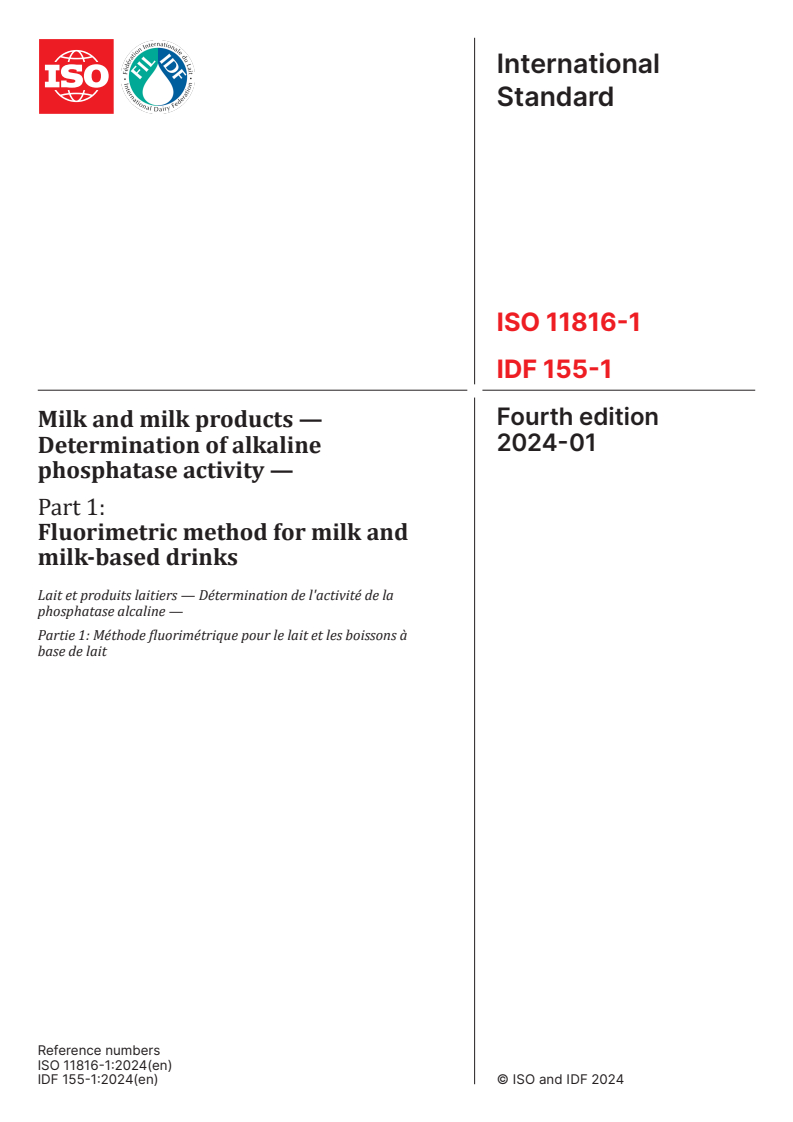
International
Standard
ISO 11816-1
IDF 155-1
Fourth edition
Milk and milk products —
2024-01
Determination of alkaline
phosphatase activity —
Part 1:
Fluorimetric method for milk and
milk-based drinks
Lait et produits laitiers — Détermination de l'activité de la
phosphatase alcaline —
Partie 1: Méthode fluorimétrique pour le lait et les boissons à
base de lait
Reference numbers
IDF 155-1:2024(en) © ISO and IDF 2024
IDF 155-1:2024(en)
© ISO and IDF 2024
All rights reserved. Unless otherwise specified, or required in the context of its implementation, no part of this publication may
be reproduced or utilized otherwise in any form or by any means, electronic or mechanical, including photocopying, or posting on
the internet or an intranet, without prior written permission. Permission can be requested from either ISO at the address below
or ISO’s member body in the country of the requester.
ISO copyright office International Dairy Federation
CP 401 • Ch. de Blandonnet 8 Silver Building • Bd Auguste Reyers 70/B
CH-1214 Vernier, Geneva B-1030 Brussels
Phone: +41 22 749 01 11 Phone: +32 2 325 67 40
Fax: +32 2 325 67 41
Email: copyright@iso.org Email: info@fil-idf.org
Website: www.iso.org Website: www.fil-idf.org
Published in Switzerland
ii
IDF 155-1:2024(en)
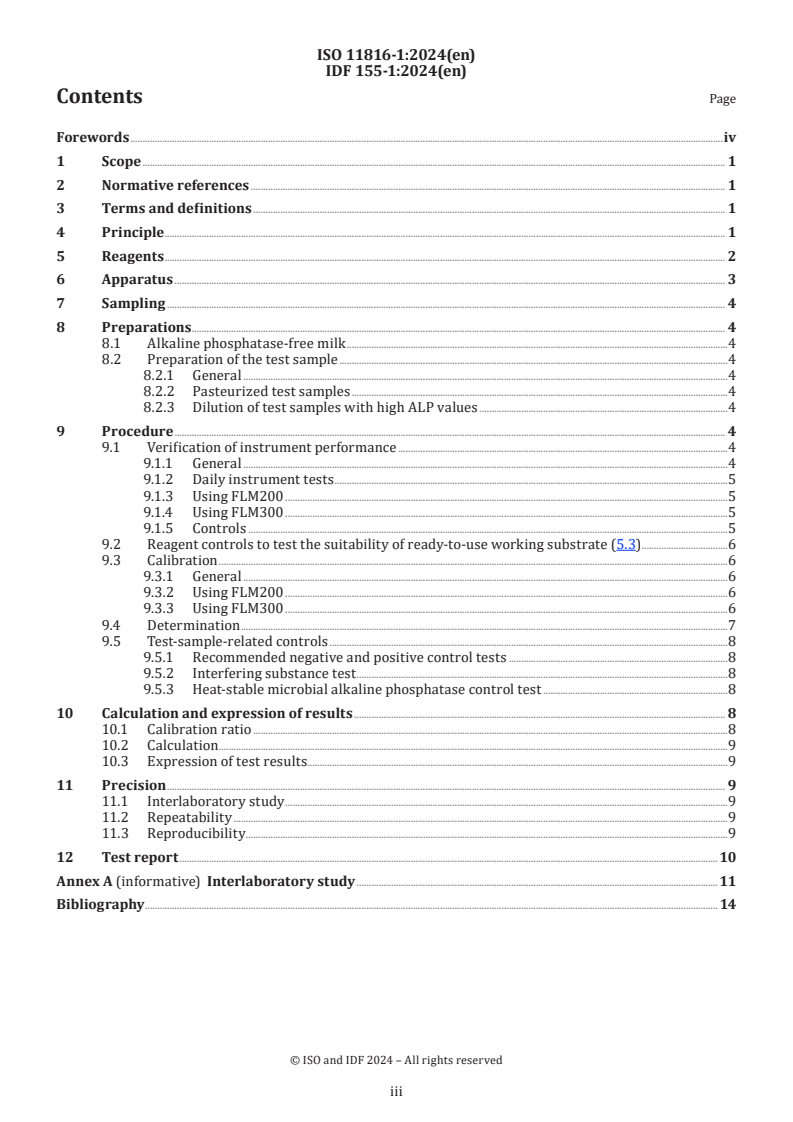
Contents Page
Forewords .iv
1 Scope . 1
2 Normative references . 1
3 Terms and definitions . 1
4 Principle . 1
5 Reagents . 2
6 Apparatus . 3
7 Sampling . 4
8 Preparations . 4
8.1 Alkaline phosphatase-free milk .4
8.2 Preparation of the test sample .4
8.2.1 General .4
8.2.2 Pasteurized test samples .4
8.2.3 Dilution of test samples with high ALP values .4
9 Procedure . 4
9.1 Verification of instrument performance .4
9.1.1 General .4
9.1.2 Daily instrument tests .5
9.1.3 Using FLM200 .5
9.1.4 Using FLM300 .5
9.1.5 Controls .5
9.2 Reagent controls to test the suitability of ready-to-use working substrate (5.3) .6
9.3 Calibration .6
9.3.1 General .6
9.3.2 Using FLM200 .6
9.3.3 Using FLM300 .6
9.4 Determination .7
9.5 Test-sample-related controls .8
9.5.1 Recommended negative and positive control tests .8
9.5.2 Interfering substance test .8
9.5.3 Heat-stable microbial alkaline phosphatase control test .8
10 Calculation and expression of results . 8
10.1 Calibration ratio .8
10.2 Calculation .9
10.3 Expression of test results.9
11 Precision . 9
11.1 Interlaboratory study .9
11.2 Repeatability .9
11.3 Reproducibility .9
12 Test report . 10
Annex A (informative) Interlaboratory study .11
Bibliography . 14
iii
IDF 155-1:2024(en)
Forewords
ISO (the International Organization for Standardization) is a worldwide federation of national standards
bodies (ISO member bodies). The work of preparing International Standards is normally carried out through
ISO technical committees. Each member body interested in a subject for which a technical committee
has been established has the right to be represented on that committee. International organizations,
governmental and non-governmental, in liaison with ISO, also take part in the work. ISO collaborates closely
with the International Electrotechnical Commission (IEC) on all matters of electrotechnical standardization.
The procedures used to develop this document and those intended for its further maintenance are described
in the ISO/IEC Directives, Part 1. In particular, the different approval criteria needed for the different types
of ISO document should be noted. This document was drafted in accordance with the editorial rules of the
ISO/IEC Directives, Part 2 (see www.iso.org/directives).
ISO draws attention to the possibility that the implementation of this document may involve the use of (a)
patent(s). ISO takes no position concerning the evidence, validity or applicability of any claimed patent
rights in respect thereof. As of the date of publication of this document, ISO had not received notice of (a)
patent(s) which may be required to implement this document. However, implementers are cautioned that
this may not represent the latest information, which may be obtained from the patent database available at
www.iso.org/patents. ISO shall not be held responsible for identifying any or all such patent rights.
Any trade name used in this document is information given for the convenience of users and does not
constitute an endorsement.
For an explanation of the voluntary nature of standards, the meaning of ISO specific terms and expressions
related to conformity assessment, as well as information about ISO's adherence to the World Trade
Organization (WTO) principles in the Technical Barriers to Trade (TBT), see www.iso.org/iso/foreword.html.
This document was prepared by Technical Committee ISO/TC 34, Food products, Subcommittee SC 5,
Milk and milk products, and the International Dairy Federation (IDF), in collaboration with the European
Committee for Standardization (CEN) Technical Committee CEN/TC 302, Milk and milk products — Methods
of sampling and analysis, in accordance with the Agreement on technical cooperation between ISO and CEN
(Vienna Agreement). It is being published jointly by ISO and IDF.
This fourth edition cancels and replaces the third edition (ISO 11816-1 | IDF 155-1:2013), which has been
technically revised.
The main changes are as follows:
— the FLM200 (which has been discontinued) has been replaced by the FLM300 version;
— the instructions for use of the instrument and the flow of those instructions have been revised in
accordance with FLM300, which has an upgraded user interface and electronics (there has been no
change to the assay or the test procedure with the changes to the interface and software);
— the instrument now includes the heater block which was a separate item previously.
A list of all parts in the ISO 11816 | IDF 155 series can be found on the ISO website.
Any feedback or questions on this document should be directed to the user’s national standards body. A
complete listing of these bodies can be found at www.iso.org/members.html.
iv
IDF 155-1:2024(en)
IDF (the International Dairy Federation) is a non-profit private sector organization representing the
interests of various stakeholders in dairying at the global level. IDF members are organized in National
Committees, which are national associations composed of representatives of dairy-related national interest
groups including dairy farmers, dairy processing industry, dairy suppliers, academics and governments/
food control authorities.
ISO and IDF collaborate closely on all matters of standardization relating to methods of analysis and
sampling for milk and milk products. Since 2001, ISO and IDF jointly publish their International Standards
using the logos and reference numbers of both organizations.
IDF draws attention to the possibility that the implementation of this document may involve the use of (a)
patent(s). IDF takes no position concerning the evidence, validity or applicability of any claimed patent
rights in respect thereof. As of the date of publication of this document, IDF had not received notice of (a)
patent(s) which may be required to implement this document. However, implementers are cautioned that
this may not represent the latest information, which may be obtained from the patent database available at
www.iso.org/patents. IDF shall not be held responsible for identifying any or all such patent rights.
Any trade name used in this document is information given for the convenience of users and does not
constitute an endorsement.
This document was prepared by the IDF Standing Committee on Analytical Methods for Processing Aids
and Indicators and ISO Technical Committee ISO/TC 34, Food products, Subcommittee SC 5, Milk and milk
products. It is being published jointly by ISO and IDF.
The work was carried out by the IDF/ISO Action Team P19 of the Standing Committee on Analytical Methods
for Processing Aids and Indicators under the aegis of its project leader Mr Rick Zampa (US).
v
International Standard
IDF 155-1:2024(en)
Milk and milk products — Determination of alkaline
phosphatase activity —
Part 1:
Fluorimetric method for milk and milk-based drinks
1 Scope
This document specifies a fluorimetric method for the determination of alkaline phosphatase (ALP) (EC
3.1.3.1) activity in raw and heat-treated whole milk, semi-skimmed milk, skimmed milk and flavoured milks.
This method is applicable to milk and milk-based drinks from cows, sheep and goats. It is also applicable to
milk powder after reconstitution.
The instrument used for the determination of ALP can read activities up to 7 000 milliunits per litre (mU/l).
If the activity is higher than 7 000 mU/l, it is diluted with ALP-free milk so as to obtain a measurement not
higher than 7 000 mU/l.
2 Normative references
There are no normative references in this document.
3 Terms and definitions
For the purposes of this document, the following terms and definitions apply.
ISO and IEC maintain terminology databases for use in standardization at the following addresses:
— ISO Online browsing platform: available at https:// www .iso .org/ obp
— IEC Electropedia: available at https:// www .electropedia .org/
3.1
alkaline phosphatase activity
ALP activity
activity of the enzyme present in the product, determined by the specified procedure
Note 1 to entry: The ALP activity is expressed as milliunits of enzyme activity per litre of sample (mU/l).
4 Principle
The ALP activity of the sample is measured by a continuous fluorimetric direct kinetic assay. A non-
fluorescent aromatic monophosphoric ester substrate, 2′-[2-benzothiazolyl]-6′-hydroxybenzothiazole
phosphate, in the presence of any ALP derived from the sample, undergoes hydrolysis of its phosphate
radical, producing a highly fluorescent product. Fluorimetric measurement of ALP activity is measured at
IDF 155-1:2024(en)
®1)
38 °C over a 3 min period when using a Fluorophos . This includes pre-incubation of substrate and sample,
followed by multiple kinetic readings of the reaction rate.
NOTE Although this is a 3 min test, the first minute is an equilibration period to ensure that the sample is at 38 °C.
Measurements of activity are actually made from the beginning of the second minute to the end of the third minute
(i.e. over a 2 min period).
5 Reagents
During the analysis, unless otherwise stated, use only reagents of recognized analytical grade and distilled
or demineralized water or water of equivalent purity.
The reagents specified in 5.1 to 5.5 and the apparatus specified in 6.1 to 6.4 (except 6.3.3) comprise the
2) ®
Fluorophos Test System . The manufacturer can change the packaging configurations supplied with ®
Fluorophos Test system. The user should refer to the manufacturer’s instructions for preparing reagents if
different from those specified herein.
® ®
5.1 Fluorophos substrate, in bottles, each containing 144 mg of Fluorophos substrate powder, molar
mass of 580 g/mol.
This is a non-fluorescent aromatic monophosphoric ester substrate, 2′-[2-benzothiazolyl]-6′- ®
hydroxybenzothiazole phosphate (Fluorophos ). ®
The Fluorophos substrate remains stable for two years from the date of manufacture, provided it is stored
in unopened bottles at between 2 °C and 8 °C. Protect against light.
5.2 Substrate buffer solution, diethanolamine (DEA) buffer solution, c(DEA) = 2,4 mol/l, with pH-value
10,0, in bottles of 240 ml each.
The substrate buffer solution remains stable for two years from the date of manufacture, provided it is
stored in unopened bottles at between 2 °C and 8 °C. Protect against light.
5.3 Working substrate. ®
Allow the Fluorophos substrate (5.1) and the substrate buffer solution (5.2) to come to room temperature. ®
Add the content of one bottle of substrate buffer solution (240 ml) (5.2) to that of one bottle of Fluorophos
substrate (144 mg) (5.1) and mix well by inversion for 3 min to create an approximately 1,0 millimolar (pH-
value 10) solution. Use amber glass to protect against light.
Allow the obtained solution to stand at room temperature for at least 30 min prior to use.
Use the analogue-to-digital (A/D) test given in 9.2 to test the suitability of the ready-to-use working
substrate. Do not use the working substrate if a reading above 1 200 FLU (fluorescence units) is obtained.
The working substrate remains stable for 60 days when protected from light and stored at between 2 °C and
8 °C, or for 8 h when stored at 38 °C.
NOTE The volume of the working substrate (240 ml) obtained is sufficient for approximately 115 tests. ®
1) Fluorophos is the registered trademark of a product supplied by Advanced Instruments, LLC. This information is
given for the convenience of users of this document and does not constitute an endorsement by ISO or IDF of the product
named. Equivalent products may be used if they can be shown to lead to the same results. ®
2) The Fluorophos Test System is the trade name of a product supplied by Advanced Instruments, LLC. This information
is given for the convenience of users of this document and does not constitute an endorsement by ISO or IDF of the
product named. Equivalent products may be used if they can be shown to lead to the same results.
IDF 155-1:2024(en)
®3)
5.4 Calibrator solutions, Fluoroyellow (FY) [2′-(2-benzothiazolyl)-6′-hydroxybenzothiazole] in
substrate buffer solution (5.2).
The calibrator solutions remain stable for 18 months from the date of manufacture, provided they are stored
in unopened bottles at between 2 °C and 8 °C. Mix gently prior to use to ensure optimal results. ®
5.4.1 Calibrator solution A, containing 0 μmol/l of Fluoroyellow .
−3 ®
5.4.2 Calibrator solution B, containing 17,24 × 10 μmol/l of Fluoroyellow .
−3 ®
5.4.3 Calibrator solution C, containing 34,48 × 10 μmol/l of Fluoroyellow .
−3 ®
5.5 Daily instrument control solution, containing 34,48 × 10 μmol/l of Fluoroyellow .
The daily instrument control solution remains stable for 18 months from the date of manufacture, provided
it is stored in unopened bottles at between 2 °C and 8 °C. Mix gently prior to use to ensure optimal results.
6 Apparatus
Usual laboratory equipment and, in particular, the following shall be used.
6.1 Filter fluorimeter, with thermostatically controlled cuvette holder, capable of operating at
38 °C ± 1 °C and right-angle optics, allowing excitation at a wavelength of 440 nm and emission between ®
520 nm and 560 nm [e.g. Fluorophos instrument].
6.2 Cuvettes, disposable, non-fluorescent glass, of diameter 12 mm and of length 75 mm.
6.3 Pipettes.
6.3.1 Fixed-volume dispenser, capable of dispensing 2,0 ml.
6.3.2 Positive-displacement or air-displacement pipette, of capacity 0,075 ml.
Follow strict instructions for the pipetting technique as this is a critical step in generating accurate results.
Ensure that the piston of the pipette bore is tightly secured prior to use.
6.3.3 Pipettes, of capacity 2 ml and 3 ml.
6.4 Incubator block, capable of maintaining a temperature of 38 °C ± 1 °C, suitable for holding cuvettes.
®4)
6.5 Plastic paraffin film, (e.g. Parafilm ) or other suitable laboratory-grade film.
6.6 Vortex mixer.
6.7 Water bath, capable of maintaining a temperature of 63 °C ± 1 °C and 95 °C ± 1 °C.
6.8 One-mark volumetric flasks, of capacity 100 ml. ®
3) Fluoroyellow is the registered trademark of a product supplied by Advanced Instruments, LLC. This information is
given for the convenience of users of this document and does not constitute an endorsement by ISO or IDF of the products
named. Equivalent products may be used if they can be shown to lead to the same results. ®
4) Parafilm is an example of a suitable product available commercially. This information is given for the convenience
of users of this document and does not constitute an endorsement by ISO or IDF of this product.
IDF 155-1:2024(en)
7 Sampling
A representative sample should have been sent to the laboratory. It should not have been damaged or
changed during transport or storage.
Sampling is not part of the method specified in this document. A recommended sampling method is given in
ISO 707 | IDF 50.
8 Preparations
8.1 Alkaline phosphatase-free milk
Prepare ALP-free milk of the type to be tested by carefully dispensing the desired portion of milk into a test
tube or suitable container, ensuring that no milk touches the rim or sides of the container.
Place the tube or container with the milk portion in the water bath (6.7) set at 95 °C. Preheat the milk portion
to 95 °C, before starting its 5 min heating period at that temperature. Check the temperature by using a
thermometer or thermistor probe placed in the centre of the tube or container. When the milk portion
reaches 95 °C, immediately start its 5 min heating period. Cool the whole portion rapidly after the heating
period.
Test the thus-treated milk portion to ensure that its ALP activity is less than 10 mU/l.
8.2 Preparation of the test sample
8.2.1 General
Carefully mix all test samples prior to use.
NOTE It is usually not necessary to prewarm test samples.
8.2.2 Pasteurized test samples
Use pasteurized test samples as delivered, in amounts as require
...
Norme
internationale
ISO 11816-1
FIL 155-1
Quatrième édition
Lait et produits laitiers —
2024-01
Détermination de l'activité de la
phosphatase alcaline —
Partie 1:
Méthode fluorimétrique pour le lait
et les boissons à base de lait
Milk and milk products — Determination of alkaline phosphatase
activity —
Part 1: Fluorimetric method for milk and milk-based drinks
Numéros de référence
FIL 155-1:2024(fr) © ISO et FIL 2024
FIL 155-1:2024(fr)
DOCUMENT PROTÉGÉ PAR COPYRIGHT
© ISO et FIL 2024
Tous droits réservés. Sauf prescription différente ou nécessité dans le contexte de sa mise en œuvre, aucune partie de cette
publication ne peut être reproduite ni utilisée sous quelque forme que ce soit et par aucun procédé, électronique ou mécanique,
y compris la photocopie, ou la diffusion sur l’internet ou sur un intranet, sans autorisation écrite préalable. Une autorisation peut
être demandée à l’ISO à l’adresse ci-après ou au comité membre de l’ISO dans le pays du demandeur.
ISO copyright office International Dairy Federation
Case postale 401 • Ch. de Blandonnet 8 Silver Building • Bd Auguste Reyers 70/B
CH-1214 Vernier, Genève B-1030 Brussels
Tél.: +41 22 749 01 11 Tél.: + 32 2 325 67 40
Fax: + 32 2 325 67 41
E-mail: copyright@iso.org E-mail: info@fil-idf.org
Web: www.iso.org Web: www.fil-idf.org
Publié en Suisse
© ISO et FIL 2024 – Tous droits réservés
ii
FIL 155-1:2024(fr)
Sommaire Page
Avant-propos .iv
1 Domaine d’application . 1
2 Références normatives . 1
3 Termes et définitions . 1
4 Principe. 1
5 Réactifs . 2
6 Appareillage . 3
7 Échantillonnage . 4
8 Préparations . 4
8.1 Lait exempt de phosphatase alcaline .4
8.2 Préparation de l’échantillon pour essai .4
8.2.1 Généralités .4
8.2.2 Échantillons pour essai pasteurisés .4
8.2.3 Dilution des échantillons pour essai présentant des valeurs ALP élevées .4
9 Mode opératoire . 4
9.1 Vérification des performances de l’instrument.4
9.1.1 Généralités .4
9.1.2 Essais de contrôle quotidien des instruments .5
9.1.3 Utilisation du FLM200 .5
9.1.4 Utilisation du FLM300 .5
9.1.5 Contrôles.5
9.2 Contrôles de réactifs pour évaluer l’adéquation du substrat de travail prêt à
l’emploi (5.3) .6
9.3 Étalonnage .6
9.3.1 Généralités .6
9.3.2 Utilisation du FLM200 .7
9.3.3 Utilisation du FLM300 .7
9.4 Détermination .7
9.5 Contrôles relatifs aux échantillons pour essai .8
9.5.1 Essais recommandés de contrôle négatif et positif .8
9.5.2 Essai de substance interférente .8
9.5.3 Essai de contrôle de la phosphatase alcaline microbienne stable à la chaleur .8
10 Calcul et expression des résultats . 9
10.1 Rapport d’étalonnage .9
10.2 Calcul .9
10.3 Expression des résultats d’essai .9
11 Fidélité . 10
11.1 Essai interlaboratoires .10
11.2 Répétabilité .10
11.3 Reproductibilité . .10
12 Rapport d’essai . 10
Annexe A (informative) Essai interlaboratoires .11
Bibliographie . 14
© ISO et FIL 2024 – Tous droits réservés
iii
FIL 155-1:2024(fr)
Avant-propos
L’ISO (Organisation internationale de normalisation) est une fédération mondiale d’organismes nationaux
de normalisation (comités membres de l’ISO). L’élaboration des Normes internationales est en général
confiée aux comités techniques de l’ISO. Chaque comité membre intéressé par une étude a le droit de faire
partie du comité technique créé à cet effet. Les organisations internationales, gouvernementales et non
gouvernementales, en liaison avec l’ISO, participent également aux travaux. L’ISO collabore étroitement avec
la Commission électrotechnique internationale (IEC) en ce qui concerne la normalisation électrotechnique.
Les procédures utilisées pour élaborer le présent document et celles destinées à sa mise à jour sont
décrites dans les Directives ISO/IEC, Partie 1. Il convient, en particulier, de prendre note des différents
critères d’approbation requis pour les différents types de documents ISO. Le présent document
a été rédigé conformément aux règles de rédaction données dans les Directives ISO/IEC, Partie 2
(voir www.iso.org/directives).
L’ISO attire l’attention sur le fait que la mise en application du présent document peut entraîner l’utilisation
d’un ou de plusieurs brevets. L’ISO ne prend pas position quant à la preuve, à la validité et à l’applicabilité de
tout droit de brevet revendiqué à cet égard. À la date de publication du présent document, l’ISO n’avait pas
reçu notification qu’un ou plusieurs brevets pouvaient être nécessaires à sa mise en application. Toutefois,
il y a lieu d’avertir les responsables de la mise en application du présent document que des informations
plus récentes sont susceptibles de figurer dans la base de données de brevets, disponible à l’adresse
www.iso.org/brevets. L’ISO ne saurait être tenue pour responsable de ne pas avoir identifié tout ou partie de
tels droits de brevet.
Les appellations commerciales éventuellement mentionnées dans le présent document sont données pour
information, par souci de commodité, à l’intention des utilisateurs et ne sauraient constituer un engagement.
Pour une explication de la nature volontaire des normes, la signification des termes et expressions
spécifiques de l’ISO liés à l’évaluation de la conformité, ou pour toute information au sujet de l’adhésion de
l’ISO aux principes de l’Organisation mondiale du commerce (OMC) concernant les obstacles techniques au
commerce (OTC), voir www.iso.org/avant-propos.
Le présent document a été élaboré par le comité technique ISO/TC 34, Produits alimentaires, sous-comité SC 5,
Lait et produits laitiers, et par la Fédération Internationale du Lait (FIL), en collaboration avec le comité
technique CEN/TC 302, Lait et produits laitiers — Méthodes d’échantillonnage et d’analyse, du Comité européen
de normalisation (CEN), conformément à l’accord de coopération technique entre l’ISO et le CEN (Accord de
Vienne). Il est publié conjointement par l’ISO et la FIL.
Cette quatrième édition annule et remplace la troisième édition (ISO 11816-1 | FIL 155-1:2013), qui a fait
l’objet d’une révision technique.
Les principales modifications sont les suivantes:
— le FLM200 (qui a été abandonné) a été remplacé par la version FLM300;
— les instructions d’utilisation de l’instrument et le flux de ces instructions ont été révisés conformément
au FLM300, qui dispose d’une interface utilisateur et d’un système électronique améliorés (l’essai ou la
procédure d’essai n’ont pas été modifiés à la suite des modifications apportées au logiciel et à l’interface);
— le bloc chauffant, qui était un élément séparé, fait désormais partie de l’instrument.
Une liste de toutes les parties de la série ISO 11816 | FIL 155 se trouve sur le site web de l’ISO.
Il convient que l’utilisateur adresse tout retour d’information ou toute question concernant le présent
document à l’organisme national de normalisation de son pays. Une liste exhaustive desdits organismes se
trouve à l’adresse www.iso.org/fr/members.html.
© ISO et FIL 2024 – Tous droits réservés
iv
FIL 155-1:2024(fr)
La FIL (Fédération internationale du lait) est une organisation privée à but non lucratif qui représente les
intérêts des divers acteurs de la filière laitière au niveau international. Les membres de la FIL sont organisés
en comités nationaux, qui sont des associations nationales composées de représentants de groupes d’intérêt
nationaux dans le secteur des produits laitiers, incluant des producteurs laitiers, des acteurs de l’industrie
de transformation des produits laitiers, des fournisseurs de produits laitiers, des universitaires et des
représentants des gouvernements/autorités chargées du contrôle des aliments.
L’ISO et la FIL collaborent étroitement sur toutes les activités de normalisation concernant les méthodes
d’analyse et d’échantillonnage du lait et des produits laitiers. Depuis 2001, l’ISO et la FIL publient
conjointement leurs Normes internationales en utilisant les logos et les numéros de référence des deux
organisations.
La FIL attire l’attention sur le fait que la mise en application du présent document peut entraîner l’utilisation
d’un ou de plusieurs brevets. La FIL ne prend pas position quant à la preuve, à la validité et à l’applicabilité de
tout droit de brevet revendiqué à cet égard. À la date de publication du présent document, la FIL n'avait pas
reçu notification qu’un ou plusieurs brevets pouvaient être nécessaires à sa mise en application. Toutefois,
il y a lieu d’avertir les responsables de la mise en application du présent document que des informations
plus récentes sont susceptibles de figurer dans la base de données de brevets, disponible à l'adresse
www.iso.org/brevets. La FIL ne saurait être tenue pour responsable de ne pas avoir identifié tout ou partie
de tels droits de propriété.
Les appellations commerciales éventuellement mentionnées dans le présent document sont données pour
information, par souci de commodité à l’intention des utilisateurs et ne sauraient constituer un engagement.
Le présent document a été élaboré par le Comité permanent de la FIL chargé des Méthodes d’analyse pour
les auxiliaires technologiques et indicateurs et par le comité technique ISO/TC 34, Produits alimentaires,
sous-comité SC 5, Lait et produits laitiers. Il est publié conjointement par l’ISO et la FIL.
L’ensemble des travaux a été confié au groupe de travail mixte ISO/FIL P19 du Comité permanent chargé des
Méthodes d’analyse pour les auxiliaires technologiques et indicateurs, sous la conduite de son chef de projet,
M. Rick Zampa (États-Unis).
© ISO et FIL 2024 – Tous droits réservés
v
Norme internationale
FIL 155-1:2024(fr)
Lait et produits laitiers — Détermination de l'activité de la
phosphatase alcaline —
Partie 1:
Méthode fluorimétrique pour le lait et les boissons à base de
lait
1 Domaine d’application
Le présent document spécifie une méthode fluorimétrique pour la détermination de l’activité de la
phosphatase alcaline (ALP) (EC 3.1.3.1) dans les laits crus et traités thermiquement entiers, demi-écrémés,
écrémés et les laits aromatisés.
La méthode est applicable au lait et aux boissons à base de lait de vache, de brebis et de chèvre. Elle est
également applicable au lait en poudre après reconstitution.
L’instrument utilisé pour la détermination de l’ALP peut lire des activités jusqu’à 7 000 mU/l (milliunités par
litre). Si l’activité est supérieure à 7 000 mU/l, une dilution avec du lait exempt d’ALP est effectuée de façon à
obtenir un mesurage ne dépassant pas 7 000 mU/l.
2 Références normatives
Le présent document ne contient aucune référence normative.
3 Termes et définitions
Pour les besoins du présent document, les termes et définitions suivants s’appliquent.
L’ISO et l’IEC tiennent à jour des bases de données terminologiques destinées à être utilisées en normalisation,
consultables aux adresses suivantes:
— ISO Online browsing platform: disponible à l’adresse https:// www .iso .org/ obp
— IEC Electropedia: disponible à l’adresse https:// www .electropedia .org/
3.1
activité de la phosphatase alcaline
activité ALP
activité de l’enzyme présente dans le produit, déterminée suivant le mode opératoire spécifié
Note 1 à l'article: L’activité ALP est exprimée en milliunités d’activité enzymatique par litre d’échantillon (mU/l).
4 Principe
L’activité ALP de l’échantillon se mesure en effectuant un essai cinétique direct fluorimétrique continu. Un
substrat d’ester monophosphorique aromatique non fluorescent, 2′-[2-benzothiazolyl]-6′-hydroxybenzothi
azole phosphate, en présence d’ALP issue de l’échantillon, subit une hydrolyse de son radical phosphate et
produit un composé hautement fluorescent. Le mesurage fluorimétrique de l’activité ALP est effectué à 38 °C
© ISO et FIL 2024 – Tous droits réservés
FIL 155-1:2024(fr)
®1)
sur une période de 3 min lorsque l’on utilise un Fluorophos . Ce mesurage comprend la préincubation du
substrat et de l’échantillon, suivie de plusieurs lectures cinétiques de la vitesse de réaction.
NOTE Bien que l’essai dure 3 min, la première minute est une période d’équilibrage afin de s’assurer que
l’échantillon est à 38 °C. Les mesurages d’activité sont en effet réalisés du début de la deuxième minute à la fin de la
troisième minute (c’est-à-dire sur une période de 2 min).
5 Réactifs
Au cours de l’analyse, sauf indication contraire, utiliser uniquement des réactifs de qualité analytique
reconnue et de l’eau distillée ou déminéralisée ou de l’eau de pureté équivalente. ®
Les réactifs spécifiés en 5.1 à 5.5 et les appareils spécifiés en 6.1 à 6.4 (sauf 6.3.3) comprennent le Fluorophos
2) ®
Test System . La configuration des emballages fournis avec le Fluorophos Test System peut être modifiée
par le fabricant. II convient que l’utilisateur se réfère aux instructions du fabricant pour la préparation des
réactifs s’ils se révèlent différents de ceux spécifiés dans le présent document.
® ®
5.1 Substrat Fluorophos en flacons, contenant chacun 144 mg de poudre de substrat Fluorophos ,
masse molaire de 580 g/mol.
Il s’agit d’un substrat d’ester monophosphorique aromatique non fluorescent, ®
2’-[2-benzothiazolyl]-6’-hydroxybenzothiazole phosphate (Fluorophos ). ®
Le substrat Fluorophos reste stable pendant 2 ans après sa date de fabrication lorsqu’il est conservé, dans
le flacon non ouvert, entre 2 °C et 8 °C. Garder à l’abri de la lumière.
5.2 Solution tampon de substrat, solution tampon de diéthanolamine (DEA), c(DEA) = 2,4 mol/l, valeur
de pH de 10,0, en flacons de 240 ml.
La solution tampon de substrat reste stable pendant deux ans après sa date de fabrication lorsqu’elle est
conservée, dans le flacon non ouvert, entre 2 °C et 8 °C. Garder à l’abri de la lumière.
5.3 Substrat de travail ®
Amener le substrat Fluorophos (5.1) et la solution tampon de substrat (5.2) à température ambiante. Ajouter ®
le contenu d’un flacon de solution tampon de substrat (240 ml) (5.2) à un flacon de substrat Fluorophos
(144 mg) (5.1), puis mélanger avec soin en retournant le récipient pendant 3 min pour créer une solution
d’environ 1,0 mmol (valeur de pH 10). Utiliser un verre ambré pour protéger de la lumière.
Laisser la solution ainsi obtenue reposer à température ambiante pendant au moins 30 min avant utilisation.
Utiliser l’essai analogique/numérique (A/D) donné en 9.2 pour vérifier que le substrat de travail prêt
pour utilisation est bon. Ne pas utiliser le substrat de travail en cas d’obtention d’une valeur supérieure à
1 200 FLU (unités de fluorescence).
Le substrat de travail reste stable pendant 60 jours lorsqu’il est conservé à l’abri de la lumière entre 2 °C et
8 °C, ou pendant 8 h lorsqu’il est conservé à 38 °C.
NOTE Le volume de substrat de travail obtenu (240 ml) suffit pour effectuer environ 115 essais. ®
1) Fluorophos est la marque déposée d’un produit distribué par Advanced Instruments, LLC. Cette information est
donnée à l’intention des utilisateurs du présent document et ne signifie nullement que l’ISO ou la FIL approuve l’emploi
du produit ainsi désigné. Des produits équivalents peuvent être utilisés s’il est démontré qu’ils aboutissent aux mêmes
résultats. ®
2) Le Fluorophos Test System est l’appellation commerciale d’un produit distribué par Advanced Instruments, LLC.
Cette information est donnée à l’intention des utilisateurs du présent document et ne signifie nullement que l’ISO ou la
FIL approuve l’emploi du produit ainsi désigné. Des produits équivalents peuvent être utilisés s’il est démontré qu’ils
aboutissent aux mêmes résultats.
© ISO et FIL 2024 – Tous droits réservés
FIL 155-1:2024(fr)
®3)
5.4 Solutions étalons, Fluoroyellow (FY) [2’-(2-benzothiazolyl)-6’-hydroxybenzothiazole] dans une
solution tampon de substrat (5.2).
Les solutions étalons restent stables pendant 18 mois après leur date de fabrication lorsqu’elles sont
conservées dans des flacons non ouverts entre 2 °C et 8 °C. Mélanger doucement avant utilisation pour
obtenir des résultats optimaux. ®
5.4.1 Solution étalon A, contenant 0 μmol/l de Fluoroyellow .
−3 ®
5.4.2 Solution étalon B, contenant 17,24 × 10 μmol/l de Fluoroyellow .
−3 ®
5.4.3 Solution étalon C, contenant 34,48 × 10 μmol/l de Fluoroyellow .
-3 ®
5.5 Solution de contrôle quotidien des instruments, contenant 34,48 × 10 µmol/l de Fluoroyellow .
La solution de contrôle quotidien des instruments reste stable pendant 18 mois après sa date de fabrication
lorsqu’elle est conservée dans des flacons non ouverts entre 2 °C et 8 °C. Mélanger doucement avant
utilisation pour obtenir des résultats optimaux.
6 Appareillage
Utiliser le matériel courant de laboratoire et, en particulier, ce qui suit.
6.1 Fluorimètre à filtre, avec un support de cuvettes à contrôle thermostatique, capable de fonctionner à
38 °C ±1 °C et avec une optique à angle droit, permettant une excitation à une longueur d’onde de 440 nm et ®
une émission entre 520 nm et 560 nm [instrument Fluorophos ) par exemple].
6.2 Cuvettes, jetables, en verre non fluorescent, de 12 mm de diamètre et de 75 mm de longueur.
6.3 Pipettes
6.3.1 Pipette à volume fixe, permettant de délivrer 2,0 ml.
6.3.2 Pipette à déplacement positif ou pipette à piston, de 0,075 ml de capacité.
Suivre à la lettre les instructions de la technique de pipetage, car cette étape est cruciale pour l’obtention de
résultats précis. Veiller à bien immobiliser le piston de l’alésage de la pipette avant utilisation.
6.3.3 Pipettes, de 2 ml et 3 ml de capacité.
6.4 Bloc d’incubation, pouvant maintenir une température de 38 °C ±1 °C et pouvant contenir des
cuvettes.
®4)
6.5 Film plastique de paraffine (par exemple Parafilm ) ou autre film approprié de qualité pour
laboratoire.
6.6 Agitateur Vortex ®
3) Fluoroyellow est la marque déposée d’un produit distribué par Advanced Instruments, LLC. Cette information
est donnée à l’intention des utilisateurs du présent document et ne signifie nullement que l’ISO ou la FIL approuvent
ou recommandent l’emploi exclusif des produits ainsi désignés. Des produits équivalents peuvent être utilisés s’il est
démontré qu’ils aboutissent aux mêmes résultats. ®
4) Parafilm est un exemple de produit approprié disponible sur le marché. Cette information est donnée à l’intention
des utilisateurs du présent document et ne signifie nullement que l’ISO ou la FIL approuve l’emploi du produit ainsi
désigné.
© ISO et FIL 2024 – Tous droits réservés
FIL 155-1:2024(fr)
6.7 Bain d’eau, pouvant maintenir une température de 63 °C ±1 °C et 95 °C ±1 °C.
6.8 Fioles jaugées à un trait, de 100 ml de capacité.
7 Échantillonnage
Il convient qu’un échantillon représentatif ait été envoyé au laboratoire. Il convient qu’il n’ait été ni
endommagé ni modifié au cours du transport ou du stockage.
L’échantillonnage ne fait pas partie de la méthode spécifiée dans le présent document. Une méthode
d’échantillonnage recommandée est fournie dans l’ISO 707 | FIL 50.
8 Préparations
8.1 Lait exempt de phosphatase alcaline
Préparer du lait exempt d’ALP, du même type que l’échantillon à analyser, en versant avec soin la quantité de
lait voulue dans un tube à essai ou dans un récipient adapté, en veillant à ce que le lait ne touche pas le bord
ou les côtés du récipient.
Placer le tube ou le récipient contenant le lait dans le bain d’eau (6.7) réglé à 95 °C. Préchauffer le lait à
95 °C avant de démarrer la période de chauffage de 5 min à cette température. Contrôler la température à
l’aide d’un thermomètre ou d’une sonde à thermistance, placée au centre du tube ou du récipient. Lorsque
la température du lait atteint 95 °C, démarrer immédiatement son temps de chauffage de 5 min. Refroidir
rapidement le lait à la fin du temps de chauffage.
Soumettre à essai le lait ainsi traité afin de s’assurer que son activité ALP est inférieure à 10 mU/l.
8.2 Préparation de l’échantillon pour essai
8.2.1 Généralités
Mélanger soigneusement tous les échantillons pour essai avant utilisation.
NOTE Il est généralement inutile de préchauffer les échantillons pour essai.
8.2.2 Échantillons pour essai pasteurisés
Utiliser les échantillons pour essai pasteurisés tels que livrés, dans les quantités requises.
8.2.3 Dilution des échantillons pour essai présentant des valeurs ALP élevées
Préparer des dilutions des échantillons de lait en utilisant du lait exempt d’ALP (8.1), de manière à ce que
leurs niveaux d’ALP se situent dans la plage analytique de l’essai (<7 000 mU/l). Mélanger soigneusement les
solutions diluées.
9 Mode opératoire
9.1 Vérification des performances de l’instrument
9.1.1 Généralités
Il est important de vérifier les performances de l’instrument en matière d’écarts, de lumière parasite et de
stabilité avant de procéder à l’analyse des échantillons pour essai. Veiller à utiliser le fluorimètre à filtre
(6.1) conformément aux princip
...