

ISO/TS 4985:2023
(Main)Milk and milk products — Determination of alkaline phosphatase activity — Fluorimetric microplate method
General Information
- Abstract
This document specifies a fluorimetric microplate method for the determination of alkaline phosphatase (ALP, EC 3.1.3.1)[5] activity in raw and heat-treated whole milk, semi-skimmed milk, skimmed milk, cream, flavoured milks and cheeses. This method is applicable to milk and milk-based drinks from cows, sheep and goats. Although the method was not tested in milk from other species, it can also be applicable to milk from other species with a similar composition to cow, sheep or goat milk, such as milk from buffalo and camelids. It is also applicable to milk powder after reconstitution and soft, semi-hard and hard cheeses provided that the mould is only on the surface of the cheese and not also in the inner part (e.g. blue veined cheeses). For large hard cheeses, specific conditions of sampling apply (see Clause 7). NOTE This method was adapted from Reference [6].
- Status
- Published
- Publication Date
- 30-Jul-2023
- Technical Committee
- ISO/TC 34/SC 5 - Milk and milk products
- Drafting Committee
- ISO/TC 34/SC 5 - Milk and milk products
- Current Stage
- 9020 - International Standard under periodical review
- Start Date
- 15-Jul-2026
- Completion Date
- 15-Jul-2026
Buy Documents


ISO/TS 4985:2023 - Milk and milk products — Determination of alkaline phosphatase activity — Fluorimetric microplate method Released:31. 07. 2023

ISO/TS 4985:2023 - Lait et produits laitiers — Détermination de l’activité de la phosphatase alcaline — Méthode fluorimétrique sur microplaque/9/2023
Overview
ISO/TS 4985:2023 (IDF/RM 255:2023) specifies a fluorimetric microplate method for determination of alkaline phosphatase (ALP, EC 3.1.3.1) activity in milk and selected milk products. The technique measures enzymatic hydrolysis of the non‑fluorescent substrate 4‑methylumbelliferone phosphate (4‑MUP) to the fluorescent product 4‑methylumbelliferone (4‑MU) at 37 °C over a 15‑minute kinetic read. Results are expressed in milliunits per litre (mU/l) for milk and mU/g for cheese.
Keywords: ISO/TS 4985:2023, alkaline phosphatase, ALP, fluorimetric microplate method, 4‑MUP, milk testing, dairy laboratories.
Key topics and technical requirements
- Scope of application: raw and heat‑treated whole, semi‑skimmed and skimmed milk, cream, flavoured milks, reconstituted milk powder, and soft, semi‑hard and hard cheeses (surface‑mould only). Applicable to cow, sheep and goat milks; extendable to similar species (e.g., buffalo, camelids).
- Analytical principle: continuous fluorimetric direct kinetic assay monitoring formation of 4‑MU.
- Reagents and buffers: examples provided include magnesium chloride, Tergitol 15‑S‑9, AMP buffer and DEA buffer; only analytical‑grade reagents recommended.
- Apparatus and calibration: microplate fluorimeter with defined instrument settings, linearity testing, preparation of working standards and calibration curves (4‑MU standards).
- Sampling and preparation: specific sampling for large hard cheeses (see Clause 7); preparation of ALP‑free controls and test samples for milk and cheese (Clauses 7–9).
- Quality control and controls: negative/positive controls, interfering‑substance tests, heat‑stable microbial ALP control.
- Calculation and reporting: procedures for calibration curve generation, activity calculation and expression of results; precision and interlaboratory data included (Annex A–C).
Applications
- Verification of heat treatment/pasteurization - routine check to confirm effective pasteurization by detecting residual ALP activity.
- Dairy quality control - process monitoring in milk processing, cheese production and reconstitution of milk powder.
- Regulatory and food safety testing - standardized method for compliance testing by food control authorities.
- Research and method development - laboratories conducting enzyme activity studies in dairy matrices.
Who uses this standard
- Dairy plant QC laboratories and production technologists
- National food control and public health laboratories
- Accredited testing laboratories (ISO/IEC 17025)
- Cheesemakers and dairy R&D groups
Related standards
- ISO/TS 4985:2023 is part of ISO/IDF analytical methods for milk. Users should consult other ISO/IDF methods for sampling, microbiological testing and complementary enzyme assays as relevant to their quality program.
This specification delivers a validated, microplate‑based fluorimetric workflow for ALP determination, enabling higher throughput, traceable calibration and robust quality control for dairy testing.
Relations
- Consolidated By
ISO 10325:2026 - Fibre ropes — High modulus polyethylene — 8-strand braided ropes, 12-strand braided ropes and covered ropes - Effective Date
- 14-Sep-2024
Buy Documents
ISO/TS 4985:2023 - Milk and milk products — Determination of alkaline phosphatase activity — Fluorimetric microplate method Released:31. 07. 2023
ISO/TS 4985:2023 - Lait et produits laitiers — Détermination de l’activité de la phosphatase alcaline — Méthode fluorimétrique sur microplaque/9/2023
Get Certified
Connect with accredited certification bodies for this standard

BSI Group
BSI (British Standards Institution) is the business standards company that helps organizations make excellence a habit.

Bureau Veritas
Bureau Veritas is a world leader in laboratory testing, inspection and certification services.

DNV
DNV is an independent assurance and risk management provider.
Sponsored listings
Frequently Asked Questions
ISO/TS 4985:2023 is a technical specification published by the International Organization for Standardization (ISO). Its full title is "Milk and milk products — Determination of alkaline phosphatase activity — Fluorimetric microplate method". This standard covers: This document specifies a fluorimetric microplate method for the determination of alkaline phosphatase (ALP, EC 3.1.3.1)[5] activity in raw and heat-treated whole milk, semi-skimmed milk, skimmed milk, cream, flavoured milks and cheeses. This method is applicable to milk and milk-based drinks from cows, sheep and goats. Although the method was not tested in milk from other species, it can also be applicable to milk from other species with a similar composition to cow, sheep or goat milk, such as milk from buffalo and camelids. It is also applicable to milk powder after reconstitution and soft, semi-hard and hard cheeses provided that the mould is only on the surface of the cheese and not also in the inner part (e.g. blue veined cheeses). For large hard cheeses, specific conditions of sampling apply (see Clause 7). NOTE This method was adapted from Reference [6].
This document specifies a fluorimetric microplate method for the determination of alkaline phosphatase (ALP, EC 3.1.3.1)[5] activity in raw and heat-treated whole milk, semi-skimmed milk, skimmed milk, cream, flavoured milks and cheeses. This method is applicable to milk and milk-based drinks from cows, sheep and goats. Although the method was not tested in milk from other species, it can also be applicable to milk from other species with a similar composition to cow, sheep or goat milk, such as milk from buffalo and camelids. It is also applicable to milk powder after reconstitution and soft, semi-hard and hard cheeses provided that the mould is only on the surface of the cheese and not also in the inner part (e.g. blue veined cheeses). For large hard cheeses, specific conditions of sampling apply (see Clause 7). NOTE This method was adapted from Reference [6].
ISO/TS 4985:2023 is classified under the following ICS (International Classification for Standards) categories: 67.100.10 - Milk and processed milk products. The ICS classification helps identify the subject area and facilitates finding related standards.
ISO/TS 4985:2023 has the following relationships with other standards: It is inter standard links to ISO 10325:2026. Understanding these relationships helps ensure you are using the most current and applicable version of the standard.
ISO/TS 4985:2023 is available in PDF format for immediate download after purchase. The document can be added to your cart and obtained through the secure checkout process. Digital delivery ensures instant access to the complete standard document.
Standards Content (Sample)
TECHNICAL ISO/TS
SPECIFICATION 4985
IDF/RM 255
First edition
2023-07
Milk and milk products —
Determination of alkaline
phosphatase activity — Fluorimetric
microplate method
Reference numbers
IDF/RM 255:2023(E)
IDF/RM 255:2023(E)
© ISO and IDF 2023
All rights reserved. Unless otherwise specified, or required in the context of its implementation, no part of this publication may
be reproduced or utilized otherwise in any form or by any means, electronic or mechanical, including photocopying, or posting on
the internet or an intranet, without prior written permission. Permission can be requested from either ISO at the address below
or ISO’s member body in the country of the requester.
ISO copyright office International Dairy Federation
CP 401 • Ch. de Blandonnet 8 Silver Building • Bd Auguste Reyers 70/B
CH-1214 Vernier, Geneva B-1030 Brussels
Phone: +41 22 749 01 11 Phone: +32 2 325 67 40
Fax: +32 2 325 67 41
Email: copyright@iso.org Email: info@fil-idf.org
Website: www.iso.org Website: www.fil-idf.org
Published in Switzerland
ii
IDF/RM 255:2023(E)
Contents Page
Forewords .v
1 Scope . 1
2 Normative references . 1
3 Terms and definitions . 1
4 Principle . 1
5 Reagents . 2
6 Apparatus and materials .3
7 Sampling . 4
8 Preparation . 4
8.1 Preparation of alkaline phosphatase-free sample . 4
8.1.1 General . 4
8.1.2 Alkaline phosphatase-free milk . 4
8.1.3 Alkaline phosphatase-free cheese . 4
8.2 Preparation of test sample . 5
8.2.1 Milk samples. 5
8.2.2 Cheese samples . 5
9 Procedure .5
9.1 Instrument . 5
9.1.1 Instrument settings . 5
9.1.2 Test the linearity range of the instrument . 6
9.1.3 Quality control . 6
9.2 Calibration . 6
9.2.1 General . 6
9.2.2 Preparation of the working standard solutions . 6
9.2.3 Preparation of the calibration curve . 7
9.3 Determination . 7
9.3.1 Milk samples. 7
9.3.2 Cheese samples . 8
9.3.3 Plate layout and fluorescence measurement . 9
9.4 Test sample-related controls. 9
9.4.1 Recommended negative and positive controls . 9
9.4.2 Interfering substance test . 10
9.4.3 Heat-stable microbial alkaline phosphatase control test . 10
10 Calculation and expression of results .10
10.1 Calibration curve . 10
10.2 Calculation of ALP activity of unknown samples . 11
10.2.1 Milk samples. 11
10.2.2 Cheese samples .12
10.2.3 Calculation example .13
10.3 Expression of results . . 14
11 Precision .14
11.1 Interlaboratory test . . 14
11.2 Repeatability . 14
11.3 Reproducibility . 14
12 Test report .15
Annex A (informative) Precision data .16
Annex B (informative) Method comparison .17
Annex C (informative) Examples of preparation of test sample .19
iii
IDF/RM 255:2023(E)
Bibliography .21
iv
IDF/RM 255:2023(E)
Forewords
ISO (the International Organization for Standardization) is a worldwide federation of national
standards bodies (ISO member bodies). The work of preparing International Standards is normally
carried out through ISO technical committees. Each member body interested in a subject for which
a technical committee has been established has the right to be represented on that committee.
International organizations, governmental and non-governmental, in liaison with ISO, also take part
in the work. ISO collaborates closely with the International Electrotechnical Commission (IEC) on all
matters of electrotechnical standardization.
The procedures used to develop this document and those intended for its further maintenance are
described in the ISO/IEC Directives, Part 1. In particular, the different approval criteria needed for the
different types of ISO document should be noted. This document was drafted in accordance with the
editorial rules of the ISO/IEC Directives, Part 2 (see www.iso.org/directives).
ISO draws attention to the possibility that the implementation of this document may involve the use
of (a) patent(s). ISO takes no position concerning the evidence, validity or applicability of any claimed
patent rights in respect thereof. As of the date of publication of this document, ISO had not received
notice of (a) patent(s) which may be required to implement this document. However, implementers are
cautioned that this may not represent the latest information, which may be obtained from the patent
database available at www.iso.org/patents. ISO shall not be held responsible for identifying any or all
such patent rights.
Any trade name used in this document is information given for the convenience of users and does not
constitute an endorsement.
For an explanation of the voluntary nature of standards, the meaning of ISO specific terms and
expressions related to conformity assessment, as well as information about ISO’s adherence to
the World Trade Organization (WTO) principles in the Technical Barriers to Trade (TBT), see
www.iso.org/iso/foreword.html.
This document was prepared by Technical Committee ISO/TC 34, Food products, Subcommittee SC 5,
Milk and milk products, and the International Dairy Federation (IDF). It is being published jointly by ISO
and IDF.
Any feedback or questions on this document should be directed to the user’s national standards body. A
complete listing of these bodies can be found at www.iso.org/members.html.
v
IDF/RM 255:2023(E)
IDF (the International Dairy Federation) is a non-profit private sector organization representing the
interests of various stakeholders in dairying at the global level. IDF members are organized in National
Committees, which are national associations composed of representatives of dairy-related national
interest groups including dairy farmers, dairy processing industry, dairy suppliers, academics and
governments/food control authorities.
ISO and IDF collaborate closely on all matters of standardization relating to methods of analysis
and sampling for milk and milk products. Since 2001, ISO and IDF jointly publish their International
Standards using the logos and reference numbers of both organizations.
Attention is drawn to the possibility that some of the elements of this document may be the subject of
patent rights. IDF shall not be held responsible for identifying any or all such patent rights. Details of
any patent rights identified during the development of the document will be in the Introduction and/or
on the ISO list of patent declarations received (see www.iso.org/patents).
Any trade name used in this document is information given for the convenience of users and does not
constitute an endorsement.
This document was prepared by the IDF Standing Committee on Analytical Methods for Processing Aids
and Indicators and ISO Technical Committee ISO/TC 34, Food products, Subcommittee SC 5, Milk and
milk products. It is being published jointly by ISO and IDF.
The work was carried out by the IDF/ISO Action Team on P20 of the Standing Committee on Analytical
Methods for Processing Aids and Indicators under the aegis of its project leader Dr C. Egger (CH).
vi
TECHNICAL SPECIFICATION
IDF/RM 255:2023(E)
Milk and milk products — Determination of alkaline
phosphatase activity — Fluorimetric microplate method
1 Scope
This document specifies a fluorimetric microplate method for the determination of alkaline phosphatase
[5]
(ALP, EC 3.1.3.1) activity in raw and heat-treated whole milk, semi-skimmed milk, skimmed milk,
cream, flavoured milks and cheeses.
This method is applicable to milk and milk-based drinks from cows, sheep and goats. Although the
method was not tested in milk from other species, it can also be applicable to milk from other species
with a similar composition to cow, sheep or goat milk, such as milk from buffalo and camelids. It is also
applicable to milk powder after reconstitution and soft, semi-hard and hard cheeses provided that the
mould is only on the surface of the cheese and not also in the inner part (e.g. blue veined cheeses). For
large hard cheeses, specific conditions of sampling apply (see Clause 7).
NOTE This method was adapted from Reference [6].
2 Normative references
There are no normative references in this document.
3 Terms and definitions
For the purposes of this document, the following terms and definitions apply.
ISO and IEC maintain terminology databases for use in standardization at the following addresses:
— ISO Online browsing platform: available at https:// www .iso .org/ obp
— IEC Electropedia: available at https:// www .electropedia .org/
3.1
alkaline phosphatase activity
ALP activity
amount of enzyme that is capable of catalysing the transformation of 1 μmol of substrate per minute
under the conditions of the specified procedure
Note 1 to entry: The ALP activity in milk is expressed as milliunits of enzyme activity per litre of sample (mU/l)
and as milliunits of enzyme activity per gram of sample (mU/g) in the case of cheese.
4 Principle
The ALP activity of the sample is measured by a continuous fluorimetric direct kinetic assay. A non-
fluorescent aromatic monophosphoric substrate, 4-methylumbelliferone phosphate (4-MUP), in the
presence of any ALP derived from the sample, undergoes hydrolysis of its phosphate, producing the
highly fluorescent product 4-methylumbelliferone (4-MU). Fluorimetric measurement of ALP activity is
measured at 37 °C, over a 15 min period.
The measured fluorescence is proportional to the concentration of the emitted fluorescent product and
is used to calculate the enzyme activity.
IDF/RM 255:2023(E)
5 Reagents
Use only reagents of recognized analytical grade.
5.1 Magnesium chloride solution, substance concentration, c(MgCl ) = 1 mol/l.
Weigh 50,8 g of magnesium chloride hexahydrate (MgCl · 6 H O, molecular mass is 203,3 g/mol) in
2 2
a 50 ml glass beaker (6.17), dissolve with distilled water and transfer in a volumetric flask of 250 ml
(6.18). Adjust the volume with water up to the mark.
This solution can be stored in aliquots (e.g. 10 ml) at below −20 °C for one year.
TM ®1) 2)
5.2 Tergitol 15-S-9 (CAS Registry Number 84133-50-6) solution, c = 100 g/l.
TM
Weigh 25,0 g of Tergitol 15-S-9 in a 150 ml glass beaker (6.17), dissolve by stirring gently with
distilled water at 25 °C ± 2 °C and transfer in a volumetric flask of 250 ml (6.18). Adjust the volume with
water up to the mark.
This solution can be stored in aliquots (e.g. 15 ml) at a temperature between 2 °C and 8 °C for one year.
5.3 2-amino-2-methyl-1-propanol (AMP) buffer solution, c = 0,11 mol/l, pH = 10,1.
Weigh 9,8 g of AMP, purity > 95 %, molecular mass is 89,14 g/mol, in a 600 ml glass beaker (6.17),
add 500 ml of distilled water on a stirrer and adjust pH to 10,1 with a hydrochloric acid solution
c(HCl) = 5 mol/l. Transfer in a 1 000 ml volumetric flask (6.18) and adjust with water up to the mark.
This solution can be stored in aliquots (e.g. 30 ml) at below −20 °C for one year.
2+
5.4 Diethanolamine (DEA) buffer solution, c = 2 mol/l, pH = 9,8, c(Mg ) = 0,5 mmol/l.
Weigh 210,3 g of DEA, molecular mass is 105,14 g/mol, in a 1 000 ml glass beaker (6.17), add 700 ml of
distilled water while stirring and adjust pH to 9,8 with a hydrochloric acid solution c(HCl) = 5 mol/l.
Add 0,5 ml of MgCl solution (5.1). Transfer in a 1 000 ml volumetric flask (6.18) and adjust with water
up to the mark.
This solution can be stored in aliquots (e.g. 50 ml) at below −20 °C for one year.
2+ TM
5.5 DEA extraction buffer, c = 1,5 mol/l, pH = 9,8, c(Mg ) = 1,5 mmol/l, c(Tergitol ) = 0,1 %.
Weigh 157,7 g of DEA in a 600 ml glass beaker (6.17), add 500 ml of distilled water on a stirrer and adjust
pH to 9,8 with a hydrochloric acid solution c(HCl) = 5 mol/l HCl 5 mol/l. Add 1,5 ml of MgCl solution
TM
(5.1) and 10 ml of Tergitol 15-S-9 solution (5.2). Transfer in a 1 000 ml volumetric flask (6.18) and
adjust with water up to the mark.
This solution can be stored in aliquots (e.g. 200 ml) at below −20 °C for one year.
5.6 4-methylumbelliferone sodium salt (4-MU) standard stock solution, c = 2,5 mmol/l.
Weigh 9,9 mg of 4-MU, purity > 98 %, molecular mass is 198,16 g/mol, in a 25 ml glass beaker (6.17),
solubilize and rinse well with the AMP buffer solution (5.3), transfer to a volumetric flask of 20 ml (6.18)
and fill up to the mark with the same buffer. Keep solution in the dark. ®
1) Chemical Abstracts Service (CAS) Registry Number is a trademark of the American Chemical Society (ACS).
This information is given for the convenience of users of this document and does not constitute an endorsement by
ISO of the product named. Equivalent products may be used if they can be shown to lead to the same results.
2) This is an example of a suitable product available commercially. This information is given for the convenience
of users of this document and does not constitute an endorsement by ISO or IDF of the product named. Equivalent
products may be used if they can be shown to lead to the same results.
IDF/RM 255:2023(E)
This solution can be stored in aliquots (e.g. 200 µl) at below −20 °C for one year.
5.7 4-methylumbelliferone phosphate (4-MUP) substrate solution, c = 2,5 mmol/l.
Weigh 12,8 mg of 4-MUP, molecular mass is 256,15 g/mol, in a 25 ml glass beaker (6.17), solubilize and
rinse well with the DEA buffer solution (5.4), transfer in a volumetric flask of 20 ml (6.18) and fill up to
the mark with the same buffer.
Prepare the solution freshly and keep in the dark.
6 Apparatus and materials
Usual laboratory equipment and, in particular, the following shall be used.
6.1 Fluorescence microplate reader, capable of reading 96-well microplates at an excitation
wavelength of 365 nm and emission wavelength of 450 nm. Capable of temperature control at
37 °C ± 1 °C and allowing kinetic measurements (e.g. one reading per minute for 15 min).
6.2 Microplates, black, flat bottom, 96 well.
6.3 Pipette, of capacity 20 µl to 100 µl.
6.4 Pipette, of capacity 100 µl to 1 000 µl.
6.5 Multichannel pipettor, capable of dispensing 20 µl to 100 µl.
6.6 Air displacement pipette, of capacity 5 ml.
A glass pipette can also be used.
6.7 Microtubes, of capacity 2 ml.
6.8 Tubes, of capacity 15 ml and 50 ml.
6.9 Glass test tube, of approximately diameter 12 mm and length 10 cm.
6.10 Water bath, heating block or incubator suitable of maintaining a temperature of 37 °C ± 1 °C,
63 °C ± 1 °C and 95 °C ± 1 °C.
6.11 Vortex mixer.
®3)
6.12 Parafilm , or other suitable laboratory-grade film.
6.13 Aluminium foil.
6.14 Grinding device.
®4)
6.15 ULTRA-TURRAX , or other homogenizer provided with a stem of diameter of approximately
6 mm to 8 mm. ®
3) Parafilm is an example of a suitable product available commercially. This information is given for the
convenience of users of this document and does not constitute an endorsement by ISO or IDF of this product. ®
4) ULTRA-TURRAX is an example of a suitable product available commercially. This information is given for the
convenience of users of this document and does not constitute an endorsement by ISO or IDF of this product.
IDF/RM 255:2023(E)
6.16 Centrifuge, capable of centrifuging at 1 000g at 4 °C for 10 ml or 15 ml, and 50 ml tubes.
6.17 Glass beaker, of capacity 5 ml (approximately diameter 20 mm and length 30 mm), 10 ml (of
approximately diameter 25 mm and length 30 mm), 25 ml, 50 ml, 150 ml, 600 ml and 1 000 ml.
6.18 One-mark volumetric flasks, of capacity 20 ml, 25 ml, 250 ml and 1 000 ml.
6.19 Analytical balance.
6.20 pH meter.
7 Sampling
A representative sample should have been sent to the laboratory. It should not have been damaged or
changed during transport or storage.
Sampling is not part of the method specified in this document. A recommended sampling method is
[1]
given in ISO 707 | IDF 50 .
[1]
However, ISO 707 | IDF 50 is not suitable for large hard cheeses where the whey curd mixture has
been scalded at temperatures above 50 °C. If the cheese is made from raw milk, the ALP activity is not
homogenously distributed within these cheeses. The activity is high in the outer layer of the cheese
wheel, between 0 cm to 4 cm below the rind of the round side, but very low or even undetectable in the
core.
Samples of large hard cheeses, therefore, shall be sampled by taking a portion of 1 cm, taken at 0,5 cm
below the rind of the round side (see Figure C.1).
In case of doubt regarding the type of cheese, between a hard and a semi-hard cheese, proceed to the
sampling as described for large hard cheeses.
8 Preparation
8.1 Preparation of alkaline phosphatase-free sample
8.1.1 General
The ALP-free sample is used as sample blank, for calibration and for sample dilution if necessary.
8.1.2 Alkaline phosphatase-free milk
Prepare phosphatase-free milk of the type to be tested by carefully dispensing the desired portion
of milk into a test tube or suitable container, ensuring that no milk touches the rim or sides of the
container. Cover the tube or container containing the milk portion and place it in the water bath or in
the heating block (6.10) set at 95 °C. Preheat the milk portion to 95 °C, before starting its 5 min heating
period at that temperature. Check the temperature by using a thermometer or thermistor probe placed
in the centre of the tube or container. When the milk portion reaches 95 °C, immediately start its 5 min
heating period. Cool the whole portion rapidly after the heating period.
8.1.3 Alkaline phosphatase-free cheese
For each type of cheese to be tested, prepare a phosphatase-free cheese from the supernatant of the
cheese (see 9.3.2.6) by heating a portion of the supernatant as described in 8.1.2, replacing the milk by
the supernatant.
IDF/RM 255:2023(E)
8.2 Preparation of test sample
8.2.1 Milk samples
8.2.1.1 General
Carefully mix all test samples prior to use.
NOTE It is usually not necessary to prewarm test samples.
8.2.1.2 Pasteurized test samples
Use pasteurized test samples as delivered, in amounts as required.
8.2.1.3 Dilution of test samples with high ALP values
Prepare dilutions of the test samples of milk using phosphatase-free milk (see 8.1.2) in order to bring
their ALP levels within the linearity ran
...
SPÉCIFICATION ISO/TS
TECHNIQUE 4985
FIL/MR 255
Première édition
2023-07
Lait et produits laitiers —
Détermination de l’activité de la
phosphatase alcaline — Méthode
fluorimétrique sur microplaque
Milk and milk products — Determination of alkaline phosphatase
activity — Fluorimetric microplate method
Numéros de référence
FIL/MR 255:2023(F)
© ISO et FIL 2023
FIL/MR 255:2023(F)
DOCUMENT PROTÉGÉ PAR COPYRIGHT
© ISO et FIL 2023
Tous droits réservés. Sauf prescription différente ou nécessité dans le contexte de sa mise en œuvre, aucune partie de cette
publication ne peut être reproduite ni utilisée sous quelque forme que ce soit et par aucun procédé, électronique ou mécanique,
y compris la photocopie, ou la diffusion sur l’internet ou sur un intranet, sans autorisation écrite préalable. Une autorisation peut
être demandée à l’ISO à l’adresse ci-après ou au comité membre de l’ISO dans le pays du demandeur.
ISO copyright office International Dairy Federation
Case postale 401 • Ch. de Blandonnet 8 Silver Building • Bd Auguste Reyers 70/B
CH-1214 Vernier, Genève B-1030 Brussels
Tél.: +41 22 749 01 11 Tél.: + 32 2 325 67 40
Fax: +41 22 749 09 47 Fax: + 32 2 325 67 41
E-mail: copyright@iso.org E-mail: info@fil-idf.org
Web: www.iso.org Web: www.fil-idf.org
Publié en Suisse
ii
© ISO et FIL 2023 – Tous droits réservés
FIL/MR 255:2023(F)
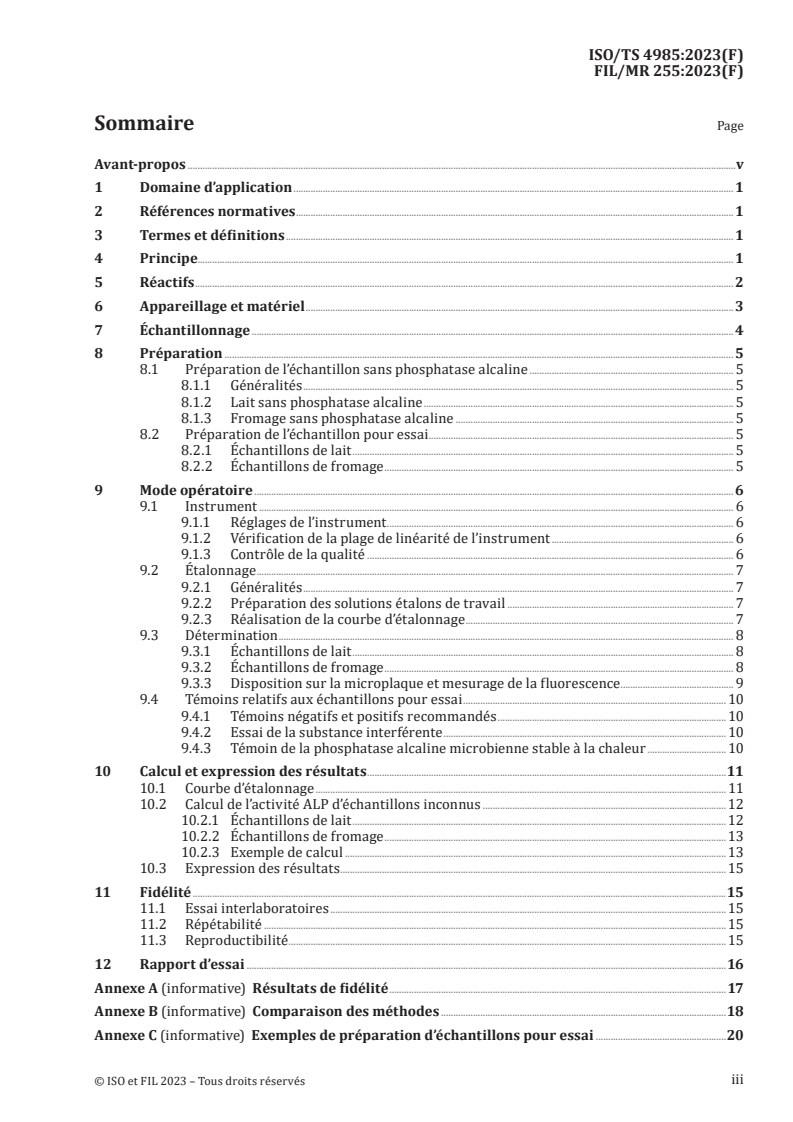
Sommaire Page
Avant-propos .v
1 Domaine d’application . 1
2 Références normatives .1
3 Termes et définitions . 1
4 Principe. 1
5 Réactifs . 2
6 Appareillage et matériel .3
7 Échantillonnage .4
8 Préparation . 5
8.1 Préparation de l’échantillon sans phosphatase alcaline . 5
8.1.1 Généralités . 5
8.1.2 Lait sans phosphatase alcaline . 5
8.1.3 Fromage sans phosphatase alcaline . 5
8.2 Préparation de l’échantillon pour essai . 5
8.2.1 Échantillons de lait . 5
8.2.2 Échantillons de fromage . 5
9 Mode opératoire . 6
9.1 Instrument . 6
9.1.1 Réglages de l’instrument . 6
9.1.2 Vérification de la plage de linéarité de l’instrument . 6
9.1.3 Contrôle de la qualité . 6
9.2 Étalonnage . 7
9.2.1 Généralités . 7
9.2.2 Préparation des solutions étalons de travail . 7
9.2.3 Réalisation de la courbe d’étalonnage . 7
9.3 Détermination . 8
9.3.1 Échantillons de lait . 8
9.3.2 Échantillons de fromage . 8
9.3.3 Disposition sur la microplaque et mesurage de la fluorescence . 9
9.4 Témoins relatifs aux échantillons pour essai . 10
9.4.1 Témoins négatifs et positifs recommandés . 10
9.4.2 Essai de la substance interférente . 10
9.4.3 Témoin de la phosphatase alcaline microbienne stable à la chaleur . 10
10 Calcul et expression des résultats .11
10.1 Courbe d’étalonnage . 11
10.2 Calcul de l’activité ALP d’échantillons inconnus .12
10.2.1 Échantillons de lait .12
10.2.2 Échantillons de fromage . 13
10.2.3 Exemple de calcul .13
10.3 Expression des résultats . 15
11 Fidélité .15
11.1 Essai interlaboratoires .15
11.2 Répétabilité . 15
11.3 Reproductibilité . .15
12 Rapport d’essai .16
Annexe A (informative) Résultats de fidélité .17
Annexe B (informative) Comparaison des méthodes .18
Annexe C (informative) Exemples de préparation d’échantillons pour essai .20
iii
© ISO et FIL 2023 – Tous droits réservés
FIL/MR 255:2023(F)
Bibliographie .22
iv
© ISO et FIL 2023 – Tous droits réservés
FIL/MR 255:2023(F)
Avant-propos
L'ISO (Organisation internationale de normalisation) est une fédération mondiale d'organismes
nationaux de normalisation (comités membres de l'ISO). L'élaboration des Normes internationales est
en général confiée aux comités techniques de l'ISO. Chaque comité membre intéressé par une étude
a le droit de faire partie du comité technique créé à cet effet. Les organisations internationales,
gouvernementales et non gouvernementales, en liaison avec l'ISO participent également aux travaux.
L'ISO collabore étroitement avec la Commission électrotechnique internationale (IEC) en ce qui
concerne la normalisation électrotechnique.
Les procédures utilisées pour élaborer le présent document et celles destinées à sa mise à jour sont
décrites dans les Directives ISO/IEC, Partie 1. Il convient, en particulier, de prendre note des différents
critères d'approbation requis pour les différents types de documents ISO. Le présent document a
été rédigé conformément aux règles de rédaction données dans les Directives ISO/IEC, Partie 2 (voir
www.iso.org/directives).
L’ISO attire l’attention sur le fait que la mise en application du présent document peut entraîner
l’utilisation d’un ou de plusieurs brevets. L’ISO ne prend pas position quant à la preuve, à la validité
et à l’applicabilité de tout droit de brevet revendiqué à cet égard. À la date de publication du présent
document, l’ISO n'avait pas reçu notification qu’un ou plusieurs brevets pouvaient être nécessaires à sa
mise en application. Toutefois, il y a lieu d’avertir les responsables de la mise en application du présent
document que des informations plus récentes sont susceptibles de figurer dans la base de données de
brevets, disponible à l'adresse www.iso.org/brevets. L’ISO ne saurait être tenue pour responsable de ne
pas avoir identifié tout ou partie de tels droits de propriété.
Les appellations commerciales éventuellement mentionnées dans le présent document sont données
pour information, par souci de commodité, à l’intention des utilisateurs et ne sauraient constituer un
engagement.
Pour une explication de la nature volontaire des normes, la signification des termes et expressions
spécifiques de l'ISO liés à l'évaluation de la conformité, ou pour toute information au sujet de l'adhésion
de l'ISO aux principes de l’Organisation mondiale du commerce (OMC) concernant les obstacles
techniques au commerce (OTC), voir www.iso.org/avant-propos.
Le présent document a été élaboré par le comité technique ISO/TC 34, Produits alimentaires, sous-comité
SC 5, Lait et produits laitiers, et la Fédération internationale du Lait (FIL). Il est publié conjointement par
l’ISO et la FIL.
Il convient que l’utilisateur adresse tout retour d’information ou toute question concernant le présent
document à l’organisme national de normalisation de son pays. Une liste exhaustive desdits organismes
se trouve à l’adresse www.iso.org/fr/members.html.
v
© ISO et FIL 2023 – Tous droits réservés
FIL/MR 255:2023(F)
La FIL (Fédération internationale du lait) est une organisation privée à but non lucratif qui représente
les intérêts des divers acteurs de la filière laitière au niveau international. Les membres de la FIL sont
organisés en comités nationaux, qui sont des associations nationales composées de représentants de
groupes d’intérêt nationaux dans le secteur des produits laitiers, incluant des producteurs laitiers, des
acteurs de l’industrie de transformation des produits laitiers, des fournisseurs de produits laitiers, des
universitaires et des représentants des gouvernements/autorités chargées du contrôle des aliments.
L’ISO et la FIL collaborent étroitement sur toutes les activités de normalisation concernant les méthodes
d’analyse et d’échantillonnage du lait et des produits laitiers. Depuis 2001, l’ISO et la FIL publient
conjointement leurs Normes internationales en utilisant les logos et les numéros de référence des deux
organisations.
La FIL attire l’attention sur le fait que la mise en application du présent document peut entraîner
l’utilisation d’un ou de plusieurs brevets. La FIL ne prend pas position quant à la preuve, à la validité
et à l’applicabilité de tout droit de brevet revendiqué à cet égard. À la date de publication du présent
document, la FIL n'avait pas reçu notification qu’un ou plusieurs brevets pouvaient être nécessaires à sa
mise en application. Toutefois, il y a lieu d’avertir les responsables de la mise en application du présent
document que des informations plus récentes sont susceptibles de figurer dans la base de données de
brevets, disponible à l'adresse www.iso.org/brevets. La FIL ne saurait être tenue pour responsable de
ne pas avoir identifié tout ou partie de tels droits de propriété.
Les appellations commerciales éventuellement mentionnées dans le présent document sont données
pour information, par souci de commodité à l’intention des utilisateurs et ne sauraient constituer un
engagement.
Le présent document a été élaboré par le Comité permanent de la FIL chargé des Méthodes d’analyse pour
les auxiliaires technologiques et indicateurs et par le comité technique ISO/TC 34, Produits alimentaires,
sous-comité SC 5, Lait et produits laitiers. Il est publié conjointement par l’ISO et la FIL.
La présente Méthode révisée FIL est équivalente à une ISO/PAS (Spécification publiquement disponible)
ou à une ISO/TS (Spécification technique) et est donc publiée conjointement selon les conditions ISO.
L’ensemble des travaux a été confié au groupe de travail mixte ISO/FIL P20 du Comité permanent chargé
des Méthodes d’analyse pour les auxiliaires technologiques et indicateurs, sous la conduite de son chef de
projet, M. C. Egger (CH).
vi
© ISO et FIL 2023 – Tous droits réservés
SPÉCIFICATION TECHNIQUE
FIL/MR 255:2023(F)
Lait et produits laitiers — Détermination de l’activité de
la phosphatase alcaline — Méthode fluorimétrique sur
microplaque
1 Domaine d’application
Le présent document spécifie une méthode fluorimétrique sur microplaque pour la détermination de
[5]
l’activité de la phosphatase alcaline (ALP, EC 3.1.3.1) dans les laits crus et traités thermiquement
entiers, demi-écrémés, écrémés, dans la crème, les laits aromatisés et les fromages.
La méthode est applicable au lait et aux boissons à base de lait de vache, de brebis et de chèvre. Bien
que la méthode n’ait pas été testée sur le lait d’autres espèces, elle peut également s’appliquer au lait
d’espèces dont la composition est semblable à celle du lait de vache, de brebis ou de chèvre, tel que le lait
de bufflonne ou de camélidés. Elle est également applicable au lait en poudre après reconstitution et aux
fromages à pâte molle, à pâte pressée non cuite et à pâte pressée cuite, à condition que la moisissure ne
soit présente que sur la surface du fromage et ne se soit pas propagée à l’intérieur, comme dans le cas
des fromages veinés de bleu, par exemple. Pour les gros fromages à pâte pressée cuite, des conditions
spécifiques d’échantillonnage s’appliquent (voir Article 7).
NOTE Cette méthode a été adaptée de la Référence [6].
2 Références normatives
Le présent document ne contient aucune référence normative.
3 Termes et définitions
Pour les besoins du présent document, les termes et définitions suivants s’appliquent.
L’ISO et l’IEC tiennent à jour des bases de données terminologiques destinées à être utilisées en
normalisation, consultables aux adresses suivantes:
— ISO Online browsing platform: disponible à l’adresse https:// www .iso .org/ obp
— IEC Electropedia: disponible à l’adresse https:// www .electropedia .org/
3.1
activité de la phosphatase alcaline
activité ALP
quantité d’enzyme capable de catalyser la transformation de 1 μmol de substrat par minute dans les
conditions du mode opératoire spécifié
Note 1 à l'article: L’activité de la phosphatase alcaline est exprimée en milliunités d’activité enzymatique par litre
d’échantillon (mU/l) dans le cas du lait et en milliunités d’activité enzymatique par gramme d’échantillon (mU/g)
dans le cas du fromage.
4 Principe
L’activité ALP de l’échantillon se mesure en effectuant un essai direct fluorimétrique continu en
cinétique. Un substrat monophosphorique aromatique non fluorescent, 4-méthylumbelliferone
phosphate (4-MUP), en présence de phosphatase alcaline issue de l’échantillon, subit une hydrolyse
de son phosphate et produit le composé 4-méthylumbelliferone (4-MU) hautement fluorescent. Le
mesurage fluorimétrique de l’activité ALP est effectué à 37 °C sur une période de 15 min.
© ISO et FIL 2023 – Tous droits réservés
FIL/MR 255:2023(F)
La fluorescence mesurée est proportionnelle à la concentration du composé fluorescent émis et est
utilisée pour le calcul de l’activité enzymatique.
5 Réactifs
Utiliser uniquement des réactifs de qualité analytique reconnue.
5.1 Solution de chlorure de magnésium, concentration c(MgCl ) = 1 mol/l.
Peser 50,8 g de chlorure de magnésium hexahydraté (MgCl · 6 H O, masse moléculaire 203,3 g/mol)
2 2
dans un bécher en verre de 50 ml (6.17), dissoudre avec de l’eau distillée et transférer dans une fiole
jaugée de 250 ml (6.18). Ajuster le volume avec de l’eau jusqu’au trait de jauge.
Cette solution peut être stockée en parties aliquotes (par exemple, 10 ml) à une température inférieure
à −20 °C pendant un an.
TM ®1) 2)
5.2 Solution de Tergitol 15-S-9 (numéro de registre CAS 84133-50-6) , c = 100 g/l.
TM
Peser 25,0 g de Tergitol 15-S-9 dans un bécher en verre de 150 ml (6.17), dissoudre, en agitant
doucement, avec de l’eau distillée à 25 °C ± 2 °C et transférer dans une fiole jaugée de 250 ml (6.18).
Ajuster le volume avec de l’eau jusqu’au trait de jauge.
Cette solution peut être stockée en parties aliquotes (par exemple, 15 ml) à une température comprise
entre 2 °C et 8 °C pendant un an.
5.3 Solution tampon de 2-amino-2-méthyl-1-propanol (AMP), c = 0,11 mol/l, pH = 10,1.
Peser 9,8 g d’AMP, de pureté > 95 % et de masse moléculaire 89,14 g/mol, dans un bécher en verre de
600 ml (6.17), ajouter 500 ml d’eau distillée sur un agitateur et ajuster le pH à 10,1 avec une solution
d’acide chlorhydrique de concentration c(HCl) = 5 mol/l. Transférer dans une fiole jaugée de 1 000 ml
(6.18) et ajuster avec de l’eau jusqu’au trait de jauge.
Cette solution peut être stockée en parties aliquotes (par exemple, 30 ml) à une température inférieure
à −20 °C pendant un an.
2+
5.4 Solution tampon de diéthanolamine (DEA), c = 2 mol/l, pH = 9,8, c(Mg ) = 0,5 mmol/l.
Peser 210,3 g de DEA, de masse moléculaire 105,14 g/mol, dans un bécher en verre de 1 000 ml (6.17),
ajouter 700 ml d’eau distillée en agitant et ajuster le pH à 9,8 avec une solution d’acide chlorhydrique
c(HCl) = 5 mol/l. Ajouter 0,5 ml de solution de chlorure de magnésium (5.1). Transférer dans une fiole
jaugée de 1 000 ml (6.18) et ajuster avec de l’eau jusqu’au trait de jauge.
Cette solution peut être stockée en parties aliquotes (par exemple, 50 ml) à une température inférieure
à −20 °C pendant un an.
2+ TM
5.5 Tampon d’extraction de DEA, c = 1,5 mol/l, pH = 9,8, c(Mg ) = 1,5 mmol/l, c(Tergitol ) = 0,1 %.
Peser 157,7 g de DEA dans un bécher en verre de 600 ml (6.17), ajouter 500 ml d’eau distillée sur un
agitateur et ajuster le pH à 9,8 avec une solution d’acide chlorhydrique de concentration c(HCl) = 5 mol/l. ®
1) Le numéro de registre du Chemical Abstracts Service (CAS) est une marque de l’American Chemical Society
(ACS). Cette information est donnée à l’intention des utilisateurs du présent document et ne signifie nullement que
l’ISO approuve l’emploi du produit ainsi désigné. Des produits équivalents peuvent être utilisés s’il est démontré
qu’ils aboutissent aux mêmes résultats.
2) Il s’agit d’un exemple de produit approprié disponible sur le marché. Cette information est donnée à l’intention
des utilisateurs du présent document et ne signifie nullement que l’ISO ou la FIL approuve l’emploi du produit ainsi
désigné. Des produits équivalents peuvent être utilisés s’il est démontré qu’ils aboutissent aux mêmes résultats.
© ISO et FIL 2023 – Tous droits réservés
FIL/MR 255:2023(F)
TM
Ajouter 1,5 ml de solution de chlorure de magnésium (5.1) et 10 ml de solution de Tergitol 15-S-9
(5.2). Transférer dans une fiole jaugée de 1 000 ml (6.18) et ajuster avec de l’eau jusqu’au trait de jauge.
Cette solution peut être stockée en parties aliquotes (par exemple, 200 ml) à une température inférieure
à −20 °C pendant un an.
5.6 Solution mère étalon de sel sodique de 4-méthylumbelliferone (4-MU), c = 2,5 mmol/l.
Peser 9,9 mg de 4-MU, de pureté > 98 % et de masse moléculaire 198,16 g/mol, dans un bécher en verre
de 25 ml (6.17), solubiliser et bien rincer avec la solution tampon d’AMP (5.3), transférer dans une fiole
jaugée de 20 ml (6.18) et compléter jusqu’au trait de jauge avec le même tampon. Conserver la solution
à l’abri de la lumière.
Cette solution peut être stockée en parties aliquotes (par exemple, 200 µl) à une température inférieure
à −20 °C pendant un an.
5.7 Solution substrat de 4-méthylumbelliferone phosphate (4-MUP), c = 2,5 mmol/l.
Peser 12,8 mg de 4-MUP, de masse moléculaire 256,15 g/mol, dans un bécher en verre de 25 ml (6.17),
solubiliser et bien rincer avec la solution tampon de DEA (5.4), transférer dans une fiole jaugée de 20 ml
(6.18) et compléter jusqu’au trait de jauge avec le même tampon.
Préparer la solution juste avant utilisation et la conserver à l’abri de la lumière.
6 Appareillage et matériel
Utiliser le matériel courant de laboratoire et, en particulier, ce qui suit.
6.1 Lecteur de microplaques à fluorescence, capable de lire des microplaques à 96 puits à une
longueur d’onde d’excitation de 365 nm et une longueur d’onde d’émission de 450 nm. Capable de
contrôler la température à 37 °C ± 1 °C et permettant des mesurages en cinétique (par exemple, un
relevé par minute pendant 15 min).
6.2 Microplaques, noires, fond plat, 96 puits.
6.3 Pipette, de capacité 20 µl à 100 µl.
6.4 Pipette, de capacité 100 µl à 1 000 µl.
6.5 Pipeteur multicanaux, capable de distribuer 20 µl à 100 µl.
6.6 Pipette à piston, de capacité 5 ml.
Une pipette en verre peut également être utilisée.
6.7 Microtubes, de capacité 2 ml.
6.8 Tubes, de capacité 15 ml et 50 ml.
6.9 Tube à essai en verre, de diamètre 12 mm et de longueur 10 cm environ.
6.10 Bain-marie, bloc chauffant ou incubateur capable de maintenir des températures de
37 °C ± 1 °C, 63 °C ± 1 °C et 95 °C ± 1 °C.
6.11 Agitateur vortex.
© ISO et FIL 2023 – Tous droits réservés
FIL/MR 255:2023(F)
®3)
6.12 Parafilm , ou autre film adéquat pour laboratoire.
6.13 Feuille d’aluminium.
6.14 Broyeur.
®4)
6.15 ULTRA-TURRAX , ou autre homogénéisateur équipé d’une tige de diamètre 6 mm à 8 mm
environ.
6.16 Centrifugeuse, capable de centrifuger à 1 000 g à 4 °C pour des tubes de 10 ml ou de 15 ml, et des
tubes de 50 ml.
6.17 Béchers en verre, de capacité 5 ml (environ 20 mm de diamètre et 30 mm de hauteur), 10 ml
(environ 25 mm de diamètre et 30 mm de hauteur), 25 ml, 50 ml, 150 ml, 600 ml et 1 000 ml.
6.18 Fioles jauges à un trait, de capacité 20 ml, 25 ml, 250 ml et 1 000 ml.
6.19 Balance analytique.
6.20 pH-mètre.
7 Échantillonnage
Il convient qu’un échantillon représentatif ait été envoyé au laboratoire. Il convient qu’il n’ait été ni
endommagé ni modifié au cours du transport ou du stockage.
L’échantillonnage ne fait pas partie de la méthode spécifiée dans le présent document. Une méthode
[1]
d’échantillonnage recommandée est indiquée dans l’ISO 707 | FIL 50 .
[1]
Toutefois, l’ISO 707 | FIL 50 ne convient pas aux gros fromages à pâte pressée cuite pour lesquels
le mélange lactosérum-caillé a été chauffé à des températures supérieures à 50 °C. Si le fromage est
constitué de lait cru, l’activité ALP n’est pas distribuée de manière homogène dans ces fromages.
L’activité est élevée dans la couche externe de la meule, entre 0 cm et 4 cm sous la croûte du bord
arrondi, mais très faible ou même indétectable au centre.
Par conséquent, les échantillons de gros fromages à pâte pressée cuite doivent être recueillis en
prélevant une portion de 1 cm à 0,5 cm sous la croûte du bord arrondi (voir Figure C.1).
En cas de doute concernant le type de fromage (fromage à pâte pressée cuite ou fromage à pâte pressée
non cuite), procéder à l’échantillonnage décrit pour les gros fromages à pâte pressée cuite. ®
3) Parafilm est un exemple de produit approprié disponible sur le marché. Cette information est donnée à
l’intention des utilisateurs du présent document et ne signifie nullement que l’ISO ou la FIL approuve l’emploi du
produit ainsi désigné. ®
4) ULTRA-TURRAX est un exemple de produit approprié disponible sur le marché. Cette information est donnée
à l’intention des utilisateurs du présent document et ne signifie nullement que l’ISO ou la FIL approuve l’emploi du
produit ainsi désigné.
© ISO et FIL 2023 – Tous droits réservés
FIL/MR 255:2023(F)
8 Préparation
8.1 Préparation de l’échantillon sans phosphatase alcaline
8.1.1 Généralités
L’échantillon sans ALP est utilisé comme un échantillon à blanc, pour l’étalonnage et, éventuellement, la
dilution des échantillons.
8.1.2 Lait sans phosphatase alcaline
Préparer du lait sans phosphatase du type à soumettre à l’essai en versant soigneusement la quantité
souhaitée de lait dans un tube à essai ou un récipient adapté, en veillant à ce que le lait ne soit pas
en contact avec le bord ou les côtés du récipient. Couvrir le tube ou le récipient contenant le lait et le
placer dans le bain-marie ou le bloc chauffant (6.10) réglé à 95 °C. Amener le lait à 95 °C avant de le
chauffer à cette température pendant 5 min. Vérifier la température en utilisant un thermomètre ou
une sonde de thermistance placé(e) au centre du tube ou du récipient. Lorsque la température du lait
atteint 95 °C, démarrer immédiatement son temps de chauffage de 5 min. Refroidir rapidement le lait à
la fin du temps de chauffage.
8.1.3 Fromage sans phosphatase alcaline
Pour chaque type de fromage à soumettre à l’essai, préparer un fromage sans phosphatase à partir du
surnageant du fromage (voir 9.3.2.6) en chauffant une portion du surnageant comme décrit en 8.1.2, en
remplaçant le lait par le surnageant.
8.2 Préparation de l’échantillon pour essai
8.2.1 Échantillons de lait
8.2.1.1 Généralités
Mélanger soigneusement tous les échantillons pour essai avant utilisation.
NOTE Il n’est généralement pas nécessaire de préchauffer les échantillons pour essai.
8.2.1.2 Échantillons pour essai pasteurisés
Utiliser des échantillons pour essai pasteurisés tels qu’ils sont fournis, dans les quantités requises.
8.2.1.3 Dilution des échantillons pour essai présentant des valeurs ALP élevées
Préparer les dilutions des échantillons de lait pour essai en utilisant du lait sans phosphatase (voir 8.1.2)
afin d’amener leur nivea
...