

ISO 4991:2015
(Main)Steel castings for pressure purposes
General Information
- Abstract
ISO 4991:2015 covers steel castings for pressure containing parts. It includes materials which are used for the manufacture of components subject to pressure vessel codes and components not subject to codes. This International Standard relates to castings manufactured from unalloyed and alloyed steel grades (characterized by their chemical composition, Table 1, and mechanical properties, Tables 2, 3, 4 and 5). NOTE Annex D gives information on ISO grade designation and available UNS numbers which are similar to the ISO grade designation.
- Status
- Withdrawn
- Publication Date
- 13-Dec-2015
- Technical Committee
- ISO/TC 17/SC 11 - Steel castings
- Drafting Committee
- ISO/TC 17/SC 11 - Steel castings
- Current Stage
- 9599 - Withdrawal of International Standard
- Start Date
- 22-Nov-2024
- Completion Date
- 29-Aug-2026
Overview
ISO 4991:2015 - "Steel castings for pressure purposes" - is an international standard that specifies requirements for steel castings used in pressure-containing parts. It covers both castings intended for components governed by pressure vessel codes and those not subject to codes. The standard defines accepted steel grades, chemical composition (Table 1), and mechanical properties (Tables 2–5), and includes guidance on heat treatment, welding, inspection and testing, and traceability.
Key technical topics and requirements
- Material grades and composition: Chemical composition ranges for unalloyed and alloyed steel castings are given in Table 1. Common ISO cast grades (e.g., GP240GH, G20Mn5, GX15CrMo5) are listed with compositional limits.
- Mechanical properties: Tensile, proof-stress and impact requirements are specified in Tables 2–5. Mechanical testing is performed on test pieces from representative test blocks.
- Heat treatment: Types of heat treatment are defined (symbols such as +N = normalized, +QT = quenched & tempered, +AT = solution annealed). Purchasers must state required heat treatment when multiple options exist.
- Welding: Welding is permitted (unless otherwise agreed) and shall comply with ISO 11970; Annex B provides welding conditions.
- Inspection, testing and NDT: Inspection rules include sample formation, lot definition and non‑destructive testing (NDT). Purchasers must specify NDT methods, areas to examine and acceptance criteria per ISO 4990.
- Marking and traceability: Castings must be marked for material identification and heat/serial numbers traceable to heats; manufacturer identification is also required.
- Supplementary requirements and annexes: Optional supplementary requirements (Annex A), informative welding and creep property guidance (Annexes B and C), and a helpful Annex D mapping ISO grades to similar UNS cast grades.
Practical applications and users
ISO 4991 is used by:
- Foundries and casting manufacturers producing pressure-containing components
- Pressure vessel and boiler manufacturers specifying cast parts
- Design engineers and procurement professionals ensuring material fitness-for-service
- Welding engineers and fabricators applying repair or joining procedures
- Quality and inspection teams performing mechanical tests and NDT The standard helps ensure safety, repeatability and regulatory compliance when specifying steel castings for boilers, pressure vessels, valves, pumps and other pressurized equipment.
Related standards (normative and referenced)
- ISO 4990 - General technical delivery requirements for steel castings
- ISO 4885 - Heat treatment vocabulary
- ISO 11970 - Welding procedures for steel castings
- ISO 6892-1 / ISO 6892-2 - Tensile testing (room and elevated temperatures)
- ISO 148-1 - Charpy impact testing
- ISO 13520 - Ferrite determination in stainless castings
Keywords: ISO 4991, steel castings, pressure purposes, pressure vessel, chemical composition, mechanical properties, heat treatment, welding, inspection, non-destructive testing, UNS cast grades.
Relations
- Effective Date
- 06-Jun-2022
- Effective Date
- 06-Jun-2022
- Effective Date
- 12-Feb-2011
Get Certified
Connect with accredited certification bodies for this standard

Element Materials Technology
Materials testing and product certification.

Inštitut za kovinske materiale in tehnologije
Institute of Metals and Technology. Materials testing, metallurgical analysis, NDT.
Sponsored listings
Frequently Asked Questions
ISO 4991:2015 is a standard published by the International Organization for Standardization (ISO). Its full title is "Steel castings for pressure purposes". This standard covers: ISO 4991:2015 covers steel castings for pressure containing parts. It includes materials which are used for the manufacture of components subject to pressure vessel codes and components not subject to codes. This International Standard relates to castings manufactured from unalloyed and alloyed steel grades (characterized by their chemical composition, Table 1, and mechanical properties, Tables 2, 3, 4 and 5). NOTE Annex D gives information on ISO grade designation and available UNS numbers which are similar to the ISO grade designation.
ISO 4991:2015 covers steel castings for pressure containing parts. It includes materials which are used for the manufacture of components subject to pressure vessel codes and components not subject to codes. This International Standard relates to castings manufactured from unalloyed and alloyed steel grades (characterized by their chemical composition, Table 1, and mechanical properties, Tables 2, 3, 4 and 5). NOTE Annex D gives information on ISO grade designation and available UNS numbers which are similar to the ISO grade designation.
ISO 4991:2015 is classified under the following ICS (International Classification for Standards) categories: 77.140.30 - Steels for pressure purposes; 77.140.80 - Iron and steel castings. The ICS classification helps identify the subject area and facilitates finding related standards.
ISO 4991:2015 has the following relationships with other standards: It is inter standard links to ISO 16140-6:2019, ISO 4991:2024, ISO 4991:2005. Understanding these relationships helps ensure you are using the most current and applicable version of the standard.
ISO 4991:2015 is available in PDF format for immediate download after purchase. The document can be added to your cart and obtained through the secure checkout process. Digital delivery ensures instant access to the complete standard document.
Standards Content (Sample)
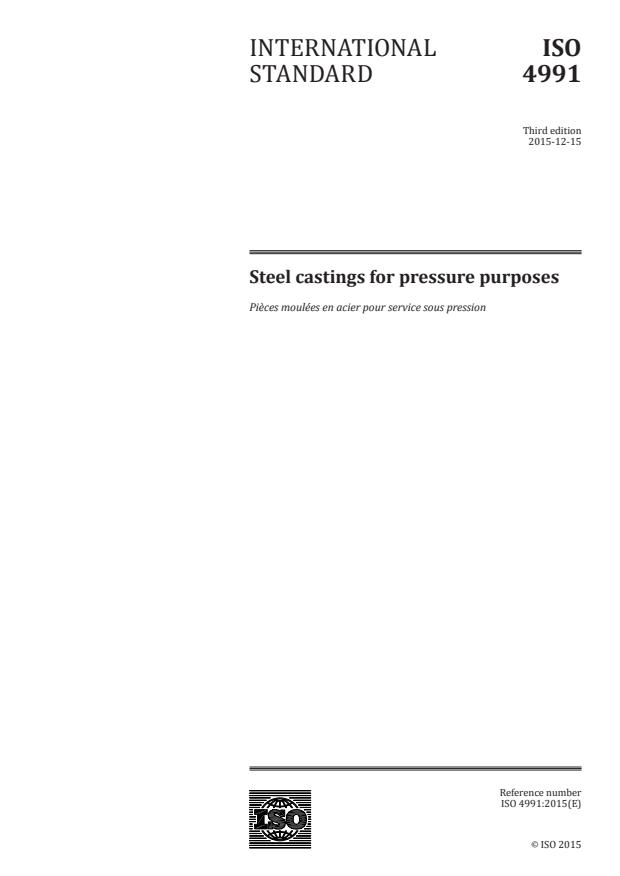
INTERNATIONAL ISO
STANDARD 4991
Third edition
2015-12-15
Steel castings for pressure purposes
Pièces moulées en acier pour service sous pression
Reference number
©
ISO 2015
© ISO 2015, Published in Switzerland
All rights reserved. Unless otherwise specified, no part of this publication may be reproduced or utilized otherwise in any form
or by any means, electronic or mechanical, including photocopying, or posting on the internet or an intranet, without prior
written permission. Permission can be requested from either ISO at the address below or ISO’s member body in the country of
the requester.
ISO copyright office
Ch. de Blandonnet 8 • CP 401
CH-1214 Vernier, Geneva, Switzerland
Tel. +41 22 749 01 11
Fax +41 22 749 09 47
copyright@iso.org
www.iso.org
ii © ISO 2015 – All rights reserved
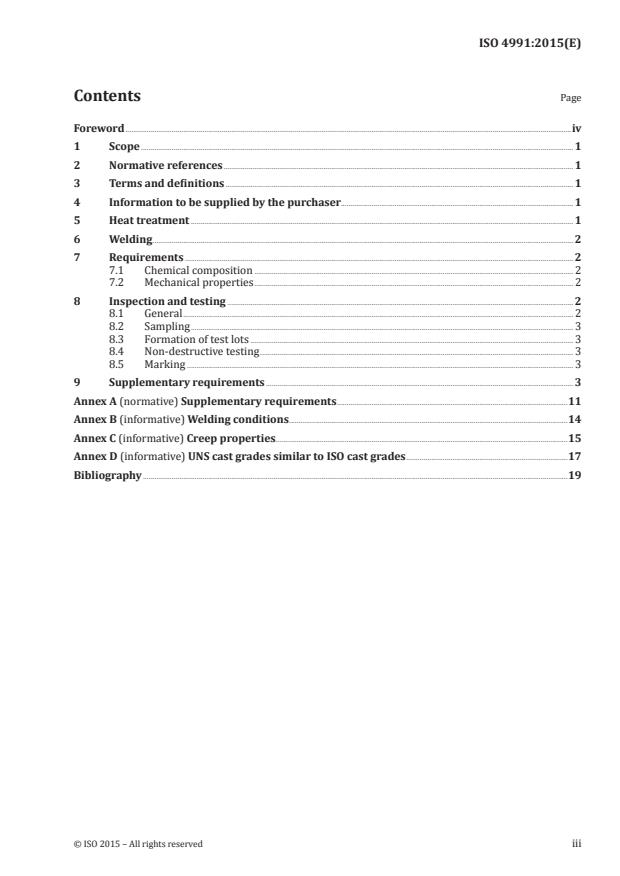
Contents Page
Foreword .iv
1 Scope . 1
2 Normative references . 1
3 Terms and definitions . 1
4 Information to be supplied by the purchaser. 1
5 Heat treatment . 1
6 Welding . 2
7 Requirements . 2
7.1 Chemical composition . 2
7.2 Mechanical properties . 2
8 Inspection and testing . 2
8.1 General . 2
8.2 Sampling . 3
8.3 Formation of test lots . 3
8.4 Non-destructive testing . 3
8.5 Marking . 3
9 Supplementary requirements . 3
Annex A (normative) Supplementary requirements .11
Annex B (informative) Welding conditions .14
Annex C (informative) Creep properties.15
Annex D (informative) UNS cast grades similar to ISO cast grades .17
Bibliography .19
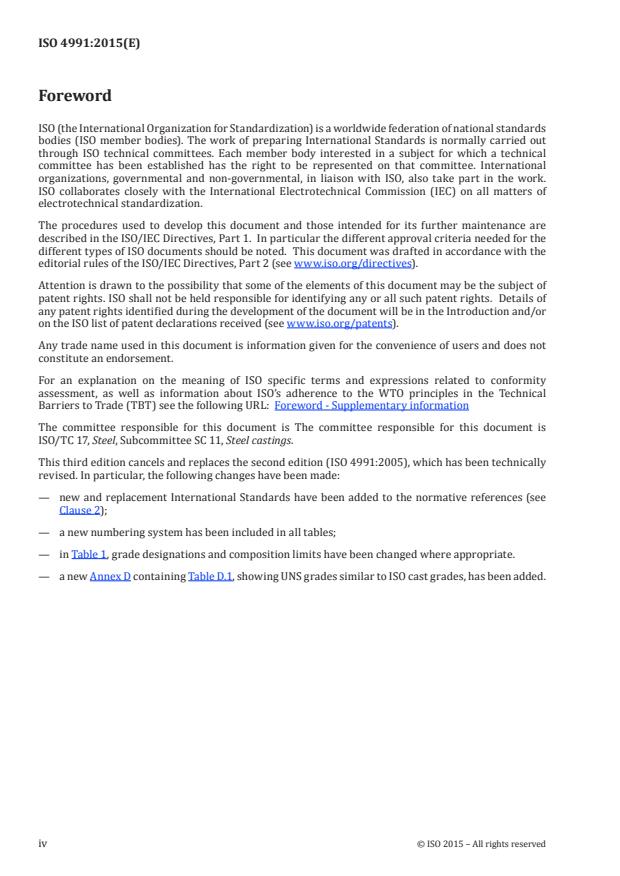
Foreword
ISO (the International Organization for Standardization) is a worldwide federation of national standards
bodies (ISO member bodies). The work of preparing International Standards is normally carried out
through ISO technical committees. Each member body interested in a subject for which a technical
committee has been established has the right to be represented on that committee. International
organizations, governmental and non-governmental, in liaison with ISO, also take part in the work.
ISO collaborates closely with the International Electrotechnical Commission (IEC) on all matters of
electrotechnical standardization.
The procedures used to develop this document and those intended for its further maintenance are
described in the ISO/IEC Directives, Part 1. In particular the different approval criteria needed for the
different types of ISO documents should be noted. This document was drafted in accordance with the
editorial rules of the ISO/IEC Directives, Part 2 (see www.iso.org/directives).
Attention is drawn to the possibility that some of the elements of this document may be the subject of
patent rights. ISO shall not be held responsible for identifying any or all such patent rights. Details of
any patent rights identified during the development of the document will be in the Introduction and/or
on the ISO list of patent declarations received (see www.iso.org/patents).
Any trade name used in this document is information given for the convenience of users and does not
constitute an endorsement.
For an explanation on the meaning of ISO specific terms and expressions related to conformity
assessment, as well as information about ISO’s adherence to the WTO principles in the Technical
Barriers to Trade (TBT) see the following URL: Foreword - Supplementary information
The committee responsible for this document is The committee responsible for this document is
ISO/TC 17, Steel, Subcommittee SC 11, Steel castings.
This third edition cancels and replaces the second edition (ISO 4991:2005), which has been technically
revised. In particular, the following changes have been made:
— new and replacement International Standards have been added to the normative references (see
Clause 2);
— a new numbering system has been included in all tables;
— in Table 1, grade designations and composition limits have been changed where appropriate.
— a new Annex D containing Table D.1, showing UNS grades similar to ISO cast grades, has been added.
iv © ISO 2015 – All rights reserved
INTERNATIONAL STANDARD ISO 4991:2015(E)
Steel castings for pressure purposes
1 Scope
This International Standard covers steel castings for pressure containing parts.
It includes materials which are used for the manufacture of components subject to pressure vessel
codes and components not subject to codes.
This International Standard relates to castings manufactured from unalloyed and alloyed steel grades
(characterized by their chemical composition, Table 1, and mechanical properties, Tables 2, 3, 4 and 5).
NOTE Annex D gives information on ISO grade designation and available UNS numbers which are similar to
the ISO grade designation.
2 Normative references
The following documents, in whole or in part, are normatively referenced in this document and are
indispensable for its application. For dated references, only the edition cited applies. For undated
references, the latest edition of the referenced document (including any amendments) applies.
ISO 148-1, Metallic materials — Charpy pendulum impact test — Part 1: Test method
ISO 4885, Ferrous products — Heat treatments — Vocabulary
ISO 4990, Steel castings — General technical delivery requirements
ISO 6892-1, Metallic materials — Tensile testing — Part 1: Method of test at room temperature
ISO 6892-2, Metallic materials — Tensile testing — Part 2: Method of test at elevated temperature
ISO 11970, Specification and approval of welding procedures for production welding of steel castings
ISO 13520, Determination of ferrite content in austenitic stainless steel castings
3 Terms and definitions
For the purposes of this document, the terms and definitions given in ISO 4885 and ISO 4990 apply.
4 Information to be supplied by the purchaser
Materials specified in this International Standard shall conform to the applicable requirements of
ISO 4990 including the supplementary requirements listed in Annex A that are indicated in the enquiry
and purchase order.
5 Heat treatment
The type of heat treatment shall comply with Table 6 for the specified grades. The temperatures given
are for information only.
When a grade may be delivered at different strength levels depending on the type of heat treatment (see
Table 2), the purchaser shall state at the time of enquiry and order the type of heat treatment required.
The symbols for the type of heat treatment are as follows:
+N normalized
+QT quenched and tempered
+AT solution annealed
NOTE For definitions, see ISO 4885.
6 Welding
Welding is permitted, unless otherwise agreed. All the welds shall conform to the same criteria for
non-destructive testing as the relevant part of the casting. Welding shall be carried out in accordance
with ISO 11970.
The welding conditions are given in Annex B.
7 Requirements
7.1 Chemical composition
An analysis of each heat shall be made by the manufacturer to determine the contents of the
specified elements.
The chemical composition shall comply with the values given in Table 1.
Permissible deviations for the product analysis are indicated in ISO 4990.
7.2 Mechanical properties
The mechanical properties shall comply with the values given in Tables 2, 3, 4 and 5.
Mechanical properties shall be measured on test pieces taken from test blocks (according to ISO 4990).
The tensile tests at room temperature shall be carried out according to ISO 6892-1 and, if specified,
impact tests according to ISO 148-1.
If required by agreement at the time of enquiry and order, impact energy properties at low temperature
shall comply with Table 3.
If required by agreement at the time of enquiry and order, impact energy values at room temperature
shall comply with Table 4.
If required by agreement at the time of enquiry and order, verification of the elevated temperature
proof stress values shall be carried out at elevated temperatures in accordance with ISO 6892-2. In such
a case, the values shall comply with Table 5.
Creep resistance mean values are given for information, for some grades in Annex C.
8 Inspection and testing
8.1 General
For all products ordered to the requirements of this International Standard, specific inspection and
testing is required.
2 © ISO 2015 – All rights reserved
8.2 Sampling
Test blocks shall be heat treated in production furnaces to the same procedure as the castings they
represent.
Test pieces shall not be cut from the test block until the latter has been heat treated.
8.3 Formation of test lots
The formation of test lots shall be carried out in accordance with ISO 4990.
8.4 Non-destructive testing
The following information shall be given at the time of enquiry and order in accordance with ISO 4990:
— non-destructive methods required,
— area to be examined,
— acceptance criteria required.
8.5 Marking
8.5.1 Castings shall be marked for material identification. In addition, heat numbers, or serial numbers
that are traceable to heat numbers, shall be marked on all castings. For small castings, it may be agreed
at the time of the enquiry and order that they may be batched and that their identification is marked on a
label attached to each batch.
8.5.2 Castings shall be marked with the manufacturer’s identification or symbol except where other
provisions have been made between the manufacturer and purchaser.
8.5.3 When more than one heat treatment type is available, the heat treatment applied shall be marked
with a suffix added to the grade designation (see Table 2).
9 Supplementary requirements
This International Standard also specifies supplementary requirements, which may be applied to steel
castings. These requirements are provided for use when additional testing or inspection is desired and
apply only when individually specified by the purchaser.
A list of supplementary requirements which may be used at the option of the purchaser is given in
ISO 4990 and in Annex A.
If ferrite determination is required for austenitic and austenitic-ferritic grades, it may be made
using ISO 13520.
4 © ISO 2015 – All rights reserved
Table 1 — Chemical composition, in per cent, mass fraction
Grade designation C Si Mn P S Cr Mo Ni V Cu Other
Name Number max. max. max.
a a b
GP240GH 1.0619 0,18–0,23 0,60 0,50–1,20 0,030 0,020 0,30 max. 0,12 max. 0,40 max. 0,03 max. 0,30 max.
a a b
GP280GH 1.0625 0,18–0,25 0,60 0,80–1,20 0,030 0,020 0,30 max. 0,12 max. 0,40 max. 0,03 max. 0,30 max.
b
G17Mn5 1.1131 0,15–0,20 0,60 1,00–1,60 0,020 0,025 0,30 max. 0,12 max. 0,40 max. 0,03 max. 0,30 max.
G20Mn5 1.6220 0,17–0,23 0,60 1,00–1,60 0,020 0,020 0,30 max. 0,12 max. 0,80 max. 0,03 max. 0,30 max.
G18Mo5 1.5422 0,15–0,20 0,60 0,80–1,20 0,020 0,020 0,30 max. 0,45–0,65 0,40 max. 0,050 max. 0,30 max.
G20Mo5 1.5419 0,15–0,23 0,60 0,50–1,00 0,025 0,020 0,30 max. 0,40–0,60 0,40 max. 0,050 max. 0,30 max.
G17CrMo5–5 1.7357 0,15–0,20 0,60 0,50–1,00 0,020 0,020 1,00–1,50 0,45–0,65 0,40 max. 0,050 max. 0,30 max.
G17CrMo9–10 1.7379 0,13–0,20 0,60 0,50–0,90 0,020 0,020 2,00–2,50 0,90–1,20 0,40 max. 0,050 max. 0,30 max.
G12MoCrV5–2 1.7720 0,10–0,15 0,45 0,40–0,70 0,030 0,020 0,30–0,50 0,40–0,60 0,40 max. 0,22–0,30 0,30 max.
G17CrMoV5–10 1.7706 0,15–0,20 0,60 0,50–0,90 0,020 0,015 1,20–1,50 0,90–1,10 0,40 max. 0,20–0,30 0,30 max.
G25NiCrMo3 1.6553 0,23–0,28 0,80 0,60–1,00 0,030 0,025 0,40–0,80 0,15–0,30 0,40–0,80 0,03 max. 0,30 max.
G25NiCrMo6 1.6554 0,23–0,28 0,60 0,60–0,90 0,030 0,025 0,70–0,90 0,20–0,30 1,00–2,00 0,03 max. 0,30 max.
G17NiCrMo13–6 1.6781 0,15–0,19 0,50 0,55–0,80 0,015 0,015 1,30–1,80 0,45–0,60 3,00–3,50 0,050 max. 0,30 max.
G9Ni10 1.5636 0,06–0,12 0,60 0,50–0,80 0,020 0,015 0,30 max. 0,20 max. 2,00–3,00 0,050 max. 0,30 max.
G9Ni14 1.5638 0,06–0,12 0,60 0,50–0,80 0,020 0,015 0,30 max. 0,20 max. 3,00–4,00 0,050 max. 0,30 max.
GX15CrMo5 1.7365 0,12–0,19 0,80 0,50–0,80 0,025 0,025 4,00–6,00 0,45–0,65 - 0,05 0,30 max.
GX10CrMoV9–1 1.7367 0,08–0,12 0,20–0,50 0,30–0,60 0,030 0,010 8,0–9,5 0,85–1,05 0,40 max 0,18–0,25 - Nb 0,060–0,10
N 0,030–0,070
Al 0,02max
Ti 0,01 max
Zr 0,01 max
GX15CrMo9–1 1.7376 0,12–0,19 1,00 0,35–0,65 0,030 0,030 8,00–10,00 0,90–1,20 0,40 max. 0,05 0,30 max.
GX8CrNi12–1 1.4107 0,10 max. 0,40 0,50–0,80 0,030 0,020 11,50–12,50 0,50 max. 0,80–1,50 0,08 max. 0,30 max.
GX23CrMoV12–1 1.4931 0,20–0,26 0,40 0,50–0,80 0,030 0,020 11,30–12,20 1,00–1,20 1,00 max. 0,25–0,35 0,30 max. W 0,50 max
GX3CrNi13–4 1.6982 0,05 max. 1,00 1,00 max. 0,035 0,015 12,00–13,50 0,70 max. 3,50–5,00 0,08 max. 0,30 max.
GX4CrNi13–4 1.4317 0,06 max. 1,00 1,00 max. 0,035 0,025 12,00–13,50 0,70 max. 3,50–5,00 0,08 max. 0,30 max.
GX4CrNiMo16–5-1 1.4405 0,06 max. 0,80 1,00 max. 0,035 0,025 15,00–17,00 0,70–1,50 4,00–6,00 0,08 max. 0,30 max.
a
For each reduction of 0,01 % carbon below the maximum specified, an increase of 0,04 % manganese above the maximum specified will be permitted to a maximum of 1,40 %.
b
%Cr + %Mo + %Ni + %V + %Cu ≤ 1,00 %.
Table 1 (continued)
Grade designation C Si Mn P S Cr Mo Ni V Cu Other
Name Number max. max. max.
GX2CrNiN19–11 1.4487 0,030 max. 1,50 2,00 max. 0,035 0,030 18,00–20,00 - 9,00–12,00 - 0,50 max. 0,12 ≤ N ≤ 0,20
GX5CrNi19–10 1.4308 0,07 max. 1,50 1,50 max. 0,040 0,030 18,00–20,00 - 8,00–11,00 - 0,50 max.
GX5CrNiNb19–11 1.4552 0,07 max. 1,50 1,50 max. 0,040 0,030 18,00–20,00 - 9,00–12,00 - 0,50 max. 8xC ≤ Nb ≤ 1,00
GX2CrNiMoN19–11–2 1.4490 0,030 max. 1,50 2,00 max. 0,035 0,030 18,00–20,00 2,00–2,50 9,00–12,00 - 0,50 max. 0,12 ≤ N ≤ 0,20
GX5CrNiMo19–11–2 1.4408 0,07 max. 1,50 1,50 max. 0,040 0,030 18,00–20,00 2,00–2,50 9,00–12,00 - 0,50 max.
GX5CrNiMoNb19–11–2 1.4581 0,07 max. 1,50 1,50 max. 0,040 0,030 18,00–20,00 2,00–2,50 9,00–12,00 - 0,50 max. 8xC ≤ Nb ≤ 1,00
GX2CrNiMoN22
...