

ISO 13793:2001
(Main)Thermal performance of buildings - Thermal design of foundations to avoid frost heave
General Information
- Abstract
- Status
- Published
- Publication Date
- 14-Mar-2001
- Technical Committee
- ISO/TC 163/SC 2 - Calculation methods
- Drafting Committee
- ISO/TC 163/SC 2 - Calculation methods
- Current Stage
- 9093 - International Standard confirmed
- Start Date
- 27-Mar-2023
- Completion Date
- 29-Aug-2026
Buy Documents


ISO 13793:2001 - Thermal performance of buildings - Thermal design of foundations to avoid frost heave Released:3/15/2001




ISO 13793:2001 - Performance thermique des bâtiments - Conception thermique des fondations pour éviter les poussées dues au gel Released:3/15/2001
Overview
ISO 13793:2001 specifies procedures for the thermal design of building foundations to avoid frost heave, a significant concern in cold climates where soil freezing can lead to structural deformation. Developed by the International Organization for Standardization (ISO), this standard applies to both slab-on-ground and suspended floor types, for heated and unheated buildings, built on frost-susceptible soils. It provides guidance to ensure the ground beneath foundations does not freeze, preventing costly damage and ensuring long-term building performance. The standard is widely recognized and utilized in many cold-climate countries, making it a key reference for architects, engineers, and construction professionals.
Key Topics
1. Frost Heave Prevention
- Outlines methods to prevent ground freezing under foundations, such as sufficient foundation depth, soil replacement, or the use of thermal insulation.
- Addresses building design adjustments for both heated and unheated facilities.
2. Soil and Climate Assessment
- Emphasizes the importance of determining soil frost susceptibility through geotechnical analysis.
- Introduces the concept of the freezing index and annual average air temperature as core climate factors affecting foundation design. Excludes application for permafrost areas (average temperature below 0°C).
3. Foundation Insulation Techniques
- Details the use of ground insulation (horizontal) and vertical edge insulation (along foundation walls) to limit frost penetration.
- Provides recommendations based on building type, internal temperatures, and climatic region.
4. Design Principles and Material Properties
- Specifies the use of ISO-recommended calculation methods for foundation depth, insulation thickness, and placement.
- Recommends materials with appropriate compressive strength and moisture resistance, as well as suitable installation and protection methods for insulation elements.
Applications
ISO 13793:2001 is a vital design tool for:
- Building Design & Construction: Ensures structural integrity of residential, commercial, and industrial buildings in locations subject to seasonal ground freezing.
- Thermal Insulation Planning: Assists in determining where and how much insulation is needed around foundations-especially for buildings with slab-on-ground floors or crawl spaces.
- Retrofit & Renovation: Offers strategies for upgrading existing structures to mitigate frost heave risks by improving insulation or modifying foundation depth.
- Cross-disciplinary Projects: Used by architects, civil engineers, structural designers, and contractors for integrated building envelope solutions in cold climates.
Practical Value
- Reduces risk of future structural damage and costly repairs due to frost heave.
- Enables more economical foundation designs-such as shallower footings-when combined with insulation, saving on excavation and material costs.
- Enhances energy efficiency by optimizing insulation placement, especially for heated buildings.
- Provides flexibility-allowing combination of various protective measures tailored to specific project needs.
Related Standards
- ISO 6946: Building components and building elements – Thermal resistance and thermal transmittance – Calculation method.
- ISO 7345: Thermal insulation – Physical quantities and definitions.
- ISO 10211-1: Thermal bridges in building construction – Heat flows and surface temperatures – Part 1: General calculation methods.
- ISO 10456: Building materials and products – Procedures for determining declared and design thermal values.
ISO 13793:2001 serves as an essential component within the broader framework for the thermal performance of buildings, supporting the safe, efficient design and operation of structures exposed to winter climates and frost-susceptible conditions.
Keywords: thermal design of foundations, frost heave prevention, building insulation standards, cold climate construction, slab-on-ground insulation, foundation frost protection, ISO 13793:2001 compliance.
Relations
- Effective Date
- 12-Feb-2026
- Effective Date
- 06-Jun-2022
Buy Documents
ISO 13793:2001 - Thermal performance of buildings - Thermal design of foundations to avoid frost heave Released:3/15/2001
ISO 13793:2001 - Performance thermique des bâtiments - Conception thermique des fondations pour éviter les poussées dues au gel Released:3/15/2001
Get Certified
Connect with accredited certification bodies for this standard

DIBt (Deutsches Institut für Bautechnik)
German Institute for Building Technology.
DIN CERTCO
DIN Group product certification.
Zavod za gradbeništvo Slovenije (ZAG) - Inšpekcija
ZAG inspection body for construction products, structures, and materials.
Sponsored listings
Frequently Asked Questions
ISO 13793:2001 is a standard published by the International Organization for Standardization (ISO). Its full title is "Thermal performance of buildings - Thermal design of foundations to avoid frost heave". This standard covers: La présente norme donne des règles simplifiées pour la conception thermique des fondations des bâtiments en vue d'éviter l'apparition de poussées dues au gel. Elle s'applique aux fondations construites sur des terrains sensibles au gel et inclut les bâtiments avec planchers sur terre-plein et sur vide sanitaire. Elle s'applique aux bâtiments chauffés ou non chauffés, mais ne concerne pas les autres ouvrages devant être protégées du gel (par exemple les routes, les canalisations d'eau enterrées). La présente norme ne s'applique pas aux entrepôts frigorifiques ni aux patinoires. La présente norme concerne les climats où la moyenne annuelle de la température de l'air est supérieure à 0° C, mais ne s'applique pas aux zones permagel où la moyenne annuelle de la température de l'air est inférieure à 0° C.
La présente norme donne des règles simplifiées pour la conception thermique des fondations des bâtiments en vue d'éviter l'apparition de poussées dues au gel. Elle s'applique aux fondations construites sur des terrains sensibles au gel et inclut les bâtiments avec planchers sur terre-plein et sur vide sanitaire. Elle s'applique aux bâtiments chauffés ou non chauffés, mais ne concerne pas les autres ouvrages devant être protégées du gel (par exemple les routes, les canalisations d'eau enterrées). La présente norme ne s'applique pas aux entrepôts frigorifiques ni aux patinoires. La présente norme concerne les climats où la moyenne annuelle de la température de l'air est supérieure à 0° C, mais ne s'applique pas aux zones permagel où la moyenne annuelle de la température de l'air est inférieure à 0° C.
ISO 13793:2001 is classified under the following ICS (International Classification for Standards) categories: 91.120.10 - Thermal insulation of buildings; 93.020 - Earthworks. Excavations. Foundation construction. Underground works. The ICS classification helps identify the subject area and facilitates finding related standards.
ISO 13793:2001 has the following relationships with other standards: It is inter standard links to EN ISO 13793:2001, ISO 6907:1994. Understanding these relationships helps ensure you are using the most current and applicable version of the standard.
ISO 13793:2001 is available in PDF format for immediate download after purchase. The document can be added to your cart and obtained through the secure checkout process. Digital delivery ensures instant access to the complete standard document.
Standards Content (Sample)
INTERNATIONAL ISO
STANDARD 13793
First edition
2001-03-15
Thermal performance of buildings —
Thermal design of foundations to avoid
frost heave
Performance thermique des bâtiments — Conception thermique
des fondations pour éviter les poussées dues au gel
Reference number
©
ISO 2001
PDF disclaimer
This PDF file may contain embedded typefaces. In accordance with Adobe's licensing policy, this file may be printed or viewed but shall not
be edited unless the typefaces which are embedded are licensed to and installed on the computer performing the editing. In downloading this
file, parties accept therein the responsibility of not infringing Adobe's licensing policy. The ISO Central Secretariat accepts no liability in this
area.
Adobe is a trademark of Adobe Systems Incorporated.
Details of the software products used to create this PDF file can be found in the General Info relative to the file; the PDF-creation parameters
were optimized for printing. Every care has been taken to ensure that the file is suitable for use by ISO member bodies. In the unlikely event
that a problem relating to it is found, please inform the Central Secretariat at the address given below.
All rights reserved. Unless otherwise specified, no part of this publication may be reproduced or utilized in any form or by any means, electronic
or mechanical, including photocopying and microfilm, without permission in writing from either ISO at the address below or ISO's member body
in the country of the requester.
ISO copyright office
Case postale 56 � CH-1211 Geneva 20
Tel. + 41 22 749 01 11
Fax + 41 22 749 09 47
E-mail copyright@iso.ch
Web www.iso.ch
Printed in Switzerland
ii © ISO 2001 – All rights reserved
Foreword
ISO (the International Organization for Standardization) is a worldwide federation of national standards bodies (ISO
member bodies). The work of preparing International Standards is normally carried out through ISO technical
committees. Each member body interested in a subject for which a technical committee has been established has
the right to be represented on that committee. International organizations, governmental and non-governmental, in
liaison with ISO, also take part in the work. ISO collaborates closely with the International Electrotechnical
Commission (IEC) on all matters of electrotechnical standardization.
International Standards are drafted in accordance with the rules given in the ISO/IEC Directives, Part 3.
Draft International Standards adopted by the technical committees are circulated to the member bodies for voting.
Publication as an International Standard requires approval by at least 75 % of member bodies casting a vote.
Attention is drawn to the possibility that some of the elements of this International Standard may be the subject of
patent rights. ISO shall not be held responsible for identifying any or all such patent rights.
International Standard ISO 13793 was prepared by the European Committee for Standardization (CEN) in
collaboration with ISO Technical Committee TC 163, Thermal insulation, Subcommittee SC 2, Calculation methods,
in accordance with the Agreement on technical cooperation between ISO and CEN (Vienna Agreement).
Throughout the text of this standard, read ".this European Standard." to mean ".this International Standard.".
Annexes A, B and C form a normative part of this International Standard. Annexes D and E are for information only.
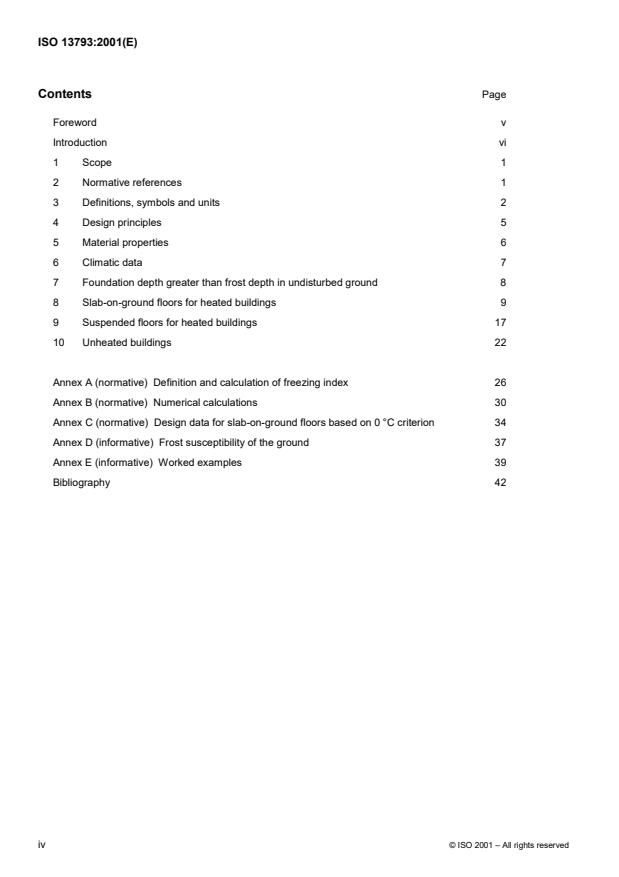
Contents Page
Foreword v
Introduction vi
1 Scope 1
2 Normative references 1
3 Definitions, symbols and units 2
4 Design principles 5
5 Material properties 6
6 Climatic data 7
7 Foundation depth greater than frost depth in undisturbed ground 8
8 Slab-on-ground floors for heated buildings 9
9 Suspended floors for heated buildings 17
10 Unheated buildings 22
Annex A (normative) Definition and calculation of freezing index 26
Annex B (normative) Numerical calculations 30
Annex C (normative) Design data for slab-on-ground floors based on 0 °C criterion 34
Annex D (informative) Frost susceptibility of the ground 37
Annex E (informative) Worked examples 39
Bibliography 42
iv © ISO 2001 – All rights reserved
Foreword
The text of EN ISO 13793:2001 has been prepared by Technical Committee CEN/TC 89 "Thermal
performance of buildings and building components", the secretariat of which is held by SIS, in
collaboration with Technical Committee ISO/TC 163 "Thermal insulation".
This European Standard shall be given the status of a national standard, either by publication of an
identical text or by endorsement, at the latest by September 2001, and conflicting national standards
shall be withdrawn at the latest by September 2001.
References to International Standards that have also been published as European Standards are given
in normative annex ZA, which is an integral part of this European Standard.
Annexes A, B and C form an integral part of ISO 13793. Annexes D and E are for information only.
According to the CEN/CENELEC Internal Regulations, the national standards organizations of the
following countries are bound to implement this European Standard: Austria, Belgium, Czech Republic,
Denmark, Finland, France, Germany, Greece, Iceland, Ireland, Italy, Luxembourg, Netherlands, Norway,
Portugal, Spain, Sweden, Switzerland and the United Kingdom.
Introduction
Frost heave is the deformation of a building due to ice lenses in the ground below it, which can occur
when soil freezes under the foundations or other structural members in contact with the soil. This is
relevant to the design of building foundations in climates where the depth of penetration of frost into the
ground may exceed the minimum foundation depth necessary for structural reasons.
Not all types of soil are susceptible to frost heave (this is discussed in annex D).
The risk of frost heave can be avoided in various ways. One is to have foundations deep enough so as to
be below the frost penetration depth. Thus, special design procedures for frost heave are not necessary
for buildings with basements extending more than the frost penetration depth below ground level (except
to ensure the use of suitable backfill material that will not adfreeze to the basement wall).
Another possibility is to remove the frost-susceptible soil down to a depth below the frost penetration
depth, and replace it with material that is non-susceptible to frost before constructing the foundations.
A third option is to insulate the foundations so as to avoid frost penetrating below the foundations. In cold
climates the latter option is frequently the most economic as it allows shallower foundations, and this
standard gives methods for determining the width, depth, thermal resistance and placement of insulation
in the foundation region in order to reduce the risk of frost heave to a negligible level.
In unheated buildings the heat available from the building itself is less than with heated buildings, and
more perimeter insulation is needed to protect the foundations.
The procedures in this standard are essentially those that have been used in the Nordic countries over
many years, and have been found to be satisfactory in practice in preventing frost heave. They are based
on the results of dynamic computer calculations, which took account of the annual temperature cycle, the
heat capacity of the ground, the latent heat of freezing of water, etc., and which have been validated by
experimental data from actual constructions.
The standard is concerned with ensuring that the ground below the foundation (if frost-susceptible) does
not become frozen. In permafrost areas (annual average temperature less than 0 °C), the appropriate
design may, by contrast, be based on maintaining the ground fully frozen for the whole year. That
involves quite different solutions that are not considered in this standard.
vi © ISO 2001 – All rights reserved
1 Scope
This standard gives simplified procedures for the thermal design of building foundations so as to avoid
the occurrence of frost heave.
It applies to foundations on frost-susceptible ground, and includes buildings with both slab-on-ground
floors and suspended floors.
It covers heated and unheated buildings, but other situations requiring frost protection (for example
roads, water pipes in the ground) are not included.
The standard is not applicable to cold stores and ice rinks.
The standard applies in climates where the annual average air temperature is above 0 °C, but does not
apply in permafrost areas where the annual average air temperature is below 0 °C.
2 Normative references
This European Standard incorporates, by dated or undated references, provisions from other
publications. These normative references are cited at the appropriate places in the text and the
publications are listed hereafter. For dated references, subsequent amendments to or revisions of any of
these publications apply to this European Standard only when incorporated in it by amendment or
revision. For undated references, the latest editions of the publication referred to applies (including
amendments).
ISO 6946 Building components and building elements - Thermal resistance and thermal
transmittance - Calculation method
Thermal insulation - Physical quantities and definitions
ISO 7345
ISO 10211-1 Thermal bridges in building construction - Heat flows and surface temperatures -
Part 1: General calculation methods
Building materials and products - Procedures for determining declared and design
ISO 10456
thermal values
3 Definitions, symbols and units
3.1 Terms and definitions
For the purposes of this standard, the terms and definitions in ISO 7345 and the following apply.
3.1.1
slab on ground floor
floor construction directly on the ground over its whole area
3.1.2
suspended floor
floor construction in which the floor is held off the ground, resulting in an air void between the floor and
the ground
NOTE This air void, also called underfloor space or crawl space, may be ventilated or
unventilated, and does not form part of the habitable space.
3.1.3
vertical edge insulation
insulation placed vertically against the foundation internally and/or externally, or within the foundation
itself
3.1.4
ground insulation
insulation placed horizontally (or nearly so) below ground, external to the building
NOTE See Figure 1.
3.1.5
freezing index
24 times the sum of the difference between 0°C and daily mean external air temperature, accumulated
on a daily basis over the freezing season (including both positive and negative differences)
3.1.6 freezing season
period during which the mean daily external air temperature remains less than 0°C, together with any
freezing/thawing periods at either end of this period if they result in net freezing
3.1.7
frost depth
depth of penetration of frost into the ground
3.1.8
foundation depth
depth of foundation below the outside ground level
NOTE If the foundations are put on a layer of well-drained material that is non-susceptible to
frost, the thickness of such a layer may be included in the foundation depth.
2 © ISO 2001 – All rights reserved
3.1.9
frost-susceptible soil
soil of a type which may cause frost heave forces when frozen as part of the ground
3.1.10
floor insulation position
height of lower surface of the floor insulation layer above external ground surface
NOTE If there is no insulation in the floor this quantity is measured from the floor surface.
3.2 Symbols and units
The following is a list of the principal symbols used. Other symbols are defined where they are used
within the text.
Symbol Quantity Unit
B
width (smaller dimension) of building m
b
g width of ground insulation, measured from outer limit of footing m
b
gc width of ground insulation at corner m
b
gw width of ground insulation along wall m
F
d design freezing index K·h
F
freezing index which statistically is exceeded once in a period of n years K·h
n
H
0 maximum frost depth in undisturbed, snow-free ground m
H
foundation depth for walls m
f
H
fc foundation depth for corners m
H
depth of vertical edge insulation m
v
h floor insulation position m
L
length of corner insulation (measured along external surface of wall) m
c
R
f thermal resistance of floor construction
m²·K/W
(average value over the outer 1 m of floor)
R
v thermal resistance of vertical edge insulation m²·K/W
R
thermal resistance of ground insulation m²·K/W
g
R
gc thermal resistance of ground insulation at corner m²·K/W
R
gw thermal resistance of ground insulation along wall m²·K/W
annual average external air temperature °C
�
e
�
average internal air temperature in month m °C
i,m
a) Lightweight concrete foundation wall with b) Floor slab with edge beam
ground insulation
c) Concrete foundation wall with ground d) Concrete foundation wall with external
insulation and internal vertical edge insulation vertical edge insulation
e) Raft construction with ground insulation f) Raft construction over a bed of crushed stones
and vertical edge insulation (h < 0 in this case, so is not considered)
Key
1 Ground insulation 2 Vertical edge insulation
3 Non frost-susceptible soil 4 Bed of crush stones ventilated from inside
NOTE These are illustrations to show thermal principles and should not be considered as constructional
details.
Figure 1 - Examples of vertical edge insulation and ground insulation in foundation structures
4 © ISO 2001 – All rights reserved
4 Design principles
Soil is fully frozen when all the water in it is frozen. This is assumed to have occurred when the
temperature of the soil reaches -1 °C (see annex D). The data given in clauses 8 to 10 apply when the
foundations are to be designed so that no fully frozen soil occurs below the foundation during the design
winter. Alternative data based on a criterion of 0°Caregiveninannex C.
This design condition may be achieved in one of four ways:
1) arranging for the foundation depth to be greater than the depth at which fully frozen soil occurs;
2) removing frost-susceptible soil from below where the foundations will be built, to the same depth
as mentioned in 1), and replacing this with well-drained material that is non-susceptible to frost;
3) insulating the foundations to reduce heat loss from the soil below the foundations so as to keep
this soil unfrozen;
4) using heat loss from the building, or special heating measures, to keep the soil below the
foundations unfrozen.
For the purposes of this standard, 1) and 2) are equivalent and are covered in clause 7. Furthermore, the
solution adopted can be a combination of 2), 3) and 4). Thus, the thickness of any layer below the
foundations that is non-susceptible to frost may be included in the foundation depth H when using this
f
standard to decide whether frost protection measures are necessary and, if so, what insulation is
needed.
NOTE 1 If option 4) is chosen, a combination with 3) is usually necessary to restrict heat loss.
The insulation required by options 3) and 4) can be determined by:
a) using the tables and graphical presentations in this standard (see clause 8, 9 or 10, depending on
the type of building), or
b) undertaking numerical calculations conforming with the principles given in annex B.
It is also permissible to use a combination of a) and b), for example determination of insulation required
at corners by a) and (two-dimensional) numerical calculations to determine the insulation required
elsewhere.
Heat emission from floor heating systems, heating cables in the ground, or similar, is not allowed for in
the design procedures of clauses 8 to 10. Numerical calculations shall be undertaken when such heat
emission is to be considered.
NOTE 2 If the design procedures of clauses 8 to 10 are applied to such situations, there will be
an additional margin of safety as regards frost heave, but perhaps additional heat loss.
The foundations shall be designed to avoid adfreezing of the soil, thus preventing frost heave by transfer
of shear forces, for example by having a layer of material that is non-susceptible to frost adjacent to the
walls of the foundation or basement.
If the building envelope is not completed and/or the building is not heated before the frost season,
additional insulation measures shall be undertaken to protect the foundations.
NOTE 3 One way of achieving such additional protection is to design the foundations as for
unheated buildings using a design freezing index for non-permanent structures (see 6.1).
The parameters relevant to frost protection are:
- climate, especially freezing index and annual average temperature;
- frost susceptibility of the soil;
- thermal properties of the ground, both frozen and unfrozen;
- insulation of the floor;
- internal temperature in the building;
- the geometry, and especially the overall dimensions, of the building, and the type of foundation
used.
NOTE 4 Snow cover has the effect of reducing the frost penetration depth, but since snow cover
cannot be assured for design purposes, no allowance for it is made when assessing the design
criterion.
Some examples are illustrated in Figure 1.
5 Material properties
5.1 Properties of the ground
The ground shall be considered to be frost-susceptible unless otherwise established by geotechnical
examination.
NOTE 1 Information about frost susceptibility is given in annex D.
This standard is based on homogeneous ground consisting of frost-susceptible soil with the following
properties:
thermal conductivity (unfrozen) � =1,5W/(m·K)
thermal conductivity (frozen) � =2,5W/(m·K)
f
heat capacity per volume (unfrozen) C =3� 10 J/(m³·K)
heat capacity per volume (frozen) C =1,9� 10 J/(m³·K)
f
latent heat of freezing per cubic metre of soil L =150� 10 J/m³
dry density � = 1350 kg/m³
water content (saturation degree = 90 %) w=450 kg/m³
For most types of frost-susceptible soils, the frost penetration depth adjacent to a building differs little
from that determined using the above values. If, however, the actual soil properties are considerably
different from those listed above, numerical calculations in accordance with annex B should be
undertaken.
6 © ISO 2001 – All rights reserved
NOTE 2 As a general rule, the design data in clauses 8 to 10 can be applied for soils with dry
density in the range 1100 kg/m³ to 1600 kg/m³ and with water saturation exceeding 80 %.
NOTE 3 When ground insulation is used, the relevant properties are those of the soil in the
vicinity of the building. If ground insulation is not used, the properties of the backfill may be
significant, especially if the backfill zone is relatively wide. Backfill (which is well-drained to avoid
adfreezing) can increase the frost penetration depth locally due to absence of water in the soil
and its associated latent heat.
5.2 Properties of building materials
For the thermal resistance of any building product, use the appropriate design value, either calculated
according to ISO 10456 or obtained from tabulated values. The thermal resistance of products used
below ground level shall reflect the moisture conditions of the application.
NOTE Moisture conditions may be affected by whether or not the building is heated, and are
often more severe adjacent to unheated buildings.
If thermal conductivity is quoted, obtain the thermal resistance as the thickness divided by thermal
conductivity. The thickness used shall allow for any compression of the product, if applicable.
Ensure that any insulation material subject to compressive load has adequate compressive strength and
deformation characteristics.
If ground insulation is necessary for the protection, measures shall be taken to ensure that it is not
damaged or removed after completion of the building. Inform the user of the building of the presence and
location of the ground insulation and of its purpose.
6 Climatic data
6.1 Design freezing index
The insulation required for frost protection depends on the severity of the design winter, expressed in
terms of the freezing index together with the annual average external air temperature.
The design freezing index F is expressed in terms of F , the value of the freezing index which
d n
statistically is exceeded once in n years for the locality concerned, based on recorded meteorological
data and calculated according to annex A. F has a 1 in n probability of being exceeded in a given winter.
n
Having selected the value of n,obtain F from tables or maps covering the locality concerned.
n
The appropriate value of n is related to the expected lifetime of the building and the sensitivity of the
building to frost heave.
For permanent structures use F or F .
100 50
NOTE For practical purposes F and F can be considered to be equivalent, as the
100 50
difference between them is very small, and either may be used (depending on availability).
For the design of buildings that can tolerate some movement, or for non-permanent buildings, a lower
freezing index (e.g. F , F , F ) may be used.
20 10 5
6.2 Frost depth in undisturbed ground
The greatest depth of frost penetration in undisturbed ground (i.e. ground unprotected by buildings, snow
cover or vegetation) depends on the climate (freezing index and annual average air temperature) and on
the thermal properties of the ground.
NOTE Design values of maximum frost depth in undisturbed, homogeneous frost-susceptible
ground without snow cover, H , may be found for some locations in national maps or tables.
If H is not known, an approximate value may be calculated from the following equation:
7200 F �
df
H � (1)
LC� �
e
where
F is the design freezing index, in K·h;
d
� is the thermal conductivity of frozen soil, in W/(m·K);
f
L is the latent heat of freezing of water in the soil per volume of soil, in J/m³;
C is the heat capacity of unfrozen soil per volume, in J/(m³·K);
� is the annual average external air temperature, in °C.
e
If appropriate soil data are not given, use the data in 5.1.
7 Foundation depth greater than frost depth in undisturbed ground
The foundations of any building can be designed so that the foundation depth, H,is atleastthe
f
maximum frost depth in undisturbed snow-free ground, H .
If H � H , the foundations are adequately protected against frost heave and neither edge insulation nor
f 0
ground insulation is required.
If the foundations are on a layer of well-drained material that is non-susceptible to frost, the thickness of
such a layer may be included in H .
f
NOTE For climates with F <2000K·h this condition applies for depth of foundation of 0,45 m or
d
greater.
If H < H , consult clauses 8 to 10 or undertake numerical calculations according to annex B.
f o
8 © ISO 2001 – All rights reserved
8 Slab-on-ground floors for heated buildings
8.1 Applicability
This clause applies to foundations for which H < H and to:
f 0
a) buildings in which the average internal air temperature throughout the building in each month is at
least 17 °C(i.e. � � 17 °C for all m);
i,m
b) buildings in which some parts are heated and some parts are unheated, provided that in the
heated parts � � 17 °C for all m, and that the unheated parts are treated as described in 8.5;
i,m
c) buildings in which 5 °C � � <17 °C with the modifications described in 8.8.
i,m
If � <5 °C in any month, the frost protection of the foundations should be designed as for unheated
i,m
buildings (see clause 10).
For data based on a design criterion of 0 °C below the foundations, see annex C.
8.2 General principles
In all cases, provide vertical edge insulation as specified in 8.6.
Heat from the building raises the ground temperature less at corners than along the sides of the building.
Therefore additional measures may be needed at corners, either by having deeper foundations at the
corners or by having additional insulation there.
This clause provides three options for achieving the necessary frost protection:
1) using vertical edge insulation only, with no ground insulation: excavate the foundations to the
depth given in 8.7.1 (a greater foundation depth is needed at corners than along the rest of the
walls);
2) using ground insulation only at the corners, to avoid increasing the foundation depth at the
corners: the foundation depth is as for the walls in 1), see 8.7.2;
3) using a restricted foundation depth (not less than 0,4 m), with the same foundation depth all round
the building: provide ground insulation all round the building, but increased at the corners, see
8.7.3.
The foundation depth and/or the extent of the ground insulation is determined by the design freezing
index, F .
d
Design the floor insulation to give satisfactory floor temperatures and energy economy (i.e. independently
of the frost heave problem).
NOTE The use of vertical edge insulation and ground insulation increases floor surface
temperatures and decreases heat loss at the edge of the floor.
8.3 Restrictions
8.3.1 Building width
The foundation depths and frost insulation specified in this clause apply to buildings with a width B of at
least 4 m.
If B < 4 m the foundations should be designed, either in depth or in provision of ground insulation,
according to the procedures given for corners, but applied all round the building.
8.3.2 Floor insulation position
The foundation depths and frost insulation specified in this clause apply to floors for which the floor
insulation position h does not exceed 0,6 m.
If h > 0,6 m, either undertake numerical calculations in accordance with annex B or use the procedures
for unheated buildings (clause 10).
8.3.3 Thermal resistance of floor slab
The thermal resistance of the floor construction, R , is the total thermal resistance between the floor
f
surface and the soil. It includes any insulation layers above, below or within it, together with that of any
floor covering.
If the thermal resistance of the floor construction varies over its area, take R as the average value over
f
the outer 1 m of floor.
The foundation depths and frost insulation specified in this clause apply to slabs with R not exceeding
f
5m²·K/W. If R >5m²·K/W, either undertake numerical calculations in accordance with annex B or use
f
the procedures for unheated buildings (clause 10).
8.4 Ground insulation
Ground insulation shall be protected against risk of mechanical damage. The top surface of any ground
insulation should be at least 300 mm below ground level, unless covered by paving in which case the
depth may be reduced to 200 mm.
The data given on the width of ground insulation, b , b and b , assume that this width is measured
g gw gc
from the outermost face of the foundation.
NOTE It may be necessary for the total width of the ground insulation to be greater than b ,if
g
the footing projects beyond the foundation wall, as in Figure 1a.
If ground insulation is used together with internal edge insulation, take care to avoid a thermal bridge by
continuing the ground insulation beneath the foundation to meet the vertical edge insulation (see
Figure 1c).
Ensure that ground insulation is continuous with no gaps, that it is adequately protected from excessive
moisture by roof overhangs, sound guttering arrangements, etc. and that it is placed on a drainage layer.
10 © ISO 2001 – All rights reserved
8.5 Unheated parts of a building
8.5.1 General
If some parts of a building are unheated, the procedures of 8.6 and 8.7 may be applied to the heated
parts, provided that the protection described in 8.5.2 or 8.5.3 (as appropriate) is applied to the unheated
parts of the building.
8.5.2 Building with limited unheated parts
The unheated parts of a building may be regarded as limited if their dimensions do not exceed those
indicated in Figure 2, where the parameter L is given as a function of the design freezing index in
u
Table 1.
Table 1 - Maximum unheated length L for limited unheated parts
u
F (K·h)
� 30 000 > 30 000 to 40 000 > 40 000 to 50 000 > 50 000
d
L (m)
u 3,0 2,5 2,0 1,5
Key
1 Heated part
2 Unheated part
Figure 2 - Definition of limited unheated part of floor slab
NOTE L is the maximum length of an unheated part which is surrounded on three sides by
u
heated areas of the building. The maximum length is less than L in other cases, as shown in
u
Figure 2.
For limited unheated parts:
- insulate the floor of the unheated part so that the thermal resistance of the floor is at least to the
minimum ground resistance, R , for unheated buildings according to 10.2 (Table 11 or Table 12);
g
- at the external perimeter of the unheated part, use vertical edge insulation according to 8.6;
- if the unheated part is surrounded on three sides by heated areas of the building (Figure 2a): use
frost protection as for corners according to 8.7 at the external perimeter of the unheated part and
for a distance L to each side of it, where values of L are given as a function of the design
c c
freezing index in Table 5;
- if the unheated part is surrounded on only one or two sides by heated areas of the building
(Figures 2b and 2c): at the external perimeter of the unheated part and for a distance L to each
c
side of it, use ground insulation of width 0,5b ,with b according to 10.2 (Table 10), of thermal
g g
resistance R as for unheated buildings according to 10.2 (Table 11 or Table 12), where values of
g
L are given as a function of the design freezing index in Table 5;
c
- avoid thermal bridges at the internal perimeter of the unheated part.
8.5.3 Building with more extensive unheated parts
If any unheated part of a building cannot be regarded as limited because its dimensions exceed those
indicated in Figure 2, regard the heated and the unheated parts as separate buildings and design the
foundations accordingly, continuing the design for the unheated part for a distance L where it adjoins the
c
heated part, where values of L are given as a function of the design freezing index in Table 5.
c
8.6 Vertical edge insulation
In all cases, provide vertical edge insulation, of thermal resistance R at least that given in Table 2. Use
v
linear interpolation to obtain intermediate values.
Table 2 - Minimum thermal resistance of vertical edge insulation
for slab-on-ground floors, R (in m²·K/W)
V
R in m²·K/W, h in m
f
0,0 < R ���� 1,0 1,0 < R ���� 2,6 2,6 < R ���� 5,0
f f f
F
d
K·h
h �� 0,3 0,3 < h �� 0,6 h �� 0,3 0,3 < h �� 0,6 h �� 0,3 0,3 < h �� 0,6
�� �� �� �� �� ��
5 000 - - 0,5 0,8 0,8 1,0
10 000 0,5 0,8 1,0 1,0 1,5 2,0
20 000 0,8 1,0 1,0 1,2 1,5 2,3
30 000 1,0 1,0 1,0 1,3 1,5 2,5
40 000 1,0 1,0 1,2 1,5 1,7 2,7
50 000 1,0 1,2 1,4 1,7 2,0 3,0
60 000 1,2 1,4 1,8 2,1 2,4 3,4
70 000 1,4 1,6 2,1 2,4 2,8 3,6
NOTE 1 Greater values of R than those shown in Table 2 may be appropriate for reasons of
v
minimum floor surface temperatures or restriction of heat loss.
The necessary vertical edge insulation can be obtained by using a foundation material with low thermal
conductivity (e.g. lightweight concrete), or by using a layer of insulation material external to, within or
internal to the foundation wall or beam.
12 © ISO 2001 – All rights reserved
NOTE 2 Although external insulation is preferable from the point of view of frost protection, the
data given cover all the above alternatives.
Vertical edge insulation should extend from the top of the slab insulation to a depth H below ground
v
level, taking care to avoid a thermal bridge between the slab insulation, the wall insulation and the
vertical edge insulation, where:
- with no ground insulation, H � 0,6 m or the full foundation depth if less;
v
- with ground insulation, H is the depth of the lower surface of the ground insulation.
v
8.7 Alternative foundation designs
The foundation design should comply with 8.6 and with one of the following alternatives.
8.7.1 Foundations with no ground insulation
The foundation depth should be:
- atthe walls, atleast H ;
f
- near the corners and at limited unheated parts for a distance L from these places, at least the
c
greater depth H (if F >30 000 K·h);
fc d
where the values of H , H and L are given in Table 3 as a function of the design freezing index.
f fc c
Table 3 - Foundation depth for slab-on-ground floor without ground insulation
F H H L
d f fc c
K·h m m m
F � 30 000
0,35 0,35 -
d
30 000 < F � 35 000
0,40 0,60 1,0
d
35 000 < F � 40 000
0,50 0,80 1,0
d
40 000 < F � 45 000
0,60 1,00 1,5
d
45 000 < F � 50 000
0,75 1,30 1,5
d
50 000 < F � 55 000
0,90 1,60 1,5
d
55 000 < F � 60 000
1,10 1,80 2,0
d
60 000 < F � 65 000
1,30 2,00 2,0
d
65 000 < F � 70 000
1,50 2,20 2,5
d
8.7.2 Ground insulation only at corners
If F � 30 000 K·h, ground insulation is not required.
d
For greater values of F , the foundation depth shall be at least H all round the building, and ground
d f
insulation shall be used near corners and at limited unheated parts for a distance L from these places,
c
where the values of H and L are given in Table 4.
f c
The thermal resistance of the ground insulation shall be at least 1,0 m²·K/W, and its width shall be b ,
gc
values of b being given in Table 4. See also Figure 3.
gc
Table 4 - Foundation depth and corner insulation for slab-on-ground floor
F H b L
d f gc c
K·h m m m
F � 30 000
0,35 - -
d
30 000 < F � 35 000
0,40 0,50 1,0
d
35 000 < F � 40 000
0,50 0,50 1,0
d
40 000 < F � 45 000
0,60 0,50 1,5
d
45 000 < F � 50 000
0,75 0,60 1,5
d
50 000 < F � 55 000
0,90 0,80 1,5
d
55 000 < F � 60 000
1,10 0,80 2,0
d
60 000 < F � 65 000
1,30 0,80 2,0
d
65 000 < F � 70 000
1,50 1,00 2,5
d
8.7.3 Ground insulation all round the building
If F � 30 000 K·h, ground insulation is not required.
d
For greater values of F , the foundation depth may be reduced to not less than 0,4 m by placing ground
d
insulation all round the building.
If F > 30 000 K·h, ground insulation is necessary near corners and at limited unheated parts, for a
d
distance L from these places as given in Table 5. Select an appropriate combination of thermal
c
resistance, R , and width, b , of ground insulation near the corners using Figure 4, according to the
gc gc
value of F .
d
If F > 37 500 K·h, ground insulation is also necessary along the walls. Select an appropriate
d
combination of thermal resistance, R , and width, b , of ground insulation along the walls using Figure
gw gw
5,accordingtothe value of F . Then use Figure 4 to determine the greater ground insulation needed
d
near the corners and unheated parts. The corner insulation applies for a distance L as given in Table 5.
c
See also Figure 3.
14 © ISO 2001 – All rights reserved
Key
1 Limited unheated part (store room, porch etc)
Figure 3 - Width of ground insulation
Key
1 Minimum b 3 Width of ground insulation at corners, b
gc gc
2 Minimum R 4 Thermal resistance of ground insulation at corners, R
gc gc
Figure 4 - Width and thermal resistance of ground insulation at corners and limited unheated
parts, for slab-on-ground floor with H ���� 0,4 m
f
Key
1 Minimum b 3 Width of ground insulation along walls, b
gw gw
2 Minimum R 4 Thermal resistance of ground insulation along walls, R
gw gw
Figure 5 - Width and thermal resistance of ground insulation along walls,
for slab-on-ground floor with H ���� 0,4 m
f
16 © ISO 2001 – All rights reserved
Table 5 - Length of corner insulation
F L
d c
K·h m
F � 30 000
-
d
30 000 < F � 35 000
1,0
d
35 000 < F � 40 000
1,0
d
40 000 < F � 45 000
1,5
d
45 000 < F � 50 000
1,5
d
50 000 < F � 55 000
1,5
d
55 000 < F � 60 000
2,0
d
60 000 < F � 65 000
2,0
d
65 000 < F � 70 000
2,5
d
8.8 Buildings with low internal temperature
For poorly heated buildings with 5° C � � <17 °C, the values in 8.7.3 may be used if H is at least
i,m f
0,6 m instead of 0,4 m.
Alternatively increase the values of H in Table 3 or Table 4 by 0,2 m.
f
If � <5 °C in any month, the frost protection of the foundations shall be designed as for unheated
i,m
buildings (see clause 10).
9 Suspended floors for heated buildings
9.1 Heated underfloor space
This clause applies to foundations for which H < H .
f o
The same procedures as for slab-on-ground floors, using the values of the parameters in clause 8, can
be used for suspended floors in which the underfloor space is either unventilated and airtight or
ventilated by the internal air, provided that:
- the walls of the underfloor space are insulated, with thermal resistance at least R as given in
v
Table 2, and this insulation is continued below ground as specified in 8.6;
- R , taken as the sum of the thermal resistance of the suspended part of the floor and that of the
f
insulation on the base of the underfloor space, does not exceed 5,0 m²·K/W.
Ensure that the foundation walls are properly sealed to restrict air leakage.
9.2 Underfloor space ventilated with outside air
9.2.1 General
The foundations may be designed either without ground insulation according to 9.2.2 or 9.2.3 (as
appropriate), or with ground insulation according to 9.2.4, subject to the following restrictions.
1) The width of the building, B,isatleast4m.
2) The average internal air temperature in each month in all parts of the building is not less than
17 °C.
3) The thermal resistance of any insulation on the ground surface at the base of the underfloor space
does not exceed 0,5 m²·K/W.
4) The thermal resistance of the suspended part of the floor does not exceed 8 m²·K/W (without
ground insulation) or 5 m²·K/W (with ground insulation).
5) The thermal resistance of the foundation wall above the outside ground level is not less than the
appropriate value in Table 6 when the bottom of the floor construction is situated at a height not
more than 0,6 m above the outside ground level.
If the bottom of the floor construction is situated higher than 0,6 m above the outside ground level,
this thermal resistance is to be increased such that the total heat flow rate passing through the
foundation wall above the outside ground level does not exceed that of a 0,6 m high wall having
the thermal resistance specified in Table 6.
6) Vertical edge insulation of thermal resistance at least that specified in Table 6 is applied to a depth
of at least 0,6 m if there is no ground insulation, or to the lower surface of the ground insulation if
ground insulation is present.
7) The ventilation rate of the underfloor space does not exceed 2 m³ per square metre of floor slab
per hour.
NOTE A method of estimating the ventilation rate is given in EN ISO 13370, Thermal
performance of buildings - Heat transfer via the ground - Calculation methods.
If any of the above conditions are not met, either design the foundations as for unheated buildings in
accordance with clause 10 or undertake numerical calculations in accordance with annex B.
18 © ISO 2001 – All rights reserved
Table 6 - Minimum thermal resistance of foundation walls above ground
and of vertical edge insulation below ground for suspended floors
F R
d v
K·h m²·K/W
F � 5000
d 0,5
5000< F � 10 000
0,8
d
10 000 < F � 20 000
1,0
d
20 000 < F � 30 000
1,0
d
30 000 < F � 40 000
1,0
d
40 000 < F � 50 000
1,2
d
50 000 < F � 60 000
d 1,4
60 000 < F � 70 000
1,6
d
9.2.2 Foundations with no ground insulation : long buildings
A long building is one whose length is more than three times its width.
Depending on the design freezing index, the maximum ventilation rate of the underfloor space, and the
thermal resistance of the suspended floor, the foundation depth shall be:
- at the walls, at least that in Table 7;
- near the corners for a distance L from the corners, at least the greater depth given in Table 8;
c
where values of L are given in Table 5 as a function of the design freezing index. Linear interpolation
c
may be used in Tables 7 and 8 for other values of R .
f
Table 7 - Foundation depth, in metres, for suspended floors: walls of long buildings
Design freezing index Ventilation rate
F
m³/m²h
d
K·h
R R
f f
m²·K/W m²·K/W
F � 5000 a) a) a)
0,50 0,40 0,55
d
5000< F � 10 000 a) a)
0,45 0,70 0,55 0,80
d
10 000 < F � 15 000 a)
0,55 0,85 0,45 0,70 0,95
d
15 000 < F � 20 000 a)
0,65 0,95 0,50 0,80 1,15
d
20 000 < F � 25 000
0,35 0,75 1,10 0,60 0,90 1,25
d
25 000 < F � 30 000
0,50 0,85 1,25 0,70 1,00 1,35
d
30 000 < F � 35 000
0,60 1,00 1,40 0,80 1,20 1,60
d
35 000 < F � 40 000
0,70 1,15 1,60 0,90 1,35 1,80
d
40 000 < F � 45 000
0,75 1,25 1,75 1,00 1,50 2,00
d
45 000 < F � 50 000
0,85 1,40 1,90 1,10 1,65 2,20
d
50 000 < F � 55 000
0,90 1,50 2,05 1,20 1,75 2,35
d
55 000 < F � 60 000
0,95 1,60 2,20 1,25 1,90 2,50
d
60 000 < F � 65 000
1,05 1,70 2,35 1,35 2,05 2,60
d
65 000 < F � 70 000
1,10 1,80 2,50 1,45 2,15 2,70
d
a)
indicateslessthan0,35
9.2.3 Foundations with no ground insulation : short buildings
A short building is one whose length is not more than three times its width.
The foundation depth shall be at least that given in Table 8 all round the building.
NOTE The greater depth is needed all round short buildings because, for a given width, these
have greater loss (per square metre of floor area) through the ground and through the walls of
the underfloor space, compared with a long building, resulting in a lower temperature in the
underfloor space.
20 © ISO 2001 – All rights reserved
Table 8 - Foundation depth (in metres) for suspended floors:
short buildings and corners of long buildings
Design freezing index Ventilation rate
F
m³/(m²·h)
d
K·h
R R
f f
m²·K/W m²·K/W
F � 5000
a) 0,40 0,55 a) 0,50 0,65
d
5000< F � 10 000 a)
0,55 0,80 0,45 0,70 0,90
d
10 000 < F � 15 000
d 0,45 0,70 0,95 0,55 0,85 1,10
15 000 < F � 20 000
0,50 0,80 1,15 0,65 0,95 1,30
d
20 000 < F � 25 000
d 0,60 0,90 1,25 0,75 1,10 1,45
25 000 < F � 30 000
0,70 1,00 1,35 0,85 1,25 1,60
d
30 000 < F � 35 000
0,80 1,20 1,60 1,00 1,40 1,80
d
35 000 < F � 40 000
0,90 1,35 1,80 1,15 1,60 2,05
d
40 000 < F � 45 000
d 1,00 1,50 2,00 1,25 1,75 2,25
45 000 < F � 50 000
1,10 1,65 2,20 1,40 1,90 2,40
d
50 000 < F � 55 000
d 1,20 1,75 2,35 1,50 2,05 2,50
55 000 < F � 60 000
1,25 1,90 2,50 1,60 2,20 2,60
d
60 000 < F � 65 000
1,35 2,05 2,60 1,70 2,35 2,70
d
65 000 < F � 70 000
1,45 2,15 2,70 1,80 2,50 2,80
d
a)
indicateslessthan0,35
9.2.4 Foundations with ground insulation
The foundation depth (all round the building) shall be at least that given in Table 9.
The data apply for R � 5m²·K/W. Ground insulation of width b � 1,0 m is applied all round the building,
f g
having thermal resistance R along the walls, and R at the corners and for a distance L from each
gw gc c
corner, where values of L are given in Table 5.
c
Table 9 - Foundation depth, in metres, for suspended floors with ground insulation
R (m²·K/W)
gw 0,0 0,5 1,0 1,5 2,0 2,5 3,0
R (m²·K/W)
gc 0,0 0,7 1,4 2,1 2,8 3,5 4,2
F
d
K·h
F � 20 000 a) a) a) a) a)
0,80 0,35
d
20 000 < F � 25 000 a) a) a) a) a)
0,90 0,50
d
25 000 <
...
NORME ISO
INTERNATIONALE 13793
Première édition
2001-03-15
Performance thermique des bâtiments —
Conception thermique des fondations pour
éviter les poussées dues au gel
Thermal performance of buildings — Thermal design of foundations to
avoid frost heave
Numéro de référence
©
ISO 2001
PDF – Exonération de responsabilité
Le présent fichier PDF peut contenir des polices de caractères intégrées. Conformément aux conditions de licence d'Adobe, ce fichier peut
être imprimé ou visualisé, mais ne doit pas être modifiéà moins que l'ordinateur employéà cet effet ne bénéficie d'une licence autorisant
l'utilisation de ces polices et que celles-ci y soient installées. Lors du téléchargement de ce fichier, les parties concernées acceptent de fait la
responsabilité de ne pas enfreindre les conditions de licence d'Adobe. Le Secrétariat central de l'ISO décline toute responsabilité en la
matière.
Adobe est une marque déposée d'Adobe Systems Incorporated.
Les détails relatifs aux produits logiciels utilisés pour la créationduprésent fichier PDF sont disponibles dans la rubrique General Info du
fichier; les paramètres de création PDF ont été optimisés pour l'impression. Toutes les mesures ont été prises pour garantir l'exploitation de
ce fichier par les comités membres de l'ISO. Dans le cas peu probable où surviendrait un problème d'utilisation, veuillez en informer le
Secrétariat central à l'adresse donnée ci-dessous.
Droits de reproduction réservés. Sauf prescription différente, aucune partie de cette publication ne peut être reproduite ni utilisée sous quelque
forme que ce soit et par aucun procédé, électronique ou mécanique, y compris la photocopie et les microfilms, sans l'accord écrit de l’ISO à
l’adresse ci-aprèsouducomité membre de l’ISO dans le pays du demandeur.
ISO copyright office
Case postale 56 � CH-1211 Geneva 20
Tel. + 41 22 749 01 11
Fax. + 41 22 749 09 47
E-mail copyright@iso.ch
Web www.iso.ch
Imprimé en Suisse
ii © ISO 2001 – Tous droits réservés
Avant-propos
L'ISO (Organisation internationale de normalisation) est une fédération mondiale d'organismes nationaux de
normalisation (comités membres de l'ISO). L'élaboration des Normes internationales est en général confiéeaux
comités techniques de l'ISO. Chaque comité membre intéressé par une étude aledroit de fairepartie ducomité
technique créé à cet effet. Les organisations internationales, gouvernementales et non gouvernementales, en
liaison avec l'ISO participent également aux travaux. L'ISO collabore étroitement avec la Commission
électrotechnique internationale (CEI) en ce qui concerne la normalisation électrotechnique.
Les Normes internationales sont rédigées conformément aux règles données dans les Directives ISO/CEI, Partie 3.
Les projets de Normes internationales adoptés par les comités techniques sont soumis aux comités membres pour
vote. Leur publication comme Normes internationales requiert l'approbation de 75 % au moins des comités
membres votants.
L'attention est appelée sur le fait que certains des élémentsdelaprésente Norme internationale peuvent faire
l'objet de droits de propriété intellectuelle ou de droits analogues. L'ISO ne saurait être tenue pour responsable de
ne pas avoir identifié de tels droits de propriété et averti de leur existence.
La Norme internationale ISO 13793 a étéélaboréepar le Comité européen de normalisation (CEN) en
collaboration avec le comité technique ISO/TC 163, Isolation thermique, sous-comité SC 2, Méthode de calcul,
conformément à l’Accord de coopération technique entre l’ISO et le CEN (Accord de Vienne).
Tout au long du texte de la présente norme, lire «…la présente norme européenne…» avec le sens de «…la
présente Norme internationale…».
Les annexes A, B et C constituent des éléments normatifs de la présente Norme internationale. Les annexes D et E
sont données uniquement à titre d'information.
Sommaire Page
Avant-propos v
Introduction vi
1 Domaine d'application 1
2Références normatives 1
3Définitions, symboles et unités2
4 Principes de conception 5
5 Propriétésdes matériaux 6
6 Données climatiques 7
7 Profondeur de fondation supérieure à la profondeur de gel dans les sols non perturbés8
8 Planchers sur terre-plein en bâtiments chauffés9
9 Planchers sur vide sanitaire en bâtiments chauffés17
10 Bâtiments non chauffés22
Annexe A (normative) Définition et calcul de l'indice de gel 26
Annexe B (normative) Calculs numériques 30
Annexe C (normative) Données de calcul pour planchers sur terre-plein, basées sur
le critère 0°C 34
Annexe D (informative) Sensibilité au gel du sol 37
Annexe E (informative) Exemples pratiques 39
Bibliographie 42
iv © ISO 2001 – Tous droits réservés
Avant-propos
Le texte de l’EN ISO 13793:2001 a étéélaboré par le Comité Technique CEN/TC 89 "Performance
thermique des bâtiments et des composants du bâtiment"dont le secrétariat est tenu par le SIS, en
collaboration avec le Comité Technique ISO/TC 163 "Isolation thermique".
Cette Norme européenne devra recevoir le statut de norme nationale, soit par publication d'un texte
identique, soit par entérinement, au plus tard en septembre 2001, et toutes les normes nationales en
contradiction devront être retirées au plus tard en septembre 2001.
Les références aux Normes internationales qui ont été publiées en tant que Normes européennes sont
mentionnées à l’annexe normative ZA.
Les annexes A, B et C font partie intégrante de la présente partie de l’ISO 13793. Les annexes D et E
sont données uniquement à titre d’information.
SelonleRèglement Intérieur du CEN/CENELEC, les instituts de normalisation nationaux des pays
suivants sont tenus de mettre cette Norme européenne en application: Allemagne, Autriche, Belgique,
Danemark, Espagne, Finlande, France, Grèce, Irlande, Islande, Italie, Luxembourg, Norvège, Pays-Bas,
Portugal, République Tchèque, Royaume-Uni, Suède et Suisse.
Introduction
Par poussées dues au gel, on entend l’effet de lentilles de glace situées dans le sol en-dessous d’un
bâtiment, provoquant la déformation de celui-ci. Elles peuvent survenir lorsque le sol gèle sous les
fondations ou sous d’autres éléments de structure en contact avec le sol. Ce phénomène est à prendre
en compte dans la conception des fondations des bâtiments pour les climats où la pénétrationdugel
dans le sol peut dépasser la profondeur minimale des fondations requise pour des raisons structurelles.
Tous les types de sol ne sont pas sensibles aux poussées dues au gel (voir annexe D).
Le risque de poussées dues au gel peut être évité de diverses manières. L’une consiste à prévoir des
fondations dont la profondeur dépasse la profondeur de pénétration du gel. Ainsi des dispositions
spéciales de conception contre les poussées dues au gel sont-elles inutiles pour les bâtiments dont les
soubassements s'étendent au-delà du niveau de pénétration du gel (sauf à assurer l'utilisation de
remblais adéquats ne risquant pas de geler contre les murs de soubassement).
Il est également possible, avant de construire les fondations, de retirer le terrain sensible au gel jusqu'à
une profondeur plus basse que le niveau de pénétration du gel et de la remplacer par des matériaux
insensibles au gel.
Une troisième possibilité consiste à isoler les fondations, afin d'éviter la pénétration du gel sous celles-ci.
Dans les climats froids, cette dernière option s'avère souvent la plus économique car elle permet de
construire des fondations moins profondes. La présente norme donne des méthodes permettant de
déterminer la largeur, la profondeur, la résistance thermique et l'emplacement de l'isolation dans les
fondations, afin de rendre négligeable le risque lié aux poussées dues au gel.
Pour les bâtiments non chauffés, la chaleur fournie par le bâtiment lui-même est moindre qu'avec des
bâtiments chauffés et il est donc nécessaire de prévoir une isolation périmétrale plus importante pour
protéger les fondations.
Les dispositions de la présente norme sont, pour l'essentiel, celles utilisées dans les pays nordiques
depuis de nombreuses années et qui se sont révélées satisfaisantes dans la pratique pour prévenir les
poussées dues au gel. Ces dispositions sont fondées sur les résultats de calculs numériques en régime
dynamique qui prennent en compte le cycle de température annuel, l'inertie thermique du sol, la chaleur
latente de congélation de l'eau, etc., et qui ont été validés à l'aide de données expérimentales sur des
constructions existantes.
La présente norme vise à assurer que le sol situé sous les fondations (s'il est sensible au gel) ne gèle
pas. Dans les zones permagel (moyenne annuelle des températures inférieure à 0 °C), il peut s'avérer
utile, au contraire, de maintenir toute l'annéelesolcomplètement gelé. Ceci met en jeu des solutions
totalement différentes qui ne sont pas prises en compte dans la présente norme.
vi © ISO 2001 – Tous droits réservés
1 Domaine d'application
La présente norme donne des règles simplifiées pour la conception thermique des fondations des
bâtiments en vue d’éviter l’apparition de poussées dues au gel.
Elle s'applique aux fondations construites sur des terrains sensibles au gel et inclut les bâtiments avec
planchers sur terre-plein et sur vide sanitaire.
Elle s'applique aux bâtiments chauffés ou non chauffés, mais ne concerne pas les autres ouvrages
devant être protégées du gel (par exemple les routes, les canalisations d'eau enterrées).
La présente norme ne s'applique pas aux entrepôts frigorifiques ni aux patinoires.
La présente norme concerne les climats oùlamoyenneannuelledelatempérature de l'air est supérieure
à 0 °C, mais ne s'applique pas aux zones permagel oùlamoyenneannuelledelatempérature de l'air
est inférieure à 0 °C.
2Références normatives
Cette Norme européenne comporte, par référence datée ou non datée, des dispositions issues d’autres
publications. Ces références normatives sont citées aux endroits appropriés dans le texte et les
publications sont énumérées ci-après. Pour les références datées, les amendements ou révisions
ultérieurs de l’une quelconque de ces publications ne s’appliquent à cette Norme européenne que s’ils y
ont été incorporés par amendement ou révision. Pour les références non datées, la dernière édition de la
publication à laquelle il est fait référence s’applique (y compris les amendements).
ISO 6946 Composants et parois de bâtiments - Résistance thermique et coefficient de
transmission thermique - Méthodedecalcul
ISO 7345 Isolation thermique - Grandeurs physiques et définitions
ISO 10211-1 Ponts thermiques dans le bâtiment – Flux de chaleur et températures
superficielles - Partie 1: Méthodes générales de calcul
ISO 10456 Matériaux et produits du bâtiment - Procédures pour la détermination des valeurs
thermiques déclarées et utiles
3Définitions, symboles et unités
3.1 Termes et définitions
Pour les besoins de la présente norme, les termes et définitions de l'ISO 7345 ainsi que les suivants
s'appliquent :
3.1.1
plancher sur terre-plein
plancher construit directement sur le sol sur toute sa surface
3.1.2
plancher sur vide sanitaire
plancher ne reposant pas directement sur le sol et ménageant un espace vide entre le plancher et le sol
NOTE Cet espace, également appelé vide sous plancher ou vide sanitaire, peut être ventilé ou
non et n'appartient pas au volume habitable.
3.1.3
isolation périmétrale verticale
isolation placée verticalement contre la fondation, du côté extérieur et/ou intérieur, ou dans la fondation
elle-même
3.1.4
isolation du sol
isolation placée horizontalement (ou presque) sous le niveau du sol à l'extérieur du bâtiment
NOTE Voir Figure 1.
3.1.5
indice de gel
24 fois la somme cumuléede ladifférence entre 0 °C et la moyenne quotidienne de la température de
l'air extérieur, effectuée sur une base journalière pendant la période de gel (incluant les différences
positives et négatives)
3.1.6
période de gel
période pendant laquelle la moyenne quotidienne de la température de l'air extérieur demeure inférieure
à 0 °C, à laquelle s'ajoutent les périodes de gel-dégel situées aux extrémités de cette période, dans la
mesure où il en résulte globalement un gel
3.1.7
profondeur de gel
profondeur de la pénétration du gel dans le sol
3.1.8
profondeur de fondation
profondeur de fondation en-dessous du niveau du sol extérieur
NOTE Si la couche de terrain sur laquelle reposent les fondations est bien drainéeetconstituée
de matériaux insensibles au gel, l'épaisseur de cette couche peut être comprise dans la
profondeur de fondation.
2 © ISO 2001 – Tous droits réservés
3.1.9
terrain sensible au gel
terrain susceptible de provoquer des poussées dues au gel en cas de gel du sol
3.1.10
position de l’isolation du plancher
hauteur de la face inférieure de la couche d'isolation du plancher au-dessus du niveau du sol extérieur
NOTE En l’absence d’isolation du plancher, cette hauteur est mesurée par rapport à la surface
du plancher.
3.2 Symboles et unités
Le tableau suivant présente la liste des principaux symboles utilisés. Les autres symboles sont définis
lors de leur utilisation dans le texte.
Symbole Grandeur Unité
B largeur (plus petite dimension ) du bâtiment m
b
g largeur de l'isolation du sol, mesurée depuis le bord extérieur de la semelle m
b
gc largeur de l'isolation du sol aux angles m
b
gw largeur de l'isolation du sol le long du mur m
F
d indice de gel nominal K·h
F
indice de gel statistiquement dépassé une fois toutes les n années K·h
n
H
0 profondeur maximale de gel dans un sol non perturbé et non enneigé m
H
profondeur de fondation pour les murs m
f
H
fc profondeur de fondation pour les angles m
H
profondeur de l'isolation périmétrale verticale m
v
h position de l’isolation du plancher m
L
c longueur de l'isolation aux angles (mesurée le long de la face externe du mur) m
R
f résistance thermique du plancher (valeur moyenne sur 1 m de large le long de la m²·K/W
périphérie)
R
v résistance thermique de l'isolation périmétrale verticale m²·K/W
R
résistance thermique de l'isolation du sol m²·K/W
g
R
gc résistance thermique de l'isolation du sol, aux angles m²·K/W
R
résistance thermique de l'isolation du sol, le long du mur m²·K/W
gw
moyenne annuelle de la température de l'air extérieur °C
�
e
�
moyennedelatempérature de l'air intérieur pour le mois m °C
i,m
a) Mur de fondation en béton de granulats b) Dalle plancher avec entrait
légers avec isolation du sol
c) Mur de fondation en béton avec isolation du d) Mur de fondation en béton avec
sol et isolation périmétrale verticale par isolation périmétrale verticale par
l'intérieur l'extérieur
e) construction sur radier avec isolation du f) construction sur radier sur lit de pierres
sol et isolation périmétrale verticale concassées (dans ce cas h < 0, donc non
considéré)
Légende
1 Isolation du sol 2 Isolation périmétrale verticale
3 Terrain insensible au gel 4 Lit de pierres concassées ventilé par l’intérieur
NOTE Ces exemples illustrent les principes thermiques et il n’y a pas lieu de les considérer
comme des détails de construction.
Figure 1 - Exemples d'isolation périmétrale verticale et d'isolation du sol
dans les structures des fondations
4 © ISO 2001 – Tous droits réservés
4 Principes de conception
Le terrain est complètement gelé lorsque la totalité de l'eau qu'il contient est gelée. On admet que ceci
survient lorsque la température du sol atteint -1 °C (voir annexe D). Les données des articles 8 à 10
s’appliquent lorsque les fondations sont conçues pour que le sol situé sous les fondations ne soit jamais
complètement gelé pendant l'hiver conventionnel. Des données différentes, basées sur un critère 0 °C,
sont fournies à l’annexe C.
Cette condition peut être remplie de quatre manières différentes :
1) choisir une profondeur de fondation supérieure à la profondeur à laquelle le sol est susceptible de
complètement geler ;
2) retirer le terrain sensible au gel sous l'emplacement où seront construites les fondations, jusqu'à la
profondeur mentionnée en 1), et le remplacer par des matériaux bien drainés et insensibles au
gel ;
3) isoler les fondations afin de réduire les déperditions thermiques du sol situé sous les fondations de
façon à en empêcher le gel ;
4) utiliser les déperditions thermiques du bâtiment ou des dispositions de chauffage particulières pour
empêcher le sol situé sous les fondations de geler.
Pour les besoins de la présente norme, les options 1) et 2) sont équivalentes et sont traitées dans
l'article 7. De plus, la solution adoptée peut combiner les options 2), 3) et 4). Ainsi peut-on inclure dans la
profondeur de fondation H l'épaisseur de toute couche de matériaux insensible au gel située sous les
f
fondations, lorsqu’on utilise la présente norme pour décider si des mesures de protection contre le gel
s’imposent et, dans l’affirmative, quelle isolation est nécessaire.
NOTE 1 Lorsque l'option 4) est retenue, il est généralement nécessaire de la combiner avec
l'option 3) pour réduire les déperditions thermiques.
L'isolation requise par les options 3) et 4) peut être déterminée:
a) soit à l'aide des tableaux et des représentations graphiques de la présente norme (voir articles 8, 9
ou 10 selon le type de bâtiment) ;
b) soit en effectuant des calculs numériques conformes aux principes donnés à l'annexe B.
Il est également permis d'utiliser une combinaison de a) et b), par exemple recours à l'option a) pour
déterminer l'isolation requise aux angles et calculs numériques (bi-dimensionnels) pour déterminer
l'isolation requise aux autres emplacements.
L'émission de chaleur provenant de systèmes de chauffage par le sol, câbles chauffants enterrésou
autres systèmes similaires, n'est pas prise en compte dans les règles de conception des articles 8 à 10.
Procéder à des calculs numériques lorsqu'une telle émission de chaleur doit être prise en considération.
NOTE 2 Si les règles de conception des articles 8 à 10 sont appliquées dans de telles
situations, il y aura une marge supplémentaire de sécurité pour ce qui concerne les poussées
dues au gel, mais cela peut augmenter les déperditions thermiques.
Les fondations doivent être conçues de manière àéviter le gel du sol à leur contact, empêchant ainsi les
poussées dues à la transmission d’efforts de cisaillement, par exemple, en ajoutant une couche de
matériaux insensibles au gel contre les murs de fondations ou de soubassement.
Si l'enveloppe du bâtiment n'est pas terminéeet/ousi le bâtiment n'est pas chauffé avant la période de
gel, des mesures supplémentaires d'isolation doivent être prises pour protéger les fondations.
NOTE 3 Une manière de réaliser cette protection supplémentaire est de concevoir les
fondations comme pour des bâtiments non chauffés et d'utiliser un indice de gel correspondant
aux structures non permanentes (voir 6.1).
Les paramètres à prendre en compte pour la protection contre le gel sont :
- le climat et notamment l'indice de gel et la température moyenne annuelle ;
- la sensibilité au gel du terrain ;
- les propriétés physiques du terrain, à l'état gelé et non gelé ;
- l'isolation du plancher ;
-latempérature intérieure du bâtiment ;
-lagéométrie et notamment les dimensions totales du bâtiment et le type de fondation utilisé.
NOTE 4 En cas de couverture neigeuse, la profondeur de pénétrationdugelestréduite, mais
étant donné qu'il est impossible de garantir une telle couverture neigeuse, celle-ci n’est pas prise
en compte lors de la détermination des critères de conception.
La Figure 1 montre quelques exemples.
5 Propriétésdesmatériaux
5.1 Propriétésdu sol
Le sol doit être considéré comme sensible au gel, à moins qu'un examen géotechnique ne permette d'en
décider autrement.
NOTE 1 Des informations concernant la sensibilité au gel sont données à l'annexe D.
La présente norme est fondée sur des types de sols homogènes, sensibles au gel et possédant les
propriétés suivantes :
.
conductivité thermique (non gelé) � =1,5W/(m K)
.
conductivité thermique (gelé) � =2,5W/(m K)
f
capacité thermique volumique (non gelé) C =3� 10 J/(m³·K)
capacité thermique volumique (gelé) C =1,9� 10 J/(m³·K)
f
chaleur latente de congélation par mètre cube de sol L =150� 10 J/m³
masse volumique sèche � = 1350 kg/m³
teneur en eau (degré de saturation = 90 %) w =450 kg/m³
6 © ISO 2001 – Tous droits réservés
Pour la plupart des types de sols sensibles au gel, la profondeur de pénétration du gel au contact du
bâtiment diffère peu de celle déterminée à l'aide des valeurs ci-dessus. Cependant, si les propriétés
réelles du sol sont trèsdifférentes de celles indiquées ci-dessus, il convient de procéder à des calculs
numériques conformément à l'annexe B.
NOTE 2 En règle générale, les données de calcul des articles 8 à 10 peuvent être appliquées
aux sols présentant des masses volumiques à sec comprises entre 1100 kg/m³ et 1600 kg/m³ et
une saturation en eau supérieure à 80 %.
NOTE 3 En cas d'isolation du sol, les propriétés à considérer sont celles du terrain qui se trouve
autour du bâtiment. Si le sol n'a pas été isolé, les propriétés du remblai peuvent être
significatives, notamment si la zone de remblai est assez importante. Le remblai (bien drainé
pour empêcher le gel) peut avoir pour effet d'augmenter localement la profondeur de pénétration
du gel, à cause de l'absence d'eau dans le sol et de la chaleur latente associée.
5.2 Propriétésdesmatériaux du bâtiment
Pour ce qui concerne la résistance thermique des matériaux de construction, utiliser les valeurs de calcul
appropriées, calculées selon l'ISO 10456 ou obtenues à partir de valeurs tabulées. La résistance
thermique des produits utilisés en-dessous du niveau du sol doit refléter les conditions d'humidité réelles.
NOTE Les conditions d'humidité peuvent varier suivant que le bâtiment est chauffé ou non et
sont souvent plus critiques à proximité de bâtiments non chauffés.
Si la conductivité thermique est indiquée, calculer la résistance thermique en divisant l'épaisseur par la
conductivité thermique. Le cas échéant, l'épaisseur utilisée doit tenir compte de la compression possible
du produit.
Vérifier que tout matériau isolant soumis à un effort de compression possède une résistance à la
compression et des caractéristiques de déformation adaptées.
Si une isolation du sol est nécessaire, des mesures doivent être prises pour garantir que celle-ci ne sera
pas endommagée ou enlevée aprèsachèvement des travaux. Informer l'utilisateur du bâtiment de la
présence de cette isolation et indiquer son emplacement, ainsi que son objet.
6 Données climatiques
6.1 Indice de gel nominal
L'isolation requise pour la protection contre le gel dépend de la rigueur de l'hiver conventionnel, exprimée
en termes d'indice de gel et de température moyenne annuelle de l'air extérieur.
La valeur du calcul de l'indice de gel F est définie comme la valeur F de l’indice de gel qui, pour la
d n
localité considérée, est statistiquement dépassée une fois toutes les n années, valeur fondée sur des
données météorologiques enregistrées et calculée conformément à l'annexe A. F a donc une chance
n
sur n d’être dépassée pendant une période hivernale donnée.
Aprèsavoir sélectionné la valeur de n,déterminer F à partir de tableaux ou cartes concernant la localité
n
considérée.
La valeur appropriéede n est fonction de la duréedevieprévuedubâtiment et de sa sensibilité aux
poussées dues au gel.
Pour des structures permanentes, utiliser F ou F .
100 50
NOTE Dans la pratique F et F peuvent être considéréscomme équivalents, car la
100 50
différence entre ces deux valeurs est très faible, et l'un ou l'autre de ces indices peut être utilisé
selon les données disponibles.
Pour la conception de bâtiments pouvant tolérer quelques mouvements ou pour des bâtiments
provisoires, un indice de gel moins élevé peut être utilisé (par exemple : F , F , F ).
20 10 5
6.2 Profondeur du gel dans les sols non perturbés
La profondeur maximale de pénétration du gel dans les sols non perturbés(c'est-à-dire les terrains non
protégés par des bâtiments, la neige ou la végétation) dépend du climat (indice de gel et moyenne
annuelle de la température de l'air) et des propriétés thermiques du sol.
NOTE Des valeurs de calcul H de la profondeur maximale de gel dans les terrains insensibles
au gel, homogènes, non perturbés et non enneigés, existent pour certains lieux dans des
tableaux ou des cartes nationaux.
Si H est inconnu, une valeur approximative peut être calculée à l'aide de l’équation suivante :
7200 F �
df
H � (1)
LC� �
e
où
F est l'indice de gel nominal, en K·h;
d
� est la conductivité thermique du sol gelé,enW/(m·K) ;
f
L est la chaleur latente de congélation de l'eau contenue dans le sol par volume de sol, en
J/m³ ;
C est la capacité thermique volumique du sol non gelé,enJ/(m³·K) ;
� est la moyenne annuelle de la température de l'air extérieur, en °C.
e
Si les propriétés du sol ne sont pas connues, utiliser les valeurs données en 5.1.
7 Profondeur de fondation supérieure à la profondeur de gel
dans les sols non perturbés
Les fondations de tout bâtiment peuvent être conçues de manière à ce que la profondeur de fondation,
H , soit au moins égale à la profondeur maximale de gel dans le sol non perturbé et non enneigé, H .
f 0
Si H > H , les fondations sont correctement protégées contre les poussées dues au gel et ni l’isolation
f 0
périmétrale ni l’isolation du sol ne sont nécessaires.
Si les fondations reposent sur une couche bien drainéedematériaux insensibles au gel, l'épaisseur de
cette couche peut être incluse dans H .
f
8 © ISO 2001 – Tous droits réservés
NOTE Dans les climats pour lesquels F < 2000 K·h, cette condition est satisfaite pour des
d
profondeurs de fondation d’au moins 0,45 m.
Si H < H , consulter les articles 8 à 10 ou procéder à des calculs numériques selon l'annexe B.
f o
8 Planchers sur terre-plein en bâtiments chauffés
8.1 Domaine d’application
Le présent article s'applique aux fondations pour lesquelles H
f 0
a) dans lesquels la moyenne mensuelle de la température de l'air intérieur dans tout le bâtiment est
chaque mois au moins égale à 17 °C(� >17 °C pour tout m);
i,m
b) dont certaines parties sont chauffées et d'autres non chauffées, à condition que dans les parties
chauffées � >17 °C pour tout m et que les parties non chauffées soient traitées comme décrit
i,m
en 8.5 ;
c) dans lesquels 5 °C< � <17 °C, avec les modifications décrites en 8.8.
i,m
Si, pour un mois quelconque, � <5 °C, il convient que la protection contre le gel des fondations soit
i,m
conçue comme pour les bâtiments non chauffés (voir article 10).
Si le critère de conception est une limitation à 0 °Cdelatempérature sous les fondations, voir les
données correspondantes à l’annexe C.
8.2 Principes généraux
Dans tous les cas, prévoir une isolation périmétrale verticale comme spécifié en 8.6.
La chaleur en provenance du bâtiment augmente moins la température du sol aux angles que le long
des côtésdubâtiment. Des dispositions supplémentaires peuvent donc être nécessaires aux angles du
bâtiment, soit en augmentant la profondeur des fondations aux angles, soit en y augmentant l'isolation.
Le présent article indique trois options pour réaliser la protection nécessaire contre le gel :
1) utiliser seulement l'isolation périmétrale verticale, sans isolation du sol ; creuser les fondations à la
profondeur indiquée en 8.7.1 (les fondations devant être plus profondes aux angles que le long du
reste des murs) ;
2) utiliser une isolation du sol uniquement aux angles pour éviter d’augmenter la profondeur des
fondations aux angles ; la profondeur de fondation est celle indiquée pour les murs en 1) ; voir
8.7.2 ;
3) utiliser une profondeur de fondation réduite (au moins égale à 0,4 m) et uniforme tout autour du
bâtiment; prévoir une isolation du sol autour du bâtiment, en l'augmentant aux angles ; voir 8.7.3.
La profondeur des fondations et/ou l'extension de l'isolation du sol se détermine(nt) à partir de l'indice de
gel nominal, F .
d
Concevoir l'isolation du plancher de manière à obtenir des températures au sol et des économies
d'énergie satisfaisantes (indépendamment du problème des poussées dues au gel).
NOTE L'isolation périmétrale verticale et l'isolation du sol augmentent les températures à la
surface du plancher et réduisent les déperditions thermiques à la périphérieduplancher.
8.3 Restrictions
8.3.1 Largeur du bâtiment
Les profondeurs de fondation et l'isolation contre le gel spécifiées dans le présent article s'appliquent à
des bâtiments d'une largeur B d'au moins 4 m.
Si B < 4 m, il convient de concevoir la totalité des fondations, pour ce qui est de la profondeur et des
dispositions d'isolation du sol, conformément aux règles données pour les angles du bâtiment, mais en
les appliquant tout autour du bâtiment.
8.3.2 Position de l’isolation du plancher
Les profondeurs de fondation et l'isolation contre le gel spécifiées dans le présent article s'appliquent aux
planchers présentant une position de l’isolation du plancher h ne dépassant pas 0,6 m.
Si h > 0,6 m, procéder à des calculs numériques conformément à l'annexe B ou utiliser les règles
données pour les bâtiments non chauffés (article 10).
8.3.3 Résistance thermique du plancher
La résistance thermique du plancher, R,estlarésistance thermique totale entre la surface du plancher
f
et le sol. Elle inclut toute couche d'isolation située au-dessus, en-dessous ou à l'intérieur du plancher,
ainsi que tout revêtement du plancher.
Si la résistance thermique du plancher n'est pas la même sur toute sa surface, prendre pour R la valeur
f
moyenne sur une largeur de 1 m à la périphérie du plancher.
Les profondeurs de fondation et l'isolation contre le gel spécifiées dans le présent article s'appliquent aux
. .
planchers pour lesquels R ne dépasse pas 5 m² K/W. Si R >5m² K/W, procéder à des calculs
f f
numériques conformément à l'annexe B ou utiliser les règles données pour les bâtiments non chauffés
(article 10).
8.4 Isolation du sol
L’isolation du sol doit être protégée contre tout risque d’endommagement mécanique. Il est recommandé
que la face supérieure de toute isolation du sol soit située à au moins 300 mm sous le niveau du sol, à
moins qu’elle ne soit recouverte d'un dallage, auquel cas cette profondeur peut être ramenée à 200 mm.
Les données concernant la largeur de l'isolation du sol, b , b et b , supposent que cette largeur est
g gw gc
mesurée à partir de la face externe des fondations.
10 © ISO 2001 – Tous droits réservés
NOTE Si la semelle dépasse du mur de fondation, comme illustréà la Figure 1a, il peut être
nécessaire que la largeur totale de l'isolation du sol soit supérieure à b .
g
Si une isolation du sol est utiliséeenmême temps qu'une isolation interne des parois des fondations, il
importe d'éviter tout pont thermique en prolongeant l'isolation du sol sous les fondations pour lui faire
rejoindre l'isolation de la paroi verticale (voir Figure 1c).
S'assurer que l'isolation du sol est continue sans interruption, qu'elle est protégéedetoutehumidité
excessive par des avancées de toiture, des systèmes de gouttières appropriés, etc., et qu'elle est placée
sur une couche drainante.
8.5 Parties non chauffées du bâtiment
8.5.1 Généralités
Si certaines parties du bâtiment ne sont pas chauffées, les dispositions des paragraphes 8.6 et 8.7
peuvent être appliquées pour les locaux chauffés, à condition que les mesures de protection décrites en
8.5.2 et 8.5.3 (selon le cas) soient appliquées pour les parties non chauffées du bâtiment.
8.5.2 Bâtiment comportant des parties non chauffées de faible extension
Les locaux non chauffésdubâtiment peuvent être considérés comme de faible extension si leurs
dimensions ne dépassent pas celles indiquées à la Figure 2, le paramètre L du Tableau 1 étant donné
u
en fonction de l'indice de gel nominal.
Tableau 1 - Longueur maximale L des parties non chauffées de faible extension
u
. <30000 >30000 à 40 000 > 40 000 à 50 000
� 50 000
F (K h)
d
L (m) 3,0 2,5 2,0 1,5
u
Légende
1 Partie chauffée
2 Partie non chauffée
Figure 2 - Définition des parties du plancher non chauffées et de faible extension
NOTE L est la longueur maximale d'une partie non chauffée entourée sur trois de ses côtés
u
par des zones chauffées du bâtiment. Dans les autres cas, la longueur maximale est inférieure à
L , comme indiquéà la Figure 2.
u
Pour les parties non chauffées de faible extension :
- isoler le plancher de la partie non chaufféedetelle façon que la résistance thermique du plancher
soit au moins égale à la résistance minimale du sol, R ,pourbâtiments non chauffés, donnéeen
g
10.2 (Tableau 11 ou Tableau 12) ;
-surlepérimètre côté extérieur de la partie non chauffée, utiliser une isolation périmétrale verticale
conforme au 8.6 ;
- si la partie non chauffée est entourée sur trois de ses côtés par des zones chauffées du bâtiment
(Figure 2a) : utiliser une protection contre le gel comme pour les angles, conformément au 8.7, au
périmètre côté extérieur de la partie non chauffée et sur une distance L de chaque côté,les
c
valeurs de L étant données au Tableau 5 en fonction de l'indice de gel nominal ;
c
- si la partie non chauffée est adjacente sur seulement un ou deux de ses côtés à des zones
chauffées du bâtiment (Figures 2b et 2c) : utiliser sur le périmètre côté extérieur de la partie non
chauffée et sur une distance L de chaque côté, une isolation du sol de largeur 0,5 b , b étant
c g g
donné en 10.2, avec une résistance thermique R comme pour les bâtiments non isolés
g
conformément au 10.2 (Tableau 11 ou Tableau 12), les valeurs de L étant données au Tableau 5
c
en fonction de l'indice de gel nominal ;
- éviter les ponts thermiques sur le périmètre côté intérieur de la partie non chauffée.
8.5.3 Bâtiment comportant des parties non chauffées de plus grande extension
Si une partie non chaufféed’un bâtiment ne peut pas être considérée comme de faible extension car ses
dimensions dépassent celles indiquées à la Figure 2, assimiler les parties chauffées et non chauffées à
des bâtiments séparés et concevoir les fondations en conséquence, en prolongeant les dispositions de la
partie chauffée sur une distance L au-delà de sa jonction avec la partie chauffée, les valeurs de L étant
c c
celles données au Tableau 5 en fonction de l'indice de gel nominal.
8.6 Isolation périmétrale verticale
Dans tous les cas, prévoir une isolation périmétrale verticale d'une résistance thermique R au moins
v
égale à celle indiquée au Tableau 2. Pour obtenir les valeurs intermédiaires, procéder à une interpolation
linéaire.
12 © ISO 2001 – Tous droits réservés
Tableau 2 - Résistance thermique minimale de l'isolation périmétrale verticale
pour planchers sur terre-plein, R (en m²·K/W)
v
R en m²·K/W, h en m
f
0,0 < R �� 1,0 1,0 < R �� 2,6 2,6 < R �� 5,0
�� �� ��
f f f
F
d
K·h
h ���� 0,3 0,3 < h ���� 0,6 h ���� 0,3 0,3 < h ���� 0,6 h ���� 0,3 0,3 < h ���� 0,6
5 000 - - 0,5 0,8 0,8 1,0
10 000 0,5 0,8 1,0 1,0 1,5 2,0
20 000 0,8 1,0 1,0 1,2 1,5 2,3
30 000 1,0 1,0 1,0 1,3 1,5 2,5
40 000 1,0 1,0 1,2 1,5 1,7 2,7
50 000 1,0 1,2 1,4 1,7 2,0 3,0
60 000 1,2 1,4 1,8 2,1 2,4 3,4
70 000 1,4 1,6 2,1 2,4 2,8 3,6
NOTE 1 Il peut être nécessaire d'utiliser des valeurs de R supérieures à celles indiquées au
v
Tableau 2 pour maintenir des températures de surface de plancher minimales ou pour limiter les
déperditions thermiques.
L'isolation périmétrale verticale peut être réalisée en utilisant un matériau présentant une conductivité
réduite (ex.: béton léger) ou en ajoutant un matériau isolant à l'extérieur, à l'intérieur ou au sein du mur
ou de l'entrait des fondations.
NOTE 2 Bien que l'isolation par l’extérieur soit préférable pour ce qui est de la protection contre
le gel, les données indiquées concernent également les autres possibilités.
Il convient que l'isolation périmétrale verticale s'étende du sommet de l'isolation de la dalle jusqu'à une
profondeur H sous le niveau du sol, en prenant soin d'éviter tout pont thermique entre l'isolation de la
v
dalle, l'isolation du mur et l'isolation périmétrale verticale, avec :
- sans isolation du sol, H >0,6m oulatotalité de la profondeur de fondation si celle-ci est
v
inférieure ;
- avec isolation du sol, H égal à la profondeur de la face inférieure de cette isolation.
v
8.7 Autres types de fondations
Il convient que la configuration des fondations soit conforme au 8.6 et à un des cas présentés
ci-dessous.
8.7.1 Fondations sans isolation du sol
Il est recommandé que la profondeur des fondations soit au moins égale :
- à H,au niveaudes murs ;
f
- à la profondeur plus grande H , au niveau des angles et des parties non chauffées de faible
fc
extension, sur une distance L à partir de ces emplacements ;
c
les valeurs de H , H et L étant données au Tableau 3 en fonction de l'indice de gel nominal.
f fc c
Tableau 3 - Profondeur des fondations pour plancher sur terre-plein sans isolation du sol
F H H L
d f fc c
K·h m m m
F � 30 000
0,35 0,35 -
d
30 000 < F � 35 000
0,40 0,60 1,0
d
35 000 < F � 40 000
0,50 0,80 1,0
d
40 000 < F � 45 000
0,60 1,00 1,5
d
45 000 < F � 50 000
0,75 1,30 1,5
d
50 000 < F � 55 000
0,90 1,60 1,5
d
55 000 < F � 60 000
1,10 1,80 2,0
d
60 000 < F � 65 000
1,30 2,00 2,0
d
65 000 < F � 70 000
1,50 2,20 2,5
d
8.7.2 Isolation du sol limitée aux angles
Si F � 30 000 K·h, l’isolation du sol n’est pas nécessaire.
d
Pour des valeurs de F supérieures, la profondeur des fondations doit être au moins égale à H tout
d
f
autour du bâtiment, et l'isolation du sol doit être utilisée au niveau des angles et des parties non
chauffées de faible extension sur une distance L à partir de ces emplacements les valeurs de H et de
c f
L étant données au Tableau 4.
c
.
La résistance thermique de l'isolation du sol doit être au moins égale à 1,0 m² K/W et sa largeur égale à
b , les valeurs de b étant celles données au Tableau 4. Voir également la Figure 3.
gc gc
Tableau 4 - Profondeur des fondations et isolation aux angles
pour plancher sur terre-plein
F H b L
d f gc c
K·h m m m
F � 30 000
0,35 - -
d
30 000 < F � 35 000
0,40 0,50 1,0
d
35 000 < F � 40 000
0,50 0,50 1,0
d
40 000 < F � 45 000
0,60 0,50 1,5
d
45 000 < F � 50 000
0,75 0,60 1,5
d
50 000 < F � 55 000
0,90 0,80 1,5
d
55 000 < F � 60 000
1,10 0,80 2,0
d
60 000 < F � 65 000
1,30 0,80 2,0
d
65 000 < F � 70 000
1,50 1,00 2,5
d
14 © ISO 2001 – Tous droits réservés
8.7.3 Isolation du sol tout autour du bâtiment
.
Si F <30000 K h, l'isolation du sol n'est pas nécessaire.
d
Pour des valeurs de F supérieures, on peut, en disposant une isolation du sol tout autour du bâtiment,
d
réduire la profondeur des fondations à une valeur au moins égale à 0,4 m.
.
Si F >30000 K h, l'isolation du sol est nécessaire à proximité des angles et des parties non chauffées
d
de faible extension, sur la distance L à partir de ces emplacements indiquée au Tableau 5. Sélectionner
c
une combinaison appropriéederésistance thermique, R , et de largeur, b , pour l'isolation du sol près
gc gc
des angles, à l'aide de la Figure 4, selon la valeur de F .
d
.
Si F >37500 K h, l'isolation du sol est nécessaire également le long des murs. Sélectionner, à l'aide de
d
la Figure 5, une combinaison appropriéederésistance thermique, R , et de largeur, b , pour l'isolation
gw gw
du sol le long des murs. Utiliser ensuite la Figure 4 pour déterminer l'isolation du sol plus importante qui
est nécessaire à proximité des angles et des parties non chauffées. L'isolation près des angles
s’applique sur la distance L indiquéeauTableau5.
c
Voir également la Figure 3.
Légende
1 Partie non chauffée de faible extension (cellier, porche, etc)
Figure 3 - Largeur de l'isolation du sol
Légende
1 Minimum b
gc
2 Minimum R
gc
3 Largeur de l’isolation du sol près des angles, b
gc
4Résistance thermique de l’isolation du sol près des angles, R
gc
Figure 4 - Largeur et résistance thermique de l'isolation du sol près des angles et des parties non
chauffées de faible extension, pour les planchers sur terre-plein avec H <0,4
f
Légende
1 Minimum b
gw
2 Minimum R
gw
3 Largeur de l’isolation du sol le long des murs, b
gw
4Résistance thermique de l’isolation du sol le long des murs, R
gw
Figure 5 - Largeur et résistance thermique de l'isolation du sol
le long des murs, pour les planchers sur terre-plein avec H <0,4
f
16 © ISO 2001 – Tous droits réservés
Tableau 5 - Longueur de l'isolation aux angles
F L
d c
K·h m
F � 30 000
-
d
30 000 < F � 35 000
1,0
d
35 000 < F � 40 000
1,0
d
40 000 < F � 45 000
1,5
d
45 000 < F � 50 000
1,5
d
50 000 < F � 55 000
1,5
d
55 000 < F � 60 000
2,0
d
60 000 < F � 65 000
2,0
d
65 000 < F � 70 000
2,5
d
8.8 Bâtiments ayant une température intérieure peu élevée
Pour les bâtiments peu chauffésavec5 °C<� <17 °C, on peut utiliser les valeurs données en 8.7.3
i,m
si H est au moins égale à 0,6 m au lieu de 0,4 m.
f
Une autre possibilité consiste à augmenter les valeurs de H des Tableaux 3 ou 4 de 0,2 m.
f
Si pour un mois quelconque, � <5 °C, concevoir la protection contre le gel des fondations comme
i,m
pour un bâtiment non chauffé (voir article 10).
9 Planchers sur vide sanitaire en bâtiments chauffés
9.1 Vide sanitaire chauffé
Le présent article s’applique aux fondations pour lesquelles H
f 0
Il est possible d'utiliser les mêmes règles que pour les planchers sur terre-plein, ainsi que les valeurs des
paramètres de l'article 8, pour les planchers sur vide sanitaire non ventilé et étanche à l’air, ou ventilé par
l’air intérieur, à condition :
- que les murs du vide sanitaire soient isolés, avec une résistance thermique R au moins égale à
v
celle indiquée au Tableau 2, et que cette isolation se prolonge sous terre comme indiqué en 8.6 ;
- que R , correspondant à la somme des résistances thermiques du plancher et de l'isolation au bas
f
.
du vide sanitaire, ne dépasse pas 5,0 m² K/W.
S'assurer que les murs de fondation sont correctement jointoyés pour limiter les passages d'air.
9.2 Vide sanitaire ventilé par l'air extérieur
9.2.1 Généralités
Les fondations peuvent être conçues sans isolation du sol, conformément au 9.2.2 ou au 9.2.3 (selon le
cas) ou avec une isolation du sol conforme au 9.2.4, à condition que les restrictions suivantes soient
respectées.
1) La largeur du bâtiment, B, est d'au moins 4 m.
2) La température moyenne de l'air intérieur dans toutes les parties du bâtiment est pour chaque
mois au moins égale à 17 °C.
3) La résistance thermique de l'isolation de la surface du sol au bas du vide sanitaire ne dépasse
.
nulle part 0,5 m² K/W.
.
4) La résistance thermique du plancher ne dépasse pas 8 m² K/W (sans isolation du sol) ou
.
5m² K/W (avec isolation du sol).
5) La résistance thermique du mur de fondation au-dessus du niveau du sol extérieur est au moins
égale à la valeur appropriéeindiquée au Tableau 6 lorsque la base du plancher n'est pas à plus
de 0,6 m au-dessus du niveau du sol extérieur.
Si la base du plancher est à plus de 0,6 m au-dessus du niveau du sol extérieur, cette résistance
thermique doit être augmentée de manière à ce que le flux d
...