

ISO/FDIS 14982-1
(Main)Agricultural and forestry machinery — Electromagnetic compatibility — Part 1: Test methods and acceptance criteria
General Information
- Abstract
- Status
- Not Published
- Technical Committee
- ISO/TC 23/SC 2 - Common tests
- Drafting Committee
- ISO/TC 23/SC 2/WG 10 - Revision of ISO 14982 (EMC)
- Current Stage
- 5000 - FDIS registered for formal approval
- Start Date
- 13-Jan-2022
- Completion Date
- 17-Jan-2022
Buy Documents
ISO/FDIS 14982-1 - Agricultural and forestry machinery — Electromagnetic compatibility — Part 1: General EMC requirements Released:14. 02. 2025
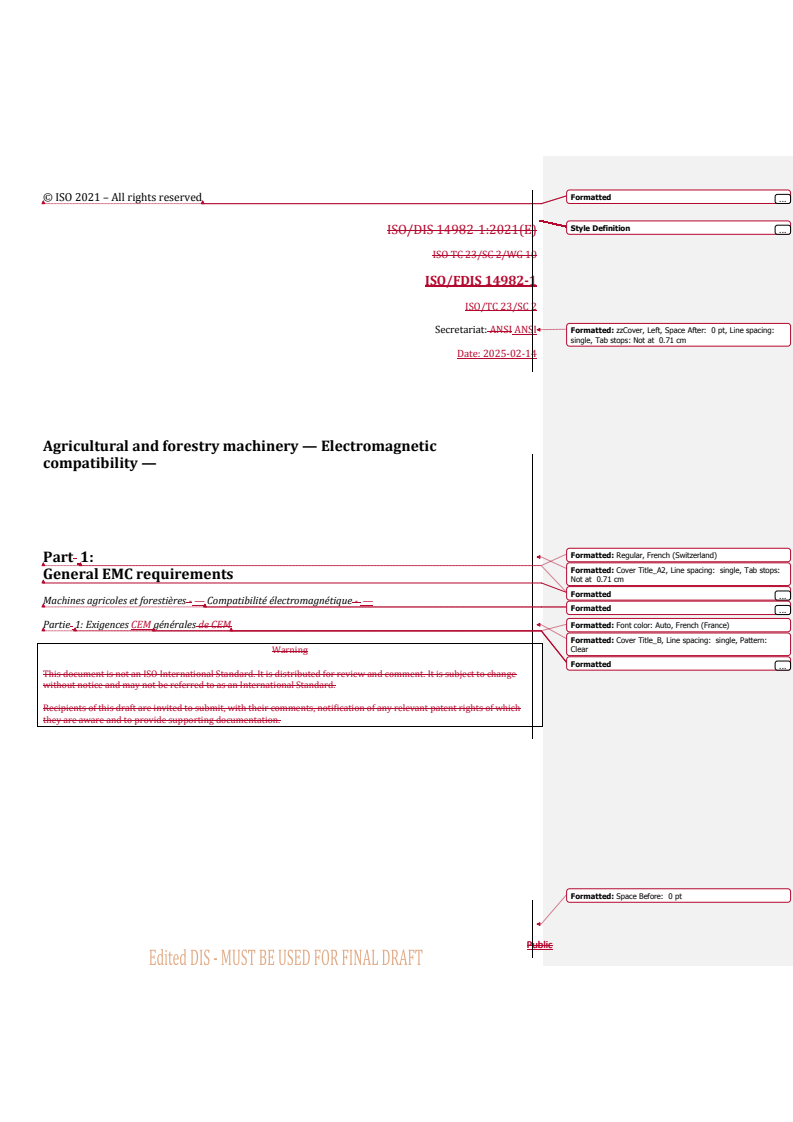
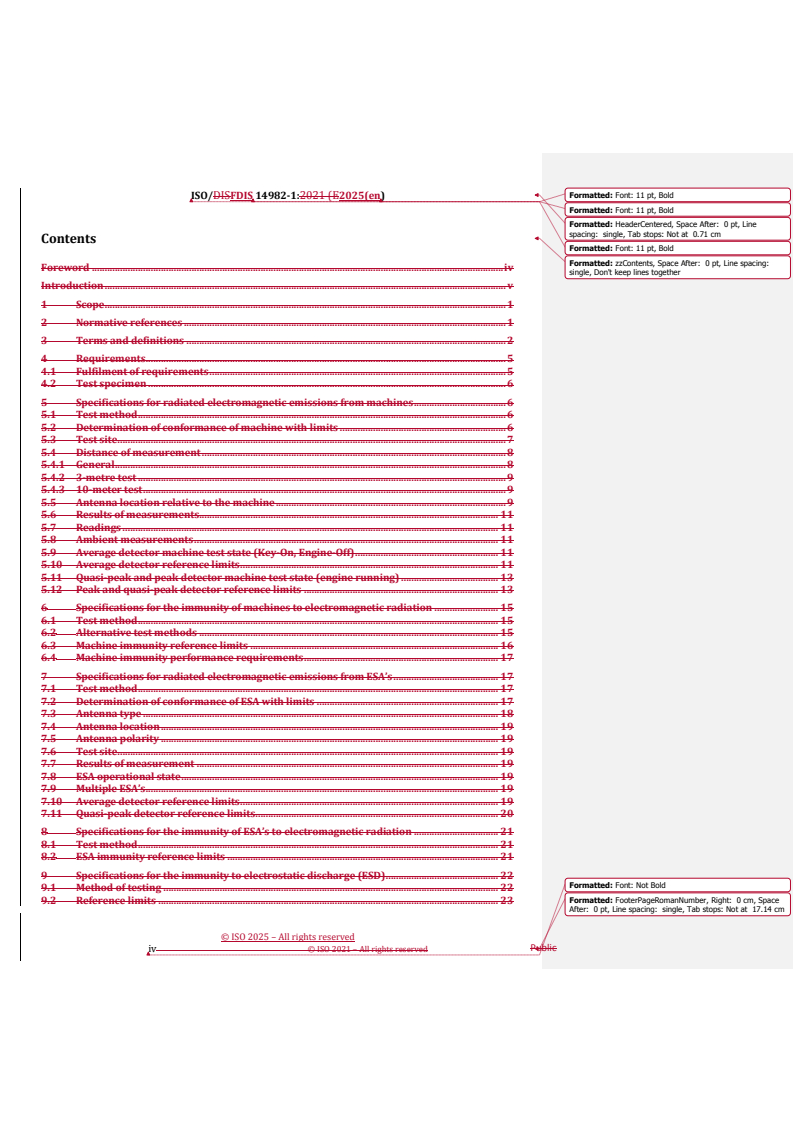
REDLINE ISO/FDIS 14982-1 - Agricultural and forestry machinery — Electromagnetic compatibility — Part 1: General EMC requirements Released:14. 02. 2025
Overview
ISO/FDIS 14982-1:2021 is an upcoming international standard focusing on the electromagnetic compatibility (EMC) requirements for agricultural and forestry machinery. This standard, developed under ISO Technical Committee 23/Subcommittee 2, addresses the essential general EMC requirements that ensure machinery operates effectively without causing or being susceptible to electromagnetic disturbance.
Electromagnetic compatibility is critical for safeguarding the operational reliability, safety, and environmental compliance of modern agricultural and forestry machines, many of which increasingly integrate electronic systems.
Key Topics
This standard covers comprehensive EMC aspects, including:
- Radiated electromagnetic emissions from machinery: Specifications for measuring and limiting electromagnetic emissions to prevent interference with other equipment.
- Immunity to electromagnetic radiation: Requirements to ensure machines can resist electromagnetic disturbances and continue to function correctly.
- Electrostatic discharge (ESD) immunity: Procedures and limits to verify machinery can withstand electrostatic discharges without malfunction.
- Conducted transient emissions and immunity: Specifications for electrical transients conducted through equipment, ensuring robust performance under transient electromagnetic conditions.
- Test methods and procedures: Detailed methods for EMC testing including test site specifications, measurement distances, antenna placement, and detector types (peak, quasi-peak, average).
- Test specimen configuration: Guidance on selecting representative machine configurations for EMC testing to ensure consistent and relevant results.
- Documentation and test reporting: Requirements for test reports that document compliance and facilitate regulatory approvals.
By addressing both emission control and immunity performance, ISO/FDIS 14982-1 aims to minimize electromagnetic disturbances, thereby reducing risks of operational failure and enhancing machine interoperability in complex working environments.
Applications
ISO/FDIS 14982-1 is designed for:
- Manufacturers of agricultural and forestry machinery: To ensure their products meet essential EMC requirements for market access and regulatory compliance.
- Testing laboratories and certification bodies: As a reference for designing EMC test protocols and assessing machine conformity.
- Component and subassembly suppliers (ESA - Electrical and electronic subassemblies): To evaluate the EMC performance of modules integrated into larger machinery systems.
- Regulators and standardization bodies: To harmonize EMC requirements across countries, supporting trade and safety in agricultural and forestry sectors.
- End-users and operators: To benefit from reliable, interference-free machinery which improves operational efficiency and reduces downtime.
Applying this standard helps manage electromagnetic interference risks typically caused by the growing use of electronic controls, sensors, and wireless communication devices in agricultural and forestry equipment.
Related Standards
ISO/FDIS 14982-1 aligns with several important frameworks and directives:
- ISO/IEC Directives Part 1 and 2: Guiding the development and editorial rules for international standards.
- European EMC Directive 2014/30/EU: The essential requirements addressed by this standard support compliance with this key regulatory framework for machinery placed on the European market.
- Machinery Directive 2006/42/EC: Includes provisions related to EMC, essential for the safety of agricultural and forestry equipment.
- Other ISO and IEC EMC standards: Providing detailed test methods and requirements applicable across electrotechnical equipment.
This standard complements existing EMC documentation and facilitates consistent application of electromagnetic compatibility principles across the agricultural and forestry machinery industries.
Keywords: electromagnetic compatibility, EMC requirements, agricultural machinery, forestry machinery, ISO 14982-1, electromagnetic emissions, immunity testing, electrostatic discharge, conducted transients, electrical subassemblies, EMC testing, machinery standards, ISO standards, EMC directive compliance, machinery safety.
Relations
- Effective Date
- 12-Feb-2026
- Effective Date
- 06-Jun-2022
- Effective Date
- 17-Jul-2021
Buy Documents
ISO/FDIS 14982-1 - Agricultural and forestry machinery — Electromagnetic compatibility — Part 1: General EMC requirements Released:14. 02. 2025
REDLINE ISO/FDIS 14982-1 - Agricultural and forestry machinery — Electromagnetic compatibility — Part 1: General EMC requirements Released:14. 02. 2025
Get Certified
Connect with accredited certification bodies for this standard

Control Union Certifications
Global certification for agriculture and sustainability.

ECOCERT
Organic and sustainability certification.

FSC International
Forest Stewardship Council certification.
Sponsored listings
Frequently Asked Questions
ISO/FDIS 14982-1 is a draft published by the International Organization for Standardization (ISO). Its full title is "Agricultural and forestry machinery — Electromagnetic compatibility — Part 1: Test methods and acceptance criteria". This standard covers: Agricultural and forestry machinery — Electromagnetic compatibility — Part 1: Test methods and acceptance criteria
Agricultural and forestry machinery — Electromagnetic compatibility — Part 1: Test methods and acceptance criteria
ISO/FDIS 14982-1 is classified under the following ICS (International Classification for Standards) categories: 33.100.01 - Electromagnetic compatibility in general; 65.060.01 - Agricultural machines and equipment in general. The ICS classification helps identify the subject area and facilitates finding related standards.
ISO/FDIS 14982-1 has the following relationships with other standards: It is inter standard links to FprEN ISO 14982-1, ISO 15363:2017, ISO 14982:1998. Understanding these relationships helps ensure you are using the most current and applicable version of the standard.
ISO/FDIS 14982-1 is available in PDF format for immediate download after purchase. The document can be added to your cart and obtained through the secure checkout process. Digital delivery ensures instant access to the complete standard document.
Standards Content (Sample)
FINAL DRAFT
International
Standard
ISO/TC 23/SC 2
Agricultural and forestry
Secretariat: ANSI
machinery — Electromagnetic
Voting begins on:
compatibility —
2025-02-21
Part 1:
Voting terminates on:
2025-04-18
General EMC requirements
Machines agricoles et forestières — Compatibilité
électromagnétique —
Partie 1: Exigences CEM générales
RECIPIENTS OF THIS DRAFT ARE INVITED TO SUBMIT,
WITH THEIR COMMENTS, NOTIFICATION OF ANY
RELEVANT PATENT RIGHTS OF WHICH THEY ARE AWARE
AND TO PROVIDE SUPPOR TING DOCUMENTATION.
IN ADDITION TO THEIR EVALUATION AS
BEING ACCEPTABLE FOR INDUSTRIAL, TECHNO-
ISO/CEN PARALLEL PROCESSING LOGICAL, COMMERCIAL AND USER PURPOSES, DRAFT
INTERNATIONAL STANDARDS MAY ON OCCASION HAVE
TO BE CONSIDERED IN THE LIGHT OF THEIR POTENTIAL
TO BECOME STAN DARDS TO WHICH REFERENCE MAY BE
MADE IN NATIONAL REGULATIONS.
Reference number
FINAL DRAFT
International
Standard
ISO/TC 23/SC 2
Agricultural and forestry
Secretariat: ANSI
machinery — Electromagnetic
Voting begins on:
compatibility —
2025-02-21
Part 1:
Voting terminates on:
2025-04-18
General EMC requirements
Machines agricoles et forestières — Compatibilité
électromagnétique —
Partie 1: Exigences CEM générales
RECIPIENTS OF THIS DRAFT ARE INVITED TO SUBMIT,
WITH THEIR COMMENTS, NOTIFICATION OF ANY
RELEVANT PATENT RIGHTS OF WHICH THEY ARE AWARE
AND TO PROVIDE SUPPOR TING DOCUMENTATION.
© ISO 2025
IN ADDITION TO THEIR EVALUATION AS
All rights reserved. Unless otherwise specified, or required in the context of its implementation, no part of this publication may
BEING ACCEPTABLE FOR INDUSTRIAL, TECHNO-
ISO/CEN PARALLEL PROCESSING
LOGICAL, COMMERCIAL AND USER PURPOSES, DRAFT
be reproduced or utilized otherwise in any form or by any means, electronic or mechanical, including photocopying, or posting on
INTERNATIONAL STANDARDS MAY ON OCCASION HAVE
the internet or an intranet, without prior written permission. Permission can be requested from either ISO at the address below
TO BE CONSIDERED IN THE LIGHT OF THEIR POTENTIAL
or ISO’s member body in the country of the requester.
TO BECOME STAN DARDS TO WHICH REFERENCE MAY BE
MADE IN NATIONAL REGULATIONS.
ISO copyright office
CP 401 • Ch. de Blandonnet 8
CH-1214 Vernier, Geneva
Phone: +41 22 749 01 11
Email: copyright@iso.org
Website: www.iso.org
Published in Switzerland Reference number
ii
Contents Page
Foreword .v
Introduction .vi
1 Scope . 1
2 Normative references . 1
3 Terms and definitions . 2
4 Requirements . 5
4.1 Fulfilment of requirements .5
4.2 Test specimen .5
5 Specifications for radiated electromagnetic emissions from machines . 6
5.1 Test method .6
5.2 Determination of conformance of machine with limits .6
5.3 Test site .7
5.4 Distance of measurement .8
5.4.1 General .8
5.4.2 3-metre test .9
5.4.3 10-meter test.9
5.5 Antenna location relative to the machine .9
5.6 Results of measurements .11
5.7 Readings .11
5.8 Ambient measurements .11
5.9 Average detector machine test state (Key-On, Engine-Off) . 12
5.10 Average detector reference limits . 12
5.11 Quasi-peak and peak detector machine test state (engine running) . . 13
5.12 Peak and quasi-peak detector reference limits .14
6 Specifications for the immunity of machines to electromagnetic radiation .15
6.1 Test method . 15
6.2 Alternative test methods .16
6.3 Machine immunity reference limits .16
6.4 Machine immunity performance requirements .17
7 Specifications for radiated electromagnetic emissions from ESA’s . 17
7.1 Test method .17
7.2 Determination of conformance of ESA with limits .17
7.3 Antenna type .18
7.4 Antenna location .19
7.5 Antenna polarity .19
7.6 Test site .19
7.7 Results of measurement .19
7.8 ESA operational state .19
7.9 Multiple ESA’s.19
7.10 Average detector reference limits .19
7.11 Quasi-peak detector reference limits . 20
8 Specifications for the immunity of ESA’s to electromagnetic radiation .21
8.1 Test method .21
8.2 ESA immunity reference limits .21
9 Specifications for the immunity to electrostatic discharge (ESD) .22
9.1 Method of testing . 22
9.2 Reference limits . 23
10 Specifications for conducted transient emissions from ESA’s .23
10.1 General . 23
10.2 Method of testing . 23
10.3 Reference limits . 23
iii
11 Specifications for the immunity of ESA’s to conducted electrical transients .24
11.1 Method of testing .24
11.2 Reference limits .24
12 Exceptions .25
13 Test report .25
Annex A (informative) Guidance for selecting test specimen configuration and additional
considerations .27
Annex ZA (informative) Relationship between this European Standard and the essential
requirements of Directive 2014/30/EU [2014 OJ L96] aimed to be covered .29
Annex ZZ (informative) Relationship between this European Standard and the essential
requirements of Directive 2006/42/EC aimed to be covered .30
Bibliography .31
iv
Foreword
ISO (the International Organization for Standardization) is a worldwide federation of national standards
bodies (ISO member bodies). The work of preparing International Standards is normally carried out through
ISO technical committees. Each member body interested in a subject for which a technical committee
has been established has the right to be represented on that committee. International organizations,
governmental and non-governmental, in liaison with ISO, also take part in the work. ISO collaborates closely
with the International Electrotechnical Commission (IEC) on all matters of electrotechnical standardization.
The procedures used to develop this document and those intended for its further maintenance are described
in the ISO/IEC Directives, Part 1. In particular, the different approval criteria needed for the different types
of ISO document should be noted. This document was drafted in accordance with the editorial rules of the
ISO/IEC Directives, Part 2 (see www.iso.org/directives).
ISO draws attention to the possibility that the implementation of this document may involve the use of (a)
patent(s). ISO takes no position concerning the evidence, validity or applicability of any claimed patent
rights in respect thereof. As of the date of publication of this document, ISO had not received notice of (a)
patent(s) which may be required to implement this document. However, implementers are cautioned that
this may not represent the latest information, which may be obtained from the patent database available at
www.iso.org/patents. ISO shall not be held responsible for identifying any or all such patent rights.
Any trade name used in this document is information given for the convenience of users and does not
constitute an endorsement.
For an explanation of the voluntary nature of standards, the meaning of ISO specific terms and expressions
related to conformity assessment, as well as information about ISO's adherence to the World Trade
Organization (WTO) principles in the Technical Barriers to Trade (TBT), see www.iso.org/iso/foreword.html.
This document was prepared by Technical Committee ISO/TC 23, Tractors and machinery for agriculture
and forestry, Subcommittee SC 2, Common tests, in collaboration with the European Committee for
Standardization (CEN) Technical Committee CEN/TC 144, Agricultural machinery, in accordance with the
Agreement on technical cooperation between ISO and CEN (Vienna Agreement).
1)
This first edition of ISO 14982-1, together with ISO/FDIS 14982-2:— , cancels and replaces ISO 14982:1998,
which has been technically revised.
The main changes are as follows:
— the provisions have been brought up to date with technological change;
— normative references have been updated to their latest editions.
A list of all parts in the ISO 14982 series can be found on the ISO website.
Any feedback or questions on this document should be directed to the user’s national standards body. A
complete listing of these bodies can be found at www.iso.org/members.html.
1) Under development. Stage at the date of publication: ISO/FDIS 14982-2:2025.
v
Introduction
0.1 Document type
This document is a type-C standard as stated in ISO 12100:2010.
This document is of relevance, in particular, for the following stakeholder groups representing the market
players regarding machine safety:
— machine manufacturers;
— health and safety bodies (regulators, accident prevention organizations, market surveillance, etc.).
Others may be affected by the level of machine safety achieved with the means of the document by the
above-mentioned stakeholder groups:
— machine users/employers;
— machine users/employees (trade unions, organizations for people with special needs);
— service providers, e.g. for maintenance;
— consumers (in case of machines intended for use by consumers).
The above-mentioned stakeholder groups have been given the possibility to participate at the drafting
process of this document.
The machine concerned and the extent to which hazards, hazardous situations, or hazardous events are
indicated in the Scope of this document.
When requirements of this type-C standard are different from those which are stated in type-A or type-B
standards, the requirements of this type-C standard take precedence over the requirements of the other
standards for machines that have been designed and built according to the requirements of this type-C
standard.
0.2 Background
In recent years, an increasing number of electronic devices for controlling, monitoring and displaying a
variety of functions have been introduced into machine designs. It is necessary to consider the electrical and
electromagnetic environment in which these devices operate.
Electrical and radio-frequency disturbances occur during normal operation of many items of machines. They
are generated over a wide frequency range with various electrical characteristics and can be distributed to
on-board electronic devices and systems by conduction, radiation, or both. Narrowband signals generated
from sources on or off the machine can also be coupled into the electrical or electronic system, affecting
the normal performance of electronic devices. Such sources of narrowband electromagnetic disturbances
include mobile radios and broadcast transmitters.
Electrostatic discharges are relevant to the machine because control elements can be positioned where
potential differences could emerge at contact points. Conducted transients in power supply wiring must be
considered because the machine can contain open systems, in which several devices or components may be
combined to complement machine functionality.
While there are many existing standards for a variety of products and systems, the test method presented
by the ISO 14982 series provides for the specific test conditions of the machine within its scope as well
as the electrical/electronic sub-assemblies (ESA) or ESA separate from the machine. The test method
recognizes that due to their size and usage, the arrangement of the machines in the test facility needs to be
representative of their typical operating characteristics. This document provides test methods and criteria
which are acceptable for the machine types it covers, considering their unique characteristics and operating
parameters.
vi
Because the machinery has several systems that may consist of components that may be used on a variety
of different machine types, the approach of defining "electrical/electronic sub-assemblies” or separate
technical units" for these components may be applied for the immunity and emissions test methods. This
allows these components to be evaluated by comparable (or alternative) test methods in existing laboratory
facilities consisting of specially equipped shielded rooms. When electrical/electronic sub-assembly tests are
performed, it is necessary to consider any additional effects imparted by the wiring systems used to connect
the sub-assemblies to the machine. The tests can also be conducted on the machinery.
Annex A provides guidance for selecting and configuring test specimens.
vii
FINAL DRAFT International Standard ISO/FDIS 14982-1:2025(en)
Agricultural and forestry machinery — Electromagnetic
compatibility —
Part 1:
General EMC requirements
1 Scope
This document specifies the test methods and acceptance criteria for evaluating the electromagnetic
compatibility of tractors, and all kinds of mobile (including hand-held or battery powered) agricultural and
forestry machines, landscaping, and gardening machines [referred to hereafter as machine(s)] as supplied
by the machine manufacturer. It is applicable to machines and electrical/electronic sub-assemblies (ESA's)
which are manufactured after the date of publication of this document.
This document specifies general EMC requirements under typical EMC environmental conditions.
ISO/FDIS 14982-2:— deals with EMC requirements specifically related to functional safety.
Electrical/electronic components or sub-assemblies intended for fitting in machines are also within the
scope of this document, except regarding immunity for those parts whose functions are not involved in the
direct control and modification of the state of the functions of the machine. The following electromagnetic
phenomena are to be evaluated:
— radiated electromagnetic emissions;
— electromagnetic field immunity;
— electrostatic discharge;
— conducted transients.
This document is not applicable to machines directly supplied with current from public electrical mains.
Exceptions to machines or electrical/electronic systems or ESA's that might not require testing in accordance
with this document are given in Clause 12.
2 Normative references
The following documents are referred to in the text in such a way that some or all of their content constitutes
requirements of this document. For dated references, only the edition cited applies. For undated references,
the latest edition of the referenced document (including any amendments) applies.
ISO 7637-1:2015, Road vehicles — Electrical disturbances from conduction and coupling — Part 1: Definitions
and general considerations
ISO 7637-2:2011, Road vehicles — Electrical disturbances from conduction and coupling — Part 2: Electrical
transient conduction along supply lines only
ISO 10605:2008, Road vehicles — Test methods for electrical disturbances from electrostatic discharge
ISO 11451-1:2015, Road vehicles — Vehicle test methods for electrical disturbances from narrowband radiated
electromagnetic energy — Part 1: General principles and terminology
ISO 11451-2:2015, Road vehicles — Vehicle test methods for electrical disturbances from narrowband radiated
electromagnetic energy — Part 2: Off-vehicle radiation sources
ISO 11452-2:2019, Road vehicles — Component test methods for electrical disturbances from narrowband
radiated electromagnetic energy — Part 2: Absorber-lined shielded enclosure
ISO 11452-3:2016, Road vehicles — Component test methods for electrical disturbances from narrowband
radiated electromagnetic energy — Part 3: Transverse electromagnetic (TEM) cell
ISO 11452-4:2020, Road vehicles — Component test methods for electrical disturbances from narrowband
radiated electromagnetic energy — Part 4: Harness excitation methods
ISO 11452-5:2002, Road vehicles — Component test methods for electrical disturbances from narrowband
radiated electromagnetic energy — Part 5: Stripline
ISO 12100:2010, Safety of machinery — General principles for design — Risk assessment and risk reduction
ISO 16750-2:2012, Road vehicles — Environmental conditions and testing for electrical and electronic equipment
— Part 2: Electrical loads
CISPR 12, Vehicles, boats and internal combustion engines — Radio disturbance characteristics — Limits and
methods of measurement for the protection of off-board receivers
CISPR 25, Vehicles, boats and internal combustion engines — Radio disturbance characteristics — Limits and
methods of measurement for the protection of on-board receivers
3 Terms and definitions
For the purposes of this document, the terms and definitions given in ISO 12100:2010 and the following apply.
ISO and IEC maintain terminological databases for use in standardization at the following addresses:
— ISO Online browsing platform: available at https:// www .iso .org/ obp;
— IEC Electropedia: available at http:// www .electropedia .org
3.1
absorber lined shielded enclosure
ALSE
shielded enclosure/screened room with radio-frequency-absorbing material on its internal ceiling and walls
3.2
amplitude modulation
AM
modulation in which the amplitude of a periodic carrier is a given function generally linear, of the
instantaneous values of the modulating signal.
Note 1 to entry: Sine wave amplitude modulated (AM) by 1 kHz sine wave at 80 % (modulation index m = 0,8)
3.3
artificial network
AN
network inserted in the supply lead or signal/load lead of apparatus to be tested which provides, in a given
frequency range, a specified load impedance for the measurement of disturbance voltages and which can
isolate the apparatus from the supply or signal sources/loads in that frequency range
Note 1 to entry: This network is inserted in the DC power lines of the vehicle in charging mode and provides, in a
given frequency range, a specified load impedance and which isolates the vehicle from the DC power supply in that
frequency range.
3.4
average detector
detector, the output voltage of which is the average value of the envelope of an applied signal
Note 1 to entry: The average value shall be taken over a specified time interval.
[SOURCE: IEC 60050-161:1990, 161-04-26]
3.5
broadband emission
emission which has a bandwidth greater than that of a particular measuring apparatus or receiver
3.6
bulk current
total amount of common mode current in a harness
3.7
conducted transients
transient voltage or current distributed in the power supply wiring of a machine or component or separate
technical unit via a conductor between the source of the transient and the drain
3.8
degradation of performance
undesired departure in the operational performance of any device, equipment, or system from its intended
performance
Note 1 to entry: The term “degradation” also applies to temporary or permanent failure.
[SOURCE: IEC 60050-161:1990]
3.9
electrical/electronic sub-assembly
ESA
electrical and/or electronic component or set of components intended to be part of a machine, together with
any associated electrical connections and wiring, which performs one or more specialised functions.
3.10
electrical/electronic system
electrical and/or electronic component or set of components intended to be part of a machine, together with
any associated electrical connections.
3.11
electromagnetic compatibility
EMC
ability of equipment or system to function satisfactorily in its electromagnetic environment (3.13) without
introducing intolerable electromagnetic disturbance (3.12) to anything in that environment
[SOURCE: IEC 60050-161:1990]
3.12
electromagnetic disturbance
any electromagnetic phenomenon which may degrade the performance of a machine or component or
separate technical unit
Note 1 to entry: An electromagnetic disturbance may be an electromagnetic noise, an unwanted signal, or a change in
the propagation medium itself.
3.13
electromagnetic environment
totality of electromagnetic phenomena existing at a given location
3.14
electrostatic discharge
ESD
transfer of electric charge between bodies of different electrostatic potential in proximity or through
direct contact
3.15
ESA type
ESA which does not differ in such essential respects as:
— the function performed by the ESA;
— the arrangement of the electrical and/or electronic components, if applicable;
— the primary material of the casing
3.16
immunity related functions
functions related to operator control, and to the direct control or operation of the machine by affecting
visibility, or which, when disturbed, cause confusion to the operator or others nearby or to machine
statutory data, and functions related to machine data bus functionality
Note 1 to entry: Examples of immunity related functions may include, but are not limited to:
— unexpected machine movement;
— changes in engine speed, wheel speed or wheel angle;
— driving lights, windscreen wipers, demisting systems, direction indicators, stop lamps, marker lamps, rear
position lamp, emergency light bars;
— wrong information from warning indicators, lamps, or displays related to the functions of operator control;
— acoustical disturbances from incorrect operation of anti-theft alarms, horns, reverse movement alarm;
— functions which can affect machine statutory data such as hour meters and odometers;
— machine data bus functions which can block data transmission on machine data bus system used to transmit data
related to the correct functioning of other immunity related functions;
— unexpected activation of safety restraint systems;
— unexpected movement of driver’s seat or steering wheel position.
3.17
machine type
machines which do not differ in such essential respects as:
— the structural shape;
— the general arrangement of the electrical and/or electronic components and the general wiring
arrangement;
— the primary material of which the design of the machine consists of (for example a steel, aluminium or
fibreglass covering parts).
3.18
narrowband
emission which has a bandwidth less than that of a particular measuring apparatus or receiver
[SOURCE: IEC 60050-161:1990]
3.19
non-immunity related functions
functions which are not related to direct operator control or operation of the machine
3.20
peak detector
detector, the output voltage of which is the peak value of an applied signal
[SOURCE: IEC 60050-161:1990, 161-04-24]
3.21
pulse modulation type 1
PM type 1
pulse modulation similar to GSM, with t = 577 µs and a period = 4 600 µs
on
3.22
pulse modulation type 2
PM type 2
pulse modulation similar to radar, with t = 3 µs and a period = 3 333 µs
on
3.23
quasi-peak detector
detector having specified electrical time constants which, when regularly repeated identical pulses are
applied to it, delivers an output voltage which is a fraction of the peak value of the pulses, the fraction
increasing towards unity as the pulse repetition rate is increased
[SOURCE: IEC 60050-161:1990, 161-04-24]
3.24
reference limit
limit value with which the production conforms to
4 Requirements
4.1 Fulfilment of requirements
The requirements of this document shall be met by a machine (and its electrical/electronic installation or its
ESA’s) operating in accordance with its final purpose.
If the entire machine is not tested, then the use of options b) and c) shall require a combination of the testing
described, and sufficient analysis of the combined machine(s) and ESA(s) to ensure proper performance to
this document when combined.
a) The requirements of this document are deemed to be fulfilled for a complete machine when the
requirements identified in Clauses 5, 6, and 9 as applicable, are fulfilled. No routine tests of the
electrical/electronic systems or ESA's are required.
b) The requirements of this document are deemed to be fulfilled if it is confirmed by the machine
manufacturer that all electrical/electronic systems or ESA's fulfil the requirements identified in
Clauses 7, 8, 9, 10, and 11 and has been installed taking into account the recommended requirements of
the ESA manufacturer and risk assessment by the machine manufacturer.
c) The requirements of this document are deemed to be fulfilled for a machine meeting the requirements
of Clauses 5, 6, 9, and in which an electrical/electronic system, ESA, tractor/towed implement, or
other types of implement combinations, which also complies with Clauses 7, 8, 9, 10, and 11 and has
been installed taking into account the recommended requirements of the ESA manufacturer and risk
assessment by the system integrator.
d) The requirements of this document are also deemed to be fulfilled when the machine has no such
equipment for which an immunity or interference test is required. In this case, no tests are necessary
(see exceptions in Clause 12).
4.2 Test specimen
The test specimen may be of an ESA type or machine type as specified in 3.15 and 3.17.
For a subsequent test on a similarly configured machine or ESA, conformity to the reference limits shall be
accepted as fulfilment of the requirements of this document.
For electrostatic discharge and conducted transients, the reference limits are valid for all testing of any test
specimen.
Additional guidance for test specimen selection and configuration can be found in Annex A.
5 Specifications for radiated electromagnetic emissions from machines
5.1 Test method
The test is intended to measure the radiated electromagnetic emissions generated by electrical or electronic
systems fitted to machines, tractors, headers, attachments, and trailed machines.
EMC performance of headers, attachments, and trailed machines (that are only operated by using a carrier
machine) may be affected by the carrier machine and thus may be tested independently. The attachments
shall be brought into a specified operating state by an auxiliary device which replaces the carrier machine
during the test.
The carrier machine operations may be simulated for the header, attachment, or trailed machine to function,
and remove the interference a carrier machine can provide.
If not otherwise stated, the test shall be performed as specified in CISPR 12.
5.2 Determination of conformance of machine with limits
In all cases, the machine shall conform to the classifying procedure as specified in Figure 1.
The flow-chart is applicable for each individual frequency. Only frequencies that are above applicable test
limits need to be remeasured using the average or quasi-peak detector.
Signal transmissions above test limits of the carrier radio frequency range of intended transmitters installed
on the machine are to be excluded from the assessment if it can be confirmed the emission is wanted or
intended.
Figure 1 — Method of determination of conformance
5.3 Test site
The test site shall be a clear, level area free of electromagnetic reflecting surfaces within a circle of minimum
radius 30,0 m measured from a point midway between the machine and the antenna for a distance of 10 m
between the receiving antenna and machine. The circle may be reduced to a minimum radius of 20 m when
the distance is 3 m between the receiving antenna and machine under test.
The measuring set, test hut or machine in which the measurement set is located may be within the test site,
but only in the permitted region shown in Figure 2.
Dimensions in metres
Key
1 machine
2 centre of clear area midway between the antenna and machine
3 antenna
4 permitted region for measuring set (in hut or vehicle)
R radius
Figure 2 — Measuring site
5.4 Distance of measurement
5.4.1 General
The test may be performed with the reference antenna located at either 3,0 m or 10,0 m from the device
under test.
No part of any antenna’s receiving elements shall be closer than 0,25 m to the plane on which the machine rests.
5.4.2 3-metre test
The phase centre of the antenna shall be 1,8 m ± 0,05 m above the plane on which the machine rests.
The horizontal distance from the reference point of the antenna to the outer body surface of the machine
shall be 3,0 m ± 0,05 m.
Multiple antenna positions may be required if the length of the machine or device under test is greater
than the 3 dB beam width of the antenna. The same positions shall be used for both horizontal and vertical
antenna polarizations.
5.4.3 10-meter test
The phase centre of the antenna shall be 3,0 m ± 0,05 m above the plane on which the machine rests.
The horizontal distance from the reference point of the antenna to the outer body surface of the machine
shall be 10,0 m ± 0,2 m.
5.5 Antenna location relative to the machine
Measurements shall be taken on the left and right side of the machine or device under test.
The determination of the antenna reference points shall be machine-specific and related to the maximum
concentration of emissions by location of electronic equipment on the machine and shall be noted in the
test report.
Multiple antenna positions may be required if the length of the machine or device under test is greater
than the 3 dB beamwidth of the antenna. The same positions shall be used for both horizontal and vertical
antenna polarities.
At each of the measuring points, readings shall be taken with the antenna in the horizontal and vertical
polarities as shown in Figure 3 and Figure 4.
Dimensions in metres
Key
1 machine under test
2 machine specific determined reference point(s)
NOTE Dimensions in brackets for 3-m antenna distance testing.
Figure 3 — Horizontal antenna polarity relative to maximum concentration of emissions
Dimensions in metres
Key
1 machine under test
NOTE Dimensions in brackets for 3-m antenna distance testing.
Figure 4 — Vertical antenna polarity relative to maximum concentration of emissions
5.6 Results of measurements
The results of measurement shall be expressed in dB(µV/m) as follows:
— 30 MHz to 1 000 MHz: 120 kHz bandwidth;
— 1 000 MHz to 6 000 MHz: 1 MHz bandwidth.
5.7 Readings
The maximum of the readings shall be taken as the characteristic reading at the frequency at which the
measurements were made.
If the limit is exceeded during the test, investigations shall be made to ensure that this is due to the machine
and not to background radiation.
Measurements may be performed with either peak, average, or quasi-peak detectors.
5.8 Ambient measurements
To ensure that there is no extraneous noise or signal of a magnitude sufficient to affect materially the
measurement, measurements shall be taken before and after the test. If the machine is present when ambient
measurements are taken, steps shall be taken to ensure that any emissions from the machine do not affect
the ambient measurements significantly, for example by removing the machine from the test area, removing
the ignition key, or disconnecting the battery. For both measurements, the extraneous noise or signal shall
be at least 6 dB below the test limits (except for intentional narrowband ambient transmissions).
The manufacturer/tester shall ensure that machine telematics devices are not communicating when the
ignition key has been removed or the battery has been disconnected. The device can be removed from the
test area if it cannot be isolated by removing the key or disconnecting the machine battery.
5.9 Average detector machine test state (Key-On, Engine-Off)
A description of the operating states of the EUT with all the functions to be tested and activated shall be
specified in the test plan.
— The ignition switch shall be switched on.
— The engine shall not be operating.
— The machine’s electronic/electrical system(s) shall be operating during the measurement.
— Systems which generate only broadband emissions may be disabled.
5.10 Average detector reference limits
Measurements shall be made over the whole frequency range from 30 MHz to 6 000 MHz as shown in
Figure 5 and Figure 6.
For measurements made using a machine-to-antenna spacing of (10,0 ± 0,2) m, the emissions reference limit
shall be:
— 28 dBμV/m in the 30 MHz to 230 MHz frequency band;
— 35 dBμV/m in the 230 MHz to 1 000 MHz frequency band;
— 50 dBμV/m in the 1 000 MHz to 6 000 MHz frequency band.
The lower limit shall apply at the transition frequency.
NOTE 1 30 MHz – 1 000 MHz Limit derived from UN ECE Regulation 10 Revision 6.
1 000 MHz – 6 000 MHz Limit derived from CISPR32:2015+AMD1:2019 Table A.3 lowered by 10 dB to account for
the 10 m test distance.
Key
X frequency – MHz – logarithmic plot
Figure 5 — Machine average limit for antenna distance of 10 m
For measurements made using a machine-to-antenna spacing of (3,0 ± 0,2) m, the emissions reference limit
shall be:
— 38 dBμV/m in the 30 MHz to 230 MHz frequency band;
— 45 dBμV/m in the 230 MHz to 1 000 MHz frequency band, and;
— 60 dBμV/m in the 1 000 MHz to 6 000 MHz frequency band.
The lower limit shall apply at the transition frequency.
NOTE 2 30 MHz – 1 000 MHz Limit derived from UN ECE Regulation 10 Revision 6.
1 000 MHz – 6 000 MHz Limit derived from CISPR32:2015+AMD1:2019 Table A.3.
Key
X frequency – MHz – logarithmic plot
Figure 6 — Machine average limit for antenna distance of 3 m
When multiple machines are tested, the emissions reference limit shall be increased by 2 dB.
5.11 Quasi-peak and peak detector machine test state (engine running)
A description of the operating states of the EUT with all the functions to be tested and activated shall be
specified in the test plan.
All sources of broadband emissions which are deemed to be continuously used shall be switched on during
the test. This can be any device which, when operated, is on for longer than 15 s.
If the machine is engine driven, the engine shall be running at its normal operating temperature and the
...
...
Style Definition
...
ISO/DIS 14982-1:2021(E)
ISO TC 23/SC 2/WG 10
ISO/TC 23/SC 2
Secretariat: ANSI ANSI Formatted: zzCover, Left, Space After: 0 pt, Line spacing:
single, Tab stops: Not at 0.71 cm
Date: 2025-02-14
Agricultural and forestry machinery — Electromagnetic
compatibility —
Formatted: Regular, French (Switzerland)
Part 1:
Formatted: Cover Title_A2, Line spacing: single, Tab stops:
General EMC requirements
Not at 0.71 cm
Formatted
...
Machines agricoles et forestières - — Compatibilité électromagnétique - —
Formatted
...
Partie 1: Exigences CEM générales de CEM Formatted: Font color: Auto, French (France)
Formatted: Cover Title_B, Line spacing: single, Pattern:
Clear
Warning
Formatted
...
This document is not an ISO International Standard. It is distributed for review and comment. It is subject to change
without notice and may not be referred to as an International Standard.
Recipients of this draft are invited to submit, with their comments, notification of any relevant patent rights of which
they are aware and to provide supporting documentation.
Formatted: Space Before: 0 pt
PPuubbliclic
ISO/DIS 14982-1:2021 (E)
FDIS stage
PPuubblilicc
Formatted: HeaderCentered, Left, Space After: 0 pt, Line
ISO/DISFDIS 14982-1:2021 (E2025(en)
spacing: single, Tab stops: Not at 0.71 cm
Formatted: Font: 11 pt, Bold
Formatted: Font: 11 pt, Bold
Formatted: Font: 11 pt, Bold
Formatted: Left: 1.5 cm, Right: 1.5 cm, Gutter: 0 cm,
All rights reserved. Unless otherwise specified, or required in the context of its implementation, no part of this publication
Header distance from edge: 1.27 cm
may be reproduced or utilized otherwise in any form or by any means, electronic or mechanical, including photocopying,
Formatted: Indent: Left: 0 cm, Right: 0 cm, Adjust space
or posting on the internet or an intranet, without prior written permission. Permission can be requested from either ISO
between Latin and Asian text, Adjust space between Asian
at the address below or ISO’s member body in the country of the requester.
text and numbers, Border: Left: (No border), Right: (No
ISO copyright office
CP 401 • Ch. de Blandonnet 8
CH-1214 Vernier, Geneva
Phone: + 41 22 749 01 11
Formatted: French (Switzerland)
EmailE-mail: copyright@iso.org
Formatted: French (Switzerland)
Website: www.iso.orgwww.iso.org
Formatted: French (Switzerland)
Published in Switzerland
Formatted: Font: 10 pt
Formatted: Font: 10 pt
Formatted: Font: Not Bold
Formatted: FooterPageRomanNumber, Right: 0 cm, Tab
stops: Not at 17.14 cm
Public
iii
Formatted: Font: 11 pt, Bold
ISO/DISFDIS 14982-1:2021 (E2025(en)
Formatted: Font: 11 pt, Bold
Formatted: HeaderCentered, Space After: 0 pt, Line
spacing: single, Tab stops: Not at 0.71 cm
Contents
Formatted: Font: 11 pt, Bold
Formatted: zzContents, Space After: 0 pt, Line spacing:
Foreword . iv
single, Don't keep lines together
Introduction . v
1 Scope . 1
2 Normative references . 1
3 Terms and definitions . 2
4 Requirements. 5
4.1 Fulfilment of requirements . 5
4.2 Test specimen . 6
5 Specifications for radiated electromagnetic emissions from machines . 6
5.1 Test method . 6
5.2 Determination of conformance of machine with limits . 6
5.3 Test site . 7
5.4 Distance of measurement . 8
5.4.1 General . 8
5.4.2 3-metre test . 9
5.4.3 10-meter test . 9
5.5 Antenna location relative to the machine . 9
5.6 Results of measurements. 11
5.7 Readings . 11
5.8 Ambient measurements . 11
5.9 Average detector machine test state (Key-On, Engine-Off) . 11
5.10 Average detector reference limits . 11
5.11 Quasi-peak and peak detector machine test state (engine running) . 13
5.12 Peak and quasi-peak detector reference limits . 13
6 Specifications for the immunity of machines to electromagnetic radiation . 15
6.1 Test method . 15
6.2 Alternative test methods . 15
6.3 Machine immunity reference limits . 16
6.4 Machine immunity performance requirements . 17
7 Specifications for radiated electromagnetic emissions from ESA’s . 17
7.1 Test method . 17
7.2 Determination of conformance of ESA with limits . 17
7.3 Antenna type . 18
7.4 Antenna location . 19
7.5 Antenna polarity . 19
7.6 Test site . 19
7.7 Results of measurement . 19
7.8 ESA operational state . 19
7.9 Multiple ESA’s . 19
7.10 Average detector reference limits . 19
7.11 Quasi-peak detector reference limits . 20
8 Specifications for the immunity of ESA’s to electromagnetic radiation . 21
8.1 Test method . 21
8.2 ESA immunity reference limits . 21
9 Specifications for the immunity to electrostatic discharge (ESD) . 22
Formatted: Font: Not Bold
9.1 Method of testing . 22
Formatted: FooterPageRomanNumber, Right: 0 cm, Space
9.2 Reference limits . 23
After: 0 pt, Line spacing: single, Tab stops: Not at 17.14 cm
Public
iv © ISO 2021 – All rights reserved
Formatted: Font: 11 pt, Bold
ISO/DISFDIS 14982-1:2021 (E2025(en)
Formatted: HeaderCentered, Left, Space After: 0 pt, Line
spacing: single, Tab stops: Not at 0.71 cm
Formatted: Font: 11 pt, Bold
10 Specifications for conducted transient emissions from ESA’s . 23
Formatted: Font: 11 pt, Bold
10.1 General . 23
10.2 Method of testing . 23
10.3 Reference limits . 23
11 Specifications for the immunity of ESA’s to conducted electrical transients . 23
11.1 Method of testing . 23
11.2 Reference limits . 23
12 Exceptions . 25
13 Test report . 25
Annex A (informative) Guidance for selecting test specimen configuration and additional
considerations . 27
A.1 General . 27
A.2 Justification. 27
A.3 Requirements. 28
Annex ZA (informative) Relationship between this European Standard and the essential
requirements of Directive 2014/30/EU [2014 OJ L96] aimed to be covered . 29
Annex ZZ (informative) Relationship between this European Standard and the essential
requirements of Directive 2006/42/EC aimed to be covered . 30
Bibliography . 31
Foreword . vi
Introduction .vii
1 Scope . 1
2 Normative references . 1
3 Terms and definitions . 2
4 Requirements. 6
5 Specifications for radiated electromagnetic emissions from machines . 7
6 Specifications for the immunity of machines to electromagnetic radiation . 22
7 Specifications for radiated electromagnetic emissions from ESA’s . 25
8 Specifications for the immunity of ESA’s to electromagnetic radiation . 33
9 Specifications for the immunity to electrostatic discharge (ESD) . 35
10 Specifications for conducted transient emissions from ESA’s . 35
11 Specifications for the immunity of ESA’s to conducted electrical transients . 36
12 Exceptions . 38
13 Test report . 38
Annex A (informative) Guidance for selecting test specimen configuration and additional
considerations . 40
Formatted: Font: 10 pt
Annex ZA (informative) Relationship between this European Standard and the essential
Formatted: Font: 10 pt
requirements of Directive 2014/30/EU [2014 OJ L96] aimed to be covered . 43
Formatted: Font: Not Bold
Bibliography . 45
Formatted: FooterPageRomanNumber, Right: 0 cm, Tab
stops: Not at 17.14 cm
Public
v
Formatted: Font: 11 pt, Bold
ISO/DISFDIS 14982-1:2021 (E2025(en)
Formatted: HeaderCentered, Space After: 0 pt, Line
spacing: single, Tab stops: Not at 0.71 cm
Formatted: Font: 11 pt, Bold
Foreword
Formatted: Font: 11 pt, Bold
ISO (the International Organization for Standardization) is a worldwide federation of national standards Formatted: English (United Kingdom)
bodies (ISO member bodies). The work of preparing International Standards is normally carried out through
Formatted: English (United Kingdom)
ISO technical committees. Each member body interested in a subject for which a technical committee has been
Formatted: English (United Kingdom)
established has the right to be represented on that committee. International organizations, governmental and
Formatted: English (United Kingdom)
non-governmental, in liaison with ISO, also take part in the work. ISO collaborates closely with the
Formatted: English (United Kingdom)
International Electrotechnical Commission (IEC) on all matters of electrotechnical standardization.
The procedures used to develop this document and those intended for its further maintenance are described
in the ISO/IEC Directives, Part 1. In particular, the different approval criteria needed for the different types of Formatted: English (United Kingdom)
ISO documentsdocument should be noted. This document was drafted in accordance with the editorial rules
Formatted: English (United Kingdom)
of the ISO/IEC Directives, Part 2 (see www.iso.org/directives).
Formatted: English (United Kingdom)
Field Code Changed
Attention is drawnISO draws attention to the possibility that some of the elementsimplementation of this
Formatted: English (United Kingdom)
document may beinvolve the subjectuse of (a) patent(s). ISO takes no position concerning the evidence,
Formatted: English (United Kingdom)
validity or applicability of any claimed patent rights. in respect thereof. As of the date of publication of this
document, ISO had not received notice of (a) patent(s) which may be required to implement this document.
Formatted: English (United Kingdom)
However, implementers are cautioned that this may not represent the latest information, which may be
Formatted: English (United Kingdom)
obtained from the patent database available at www.iso.org/patents. ISO shall not be held responsible for
Formatted: English (United Kingdom)
identifying any or all such patent rights. Details of any patent rights identified during the development of the
Formatted: English (United Kingdom)
document will be in the Introduction and/or on the ISO list of patent declarations received (see
Formatted: English (United Kingdom)
www.iso.org/patents).
Formatted: English (United Kingdom)
Any trade name used in this document is information given for the convenience of users and does not
constitute an endorsement.
For an explanation of the voluntary nature of standards, the meaning of ISO specific terms and expressions
related to conformity assessment, as well as information about ISO's adherence to the World Trade
Formatted: English (United Kingdom)
Organization (WTO) principles in the Technical Barriers to Trade (TBT), see
Formatted: Font color: Auto, English (United Kingdom)
www.iso.org/iso/foreword.htmlwww.iso.org/iso/foreword.html.
Formatted: English (United Kingdom)
This document was prepared by Technical Committee ISO/TC 23, Tractors and machinery for agriculture and
Formatted: Font: Not Italic, English (United Kingdom)
forestry, Subcommittee SC 2, Common tests, in collaboration with the European Committee for Standardization
Formatted: English (United Kingdom)
(CEN) Technical Committee CEN/TC 144, Agricultural machinery, in accordance with the Agreement on
Formatted: Font: Not Italic, English (United Kingdom)
technical cooperation between ISO and CEN (Vienna Agreement).
Formatted: English (United Kingdom)
1)
Formatted: Font: Not Italic, English (United Kingdom)
This first edition of ISO 14982-1, together with ISO/FDIS 14982-2,:— , cancels and replaces ISO 14982:1998,
which has been technically revised. Formatted: English (United Kingdom)
Formatted: English (United Kingdom)
The main changes compared to the previous edition are as follows:
Formatted: English (United Kingdom)
Formatted: Font color: Auto, English (United Kingdom)
⎯— the provisions have been brought up to date with technological change;
Formatted: English (United Kingdom)
⎯— normative references have been updated to their latest editions. Formatted: Font color: Auto
Formatted: Foreword Text
A list of all parts in the ISO 14982 series can be found on the ISO website.
Formatted: Font color: Auto
Formatted: Font color: Auto
Any feedback or questions on this document should be directed to the user’s national standards body. A
Formatted: Foreword Text
complete listing of these bodies can be found at www.iso.org/members.html.
Formatted: English (United Kingdom)
Field Code Changed
Formatted: Font: Not Bold
Formatted: FooterPageRomanNumber, Right: 0 cm, Space
1)
Under development. Stage at the date of publication: ISO/FDIS 14982-2:2025. After: 0 pt, Line spacing: single, Tab stops: Not at 17.14 cm
Public
vi © ISO 2021 – All rights reserved
Formatted: Font: 11 pt, Bold
ISO/DISFDIS 14982-1:2021 (E2025(en)
Formatted: Font: 11 pt, Bold
Formatted: Font: 11 pt, Bold
Formatted: HeaderCentered, Left, Space After: 0 pt, Line
Introduction
spacing: single, Tab stops: Not at 0.71 cm
Formatted: No page break before
0.1 0.1Document type
Formatted: IntroHeading2, Adjust space between Latin and
Asian text, Adjust space between Asian text and numbers
This document is a type-C standard as stated in ISO 12100:2010.
Formatted: Font: Cambria
This document is of relevance, in particular, for the following stakeholder groups representing the market Formatted: Font: Cambria
players regarding machine safety:
Formatted: Body Text
⎯— machine manufacturers; Formatted: List Continue 1, No bullets or numbering
⎯— health and safety bodies (regulators, accident prevention organizations, market surveillance, etc.).
Others may be affected by the level of machine safety achieved with the means of the document by the above- Formatted: Body Text
mentioned stakeholder groups:
Formatted: List Continue 1, No bullets or numbering
⎯— machine users/employers;
⎯— machine users/employees (trade unions, organizations for people with special needs);
⎯— service providers, e.g.,. for maintenance;
⎯— consumers (in case of machines intended for use by consumers).
The above-mentioned stakeholder groups have been given the possibility to participate at the drafting process Formatted: Body Text
of this document.
The machine concerned and the extent to which hazards, hazardous situations, or hazardous events are
indicated in the Scope of this document.
When requirements of this type-C standard are different from those which are stated in type-A or type-B
standards, the requirements of this type-C standard take precedence over the requirements of the other
standards for machines that have been designed and built according to the requirements of this type-C
standard.
0.2 0.2Background
In recent years, an increasing number of electronic devices for controlling, monitoring and displaying a variety
of functions have been introduced into machine designs. It is necessary to consider the electrical and
electromagnetic environment in which these devices operate.
Electrical and radio-frequency disturbances occur during normal operation of many items of machines. They
are generated over a wide frequency range with various electrical characteristics and can be distributed to
on-board electronic devices and systems by conduction, radiation, or both. Narrowband signals generated
from sources on or off the machine can also be coupled into the electrical or electronic system, affecting the
normal performance of electronic devices. Such sources of narrowband electromagnetic disturbances include
mobile radios and broadcast transmitters.
Electrostatic discharges are relevant to the machine because control elements can be positioned where
potential differences could emerge at contact points. Conducted transients in power supply wiring must be
Formatted: Font: 10 pt
considered because the machine can contain open systems, in which several devices or components may be
combined to complement machine functionality.
Formatted: Font: 10 pt
Formatted: Font: Not Bold
While there are many existing standards for a variety of products and systems, the test method presented by
Formatted: FooterPageRomanNumber, Right: 0 cm, Tab
the ISO 14982 series provides for the specific test conditions of the machine within its scope as well as the
stops: Not at 17.14 cm
Public
vii
Formatted: Font: 11 pt, Bold
ISO/DISFDIS 14982-1:2021 (E2025(en)
Formatted: Font: 11 pt, Bold
Formatted: HeaderCentered, Space After: 0 pt, Line
spacing: single, Tab stops: Not at 0.71 cm
electrical/electronic sub-assemblies (ESA) or ESA separate from the machine. The test method recognizes
Formatted: Font: 11 pt, Bold
that due to their size and usage, the arrangement of the machines in the test facility needs to be representative
of their typical operating characteristics. This document provides test methods and criteria which are
acceptable for the machine types it covers, considering their unique characteristics and operating parameters.
Because the machinery has several systems that may consist of components that may be used on a variety of
different machine types, the approach of defining "electrical/electronic sub-assemblies” or separate technical
units" for these components may be applied for the immunity and emissions test methods. This allows these
components to be evaluated by comparable (or alternative) test methods in existing laboratory facilities
consisting of specially equipped shielded rooms. When electrical/electronic sub-assembly tests are
performed, it is necessary to consider any additional effects imparted by the wiring systems used to connect
the sub-assemblies to the machine. The tests can also be conducted on the machinery.
Annex AAnnex A provides guidance for selecting and configuring test specimens.
Formatted: Font: Not Bold
Formatted: FooterPageRomanNumber, Right: 0 cm, Space
After: 0 pt, Line spacing: single, Tab stops: Not at 17.14 cm
Public
viii © ISO 2021 – All rights reserved
Formatted: HeaderCentered
Agricultural and forestry machinery — Electromagnetic
compatibility —
Formatted: Main Title 2, Tab stops: Not at 8.6 cm
Part 1:
General EMC requirements
1 Scope
This document specifies the test methods and acceptance criteria for evaluating the electromagnetic Formatted: Body Text, Space After: 0 pt
compatibility of tractors, and all kinds of mobile (including hand-held or battery powered) agricultural and
forestry machines, landscaping, and gardening machines [referred to hereafter as machine(s)] as supplied by
the machine manufacturer. It is applicable to machines and electrical/electronic sub-assemblies (ESA's)
which are manufactured after the date of publication of this document.
This document specifies general EMC requirements under typical EMC environmental conditions. ISO Formatted: English (United Kingdom)
/FDIS 14982-2:— deals with EMC requirements specifically related to functional safety.
Formatted: English (United Kingdom)
Formatted: Body Text, Adjust space between Latin and Asian
Electrical/electronic components or sub-assemblies intended for fitting in machines are also within the scope
text, Adjust space between Asian text and numbers
of this document, except regarding immunity for those parts whose functions are not involved in the direct
Formatted: English (United Kingdom)
control and modification of the state of the functions of the machine. The following electromagnetic
Formatted: English (United Kingdom)
phenomena are to be evaluated:
Formatted: Body Text, Space After: 0 pt
Formatted: List Continue 1, No bullets or numbering
⎯— radiated electromagnetic emissions;
⎯— electromagnetic field immunity;
⎯— electrostatic discharge;
⎯— conducted transients.
This document is not applicable to machines directly supplied with current from public electrical mains. Formatted: Body Text
Exceptions to machines or electrical/electronic systems or ESA's that maymight not require testing in
accordance with this document are given in Clause 12.Clause 12.
Formatted: Indent: Left: 0 cm, First line: 0 cm
2 Normative references
The following documents are referred to in the text in such a way that some or all of their content constitutes Formatted: English (United Kingdom)
requirements of this document. For dated references, only the edition cited applies. For undated references,
Formatted: Body Text, Adjust space between Latin and Asian
the latest edition of the referenced document (including any amendments) applies. text, Adjust space between Asian text and numbers
Formatted: English (United Kingdom)
ISO 7637-1: 2015, Road vehicles — Electrical disturbance bydisturbances from conduction and coupling —
Formatted: English (United Kingdom)
Part 1: Definitions and general considerations
Formatted: Font: Not Italic
ISO 7637-2: 2011, Road vehicles — Electrical disturbance bydisturbances from conduction and coupling — Formatted: Font: Not Italic
Part 2: Electrical transient conduction along supply lines only
Formatted: Font color: Auto
Formatted: Font: Not Italic, Font color: Auto
ISO 10605:2008, Road vehicles — Electrical disturbance from — Test methods for electrical disturbances from
Formatted: Font: Not Italic
electrostatic discharge
ISO 11451-1:2015, Road vehicles — Electrical — Vehicle test methods for electrical disturbances byfrom Formatted: Font: Not Italic
narrowband radiated electromagnetic energy — Vehicle test methods — Part 1: General principles and
definitionsterminology
Formatted: FooterPageRomanNumber
Formatted: Font: Bold
ISO 11451-2:2015, Road vehicles — Electrical disturbances by narrowband radiated electromagnetic energy — Formatted: Font: Not Italic
Vehicle test methods for electrical disturbances from narrowband radiated electromagnetic energy — Part 2:
Off-vehicle radiation sourcesources
ISO 11452-12:2019, Road vehicles — Electrical — Component test methods for electrical disturbances byfrom Formatted: RefNorm
narrowband radiated electromagnetic energy — Component test methods — Part 1: General and definitions 2:
Formatted: Font: Not Italic
Absorber-lined shielded enclosure
ISO 11452-23:2016, Road vehicles — Electrical disturbances by narrowband radiated electromagnetic Formatted: Font: Not Italic
energy — Component test methods — Part 2: Absorber-lined chamber
ISO 11452-3, Road vehicles – Component test methods for electrical disturbances from narrowband radiated Formatted: RefNorm
electromagnetic energy –— Part 3: Transverse electromagnetic (TEM) cell
Formatted: Font: Not Italic
ISO 11452-4:2020, Road vehicles — Component test methods for electrical disturbances from narrowband Formatted: Font: Not Italic
radiated electromagnetic energy — Part 4: Harness excitation methods
Formatted: RefNorm, Adjust space between Latin and Asian
ISO 11452-5:2002, Road vehicles — Electrical — Component test methods for electrical disturbances byfrom
text, Adjust space between Asian text and numbers
narrowband radiated electromagnetic energy — Component test methods — Part 5: Stripline
Formatted: Font: Not Italic
ISO 12100:2010, Safety of machinery -— General principles for design -— Risk assessment and risk reduction
Formatted: RefNorm, Space Before: 0 pt
Formatted: Font color: Auto, Pattern: Clear
ISO 16750-2:2012, Road vehicles — Environmental conditions and testing for electrical and electronic
Formatted: Font color: Auto, Pattern: Clear
equipment, — Part 2: Electrical loads
Formatted: Font color: Auto, Pattern: Clear
Formatted: Font: Not Italic
CISPR 12, Vehicles, boats and internal combustion engines — Radio disturbance characteristics
— Limits and methods of measurement for the protection of off-board receivers
Formatted: English (United Kingdom)
Formatted: RefNorm
CISPR 25, Vehicles, boats and internal combustion engines — Radio disturbance characteristics — Limits and
Formatted: English (United Kingdom)
methods of measurement for the protection of on-board receivers
CISPR 32 Ed. 2.1:2019, Electromagnetic compatibility of multimedia equipment – Emissions requirements
Formatted: Indent: Left: 0 cm, First line: 0 cm
3 Terms and definitions
Formatted: Body Text
For the purposes of this document, the terms and definitions given in ISO 12100:2010 and the following apply.
Formatted: English (United Kingdom)
Formatted: Body Text, Space After: 0 pt, Line spacing:
ISO and IEC maintain terminological databases for use in standardization at the following addresses: single
Formatted: List Continue 1, No bullets or numbering
⎯— ISO Online browsing platform: available at http://www.iso.org/obphttps://www.iso.org/obp;
Formatted: English (United Kingdom)
Formatted: English (United Kingdom)
⎯— IEC Electropedia: available at http/www.electropedia.orghttp://www.electropedia.org
Formatted: TermNum2
3.1 3.1 Formatted: Font: 12 pt
absorber lined shielded enclosure
Formatted: Term(s) Admitted
ALSE
Formatted: Font: 12 pt
shielded enclosure/screened room with radio-frequency-absorbing material on its internal ceiling and walls
Formatted: Term(s) Admitted
Formatted: Note
3.2 3.2
amplitude modulation Formatted: English (United Kingdom)
AM
Formatted: English (United Kingdom)
modulation in which the amplitude of a periodic carrier is a given function generally linear, of the
Formatted: English (United Kingdom)
instantaneous values of the modulating signal.
Formatted: Font: Not Italic, English (United Kingdom)
Formatted: English (United Kingdom)
Note 1 to entry: Sine wave amplitude modulated (AM) by 1 kHz sine wave at 80 % (modulation index m = 0,8)
Formatted: FooterPageRomanNumber
Formatted: Font: Bold
3.3 3.3
artificial network
AN
network inserted in the supply lead or signal/load lead of apparatus to be tested which provides, in a given Formatted: Definition, Adjust space between Latin and Asian
text, Adjust space between Asian text and numbers
frequency range, a specified load impedance for the measurement of disturbance voltages and which can
isolate the apparatus from the supply or signal sources/loads in that frequency range
given frequency range, a specified load impedance for the measurement of disturbance voltages and
which can isolate the apparatus from the supply or signal sources/loads in that frequency range.
Note 1 to entry: This network is inserted in the DC power lines of the vehicle in charging mode and provides, in a given
Formatted: Note, Adjust space between Latin and Asian text,
frequency range, a specified load impedance and which isolates the vehicle from the DC power supply in that frequency Adjust space between Asian text and numbers
range.
3.4 3.4 Formatted: TermNum2
average detector
detector, the output voltage of which is the average value of the envelope of an applied signal Formatted: English (United Kingdom)
Formatted: Definition, Adjust space between Latin and Asian
signal. text, Adjust space between Asian text and numbers
Formatted: English (United Kingdom)
Note 1 to entry: The average value mustshall be taken over a specified time interval.
Formatted: Note, Adjust space between Latin and Asian text,
Adjust space between Asian text and numbers
[Source: SOURCE: IEC 60050-161:1990, 161-04-26]
Formatted: English (United Kingdom)
Formatted: English (United Kingdom)
3.5 3.5
Formatted: English (United Kingdom)
broadband emission
emission which has a bandwidth greater than that of a particular measuring apparatus or receiver
Formatted: TermNum2
Formatted: Font: 12 pt
3.6 3.6
Formatted: TermNum2
bulk current
Formatted: Font: 12 pt
total amount of common mode current in a harness
Formatted: Definition
3.7 3.7
Formatted: Font: 12 pt
conducted transients
transient voltage or current distributed in the power supply wiring of a machine or component or separate
technical unit via a conductor between the source of the transient and the drain
3.8 3.8
Formatted: TermNum2
degradation of performance
Formatted: Font: 12 pt
undesired departure in the operational performance of any device, equipment, or system from its intended
Formatted: Definition
performance
Note 1 to entry: The term “degradation” also applies to temporary or permanent failure.
[SourceSOURCE: IEC 60050-161:1990]
3.9 3.9 Formatted: Font: 12 pt
electrical/electronic sub-assembly
ESA
electrical and/or electronic component or set of components intended to be part of a machine, together with
any associated electrical connections and wiring, which performs one or more specialised functions.
Formatted: FooterPageRomanNumber
Formatted: Font: Bold
3.10 3.10 Formatted: TermNum2
electrical/electronic system
Formatted: Font: 12 pt
electrical and/or electronic component or set of components intended to be part of a machine, together with
any associated electrical connections.
3.11 3.11 Formatted: TermNum2
electromagnetic compatibility
Formatted: Font: 12 pt
EMC
Formatted: Term(s)
ability of equipment or system to function satisfactorily in its electromagnetic environment (3.13)(3.13)
without introducing intolerable electromagnetic disturbance (3.12) to anything in that environment Formatted: Font: Italic
[SOURCE: IEC 60050-161 Ed. 1.0 t:1990]
3.12 3.12
Formatted: Font: 12 pt
electromagnetic disturbance
Formatted: Indent: Left: 0 cm, First line: 0 cm
any electromagnetic phenomenon which may degrade the performance of a machine or component or
separate technical unit.
Note 1 to entry: An electromagnetic disturbance may be an electromagnetic noise, an unwanted signal, or a change in
Formatted: Note
the propagation medium itself.
3.13 3.13 Formatted: Font: 12 pt
electromagnetic environment
totality of electromagnetic phenomena existing at a given location Formatted: Definition
3.14 3.14 Formatted: Font: 12 pt
electrostatic discharge
ESD
transfer of electric charge between bodies of different electrostatic potential in proximity or through direct
contact
3.15 3.15
Formatted: TermNum2
ESA type
Formatted: Font: 12 pt
ESA which does not differ in such essential respects as:
Formatted: List Continue 1, Space After: 0 pt, No bullets or
⎯— the function performed by the ESA;
numbering, Allow hanging punctuation, Adjust space between
Latin and Asian text, Adjust space between Asian text and
⎯— the arrangement of the electrical and/or electronic components, if applicable.;
numbers, Font Alignment: Auto
⎯— the primary material of the casing.
Formatted: TermNum2
Formatted: Font: 12 pt
3.16 3.16
Formatted: Font: Cambria
immunity related functions
functions related to operator control, and to the direct control or operation of the machine by affecting
Formatted: Font: Cambria
visibility, or which, when disturbed, cause confusion to the operator or others nearby or to machine statutory
Formatted: Font: Cambria
data, and functions related to machine data bus functionality
Formatted: Font: Cambria
Formatted: Font: Cambria
Note 1 to entry: Examples of immunity related functions may include, but are not limited to:
Formatted: List Continue 1 (-), Indent: Left: 0 cm, First line:
0 cm, Bulleted + Level: 1 + Aligned at: 0 cm + Indent at: 0
⎯— unexpected machine movement;
cm
Formatted: Font: Not Bold
⎯— changes in engine speed, wheel speed or wheel angle;
Formatted: Font: Not Bold
⎯— driving lights, windscreen wipers, demisting systems, direction indicators, stop lamps, marker lamps, rear
Formatted: Font: Not Bold
position lamp, emergency light bars;
Formatted: FooterPageRomanNumber
Formatted: Font: Bold
⎯— wrong information from warning indicators, lamps, or displays related to the functions of operator control; Formatted: Font: Not Bold
⎯— acoustical disturbances from incorrect operation of anti-theft alarms, horns, reverse movement alarm; Formatted: Font: Not Bold
⎯— functions which can affect machine statutory data such as hour meters and odometers;
Formatted: Font: Not Bold
⎯— machine data bus functions which can block data transmission on machine data bus system used to transmit
data related to the correct functioning of other immunity related functions; Formatted: Font: Not Bold
⎯— unexpected activation of safety restraint systems; Formatted: Font: Not Bold
⎯— unexpected movement of driver’s seat or steering wheel position. Formatted: Font: Not Bold
3.17 3.17 Formatted: TermNum2
machine type
Formatted: Font: 12 pt
machines which do not differ in such essential respects as:
Formatted: List Continue 1, No bullets or numbering
⎯— the structural shape;
Formatted: TermNum2
⎯— the general arrangement of the electrical and/or electronic components and the general wiring
Formatted: Font: 12 pt
arrangement;
Formatted: Font color: Auto
Formatted: Font: Not Bold
⎯— the primary material of which the design of the machine consists of (for example a steel, aluminium or
Formatted: Source
fibreglass covering parts).
Formatted: TermNum2, Space Before: 0 pt
3.18 3.18
Formatted: Font: 12 pt
narrowband
Formatted: Term(s)
emission which has a bandwidth less than that of a particular measuring apparatus or receiver
Formatted: TermNum2, Space Before: 0 pt
Formatted: Font: 12 pt
[Source[SOURCE: IEC 60050-161:1990] Formatted: Font: Bold
Formatted: English (United Kingdom)
3.19 3.19
Formatted: Definition
non-immunity related functions
Formatted: Font: 12 pt
functions which are not related to direct operator control or operation of the machine
Formatted: Font: Bold
3.20 3.20 Formatted: English (United Kingdom)
peak detector
Formatted: Definition, Adjust space between Latin and Asian
text, Adjust space between Asian text and numbers
detector, the output voltage of which is the peak value of an applied signal
Formatted: English (United Kingdom)
[SourceSOURCE: IEC 60050-161:1990, 161-04-24]
Formatted: English (United Kingdom)
Formatted: English (United Kingdom)
3.21 3.21
Formatted: Font: 11 pt, English (United Kingdom)
pulse modulation type 1
PM type 1 Formatted: TermNum2
pulse modulation similar to GSM, with ton = 577 µs and a period = 4 600 µs
Formatted: Font: 12 pt
Formatted: Font: Bold
3.22 3.22
Formatted: English (United Kingdom)
pulse modulation type 2
Formatted: Definition, Adjust space between Latin and Asian
PM type 2
text, Adjust space between Asian text and numbers
pulse modulation similar to radar, with ton = 3 µs and a period = 3 333 µs
Formatted: English (United Kingdom)
Formatted: English (United Kingdom)
Formatted: English (United Kingdom)
Formatted: Font: 11 pt, English (United Kingdom)
Formatted: FooterPageRomanNumber
Formatted: Font: Bold
3.23 3.23 Formatted: Font: 12 pt
quasi-peak detector
Formatted: TermNum2
detector having specified electrical time constants which, when regularly repeated identical pulses are applied
Formatted: English (United Kingdom)
to it, delivers an output voltage which is a fraction of the peak value of the pulses, the fraction increasing
Formatted: Font: Not Italic, English (United Kingdom)
towards unity as the pulse repetition rate is increased
Formatted: English (United Kingdom)
Formatted: Definition, Adjust space between Latin and Asian
pulses are applied to it, delivers an ou
...