

ISO/TS 18234-7:2013
(Main)Intelligent transport systems — Traffic and travel information via transport protocol experts group, generation 1 (TPEG1) binary data format — Part 7: Parking information (TPEG1-PKI)
General Information
- Abstract
ISO/TS 18234-7:2013 specifies the TPEG Parking Information Application (PKI) which is designed to deliver parking information to a variety of receivers using a number of different channels, foremost digital broadcasting and internet technologies. Parking information may be presented to the user in many different ways including textually, voiced and graphically using standard formats.
- Status
- Published
- Publication Date
- 09-Oct-2013
- Technical Committee
- ISO/TC 204 - Intelligent transport systems
- Drafting Committee
- ISO/TC 204/WG 10 - Traveller information systems
- Current Stage
- 9093 - International Standard confirmed
- Start Date
- 06-Nov-2024
- Completion Date
- 29-Aug-2026
Buy Documents

ISO/TS 18234-7:2013 - Intelligent transport systems — Traffic and travel information via transport protocol experts group, generation 1 (TPEG1) binary data format — Part 7: Parking information (TPEG1-PKI) Released:10/10/2013
Overview
ISO/TS 18234-7:2013 - part of the ISO/TS 18234 series - defines the TPEG1 Parking Information (TPEG1‑PKI) binary data format for delivering parking information as part of Intelligent Transport Systems (ITS). The specification describes how parking data (location, capacity, features, status, fees, etc.) are encoded in the TPEG generation‑1 binary stream so that a wide range of receivers (digital broadcast, internet, in‑vehicle and mobile devices) can present information textually, voiced or graphically.
Key Topics
- TPEG1 binary format and framing: service component frames and message stream organization following TPEG1-SSF conventions.
- Message components: structure and semantics for the Parking Message, including containers such as MessageManagement, ParkingLocation, ParkingSiteDescription, CurrentCapacity, ExpectedCapacity and Advice.
- Tables and code lists: standardized value tables (pki001…pki022) for VehicleType, ParkingType, UserType, FuelType, AvailableFeatures, ParkingStatus, PaymentMethod, Advice, Tendency, FeeType, and more - enabling interoperable encodings.
- Binary data types and SSF: normative annexes define binary SSF, primitive and compound data types, syntax representation and indexing rules for reliable encoding/decoding.
- Message Management Container (MMC): multipart and monolithic message handling for message lifecycle, sequencing and multi‑part distribution.
- Design principles and transport: guidelines for toolkits, external definitions and adapting TPEG streams to different bearers (broadcast, IP).
Applications
ISO/TS 18234-7:2013 is intended for practical use in:
- Real‑time parking guidance systems (in‑vehicle navigation and roadside displays).
- Mobile and web parking apps that consume standardized parking data feeds.
- Broadcast and IP service providers distributing parking and travel information via DAB, DVB, cellular or internet channels.
- Municipal traffic management and smart‑city platforms integrating parking availability and fee/operational data.
- OEMs and telematics suppliers implementing TPEG receivers and data decoders.
Who uses it: ITS system architects, broadcasters, navigation/infotainment vendors, app developers, data aggregators, municipal traffic authorities and standards integrators.
Related Standards
ISO/TS 18234 is a multipart family; relevant companion parts include:
- Part 1: TPEG1‑INV (Introduction, numbering and versions)
- Part 2: TPEG1‑SSF (Syntax, semantics and framing)
- Part 3: TPEG1‑SNI (Service and network information)
- Part 4: TPEG1‑RTM (Road Traffic Message)
- Part 5: PTI (Public Transport Information)
- Part 6: Location referencing
- Parts 8–11 covering congestion, compact events, conditional access and location containers
Adopting ISO/TS 18234-7:2013 (TPEG1‑PKI) ensures interoperable, codec‑efficient delivery of parking data across broadcast and IP channels, improving consistency and usability of parking information in ITS applications.
Relations
- Effective Date
- 09-Feb-2026
- Effective Date
- 12-Feb-2026
- Effective Date
- 17-Dec-2022
- Effective Date
- 06-Jun-2022
Buy Documents
ISO/TS 18234-7:2013 - Intelligent transport systems — Traffic and travel information via transport protocol experts group, generation 1 (TPEG1) binary data format — Part 7: Parking information (TPEG1-PKI) Released:10/10/2013
Get Certified
Connect with accredited certification bodies for this standard

BSI Group
BSI (British Standards Institution) is the business standards company that helps organizations make excellence a habit.

Great Wall Tianjin Quality Assurance Center
Established 1993, first batch to receive national accreditation with IAF recognition.
Hong Kong Quality Assurance Agency (HKQAA)
Hong Kong's leading certification body.
Sponsored listings
Frequently Asked Questions
ISO/TS 18234-7:2013 is a technical specification published by the International Organization for Standardization (ISO). Its full title is "Intelligent transport systems — Traffic and travel information via transport protocol experts group, generation 1 (TPEG1) binary data format — Part 7: Parking information (TPEG1-PKI)". This standard covers: ISO/TS 18234-7:2013 specifies the TPEG Parking Information Application (PKI) which is designed to deliver parking information to a variety of receivers using a number of different channels, foremost digital broadcasting and internet technologies. Parking information may be presented to the user in many different ways including textually, voiced and graphically using standard formats.
ISO/TS 18234-7:2013 specifies the TPEG Parking Information Application (PKI) which is designed to deliver parking information to a variety of receivers using a number of different channels, foremost digital broadcasting and internet technologies. Parking information may be presented to the user in many different ways including textually, voiced and graphically using standard formats.
ISO/TS 18234-7:2013 is classified under the following ICS (International Classification for Standards) categories: 03.220.01 - Transport in general; 35.240.60 - IT applications in transport. The ICS classification helps identify the subject area and facilitates finding related standards.
ISO/TS 18234-7:2013 has the following relationships with other standards: It is inter standard links to CEN ISO/TS 18234-1:2013, CEN ISO/TS 18234-7:2013, ISO 16773-2:2007, ISO/IEC 9594-5:2001. Understanding these relationships helps ensure you are using the most current and applicable version of the standard.
ISO/TS 18234-7:2013 is available in PDF format for immediate download after purchase. The document can be added to your cart and obtained through the secure checkout process. Digital delivery ensures instant access to the complete standard document.
Standards Content (Sample)
TECHNICAL ISO/TS
SPECIFICATION 18234-7
First edition
2013-10-15
Intelligent transport systems — Traffic
and travel information via transport
protocol experts group, generation 1
(TPEG1) binary data format —
Part 7:
Parking information (TPEG1-PKI)
Systèmes intelligents de transport — Informations sur le trafic et le
tourisme via les données de format binaire du groupe d'experts du
protocole de transport, génération 1 (TPEG1)
Partie 7: Informations relatives aux parcs de stationnement
(TPEG1-PKI)
Reference number
©
ISO 2013
© ISO 2013
All rights reserved. Unless otherwise specified, no part of this publication may be reproduced or utilized otherwise in any form or by any
means, electronic or mechanical, including photocopying, or posting on the internet or an intranet, without prior written permission.
Permission can be requested from either ISO at the address below or ISO’s member body in the country of the requester.
ISO copyright office
Case postale 56 CH-1211 Geneva 20
Tel. + 41 22 749 01 11
Fax + 41 22 749 09 47
E-mail copyright@iso.org
Web www.iso.org
Published in Switzerland
ii © ISO 2013 – All rights reserved
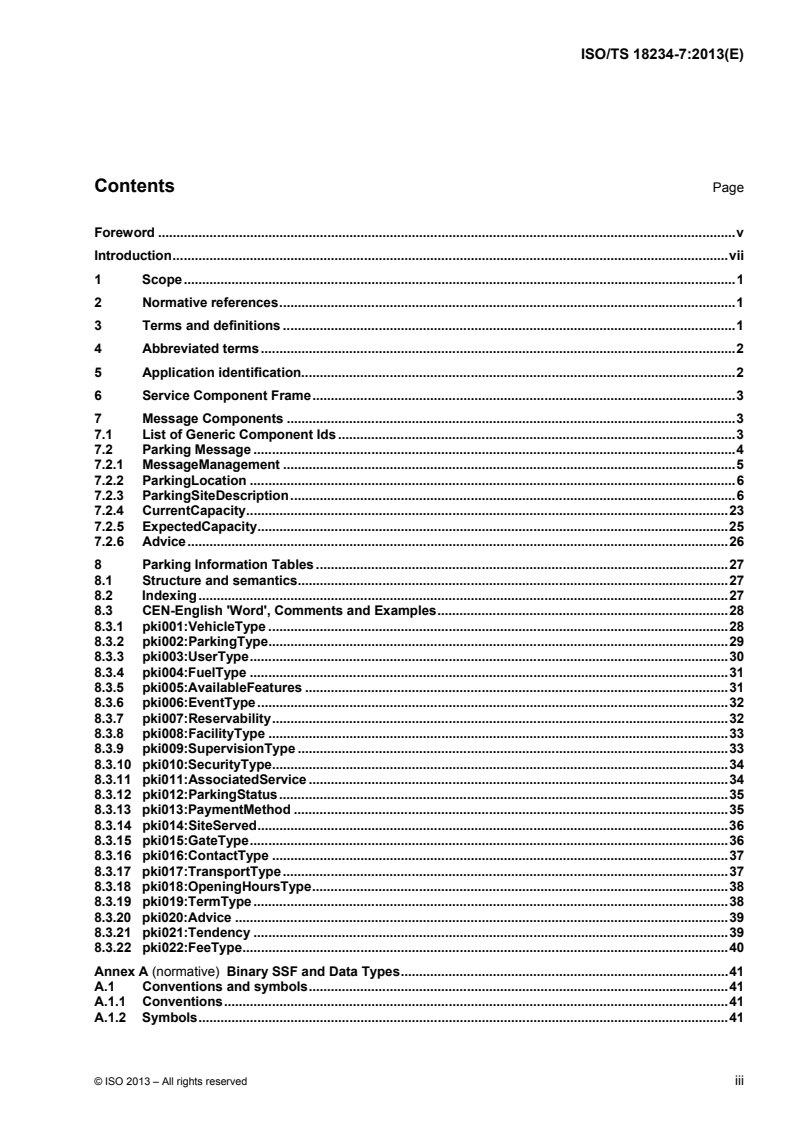
Contents Page
Foreword . v
Introduction . vii
1 Scope . 1
2 Normative references . 1
3 Terms and definitions . 1
4 Abbreviated terms . 2
5 Application identification. 2
6 Service Component Frame . 3
7 Message Components . 3
7.1 List of Generic Component Ids . 3
7.2 Parking Message . 4
7.2.1 MessageManagement . 5
7.2.2 ParkingLocation . 6
7.2.3 ParkingSiteDescription . 6
7.2.4 CurrentCapacity . 23
7.2.5 ExpectedCapacity . 25
7.2.6 Advice . 26
8 Parking Information Tables . 27
8.1 Structure and semantics. 27
8.2 Indexing . 27
8.3 CEN-English 'Word', Comments and Examples . 28
8.3.1 pki001:VehicleType . 28
8.3.2 pki002:ParkingType . 29
8.3.3 pki003:UserType . 30
8.3.4 pki004:FuelType . 31
8.3.5 pki005:AvailableFeatures . 31
8.3.6 pki006:EventType . 32
8.3.7 pki007:Reservability . 32
8.3.8 pki008:FacilityType . 33
8.3.9 pki009:SupervisionType . 33
8.3.10 pki010:SecurityType . 34
8.3.11 pki011:AssociatedService . 34
8.3.12 pki012:ParkingStatus . 35
8.3.13 pki013:PaymentMethod . 35
8.3.14 pki014:SiteServed . 36
8.3.15 pki015:GateType . 36
8.3.16 pki016:ContactType . 37
8.3.17 pki017:TransportType . 37
8.3.18 pki018:OpeningHoursType . 38
8.3.19 pki019:TermType . 38
8.3.20 pki020:Advice . 39
8.3.21 pki021:Tendency . 39
8.3.22 pki022:FeeType . 40
Annex A (normative) Binary SSF and Data Types . 41
A.1 Conventions and symbols . 41
A.1.1 Conventions . 41
A.1.2 Symbols . 41
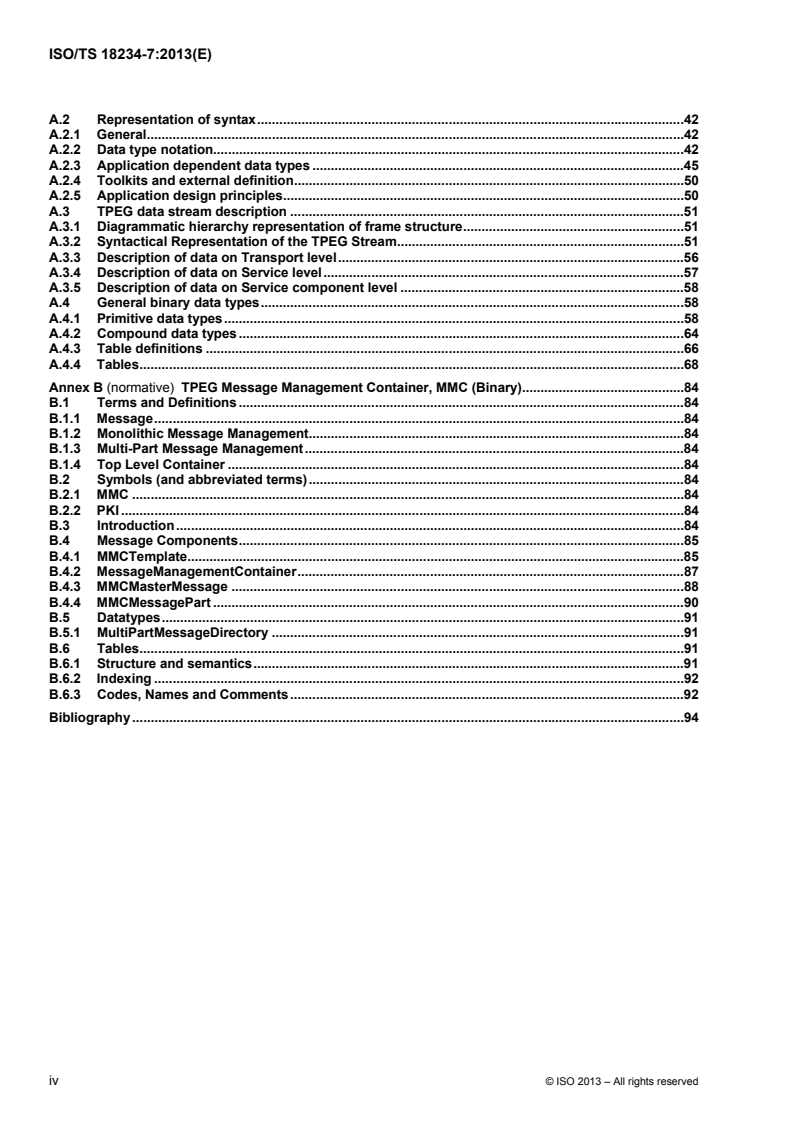
A.2 Representation of syntax .42
A.2.1 General .42
A.2.2 Data type notation.42
A.2.3 Application dependent data types .45
A.2.4 Toolkits and external definition .50
A.2.5 Application design principles .50
A.3 TPEG data stream description .51
A.3.1 Diagrammatic hierarchy representation of frame structure .51
A.3.2 Syntactical Representation of the TPEG Stream .51
A.3.3 Description of data on Transport level .56
A.3.4 Description of data on Service level .57
A.3.5 Description of data on Service component level .58
A.4 General binary data types .58
A.4.1 Primitive data types .58
A.4.2 Compound data types .64
A.4.3 Table definitions .66
A.4.4 Tables .68
Annex B (normative) TPEG Message Management Container, MMC (Binary) .84
B.1 Terms and Definitions .84
B.1.1 Message .84
B.1.2 Monolithic Message Management .84
B.1.3 Multi-Part Message Management .84
B.1.4 Top Level Container .84
B.2 Symbols (and abbreviated terms) .84
B.2.1 MMC .84
B.2.2 PKI .84
B.3 Introduction .84
B.4 Message Components .85
B.4.1 MMCTemplate .85
B.4.2 MessageManagementContainer .87
B.4.3 MMCMasterMessage .88
B.4.4 MMCMessagePart .90
B.5 Datatypes .91
B.5.1 MultiPartMessageDirectory .91
B.6 Tables .91
B.6.1 Structure and semantics .91
B.6.2 Indexing .92
B.6.3 Codes, Names and Comments .92
Bibliography .94
iv © ISO 2013 – All rights reserved
Foreword
ISO (the International Organization for Standardization) is a worldwide federation of national standards bodies
(ISO member bodies). The work of preparing International Standards is normally carried out through ISO
technical committees. Each member body interested in a subject for which a technical committee has been
established has the right to be represented on that committee. International organizations, governmental and
non-governmental, in liaison with ISO, also take part in the work. ISO collaborates closely with the
International Electrotechnical Commission (IEC) on all matters of electrotechnical standardization.
International Standards are drafted in accordance with the rules given in the ISO/IEC Directives, Part 2.
The main task of technical committees is to prepare International Standards. Draft International Standards
adopted by the technical committees are circulated to the member bodies for voting. Publication as an
International Standard requires approval by at least 75 % of the member bodies casting a vote.
In other circumstances, particularly when there is an urgent market requirement for such documents, a
technical committee may decide to publish other types of normative document:
— an ISO Publicly Available Specification (ISO/PAS) represents an agreement between technical experts in
an ISO working group and is accepted for publication if it is approved by more than 50 % of the members
of the parent committee casting a vote;
— an ISO Technical Specification (ISO/TS) represents an agreement between the members of a technical
committee and is accepted for publication if it is approved by 2/3 of the members of the committee casting
a vote.
An ISO/PAS or ISO/TS is reviewed after three years in order to decide whether it will be confirmed for a
further three years, revised to become an International Standard, or withdrawn. If the ISO/PAS or ISO/TS is
confirmed, it is reviewed again after a further three years, at which time it must either be transformed into an
International Standard or be withdrawn.
Attention is drawn to the possibility that some of the elements of this document may be the subject of patent
rights. ISO shall not be held responsible for identifying any or all such patent rights.
ISO/TS 18234-7 was prepared by the European Committee for Standardization (CEN) Technical Committee
CEN/TC 278, Road transport and traffic telematics, in collaboration with ISO Technical Committee
ISO/TC 204, Intelligent transport systems, in accordance with the Agreement on technical cooperation
between ISO and CEN (Vienna Agreement).
ISO/TS 18234 consists of the following parts, under the general title Intelligent transport systems — Traffic
and travel information via transport protocol experts group, generation 1 (TPEG1) binary data format:
Part 1: Introduction, numbering and versions (TPEG1-INV)
Part 2: Syntax, semantics and framing structure (TPEG1-SSF)
Part 3: Service and network information(TPEG1-SNI)
Part 4: Road Traffic Message application (TPEG1-RTM)
Part 5: Public Transport Information (PTI) application
Part 6: Location referencing applications
Part 7: Parking information (TPEG1-PK1)
Part 8: Congestion and travel-time application (TPEG1-CTT)
Part 9: Traffic event compact (TPEG1-TEC)
Part 10: Conditional access information (TPEG1-CAI)
Part 11: Location Referencing Container (TPEG1-LRC)
vi © ISO 2013 – All rights reserved
Introduction
TPEG technology uses a byte-oriented data stream format, which may be carried on almost any digital bearer
with an appropriate adaptation layer. TPEG messages are delivered from service providers to end-users, and
are used to transfer information from the database of a service provider to a user’s equipment.
The brief history of TPEG technology development dates back to the European Broadcasting Union (EBU)
Broadcast Management Committee establishing the B/TPEG project group in autumn 1997 with the mandate
to develop, as soon as possible, a new protocol for broadcasting traffic and travel-related information in the
multimedia environment. TPEG technology, its applications and service features are designed to enable
travel-related messages to be coded, decoded, filtered and understood by humans (visually and/or audibly in
the user’s language) and by agent systems.
One year later in December 1998, the B/TPEG group produced its first EBU specifications. Two Technical
Specifications were released. ISO/TS 18234-2 (TPEG-SSF) described the Syntax, Semantics and Framing
Structure, which is used for all TPEG applications. ISO/TS 18234-4 (TPEG-RTM) described the first
application, for Road Traffic Messages.
Subsequently, CEN/TC 278/WG 4, in conjunction with ISO/TC 204, established a project group comprising the
members of B/TPEG and they have continued the work concurrently since March 1999. Since then two further
parts were developed to make the initial complete set of four parts, enabling the implementation of a
consistent service. ISO/TS 18234-3 describes the Service and Network Information Application, which should
be used by all service implementations to ensure appropriate referencing from one service source to another.
ISO/TS 18234-1 completes the series, by describing the other parts and their relationship; it also contains the
application IDs used within the other parts. Additionally, ISO/TS 18234-5, the Public Transport Information
Application (TPEG-PTI) and ISO/TS 18234-6 (TPEG-LRC), were developed.
This Technical Specification adds another powerful application to the ISO 18234-series allowing detailed
parking information to be encoded and transmitted to the user. This Technical Specification includes new
advanced message management and new datatypes, as specified in the annexes.
Today, traffic congestion has become a serious problem in urban areas. Some traffic congestion is attributed
to drivers searching for parking spaces. Therefore, timely provision of parking information could help ease
traffic congestion. Furthermore, parking information would be valuable for the visitor, particularly when it could
be used to signal where a temporary parking facility is established for a special occasion.
TPEG applications are developed using UML modelling and a software tool is used to automatically select
content which then populates this Technical Specification. Diagrammatic extracts from the model are used to
show the capability of the binary coding in place of lengthy text descriptions; the diagrams do not necessarily
include all relevant content possible.
This Technical Specification describes the binary data format of the on-air interface of the Parking Information
application, (TPEG-PKI) with the technical version number TPEG-PKI_1.0/001.
TECHNICAL SPECIFICATION ISO/TS 18234-7:2013(E)
Intelligent transport systems — Traffic and travel information
via transport protocol experts group, generation 1 (TPEG1)
binary data format —
Part 7:
Parking information (TPEG1-PKI)
1 Scope
This Technical Specification specifies the TPEG Parking Information Application (PKI) which is designed to
deliver parking information to a variety of receivers using a number of different channels, foremost digital
broadcasting and internet technologies. Parking information may be presented to the user in many different
ways including textually, voiced and graphically using standard formats.
2 Normative references
The following referenced documents are indispensable for the application of this Technical Specification. For
dated references, only the edition cited applies. For undated references, the latest edition of the referenced
document (including any amendments) applies.
ISO 639-1:2002, Codes for the representation of names of languages — Part 1: Alpha-2 code
ISO 3166-1:2006, Codes for the representation of names of countries and their subdivisions — Part 1:
Country codes
ISO 4217:2001, Codes for the representation of currencies and funds
ISO/TS 18234-1, Intelligent transport systems — Traffic and travel information via transport protocol experts
group, generation 1 (TPEG1) binary data format — Part 1: Introduction, numbering and versions (TPEG1-INV)
ISO/TS 18234-2, Intelligent transport systems — Traffic and travel information via transport protocol experts
group, generation 1 (TPEG1) binary data format — Part 2: Syntax, semantics and framing structure (SSF)
ISO/TS 18234-3, Intelligent transport systems — Traffic and travel information via transport protocol experts
group, generation 1 (TPEG1) binary data format — Part 3: Service and network information (TPEG1-SNI)
ISO/TS 18234-11, Intelligent transport systems — Traffic and travel information via transport protocol experts
group, generation 1 (TPEG1) binary data format — Part 11: Location Referencing Container (TPEG1-LRC)
IEC 60559:1989, Binary floating-point arithmetic for microprocessor systems
3 Terms and definitions
For the purposes of this document, the following terms and definitions apply.
3.1
application identification
AID
application that indicates how to process TPEG content and routes information to the appropriate application
decoder
NOTE Each TPEG application has a unique number, which identifies the application according to Clause 5 of this
Technical Specification. The application identification is part of the TPEG specification and is defined as and when new
applications are developed.
4 Abbreviated terms
For the purposes of this document, the following abbreviated terms apply.
AID Application Identification
B/TPEG Broadcast/TPEG (the EBU project group name for the specification drafting group)
CEN Comité Européen de Normalisation
EBU European Broadcasting Union
IPR Intellectual Property Right(s)
MMC Message Management Container Toolkit
PKI Parking Information Application
PTI Public Transport Information
RTM Road Traffic Message
TEC Traffic Event Compact application
TPEG Transport Protocol Expert Group
TTI Traffic and Travel Information
5 Application identification
The word 'application' is used in the TPEG specifications to describe specific subsets of the TPEG structure.
An application defines a limited vocabulary for a certain type of messages, for example parking information or
road traffic information. Each TPEG application is assigned a unique number, called the Application
Identification (AID). An AID is defined whenever a new application is developed and these are all listed in CEN
ISO/TS 18234-1.
The application identification number is used within the TPEG-SNI application to indicate how to process
TPEG content and facilitates the routing of information to the appropriate application decoder.
TPEG-PKI is assigned the AID = 0003 hex.
2 © ISO 2013 – All rights reserved
6 Service Component Frame
PKI makes use of the "Service component frame with dataCRC, groupPriority, and messageCount" according
to Annex A, Clause A.3.2.6.2.4. For explanatory purpose this is repeated here.
< ServCompFramePrioritisedCountedProtected>:= : CRC protected service component frame with group
priority and message count
(header), : Component frame header as defined in A.3.2.6.
(groupPriority), : group priority applicable to all messages in the
ApplicationContent
(messageCount), : count of messages in this ApplicationContent
external (content), : actual payload of the application
(dataCRC); : CRC starting with first byte after the header
The main frame of PKI defines ApplicationContent as follows:
:= : Service component frame template
: derived header from [SSF], AID = 3
messageCount * (msg);
: Any number of any PKI message components
7 Message Components
7.1 List of Generic Component Ids
Name Id
Parking Message 0
MessageManagementContainer 1
MMCMasterMessage 2
MMCMessagePart 3
ParkingLocation 4
ParkingSiteDescription 5
CurrentCapacity 6
CurrentCapacityFor 7
ExpectedCapacity 8
ExpectedCapacityFor 9
InformationFor 10
SizeRestrictions 11
ParkingInfo 12
ParkingSpecification 13
Logo 14
Contact 16
OpeningHours 17
GateInfo 18
PricingPayment 19
PaymentDetails 20
Facilities 21
ToSite 23
Advice 24
AssociatedService 25
ParkingForEvent 26
7.2 Parking Message
A parking message shall contain a MessageManagement component and should have ParkingLocation,
ParkingSiteDescription and Advice components as well as one CurrentCapacity and several
ExpectedCapacity components, as shown in Figure 1.
class ParkingMessage
MessageManagementContainer
MessageManagement ParkingMessage
«External»
MMCLink «OrderedComponentGroup»
LocationReferencingContainer
+ mmt: MessageManagement
«External»
«UnorderedComponentGroup»
ParkingLocation
+ ParkingSiteDescription [0.1]
+ Advice [0.*]
MMCMasterMessage
+ CurrentCapacity [0.1]
«External» + ExpectedCapacity [0.*]
MMCMasterLink + ParkingLocation [0.1]
MMCMessagePart
«External»
MMCPartLink
CurrentCapacity ExpectedCapacity
+ timestampDataAquisition: DateTime [0.1] + time: TimeToolkit
+ availableSpaces: IntUnLi [0.1] + expectedSpaces: IntUnLi [0.1]
+ parkingOccupancy: FixedPercentage [0.1] + expectedStatus: pki012:ParkingStatus [0.1]
ParkingSiteDescription
+ fillState: pki012:ParkingStatus [0.1]
«UnorderedComponentGroup»
+ fillStateRate: IntSiLi [0.1]
+ ExpectedCapacityFor [0.*]
«UnorderedComponentGroup»
+ waitingTime: TimeToolkit [0.1]
+ ParkingInfo [0.1]
+ tendency: pki021:Tendency [0.1]
+ ParkingSpecification [0.1]
+ reservability: pki007:Reservability [0.1]
+ OpeningHours [0.*]
«UnorderedComponentGroup»
+ PricingPayment [0.*]
+ CurrentCapacityFor [0.*]
+ ParkingForEvent [0.*]
+ Facilities [0.*]
+ AssociatedService [0.*]
CurrentCapacityFor ExpectedCapacityFor
+ vehicleType: pki001:VehicleType [0.1] + availableSpaces: IntUnLi [0.1]
Adv ice
+ userType: pki003:UserType [0.1] + userType: pki003:UserType [0.1]
+ availableSpaces: IntUnLi [0.1] + vehicleType: pki001:VehicleType [0.1]
+ adviceText: pki020:Advice
+ fillState: pki012:ParkingStatus [0.1]
Figure 1 — Structure of a parking message component
Methods of the TPEG Message Management Container Annex B - Message Management Container can be
used to transmit static data independent from the dynamic data. The components have been grouped to easily
allow such dynamic updates.
For example the name and the location of a parking site do not change frequently and thus this information
can be transmitted less frequently, unlike the number of available spaces. It is important none the less that the
basic information required to display a sensible message to the user should be sent in suitable intervals to
allow receivers just switched on to decode data within reasonable time.
Clients should decode messages with the same version number (and PartID in case of partial messages) only
once.
4 © ISO 2013 – All rights reserved
>:=
(0), : Identifier = 0
(lengthComp), : Length of component in bytes, excluding the id and length
indicator
(lengthAttr), : Length of attributes, always 0 since this component has no
attributes
(mmt), : Message Management Container
unordered {
m * [0.1],
m * [0.1],
m * [0.1],
m * [0.*],
m * [0.*]
};
7.2.1 MessageManagement
Serves as an optional link to the standard MessageManagementContainer. See Annex B - Message
Management Container for content.
>:=
(x), : Identifier, is defined by instance
(lengthComp), : Length of component in bytes, excluding the id and length
indicator
(lengthAttr); : Length of attributes of this component in bytes
The purpose of the following definitions is to assign a unique identifier to the components.
>:=
external ; : Identifier = 1
>:=
external ;
: Identifier = 2
>:=
external ; : Identifier = 3
7.2.2 ParkingLocation
Serves as a link to the LocationReferencingContainer, described in ISO/TS 18234-11
The purpose of this component definition is to assign a unique identifier to the component.
>:=
external ; : Identifier = 4
7.2.3 ParkingSiteDescription
The ParkingSiteDescription component is a wrapper for mostly static information about a parking facility. The
information is grouped in the ParkingInfo, ParkingSpecification, OpeningHours, PricingPayment, Facilities,
ParkingForEvent and AssociatedService components, as shown in Figure 2.
6 © ISO 2013 – All rights reserved
class ParkingSiteDescription
ParkingSiteDescription
ParkingInfo
«UnorderedComponentGroup»
+ parkingId: ShortString [0.1]
+ ParkingInfo [0.1]
+ parkingName: LocalisedShortString [0.*]
+ ParkingSpecification [0.1]
+ parkingAddress: LocalisedShortString [0.*]
+ OpeningHours [0.*]
+ parkingOperator: LocalisedShortString [0.*] AssociatedService
+ PricingPayment [0.*]
«UnorderedComponentGroup» + ParkingForEvent [0.*]
+ serviceType: pki011:AssociatedService
+ Logo [0.1] + Facilities [0.*]
+ serviceName: LocalisedShortString [0.*]
+ Contact [0.*] + AssociatedService [0.*]
+ operator: LocalisedShortString [0.*]
Logo Facilities
+ mimeType: ShortString + availableFeatures: pki005:AvailableFeatures [0.*]
+ src: ShortString + parkingGuidanceType: pki008:FacilityType [0.1]
+ securityType: pki010:SecurityType [0.1]
+ supervisionType: pki009:SupervisionType [0.1]
+ operationHours: TimeToolkit [0.1]
Contact
+ userType: pki003:UserType [0.1]
+ contactType: pki016:ContactType
+ contactInfo: ShortString
ParkingSpecification ParkingForEv ent PricingPayment
+ parkingType: pki002:ParkingType + eventType: pki006:EventType [0.1] + feeType: pki022:FeeType
+ parkingTerm: pki019:TermType [0.1] + eventDescription: LocalisedShortString [0.*] + amount: Float
+ parkingCapacity: IntUnLi [0.1] + siteType: pki014:SiteServed [0.1] + currencyType: typ003:CurrencyType
+ reservability: pki007:Reservability [0.1] + siteName: LocalisedShortString [0.*] + time: TimeToolkit [0.1]
+ vehicleType: pki001:VehicleType [0.1]
«UnorderedComponentGroup» «UnorderedComponentGroup»
+ userType: pki003:UserType [0.1]
+ GateInfo [0.*] + Contact [0.*]
+ InformationFor [0.*] + ToSite [0.*] «UnorderedComponentGroup»
+ SizeRestrictions [0.1] + PaymentDetails [0.*]
OpeningHours ToSite PaymentDetails
+ openingHoursType: pki018:OpeningHoursType + spatialDistance: IntUnLi [0.1] + currencyType: typ003:CurrencyType [0.*]
+ openingHoursInfo: TimeToolkit + temporalDistance: IntUnLi [0.1] + method: pki013:PaymentMethod [0.1]
+ vehicleType: pki001:VehicleType [0.1] + directionTo: typ006:OrientationType [0.1] + acceptedBrand: ShortString [0.*]
+ userType: pki003:UserType [0.1] + transportationType: pki017:TransportType [0.1] + benefitInfo: LocalisedLongString [0.*]
Figure 2 — Structure of the ParkingSiteDescription
>:=
(5), : Identifier = 5
(lengthComp), : Length of component in bytes, excluding the id and length
indicator
(lengthAttr), : Length of attributes, always 0 since this component has no
attributes
unordered {
m * [0.1],
m * [0.1],
m * [0.*],
m * [0.*],
m * [0.*],
m * [0.*],
m * [0.*]
};
8 © ISO 2013 – All rights reserved
7.2.3.1 ParkingInfo
The ParkingInfo component contains address and contact information about a parking facility to be displayed
to the user. This includes name, address, operator, logo and the contact details.
>:=
(12), : Identifier = 12
(lengthComp), : Length of component in bytes, excluding the id and length
indicator
(lengthAttr), : Length of attributes of this component in bytes
(selector), : 1 byte containing 4 switches.
If (bit 0 of selector is set)
(parkingId),
: This attribute may hold a parking site specific ID string,
allowing linking this site to other referencing schemes. It
shall not contain language specific descriptions and should
preferably not be presented to the user as a description.
If (bit 1 of selector is set) {
(n), : Number of entries in array attribute, between 0 and infinity.
n * (parkingName) [0.*] : Name of the parking in various languages.
}
If (bit 2 of selector is set) {
(n), : Number of entries in array attribute, between 0 and infinity.
n * (parkingAddress) [0.*] : Address of the parking in language specific formats.
: e.g. for German: Frauensteige 2, D-89075 Ulm
}
If (bit 3 of selector is set) {
(n), : Number of entries in array attribute, between 0 and infinity.
n * (parkingOperator) [0.*], : Language specific strings representing the name and/or
company of the operator.
}
unordered {
m * [0.1], : m represents the number of occurrences, between zero
and one.
m * [0.*] : m represents the number of occurrences, between 0 and
infinity.
};
7.2.3.1.1 Logo
The logo component provides a URL and a mimeType for a company or parking site logo type. It does not
contain the image data itself.
>:=
(14), : Identifier = 14
(lengthComp), : Length of component in bytes, excluding the id and length
indicator
(lengthAttr), : Length of attributes of this component in bytes
(mimeType), : The mime type of the image at the provided source.
(src); : URL where the logo can be retrieved.
7.2.3.1.2 Contact
Provides contact information.
>:=
(16), : Identifier = 16
(lengthComp), : Length of component in bytes, excluding the id and length
indicator
(lengthAttr), : Length of attributes of this component in bytes
(contactType), : Indicates the type of the information in the contactInfo
attribute.
(contactInfo); : The actual contact information of the type indicated in the
contactType attribute.
10 © ISO 2013 – All rights reserved
7.2.3.2 ParkingSpecification
The ParkingSpecification component contains detailed and mostly static information about a parking facility
describing properties of the parking site. This includes the type of parking and the maximum capacity among
other information, as shown in Figure 3.
class ParkingSpecification
GateInfo ParkingSpecification
+ gateName: LocalisedShortString [0.*] + parkingType: pki002:ParkingType
+ gateType: pki015:GateType [0.1] + parkingTerm: pki019:TermType [0.1]
+ gateWidth: DistanceCentiMetres [0.1] + parkingCapacity: IntUnLi [0.1]
+ gateHeight: DistanceCentiMetres [0.1] + reservability: pki007:Reservability [0.1]
+ directionTo: typ006:OrientationType [0.1]
«UnorderedComponentGroup»
+ distanceTo: DistanceMetres [0.1]
+ GateInfo [0.*]
+ street: LocalisedShortString [0.*]
+ InformationFor [0.*]
«UnorderedComponentGroup» + SizeRestrictions [0.1]
+ ParkingLocation [0.1]
LocationReferencingContainer
InformationFor SizeRestrictions
«External»
+ vehicleType: pki001:VehicleType [0.1] + maxLength: DistanceCentiMetres [0.1]
ParkingLocation
+ userType: pki003:UserType [0.1] + maxHeight: DistanceCentiMetres [0.1]
+ fuelType: pki004:FuelType [0.1] + maxWidth: DistanceCentiMetres [0.1]
+ validity: Boolean + maxWeight: Weight [0.1]
+ prohibited: Boolean
+ parkingTerm: pki019:TermType [0.1]
+ parkingCapacity: IntUnLi [0.1]
Figure 3 — Structure of the ParkingSpecification
>:=
(13), : Identifier = 13
(lengthComp), : Length of component in bytes, excluding the id and length
indicator
(lengthAttr), : Length of attributes of this component in bytes
(parkingType), : Indicates the over all type for the parking.
(selector), : 1 byte containing 3 switches.
If (bit 0 of selector is set)
(parkingTerm), : Classifies the site with respect to the maximum allowed
parking time or pricing schema. For example short term
parking sites are usually very expensive for long term use.
For the rare case that a parking site offers places for several
term types, the parking site should be represented as one
separate "virtual" parking site for each term type.
If (bit 1 of selector is set)
(parkingCapacity), : Total number of max available spaces.
If (bit 2 of selector is set)
(reservability),
: Indicates whether it is possible to reserve places.
unordered {
m * [0.*], : m represents the number of occurrences, between 0 and
infinity.
m * [0.1],
: m represents the number of occurrences, between zero
and one.
m * [0.*] : m represents the number of occurrences, between 0 and
infinity.
};
7.2.3.2.1 InformationFor
The InformationFor component contains more detailed information about specific vehicle types, user groups or
fuel types. This component allows targeted information to be delivered to particular groups, such as disabled
drivers for example, with regard to the parking term, the number of reserved spaces, the maximum number of
available spaces and other specific information. The component can further signal who may or may not use
the particular site. The number of reserved spaces can e.g. be encoded as a component with userType
"reservation holders".
The numbers contained within this component are a subset of the numbers indicated in the attributes of the
ParkingSpecification component. The sum of the numbers might be larger than the total number of available
spaces, because there may be overlapping groups.
For example all of the spaces available for a certain user group, might be also available for a special vehicle
type.
12 © ISO 2013 – All rights reserved
>:=
(10), : Identifier = 10
(lengthComp), : Length of component in bytes, excluding the id and length
indicator
(lengthAttr), : Length of attributes of this component in bytes
(selector), : 1 byte containing 7 switches.
If (bit 0 of selector is set)
(vehicleType), : This attribute indicates the vehicle type the information in
the component is valid for.
If (bit 1 of selector is set)
(userType), : This attribute indicates the user type the information in the
component is valid for.
If (bit 2 of selector is set)
(fuelType), : This attribute indicates the fuel type a vehicle must use for
the information in this component to be valid.
If (bit 3 of selector is set)
(validity), : If set to true, bit 4 contains valid information. If set to false,
bit 4 shall be ignored by the decoder.
If (bit 4 of selector is set)
(prohibited), : If set to true, the usage of this site is prohibited for groups
indicated by the above attributes. If set to false the use is
explicitly allowed.
If (bit 5 of selector is set)
(parkingTerm), : Holds information about the term the parking is available
for the indicated group.
If (bit 6 of selector is set)
(parkingCapacity); : Number of spaces available for the indicated group.
7.2.3.2.2 SizeRestrictions
The SizeRestrictions component defines physical limits concerning the maximum size of vehicles that can use
the parking site.
>:=
(11), : Identifier = 11
(lengthComp), : Length of component in bytes, excluding the id and length
indicator
(lengthAttr), : Length of attributes of this component in bytes
(selector), : 1 byte containing 4 switches.
If (bit 0 of selector is set)
(maxLength),
: The maximum length in c
...