

ISO 37113:2024
(Main)Sustainable cities and communities — Guidance for managing a public-health emergency response in smart city operating models
General Information
- Abstract
This document provides guidance to community authorities on how to use smart technologies and smart ways of working to improve their ability to anticipate, manage and mitigate public-health emergencies (PHEs), including through transparent, interactive and citizen-centric communications with citizens. It does this by demonstrating how the principles and good practices for smart city operating models recommended in ISO 37106 can deliver improved outcomes in public-health emergency management (PHEM), at every stage of the command-and-control process for emergency management and incident response set out in ISO 22320. This document sets out recommendations for community authorities and provides tools that can be used to assess the maturity of community systems for smart PHEM. This document applies to all types of cities and communities that are willing to apply smart city operating models to respond to PHEs.
- Status
- Published
- Publication Date
- 03-Sep-2024
- Technical Committee
- ISO/TC 268 - Sustainable cities and communities
- Drafting Committee
- ISO/TC 268 - Sustainable cities and communities
- Current Stage
- 6060 - International Standard published
- Start Date
- 04-Sep-2024
- Due Date
- 29-Apr-2025
- Completion Date
- 04-Sep-2024

Overview - What ISO 37113:2024 covers
ISO 37113:2024, "Sustainable cities and communities - Guidance for managing a public‑health emergency response in smart city operating models," provides community authorities with guidance on using smart city technologies and new ways of working to anticipate, manage and mitigate public‑health emergencies (PHEs). The standard links the principles of ISO 37106 (smart city operating models) with the command‑and‑control process of ISO 22320 (emergency management and incident response), and includes tools to assess the maturity of local systems for smart public‑health emergency management (PHEM). It applies to all types of cities and communities seeking to strengthen resilience and citizen‑centric emergency responses.
Key topics and technical focus
- Framework alignment: Maps smart city operating model principles to the ISO 22320 command‑and‑control stages (information gathering, situation assessment and forecasting, planning, decision‑making and communication, implementation, feedback and control).
- Governance and strategy management: Leadership, cross‑agency governance, collaborative engagement, integrated whole‑chain planning, capacity building, procurement and supplier management.
- Citizen‑centric service delivery: Understanding citizen needs, transparent and interactive communication, integrated service delivery, identity and privacy management.
- Integrated digital & physical resource management: IoT, cloud and data environments for real‑time monitoring, integration and sharing of data resources, smart enablement of city infrastructure, and improved decision‑making.
- Maturity assessment: Tools and an annexed maturity model (Annex A) to evaluate readiness and maturity of smart PHEM capabilities.
- Sustainability and resilience: Support for UN Sustainable Development Goals and alignment with sustainable community objectives in ISO 37101.
Practical applications - who uses ISO 37113
ISO 37113 is practical guidance for:
- City and community authorities planning or upgrading PHE response capacity using smart city approaches.
- Public health agencies integrating digital surveillance, tracing and reporting into emergency workflows.
- Emergency managers and incident commanders who need to link command‑and‑control processes with digital platforms.
- IT/IoT/AI teams and data managers designing interoperable, privacy‑aware data systems for real‑time situational awareness.
- Procurement and policy makers setting requirements for suppliers, capacity building and governance frameworks. Use cases include pandemic preparedness, outbreak monitoring and response coordination, citizen communication platforms, resource allocation and post‑incident evaluation.
Related standards
- ISO 37106 - Smart city operating model principles
- ISO 22320 - Command‑and‑control for emergency management
- ISO 37100 / ISO 37101 - Sustainable cities vocabulary and community strategic purposes
- ISO/TR 37112 - Research on smart responses to COVID‑19
Keywords: ISO 37113, smart city, public‑health emergency, PHEM, emergency management, ISO 37106, ISO 22320, maturity model, citizen‑centric, IoT, data sharing, privacy, urban resilience.
Get Certified
Connect with accredited certification bodies for this standard

BSI Group
BSI (British Standards Institution) is the business standards company that helps organizations make excellence a habit.

Bureau Veritas
Bureau Veritas is a world leader in laboratory testing, inspection and certification services.

DNV
DNV is an independent assurance and risk management provider.
Sponsored listings
Frequently Asked Questions
ISO 37113:2024 is a standard published by the International Organization for Standardization (ISO). Its full title is "Sustainable cities and communities — Guidance for managing a public-health emergency response in smart city operating models". This standard covers: This document provides guidance to community authorities on how to use smart technologies and smart ways of working to improve their ability to anticipate, manage and mitigate public-health emergencies (PHEs), including through transparent, interactive and citizen-centric communications with citizens. It does this by demonstrating how the principles and good practices for smart city operating models recommended in ISO 37106 can deliver improved outcomes in public-health emergency management (PHEM), at every stage of the command-and-control process for emergency management and incident response set out in ISO 22320. This document sets out recommendations for community authorities and provides tools that can be used to assess the maturity of community systems for smart PHEM. This document applies to all types of cities and communities that are willing to apply smart city operating models to respond to PHEs.
This document provides guidance to community authorities on how to use smart technologies and smart ways of working to improve their ability to anticipate, manage and mitigate public-health emergencies (PHEs), including through transparent, interactive and citizen-centric communications with citizens. It does this by demonstrating how the principles and good practices for smart city operating models recommended in ISO 37106 can deliver improved outcomes in public-health emergency management (PHEM), at every stage of the command-and-control process for emergency management and incident response set out in ISO 22320. This document sets out recommendations for community authorities and provides tools that can be used to assess the maturity of community systems for smart PHEM. This document applies to all types of cities and communities that are willing to apply smart city operating models to respond to PHEs.
ISO 37113:2024 is classified under the following ICS (International Classification for Standards) categories: 03.100.01 - Company organization and management in general; 13.020.20 - Environmental economics. Sustainability. The ICS classification helps identify the subject area and facilitates finding related standards.
ISO 37113:2024 is available in PDF format for immediate download after purchase. The document can be added to your cart and obtained through the secure checkout process. Digital delivery ensures instant access to the complete standard document.
Standards Content (Sample)
International
Standard
ISO 37113
First edition
Sustainable cities and
2024-09
communities — Guidance
for managing a public-health
emergency response in smart city
operating models
Villes et communautés territoriales durables —
Recommandations pour la gestion d'une réponse d'urgence en
matière de santé publique dans les modèles d'exploitation des
villes intelligentes
Reference number
© ISO 2024
All rights reserved. Unless otherwise specified, or required in the context of its implementation, no part of this publication may
be reproduced or utilized otherwise in any form or by any means, electronic or mechanical, including photocopying, or posting on
the internet or an intranet, without prior written permission. Permission can be requested from either ISO at the address below
or ISO’s member body in the country of the requester.
ISO copyright office
CP 401 • Ch. de Blandonnet 8
CH-1214 Vernier, Geneva
Phone: +41 22 749 01 11
Email: copyright@iso.org
Website: www.iso.org
Published in Switzerland
ii
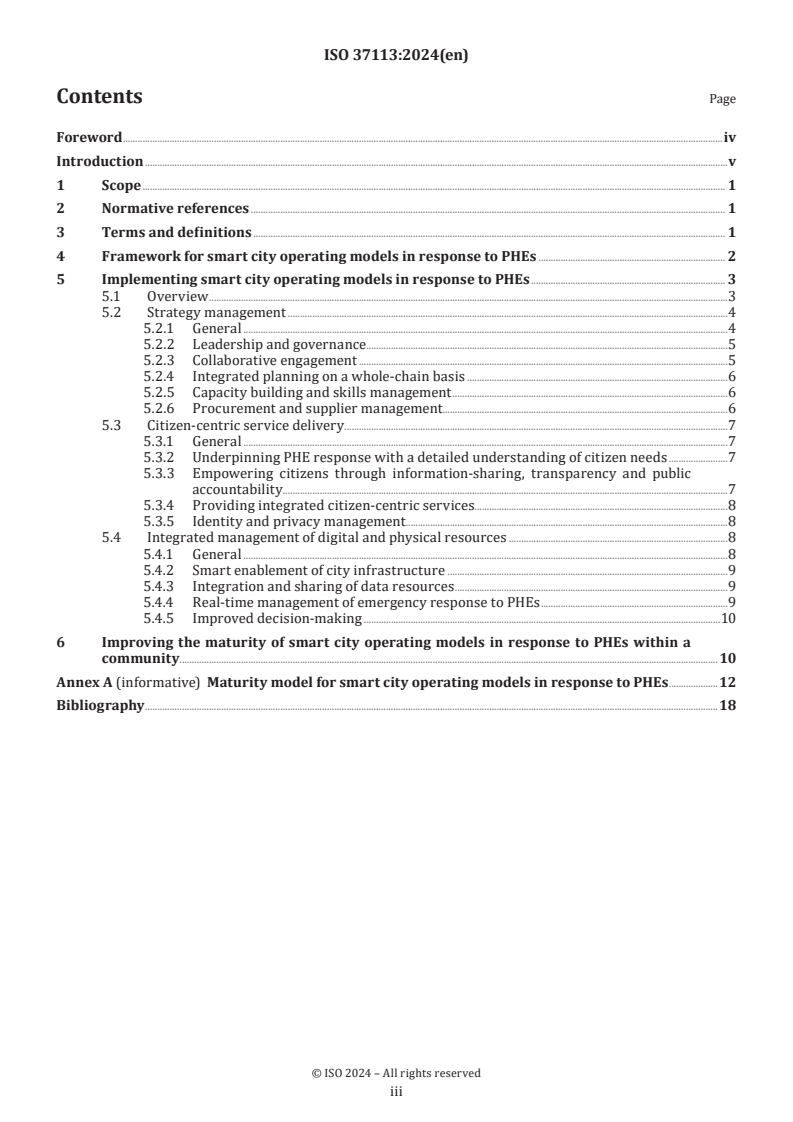
Contents Page
Foreword .iv
Introduction .v
1 Scope . 1
2 Normative references . 1
3 Terms and definitions . 1
4 Framework for smart city operating models in response to PHEs . 2
5 Implementing smart city operating models in response to PHEs . 3
5.1 Overview .3
5.2 Strategy management .4
5.2.1 General .4
5.2.2 Leadership and governance . . .5
5.2.3 Collaborative engagement .5
5.2.4 Integrated planning on a whole-chain basis .6
5.2.5 Capacity building and skills management .6
5.2.6 Procurement and supplier management.6
5.3 Citizen-centric service delivery . .7
5.3.1 General .7
5.3.2 Underpinning PHE response with a detailed understanding of citizen needs .7
5.3.3 Empowering citizens through information-sharing, transparency and public
accountability.7
5.3.4 Providing integrated citizen-centric services.8
5.3.5 Identity and privacy management .8
5.4 Integrated management of digital and physical resources .8
5.4.1 General .8
5.4.2 Smart enablement of city infrastructure .9
5.4.3 Integration and sharing of data resources .9
5.4.4 Real-time management of emergency response to PHEs .9
5.4.5 Improved decision-making .10
6 Improving the maturity of smart city operating models in response to PHEs within a
community . . 10
Annex A (informative) Maturity model for smart city operating models in response to PHEs .12
Bibliography .18
iii
Foreword
ISO (the International Organization for Standardization) is a worldwide federation of national standards
bodies (ISO member bodies). The work of preparing International Standards is normally carried out through
ISO technical committees. Each member body interested in a subject for which a technical committee
has been established has the right to be represented on that committee. International organizations,
governmental and non-governmental, in liaison with ISO, also take part in the work. ISO collaborates closely
with the International Electrotechnical Commission (IEC) on all matters of electrotechnical standardization.
The procedures used to develop this document and those intended for its further maintenance are described
in the ISO/IEC Directives, Part 1. In particular, the different approval criteria needed for the different types
of ISO document should be noted. This document was drafted in accordance with the editorial rules of the
ISO/IEC Directives, Part 2 (see www.iso.org/directives).
ISO draws attention to the possibility that the implementation of this document may involve the use of (a)
patent(s). ISO takes no position concerning the evidence, validity or applicability of any claimed patent
rights in respect thereof. As of the date of publication of this document, ISO had not received notice of (a)
patent(s) which may be required to implement this document. However, implementers are cautioned that
this may not represent the latest information, which may be obtained from the patent database available at
www.iso.org/patents. ISO shall not be held responsible for identifying any or all such patent rights.
Any trade name used in this document is information given for the convenience of users and does not
constitute an endorsement.
For an explanation of the voluntary nature of standards, the meaning of ISO specific terms and expressions
related to conformity assessment, as well as information about ISO's adherence to the World Trade
Organization (WTO) principles in the Technical Barriers to Trade (TBT), see www.iso.org/iso/foreword.html.
This document was prepared by Technical Committee ISO/TC 268, Sustainable cities and communities.
Any feedback or questions on this document should be directed to the user’s national standards body. A
complete listing of these bodies can be found at www.iso.org/members.html.
iv
Introduction
Managing public-health emergencies (PHEs) and eliminating their impact on sustainable development
has become a common challenge for all countries in the world. In recent years, various types of PHEs
[e.g. Ebola virus disease (EVD) in West Africa, the Middle East Respiratory Syndrome (MERS), Zika virus
disease, COVID-19 and monkeypox], have caused severe consequences to countries around the world. This
has critically challenged the public-health emergency management (PHEM) systems of many countries,
especially developing countries. Eliminating the impact of sudden public-health events is an important goal
for achieving sustainable development globally.
The rapid development of the internet, Internet of Things (IoT), artificial intelligence (AI), cloud computing
and other information and communication technologies are accelerating change across the economy and
society at large. In smart cities and communities, new network facilities, new data environments, and new
technology applications offer the potential to transform the effectiveness of PHEM. This enables monitoring
and analysis, virus tracing, prevention and control treatment, resource allocation and other aspects of PHEs,
to be managed more quickly. It also allows more efficient and transparent reporting systems, and more
effective medical, social and economic outcomes.
Equally, however, technology can only make a difference when accompanied by innovative ways of working
through smart governance processes, supported by interoperable standards that enable organizations to
collaborate in new ways to deliver integrated action, efficiently, effectively and at scale. This is done through
partnership across the public sector and private sector, and across local, regional, national and international
levels of government.
This document brings together practical recommendations to community authorities on how to plan
and deliver this type of smart response to PHEs, combining innovation in technology with innovation in
governance processes. These recommendations are designed to be flexible, enabling tailored implementation
by the local governments of cities and communities in ways that recognize their unique situation and policy
context.
This document helps leaders of cities and communities to:
— use smart technologies, following the principles of ISO 37106, to manage relevant facilities and resources
for PHEs, enabling dynamic real-time monitoring and management of relevant data;
— support a more effective response to PHEs and promote more effective cooperation among all interested
parties, based on each stage of the command-and-control process for emergency management and
incident response set out in ISO 22320;
— help cities to assess the current level of maturity of a PHE response in smart city operating models;
— improve urban resilience so that the cities or communities can adapt to all risks in PHEs and lead towards
sustainability with the help of smart city operating models.
NOTE This document was informed by research from cities around the world on how smart operating models
supported effective responses to the COVID-19 pandemic, as described in ISO/TR 37112.
The document is structured as follows:
— Clause 1 describes the scope;
— Clause 2 lists normative references;
— Clause 3 sets out the terms and definitions used in the document;
— Clause 4 illustrates the framework for smart city operating models in response to PHEs;
— Clause 5 describes how to implement smart city operating models in response to PHEs;
— Clause 6 describes the way to improve the maturity of smart city operating models in response to PHEs
within a community;
v
— Annex A describes the maturity model for smart city operating models in response to PHEs.
vi
International Standard ISO 37113:2024(en)
Sustainable cities and communities — Guidance for
managing a public-health emergency response in smart city
operating models
1 Scope
This document provides guidance to community authorities on how to use smart technologies and smart
ways of working to improve their ability to anticipate, manage and mitigate public-health emergencies
(PHEs), including through transparent, interactive and citizen-centric communications with citizens. It does
this by demonstrating how the principles and good practices for smart city operating models recommended
in ISO 37106 can deliver improved outcomes in public-health emergency management (PHEM), at every
stage of the command-and-control process for emergency management and incident response set out in
ISO 22320.
This document sets out recommendations for community authorities and provides tools that can be used to
assess the maturity of community systems for smart PHEM.
This document applies to all types of cities and communities that are willing to apply smart city operating
models to respond to PHEs.
2 Normative references
The following documents are referred to in the text in such a way that some or all of their content constitutes
requirements of this document. For dated references, only the edition cited applies. For undated references,
the latest edition of the referenced document (including any amendments) applies.
ISO 37100, Sustainable cities and communities — Vocabulary
3 Terms and definitions
For the purposes of this document, the terms and definitions given in ISO 37100 and the following apply.
ISO and IEC maintain terminology databases for use in standardization at the following addresses:
— ISO Online browsing platform: available at https:// www .iso .org/ obp
— IEC Electropedia: available at https:// www .electropedia .org/
3.1
public-health emergency
PHE
sudden occurrence of major infectious diseases, diseases of unknown causes, major food and water and
occupational poisoning and other events that seriously affect and cause, or can cause, damage to public-health
3.2
public-health risk
likelihood of an event that can adversely affect the health of the human population, with an emphasis on one
which can spread internationally or can present a serious and direct danger
4 Framework for smart city operating models in response to PHEs
This document supports the United Nations Sustainable Development Goals (UN SDGs) of making cities and
human settlements inclusive, safe, resilient and sustainable, and is an enabler for all six strategic purposes
of a sustainable community described in ISO 37101. It does so by providing an overall framework for smart
city operating models in response to PHEs, as summarized in Figure 1.
Figure 1 — Framework for smart city operating models in response to PHEs
In particular, this document:
a) is informed by the four delivery principles for a ‘smart city operating model’ described in ISO 37106:
1) establishing a clear, compelling and inclusive vision for the sustainable future of the community;
2) taking a citizen-centric approach to all aspects of service design and delivery;
3) enabling a ubiquitous, integrated and inclusive digitization of community spaces and systems;
4) embedding openness and collaboration in the way the community works;
b) provides recommendations for community authorities on how each of the three community-wide
governance processes for a smart city operating model established by ISO 37106 (e.g. strategy
management, citizen-centric service delivery, and digital and physical asset management) can support
more effective PHEM at each stage of the command-and-control process for emergency management
and incident response set out in ISO 22320:
— information gathering, processing and sharing;
— assessment of the situation, including forecasting;
— planning;
— decision-making and communication;
— implementation of decisions;
— feedback and control measures (which also covers monitoring and evaluation).
Although Figure 2 illustrates the ISO 22320 command-and-control process as a simplified, linear one, in
practice it is a non-linear process with multiple feedback loops across multiple stakeholders, as illustrated
in Figure 3.
Figure 2 — Multiple stakeholder coordinated command-and-control process for emergency
management and incident response
Smart PHEM uses new technologies and new ways of working to help improve each step of this process, and
to facilitate speedier and more effective collaboration across the wide range of stakeholders that need to
be involved at each step. Clause 5 describes these new technologies and new ways of working, and Clause 6
provides a tool to assess the maturity of a community’s smart PHEM processes at each stage of the ISO 22320
command-and-control process.
5 Implementing smart city operating models in response to PHEs
5.1 Overview
ISO 37106 sets out recommendations for a smart city operating model that is focused on addressing city-
wide challenges of joining up across city silos, in three areas:
— Strategy management: the key aspects of governance, planning and decision-making that need to be
managed on a city-wide level in order to provide effective responses to community-wide challenges.
— Citizen-centric service management: the provision of public services for citizens and businesses that are
built around user needs, accessibility, inclusivity and co-created with users.
— Integrated digital and physical resource management: ensuring that data on the performance and use of
the community’s physical, spatial and digital assets is available in real-time and on an interoperable basis,
in order to enable real-time integration and optimization of city resources; and opening up community
data (securely and protecting privacy) in order to enable innovation by citizens, businesses and civil
society.
Figure 3 below uses the "benefit mapping" methodology recommended in ISO 37106 to summarize how
development of such a smart city operating model can support more effective PHEM. Subclauses 5.2 to 5.4
then look at each of the three components in turn, setting out practical recommendations for community
authorities on how investments and governance changes in these areas can lead to improved PHEM
outcomes. This smart city operating model ultimately supports each stage of the command-and-control
process for the emergency management and incident response process to public-health emergencies.
NOTE The sixth step in the ISO 22320 command-and-control process in Figure 3 includes monitoring and
evaluation.
Figure 3 — How a smart city operating model supports more effective PHEM
5.2 Strategy management
5.2.1 General
ISO 37106 sets out recommendations to city leaders on strategy management for smart cities that (as
summarized in ISO 37106:2021, 6.2) focus on taking a city-wide approach to:
a) establish an integrated vision, strategy and benefit realization plan;
b) underpin this with an operating model which provides strong leadership and collaborative engagement
with all interested parties, balancing the need for city-wide management on the one hand and local
innovation on the other;
c) take an organic approach to implementation: establishing the business processes, capacity and
structures that can drive transformation and create and grow sustained improvements over time, even
if all the steps of that transformational journey cannot be planned in detail at the outset.
The case study evidence from cities around the world presented in ISO/TR 37112 confirms the importance
of this approach in the context of PHEM. Key cross-cutting themes across all the case studies featured in
ISO/TR 37112 include:
— The importance of taking an integrated, digitally-enabled approach on a whole-chain basis: not simply
implementing each individual step of the ISO 22320 command-and-control process but seeking to manage
the different steps of that process as an integrated approach with transparency and real-time feedback
loops for city managers.
— The need for strong leadership and collaborative governance: All the case studies in ISO/TR 37112
highlight the need for visionary leadership at political and operational levels within the local authority,
and the need for collaborative governance processes to drive co-ordination across different organizational
silos. Where such processes were already in place, with existing trusted relationships, cities were able to
respond far more quickly to COVID-19.
Against this context, the following subclauses set out recommendations for city and community leaders
seeking to implement a city-wide strategic management system for smart PHEM.
5.2.2 Leadership and governance
Leaders of smart cities and smart communities should establish leadership and governance arrangements
for smart PHEM that ensure:
a) a clear focus of accountability within the local authority;
b) a broad-based leadership team, ensuring that leaders from integrated health, social care and wider
community services are brought together;
c) development of visionary goals in an iterative manner with a wide range of stakeholders in the short-
and long-term scales for smart cities to respond to PHEs;
d) a programmatic approach to identifying and keeping under review the risks associated with PHEs
through development of policies for PHEs, and commitment to allocation of appropriate resources to
develop, implement and continuously improve the policy system;
e) documented operating procedures for PHEM, with clear instructions, systematic and orderly, smooth
and effective execution, and accurate problem solving;
f) integration of PHEM and broader resilience considerations into urban planning.
5.2.3 Collaborative engagement
Leaders of smart cities and smart communities should establish collaborative engagement arrangements for
smart PHEM that ensure:
a) engagement of all stakeholders via inclusive and collaborative governance processes, underpinned by
effective data sharing;
b) definition and mapping of all key interested parties and their responsibilities, including but not limited
to: management departments, medical and health institutions, academic and research institutes, non-
governmental organizations, the private sector, community managers and citizens, overseas visitors
and workers and the media;
c) use of digital platforms to share information between the local authorities and other interested parties,
including through provision of timely, accurate and comprehensive data on progress of the PHE and of
the community’s response;
d) effective collaboration between the community, regional and national levels, to achieve sharing of
information, emergency resources, joint protection of emergency material production, and linkage of
major emergency strategies and measures;
e) development of a zonal and hierarchical PHEM strategy using smart technologies such as Geographic
Information Systems (GIS).
5.2.4 Integrated planning on a whole-chain basis
Leaders of smart cities and smart communities should establish integrated planning arrangements for
smart PHEM that ensure:
a) PHE plans take a whole-chain approach across all elements of the ISO 22320 command-and-control
process;
b) a holistic strategy embracing health, social and economic interventions, such as monitoring information,
personnel movement, preparing stockpile emergency supplies and assuring price stability;
c) evidence-based decision making on the characteristics and needs of the whole-chain management for
PHEs and determining the priority of actions;
d) refinement of the relevant modules of the smart city system to enable data exchange and data sharing
between local community and others such as districts, regions or cities, whilst respecting identity and
privacy management (5.3.4);
e) transparent reporting on whole-chain management, measurement and performance evaluation for PHEs;
f) cross-silo collaboration;
g) improved self-organization of local communities to link up the smart services between local community
and city;
h) post-emergency evaluation aimed at reviewing lessons learned and identifying medium-term and long-
term impacts of strategic and operational decisions that should be taken into account in updated PHE plans.
5.2.5 Capacity building and skills management
Leaders of smart cities and smart communities should establish integrated planning arrangements for
smart PHEM that ensure:
a) capacity building for public-health and epidemic/pandemic prevention to cope with major PHEs that:
— includes risk analysis and assessment of PHEs, emergency planning, resource allocation, testing,
periodic assessment and improvement, and plan revision;
— takes advantage of advanced technologies such as big data, IoT and AI.
b) long-term training and exercise systems for personnel and response agencies, in order to further
promote the build-up of digital tools for responding to PHEs;
c) incorporation of the principles and practices recommended in this document within the handbooks and
procedural manuals of the organizations concerned.
5.2.6 Procurement and supplier management
Leaders of smart cities and smart communities should establish procurement and supplier management
arrangements for smart PHEM that ensure:
a) integrated transportation and logistics, supported by an integrated emergency logistics information
platform to ensure supply chain for PHEs through smart technology such as big data and IoT;
b) establishment and maintenance of an information system of suppliers to ensure transparency, safety
and sustainability of the emergency procurement;
c) development of smart emergency logistics plans, supported by practical testing to ensure the emergency
logistics and supply chain are resilient to public-health risks;
d) cultivation of protective awareness of transportation personnel in the distribution and transportation
of goods and products for PHEs, as well as epidemic prevention and disinfection of materials and
transportation vehicles.
5.3 Citizen-centric service delivery
5.3.1 General
ISO 37106 sets out recommendations to city leaders on citizen-centric service delivery, characterized by:
a) delivery of integrated services that are built around user needs, co-created with users and accessible in
one stop over multiple channels;
b) empowering interested parties of all kinds across the city to create new kinds of services and value, by
opening up city data via open platforms;
c) development of a "citizen-centric trust model" to support privacy-protective use of integrated data
within a secure, federated IT and governance architecture;
d) encouraging access and use of digital services by citizen and business groups, including those currently
excluded from these services for whatever reason.
The case study evidence from cities around the world provided in ISO/TR 37112 confirms the importance
of this approach in the context of PHEM. The case studies highlight the importance of putting citizens at
the centre of the city’s planning and delivery for PHE, and the importance of openness and transparency in
building trust and engagement. Linked with this openness is a need to put protection of individual privacy
at the heart of the process, and to be transparent in how this is managed.
Against this context, the following subclauses set out recommendations for city and community leaders
seeking to implement a citizen-centric approach for smart PHEM.
5.3.2 Underpinning PHE response with a detailed understanding of citizen needs
Leaders of smart cities and smart communities should establish citizen insight arrangements for smart
PHEM that ensure:
a) detailed and evidence-based segmentation of the different citizen groups impacted by the PHE;
b) ongoing investment in citizen insight to understand how citizen needs change through the course of
the PHE;
c) a co-design / co-creation approach is taken to interventions that impact directly on citizens;
d) any specific additional needs of users who might need assistance in engaging digitally with measures
for PHEs response have been identified;
e) effective and interactive communication services for visitors during PHEs, enabling visitors easily to
understand and engage with the city’s policy when responding to PHEs.
5.3.3 Empowering citizens through information-sharing, transparency and public accountability
Leaders of smart cities and smart communities should establish citizen communication arrangements for
smart PHEM that ensure:
a) communication with citizens about plans and progress in all aspects of planning for and management
of PHEs;
b) investment in data sharing and interoperability across relevant public sector and private sector
platforms;
c) establishment of digitally-enabled models of public participation, with appropriate support for any
groups that can have difficulty in participating with these;
d) establishment of a tiered medical and response information sharing mechanism for PHEs;
e) establishment of an integrated information platform for social management through technical support
and information support to achieve the goals of epidemic monitoring and analysis, virus tracking,
prevention and control, resource allocation.
5.3.4 Providing integrated citizen-centric services
Leaders of smart cities and smart communities should establish citizen service delivery arrangements for
smart PHEM that:
a) provide one-stop, multi-chan
...