

ISO/TR 37112:2024
(Main)Sustainable cities and communities — Case studies in how smart city operating models support an effective public-health emergency response
General Information
- Abstract
This document identifies good practice case studies of smart city responses to COVID-19 through the use of smart technologies, smart data, smart decision-making and smart ways of working. In particular, it aims to demonstrate how the principles for smart city operating models recommended in ISO 37106 can deliver improved outcomes in public-health emergency management (PHEM), at every stage of the command-and-control process for emergency management and incident response set out in ISO 22320. This document is intended to inform ISO 37113, which recommends a framework of good practices that can be used in responding to future public-health emergencies.
- Status
- Published
- Publication Date
- 14-Mar-2024
- Technical Committee
- ISO/TC 268 - Sustainable cities and communities
- Drafting Committee
- ISO/TC 268 - Sustainable cities and communities
- Current Stage
- 6060 - International Standard published
- Start Date
- 15-Mar-2024
- Due Date
- 08-Mar-2023
- Completion Date
- 15-Mar-2024


Overview
ISO/TR 37112:2024 - Sustainable cities and communities: Case studies in how smart city operating models support an effective public‑health emergency response is a Technical Report from ISO/TC 268 that compiles global case studies of smart city responses to COVID‑19. The report demonstrates how smart technologies, smart data, smart decision‑making and smart ways of working - guided by the principles in ISO 37106 - can improve outcomes across the command‑and‑control stages described in ISO 22320. It is informational (non‑normative) and intended to inform the development of ISO 37113 and support UN Sustainable Development Goals for resilient, safe and sustainable cities.
Key topics and technical focus
- Case study framework for Smart Public‑Health Emergency Management (PHEM) emphasizing integrated data and governance.
- Practical examples mapped to ISO 22320 command‑and‑control phases:
- Observation / information gathering (e.g., Putrajaya city command centre)
- Situation assessment and forecasting (e.g., New York precision spatial data)
- Planning (e.g., China‑Singapore Tianjin Eco‑city pandemic mapping)
- Decision‑making and communication (e.g., Scottish inter‑city collaboration)
- Implementation (e.g., Wuhan rapid construction of a smart emergency hospital)
- Feedback and control measures (e.g., Hangzhou health‑code system)
- Emphasis on interoperability, data sharing, smart governance, and cross‑sector collaboration (public/private; local/regional/national).
- Non‑normative guidance: the document contains lessons learned, good practice examples and a conceptual framework rather than prescriptive technical requirements.
Practical applications and target users
Who would use ISO/TR 37112:2024:
- City planners and local government authorities designing smart city PHEM capabilities.
- Public‑health officials and emergency managers seeking integrated command‑and‑control approaches.
- Standards developers and policymakers drafting frameworks for emergency preparedness and smart governance.
- Technology vendors and system integrators building interoperable sensing, data‑analytics and command‑centre solutions.
- Researchers and practitioners evaluating best practices and lessons learned from COVID‑19 responses.
Practical uses:
- Informing procurement and design of city command centres, data platforms and emergency workflows.
- Structuring multi‑agency exercises, interoperability testing and incident response playbooks.
- Guiding policy on data governance, open data and public engagement during public‑health emergencies.
Related standards
- ISO 37106 - Smart city operating model principles (guiding principles applied throughout the report)
- ISO 22320 - Command‑and‑control for emergency management (process stages referenced)
- ISO 37101 - Sustainable communities (strategic alignment)
- ISO 37113 - Under development; ISO/TR 37112 informs its good practice framework
Keywords: ISO/TR 37112:2024, smart city operating models, public‑health emergency management, PHEM, ISO 37106, ISO 22320, COVID‑19 case studies, smart technologies, smart data, urban resilience.
Get Certified
Connect with accredited certification bodies for this standard

BSI Group
BSI (British Standards Institution) is the business standards company that helps organizations make excellence a habit.

Bureau Veritas
Bureau Veritas is a world leader in laboratory testing, inspection and certification services.

DNV
DNV is an independent assurance and risk management provider.
Sponsored listings
Frequently Asked Questions
ISO/TR 37112:2024 is a technical report published by the International Organization for Standardization (ISO). Its full title is "Sustainable cities and communities — Case studies in how smart city operating models support an effective public-health emergency response". This standard covers: This document identifies good practice case studies of smart city responses to COVID-19 through the use of smart technologies, smart data, smart decision-making and smart ways of working. In particular, it aims to demonstrate how the principles for smart city operating models recommended in ISO 37106 can deliver improved outcomes in public-health emergency management (PHEM), at every stage of the command-and-control process for emergency management and incident response set out in ISO 22320. This document is intended to inform ISO 37113, which recommends a framework of good practices that can be used in responding to future public-health emergencies.
This document identifies good practice case studies of smart city responses to COVID-19 through the use of smart technologies, smart data, smart decision-making and smart ways of working. In particular, it aims to demonstrate how the principles for smart city operating models recommended in ISO 37106 can deliver improved outcomes in public-health emergency management (PHEM), at every stage of the command-and-control process for emergency management and incident response set out in ISO 22320. This document is intended to inform ISO 37113, which recommends a framework of good practices that can be used in responding to future public-health emergencies.
ISO/TR 37112:2024 is classified under the following ICS (International Classification for Standards) categories: 03.100.01 - Company organization and management in general; 13.020.20 - Environmental economics. Sustainability. The ICS classification helps identify the subject area and facilitates finding related standards.
ISO/TR 37112:2024 is available in PDF format for immediate download after purchase. The document can be added to your cart and obtained through the secure checkout process. Digital delivery ensures instant access to the complete standard document.
Standards Content (Sample)
Technical
Report
ISO/TR 37112
First edition
Sustainable cities and
2024-03
communities — Case studies in
how smart city operating models
support an effective public-health
emergency response
Villes et communautés territoriales durables — Études de cas sur
la façon dont les modèles d'exploitation des villes intelligentes
soutiennent une réponse d'urgence efficace en matière de santé
publique
Reference number
© ISO 2024
All rights reserved. Unless otherwise specified, or required in the context of its implementation, no part of this publication may
be reproduced or utilized otherwise in any form or by any means, electronic or mechanical, including photocopying, or posting on
the internet or an intranet, without prior written permission. Permission can be requested from either ISO at the address below
or ISO’s member body in the country of the requester.
ISO copyright office
CP 401 • Ch. de Blandonnet 8
CH-1214 Vernier, Geneva
Phone: +41 22 749 01 11
Email: copyright@iso.org
Website: www.iso.org
Published in Switzerland
ii
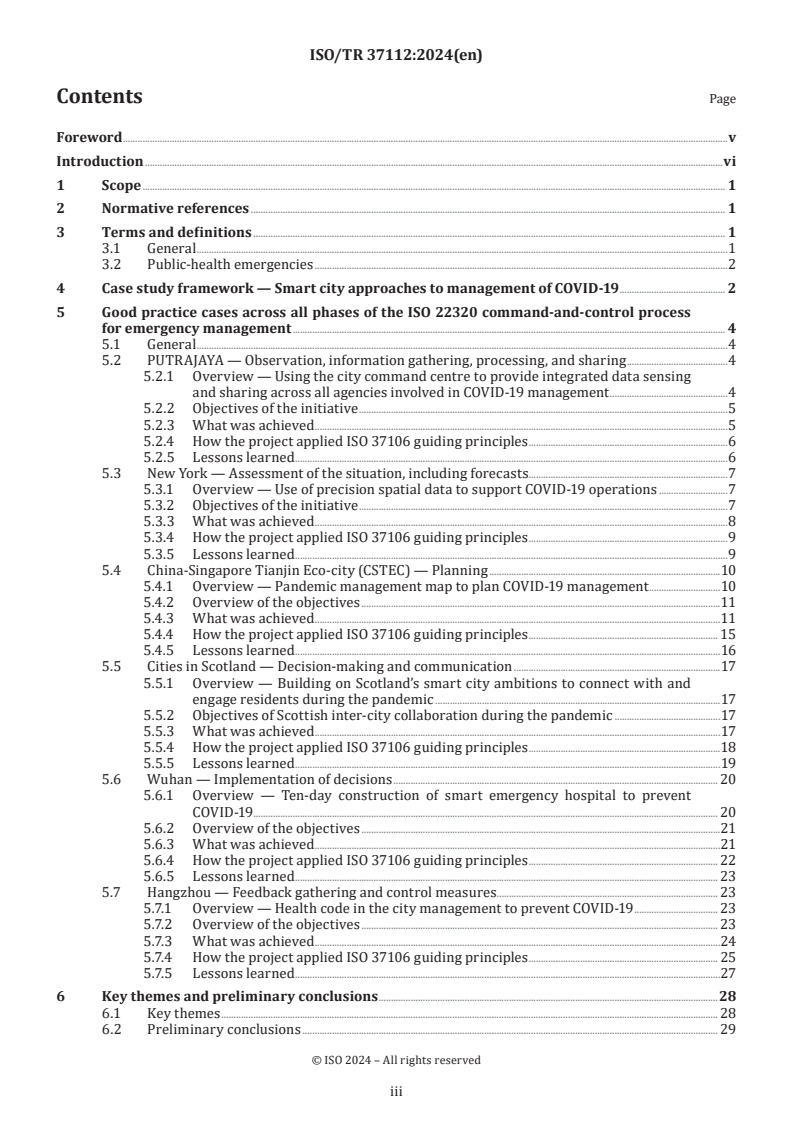
Contents Page
Foreword .v
Introduction .vi
1 Scope . 1
2 Normative references . 1
3 Terms and definitions . 1
3.1 General .1
3.2 Public-health emergencies .2
4 Case study framework — Smart city approaches to management of COVID-19 . 2
5 Good practice cases across all phases of the ISO 22320 command-and-control process
for emergency management . 4
5.1 General .4
5.2 PUTRAJAYA — Observation, information gathering, processing, and sharing .4
5.2.1 Overview — Using the city command centre to provide integrated data sensing
and sharing across all agencies involved in COVID-19 management .4
5.2.2 Objectives of the initiative .5
5.2.3 What was achieved .5
5.2.4 How the project applied ISO 37106 guiding principles .6
5.2.5 Lessons learned .6
5.3 New York — Assessment of the situation, including forecasts.7
5.3.1 Overview — Use of precision spatial data to support COVID-19 operations .7
5.3.2 Objectives of the initiative .7
5.3.3 What was achieved .8
5.3.4 How the project applied ISO 37106 guiding principles .9
5.3.5 Lessons learned .9
5.4 China-Singapore Tianjin Eco-city (CSTEC) — Planning .10
5.4.1 Overview — Pandemic management map to plan COVID-19 management .10
5.4.2 Overview of the objectives .11
5.4.3 What was achieved .11
5.4.4 How the project applied ISO 37106 guiding principles . 15
5.4.5 Lessons learned .16
5.5 Cities in Scotland — Decision-making and communication .17
5.5.1 Overview — Building on Scotland’s smart city ambitions to connect with and
engage residents during the pandemic .17
5.5.2 Objectives of Scottish inter-city collaboration during the pandemic .17
5.5.3 What was achieved .17
5.5.4 How the project applied ISO 37106 guiding principles .18
5.5.5 Lessons learned .19
5.6 Wuhan — Implementation of decisions . 20
5.6.1 Overview — Ten-day construction of smart emergency hospital to prevent
COVID-19 . 20
5.6.2 Overview of the objectives .21
5.6.3 What was achieved .21
5.6.4 How the project applied ISO 37106 guiding principles . 22
5.6.5 Lessons learned . 23
5.7 Hangzhou — Feedback gathering and control measures. 23
5.7.1 Overview — Health code in the city management to prevent COVID-19 . 23
5.7.2 Overview of the objectives . 23
5.7.3 What was achieved .24
5.7.4 How the project applied ISO 37106 guiding principles . 25
5.7.5 Lessons learned .27
6 Key themes and preliminary conclusions .28
6.1 Key themes . 28
6.2 Preliminary conclusions . 29
iii
Bibliography .31
iv
Foreword
ISO (the International Organization for Standardization) is a worldwide federation of national standards
bodies (ISO member bodies). The work of preparing International Standards is normally carried out through
ISO technical committees. Each member body interested in a subject for which a technical committee
has been established has the right to be represented on that committee. International organizations,
governmental and non-governmental, in liaison with ISO, also take part in the work. ISO collaborates closely
with the International Electrotechnical Commission (IEC) on all matters of electrotechnical standardization.
The procedures used to develop this document and those intended for its further maintenance are described
in the ISO/IEC Directives, Part 1. In particular the different approval criteria needed for the different types
of ISO documents should be noted. This document was drafted in accordance with the editorial rules of the
ISO/IEC Directives, Part 2 (see www.iso.org/directives).
ISO draws attention to the possibility that the implementation of this document may involve the use of (a)
patent(s). ISO takes no position concerning the evidence, validity or applicability of any claimed patent
rights in respect thereof. As of the date of publication of this document, ISO had not received notice of (a)
patent(s) which may be required to implement this document. However, implementers are cautioned that
this may not represent the latest information, which may be obtained from the patent database available at
www.iso.org/patents. ISO shall not be held responsible for identifying any or all such patent rights.
Any trade name used in this document is information given for the convenience of users and does not
constitute an endorsement.
For an explanation on the voluntary nature of standards, the meaning of ISO specific terms and
expressions related to conformity assessment, as well as information about ISO's adherence to the World
Trade Organization (WTO) principles in the Technical Barriers to Trade (TBT) see the following URL:
www.iso.org/iso/foreword.html.
This document was prepared by Technical Committee ISO/TC 268, Sustainable cities and communities.
Any feedback or questions on this document should be directed to the user’s national standards body. A
complete listing of these bodies can be found at www.iso.org/members.html.
v
Introduction
Dealing with public-health emergencies and eliminating their impact on sustainable development has
become a common challenge globally. In recent years, the Ebola virus disease, the Middle East respiratory
syndrome (MERS), Zika virus and COVID-19, have caused severe consequences to countries around the
world. This has critically challenged the public-health emergency management (PHEM) systems of many
countries, especially developing countries. Eliminating the impact of sudden public-health events is an
important goal for achieving sustainable development globally.
The rapid development of the Internet, Internet of Things, Artificial Intelligence, Cloud Computing, 5G
broadband cellular networks and other information and communication technologies is accelerating change
across the economy and society at large. In smart cities and communities, new network facilities, new data
environments, and new technology applications offer the potential to transform the effectiveness of PHEM.
This enables monitoring and analysis, virus tracing, prevention and control treatment, resource allocation
and other aspects of public-health emergencies to be managed at a faster response speed, with more efficient
and transparent reporting systems, and more effective medical, social and economic outcomes.
However, technology can only make a difference when accompanied by innovative ways of working
(e.g. smart governance processes), supported by interoperable standards, that enable organizations to
collaborate in new ways to:
— deliver integrated action, rapidly and at scale;
— engage the public in new and more interactive forms of communication and participation;
— do this through partnership across the public sector and private sector, and collaboration across local,
regional, national and international levels of government.
This document is intended to inform the development of future international standards in this area on
how community authorities can effectively plan and deliver this kind of smart PHEM, by drawing together
and analysing best practice case studies on how cities around the world have responded to the COVID-19
pandemic.
This document has been developed by an ad hoc group bringing together members of the ISO/TC 268 and
the IEC Smart Cities Systems Committee (IEC SyC SC). Case studies were gathered by national standards
organizations, using an information-gathering framework aligned with the Smart City Use Case framework
previously developed by IEC SyC SC; and interviews were held with senior representatives from each city to
explore lessons learned and refine the case studies in more detail.
vi
Technical Report ISO/TR 37112:2024(en)
Sustainable cities and communities — Case studies in how
smart city operating models support an effective public-
health emergency response
1 Scope
This document identifies good practice case studies of smart city responses to COVID-19 through the use
of smart technologies, smart data, smart decision-making and smart ways of working. In particular, it aims
to demonstrate how the principles for smart city operating models recommended in ISO 37106 can deliver
improved outcomes in public-health emergency management (PHEM), at every stage of the command-and-
control process for emergency management and incident response set out in ISO 22320.
1)
This document is intended to inform ISO 37113 , which recommends a framework of good practices that
can be used in responding to future public-health emergencies.
2 Normative references
There are no normative references in this document.
3 Terms and definitions
For the purposes of this document, the following terms and definitions apply.
ISO and IEC maintain terminology databases for use in standardization at the following addresses:
— IEC Electropedia: available at http:// www .electropedia .org/
— ISO Online browsing platform: available at https:// www .iso .org/ obp
3.1 General
3.1.1
open data
data available without restrictions from copyright, patents or other mechanisms of control or costs,
regardless of access, or use
Note 1 to entry: “without restrictions” does not mean that there is no copyright, patents, or ownership of the data,
simply that users of the data are able to make use of the data under license terms that make clear that there are no
restrictions on that use, other than potentially a requirement to attribute the source of the data.
Note 2 to entry: “regardless of access, or use” means that it has universal participation, and it is available to use, re-use
and redistribute for any purpose, as long as the integrity of its opening and origin is preserved.
[SOURCE: ISO 37110:2022, 3.1]
1) Under development. Stage at the time of publication: ISO/DIS 37113.
3.2 Public-health emergencies
3.2.1
public-health emergency
PHE
sudden occurrence of major infectious diseases, diseases of unknown causes, major food and occupational
poisoning and other events that seriously affect public health that cause or can cause serious damage to
public health
3.2.2
public-health risk
likelihood of an event that can adversely affect the health of human populations, with an emphasis on one
which can spread internationally or can present a serious and direct danger
3.2.3
public-health emergency management
PHEM
overall approach to preventing a public-health emergency (PHE) and managing those that occur
Note 1 to entry: In general, PHEM utilizes a risk-management approach to prevention, preparedness, response and
recovery before, during and after either potentially destabilizing or disruptive events, or both.
4 Case study framework — Smart city approaches to management of COVID-19
This document supports the United Nations Sustainable Development Goals (UN SDGs) of making cities and
human settlements inclusive, safe, resilient, and sustainable, and is an enabler for all six strategic purposes of
a sustainable community described in ISO 37101. It identifies good practices in how communities have smart
technologies, smart data, smart decision-making and smart ways of working to improve the effectiveness
of their response to COVID-19. The conceptual framework used to explore these practices is illustrated in
Figure 1 below.
Figure 1 — Framework for Smart Public-Health Emergency Management (PHEM)
In particular, this document:
a) Is informed by
1) the four delivery principles for a ‘smart city operating model’ described in ISO 37106:
i) establishing a clear, compelling and inclusive vision for the sustainable future of the community;
ii) taking a citizen-centric approach to all aspects of service design and delivery;
iii) enabling a ubiquitous, integrated and inclusive digitization of community spaces and systems;
iv) embedding openness and collaboration in the way the community works;
2) the smart city operating model described in ISO 37106, which enable cities to implement the above
principles by addressing city-wide challenges of joining up across city silos, in three areas:
i) Strategy management: the key aspects of governance, planning roadmap development and
decision-making that need to be managed at a whole-of-city level in order to provide effective
responses to community-wide challenges.
ii) Citizen-centric service management: the provision of public services for citizens and businesses
that are built around user needs, accessibility, inclusivity and co-created with users.
iii) Integrated digital and physical resource management: ensuring that data on the performance
and use of the community’s physical, spatial and digital assets is available in real-time and on an
interoperable basis, in order to enable real-time integration and optimization of city resources;
and opening up community data (in secure and privacy-protective ways) in order to enable
innovation by citizens, businesses and civil society.
b) Provides good practice case studies for community authorities on how these ISO 37106 delivery
principles and smart city operating models can support more effective PHEM at each stage of the
command-and-control process for emergency management and incident response set out in ISO 22320.
Although Figure 1 illustrates the ISO 22320 command-and-control process as a simplified, linear one, in
practice it is a non-linear process with multiple feedback loops across multiple stakeholders, as illustrated
in Figure 2.
Figure 2 — Multiple stakeholder coordinated command-and-control process for emergency
management and incident response
Smart PHEM uses new technologies and new ways of working to help improve each step of this process, and
to facilitate speedier and more effective collaboration across the wide range of stakeholders that need to be
involved at each step. Case studies on how cities have done this during COVID-19 are described below. The
case studies were selected in collaboration with national standards organizations and through outreach to
cities in collaboration with the IEC SyC SC and were documented in consultation with senior officials from
the different cities.
5 Good practice cases across all phases of the ISO 22320 command-and-control
process for emergency management
5.1 General
This clause highlights six good practice case studies. Each one focuses on a separate aspect of the ISO 22320
command-and-control processes for emergency management and incident response (as shown above in
Figure 1) and demonstrates how the case study implements the ISO 37106 principles of visionary, citizen-
centric, digital, and open and collaborative.
5.2 PUTRAJAYA — Observation, information gathering, processing, and sharing
5.2.1 Overview — Using the city command centre to provide integrated data sensing and sharing
across all agencies involved in COVID-19 management
Putrajaya is the new Federal Government Administrative Centre for Malaysia, with a population of 109,000
and an area of 49 km . The Putrajaya Command Centre is an integrated data centre that monitors the city
24/7 to promote the safety and wellbeing of the community, from routine traffic management through to
disaster relief. The Centre collates data from across the city, including through sensors, panic buttons and a
network of CCTV cameras, and applies AI analysis of video and other unstructured data to allow for easier
processing and decision-making. In doing so, it allows information to be shared between key agencies with
the city, including the police, fire, and hospital emergency departments.
The Centre was core to the city’s COVID-19 response. During COVID-19, the Putrajaya Command Centre
became the focal point of the city’s response to COVID-19, integrating data sources from across the city’s
infrastructure and agencies into a central location.
5.2.2 Objectives of the initiative
The Putrajaya Command Centre had three key objectives in the city’s management of COVID-19:
a) To collate and interpret data points from across the city’s smart city infrastructure and from the city’s
key agencies (e.g. police, health, transport and emergency response) into a central location for smoother
and more intelligent data processing and decision making.
b) To facilitate communication and engagement between the main organisations working to control the
spread of COVID-19 through the shared use of that integrated data.
c) To use insights to develop and implement a cohesive response to the PHE. This includes both:
— coordinating actions across all relevant city agencies;
— direct deployment of the Command Centre's own response system (a network of speakers allowed the
City Command Centre administration to broadcast personalized warnings to individuals violating
Putrajaya’s social distancing guidelines).
5.2.3 What was achieved
Putrajaya’s response to COVID-19 was informed and enabled by the Smart City Blueprint for Putrajaya,
published five years previously in 2017. Informed by extensive dialogue and engagement with city
stakeholders, this established a comprehensive framework to achieve the city’s transformational goals by
2025. The Smart City Blueprint sets out 93 initiatives across seven smart city domains:
— smart transportation and mobility;
— smart home and environment;
— smart government services;
— smart infrastructure and utilities;
— smart safety and security;
— smart economy;
— smart community.
These initiatives are citizen-centric and aim to improve urban sustainability and quality of life through the
use of innovative technology as an enabler. They are prioritized along an implementation timeline divided
into quick wins, short-term, medium-term, and long-term priorities, with an initial focus on prioritizing
smart city security and the enabling infrastructure.
The City Command Centre was established as a key early initiative in delivering the Smart City Blueprint. A
centre for all data across the city, it also built a comprehensive set of ‘standard operating procedures’ (SOPs),
enabling a unified and collaborative response to city incidents by police, fire, hospital and other services.
These SOPs cover both daily incidents, e.g. traffic accidents, and environmental disasters such as flood or fire.
The City Command Centre quickly became the centre of Putrajaya’s COVID-19 response; multiple data
sources were pulled into a single dashboard and COVID-19 case information was used to populate a map
of the city, providing easily visualised ways of processing and analysing the information. Daily meetings
were held with the mayor, hospitals, and the public-health department to share aggregated data around case
numbers, locations, and potential hot spots. This integrated approach allowed the city to make informed
decisions and a number of SOPs were developed to allow rapid response to new challenges.
The Centre was also used to co-ordinate related work between key city agencies. For example, if the police
needed to block a road in order to minimise entry and exit to Putrajaya, this could be managed collaboratively
across the related agencies to ensure a smooth response. The Command Centre also played its own role in the
enforcement of social distancing protocols, allowing administrators to administer warnings to individuals
violating these protocols. Nearly 100 % of people amended their behaviour to obey the social distancing
guidelines following the verbal warning over the speaker system.
Through the smart integrated response to COVID-19, Putrajaya was able to effectively control the spread of
the disease. Apart from a few instances when the whole nation was under lockdown, Putrajaya navigated
the pandemic without needing to implement a city-wide lockdown. Instead, Putrajaya was able to implement
specific, localized lockdowns in areas of high infection.
5.2.4 How the project applied ISO 37106 guiding principles
Table 1 below summarizes the core ways that the Putrajaya Command Centre put into practice the guiding
principles for a ‘smart city operating model’ set out in ISO 37106.
Table 1 — Mapping the actions taken by Putrajaya against the guiding principles of ISO 37106
Guiding principles of ISO 37106 Putting principle into practice
Visionary: The Putrajaya Command Centre is an integral part of Putrajaya’s broad-
er ambition to become a leading example of smart city best practice. The
Establishing a clear, compelling and
Centre features prominently in the city’s Smart City Blueprint document
inclusive vision for the sustainable
and promotes the smart operation of the city. It also has clear leadership
future for a community
support and the Mayor interacted with the Command Centre daily during
COVID-19.
Citizen-centric: The Command Centre has several citizen-centric design elements, including
panic buttons that are available at key locations around the city or within
Taking a citizen-centric approach
the city’s mobile app. Citizen privacy is a core consideration. Clear strate-
to all aspects of service design and
gies are put in place to safeguard personal data within the City Command
delivery
Centre and the technology itself was designed with citizen privacy in
mind. For example, the CCTV coverage is restricted to public areas, and
is equipped with a privacy-masking function which automatically blocks
doors and windows from being monitored, apart from some notable excep-
tions such as children’s playgrounds.
Digital: The Command Centre leverages a wide array of technologies to process
multiple data streams. This promotes faster decision-making and facilitates
Enabling a ubiquitous, integrated
greater collaboration between city agencies through technology-enabled
and inclusive digitization of commu-
communication. The use of artificial intelligence, in tandem with aggregat-
nity spaces and systems
ed data dashboards, allows the Command Centre administrators and city
leaders to identify new trends and to respond rapidly and appropriately.
Open and collaborative: The Putrajaya Command Centre promotes co-operation between core
agencies within the city, such as the mayoral team and the police, fire, and
Embedding openness and collab-
hospital departments. This integrated way of working allows for faster and
oration in the way the community
more effective response times by ensuring that accurate information about
works
an emerging crisis is shared with the relevant agencies, allowing them to
co-ordinate their response more effectively.
5.2.5 Lessons learned
Table 2 summarizes the key lessons that the Putrajaya Command Centre administration have identified
in order to better inform the management of future public-health crises. It also highlights the relevant
components of ISO 37106 that can be usefully applied as these lessons are implemented.
Table 2 — Identifying key challenges faced by Putrajaya and lessons learned to better prepare for
future public-health emergencies
Issue Lessons learned Relevant components of ISO 37106
In the early stag- Developing SOPs around data collection in — [B2] Leadership and governance provides
es of COVID-19, the event of health emergencies will allow guidance on bringing together city leaders on a
there were a lack for a more rapid response in the future. cross-sectoral basis into effective governance
of SOPs to cater arrangements at both the strategic and
At its start, the Putrajaya Command Centre
to the manage- delivery levels.
only interacted with the hospital emer-
ment of public
gency department. More agencies related
— [B13] IT and data resources mapping and
health emergen-
to public health, e.g. as the Public-Health
management provides guidance on how
cies
Department, were then invited to work
to ensure these collaborative governance
with the City Command Centre during
arrangements can be applied to enable
COVID-19. These partnerships could have
effective exploitation of common data
been established earlier in order to ensure
resources.
the proper SOPs were in place at the onset
of COVID-19.
Importance of While data integration and AI analytics are — [B12] Managing smart city developments and
personal human vital to the operation of the City Command infrastructures emphasises the importance of
contact in addi- Centre, Putrajaya’s experience during taking an integrated approach across digital,
tion to digital COVID-19 also highlighted the importance physical and human domains, and provides
collaboration of bringing people together in a physical lo- guidance on to embed such an integrated
cation. Key decision makers from different approach in city planning systems.
agencies were able, with appropriate social
distancing protocols, to use the coordina-
tion room above the Command Centre as a
shared meeting space. This enabled leaders
to coordinate the emergency response
more effectively.
5.3 New York — Assessment of the situation, including forecasts
5.3.1 Overview — Use of precision spatial data to support COVID-19 operations
New York is a state in north-eastern United States of America, with a population of 20,2 million and an
area of 141,300 km . New York State and New York counties, pioneered by Suffolk County and Rockland
County, used highly-granular GIS mapping and geo-coding of individual COVID-19 infections to enable real-
time assessment of pandemic development, giving city officials new insights into the current situation
and predictions for how the situation was evolving. These were used to inform policy decisions, enable
more targeted interventions at local level informed by “micro-cluster strategies”, and to share relevant
information with both the public and key organisations in real time.
5.3.2 Objectives of the initiative
There were four core objectives to Suffolk County and Rockland County’s approach to driving the geospatial
data project pandemic management:
a) To capture highly detailed geocoded data to track each COVID-19 infection from the point of initial
reporting, and to map it against the city in order to provide precise identification of potential clusters of
infection (providing a more comprehensive and accurate image of the situation than tracking infections
by zip code as was being done across the rest of New York State).
b) To then use these insights to develop targeted strategies for responding in real time to new clusters of
infection as they emerged; this could include implementing locally specific restrictions, warning other
residents, or distributing resources more effectively.
c) To then use these insights to develop a predictive model that would allow city officials and other major
stakeholders to prevent or limit infection before a cluster develops, to mobilise aid in advance, and to
target a communication strategy around those most at risk.
d) To identify good practice in geospatial pandemic management and share with other New York counties
and city stakeholders.
5.3.3 What was achieved
SOURCE Reference [30], reproduced with the permission of the Suffolk County Government, New York, US.
Figure 3 — Example of the data dashboards shared with Suffolk County Police, split by precinct
Both Rockland and Suffolk County were able to geocode information on COVID-19 infections in the
laboratories. Analysis of these geocoded addresses were then used to create a micro-cluster strategy that
targeted areas showing spikes in infection and to develop tiers of strategies in and around those at-risk
areas. These predictions and insights influenced policy decisions around the risk management of COVID-19,
and comprehensive, interactive data visualisations were made available to both citizens and key city
organisations.
For example, Suffolk County Police were provided with access to highly-granular geocoded data to allow
them to understand the risk by precinct and able to show whether an individual house was high risk when
responding to a call (see Figure 3). Enabling police to identify if there were any positive COVID-19 cases in
any house before entering gave the opportunity to take proper precautionary measures, further limiting the
spread of the disease.
The GIS data was a core component of public briefings, in particular during the implementation of the micro-
cluster strategies. The geocoded data was also used to create early warning dashboards (see Figure 4).
By mapping geocoded data of COVID-19 infections against key metrics, such as hospital capacity, the counties
were able to ensure they were better prepared for the forecasted scenario.
Figure 4 — Screenshot demonstrating Rockland’s Early Warning Dashboard, comparing metrics
such as new infections, severity of infections, and hospital capacity
The success of these initial projects in Rockland County and Suffolk County later informed a modified state-
wide initiative.
5.3.4 How the project applied ISO 37106 guiding principles
Table 3 below summarizes key ways in which the project put into practice the guiding principles for a ‘smart
city operating model’ set out in ISO 37106.
Table 3 — Mapping the actions taken by Rockland and Suffolk County against the guiding principles
of ISO 37106
Guiding principles in ISO 37106 Putting principles into practice
Visionary: The project had clear support from political and administrative
leaders at the highest levels, and at both County and State levels.
Establishing a clear, compelling and inclu-
Moreover, it was able to build on a long-standing vision for Geograph-
sive vision for the sustainable future for a
ic Information Systems as a key enabler for New York. New York has
community
been a global pioneer of GIS to drive city planning and operations,
both using it to underpin key city services such as 911 and also pro-
viding geo-coded data as Open Data to support development of city
applications by the private sector and civil society.
Citizen-centric: Linking the individual citizen to spatial data lay at the heart of this
project. Throughout, great care was taken to ensure the protection
Taking a citizen-centric approach to all
of personal privacy of citizens. Through the creation and sharing of
aspects of service design and delivery
data visualisations with the wider community, individual citizens
were enabled to understand the evolving situation and use that to
inform their own behaviour.
Digital: The comprehensive and integrated nature of the digital geo-coding
helped to reduce the scope for human error in pandemic response
Enabling a ubiquitous, integrated and
systems, improved data quality, and enabled high levels of protection
inclusive digitization of community spaces
for personal and sensitive data. It also enabled greater sharing and
and systems
interactivity of data dashboards, so that they could be applied to
meet differing requirements.
Open and collaborative: The success of the GIS-mapping of COVID-19 infections relied on the
partnership between multiple data partners and city organisations
Embedding openness and collaboration in
to ensure an accurate understanding of the situation. Open data
the way the community works
feeds enabled community organizations to work with and add value
to the data.
5.3.5 Lessons learned
Table 4 below summarizes key lessons that leaders of this initiative have drawn from the experience to
inform management of future public-health emergencies, and highlights components of the ISO 37106 smart
city operating model that can be applied as they do this.
Table 4 — Identifying key challenges faced by Suffolk County, Rockland County, and New York State
more broadly and lessons learned
Issue Lessons learned Relevant components of ISO 37106
Organisational Mobilizing multiple organizations to ensure rapid — [B2] Leadership and governance
silos can limit implementation of new GIS-enabled systems is provides guidance on bringing
effective informa- challenging. At a state-wide level, not all depart- together city leaders on a cross-
tion sharing ments of health had a strong initial understand- sectoral basis into effective
ing of the potential for spatial data and systems governance arrangements at both the
to support their COVID-19 response. Rockland strategic and delivery levels.
and Suffolk Counties were able to move rapidly
— [B13] IT and data resources mapping
because of pre-existing collaborative governance
and management provides guidance
structures between geo-data, health and other
on how to ensure these collaborative
specialists, and an ability to draw on strong per-
governance arrangements can be
sonal relationships at the senior level in defining
applied to enable effective exploitation
strategies for responding rapidly to the COVID-19
of common data resources, including
challenge.
spatial data.
Pre-existing The lack of a clear and pre-agreed model for how — [B10] Identity and privacy
protocols around to apply granular geo-coding in the context of management provides guidance on
geocoding person- personal health data in a privacy-protective way development of a ‘citizen-centric trust
al health data presented significant challenges. model’ to support privacy-protective
use of data within a secure, federated
In the US, the Health Insurance Portability and
IT and governance architecture.
Accountability Act of 1996 (HIPAA) establishes
national standards for the protection of certain
health information, including safeguards organi-
sations must put in place to manage security risks
and ensure confidentiality of patient data. At the
start of COVID-19, there was wide-spread concern
amongst health professionals that geocoding
medical information might infringe on HIPAA.
Rockland and Suffolk Counties demonstrated that
it was possible to collect and deploy precision
location data without jeopardizing patient privacy
and HIPPA compliance; for the future, the city,
counties and state of New York would benefit from
having a clearly agreed framework in advance.
5.4 China-Singapore Tianjin Eco-city (CSTEC) — Planning
5.4.1 Overview — Pandemic management map to plan COVID-19 management
China-Singapore Tianjin Eco-city (CSTEC), in Binhai district in Tianjin City, China, is a strategic cooperation
project between China and Singapore, with a population of 120,000 and an area of 150 km . In order to
prevent and respond to COVID-19 on an accurate and timely basis, when facing a large amount of COVID-19
data, CSTEC, capitalizing on its advantages as a smart city, developed a pandemic management map. This
map combines pandemic information with spatial information on resource planning and brings together
relevant pandemic statistics, including six sections comprising: citizens, traffic and vehicles, enterprises,
construction sites, big data analysis, and pandemic notification.
This case focuses on the ISO 22320 ‘planning’ aspect. It enables the CSTEC Administrative Committee to:
— delineate mock control areas based on big data analysis;
— make prevention and control decisions to aid in the execution of accurate pandemic prevention and
control work;
— deliver timely risk information to the public and key organizations for effective communication.
The creation and implementation of the pandemic management map reflected the guiding principles in
ISO 37106 and can be used as an example of smart city management. The CSTEC Administrative Committee
used this map to reduce the likelihood of infection in CSTEC and take steps to ensure effective recovery,
which also reflects t
...