

ISO/TR 14644-21:2023
(Main)Cleanrooms and associated controlled environments — Part 21: Airborne particle sampling techniques
General Information
- Abstract
This document discusses the physical limitations of probe and particle counter placement, and any tubing that connects the two, particularly in providing representative samples where particles 5 micrometres and greater are of interest. The document further identifies the key factors of sampling performance when classifying and monitoring, and good practice to determine and maintain an acceptable compromise between attainable accuracy in counting and feasibility of counting in real-life situations. This document includes a decision tree, used to identify key considerations when sampling airborne particles, and whether the system requires further assessment. There are also examples provided to illustrate typical application challenges and show how the decision tree can be used. It is assumed that this document is read in conjunction with ISO 14644-1 and ISO 14644-2. This document is not a manual, but an explanatory document. It does not describe measurement methods, which is handled in ISO 14644-1 and ISO 14644-2, but provides information to help make effective choices of sampling configuration, when evaluating a new or existing system.
- Status
- Published
- Publication Date
- 17-Aug-2023
- Technical Committee
- ISO/TC 209 - Cleanrooms and associated controlled environments
- Drafting Committee
- ISO/TC 209 - Cleanrooms and associated controlled environments
- Current Stage
- 6060 - International Standard published
- Start Date
- 18-Aug-2023
- Completion Date
- 18-Aug-2023
Buy Documents

ISO/TR 14644-21:2023 - Cleanrooms and associated controlled environments — Part 21: Airborne particle sampling techniques Released:18. 08. 2023

ISO/TR 14644-21:2023 - Salles propres et environnements maîtrisés apparentés — Partie 21: Techniques de prélèvement des particules en suspension dans l’air/20/2023
Overview
ISO/TR 14644-21:2023 - “Cleanrooms and associated controlled environments - Part 21: Airborne particle sampling techniques” is an explanatory technical report that clarifies best practice for sampling airborne particles in cleanrooms, with particular emphasis on particles ≥ 5 µm (macroparticles). It does not replace measurement methods in ISO 14644-1/2 but explains practical limitations and choices for probe and particle counter placement, sampling tubing, and system evaluation to achieve representative, accurate particle counts in real-life conditions.
Key topics and requirements
- Scope and intent
- Focus on physical limitations of probe placement, counter positioning and any connecting tubing when sampling macroparticles.
- Emphasises trade-offs between attainable counting accuracy and practical feasibility.
- Instrumentation
- Guidance on selection of LSAPC (light-scattering airborne particle counters) based on effective particle-size range and sample flow rate.
- Sampling configuration
- Preference for direct sampling (no tubing) where possible; if tubing is necessary, keep it short and straight to reduce losses.
- Consideration of probe location, state of occupancy, and representative sampling points for both classification and monitoring.
- Performance factors
- Discussion of sampling errors, sample measurement errors, tubing-related losses and uncertainty associated with counting macroparticles.
- Use of an informative decision tree to assess whether a sampling system requires further evaluation and to guide practical choices.
- Verification and examples
- Practical examples illustrate common application challenges and how to apply the decision tree to existing or new sampling systems.
Applications and users
ISO/TR 14644-21:2023 is targeted at professionals responsible for cleanroom contamination control and airborne particle monitoring:
- Cleanroom managers and validation engineers implementing classification and monitoring programs
- Quality assurance / Quality control (QA/QC) teams in pharmaceutical, biotechnology, medical device, semiconductor and microelectronics manufacturing
- Testing laboratories and third‑party auditors assessing sampling systems
- Regulatory and compliance personnel interpreting particle-count data for process protection
Practical uses include configuring sampling systems for reliable particle counts, reducing sampling uncertainty for macroparticles, evaluating compromises in installed tubing/probe layouts, and improving decisions about sampling locations and instrumentation.
Related standards
- ISO 14644-1 (cleanroom classification by airborne particle concentration)
- ISO 14644-2 (monitoring to provide evidence of cleanroom performance)
- ISO/TR 14644-21 is intended to be read in conjunction with these parts of the ISO 14644 series.
Buy Documents
ISO/TR 14644-21:2023 - Cleanrooms and associated controlled environments — Part 21: Airborne particle sampling techniques Released:18. 08. 2023
ISO/TR 14644-21:2023 - Salles propres et environnements maîtrisés apparentés — Partie 21: Techniques de prélèvement des particules en suspension dans l’air/20/2023
Get Certified
Connect with accredited certification bodies for this standard

CIS Institut d.o.o.
Personal Protective Equipment (PPE) certification body. Notified Body NB-2890 for EU Regulation 2016/425 PPE.

Kiwa BDA Testing
Building and construction product certification.
Kmetijski inštitut Slovenije
Agricultural Institute of Slovenia. Soil testing, plant health, agricultural product analysis.
Sponsored listings
Frequently Asked Questions
ISO/TR 14644-21:2023 is a technical report published by the International Organization for Standardization (ISO). Its full title is "Cleanrooms and associated controlled environments — Part 21: Airborne particle sampling techniques". This standard covers: This document discusses the physical limitations of probe and particle counter placement, and any tubing that connects the two, particularly in providing representative samples where particles 5 micrometres and greater are of interest. The document further identifies the key factors of sampling performance when classifying and monitoring, and good practice to determine and maintain an acceptable compromise between attainable accuracy in counting and feasibility of counting in real-life situations. This document includes a decision tree, used to identify key considerations when sampling airborne particles, and whether the system requires further assessment. There are also examples provided to illustrate typical application challenges and show how the decision tree can be used. It is assumed that this document is read in conjunction with ISO 14644-1 and ISO 14644-2. This document is not a manual, but an explanatory document. It does not describe measurement methods, which is handled in ISO 14644-1 and ISO 14644-2, but provides information to help make effective choices of sampling configuration, when evaluating a new or existing system.
This document discusses the physical limitations of probe and particle counter placement, and any tubing that connects the two, particularly in providing representative samples where particles 5 micrometres and greater are of interest. The document further identifies the key factors of sampling performance when classifying and monitoring, and good practice to determine and maintain an acceptable compromise between attainable accuracy in counting and feasibility of counting in real-life situations. This document includes a decision tree, used to identify key considerations when sampling airborne particles, and whether the system requires further assessment. There are also examples provided to illustrate typical application challenges and show how the decision tree can be used. It is assumed that this document is read in conjunction with ISO 14644-1 and ISO 14644-2. This document is not a manual, but an explanatory document. It does not describe measurement methods, which is handled in ISO 14644-1 and ISO 14644-2, but provides information to help make effective choices of sampling configuration, when evaluating a new or existing system.
ISO/TR 14644-21:2023 is classified under the following ICS (International Classification for Standards) categories: 13.040.35 - Cleanrooms and associated controlled environments. The ICS classification helps identify the subject area and facilitates finding related standards.
ISO/TR 14644-21:2023 is available in PDF format for immediate download after purchase. The document can be added to your cart and obtained through the secure checkout process. Digital delivery ensures instant access to the complete standard document.
Standards Content (Sample)
TECHNICAL ISO/TR
REPORT 14644-21
First edition
2023-08
Cleanrooms and associated controlled
environments —
Part 21:
Airborne particle sampling techniques
Salles propres et environnements maîtrisés apparentés —
Partie 21: Techniques de prélèvement des particules en suspension
dans l’air
Reference number
© ISO 2023
All rights reserved. Unless otherwise specified, or required in the context of its implementation, no part of this publication may
be reproduced or utilized otherwise in any form or by any means, electronic or mechanical, including photocopying, or posting on
the internet or an intranet, without prior written permission. Permission can be requested from either ISO at the address below
or ISO’s member body in the country of the requester.
ISO copyright office
CP 401 • Ch. de Blandonnet 8
CH-1214 Vernier, Geneva
Phone: +41 22 749 01 11
Email: copyright@iso.org
Website: www.iso.org
Published in Switzerland
ii
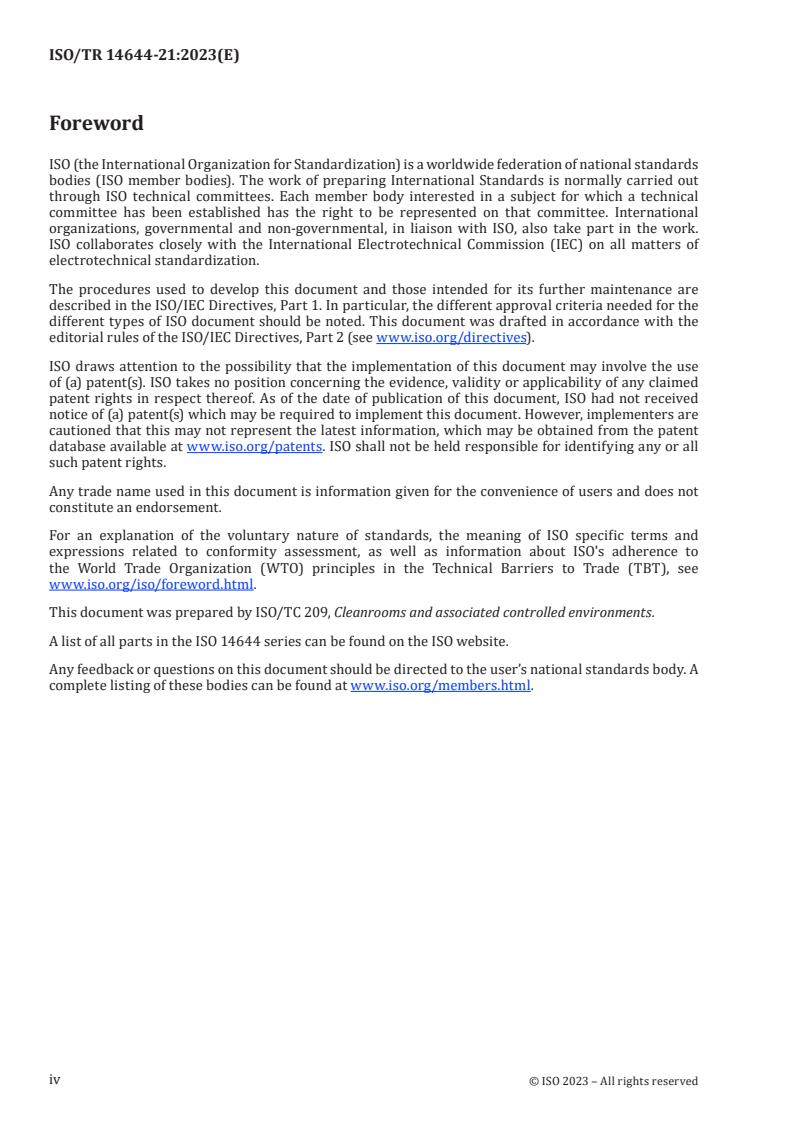
Contents Page
Foreword .iv
Introduction .v
1 Scope . 1
2 Normative documents . 1
3 Terms and definitions . 1
4 Determination of airborne particle concentration . 2
4.1 General . 2
4.2 Classification . 3
4.3 Monitoring . 4
4.4 Other LSAPC applications . 4
5 Sampling airborne particles – things to consider . 5
5.1 General . 5
5.2 Instrument selection . 5
5.2.1 General . 5
5.2.2 Considered particle size selection . 6
5.2.3 Required sample volume and sample flow rate . 7
5.3 State of occupancy . 7
5.3.1 General . 7
5.4 Sample locations – points to consider. 7
5.4.1 General . 7
5.4.2 Sampling locations for classification . 7
5.4.3 Sample locations for monitoring . 9
5.5 Instrument measurement issues. 10
5.5.1 General . 10
5.5.2 Sampling errors . 10
5.5.3 Sample measurement errors . 13
5.5.4 Sample tubing issues . 14
5.6 Decision tree . 16
5.7 Examples of use of the decision tree . 19
5.7.1 General . 19
5.7.2 Example 1 . 19
5.7.3 Example 2 . 21
5.7.4 Example 3 . 23
6 Verifying a system .25
Bibliography .26
iii
Foreword
ISO (the International Organization for Standardization) is a worldwide federation of national standards
bodies (ISO member bodies). The work of preparing International Standards is normally carried out
through ISO technical committees. Each member body interested in a subject for which a technical
committee has been established has the right to be represented on that committee. International
organizations, governmental and non-governmental, in liaison with ISO, also take part in the work.
ISO collaborates closely with the International Electrotechnical Commission (IEC) on all matters of
electrotechnical standardization.
The procedures used to develop this document and those intended for its further maintenance are
described in the ISO/IEC Directives, Part 1. In particular, the different approval criteria needed for the
different types of ISO document should be noted. This document was drafted in accordance with the
editorial rules of the ISO/IEC Directives, Part 2 (see www.iso.org/directives).
ISO draws attention to the possibility that the implementation of this document may involve the use
of (a) patent(s). ISO takes no position concerning the evidence, validity or applicability of any claimed
patent rights in respect thereof. As of the date of publication of this document, ISO had not received
notice of (a) patent(s) which may be required to implement this document. However, implementers are
cautioned that this may not represent the latest information, which may be obtained from the patent
database available at www.iso.org/patents. ISO shall not be held responsible for identifying any or all
such patent rights.
Any trade name used in this document is information given for the convenience of users and does not
constitute an endorsement.
For an explanation of the voluntary nature of standards, the meaning of ISO specific terms and
expressions related to conformity assessment, as well as information about ISO's adherence to
the World Trade Organization (WTO) principles in the Technical Barriers to Trade (TBT), see
www.iso.org/iso/foreword.html.
This document was prepared by ISO/TC 209, Cleanrooms and associated controlled environments.
A list of all parts in the ISO 14644 series can be found on the ISO website.
Any feedback or questions on this document should be directed to the user’s national standards body. A
complete listing of these bodies can be found at www.iso.org/members.html.
iv
Introduction
This document provides clarification on the application of sound airborne particle sampling techniques
in support of ISO 14644-1:2015 for classification of cleanrooms and clean zones, and ISO 14644-2:2015
for airborne particle monitoring, to provide evidence of cleanroom performance related to air
cleanliness by particle concentration. It provides information on how to gather appropriate, accurate and
repeatable data, and how to interpret this information for the purpose of improving process protection.
This also includes information on the choice of measurement methods and apparatus configuration,
calibration, repeatability/reproducibility and the uncertainty associated with measurement. In short,
what can be reasonably attained with the current technology.
This document addresses potential misinterpretation of the use of ISO 14644-1:2015, C.4.1.2 in
informative Annex C, which suggests the use of limited tubing length for sampling macroparticles. The
phrase in question has been applied beyond the context intended in ISO 14644-1, to other applications.
This document also provides extra clarity on the use of the M Descriptor in ISO 14644-1:2015, Annex C,
specifically in relation to consideration of >5,0 µm alongside ISO Class 5 (EU-PIC/S GMP Grade A and B
at rest).
It provides information on the uncertainty associated with sampling particles ≥5,0 µm and macro-
particles, and measures that can be taken to reduce that uncertainty.
It addresses the importance of understanding that:
— for classification, the quality of the sample is the most important factor;
— for monitoring, the quality of the data is the most important factor;
— direct sampling without tubing is preferred. However, sample tubing is sometimes necessary to get
a representative sample at a significant or critical location;
— to reduce sampling loss in tubing, this tubing is as short and straight as possible;
— a sampling system is evaluated to assess the impact of any compromises in its set up.
An evaluation of existing sampling systems can deem them suitable for continued use even if the system
is assessed as less than optimal.
The scientific basis for airborne particle counting, and the performance characteristics of airborne
particle counters, particularly LSAPC, is amply documented in established technical publications (see
Bibliography).
v
TECHNICAL REPORT ISO/TR 14644-21:2023(E)
Cleanrooms and associated controlled environments —
Part 21:
Airborne particle sampling techniques
1 Scope
This document discusses the physical limitations of probe and particle counter placement, and any
tubing that connects the two, particularly in providing representative samples where particles 5
micrometres and greater are of interest.
The document further identifies the key factors of sampling performance when classifying and
monitoring, and good practice to determine and maintain an acceptable compromise between
attainable accuracy in counting and feasibility of counting in real-life situations.
This document includes a decision tree, used to identify key considerations when sampling airborne
particles, and whether the system requires further assessment. There are also examples provided to
illustrate typical application challenges and show how the decision tree can be used.
It is assumed that this document is read in conjunction with ISO 14644-1 and ISO 14644-2. This
document is not a manual, but an explanatory document. It does not describe measurement methods,
which is handled in ISO 14644-1 and ISO 14644-2, but provides information to help make effective
choices of sampling configuration, when evaluating a new or existing system.
2 Normative documents
There are no normative references in this document.
3 Terms and definitions
For the purposes of this document, the following terms and definitions apply.
ISO and IEC maintain terminology databases for use in standardization at the following addresses:
— ISO Online browsing platform: available at https:// www .iso .org/ obp
— IEC Electropedia: available at https:// www .electropedia .org
3.1
classification
method of assessing level of cleanliness against a specification for a cleanroom or clean zone
Note 1 to entry: Levels should be expressed in terms of an ISO Class, which represents maximum allowable
concentrations of particles in a unit volume of air.
[SOURCE: ISO 14644-1:2015, 3.1.4]
3.2
monitoring
observations made by measurement in accordance with a defined method and plan to provide evidence
of the performance of an installation
Note 1 to entry: Monitoring may be continuous, sequential or periodic; and if periodic, the frequency shall be
specified.
Note 2 to entry: This information may be used to detect trends in operational state and to provide process
support.
[SOURCE: ISO 14644-2:2015, 3.2]
3.3
particle size
diameter of a sphere that produces a response, by a given particle-sizing instrument, that is equivalent
to the response produced by the particle being measured
Note 1 to entry: For discrete-particle light-scattering instruments, the equivalent optical diameter is used.
[SOURCE: ISO 14644-1:2015, 3.2.2]
3.4
macroparticle
particle with an equivalent diameter greater than 5 μm
[SOURCE: ISO 14644-1:2015, 3.2.5]
3.5
M descriptor
designation for measured or specified concentration of macroparticles per cubic metre of air, expressed
in terms of the equivalent diameter that is characteristic of the measurement method used
Note 1 to entry: The M descriptor can be regarded as an upper limit for the averages at sampling locations. M
descriptors cannot be used to define air cleanliness classes by particle concentration, but they may be quoted
independently or in conjunction with air cleanliness classes by particle concentration.
[SOURCE: ISO 14644-1:2015, 3.2.6]
4 Determination of airborne particle concentration
4.1 General
Airborne particle concentration is the primary attribute and essential parameter that determines and
denotes the cleanliness level of a cleanroom or clean zone.
In classification, ISO 14644-1 states that “The use of light scattering (discrete) airborne particle
counters (LSAPC) is the basis for determination of the concentration of airborne particles, equal to and
greater than the specified sizes, at designated sampling locations”.
ISO 14644-1 does not provide for classification of particle populations that are outside the specified
lower threshold particle-size range, 0,1 µm to 5 µm. According to ISO 14644-1, an M descriptor (see
ISO 14644-1, Annex C) may be used to quantify populations of macroparticles (particles larger than
5 µm).
In monitoring, an LSAPC is also used for airborne particle counting, often supported by other methods,
as indicated in ISO 14644-2.
For both classification and monitoring, the choice of the counter takes account of the effective particle
size range and sampling flowrate with regard to sample size.
For monitoring, the effectiveness of the sampling system is determined by the appropriate choice of
sampling location and the ability of the system to capture particles and deliver them to the counting
mechanism.
A key driver in quality management is continuous improvement. When we apply the dynamic
cycle tool Plan-Do-Check-Act (PDCA) to cleanroom contamination control, key information is used
from classification and monitoring activities to establish and demonstrate that control. Changes
and improvements will lead to re-evaluation and a repeat of this cycle. Figure 1 below illustrates
the importance of classification and monitoring and how these influence the process of continual
improvement.
Figure 1 — Strategy for contamination control
All particle counting systems have the potential to delay or prevent a particle from reaching the
counting mechanism of the LSAPC. The likelihood of this increases with the particle's size and the
length and complexity of its pathway through the system. Good practice is applied to minimise particle
loss and potential gain through shedding and false counts. The following sections explain the relevant
aspects of the determination of airborne particle concentration that is performed in classification and
monitoring. Guidance will be given in Clause 5 on the application of particle counting technologies and
associated sampling methods.
4.2 Classification
In classification, the cleanliness of the cleanroom is specified for a state of occupancy and considered
particle size(s). The sizes available for classification are defined in ISO 14644-1:2015, Table 1, and all
sizes considered are measured simultaneously, with the same LSAPC instrument. Sampling locations
and minimum sample volumes are selected using the procedure described in ISO 14644-1. Satisfactory
airborne particle concentration results obtained by sampling at these locations provide confidence that
the volume measured will comply with the specified class.
The reference method for classification supposes a degree of reproducibility to establish control for a
specified state of occupation, both initially and when classification is reconfirmed. As such, the quality
of the sample taken and precision of the values recorded is paramount.
The measurement of airborne nanoscale particles, <0,1 µm, uses another type of instrument, not
included in this document. Values obtained at the nanoscale are not appropriate for classification. This
application is considered in ISO 14644-12.
ISO 14644-1:2015, Table 1 provides the range of particle sizes and particle concentrations deemed
statistically appropriate for classification.
NOTE ISO 14644-1, Table E.1 shows application of the same threshold particle sizes for decimal classes, and
ISO 14644-1, Formula E.1 enables calculation of the maximum particle concentration for intermediate particle
sizes within the normative range.
Note f) to ISO 14644-1:2015, Table 1, indicates a special case for recording larger particles when
classifying at ISO 5. It provides an example where particles ≥5 µm are sampled with a specified limit
of 29 particles/m as a complement to classification at ISO 5 measured on sizes that are included in
ISO 14644-1:2015, Table 1 as appropriate for that class. This complement is expressed via the M
Descriptor, in this case as “ISO M (29; ≥5 µm); LSAPC” for ISO 5 and refers on to ISO 14644-1:2015,
C.7. For some applications, it can be necessary to also sample other sizes outside those for which
ISO 14644-1:2015, Table 1 defines concentrations. ISO 14644-1:2015, C.7 in informative Annex C
provides an example of adaptation of the M descriptor to accommodate consideration of ≥ 5 µm particle
size for ISO Class 5 at this particle size threshold, where ISO 14644-1:2015, Table 1 does not specify a
concentration limit.
ISO 14644-1:2015, Annex C is concerned with the broader techniques of measurement of macroparticles
(particle size thresholds not in ISO 14644-1:2015, Table 1), by a variety of appropriate methods and
instrumentation, including the LSAPC, and expression of the result. This subject is not considered
within the scope of this document. When measuring and recording particles > 5,0 µm (macroparticles)
alongside those measured within the ISO 14644-1:2015, Table 1 range, their value is expressed as an M
descriptor, in support of classification.
4.3 Monitoring
Monitoring is explained and illustrated in ISO 14644-2:2015. The activity involves recording and
analysing data on a variety of parameters to support demonstration of control.
The trending of data obtained from monitoring with LSAPC is used to understand the variation in the
number of particles over time and its relationship with the specified and maintained cleanliness of
the cleanroom or clean zone. Data obtained and analysed is used to evaluate whether air quality is
maintained at a satisfactory level at locations considered significant or critical for the process, at the
appropriate occasions. This data can be analysed along with other monitoring parameters to provide a
holistic approach to demonstrating control.
Monitoring is applied to demonstrate that the air cleanliness at a defined location complies with the
required level at a defined point in time, during operation, and often during periods at rest. Particle
sizes used for monitoring can be different from those required for classification. This is clearly shown
in EU & PIC/S GMP Annex 1 (2022) where monitoring is subject to limits for particle sizes (>5,0 µm)
not identified as reliable for the purpose of classification at ISO5. Results are often expressed per unit
of time, rather than accumulated to a unit volume. Other indirect indicators may also inform on the
satisfactory operation of the installation or equipment.
In ISO 14644-2, guidance is provided on where, when and how to monitor the airborne particle
concentration, and how to complement this with other indicators of cleanroom or process zone
performance.
In monitoring, the reproducibility of sampling efficiency, and the ability to detect variations over time,
are more important than absolute precision in the data obtained at a particular point in time.
Analysis of variations over time can help to understand the process, and provide trending data to assist
the management of critical parameters in order to maintain control as required.
Monitoring performed using a mobile or fixed LSAPC can be periodic or continuous. In monitoring,
minor particle loss in the sampling system is typically accepted since this will not affect the trending of
the local air cleanliness unless the alert or action level is very low.
NOTE It is important that the system is verified as able to record the considered particle sizes in a
satisfactory manner.
4.4 Other LSAPC applications
LSAPCs are also used for measuring high airborne particle concentration at defined sample
locations during the Recovery Test (ISO 14644-3:2019, B.4), the installed filter system leakage test
(ISO 14644-3:2019 B.7) the containment leak test (ISO 14644-3:2019, B.8) and the Segregation Test
(ISO 14644-3:2019, B.11). This document does not examine the detail of these and other applications.
In addition, the LSAPC can be used for investigation of particle concentrations at specific locations for
the purposes of characterisation, without any attempt to predict compliance of a whole surface or room
to a specified class. This activity is not expressly considered in ISO 14644-1 and ISO 14644-2, except in
ISO 14644-1:2015, Annex C but can be a valuable part of establishing and demonstrating control.
5 Sampling airborne particles – things to consider
5.1 General
The sampling of airborne particle concentration at a specific location, to determine air cleanliness,
cannot always be performed by placing the LSAPC directly at the location, due to limitations on access,
instrument size and the need to avoid disturbance of a critical volume by the counter exhaust and heat
gain. Consequently, a sample will often need to be drawn from the test location to the instrument for
measurement.
The approach taken ensures that:
— the sample is representative;
— a suitable volume is taken, relative to the particle size;
— collecting the sample does not affect the operation of the process;
— the particles sampled do reach the device;
— the location of the LSAPC is not influenced by other factors.
Consideration of influencing factors is discussed further in this clause.
5.2 Instrument selection
5.2.1 General
There are several types of LSAPC that can be used to determine classification, and in routine monitoring.
The choice of instrument type, for classification or monitoring, is typically a balance between:
— Sample volume required for statistical significance:
— a minimum number of particles is required to determine a classification state;
— low concentrations of particles require large sample volumes, and/or sequential sampling.
— Total test time:
— particle counter sample at a fixed volumetric flow rate;
— minimum sample volumes determine the time required to sample at each location;
— higher flowrates will reduce test duration;
— sample tubing requirements.
Manufacturers will provide recommended dimensions for tubing.
Table 1 describes different types of instrument and their typical applications.
Table 1 — Comparison of particle counter types
Function Portable particle Handheld particle Remote particle sensor
counter counter
Number of size channels Typically 4-6 Typically 2-6 Typically 2-6
Smallest channel Application dependant, Application dependant, Application dependant,
(sensitivity) typically 0,1 µm, 0,3 µm or typically 0,2 µm, 0,3 µm or typically 0,1 µm, 0,2 µm,
0,5 µm 0,5 µm 0,3 µm or 0,5 µm
Sample flow rate 28,3 l/min (1 cfm) or Low flowrate of 2,83 l/min Flowrates of 28,3 l/min or
greater (50 l/min, 75, l/ (0,1 cfm) 2,83 l/min
min, 100 l/min)
Power Mains or battery Mains or Battery Mains, or power over
Ethernet
Mobility Carried by hand, placed Lightweight carried in Fixed location mounted to
on mobile cart, probe on hand or placed on tripod/ equipment or infrastruc-
tripod/stand or fixed to stand ture
the top of the LSAPC
Display Local interactive display Local display with fewer None – connected to
with many operator fea- operator features central system for data
tures display
Printer Onboard External accessory None – connected to cen-
tral system
Typical applications Cleanroom classification, Cleanroom classification, Continuous monitoring of
a
portable and in-situ mon- and portable monitoring, individual locations
itoring. HEPA filter leak recovery tests
testing, recovery tests,
a
Fixed monitoring devices in cleanrooms and clean zones are sometimes used to support classification, on condition
that the sample volume considered is consistent with the requirements of ISO 14644-1, and the timing and duration of
the sample are designated for classification activity. Appropriate sensitivity for capture of the specified particle sizes,
positioning of the sampling head and absence of disturbance of the critical location are determined for each case, to assess
the suitability of this use of the remote sensor.
5.2.2 Considered particle size selection
The range of particle sizes considered in the ISO 14644-1, Table 1 classification is ≥0,1 µm, ≥0,2 µm,
≥0,3 µm, ≥0,5 µm, ≥1,0 µm and ≥5,0 µm. Selected particle sizes will include all particles equal to or
greater than the selected size.
For classification and for monitoring, the chosen size(s) can be driven by the significance, for product
or process cleanliness, of specific particle sizes and concentrations, but are also often determined by
applicable regulation or industry guidance. It is also possible to select specific sizes not featured in
ISO 14644-1:2015, Table 1. Concentrations for intermediate sizes within the table can be calculated.
The measurement of airborne nanoscale particles, <0,1 µm, uses another type of instrument, not
included in this document. This application is considered in ISO 14644-12.
In some scenarios, alternative levels of air cleanliness are selected, at specific particle sizes larger
than 5 µm which are not within the size range applicable to classification. These are defined as
macroparticles and ISO 14644-1:2015, Annex C provides guidance for sampling only these larger
particles. Their measured concentration can be described by use of the M Descriptor, with mention of
the measurement method used.
This specific mention does not mean that the whole of ISO 14644-1:2015, Annex C applies to
classification. The rest of the guidance expressed in this informative Annex is solely concerned with the
measurement of macroparticles per se.
In particular, the guidance given in ISO 14644-1:2015, Clauses C.3, C.4, C.5 is not applicable to
classification of particles in the size ranges detailed in ISO 14644-1:2015, Table 1.
For monitoring applications, additional particle sizes to those used for classification can be beneficial
for trending if considered relevant.
5.2.3 Required sample volume and sample flow rate
The need to perform either classification or monitoring will typically determine the type of instrument
and the flow rate chosen, as high sample flowrate instruments allow for a specific sample size to be
taken in a shorter amount of time. Shorter sample duration time is beneficial for routine classification
and facility monitoring where individual samples are taken throughout an area and the instrument is
moved between samples. Sample time is balanced against the statistical accuracy of the measurement
and the potential for monitoring a sample location’s change of state over time.
5.3 State of occupancy
5.3.1 General
In ISO 14644-1, three occupancy states are defined:
— as-built;
— at-rest;
— operational.
For each occupancy state an ISO class and particle size or sizes will be designated for a specific
cleanroom or clean zone.
At-rest and operational states are typically used for routine classification and monitoring, classification
as-built can be useful for new projects, particularly if the cleanroom is to be commissioned before
equipment is installed.
Particle size distribution will vary between the at-rest and operational states. Larger particles will
settle out as part of the room recovers to the at-rest state, whereas in operation there is variation
through the particle size distribution due to a more diverse set of particle sources. Depending on the
application considered, this can influence alarm and action limits for monitoring.
5.4 Sample locations – points to consider
5.4.1 General
The selection of an appropriate sampling location is important, to ensure a representative sample
is obtained when classifying, and to reflect activity at a critical or representative location when
monitoring.
5.4.2 Sampling locations for classification
For classification, ISO 14644-1:2015, Annex A, A.4.2 describes the selection of locations. It can be
necessary to position the sample probe at a number of different locations, potentially at different
heights.
Some particle loss always exists in airborne sampling. Therefore, a prudent approach to minimise
particle loss can be to use no tubing at all, so that the sample is drawn directly from the sample probe
into the LSAPC. However, in some cases it is not possible to place the counter directly at the location. In
these cases, sample tubing will link the probe to the counter positioned at some distance.
ISO 14644-1:2015, A.5.1 states “Set up the particle counter (see A.2) in accordance with the
manufacturer’s instructions.” The following clause A.5.2 concerns orientation of the sampling probe.
There is no explicit restriction on tube length. Such restriction can be included in the manufacturer’s
recommendations. The LSAPC can be placed at convenient location(s) with the sample probe mounted
on a tripod, so that height and location are easily adjustable. This is true for cleanrooms, unidirectional
flow workstations, isolators, restricted access barrier systems (RABS), safety cabinets etc.
5.4.2.1 Practical challenges associated with counting without use of sample tubing
ISO 14644-1 states that sample heights can differ between areas under test and even between sample
locations within a single area under test. Ensuring the LSAPC sample probe is at the correct height
when fixed directly to the counter, without tubing, may require some attention. An LSAPC with 28,3 l/
min or greater sample flow rate is not a lightweight instrument.
a) In cleanrooms, the LSAPC is placed either freestanding, or on a cart/trolley bench. Effective use of
a trolley bench requires that this be adjustable to meet various specified sample heights. This is not
a practical solution. For some locations, it is not always possible to place the LSAPC on a flat surface
to ensure correct probe orientation. This situation also excludes use of a trolley.
NOTE Only a handheld particle counter can be used to respond to this latter challenge, but sampling
efficiency for large particles is limited by the low flowrate (2,83 l/m) of such a counter. For unidirectional
horizontal flow workstations, it is impossible to sample correctly without recourse to a sample tube. The
probe cannot be positioned in the correct direction, nor at the required height.
b) For unidirectional vertical flow workstations, class II safety cabinets, downflow isolators etc. the
LSAPC can sit inside the critical environment. However, depending on the shape, size and flowrate
of the LSAPC such placement can disturb the airflow characteristics of the clean zone. Also, this
limits the sample probe position to one height.
5.4.2.2 Practical challenges associated with use of a short - ≤1 m - length of tubing
a) Some particle loss will inevitably occur with use of tubing. This can be minimised by maintaining a
straight run of the tubing but some loss is to be expected.
b) For cleanrooms, a tripod can be used. This adds some flexibility to location positions and heights
(but limited to a maximum of 1 m above the LSAPC). This short length of tubing restricts the
practical movement and placement of the LSAPC, which can sit virtually under or next to the
probe (which is mounted on a tripod). Process equipment and chosen sample heights can limit that
possibility.
c) Sampling at significant height above practical counter placement presents specific challenges, due
to the distance between the counter and the sampling location.
d) If the tripod in a cleanroom is placed too far from the counter, the tubing can restrict distance, and
pull over the tripod and sample probe.
e) In horizontal unidirectional airflow workstations, where the critical working area is on or above a
flat surface or bench, a small tripod with probe attached by tubing to the LSAPC can be difficult to
direct horizontally. This is because the counter must be out of the airflow, and placed on the floor
or trolley bench. The tube can be too short for this distance and smaller tripods are more prone to
toppling over, especially with the higher flowrate LSAPC and consequent wider tubing radius (and
tube rigidity). The alternative is to set up a large tripod at the exit plane and turn the sample head
toward the airflow. However, this is sampling at the exit and not necessarily in the working area.
It can be a workable solution if the LSAPC can be placed below the exit plane opening and near the
tripod.
f) For Isolators the issues can be more complex. The tubing comes from the probe, which is likely to be
on a small tripod, out of the isolator and onto the LSAPC, all within 1 m. Some manufacturers install
connection ports in the front fascia/screen or on the top of the critical working area (chamber)
to connect a tube from the tripod to the port and then another tube from the port to the LSAPC.
This creates difficulty, in some scenarios, in keeping the total length under 1 m, especially with
multiple sample locations. There are also potential issues again with tripod stability. A practical
compromise can be to use a cut and taped glove finger to feed the tubing into the isolator, and close
the required sampling point. This can work, unless the glove is in use (operational activity).
g) Entry/Exit transfer boxes also present challenges. Often there are no gloves or ports. Consequently,
the LSAPC is placed inside the small inside space. Accordingly, there is no tubing length issue, but
there are very restricted options on location, and a risk of compromising airflow. If the volume
sampled is a port, then again the issues in e) above are replicated.
h) Open-fronted downflow cabinets and class II safety cabinets have similar issues to those above:
small tripod, inflexible tubing, and length from tripod to counter. These tend to be less of a
restriction/issue in the field.
i) Sampling hot air volumes, as for instance in depyrogenation tunnels, presents particular challenges.
An LSAPC cannot take in high-temperature air. Cooling the sample often involves longer tubing.
This requires special attention.
5.4.2.3 “Operational” classification with tubing presents additional practical challenges
a) The routing of tubing, especially within confined environments such as isolators, can make short
tubing a real problem. The tubing run can obstruct the process.
b) The locating of the probe and/or tripod can interfere with the process, process equipment or
operations.
5.4.3 Sample locations for monitoring
Sample locations within the cleanroom or clean zone are determined by a risk-based approach and
often defined as ‘critical locations’ as part of a contamination control programme.
The critical location is a process point or small area, or perhaps represents a more general background
environment.
For a continuous monitoring system, the sample inlet is more likely to be fixed, or perhaps fixed and
connected with a probe and tripod, where movement within a defined localised area is required.
For a routine (periodic) monitoring programme, the sample probe can be connected to a portable
counter and enable a number of different locations to be sampled, along with potentially different
orientations, as for classification (i.e. pointed towards primary direction of airflow).
Some particle loss always exists in airborne sampling. Where particle loss in the sample is of concern,
a prudent approach to minimise such loss can be to use no tubing at all, so that the sample is drawn
directly from the sample inlet into the LSAPC.
This is possible in some scenarios, where the counter can be directly positioned at the critical location.
However, for most applications, continuous or routine, some form of tubing will be required to connect
the sample inlet and LSAPC.
For routine monitoring where a movable particle counter is used, the challenges and considerations
detailed in 5.4.2 are also applicable.
For monitoring using a fixed particle counter, the following considerations are important.
a) The choice between a counter fitted with an integral pump or linked to a central vacuum pump
is fundamental. Noise, size, and heat gains are likely to be factors that influence the location for a
fixed LSAPC. Integral pump units are larger than those connected to a central vacuum system, but
avoid the need for complex vacuum pipework and plantroom space for the pump.
b) In cleanrooms, the LSAPC is often mounted on a wall, a pillar, or a fixed structure. This can limit
the location options, and not enable satisfactory positioning to obtain a representative sample.
Depending on the room grille distribution, airflow patterns and working height, a location near
the wall could be misrepresentative of the cleanroom and critical location. If tubing is required, the
sample tubing length will often be quite short. However, if sample tubing is required to gain access
to a critical location at working height, this can hinder the process or movement of personnel.
c) For unidirectional flow workstations (both horizontal and vertical flow variants) the isokinetic
sampling probe needs to be close to the critical location without hindering the process or restricting
the process equipment. An isokinetic probe and sample tubing are required, connected from within
the critical work zone to an LSAPC location outside the work zones but as close as possible to the
critical location. The LSAPC is lower than the sample height to avoid sampling upward through
tubing.
d) In horizontal or vertical unidirectional flow workstations, isolators and RABS, it is likely the
tubing run will be longer than ideal, and is also likely to require a number of bends and possibly
connectors or valves. Large radius bends contribute to the overall length of a tube, and can force
a sampling location to be above the working height. These factors all influence the efficiency of
particle sampling. It is therefore likely that in many installations an assessment can help to
understand the potential losses in the sampling system. It can also be useful to make a choice
between the tubing materials and finishes available. Tubing runs can be examined and optimised
before implementation. Special installation fixtures and tailor-made solutions can be considered at
the early stage of separative device design for the shortest possible sampling system.
5.5 Instrument measurement issues
5.5.1 General
When reviewing the potential errors associated with particle counting, there are several associated
risks, which can be collated into three main topics for discussion:
a) sampling errors (5.5.2);
b) sample measurement errors (5.5.3);
c) sample transportation errors (5.5.4).
When a sample is taken without the need for transport (tubing) between the sample location and
measurement of the sample by the particle counter, the sampling error and measurement error are
primary areas of concern.
Sampling errors and sample measurement errors relate to the particle counter and its sample probe
and are covered below in 5.5.2 and 5.5.3. Sample transportation errors relat
...
RAPPORT ISO/TR
TECHNIQUE 14644-21
Première édition
2023-08
Salles propres et environnements
maîtrisés apparentés —
Partie 21:
Techniques de prélèvement des
particules en suspension dans l’air
Cleanrooms and associated controlled environments —
Part 21: Airborne particle sampling techniques
Numéro de référence
DOCUMENT PROTÉGÉ PAR COPYRIGHT
© ISO 2023
Tous droits réservés. Sauf prescription différente ou nécessité dans le contexte de sa mise en œuvre, aucune partie de cette
publication ne peut être reproduite ni utilisée sous quelque forme que ce soit et par aucun procédé, électronique ou mécanique,
y compris la photocopie, ou la diffusion sur l’internet ou sur un intranet, sans autorisation écrite préalable. Une autorisation peut
être demandée à l’ISO à l’adresse ci-après ou au comité membre de l’ISO dans le pays du demandeur.
ISO copyright office
Case postale 401 • Ch. de Blandonnet 8
CH-1214 Vernier, Genève
Tél.: +41 22 749 01 11
E-mail: copyright@iso.org
Web: www.iso.org
Publié en Suisse
ii
Sommaire Page
Avant-propos .iv
Introduction .v
1 Domaine d’application . 1
2 Documents normatifs .1
3 Termes et définitions . 1
4 Détermination de la concentration particulaire de l’air . 2
4.1 Généralités . 2
4.2 Classification . 3
4.3 Surveillance . 4
4.4 Autres applications LSAPC. 5
5 Prélèvement de particules en suspension dans l’air – Éléments à considérer .5
5.1 Généralités . 5
5.2 Sélection de l’instrument . 6
5.2.1 Généralités . 6
5.2.2 Choix de la taille de particule à prendre en compte . 7
5.2.3 Volume et débit de prélèvement requis . 7
5.3 État d’occupation . 8
5.3.1 Généralités . 8
5.4 Points de prélèvement — éléments à prendre en compte . . 8
5.4.1 Généralités . 8
5.4.2 Points de prélèvement pour la classification . 8
5.4.3 Points de prélèvement pour la surveillance . 10
5.5 Questions relatives aux mesures par des instruments . 11
5.5.1 Généralités . 11
5.5.2 Erreurs de prélèvement .12
5.5.3 Erreurs de mesure de l’échantillon . 15
5.5.4 Problèmes liés aux tubes de prélèvement . 16
5.6 Arbre de décision . 19
5.7 Exemples d’utilisation de l’arbre de décision . 21
5.7.1 Généralités . 21
5.7.2 Exemple 1 . 21
5.7.3 Exemple 2 .23
5.7.4 Exemple 3 . 25
6 Vérification d’un système .27
Bibliographie .28
iii
Avant-propos
L’ISO (Organisation internationale de normalisation) est une fédération mondiale d’organismes
nationaux de normalisation (comités membres de l’ISO). L’élaboration des Normes internationales est
en général confiée aux comités techniques de l’ISO. Chaque comité membre intéressé par une étude
a le droit de faire partie du comité technique créé à cet effet. Les organisations internationales,
gouvernementales et non gouvernementales, en liaison avec l’ISO participent également aux travaux.
L’ISO collabore étroitement avec la Commission électrotechnique internationale (IEC) en ce qui
concerne la normalisation électrotechnique.
Les procédures utilisées pour élaborer le présent document et celles destinées à sa mise à jour sont
décrites dans les Directives ISO/IEC, Partie 1. Il convient, en particulier, de prendre note des différents
critères d’approbation requis pour les différents types de documents ISO. Le présent document
a été rédigé conformément aux règles de rédaction données dans les Directives ISO/IEC, Partie 2
(voir www.iso.org/directives).
L’ISO attire l’attention sur le fait que la mise en application du présent document peut entraîner
l’utilisation d’un ou de plusieurs brevets. L’ISO ne prend pas position quant à la preuve, à la validité et
à l’applicabilité de tout droit de propriété revendiqué à cet égard. À la date de publication du présent
document, l’ISO n’avait pas reçu notification qu’un ou plusieurs brevets pouvaient être nécessaires à sa
mise en application. Toutefois, il y a lieu d’avertir les responsables de la mise en application du présent
document que des informations plus récentes sont susceptibles de figurer dans la base de données de
brevets, disponible à l’adresse www.iso.org/brevets. L’ISO ne saurait être tenue pour responsable de ne
pas avoir identifié de tels droits de propriété et averti de leur existence.
Les appellations commerciales éventuellement mentionnées dans le présent document sont données
pour information, par souci de commodité, à l’intention des utilisateurs et ne sauraient constituer un
engagement.
Pour une explication de la nature volontaire des normes, la signification des termes et expressions
spécifiques de l’ISO liés à l’évaluation de la conformité, ou pour toute information au sujet de l’adhésion
de l’ISO aux principes de l’Organisation mondiale du commerce (OMC) concernant les obstacles
techniques au commerce (OTC), voir le lien suivant: www.iso.org/iso/fr/avant-propos.
Le présent document a été élaboré par le comité technique ISO/TC 209, Salles propres et environnements
maîtrisés apparentés.
Une liste de toutes les parties de la série ISO 14644 se trouve sur le site Web de l’ISO.
Il convient que l’utilisateur adresse tout retour d’information ou toute question concernant le présent
document à l’organisme national de normalisation de son pays. Une liste exhaustive desdits organismes
se trouve à l’adresse www.iso.org/fr/members.html.
iv
Introduction
Le présent document apporte des précisions sur l’application de techniques robustes de prélèvement
des particules en suspension dans l’air dans le cadre de l’ISO 14644-1:2015 pour la classification des
salles propres et des zones propres, et de l’ISO 14644-2:2015 pour la surveillance des particules en
suspension dans l’air, afin de fournir des preuves de la performance des salles propres en ce qui concerne
la propreté particulaire de l’air. Il fournit des informations sur la manière de recueillir des données
appropriées, précises et reproductibles, et sur leur interprétation dans le but d’améliorer la protection
des procédés. Il comprend également des informations sur le choix des méthodes de mesurage et la
configuration de l’appareillage, l’étalonnage, la répétabilité/reproductibilité et l’incertitude associée au
mesurage. En bref, il s’agit de ce qui peut être raisonnablement atteint avec la technologie actuelle.
Le présent document traite d’une éventuelle mauvaise interprétation de l’utilisation de C.4.1.2 dans
l’Annexe C informative de l’ISO 14644-1:2015, qui suggère l’utilisation d’une longueur de tube limitée
pour le prélèvement des macroparticules. La phrase en question a été appliquée au-delà du contexte
prévu par l’ISO 14644-1, à d’autres applications. Le présent document apporte également des précisions
sur l’utilisation du descripteur M dans l’Annexe C de l’ISO 14644-1:2015, en particulier en ce qui
concerne la prise en compte de particules de taille ≥ 5,0 µm associées à la classe ISO 5 (classes A et B au
repos des GMP de l’UE et de PIC/S).
Il fournit des informations sur l’incertitude associée au prélèvement des particules ≥ 5,0 µm et des
macroparticules, ainsi que sur les mesures qui peuvent être prises pour réduire cette incertitude.
Il souligne l’importance de comprendre les éléments suivants:
— la qualité de l’échantillon est le facteur le plus important pour la classification;
— la qualité des données est le facteur le plus important pour la surveillance;
— il est préférable de procéder à un prélèvement direct sans tube. Cependant, il est parfois nécessaire
d’utiliser des tubes de prélèvement pour obtenir un échantillon représentatif à un emplacement
important ou critique;
— les tubes sont aussi courts et droits que possible afin de réduire les pertes lors du prélèvement;
— un système de prélèvement est évalué afin de déterminer l’impact de tout compromis dans sa
configuration.
Une évaluation des systèmes de prélèvement existants peut permettre de déterminer s’ils peuvent
continuer à être utilisés, même si le système n’est pas optimal selon cette évaluation.
La base scientifique du comptage des particules en suspension dans l’air et les caractéristiques de
performance des compteurs de particules en suspension dans l’air, en particulier le LSAPC, sont
amplement documentées dans des publications techniques reconnues (voir la Bibliographie).
v
RAPPORT TECHNIQUE ISO/TR 14644-21:2023(F)
Salles propres et environnements maîtrisés apparentés —
Partie 21:
Techniques de prélèvement des particules en suspension
dans l’air
1 Domaine d’application
Le présent document traite des limites physiques de l’emplacement des sondes et des compteurs de
particules, ainsi que des tubes qui les relient, en particulier lorsqu’il s’agit de fournir des échantillons
représentatifs lorsque des particules de 5 micromètres ou plus sont considérées.
Le document définit en outre les facteurs clés de la performance du prélèvement lors de la classification
et de la surveillance, ainsi que les bonnes pratiques permettant de déterminer et de maintenir un
compromis acceptable entre la précision et la faisabilité du comptage dans des situations réelles.
Le présent document comprend un arbre de décision qui permet d’identifier les éléments clés à prendre
en compte lors du prélèvement des particules en suspension dans l’air et de déterminer si le système
requiert une évaluation plus poussée. Des exemples sont également fournis pour illustrer les difficultés
posées par les applications typiques et montrer comment cet arbre de décision peut être utilisé.
Il est présumé que ce document est lu conjointement avec l’ISO 14644-1 et l’ISO 14644-2. Le présent
document n’est pas un manuel, mais un document explicatif. Il ne décrit pas les méthodes de mesurage,
qui sont traitées dans l’ISO 14644-1 et l’ISO 14644-2, mais fournit des informations pour aider à choisir
efficacement la configuration du prélèvement, lors de l’évaluation d’un nouveau système ou d’un
système existant.
2 Documents normatifs
Le présent document ne contient aucune référence normative.
3 Termes et définitions
Pour les besoins du présent document, les termes et définitions suivants s’appliquent.
L’ISO et l’IEC tiennent à jour des bases de données terminologiques destinées à être utilisées en
normalisation, consultables aux adresses suivantes:
— ISO Online browsing platform: disponible à l’adresse https:// www .iso .org/ obp
— IEC Electropedia: disponible à l’adresse https:// www .electropedia .org
3.1
classification
méthode d’évaluation du niveau de propreté d’une salle propre, d’une zone propre
Note 1 à l'article: Il convient que les niveaux soient exprimés en termes d’une classe ISO qui représente la
concentration maximale admissible de particules par unité de volume d’air.
[SOURCE: ISO 14644-1:2015, 3.1.4]
3.2
surveillance
observations réalisées par mesurage selon un plan et une méthode définis afin d’obtenir des indications
sur les performances d’une installation
Note 1 à l'article: La surveillance peut être continue, séquentielle ou périodique. Si elle est périodique, la fréquence
doit être spécifiée.
Note 2 à l'article: Ces informations peuvent servir à détecter des tendances en activité, et fournir une assistance
au procédé.
[SOURCE: ISO 14644-2:2015, 3.2]
3.3
taille de particule
diamètre d’une sphère qui, dans un instrument donné de mesure des tailles de particules, donne une
réponse qui est équivalente à la réponse de la particule à mesurer
Note 1 à l'article: Pour les instruments faisant appel aux caractéristiques de la diffusion de la lumière et capables
de compter les particules individuellement, on utilise le terme diamètre optique équivalent.
[SOURCE: ISO 14644-1:2015, 3.2.2]
3.4
macroparticule
particule dont le diamètre équivalent est supérieur à 5 µm
[SOURCE: ISO 14644-1:2015, 3.2.5]
3.5
descripteur M
désignation pour la concentration, mesurée ou spécifiée, des macroparticules par mètre cube d’air,
exprimée en termes de diamètre équivalent caractéristique de la méthode de mesure mise en œuvre
Note 1 à l'article: Le descripteur M peut être considéré comme une limite supérieure des moyennes obtenues aux
points de prélèvement. Un descripteur M ne peut servir à caractériser une classe de propreté particulaire de l’air,
mais peut être utilisé indépendamment ou conjointement à une classe de propreté particulaire de l’air.
[SOURCE: ISO 14644-1:2015, 3.2.6]
4 Détermination de la concentration particulaire de l’air
4.1 Généralités
La concentration particulaire de l’air est le principal attribut et le paramètre essentiel qui détermine et
désigne le niveau de propreté d’une salle propre ou d’une zone propre.
Dans le cadre de la classification, l’ISO 14644-1 stipule «La méthode de référence pour déterminer la
concentration de particules dans l’air d’une taille supérieure ou égale aux tailles spécifiées aux points
de prélèvement désignés est l’utilisation de compteurs utilisant les propriétés de diffusion de la lumière
(light scattering airborne particle counters - LSAPC).
L’ISO 14644-1 ne donne pas de classification pour des populations de particules dont le seuil inférieur
se situe en dehors de l’étendue granulométrique de référence de 0,1 μm à 5 μm. Conformément à
l’ISO 14644-1, un descripteur M (voir l’ISO 14644-1, Annexe C) peut être utilisé pour quantifier les
populations de macroparticules (particules plus grandes que 5 μm).
Dans le cadre de la surveillance, un LSAPC est également utilisé pour le comptage des particules en
suspension dans l’air, souvent complété par d’autres méthodes, comme indiqué dans l’ISO 14644-2.
Pour la classification et la surveillance, le choix du compteur tient compte de la plage granulométrique
efficace et du débit de prélèvement en fonction de la taille de l’échantillon.
Pour la surveillance, l’efficacité du système de prélèvement est déterminée par le choix approprié du
point de prélèvement et la capacité du système à collecter les particules et à les acheminer vers le
mécanisme de comptage.
L’amélioration continue est un élément clé de la gestion de la qualité. En appliquant l’approche PDCA
(planifier, réaliser, vérifier, agir) pour cycle dynamique à la maîtrise de la contamination des salles
propres, les informations clés sont utilisées à partir des activités de classification et de surveillance
afin d’établir et de démontrer cette maîtrise. Les changements et les améliorations entraînent une
réévaluation et une répétition de ce cycle. La Figure 1 ci-dessous illustre l’importance de la classification
et de la surveillance ainsi que la manière dont celles-ci influencent le procédé d’amélioration continue.
Figure 1 — Stratégie de maîtrise de la contamination
Tous les systèmes de comptage de particules peuvent retarder le transport ou empêcher une particule
d’atteindre le mécanisme de comptage du LSAPC. La fréquence de ce phénomène augmente avec la
taille de la particule ainsi qu’avec la longueur et la complexité de son parcours dans le système. De
bonnes pratiques sont adoptées pour réduire le plus possible les pertes de particules, ainsi que les
gains potentiels dus au relargage et aux faux comptages. Les sections suivantes expliquent les aspects
pertinents de la détermination de la concentration particulaire de l’air qui est effectuée dans le cadre
de la classification et de la surveillance. L’Article 5 fournit des recommandations relatives à l’application
des technologies de comptage des particules et des méthodes de prélèvement associées.
4.2 Classification
Dans le cadre de la classification, la propreté de la salle propre est spécifiée pour un état d’occupation
et une ou des tailles de particules données. Les tailles disponibles pour la classification sont définies
dans l’ISO 14644-1:2015, Tableau 1, et toutes les tailles considérées sont mesurées simultanément avec
le même instrument LSAPC. Les points de prélèvement et les volumes d’échantillonnage minimaux sont
sélectionnés en utilisant le mode opératoire décrit dans l’ISO 14644-1. Des résultats satisfaisants en
matière de concentration particulaire de l’air, obtenus par prélèvement à ces endroits, permettent de
s’assurer que le volume mesuré est conforme à la classe spécifiée.
La méthode de référence pour la classification suppose un degré de reproductibilité pour établir
la maîtrise pour un état d’occupation spécifié, à la fois initialement et lorsque la classification est
reconfirmée. À ce titre, la qualité de l’échantillon prélevé et la précision des valeurs enregistrées sont
primordiales.
Le mesurage des nanoparticules en suspension dans l’air, < 0,1 µm, utilise un autre type d’instrument,
non traité dans le présent document. Les valeurs obtenues à l’échelle nanométrique ne conviennent pas
à la classification. Cette application est prise en compte dans l’ISO 14644-12.
L’ISO 14644-1:2015, Tableau 1 fournit la plage de tailles de particules et de concentrations particulaires
jugées statistiquement appropriées à des fins de classification.
NOTE Le Tableau E.1 de l’ISO 14644-1 indique l’application du même seuil de tailles de particules pour les
classes décimales, et la Formule E.1 de l’ISO 14644-1 permet de calculer la concentration particulaire maximale
pour des tailles de particules intermédiaires comprises dans la plage normative.
La Note f) de l’ISO 14644-1:2015, Tableau 1 indique un cas particulier pour l’enregistrement
des particules grossières lors de la classification à l’ISO 5. Il fournit un exemple dans lequel des
particules ≥ 5 µm sont prélevées avec une limite spécifiée de 29 particules/m en complément de la
classification ISO 5 mesurée sur des tailles incluses dans le Tableau 1 de l’ISO 14644-1:2015 pour cette
classe. Ce complément est exprimé par le biais du descripteur M, dans ce cas comme «ISO M (29; ≥ 5 µm);
LSAPC» pour l’ISO 5 et fait référence à l’ISO 14644-1:2015, C.7. Dans le cadre de certaines applications,
il peut se révéler nécessaire de prélever également d’autres tailles en dehors de celles pour lesquelles
l’ISO 14644-1:2015, Tableau 1 définit des concentrations. L’Article C.7 de l’Annexe C informative de
l’ISO 14644-1:2015 fournit un exemple d’adaptation du descripteur M pour tenir compte d’une taille
de particule ≥ 5 µm pour la classe ISO 5 à ce seuil, pour lequel le Tableau 1 de l’ISO 14644-1:2015 ne
spécifie pas de limite de concentration.
L’ISO 14644-1:2015, Annexe C traite des techniques plus larges de mesurage des macroparticules (pour
les seuils de taille de particule non inclus dans le Tableau 1 de l’ISO 14644-1:2015), au moyen de divers
instruments et méthodes appropriés, parmi lesquels le LSAPC, et de l’expression du résultat. Ce sujet
n’est pas pris en compte dans le domaine d’application du présent document. Lors du mesurage et de
l’enregistrement des particules > 5,0 µm (macroparticules) avec celles mesurées dans la plage indiquée
dans le Tableau 1 de l’ISO 14644-1:2015, leur valeur est exprimée en tant que descripteur M, en appui à
la classification.
4.3 Surveillance
La surveillance est expliquée et illustrée dans l’ISO 14644-2:2015. Cette activité implique
l’enregistrement et l’analyse de données sur une variété de paramètres à l’appui de la démonstration de
la maîtrise.
L’analyse de tendance des données obtenues par la surveillance avec le LSAPC est utilisée pour
comprendre la variation du nombre de particules dans le temps et sa relation avec la propreté spécifiée
et maintenue de la salle propre ou de la zone propre. Les données obtenues et analysées sont utilisées
pour évaluer si la qualité de l’air est maintenue à un niveau satisfaisant aux emplacements considérés
comme significatifs ou critiques pour le procédé, aux moments appropriés. Ces données peuvent
être analysées avec d’autres paramètres surveillés pour fournir une approche holistique en vue de
démontrer la maîtrise.
La surveillance est mise en œuvre pour démontrer que la propreté de l’air à un emplacement défini est
conforme au niveau requis à un moment spécifié, en activité, et souvent pendant les périodes de repos.
Les tailles de particules utilisées pour la surveillance peuvent être différentes de celles requises pour
la classification. Cela est clairement indiqué dans l’Annexe 1 (2022) des GMP de l’UE et du PIC/S où la
surveillance est soumise à des limites de tailles de particules (>5,0 µm) non identifiées comme fiables
aux fins de la classification à l’ISO 5. Les résultats sont souvent exprimés par unité de temps, plutôt que
de les extrapoler à une unité de volume. D’autres indicateurs indirects peuvent également fournir des
informations sur le fonctionnement satisfaisant de l’installation ou de l’équipement.
L’ISO 14644-2 fournit des recommandations sur l’endroit, le moment et la manière de surveiller la
concentration particulaire de l’air et sur la manière de compléter ces données par d’autres indicateurs
de performance de la salle propre ou de la zone du procédé.
Dans le cadre de la surveillance, la reproductibilité de l’efficacité de prélèvement et la capacité à détecter
les variations dans le temps sont plus importantes que la fidélité absolue des données obtenues à un
moment particulier dans le temps.
L’analyse des variations dans le temps peut aider à comprendre le procédé et fournir des données de
tendance pour faciliter la gestion des paramètres critiques afin de maintenir la maîtrise si nécessaire.
La surveillance effectuée à l’aide d’un LSAPC fixe ou mobile peut être périodique ou continue. Lors de
la surveillance, des pertes mineures de particules dans le système de prélèvement sont généralement
acceptées, car cela n’affecte pas la tendance de la propreté de l’air à ce point à moins que le niveau
d’alerte ou d’action ne soit très faible.
NOTE Il est important de vérifier l’aptitude du système à enregistrer les tailles de particules considérées de
manière satisfaisante.
4.4 Autres applications LSAPC
Les LSAPC sont également utilisés pour mesurer une concentration particulaire élevée de l’air à des
points de prélèvement définis au cours de l’essai de récupération (ISO 14644-3:2019, B.4), l’essai de
recherche de fuite sur l’élément de filtration installé (ISO 14644-3:2019, B.7), l’essai de recherche de
fuite de confinement (ISO 14644-3:2019, B.8) et l’essai de séparation (ISO 14644-3:2019, B.11). Le
présent document n’examine pas les détails de ces applications et d’autres.
En outre, le LSAPC peut être utilisé pour étudier les concentrations particulaires à des emplacements
spécifiques pour les besoins de la caractérisation, sans tenter de prédire la conformité d’une surface ou
d’une pièce entière à une classe spécifiée. Cette activité n’est pas expressément prise en compte dans
l’ISO 14644-1 et l’ISO 14644-2, sauf dans l’ISO 14644-1:2015, Annexe C, mais peut constituer une partie
précieuse de la mise en place et de la démonstration de la maîtrise.
5 Prélèvement de particules en suspension dans l’air – Éléments à considérer
5.1 Généralités
Le prélèvement de la concentration particulaire de l’air en un point spécifique, afin de déterminer la
propreté de l’air, ne peut pas toujours être effectué en plaçant le LSAPC directement à l’emplacement,
en raison des limites d’accès, de la taille de l’instrument et de la nécessité d’éviter la perturbation d’un
volume critique par les refoulements d’air et les apports de chaleur du compteur. Par conséquent, il est
souvent nécessaire de transporter un échantillon depuis le point de prélèvement jusqu’à l’instrument
pour le mesurage.
L’approche adoptée garantit que:
— l’échantillon est représentatif;
— le volume approprié est prélevé en fonction de la taille des particules considérées;
— le prélèvement de l’échantillon n’affecte pas le fonctionnement du procédé;
— les particules prélevées atteignent effectivement le dispositif;
— l’emplacement du LSAPC n’est pas influencé par d’autres facteurs.
La prise en compte des facteurs d’influence est abordée plus en détail dans le présent article.
5.2 Sélection de l’instrument
5.2.1 Généralités
Il existe plusieurs types de LSAPC qui peuvent être utilisés pour déterminer la classification et la
surveillance de routine. Le choix du type d’instrument, pour la classification ou la surveillance, est
généralement un équilibre entre:
— le volume de prélèvement requis pour la signification statistique;
— un nombre minimal de particules requis pour déterminer un état de classification;
— de faibles concentrations particulaires nécessitent des volumes d’échantillon importants et/ou
un prélèvement séquentiel;
— le temps total d’essai;
— le compteur de particules qui prélève à un débit volumétrique fixe;
— les volumes de prélèvement minimaux qui déterminent le temps nécessaire au prélèvement en
chaque point;
— les débits plus élevés qui réduisent la durée de l’essai;
— les exigences relatives aux tubes de prélèvement.
Les fabricants fournissent les dimensions recommandées pour les tubes.
Le Tableau 1 décrit différents types d’instruments ainsi que leurs applications types.
Tableau 1 — Comparaison des types de compteurs de particules
Fonction Compteur de particules Compteur de particules Capteur de particules à
portable portatif distance
Nombre de canaux granu- Généralement 4 à 6 Généralement 2 à 6 Généralement 2 à 6
lométriques
Plus petit canal (sensibi- Dépendant de l’applica- Dépendant de l’applica- Dépendant de l’applica-
lité) tion, généralement 0,1 µm, tion, généralement 0,2 µm, tion, généralement 0,1 µm,
0,3 µm ou 0,5 µm 0,3 µm ou 0,5 µm 0,2 µm, 0,3 µm ou 0,5 µm
Débit de prélèvement 28,3 l/min (1 cfm) ou plus Débit faible de 2,83 l/min Débits de 28,3 l/min ou de
(50 l/min, 75 l/min, 100 l/ (0,1 cfm) 2,83 l/min
min)
Électricité Alimentation secteur ou Alimentation secteur ou Alimentation secteur ou
batterie batterie alimentation par Ethernet
Mobilité Tenu à la main, placée sur Léger transporté à la main Emplacement fixe monté
un chariot mobile, avec la ou placé sur le trépied/ sur un équipement ou un
sonde posée sur trépied/ support élément structurel
support ou fixée sur le
capot du LSAPC
a
Des dispositifs de surveillance fixes dans les salles propres et les zones propres sont parfois utilisés pour faciliter la
classification, à condition que le volume prélevé considéré soit conforme aux exigences de l’ISO 14644-1 et que le moment
et la durée de l’échantillon soient désignés pour l’activité de classification. Une sensibilité appropriée pour la collecte des
tailles de particules spécifiées, le positionnement de la tête de prélèvement et l’absence de perturbation de l’emplacement
critique sont déterminés pour chaque cas, afin d’évaluer l’adéquation de cette utilisation du capteur à distance.
TTabableleaauu 1 1 ((ssuuiitte)e)
Fonction Compteur de particules Compteur de particules Capteur de particules à
portable portatif distance
Affichage Affichage interactif local Affichage local avec moins Aucun — connecté à un
avec de nombreuses fonc- de fonctionnalités pour système central pour l’affi-
tions pour l’opérateur l’opérateur chage des données
Imprimante Embarqué Accessoire externe Aucun — connecté au
système central
Applications types Classification des salles Classification des salles Surveillance continue
propres, surveillance propres et surveillance d’emplacements indivi-
a
mobile et in situ. Essai mobile, essais de récupé- duels .
d’intégrité de filtres HEPA, ration.
essais de récupération.
a
Des dispositifs de surveillance fixes dans les salles propres et les zones propres sont parfois utilisés pour faciliter la
classification, à condition que le volume prélevé considéré soit conforme aux exigences de l’ISO 14644-1 et que le moment
et la durée de l’échantillon soient désignés pour l’activité de classification. Une sensibilité appropriée pour la collecte des
tailles de particules spécifiées, le positionnement de la tête de prélèvement et l’absence de perturbation de l’emplacement
critique sont déterminés pour chaque cas, afin d’évaluer l’adéquation de cette utilisation du capteur à distance.
5.2.2 Choix de la taille de particule à prendre en compte
La plage de tailles de particules considérée pour la classification dans le Tableau 1 de l’ISO 14644-1
est ≥ 0,1 µm, ≥ 0,2 µm, ≥ 0,3 µm, ≥ 0,5 µm, ≥ 1,0 µm et ≥ 5,0 µm. Les tailles de particules sélectionnées
incluent toutes les particules supérieures ou égales à la taille sélectionnée.
En ce qui concerne la classification et la surveillance, la ou les tailles choisies peuvent être influencées
par l’importance, pour la propreté du produit ou du procédé, de tailles et de concentrations de
particules spécifiques, mais elles sont également souvent déterminées par la réglementation applicable
ou les recommandations du secteur d’activité concerné. Il est également possible de sélectionner des
tailles spécifiques non indiquées dans l’ISO 14644-1:2015, Tableau 1. Les concentrations pour les tailles
intermédiaires se trouvant dans la plage du tableau peuvent être calculées.
Le mesurage des nanoparticules en suspension dans l’air, < 0,1 µm, utilise un autre type d’instrument,
non traité dans le présent document. Cette application est prise en compte dans l’ISO 14644-12.
Dans certains scénarios, d’autres niveaux de propreté de l’air sont choisis, pour des tailles de particules
spécifiques supérieures à 5 µm qui ne se situent pas dans la plage de tailles applicable à la classification.
Celles-ci sont définies comme des macroparticules et l’Annexe C de l’ISO 14644-1:2015 fournit des
recommandations pour le prélèvement de ces particules de plus grande taille. Leur concentration
mesurée peut être décrite à l’aide du descripteur M, en mentionnant la méthode de mesurage utilisée.
Cette mention spécifique ne signifie pas que l’ensemble de l’Annexe C de l’ISO 14644-1:2015 s’applique
à la classification. Le reste des recommandations exprimées dans cette annexe informative concerne
uniquement le mesurage des macroparticules en tant que telles.
Les recommandations données dans l’ISO 14644-1:2015, Articles C.3, C.4, C.5 ne s’appliquent
notamment pas à la classification des particules dans les plages granulométriques détaillées dans
l’ISO 14644-1:2015, Tableau 1.
Pour les applications de surveillance, des tailles de particules supplémentaires à celles utilisées pour
la classification peuvent être bénéfiques pour l’analyse des tendances, si cela est considéré comme
pertinent.
5.2.3 Volume et débit de prélèvement requis
La nécessité d’effectuer une classification ou une surveillance détermine généralement le type
d’instrument et le débit choisis, car les instruments à débit de prélèvement élevé permettent de
prélever un échantillon spécifique dans un délai plus court. Il est préférable d’opter pour une durée de
prélèvement plus courte à des fins de classification de routine et de surveillance de l’installation lorsque
des échantillons individuels sont prélevés à de multiples endroits d’une surface considérée, et que
l’instrument est déplacé d’un point de prélèvement à un autre. On cherche à obtenir un équilibre entre
la durée de prélèvement et l’exactitude statistique du mesurage, ainsi que la possibilité de surveiller le
changement d’état d’un point de prélèvement dans le temps.
5.3 État d’occupation
5.3.1 Généralités
Dans l’ISO 14644-1, trois états d’occupation sont définis:
— après construction;
— au repos;
— en activité.
Pour chaque état d’occupation, une classe ISO et des tailles de particules sont désignées pour une salle
propre ou une zone propre spécifique.
Les états au repos et en activité sont généralement utilisés pour la classification et la surveillance de
routine, la classification après construction peut être utile pour les nouveaux projets, en particulier si la
salle propre doit être mise en service avant l’installation des équipements.
La distribution granulométrique varie entre l’état au repos et l’état en activité. Les particules les
plus grosses se déposent lorsqu’une partie de la salle revient à l’état de repos, alors qu’en activité,
la distribution de la taille des particules varie en raison d’un ensemble plus diversifié de sources de
particules. Selon l’application considérée, cela peut influencer les seuils d’alarme et d’action pour la
surveillance.
5.4 Points de prélèvement — éléments à prendre en compte
5.4.1 Généralités
Le choix d’un point de prélèvement approprié est important pour s’assurer qu’un échantillon
représentatif est obtenu dans le cadre de la classification et pour refléter l’activité à un emplacement
critique ou représentatif lors de la surveillance.
5.4.2 Points de prélèvement pour la classification
L’ISO 14644-1:2015, Annexe A, A.4.2 décrit le choix des points de prélèvement à des fins de classification.
Il peut être nécessaire de positionner la sonde de prélèvement en un certain nombre de points différents,
potentiellement à différentes hauteurs.
Une certaine perte de particules s’opère toujours lors des prélèvements d’échantillons dans l’air.
Par conséquent, une approche prudente pour réduire le plus possible la perte de particules peut
consister à ne pas utiliser de tube du tout, de sorte que l’échantillon soit aspiré directement de la sonde
de prélèvement dans le LSAPC. Cependant, dans certains cas, il n’est pas possible de placer le compteur
directement au point de prélèvement. Dans ces cas, le tube relie la sonde au compteur positionné à une
certaine distance.
L’ISO 14644-1:2015, A.5.1 mentionne «Préparer le compteur de particules (voir A.2) suivant les
instructions du fabricant.» Le paragraphe A.5.2 suivant concerne l’orientation de la sonde de
prélèvement. Il n’y a aucune restriction explicite sur la longueur du tube. Une telle restriction peut être
incluse dans les recommandations du fabricant. Le LSAPC peut être placé à des emplacements pratiques
avec la sonde de prélèvement montée sur un trépied, de sorte que la hauteur et l’emplacement soient
facilement réglables. Cela vaut pour les salles propres, les postes de travail à flux d’air unidirectionnel,
les isolateurs, les systèmes de barrières à accès restreint (RABS), les postes de sécurité, etc.
5.4.2.1 Difficultés pratiques associées au comptage sans utilisation de tubes de prélèvement
L’ISO 14644-1 stipule que les hauteurs de prélèvement peuvent différer entre les volumes soumis à essai
et même entre les points de prélèvement dans un seul volume soumis à essai. Veiller à ce que la sonde de
prélèvement LSAPC soit à la bonne hauteur, lorsqu’elle est fixée directement sur le compteur, sans tube,
peut nécessiter un peu d’attention. Un LSAPC d’un débit d’échantillonnage supérieur ou égal à 28,3 l/
min n’est pas un instrument léger.
a) Dans les salles propres, le LSAPC est posé soit directement, soit sur un chariot/un banc à roulettes.
L’utilisation efficace d’un banc à roulettes exige qu’il soit réglable pour s’adapter aux différentes
hauteurs de prélèvement spécifiées. Ce n’est pas une solution pratique. Pour certains emplacements,
il n’est pas toujours possible de placer le LSAPC sur une surface plane pour assurer une orientation
correcte de la sonde. Cette situation exclut également l’utilisation d’un chariot.
NOTE Seul un compteur de particules portatif peut être utilisé pour répondre à ce dernier défi,
mais l’efficacité de prélèvement des grosses particules est limitée par le faible débit (2,83 l/min) d’un
tel compteur. Pour les postes de travail à flux horizontal unidirectionnel, il est impossible d’effectuer un
prélèvement correct sans recourir à un tube de prélèvement. La sonde ne peut pas être positionnée dans la
bonne direction ni à la hauteur requise.
b) Pour les postes de travail à flux vertical unidirectionnel, les postes de sécurité de classe II, les
isolateurs à flux vertical, etc., le LSAPC peut être placé à l’intérieur de l’environnement critique.
Toutefois, en fonction de la forme, de la taille et du débit du LSAPC, un tel placement peut perturber
les caractéristiques d’écoulement de l’air de la zone propre. Cela limite également la position de la
sonde de prélèvement à une seule hauteur.
5.4.2.2 Difficultés pratiques liées à l’utilisation d’un tube court de 1 m ou moins
a) Il se produit inévitablement une certaine perte de particules en cas d’utilisation d’un tube de
transport. Ce phénomène peut être atténué en maintenant le parcours du tube droit, bien qu’il faille
s’attendre à une certaine perte.
b) Il est possible d’utiliser un trépied dans les salles propres. Cela permet une certaine souplesse dans
les emplacements et leur hauteur (mais limitée à un maximum de 1 m au-dessus du LSAPC). Cette
courte longueur de tube limite les mouvements et l’emplacement du LSAPC, qui peut être placé sous
ou à côté de la sonde (qui est montée sur un trépied). Les équipements du procédé et les hauteurs
de prélèvement choisies peuvent limiter cette possibilité.
c) Le prélèvement d’échantillons à une hauteur significative au-dessus de celle où il est pratique de
poser le compteur présente des difficultés spécifiques, en raison de la distance entre le compteur et
le point de prélèvement.
d) Si le trépied est placé trop loin du compteur dans la salle propre, le tube peut limiter la distance et
tirer sur le trépied ainsi que sur la sonde de prélèvement.
e) Dans les postes de travail à flux d’air unidirectionnel horizontal, où la zone de travail critique
se trouve sur ou au-dessus d’une surface plane ou d’une paillasse, il peut être difficile d’orienter
horizontalement une sonde reliée par un tube au LSAPC et fixée sur un petit trépied. En effet, le
compteur doit être placé hors du flux d’air et posé sur le sol ou sur le banc à roulettes. Le tube
peut être trop court pour cette distance et les petits trépieds sont plus susceptibles de basculer,
en particulier avec un LSAPC à débit plus élevé et le rayon du tube plus large qui en découle (ainsi
que la rigidité du tube). Une autre solution consiste à installer un grand trépied au niveau du plan
de sortie et à tourner la tête de prélèvement vers le flux d’air. Toutefois, il s’agit d’un prélèvement à
la sortie et non pas forcément dans le volume de travail. Cette solution est envisageable si le LSAPC
peut être placé sous l’ouverture du plan de sortie et à proximité du trépied.
f) Les défis rencontrés dans le cas des isolateurs peuvent être plus complexes. La ligne de tubes part
de la sonde, qui es
...